Knife collecting is an extremely rewarding experience for knife enthusiasts. There truly is a knife for everyone. Many increase or hold their value throughout the years, making collecting knives something to pass on to the next generation of knife collectors.
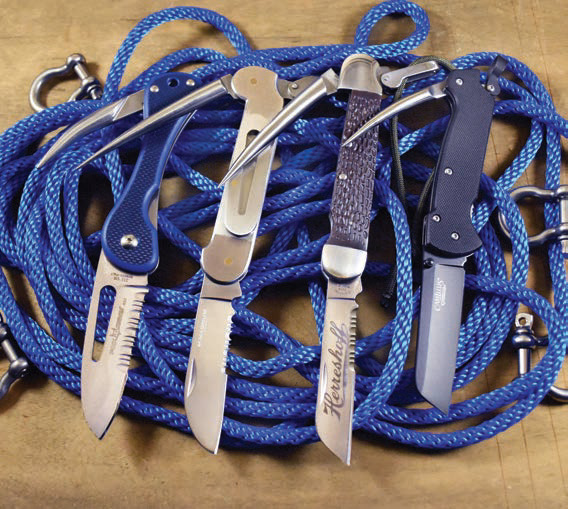
One of the more unusual patterns in the long history of folding knives is the marlinespike. It is a blend of the early rope knife—not the sunfish, but the wharncliffe version—and the singular, knitting-needle-like marlinespike.
These were combined into a single folder and have served many a sailor and diver well. The blade is a sure-handed rope cutter, and the spike is made for working with knots and splicing rope. In fact, there is a knot dubbed the marlinespike hitch that serves as a temporary knot for various needs.
Also known as rigging knives, marlinespike knives live today in the form of reproductions of the original folders and thoroughly modern send-ups. Climbers, who use a lot of different knots in their endeavors, also find marlinespike knives useful.
Example 1: Colonial Knife’s Marlin Spike
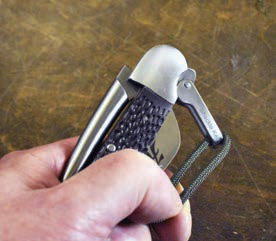
The press-lock is a common blade release for marlinespike folders that dates back to the knife’s early days. However, there’s more here than meets the eye: The Colonial Marlin Spike’s lock also serves as a bail and a shackle opener.
Colonial Knife’s Marlin Spike is a reproduction of the original marlinespike knife issued by the U.S. Navy in World War I—with some modern touches.
The locking, 440C stainless steel spike and partially serrated—a plain-edge version is also available—sheepsfoot slip-joint blade are both 3 inches long. The scales are a simulated brown jigged-bone Zytel and the bolsters are stainless. The spike locks via a press-lock on the base, which also serves as a shackle opener and bail for a lanyard.
Example 2: Boker Magnum Catamaran
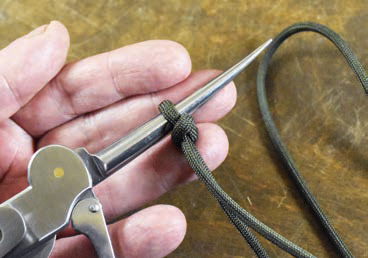
The marlinespike hitch is a simple, temporary knot that can be easily removed once it has served its purpose. The knot is attached to the Boker Magnum Catamaran’s spike in a scenario for which it can serve as a handle.
The Boker Magnum Catamaran has the traditional profile of the old marlinespike folders, replete with a press-lock bail/shackle opener for the spike tool and a 4.375-inch stainless steel frame.
The 3.3-inch spike and 2.75-inch partially serrated sheepsfoot slip-joint blade are 440A stainless steel. You’ll find a nifty shackle opener on the handle, also stainless steel, pinned to the frame.
Example 3: Camillus Marlin Spike
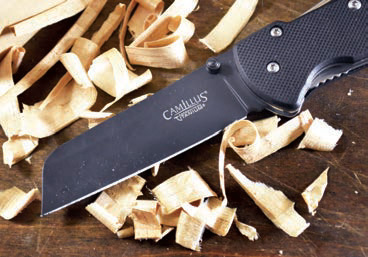
While the plain edge of the Camillus Marlin Spike’s sheepsfoot blade might not quite match the speed of a serrated edge, when it comes to wood it vastly out-carves the rest of the pack. This is a big consideration if you need a knife that will step outside The Rope Zone.
The Camillus Marlin Spike is a modern take on the original. The stylized, 4-inch frame is black G-10 with stainless steel liners. The 2.75-inch sheepsfoot blade—the only one of the test group without serrations—is VG-10 stainless steel with a black, carbonitride titanium coating.
It secures via a linerlock. The folder’s 2.25-inch spike locks via the press-lock/bail and is black coated as well. It is the lightest (3.2 ounces) of the test knives.
Example 4: Fox Sailing Knife
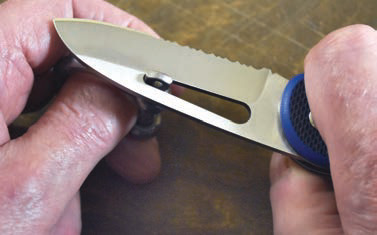
The Fox Sailing Knife has a cutout in the blade that serves as a shackle release. A shackle’s screw tab is caught in the jaws of the blade’s open maw.
The Fox Sailing Knife delivers with a cool, 4-inch handle of textured blue G-10. Stainless liners house linerlock mechanisms for both the 3-inch modified wharncliffe blade of 420 stainless steel and 2.25-inch spike.
The partially serrated blade has a cutout that serves as a shackle opener, along with a hole in the base of the frame that can accept a lanyard.
If you’re lucky enough to attend a knife show in-person this year, take advantage of the time to use your smartphone—or even a camera, heaven forbid—to help establish the provenance of the knife you buy.
A provenance that not only can you show proudly to anyone and everyone who might be interested in the cool little enclave of makers that comprise the knife industry, but also to help increase the knife’s value.
What Is “Provenance?”
Provenance, in case you don’t know, is defined by Webster’s as “place or source of origin,” and proof of it is something those who deal in the world of collectables value almost as much as the collectable itself.
Such is the case in the world of edged collectables, where the knives of certain makers can be extremely valuable. Being able to prove beyond almost a shadow of a doubt that one of those makers made the knife you assert he or she has made can mean hundreds if not thousands of dollars of difference in the amount of money you can get for it—if and when you decide to sell it.
In later years, if you keep the knife and its provenance together, it can mean even more money and prestige than that.
What Forms of Proof Count as Provenance?
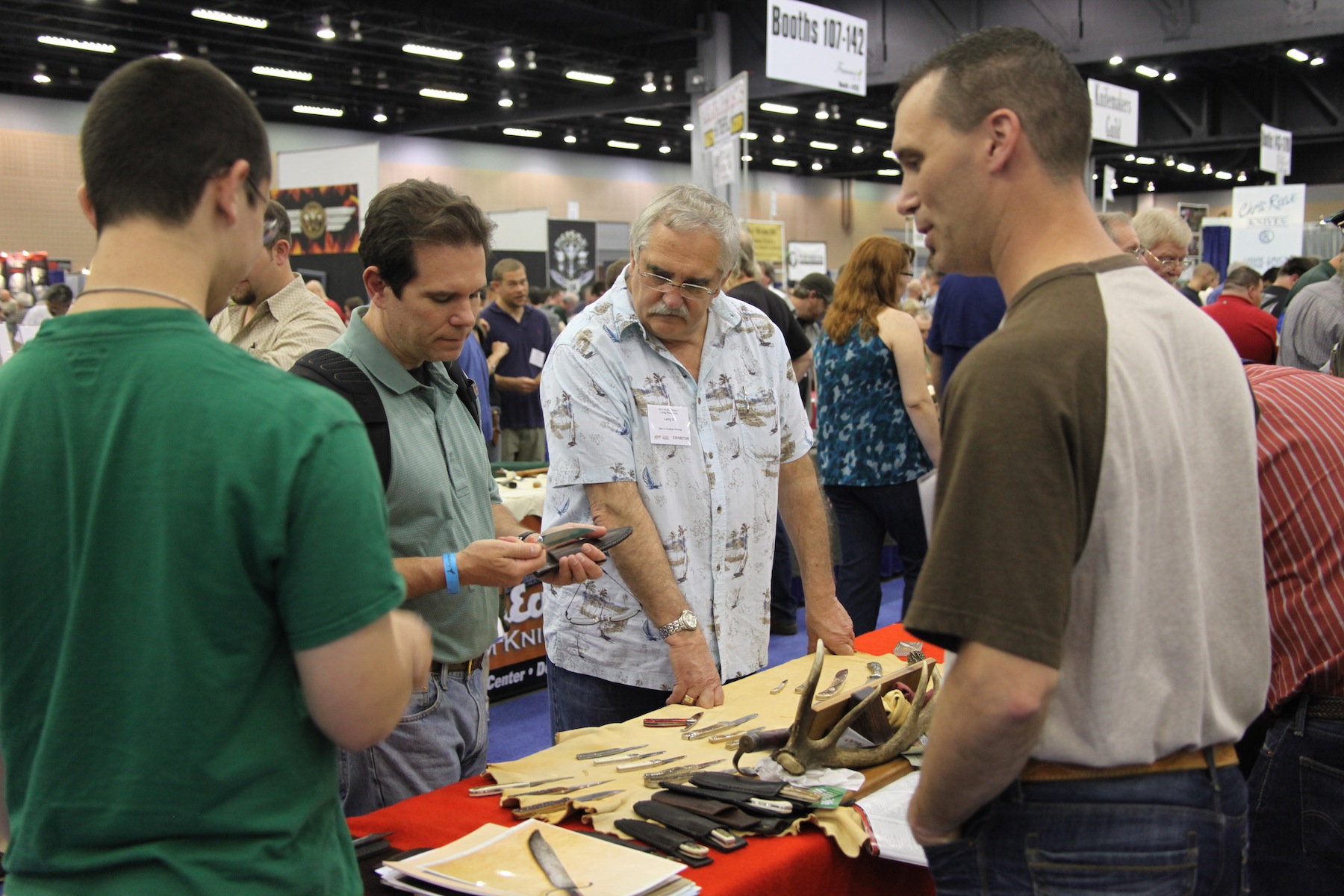
Even if you can’t make it to a knife show in 2020, such as this scene at Jerry Van Eizenga’s table during a past BLADE Show, you can still request signed business cards, specs, receipts and photos from the knifemaker through the mail. A notary public isn’t out of the question, either. (file photo)
Provenance can take any number of forms, including dated written and signed documentation, sales receipts, product boxes (with the overall condition of those boxes playing a large part in value, too), etc. The more legitimate examples of proof you have, the better the provenance is.
Among other forms of such proof are photographs, and such photographs can come in any number of renditions.
For instance, once you buy the knife from the maker at his or her table, you might ask if it’s OK if you:
photograph the knife on the maker’s table, perhaps even with his/her autographed and dated business card situated next to the knife;
have your photograph taken with the maker, with you and/or he or she holding the knife; and
any other image you can think of to date or memorialize the occasion.
And you don’t have to stop there. You can keep the maker’s autographed business card from the photo, any kind of signed and dated receipt, knife specs (including name of knife, steel, blade length, handle material, lock, any unusual facts or descriptions of how the knife was made, etc.) and so on, and store it all with the knife.
If you feel even more enterprising, bring a recorder and record the maker’s answers to questions concerning the knife.
Of course, you will need to ask the maker’s permission for all of the above beforehand, but, if you’re paying the maker’s asking price for the knife, chances are he or she is going to be more than happy to comply and help you establish the knife’s provenance.
Provenance Benefits Both Ways
After all, the more money you get/more prestige you establish for the knife is probably going to benefit the maker’s ability to get top dollar for/reinforce the collectability of his/her knives, too.
Besides, it helps you establish a better rapport with the maker and is all kind of fun to boot.
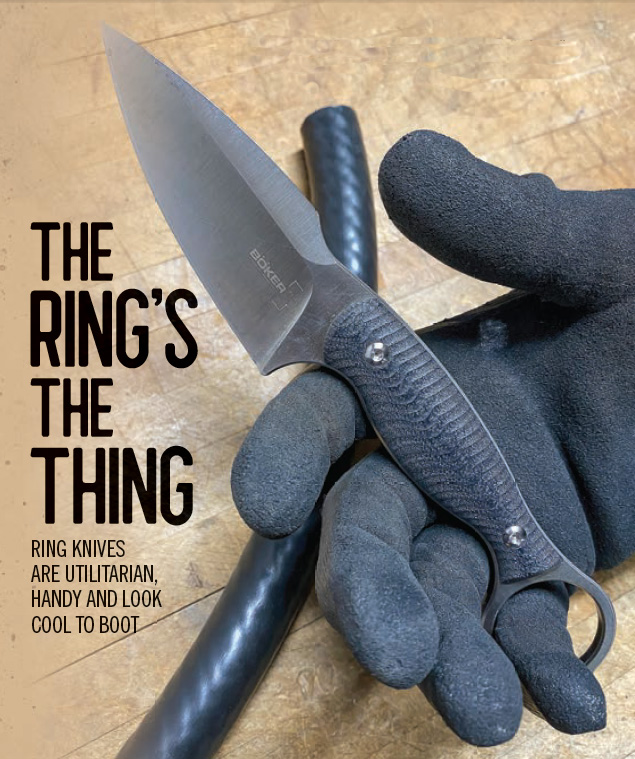
When you think of a knife with a ring in the handle butt, a karambit probably comes to mind. Fact is, there are other knives with such a feature. In fact, some have rings at the middle and also even at the front of the handle.
Unlike karambits, in which the ring is used for quickly spinning the knife in between different grips as well as affecting the grips themselves, non-karambit versions of such knives employ the ring in utilitarian ways that are less flashy.
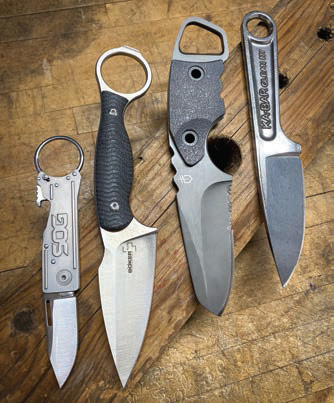
The latest ring knives from left, with manufacturer’s suggested retail prices in parentheses: SOG Keytron ($23.95), Boker Plus Accomplice ($119.95), Gerber Epic ($42) and KA-BAR Wrench Knife ($54.74). (Marty Stanfield Photography)
Examples include assisting in providing a more secure purchase on the handle, dangling the knife from a pinky to allow for full use of the hand while keeping the knife handy, attaching the knife to a keyring, or simply hanging the knife on a tool rack or elsewhere.
If your approach involves frequent intermittent knife use, interspersing it with employing your hand to grip, hold or pull the material you’re cutting or some other method all your own, then adding a ring knife to your collection might be beneficial.
Mail-In Knife Sharpening Services: Is There Anything New Under the Sun?
In absence of innovation, execution is everything.
Knife Aid, as seen on ABC’s Shark Tank TV show, caught the attention of the wider viewing audience as a new way to sharpen knives. The pitch centered on consumers mailing knives to Knife Aid for sharpening. The knives returned later in the mail.
This excited the “sharks” of Shark Tank (including the surprisingly blade-savvy Mr. Wonderful), and a deal hatched to bring Knife Aid to the masses.
Billionaire investors aside, those in the world of knives likely yawned at this novelty. Mailing in knives for sharpening is Pony Express territory.
In Search Of The Better Mousetrap
Still, I wanted to try Knife Aid for myself for two reasons.
First, Knife Aid‘s execution seemed interesting. This operation looked as polished as a fresh blade, incorporating email updates about order status, slick packaging and the ability to scale. That last part is tough.
I’m a sucker for better mousetraps. I’m interested in how people stay on the cutting edge of what they do, especially in knives. (I’m also obligated by BLADE to use one knife pun per day. Hope you’re reading this, Steve.)
Second, I’m crunched for time like never before. I used to treat knife sharpening as a sort of meditation to unwind. Those days are gone, and my knives in regular rotation show it.
How Knife Aid Works
I contacted Knife Aid directly to try its service, but the process works the same for anyone.
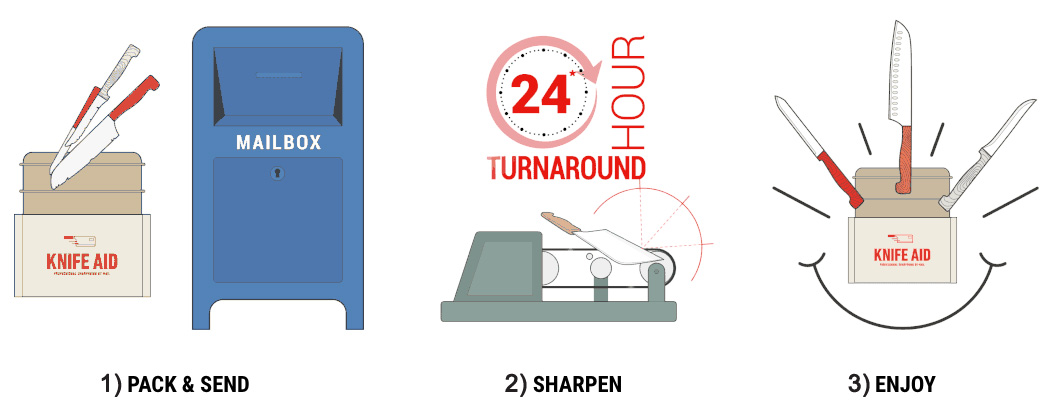
After placing your order, Knife Aid mails you an envelope with everything you need to send knives or scissors in for sharpening.
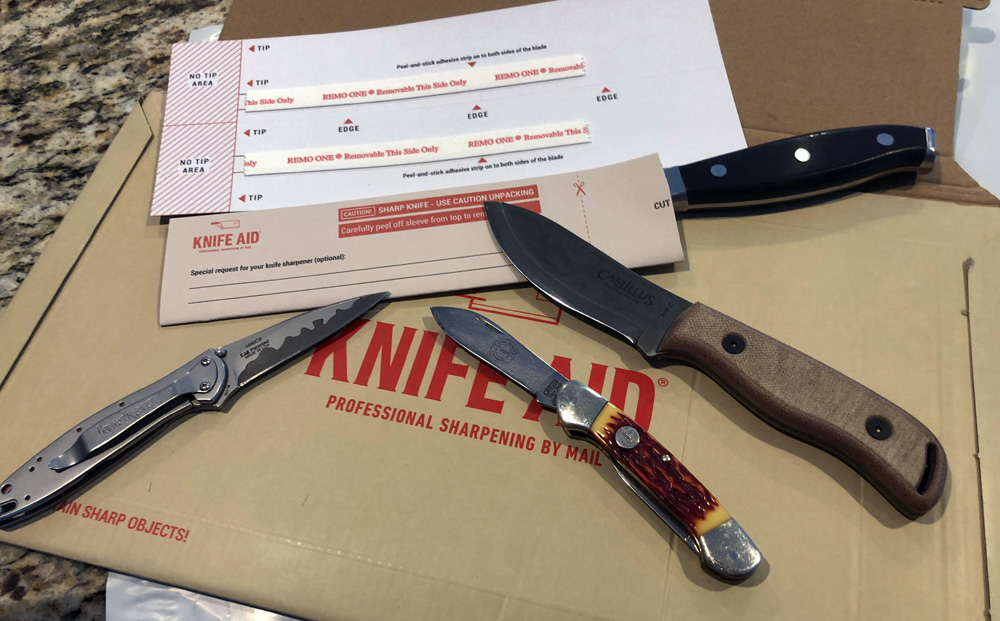
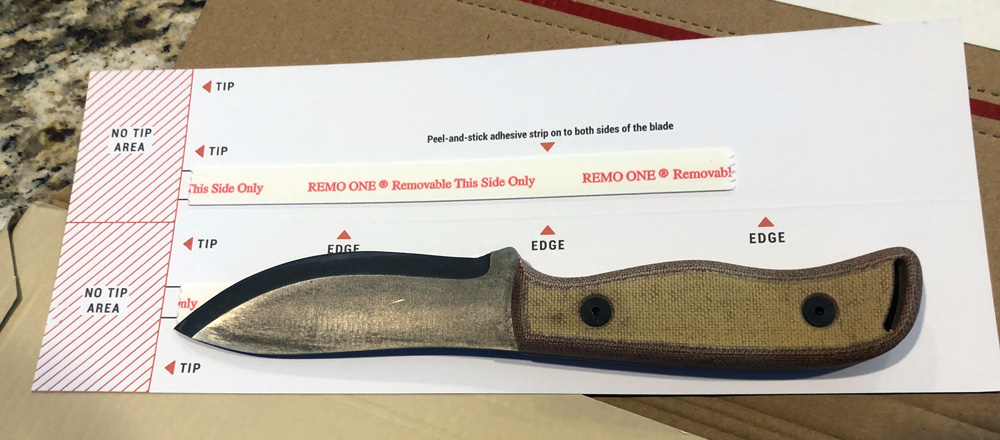
And I do mean everything: a sturdy envelope, pre-paid postage, adhesive blade guards, you name it. All you need to do is pack your knives according to the instructions. That’s it. You could be all set in three minutes.
From left are a Kershaw Leek, a Camillus canoe, a Camillus Bushcrafter and a J.A. Henckels chef’s knife too embarrassed to be photographed. Not pictured are the Oxo scissors, but they also went out for sharpening.
Knife Aid takes almost any blade you can throw (figuratively) at them, but there are some restrictions to keep in mind. Daggers, autos, single bevels, straight razors and anything longer than 16 inches are out of bounds.
I selected a couple pocketknives, some go-to scissors that border on shears and a bushcraft fixed. However, the real test would be a chef’s knife. That poor thing endured a lot of kitchen abuse. It would be my benchmark.
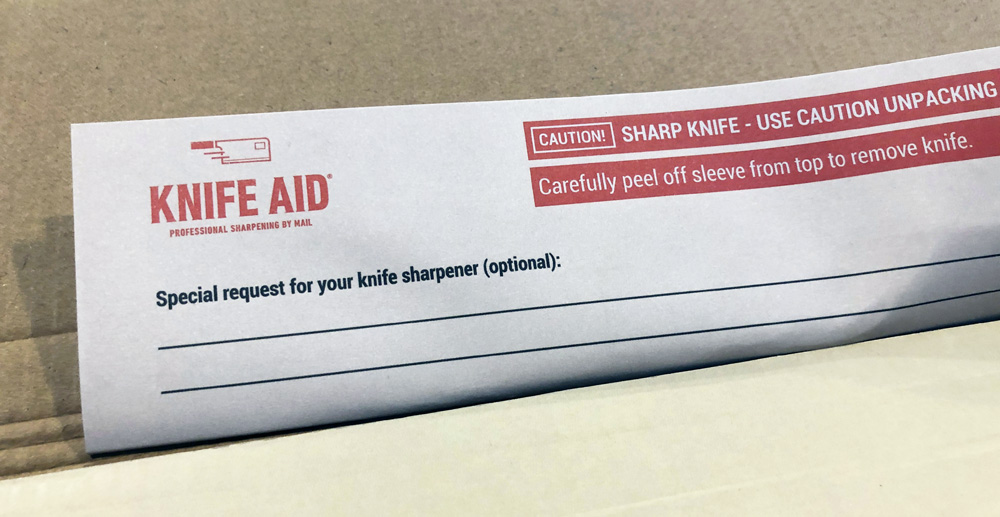
I liked that Knife Aid left room for custom instructions for the sharpener. This is great if you have a specific angle or grind in mind. You could also draw attention to a repair.
A spot for special instructions was a nice touch.A closer look at how those adhesive blade guards work.
I dropped the stuffed envelope off at the Post Office. Again, the pre-paid postage kept everything simple. I didn’t need to worry about weights or sizes. All I had to do is wait.
The Wait
Waiting didn’t feel like waiting, because Knife Aid kept me updated throughout the whole process with emails. At no point did it seem as though my knives fell into an abyss.
Testing The Sharpened Knives
It doesn’t get more straightforward than this.
I received the sharpened knives back about a week after I mailed them in. The 24-hour turnaround Knife Aid talks about on its website refers to the time from the start of the sharpening.
The scissors cut better than new. No joke. I use those scissors a dozen times a day around the house, especially the kitchen. Any resistance to the cut collapsed. I can’t quantify how much sharper they became, but I can say the fun factor went to 11. Yes, sharp scissors can be fun.
The pocketknives, more for tooling around outdoors, cut paper strips like champs, slicing with the weight of the blade and a feather grip. Had COVID-19 not welded the doors shut, a proper in-field exercise would be in order, but the paper told the story well enough.
However, that’s not what pushed me over the line on Knife Aid.
The Chef’s Knife: From Dull to Lightsaber Sharp
The chef’s knife. Oh, the chef’s knife.
Let me put this into context.
This degraded J. A. Henckels went into service in 2009 as the kitchen beater blade. It’s fought food and fixtures alike, pausing only to take a bath in the dishwasher.
Yes, I know what a sin that is, but you’ve got to understand something. Those clothes you wear while painting? Those shoes you mow the grass in? That truck you never buy tabs for? This is the knife equivalent of those. It doesn’t cut like butter. It cuts like butter. Hence the beating of the blade through the latest victim of food prep.
Things turned around big time after the sharpening. This chef’s knife zoomed past scary sharp to full-blown lightsaber. We’re talking near-zero resistance along the cut, greased only with gravity. Food prep for meals went from count-my-fingers-when-I’m-done bad to I-wonder-would-happen-if-I-tried-to-cut-XYZ great.
Excellent.
Knives to Avoid Sending to Knife Aid
Any time you stick knives through the mail, you risk losing them. Just ask any knifemaker at BLADE Show. Everyone has a story. You can’t count on postal insurance, either. Make that two stories.
For that reason, I’d only send knives to Knife Aid that you can afford to lose. As far as values, I’d peg a well-worn Sebenza as the top class of blade to trust.
The same goes for chef’s knives, which I imagine make up the bulk of Knife Aid’s business. Losing a $200 knife stings, but a $2,000 knife stings 10 times more.
Suggestions
In a perfect world, I’d like to know more about who did the sharpening. Maybe I’d even request the same person again and throw in a tip. Good work should be rewarded.
I also wish they offered to disassemble and clean pocketknives. Why stop at sharpening? Give that gummy knife a spa day.
Worth The Money: A Sharp Knife is Like Getting a New Knife
Here’s the deal. Most of the time, a sharp knife is as good as a new knife. As of this writing, Knife Aid charges as low as $10.64 a knife for its service (check the prices here). Would I re-buy each of my knives for about 10 bucks? You bet.
Raising that chef’s knife from the dead sealed the deal. Knife Aid is a winner. I’d recommend it to anyone.
Knife Aid is going to bring knife sharpening to a lot of people who don’t think about knives as much as the staff at BLADE does. That’s a big positive, because with it comes the appreciation of the craft inside each knife, and that’s pretty sharp.
(That’s two puns, Steve.)
Try Knife Aid For Yourself
If you’d like to try Knife Aid, click here and get started. It’s easy.
Full disclosure: BLADE receives a commission on orders it refers to Knife Aid, because we have to keep the lights on. That shouldn’t stain the service Knife Aid provides. Give it a shot. You’ll like it.
We recently published a picture of a custom knife with a price one observer indicated was exorbitant. This person questioned why we had published it.
When we publish the picture of a knife, we try to include the price. In the instance of a factory knife, the price we list is the manufacturer’s suggested retail price. In the case of custom makers’ knives, where possible we preface what the maker charges for the knife with “The maker’s list price”—for example, “The maker’s list price: $500.”
…And Value is Another
The reason we do it that way is the price is the one the maker is asking for the knife, not the collector value. We are no more going to change the maker’s asking price for a custom knife to reflect what we think the collector value is any more than we would do the same to a factory knife. It simply is not our place to do so. (Besides, it could open us up for legal action.)
We don’t list the collector value for custom knives because:
a) such values can be subjective;
b) such values are subject to fluctuation, sometimes almost overnight;
c) we simply may not know the collector value;
d) any number of other reasons; or
e) all of the above.
Why Doesn’t BLADE Publish Collector Values?
Now, sometimes we will list prices based on knife-show-opening bids, secondary market values, purveyor’s list and other prices, etc., but we never publish collector values for custom knives.
BLADE® is a knife magazine, not a price guide. Our mission is to show the work of as many makers as possible to as many knife buyers/collectors as possible, and let the latter decide what they want to buy and whether it’s worth the price.
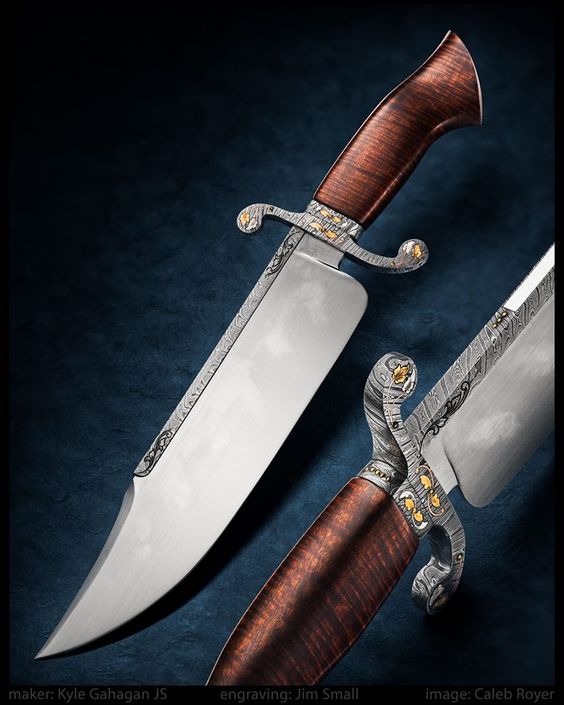
Kyle Gahagan made this 10.5-inch blade with forge-welded 1075 and 15N20 steels. The guard uses the same steel, and the handle is ringed gidgee wood. Maker’s list price: $3,500.
Do Knifemakers Charge Too Much?
The fact that some makers charge too much for their knives is no news flash. The temptation to make as much money as possible from one’s labors is always there and is understandable—if done within reason.
However, to do so beyond reason not only is unfair to buyers, it also is likely to backfire on the makers in question by turning off buyers, thus dampening the makers’ future knife sales. In some cases, it may drive the makers out of business.
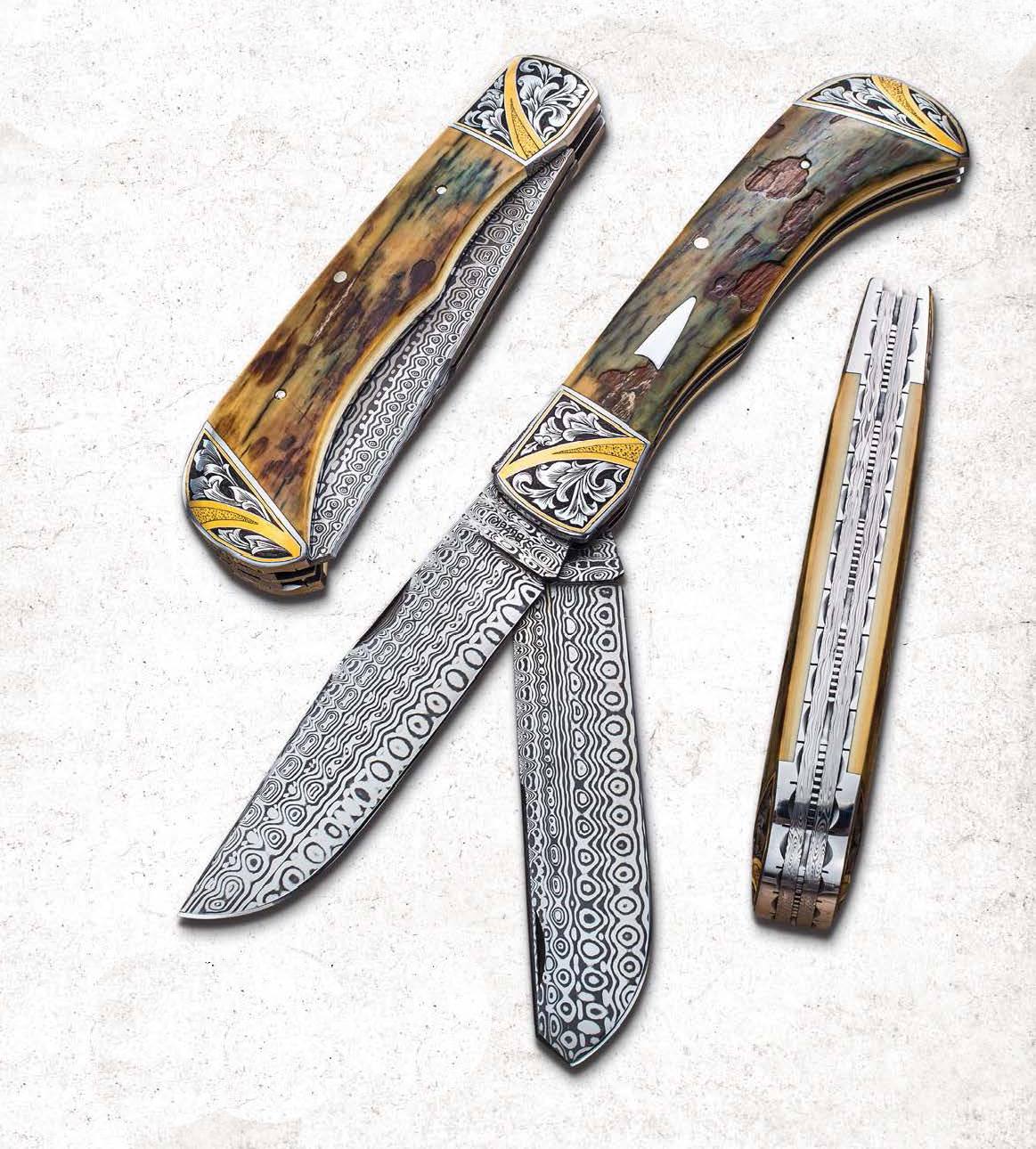
Stan Buzek based his slip joint on a Bill Ruple two-blade trapper. The hollow-ground blades are Damasteel damascus and 3.5 inches each. The fileworked liners are 416 stainless steel. Closed length: 4 3/8 inches. Buzek’s list price to make a similar piece: $1,950. (SharpByCoop photo)
On the other hand, if we publish a maker’s knife and list price and the maker gets feedback on how out of touch the price may be, it might serve as a teaching moment and help the maker get his prices more in line with reality—and help keep the maker in business.
Now, there are some makers who charge four, five and, in ultra-rare cases, six figures for their knives—and get it. And more power to them.
However, they get those prices by the grace of their creativity, ability, reputation, knowledge of the knife market and more, not because they simply ask for them.
Editor’s note: “Micarta” has become the Kleenex of knife handles. It’s used so generically that it’s easy to lose sight of the fact that the word refers to something specific.
That’s why BLADE is bringing you this quick rundown of Micarta® from Kevin Brainard, a business development manager and 45-year veteran of Norplex, the company that owns Micarta® (the real deal). You may have caught the company at BLADE Show, where it runs the UltreX booth.
The goal of this piece is for knifemakers and knife collectors to become more aware of what is and isn’t actually Micarta®.
Hint: If it didn’t come from Norplex, it’s not genuine Micarta®!
by Kevin Brainard
1 – Micarta® is a Registered Trademark of Norplex/Micarta
We own several registrations for our Micarta® mark around the world, including U.S. Trademark Registration Nos. 0096374 (issued in 1914), 0320374 (issued in 1934), and 0324365 (issued in 1935), covering our high-quality industrial laminates.
These laminates have been offered by Norplex-Micarta and our predecessors since at least as early as 1912. As a result of the significant sales, promotion, and widespread use of Micarta® brand laminates, our mark is widely recognized around the world as a designation of the source of our products, which are used in a variety of applications ranging from electrical insulation to gun and knife handles.
In addition to our common law rights in the Micarta® mark, our incontestable federal trademark registrations constitute conclusive evidence of the validity of the mark, the registration thereof, and of our ownership and exclusive right to use Micarta® in connection with these products.
2 – Micarta® is Made in the USA
Available in several different colors, combinations, and surface treatments, UltreX™
paper and cotton phenolic materials use the original production methods of Westinghouse,
updated with today’s process and environmental controls.
And unlike some of the other “micarta” available in the market, UltreX™ Micarta® is produced in the USA in Postville, Iowa.
3 – G-10 is Not Micarta®
The Spyderco Persistence sports G-10 handles.
Micarta® is made with a cloth or paper substrate and coated with phenolic or melamine resin. G-10 is woven fiberglass and coated with epoxy resin.
The processes to make both materials are very similar in the fact that both are consolidated under heat and pressure to make the final laminate. There is a chemical reaction that is called polymerization that bonds the layers together into a high-pressure thermoset laminate.
According to the trademarks, G-10 is not Micarta®.
4 – “Micarta” Refers to a Specific Product
Like so many other trade names, Micarta® name is used like Kleenex is for facial tissue. Instead of calling it a “thermoset laminate” it is easier to call it Micarta®. This is true in the knife scales, handles and gun grip markets. We have similar issues with the Micarta® name in our other markets.
5 – Micarta® Goes Back to 1912
It was originally designed to be used as electrical insulation back in 1912 by George Westinghouse using a phenolic resin developed by Leo Baekeland called Bakelite.
“This has got to be through the old way of human contact,” Bob Loveless knife specialist John Denton observed, “sort of like the lunchroom in school. You hang out, listen, see what is moving, what dealers are buying and, of course, now with the ‘inter-web,’ we have so much more information within seconds, while in the ’70s or ’80s we had to wait for BLADE® Magazine or the gun magazines to run stories on Loveless.
“Shows are still important to attend, but nowhere like they were years ago. Face to face is still part of the knife world.”
2) Maker Charisma
A lot depends on whether the maker has the kind of personality that appeals to the knife enthusiast. At BladeGallery, Daniel O’Malley specializes in one-of-a-kind custom knives. The answer includes multiple factors.
“There are a lot of things that go into making a knifemaker’s knives ‘hot,’” he reasoned. “Part of it is the personality of the maker. When a collector meets a maker for the first time, the collector often has a picture in his head of what the maker will be like. If the maker falls short [of the collector’s expectations], it can be quite disillusioning.”
3) Customer Service
“[The maker] being willing to repair knives when there is a problem is also very important,” O’Malley continued. “It can easily make the difference in a collector continuing to purchase a maker’s work. It can even be the difference in whether a person continues to collect the maker’s knives over time.
“After all, if a collector has spent a large sum of money on their collection, it can be very nerve wracking to find that it’s hard to get a damaged knife repaired. Similarly, it can be comforting if a problem can be relatively painlessly solved.”
4) Do Your Homework
Les Robertson of Robertson’s Custom Cutlery offers custom fixed blade and folding knives, including tacticals and presentation pieces, as well as some exclusives. His take on the delicate topic of a maker’s reliability and the quality of the maker’s work is sage advice for knife enthusiasts in any price range or level of experience.
“I give my client the very best information I have at the time,” Robertson asserted. “This includes issues with a maker or the quality of their work. Often, a maker’s skill level, quality, customer service, and/or delivery issues are overlooked because the knife can be sold immediately for a profit.
“Given the prices of many of the custom knives today, I highly recommend that collectors do their homework before purchasing a knife.
“I realize this takes away from the thrill of instant gratification and removes some of the fun out of the hobby. Long term, though, you will feel great about every knife you have bought, and your wallet will thank you.”
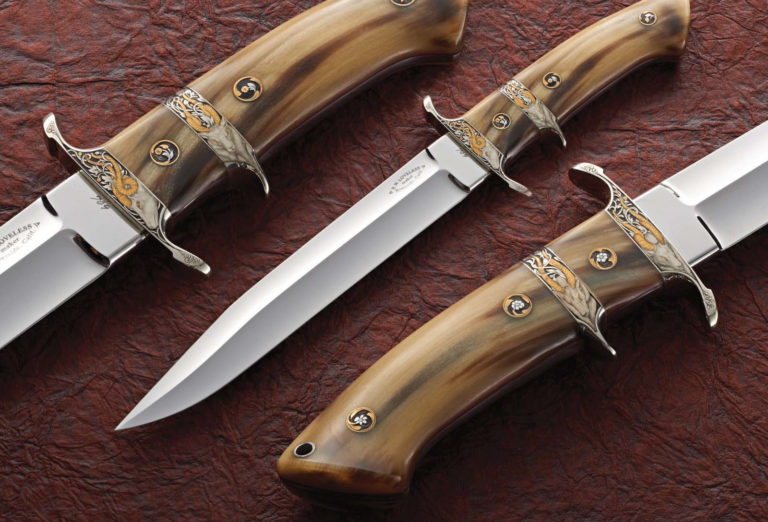
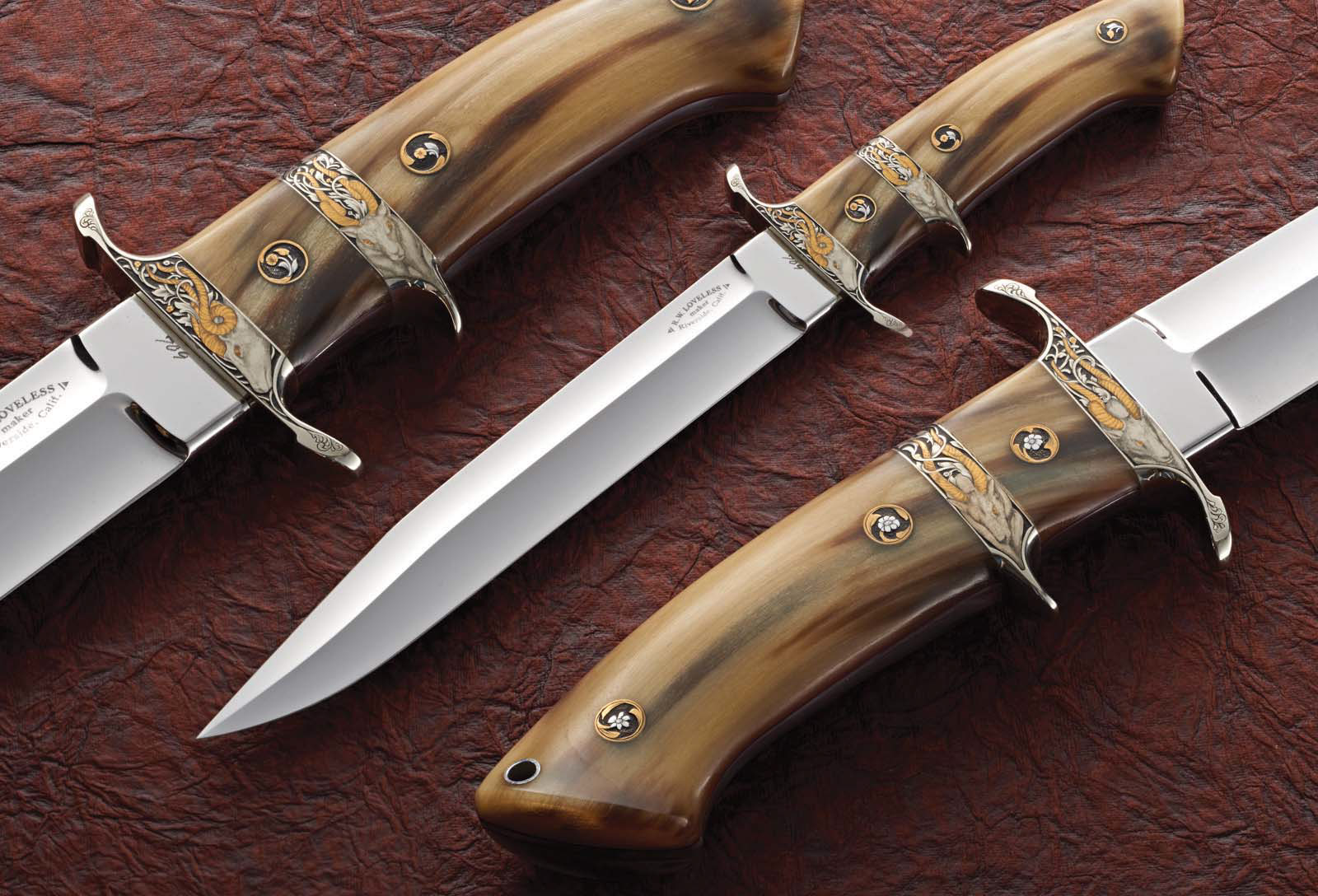
Purveyor John Denton said he turned down $60,000 at the 2014 BLADE Show for this Big Bear in sheep horn and Dan Wilkerson engraving. (PointSeven knife image)
5) Set An Allowance
Everyone, it seems, has spending limits. The role of the dealer often involves assisting clients in determining how much to spend. Recognition of the amount of disposable income available keeps a buyer/collector in the game.
6) Collect With A Purpose
Denton advises customers to acquire some knowledge on prices and to assess their real purpose for buying custom knives in the first place.
“First of all, you want collectors to be educated,” he commented, “and not to be buying just to make money. That is the most risky way to approach collecting. But then if they buy what they like and in three years can’t get 10 cents on the dollar, it will cut their knife buying down and drive them out of the market.”
Dealer Dave Ellis of Exquisiteknives.com notes that the investment perspective differs greatly from that of the collector who wants to enjoy, build and retain knives for years to come.
“When I chat with newbies,” he remarked, “a lot of them get into knives from an investment standpoint. They have read in the Wall Street Journal that investing in knives is a good idea, or heard about a knife that was purchased for $800 and then sold for $8,000. I tell them to buy what they like first and to worry about resale later because if it doesn’t pan out, then they won’t have to hold onto something they don’t like.”
Taking a measured approach is key to successful, price-sensitive acquisitions.
“I tell the collector to pace themselves,” Denton said. “Get into a knife that will be easy to turn if you get tired of it down the road. I’ve had several people ask me to build them a $300,000 collection, and I tell them I don’t do that because they will get mad if they don’t make 14 percent growth per year—and they don’t know why they’re buying the knife.
“The true collector has studied the knives and the market, and he will realize what knives are worth and what he can resell them for.”
Those who are new to the custom knife market can tap a great resource in a top dealer. Advice on the market, prevailing prices and hot makers is only part of the relationship. High-end folders by BLADE Magazine Cutlery Hall-Of-Fame® member Ron Lake, Warren Osborne and Jim Martin, along with Loveless fixed blades, are among Ellis’s offerings.
When Dave talks with a new buyer/collector, he asks a few basic questions.
“There are more heavy hitters getting in the game with lots of money,” he said, “but that doesn’t mean they are buying the right things. What have their interests been up to now? Did they grow up with knives? Do they carry and use a knife? What is their reason for buying now? Use it? Collect it? Give it to a nephew for college graduation? I don’t want to offer a $7,000 Loveless hunter when a $150 skinner by any smith will do.”
7) Attend Shows That Fit
Though knife shows may be one of many ways to gain information and see what is out there, the individual contact with dealers, makers and other knife enthusiasts is invaluable. Attending shows that mean the most to the individual buyer’s needs and wants helps in the education process and in finding the people and knives that enhance the experience.
Robertson attends the BLADE Show due directly to its diversity of custom knives for sale. He says that the Arkansas Custom Knife Show is also one of the premier forged blade shows and features apprentice, journeyman and master smiths in the American Bladesmith Society.
“The New York Custom Knife Show offers a variety of knives from very well-known custom knifemakers,” Robertson added. “This show in recent years has had more of a tactical knife flavor. The USN Show offers the widest variety of tactical folders you will see at any show in the world.”
These are just a few of Robertson’s picks. Other shows are out there, and many of them are quite beneficial to knife enthusiasts looking for certain styles of knives and/or makers.