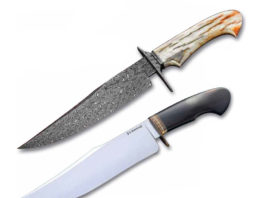
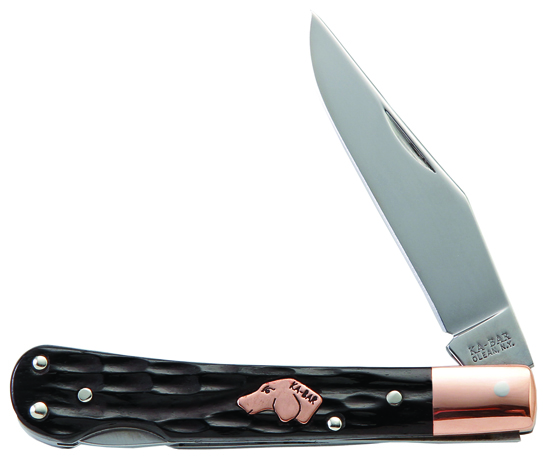
Knife collecting is an extremely rewarding experience for knife enthusiasts. There truly is a knife for everyone. Many increase or hold their value throughout the years, making collecting knives something to pass on to the next generation of knife collectors.
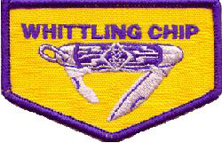
As long as we have the Whittling Chip, then we have nothing to worry about in the knife industry. “What is the Whittling Chip?” you non-Boy-Scout, “no Eagle Scout Badge here”-type folks might ask? It’s a badge earned in Cub Scouts at the “Bear” level, and/or as a Webelos scout.
Bear scouts and Webelos scouts may earn the privilege of carrying a pocketknife to Cub Scout functions. The objective of this award is to make Scouts aware that:
‘A Cub Scout knife is an important tool. You can do many things with its blades. The cutting blade is the one you will use most of the time. With it you can make shavings and chips and carve all kinds of things.
You must be very careful when you whittle or carve. Take good care of your knife. Always remember that a knife is a tool, not a toy. Use it with care so that you don’t hurt yourself or ruin what you are carving.’
The requirements to earn the Whittling Chip card and patch are:
Complete Bear Achievement 19, Shavings and Chips
Demonstrate knowledge and skill in the use of a pocketknife.
Close the blade with the palm of your hand.
Never use a knife on something that will dull or break it.
Be careful that you do not cut yourself or any person nearby.
Never use a knife to strip the bark from a tree.
Do not carve your initials into anything that does not belong to you.
Take the Pocketknife Pledge:
I will treat my pocketknife with the respect due a useful tool.
I will always close my pocketknife and put it away when not in use.
I will not use my pocketknife when it might injure someone near me.
I promise never to throw my pocketknife for any reason.
I will use my pocketknife in a safe manner at all times.
Yes, as long as we have the Whittling Chip, all is well in the world of knives!
James D. Julia Auctioneers extraordinary firearms and knife auction will be taking place on Monday and Tuesday, March 12th & 13th 2012. This auction should prove to be one of the most exciting events in knife history!
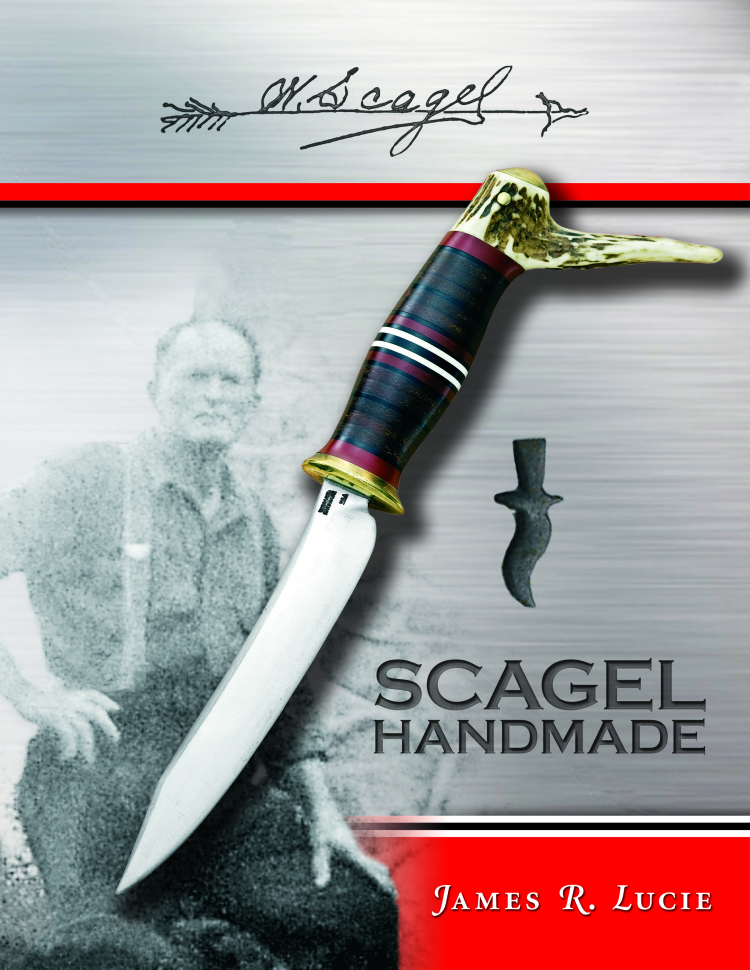
Dr. Jim Lucie, of Fruitport, Michigan recently decided to sell his lifelong collection of William Scagel knives. Dr. Lucie is today regarded as the reigning authority on Bill Scagel, his life, and the knives he produced. Dr. Lucie is a noted author of a monumental book on Scagel’s works titled, “Scagel Handmade”. He has also been a passionate collector of Scagel made things for most to his life. Dr. Lucie had the great fortune of meeting, doctoring and becoming a friend of Bill Scagel late in his life. His special relationship gave him a unique insight into this extraordinary man. Scagel was an extremely conservative, crusty and independent individual who lived life on his own terms.
Born in 1875, he lived until 1963 and for the majority of his life he used his unique skills and abilities to manufacture and craft about anything he wished. His focus however was on the production of quality knives. Although the product he produces was a simple utilitarian object he incorporated his unique artistic talent into the production of a true art form. His knives were literally a thing of beauty and he eventually began marketing them through the elite sporting goods store Von Lengerke & Antoine of Chicago. Up until 1929, his exquisite knives were featured in their catalogs and sportsmen from all parts of North America acquired his very special knives. Scagel was the first person to give art form to the American knife in the 20th century. Eventually, Bo Randall began to create artistic knives like those of Scagel’s and today the extraordinary fraternity of blade smiths throughout North America can attribute the origin of this art form to Scagel himself; he was unquestionably the genesis of this much revered and collected art form.
Dr. Lucie’s special relationship and appreciation of Scagel’s works eventually resulted in his amassing what is considered the finest collection of Scagel made products to exist today. His special knowledge and interest in Scagel, eventually led to his definitive book on Scagel products, “Scagel Handmade”. Dr. Lucie was so enthralled by Scagel’s art form that after Scagel’s death, he learned to become a blade smith himself and began producing wonderfully artistic knives in a manner similar to those of Scagel. Dr. Lucie’s knives themselves are highly collectible and he currently has a six-year waiting list for one of his masterpieces.
With the exception of a couple of items he retained for his daughters, his entire collection will be offered in this auction. There are so many great rarities, one of them is the Armond Durham camp ax with stag handle, originally made for Armond Durham. Durham had a number of pieces made, all of which he never used so everything from the Durham collection, including this ax, is essentially in near mint condition. The ax carries a conservative presale estimate of $20,000 – $28,000. Another very rare item is the D-guard fighter knife made for a Marine during WWII. On his first leave home, the marine ordered another five for members of his unit. These were the only D-guard knives ever made by Scagel and this is the only one currently known to have survived. It is estimated at $18,000 – $26,000. Another gem is the mint hunter with Heiser tooled sheath in an original V. L. & A box, the knife and Sheath are virtually new. It carries a presale estimate of $21,000 – $30,000. Another great rarity is a near mint crown stag folder knife. This pocket knife with stag handle this most unusual form is highly desirable and in its special condition, should easily generate $17,500 – $25,000. Another very rare and outstanding example of Scagel’s knives the hunter knife with folder in the handle. This very special form was exceedingly difficult to make and later in life, while corresponding with Bo Randall, he specifically stated that they were extremely difficult to make and that he only made 12 of these. This outstanding example is estimated at $20,000 – $30,000. Another exquisite Scagel knife is what Dr. Lucie refers to as the “Iron Mermaid of the Great Lakes” fish knife. This unique knife, specially crafted for the client who ordered it, is fitted with an antler handle in the form of a fish tail and is estimated at $18,000 – $27,000.
Not only were Scagel’s artistic abilities displayed in the product that he made, but sometimes his personal politics were reflected also. Scagel was never one to be beholden to one for a favor and when one was given he almost always immediately repaid it. One freezing night, while walking home, the local Democratic Party chairman stopped and insisted that he give Scagel a ride to his house. Scagel reluctantly accepted the favor and a few days later presented the Democrat with a small, hand-crafted knife and sheath as a gift. Later, a friend asked Scagel why the knife had an ivory slab on one side and a mottled mother of pearl handle on the opposite side. Scagel replied “Oh, you mean that damn Democrat knife I made? All Democrats are two-faced so I made the knife handle accordingly!” Estimate $4,200 – $6,000.
There are between 70 and 80 Scagel lots in this sale and they will be offered in consecutive order on one day. Absolutely no Scagel items from any other source will be mixed with Dr. Lucie’s collection. Julia’s catalog, considered the finest in the industry, will feature exquisite, full color photos of each lot and a detailed description provided by Dr. Lucie himself. The catalog description will also incorporate a conservative presale estimate. One unique feature about the Julia company is that unlike most auction houses who offer their goods “as is, where is”, Julia’s descriptions carry a 45-day guarantee from the date of the auction against any major discrepancy in the catalog description, thus making absentee bid participation not only easy and convenient but also safe.
In an effort to help make these rare items available for anyone interested, the Julia firm and Dr. Lucie have decided to make available special financing terms for qualified parties. If a client is approved, the terms will allow them to make payments for purchases over a period of time. Under no circumstances will terms be provided to anyone who does not apply before the auction. Customers must apply for and be approved before the auction for these special financing terms.
In addition, participation at the auction is most convenient. Some buyers attend the auction live and bid in person. Others after receiving the catalog may submit absentee bids to be bid competitively at the auction. Still others may make advance arrangements to bid over the telephone as it is being sold. And finally, anyone who has a computer will be able to bid live time during the auction by accessing the Julia catalog through “Artfact”.
This very special auction, featuring this unique collection will certainly prove to be a once in a lifetime opportunity. Not only will this be the most significant offering of Scagel knives ever offered, but the condition in general is truly outstanding. Many of the items have never been used.
One of the most difficult parts about preparing the catalog proved to be the estimates. Because of the rarity, the superb condition and in some cases the uniqueness of the items, it is impossible to predict what they might bring. However, the Julia firm and Dr. Lucie have agreed that the estimates should be realistically conservative so that all potential buyers can know that the collection is intended to be completely sold. Julia’s catalog will be available approximately four weeks prior to the auction and should be posted on their website approximately 3 weeks prior to the auction. For more information, contact Julia’s for free, detailed illustrated brochures of the sale (available four weeks prior to the auction) at (207) 453-7125 or visit their website at www.jamesdjulia.com.
Mach 12 form 10 to 4 at the Hilton Hawaiin Villiage in Honolulu Hawaii! Fun time one day show that you can write off! Open to all type of knives and great room rates starting at $169 a night!
Contact me for more into!
Editor’s note: With news of Canada ending imports of folding knives rocking the knife world, here is another important issue taking place at international borders.
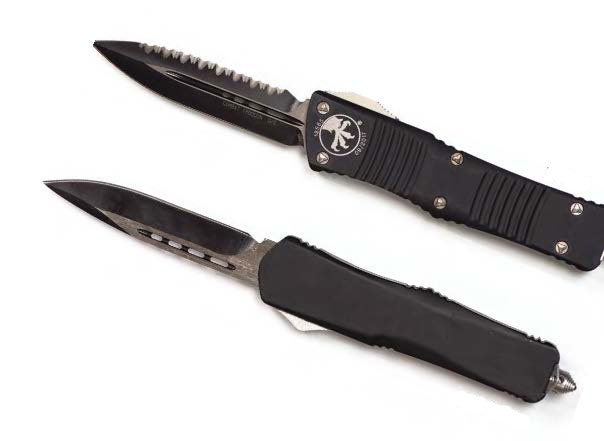
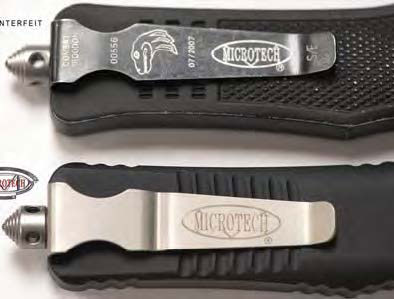
U.S. Customs and Border Protection recently seized a dozen counterfeit Microtech knives attempting to enter via Alaska. Note the difference between an authentic Microtech Trodoon (above, top) and a counterfeit of it (bottom). (Microtech image)
Knife Companies Get Proactive
As part of his duties at Buck Knives, Joe Houser clicks through e-commerce websites like eBay, searching for fake Buck knives. When he finds a listing where someone is pedaling a counterfeit Buck, Houser works with the website to take the listing down and perhaps banish the seller from the site.
A few years ago, Buck didn’t have someone doing this job. But more and more fans of Buck Knives were sending their blades to the company’s warranty department only to learn their cherished knives really weren’t Bucks at all. Someone had ripped off the designs, piggybacking off Buck’s name and reputation to sell a shell of a knife to a swindled customer.
Counterfeiting may be the most recent challenge to adversely affect the knife industry. Over the past year or two, counterfeiters have gotten smarter, mimicking knife designs better. And thanks to the rise of international e-commerce websites, it’s harder to stop shipments of illegal knives entering the country because many come through in onesies and twosies, sent direct to the buyer through FedEx, UPS and other shipping outfits.
Bad for Collectors, Bad for Business
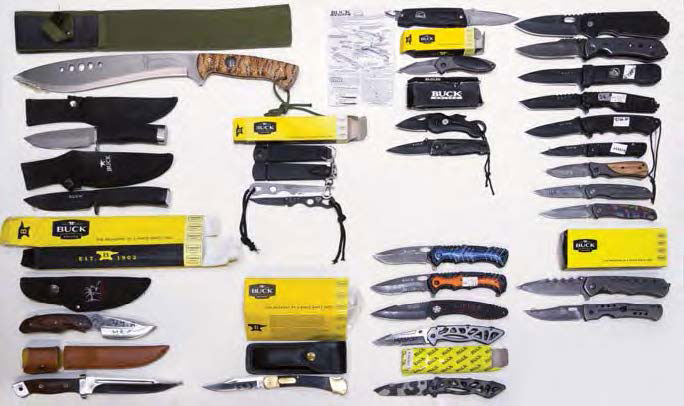
Buck Knives took a dozen Buck knife counterfeits and gave them a Rockwell hardness test. “None of the blades, not one, were made of hardened steel,” noted Buck’s Joe Houser. “They are very cheaply made and fall apart quite easily.” A display of Buck counterfeits (above) reflects the scope of the problem. (Buck image)
Buck took a dozen of the counterfeits and gave them a Rockwell hardness test.
“None of the blades, not one, are made of hardened steel. They are very cheaply made and fall apart quite easily,” Hauser wrote by e-mail. “I know of one model of Buck’s that I see counterfeited where the producers of the knife did not even install the linerlock. The blade had nothing at all to hold it open or closed.”
Research by the American Knife & Tool Institute (AKTI), a leading organization fighting for common-sense knife laws, indicates U.S. manufacturers lose 10 percent in sales annually to counterfeiting.
As a result, AKTI officials estimate counterfeit blades siphon about $95 million from the knife industry every year. It’s enough to erode the bottom line of knife manufacturers providing American jobs. And if the problem is to be solved, it will take the whole of the knife industry, AKTI officials say.
U.S. Government Struggles to Keep Up
U.S. Customs and Border Protection made 31,500 seizures in 2016 of products it found to have violated intellectual property rights—52 percent more in fiscal year 2016 than in 2014. (U.S. Customs and Border Protection image)
Gregory Moore, public affairs specialist with U.S. Customs and Border Protection (CBP), said Customs made 31,500 seizures in 2016 of products it found to have 77 violated intellectual property rights—52 percent more products in fiscal year 2016 than in 2014. The increase presents a challenge for the agency.
“With the global rise of e-commerce and online shipping, the number of small packages containing counterfeit goods continues to rise,” Moore wrote. “Ninety percent of the seizures in fiscal year 2016 were small packages shipped through express carriers or international mail. The increase of [goods infringing on intellectual property rights] in the small-package environment creates both a logistical and enforcement challenge for CBP.”
The best way to make sure the knife you order online is legitimate is to buy from retailers that specialize exclusively in knives. ShopBlade.com is one of them. Click to browse a selection of genuine knives.
Counterfeit knives make up less than 1 percent of the products Customs seizes that it considers a threat to health and safety, a category that also includes counterfeit pharmaceuticals and sporting goods. After all, poor steel can cause a blade to snap, a pivot to fail, etc., increasing the chances of injury or even death.
Besides, seeing a knife being ripped off and made with poor materials stinks.
“Well, it’s frustrating,” said Doug Ritter, executive director of the other leading organization dedicated to common-sense knife laws, Knife Rights. Ritter also has designed knives for CRKT and Benchmade.
Most honest knives are derivatives of older knives, Ritter said, where knifemakers seek to improve the designs and make a better knife.
“That’s the way stuff develops,” Ritter said.
Meanwhile, the organization spearheading the effort against counterfeit knives is AKTI.
“We encourage them in their efforts and hope they are successful because these counterfeits hurt everyone in the knife community,” Ritter wrote.
Counterfeiters Get Smaller, More Numerous
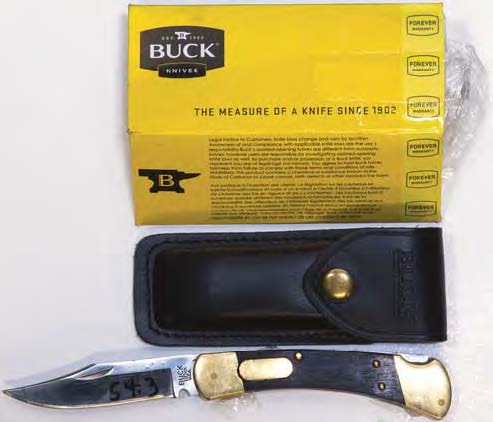
Some of the counterfeits go so far as to copy the knife right down to the blade mark and product box with literature, as here with a fake Buck 110. (Buck image)
CRKT President Rod Bremer’s interest in counterfeit knives began to grow about five years ago when he started noticing more and more counterfeits from Southeast Asia. Today, he noted, most counterfeit knives originate from China.
Bremer, who chairs AKTI’s anti-counterfeiting committee, said most counterfeiters have small operations—simply working out of a garage—making them hard to track down. Sometimes they copy manufacturers’ knives right down to the packaging and warranties that are honored for genuine models only. Often, the counterfeiters try to catch the eye of buyers looking for a deal.
Compared to legitimate knives, Bremer said, counterfeits are usually priced at 50 to 70 percent of the MSRP of the genuine article. For example, one American knife company manufactures a fixed blade for $425 of which a Chinese e-commerce site recently listed a counterfeit—complete with the company’s logos on the packaging—for about $41.
Some counterfeiters have become so sophisticated that knife companies must look at machining marks and other small details to identify the real thing, similar to identifying counterfeit currency.
These details are kept secret by the companies lest the knowledge falls into the hands of counterfeiters.
What Can be Done?
A close-up of the pocket clips of the genuine Microtech Trodoon (bottom) and a counterfeit (top) reinforces just how far counterfeiters will go to copy the genuine article. (Microtech image)
Bremer said the knife industry’s most comprehensive strategy is to play a full-court press, including being vigilant in asking e-commerce sites to remove listings of counterfeit models. If the knife industry as a whole makes it a “pain in the butt” to sell bogus knives, he said, then the bad actors may move to more lucrative products.
“Counterfeiters are not particularly selective,” Bremer observed. “They just want to knock somebody’s brand off, sell it and make a lot of money.”
Can the federal government build a virtual wall of blue-gloved U.S. Customs officers opening boxes and targeting shipments coming in from outside nations? Unfortunately, as Bremer noted, “I don’t think they have the manpower to catch all the shipments.”
Stop by any major port, such as San Francisco or Savannah, and you’ll see container yards of goods miles and miles long. But not all is doom and gloom.
“China has gotten more aggressive on intellectual property,” Bremer said. “The new president of China has gotten pretty harsh on people that are knowingly ripping off patents, but the effort is clearly not as aggressive as most of us would like. And it’s going to take time.”
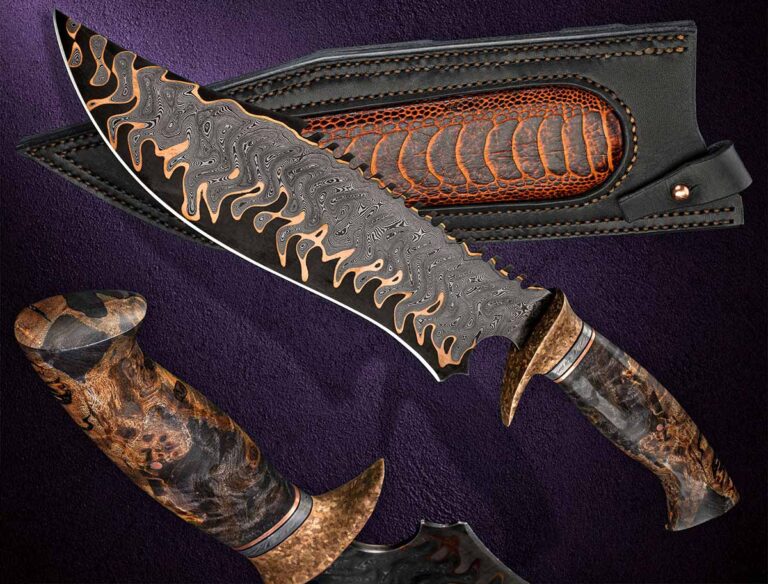
Inspired by Rambo’s knife, Corey Reynolds’ sawback bowie channels the genre in a copper-mai chevron pattern.
Like many boys his age, Corey Reynolds grew up watching Rambo movies. Now 43, he’s been making knives about three years and decided he wanted to make a knife with a Rambo look—and what better way to do that than with a sawback bowie?
For blade material he used copper-mai steel in a chevron pattern from Baker Forge and Tool, and for the piece de resistance configured the sawback so the copper would be exposed at the base of each tooth.
Though the way he did the teeth is mostly for looks, he said each tooth has a fairly good edge. The handle is spalted maple from Steelhead Forged Scales with spacers of copper, raindrop-clad feather damascus forged by Adam DeVille, and G-10. The guard is of a striking multi-etched material called gem bronze from Mike’s Metalworking.
Sawback Bowie Specs Maker: Corey Reynolds Blade Length: 9” Blade Material: Copper-mai in a chevron pattern Handle Material: Spalted maple w/copper, raindrop-clad feather damascus and G-10 spacers Guard: Gem bronze Overall Length: 15” Sheath: By the maker of leather w/ostrich leg inlay from Ray’s Ostrich Leathers Maker’s Price For A Similar Knife: $1,400
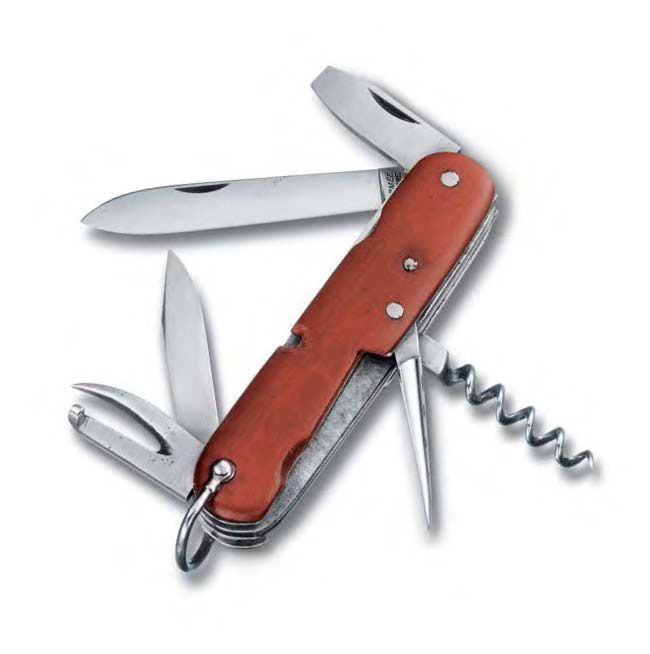
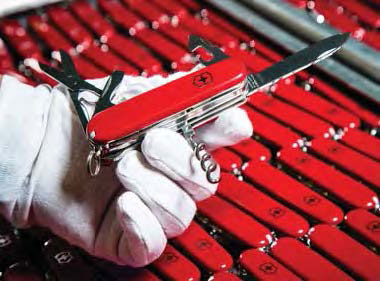
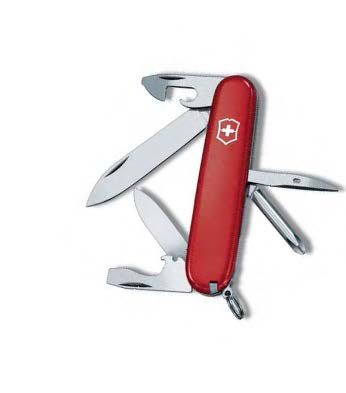
In 1897, Victorinox founder Karl Elsener created the Officer’s and Sports Knife (above). It evolved into the model known today as the Spartan, the most popular Swiss Army knife.
Rarely does a single brand, style or look set the standard for an entire genre in the knife industry, let alone hold its place for decades with no sign of a loosening grip. Just say the words “Swiss Army knife” and the image is clear and constant.
The classic red handle emblazoned with the shield and cross of its land of origin render the Swiss Army knife (SAK) instantly recognizable, while its multifunction versatility makes it indispensable for those who carry it and rely on it in a variety of situations.
Cut, slice, tighten/loosen a flat- or Phillips-head screw, punch, file, open a can or bottle and even sign your name, the pride of Victorinox and the trademark of the Swiss Army is the versatility that is found nowhere else.
Origins in the American Market
The consensus is that the Swiss Army knife gained widespread appeal during and after World War II as Allied soldiers brought them home, and those who saw them clamored for one of their own.
Like every icon in any field, the SAK is surrounded in legend and lore. The consensus is that the knife gained widespread appeal during and after World War II as Allied soldiers brought them home, and those who saw the knives clamored for one of their own.
American military personnel came to further love the SAK when it became available at the nearest base PX (post exchange), and sales are said to have exploded.
The History of Swiss Army Knives
Carl Elsener III
Of course, there was a tinge of controversy related to the “first” Swiss Army knives. In 2005, Victorinox went a long way in closing the book on that discussion with the acquisition of rival Wenger, followed by the consolidation of the two brands into the single Victorinox label in 2013.
Victorinox Global Chief Executive Officer Charles Elsener likes to tell the story of his family’s development of the early SAK.
“In 1897, founder Karl Elsener created his ‘Officer’s and Sports Knife,’” Charles explained, “and registered it legally June 12 of that year. He also was responsible for the iconic design, which has not changed to this day. From 1897 to 1937, the handles were made of red fiber. Functions of the knife included big blade, small blade, can opener, corkscrew and reamer. The name of this model today is the ‘Spartan.’”
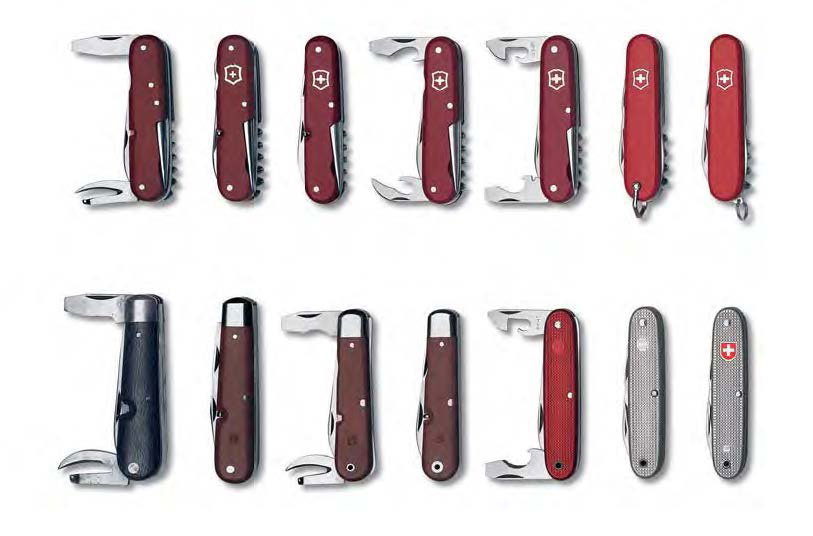
An evolution of the Officer’s and Sports Knife by year and feature, top row from left: 1897 (fiber grip); 1909 (fiber grip/cross and shield); 1937 (celluloid grip); 1946 (new can opener); 1951 (new can opener and Alox dividing layer); 1961 (new awl and invisible rivet); and 1968 (ring instead of bow bail). The same for the Soldier’s knife, bottom row from left: 1891 (wood grip); 1908 (fiber grip); 1951 (fiber grip, stainless steel); 1954 (fiber w/rosettes); 1961 (red Alox); 1965 (silver Alox); and 1980 (silver Alox w/Swiss flag).
In 1937 the knife handles changed to celluloid, and since 1971 the material used is Cellidor. The red color was probably chosen for the red in the Swiss flag and also for the Swiss canton [district] of Schwyz—and probably to help the owner find his treasured possession when it falls on the ground!
Popular Swiss Army Knife Models
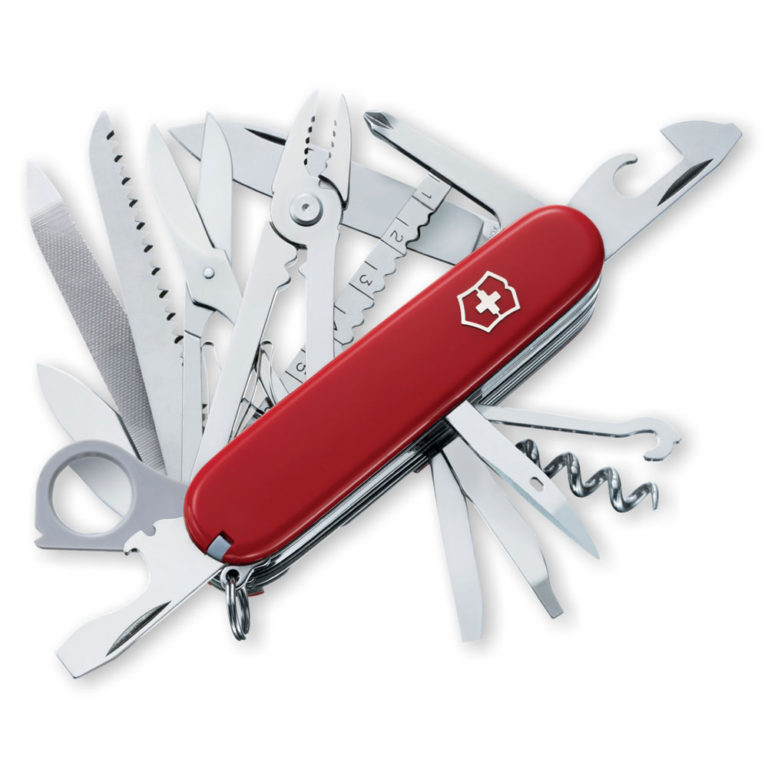
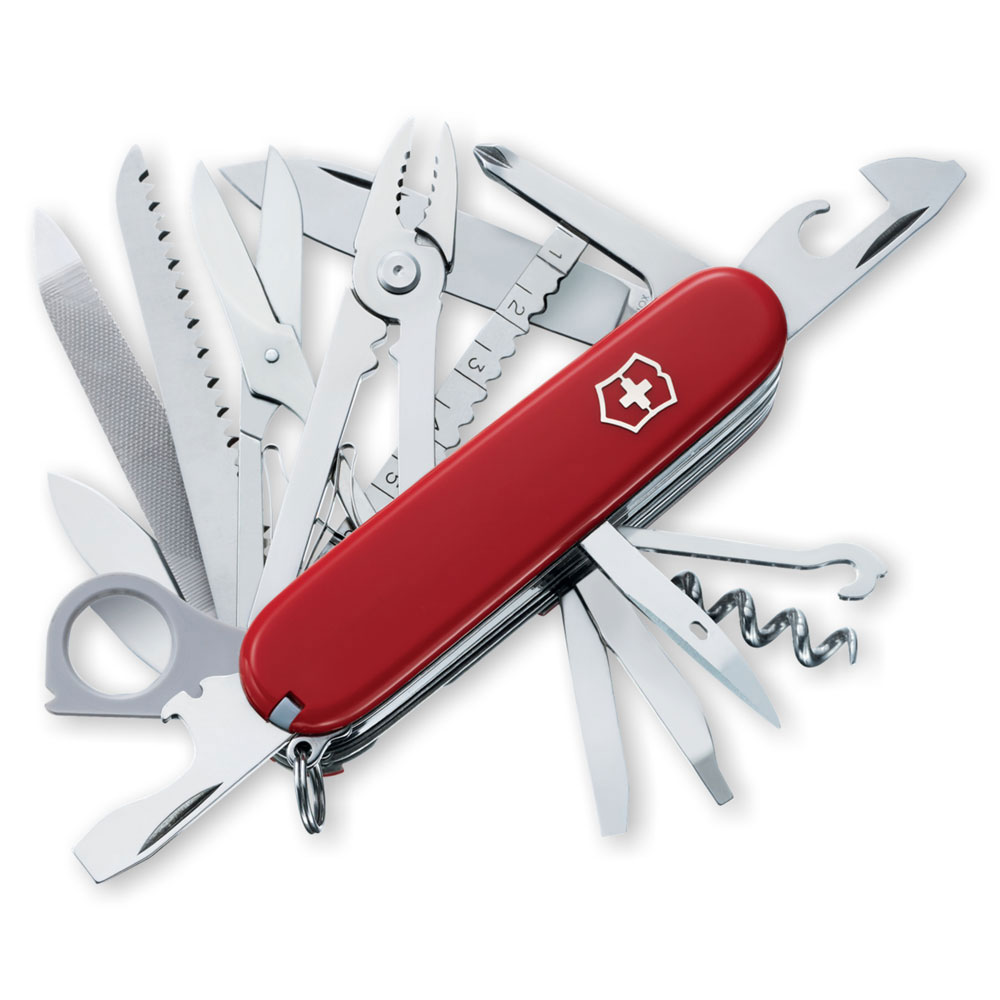
The flagship SAK is the SwissChamp, introduced in 1986 with a grand total of 33 functions.
Today, Victorinox produces 60,000 SAKs per day and a staggering 13 million pieces annually.
According to Elsener, the most popular SAK in the company’s early days was the Spartan. In 1902, a wood saw and scissors were added. The new model with scissors was christened the Climber, and the Huntsman included both the wood saw and scissors.
As more and more tools were added, the flagship knife became the SwissChamp, introduced in 1986 with a grand total of 33 functions.
“The fourth bestseller is our smaller Classic keyring model,” Elsener added, “and these five bestsellers have been the same since their introduction.”
Charles confirms that American soldiers popularized the SAK during World War II and are responsible for its name today since they had difficulty pronouncing it in German as the “Schweizer Offiziers-und Sportsmesser.”
Today, Victorinox produces 60,000 SAKs per day and a staggering 13 million pieces annually, achieving these numbers consistently.
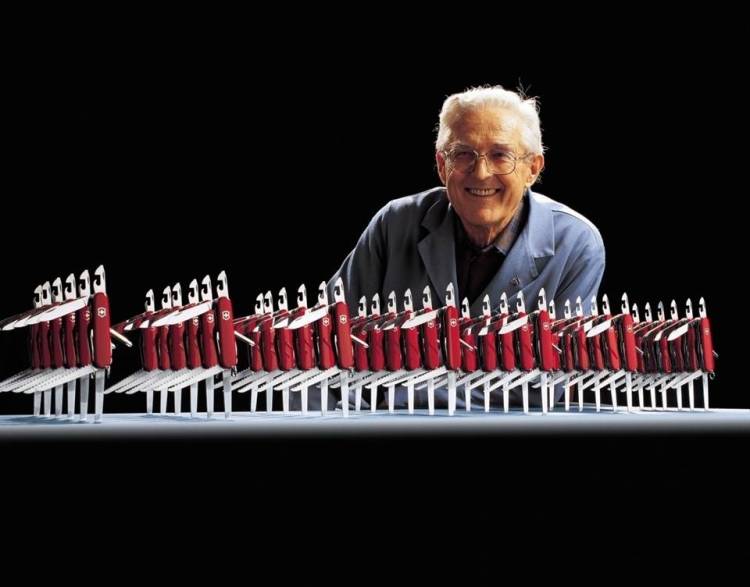
Charles told of a modest, unassuming man who wore a workman’s smock while at the company.
“One day Carl happened to be at the loading dock when a truck pulled in and everyone else was at lunch,” Tim smiled. “The driver saw Carl and said, ‘Hey you! Help me unload this truck.’ Without saying a word, Carl did. Only when another worker returned from lunch and saw what was happening did the mortified driver realize what he had done. But Carl took no offense at all. He was still his humble self.”
An Unassailable Knife
The humble knife the Elsener family put together also has risen without unnecessary fanfare to the height of fame and cutlery glory. Leatherman sees an unassailable place in knife history for the SAK.
“Victorinox with the Swiss Army knife anchors the knife industry,” he asserted. “One category of products within the cutlery industry is ‘pocket-carried knives,’ which has three subcategories—common pocketknives, tactical knives and multipurpose pocketknives. And deservedly so. The design deserves every bit of recognition it has received. I know firsthand how hard it is to make a knife or tool without a cosmetic defect. And I have never seen a cosmetic defect in a Swiss Army knife. The Swiss Army knife is recognized and coveted worldwide.
“I was very much aware of the Swiss Army knife as I was designing the Leatherman Tool,” Tim continued. “So much so that in one of my prototypes I cannibalized a pair of scissors from a Swiss Army knife to put in my tool. However, my design diverged away from the Swiss Army knife because in a Swiss Army knife the blade is the central feature, and I wanted a pair of pliers to be the central feature of my Leatherman Tool.”
The Swiss Army Knife Collectors Society
While satisfying the needs of the businessman, blue-collar worker and outdoorsman, the SAK also has cultivated a devoted group of collectors. Doug Dillman, owner of Freeport Knife Co. in Freeport, Maine, leads the Swiss Army Knife Collectors Society, which was founded in 2000 by avid collector Dan Jacquart.
“The club currently has about 150 members,” Dillman commented. “Our objective since the beginning has been to encourage and support collectors who share a passion for both collecting Swiss Army knives and educating members about the many changes to the product and the factory’s history since its creation in 1884. We largely accomplish this through the publication of a biannual newsletter. We try to offer articles about changes to the many models over the years, new product introductions, and special-edition models. Our last issue included a tang stamp chart to help members determine the age of a knife.”
Insights for Swiss Army Knife Collectors
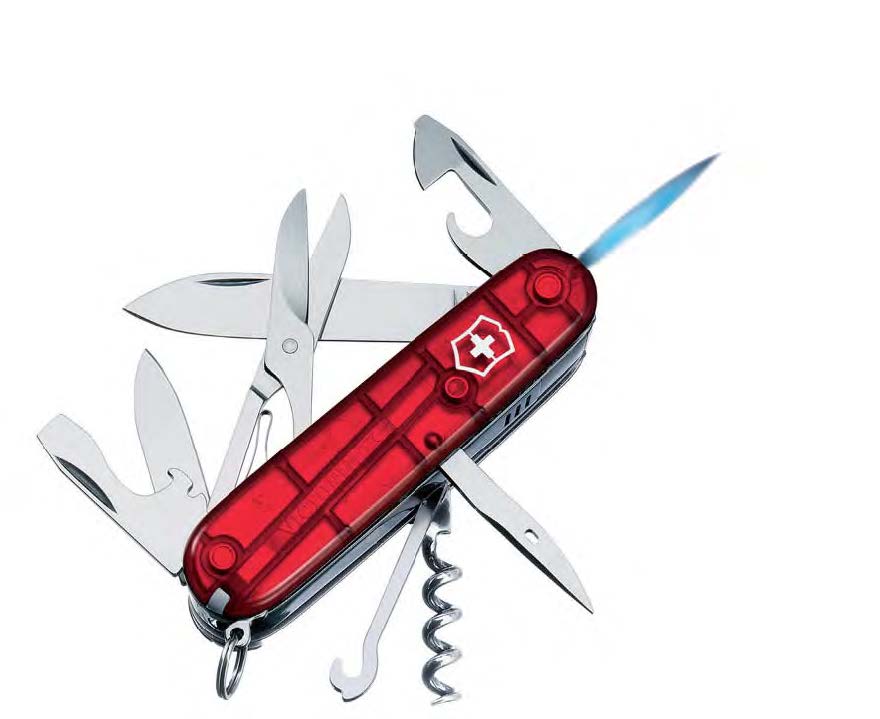
SAKs highly desirable for collectors are often models made for only a short time, such as the Swissflame series from the late 1990s and early 2000s. The model included a butane lighter.
A collector for 30 years, Dillman has seen a number of SAKs appreciate in value.
“Old-style Soldier’s knives prior to 1954 can be found anywhere from $100 to more than $1,000, depending of course on condition,” he commented. “Very early ones from the 1890s with black-stained oak handles are certainly the most valuable. Many people also try to collect specific Soldier’s knives with specific-year date stamps. Knives that are highly desirable for collectors are often models made for only a short time, such as the Swissflame series from the late 1990s and early 2000s. These were unique in that they included a butane lighter.”
Other highly prized collectibles include the Scientist, produced in the 1980s and ’90s, and the Motorist with its metal inlay of St. Christopher. Knives made first as presentation gifts for four American presidents sell for $50 to more than $100.
Chris Lubkemann wrote The Victorinox Swiss Army Whittling Book, published in 2015, which already has been translated into Swiss, German, Dutch and Spanish. His use of the Swiss Army Tinker for carving led to the research and the publication of the book.
Actually Lubkemann carved for many years with an assortment of other knives.
The Tinker SAK led Chris Lubkemann to write “The Victorinox Swiss Army Whittling Book,” published in 2015, which already has been translated into Swiss, German, Dutch and Spanish.
The Tinker had been given to him as a gift and stayed put on a shelf. As he recalled, “My [previous knife] developed a lot of play between the handle and the blade, to the point where it was no longer a viable carving tool. I’m sure I could have gone out and bought another, but conservative spender that I am, I decided to pull out my Swiss Army Tinker and see how it worked.
“The rest is history. Not having any personal previous experience with Swiss Army knives, I was immediately impressed with the tool. While the blades were stainless they took an edge well, and for my special purposes maintained the edge well.”
Chris met Brian Huegel of Country Knives in Lancaster, Pennsylvania, and Brian in turn knew Carl Elsener. At Brian’s suggestion, Chris contacted Carl, who demonstrated an interest in the whittling book, which became a reality with the support of both Victorinox and Fox Chapel Publishing.
“I was a fan of the knife long before I had any contact with Victorinox,” Chris concluded. “The more I used my Swiss Army knife the more I liked it and recommended it, especially the Tinker model, which is widely available, reasonably priced and incredibly useful—for much more than carving!”
“The Value Given is Much, Much Higher than the Price Charged”
Tim Leatherman remembers a trip to Europe that he made about 30 years ago.
“I had occasion to be near Ibach, Switzerland, so, uninvited, I parked well away and walked up to the entrance of Victorinox’s headquarters and factory. I was totally in awe,” he said. “I felt like I had found the Holy Grail. I remember they had a display on the outside wall of a Swiss Army knife broken down into its components. I must have studied it for an hour. I was too awestruck to knock on their door. The key to the success of any knife is that the value given be more than the price charged. With the Swiss Army knife the value given is much, much higher than the price charged, and the price is very reasonable.”
All images courtesy of Victorinox.
Find Swiss Army Knives at BLADE Show 2018
The world’s largest and foremost knife show, BLADE Show, is taking place June 1-3 in Atlanta. You’ll find the planet’s most innovative knifemakers in one spot. Learn more about how to attend BLADE Show 2018 here.
A sushi knife that developed a taste for Texas brisket.
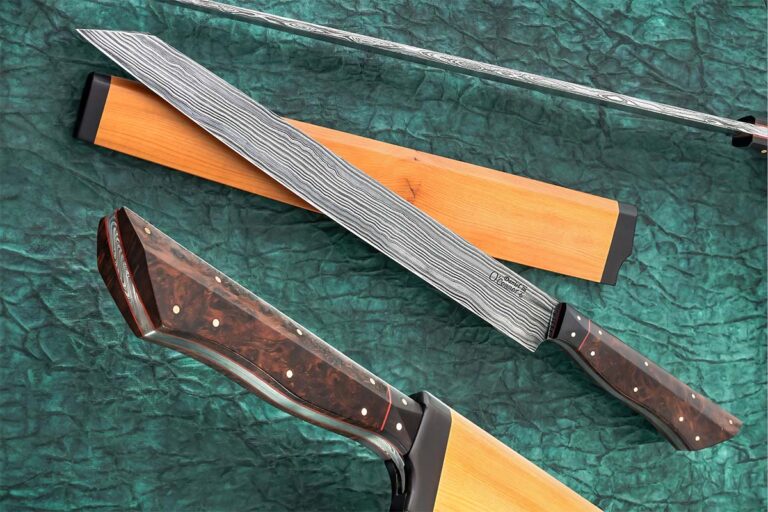
You might say Daniel O’Connor’s Black Widow leads a double life. It started as a sushi knife but when one of Daniel’s Texas pals said it looked like it would make a great brisket knife, O’Connor went with the flow, telling his friend, “It’s about whatever you want it to be.”
Based on a kiritsuke yanagi-ba sushi knife, Black Widow features a damascus of 150 layers of 1084 carbon and 15N20 nickel-alloy steels. Daniel forged the steels in a square and then forged them flat, perpendicular to the original stack. This resulted in the edges of the layers showing up in more or less straight lines, what Japanese swordsmiths call masame hada.
The accompanying image of the knife’s butt shows how the layers distorted when forged on edge. Daniel indicated he will use the pattern in the future.
Black Widow Specs Blade length: 12” Blade grind: A double urashi—double bevel w/a slight hollow on each side Handle: Bocote burl w/red fiber liners Bolster: Bog oak Overall length: 17” Sheath: Irish yew and bog oak Maker’s price for a similar knife and sheath: $1,500