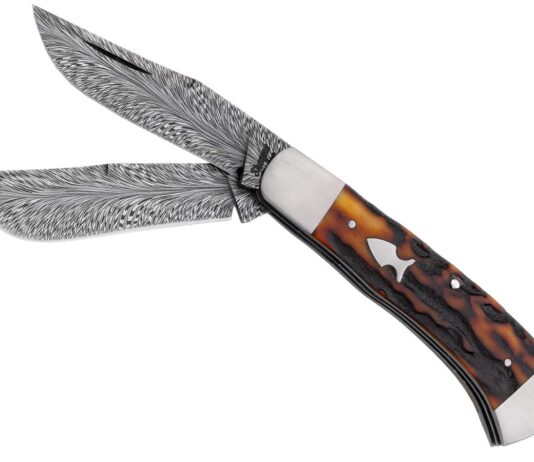
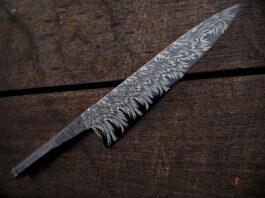
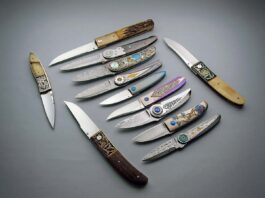
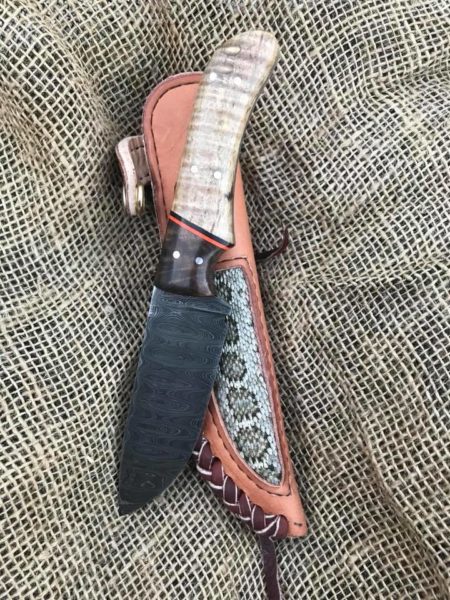
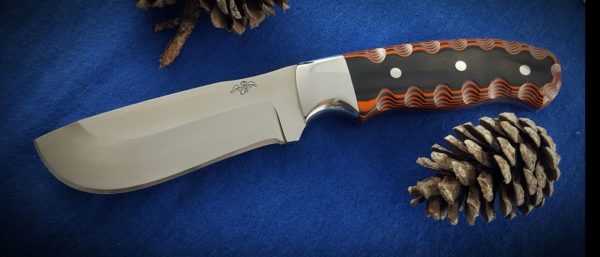
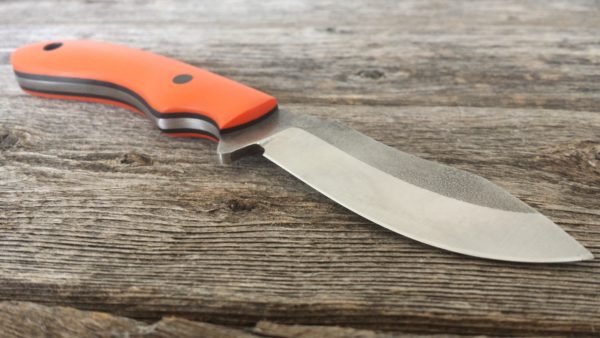
Knife collecting is an extremely rewarding experience for knife enthusiasts. There truly is a knife for everyone. Many increase or hold their value throughout the years, making collecting knives something to pass on to the next generation of knife collectors.
It makes sense that pumpkin spice marketers would want to find ways to push a product that only got used once or twice a year in one or two pumpkin pies. Now, of course, it’s a running joke that there’s pumpkin spice in everything from dog treats to breakfast cereals. Some long for the days when only pumpkin-spiced candles and lattes accosted their sensibilities, others look forward to seasonal yogurts, beers and Oreos. While we’re in the full swing of fall, deer season and stocking up on pumpkin spice M&Ms for Halloween, why shouldn’t we celebrate pumpkin-spiced custom knives?
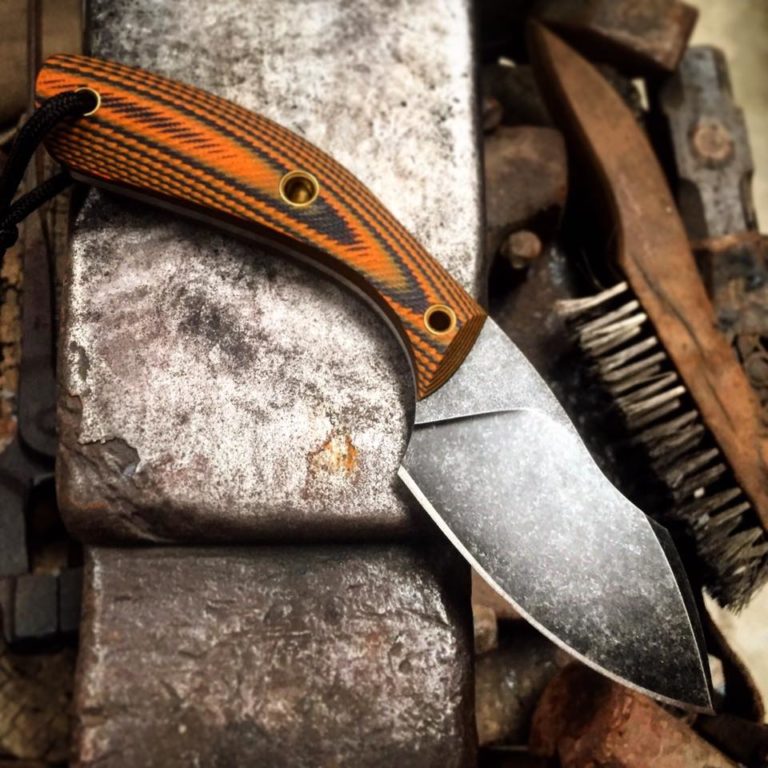
The pumpkin in this knife’s G10 handle is tempered with black, but you’ll still be able to find it if you drop it in the leaves while dressing a deer.
This APEX has a 3 7/8-inch freehand flat-ground blade made of D2 steel with a darkened stonewashed finish. The handle is made with Fluted Orange/Black G10. Maker’s list price: $230 including handmade cross-draw leather sheath and free sharpening for life. Contact Alex Smith, Smith & Sons Knife Co., 874 N. Beglis Pkwy, Sulphur, LA 70663; 337-527-6468, [email protected], on Facebook: at Smith & Sons Knife Company, on Instagram @smith_and_sons_knives and on Twitter @SmithnSonsKnfCo.
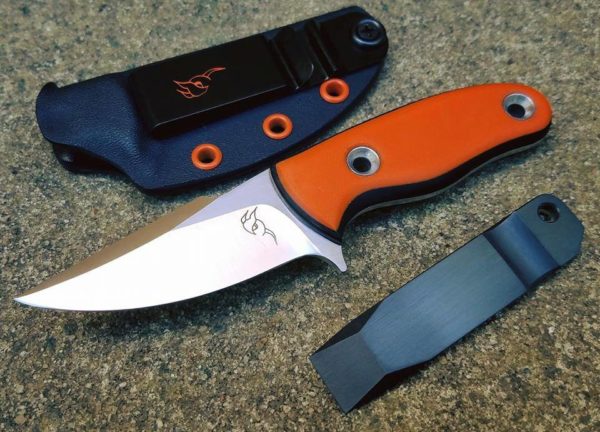
2. Go bold! There’s no need to hide your love of spicy pumpkin with this mini skinner or everyday carry knife.
The Critter Harpoon works as either an everyday carry or small skinner. It has a 3-inch flat-ground blade made of CPM 154 steel with a bright satin finish. The Orange G10 handle has black liners. Overall length is 6.75 inches. Maker’s list price: $360 including sheath made in-house. Contact Daniel Pica at 919-542-2335, [email protected], www.screechowlknives.com and on Facebook at Screech Owl Knives.
3. The pumpkin in this handle is subdued by the black in scales made by 8th Dimension Concepts.
This piece by Randy Madan has a 4.5-inch flat-ground blade made out of 1095 steel by Aldo Bruno at New Jersey Steel Baron. The overall length is 9 inches. The scales were created by 8th Dimension Concepts. Flat grind. Maker’s list price: $200-plus. Randy Madan, Patriot Horde Knives at 760-885-9370, [email protected], on Facebook at Patriot Horde Knives.
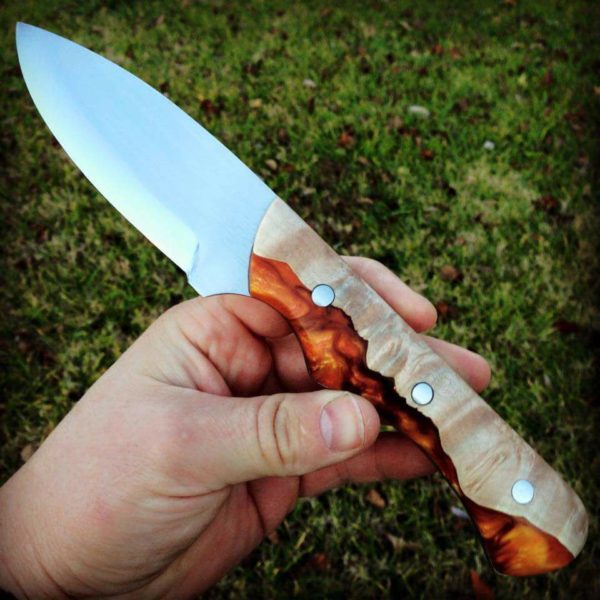
4. The striking contrast in this pumpkin and maple handle was created by Tim Kipps of J. Hue Customs. He calls it Magma color. By whatever name, it’s smashing.
This Bushie by U.S. Air Force veteran Bill Dudek has a 4.5-inch Scandi-ground blade made of 1095 carbon steel with a satin finish. The handle was fashioned from a Deadwood blank that Tim Kipps of J. Hue Customs made by clear-casting stabilized maple burl in his Magma color. Overall length is 9.5 inches. Maker’s list price: $150. Contact Bill Dudek, A Better Edge, 845-430-3406, [email protected].
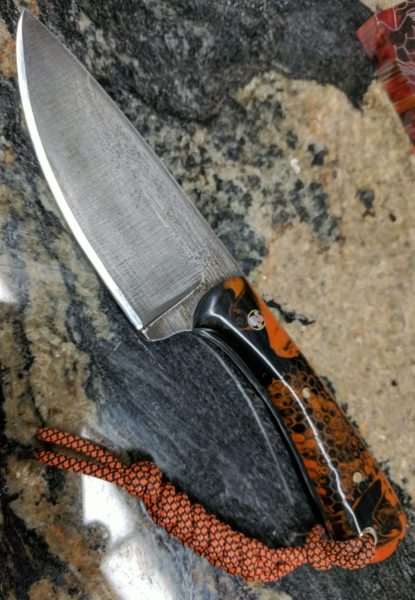
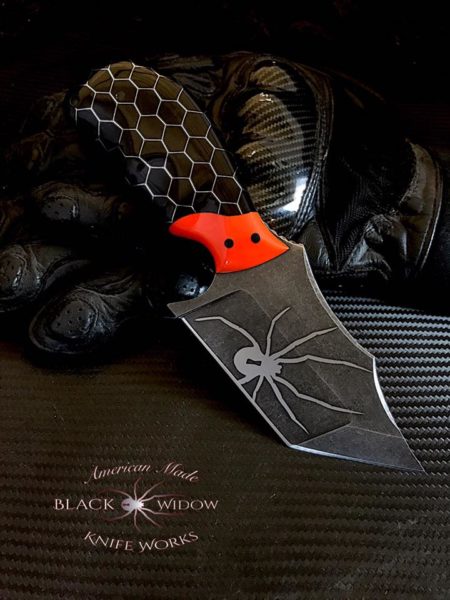
5. A pop of pumpkin is all that’s needed on this handle scale made by Voodoo Resins.
The Carnage tanto has a 4-inch flat-ground blade of CPM S30V steel, stone-washed with a Black Widow etch. Overall length is 8 inches. The handle is a Voodoo Resins Black Honeycomb and Orange resin. Maker’s list price: $380-$400. Contact Brent Vaccaro at [email protected], 908-328-2049, on Facebook at Black Widow Knifeworks & Tactical Gear and on Instagram @blackwidowknifeworks.
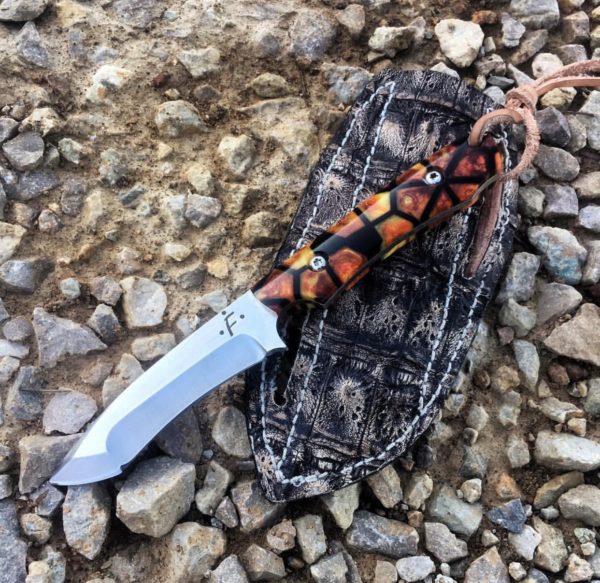
6. Pumpkin is just one of the orangey colors in Beyond Wood Products’ Firey Labyrinth scales.
The Cruiser has a 3.25-inch blade of satin-finished Elmax steel. It has a compound, hollow ground with a flat-ground tip and swedge. The scales are Beyond Wood Products’ Fiery Labyrinth. Fittings are removable and stainless steel for easy cleaning. Overall length: 9.75 inches. Maker’s list price: $275 with caiman tail pancake sheath. Contact Tyler Freund. Freund’s Custom Knives, 1755 Madison 541, Ironton, MO 63650; 573-366-3906, [email protected] and on Instagram @freunds_customs.
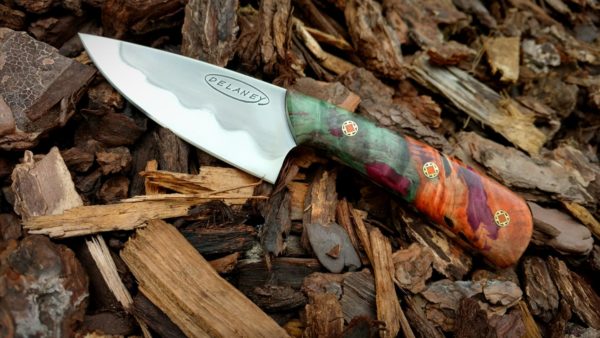
7. Buckeye burl was used by the maker to create this natural-shaded pumpkin, green and maroon handle.
Jason Batdorf made this Delaney drop-point with a 4-inch flat-ground blade of 1095 steel with hamon. The maker-made handle is stabilized and died buckeye burl. Overall length is 8 inches. Maker’s list price: $250. Contact Jason Batdorf, Delaney Knives, 419-583-7238 and on Facebook at Delaney Knives.
8. It’s a spice; not a whole meal!
Bobby Toerck’s drop-point skinner has a 4.5-inch flat-ground blade of pattern-welded steel from Alabama Damascus Steel. The handle is made of bastogne walnut and spalted curly maple by Terry Dunn with black and orange G10 spacers. Overall length is 10 inches. Maker’s list price: $500. Contact Bobby Toerck at T4 Custom Knives, 903-812-1173, [email protected] and on Facebook at T4 Custom Knives.
9. Pumpkin is an ideal accent for black in this combined G10 handle.
Devin Bliss’ modified boar skinner has a 4.25-inch hollow-ground blade of S35VN steel. The overall length is 9.25 inches. The bolster and pins are 416 stainless steel. The handle is Orange and Black G10. Maker’s list price: $500 with Kydex sheath. Contact Devin Bliss at DB Custom Knives, 903-769-2051 [email protected] and on Facebook at DB Custom Knives.
10. Who says a spice can’t be the whole meal?
Jason Wilder’s Micro Cutlass has a 2.75-inch flat-ground blade made out of 52100 steel with a textured finish. The handle scales are Orange G10 with carbon fiber fittings. The overall length is 6.75 inches. Maker’s list price: $150. Contact Jason Wilder 254-243-0338, [email protected], www.wilderforgeknives.com and on Facebook at Wilder Forge.
A Digital Subscription To BLADE Is The Answer
You can read your digital issues of BLADE Magazine anywhere you have your phone, tablet or computer, and there’s no need to find storage for all your old issues.
If piling-up issues of magazines seems like a waste to you… If you feel like you don’t have time to read a magazine… If you like the stories we offer in BLADE, but want a more economical option, then a digital subscription is the answer. An annual subscription to BLADE is $17.98, $4 off the print price.
Halloween knives conjure visions of human steak and Bela Lugosi, high tops and Frankenstein, and decapitations and zombies. Warming to the genre yet?
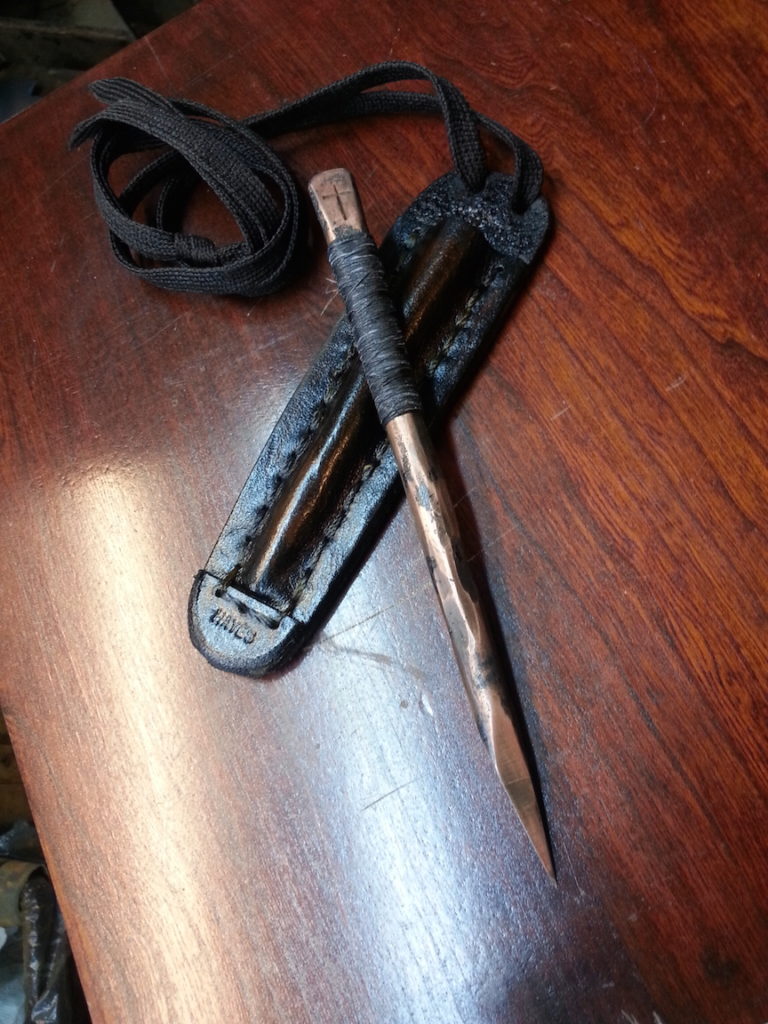
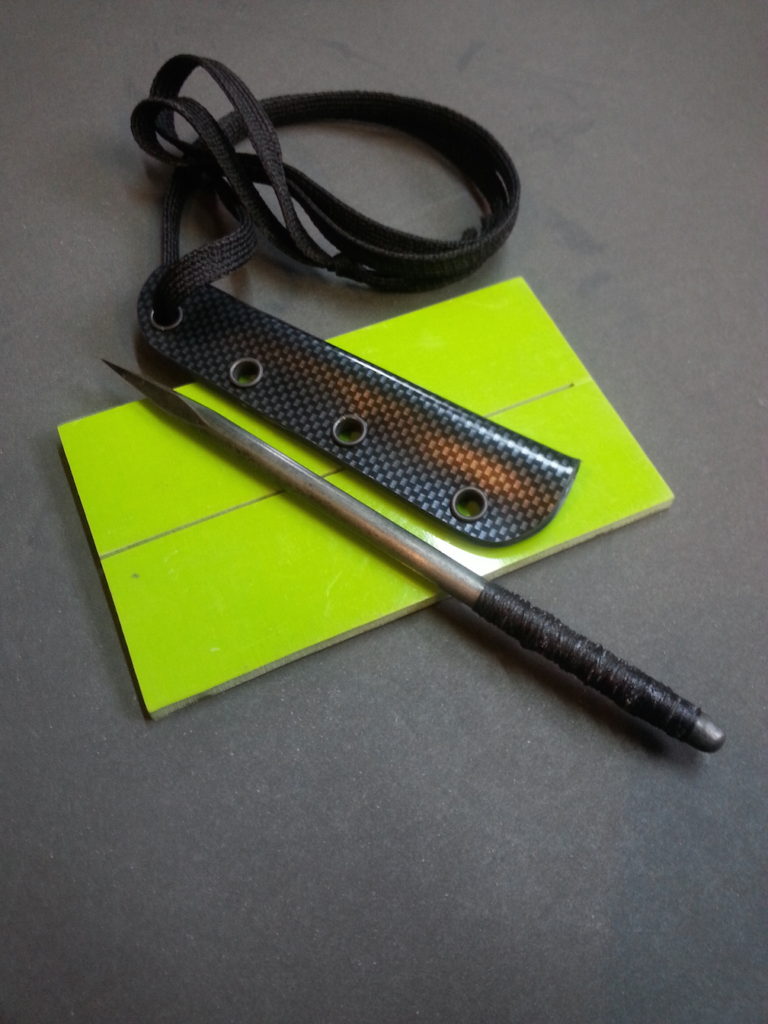
ABS master smith Wally Hayes makes a couple of Halloween knives that fit the mold like a stake in Frank Langella’s heart: the Vampire Stake and the Zombie Spike. Formed like, well, a stake to drive into the chest of one of the spooky set’s most famous blood-sucking ghouls, the Vampire Stake has a distinctive cross forged into the handle butt to intimidate the worst of the slimy night crawlers, antique coloration and a leather sheath. The Zombie Spike, on the other hand, is 6 inches long and fashioned from O1 tool steel ground and heat treated for high performance. Hayes says it’s popular among his law enforcement customers, though he didn’t mention if it was the officers in the CSI: Walking Dead unit or not. It comes with a Kydex sheath.
Creatures of the night cringe at the sight of the Vampire Stake by Wally Hayes.Wally Hayes‘ Zombie Spike will keep the Walking Dead on their toes.
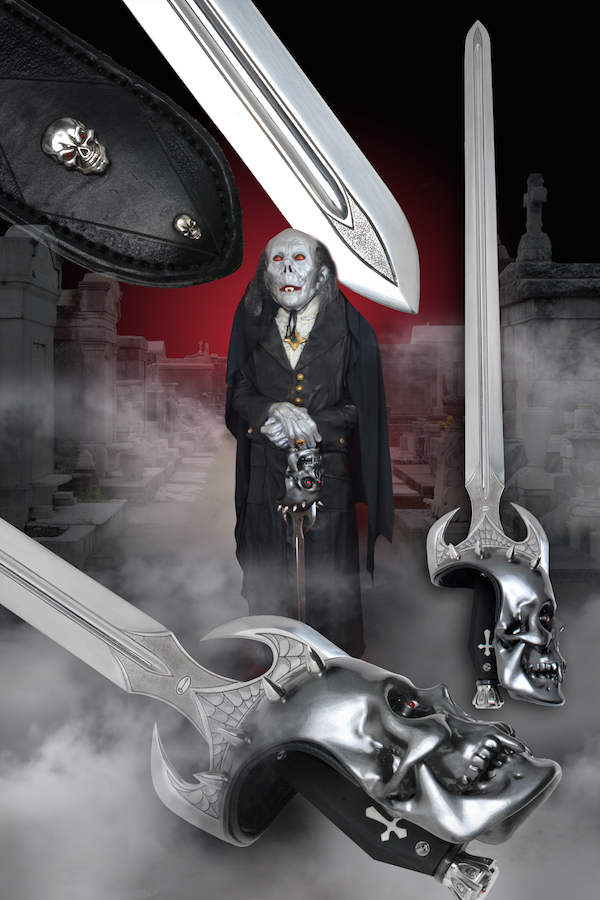
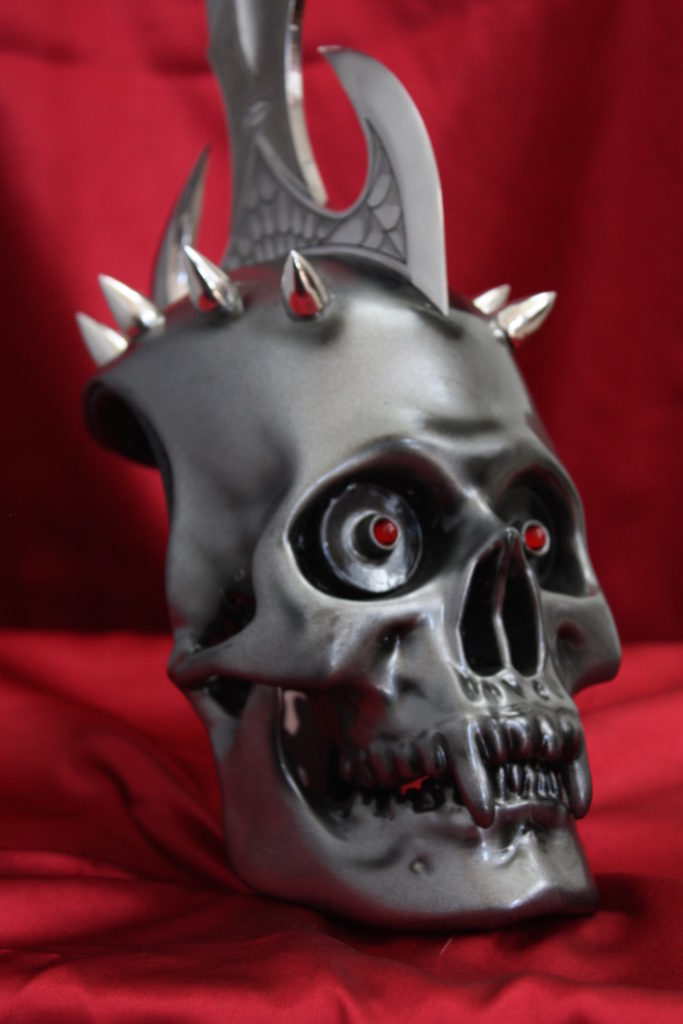
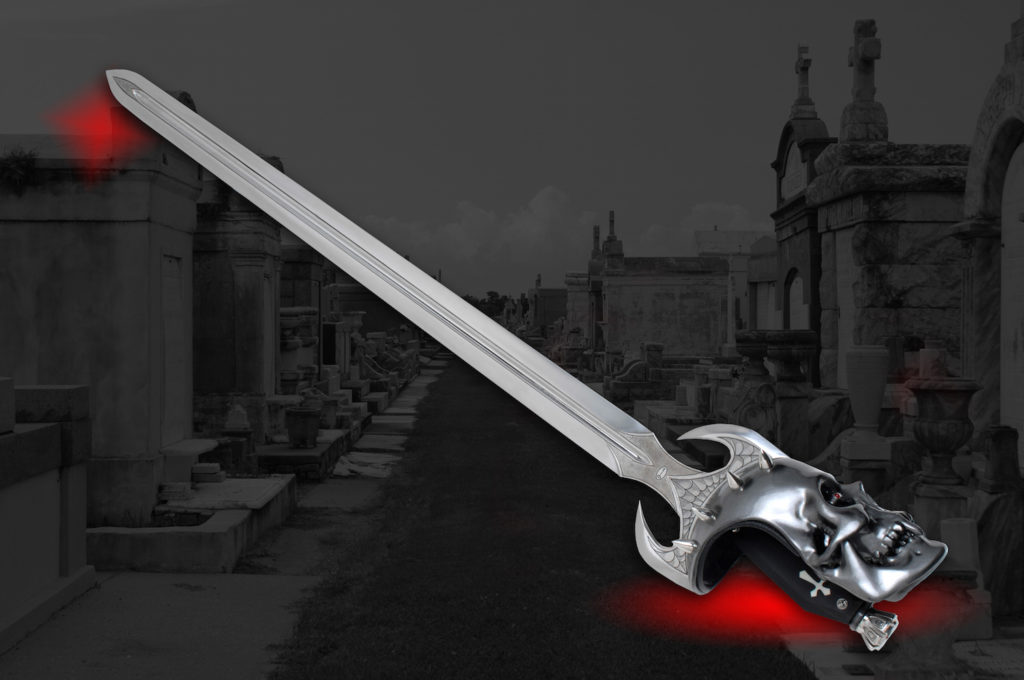
Dan Keyes‘ “The Count” features a coffin handle with inlaid ivory crosses, a fullered, 30-inch blade of double-drawn 440C stainless steel and LED bulbs that light The Count’s red eyes. The skull is powder-coated “anthracite gray” with highlighted airbrushing. Weight: Just short of five pounds. Overall length: 38.5 inches.
The Count by Dan Keyes is just what Dr. Death ordered.The red eyes of The Count’s skull light up with the flip of a switch in the handle next to the black-leather-lined skull.The Count boasts a 30-inch blade, weighs just short of 5 pounds and is 38.5 inches long overall.
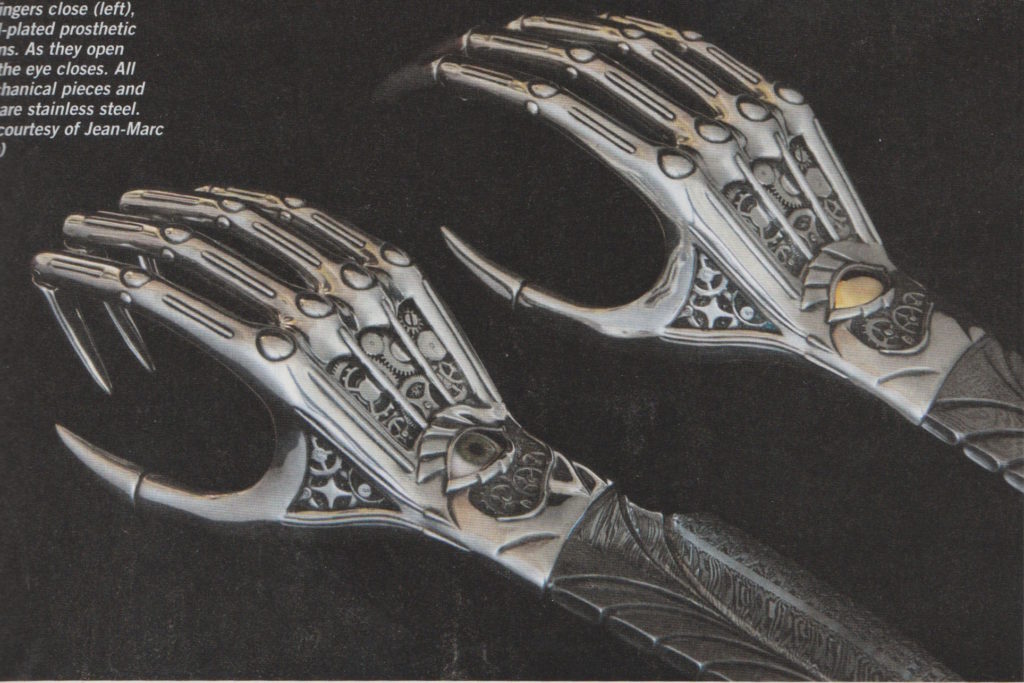
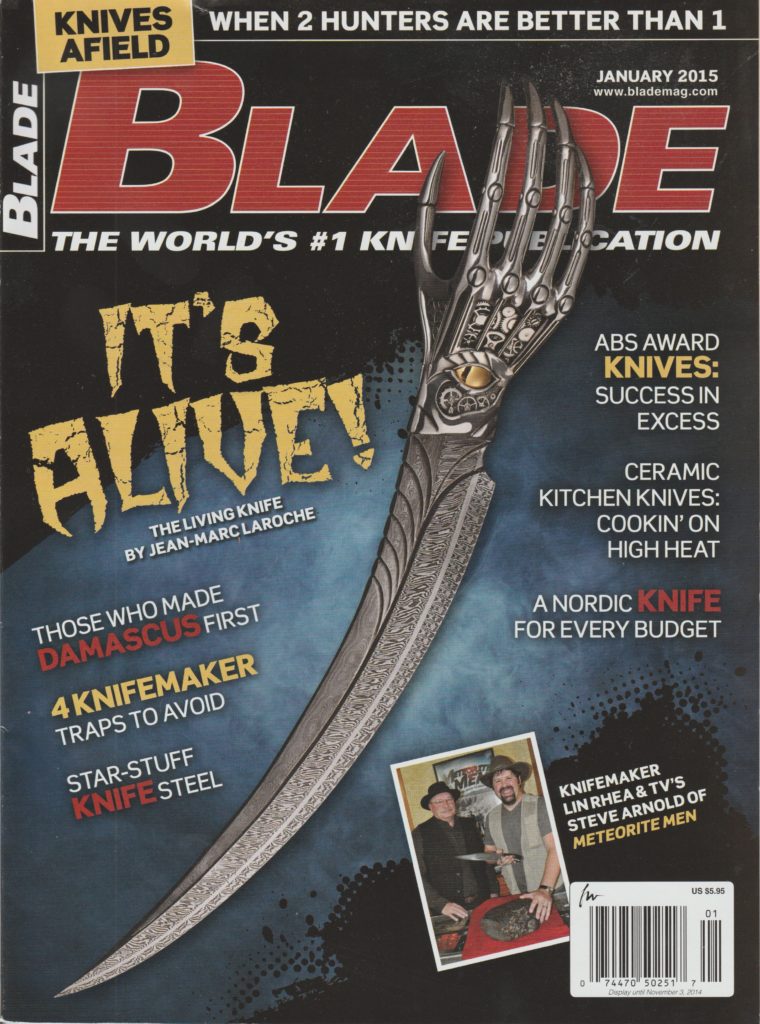
The creation of French knifemaker/artist Jean-Marc Laroche, The Living Knife has a “hand” for a handle with “fingers” that close, an “eye” and an overall lifelike appearance that will literally, er, grab you. As you grab the handle, the “fingers” actually grab back so that it’s hard to tell who’s holding whom. And, as the fingers grab your hand, the “eye” opens. The hand also is embellished with gears in the Steampunk style. The blade is a composite of 15N20, 15LM and UHB11 high-alloy nickel and carbon steels in explosion, twist and random patterns forged by Swedish maker Roger Bergh. Overall length: 25 inches.
When you grab the “fingers” of the “hands” of Jean-Marc Laroche‘s The Living Knife, they literally grab you back!
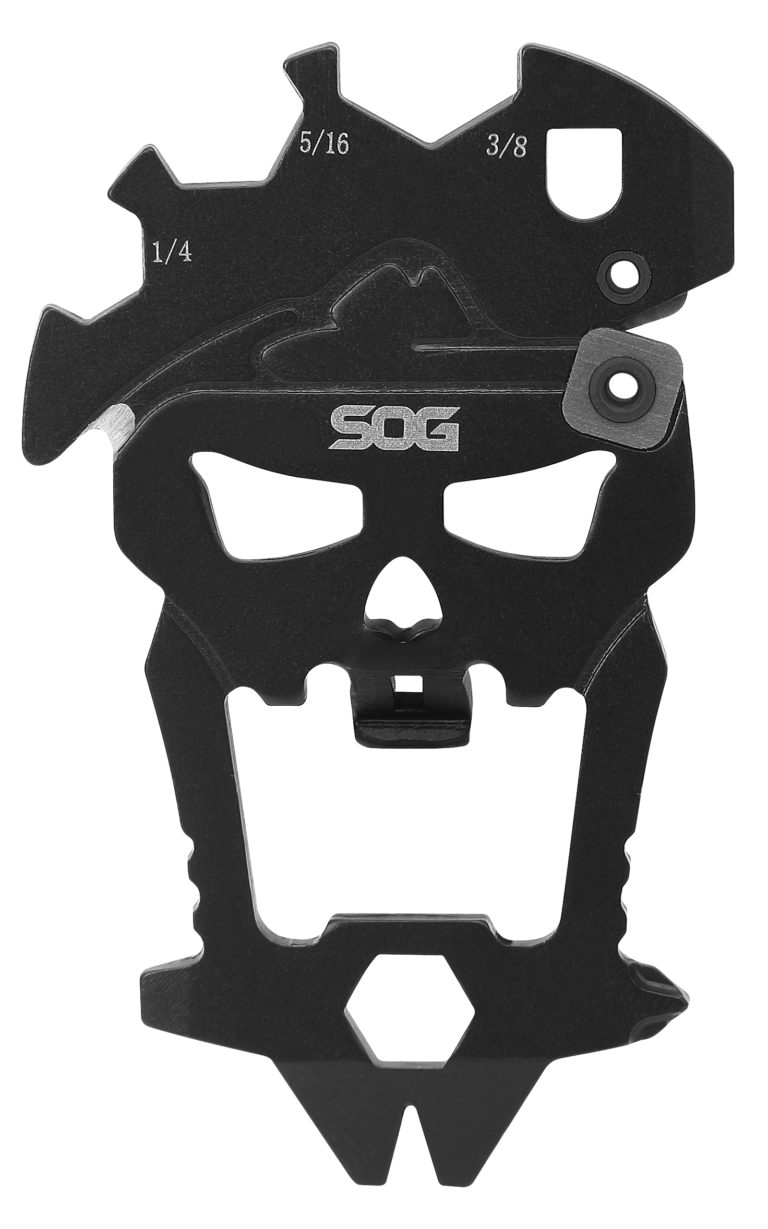
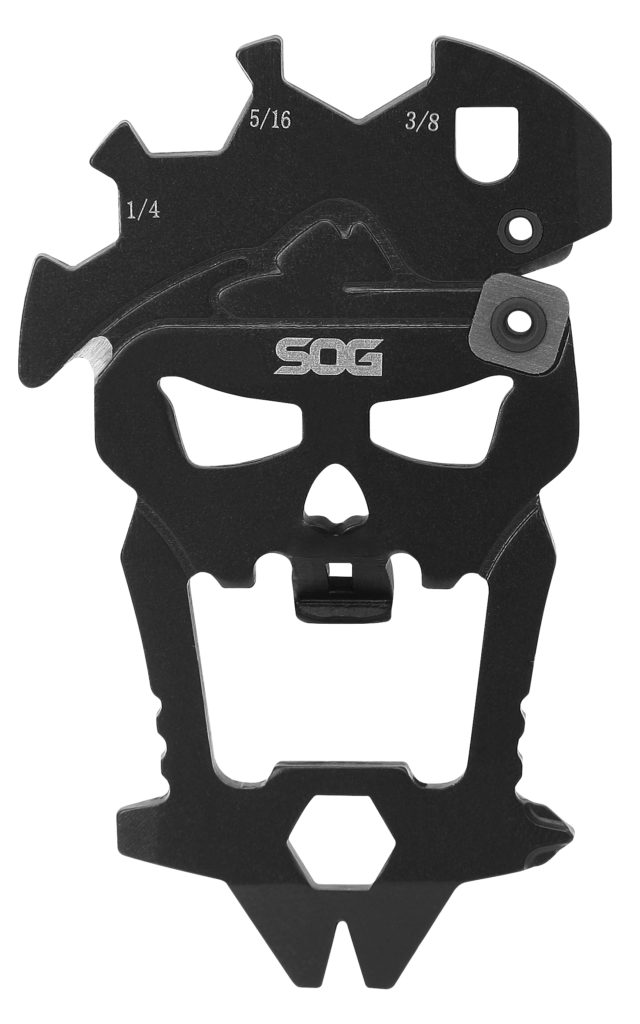
The MacV Tool from SOG Specialty Knives & Tools is shaped like a skull and is 12 tools in one, including 1/4-, 5/16 and 3/8-inch wrenches, blade sharpener, strap/cord cutter, small and large flathead screwdrivers and more. Designed to resemble the original skull from the MACV-SOG group of Vietnam War fame the company is named after, it measures 2.5 by 1.5 inches and weighs .6 ounce.
Shaped to resemble the skull logo of the original MACV-SOG group of Vietnam War fame, the MacV Tool from SOG Specialty Knives & Tools is 12 tools in one.
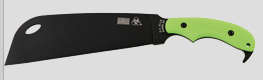
A toxic green handle and big, bad modified-cleaver blade in a black finish complete the KA-BAR Zomstro Chopper.
As you might imagine, knives with a zombie theme are undead and well, including the Reaver Cleaver from Zombie Tools and the Zomstro Chopper from KA-BAR. Based on the Chinese war sword, the Reaver Cleaver features an 18-inch blade of 5160 carbon steel, weighs 3 pounds, 10 ounces, and is 31 inches overall. The Zomstro Chopper, meanwhile, features a big, bad modified cleaver blade in a black finish and KA-BAR’s toxic green Zombie handle.
If The Count and the rest of our Halloween knives don’t keep you down for the count, you might be among the living dead. If so, stay clammy and watch out for sunrise!
Survival instructor and host of The Weather Channel’s new series “SOS, How To Survive,” Creek Stewart is releasing a new addition to his line of Whiskey Knives. The 7.75-inch-bladed tanto in A36 carbon steel is designed by Hank Gevedon of Reptile Toolworks with continual input from Creek.
Creek Stewart of “Fat Guys In The Woods” fame is hosting a new Weather Channel series: SOS, How To Survive. He is also adding The Rising Sun to his line of Whiskey Knives.
Creek runs Willow Haven Outdoor in Anderson, Indiana, where he teaches survival skills, provides some survival supplies and especially enjoys partnering with American artisans to offer items of high quality craftsmanship at affordable prices. His Apocabox is a subscription-based collection of survival items that arrives at your door every two months. He also offers a monthly survival skill program. Creek was the star of “Fat Men In the Woods,” and is again working with The Weather Channel on the new series. He is the author of an young adult survivalist romance titled “Rugosa.” A follow-up to that is also in the works.
In “SOS, How To Survive,” Creek and other survival experts analyze a series of real-life survival situations. They discuss what happened, what was done correctly by the survivors or what went wrong. The show started Sunday, August 20 and is ongoing. Throughout Creek offers tips that can be used in survival situations.
Creek Stewart Hosts The Weather Channel’s New SOS Series
Meanwhile back in Mount Vernon, Kentucky, Hank and his crew are gearing up to roll small batches of The Rising Sun into production by early 2018. Like all Whiskey Knives, The Rising Sun marries the early American frontier spirit and looks with the precision of Asia’s strong cutlery tradition. All of the knives are asymmetrically ground (so remember to only sharpen one side and just strop the other). The A36 carbon steel allows for a hard outer edge that is sharp and holds an edge with a tough inner core that is flexible and stands up to the rigors of hard outdoor use.
The Rising Sun from Whiskey Knives has a “ghost” guard that rides up the sheath, creating a striking visual when carried.
The handles are made from upcycled white oak whiskey barrel staves, which have already gone through a processing and aging. Fitting rivets are aluminum, and Whiskey Knives come with a 9-ounce belly leather sheath, stapled and dipped in paraffin wax. The Rising Sun’s sheath slides up through the knife’s ghost guard for an attractive-looking carry. MSRP: $189.
Contact Creek Stewart, Willow Haven Outdoor, 2867 N. 200 E., Anderson, IN 46012, www.creekstewart.com/whiskey-knives, on Facebook at Creek Stewart and on Instagram at @creekstewart.
A Digital Subscription To BLADE Is The Answer
You can read your digital issues of BLADE Magazine anywhere you have your phone, tablet or computer, and there’s no need to find storage for all your old issues.
If piling-up issues of magazines seems like a waste to you… If you feel like you don’t have time to read a magazine… If you like the stories we offer in BLADE, but want a more economical option, then a digital subscription is the answer. An annual subscription to BLADE is $17.98, $4 off the print price.
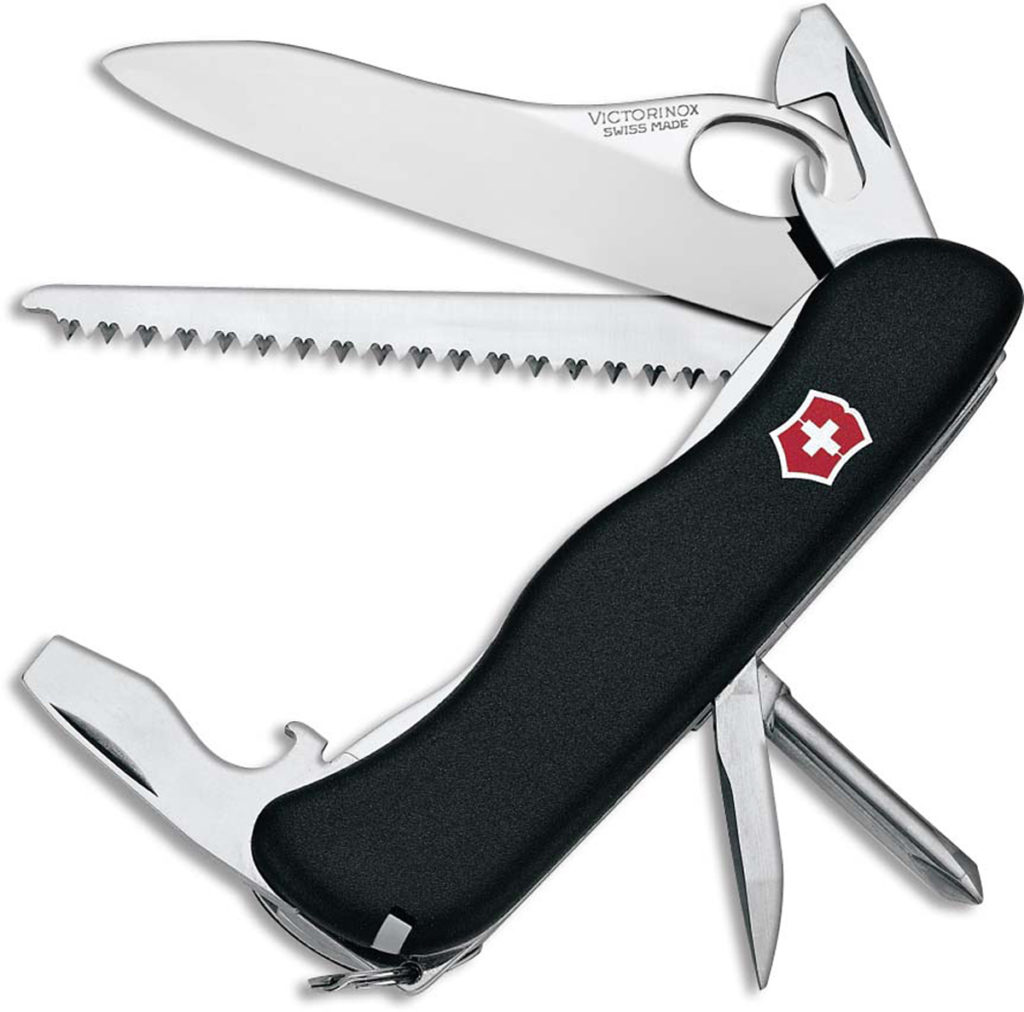
Troney Troler of Knives Plus likes the Victorinox Trekker as a fish knife—and it also has a bottle opener for your favorite ale.
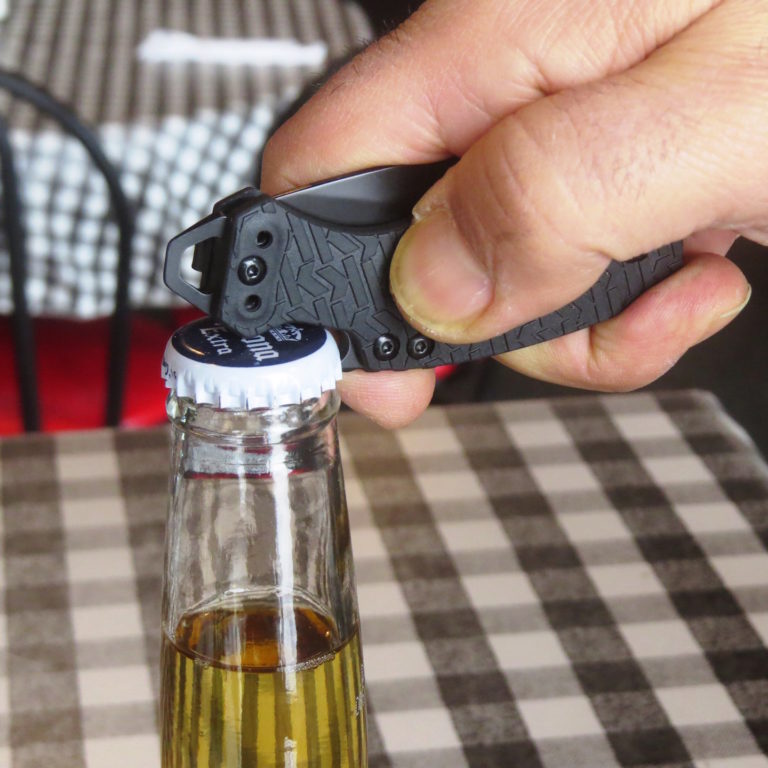
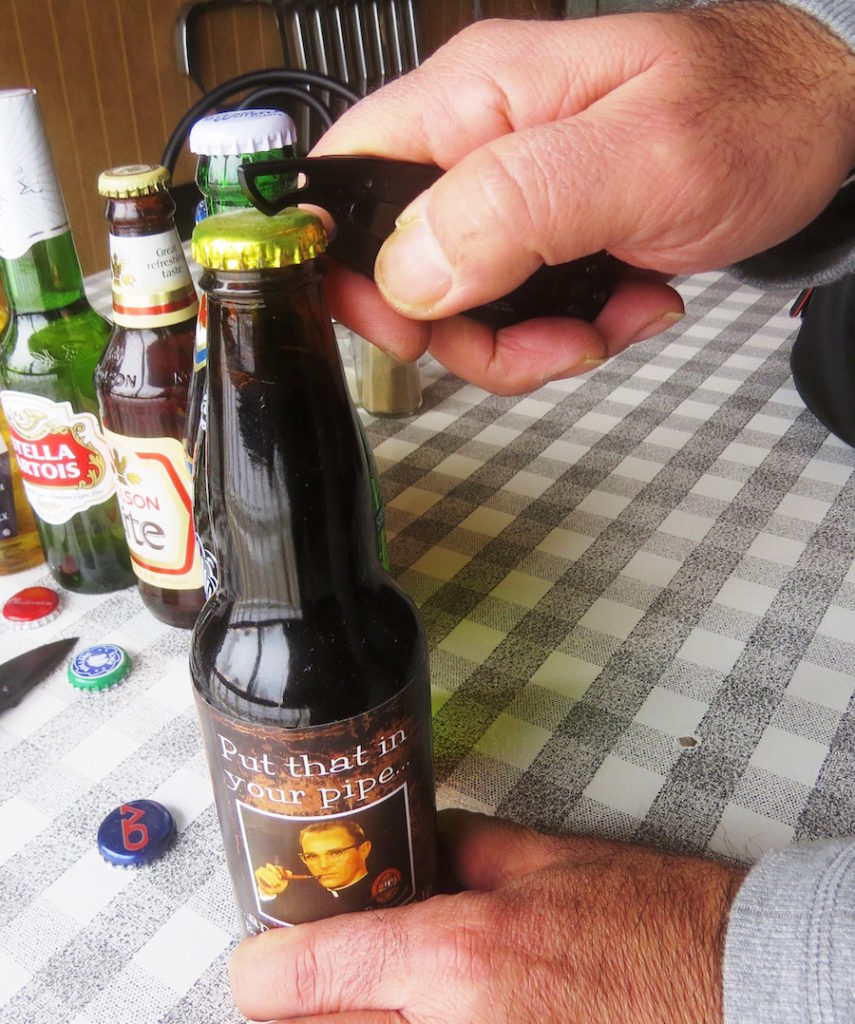
Opening your favorite beer will be on tap Thursday, Sept. 28, for National Drink Beer Day, and you can cap off the festivities with one of the latest in beer knives.
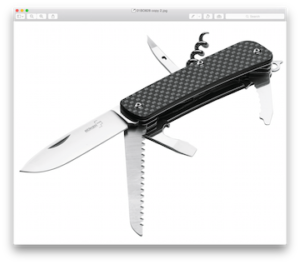
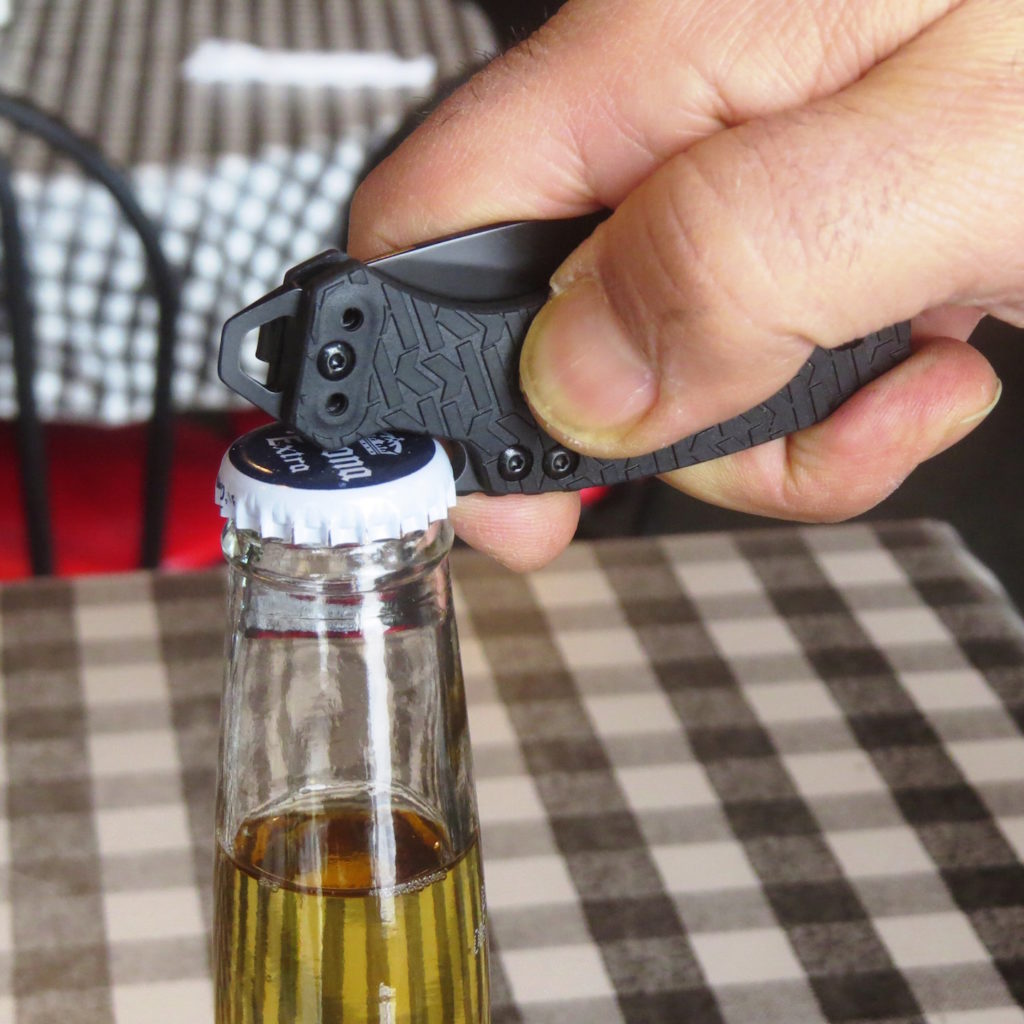
Boker’s Tech Tool takes the traditional bottle-can opener approach to beer knives.
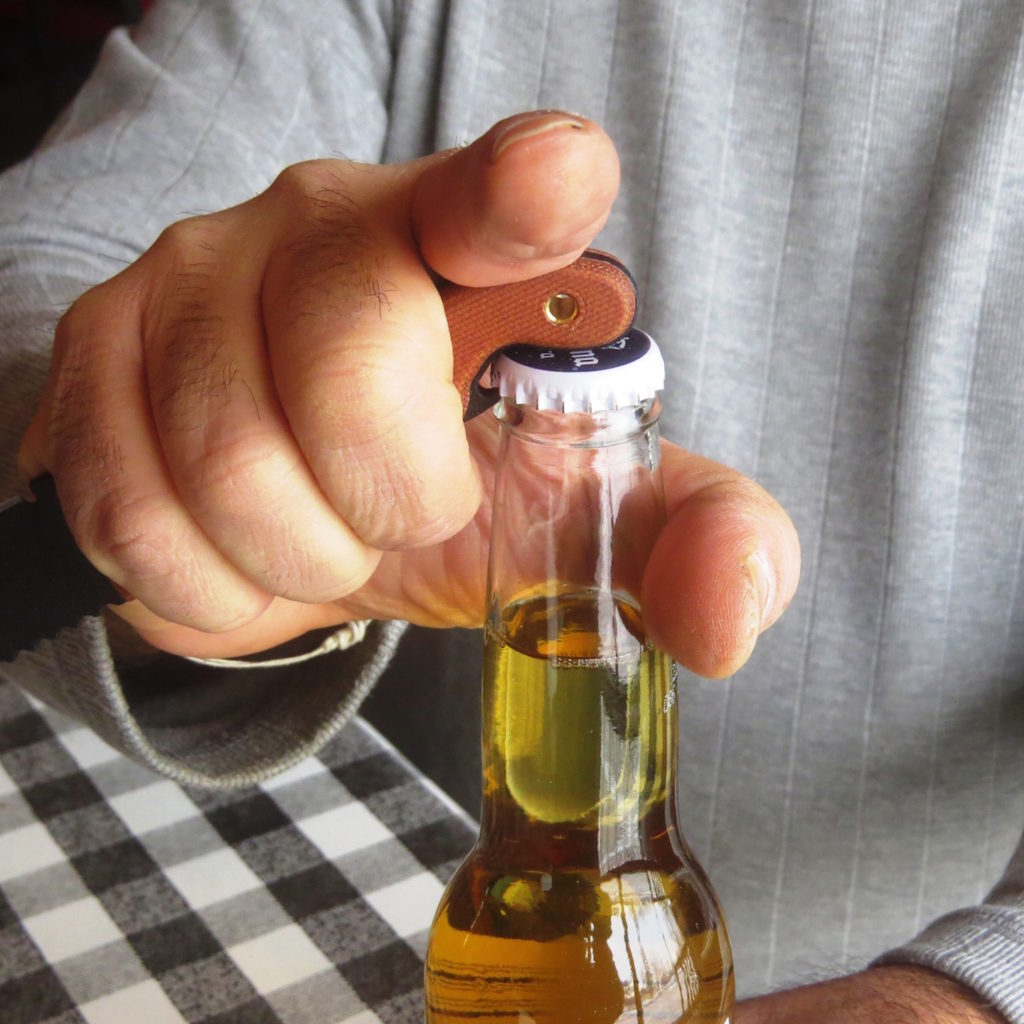
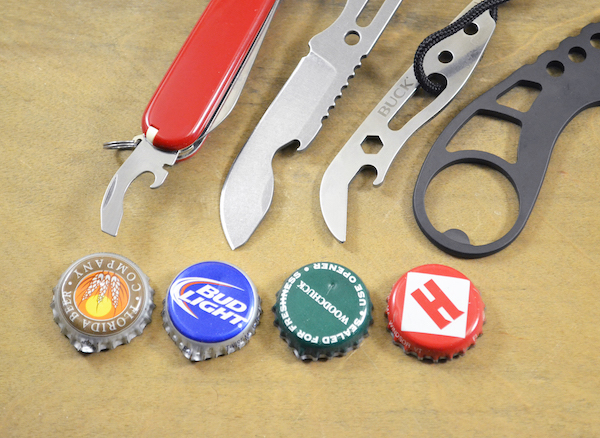
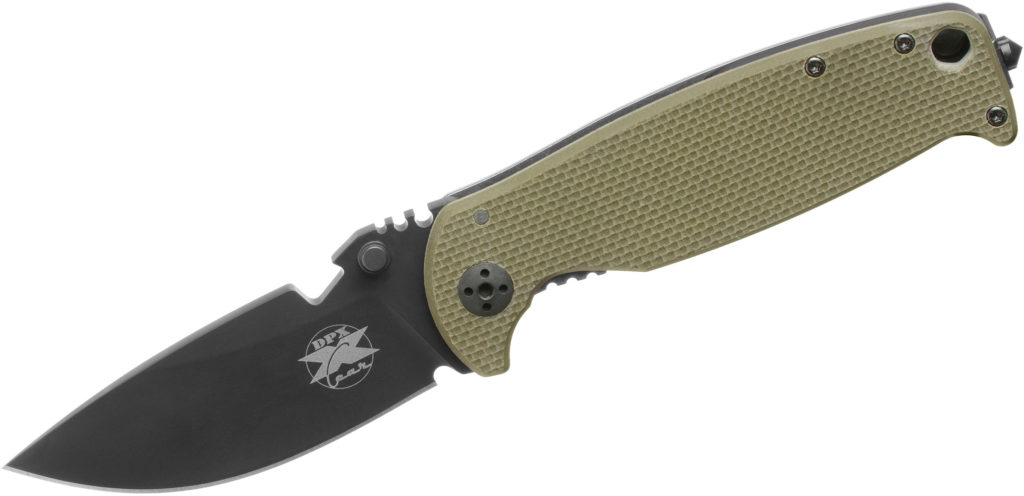
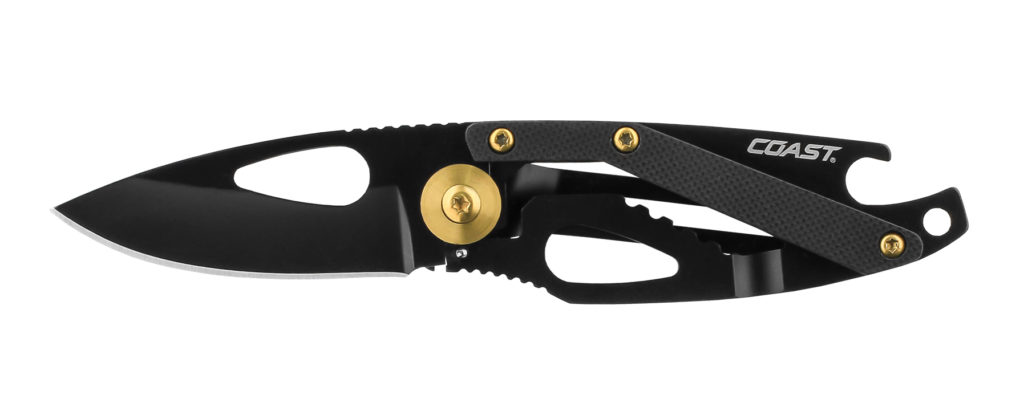
There are a number of new beer knives, from the traditional combo bottle/can-opening tools on Swiss Army and other multi-implement knives, to the more recent trend toward knives with the bottle opener in the butt of the handle or otherwise incorporated into the body of the knife. Examples of the latter style include the TOPS Pit Stop 3 and F.O.R.K. IT, Timberline Javelin BOK, the Kershaw Shuffle, Hops and Malt, Boker Plus Toucan, Coast FX200, DPx Gear HEST 2.0, White River Knife & Tool GTI 2.5 and Knucklehead, and Buck Selkirk Firestarter, Examples of the former include the Boker Tech Tool, Victorinox Walker and Trekker, and Great Eastern Cutlery Beer Scout Knife (a tip of the hat goes to the latter for the title of the knife category).
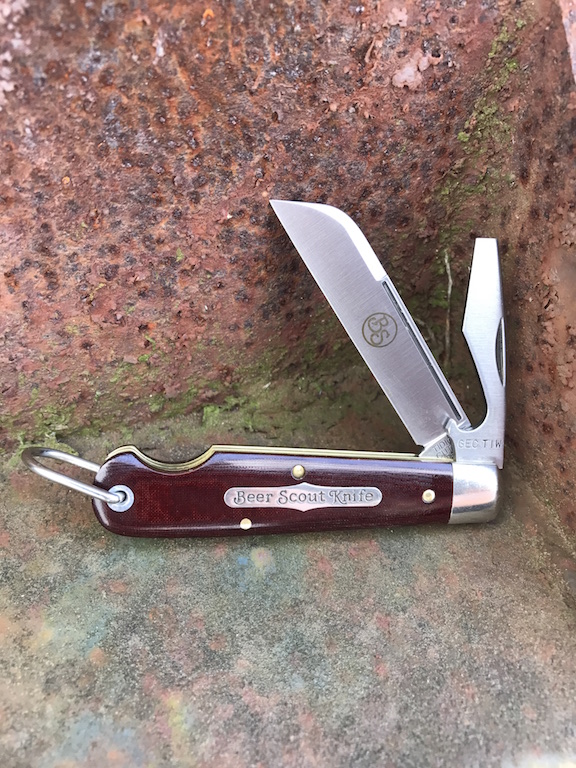
Since it provided the fizz for the headline, let’s start with the Great Eastern Beer Scout Knife. It employs a bottle opener of 1095 carbon steel to accompany a highly utilitarian sheepfoot blade. Since it’s carbon steel, be sure to wipe your bottle-opening implement and knife down after use and corrosion should be held to a minimum.
The White River Knife & Tool Knucklehead makes a great beer knife with a bottle opener in the butt and has a blade of CPM S30V stainless.
While we don’t think White River Knife & Tool was trying to insinuate anything about beer drinkers in general with the name of its Knucklehead beer knife, we DO like the name—Moe Howard of Three Stooges’ fame problem would, too—and we also like both the Knucklehead’s 2.875-inch blade of CPM S30V stainless steel and the bottle-opener in the butt. As Curly Howard might intone, get yourself a Knucklehead and “whoop-whoop-whoop” on down to National Drink Beer Day.
The preceding two are but a sampling of the latest beer knives. Check out those herein and be sure to drink responsibly and let someone else drive on National Drink Beer Day!
The Kershaw Shuffle has the bottle opener in the butt of the handle for easy opening.The bottle opener on the TOPS Pit Stop 3 is on the handle spine and should be used when the knife is sheathed.The Timberline Javelin BOK has a long handle for great leverage in popping your top.Four beer knives, from left: the TOPS Pit Stop 3, Boker Plus Toucan, Kershaw Shuffle and Timberline Javelin BOK (Bottle Opener Knife).The Beer Scout from Great Eastern Cutlery has a traditional bottle opener and a sheepfoot blade of 1095 carbon steel.Cap off your day with the bottle openers of, from left, the Victoinox Walker, TOPS F.O.R.K. IT, Buck Selkirk Firestarter and White River GTI 2.5.KnifeCenter’s Jason Kunkler used the bottle opener on the blade spine of the DPx Gear HEST 2.0 while on vacation in Peru. He did not mention whether he opened a cold one at Machu Picchu, however.The Coast FX200 is one of the new breed of beer knives with the bottle opener in the butt.
Contingency by Winkler II Knives is well designed for concealed carry. The sheath system offers a variety of carry options and the curved handle easily accommodates positive or 90-degree reverse grip. Contacts for Winkler II Knives are listed at the bottom of this article.
Contingency by Winkler Knives II is a concealable personal protection knife with a sheath system that allows for inside- or outside-the-waistband carry. (You’ll want to order a left-hand-draw sheath for right-hand IWB draw.) The 3 1/2-inch blade on Contingency is made of 80CrV2 steel and has thumb-grip gimping. The knife has a tapered, skeletonized tang and measures 7.625 inches overall.
The curved-handle design is well-suited for easy draw and positive grip or 90-degree reverse-grip positioning. It comes in your choice of walnut, maple or Black, Tan or Green Micarta. Rubber is available but is not recommended for concealed carry. The MSRP is $300. You can also order yours with sculpting, $15; sculpted WASP (air injection), $30; or sculpted multi-camo, $30.
Daniel Winkler’s Early Frontiersman Style
Daniel Winkler, along with wife and leather craftswoman, Karen Shook, started Winkler II Knives in 2016. Daniel’s ever-present love of early American history intensified when he started using black-powder weaponry to extend his hunting season. He added to his 18-century woodsman outfit by making powder horns and other accessories, and in 1975 he made his first knife. He was a member of The American Mountain Men and other historically strict reenactment groups, and began selling knives at gatherings, called rendezvous. The money he made allowed him to upgrade his car-wheel forge to a hand-cranked model. By 1988 he was making knives full time.
Daniel Winkler, co-owner of Winkler Knives II with his wife, Karen Shook, is based in Blowing Rock, North Carolina.
When he’d been at it for nearly two decades, he spent a few years entering cutting competitions. He says those experiences taught him more than he had learned in all the other years combined. Not only did he improve his knife-handling skills, he came to understand what made a knife perform in a wide variety of tests. Cutting competitions are timed events that involve a number of stations at which the maker and his knife must cut, say, a hanging rope, an upright straw, a row of water bottles, a cardboard tube, a pool noodle and then chop through a piece of lumber. The blade either cuts or it doesn’t.
Now he establishes the use of the knife before anything else, because no single knife can do all things well. He is honest about how knifemaking is always changing, sometimes advancing, sometimes failing.
In 1992 Daniel had the opportunity to make the knives and tomahawks used in the movie “The Last of the Mohicans.” His pieces also made appearances in 2012’s “Zero Dark Thirty.” It was his work on “Mohicans,” however, that would send him on the path to making knives and combat axes for today’s Special Operations personnel, while continuing to serve the hunter-outdoorsman community.
Contact Daniel Winkler, Winkler Knives II, P.O. Box 2166, Blowing Rock, NC 28605; 828-295-9156; [email protected]; www.winklerknives.com and on Facebook at Winkler Knives.
A Digital Subscription To BLADE Is The Answer
You can read your digital issues of BLADE Magazine anywhere you have your phone, tablet or computer, and there’s no need to find storage for all your old issues.
Save $4 off the print price of a annual subscription to BLADE Magazine with a digital subscription. If piling up issues of magazine seems like a waste for you… If you feel like you don’t have time to read a magazine… If you like the stories we offer in BLADE, but want a more economical option, then a digital subscription is the answer. An annual digital subscription to BLADE is $17.98.
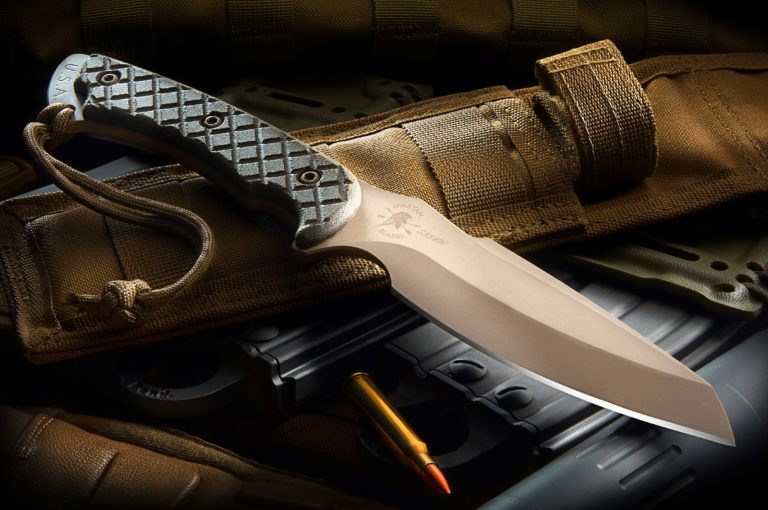
The co-owners of Spartan Blades, in keeping with the company name, decided to call their 10 7/16-inch reverse-tanto sheepsfoot-bladed combat/utility knife, Hybris. Those familiar with Greek mythology might vaguely recall indirect reference to her hubris (over-inflated pride), insolence and arrogance. However, she is also the goddess of violence and outrageous behavior, necessary traits in elite warriors, no matter the era or place in which they fight. According to myth, she was the last among her peers to marry, so Polemus, the god of war and battle, married her. Clearly, an ideal christening for Spartan Blades Hybris Combat/Utility Knife.
The 5 7/16-inch reverse-tanto sheepsfoot blade on the Spartan Blades Hybris Combat/Utility Knife is made with CPM S35VN steel with a black or earth finish. Handle comes in black or green canvas Micarta. MSRP: $330. Contact Curtis V. Iovito, Spartan Blades, LLC, 625 SE Service Road, Southern Pines, NC 28387; 910-757-0035, [email protected], www.spartanbladesusa.com.
Should you want to accessorize, Spartan Blades offers an appropriately warrior-looking line of beads in spartan helmet, skull with beret, shield and crusader cross designs, MSRP: $5-$10. However, there’s also a line of beads in sterling silver and bronze, including the exclusive-to-Spartan-Blades plumed spartan helmet, crafted by GD Studios in Latvia and exclusively imported by veteran-owned GD Skulls USA in Florida, MSRP: $98.
Curtis Iovito and Mark Carey co-founded Spartan Blades in 2008. The two retired from U.S. Army Special Forces with over 40 years combined service. They prefer to focus on providing military personnel and outdoor enthusiasts with functional, durable knives, rather than chasing the latest innovations, which may or may not have staying power. They stick to using U.S. materials, and batches are small so that quality control can remain exacting. Accompanying sheaths are made by American- or U.S. veteran-owned businesses. At the BLADE Show® Spartan Blades’ Kranos framelock flipper model won the BLADE Magazine 2017 American Made Knife Of The Year®.
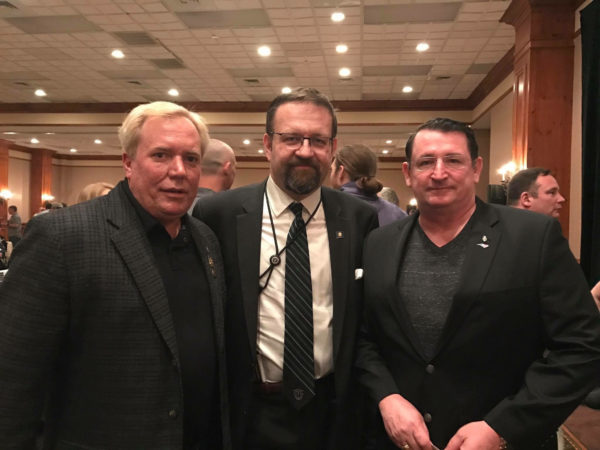
Since Curtis and Mark taught at the U.S. Army Special Operations Command sniper school (Special Forces Sniper Course), they continue to support the school and USASOC International Sniper Competition. At one event, they ran into guest speaker Sebastian Gorka, intelligence analyst, best-selling author of “Defeating Jihad, The Winnable War” and now-former deputy assistant under President Donald J. Trump.
American military and intelligence analyst, author of “Defeating Jihad, The Winnable War” and former deputy assistant to President Donald J. Trump, Sebastian Gorka (center), spoke at a U.S. Army Special Operations Command event attended by the co-owners of Spartan Blades, Curtis Iovito (right) and Mark Carey (left).
Read About New Releases From Knife Manufacturers In BLADE
An annual U.S. subscription to BLADE is $21.98. You can get your 13 issues sent to Canada for $39.98 and internationally for $49.98. Or go green and get your issues sent digitally for $17.98.
Each month BLADE Magazine features new knives from manufacturers and custom makers in its What’s New section. Be sure to subscribe so you don’t miss out. You can also read about some of them here on our website. Be sure to Like and Follow us on Facebook at BLADE Magazine.
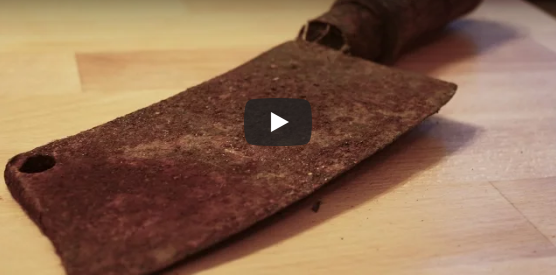
The hip kids know that the latest knife video craze involves rusty knives, knife maintenance tools and elbow grease. There’s something strangely satisfying about watching a beater knife that couldn’t fetch a quarter at a garage sale return to its former glory.
Here are the best “rusty knife rescue” videos from around the web.
Keep Your Knives Looking Their Best with This Guide