Knife Collecting

Knife collecting is an extremely rewarding experience for knife enthusiasts. There truly is a knife for everyone. Many increase or hold their value throughout the years, making collecting knives something to pass on to the next generation of knife collectors.

Browning launches Wihongi line of Maori-inspired knives

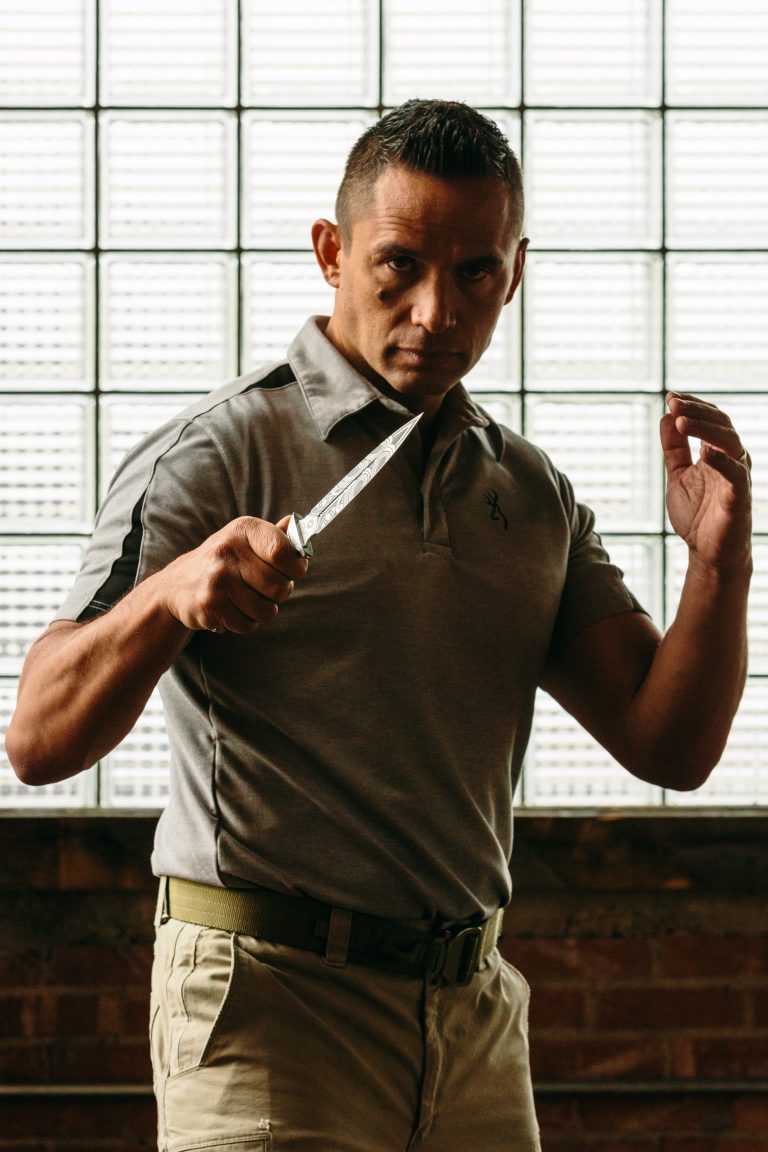
Browning has launched the Jared Wihongi line for 2017.
Together with Browning, tactical knife fighting instructor Jared Wihongi has released a signature knife line.

Jared Wihongi’s life and career is built on the warrior spirit of his Maori ancestors. He has practiced martial arts since he was a 10-year-old living in New Zealand, and the Filipino style of knife fighting, since he was 20, some 20-plus years ago. He also has his own signature line of edged weapons through Browning, knives that he hopes inspires “the warrior spirit that lives in each of us.”

Jared has reached the tuhon or master level of Pekiti Tirsia Kali and instructs police officers and elite military operatives in what he calls close quarter force integration tactics, or CQ-FIT. He applies the circular arm movements, the footwork, angling and distance control of Pekiti Tirsia Kali, using empty hands, sticks, knives and even guns, to reality-based training so that police officers are better able to subdue threats, or a special forces member is able to eliminate enemies in close-quarter combat.

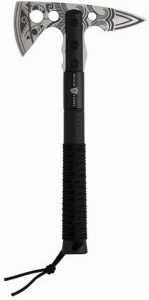
One of Jared’s most interesting-to-watch training sessions involves using a tomahawk in close-quarter fighting. Essentially, the circling motions, overhand and underhand, forward and backhand, are coordinated for attacking your opponent while simultaneously avoiding his advances. The tactical tomahawk in the Wihongi Signature Series is a true straight-handled tomahawk. The blade is made from ¼-inch 420 stainless steel, and the spike end includes a semi-sharpened blade. Three lightening holes are drilled into the blade, maintaining the integrity of the head while removing material to lighten the weapon, making it easier to wield in a fight—or to be fast as lightning.

Jared Wihongi uses tomahawks in his training, choking up on the handle for close-quarter combat.
The Jared Wihongi Signature Series Tomahawk includes acid-etched motifs from the Maori warrior culture.

The forked tang is secured with three flush-mounted screws but is also reinforced by a wide metal ring surrounding the handle. The Wihongi Signature Series Tomahawk carries Browning’s Black Label tactical line logo, along with the familiar Buckmark. The handle is wrapped in paracord, a lighter weight than 550 to eliminating bulkiness, Jared explained.

What is most notable about the weapon is the Maori tribal motif acid-etched into the steel. The warrior culture often carved facial features into wooden taiaha, or fighting staffs. These weapons would include eyes and ornate details that culminated in the familiar out-stuck tongue. Having these designs in a tattoo or engraved on a weapon meant that the warrior was carrying the strength and courage of his ancestors with him into battle.

Jared’s mother hailed from the Lone Star State, but being Mormon she decided to move to Utah. Jared’s father, living in New Zealand, attended a private school run by the Church of Jesus Christ of Latter-Day Saints. He excelled and was granted a scholarship to attend a university, also in Utah. The rest is history. By the time Jared was 1, the couple had returned to New Zealand, raising a brood of six.

Although native New Zealanders only make up 15 percent of the country’s population, the Wihongis lived in a small town that was predominantly Maori. Having grown up the late 1950s when there was little opportunity for Maori youths other than to become farmers, Jared’s father put great importance on education and became a school principal. Two of his sons followed in his footsteps, but Jared and another brother became police officers, with Jared going on to become a SWAT operator for 14 years and counting. He now teaches knife-fighting skills to SWAT teams and elite special forces in the U.S. and allied countries. “I’m an educator too,” Jared said, just in the warrior arts and lifestyle.

Jared Wihongi reviews his tomahawk fighting tactics.

Jared’s father died at a young age and when Jared was 17, the family moved back to the Salt Lake City area. Mormons are expected to go on a two-year mission before attending college. Jared served in the Philippines, which is where he began training in the Filipino knife-fighting arts. He attended college in Hawaii, where he worked as a bouncer, often having to apply his skills in a real-world application. He then returned to the Salt Lake City area and has advanced exponentially in his martial arts practice and his real-world curriculum, which  incorporates both the warrior spirit of his Maori ancestors and the premier knife-fighting skills of the Filipinos.

He recommends that anyone who wants to be able to defend themselves against a knife attack seek out a Pekiti Tirsia Kali instructor who offers real-world-scenario training. “Take a sample class,” Jared suggested. “You’ll be able to tell.” Learning to defend yourself against a knife attack is part of learning how to wield a knife in close proximity. Amazingly, this can be done with a tomahawk by choking up on your grip to right under the head. Don’t worry, practice is conducted with training knives. “But you have to make contact to understand knife fighting,” Jared explained

“When I presented this line to the sales force, I asked Jared to lead a haka dance,” said Diane Carver, knife and light product manager at Browning. The feedback she received was intense. Some had never seen the Maori warrior dance that has now been made popular by the New Zealand rugby team and others on social media. Some were inspired to see it live. “I’m so excited about this line,” Diane said.

Jared Wihongi introduces his signature knife line−and leads a haka.

If you’d like to read more about Jared and the four styles of knives in the Jared Wihongi Signature Series by Browning, be sure to pick up the July issue of BLADE® magazine or subscribe.

Secrets to making your own tomahawk

"Benchmade Tomahawk Secrets" is avaialbe in digital format for $4.99.
If you’ve ever wanted to try making your own tomahawk, this digital download will provide answers to your questions.

This digital download is an economical way to learn how to select and forge your tomahawk billet, how to drill and fill the eye hole, how to fit the haft to the head and grind it to rough shape. At only $4.99 this volume by BLADE field editor and ABS master smith Joe Szilaski is a fun and needed addition to your weapon-making library.

Save

Save

A Knife Completes A Circle of Grieving

Stefan Neil Palmer made this knife to raise funds in memory of Dustin Chamberlain.
Knifemaker Stefan Neil Palmer made a knife in memory of Dustin Chamberlain to be auctioned off. He never knew it would change his life.

While at his parents’ Siloam Springs, Arkansas, home for Christmas break 2011, 20-year-old Dustin Chamberlain was shot dead by an intruder. Nearly five years later, knifemaker and racecar driver Stefan Neil Palmer was asked by his racing mentor if he would make a knife to auction off to raise money for Dustin’s Dream, the charity foundation organized in Dustin’s memory. Stefan agreed, but when he laser-engraved Dustin’s favorite saying on the handle, everyone agreed that the knife could never be auctioned off.

On Dec. 15, 2011 Dustin, a biology-pre-med sophomore at Baylor University in Waco, Texas, was resting at home after a minor outpatient procedure. Both his parents left for work with Dustin’s reassurance that he didn’t need anyone to stay with him. His father, Don, had planned to have lunch with him. At approximately 10:45 a.m. Dustin’s mother, Deondra, called the house and Dustin’s cell phone repeatedly but got no answer. She called Don and asked him to check on their son.

Don walked into the Chamberlain home to find his son lying dead just inside the door with four gunshot wounds. In the family room, he found a stranger with what police subsequently said appeared to be a self-inflicted gunshot wound that later proved fatal. The investigation revealed that the stranger was a local man who had been reported missing, depressed and possibly suicidal. He had wandered onto the Chamberlain property, and evidence showed he’d been on the premises for two hours before the Chamberlains left for work.

It’s an understatement to say that the Chamberlain’s lives were changed forever, but as day followed day, God showed them how they could carry on Dustin’s name and spirit, Don explained. “It’s been therapeutic,” he said, referring to the charity they set up in remembrance of their son. In honor of Dustin’s dream to one-day become a doctor, Dustin’s Dream sets up medical clinics in third-world countries and funds teams to conduct medical mission trips to those countries. They also offer scholarships for aspiring medical students.

Dustin's Dream Racing member Stefan Neil Palmer made a knife to benefit the charity.
Knifemaker Stefan Neil Palmer made a knife to auction off in benefit of Dustin’s Dream.

In 2013, two years after Dustin’s murder, Chamberlain family friend Steve Butler decided to use his racing hobby to support Dustin’s Dream. Steve introduced Stefan to Dustin’s Dream Racing, which raises money for the foundation “while being a positive, Godly influence” in the sport of racing, according to their web page. In the summer of 2016 it was suggested that Stefan make a knife to auction off to benefit Dustin’s Dream.

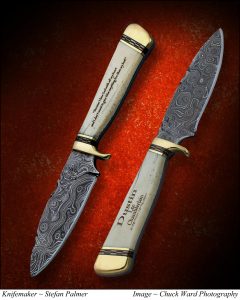
So Stefan set out to make the best knife he could to honor Dustin. The 3.112-inch hollow-ground drop-point hunter was constructed using buckshot-pattern steel forged by Brad Vice’s Alabama Damascus. “It’s my favorite pattern,” Stefan said. And buckshot- or raindrop-pattern damascus is his favorite steel. The handle was made from camel bone and brass with—fittingly—a checkerboard inlay front and rear of the handle. The shinbone of the camel is an economical choice, but it’s the ideal medium for laser engraving, explained Stefan. The rubbing compound left in the pores of the bone lend it that gray undertone. Signature filework runs from the tip to the butt of the spine. “It turned out great,” stated Stefan.

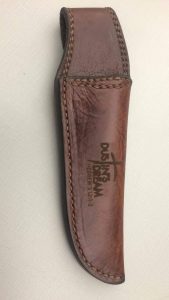
Knifemaker Stefan Neil Palmer made a sheath to accompany the knife he made to benefit Dustin's Destiny.
Stefan Neil Palmer’s accompanying sheath notes Hebrews 12:1-2, which includes in part “let us run with perseverance the race marked out for us.”

He went to Steve to see if there was anything that Dustin was known for saying. Steve showed Stefan what the Chamberlains had written about Dustin. “Whenever anyone asked Dustin how he could consistently make wise choices and live his faith, Dustin would say, ‘Because I love God with all my heart and I don’t want to give Him anything less than my best.’” Stefan explained, “I put that on the knife. When I looked at the finished product, I knew the knife was not for someone to buy. It was priceless and needed to go to Don.”

Stefan took his dilemma to Steve and it was agreed that a second knife would be made for the auction. The trick was to keep Don’s knife a secret, made harder by the fact that Don expressed great interest in the knife. Steve suggested to Don that he not bid on it because people would then back off their own bidding in an attempt to make sure that Dustin’s father ended up with Dustin’s knife. The racing team wanted the knife to bring in as much money for the foundation as possible.

In the end, at Dustin’s 5th Heavenly Birthday Chili Supper and Baked Goods Auction on Dec. 10, 2016, Stefan presented the original knife to Don, with both giver and receiver ending up in tears. “It changed my life,” Stefan said. “I’m not so likely to cut someone off on the race track with the Dustin’s Dream sticker on my car,” he added with easy laugh. (The T in the Dustin’s Dream logo is in the shape of a cross.) He relates how so many people have been affected for the better through Dustin’s example and the strength of the Chamberlains. “So much beauty has come out of it,” Stefan said.

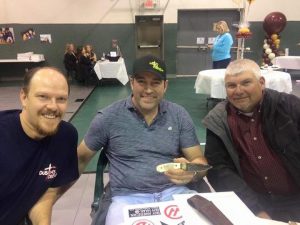
Stefan Neil Palmer holds one of two knives he ended up making in honor of Dustin Chamberlain.
Dr. Carl Duncan, left, ended up with the knife Stefan Neil Palmer, center, made in honor of Dustin, the son of Don Chamberlain, right.

The Chamberlains never returned to their home. Don manages a beef cattle ranch and other properties for his boss, and the couple and their daughter stayed at the ranch the night of the murder. They found a place to rent, but the two payments nearly put them under financially. All the while, Don said he was thinking, “I wish I could afford to just give it away to a couple who could help foster children.” Two years later, a doctor—surprise, surprise—Carl Duncan and his wife, Carol, purchased the home, and—you guessed it—they had foster children.

It was Carol who ended up with the winning bid of $3000 on the second knife, and she presented it to her husband. According to the Dustin’s Dream website, the racing team has raised $45,000 for the foundation.

Stefan’s wife, Raquel, bringing the story full circle, is returning to school to become a doctor—in the same specialty as the doctor who purchased the house and the knife. She and Stefan hope one day to accompany a medical mission team through Dustin’s Dream. Don and Deondra, a nurse, are returning to Guatemala through Dustin’s Dream for his second trip and her third. If you want to know what you can do to get involved, visit www.DustinsDream.net/give.

When Don returned to the house that fateful day, he thought it was odd that the family’s Jack Russell-rat terrier cross was out in the yard. Cricket was trembling in fear, and, uncharacteristically, she would not come to Don. It is believed that she raised a ruckus when the intruder broke into the house near her bed. Dustin came to see what the fuss was about. In yet another connection, I breed Jack Russells.

According to what police revealed to Don, the shooter asked his wife what it meant if someone was very depressed. She answered that it meant the person needed professional help. The husband and father of four reportedly said that he felt he was too much of a coward to do that. He took a gun and left the home.

I asked Don if he knew how the family was doing now. He said he didn’t, but that it had been on his heart to find out, and that my asking had solidified that course of action for him. And “no,” he said quietly, “I could never use that knife.” He has it on a dresser, along with the sheath and some photos. He wants to put it in a shadow box. “I could never use that knife,” he repeated.

‘Art of the Knife’ Is A Showcase of Beauty

"Art of the Knife" is on sale for $21, a 40-percent savings.
“Art of the Knife” doesn’t require anything more than being appreciated for its beauty.

If you want inspiration for your own knifemaking, here’s your eye candy. Over 500 knives are pictured, and they run the gamut from highly polished and bejeweled to hunters with artistic flair. Author and former BLADE managing editor Joe Kertzman covers scrimshaw and engraving, as well as the art of each style of knife. Normally, $35, this beautiful book is now on sale for $21, a 40-percent savings.

Birth of an American Legend — The Bowie

Bowie
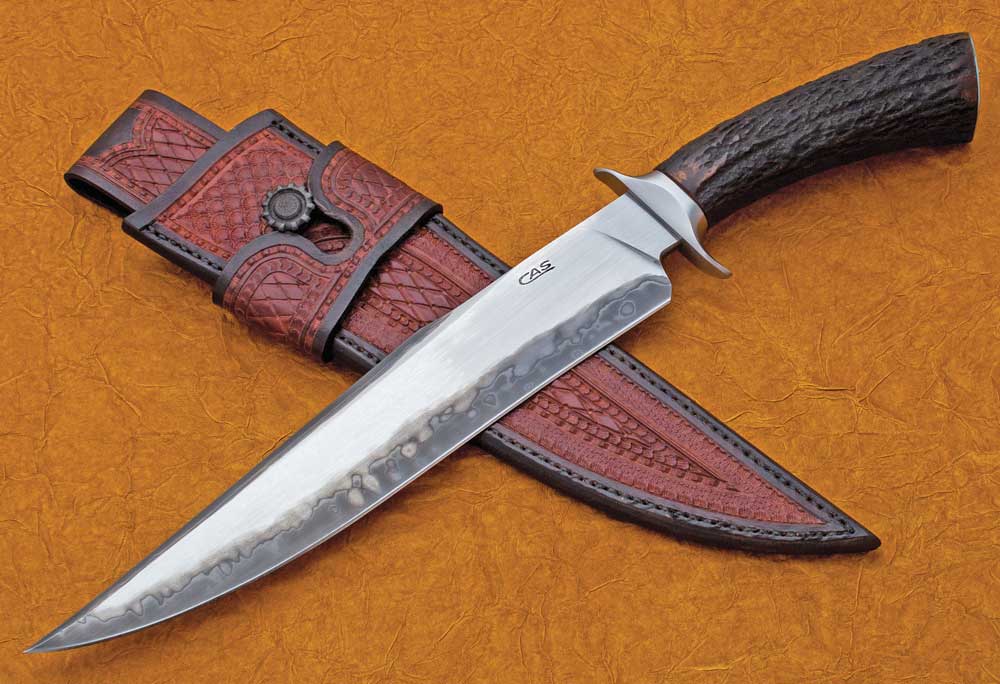
Lightweight and with great balance, Cladio and Ariel Sobral’s stag-handle bowie dons a 10-inch, satin-finished san mai steel blade, stainless steel fittings and a Marcelo Sobral custom leather sheath. (Ward image)

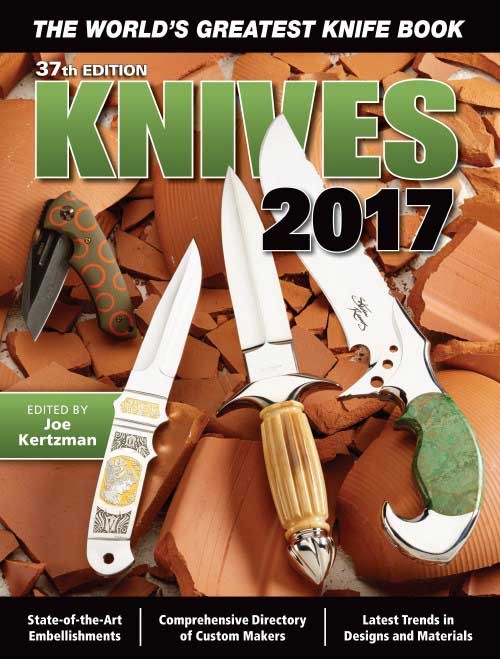
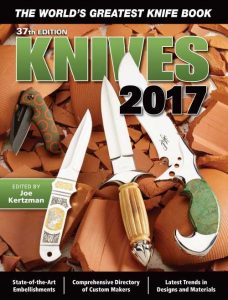
Knives 2017, The World's Greatest Knife Book.
Knives 2017, The World’s Greatest Knife Book.
September 19, 1827, on a sandbar between Louisiana and Mississippi, there was first a duel and then a fight. The fight between Col. Robert Crain and Jim Bowie purported to last only 90 seconds, and those 90 seconds have been discussed and reviewed since that day. While the sandbar fight started the Bowie legend, man and knife, it was probably ant 1831 incident in Texas that solidified the legend. Three armed men, hired to kill him, attacked Bowie. The story goes that even though the attackers were armed with rifles, Bowie was the only man to walk away.

Bowie dispatched all three attackers using his knife. If interested in an in-depth look at the start of the Bowie legend, I highly recommend Dr. James Batson’s book titled James Bowie and the Sandbar Fight: Birth of the James Bowie Legend and Bowie Knife. Batson is not only an excellent researcher and writer, but also an American Bladesmith Society (ABS) master smith. His firsthand knowledge of crafting bowie knives gives him a special insight into the creation of Jim Bowie’s original knife.

Of all the great knifemakers and designers in the world, none of them have an entire category of knives named after them like Bowie does. The style of knife used by Bowie—now known simply as a bowie or bowie knife—saw some changes after the confrontation at the sandbar. Most notable were the addition of double guards to most bowies, and sharpened clip points with the appearance of the forward third of the blade spines being clipped off.

The knives bearing Bowie’s name gained such a reputation and following that they began to be mass-produced in Sheffield, England. Renowned makers such as Joseph Rodgers and George Wostenholm started making bowie knives. Estimates are that upwards of 70 percent of the bowies that went West with the first wave of pioneers came out of Sheffield.

Bowie
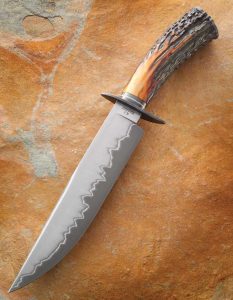
Well balanced and exceptionally quick in the hand, ABS journeyman smith Steve Randall’s bowie boasts an 8.5-inch san mai steel blade, a Sambar stag handle, and a blued high-carbon-steel guard, ferrule and pommel, the latter filed to match the grooves of the stag. (PointSeven image)

The bowie knife enjoyed “must have” status for many soldiers on both sides of the Civil War. The bowie’s diversity was summed up by a historian of the time who described the knife style as, “ … long enough to use as a sword, sharp enough to use as a razor, wide enough to use as a paddle, and heavy enough to use as a hatchet.”

What is and what is not a bowie is the subject of numerous debates. Rezin Bowie, Jim’s brother who had the first knife made for his sibling, indicated the historic knife had a 9 ¼-inch blade. Given that there is no photo of the knife, we can only go by information historians have gathered. My take on the blade length of the first bowie is that it was between 9 and 11 inches.

I’d like to say I based this on Rezin’s comments but that is not the case. Certain blade lengths favor particular tasks. Bird-and-trout blades are usually between 2 and 4 inches. Hunters and skinners generally have blades in the 3- to 5-inch range. Camp knives often feature blades stretching from 5-7 inches, and fighters commonly sport blades in the 6-8-inch range.

Based on Rezin’s comment that the blade made for his brother was 9 ¼ inches, combined with the variety of chores that could be done with the bowie, the 9-11-inch range is where I place the bowie’s blade. All of the blade lengths mentioned are generalizations. Blade lengths are subjective, and different categories will often feature shorter or longer blades. I have seen gent’s or a gambler’s bowies with 4-inch blades and hunting knives parading 10-inch blades. When I see knives sporting blades that defy the conventional lengths of their category, I am reminded of my 7th-grade shop teacher who always reminded us to use the “right tool for the job.”

Editor’s Note: This article is from Knives 2017.


R0735

The World’s Greatest Knife Book

For going on four decades, Knives has been the most comprehensive and trusted resource in the knife world, delivering an entertaining and authoritative selection of features, industry reports and eye-catching knife galleries. The annual offers knifemakers, knife collectors, knife buyers and knife dealers the vital information they require. From reliable factory knives to custom-made gems, Knives 2017, 37th Edition cuts to the quick matter to raise readers’ blade IQ. Get Your Copy Now

Blade Junkee supplies fix for knife addicts

0
Scott Wolfrom knows how to keep knife addicts happy because he used to be one himself.
Robert Scott Wolfrom sold his personal knife collection to start Blade Junkee, which sells custom and tactical knives to blade junkies worldwide.

Addicts: It takes one to know one, as the saying goes. It’s no different with knife junkies. Robert Scott Wolfrom, who goes by Scott, is the driving force behind Blade Junkee, a California-based custom and midtech knife purveyor. He’s a blade junkie himself, so he knows exactly how to feed the addiction in others. Knife junkies are always on to the latest thing, so Scott tries to be one step ahead of the next trend. One way he’s done that is to create a retail app, not just a mobile-responsive website, but a true app that you download to your phone from Google Play or Apple iTunes. Since its launch in 2015, approximately 4000 people have done just that, according to Scott. Websites will be a thing of the past, Scott predicts. “Phones are getting bigger. Younger people are doing everything on their phones. Most of them don’t even own a computer.”

In the 1990s Scott owned a custom flooring and milling business. That industry was decimated when exotic woods began flooding the market and China began producing cheap composites, Scott explained. Homeowners are currently suing Chinese manufacturers because they are getting sick from the formaldehyde used in lumber products coming from that country. Nobody understood the dangers of not using formaldehyde-free American-made flooring and molding at the time, Scott said. The end result was his company went out of business.

Blade Junkee also offers Bladeaway, a knife lover's layaway.
Blade Junkee is based in California but supplies knife junkies all over the world with custom and midtech knives.

He tried his hand at air conditioning manufacturing and construction, and he became a general manager in retail. Finally, in 2008 he thought about what he was passionate about: knives. He’d always been a collector, so he took a huge step. He sold his knife collection. He reaped $40,000 from the sale and sunk it all into his new business: Blade Junkee. The name came from his user name on knife forums.

“I am blessed,” he said about what he’s doing now through Blade Junkee. His wife, Jennifer, a school psychologist, helped him recognize his own knife addiction, and now he gets to collect all kinds of custom knives…and then sell them. “They come in and they go out,” he said with a laugh.

The Blade Junkee app offers a running list of custom knives that Scott has in stock. He is on knife forums daily, social media daily, he talks with makers and others in the industry daily. He explains that he must be following the trends in order to capitalize on what’s hot. A certain maker might be in demand for a while, or a certain construction method. Then it changes. Hand-rubbed could be in, or acid treated or the current psychedelic-looking craze. Then the trends circle back around.

Scott recognizes those cycles, because…well, he was a junkie. While some dealers can only take one or two knives at a time from a maker, Scott offers to buy eight or 10 knives at a time. The maker might say, That’s going to be $30,000; and Scott’s right there to say, Yeah, here’s $15,000 now. “It’s hard for a maker to turn that down,” he said. In this way, he never worries about whether he sells all the knives or not; if he doesn’t, he’ll have some set aside for when everyone’s scrambling to get one of that maker’s knives again.

The strategy appears to be working. In 2016, according to Scott, Blade Junkee did $1.3 million in sales. (In addition to selling custom knives, Scott also manufactures fittings, such as screws, that he sells to knifemakers.) Scott sees a lot of business from Russians, Thais and Europeans. He has customers who will spend $10,000 a month on knives. A customer may tell him, “The wife’s buying purses and shoes,” so he wants a knife that matches a particular watch.

But it isn’t just wealthy customers who fall in love with a well-crafted custom or tactical knife. Customers will tell Scott simply that he made them happy when he posted a certain picture of a knife. They might be having a bad day and seeing a picture of a well-made piece of art that Scott posted lifted their spirits. “There’s plenty more where that came from,” Scott says with a laugh. Not only does he understand buyers from both ends of the spectrum and their motivations, but it brings him joy to make them happy and feeds his own blade addiction.

If you think you can’t afford a knife you see on Blade Junkee (while you’re rocking out to, say, Rage Against the Machine or Bob Marley’s youngest son Damien), you’d be wrong. Scott offers Bladeaway, layaway for knives in four payments over a 45-day period with a 5 percent fee. This is a certain way to lock in the purchase of a knife at the current price. Some knives go so fast that Scott can’t keep them in stock because the makers aren’t mass-producing their work. “They’re artists, and I treat them like artists,” Scott said. Because of his willingness to purchase higher quantities of a maker’s work up front, a maker might pick up a call from Scott where he might avoid a call from a dealer who can only take one or two knives. This also gives Scott the ability to pick and chose which knifemakers he pursues, based on what trends he sees developing and what his junkies are clamoring for.

Although never a hunter, Scott used to fish, and like many of us, his first knife was a Buck. “I don’t drink. I don’t have kids. But I have a lot of energy. I know how to run a business. I have connections. I know how to make calls and make things happen.” And he is passionate about knives. Although Scott currently sees most of his business coming through the Blade Junkee website and social media, he can see every company having a mobile app in the future. He’s already one step ahead on that trend.

Know what your collection is worth

"Knives and Their Values" will help you understand the history and value of your knife collection.
This book, edited by BLADE editor Steve Shackleford, will help you price and care for your knife collection.

This volume will help you understand the history of the knives you collect, how much they are worth, and how to spot a fake. You will learn how to grade knives for buying and selling, and how to take care of the ones you keep. Best of all, you don’t have to wait for mail delivery. You can begin reading your e-book version right away for $24.13, a 20-percent savings.


Which Knifemakers Will Excel in 2017?

Which knifemakers will excel in 2017? What is the mark of knife greatness? When does the magic begin in the making of mosaic damascus, aka canned steel? What were the knife industry’s top stories of 2016? What will not happen in the knife industry in 2017? These and other edge-pressing questions are answered in the latest issue of BLADE®, on newsstands now!

Custom knifemaking is a whirlwind of talented individuals worldwide. Picking the ones on the verge of breakout years is no easy task, but BLADE feature writer Pat Covert tackles the assignment with gusto, interviewing some of the custom industry’s top authorities for their opinions on the subject. Find out which makers will take their work to the edge and beyond in “Will One Steel Your Heart?”

What is the mark of knife greatness? One leading indicator is a knife that, after its debut, serves as a yardstick against which all subsequent knives of a similar type are measured. BLADE field editor Mike Haskew examines these “yardstick knives” in “The Mark of Greatness.”

Mosaic damascus, aka canned steel, provides some of the most beautiful and intricate of blade materials. BLADE feature writer Daniel Jackson visits with some of today’s forgers of the scintillating steel to find out not only why they do it but how in “When The Magic Begins.”

The year past had more than its share of cool happenings in the knife industry, including the first-ever

Mosaic damascus
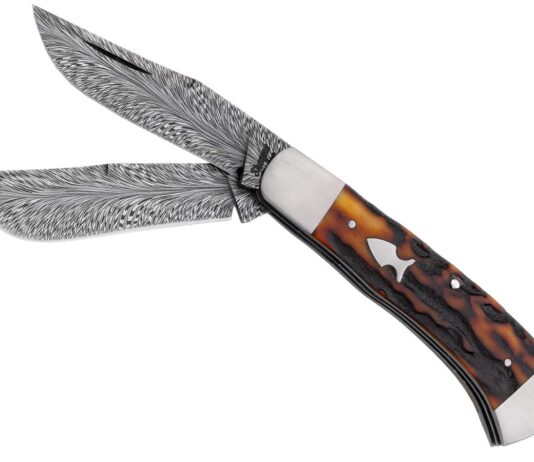
Read how mosaic damascus is forged, such as on these folders by Mike Tyre, in “When The Magic Begins.” (PointSeven image)
Borka Blades
Which knifemakers will excel in 2017? One Neil Ostroff highly recommends is Sebastijan Berenji of Borka Blades. (True North Knives image)
BLADE on newsstands
Find out which knifemakers will excel in 2017 in the latest issue of BLADE®, on newsstands now!

BLADE Show Women’s World Championship Cutting Competition, burgeoning knifemaking stars on social media, pro-knife legislative gains, a world record price for an American knife at auction and much more. Read all about it in “Sharp and Sweet ’16.”

Predicting what will happen in the coming year is a skill far beyond that of yours truly. However, one thing I can do is predict what will not happen in the coming year. Of course, one question remains: Can I even do that? It will take one year to find out. Check out my predictions in “What Will Not Happen in 2017.”

There’s much more in the latest BLADE, including an educational examination of knives and the Second Amendment by Knife Rights’ Doug Ritter (page 6), tests of the latest tantos, flipper folders and factory/custom collaborations, the hottest convenient carry knives and much more, all in the March 2017 BLADE, on newsstands now! For subscription info, click here.

Save

Save

Save

Save

Save

‘Alone’ survivalist Larry Roberts praises LTWK’s Genesis

Larry Roberts appeared on the second season of "Alone" and held out 64 days in the Vancouver Island wilderness.
Larry Roberts used the L.T. Wright Knives’ Genesis to survive as a participant on the History channel’s “Alone.”

Larry Roberts, runner-up in the second season of the History channel’s wilderness survival show “Alone,” lasted 64 days in the harsh environs of Vancouver Island with one knife: the Genesis made by L.T. Wright Knives. L.T. Wright knew Roberts as a customer and because he wrote articles for the company’s Self Reliance Illustrated magazine. What he didn’t know, because “Alone” participants are not allowed to discuss the show, was which knife Roberts used on the show. When Roberts was allowed to talk about his experiences, he raved to Wright about how much he appreciated the Genesis. Wright suggested they team up, and a winning partnership was born.

On Dec. 16, LTWK introduced its Larry Roberts Signature Edition Genesis to the public. Fans of the “Alone” star and members of the LTWK Pout House club were eligible for pre-release access for 24 hours prior to the general release.

The premise of the reality show is that a group of outdoorsmen and women are deposited in a remote locale—alone—and whoever can survive the longest, wins—$500,000 to be exact. They are positioned so that natural obstacles prevent them from encountering each other. There is no crew; the participants film themselves and are resupplied with batteries and camera chips. They must build shelters, find enough to eat without expending too many calories, stave off hypothermia and marauding animals, and maintain their sanity.

So, how exactly did Roberts use his knife? The list is extensive. He built small game traps and a fish trap. He used it batonning, feather-sticking, harvesting spruce sap and cedar bark, gutting and filleting fish, processing mice and prying shellfish off of rocks. He used it to make a spoon, a spatula and a fork. He harvested mushrooms with his Genesis, cut cordage and used the sharp 90-degree spine of the knife to strike his ferrocerium rod to start fires. He used the knife to make a spear and tent stakes, and even for first-aid and hygiene tasks, such as removing a splinter or cleaning his fingernails.

The LTWK Larry Roberts Signature Genesis comes with a true 8-oz. leather sheath with dangle and farro rod loop.
The Larry Roberts version of the LTWK Genesis has a broomstick handle and sharpened spine to assist in firebuilding.

The knife measures 9 inches overall. The 4.25-inch blade has a Scandinavian grind, and the chiseled edge is ideal for bushcrafting skills like making kindling, tent stakes and stripping bark, L.T. Wright explained. It used to be, he continued, that outdoor knives were overbuilt to account for hard use in the field, but now that the education and skill level of outdoorsmen has advanced, often through watching and practicing skills learned just on YouTube, thinner-edged knives are sought after by outdoorsmen and survivalists. Roberts, too, praised the knife’s ability to bite deeply into wood.

The Genesis offers a 1/8-inch-thick spear-point blade made of A2 tool steel, following a Kephart design overall. The knives are tested to 57 to 59 HRC on the Rockwell hardness scale, so they are tough but hold an edge, Wright said. The A2 steel, in the opinion of both Wright and Roberts, outperforms O1 and 1095 for edge retention, and corrosion and stain resistance. For his time on the island, Roberts only stropped his knife on his leather belt to remove micro-oxidation from humidity and moisture. He never had to resharpen it at all.

The Roberts version of the Genesis has a broomstick handle because Roberts found the thicker handle easier to hold and control. It also has thumb scallops and a sharpened spine for striking a fire steel against. LTWK made the black Micarta handle with white liners because Roberts likes the black-and-white contrast. The blade is stamped with Roberts’ rendition of his Vancouver Island nemesis: a mouse. “It became an obstacle for me to overcome,” he said of the creature he battled during the show.

The MSRP of the Larry Roberts Signature Edition Genesis is $225 and includes a true 8-ounce black leather sheath with a dangler and 3/8-inch ferro rod loop. Wright prefers to purchase 10-ounce double-died leather from Spen Stelzer, the owner of JRE Industries in Illinois, and have it split to 8 ounces so there are no discrepancies. “We can control consistency better that way,” he explained.

Roberts wanted the largest ferrocerium rod he was allowed to have during the show, so he went with a ½-inch rod and wasn’t able to use the loop that comes with the Genesis sheath. Roberts did use the dangler, however. He explained that it allowed the knife to hang where his hand fell naturally for easy access—just like a gunslinger in a western—and yet carry out of the way of a backpack or any other gear.

Wright grew up playing Tarzan and Rambo in the woods as a boy, and, of course, the tactical use of knives and their implementation in hunting and bushcraft interested him all along. But he wanted to make a living making knives, so he listened to what people told him they wanted. “If you go to a show and come home with all the knives you brought, you’re not going to be in business long,” he said. Like the survivalist industry itself, as the education and skill levels of users advance, so too must the sophistication of the knives. Wright listened.

The crew at L.T.Wright Knives specialize in knives that are favored in bushcrafting.
L.T. Wright (front row, second from left) was surprised and happy to find out his Genesis was the knife Larry Roberts used on the “Alone” series.

At first he made knives as L.T. Wright then as Blind Horse Knives and he’s back as L.T. Wright Knives. Wright learned to make knives from R.W. Wilson, who made the tomahawks for the 1972 movie “Jeremiah Johnson,” a cult favorite among outdoorsmen. “He’s probably sold off all of those,” Wright said, “but I do have a prototype of a tomahawk he made for the Texas Rangers.”

So, it is fitting that Wright should partner up with a man who carried his knife in a reality-based outdoorsman show for the small screen. Roberts grew up in Oregon, spending as much time outside as he could, bait-fishing for steelheads in the Rogue River and bow hunting. His first knife was probably a 3-inch lockback Buck pocketknife, he said. He married his high-school sweetheart, and they had a son and a daughter, now grown and on their own.

Roberts attended the Pathfinder School, LLC Survival Classes offered in Jackson, Ohio, through Self Reliance Outfitters. An instructor at the top-rated school, Dave Canterbury, had been on Discovery Chanel’s “Dual Survival” show, and Roberts had heard about “Alone” from a season one participant named Josh Chavez. Roberts had been looking for a challenge, a real-world way to apply the skills he’d learned. “This was it,” he said, and applied online.

You can be a superb outdoorsman, Roberts pointed out, but if you can’t express yourself in front of a camera, you won’t be selected for the show. Although more shy in real life, Roberts is a natural in front of the camera. He sent along hours of footage of himself conducting survival skills. He made the cut, and a total of 20 finalists attended a boot camp in New York. They were tested on their comfort level in the outdoors in a city park. They underwent both medical and psychological testing, and were trained extensively on how to operate the cameras they would be using to film themselves for the show.

Even though Roberts eventually had to “tap out” because he could not get enough food to compensate for the calories he expended, his life has changed from being on “Alone.” He teaches now for Pathfinder and privately on his own farm. He attended the Primitive Living Skills Conference, Rabbitstick, in September in Idaho and will be attending Winter Count, Feb. 12-18 in Maricopa, Arizona.

Roberts can’t say enough good things about the LTWK Genesis. It’s everything he ever wanted in a knife, in every way. Similarly, he can’t say enough good things about L.T. and his crew at LTWK. It was on the island, at night, when Roberts began designing a tattoo he wanted to get. It incorporated everything that was important to him during the “Alone” challenge. You can read about his experiences on the show and how the tattoo both gave him something to think about and something to look forward to getting in “Star of History Channel’s ‘Alone’ Talks Survival and Tattoos,” an interview by Kirstie Kovats in Inked magazine.

Of course, the mouse figures prominently in the design, as does the knife.

‘Bushcraft 101’ teaches the fundamentals of survivability

"Bushcraft 101" is a solid place to start your wilderness survival education, and can be a continued resources as you advance in your skill level.
Dave Canterbury, instructor at top-rated wilderness survival Pathfinder School in Ohio, explains the 5 Cs of survivability in his “Bushcraft 101.”

Not sure where to start with your quest to master wilderness survival skills? Dave Canterbury, the primitive arts instructor at Pathfinder School in Ohio mentioned above, has written a book that’ll help you get back to basics, enjoy the outdoors and understand the essentials of wilderness survival.

Save

Knife Ed 101: From the Periodic Table to the Rockwell Hardness Scale

Jim Bowie scowls as I absorb the minutia of properly conveying knife specs.
Jim Bowie is not amused with my lack of knowledge about steel mixes.

Knowing what you don’t know sometimes means knowing when to stop researching and just play with your knife. In the course of more fully educating myself about knives, I find that everything, and I mean every little thing, involves further study. It can be paralyzing. And sometimes it needs to just get silly so I can stop worrying about it.

I’m in charge of maintaining the style sheet at BLADE, which is an alphabetical list of knife industry-specific terms and instructions—or exceptions to instructions—regarding how we present certain things in BLADE. We want to be consistent.

The other day my boss and BLADE editor, Steve Shackleford, sent me something like, “Just so you know… the V in MoV is always capitalized. For example, 8Cr13MoV: Cr refers to chromium, Mo refers to molybdenum and V refers to vanadium—all elements in the steel mix.”

Cool, I thought.

And then I thought: The periodic table of elements? Seriously?

For an English major with a history minor—even one into guns and knives—this concerned me. Oh sure, there’s science in the acids and bases of a batch of cookies in the oven, but I honestly never imagined printing out that chart after I left high school. But there it lies, adding color to the growing pile, its information so obvious in hindsight. Jim Bowie perpetually scowls with what I imagine can only be his disappointment in my slow pickup.

So, when Steve explained how BLADE presents Rockwell hardness: “the Rockwell hardness is 58-59 HRC,” I figured I should try to fit more about that topic into my rock hard head.

After work I called a friend.

His response: “What is the Rockwell hardness scale and what does it mean to me?”

Exactly, I replied.

And while we’re at it, I thought, aren’t “hard” and “tough” synonyms for the same thing, like soldiers or overcooked steak? (That’s a joke. You can read about the difference between hardness and toughness in Bernard Levine’s article, “Rockwell Hardness, What It Is And What It Means To Your Blades,” BLADE Magazine, Sept. 1997, Pages 74-76.)

And why can’t I close my Twitch II? Am I not pressing hard enough? Am I afraid of the release? (That’s not a joke, and no, the lock is not engaged.)

“I can envision both scenarios,” my friend said.

That’s how he talks.

We joke about cut-resistant gloves, only he’s not joking. I’m a klutz.

He explained something about measuring divots and my ears stopped up and my eyes glazed over. I have a hard time thinking in 3D.

But I had the power all along. In the archives of BLADE itself I found this helpful article: Bernard Levine’s article, “Rockwell Hardness, What It Is And What It Means To Your Blades,” BLADE Magazine, Sept. 1997, Pages 74-76

It all makes perfect sense. I think I can now move on to worrying about whether there’s a good mix of ATS-34, 440C, CPM S30V, CTS steels and 5160, O1, D2, 1095, L6 steels represented in our Knifemaker Showcase pieces.

Your Knifemaking Questions, Answered

Knifemaking bookGet all your knifemaking questions answered in this collection of expert advise from former BLADE columnist Wayne Goddard. The Wonder of Knifemaking makes a thoughtful gift for someone interested in starting or perfecting their knifemaking skills


Advertisement

Must Read Articles

Read this before you make a knife

Knifemaking 101 – Read This Before You Make a Knife

  by Wayne Goddard My experience has taught me that there's nothing like digging in and getting started. I've often said the hardest part of the...
how to forge damascus steel

How to Forge Damascus

Advertisement
Advertisement