Knife Collecting

Knife collecting is an extremely rewarding experience for knife enthusiasts. There truly is a knife for everyone. Many increase or hold their value throughout the years, making collecting knives something to pass on to the next generation of knife collectors.

Roosevelt Knife Auction Sept. 9-11

President Theodore's Roosevelt's knife.
The pommel of the Roosevelt knife is carved in the shape of an eagle’s head of solid gold. The eagle’s eyes are garnets.
Roosevelt's knife
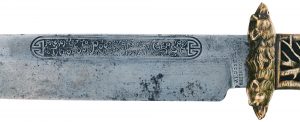
The blade has the engraved inscription, “Presented to Theodore Roosevelt By His Friend James W. Gerard.” Two bear heads serve as the guard’s quillons.
Roosevelt circa Oct. 1910.
Theodore Roosevelt in October 1910.

President Theodore Roosevelt’s knife, passed down through the Roosevelt family for the past 107 years and never before available for sale to the public, will be put to auction Sept. 9-11 by Rock Island Auction Co.

Roosevelt's knife
On one side of the handle is a forest scene with two men crouching behind a tree, one standing with rifle in hand, the other crouching.

Made by J. Russell & Co. of Green River, New York, the Roosevelt knife features handle work by Dreicer & Co. (1904-1923), the latter a leading jewelry retailer of the time and a competitor of such top companies as Faberge. Said to have originally cost $1,250—$33,216 in 2016 dollars—the Roosevelt knife is predicted by Rock Island Auction Co. to bring between $150,000 and $300,000 at auction.

According to public documents, James W. Gerard of the “supreme bench of New York City” and later ambassador to Germany, presented the knife to Roosevelt on March 3, 1909—Roosevelt’s last full day as president. It was a gift Gerard intended for Roosevelt to use on an upcoming African hunting trip. A March 10 story in the local Rock Island newspaper carried the headline “Fine Knife For Roosevelt.” It described Gerard as a close friend of Roosevelt and the knife as a “masterpiece of jeweler’s workmanship, the hilt being wrought in gold and platinum and ornamented with jewels. The [pommel] is carved in the shape of an eagle’s head of solid gold. The eagle’s eyes are garnets.

“On one side of the hilt beneath the eagle’s head is depicted a forest scene, with two [men] behind a birch tree, one of them standing, rifle in hand, the other crouching. The tree is done in gold upon a platinum background. On the reverse side is set the arms of the United States, surmounting a wishbone and intertwining tree boughs in gold. Below is the monogram ‘T.R.’ The background on this side is also of platinum. Two bears’ heads extending out from the handle form the guard at the base of the blade,” which is engraved “Presented to Theodore Roosevelt by His Friend, James W. Gerard.”

For more on the auction of the Roosevelt knife, contact Rock Island Auction Co. at www.rockislandauction.com.


Save

Save

Save

Save

Save

Save

Save

Save

Save

Save

Save

Save

Save

Save

Save

Save

Custom Pocket Clips: Sal’s Pals

Zieba's rose gold clips
The serpentine titanium clips on Michael Zieba’s folders are finished in rose gold. (PointSeven image)
Butch Ball's damascus trailing point clips.
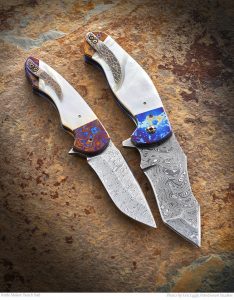
Damascus trailing-point clips adorn Butch Ball’s pearl folders. (PointSeven image)


C15 with pocket clip
Spyderco’s first factory/custom collaboration, the C15 designed by Bob Terzuola, sported a pocket clip.
short skeletonized clip
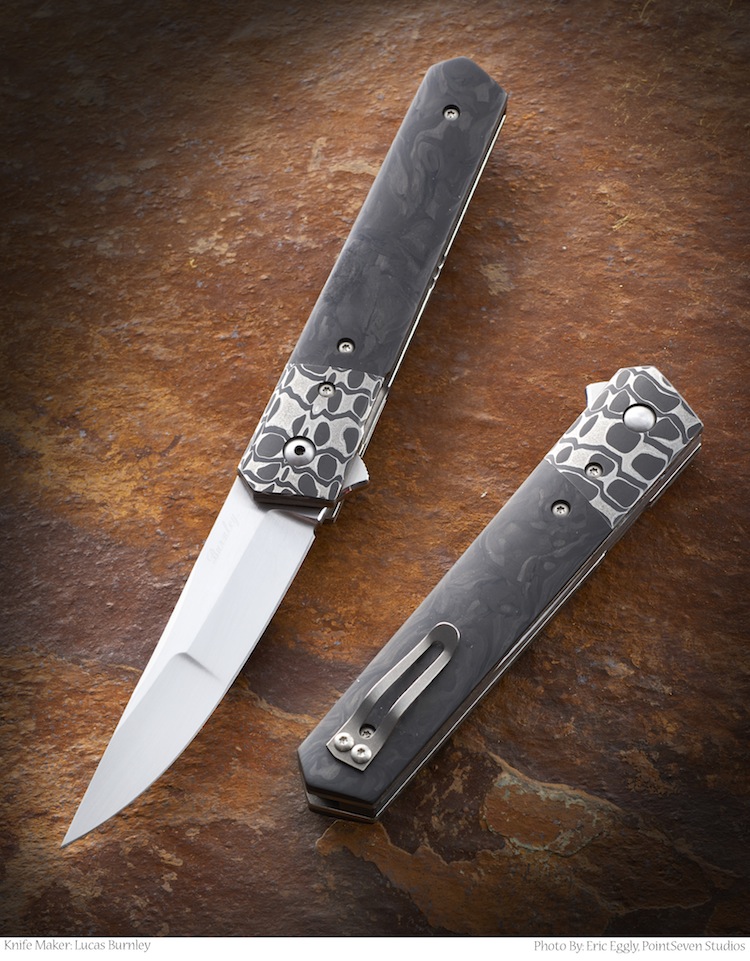
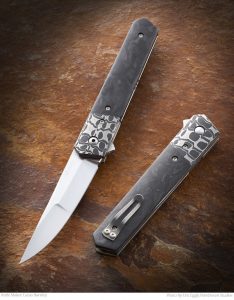
A short, skeletonized clip distinguishes Lucas Burnley’s Asian folder. (PointSeven image)

Custom knifemakers seem to introduce most knife innovations, which are then emulated by factory knife companies. Not so with custom pocket clips. BLADE Magazine Cutlery Hall-Of-Fame© member Sal Glesser popularized knives with pocket clips in his Spyderco production line, and custom knifemakers took their cue from him. As a result, today’s custom pocket clips might well be called “Sal’s Pals.”

mokuti pocket clip
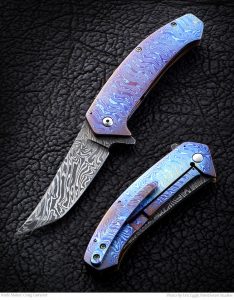
Craig Camerer employs mokuti for the long, curved clip on his folder. (PointSeven image)

Celebrating its 40th anniversary this year, Spyderco offered its first knife with a pocket clip—and also the company’s trademarked blade opening hole—in 1981 when it introduced the Worker model. Spyderco also popularized serrations on sporting folding knives.

The fact that custom knifemakers adopted the pocket clip, as did factory knife companies everywhere, should come as no surprise. For one thing, the clip’s abilities to attach a closed folding knife to the lip of your pocket rather than having the knife bang around in the bottom of it with car keys, coins, etc., and to make it much easier to retrieve are eminently practical. In addition, Spyderco has offered many factory/custom collaborations—knives designed by custom knifemakers and then reproduced by a company, in this case Spyderco. The first of these was in the early 1990s—the C15 designed by Bob Terzuola, which, of course, also had the blade hole and a pocket clip.

Today’s custom versions of the pocket clip run the gamut, including long ones, short ones, tall ones, round, anodized ones, rose gold ones and more.

For instance, Michael Zieba won Best New Maker at the 2016 BLADE Show for his S2 standard and mini models with serpentine titanium pocket clips finished in rose gold.

Short, cross-hatched clip
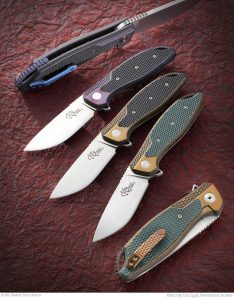
Ken Onion’s folders have a short, cross-hatched pocket clip. (PointSeven image)

On the other end of the scale is Lucas Burnley’s Asian-style folder with a very short skeletonized clip, while Butch Ball offers trailing-point damascus clips on his pearl-handle folders. Craig Camerer presents a long, curved clip in mokuti on his damascus folding knife, while Cutlery Hall-Of-Fame member Ken Onion opts for a short, cross-hatched clip on one style of his folders.

These are but a few of today’s custom knifemakers who took their cue from Sal Glesser and his utilitarian pocket clip. Hey, if you’re going to emulate someone, emulate the best.


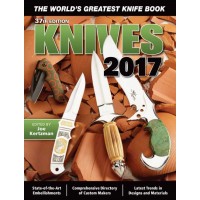
Don’t Miss Knives 2017, the World’s Greatest Knife Book

Best price best knife book about knivesThe best knives in the world can only be found in the greatest knife book on the planet. Put your order in for Knives 2017 and look forward to gorgeous full-color photos of custom knives, in-depth articles and profiles of the hottest knives from the best ‘makers.

Order Knives 2017 from ShopBlade.com for the best price anywhere.

Featured Knife: CRKT Homefront – 2016 Most Innovative Imported Design Award Winner

The CRKT Homefront: A Hit Before It’s Even Out the Door

What I enjoy the most about knife shows is the hidden gems I’ll find among the blades. Whether it’s a unique spin on a classic design, a different type of steel or handle material, a peanut-butter-meets-chocolate pairing of knifemaking pros or a radical new approach, nothing beats finding that diamond in the rough. The 2016 BLADE Show was no exception, and that’s where I first encountered this:

This, ladies and gentlemen, is the new Homefront from Columbia River Knife & Tool (CRKT), and it went down as one of my top finds at the world’s foremost knife event. Straight from the brain of Ken Onion and sporting patent pending features, I could tell this was a game changer right from the beginning. The awards ceremony at the BLADE Show proved me right. The Homefront took home the award for 2016’s Most Innovative Imported Design, and it’s not even on shelves yet.

What Makes the CRKT Homefront Special? Field Strip Technology

CRKT Ken Onion Homefront Best Knife Award Winning
“The new Field Strip Technology is great and all, but have you tried NOT burying your knife in mud?” (CRKT photo)

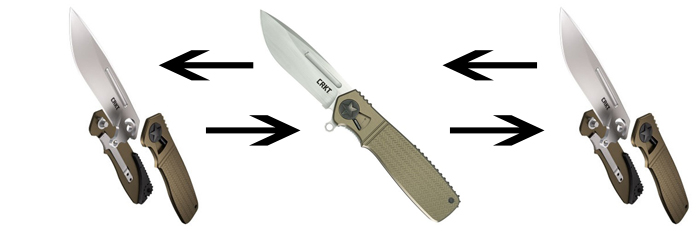
The Homefront is to knives what takedown rifles are to firearms. The Homefront’s wickedly simple Field Strip Technology allows the user to disassemble and reassemble the knife in mere seconds. Just flip a switch and turn a screw as shown in the video above. It’s as simple as that.

That same video shows the knife being cleared of dirt and debris in a stream after use outdoors, which is a great application of the Field Strip Technology. But you know what I’m most excited about? Pocket lint.

“The Easier a Knife is to Clean, the More Likely it is to be Cleaned”

Pocket lint is the bane of my everyday carry folders. The sorcery of fuzz, residual heat and repetitive motion that comes with slipping an EDC into the pocket can form a gooey mess we knife scientists like to call, “gunk.” (I’m sure there’s a Greek root word in there somewhere.) This gunk builds up in hard-to-reach places and eventually requires disassembly, because there’s a limit to what all those gallons of knife oil can do.

With Field Strip Technology, cleaning up no longer requires a set of tools and a magnet to find those tiny screws when they inevitably roll onto the floor. The Homefront comes apart in seconds, then reassembles just as quickly. The result is an simple-to-maintain folding knife that will last. The easier a knife is to clean, the more likely it is to be cleaned.

I fully expect CRKT to use Field Strip Technology on other models in the future. I wouldn’t put it past CRKT to come out with add-ons to the Homefront to take full advantage of this tech, such as alternative blade and handle designs. To that end, the Homefront would be more like the AR-15 of knives, where the appeal is in a platform that allows customization specific to the end user. That level of personalization is obvious in trends outside of knives, too, and the Homefront could mark the beginning of a wider evolution of the consumer knife market. If this is the bandwagon, I’m hopping on.

Where to Get the CRKT Homefront: ShopBlade.com

Ken Onion award winning knife 2016 blade show
The CRKT Homefront before and after, and before and after again, and again, and again and again. Click to order yours today from ShopBlade.com.

ShopBlade.com is one of the first outlets anywhere to carry the CRKT Homefront, and it does so with pride. Here are the specs:

  • Overall Length: 8.313 inches
  • Closed Length: 4.728 inches
  • Weight: 4.8 ounces
  • Blade Length: 3.502 inches
  • Blade Thickness: 0.133 inches
  • Blade Steel: AUS 8
  • Blade HRC: 57-58
  • Blade Finish: Brushed Steel
  • Edge: Plain
  • Handle Material: 6061 Aluminum
  • Lock: Locking Liner

Click here to order your CRKT Homefront today!

Ivory: Brady Deciphers Final Rule

Final Rule on ivory.
If you collect, make or otherwise deal in knives containing elephant or antique ivory, the final rule concerning the Special Rule on African Elephants is a must read for you.

In case you missed it, this past June 6 the U.S. Fish and Wildlife Service published its final rule concerning the Special Rule on African Elephants. The final rule will go into effect on July 6—just a little over two weeks from now.

As stated in the USFWS press release accompanying the rule’s publication, the USFWS goal is a “near-total elephant ivory ban.”

The final rule is basically the same as what USFWS proposed last year, including banning the international commercial import of antique ivory; shifting the burden from the trade of antique ivory items to the seller to prove the items are over 100 years old, have not been repaired or restored with ivory after Dec. 27, 1973, and, for some items, were imported through an endangered species “antique port”; and making it illegal to trade ivory in interstate commerce if the ivory is less than 100 years old. There is a 200-gram “de minimis” exception to the rule for “Pre-Convention” ivory that is further narrowed by six other criteria. There are also some special provisions for musical instruments.

According to Sandra Brady of the Elephant Protection Association, to qualify for the “de minimis” amount the following criteria must be met:

1) You must be able to prove your ivory component was legally imported either before 1990 or after 1990 with a CITES (the Convention on International Trade in Endangered Species of Wild Fauna and Flora) certificate;

2) The ivory is a fixed or integral component or components of a larger manufactured or handcrafted item and is not in its current form the primary source of the value of the item, that is, the ivory does not account for more than 50 percent of the item’s value;

3) No raw ivory—period;

4) The manufactured or handcrafted item is not made wholly or primarily of ivory, that is, the ivory component or components do not account for more than 50 percent of the item by volume;

5) The total weight of the ivory component or components is less than 200 grams (7.054793 ounces), and;

6) The item was manufactured or handcrafted before the effective date of the rule (July 6, 2016).

“Ignoring the decline in both demand for ivory and poaching trends, the wildlife groups are also ignoring market laws like supply and demand, and past lessons taught by Prohibition [the USA’s failed ban on liquor from 1920-33],” Brady continued. “But to make matters worse for the elephant, they are ignoring the viability and long-term success of sustainable use, which has brought one species of rhino back from the edge of extinction, as well as the Rocky Mountain bighorn sheep of North America.

“The fight is not over and this is but a small portion of a larger agenda, one that will make animal rights trump human rights and will further defray our rights as citizens of this great nation. Please keep passing on the truth, calling your representatives and supporting the Elephant Protection Association.”

In all, the final rule encompasses over 30 pages. For more visit Revisions to the Endangered Species Act (ESA) Special Rule for the African Elephant.

Save

Save

WE Knife Marries Top-Notch Design with Superior Materials

In creating a superior knife two factors must mesh seamlessly — design and material. WE Knife has covered both bases again and again in nearly two decades of manufacturing.

The knife maker has whipped up some pretty striking blades over the years, turning an eye to both function and ergonomics. And it has executed them with some of the most resilient and desirable material available today.

Durable Titanium, rugged CPM-S35VN steel, modern ceramics — the company’s knives are built to go the distance — then some. The gallery below showcases two examples of WE’s precision knife making. And it doesn’t take much study of the Model 601 and 604 to see that the manufacturer strives to live up to its goal to “create the world’s strongest, enduring quality, sharpest knives.”

Model 601

Image 1 of 2

The 601 has been one of WE’s cornerstone knives, for good reasons. Not only is the folder outfitted with a rugged titanium handle and a CPM-S35VN steel blade (renowned for its strength), it also features a top-notch design. The handle is ergonomically shaped to better fit in the palm and gives the user more control over the knife. The blade is easily accessible with the knife’s ceramic ball bearing enabling a smooth and fast action. And the titanium handle features a titanium clip, to always keep the knife at the ready.

Mac Gray & Co.’s Timeless Mako Folder

mako-folder
There is an enduring quality to Mac Gray & Co.’s designs. One has the idea that 100 years from now, the California company’s knives will continue be as stylish and eye-catching as they were the day they were purchased. It is certainly the case with Mac Gray’s Mako Folder.

The flowing lines and seamless appearance of this classy little folder makes it as hard to ignore as a seductive wink. But the Mako isn’t all good looks. Beneath its seductive façade lies a workhorse, more than ready to pull its weight in any duty it’s called upon.

To that end, Mac Gray has ensured the Mako will have a long life, lining the handle with 6AL4V Titanium. The material adds incredible strength and durability to the knife, at the same tick keeping it a lightweight companion, ready to be toted everyday.

The 3.5-inch blade, which boasts a saber grind, is made of 154 stainless steel, which is renowned for its toughness and edge retention. These qualities are primarily due to the steel’s high-carbon content and the addition of molybdenum. To top it all off, Mac Gray has included an attractive thumbscrew on the modified drop point blade for quick opening — a feature which will win fans among both righties and lefties as it is ambidextrous.

Mac Gray allows a certain amount of customization when it comes to the 8.5-inch Mako. Customers have the choice of Micarta or G-10 for the handle material and can choose from five colors (red, bone, black, OD Green or pink). The Mako comes with a stainless steel clip, emblazoned with Mac Gray’s name. The standard configuration is right side, tip down; but the company will tailor the clip to the customer’s carry style upon order.

The folder has a linerlock style locking mechanism, which prevents the blade from closing on a user’s hand. It has ¼-inch pivot with a bronze pivot bushing to ensure smooth operation. And, like all of Mac Gray’s knives, the Mako comes with a lifetime guarantee.

That last feature — the guarantee — might be among the most important of any when it comes to the folder. Because, with its timeless lines and top-notch function, it is almost certain that will be the length of time it’s carried.

Mako Folder Specs
Overall Length: 8.5 inches
Blade Length: 3.5 inches
Handle Length: 5 inches
Blade: Modified drop point
Blade material: CPM 154 Stainless Steel
Grind: Saber
Lock: Linerlock
Liner Material: Titanium
Handle Material: Micarta or G-10
Other features: Ambidextrous thumbscrew, stainless steel variable clip
Website: www.mgcknives.com

Tomorrow’s Knife Trends Today

Adventure Flipper by Williams.
The Adventure Flipper by Lee Williams features a “pivot-less” build. Closed length: 5 inches. (Dave Stark image)
Thorburn's L46.
The L46 flipper in Bohler N690 stainless steel and an earth-brown G-10 handle is hot from Andre Thorburn. (BladeGallery image)

If you’re looking for what the knife trends are in custom blades or what the knife trends are going to be later on in the factory cutlery industry, some of today’s hottest custom folders is a great place to start.


Just about every current knife trend in both the custom and factory industries can be traced to a custom folder. LinerLocks™? BLADE Magazine Cutlery Hall-Of-Fame© member Michael Walker revamped the design circa 1980 and has continued to improve it and build evermore creative folding mechanisms ever since, but it was his LinerLock design that revolutionized the custom knife industry in the late 1980s and the factory industry followed, with the locking mechanism appearing on scores of folders worldwide ever since. Flipper folders? BLADE Magazine Cutlery Hall-Of-Fame© member Kit Carson popularized them in the 1990s and flippers seem to be appearing in droves in both the custom and factory industries to this day.

Walker still going strong.
Michael Walker is still going strong after all these years and his folders remain hotter than ever. (Dave Ellis image)
Augustus by Kirby Lambert.
Kirby Lambert named his flipper folder after his son, Augustus. (SharpByCoop image)
Nadeau's Cyclones.
Brian Nadeau’s “Cyclone” appears here in three different versions. (SharpByCoop image)
The Machine by Bharucha.
Tashi Bharucha’s “Machine” features a 3 5/8-inch blade of CPM 154 stainless. (Dave Stark image)
McNees' Copper Baby Bolt Flipper.
Johnathan McNees makes the Copper Baby Bolt Flipper. Closed length: 4 inches. (Andrew Delavan image)If you’re looking for what the knife trends are in custom blades or what the knife trends are going to be later on in the factory cutlery industry, some of today’s hottest custom folders is a great place to start.

These are but two examples. There are many more. There are also some really cool custom folders on today’s market, some of which no doubt will inspire other custom and, later, factory makers to emulate them in some form or fashion. A few of those sharp studies in standout steel would include:

Arnold's Tactical Front Flipper.
The Tactical Front Flipper by John Arnold. Closed length: 5 inches. (BladeGallery image)

•John Arnold’s Tactical Front Flipper. “He creates some of the most elegant daily carry folders, yet with collector-grade quality, that I have come across,” noted Daniel O’Malley of BladeGallery;

•The Copper Baby Bolt Flipper in CPM 154 stainless by Johnathan McNees;

•The Adventure Flipper by Lee Williams with Lee’s “Kick Stop” flipper mechanism;

•Kirby Lambert’s “Augustus” flipper, named after the Lamberts’ newborn son;

•Brian Nadeau’s “Cyclone,” termed by custom knife purveyor Les Robertson as “a great EDC, compact and lightweight”;

•The aforementioned Michael Walker and his large folder in Damasteel damascus;

•Andre Thorburn’s L46 flipper. “Of all the knives that I open and close each day,” O’Malley noted, “Andre Thorburn’s have the most consistent, smooth action of any”;

•Tashi Bharucha’s “Machine” with frames of blasted titanium and a blade-tip-up pocket clip.

Also Check Out:

T7174Knives 2016, 36th Edition
The trusted guide for knife collectors, enthusiasts, knifemakers, and dealers around the world, this knife book covers the latest and greatest from front to back. A collection of feature articles explores the latest developments, history, and transformation of knives, swords, and edges of various kinds. Get your copy


Advertisement

Must Read Articles

Read this before you make a knife

Knifemaking 101 – Read This Before You Make a Knife

  by Wayne Goddard My experience has taught me that there's nothing like digging in and getting started. I've often said the hardest part of the...
how to forge damascus steel

How to Forge Damascus

Advertisement
Advertisement