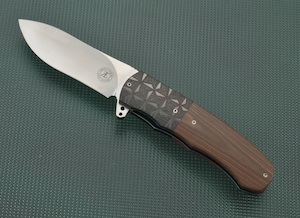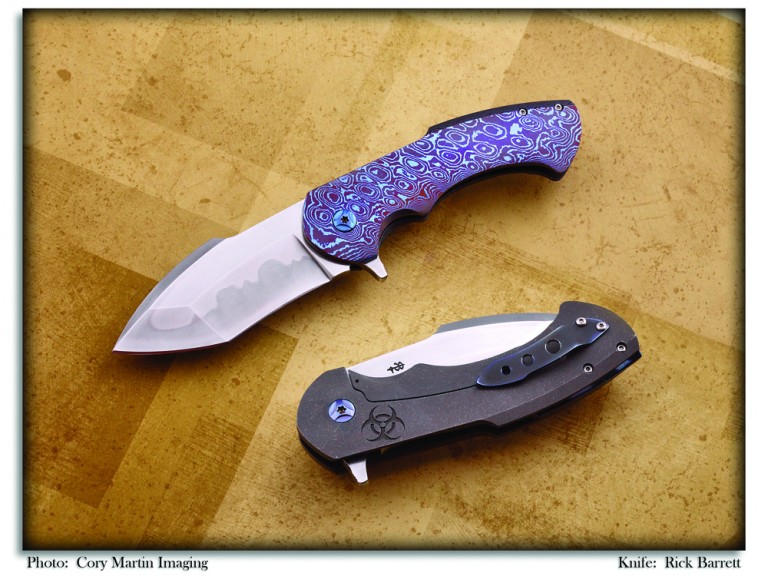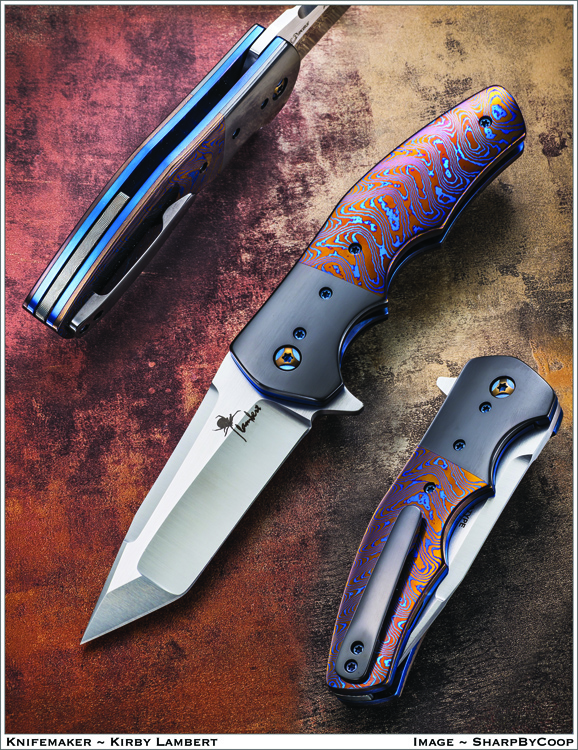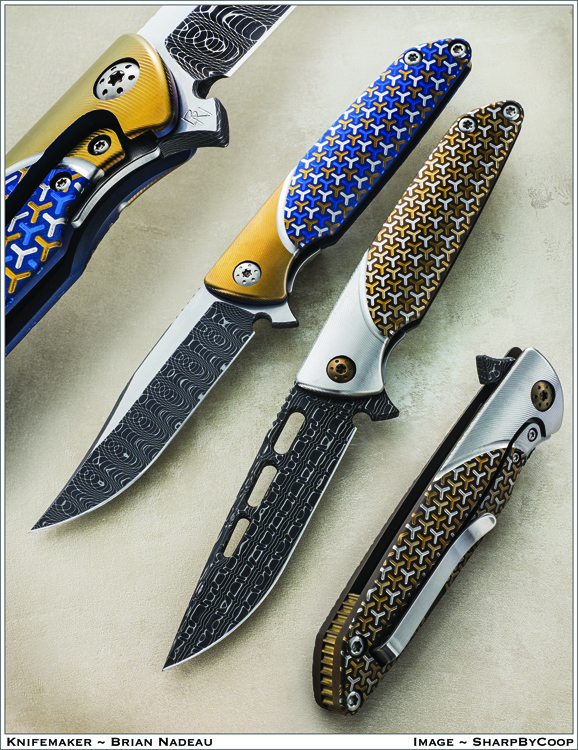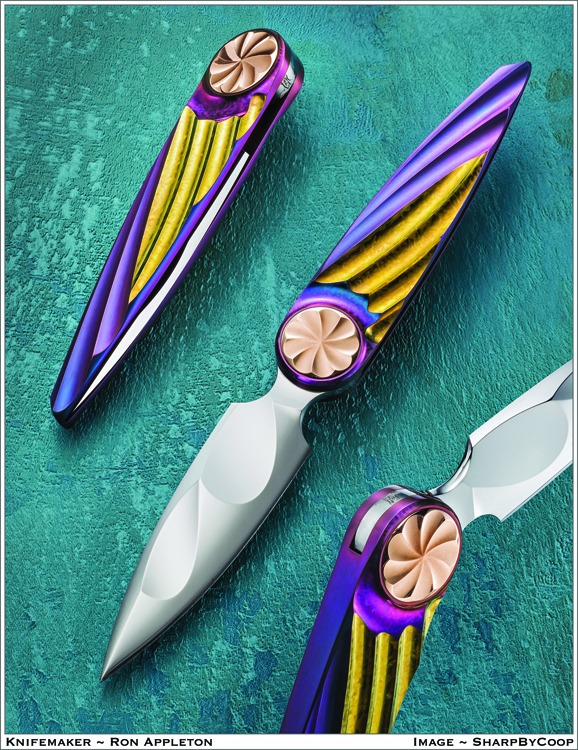
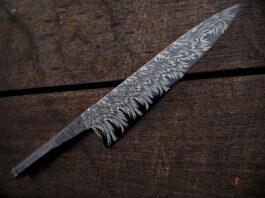
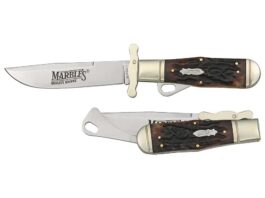
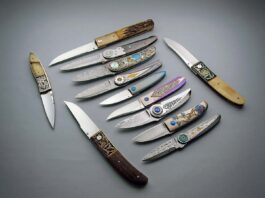


Knife collecting is an extremely rewarding experience for knife enthusiasts. There truly is a knife for everyone. Many increase or hold their value throughout the years, making collecting knives something to pass on to the next generation of knife collectors.
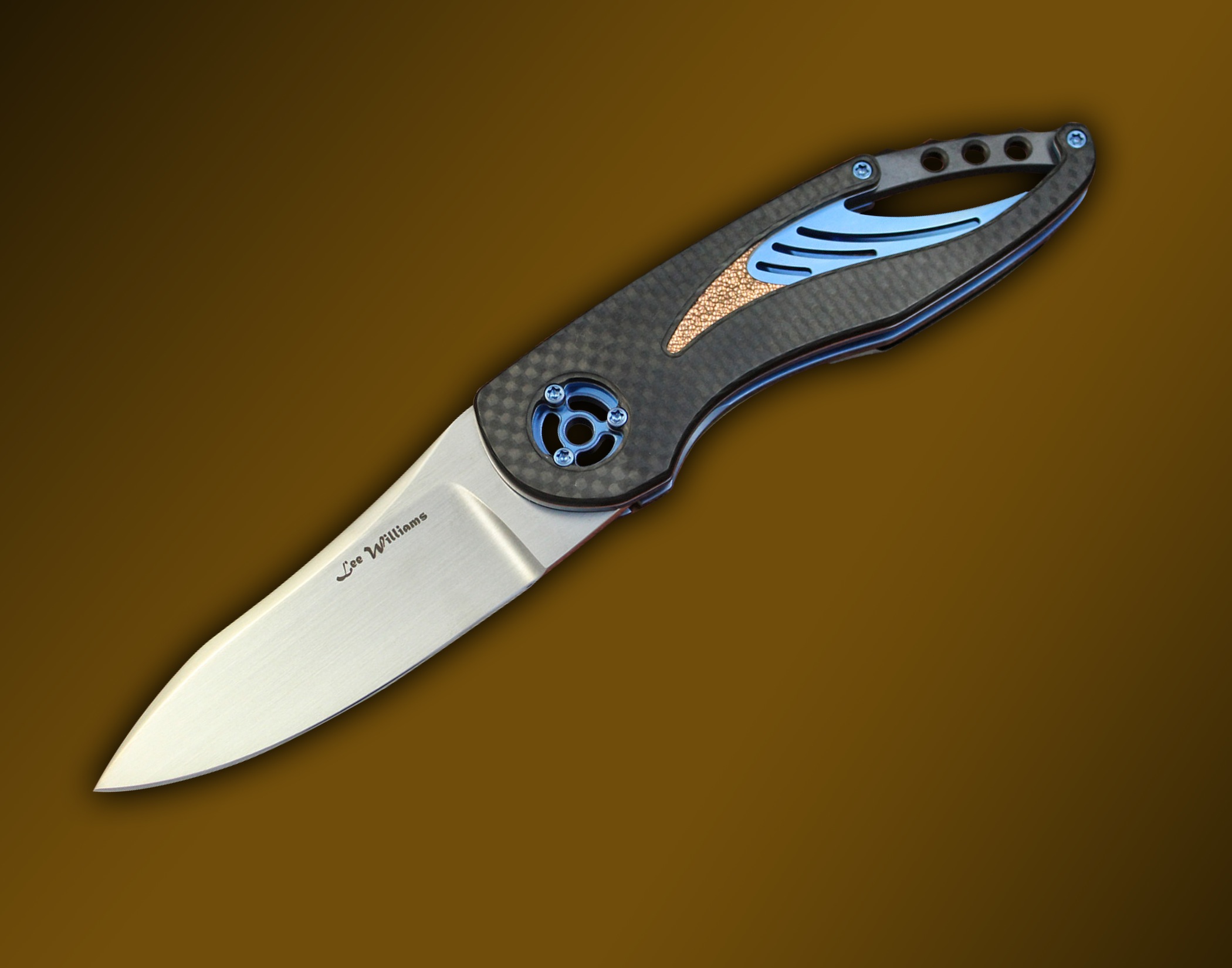
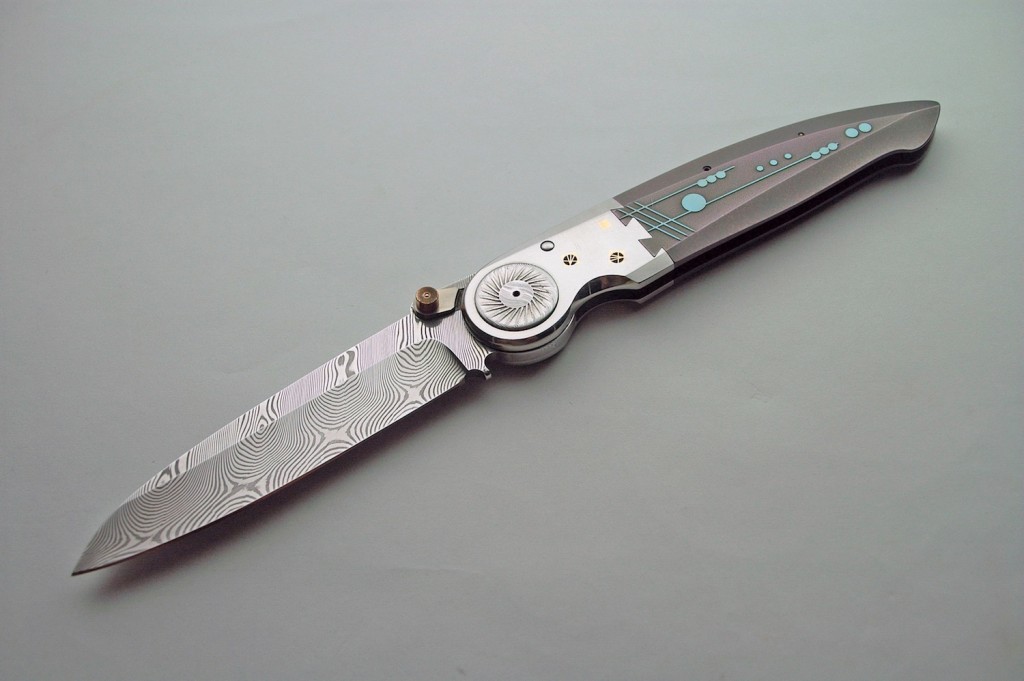
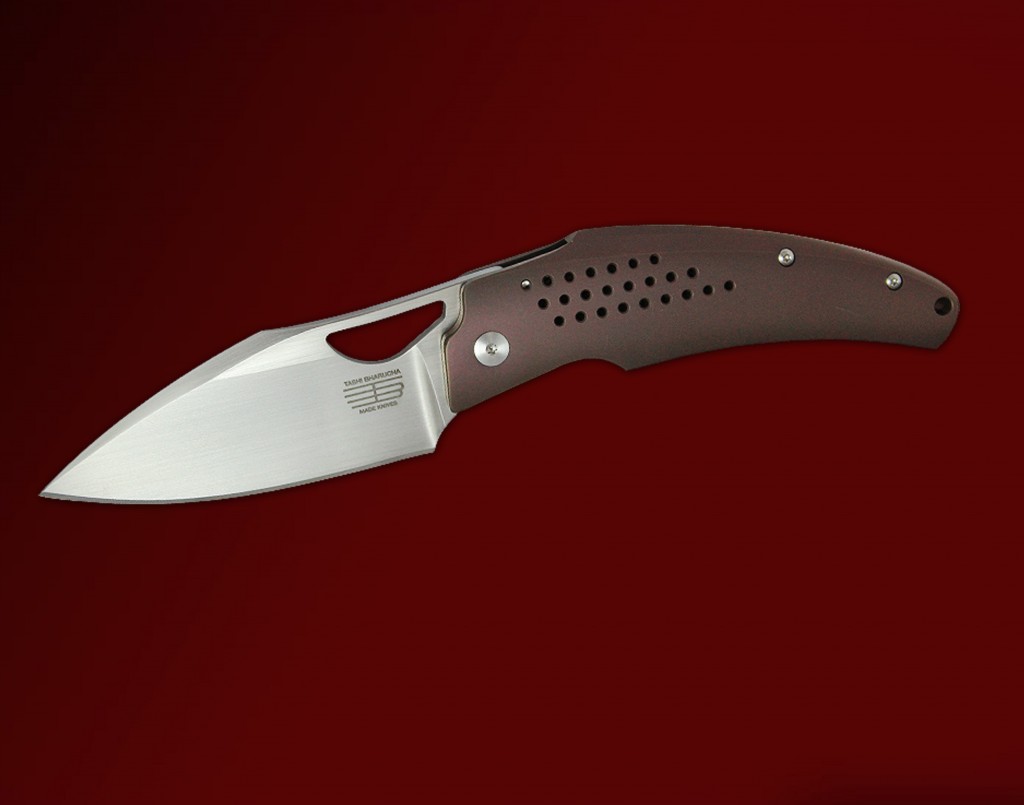
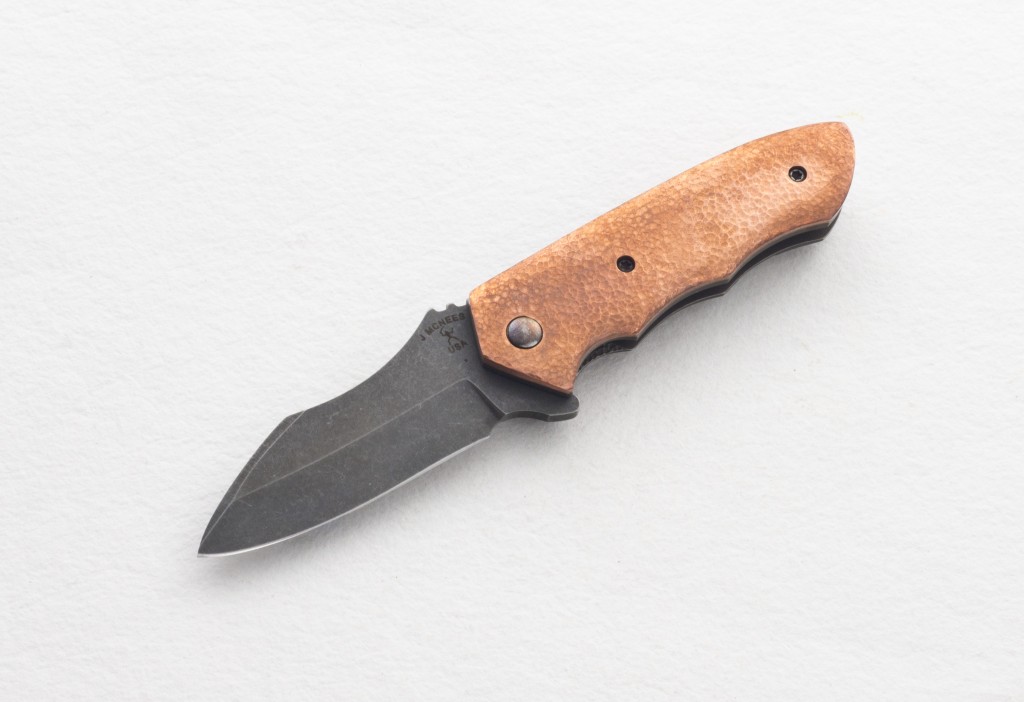
Now we all know that knifemakers are innovative, and we’ve seen incredible creativity in design, blade grinding, handle materials, damascus forging, one-hand-opening folder mechanisms, locks and gadgets. Trends don’t just happen without innovation. But using a radioactive isotope of hydrogen on a knife? One called tritium that contains one proton and two neutrons, an isotope that is rare on earth where trace amounts are formed by the interaction of the atmosphere with cosmic rays? Does it sound like science fiction? No, it’s non-fiction, real life, and true that some knifemakers inlay tritium into knife handles because it glows, looks incredibly cool and might actually help a guy stumbling around in the dark find his knife.
That last part might be a stretch, but it’s not the first time knifemakers have looked to the stars to find knife handle and blade material. They’ve been forging meteorite into knife blades and using it in handles for millennia. There’s mystique and legend surrounding ancient Egypt, and Tutankhamun, who had meteorite forged into a blade before the use of iron, of gold/meteorite knives among the Mongols or James Black using meteorite in Col. James Bowie’s blades.
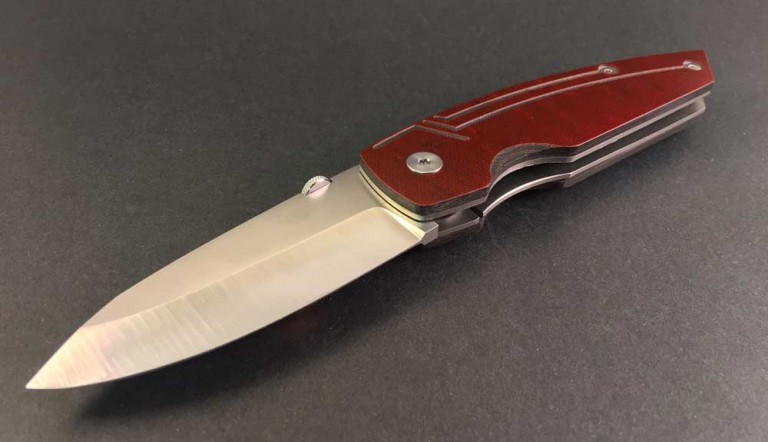
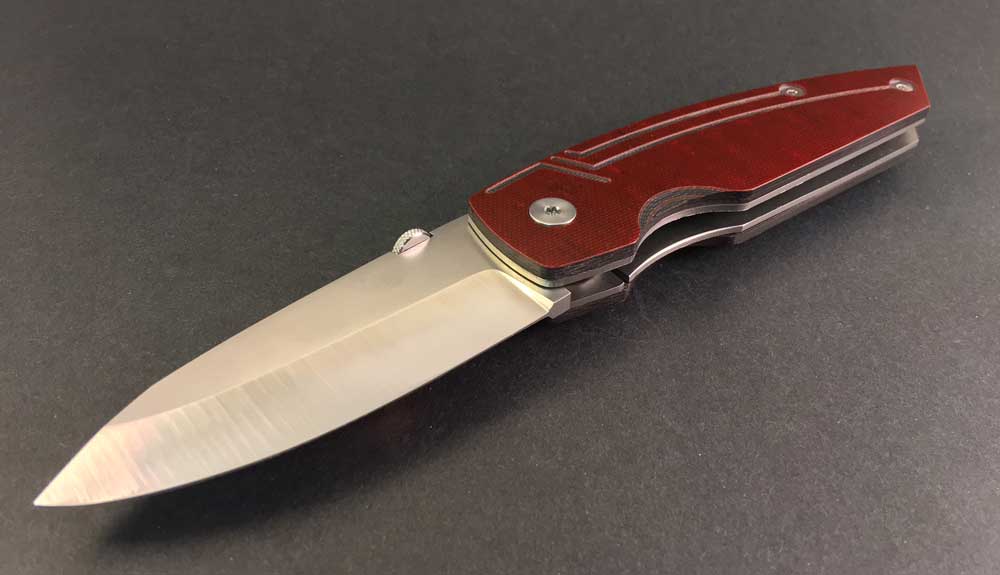
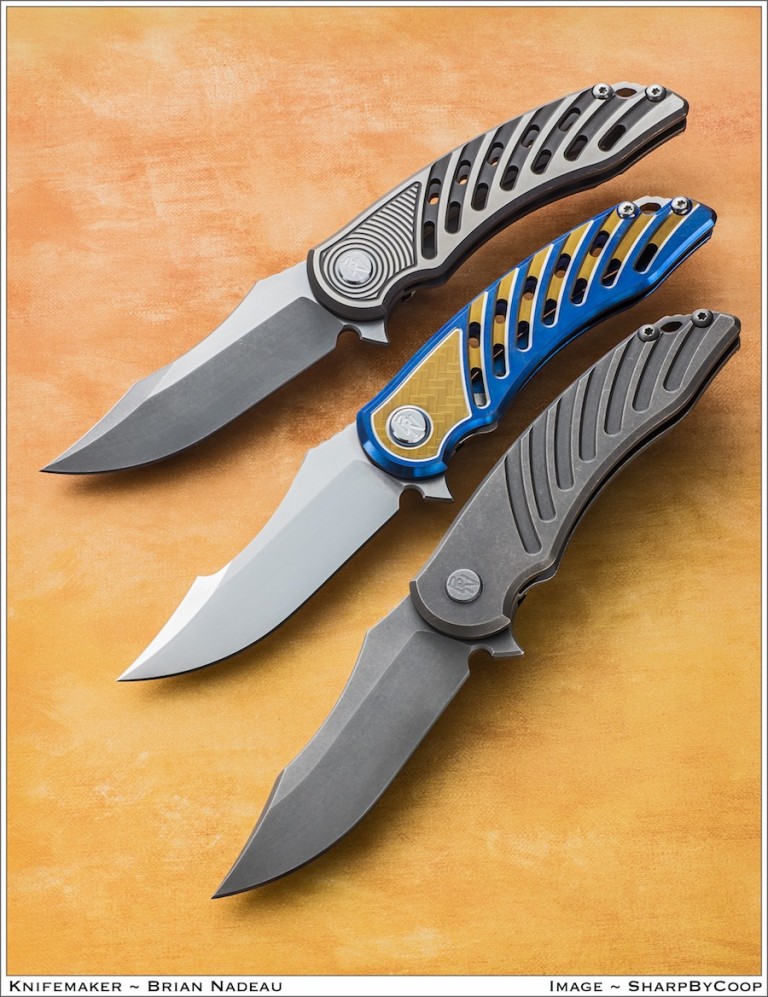
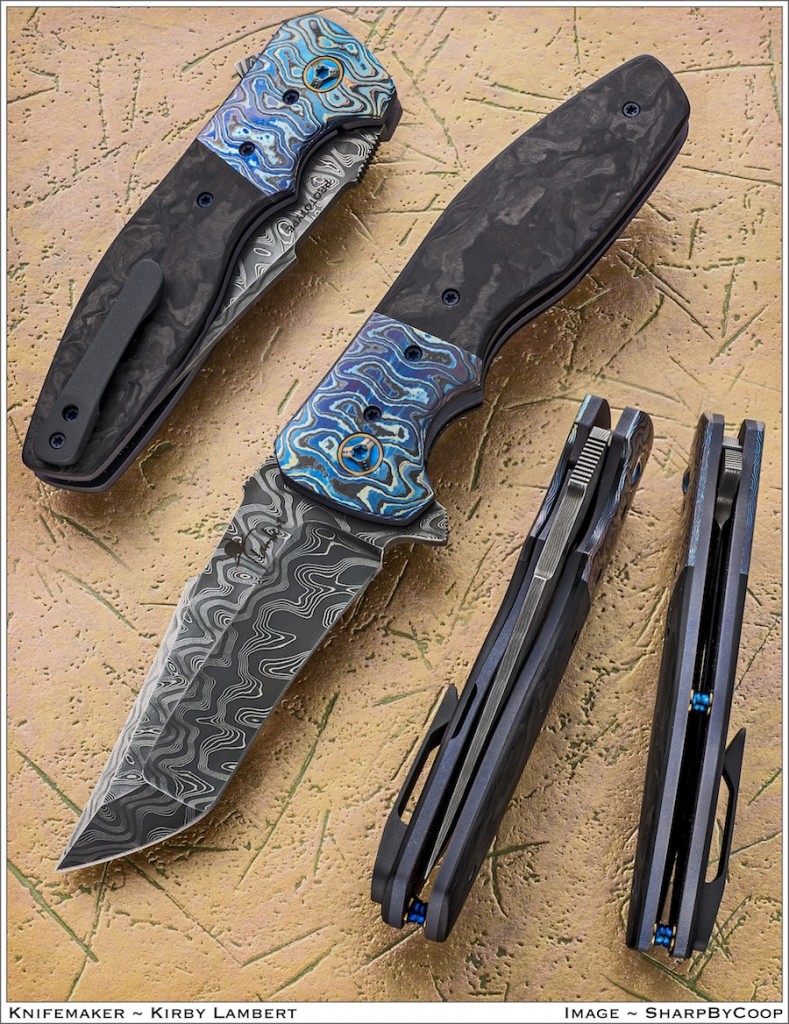
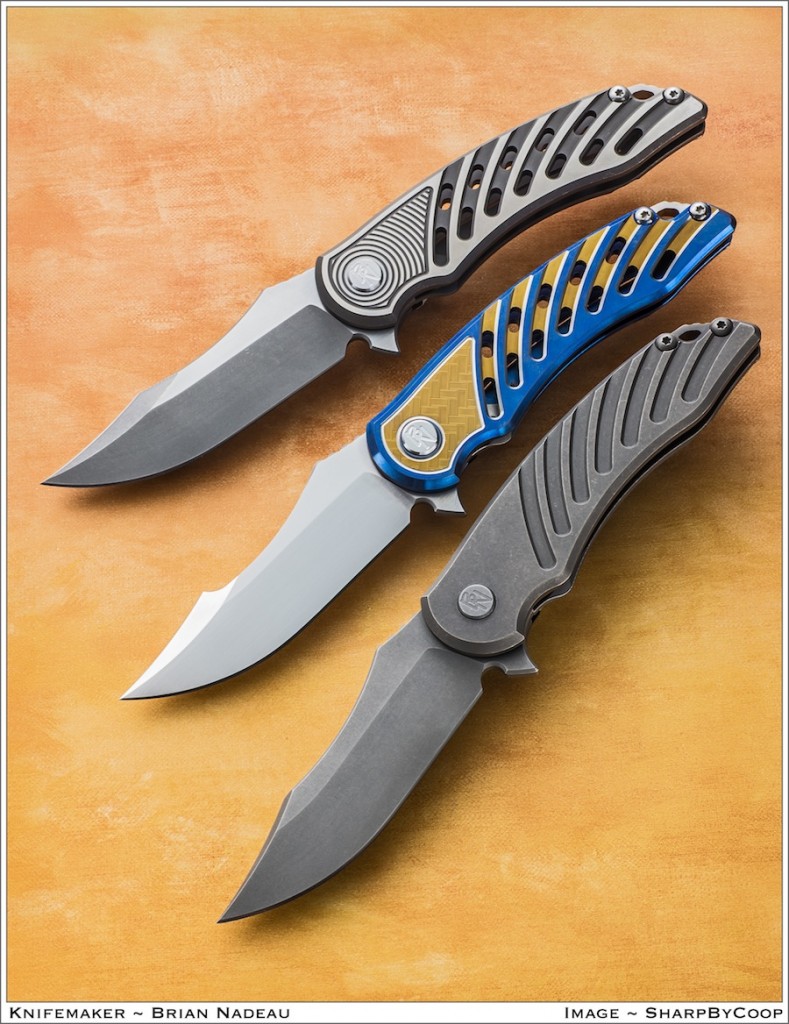
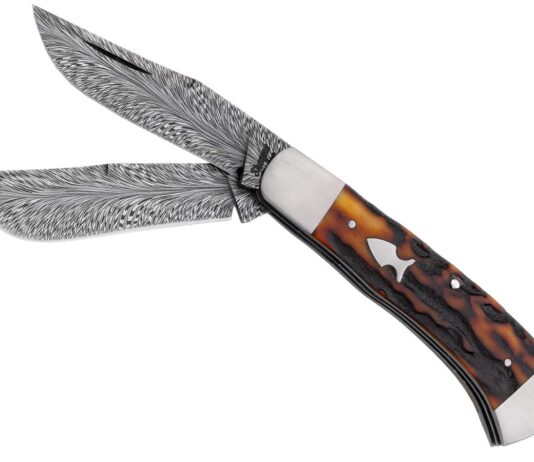
More commonly, knifemakers shape and often anodize titanium, using it for bolsters, liners and handles, or laminate two or more titanium alloys into patterns resembling damascus and resulting in what is known as Timascus. Various alloys color differently by heating or anodizing them, so the color combinations are endless, like the stars in the sky, the cosmos and the galaxies beyond.
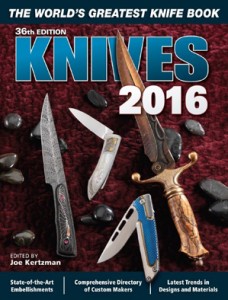
This article was excerpted from the Trends section of the KNIVES 2016 annual book. For more incredible knife images and information like it, click here to get your copy of KNIVES 2016, and enjoy!
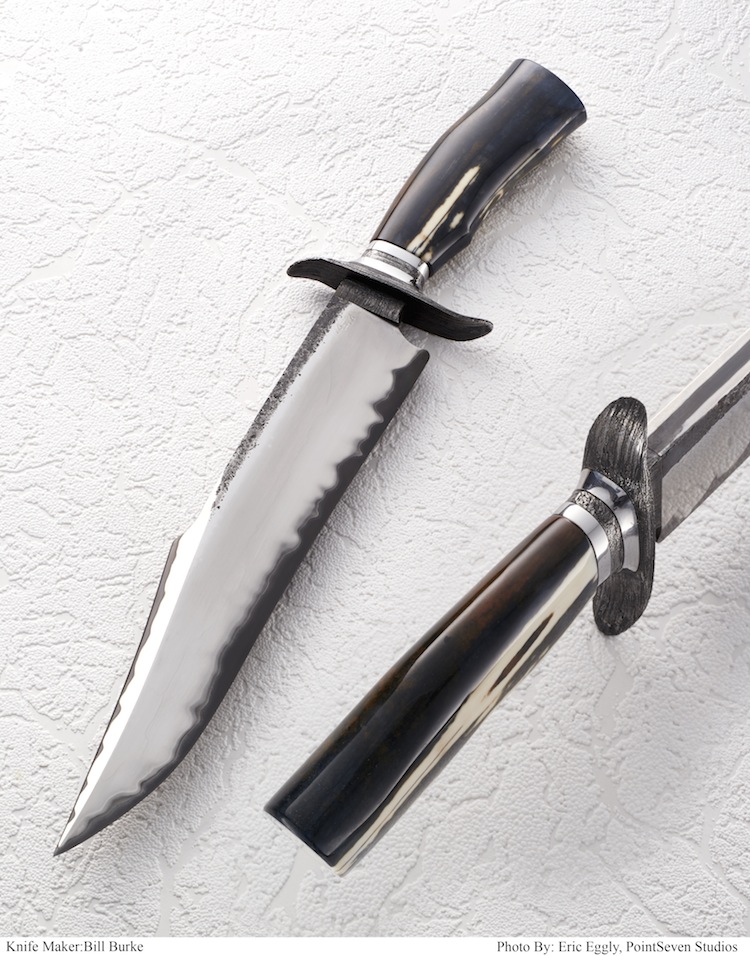
ABS master smith Bill Burke won the ICCE Award for Best Fixed Blade at the inaugural ICCE Show this past September.
Due to unforeseen circumstances, the 2nd Annual International Custom Cutlery Exposition (ICCE) has had to change the dates for its 2016 knife show from early to late September, show officials announced.
Originally slated for Sept. 9-11, the new dates are Sept. 23-25.
The show will be held in the same venue—the Downtown Marriott in Kansas City, Missouri.
According to ICCE officials, the event-hosting hotel, the Downtown Marriott, notified the ICCE’s organizers, the Knifemakers’ Guild and the American Bladesmith Society (ABS), that there would be several events scheduled for the original show dates. Due to the events scheduled in downtown Kansas City, some streets will be blocked, parking will be a hassle, and the downtown will be overcrowded the weekend of Sept. 9-11. The hotel management had other available dates that would make the show far more enjoyable for those who will attend, thus the change to Sept. 23-25.
“I heard that I’m only allowed to carry knives with 3 1/2-inch blades or shorter in my state, is that true?”
“I carry a 4-inch drop-point fixed blade when hunting, but I’m traveling to Minnesota this season, can I carry it there?”
“Someone told me I can carry an auto in Michigan now, can that be right?”
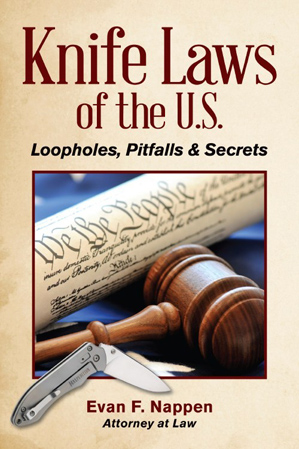
Good questions, all of them, and as silly as it might be that we have to ask such questions when it comes to carrying tools as utilitarian and downright useful as knives, that’s the world we live in. There are very few “firsts” in the knife industry, but one of them is the first and most comprehensive book ever published on federal and state knife laws. Knife Laws Of The U.S. By Evan F. Nappen answers questions about what knives are legal to own and carry in each state, and which aren’t. It delves into switchblades, ballistic and gravity knives and others, and even explains what to do and what not to do if you are arrested with a knife.
A nationally-known knife and gun rights attorney, Nappen has dedicated his life to fighting for gun and knife rights. Having practiced law since 1988, he was one of the first attorneys to ever get a federal injunction against a state gun law. He has written and produced DVDs, and authored a number of gun rights books, as well as numerous articles that have appeared in national magazines. Now he’s written THE book on knife rights. Knife Laws Of The U.S. is a good one to have, and with you, at all times, no mater where you go while carrying a knife!
Saddle up for Valentine’s Day with the Case John Wayne peanut.Whether you’re spoken for or not, the Kershaw Spoke will cut it for you and/or your sweetie-pie.
Valentine’s Day is a heartbeat away and there’s no better gift than his/her knives. These knives especially fit the bill because they are smallish folders that work well for both men and women. Featuring blades under 3 inches, they make the ideal everyday carry knife in most any venue.
Boker’s Damascus African Thuya is just such a knife. Boasting a 2.25-inch blade of Chad Nichols ladder-pattern damascus, it has a handle of tight-grained African thuya wood. MSRP: $299.
The Buck Apex is a sporty little folding knife with a 2 5/8 blade of 420HC stainless and a carbon fiber handle with carabiner, pocket clip and integrated bottle opener. Weight: 1.7 ounces. Closed length: 3.75 inches. MSRP: $45.
Boker’s Damascus African Thuya makes a great Valentine’s Day gift.Buck’s Apex features a carabiner, pocket clip and bottle opener in the carbon fiber handle.
If you’re into the Duke—John Wayne for you tenderfoots—Case’s John Wayne peanut pattern should be your cup of cattle-drive coffee. Sporting clip and pen blades—the former with Wayne’s signature—the Red River “D” shield and “The Duke” inscribed on the bolster, this one is made for Wayne fans everywhere.
The black-oxide-coated Spoke from Kershaw is an assisted-opening flipper folder with a 2-inch blade of 4Cr14 stainless and a forged steel handle. Closed length: 2.8 inches. MSRP: $27.99.
Finally, yet another great small knife for Valentine’s Day is the SOG Cash Card. The 2.75-inch blade of 8Cr13MoV stainless and full-metal construction make this minimalist’s dream knife come true.
SOG’s Cash Card should appeal to him or her on Valentine’s Day.
His/her knives—you can’t beat ’em! For more on these classics and other great knives, stay tuned to blademag.com and the World’s No. 1 Knife Publication, BLADE®.
When it comes to knives, an array of products sits ready to address the issues of protection and maintenance. Depending on personal preference you have your choice of paste waxes, aerosols, oils and cloths to get the job done. Price points vary widely as well.
Tracy Mickley of Midwest Knife Supply suggests the old reliable 3-In-One Oil or another petroleum-based product called Nano-Oil. The 3-In-One Oil sells for about $3 in a 4-ounce applicator container.
“There are hundreds of different things out there,” remarked Tracy Mickley, owner of Midwest Knife Supply in North Mankato, Minnesota. “Many of them are very good, including carrying cases that are protective and sometimes fleece lined. They are inexpensive at $5 to $20 depending on the size.”
John Perry employs the classic gunstock-lobster pocketknife pattern to showcase the mother-of-pearl. (Chuck Ward image)Gold engraving by Martin Butler borders the stunning black-lip mother-of-pearl inlay in Warren Osborne’s interframe folder. (SharpByCoop image)
7 pearl knives for Dec. 7 somehow seems oh so fitting. Dec. 7, 1941—the date which lives in infamy marked the USA’s entry into World War II and the awakening of a military dynamo that would vanquish Japan and play a crucial role in the defeat of Germany in Europe. Japan’s bombing of Pearl Harbor early that day thrust America headlong into the maelstrom that would change the world forever.
With the 74th anniversary of that momentous event upon us, we thought a fitting way to observe it would be with knives sporting one of the most beautiful of handle materials: mother-of-pearl. Called pearl by most, the material is coveted on higher-end knives and makes for a most worthy edged presentation.
Herein are seven of those knives in memory of Dec. 7. Enjoy!
Black-lip mother-of-pearl rarely looks as pleasing as it does on Tom Overeynder’s folding art dagger. (PointSeven image)Don Hanson’s mother-of-pearl folder boasts some of the maker’s forged mosaic damascus for the blade and bolster, and titanium liners anodized blue. (PointSeven image)Kyle Hanson goes the mother-of-pearl route in damascus and with a handsome leather sheath. (PointSeven image)Ken Steigerwalt uses black-lip mother-of-pearl for the inlay on his damascus art folder with a modified tanto blade. Accents in 14k gold add to the mix. (SharpByCoop image)Gilles Victors of Vacquiers, France, offers up his “Zephyr” model in mother-of-pearl as well as a handle of carbon fiber. The damascus blade comes in a modified wharncliffe style.
Ron Newton’s bowie features an ancient ivory handle. (PointSeven image)
Massachusetts and New Jersey made advances in the fight against each state’s ivory ban proponents over the past two weeks.
Opponents of the Massachusetts ivory ban outnumbered the proponents in a Nov. 17 hearing before the state’s Joint Committee on Environment. In other words, there were many more legitimate business people there—scrimshanders, musicians, antique dealers, etc.—than animal activists, and that’s a good thing for people interested in maintaining a legal ivory trade in the state.
The ban’s opponents gave many examples of art and culturally significant antiques that would needlessly be rendered worthless under the ban. The committee seemed to acknowledge the beauty and distinctiveness of the antiques that would be outlawed, and that an all-encompassing ban was unnecessarily broad. The activists commented on the “different tone” and the concern the committee showed for scrimshaw and antiques. Many of the questions asked related to creating legal exceptions to the ban.
The Massachusetts developments followed on the heels of the chaotic hearing on the Big 5 African Species ban before the New Jersey Senate Budget and Appropriations Committee on Nov. 10. The oppressive bill heard before the committee would have made possession of ivory a criminal offense punishable by three-to-five years in prison and a $5,000 to $50,000 fine. It also would have targeted other wildlife materials, including varieties of mother-of-pearl, shark’s teeth and many more. Thanks in no small part to the invaluable help of Knife Rights and Doug Ritter, written criticisms of the ban read to the committee helped result in a watered-down version of the bill that, among others, exempted ivory and rhino horn and no longer requires ivory owners to comply with the bill’s new possession prohibition and certification requirements; dramatically reduced the number of species covered from 11,800 to around 10; and slashed the penalty for failing to comply with their certification requirements from felony-level penalties to a civil penalty.
Despite the watering down of it, the New Jersey bill is still a bad one and represents a Pyrrhic victory of sorts. Though ivory was excluded, the bill still constitutes unconstitutional taking by criminalizing commercial trade and possession of otherwise legal private property without just compensation. It imposes taxes on those who lawfully possess wildlife through its certification requirements that remain in place, and manages to include additional species with no evidence of a connection between New Jersey and the targeted items. Finally, its one-size-fits-all-prohibition style strips wildlife of all commercial value to local African countries and communities best suited to protect them.
Also Check Out:
Knives 2016, 36th Edition
The trusted guide for knife collectors, enthusiasts, knifemakers, and dealers around the world, this knife book covers the latest and greatest from front to back. A collection of feature articles explores the latest developments, history, and transformation of knives, swords, and edges of various kinds. Get your copy