Knife collecting is an extremely rewarding experience for knife enthusiasts. There truly is a knife for everyone. Many increase or hold their value throughout the years, making collecting knives something to pass on to the next generation of knife collectors.
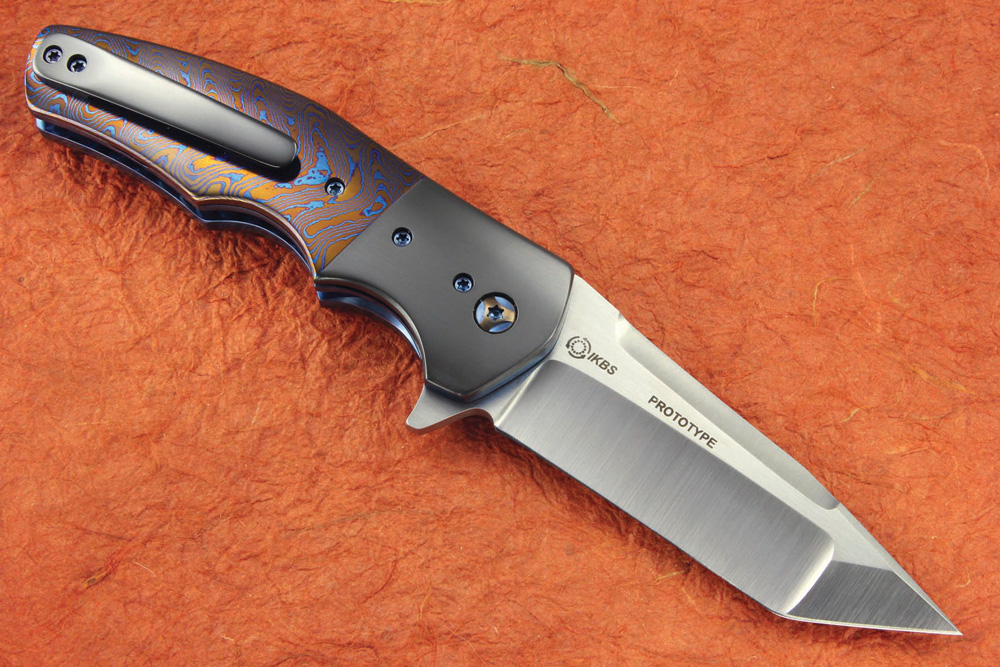
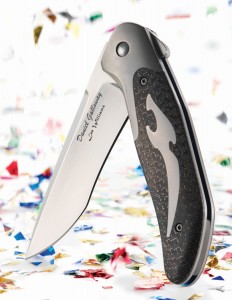
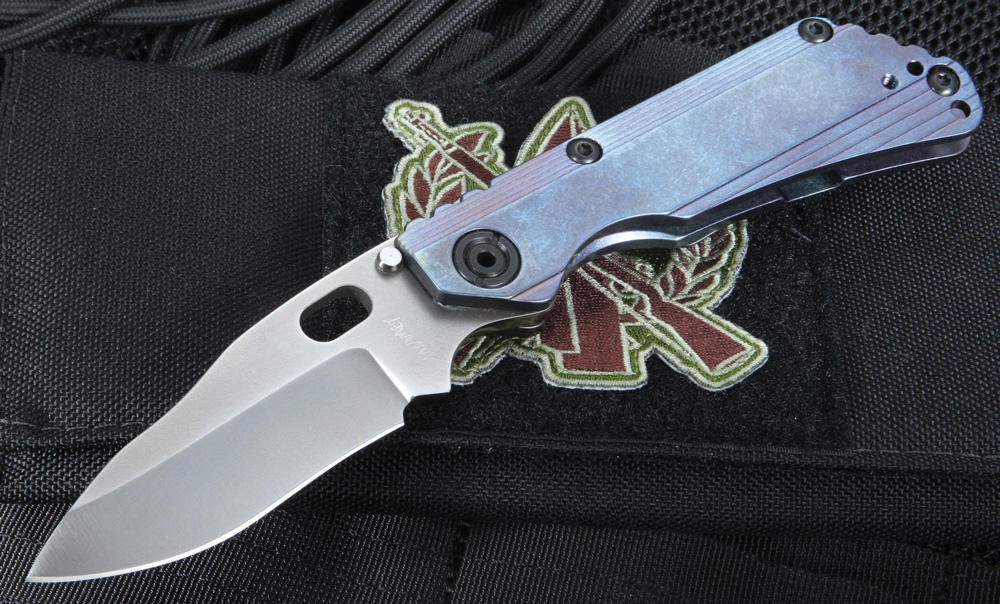
Kirby Lambert resumes his perennial presence on the to-watch list of Neil Ostroff of True North Knives with such models as the Prototype Crossroads flipper in CTS XHP stainless steel, a Mokuti handle with zirconium bolsters and an IKBS bearing system. (TNK image)Dave Stark of Steel Addiction Custom Knives said two of knifemaker Lee Williams’ protégés are gaining attention quickly: Daniel Galloway and Pat Hammond. A collaboration with Williams, Galloway’s Mongoose is the cover knife of the March 2015 issue of BLADE®. Galloway’s price: $1,600. (Kris Kandler image)
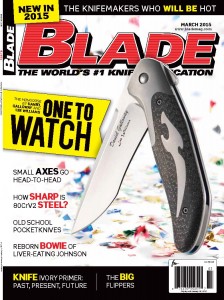
Who will be the knifemakers to watch in 2015? How sharp is one of the hottest new knife steels in the industry? What were the most important knife stories of 2014? Learn the answers to these questions and much more in the new BLADE®, on newsstands today!
Some of the USA’s top custom knife purveyors were polled for the knifemakers to watch in the new year, with one of those makers, Daniel Galloway, having his “Mongoose” collaboration knife with Lee Williams serving as this issue’s cover piece. See who the other makers are, along with some of their top work, in the new BLADE on page 12.
The high-carbon steel known as 80CrV2 is among the newer and hotter blade materials among custom knifemakers especially.
Follow ABS master smith and BLADE field editor Joe Szilaski as he makes a knife of the steel and tries it out in his knifemaking and knife-using instructional, “How Sharp Is 80CrV2?”
The year past has seen many highlights and lowlights, from the landmark announcement by the Knifemakers’ Guild and the American Bladesmith Society that, after almost 40 years of jousting, they will finally hold their first annual combined knife show in 2015, trends—or were they just fads?—in the industry, to the back-and-forth between the federal government and legal ivory owners over changes in ivory regulations. Get the scoop on these happenings and more in “’14’s Blades of Grey.”
While on the subject of ivory, award-winning knifemaker Jim Hammond has made knives for decades, a number with ivory and ancient ivory handles.
Not only did he conduct an in-depth seminar on ivory at the 2014 BLADE Show, he also volunteered to write a three-part story on the past, present and future of the misunderstood substance. Check out part one in the new BLADE on page 78.
KnifeArt’s Larry Connelley said Duane Dwyer’s reputation for knife innovation helps place him among the makers to watch in the coming year. Dwyer’s SnG with a titanium frame carries a KnifeArt price of $1,200. (KnifeArt image)
There’s much more in this issue, including the latest in big flipper folders, profiles of Masecraft Supply and Pohl Force Knives, a test of two compact custom axes, four hot factory slip joints, HEPK master smith and BLADE field editor Ed Fowler’s essay on how knifemakers must follow their inner muse in “It Takes Courage To Be Yourself,” and much more, all in the March BLADE.
Check out the custom knifemakers to watch in 2015 in the new BLADE®, on newsstands now!
Navajo artist David Yellowhorse has collaborated with Buck on some of the most beautiful knives anywhere, and the two have nailed it again with the Yellowhorse Spirit Singer. The handle is turquoise, black jet and nickel silver. The knife comes with a glass top display case and in a limited edition of 100 (if, indeed, any are left!)
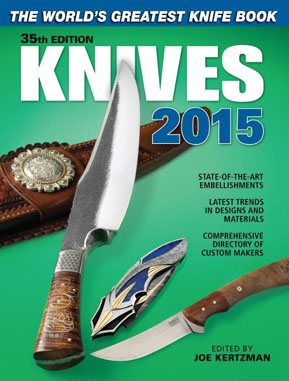
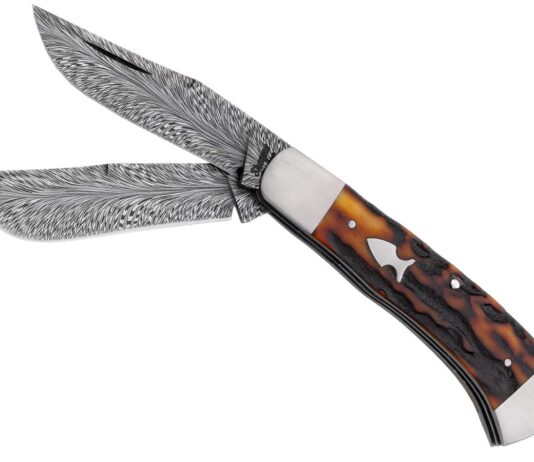
See the latest knives, swords, and edges of all types, and explore the latest trends in blades, steels, styles, and materials. Gaze upon a “State of the Art” section parading engraved, scrimshawed, jewel-inlaid, carved, etched, sculpted and forge-welded, and Damascus and mosaic-damascus knives. Click here.
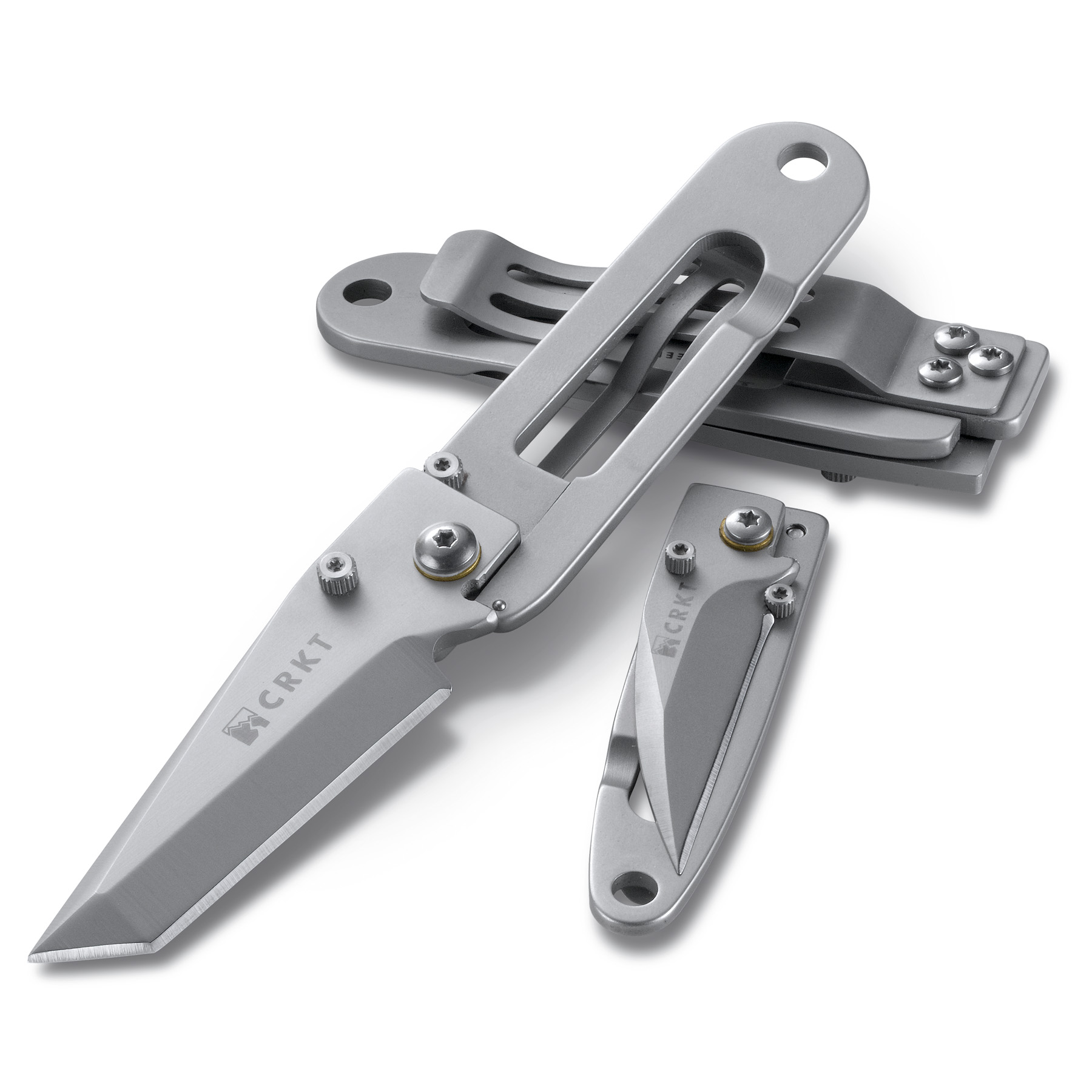
Ed Halligan’s K.I.S.S. design (left) revolutionized factory folding knives. At right is his Delilah’s P.E.C.K. design. Both knives are reproduced by CRKT. (CRKT image)
An unusually high number of knifemakers have died recently, all of whom left more than their fair share of lifelong marks on family, friends and the knife industry. In terms of influence on knife design, though, the two that probably had the largest impact were Ed Halligan and Kit Carson.
Ironically, both men designed wildly popular folding knives for CRKT, and it is those folders that have been so influential on the knife industry.
The K.I.S.S. is a simple yet ingenious folding knife. In the closed position, its two-piece frame-lock construction and safe, user-friendly design “seals” the cutting edge of the chisel-ground blade against the handle. As Halligan once explained, “With the K.I.S.S., the frame and the lock are all one piece … I made the original knife with the blade chisel ground on one side only so it would slide against the frame when folded and make a seal so you wouldn’t cut yourself.”
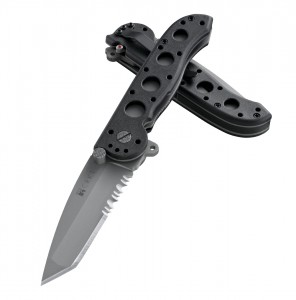
Kit Carson’s M16 design remains one for the ages. This is the M16-12Z CRKT repro. The flipper is the extension with the hole in it seen here acting as a guard just below the handle pivot. (CRKT image)
In fact, when it first came out, I recall talking to one long-time industry observer who thought the K.I.S.S. was a lawsuit waiting to happen because he thought consumers would cut themselves on the blade edge despite the blade’s seal against the handle in the closed position. However, Halligan’s version of the design works so well that such accidental cuts never happen. One of the main reasons the design is safe is that Halligan tested it in real-life conditions to be sure that such accidents never occur. “Safety is a big reason why I carried the knife around so much to make sure it worked properly,” Halligan said.
In 1997, Halligan signed a deal with CRKT for the company to reproduce the K.I.S.S., and CRKT launched the repro of the knife at the 1998 SHOT Show. Only four years old at the time, CRKT was struggling to find a knife that would help “drag the rest of the product lines along,” as CRKT’s Rod Bremer put it. The K.I.S.S. was that knife. Unfortunately, a number of unscrupulous companies blatantly knocked the K.I.S.S. off so much that it eventually became one of the most copied sporting knives worldwide. CRKT and Halligan weathered that storm, though, and Ed designed a series of K.I.S.S. iterations and spinoffs for CRKT that included the Delilah’s P.E.C.K. (for Precision Engineered Compact Knife), Samson’s K.I.S.S., the H.U.G. (Halligan’s Ultimate Gadget), the Slip K.I.S.S., the Neck P.E.C.K., the blackened K.I.S.S. In The Dark, even a fixed-blade version called the Stiff K.I.S.S. and others.
Just as they were linked in their passing, Halligan and Carson were also linked in their CRKT collaboration deals. CRKT must have been living right back in those days because it was just a year after signing the deal with Halligan to reproduce the K.I.S.S. that it signed the deal with Carson to reproduce Carson’s M16 folder. Even though Carson did not invent the flipper, his M16 is universally credited as the model that popularized flipper folders—folding knives with one-hand-opening “flippers” that double as guards when the blade is opened. “The M16 with the Carson Flipper was a huge improvement on non-assisted blade opening, making a manual knife open almost as fast as an auto without a secondary thumb stud or hole mechanism,” observed long-time knife writer Mac Overton. “Because it had less moving parts and its opening relied on inertia rather than a spring or torsion bar, the mechanism was inherently stable and reliable.”
The M16 and its military look—Carson was a U.S. Army career man—soon became not only immensely popular with consumers but with service personnel as well. In fact, by many accounts, the M16 was the most popular knife among active duty service personnel in the wars in both Iraq and Afghanistan.
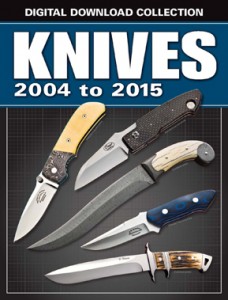
Turn back the clock with BLADE‘s digital collection of annual KNIVES books. Get every KNIVES book from 2004 to 2015 in one PDF download for just $79.99.
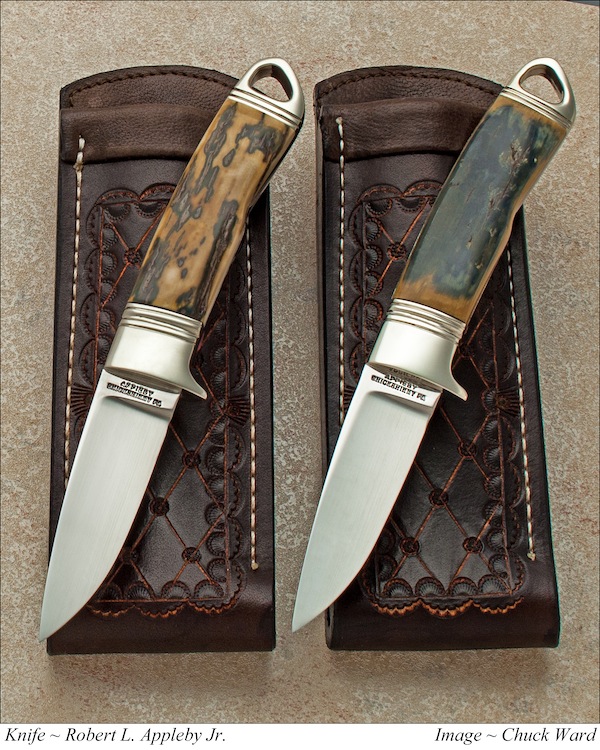
The Nov. 4 elections will impact the pending ivory ban, though to what extent depends on several factors. Meanwhile, even legal ancient ivory has been banned in New Jersey! Robert Appleby uses legal mammoth ivory on his fixed blades. (Chuck Ward photo)
While some might think Republicans taking control of Congress as a result of the Nov. 4 elections will be good for those fighting a pending legal ivory ban, such may not be the case.
Rob Mitchell of the Elephant Protection Association indicated that though the election results would seem to make a Republican majority in Congress more effective at challenging “out-of-control administrative agencies” that want to ban all legal ivory, including knives with handles of legal ivory, it could also have the opposite effect.
Since President Obama has indicated he will do what he thinks necessary to deal with aliens in the country illegally through executive order or administrative action by the end of the year at the latest, it also may mean he will take a similar approach to such issues as the ivory ban. “If so,” Mitchell writes, the U.S. Fish and Wildlife Service (USFWS) “may become more aggressive with regulations putting politics ahead of science-based conservation.”
Moreover, he added, such non-governmental organizations (NGOs) as the World Wildlife Fund, Africa Wildlife Foundation, Wildlife Conservation Society, international and American humane societies and others will “continue to spread misinformation in Congress to confuse issues and push an animal rights agenda in spite of the harm it will cause to legitimate conservation efforts and people who own legal ivory.”
As a result, Mitchell urges all those against the ban on legal ivory to either contact or to continue to contact their legislators and see where the legislators stand on House Resolution 5052 and Senate Bill 2587. In a nutshell, if approved, both measures would roll back the attempt by USFWS to ban legal ivory to the status quo of February 2014, “while allowing the government to pursue other means to combat elephant poaching and other wildlife trafficking.”
See the latest knives, swords, and edges of all types, and explore the latest trends in blades, steels, styles, and materials. Gaze upon a “State of the Art” section parading engraved, scrimshawed, jewel-inlaid, carved, etched, sculpted and forge-welded, and Damascus and mosaic-damascus knives. Click here.
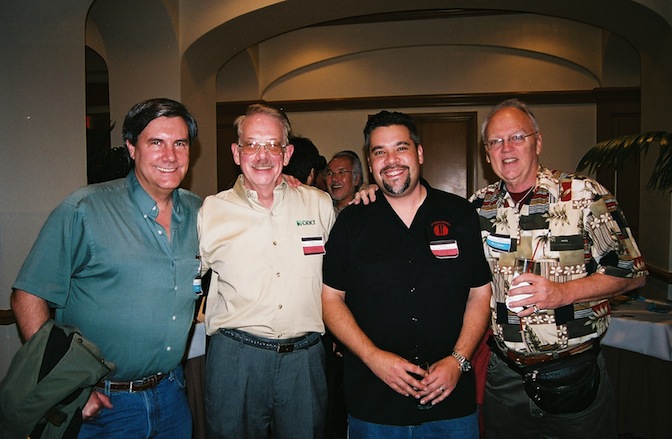
Custom knife purveyors can help you find the knife that’s best for you. In the foreground, from left: Dan Delavan, knifemaker Pat Crawford, Strider Knives’ Josh Lee and Dave Nittinger. Dan and Dave are veteran custom knife purveyors.
Choosing the custom knives that are best for you can be a tricky proposition. There are a number of things to consider, including how much money you have to spend, whether you’re buying the knife to use, collect or resell, and other factors. Especially if you’re new to the market, looking to change the focus of the kinds of knives you buy or simply unsure which knife is best for you, a custom knife purveyor (also known as a dealer) is out there who can help you.
There are a number of different types of custom knife purveyors. Some specialize in one type of knife only, such as art knives or tactical knives. Since tactical knives have been hot for a long time, there are probably more tactical knife purveyors than any other type.
The serious ones have websites with professionally photographed images of the custom knives they offer for sale, and/or advertise their purveying service in knife magazines and/or other media. A sign of a purveyor who is in business for the long haul is one who advertises consistently over an extended period of time. (The latter also goes for knifemakers.) Still other purveyors may photograph their knives for marketing purposes—with some being quite good at it—own a brick-and-mortar retail knife store, and a very few produce/coordinate their own knife shows. Some purveyors do two or more of the preceding and at least one does all three.
To find out which purveyor fits your needs, ask around at knife shows, knife discussion forums, social media sites and other venues, check websites and knife magazines, etc. Talk to your friends or acquaintances who buy custom knives or ask them for the names of others who buy custom knives. Tell them what kinds of knives you’re looking for and ask them which purveyors are the best at providing such knives and offer the best customer service. Get as many opinions as you can. It’s better to have more information than not enough. Whittle the purveyors down to a select few you think you might want to work with and call them and feel them out. Go with the one you connect with best—in other words, go with your gut feeling in picking the one you want to use.
Before we continue, some fundamentals on how purveyors obtain the knives they sell is in order. It’s really pretty cut and dried: the purveyors attend select knife shows in search of the top knives and makers and/or establish relationships with those makers—and a select knife show is always a great place to both meet the maker and see some of his/her best work. The best purveyors work with proficient makers who are good at meeting deadlines on the knives they agree to make, offer good customer service if something goes wrong with the knife, and who, in general, appeal to custom knife enthusiasts of most all stripes. The purveyor will reach an agreement with the maker to buy one or more of his or her knives and then sell the knife/knives at enough of a markup to make a profit, stay in business and buy more knives for sale. That’s pretty basic, but that’s essentially how it works.
Why should you buy from a purveyor instead of a maker? Actually, if you can bypass the purveyor and buy directly from the maker, you probably should. However, that’s not always possible and is where purveyors come in. (Besides, as noted, if you’re new to the market or unsure of what to buy, the guidance a capable purveyor can provide in buying a custom knife can be invaluable.) Through the working relationships they establish with leading makers, purveyors have access to knives from those makers that most individual custom knife enthusiasts do not. Many makers have to struggle to make deadlines for other custom orders and knife shows, and often cannot fill your order quick enough or before the knife loses some of its luster and is no longer “hot.” Purveyors, on the other hand, may have the knife in question in stock or something from the maker that will fill your needs immediately.
As an aside, if you look around enough, you will no doubt hear from some that one purveyor or another is prejudiced in favor of a certain maker or makers. Whenever you hear this, take it with a grain of salt because most all purveyors will indeed be prejudiced in favor of makers that are a) easy to work with and b) make deadlines—traits that you would probably like in a maker as well.
These are just some of the things to look for in a custom purveyor. The more you look and ask around, the more you will find other traits that will make the custom purveyor the best for you and your knife needs.
See the latest knives, swords, and edges of all types, and explore the latest trends in blades, steels, styles, and materials. Gaze upon a “State of the Art” section parading engraved, scrimshawed, jewel-inlaid, carved, etched, sculpted and forge-welded, and Damascus and mosaic-damascus knives. Click here.
This Landon Robbins fixed blade in 1084 carbon steel won Best Fighter at the Branson Hammer-In & Knife Show. (Chuck Ward image)
Today’s red-hot forged knives include some of the best in utility and other patterns, most all in blades of high-carbon steels such as 5160, 1095, 52100 and others. Though the steels are not classified as stainless, you can control the pitting and rust on the blades by simply wiping them down after each use. No biggy, really, if you think about it. Properly heat treated and ground, the blades are easy to sharpen and cut like bandits.
Here are eight knives hot from the forge, starting with a sexy fighter in 1084 carbon steel by American Bladesmith Society journeyman smith Landon Robbins of Crane, Missouri. The understated hamon or temper line of the clip-point blade, S-guard and “dropped” blackwood handle make this puppy stand out—and it also took home the award for Best Fighter at the recent Branson Hammer-In & Knife Show.
Check out BLADE’s collection of its best knife collecting books and resources, all in one bundle at a hot price. Click the image to go to ShopBlade.com.
David C. Lemoine embellishes the blade of 5160 on his drop-point hunter with a short burst of filework on the spine. A single mosaic pin accents the contrasting brown and black lacewood bird’s beak handle. Overall length: 8.25 inches. A pouch sheath completes the package.
ABS master smith Don Fogg says a sign of a well-done hamon is one that stands out and is easy to describe. We christen the hamon on the W2 tool steel blade of ABS journeyman smith Tad Lynch‘s bowie “thundercloud” for its resemblance to an oncoming storm. The handle is Micarta®. Overall length: 14.5 inches.
Lyons and tigers and bears—oh my! In this instance the Lyons is ABS journeyman smith Bill Lyons of Palisade, Nebraska, maker of a slick hunter with a deep-bellied blade of 5160. The silver-wire-inlaid handle is separated from the blade by a minimalist guard. Overall length: 7.5 inches. The knife includes a leather belt sheath.
ABS master smith Jerry Lairson enjoyed past success on the cutting competition circuit and parlays some of that experience into his kukri in 5160 carbon blade steel and an ironwood handle. The kukri designs lends itself to chopping, one of the main requirements of any good competition cutter. Overall length: 16 inches.
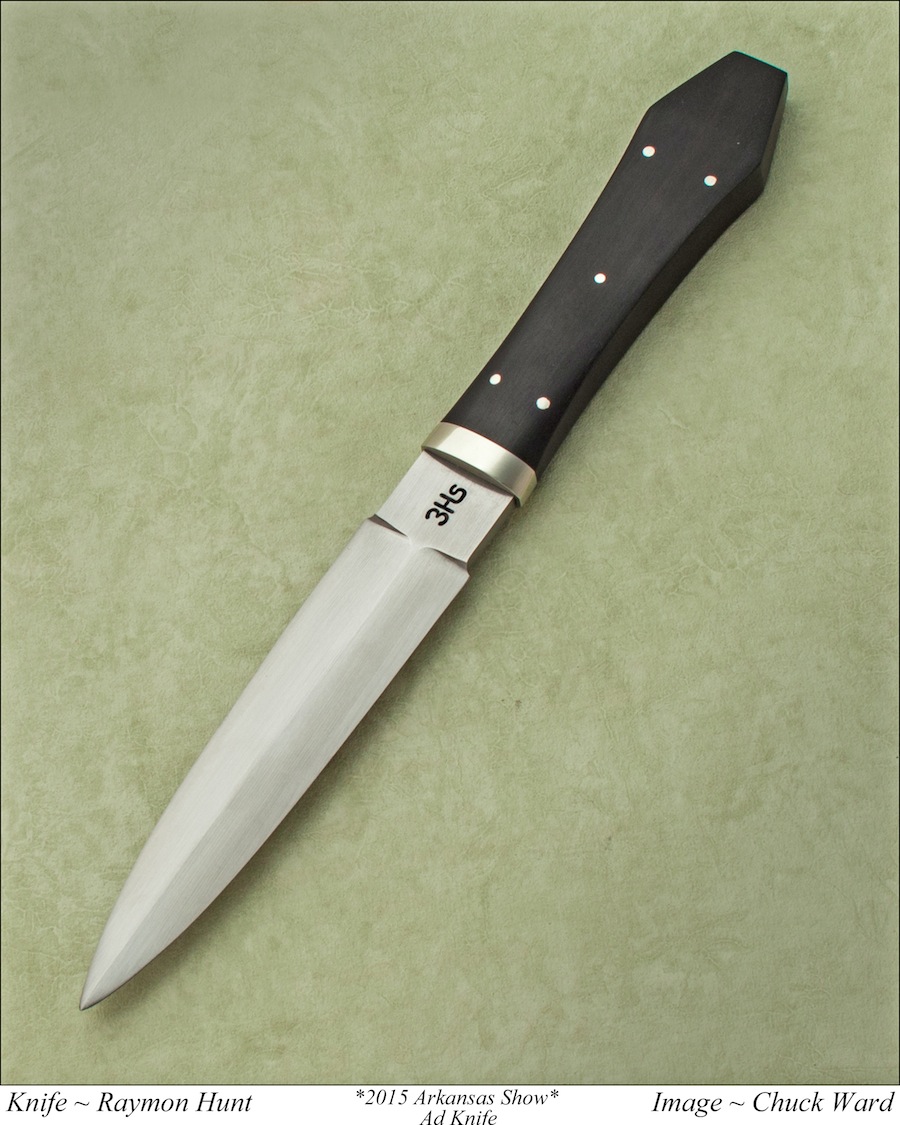
Raymon Hunt of Irving, Texas, chose O1 tool steel for the 5.25 inch blade of his boot dagger. A silver ferrule separates the knife’s double-ground blade from the ebony coffin handle. Overall length: 9.75 inches. Boot daggers, a very popular style in the early days of the modern custom knife movement, aren’t seen much anymore, so Mr. Hunt’s offering is a welcome window on a bygone style long overdue for a comeback.
Another carbon steel blade with an understated hamon—this time in 1095—highlights Joel Austin‘s bowie. The straight-back blade and Spartan features make this a knife we could see Jim Bowie wearing back in the day walking down some dark alley in Natchez-Under-The-Hill, Mississippi. The handle is ironwood. Overall length: 13 inches.
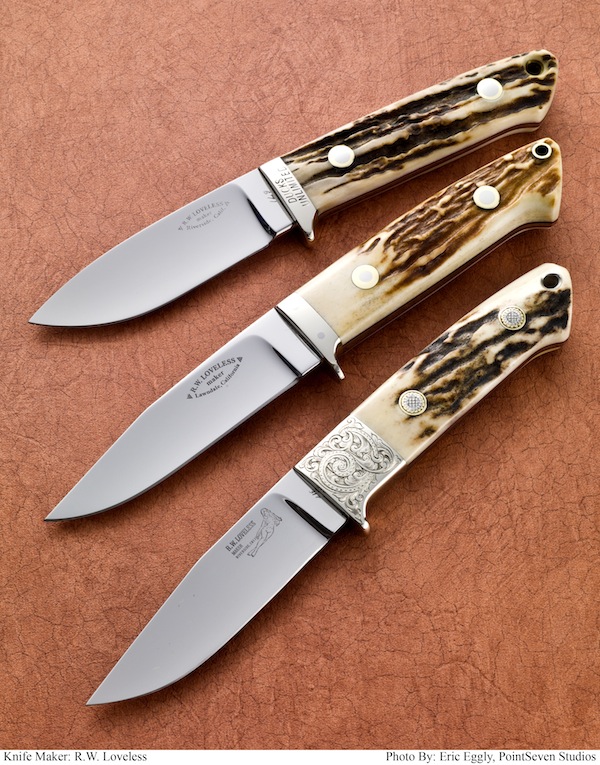
Knife terminology can change with the times. Known by many as the drop point, the knife at top by Bob Loveless originally was called the dropped hunter by Loveless himself. (PointSeven image)
Do you know your knife terminology? Yes, I agree that it probably doesn’t matter much if you do or not as long as you’re into knives and love to use them, collect them and otherwise celebrate your favorite sharp tool. On the other hand, there’s a certain satisfaction in knowing your knife terminology. In other words, it’s nice to be secure in the knowledge that your understanding of knife speak is current and that you can hold your own in conversation with knife aficionados.
Of course gentical is a newer entry in knife speak. There are others, some of which go back years, even decades.
For instance, Cutlery Hall-Of-Famer Bob Loveless is famous for a hunting knife that many call a drop-point hunter or simply a drop point. However, drop point is a misnomer—at least it is in regard to the name Loveless originally gave the design, which was dropped hunter. Both drop point and dropped refer to the point of the blade in the design, which drops or rests below the midpoint of the blade’s plane. Somewhere along the line someone called it a drop point instead of a dropped hunter and the name stuck. In my opinion, drop point is more descriptive of the blade design than dropped—besides, dropped hunter sounds like a knife you dropped and/or lost in the woods somewhere. But I digress.
Then there’s finger choil. Finger guard is another one. The word finger in either is superfluous—in other words, it’s not needed. It’s a guard or it’s a choil, period. Fingergroove or grooves is correct, but not finger guard or finger choil.
The guard is the cross/double guard with two quillons and/or single guard with one quillon—quillon is another entry in knife speak covered below—at the juncture of blade and handle that keeps your fingers/hand from sliding forward onto the blade from the grip.
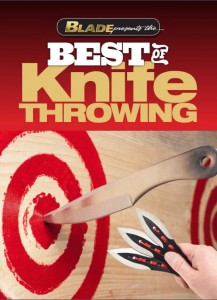
New from BLADE! Check out the best articles on knife throwing, from the pages of BLADE magazine.
A choil is a small cutout at the base of the edge of the blade. Cutlery Hall-Of-Famer A.G. Russell once said the choil’s original purpose was to indicate where to stop the stroke with the sharpener on the blade during the sharpening process. Some knives have larger cutouts at that juncture for placement of a finger for more detailed-type cuts. However, even then the cutouts are still choils, not finger choils. In addition, some companies and makers put a single groove in the handle just before the guard. Though they may call it a finger choil, it is really nothing more than a finger groove.
Now, for the quillon. According to Websters, a quillon is “either of two transverse projecting members forming the cross guard of the sword.” In other words, a cross or double guard consists of two quillons and a single guard consists of one quillon. The cutlery community uses the term for knife guards as well.
Moreover, you will often hear quillon incorrectly pronounced quill-yun. How the word obtained that pronunciation I do not know, though I suspect it came from someone who saw the word, did not know how to pronounce it, and simply did what many do in such circumstances—took a “stab” (forgive the pun) at saying it and arrived at quill-yun. The correct pronunciation is key-yun (or a reasonable facsimilie. Hey, I’m a writer, not a pronunciation expert). However, many, including a large number in the bladesmithing community, continue to refer to it as a quill-yun. Hence, if you hear that pronunciation, you’ll know what it means. (By the way, I don’t recommend trying to correct bladesmiths on their pronunciation of quill-yun. Trust me on this one.)
There are many knife terminology concepts you might want to know. I will cover them sometime in the future here at blademag.com.



 Check out the custom knifemakers to watch in 2015 in the new BLADE®, on newsstands now!