Knife Collecting

Knife collecting is an extremely rewarding experience for knife enthusiasts. There truly is a knife for everyone. Many increase or hold their value throughout the years, making collecting knives something to pass on to the next generation of knife collectors.

How To Use Drawknives

Drawknives Are A Woodworker’s Best Friend And One Of Many Unique Knives Craftsmen Use Regularly

Knives take on many shapes and sizes. As tools, their designs sometimes focus on specific tasks. In the case of the drawknife, it is designed for woodworking. Drawknives have been found to date back to the Viking era more than a millennium ago.

The design itself takes many different shapes for a variety of purposes. At times, it is not referred to as a drawknife but, at first glance, you can see the relationship and how a number of tools can be considered part of the same family. As with any tool, different cultures have different interpretations of how the tool should be designed.

What Is A Drawknife?

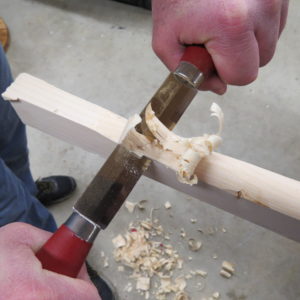
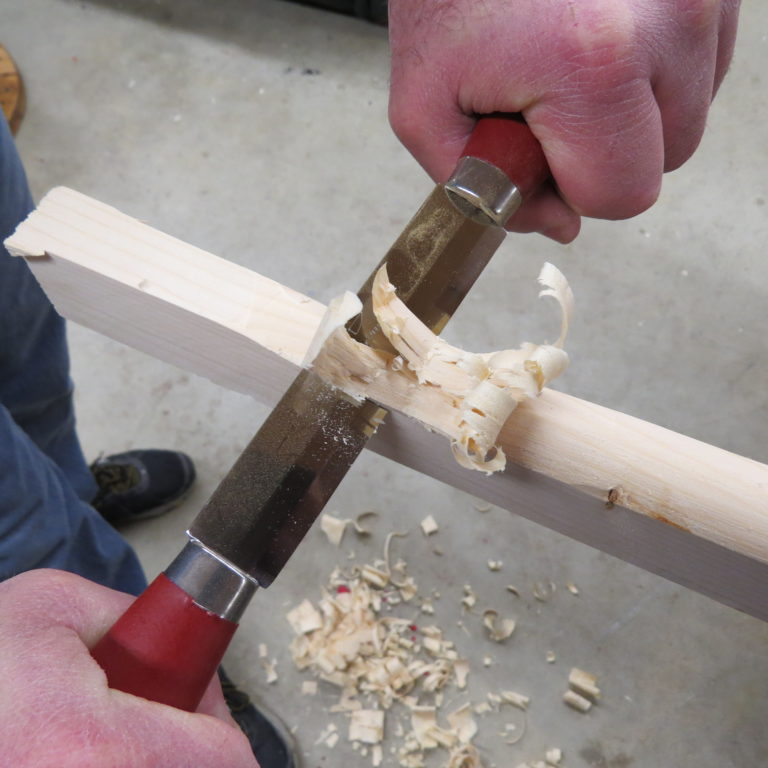
A drawknife is a single-beveled blade placed between two handles. The tool gets its name from how it is used. You simply grab both handles and draw the knife towards you bevel up. Controlling the angle that the blade enters the wood will control the depth of cut. A steep angle will get you a deeper, more aggressive cut but will also require more effort.

Lowering the angle makes for a shallower cut and also gives you a finer finish as the material is removed less aggressively. Some designs have long handles on plane with the blade. Other designs have the handle tight in and below the plane of the blade. No matter where the handles are, the action is the same but the point of control changes.
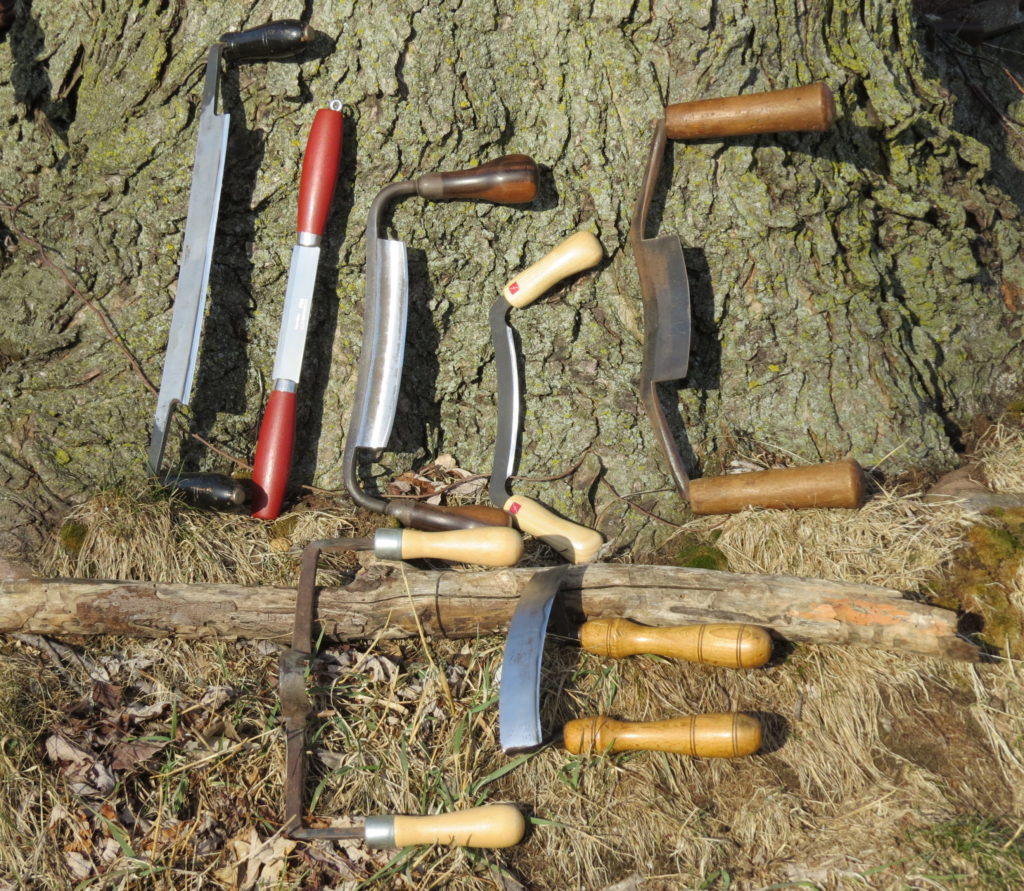
Top row, from left: a German-style drawknife made in Western Germany, Mora push knife, English-style drawknife, Flexcut 5-inch drawknife and a cooper’s knife. Bottom row, same order: Round drawknife and a chair maker’s scorp.

How To Use A Drawknife

When working with a narrow stock up to two inches wide, it’s easy enough to draw the knife straight back toward you. On wider stock, it is better to skew the knife. Skewing the knife provides a leading edge and causes less resistance during the cut. When working with hardwoods you want to keep the cut light, as the dense grain provides more resistance and bogs the knife down.
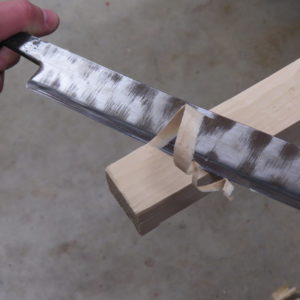
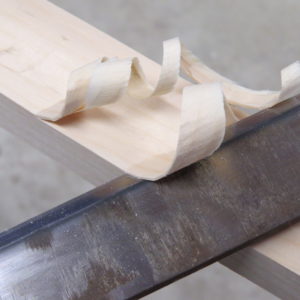
Learning to use a drawknife properly is a bit like working a puzzle. The easiest way to make a cut is to work the facets of the material. For instance, say we are working on a piece that is square. To shape the piece to the required size it is easier to work the corners down, creating more corners until you get to your desired shape. By working the flats, you must use more energy and struggle to make a cut.

When first using a drawknife, the tendency is to use your arms to power the tool. Instead, use your back muscles, which are larger and less likely to fatigue quickly. Draw the knife back as if you were using the same muscle for rowing. If done right, it should feel like your shoulder blades are trying to meet in the middle of your back. For safety’s sake, keep your elbows in tight. As you draw the knife back your elbows will hit your core acting as a safety stop, preventing you from slipping and cutting yourself.

Types Of Drawknifes

A debarking knife is usually a larger style of drawknife used for extracting bark from logs. They are larger and heavier than their woodworking counterparts so that you can blast through the bark.

It has been my experience that when working green wood, the knife doesn’t need to be kept as sharp. In fact, it is somewhat more helpful to keep the knife a bit dull when cutting green wood so as to avoid diving too deep into the wood itself. On seasoned logs, because of the lack of sap between the bark and sapwood, I find it better to have the knife a bit sharper.

Woodworking drawknives come in a variety of shapes and sizes. The two main types I have used: English and German. The English style has a blade that bares a slight arch and the handles are on the same plane as the blade. German-style knives have handles that sit lower than the blade and the blade tends to be straight. The knives’ handles can vary. Most of mine have a pear-like shape. There are other styles like a round knob style, which is a ball shape.
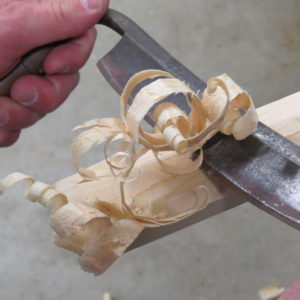
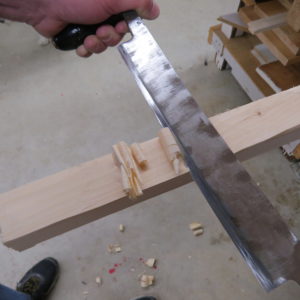
Specialty styles of knives include any drawknife that is shaped to obtain a specific result. A cooper’s knife is shaped to accommodate the making of barrel staves. I also have a handle-making knife. The handle-making knife is a tight arch designed to make handles for things like brooms or garden implements. The basic shape is a half circle, so instead of trying to round a piece off by angling a number of cuts, you get a piece of wood close to size and simply let the knife shape it.
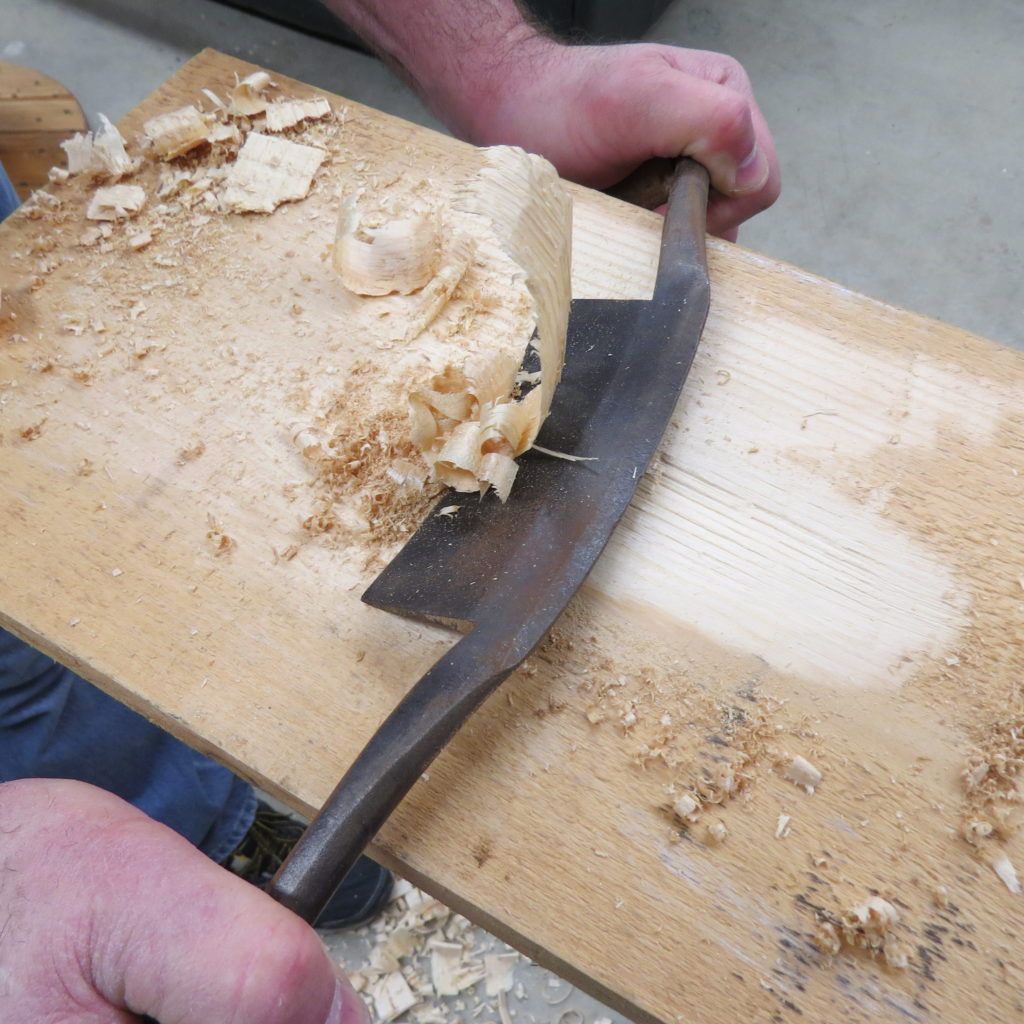
The cooper’s shave is designed to hollow out the staves of a barrel.

Push Knife


The model uses the Mora push knife to clean up curls left at the bottom of a curve. With the push knife, you can work the wood in an opposite direction without repositioning the piece.

A Scandinavian invention, the push knife is similar to a drawknife in that it has a blade attached by two handles on either side. Using a push knife is different in the way that you are expected to force the edge away from your body instead of pulling it toward you. Unlike a drawknife, the handles come straight out from the sides, which allows you to either push or pull the knife. I normally use the knife in the manner that gets the job done—meaning on occasion I will draw the knife toward me rather than push.

What Is A Scorp?

Technically, scorps are not drawknives. However, in terms of looks and use you can’t help but lump them in the same family. I have a chair maker’s scorp that is designed to hollow out the seats of chairs. On older chairs is a slight depression where the person sits. A chair maker’s scorp was used to produce the shape. The tool operates just like a drawknife except it has a shorter blade with a more pronounced arch.

How To Sharpen A Drawknife

Like any other cutting tool, a drawknife must be sharpened. Perhaps the trickiest part of sharpening a drawknife is finding a way to brace it. I find dynamic sharpening the easiest way to sharpen a drawknife. I brace the knife and move the sharpening medium instead of the other way around. One way to brace the knife for sharpening is to put one handle in your armpit and hold the other handle in your off hand. Once the knife is braced this way, take a stone to it. Another way is to brace one handle on the bench, lean your chest on the other handle, and then begin sharpening. Keep in mind a drawknife must be sharp (except where noted previously) but since it is not necessarily a fine woodworking tool, don’t get carried away.

YouTuber James Wright shows you how to sharpen a drawknife using a set of sharpening stones in his shop.

Lastly, keep it oiled. Even the newer ones are not made from new high-tech steels. Most are from simple carbon stock and a light coat of oil goes a long way. Among others, Flexcut offers a contemporary drawknife.

Other Wood Carving Tools

Beyond drawknives and planes, there are many other types of wood carving knives out there that can help with some of the finer points of woodworker. Small, nimble wood carving knives like a sloyd knife or a spoon knife.

A sloyd knife is a short, sturdy blade good for small, finite carving tasks. A spoon knife, as the name suggests, is meant to carve out the concave scoop of a spoon but can be used for any other situation where you are trying to create a concave dip in the material.

There are certainly more than just these few tools to being a successful woodworker, but knowing how to use wood carving tools big or small can get you on the path to success.

Why To Use A Drawknife

Long before there was solar power, fossil fuel power, steam power, etc., there was muscle power. Humans developed the world using tools with muscle and sweat. There is something satisfying about making something by hand. The feel of a good day’s work is sometimes what the soul needs. A drawknife not only gets the job done but also gives you an accomplishment to savor.

Where To Buy A Drawknife
A Knife for Sgt. Dakota Meyer I

0

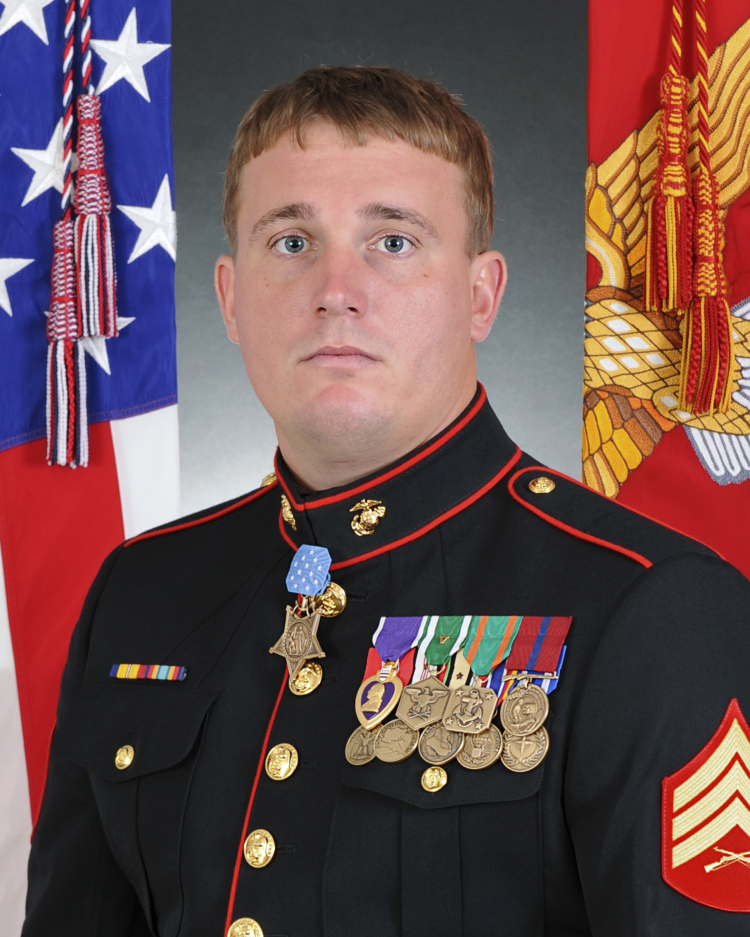
    In recognition of his military actions in Afghanistan on behalf of his fellow servicemen and his country that resulted in his receiving the Congressional Medal of Honor, U.S. Army Sgt. Dakota Meyer was presented with a custom knife made by Gene Baskett, a custom AR-15 rifle, and honorary membership in the Knifemakers’ Guild.

    During a special ceremony this past December in Elizabethtown, Kentucky, Baskett, formerly of Elizabethtown and now of Eastview, Kentucky, presented Sgt. Meyer with a Baskett handmade knife, a custom fighter with a black Moly-Coated CPM-154 stainless blade and a black linen Micarta® handle. The knife is engraved “MOH, Sgt. Dakota Meyer, USMC” on the mark side and “8 September 2009, Kunar Province Afghanistan” on the flip side. The engraving is by Patrick Clark of Clark Jewelers, also of Elizabethtown. Richardson Gunsmithing did the Moly Coating.

    In all, Baskett said he got to spend about three hours with Sgt. Meyer the day of the presentations. “He really loved the knife,” Baskett observed. “He was really appreciative and seemed very humbled by it all.”

    J.J. Akins and Steve Sprowls of Elizabethtown’s Sporter Express gun shop presented Sgt. Meyer with the custom-engraved rifle. The gun is engraved “Rifle presented by the citizens of Hardin County, KY. Sergeant Dakota Meyer, USMC. 8 September 2009. Kunar Province Afghanistan. Congressional Medal of Honor,” and was donated by Sporter Express.

    A member of the Guild’s board of directors, Baskett also presented Sgt. Meyer with a custom Guild honorary membership badge that includes the worlds “Medal of Honor Recipient” and the Marine Corps emblem.

ACTS OF HEROISM

Sgt. Meyer was born and raised in Columbia, Kentucky. He entered the Marine Corps after high school in 2006. On Sept. 8, 2009, Sgt. Meyer, then a corporal, was credited with numerous acts of heroism and saving the lives of several Marines in a battle near the village of Ganjgal in Afghanistan (see sidebar, page ???). As a result, Meyer was awarded the Medal of Honor in a ceremony at the White House on Sept. 15, 2011.

    Sgt. Meyer spoke to a small crowd and the media during the ceremony in Elizabethtown, saying he does not consider himself a hero and that the Medal of Honor and what it represents is much bigger than him. His actions on “the worst day of my life” may have saved several fellow Marines, though he said he could not save four of his close friends in his unit. He wears a bracelet bearing their names.

    The Americans who died in the ambush were: 1st Lt. Michael Johnson, 25, Virginia Beach, Virginia; Staff Sgt. Aaron Kenefick, 30, Roswell, Georgia; Hospital Corpsman Third Class James R. Layton, 22, Riverbank, California; and Gunnery Sergeant Edwin Wayne Johnson Jr., 31, Columbus, Georgia. A fifth soldier, Army Sgt. 1st Class Kenneth W. Westbrook, 41, Shiprock, New Mexico, later died from his wounds.

    Sgt. Meyer received the Medal of Honor in a ceremony at the White House on Sept. 15, 2011. When a White House staffer contacted him to arrange the ceremony, Sgt. Meyer famously asked to “have a beer with the President.” Sgt. Meyer received an invitation to the White House the afternoon before the ceremony (see sidebar, page ???). He also requested that when he was honored, simultaneous services should be held at other applicable locations to honor the memory of his fellow service members who died or were mortally wounded during the ambush and his rescue attempts.

    Sgt. Meyer is the third living recipient of the Medal of Honor since the Vietnam War, and the first living Marine in 38 years to be so honored. In addition to the Medal of Honor, he also received the Purple Heart, Navy Commendation Medal w/Combat V, the Navy Achievement Medal and the Combat Action Ribbon during his years of service from 2006-2010.

MILLION DOLLAR CHALLENGE

Sgt. Meyer uses his fame to raise money to provide college scholarships to the childen of those soldiers who did not survive the war. His goal is to raise $1 million for his “Million Dollar Challenge” (see sidebar, page ???). During the presentation ceremony, Sporter Express presented a check for $750 toward that goal.—BY MIKE CARTER

For more information on the Million Dollar Challenge, visit www.dakotameyer.com. For more on Gene Baskett knives, contact Gene Baskett, Dept. BL12, 427 Sutzer Ck. Rd., Eastview, KY 42732 270-862-5019 www.baskettknives.com.

To stay abreast of the latest in knives and knife information, subscribe to BLADE® at http://www.shopblade.com/blade-magazine-one-year-subscription-us?lid=SSfbbl101212

Keeping Up With Dakota Meyer

It is not often a living U.S. Marine receives the Congressional Medal of Honor, and Sgt. Dakota Meyer is the first one to do so in 38 years. Neither is he one to rest on his laurels.

    For instance, he has partnered with the Marine Corps Scholarship Foundation (MCSF) to raise money so the children of Marines can attend college. Sgt. Meyer said he realizes the importance of education and believes in the MCSF motto, “Honoring Marines by Educating Their Children.” The Dakota Meyer Scholarship Initiative was established and Sgt. Meyer committed to personally raising a million dollars to fund the effort. In fact, during the MCSF’s 50th anniversary celebration this past spring, it was announced that he had successfully reached his goal of raising a million dollars. The Challenge to America to match the million dollars Sgt. Meyer raised is ongoing. To learn more about it and to make a donation visit www.dakotameyer.com

    He indicated he was honored President Obama accepted his invitation to have a beer the afternoon before the Medal of Honor ceremony. (As a side note, Sgt. Meyer said the White House brews its own beer, a honey ale, which he said both he and the president enjoyed.) He added he appreciated the opportunity to speak with and ask advice from the president. The president emphasized the importance of education, a priority Sgt. Meyer shares. In fact, Sgt. Meyer said he hopes to continue his education when his travel schedule slows down.

    Meanwhile, he spends much of his time on the road, traveling all over America to share the story of his fallen brothers. He also advocates for veterans and has recently partnered with the U.S. Chamber of Commerce and Toyota on the Hiring Our Heroes campaign, which provides jobs fairs for veterans nationwide, as well as training veterans to successfully make the transition from military to civilian employment. At press time, Sgt. Meyer’s book Into the Fire was slated to be published this September.

Above and Beyond The Call

 According to Dakota Meyer’s citation for the Medal of Honor, he was recognized, “For conspicuous gallantry and intrepidity at the repeated risk of his life above and beyond the call of duty as a member of Marine Embedded Training Team 2-8, Regional Corps Advisory Command 3-7, in Kunar Province, Afghanistan, on 8 September 2009.

    “When the forward element of his combat team began to be hit by intense fire from roughly 50 Taliban insurgents dug in and concealed on the slopes above Ganjgal village, [then] Corporal Meyer mounted a gun-truck, enlisted a fellow Marine to drive, and raced to attack the ambushers and aid the trapped Marines and Afghan soldiers. During a six-hour firefight, Corporal Meyer single-handedly turned the tide of the battle, saved 36 Marines and soldiers and recovered the bodies of his fallen brothers.

    “Four separate times he fought the kilometer up into the heart of a deadly U-shaped ambush. During the fight he killed at least eight Taliban, personally evacuated 12 friendly wounded, and provided cover for another 24 Marines and soldiers to escape likely death at the hands of a numerically superior and determined foe.

    “On his first foray his lone vehicle drew machine gun, mortar, rocket grenade and small arms fire while he rescued five wounded soldiers. His second attack disrupted the enemy’s ambush and he evacuated four more wounded Marines. Switching to another gun-truck because his was too damaged, they again sped in for a third time, and as turret gunner he killed several Taliban attackers at point blank range and suppressed enemy fire so 24 Marines and soldiers could break out.

    “Despite being wounded, he made a fourth attack with three others to search for missing team members. Nearly surrounded and under heavy fire, he dismounted the vehicle and searched house-to-house to recover the bodies of his fallen team members. By his extraordinary heroism, presence of mind amidst chaos and death, and unselfish devotion to his comrades in the face of great danger, Corporal Meyer reflected great credit upon himself and upheld the highest traditions of the Marine Corps and the United States Naval Service.”


TOP PHOTO AND SECOND PHOTO FROM TOP

Congressional Medal-of-Honor recipient Sgt. Dakota L. Meyer recently was presented with a Gene Baskett handmade knife. The custom fighter has a black Moly-Coated CPM-154 stainless blade and a black linen Micarta® handle. The knife is engraved “MOH, Sgt. Dakota Meyer, USMC” on the mark side. The engraving is by Patrick Clark. Richardson Gunsmithing did the Moly Coat. (photo of Sgt. Meyer courtesy of the United States Marine Corps; knife photo by Mike Carter)


CKCA Club Knife Orders Are Sold Out

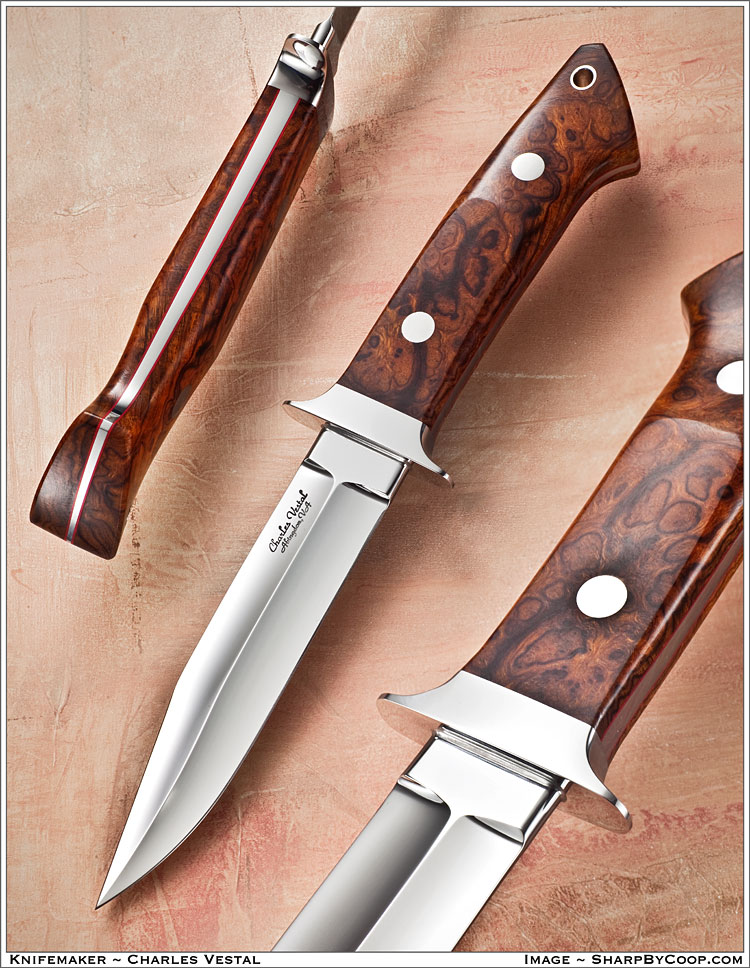
All 13 pre-orders for the 2012 Custom Knife Collectors Association (CKCA) Club Knife, a Loveless-style boot knife by CKCA knifemaker/member Charles Vestal, have been sold. The picture above is an example of one of the boot knives Vestal has done in the past. The pattern for the club knife will be somewhat different but close. 

     The CPM-154 stainless steel blades will be 4 3/4 inches long. The price of $500 for each order will include a Vestal-made leather sheath.

 
      Handle material will be black, green or burgundy Micarta®, with wood handle options as provided by the collector, and approved for use by Vestal, with no guarantees as to suitability (i.e., shrinkage, etc.).

     The guard and furniture will be stainless steel. Thad Buchanan provided Vestal with a pattern from the Loveless Shop from which the club knife will be modeled.

     First deliveries should be at the CKCA Banquet on Thursday, June 7, the night before the beginning of the 2012 BLADE Show (www.bladeshow.com).

    For more information regarding the knives click on www.customknifecollectorsassociation.com/

For more on the latest knives, knife legislation, knifemaking instruction, knife trends, knifemakers, what knives to buy and where and much more, subscribe to BLADE® Magazine, the World’s No. 1 Knife Publication. For subscription information click on http://www.shopblade.com/product/blade-magazine-one-year-subscripti…?r+ssfb020712#BL1SU

Guilford Art Center Holds Juried Knife Exhibit

Calling all bladesmiths and knifemakers: the Guilford Art Center in Guildford, Connecticut, announces “Contemporary Knife Smithing: A Juried and Invitational Exhibition,” and is calling for submissions.

Bladesmithing is a thousands-year-old craft practiced in diverse cultures across the world. It has survived as an art form despite modern industrialization, with artisans dedicated to preserving and expanding traditional techniques. This exhibit will explore and highlight the artistry of the contemporary hand-crafted knife, as an object with both functional and aesthetic value.

Exhibit Dates: July 10-August 18, 2013 

Juror: An ABS journeyman smith, Mace Vitale practices blacksmithing and is a copper smith. He has a background in architectural pre-cast concrete, is owner of Laurel Rock Forge in Guilford, and is an instructor at the Guilford Art Center.Vitale_120608

Eligibility: This exhibition is open to knives made by U.S. residents.

Entries: Each artist may submit up to three (3) works. Each work may be represented by two separate images: one full view and one detail view. Work must be submitted in high-resolution digital format. For each entry please note dimensions of knife, and a maker’s list price (retail price), or not-for-sale/insurance value. Email entries to: [email protected].

Entry Fee for Applicants: $20. Includes up to three (3) submissions. Make check payable to Guilford Art Center and mail to 411 Church St., Guilford, CT 06437. Or call the Center with credit card number 203-453-5947. Payment must be received for entries to be eligible.

Entry Deadline: June 10, 2013. Digital images and entry fee must be received by this date.

Conditions:  All accepted works must arrive with a display case that closes for safety purposes during exhibition. All entries must be original and must be completed within the last 3 years. The Center reserves the right to reject entries that do not meet these requirements or is deemed unstable. Shipped work that differs from submitted images will not be accepted. Work damaged in shipping will regretfully not be presented. All accepted work must have proper identification. No accepted work may be picked up before the closing of the exhibition.  Work may be available for sale or must be identified as NFS. The retail price or insurance value provided on the entry form will be used; no changes may be made after the work is shipped.

Shipping: Shipping costs are the responsibility of the artist. A check for return shipping, including the cost of insurance, must accompany delivered work, payable to Guilford Art Center. Work damaged in shipping will not be presented. Detailed packing/handling instructions must accompany all works.

Hand Delivery: Please call the Center to make an appointment for hand delivery/pickup at 203-453-5947, Ext. 12, or email [email protected].

Receiving Deadline: All work must be received no later than these dates.

Sales/Insurance: A 40% commission on all sales will be retained by the Center. Artists must indicate sale price and insurance value or, if NFS, just insurance value. Submission of work to this exhibit is done so at the artist’s risk and implies an agreement on the part of the artist to all the conditions of this Call for Submission. GAC will not be responsible for loss or damage to work in transit, however, work will be insured while in the Guilford Art Center facility.

Publicity: Guilford Art Center reserves the right to photograph entries for the purposes of documentation, education and publicity. Accepted artists are encouraged to send to the Center a resume, artist statement, brochures, and additional photographic materials of the accepted work for publicity purposes.


Show Schedule:

Application due: June 10, 2013    

Artist Notification: June 14, 2013   

Receiving: June 24-28, 2013  (10am-4pm)  (Shipped/by appointment) 

Opening reception: July 10, 2013 (5-7pm) 

Closing:  August 18, 2013   

 Deinstallation: August 19-23, 2013 (10am-4pm) (Shipped/by appointment) 

For more information please contact Guilford Art Center at 203-453-5947, or visit www.guilfordartcenter.org.

Knife Of The Day: CRKT Big Dog Carson Desert Tactical

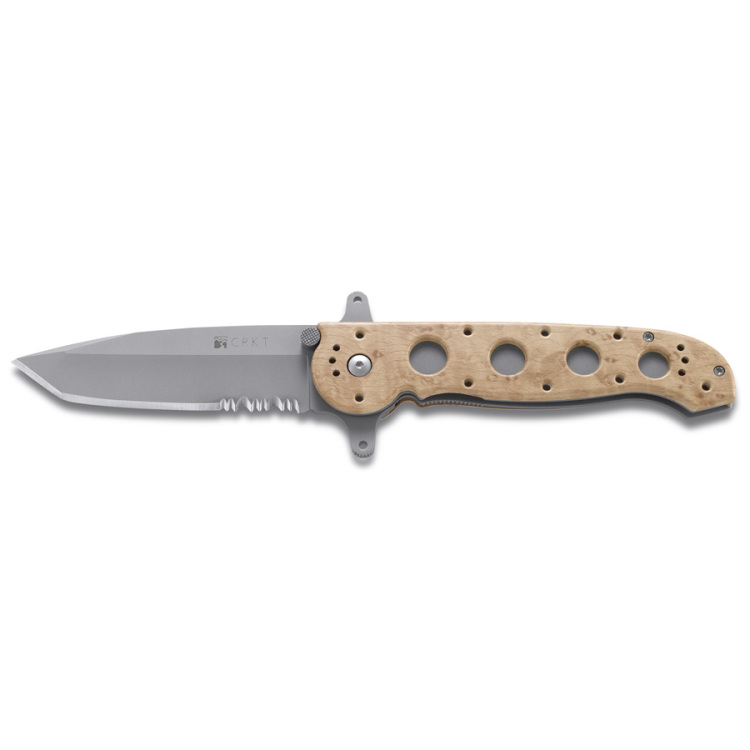
Our “Knife Of The Day” for Feb. 27 is the M16-14ZSF Carson Desert Tactical flipper folder designed by Kit Carson for Columbia River Knife & Tool.

     The 3.875-inch blade is 420J2 stainless steel and the handle of the “Big Dog” version of the knife is Zytel® in a desert camo pattern. Weight: 6.3 ounces. An AutoLAWKS safety designed by Blade Magazine Cutlery Hall-Of-Fame© members Michael Walker and Ron Lake offers added security when the folder is locked open.

For more information click on http://www.shopblade.com/product/m16-14zsf/?r+ssfb022712#X3333


Today is Deadline to Stop Proposed Ivory Ban

An all-inclusive ivory ban that would target ancient ivory such as mammoth and mastodon in addition to elephant ivory likely will pass without your help by the end of day today, Dec. 27.

Draconian ivory ban would oust ancient ivories. (SharpByCoop photo)
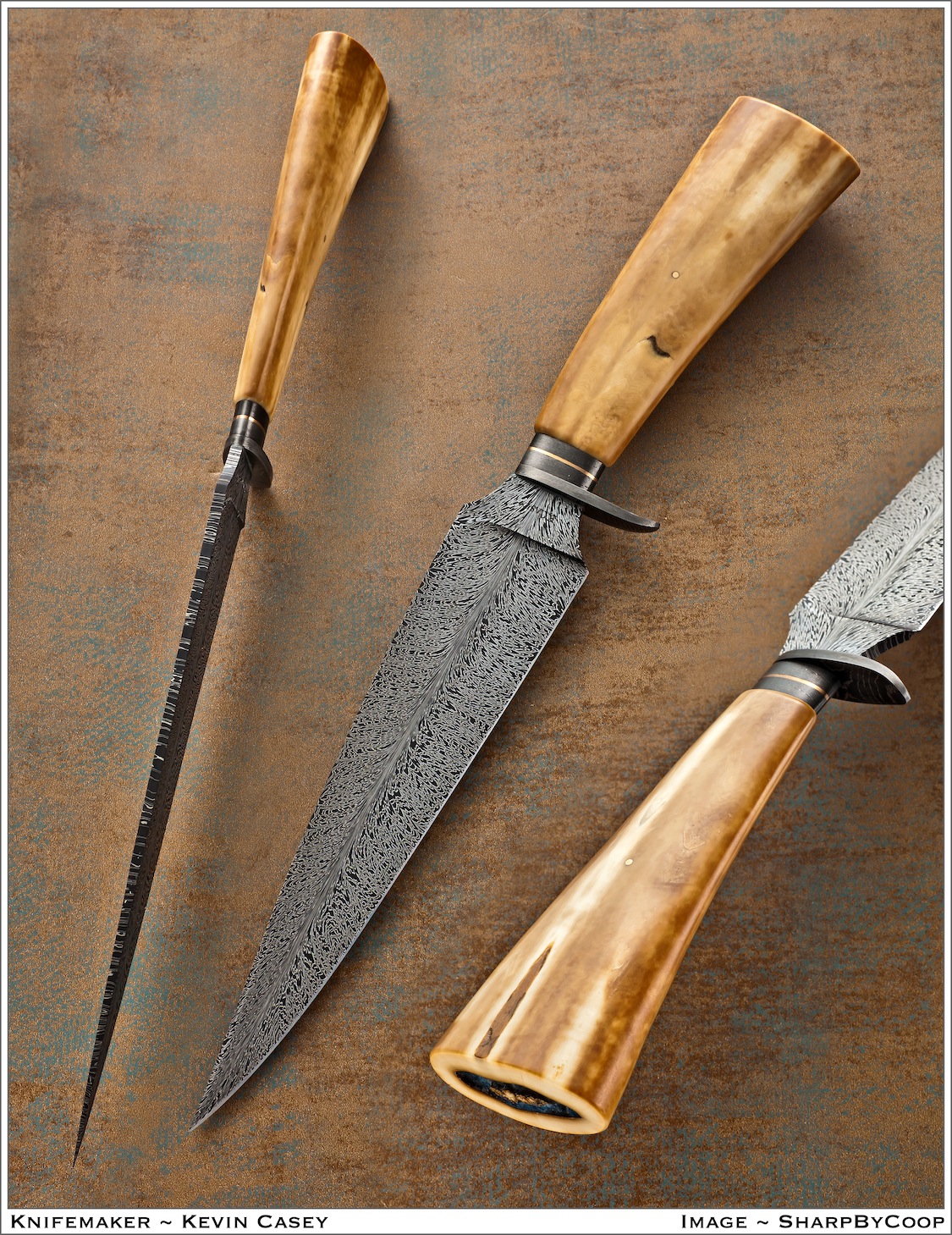
A proposed ivory ban would include ancient ivory. Kevin Casey uses ancient walrus ivory on his bowie. (SharpByCoop photo)

A Presidential Advisory Committee that met on Dec. 16 recommends a total ban of ivory within the USA to the task force on Wildlife Trafficking. The ban would apply to the sale of all ivory in any form and include pre-ban and antique ivory in knives, guns, musical instruments, pianos with ivory keys, etc. The ban would affect collectors, makers and anyone who sells within or to the USA. The committee will file its report on Dec. 28, so any entreaties opposing the proposed ban must be e-mailed by no later than today in order to be registered and considered before the report is filed.

The address to send your email to is [email protected]. Copy and paste the following letter—though feel free to tailor it as you see fit—to an email, and email it to the above address:

Dear Advisory Committee,

I stand against a total ban of all ivory sales in the USA.

As called for in the Presidential Executive Order, I ask that the recommendations continue to allow for “legal and legitimate commerce.”

The ivory market in the USA is stable and/or declining, and seizure records indicate that a high proportion of the seizures were personal effects lacking the correct paperwork, not the so-called blood tusks reported on by the media. The Elephant Trade Information System (ETIS) analysis indicates that the amount of ivory by weight seized annually has not increased in recent years. We are not the consumers of the poached ivory. Therefore, banning ivory sales within the USA will do nothing to save the remaining world population of elephants.

The CITES MIKE (Monitoring the Illegal Killing of Elephants) September 2013 report analysis, page 64, states, “Africa’s elephant populations are managed sustainably,” and that in 2013 the quote for permits for legal elephants was 1,350 animals. There is legal trade that can be monitored with DNA testing and permitting. Enforcing and policing a ban would require funds that should be used to support the ban on imports already in effect.

I fully support CITES rules, closing international borders to elephant ivory trade, a law already in effect that should be fully supported and enforced. I stand against a total ban of all ivory commerce within U.S. borders, a decision that would be an enforcement nightmare. Like Prohibition of the 1920s, it would cause a new wave of illicit commerce where a legitimate one now exists. Museums, antique dealers, collectors, artisans and individual citizens have invested in a legal and valuable material. Sanctioned trade in ivory that is legal (culled and pre-ban) and comes from unthreatened sources (mammoth, boar, warthog, antique and recycled products) can pose no possible threat to elephant herds in the wild.

I believe our mutual goals are the same and a solution can be reached. Please keep the focus where it belongs. To increase the elephant population, the killing must be stopped in Africa and at its borders.

Respectfully submitted,

____________________________ (TYPE YOUR NAME)


Ohio Classic Knife Show Starts at 1 p.m. Today

The Ohio Classic Knife Show hopes to build on the momentum of recent knife shows as it holds its annual event today and tomorrow.


Both the California Custom Knife Show held this past weekend and the Knifemakers’ Guild Show held last month were successes by a number of accounts, and the Ohio Classic hopes to build off their momentum as well as some of its own.


For instance, purveyor/collect Jon Ukman noted of the Cal show, “It was outstanding! I bought about 70 knives—and that is a good show.” Purveyor Dave Stark of Steel Addiction Custom Knives also had words of praise for the Cal show. Meanwhile, ABS bladesmith Johnny Perry, who helped display a collection of Bill Moran knives for the Moran Foundation at the Knifemakers’ Guild Show last month, said the Guild Show was a good one as well.


Held at the Pritchard-Laughlin Civic Center in Cambridge, Ohio, the Ohio Classic runs from 1 o’clock this afternoon until 7 tonight, and 9 a.m. to 5 p.m. tomorrow. In addition to some of the custom industry’s top makers, the show will include some leading factory knife exhibitors and also a cutting competition tomorrow. In addition, Jeff Fournier from Mule Team Canvas will give a demo on canvas dying.


Exhibiting knifemakers include Tom Downing, Blind Horse Knives, Ryan Daniels of Queen Cutlery, Phillip Booth, Wayne Hensley, Pete Crowl, Andrew Demko, George Trout, Mickey Yurco, Greg Gottschalk, W.C. Johnson, James Downs, Thad Yeater, Gary Wheeler, BLADE® field editor Kim Breed, Lon Humphrey, Craig Steketee, Mark Carey of Spartan Blades, Bill Behnke and many others. Also exhibiting will be Charles Turnage of Turnage Productions, photographer Terrill Hoffman, purveyor Jerry Schroeder, Pop’s Knives and Supplies, Brad Vice of Alabama Damascus, Brad Stallsmith of Peters Heat Treat and many others.


For more information visit www.ohioknifeshow.com.


For the latest knives, knife news and more, keep an edge on it with www.blademag.com (www.blademag.com).

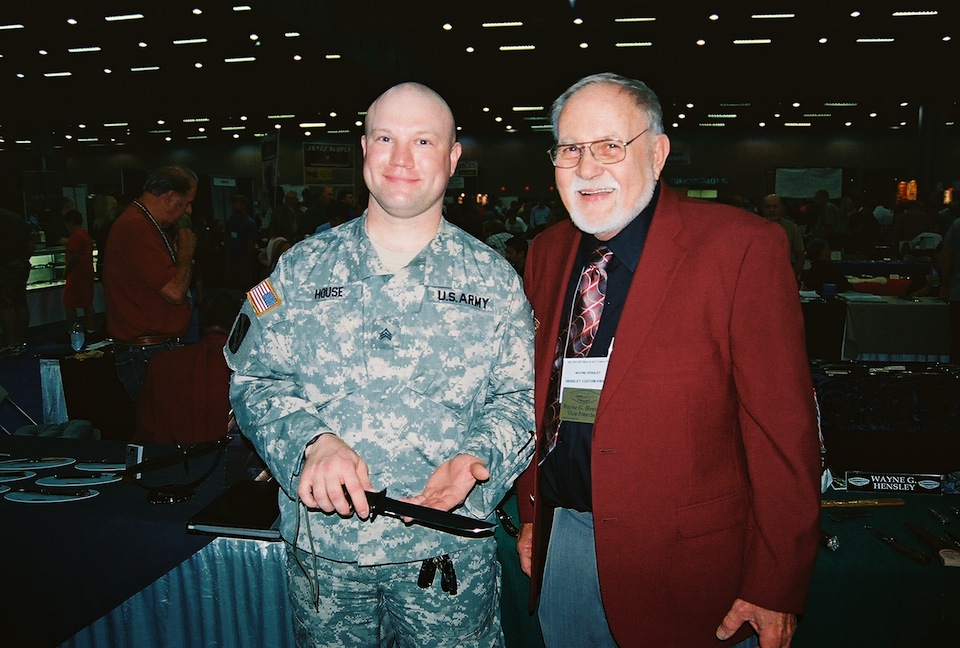
Attend the Ohio Classic Knife Show this afternoon and tomorrow to see makers like Wayne Hensley (right) and many others.
The Ohio Classic Knife Show welcomes knifemaker Wayne Hensley (right) and others this afternoon and tomorrow.
Advertisement

Must Read Articles

Read this before you make a knife

Knifemaking 101 – Read This Before You Make a Knife

  by Wayne Goddard My experience has taught me that there's nothing like digging in and getting started. I've often said the hardest part of the...
how to forge damascus steel

How to Forge Damascus

Advertisement
Advertisement