Knife Collecting

Knife collecting is an extremely rewarding experience for knife enthusiasts. There truly is a knife for everyone. Many increase or hold their value throughout the years, making collecting knives something to pass on to the next generation of knife collectors.

Antique Ivory Exceptions Rule Too Stringent

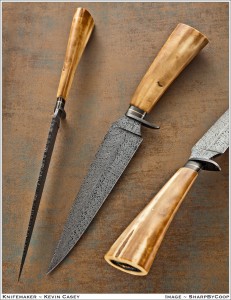
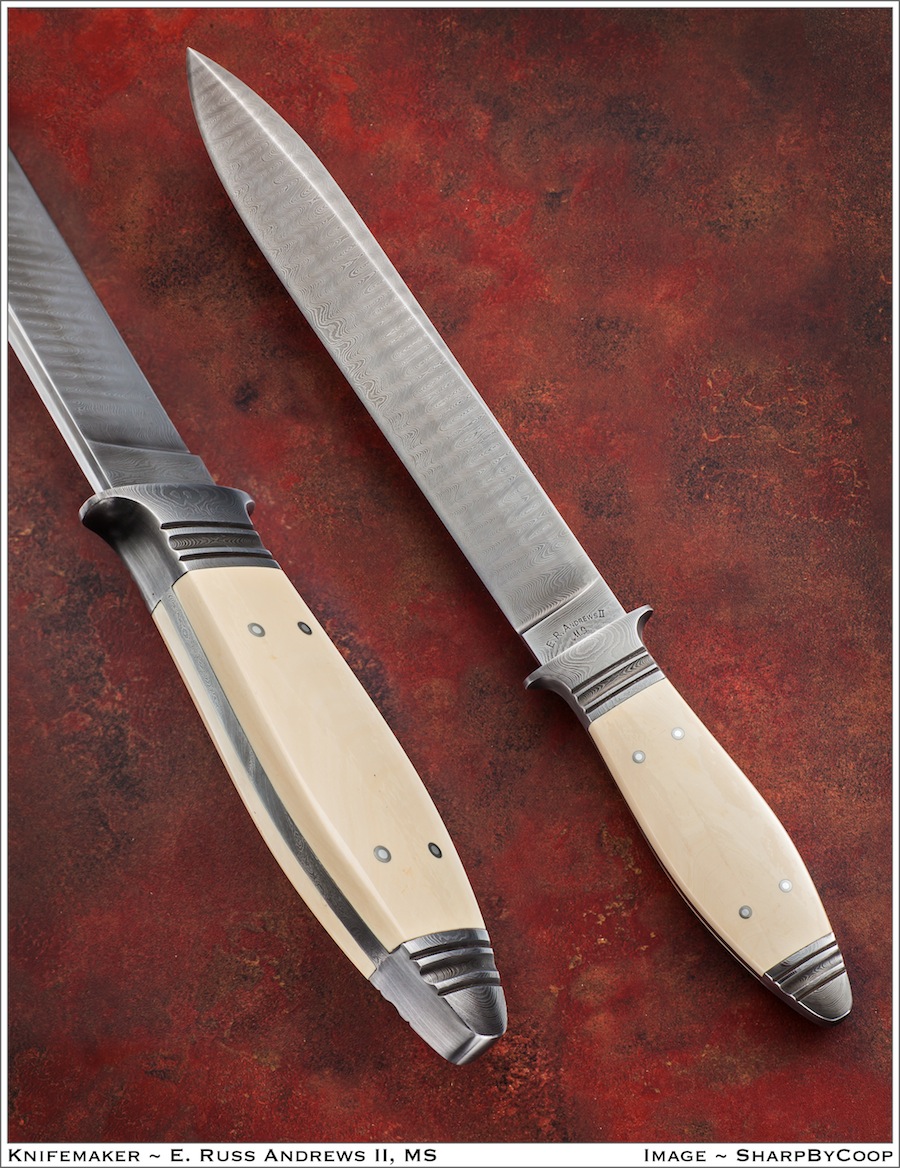
Russ Andrews uses fossil ivory on his dagger. (SharpByCoop photo)
One potential problem with the ban is that some fossil ivories resemble elephant ivory, such as the mammoth ivory on the handle of this dagger by Russ Andrews. (SharpByCoop photo)

The recently announced federal ban on ivory not only seems to outlaw all import, export, interstate and intrastate sales of elephant ivory, it also appears to make all potential exceptions to the rule such as antiques virtually impossible to meet.

Initially announced on Feb. 11, the ban received more coverage Feb. 26 when the federal website http://www.fws.gov posted a story outlining the ban in more detail, including Director’s Order No. 210 from the U.S. Department of the Interior, Fish and Wildlife Service.

The story indicated that while virtually all elephant ivory is now illegal, a few exceptions exist, such as antique elephant ivory. However, to qualify as antique, elephant ivory must adhere to a hodge-podge of requirements that not only are virtually impossible to meet but present prohibitive costs in the process.

For instance, to qualify as an antique, the ivory must be 100 years old or older. However, the person claiming the ivory is that old must “definitively prove” the identity of the species. Such proof “can be in the form of bonafide DNA analysis,” a qualified appraisal or “other documentation,” such as “family photos, ethnographic fieldwork or other information.” If such analysis is required on each and every piece of elephant ivory, it would be cost-prohibitive for individual knifemakers. What’s more, the appraiser and the appraisal must meet strict guidelines in terms of the appraiser’s credentials, the scientific method used to determine the age or species must be described in detail, a detailed history of the article including proof of authenticity must be presented, etc.

Not only are the requirements draconian in nature, they don’t even take into account the fact that no one kept such records of their ivory when they bought it months or years ago, and to obtain such information now is virtually impossible.

Further, there must be proof that the ivory was imported through one of 13 specific ports of entry—12 in the USA and the other in San Juan, Puerto Rico. Notarized statements or affidavits by the exporter or seller are not adequate proof.

The maximum penalty for violations—which would qualify as violations of the Endangered Species Act—is one year in prison and a $100,000 fine for the individual, and $200,000 for an organization. Those who submit false records or identification of ivory face a maximum penalty of five years in prison and a $250,000 fine.

For the latest knives, knife news, trends and more, stay tuned to www.blademag.com.
 

Feds Ban Trade of Elephant Ivory

Except in “a very limited number of circumstances,” the federal government has announced a ban on the commercial trade of elephant ivory, according to a report from the office of the secretary of The White House.

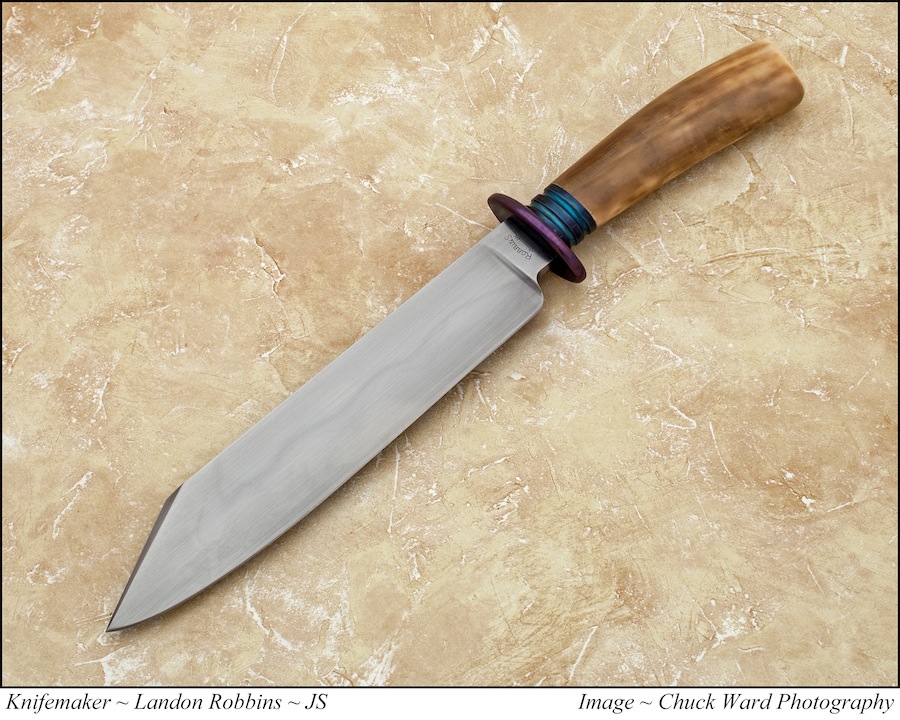
Documentation proving ancient ivory is over 100 years accompanies new federal ivory ban. (Ward photo)
A new federal ban will require documentation proving antique ivory is over 100 years old. Landon Robbins used fossil ivory on his fixed blade here. (Ward photo)

How the ban will affect existing knives with handles of elephant and fossil ivory and existing supplies of elephant and fossil ivory held by knifemaking suppliers, knifemakers and others is not exactly clear at this time. However, if past experience is any barometer, knife professionals and enthusiasts should expect the worst.

Announced yesterday, Feb. 11, the ban prohibits, except under the aforementioned very limited number of circumstances, the import, export or resale of elephant ivory within the United States.

To implement the new controls, federal departments and agencies will immediately act to:

•Prohibit the commercial import of African elephant ivory, including antiques;

•Prohibit the commercial export of elephant ivory, except for bona fide antiques, certain noncommercial items and in “exceptional circumstances permitted under the Endangered Species Act”;

•Clarify the definition of “antique” so that the ivory must be more than 100 years old and meet other requirements under the Endangered Species Act. It will be up to the importer, exporter or seller to prove the item passes muster;

•Limit the number of African elephant sport-hunted trophies an individual can import to two per hunter per year; and, lastly;

•Finalize a proposed rule that would “reaffirm and clarify that sales across state lines are prohibited, except for bona fide antiques, and will prohibit sales within a state unless the seller can demonstrate an item was lawfully imported prior to 1990 for African elephants and 1975 for Asian elephants, or under an exemption document.”

In the coming months, the report noted, the federal government will take further steps to implement the “National Strategy,” and will work with Congress to strengthen existing laws and adopt new ones to enhance its “ability to address this global challenge.”

In other words, the federal government has declared war on all things ivory.

Stay tuned to www.blademag.com for further developments.


EX-03: More Than Just Another Black Handle Tactical

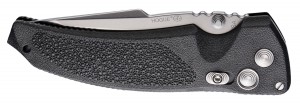
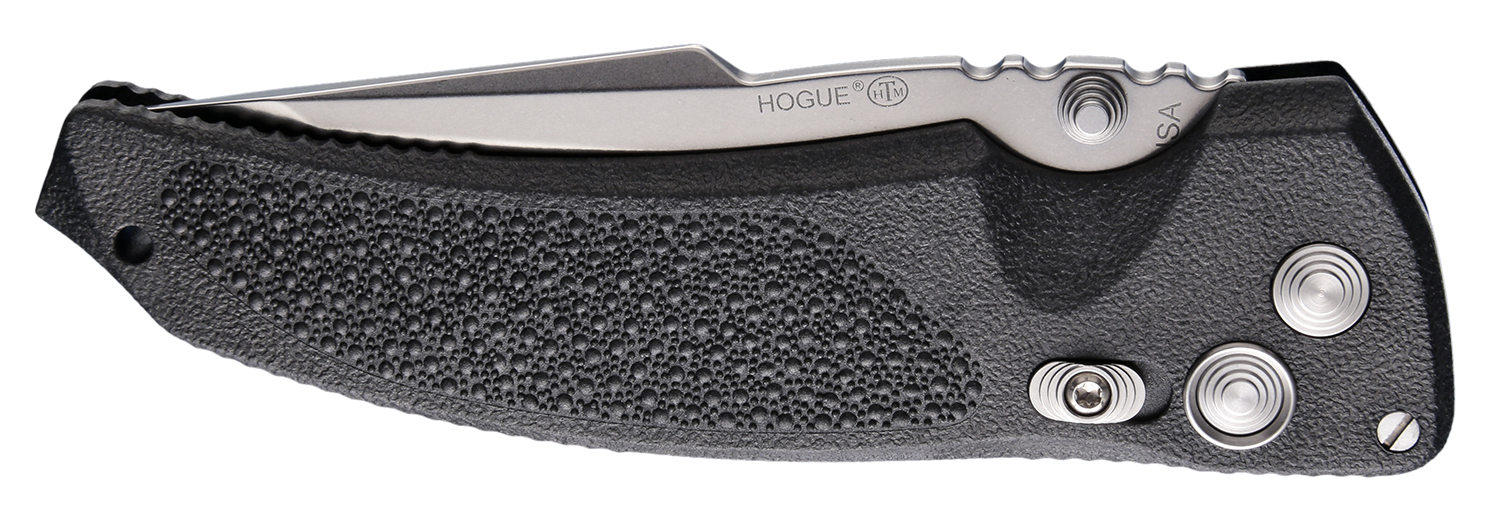
Sometimes it’s easy to denigrate the many black-handle tactical folders on the market, but Hogue Knives’ approach to the grip material for its EX-03 sheds new light on black.

The handle material for the EX-03 is a polymer known as Polyphenylene Sulfide. The trade name is PPS.

A polymer known as PPS is the handle material for the Hogue4 EX-03. (Hogue photo)
Hogue uses a polymer known as PPS for its EX-03 folder. (Hogue photo)

“This material was selected for its high-tensile strength—29,000 psi—along with many other strength categories which are superior to a more commonly used reinforced nylon such as Zytel®,” noted Jim Bruhns, president of Hogue. “PPS is also much more thermally resistant than nylon, which is more of a big deal that you would expect.

“In most applications reinforced nylon, also known as glass-filled nylon, works very well through a wide range of temperature. We have seen occasion where polymer products fail as a result of extreme temperature in some obvious places, such as the trunk of a car where extreme highs and lows can occur. Again, PPS wins in this category with a much higher deflection temperature than nylon.”

The internal components that make the EX-03’s mechanism are 17-4 stainless steel. The real trick, Bruhns stressed, was getting such a robust assembly staged into an injection-mold tool in a way that the blade could be added and adjusted as part of a final assembly after molding.

“This was something that was met with quite a bit of skepticism, as the problem is quite challenging,” Bruhns continued. “This really goes to the root competency of what we do here at Hogue.”

Bruhns was able to develop the needed tooling for the task and the results speak for themselves.

“We now have a single-piece polymer frame folder with all of the best-known materials available in a rock-solid assembly,” he stated. “This knife is the best bang for your buck available today.”

For more on the Hogue EX-03, see the May BLADE®, on newsstands Feb. 25.

Elvis and the Gil Hibben Knife

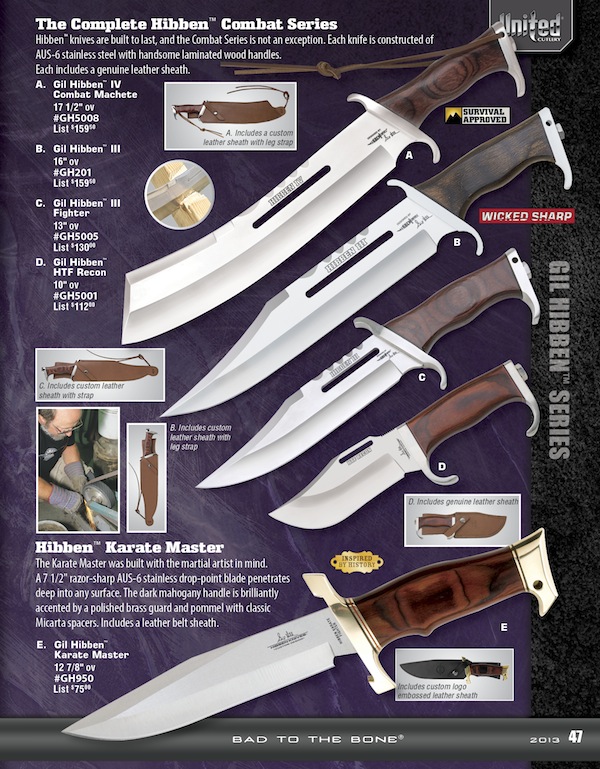
The Hibben Karate Master shown at bottom here is the updated version of the knife Gil Hibben made for Elvis Presley in 1974. (United photo)
The knife Gil Hibben made for Elvis Presley in 1974 lives on today in the “Hibben Karate Master” reproduction (shown at bottom above) from United Cutlery. (United photo)

What better day to celebrate the custom knife BLADE Magazine Cutlery Hall-Of-Fame© member Gil Hibben presented to Elvis Presley than on The King’s birthday?

Today is Presley’s birthday and a reminder of when Hibben and Phil Lobred, coordinator of the Art Knife Invitational, visited Presley 40 years ago.

It was also when Hibben presented Presley with a handmade Hibben knife.

Both Hibben and Presley were practitioners of Kenpo karate. In 1974, Gil and Phil attended a Kenpo tournament in Los Angeles. While there, they stayed with Ed Parker, founder of the Kenpo system. Parker had one of the early custom Hibben Kenpo knives which, at the time, Gil called the Ed Parker Knife. It occurred to Parker that Elvis, who had a second home in L.A. and was a karate student of Parker’s, might be interested in the Hibben knife. Plus, presenting the knife to Elvis could be a way to get Gil and Phil in to see the King.

Parker made the arrangements and Gil and Phil were at Presley’s L.A. home. When the knife was presented to Elvis, the King was extremely pleased. “He was like a kid with a new toy,” Lobred recalled. Presley went upstairs and returned with a gold Omega watch and presented it to Hibben in return. In all, Gil and Phil got to hang out with the King and Co. for about six hours.

As for whatever happened to the knife presented to Presley, Hibben said no one knows for sure. “It’s not at Graceland,” Gil noted. Maybe one day it will turn up. If it does, Hibben said he will know it on sight.

For the latest knives, knife news, trends, tips and more, stay honed at www.blademag.com.

Today is Deadline to Stop Proposed Ivory Ban

An all-inclusive ivory ban that would target ancient ivory such as mammoth and mastodon in addition to elephant ivory likely will pass without your help by the end of day today, Dec. 27.

Draconian ivory ban would oust ancient ivories. (SharpByCoop photo)
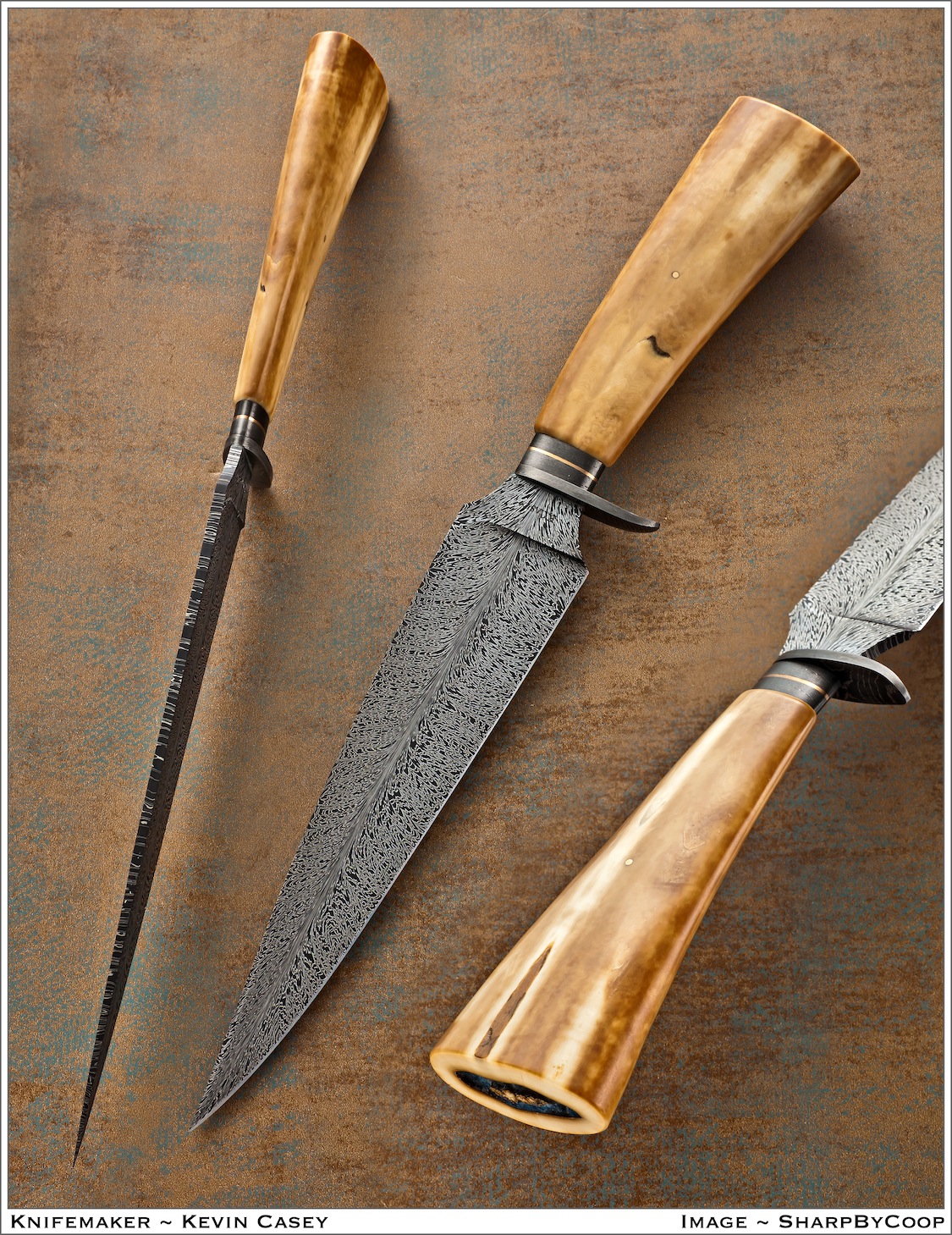
A proposed ivory ban would include ancient ivory. Kevin Casey uses ancient walrus ivory on his bowie. (SharpByCoop photo)

A Presidential Advisory Committee that met on Dec. 16 recommends a total ban of ivory within the USA to the task force on Wildlife Trafficking. The ban would apply to the sale of all ivory in any form and include pre-ban and antique ivory in knives, guns, musical instruments, pianos with ivory keys, etc. The ban would affect collectors, makers and anyone who sells within or to the USA. The committee will file its report on Dec. 28, so any entreaties opposing the proposed ban must be e-mailed by no later than today in order to be registered and considered before the report is filed.

The address to send your email to is [email protected]. Copy and paste the following letter—though feel free to tailor it as you see fit—to an email, and email it to the above address:

Dear Advisory Committee,

I stand against a total ban of all ivory sales in the USA.

As called for in the Presidential Executive Order, I ask that the recommendations continue to allow for “legal and legitimate commerce.”

The ivory market in the USA is stable and/or declining, and seizure records indicate that a high proportion of the seizures were personal effects lacking the correct paperwork, not the so-called blood tusks reported on by the media. The Elephant Trade Information System (ETIS) analysis indicates that the amount of ivory by weight seized annually has not increased in recent years. We are not the consumers of the poached ivory. Therefore, banning ivory sales within the USA will do nothing to save the remaining world population of elephants.

The CITES MIKE (Monitoring the Illegal Killing of Elephants) September 2013 report analysis, page 64, states, “Africa’s elephant populations are managed sustainably,” and that in 2013 the quote for permits for legal elephants was 1,350 animals. There is legal trade that can be monitored with DNA testing and permitting. Enforcing and policing a ban would require funds that should be used to support the ban on imports already in effect.

I fully support CITES rules, closing international borders to elephant ivory trade, a law already in effect that should be fully supported and enforced. I stand against a total ban of all ivory commerce within U.S. borders, a decision that would be an enforcement nightmare. Like Prohibition of the 1920s, it would cause a new wave of illicit commerce where a legitimate one now exists. Museums, antique dealers, collectors, artisans and individual citizens have invested in a legal and valuable material. Sanctioned trade in ivory that is legal (culled and pre-ban) and comes from unthreatened sources (mammoth, boar, warthog, antique and recycled products) can pose no possible threat to elephant herds in the wild.

I believe our mutual goals are the same and a solution can be reached. Please keep the focus where it belongs. To increase the elephant population, the killing must be stopped in Africa and at its borders.

Respectfully submitted,

____________________________ (TYPE YOUR NAME)


Damascus: The Wonder Of It All

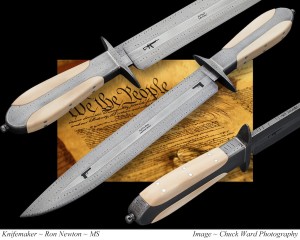
Ron Newton's damascus is spellbinding.
ABS master smith Ron Newton calls the damascus on his bowie “Newt’s Wootz.” (Chuck Ward photo)

Damascus steel has fascinated blade enthusiasts since 11th-century Crusaders first brought tales of it home from the Crusades—and the steel lives in style today on many of the custom knife industry’s leading blades.

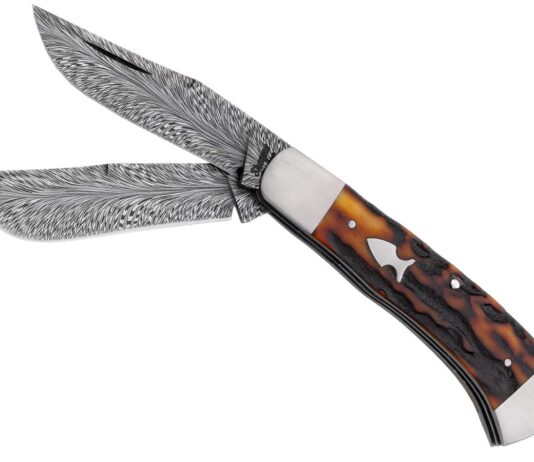
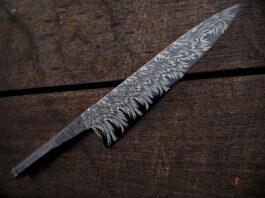
One of the things that makes damascus so appealing is the almost infinite number of patterns in which it is forged. From its modern introduction on the American knife scene by BLADE Magazine Cutlery Hall-Of-Fame© member Bill Moran at The Knifemakers’ Guild Show in 1973 to today’s array of assorted patterns, mosaics, stainless versions and more, the steel is almost always a visual feast.

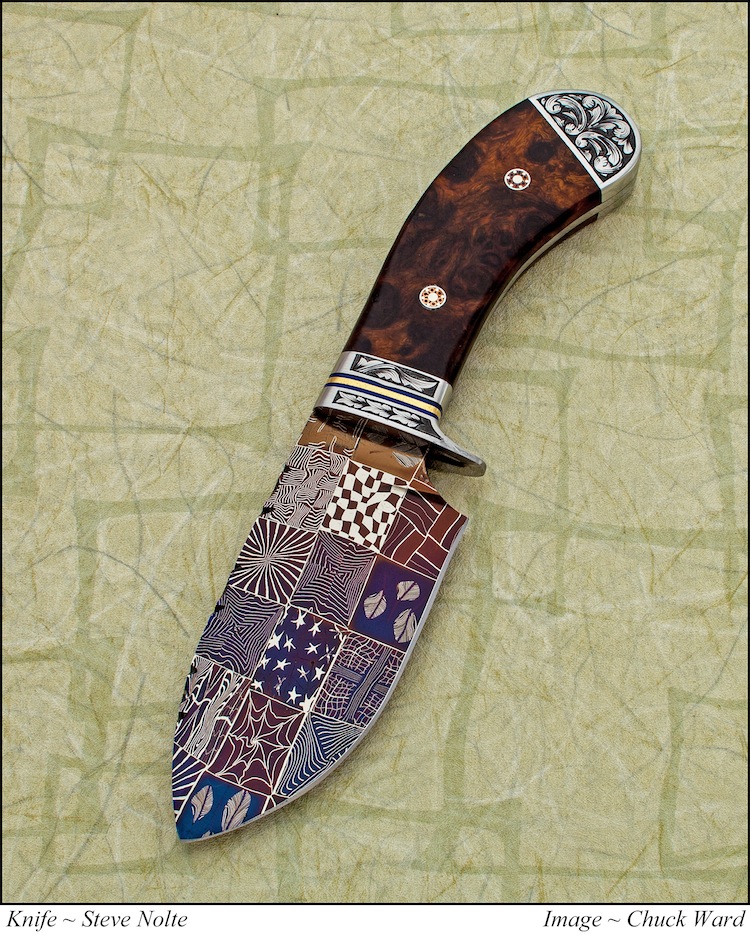
Moran named the ladder-pattern damascus, seen herein on the sub-hilt piece by Bill Behnke, after the Biblical Jacob’s Ladder. Note the “rungs” that run vertically on the blade from guard to tip, constituting the “ladder.” Steve Nolte’s wide skinner herein showcases the steel known as mosaic damascus, or also “canned steel.” There are any number of versions of it, and they are most all breathtaking.

Steve Nolte's wide skinner is highlighted by mosaic damascus.
Mosaic damascus lights up the blade of Steve Nolte’s wide skinner. (Chuck Ward photo)

Ron Newton’s “Newt’s Wootz” on his bowie herein is another of the maker’s astounding damascus steels. The damascus blade has a “Newt’s Wootz” core with 9mm handguns and AR-15 rifles plugged into the core and surrounded by tight Turkish twist bars of 1095 and 15N20 carbon steels. The two phrases in the core read “Right to keep and bear arms” and “Just try to take them.” The guard and finial knob are of a single twist damascus. The handle is six-bar Turkish twist damascus.

For the latest knives, knife news, trends, tips and more, stay tuned to www.blademag.com.
Huber Bowie At Auction Dec. 6-8

Did James Bowie own a Huber bowie?
James Bowie may have owned a Huber bowie.

A knife listed as a J. English & Huber “Sheffield Works” bowie will be among those put up for bid by Rock Island Auction Co. Dec. 6-8.

In addition to the knife, other knives, swords and firearms will be sold at the auction.

Some have suggested that James Bowie carried a Huber bowie. The Bowie Knife by Norm Flayderman includes parts of a dissertation by Dr. Tom Stapleton that suggests Huber made the knife that James and Rezin Bowie bought when they visited Philadelphia in the early 1830s. Those who read BLADE® know that BLADE field editor/ABS master smith Ed Fowler is a huge fan of vintage Huber bowies.

According to The Bowie Knife, examples of the J. English Huber are among the first and best looking of the American bowie style that originated in the early 1800s. Based in Philadelphia, the company that made the knives was in business circa 1831-36. The “Sheffield Works” in this instance was located in Philadelphia, not Sheffield, England. This has caused confusion among bowie authorities over the years. Sheffield Works was owned by Joseph English with Henry and Frederick A. Huber.

Also according to The Bowie Knife, bowies made by English could be in the running as the first to employ the “familiar ‘curved and hollowed’ clip point” seen on many antique examples.

The knife auction site lists the condition of the knife as “fine overall,” with the blade showing evidence of machine sharpening/polishing, with a few tiny chips on the tip and leading edge. The collar and pommel “are both very good, with some minor handling marks.” An inscription panel is missing from the right side of the grip, which also exhibits some age cracking and “a highly attractive grain and color.”

The site lists the estimated price for the knife at a low of $8,500 and a high of $13,000.

For the latest knives, knife news, trends and more, stay tuned to www.blademag.com.
Advertisement

Must Read Articles

Read this before you make a knife

Knifemaking 101 – Read This Before You Make a Knife

  by Wayne Goddard My experience has taught me that there's nothing like digging in and getting started. I've often said the hardest part of the...
how to forge damascus steel

How to Forge Damascus

Advertisement
Advertisement