Knife Collecting

Knife collecting is an extremely rewarding experience for knife enthusiasts. There truly is a knife for everyone. Many increase or hold their value throughout the years, making collecting knives something to pass on to the next generation of knife collectors.

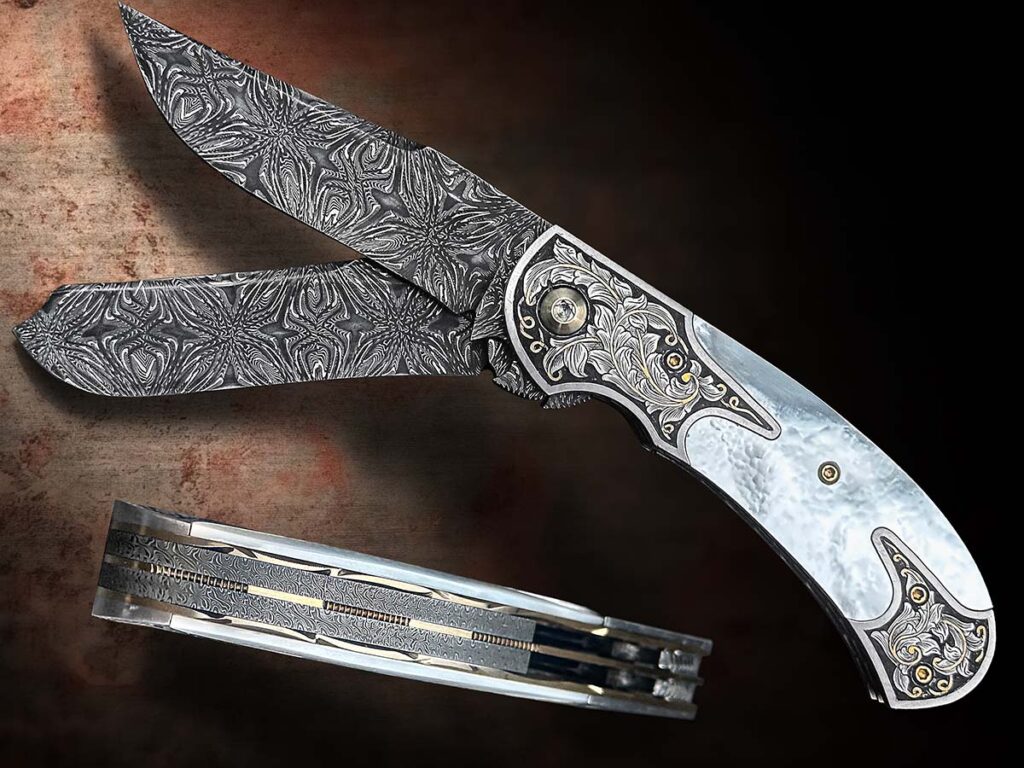
Summer’s Finest: Custom Damascus Knives You Need to See

Explore 11 jaw-dropping custom knives featuring premium damascus steel blades, exotic handle materials, and master craftsmanship.

This summer’s crop of custom knives brings damascus front and center. From twisted and ladder patterns to stainless blends and copper-clad creations, each blade in this collection highlights not just the maker’s skill, but their artistry with steel. Whether forged for daily carry, culinary precision, or collector prestige, these knives turn heads with standout materials—think crystallized titanium, crosscut mammoth, and ringed Western Myall—paired with performance-driven designs. Featured makers range from journeyman smiths to Guild members, each offering a unique take on the timeless beauty and cutting power of damascus steel.

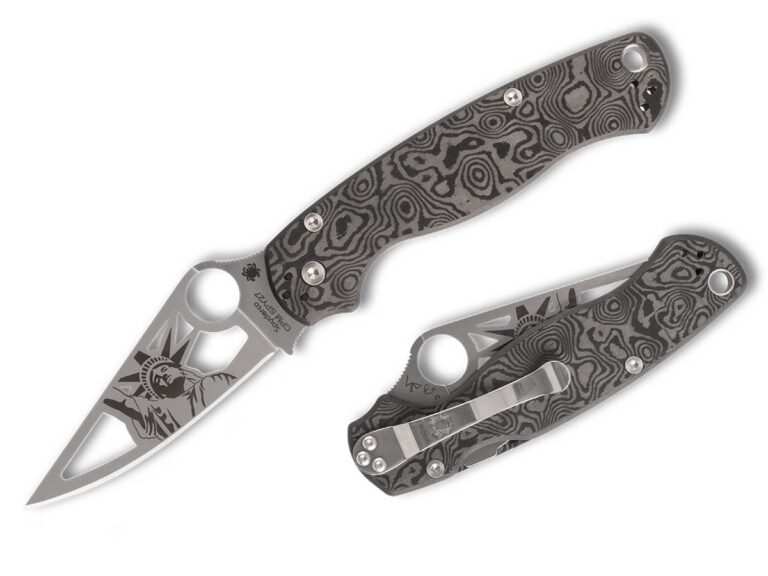
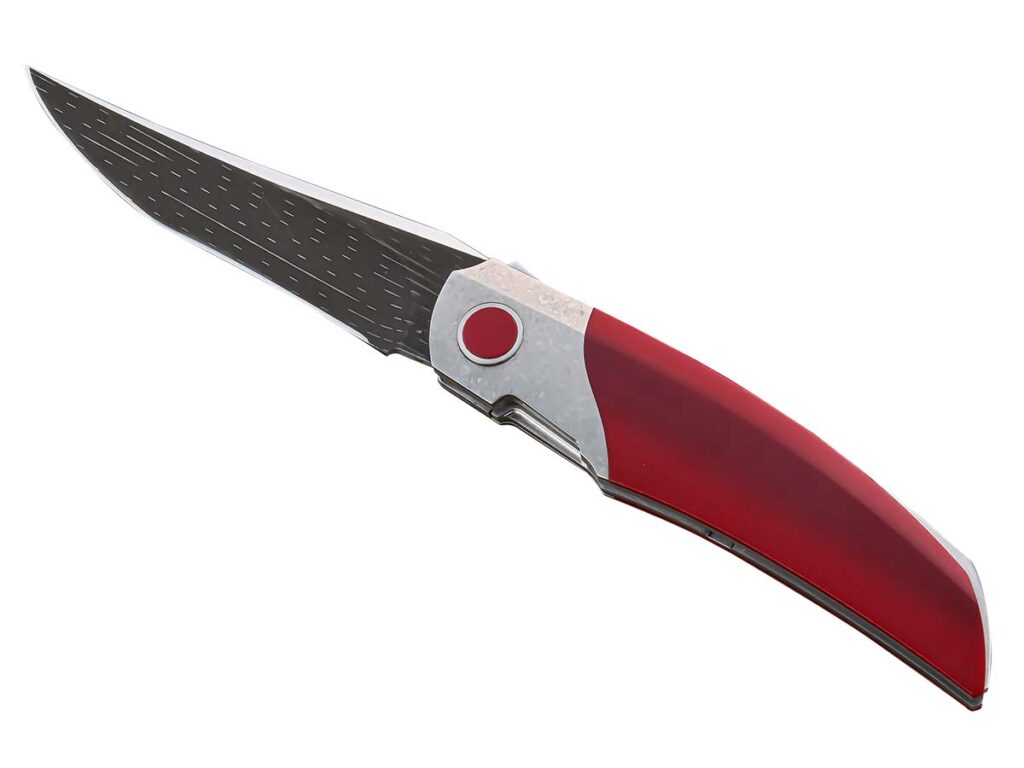
Carlos Queiros Thorn Persian TRS

Carlos Queiros Thorn Persian TRS

Knife type: Folder
Blade length: 3.35”
Blade material: Chad Nichols Starfire stainless damascus
Blade grind: Flat
Scales: Vintage bright red linen Micarta®
Bolsters: Crystalized titanium
Pocket clip: Yes
Closed length: 4.53”
Maker’s price for a similar knife: $4,700-$4,800 at press-time exchange rate
Maker: Carlos Queiros (SharpByCoop image)


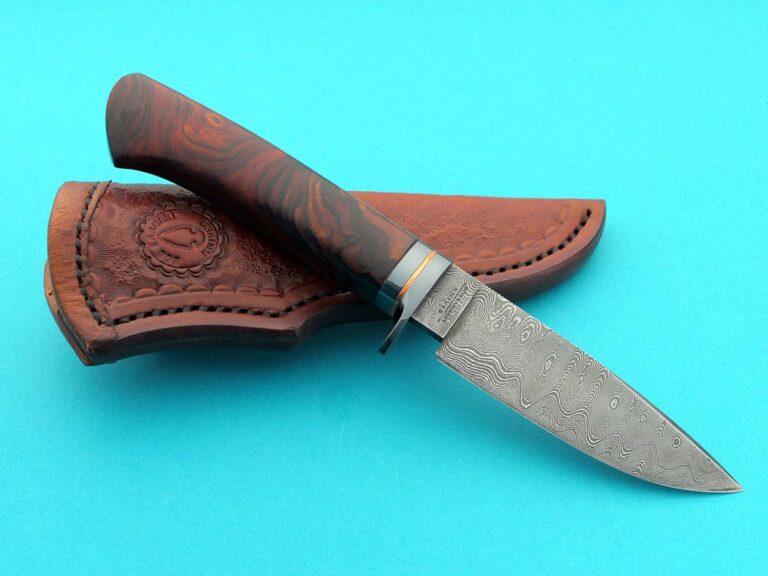
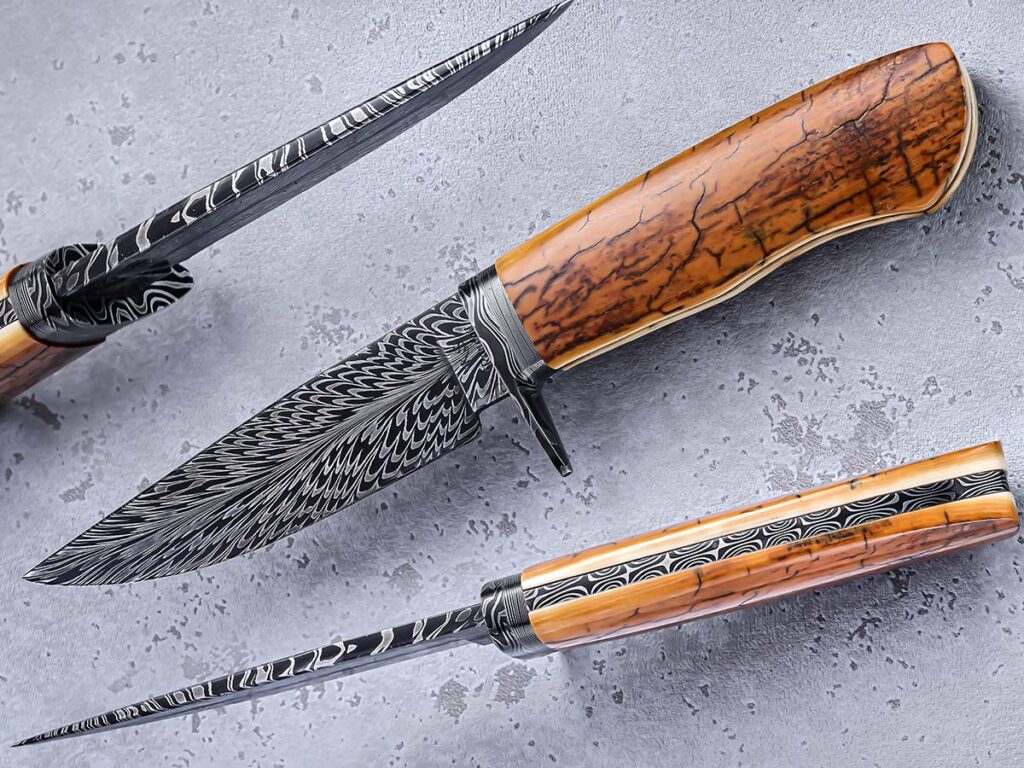
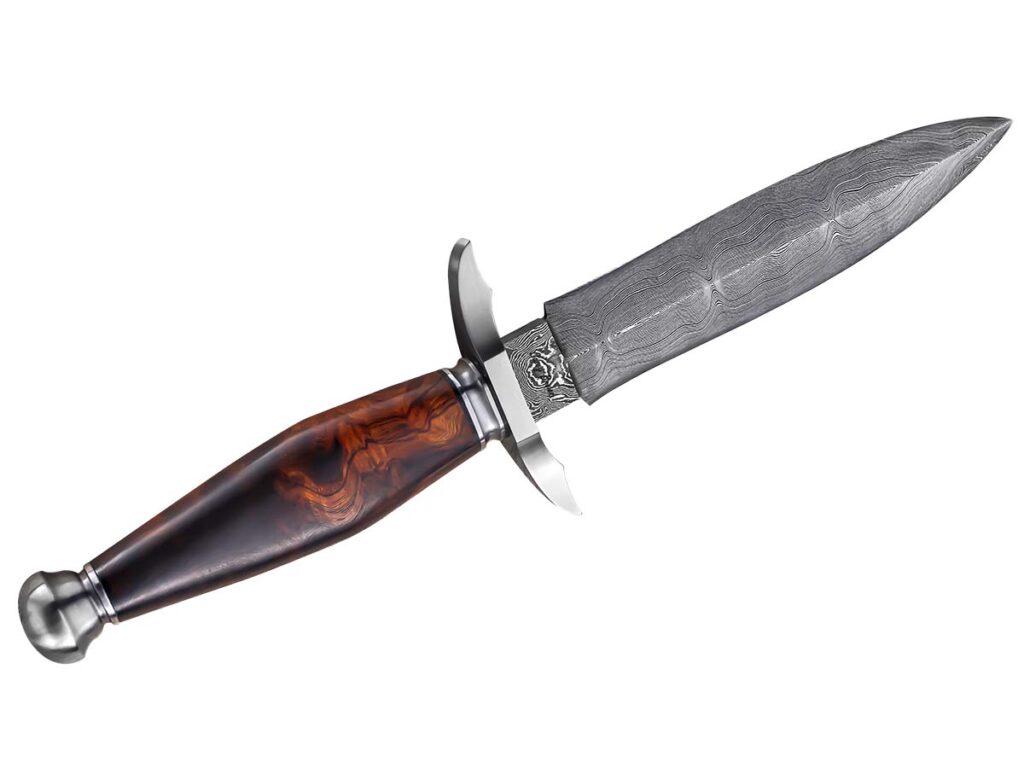
Casey Brown Dagger

Casey Brown Dagger

Blade length: 5.5”
Blade material: Ladder-pattern damascus
Blade grind: Flat
Scales: Desert ironwood
Guard/fittings: 416 stainless steel
Overall length: 10.25”
Maker’s price for a similar knife: $900
Knife to know: The maker is an ABS journeyman smith
Maker: Casey Brown (SharpByCoop image)


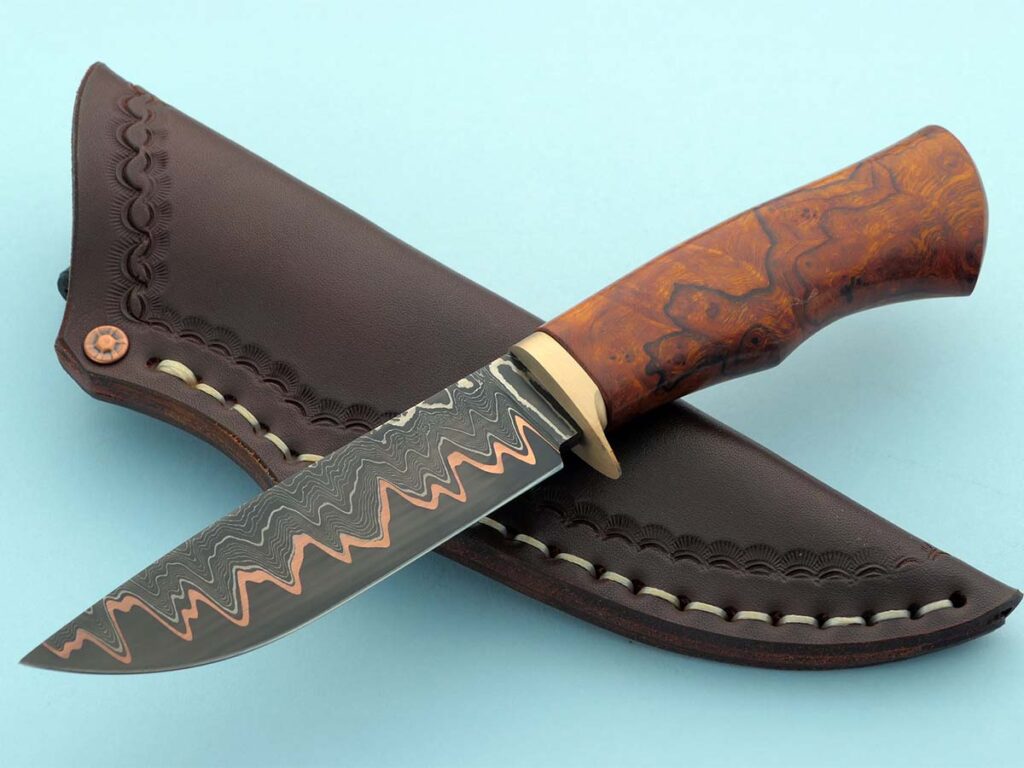
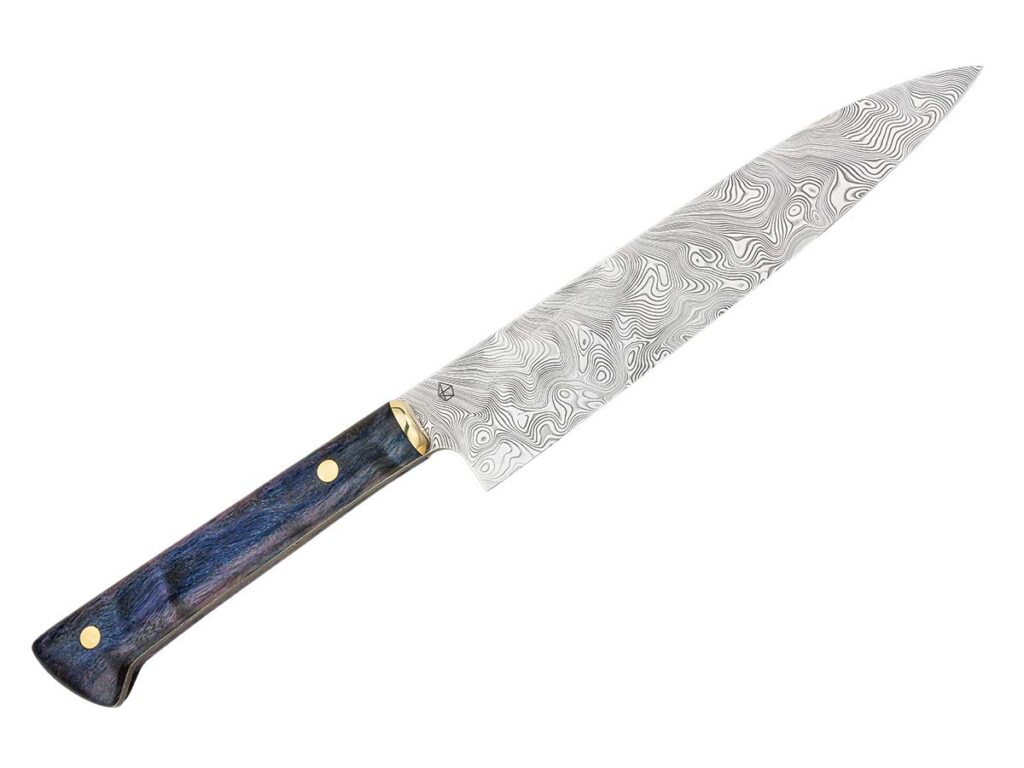
Luka Allen Petty Knife

Luka Allen Petty Knife

Blade length: 5 5/8”
Blade material: Bjorkman’s twist damascus by Damasteel
Blade grind: Flat
Scales: Cottonwood
Fittings: Brass
Overall length: 9.75”
Maker’s price for a similar knife: $450
Maker: Luka Allen, lukaallen.com (Jocelyn Frasier image)


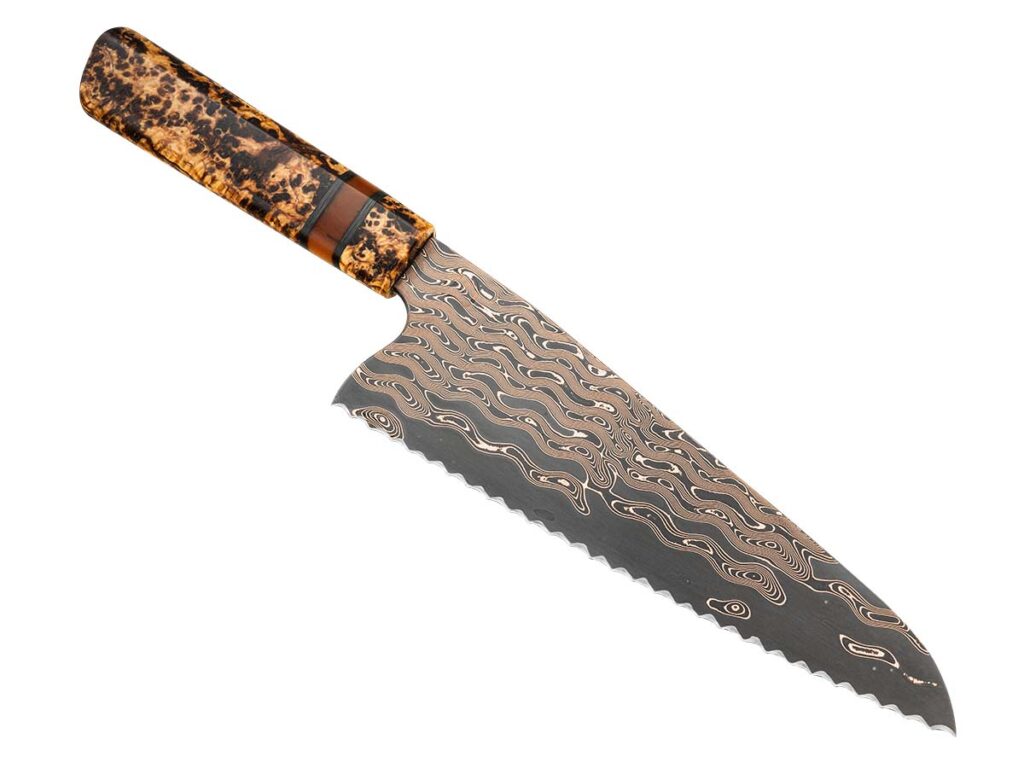
Micah Dunn Chef Bread Knife

Micah Dunn Chef Bread Knife

Blade length:7.5”
Blade material: Baker Forge & Tool copper-mai Surge pattern
Blade grind: Flat
Scales: Spalted chestnut burl and vintage Micarta®
Overall length: 12.25”
Maker’s price for a similar knife: $1,200
Maker: Micah Dunn, mdedgeworks.com (Jocelyn Frasier image)


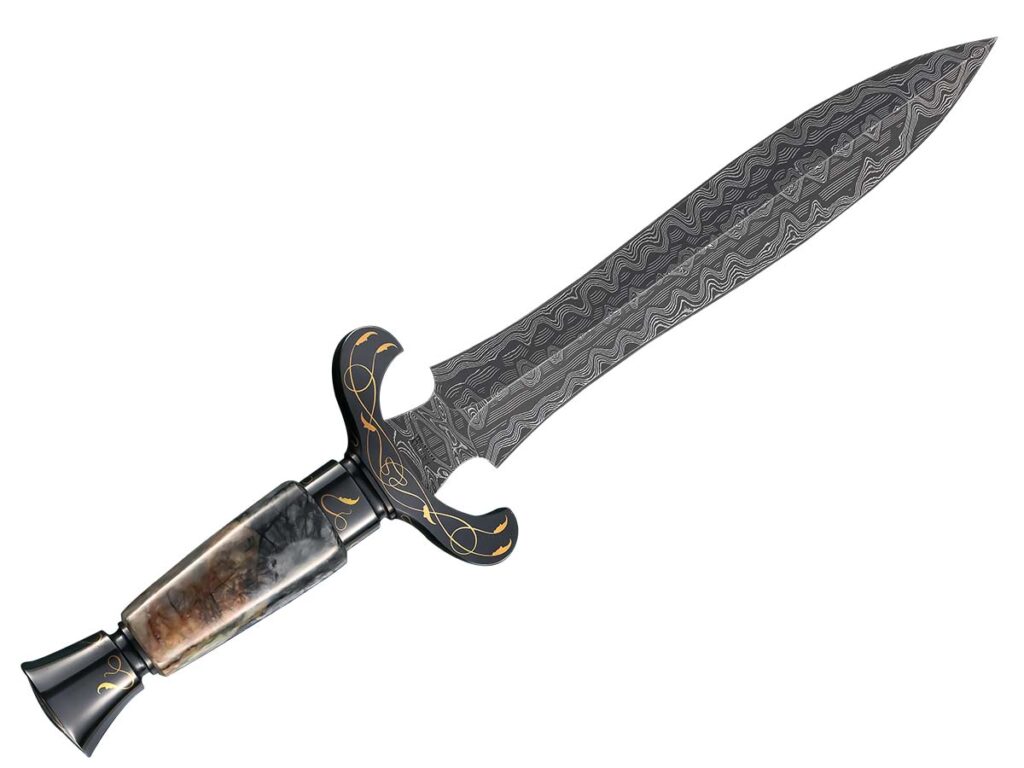
Dennis Friedly Art dagger

Dennis Friedly Art dagger

Blade length: 9”
Blade material: Mike Norris damascus
Blade grind: Hollow
Scales: Picasso marble
Fittings: Blued steel
Embellishment: 24k-gold inlay by Ray Cover Jr.
Maker’s price for a similar knife: $7,200
Knife to know: The maker is a voting member of The Knifemakers’ Guild
Maker: Dennis Friedly, friedlyknives.com (SharpByCoop image)


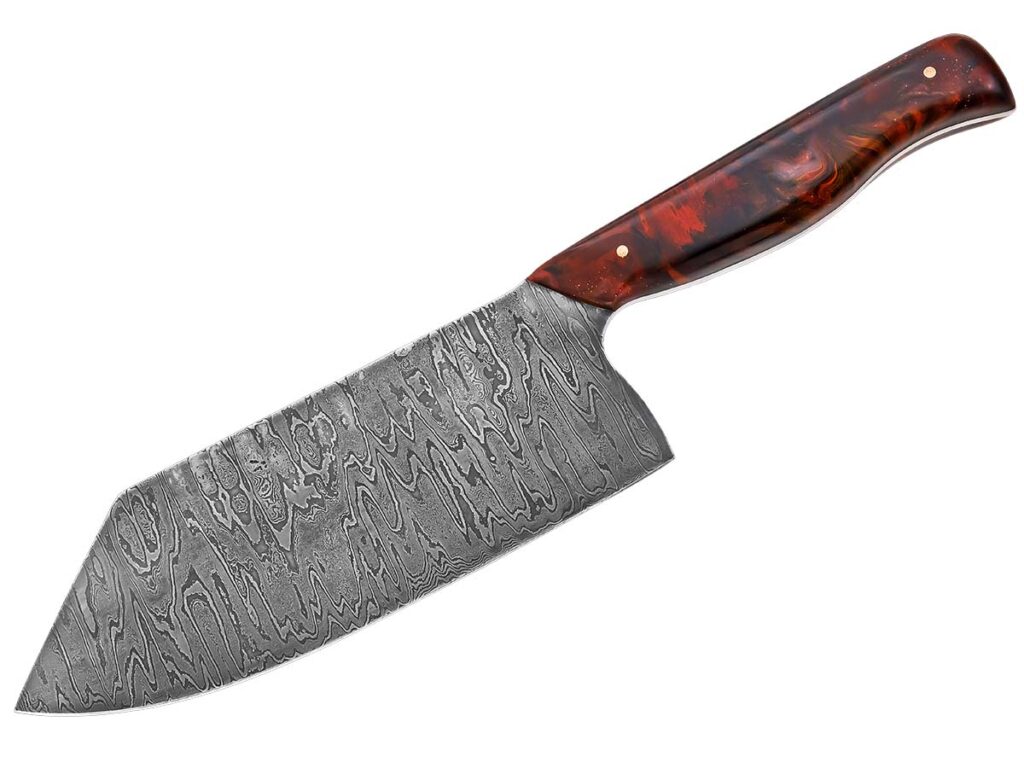
Dane Standen Cleaver

Dane Standen Cleaver

Blade length: 7.3”
Blade material: 243-layer textured damascus of 1084 carbon- and 15N20 nickel-alloy steels
Blade grind: Flat
Scales: Colored resin
Pins: Copper
Overall length: 12.2”
Maker’s price for a similar knife: Contact maker for info
Knife to know: The maker is a probationary member of the Australian Knifemakers Guild
Maker: Dane Standen (Rod Hoare image)


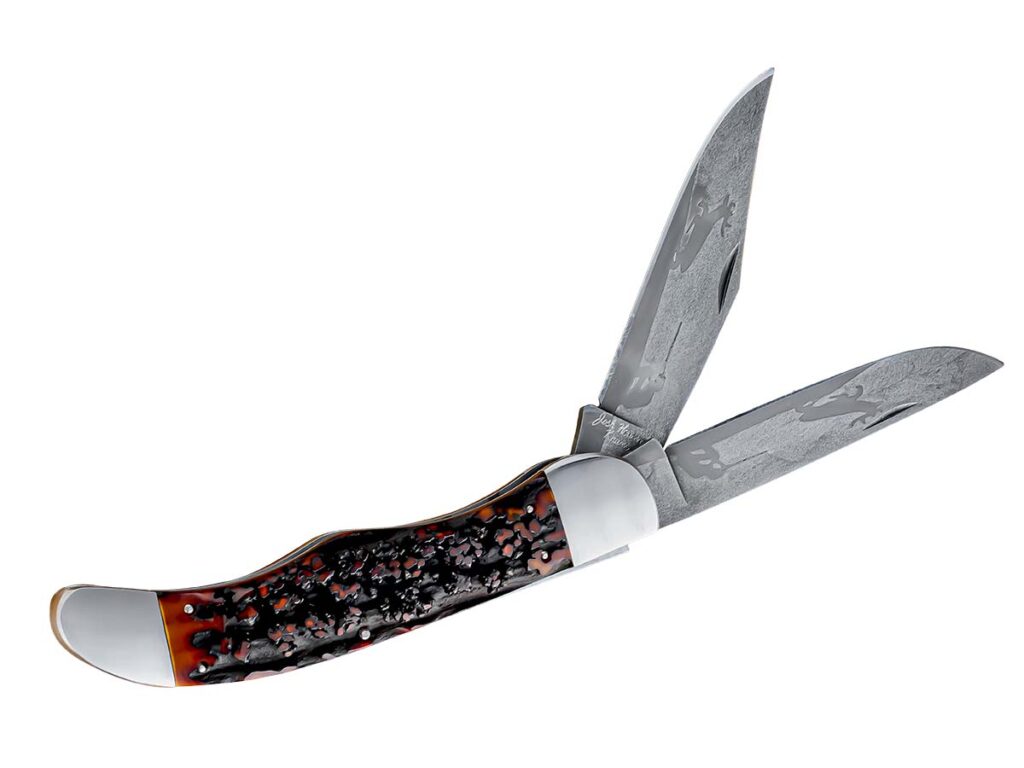
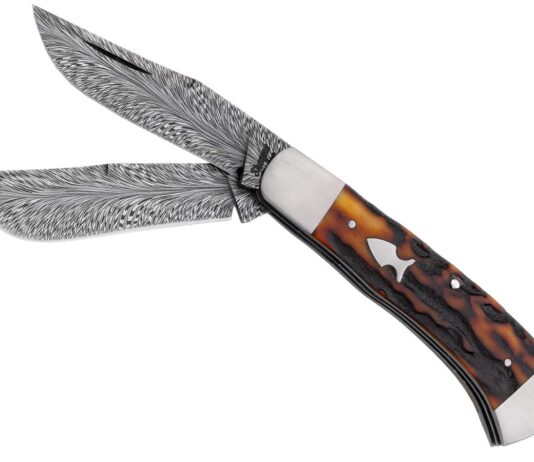
Josh Howard Folding Hunter

Josh Howard Folding Hunter

Action: Slipjoint
Blade length: 3.5”
Blade material: Pattern-welded deer hunting scene
Blade grind: Hollow
Scales: Amber stag
Handle frame & bolsters: Stainless steel
Closed length: 5.25”
Maker’s price for a similar knife: Contact the maker for info
Maker: Josh Howard, deerlickridgeforge.com (SharpByCoop image)


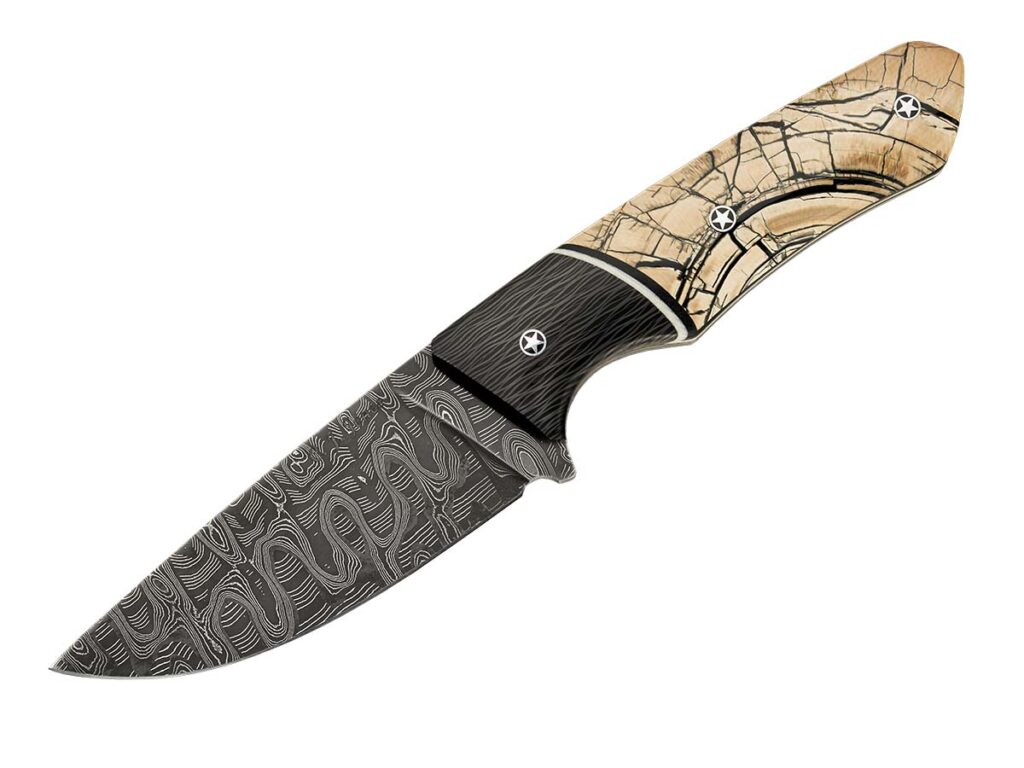
Chad J. Jones Hunter

Chad J. Jones Hunter

Blade length: 3.75”
Blade material: Mike Norris Hornet’s Nest stainless damascus
Blade grind: Flat
Scales: Crosscut mammoth tusk
Liners: Black and white G-10
Bolster: Zebra carbon fiber
Overall length: 8”
Maker’s price for a similar knife: $1,250
Maker: Chad J. Jones (Jocelyn Frasier image)


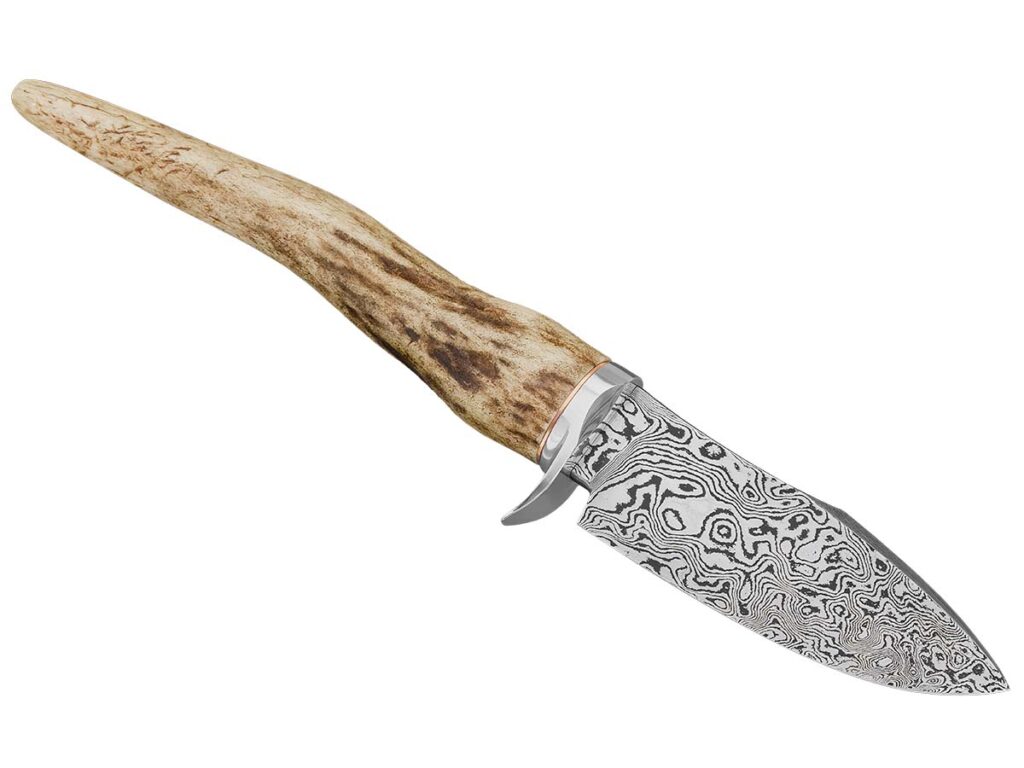
William Manning Hunter

William Manning Hunter

Blade length: 3.35”
Blade material: Random-pattern damascus of 1084 carbon-and 15N20 nickel-alloy steels
Blade grind: Flat
Scales: Antler w/copper spacer
Guard: 416 stainless steel
Overall length: 8.27”
Maker’s price for a similar knife: Contact maker for info
Knife to know: The maker is a probationary member of the Australian Knifemakers Guild
Maker: William Manning, manningblades.com (Rod Hoare image)


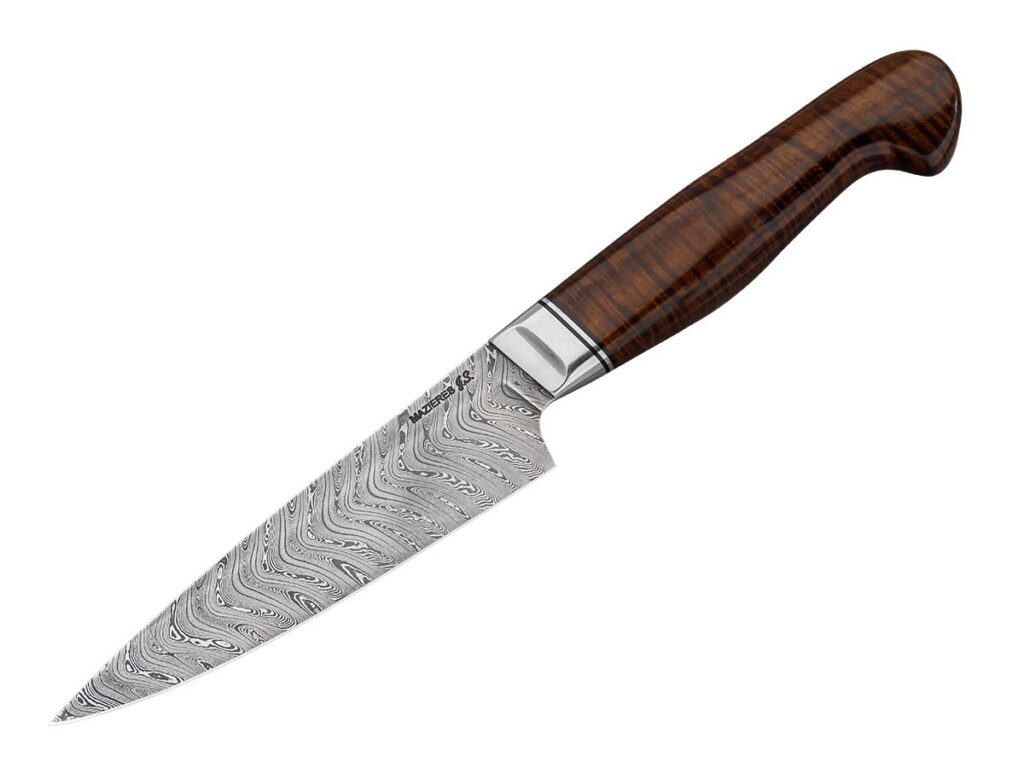
Francois Mazieres Medium Paring Knife

Francois Mazieres Medium Paring Knife

Blade length: 5”
Blade material: Pattern-welded damascus in 150 layers of 1084 and 1075 carbon- and 15N20 nickel-alloy steels embossed using
chevron dies for the final pattern
Blade grind: Flat
Scales: Stabilized South-Australian ringed Western Myall wood shaped in a composite Western/cowboy style
Spacers: G-10 and stainless steel
Bolsters: Scalloped, pinned and soldered 416 stainless steel
Construction: Hidden tang
Overall length: 10”
Maker’s price for a similar knife: $320.62 at press-time exchange rate
Knife to know: The maker is a member of the Australian Knifemakers Guild and a journeyman smith in the American Bladesmith Society
Maker: Francois Mazieres, Yandiwa.com.au (Rod Hoare image)


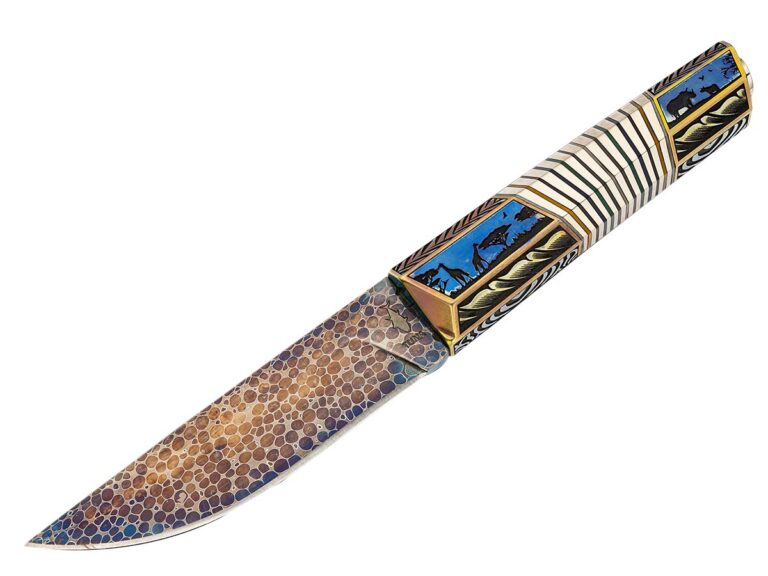
Nate “Tuna” Grant Utility Fixed Blade

Nate “Tuna” Grant Utility Fixed Blade

Blade length: 4”
Blade material: Rietveld Dragonskin damascus by Bertie Rietveld
Blade grind: Flat
Handle: Titanium, nickel silver, fiber liners, laser engraved
Overall length: 8”
Sheath: Guster leather; inlaid w/exotic animal skin; belt model with snap
Maker’s price for a similar knife: $5,000
Knife to know: The maker’s utility fixed blade won Best Utility at the 2024 Lost Pines Knife Show
Maker: Nate “Tuna” Grant, madebytuna.com (Jocelyn Frasier image)


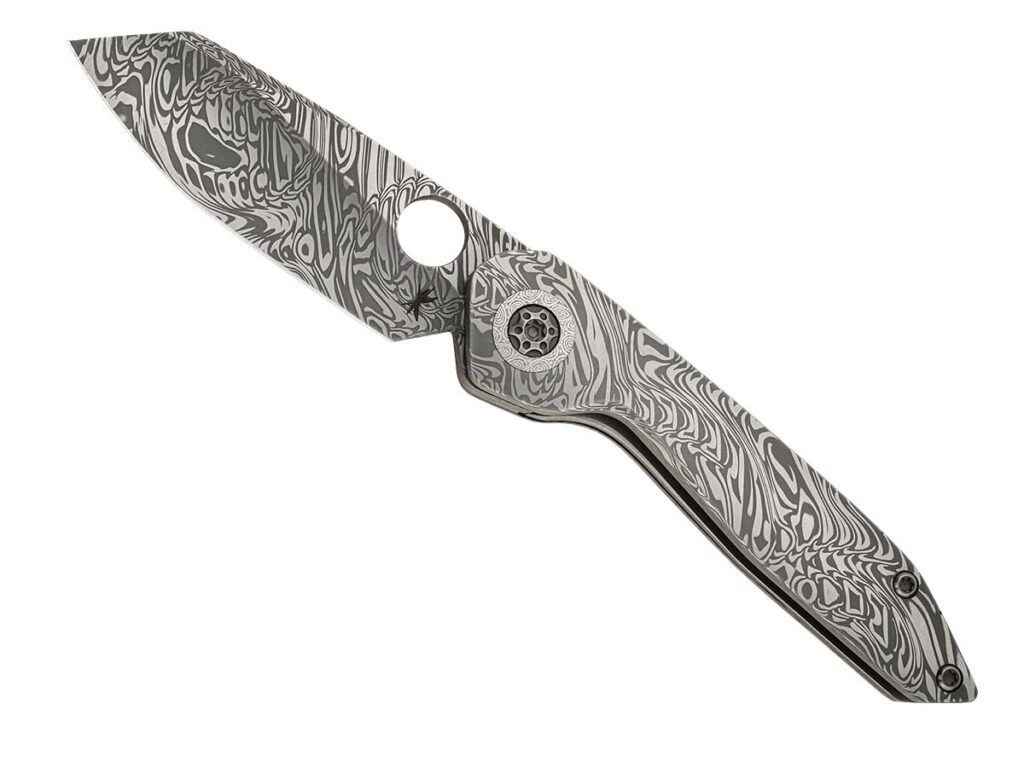
Bryan Montalvo Basset

Bryan Montalvo Basset

Knife type: Folder
Blade length: 3.25”
Blade material: Grabak damascus by Damasteel
Blade grind: Hollow
Blade pivot: Skiff caged ceramic bearings
Handle: Same material as blade
Lock: Linerlock
Pocket clip: Same material as handle
Closed length: 3.5”
Maker’s price for a similar knife: $3,000 at press-time material costs
Maker: Bryan Montalvo, keanisonknives.com (Jocelyn Frasier image)


More Knife Reviews:

Damascus Flaws: How To Spot Imperfections in Custom Knives

Learn how to spot flaws in Damascus steel blades, like delamination and inclusions, with expert tips from master bladesmiths.

They may be small and insignificant or obvious and glaring, but the skill that is involved in forging damascus steel and then fashioning blades and furniture that adorn custom knives like no other component naturally produces the potential for flaws in the steel itself.

Ironically, the structure of damascus steel, the allure of its beauty and texture, images and etched artistry, is brought together with the potential for a flaw. The production of billets that contain welded elements of 1080 carbon- and 15N20 nickel-alloy steels or other variations involves the marriage of metals. And like any union there is the possibility of a fault. The flaws may be serious or inconsequential. For the buyer, the ability to spot an imperfection and make a value judgment is highly beneficial in the ownership experience.

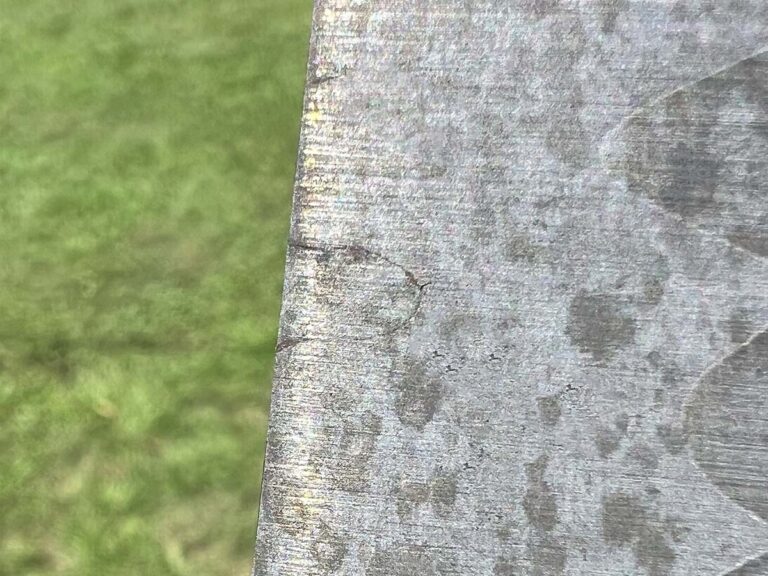
“I would say the most common flaw in a damascus blade is delamination,” ABS master smith Lin Rhea opined. “This shouldn’t be in a knife that is offered for sale. It’s usually evident as a hairline void in the layering and could occur anywhere on a blade. But I see them mostly in the deepest part of the blade as they are revealed in the bevel grinds. I believe this could be prevented by being sure the billet is up to proper welding heat before extracting it from the forge for the first weld in the particular stage of pattern development.”

In a similar perspective, ABS master smith Bill Burke sees imperfections as “a closed shut or incomplete weld that can be found anywhere on the blade. It can be seen as a dark or silvery line in lightly etched damascus or becomes a deep crevasse on heavily etched damascus—and it is caused by the smith not letting a billet soak at heat long enough before welding, or by manipulating a weld that has not been fully set and then working this tear back into the pattern.”

Fortunately for knife enthusiasts, most quality damascus knives are free of flaws, such as Eliot Maldonado’s saddlehorn trapper in Blackbird damascus by Chris Zimmerman. (Jocelyn Frasier image)

ABS master smith Steve Randall agrees and sees these types of imperfections and other potential flaws as well.

“The most common flaw on a damascus blade is the cold shut or an area where the pieces did not weld,” he observed. “It is not so much where it occurs on the blade such as the tip, edge or spine, but where the two different steels meet in the pattern. It’s the two steels that didn’t weld together that creates the flaw, and sometimes they aren’t noticed until [the maker starts] grinding into the blade.

“I would say another common flaw for damascus, mosaic specifically, would be shadow lines from the tiling process,” Steve continued. “Structurally they don’t change the steel, but they can detract from the mosaic visually.”

Both Rhea and Burke have encountered other flaws related to the fusion of the two steels in damascus.

“Less common is an inclusion of some kind,” Burke explained. “Twenty years ago flux inclusions were fairly common. Now one sees inclusions of weld filler material, though, overall, inclusions are less common now than 20 years ago. Inclusions are always found in between the elements that make up the pattern in a bar of damascus.”

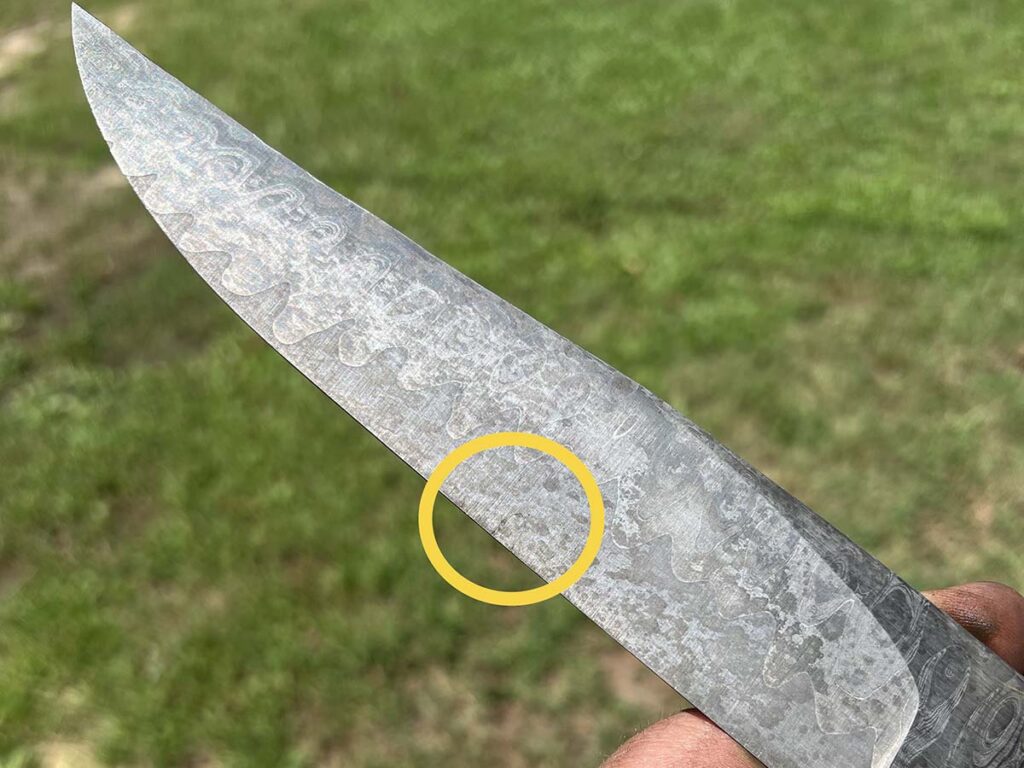
Lin added, “I’ve also seen where the maker has left a bit of welding rod material within the damascus blade. This appears as a cloudy gray area and is pretty distinct in appearance from the hardened damascus. In the event wrought iron or mild steel is mixed with high carbon and the layering is of a relatively low number count, this could be part of the intended pattern, so it might be acceptable.”

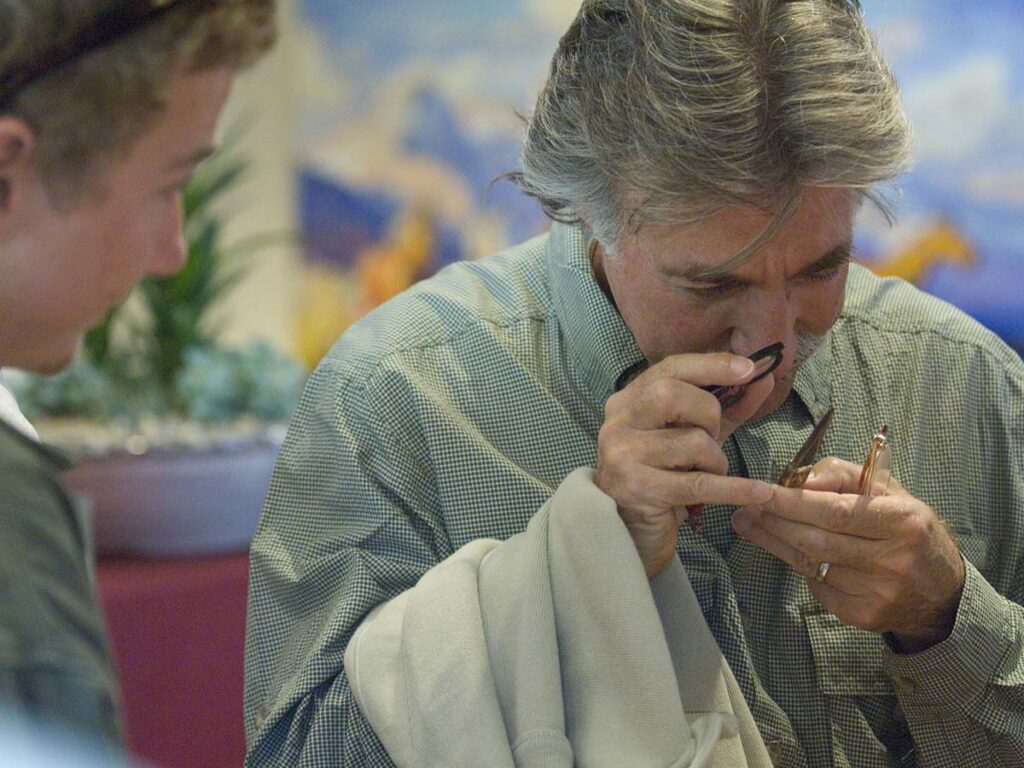
“If you’re at a show and feel you want to look at the blade under a magnifier, then you should ask the maker if he minds,” Bill Burke noted. “If he says ‘no’ or gets upset, then thank him and walk away.” (Eric Eggly/PointSeven image)

According to ABS master smith/BLADE Magazine Cutlery Hall-of-Fame® member Steve Schwarzer, the particular combination of steels might raise the prospects for a flaw to develop, especially when the skills of the maker are evolving. He commented.

“The worst flaws are the delaminations and inclusions,” he said. “These might come from poor welding practices and the choice of alloys involved. Some welds are much easier to make than others and a higher level of skill may be required. Most of it is visual—bad welds are bad welds and don’t have the necessary molecular bond.”

For a potential buyer the ability to spot a flaw is an attribute that pays off when dollars are exchanged for the finished product. Although a flaw may have no impact on the structural integrity of the damascus steel itself, the degree of impairment—if any—ultimately lies with the potential buyer who assesses the level of discrepancy. Approaching a maker’s table, discussing the damascus, and taking a closer look at the blade will sometimes generate relevant conversation and exchange of information. Flaws can show up anywhere in damascus construction, so visual inspection comes with the territory.

Schwarzer advises buyers to check the knife thoroughly.

“Using magnification helps. If the blade doesn’t look right, it probably isn’t. A flaw may show up as a bright spot in a dark area, and some skilled people can reweld their billets. I do that regularly and especially when I do guards and stuff, taking a light hammer and welding heat to fix it, but not everything can be repaired. Sometimes there is no way to repair it, and that is one reason why I hardly ever sell damascus steel—[and if I do] only to skilled professionals.”

Visual Signs

When a buyer’s interest is piqued, the next steps involve courtesy and cordial exchange with the knifemaker.

“Flaws in damascus can range from very hard to see to blaring and obvious,” Burke remarked. “An experienced eye in good light and magnification are the best ways I know to detect them. Some can be felt, but feeling the blade and running your fingers up and down and across it are not reliable and can cause rust and tarnish. If you’re at a show and feel you want to look at the blade under a magnifier, then you should ask the maker if he minds. If he says ‘no’ or gets upset, then thank him and walk away.”

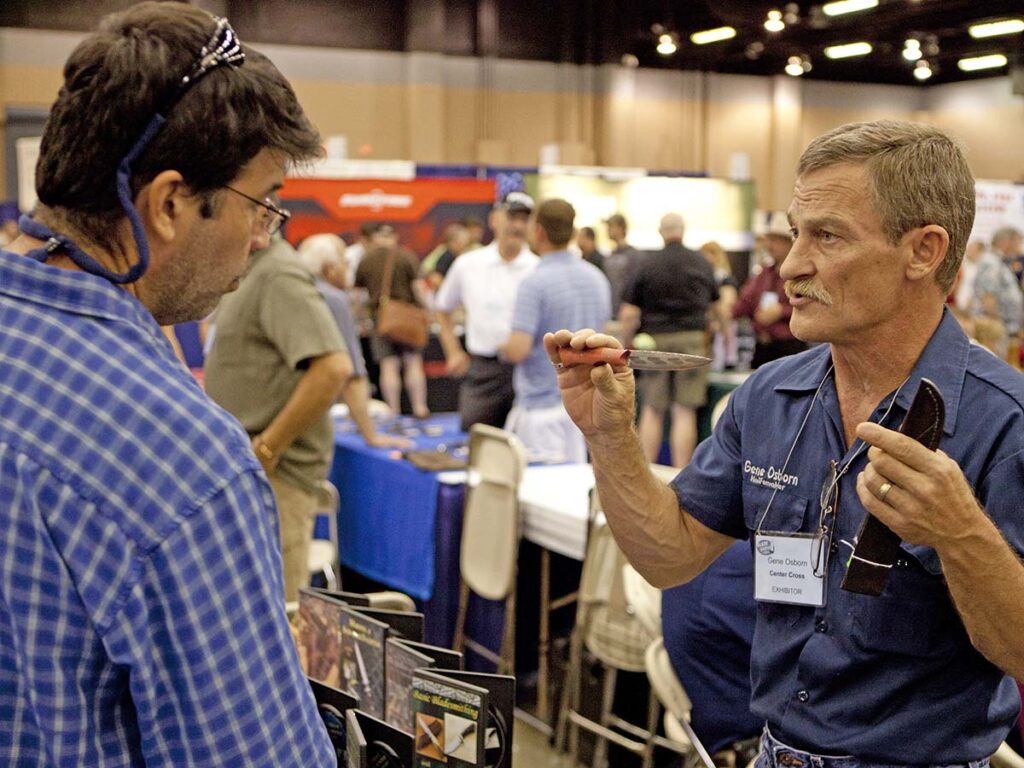
Steve Randall said most makers would not intentionally sell a knife knowing it had a flaw or without first pointing it out to the buyer. Gene Osborn (right) discusses a damascus knife with a customer at a past BLADE Show. (Eric Eggly/PointSeven image)

Randall concurs with that point of view.

“Bright light sure helps,” he observed. “It is difficult to find small flaws once a damascus blade has been etched. Running your fingers over the blade won’t tell you anything, and if you’re at a show I advise not doing it. Using a magnifying glass at the maker’s table could be awkward, and I would suggest respectfully asking before doing it.”

Historically, skilled makers and smiths have assessed their own work and identified flaws, correcting them or chalking up a flawed blade to the hazards of the craft. When ABS master smith Mike Quesenberry considers the flaw in context, he is frank in his response.

“The smith sees the weld lines with flaws before the steel is etched. To me that is something the smith has to deal with. I don’t have any problem scrapping a blade if [a flaw] shows up in the process. The hand sanding and grinding are where the time is really invested, and makers should be honest with their work. If you see a flaw, scrap it,” he stressed. “The best way to fix a flaw is to throw that blade away and start over again.”

Schwarzer smiles when he relates the style of an ancient practice.

“Japanese smiths worked out a way to hide a flaw if it didn’t mechanically affect the viability of the blade. They would do a nice little gold inlay. That was done in Persia, too, and a lot of other places. They would put artwork over something that was unseemly. If you have $300 in a blade and there is no mechanical problem, then that is a way to make it go away. It’s been said that the difference between a journeyman and a master smith is the size of the screw-up you can fix.”

Rhea acknowledges the human side of the situation. There may be a temptation to continue working on a knife with a flaw in the damascus, but then comes the realization on the part of the maker that causes him to refrain from that option. “When a buyer sees any odd discoloration in the form of surface treatment, color or texture, ask questions and give the maker the opportunity to explain or rethink his position,” he noted.

Resolving Situations

Bladesmiths and custom makers are genuinely committed to excellence. However, at times there may be a situation involving a flaw. When a purchaser detects something that may or may not be an imperfection, talking with the maker can resolve the situation to mutual satisfaction.

A welding flaw might pass a cursory glance, which is why you should always inspect any damascus blade you plan to buy closely.

“If you buy a blade and then find a flaw, you should contact the maker and ask them about it,” Burke advised. “If it is something you cannot live with, ask for a refund or allow the maker to replace the flawed knife. In most cases, the maker is going to be unaware of the flaw. If the maker is aware of the flaw or refuses to do anything for you, then you either have to keep it and say, ‘Oh well’ or sell it to someone else with full disclosure of the flaw.”

“When I have a buyer who experiences issues of any kind, I would prefer that they contact me and give me the opportunity to evaluate, discuss and make it right,” Randall noted. “I’m sure most makers would not intentionally sell a knife knowing it had a flaw or without first pointing it out to the buyer.”

Rhea sees the interested parties taking the high road in almost every case. “Most makers will honestly make a sale with good intent and in good faith,” he reasoned. “If there’s a problem just contact the maker and let him or her explain or make it right. Ultimately his reputation is on the line and he deserves the chance to make it an overall pleasant experience.

“When it comes to flaws and issues,” Lin concluded, “we all have them and we handle them in our own ways. To the degree we act to prevent problems for the buyer we also prevent problems for ourselves as makers, as well as enhance our reputation. Leaving flaws in damascus will reflect on our honesty and our attitude toward the buyer. This is something to think about very seriously. So, will there be problems? Yes, but we should go to great effort to prevent them rather than having to correct things that might be perceived as an oversight. In the end, we are human and will want to use common courtesy and humility in our dealings.”

More On Damascus:

Master Bladesmiths Showcase Their Best Long Swords

See the artistry and craftsmanship of seven custom swords from some of the best bladesmiths in the world.

Not only do swords bring out the best in some makers, those who make quality versions of them often seem to be among the best makers as well. Check out the long blades on this and the facing page and see if you agree.

Garbriel Turner: Jineta

Garbriel Turner: Jineta

The Jineta by Garbriel Turner has a 28-inch wootz blade, an ancient walrus ivory grip and iron/gold fittings. Blade grind: flat. Overall length: 36.5 inches.


Eric Estlund: Oak Themed Storta

Eric Estlund: Oak Themed Storta

Eric Estlund’s Oak Themed Storta is in a 17th-century Italian style. The 28-inch blade is 8670 carbon steel and the handle is oak burl. An acorn pommel helps complete the theme. A high-relief scabbard (not shown) and steel leaf chape with carved acorn finial add to the presentation.


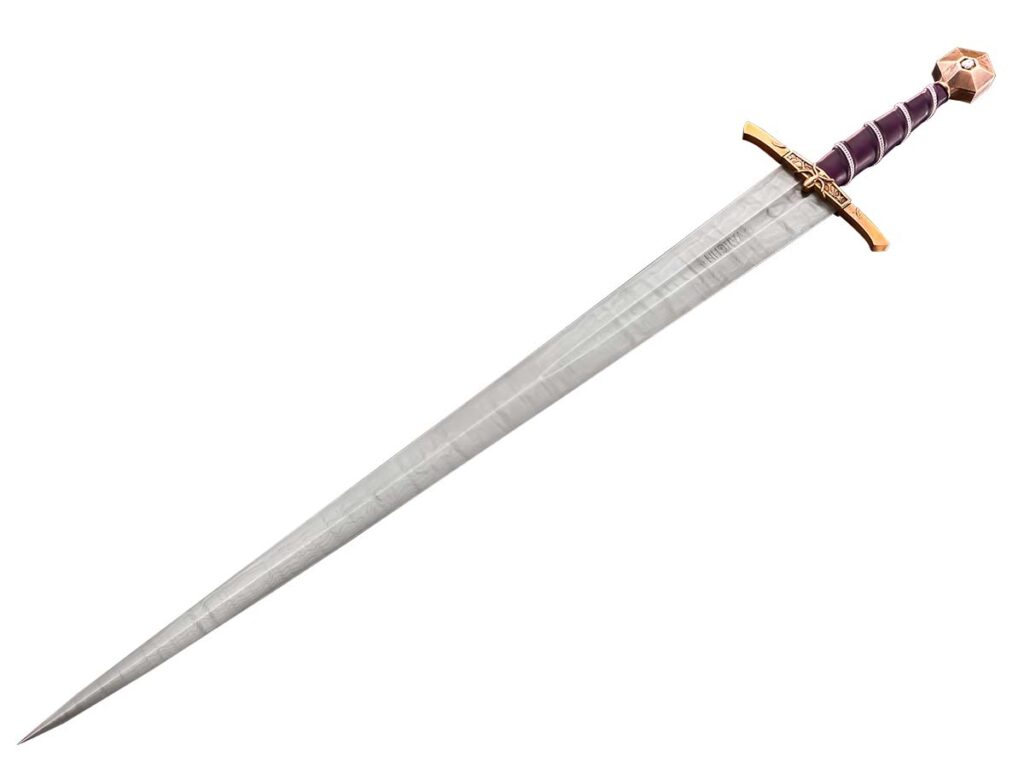
Matt Parkinson: Arming Sword

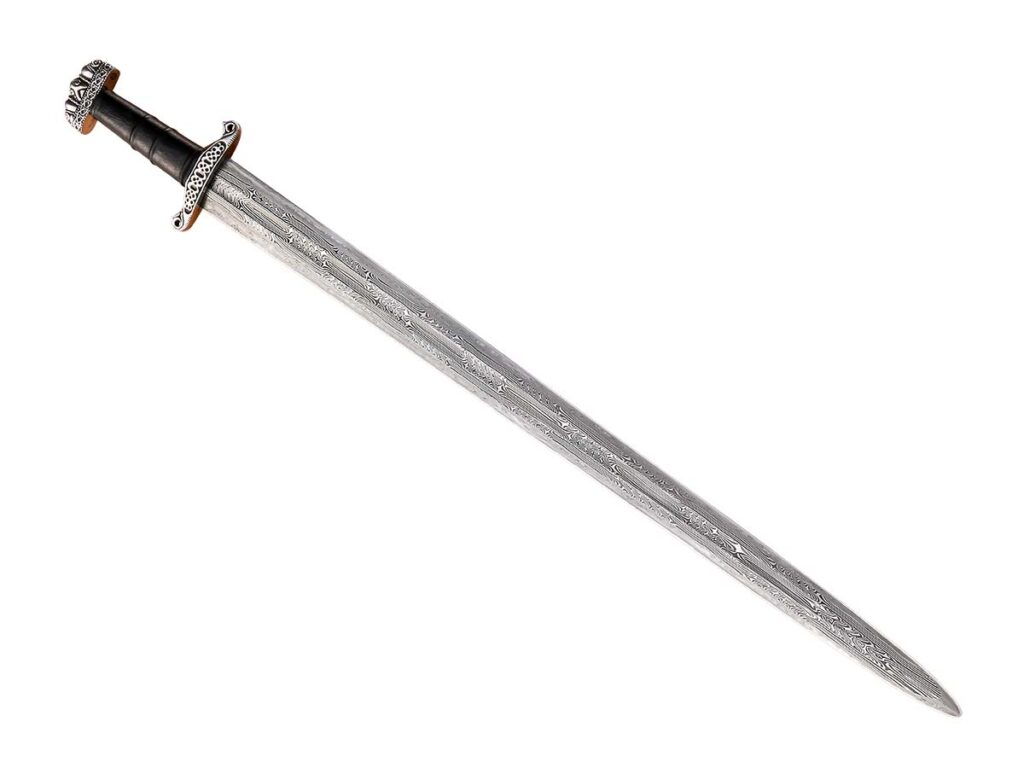
Matt Parkinson: Viking Sword

The sword shown is an Arming sword with a complex laddered and mosaic damascus blade. Polished steel fittings and a spalted maple handle. 29-inch blade 36-inches overall, weighing in at 2 pounds 10 ounces.


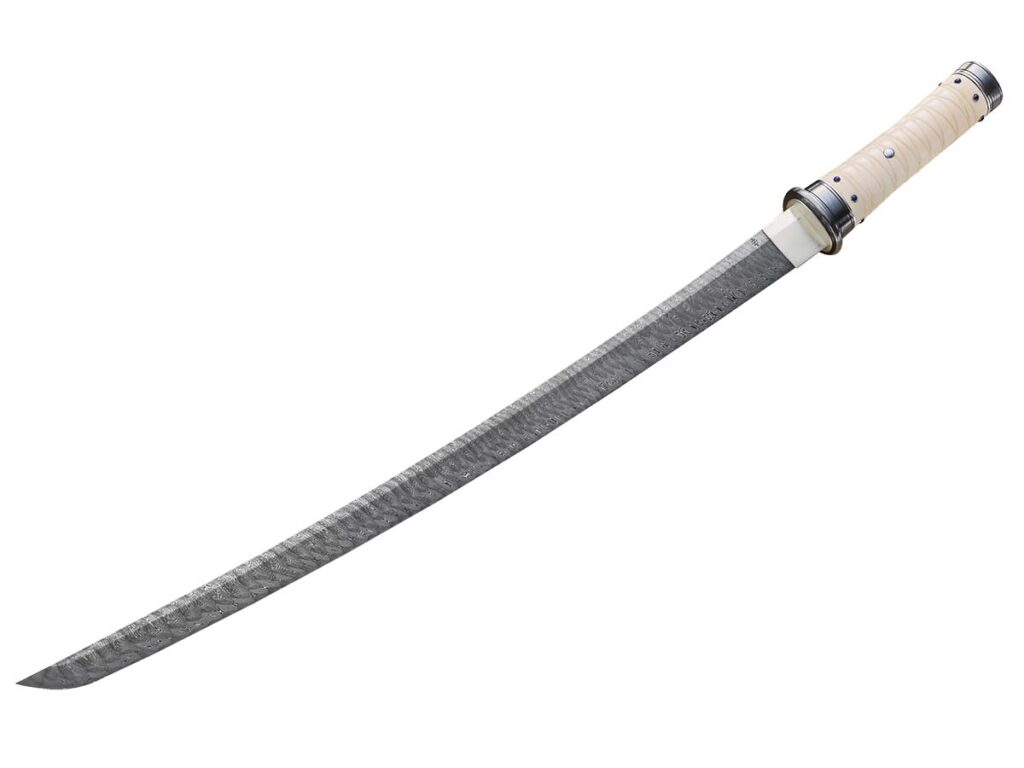
Zack Jonas: Wakizashi

Zack Jonas: Wakizashi

A Gordian core twist damascus completes the 22-inch blade of a Zack Jonas wakizashi. Fittings: W’s damascus and silver. The handle is interior mammoth ivory. Blade pattern: shinogi-zukuri. Overall length: 28 inches. The colorful scabbard (not shown) is by Matt Venier.


Ben Abbott: Viking Sword

Ben Abbott: Viking Sword

A 26-inch blade of multi-bar damascus, a leather-covered wood handle and cast sterling silver fittings outfit Ben Abbott’s Viking sword repro. Ben carved the waxes for the guard and pommel.


Ryan Breuer: PhD Sword

Ryan Breuer: PhD Sword

We published a closeup of the handle of Ryan Breuer’s PhD Sword the September 2025 issue. Here’s the full-blown model. The 32-inch blade is a damascus of 1084 carbon and 15N20 nickel-alloy steels. The handle is birch, leather and sterling silver.Overall length: 40 inches.


Jordan Borstelmann: Elmslie Type I

Jordan Borstelmann: Elmslie Type I

Jordan Borstelmann’s Elmslie Type I of a falchion sword boasts a 28-inch blade of 1075 carbon steel and a handle of leather, cord and wood. Blade grind: flat. Guard: 1045 carbon steel. Overall length: 35 inches.

Read More On Swords:

Cool Custom: Robert Burns’ Ancient Iron Bowie

Explore the classic clip-point bowie knife from apprentice smith Robert Burns of Wilderness Ironworks.

ABS apprentice smith Robert Burns of Wilderness Ironworks wanted a project that would take him back to the roots of being a bladesmith, and appears to have satisfied that desire through his classic clip-point bowie.

“My goal was to combine the ancient and the contemporary,” he wrote.

For the ancient, he started with iron ore from Minnesota and iron sand from Connecticut. He smelted the two into bloom steel, which he then refined, “my goal being to make a steel fine enough that it could potentially pass for modern damascus”—thus the “contemporary.”

Robert Burns of Pittsburgh, Pennsylvania, used ancient materials such as iron ore and iron sand for the blade and a historic mix for the fittings of his sole-authorship bowie.

To augment the “ancient,” he used a “historic mix from the Bronze Age” for the bronze for the fittings.

As Robert noted, the knife is true sole authorship, from starting ore to the finished sheath.

More Custom Knives:

UG Tools TiNy: Knife Of The Year® Proves Sweet Indeed

The TiNy packs hefty performance into a light package.

Despite hailing from Germany, Philipp Utsch and Jan Gierse are fluent in the basest American vernacular—Twinkies and violence.

To say smashing a knife weighing all of two of the spongy confections through an 8-by-8 pine post was heard loud and clear at BLADE Show 2025 is an understatement. Aside from wowing some of the most discerning knife collectors, makers and users in the world, the tandem of Teutonic toolmakers also took home the event’s most coveted hardware.

It’s rare for fixed-blade knives to reach the pinnacle of edged tool accolades—BLADE Magazine’s Knife of the Year®. Yet, the German-made gem proved to have the edge over nearly 400 other knives clamoring for the singular honor. How?

Quite simple. Utsch and Gierse’s burgeoning knifemaking concern—UG Tools—and its award-winning knife—the TiNy—took the world’s oldest tool and firmly planted it in the 21st century.

UG Tools TiNy Specs

Total weight: 2.82 ounces
Total length: 8.27 inches
Blade length: 3.94 inches
Blade thickness: .11 inches
Blade steel: MagnaCut @65 HRC
Handle material: Titanium
Handle weight: 1.34 ounces
MSRP: ~$380

Pros

  • Extremely Lightweight
  • Superior Ergonomics and Balance
  • Exceptional Durability

Cons

  • Bordering On Expensive

Rise of UG Tools

One of the more interesting aspects of the TiNy’s meteoric rise is that this was UG Tools’ first official appearance at the BLADE Show. Utsch and Gierse were in attendance at the 2024 edge-stravaganze, but as attendees, not exhibitors.

UG Tool’s mark is a combination of the founder’s last initials and some Teutonic ferocity.

The duo’s concern is also relatively new, founded in 2021. Not that knifemaking, fabrication and manufacturing were mysteries to UG’s founders.

Utsch has 20 years of knifemaking under his belt, but his daytime gig was a maintenance manager* in the founders’ hometown of Sundern. And Gierse’s career aspirations were focused on manufacturing, as he was pursuing his PhD in mechanical engineering.

It turns out, there was a lot of serendipity in those backgrounds.

Gierse’s topic focus is 3D printing—in particular, Selective Laser Melting (SLM). When he first moved into this field academically and got access to an SLM machine, a titanium knife handle was among his initial projects.

Down the line, that handle ate at him. He saw its potential, something revolutionary. He was acquainted with Utsch and approached him with the idea of teaming up to create a complete knife.

Thanks to its innovation and performance, the TiNy won both Imported Fixed Blade Knife of the Year and Knife of the year honors. It’s also stuck into some of its handy work, as the guys from UG Tools hacked through fence posts to demonstrate the knife’s resilience.
Thanks to its innovation and performance, the TiNy won both Imported Fixed Blade Knife of the Year and Knife of the Year® honors. It’s also stuck into some of its handy work, as the guys from UG Tools hacked through fence posts to demonstrate the knife’s resilience.

The bladesmith was instantly intrigued.

“[W]hen Jan suddenly sent me a photo of the first titanium handle out of the blue in 2021, I knew immediately what I was looking at. The potential was immediately clear to me,” Utsch said.

Getting A Handle On The TiNy

Funny as it might sound, the handle is the belle of the ball on the tiny. It’s where much of the innovation lies.

Additive manufactured, and hollow, the human-tool interface cuts the knife down to a scant 2.82 ounces—or two Twinkies. For a practical-tactical knife, this opens up a wealth of potential.

The old saying for backcountry hunting, military campaigns or just plain hiking is “Ounces make pounds, and pounds make pain.” At 8.27 inches in overall length, weight savings are substantial for a full-sized hunting, camping or military knife (the TiNy could fill all three roles).

UG’s design prowess overflows to the TiNy’s sheath, a sturdy Kydex unit with a retention-adjustment screw and UltiLink for unlimited attachment/carry options. An aside, given the hollow handle, it makes a very satisfying ping when clipped all the way into its sheath.
UG’s design prowess overflows to the TiNy’s sheath, a sturdy Kydex unit with a retention-adjustment screw and UltiClip UltiLink for unlimited attachment/carry options. An aside, given the hollow handle, it makes a very satisfying ping when clipped all the way into its sheath.

However, keeping things light isn’t the only advantage of the 3D printed handle.

TiNy’s Big Ergonomics

The sky is nearly the limit when it comes to SLM manufacturing, allowing for the TiNy’s advanced—if not nuanced—ergonomics. From the Pango model, I spentd time testing, which isit’s the most enjoyable aspect of the knife.

Plain and simple, in my medium-sized mitts, it feels good to hold.

Well thought out, the handle swells and recesses at the right spots to form-fit my medium-sized hands. Yet, but for my money, the integral grip texturing gets the most accolades. A mixture of dragon scale and linear elements—with a fine pebble finish—the handle stays in place no matter what axis force is applied.

The TiNy’s 3D-printed handle isn’t only lightweight, but also as comfortable as the day is long. In testing, the Pango pattern stuck firmly to the hand without firing up a hot spot.

A final point, the knife is extremely well-balanced. Using my finger as a fulcrum, it’s right behind the guard, making the blade very agile and easy to manipulate.

TiNy Blade

The 4-inch drop-point blade is very clean and understated, but well-formed for a general outdoor knife. Given UG pulled out all the stops and used MagnaCut steel, it’s also more than ready for hard use.

I appreciated the long, straight cutting surface just behind the belly. It is ample enough to facilitate larger push cuts and gives it plenty of edge on pull cuts.

Turning to Magnacut steel, UG produced a high-functioning cutting tool that requires little maintenance. Through general testing, the knife retained the same edge with which it came out of the box.

The drop on the point was just right for me to index when choking up on a pinch grip, like you might use field dressing a buck or the like. And the blade’s stonewashed finish gives it a level of tackiness, as well as hiding inevitable abuse.

TiNy Ruggedness

Interestingly, the TiNy is neither a full nor a classic tang knife, a fact that might get some traditionalists to clutch their pearls. Utsch and Gierse whacking it through an 8-inch by 8-inch post should put to rest any concerns about durability. But what’s going on to keep the blade and handle happily married?

“The extreme load-bearing capacity is achieved by the very precise press fit, in which the oversized blade is pressed into the undersized handle,” Gierse said. “This type of connection has been proven in industry for well over 100 years and transfers forces through a permanently elastic, form-fitting connection.”

UG’s knife made quick work battoning through a nearly 3-inch diameter elm log.

UG has done its testing on the knife, as well as sold several thousand and has yet to encounter a blade-handle separation.

“So far, we have not been able to damage the connection between the handle and the blade, even under extreme stress tests,” Gierse said. “This makes the knife behave like an ultra-light, fully integrated knife. Of course, the blade can break under excessive overload, just like any other knife. Despite the best heat treatment and steel, there are natural physical limits that even we cannot overcome.”

Testing The TiNny

I would have liked to have tested the TiNy during hunting season, to really put the knife through its paces. However, I received my test model during the summer and deadlines call.

In turn, I put it through a small, very unscientific laboratory evaluation that included:

  • Initial sharpness test on 20-pound bond paper: The tiny passed my initial sharpness test with flying colors.
  • Push-cut test on 1/8-inch thick1/8-inch-thick leather: It snapped straight through the leather with an audible pop.
  • Pull-cut test on ¼-inch double-wall cardboard: The knife made quick work of the cardboard, through 100 some cuts.
  • Durability Test Battoning Siberian Elm Log: Had no problem passing through a seasoned 3-inch diameter log, splitting it roughly a third of the way through. Will note, this did mar the blade finish some.
  • Follow-up sharpness test on 20-pound bond paper: No edge loss from the initial test.

Overall Impression

I was impressed with the cutting performance of the TiNy; however, I wasn’t too surprised given the blade material. There’s a reason why MagnaCut continues to demand respect in the marketplace and this was proven out by the blade maintaining its edge after moderate use.

I walked away most impressed with the comfort and controllability of the knife, thanks to a well-thought-out handle. I did wonder if the linear aspects of the texturing would prove hot with extended work. This wasn’t the case. I could have worked all day with the TiNy and not thought twice.

Before and after testing, the TiNy’s blade was razor sharp, able to shave through 20 bond with ease.

I’m not the only one.

James Rodebaugh met Utsch and Gierse in 2024, when they attended the BLADE Show as attendees. The duo gave the ABS Master Bladesmith and custom knifemaker a TiNy for field testing, with Rodebaugh taking it on hunting trips in both Alaska and Wyoming.

Dressing game and spatchcocking fowl, the knife proved resilient. He also tested a concern I have with any metal-handled knife—performance in cold weather.

“The printed titanium handle surprised me,” he said. “I thought it would be cold to the hand but warmed to body temp from approximately 20 degrees Fahrenheit in a heartbeat.”

Good to know you won’t take off palm flesh if you’re gutting a deer in the bowels of winter.

Final Cut

Rarely do knives—even ones deemed top-of-class—vastly change the manufacturing landscape. Is the UG TiNy one of those sea-change pieces of cutlery? Only time—and likely mimicry—will tell.

What can be said is that Utsch and Gierse have concocted a version of the age-old fixed blade that firmly plants its feet in modern manufacturing. And they’ve done so at a level that should make the TiNy a useful and trustworthy piece of kit, be it in the backwoods or battlefield.

For two Twinkies’ worth of knife that’s pretty sweet.

More Reviews:

Cool Customs: Edmund Davidson’s Fighter 116th Regiment

Davidson’s integral salutes a unit that lost over 800 men on D-Day.

Made to support The 29th Division Museum in Verona, Virginia, Edmund Davidson’s integral subhilt fighter celebrates an American combat unit that’s served valiantly for almost 284 years.

The Augusta County Regiment formed on Nov. 3, 1741, in Staunton, Virginia, and fought in most every American war, including the American Revolution and the battle of Manassas in the Civil War. It became part of the U.S. Army’s 29th Division in World War I and adopted the theme of “Ever Forward.”

As the 116th Regiment it was in the first wave on Omaha Beach on D-Day, where it lost over 800 officers and men and was later cited by the War Department for extraordinary heroism and outstanding performance of duty. The regiment also saw action in the Iraq and Afghanistan Wars. Today, the 116th remains active as a National Guard Unit.

Scrimshander Linda Karst Stone (left) and sheath maker Paul Long (right) hold the completed project. (knife image by Whetstone Studio)

Linda Karst Stone scrimmed the Omaha Beach battle scene on one side of the handle and unit members from the American Revolution, Civil War and today’s 116th on the flip side. The copious scroll engraving on the butt and guard is by Jere Davidson. Paul Long made the shark-skin sheath.

More Custom Knives:

Shining Blades: Book Shines A Light On The Lorenzis’ Cutting Collection

Cutlery Hall-of-Famer’s book showcases the most unique, historic and outlandish blades to enter their treasury.

Probably the most important international buyers of modern American custom knives ever, BLADE Magazine Cutlery Hall-of-Fame® members Aldo and Edda Lorenzi bought and then sold those knives and many other edged items in their iconic G. Lorenzi retail cutlery store in Milan, Italy.

Located on the Via Montenapoleone in the heart of Milan’s elegant retail sales district, and under Aldo and Edda’s direction, G. Lorenzi sold the finest knives, scissors, razors, table cutlery and assorted other edged wonders from 1959 to 2014, serving customers from every corner of the globe.

If you read BLADE® regularly, you know of the Lorenzis—but mostly only through the eyes of BLADE. In their new book, Shining Blades from the Aldo and Edda Lorenzi Collection, the Lorenzis recall their journeys far and wide in their lifelong search for the finest blades as only they can tell it, from the age of Elvis and crewcuts to the internet era.

Intrepidly scouring Europe, America and elsewhere for cutting tools of all kinds, the Lorenzis chronicle their travels in Shining Blades. From Aldo doubling Edda on their Guzzi Galletto motorbike through the snow and rain in the Alps on their first working trip to Fance in the early 1960s, to their early visits to the knifemaking shops of John Nelson Cooper, Cutlery Hall-of-Famer Bob Loveless and many other of the most famous American makers and beyond, the Lorenzis share their incredible story.

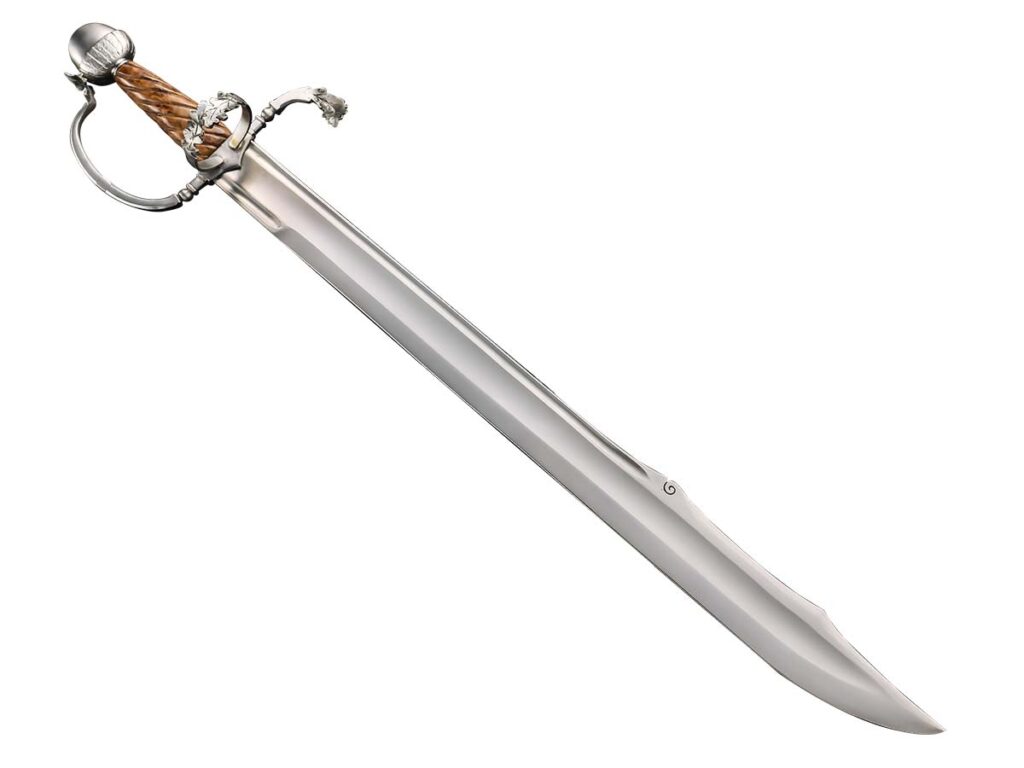
Shining through it all are full-page color images of some of the most spellbinding edged implements you will ever see. In addition to buying them the Lorenzis collected the vintage edged implements along the way. Bronze-Age spoons, folding forks and unbelievable folding knives of the 17th century forward are just some of the visual feasts of the edged art that populate the book’s pages.

For instance, if you think you’ve seen all there is to see in scissors, think again. The images of vintage scissors alone are enough to fill an encyclopedia on the subject. Spectacularly ornate and mystifying in construction, the scissors the Lorenzis amassed over the decades alone will take your breath away.
New shining blades

The preceding simply scratches the surface of what the book is all about. Most of what is illustrated and much more can be seen in the state-of-the-art Aldo and Edda Lorenzi Foundation museum in Milan.
The book also delves into some of the oldest knives known, from the 5,000-year-old knife of Otzi the Iceman discovered in 1991 on the Austrian-Italian border, the finest in European custom knives and knifemakers, ancient books on all things cutlery, notes on damascus steel and much more.

It’s all contained in a top-quality, 9 x 9.75-inch hardbound book with 344 pages that will provide you enjoyment for years to come. It’s a unique history with an MSRP of only $50—a ridiculously low price for such a landmark publication. However, as Edda Lorenzi noted, it’s not about the money so much as the education of worldwide edged tool enthusiasts and the recognition of those who authored some of the most fascinating edged tools extant.

“The book cost us about double its sales price [to produce], more or less,” she began. “Keeping the price low was our choice. It is a choice in line with our Nate Posner Award—to honor the artisans who created the works we loved most and whose names we would like to be known by as many people as possible, and to encourage new generations of artisans who, unlike collectors, certainly do not have large sums of money to invest in expensive books. To achieve this, this choice had to be made!”

If most anyone else had written the preceding paragraph I might be going, “Yeah, right.” But with the Lorenzis, you can rest assured it’s true. If you don’t believe me, ask members of the old guard at knife shows who know of them. If anything, my assessment of Aldo and Edda isn’t laudatory enough.

See Other Hall Of Fame Members:

Advertisement

Must Read Articles

Read this before you make a knife

Knifemaking 101 – Read This Before You Make a Knife

  by Wayne Goddard My experience has taught me that there's nothing like digging in and getting started. I've often said the hardest part of the...
how to forge damascus steel

How to Forge Damascus

Advertisement
Advertisement