Knife Collecting

Knife collecting is an extremely rewarding experience for knife enthusiasts. There truly is a knife for everyone. Many increase or hold their value throughout the years, making collecting knives something to pass on to the next generation of knife collectors.

Knives of Summer: ECS Whitewater Knife

Award-winning knifemaker Brian Fellhoelter drew on his experience as a whitewater guide to design the Timberline ECS. Frustrated by emergency knives that fell out of their sheaths during rafting and kayaking trips, Brian developed a reliable mechanism to hold the knife securely in the sheath until deployment is required. The result is the ECS.

For more info click on http://www.shopblade.com/timberline-ecs-drop-point-blade-1860 /?r+ssfb071112

First Family of Swedish Steel

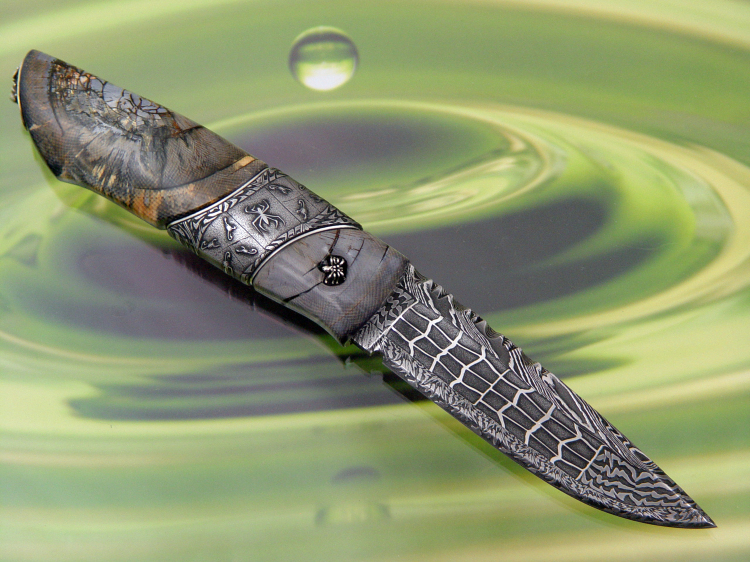
“Mammoth Spider” by Thomas Lofgren features a blade of a net-pattern mosaic damascus forged by Mattias Styrefors, a mammoth ivory and mosaic damascus handle, and sterling silver detail. (Lofgren photo)


Thomas and Claes Lofgren


Among the noteworthy Swedish knifemakers who have burst on the international cutlery scene in recent years, one of the names that stands out is Lofgren—father Thomas and son Claes.

    It is the family’s favorite sport, fishing, which brought Thomas to handmade cutlery. An annual family rite is to spend 10 days fishing—and fishing only—in the Lofoten Islands of Northern Norway. The waters are fish rich and it is not uncommon to pull out one in the 18-to-24 pound range. When you catch them you have to fillet them, which calls for a pretty good knife. Hence, Thomas began making such knives about 20 years ago. The first one cut reasonably well but was so ugly he felt obligated to make another one, and he has not quit making them since. He learned a few things from a book on knifemaking but the real trigger for improvement was an encounter with Roland Stromberg, an experienced maker. Roland taught him how to sew a nice sheath and from there showed him how to improve the general quality of his work.

    Having a technical background, Claes started getting interested in the craft in 2000, which made knifemaking just that much more important to Thomas. Since then there have been many elements of progress, emulation and sharing between father and son in the knife field. Now they are both part-time makers. Claes also works for an industrial company, and Thomas was instrumental in coordinating the 2005 and 2008 Sävsjö International Knife Expo. Thomas also found time recently to write the book, Making a Sheath for a Nordic Style Knife. It includes 150 of his own photos and sold 2,600 copies in its Swedish version, was translated into French and is now being published in German and Russian. Meanwhile, He exhibits at many shows in Sweden, other European cities (Paris, Helsinki, Solingen, Nontron), and in the USA. 

    His knife motto is “What stops growing will soon be dead.” Consequently, Thomas is always trying to improve, learning new techniques—Claes’s contributions are important in this regard—looking for new materials, and experimenting with fresh combinations of shapes and colors. “I like challenges, to walk on thin ice, even if I am not a very good swimmer,” he quipped.

    All his knives are distinctive. Even on models of similar design, he introduces many different decorations of handle and sheath, and combinations of colors and materials. In the past few years he turned toward even more high-quality materials. He is using less wood and more mammoth and walrus ivory, hippopotamus or warthog tooth, giraffe bone, etc. If he uses wood, it is often stabilized and colored. Once in a while he will embellish his knives with gold and silver, or a small precious or semi-precious stone. He prefers mosaic damascus for his blades, especially that of Conny Persson or Johan Gustafsson, or sophisticated damascus by Mattias Styrefors and André Andersson. His knives have won a number of awards in judging competitions at Swedish and American knife shows.


LIKE FATHER …

Claes’s background includes welding, most notably operating a robotic welding machine for three years. As the company he worked for expanded, a part-time position for supervising the planning of materials supply was created. Claes applied for the post and got it.

    For years he knew his father made knives, but Claes was not interested. However, in 2001 he watched his father and Johan Gustafsson board an airliner for the Knife Expo near Los Angeles (Pasadena), and “felt envious when Dad took off.” Wanting to experience the USA and California—and, of course, “California girls”—Claes saw making knives as one way to pay for the trip. His knowledge of metalworking and materials, plus the teaching of the basics by his father, resulted in very quick progress. Five months after making his first knife alone, he entered it in a judging competition at the Ludvika Show in Sweden and won in his chosen category. It was an enormous boost. By February 2002, he already had enough pieces ready to accompany his father to the Knife Expo. Since then it has become a sort of tradition for father and son to attend the Knife Expo and Ludvika Knife Week, as well as several other European shows.

    Claes’s knives share several points of similarity with his father’s. Both makers prefer mammoth bark ivory (the “bark” is the outside crust of the tusk), the same steel suppliers, quality sheaths in the Nordic style, and the same way of naming knife models. Nonetheless, not all the similarities are the result of Thomas’s influence. It is often Claes’s ideas and imagination that inspire his father.

    There are also some differences between the two. “Thomas’s knives are well made and imaginative, but with a more traditional approach. He has a feel for elegant and functional knives,” Samuel Karlsson stated. “Claes’s knives are more daring; his designs are more adventurous and extreme.”

    Being younger and with more of a technical background, Claes probably experiments more than Thomas. “The worst thing that can happen is that it goes wrong and I have to start all over again,” the younger Lofgren observed. “It can cost some material but I think it’s worth a try. I find it exciting to cross the line to find new approaches.”

    I would be remiss if I did not mention that Anna, Claes’s younger sister, also is a very good maker and has won prizes in judging competitions at Swedish knife shows. For the moment her knifemaking career is on hold as she works with her partner on restoring a farm they bought and caring for a 2-year-old boy. Meanwhile, Claes’s partner, Monika Bengtsson, also is making her first knives. “I think that I can retire now, before they all become too good for me!” Thomas laughed. “The only person not making knives in the family is my wife, Ann-Charlotte. But I can tell you that she bought two small blades …”

    Father and son makers are not uncommon, and father and daughter are less frequent. But if you add son, daughter, partner of the son and maybe one of these days the mother, a real first family of Swedish steel is in the making.—by Francis Anglade

Thomas and Claes Lofgren

+4670 834 9229 (Claes)

+46381 135 73 and +4670 69 77 405 (Thomas)

[email protected]

www.lofgrenknives.com

Specialties: Both make one-of-a-kind knives in similar styles and materials

Blade Steels: Mosaic damascus forged by Conny Persson, Johan Gustafsson, Joe Olson and Henry Hilden, and damascus forged by Mattias Styrefors and André Andersson

Handle Materials: Mammoth (including bark) and walrus ivory, hippo and warthog tusk, giraffe bone and woods (the latter often stabilized and colored)

Embellishment: Occasionally gold and silver, and precious and semi-precious stone inlays; some engraving by Jonny Walker Nilsson

Sheaths: Nordic style

Author! Author!: Thomas wrote the book, Making a Sheath for a Nordic Style Knife, which sold 2,600 copies in the Swedish version and has been translated into French, German and Russian

If you’re looking to make your own mosiac damascus, look no further than the Forging Mosaic Damascus Knives download from BLADE. You’ll learn the foundation of this fascinating process to be able to build your own great designs.


Click here to get the download for just $4.99.

Vacation Knives: Roadside Stop/Camping Set

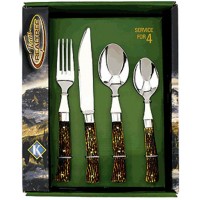
So you’re tooling down the highway with a bunch of screaming kids in the back seat on your way to DisneyWorld, and the wife says let’s pull this puppy over at the next rest area and feed the brood. What better way to chow down on those cans of beanie weanies than with the Team Realtree 16-piece flatware set from Kutmaster? Whether vacationing, camping or what have you, this set prepares you for whatever tasty morsels may cross your, the wife’s or the kids’ palates.

For more click on http://www.shopblade.com/kutmaster-team-realtree-16-pc-flatware-set-y7725/?r+ssfb080112

Colorado Dreamin’: Western Cutlery

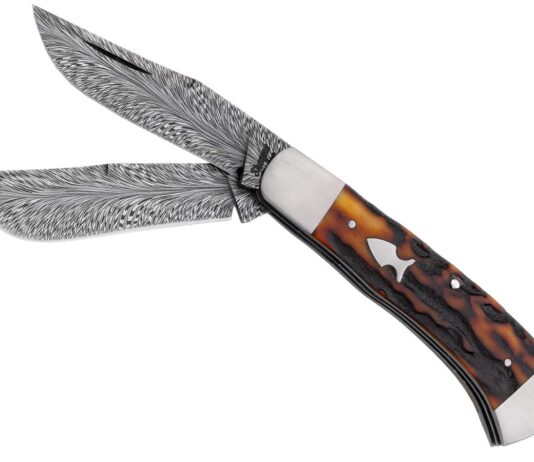
A rare Twin Set of Western Cutlery knives consists of a red-handle P48A (top) and P28 (bottom). The P28 has a sabre-ground blade instead of the standard flat grind. (Clyncke photo)

Knife collectors are dreamers. They dream of finding a Scagel, a fine bowie or an old Case knife at garage and estate sales. They dream of looking through a box of junk at a flea market, spotting an old green-bone Remington whittler, and buying it for five bucks so they can walk around smiling like a Cheshire cat. Most of the time it is just a dream, though once in a while the dream comes true.

    My dad worked at Western Cutlery in Boulder, Colorado, in the late 1930s, and I did concrete contract work for the company after it moved to the outskirts of Boulder on Western Avenue. Dad was good friends with the Harvey Platts family, and I got to know a number of the workers at the plant. I became a part-time custom knifemaker, scrimshander and jewelry maker over the years, and when Western’s plant in Longmont went out of business, I bought a lot of raw material I could use to make my knives and jewelry.

    I never lost my love of Western knives. I have owned a lot of the Boulder models and always enjoy looking for them, finding a good one, removing the dirt from it and cleaning up the sheath. My family had many Western knives on our ranch and farm, where knives were everyday tools. The many different ways of using them resulted in most being heavily abused, overly sharpened on a grindstone, and tossed in a bucket in the old shop when they wore out. I still have some of the old knives with blades that were sharpened so much they resemble toothpicks.

    I am retired now and go to many estate sales and flea markets, hoping for a good find here and there. I always see my collecting friends looking for “the prize,” too. We have a friendly competition to see who can get that old knife first, then hunt the others up and show what we found.


DREAMIN’-TYPE KNIVES

In 2010, a family friend who was 89 passed away and I bought some nice old knives from his family, including five Westerns, a nice old Case Tested XX and several other brands. A couple of the Westerns and the Case are in very good condition—dreamin’-type knives.

    A week later I was at another sale and asked about any Western knives, as another long-time Boulder family was conducting the sale. I was about to leave when a man said he had heard me ask about Westerns. He had one, I looked at it and we exchanged phone numbers. On the way home I started dreaming again about what the man had, hoping it was a rare one, maybe a World War II stiletto or a big, old one-blade folder.

    A few days later I got anxious and phoned him. He said the knives were packed away and he would call me when he found them. I had heard that many times before, so the dreamin’ abruptly stopped.

    Two days later the phone rang and it was the fellow again, telling me to stop by. I arrived and he got out three boxes and put them on a table. Inside were many cloths of different types rolled up in bundles. I picked up the top one, opened it and saw a Western 48A with red handles in mint condition. I nervously started opening more. Not one or two as I had imagined, but 28 pristine Western Boulder knives with sheaths! I was stunned to say the least. This was without a doubt the finest group of knives I had seen since Western closed its doors.

    There were six folders, including a gorgeous 062 two-blade with redbone handles, two yellow-handle trappers, a 441 with cracked-ice scales, a brownbone 426 stockman, and a 656 with beautiful redbone scales. There was an L77A with a sawtooth back, a 539 with very nice stag handles, a rare dark-yellow-handle P48A, four “Black Beauty” knives of varying sizes, an L28, 628 and a P28. As I kept unwrapping I became more stunned at each knife. These all were brand new, never used or handled at all. Luckily, they were not stored in the sheaths but wrapped separate from the corroding leather.

    As I lifted one of the last four and unwrapped it, I know my jaw dropped to my chest. Here was a wonderful white-handle “Twin Set” containing a P48A and a P28. I was nervous as a cat in a dog pound! As I unwrapped the last three, again I was stunned. Here were three more Twin Sets, one stacked leather, one white handled and another red. I calmly put them all back as the man inquired which one I would like to buy. I asked which ones were for sale and he said, “Why don’t you buy ’em all?” We arrived at a price and I paid him.

    I asked where the knives came from and he said they belonged to his brother, who had worked at Western for a while in the leather department. He did not seem to want to talk about it, so I took the knives and left.


DREAM, DREAM, DREAM …

When I got home, I carefully unwrapped the knives and sheaths again, lined them up and just stared. One of my dreams had come true for sure.

    It was time to give the knives closer inspection. Most of the brass guards and nickel bolsters were discolored with age, so I took a polishing cloth and carefully brought the new shine back. As I began to polish the stacked leather Twin Set, I got another shock.

    Both knives had a Boy Scout stamp just above the Western Boulder stamp. I had seen 48s with the Boy Scout stamp but never the smaller L48B. Also unusual is that three of the four Twin Set larger knives have sabre blades with no blood grooves. The sheaths were somewhat dry, so I applied leather balm to bring them back to life. I noticed some were not stamped the same as Western did most of its sheaths, particularly the four Twin Sets. Since the knives’ original owner had worked in Western’s leather shop, he may have been just doing what he liked, or he may have been trying new styles. I guess I will never know for sure.

    One thing I do know for sure: I will keep dreaming of finding another great knife or two, and now I can dream of finding another great cache such as this one.—by Marvin Clyncke


DREAM KNIFE VALUES*


Twin Set w/scout-stamped knives $400

Twin Set w/red tenite handles   $450

P48A w/yellow handle $375

539 w/stag handle $275

248 w/cracked-ice handle $200

060 Rancher’s two-blade folder $250

L77A w/Finnish-style sheath $250

Twin Set w/white tenite handles $450


*The author’s values are for knives in mint condition.


For more on the latest knives, knife legislation, knifemaking instruction, knife trends, knifemakers, what knives to buy and where and much more, subscribe to BLADE® Magazine, the World’s No. 1 Knife Publication. Click on http://www.shopblade.com/blade-magazine-one-year-subscription-us/?r+ssfb073112 for more information.

What’s Your Steel I.Q.?

According to BLADE® subscriber surveys, one of the topics subscribers request BLADE cover most is steel—specifically, steel for knife blades. It is not much of a stretch, then, for the latest installment of “BLADE Quiz” to challenge your knowledge of the most popular of blade materials.

    The answers are at the end of the story. Be sharp!

1) Damascus or a damascus type of steel has been traced as far back as: A) the 11th century A.D.; B) second century A.D.; C) 500 B.C.

2) Wootz steel is believed to have originated in: A) Damascus, Syria; B) Indian and/or Sri Lanka; C) Japan.

3) A Swedish steel with 2 percent nickel is known as A) Sandvik 12C27; B) Damasteel damascus; C) 15N20.

4) According to most authorities, for a steel to be stainless, it must contain what percentage range of chromium? A) 11.5 to 12; B) 12.5 to 13; C) 13 to 13.5.

5) The Japanese word for “blade steel” is: A) ha-gane; B) hada; C) ha-machi.

6) The two stainless steels for which Blade Magazine Cutlery Hall-Of-Fame© member Bob Loveless is most famous for introducing to custom knives are: A) BG-42 and 154CM; B) 154CM and ATS-34; C) 440C and Vascowear.

7) A material that is dissolved in another metal in a solid solution or that results when two or more elements combine in a solid solution A) is ductile; B) has been sintered; C) is an alloy.

8) The measure of a steel’s resistance to deformation is its A) wear resistance; B) toughness; C) hardness.

9) Cutlery Hall-Of-Famer Bill Moran introduced damascus steel to modern custom knives at the Knifemakers’ Guild Show held in A) 1972; B) 1973; C) 1974.

10) At the aforementioned Guild Show, Moran’s knives fetched how many dollars per blade inch of damascus? A) $50; B) $100; C) $150.

11) The relative resistance of a steel to breakage, chipping, or cracking under impact or stress is its A) toughness; B) hardness; C) wear resistance.

12) The Crucible Particle Metallurgy steel originally called CPM 440V is now called: A) CPM M4; B) CPM S90V; C) CPM S60V.

13) To harden to the 60 HRC level during heat treating, a steel must have at least what percentage of carbon? A) 0.5; B) 0.75; C) 0.90.

14)  The first CPM steel created exclusively for knife use was: A) CPM S30V; B) CPM 440V; C) CPM 3V.

15) If the first symbol of a steel’s designation is a letter and the second symbol is a number, it is probably a: A) high-carbon steel; B) tool steel; C) high-speed steel.

16) The point at which a steel becomes permanently deformed is its: A) yield strength; B) tensile strength; C) impact strength.

17) Tool steel contains a number of different elements that combine with the steel’s excess carbon to form A) ferrite; B) austenite; C) carbides.

18) In order to cool fast enough, low-alloy steels such as O1 must be quenched in A) oil; B) water; C) a mixture of both A and B.

19) Steel handmade from electrolytic sponge iron and antique wrought iron is called A) tamahagane; B) bulat; C) oroshigane.

20) The carbon steel D.E. Henry claims to have used for knives in the 1940s and that BLADE® field editor Ed Fowler is known best for today is: A) 52100; B) 5160; C) 1084.


Answers: 1) C; 2) B; 3) C; 4) B; 5) A; 6) B; 7) C; 8) C; 9) B; 10) B; 11) A; 12) C; 13) A; 14) A; 15) B; 16) A; 17) C; 18) A; 19) C; and 20) A. Scoring: 0-3—You’re rusty. 4-7—You just went from Man of Steel to Man of La Mancha. 8-12—Come back when you can say molybdenum without chipping a tooth. 13-17—You are starting to become abrasion resistant. 18-19—Wayne Goddard just looked over his shoulder at you. 20—Your initials have officially been changed to HRC (hardness Rockwell C).

For more on the latest knives, knife legislation, knifemaking instruction, knife trends, knifemakers, what knives to buy and where and much more, subscribe to BLADE® Magazine, the World’s No. 1 Knife Publication. Click on http://www.shopblade.com/blade-magazine-one-year-subscription-us/?r+ssfb072712 for more information.

Waki Talk: What’s Hot in Wakizashis

The wakizashi may be the most sensible and useful Japanese sword. Between a katana and tanto in length, the “waki” is long enough for any number of heavy-duty jobs but also short enough to use in confined spaces. And, for those into collecting/displaying Japanese swords, the waki offers all the traditional accouterments of high-end pieces, too.

    “The CAS Hanwei Tactical Wakizashi crosses over to the machete market to a large extent but still has the mystique of the traditional wakizashi, which a lot of people know about, so it’s a pretty good combination of a machete and an old-time weapon,” CAS Hanwei’s Barry Ross noted. “A lot of our customers use it as a brush-cutting sword. Those hiking in the backwoods carry one for cutting brush for paths and to make shelter, and [some other of our customers] use it as a defensive weapon.”

    With a manufacturer’s suggested retail price of $209, it is a lot less expensive than traditional wakis that have more expensive fittings and cost much more to build, Ross added. Sporting a checkered Kraton handle for a sure grip in slippery conditions, the CAS Tactical Wakizashi has a 20-inch blade of 5160 carbon steel plasma coated for corrosion resistance.

    For the plasma coat, CAS Hanwei has a process that applies a thin layer of nickel to the blade. It is a very tough coating that forms a physical bond with the steel, one Ross said will not wear off. “5160 will rust easily if left to its own devices and since these things will see a lot of work, we needed to do something for that”—thus the plasma coat, he reasoned. The weatherproofed, glass-filled-resin scabbard is equipped with a drain hole so it will not hold water.


THE G2 TEST

ABS master smith Wally Hayes offers tactical, traditional and high-end wakis. “I make tactical wakis for Larry Brahms of Bladeart.com,” Hayes said. “Brent Beshara tested one at the [Usual Suspect Network] G2 Show. We had to make something that was the biggest bang for the buck, something to take into battle and not cost an arm and a leg, so we came up with the tactical waki.” It has a 14-inch blade of 1084 carbon steel and an 8-inch handle with a Turk’s head knot and a ray-skin nylon wrap resin coated to waterproof it. Hayes indicated he has since switched to W2 tool steel for the blade because W2 produces “cooler temper lines and stays straight in the heat treat.” His list price: $1,200. He also offers the double-edge/double-temper-line Hayabusa that he lists for $1,800. It has a 15-inch blade and an 8-inch handle of black ray skin and purple silk.

    While Hayes said his waki production is about half tactical/half traditional, which breaks things up and makes them more fun for him, he indicated he is learning more toward the more expensive models to “push his limits.”

    “As I move up the food chain, so does the demand for my higher-end stuff, more engraving and gold,” etc., he said. “I’m attracting higher-end collectors” from such places as Cypress, Germany, China and Australia, to name a few. “And Axl [Axl Rose of Guns ‘n Roses fame] loves my stuff—traditional and tactical,” he added. “He’s got my wakis hanging in his kitchen.”

    An example of Wally’s higher-end waki would include one with 1600 layers of three different carbon steels—1050, W2 and 15N20. “I put in some of Alfred Pendray‘s carburized electrolytic iron; that way I can get the brightness and tool up to between a thousand and 1600 layers,” Wally noted. All the handles are traditional. He carves and engraves them and embellishes them in gold and silver, depending on the price, which starts at $3,500.


BACKYARD CUTTERS

Rick Barrett, who also goes by the Japanese name of Toshi Hisa, said he prefers to make his wakis with semi-traditional-type blades. “I like the longer or oh wakizashi in the 23-to-25-inch blade range, so it’s almost a short katana,” he said. “It makes a great tactical blade; it’s not so long you can’t use it in confined spaces.” Rick uses 1075, W1 and W2, modern carbon steels heat treated traditionally for a hamon.

    He indicated many of his customers include martial artists and “backyard cutters,” the latter whom cut rolled-up straw mats and bamboo in their backyards. “In my opinion, cutting things is similar to shooting firearms. You go out and practice to improve your technique; it is a bit of a hobby in itself,” he opined. “It’s like people who don’t shoot; they don’t know the pleasure people get hitting a target. Those who don’t cut don’t get it either, but [those who do] get a thrill from cutting targets.” Rick said he also has military customers who order anything from a long tanto to a short waki for use in Afghanistan as a backpack piece, as well as collectors who “just put the swords on the mantle.”

    Rick sells most of his wakis—and swords in general—without handles. “I usually do the blade alone and let the customer decide if he wants the rest done traditionally or contemporary. That’s the way the Japanese makers do swords [without handles]. A lot of Westerners look at it as not finished, whereas the Japanese look at it as finished; the rest is ancillary. I get questions all the time: ‘When are you going to finish it?’ For years I would finish it and people would say they wanted something different. You can’t just change it easily. It requires redoing a lot of things. I spend $200 on getting the handle wrapped and if I have to rewrap, I will have to undo the handle, which costs $200, and rewrap, which is another $200.”

    When he offers a waki with traditional mounts, he hands it over to a traditional mounter. “[Traditional mounters provide] a more accurate wrap than I could ever get,” he observed. “[Traditional mounting] takes years in itself to perfect. I don’t want to offer something sub-par for a sole-authorship piece. It is far better to have a tighter handle wrap, diamonds lined up perfectly, and so on. The contemporary handles I do all myself.”


3V WAKIS

Dan Keffeler makes tough, functional user wakis. He said he was invited to a dojo in 2004 and watched a participant’s sword bend during a cut. “He wound up taking it to a polisher to straighten the blade and the bill was $900,” Dan recalled. “I was working with CPM 3V and wondered why can’t I make a [sword] blade out of 3V? It has a lot of impact and chip resistance and though it’s not as tough as S7 it’s still tough, so I started making Japanese swords from 3V, testing, dialing in heat treat for a balance of all the properties we’re looking for, one that would not take a set [bend] and would chop through a 4×4.”

    Since then Dan said 3V has developed a durable reputation for both knives and swords, including his wakis. “I am one of the first if not the first to use 3V for swords, and I hope my work with it over the last eight years has helped contribute to that,” he noted. “I think 3V has the best combination of toughness and edge retention for a sword blade of any steel I’ve tested. I compete in BladeSports International cutting competitions and hold the world record [1.21 seconds] for the fastest 2×4 cut, so I have spent a lot of time on what makes things cut.

    “With a sword, toughness is primary; with a knife, edge retention is primary. For swords, I have not seen another steel that can put those two attributes together like 3V can. When heat treated properly, it’s semi-stainless like D2. You have to care for it but not like for steels like O1. 3V is abrasive resistant so it doesn’t scratch up like other sword steels. It’s harder to sharpen and grind but because it’s so tough and chip resistant, I can grind it to a thinner edge, and a thinner edge is easier to sharpen.”

    For handles for his user pieces he uses a material called Tero-Tuf. “Brian Wagner and Jeff Crownover turned me onto it,” he said. “It’s synthetic like Micarta® or G-10 but is tougher than both. It’s laminated and has a resin like canvas Micarta to make it stronger.

    “I was testing different glues on G-10, Micarta and Tero-Tuf and trying to break the glue and hitting the handle with a hammer. The G-10 would break and crumble in chunks. The Micarta took more hits but would shatter. The Tero-Tuf would throw the hammer back at me. It’s hard to get it to fracture.

    “I sent a knife [with a Tero-Tuf handle] into Knifetest.com and [the tester] hit the handle with a sledgehammer 50 times and couldn’t break the scales. It’s really a high-impact material. Another benefit is it has a really good grip when wet.”


EQUAL PARTS HOT & COOL

Useful, traditional, contemporary and collectible, today’s wakizashis have everything going for them that enthusiasts look for in a Japanese sword. If buying such a sword is on your list, consider the wakizashi, especially one of those described herein. Equal parts hot and cool, wakis are hard to beat.—by Steve Shackleford

How Long The Waki Blade?


How long is the blade of a wakizashi? According to Rick Barrett, since the waki is more of a short carry sword, the blade normally is in the 14-to-22-inch range. As for the oh wakizashi—translated as long wakizashi—he said the range is 23 to 25 inches.

    Barry Ross put the waki blade-length range at 18 to 21 inches. Dan Keffeler said waki blades generally span from 16 to 24 inches. His assessment gibes with the description by the late Bob Engnath in his “Basic Blade Shapes of Ancient Japan.” After 25 inches, Keffeler noted, the blade falls into the short katana range, with the standard katana blade at least 27 to 28 inches long.

    According to information supplied by swordsmith David Goldberg, a wakizashi is “a medium-sized blade over one shaku but less than two shaku in length.” Wikipedia indicates the Japanese shaku has been defined to equal 11.93 inches. Two shaku equal 23.86 inches.—by Steve Shackleford


For more on the latest knives, knife legislation, knifemaking instruction, knife trends, knifemakers, what knives to buy and where and much more, subscribe to BLADE® Magazine, the World’s No. 1 Knife Publication. Click on http://www.shopblade.com/blade-magazine-one-year-subscription-us/?r+ssfb072512 for more information.

Vacation Knives: Learn to Whittle & Carve

For the times when the kids complain about how there’s nothing to do during summer vacation, buy them “Whittling Twigs & Branches” by Chris Lubkemann. Heck, you might even want to try your hand with this book, which includes step-by-step demos on how to carve roosters and other birds, flowers, trees and letter openers from ordinary twigs and branches using only a pocketknife.

    Of course, you’ll need a pocketknife for the job, and a good one is the Kutmaster Team Realtree stockman with clip, spey and sheepfoot blades for carving, whittling and fine-tuning your sculpted creation.

For more info click on http://www.shopblade.com/whittling-twigs-branches/?r+ssfb072412 and http://www.shopblade.com/kutmaster-team-realtree-35-stockmans-buckstag-handle-knife-y7727/?r+ssfb072412


Advertisement

Must Read Articles

Read this before you make a knife

Knifemaking 101 – Read This Before You Make a Knife

  by Wayne Goddard My experience has taught me that there's nothing like digging in and getting started. I've often said the hardest part of the...
how to forge damascus steel

How to Forge Damascus

Advertisement
Advertisement