Knife Collecting

Knife collecting is an extremely rewarding experience for knife enthusiasts. There truly is a knife for everyone. Many increase or hold their value throughout the years, making collecting knives something to pass on to the next generation of knife collectors.

Colorado Dreamin’: Western Cutlery

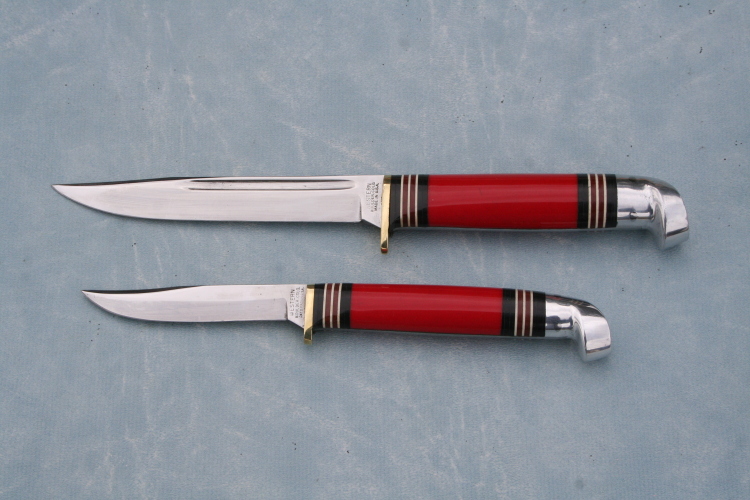
A rare Twin Set of Western Cutlery knives consists of a red-handle P48A (top) and P28 (bottom). The P28 has a sabre-ground blade instead of the standard flat grind. (Clyncke photo)

Knife collectors are dreamers. They dream of finding a Scagel, a fine bowie or an old Case knife at garage and estate sales. They dream of looking through a box of junk at a flea market, spotting an old green-bone Remington whittler, and buying it for five bucks so they can walk around smiling like a Cheshire cat. Most of the time it is just a dream, though once in a while the dream comes true.

    My dad worked at Western Cutlery in Boulder, Colorado, in the late 1930s, and I did concrete contract work for the company after it moved to the outskirts of Boulder on Western Avenue. Dad was good friends with the Harvey Platts family, and I got to know a number of the workers at the plant. I became a part-time custom knifemaker, scrimshander and jewelry maker over the years, and when Western’s plant in Longmont went out of business, I bought a lot of raw material I could use to make my knives and jewelry.

    I never lost my love of Western knives. I have owned a lot of the Boulder models and always enjoy looking for them, finding a good one, removing the dirt from it and cleaning up the sheath. My family had many Western knives on our ranch and farm, where knives were everyday tools. The many different ways of using them resulted in most being heavily abused, overly sharpened on a grindstone, and tossed in a bucket in the old shop when they wore out. I still have some of the old knives with blades that were sharpened so much they resemble toothpicks.

    I am retired now and go to many estate sales and flea markets, hoping for a good find here and there. I always see my collecting friends looking for “the prize,” too. We have a friendly competition to see who can get that old knife first, then hunt the others up and show what we found.


DREAMIN’-TYPE KNIVES

In 2010, a family friend who was 89 passed away and I bought some nice old knives from his family, including five Westerns, a nice old Case Tested XX and several other brands. A couple of the Westerns and the Case are in very good condition—dreamin’-type knives.

    A week later I was at another sale and asked about any Western knives, as another long-time Boulder family was conducting the sale. I was about to leave when a man said he had heard me ask about Westerns. He had one, I looked at it and we exchanged phone numbers. On the way home I started dreaming again about what the man had, hoping it was a rare one, maybe a World War II stiletto or a big, old one-blade folder.

    A few days later I got anxious and phoned him. He said the knives were packed away and he would call me when he found them. I had heard that many times before, so the dreamin’ abruptly stopped.

    Two days later the phone rang and it was the fellow again, telling me to stop by. I arrived and he got out three boxes and put them on a table. Inside were many cloths of different types rolled up in bundles. I picked up the top one, opened it and saw a Western 48A with red handles in mint condition. I nervously started opening more. Not one or two as I had imagined, but 28 pristine Western Boulder knives with sheaths! I was stunned to say the least. This was without a doubt the finest group of knives I had seen since Western closed its doors.

    There were six folders, including a gorgeous 062 two-blade with redbone handles, two yellow-handle trappers, a 441 with cracked-ice scales, a brownbone 426 stockman, and a 656 with beautiful redbone scales. There was an L77A with a sawtooth back, a 539 with very nice stag handles, a rare dark-yellow-handle P48A, four “Black Beauty” knives of varying sizes, an L28, 628 and a P28. As I kept unwrapping I became more stunned at each knife. These all were brand new, never used or handled at all. Luckily, they were not stored in the sheaths but wrapped separate from the corroding leather.

    As I lifted one of the last four and unwrapped it, I know my jaw dropped to my chest. Here was a wonderful white-handle “Twin Set” containing a P48A and a P28. I was nervous as a cat in a dog pound! As I unwrapped the last three, again I was stunned. Here were three more Twin Sets, one stacked leather, one white handled and another red. I calmly put them all back as the man inquired which one I would like to buy. I asked which ones were for sale and he said, “Why don’t you buy ’em all?” We arrived at a price and I paid him.

    I asked where the knives came from and he said they belonged to his brother, who had worked at Western for a while in the leather department. He did not seem to want to talk about it, so I took the knives and left.


DREAM, DREAM, DREAM …

When I got home, I carefully unwrapped the knives and sheaths again, lined them up and just stared. One of my dreams had come true for sure.

    It was time to give the knives closer inspection. Most of the brass guards and nickel bolsters were discolored with age, so I took a polishing cloth and carefully brought the new shine back. As I began to polish the stacked leather Twin Set, I got another shock.

    Both knives had a Boy Scout stamp just above the Western Boulder stamp. I had seen 48s with the Boy Scout stamp but never the smaller L48B. Also unusual is that three of the four Twin Set larger knives have sabre blades with no blood grooves. The sheaths were somewhat dry, so I applied leather balm to bring them back to life. I noticed some were not stamped the same as Western did most of its sheaths, particularly the four Twin Sets. Since the knives’ original owner had worked in Western’s leather shop, he may have been just doing what he liked, or he may have been trying new styles. I guess I will never know for sure.

    One thing I do know for sure: I will keep dreaming of finding another great knife or two, and now I can dream of finding another great cache such as this one.—by Marvin Clyncke


DREAM KNIFE VALUES*


Twin Set w/scout-stamped knives $400

Twin Set w/red tenite handles   $450

P48A w/yellow handle $375

539 w/stag handle $275

248 w/cracked-ice handle $200

060 Rancher’s two-blade folder $250

L77A w/Finnish-style sheath $250

Twin Set w/white tenite handles $450


*The author’s values are for knives in mint condition.


For more on the latest knives, knife legislation, knifemaking instruction, knife trends, knifemakers, what knives to buy and where and much more, subscribe to BLADE® Magazine, the World’s No. 1 Knife Publication. Click on http://www.shopblade.com/blade-magazine-one-year-subscription-us/?r+ssfb073112 for more information.
What’s Your Steel I.Q.?

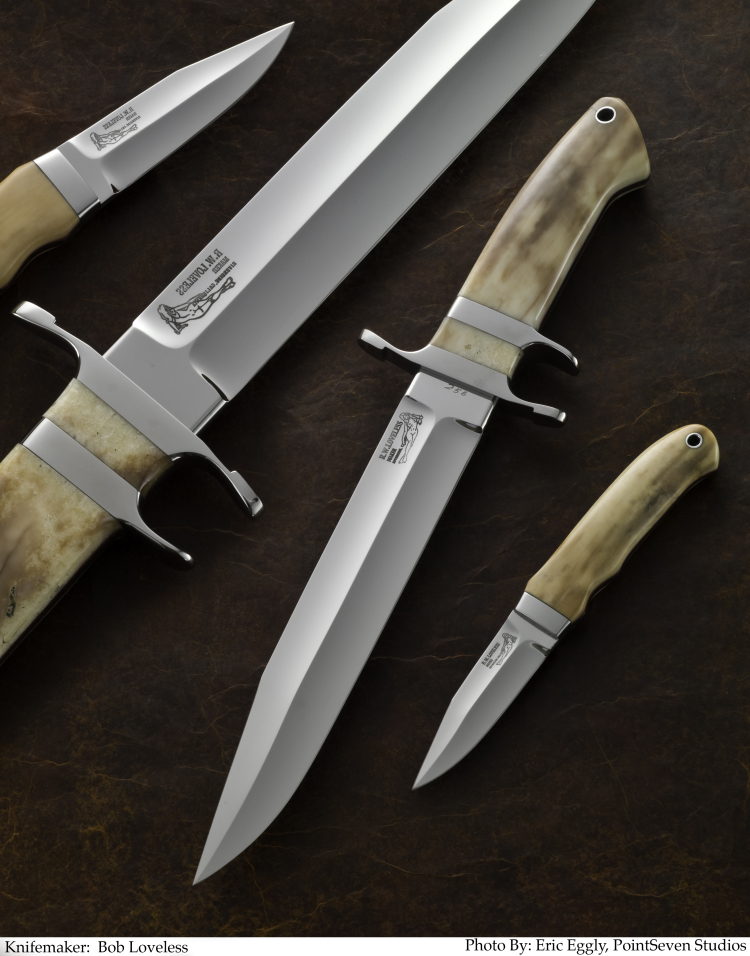
According to BLADE® subscriber surveys, one of the topics subscribers request BLADE cover most is steel—specifically, steel for knife blades. It is not much of a stretch, then, for the latest installment of “BLADE Quiz” to challenge your knowledge of the most popular of blade materials.

    The answers are at the end of the story. Be sharp!

1) Damascus or a damascus type of steel has been traced as far back as: A) the 11th century A.D.; B) second century A.D.; C) 500 B.C.

2) Wootz steel is believed to have originated in: A) Damascus, Syria; B) Indian and/or Sri Lanka; C) Japan.

3) A Swedish steel with 2 percent nickel is known as A) Sandvik 12C27; B) Damasteel damascus; C) 15N20.

4) According to most authorities, for a steel to be stainless, it must contain what percentage range of chromium? A) 11.5 to 12; B) 12.5 to 13; C) 13 to 13.5.

5) The Japanese word for “blade steel” is: A) ha-gane; B) hada; C) ha-machi.

6) The two stainless steels for which Blade Magazine Cutlery Hall-Of-Fame© member Bob Loveless is most famous for introducing to custom knives are: A) BG-42 and 154CM; B) 154CM and ATS-34; C) 440C and Vascowear.

7) A material that is dissolved in another metal in a solid solution or that results when two or more elements combine in a solid solution A) is ductile; B) has been sintered; C) is an alloy.

8) The measure of a steel’s resistance to deformation is its A) wear resistance; B) toughness; C) hardness.

9) Cutlery Hall-Of-Famer Bill Moran introduced damascus steel to modern custom knives at the Knifemakers’ Guild Show held in A) 1972; B) 1973; C) 1974.

10) At the aforementioned Guild Show, Moran’s knives fetched how many dollars per blade inch of damascus? A) $50; B) $100; C) $150.

11) The relative resistance of a steel to breakage, chipping, or cracking under impact or stress is its A) toughness; B) hardness; C) wear resistance.

12) The Crucible Particle Metallurgy steel originally called CPM 440V is now called: A) CPM M4; B) CPM S90V; C) CPM S60V.

13) To harden to the 60 HRC level during heat treating, a steel must have at least what percentage of carbon? A) 0.5; B) 0.75; C) 0.90.

14)  The first CPM steel created exclusively for knife use was: A) CPM S30V; B) CPM 440V; C) CPM 3V.

15) If the first symbol of a steel’s designation is a letter and the second symbol is a number, it is probably a: A) high-carbon steel; B) tool steel; C) high-speed steel.

16) The point at which a steel becomes permanently deformed is its: A) yield strength; B) tensile strength; C) impact strength.

17) Tool steel contains a number of different elements that combine with the steel’s excess carbon to form A) ferrite; B) austenite; C) carbides.

18) In order to cool fast enough, low-alloy steels such as O1 must be quenched in A) oil; B) water; C) a mixture of both A and B.

19) Steel handmade from electrolytic sponge iron and antique wrought iron is called A) tamahagane; B) bulat; C) oroshigane.

20) The carbon steel D.E. Henry claims to have used for knives in the 1940s and that BLADE® field editor Ed Fowler is known best for today is: A) 52100; B) 5160; C) 1084.


Answers: 1) C; 2) B; 3) C; 4) B; 5) A; 6) B; 7) C; 8) C; 9) B; 10) B; 11) A; 12) C; 13) A; 14) A; 15) B; 16) A; 17) C; 18) A; 19) C; and 20) A. Scoring: 0-3—You’re rusty. 4-7—You just went from Man of Steel to Man of La Mancha. 8-12—Come back when you can say molybdenum without chipping a tooth. 13-17—You are starting to become abrasion resistant. 18-19—Wayne Goddard just looked over his shoulder at you. 20—Your initials have officially been changed to HRC (hardness Rockwell C).

For more on the latest knives, knife legislation, knifemaking instruction, knife trends, knifemakers, what knives to buy and where and much more, subscribe to BLADE® Magazine, the World’s No. 1 Knife Publication. Click on http://www.shopblade.com/blade-magazine-one-year-subscription-us/?r+ssfb072712 for more information.

Waki Talk: What’s Hot in Wakizashis

The wakizashi may be the most sensible and useful Japanese sword. Between a katana and tanto in length, the “waki” is long enough for any number of heavy-duty jobs but also short enough to use in confined spaces. And, for those into collecting/displaying Japanese swords, the waki offers all the traditional accouterments of high-end pieces, too.

    “The CAS Hanwei Tactical Wakizashi crosses over to the machete market to a large extent but still has the mystique of the traditional wakizashi, which a lot of people know about, so it’s a pretty good combination of a machete and an old-time weapon,” CAS Hanwei’s Barry Ross noted. “A lot of our customers use it as a brush-cutting sword. Those hiking in the backwoods carry one for cutting brush for paths and to make shelter, and [some other of our customers] use it as a defensive weapon.”

    With a manufacturer’s suggested retail price of $209, it is a lot less expensive than traditional wakis that have more expensive fittings and cost much more to build, Ross added. Sporting a checkered Kraton handle for a sure grip in slippery conditions, the CAS Tactical Wakizashi has a 20-inch blade of 5160 carbon steel plasma coated for corrosion resistance.

    For the plasma coat, CAS Hanwei has a process that applies a thin layer of nickel to the blade. It is a very tough coating that forms a physical bond with the steel, one Ross said will not wear off. “5160 will rust easily if left to its own devices and since these things will see a lot of work, we needed to do something for that”—thus the plasma coat, he reasoned. The weatherproofed, glass-filled-resin scabbard is equipped with a drain hole so it will not hold water.


THE G2 TEST

ABS master smith Wally Hayes offers tactical, traditional and high-end wakis. “I make tactical wakis for Larry Brahms of Bladeart.com,” Hayes said. “Brent Beshara tested one at the [Usual Suspect Network] G2 Show. We had to make something that was the biggest bang for the buck, something to take into battle and not cost an arm and a leg, so we came up with the tactical waki.” It has a 14-inch blade of 1084 carbon steel and an 8-inch handle with a Turk’s head knot and a ray-skin nylon wrap resin coated to waterproof it. Hayes indicated he has since switched to W2 tool steel for the blade because W2 produces “cooler temper lines and stays straight in the heat treat.” His list price: $1,200. He also offers the double-edge/double-temper-line Hayabusa that he lists for $1,800. It has a 15-inch blade and an 8-inch handle of black ray skin and purple silk.

    While Hayes said his waki production is about half tactical/half traditional, which breaks things up and makes them more fun for him, he indicated he is learning more toward the more expensive models to “push his limits.”

    “As I move up the food chain, so does the demand for my higher-end stuff, more engraving and gold,” etc., he said. “I’m attracting higher-end collectors” from such places as Cypress, Germany, China and Australia, to name a few. “And Axl [Axl Rose of Guns ‘n Roses fame] loves my stuff—traditional and tactical,” he added. “He’s got my wakis hanging in his kitchen.”

    An example of Wally’s higher-end waki would include one with 1600 layers of three different carbon steels—1050, W2 and 15N20. “I put in some of Alfred Pendray‘s carburized electrolytic iron; that way I can get the brightness and tool up to between a thousand and 1600 layers,” Wally noted. All the handles are traditional. He carves and engraves them and embellishes them in gold and silver, depending on the price, which starts at $3,500.


BACKYARD CUTTERS

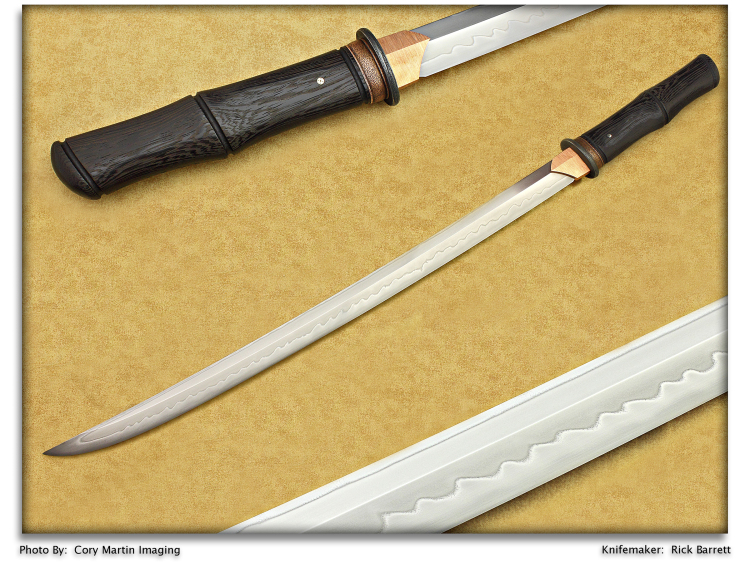
Rick Barrett, who also goes by the Japanese name of Toshi Hisa, said he prefers to make his wakis with semi-traditional-type blades. “I like the longer or oh wakizashi in the 23-to-25-inch blade range, so it’s almost a short katana,” he said. “It makes a great tactical blade; it’s not so long you can’t use it in confined spaces.” Rick uses 1075, W1 and W2, modern carbon steels heat treated traditionally for a hamon.

    He indicated many of his customers include martial artists and “backyard cutters,” the latter whom cut rolled-up straw mats and bamboo in their backyards. “In my opinion, cutting things is similar to shooting firearms. You go out and practice to improve your technique; it is a bit of a hobby in itself,” he opined. “It’s like people who don’t shoot; they don’t know the pleasure people get hitting a target. Those who don’t cut don’t get it either, but [those who do] get a thrill from cutting targets.” Rick said he also has military customers who order anything from a long tanto to a short waki for use in Afghanistan as a backpack piece, as well as collectors who “just put the swords on the mantle.”

    Rick sells most of his wakis—and swords in general—without handles. “I usually do the blade alone and let the customer decide if he wants the rest done traditionally or contemporary. That’s the way the Japanese makers do swords [without handles]. A lot of Westerners look at it as not finished, whereas the Japanese look at it as finished; the rest is ancillary. I get questions all the time: ‘When are you going to finish it?’ For years I would finish it and people would say they wanted something different. You can’t just change it easily. It requires redoing a lot of things. I spend $200 on getting the handle wrapped and if I have to rewrap, I will have to undo the handle, which costs $200, and rewrap, which is another $200.”

    When he offers a waki with traditional mounts, he hands it over to a traditional mounter. “[Traditional mounters provide] a more accurate wrap than I could ever get,” he observed. “[Traditional mounting] takes years in itself to perfect. I don’t want to offer something sub-par for a sole-authorship piece. It is far better to have a tighter handle wrap, diamonds lined up perfectly, and so on. The contemporary handles I do all myself.”


3V WAKIS

Dan Keffeler makes tough, functional user wakis. He said he was invited to a dojo in 2004 and watched a participant’s sword bend during a cut. “He wound up taking it to a polisher to straighten the blade and the bill was $900,” Dan recalled. “I was working with CPM 3V and wondered why can’t I make a [sword] blade out of 3V? It has a lot of impact and chip resistance and though it’s not as tough as S7 it’s still tough, so I started making Japanese swords from 3V, testing, dialing in heat treat for a balance of all the properties we’re looking for, one that would not take a set [bend] and would chop through a 4×4.”

    Since then Dan said 3V has developed a durable reputation for both knives and swords, including his wakis. “I am one of the first if not the first to use 3V for swords, and I hope my work with it over the last eight years has helped contribute to that,” he noted. “I think 3V has the best combination of toughness and edge retention for a sword blade of any steel I’ve tested. I compete in BladeSports International cutting competitions and hold the world record [1.21 seconds] for the fastest 2×4 cut, so I have spent a lot of time on what makes things cut.

    “With a sword, toughness is primary; with a knife, edge retention is primary. For swords, I have not seen another steel that can put those two attributes together like 3V can. When heat treated properly, it’s semi-stainless like D2. You have to care for it but not like for steels like O1. 3V is abrasive resistant so it doesn’t scratch up like other sword steels. It’s harder to sharpen and grind but because it’s so tough and chip resistant, I can grind it to a thinner edge, and a thinner edge is easier to sharpen.”

    For handles for his user pieces he uses a material called Tero-Tuf. “Brian Wagner and Jeff Crownover turned me onto it,” he said. “It’s synthetic like Micarta® or G-10 but is tougher than both. It’s laminated and has a resin like canvas Micarta to make it stronger.

    “I was testing different glues on G-10, Micarta and Tero-Tuf and trying to break the glue and hitting the handle with a hammer. The G-10 would break and crumble in chunks. The Micarta took more hits but would shatter. The Tero-Tuf would throw the hammer back at me. It’s hard to get it to fracture.

    “I sent a knife [with a Tero-Tuf handle] into Knifetest.com and [the tester] hit the handle with a sledgehammer 50 times and couldn’t break the scales. It’s really a high-impact material. Another benefit is it has a really good grip when wet.”


EQUAL PARTS HOT & COOL

Useful, traditional, contemporary and collectible, today’s wakizashis have everything going for them that enthusiasts look for in a Japanese sword. If buying such a sword is on your list, consider the wakizashi, especially one of those described herein. Equal parts hot and cool, wakis are hard to beat.—by Steve Shackleford

How Long The Waki Blade?


How long is the blade of a wakizashi? According to Rick Barrett, since the waki is more of a short carry sword, the blade normally is in the 14-to-22-inch range. As for the oh wakizashi—translated as long wakizashi—he said the range is 23 to 25 inches.

    Barry Ross put the waki blade-length range at 18 to 21 inches. Dan Keffeler said waki blades generally span from 16 to 24 inches. His assessment gibes with the description by the late Bob Engnath in his “Basic Blade Shapes of Ancient Japan.” After 25 inches, Keffeler noted, the blade falls into the short katana range, with the standard katana blade at least 27 to 28 inches long.

    According to information supplied by swordsmith David Goldberg, a wakizashi is “a medium-sized blade over one shaku but less than two shaku in length.” Wikipedia indicates the Japanese shaku has been defined to equal 11.93 inches. Two shaku equal 23.86 inches.—by Steve Shackleford


For more on the latest knives, knife legislation, knifemaking instruction, knife trends, knifemakers, what knives to buy and where and much more, subscribe to BLADE® Magazine, the World’s No. 1 Knife Publication. Click on http://www.shopblade.com/blade-magazine-one-year-subscription-us/?r+ssfb072512 for more information.

Vacation Knives: Learn to Whittle & Carve

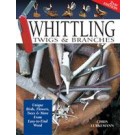
For the times when the kids complain about how there’s nothing to do during summer vacation, buy them “Whittling Twigs & Branches” by Chris Lubkemann. Heck, you might even want to try your hand with this book, which includes step-by-step demos on how to carve roosters and other birds, flowers, trees and letter openers from ordinary twigs and branches using only a pocketknife.

    Of course, you’ll need a pocketknife for the job, and a good one is the Kutmaster Team Realtree stockman with clip, spey and sheepfoot blades for carving, whittling and fine-tuning your sculpted creation.

For more info click on http://www.shopblade.com/whittling-twigs-branches/?r+ssfb072412 and http://www.shopblade.com/kutmaster-team-realtree-35-stockmans-buckstag-handle-knife-y7727/?r+ssfb072412


Balisong: The Fixed Blade That Folds

There are no locks to fail in the balisong—other than “letting go”

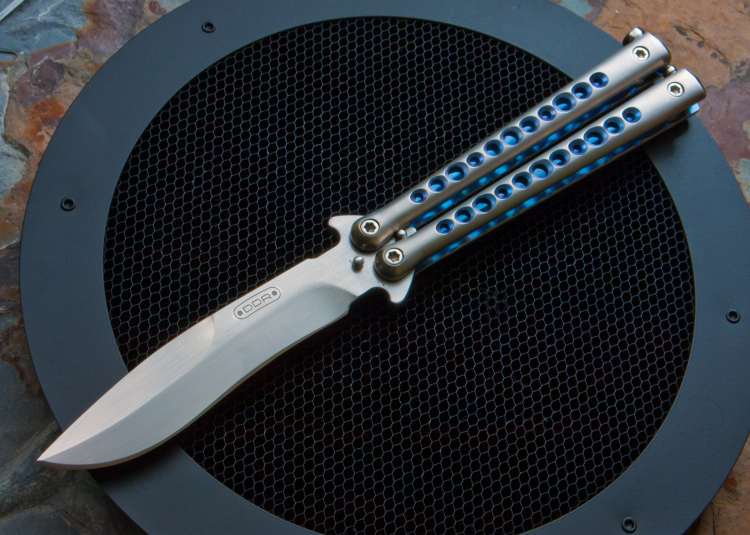
The sleek lines of the balisong, a.k.a. the butterfly knife, draw collectors and admirers like a moth to a flame. Smooth opening with a two-handle sweep in the blink of an eye adds to the allure of this somewhat mysterious knife. Meanwhile, custom makers and manufacturers have found its mechanics and optimal operation challenging to perfect.

    The origin of the butterfly knife is the object of conjecture. Though modern aficionados immediately recognize the role of Filipino makers from the early 20th century in popularizing the style, it is apparent the design dates from centuries earlier. According to balisong maker Chuck Gedraitis, the knife is also referred to as a Batangas knife after the Tagalog province of Batangas in the Philippines, where it has been traditionally made. There is also evidence that its origin is European. Collector Chuck Gollnick says he owns a French butterfly knife that dates from the 1750s, and a British example in sterling silver with hallmarks that trace it to 1873. As a result of Spanish involvement in the Philippines from the 16th through the 19th centuries, Spain also has been listed as a player in the balisong’s development.

    The continuing discussion of the knife’s heritage adds to the style’s romance and mystique. For both makers and collectors, the conversation is sure to continue.

BUTTERFLY HEART

The heart of the butterfly is its pivot mechanism, enabling the flipping action for which the knife is famous. Opinions vary on the best mechanical configuration, with several in use today that adequately fulfill their intended purpose.

    “A balisong can best be described as a ‘folding fixed blade,’ as there is typically no mechanism,” offered Vance Collver of Benchmade Knife Co., a leading manufacturer of butterfly knives. “With the exception of the modern spring latch, there are no springs incorporated in the design. All other locking-folder designs require some sort of spring technology to function. With the balisong, the handle is essentially just split in half down the middle. Each half is attached to the blade so it can pivot. This allows the two handle halves to fold around the blade itself, acting as a sheath, in a sense.”

    Collver explains that the user’s hand is essentially the lock for the split handle, and some type of latch keeps the handle halves from parting, though a latch is not necessary and the user’s grip maintains the position.

    “When in use, both handles are gripped,” he added, “making the ‘lock mechanism’ as strong as the user’s grip. There are no locks to fail other than letting go. All balisongs are the same with two handle halves pivoting at the blade tang, so the mechanism is more a question of what the best examples are with this style knife.”

    Collver identifies billet construction, in which both handle halves are machined completely from solid material; casting production, which is a variant of the billet process; the sandwich style, in which the handle halves are made from various components fastened together; and folded construction, in which the halves begin as a flat sheet material such as brass and are then folded into a “U” shape. For open and closed stops, single or dual tang pins are used.

    Maker Darrel Ralph says he considers the balisong one of the world’s strongest folding knives. He describes the pivot as equal parts simple and intricate.

    “The handles pivot on the blade independently,” he said. “This allows for offset, unique and crazy tricks or flips with the handles and blade. The secret is to be confident and always keep the ‘safe handle’—the handle that allows the back of the blade to ricochet off your hand—oriented properly as you flip.”

REVISED THINKING

Recently, Ralph has revised his thinking in regard to balisong mechanics.

    “Over the last three years we stopped making butterfly knives altogether and went back to the drawing board,” he maintained. “In this time, we examined all the issues our customers gave us with the knives we had been building. We took the problems one at a time and developed new, out-of-the-box ideas to resolve them.”

    Darrel says he considers bushing- or bearing-style pivots to be critical elements of the balisong, and his company uses both.

    “Bearings have had a hard knock over the last 10 years in balis, mostly because of the build. We feel that the Maxx Glide pivot bearing system that we have developed is one of the best on the market today,” he opined. “This system is overbuilt and brings the bali to a whole new level. The bushing system is second in our opinion. It’s a good system that is easy to work with. It holds the handles apart and allows for a good, smooth swing on the blade. Both are great systems, and we use both according to what the customer wants in the knife.”

    For years, Ralph says he heard concerns about both custom or production balisong pivots loosening after thousands of flips. To correct the problem, his designers developed the NLTP (No Loc Tight Pivot) system, which locks the pivot down and does not allow it to come loose, teaming up a set screw on one side and an adjustment screw on the other. Ralph’s Holey Moley model pictured above features the NLTP. A tension-adjustable latch also has been added, and the UFM (Ultimate Flipping Machine), a new generation of butterfly knife, is now in development.

BUSHING BACKER

Gedraitis identifies four main parts to a butterfly knife: the blade, two handle halves that pivot to expose or enclose the blade, and the latch. He uses pins or adjustable pivots to attach the handle halves to the blade. Most modern makers opt for adjustable pivots to allow the flipper to adjust the speed of the handle halves, he asserts, each acting independently of the other. He adds that the best examples of balisong operation are those that use a bushing system.

    “A bushing is inserted into the blade, and it is one thousandth of an inch thicker than the blade,” he commented. “The pivot is inserted into the bushing. The handles are added and the pivot screws are tightened. The handles pinch the sides of the bushing, and the blade rides on the bushing. This allows the flipper to adjust the screws on the pivots very tight, and the blade still moves freely on the bushing. This also keeps the tang of the knife from being scratched or rubbed by the handles.

    “A good balisong is made of quality materials and can be flipped by anyone. It has tight tolerances, washers, adjustable pivots and good balance. Bad balisongs are those made of cheap materials that are unbalanced and don’t flip properly.”

    A collector of butterfly knives for more than 20 years, Gollnick lauds the simple design and strength of the lock-up. “It works well,” he noted, “and I believe it’s the strongest lock out there. The entire mechanism is visible and can be inspected so you would know if it has been compromised. We’re seeing the best products ever now, and quality is repeatable with manufacturers cranking out consistent knives.”

    Continuing quality is reflected in the feel of the finished product. “It’s like any other knife, materials, craftsmanship and style,” Collver said. Added Ralph, “The collector wants fit, finish and exotic materials. The handles should be a little heavy in the rear to make the flippers happy. The handles should also be tight with good trick capability, including shape, rounded and not flat, and proper taper from front to back. Good blade weight and balance with fast speed and great pivots are other main points.”—by Mike Haskew


A New Balisong Club

If you are into balisongs and looking for likeminded individuals, Darrel Ralph said a new club called the Disciples may be for you.

    “We have combined forces with Stu Hopson, expert flipper, to focus the club on developing a flipping team that is second to none,” Ralph noted, “while training and sharing with up-and-coming flippers who want to get involved and grow to a champion level. We will also be working very hard to develop new ideas for butterfly knives to make technological advancements.”

    For more information contact Darrel Ralph, Dept. BL8, 4185 S. St. Rt. 605, Galena, OH 43021 740-965-9970 www.darrelralph.com.

For more on the latest knives, knife legislation, knifemaking instruction, knife trends, knifemakers, what knives to buy and where and much more, subscribe to BLADE® Magazine, the World’s No. 1 Knife Publication. Click on http://www.shopblade.com/blade-magazine-one-year-subscription-us/?r+ssfb071912 for more information.

WHK’s Conable In Men’s Health

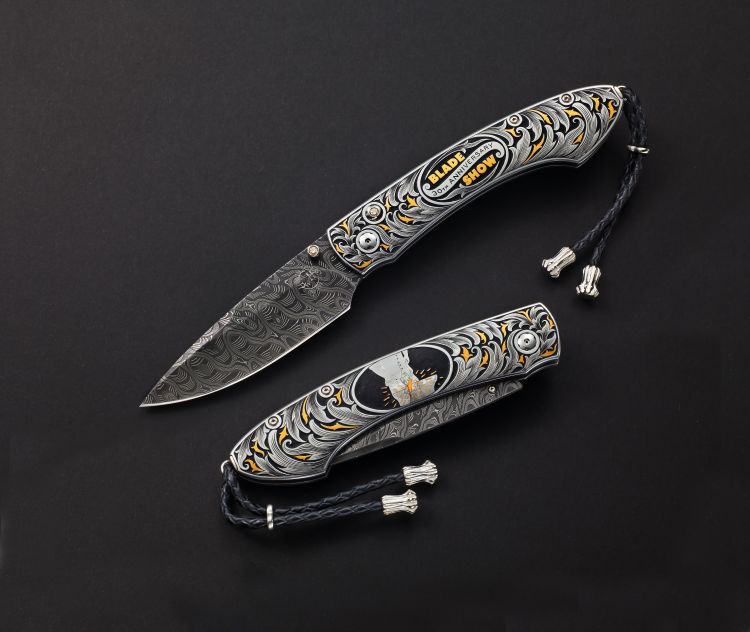
Matt Conable, founder of William Henry Knives, is featured in Men’s Health magazine. WHK has won a number of Blade Magazine Knife-Of-The-Year Awards®, including this year for Collector/Investor Knife Of The Year for the B12 Freedom. Maker of the 30th Anniversary BLADE Show Knife (above), WHK is a leading maker of high-end factory knives sold in jewelry stores and other like venues.

    Conable has been a great friend of the BLADE Show (www.bladeshow.com) and BLADE® Magazine (http://www.shopblade.com/blade-magazine-one-year-subscription-us/?r+ssfb071912) over the years, including having actor Joey “Pants” Pantoliano from The Sopranos HBO series as a special guest at the WHK booth during the 2009 BLADE Show.

    For more on the story in Men’s Health, click on http://www.menshealth.com/style/matt-conable

Vacation Knives: Something Borrowed, Something Blue …

Summertime colors for knife handles just seem right, especially when you’re going on vacation to Florida or some other sun n’ fun locale and need a sharp tool for any number of jobs.

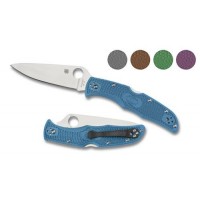
    The Spyderco Endura with a blue handle is such a knife. The textured grip is great for safe handling and the lockback adds to the blade-lock safety factor. A high-performance VG10 stainless steel blade tops off the package.

    ShopBlade’s price: $79.96.

    Oh, and whatever your travel destination, be sure to check local knife ordinances to be sure you follow the law concerning knife carry/possession.

For more information click on http://www.shopblade.com/endura4-lightweight-blue-frn-flat-ground-plainedge-w8488/?r+ssfb071812

Advertisement

Must Read Articles

Read this before you make a knife

Knifemaking 101 – Read This Before You Make a Knife

  by Wayne Goddard My experience has taught me that there's nothing like digging in and getting started. I've often said the hardest part of the...
how to forge damascus steel

How to Forge Damascus

Advertisement
Advertisement