Knife Collecting

Knife collecting is an extremely rewarding experience for knife enthusiasts. There truly is a knife for everyone. Many increase or hold their value throughout the years, making collecting knives something to pass on to the next generation of knife collectors.

Knife Handles: As Wood As It Gets

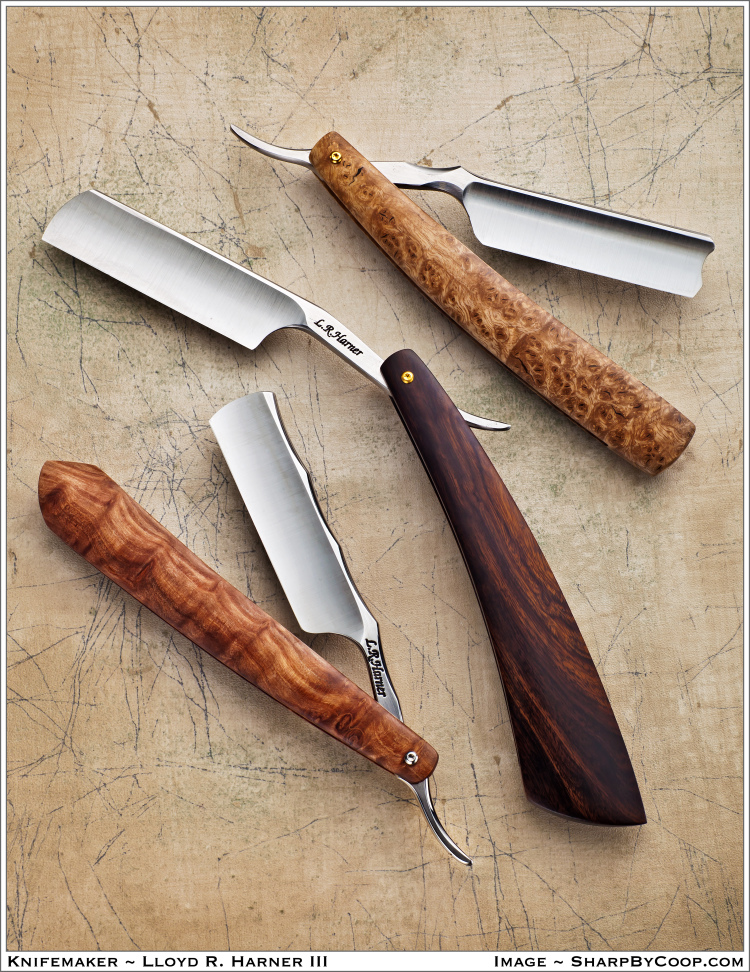
ThereIn the burl category, redwood (left) and black ash (right) are among the more popular woods. Lloyd Harner uses each for the handles of his razors, as well as the most popular of all woods, ironwood (center). The hollow-ground blades are 52100 carbon steel. (SharpByCoop.com photo)

There’s no time like the present to be a stickler for wood knife handles

Curiosity about the wood of choice among makers, users and collectors in terms of utility, user friendliness and good looks gives rise to the obvious question, “Which natural wood handle material is most popular, especially for custom knives?” American Bladesmith Society journeyman smith Peter Bromley and I were discussing the subject over coffee.

    “There are so many types of woods and so many variations within each type that the possibilities are nearly endless,” Bromley said. “You also have to find a piece of wood with a busy grain structure, so when you cut a handle-size piece, then the pattern carries over into the smaller portion.”

    Problem is, sometimes what looks good on a large piece of wood gets lost when you scale it down to handle size.

    “It’s why makers tend to like burl,” Bromley reasoned.  “It’s always busy no matter how small the handle is.”

    Shannon McFall of Knife & Gun Finishing Supplies, Chris Hartman of Masecraft Supply, and Chuck Bybee and his daughter Jessica Bybee Walker of Alpha Knife Supply each responded with two words: desert ironwood.

    “When it’s the highest quality, the most beautiful patterns are ironwood,” McFall said. “It’s still in relatively low supply, but we haven’t had a problem with replacement yet.” The shortage problems result from government regulations regarding the material. “It has become a lot harder to get the nicely figured desert ironwood,” as a result, Walker noted. “If we can’t get it, we switch to walnut. Turkish walnut is extremely dense with high contrast and performs similar to ironwood.” Bybee said he favors the look of highly figured curly koa. For high-end stuff, koa’s deep curls are rich in chatoyance, he opined. Chatoyance is the luster a material—in this case, wood—exhibits when you move it back and forth under a source of light, Bybee explained

    Hartman said ironwood is a favorite in terms of utility, looks and the best combination of both features. However, he questions whether there is a low supply of the material. “Have you ever been to a knife show that didn’t have tables full of ironwood?” he asked. With quality comes price and all those interviewed indicated ironwood is the most expensive of the woods. On the other hand, Walker said maple is probably the least expensive.


WHERE THE BURLS ARE

“Amboyna burl machines well and is a nice wood,” Walker began. She added redwood burl is always very popular—though not with production knife companies because it is more difficult to machine—along with box elder. Hartman agreed. “Amboyna burl has nice, tight patterns and it wears well, plus there seems to be a good, consistent selection available,” he said. “It looks good, feels good and sells well.” McFall cited the popularity of California buckeye, box elder, maple and amboyna burls, all of which are softer woods that must be stabilized to make them suitable for handle use.

    “Maple burl probably was the first wood stabilized successfully, it’s the most readily available and the cheapest, but we don’t sell a lot anymore and it’s not in the top five,” said Mike Ludeman of Wood Stabilizing Specialists International (WSSI). “Box elder burl is the most versatile wood and we double-dye it. Black ash burl and California buckeye burl are popular, and with buckeye each piece has to be graded individually because it can look nice, but have a huge void on the inside, so each piece has to be graded individually and priced accordingly.”

    McFall, whose Knife & Gun Finishing Supplies also provides a stabilization service, echoed Ludeman about the box elder and California burls. “They have the best patterns and finest colors,” she said. “Box elder takes a dye the best in single/double dyed, and you can get the effects of a lot of natural wood with more control over the colors.”

    Along with advances in the stabilization process comes more options. “Something normally bland with a figure can now be dyed to a natural look, rather than staining it as in the past,” McFall noted. “You have more control over the colors.”


“BETTER” OR “JUST NEW”?

Ludeman said stabilization methods are “highly regarded secrets” in a field that is growing.

    “Stabilized is not a word I like to use because it’s thrown around loosely anymore,” he noted. “I achieve 100 percent penetration of an acrylic impregnated wood.” Hartman embellished the point. “I have seen a lot of new ‘stabilizers’ advertised out there, which doesn’t make them ‘better,’ just new,” he offered. “As far as I know, the important part is proper selection and preparation of the wood, and fully understanding the entire stabilization process.” Bybee warned that amidst the growth in companies and individuals offering stabilization services, you should research the subject and exercise caution.

    Factory knives with stabilized wood handles are rare. “Generally, a factory uses stabilized wood, typically U.S. maple or box elder, for a special/limited edition” because of the cost factor, Ludeman said. “It’s not something they make tens of thousands of.” Hartman concurred. “Who can supply 500 pieces of high-quality stabilized woods on a consistent basis for two years?” he asked. “You can do limited-edition runs but it’s very hard to supply quality consistently over long periods of time in that quantity.” Bybee agreed, adding, “Factories have moved almost exclusively to man-made materials, with G-10 and Micarta® dominating now, because they can count on availability and consistency.” 


FUTURE WOODS

What woods will be popular in the future? “It varies because a lot of popular woods are harder to get so they don’t actually show up more,” Walker said. “Turkish walnut has a really rich color, nice dark browns with lighter streaks running through it, and I think it shows promise in gaining popularity.”

    “I would love to see somebody come up with something new made from bamboo,” Hartman stated. “This could be the perfect material, it’s sustainable, has a lot of good qualities, but just not enough character or pattern to become a hot-selling knife material.” He also identified the need for a  “passionate supplier” of exotic woods.

    “There are a lot of ‘suppliers’ of woods, myself included, but no ‘master wood supplier’ that does only exotic woods, stabilizes and does nothing else,” he mused, “a ‘wood crazy’ company that lives and breathes wood dust for knife folks.”

    The complexities involved in natural and stabilized woods make the possibilities, as Bromley noted, “nearly endless.” There is an attraction that cannot be denied. “Wood is naturally, beautifully created,” Hartman said, “and it’s a silly man who thinks he can improve on that kind of art.”—by Stephen Garger


Wood: It’s Not a Wash!


The No. 1 maintenance tip Jessica Bybee Walker offers is to not wash the knife in a dishwasher.

    “A lot of knifemakers use vulcanized fiber liners, which are very susceptible to moisture and can shrink and pull back or swell up in the dishwasher and crack,” she warned. Chuck Bybee recommended putting mineral oil on your hand and rolling the handle around in it. “I also put Renaissance Wax on all my ironwood knives as one of my yearly rituals,” he said.

    “Wood is a natural product so I don’t use a petroleum-based blend. I use a thin coat of olive oil on wood handles. Besides,” Peter Bromley smiled, “I like the smell.”

    Stabilized woods do not require the same amount of care as untreated woods, but that does not translate as “no” care. “Basically, stabilized wood is an enhanced wood—not the cure-all for swelling, shrinking, etc.,” Ludeman noted. “The real purpose stabilization serves is to expand the availability of woods that are otherwise too soft for knife handles.” In other words, stabilized or not, use common sense and do not leave your knife sitting on the dashboard in 90-degree heat.—by Stephen Garger


Woods: Most, Good and Least


MOST POPULAR: Desert Ironwood

MOST EXPENSIVE: Desert Ironwood

GOOD IRONWOOD SUBSTITUTE: Turkish walnut

MOST PLENTIFUL: Maple

LEAST EXPENSIVE: Maple

MOST POPULAR BURLS: Amboyna, redwood, box elder, California buckeye, maple and black ash


For more on the latest knives, knife legislation, knifemaking instruction, knife trends, knifemakers, what knives to buy and where and much more, subscribe to BLADE® Magazine, the World’s No. 1 Knife Publication. Click on http://www.shopblade.com/blade-magazine-one-year-subscription-us/?r+ssfb071212 for more information.
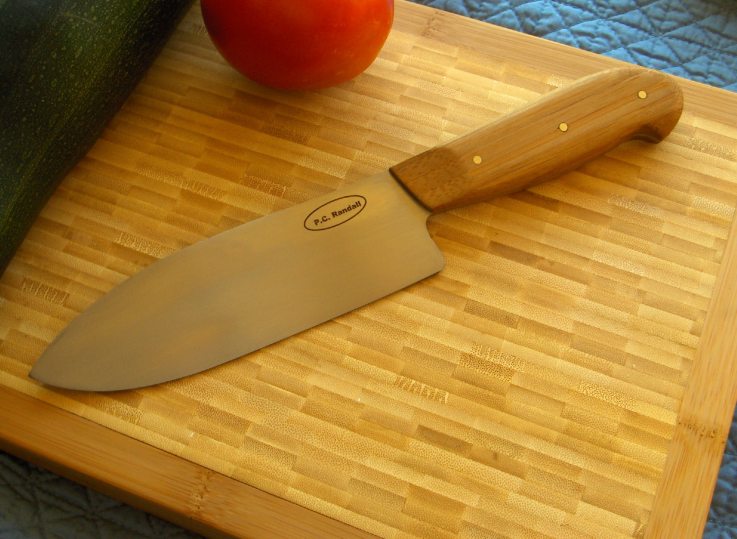
 

Photos: Bamboo Chef Knife from Patrick Knives

Medium Bamboo Chef Knife

Image 1 of 7

3/32 ATS 34 Stainless 10" overall cocobolo handle with brass pins

Here’s a look at a bamboo chef knife from Patrick Knives. For more blades like this one, check out the kitchen knives at ShopBlade.com.

Knives Of Summer: Knife/Multi-Tool Combo

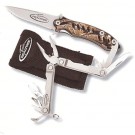
Whether it’s a standard summer cutting job such as opening a bag of dog food for Fido or something more tool oriented, such as tightening down a nut on junior’s bicycle, the Kutmaster Team Realtree Liner Lock Mini Tool Combo will handle the job.

    The knife sports a one-hand-opening 420 stainless blade and a Realtree camo handle, while the Mini Tool includes a needle-nose pliers, can opener, scissors, medium screwdriver, grippers, small slotted screwdriver and more.

    ShopBlade’s price to you: $19.99.

For more info click on http://www.shopblade.com/kutmaster-team-realtree-liner-lock-mini-tool-combo-y7745 /?r+ssfb071112

Knives Of Summer: Keep Those Puppies Sharp!

When you use one of our “Knives Of Summer,” you will need to sharpen that puppy. In fact, a little edge maintenance after each use—when feasible—is the best way to keep your knife sharp for the next time you need it.

    GATCO’s Natural Arkansas Sharpening Kit is a great way to keep your edges keen at all times. Designed for sporting, kitchen and other knives, it features a novaculite stone mined from Arkansas. The kit includes a block-mounted 5-inch stone for sharpening, a 3-inch stone for final touch-ups, honing oil and a storage case.

For more info click on http://www.shopblade.com/gatco-natural-arkansas-sharpening-kit-80005/?r+ssfb070912.

Knives Of Summer: Make Mine a Machete

Vines, shrubs, leaves, bushes, etc., overgrowing your campsite or just your yard? Check out the Gerber Gator Machete.

    It sports a 15-inch blade and a 15-inch sawback for extra-tough cutting jobs. A rubber grip is designed for control and a nylon sheath is included. Overall length: 25.7 inches. ShopBlade’s price: $19.99.

    For more information click on http://www.shopblade.com/gerber-gator-machete-w-sheath-y6980/?r+ssfb070212

Knives Of Summer: Timberline Alaskan Bush Pilot Hatchet

Summer means camping and camping requires lots of chopping jobs for such handy pieces as the Alaskan Bush Pilot Hatchet from Timberline.

    Designed by custom knifemaker Russ Kommer, the hatchet features a 440 stainless steel blade in a satin finish and a finger-grooved haft covered with Zytel slabs. Overall length: 9 inches. Weight: 3 pounds. It comes with a bridle leather sheath and a non-slip belt loop.

    For more info on the Timberline Alaskan Bush Pilot Hatchet click on http://www.shopblade.com/timberline-bush-pilot-survival-hatchet-6013/?r+ssfb062712


For more on the latest knives, knife legislation, knifemaking instruction, knife trends, knifemakers, what knives to buy and where and much more, subscribe to BLADE® Magazine, the World’s No. 1 Knife Publication. Click on http://www.shopblade.com/blade-magazine-one-year-subscription-us/?r+ssfb062712 for more information.

DPx Gear: Hot Knives From A Hot New Company

Robert Pelton Young (above), adventurer, filmmaker and author of Licensed To Kill*, The World’s Most Dangerous Places, and Come Back Alive, has spent a good bit of his life in places most people would not visit with a free, round-trip, first-class ticket and an 82nd Airborne Division fire team as bodyguards. War zones, low-intensity conflict areas, failed states, third world dictatorships, pestilent swamps, parched deserts and places where guys with AKs and bad attitudes hang out are home to RYP, as he prefers to be addressed. His first knife design, the HEST—Hostile Environment Survival Tool—reflects that experience, as do his later models, all now offered through DPx Gear.

    His entry into knife design was sparked by talks with Jeff Randall of ESEE Knives—then known as R.A.T. Cutlery—when both were in Peru, where RYP was doing a story on drug labs and Jeff was running one of his survival courses. The original HEST grew from those conversations and was initially manufactured by R.A.T. (page 74, October 2009 BLADE®).

    RYP has expanded his product range and manufacturing base. Ontario Knife Co. manufactures the original HEST, made to the same specs. Lion Steel of Maniago, Italy, makes another version, the HEST II, using Uddeholm Sleipner tool steel. Lion also manufactures the HEST/F, a folder with a D2 tool steel blade designed for the same hostile environments, and two models of the HEFT—Hostile Environment Field Tool—one with a 4-inch blade, the other 6 inches, both of Uddeholm Sleipner. All versions of the HEST and HEFT have a storage compartment under the scales.

    My cohort and I used the original HEST extensively over a period of a year in the California Sierras and the Mojave Desert. It also was one of the few knives I brought with me during my six months of travel in various countries around the Mediterranean. At 7 5/8 inches overall and with a 3 1/8-inch blade of 3/16-inch 1095 carbon steel in a Rockwell hardness of 56-57 HRC, the HEST and its Kydex® sheath are small enough to disappear in a pocket, tuck inside a belt, or carry as a neck knife. It is an excellent example of what I call a “traveler’s knife”—a fixed blade small enough to have with you at all times, sturdy enough to pry open a locked door, rip through a stone wall, serve as an arresting device, and with the ability to take and hold a hair-popping edge.

    We did all those things with the HEST and used it for everyday tasks: opening boxes, whittling fire boards and preparing food, including slicing potatoes, ribs, steaks and ripe tomatoes, the latter which requires a very sharp edge to avoid squishing them. If a knife is not useful on a daily basis, sooner or later it will be left behind. The HEST is effective as a daily tool and serves as a reliable emergency implement.

    It sports a wire breaker, a tiny pry bar at the butt and a bottle opener. Where he travels, RYP said good beer has caps requiring a lifter, whereas bad beer has screw tops. However, I had reservations about the bottle-opening notch and was concerned it weakened the blade. In actual practice the blade did flex at that juncture with the weight of a 200-pound person hanging from it, but it did not break and sprang back to true when the pressure was released.
     At first I thought the pry bar would poke and catch on clothing, but after a while I forgot it was there until it was needed. We used it to grind away mortar between stone blocks and to scrape out the mortar around a steel door set into concrete before ripping the door from the wall. I carry a fire starter and paper money rolled tightly in the hollow space under the green canvas Micarta® handle slabs. The HEST balances well, feels good in the hand, is small, sharp, tough, and, at 4.9 ounces, performs above its weight class.

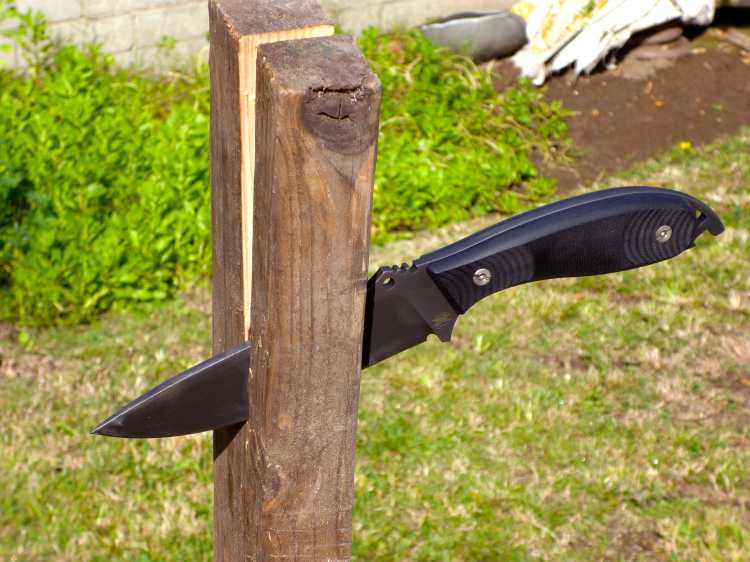
    The HEFT 6 (pictured at top splitting wood) has a 5.75 inch blade of Uddeholm Sleipner, is 10.4 inches overall and weighs 10.2 ounces. It has a combination striker and pry bar at the butt. We gave the knife a heavy month-long workout during which we used it to split a stack of 2x4s, chop through a stand of saplings, cut sheet metal, and pry open a locked steel gate. After that, and with only a quick edge touch up, I loaned it to a professional butcher, Shawn Carlson. Shawn used it for a week, during which he broke down a beef carcass, dressed out a couple dozen slabs of ribs, a stack of pork roasts, bacon and assorted other meat products. He also sliced up 20 rib slabs and split 15 chickens.

    “This is a well-designed knife with a comfortable handle,” he assessed. “It’s easy to work with and doesn’t fatigue your hand during a full day’s work. Unlike some sharpened pry bars, this knife has a fine point that allowed me to easily get into muscle and separate it from connective tissue. I didn’t need to touch it to a sharpening steel even after chopping through joints and cartilage.”—by James Morgan Ayres


*Editor’s note: Licensed To Kill is an insightful and entertaining look into the lives of military contractors, especially during the height of the Iraq War. It may not change your opinion of such contractors but it definitely will enlighten you as to what it was/is like to be one.


DPx Specs


DPx Gear

attn: Robert Young Pelton

Dept. BL7, 2321 Kettner Blvd.

San Diego, CA 92101

888-233-3924

619-780-2600

www.dpxgear.com

Specialties: Utility fixed blades and folders

Blade Materials: Uddeholm Sleipner and D2 tool steels, German Lohmann Niolox 1.4153.03 stainless steel, and 1095 carbon steel

Blade Finishes: Black texture powder coat, milspec black, stonewashed, and black satin TiCN PVD

Handle Materials: Green canvas Micarta®, olive drab G10/titanium, black G10 and Brazilian Santos wood

Geared Up: Features on some models include a wire breaker, a tiny pry bar at the butt, glass breaker and a bottle opener; all versions of the HEST and HEFT have a storage compartment under the scales

DPx FYI: Specific models are designed by Robert Young Pelton and/or Pelton in conjunction with Tom Novak and Tommaso Rumici, and made by Ontario Knife Co. and Lion Steel

Sheaths: Leather and DeSantis Kydex® models

MSRP Range: $123.75 to $275


For more on the latest knives, knife legislation, knifemaking instruction, knife trends, knifemakers, what knives to buy and where and much more, subscribe to BLADE® Magazine, the World’s No. 1 Knife Publication. Click on http://www.shopblade.com/blade-magazine-one-year-subscription-us/?r+ssfb062612 for more information.


Advertisement

Must Read Articles

Read this before you make a knife

Knifemaking 101 – Read This Before You Make a Knife

  by Wayne Goddard My experience has taught me that there's nothing like digging in and getting started. I've often said the hardest part of the...
how to forge damascus steel

How to Forge Damascus

Advertisement
Advertisement