Knife Collecting

Knife collecting is an extremely rewarding experience for knife enthusiasts. There truly is a knife for everyone. Many increase or hold their value throughout the years, making collecting knives something to pass on to the next generation of knife collectors.

What’s Your Favorite Pocketknife Pattern?

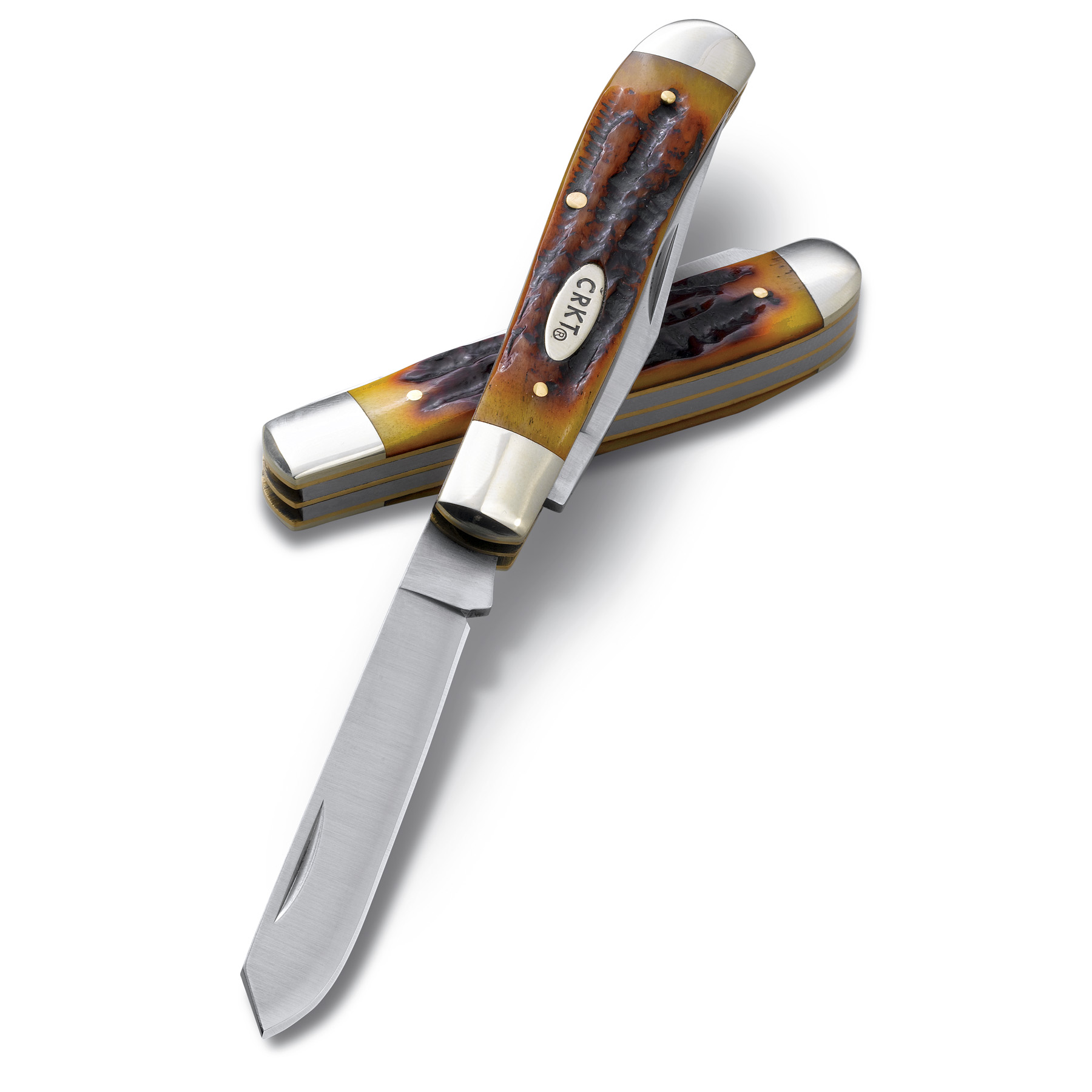
Tell us what your favorite pocketknife pattern is and chances are we will use all or portions of your comments in an upcoming issue of BLADE® Magazine. Is it a trapper like the CRKT Model 6064 shown above? (For more on it, click on http://www.shopblade.com/trapper-pocket-classic-6064.) Or is it a pattern such as a congress, stockman, muskrat, sowbelly, whittler or something else altogether?

    Feel free to include both the pattern and the brand, or just the pattern. And tell us WHY it’s your favorite.

For more on the latest knives, knife legislation, knifemaking instruction, knife trends, knifemakers, what knives to buy and where and much more, subscribe to BLADE Magazine, the World’s No. 1 Knife Publication.


Hones for the Sharpening Challenged

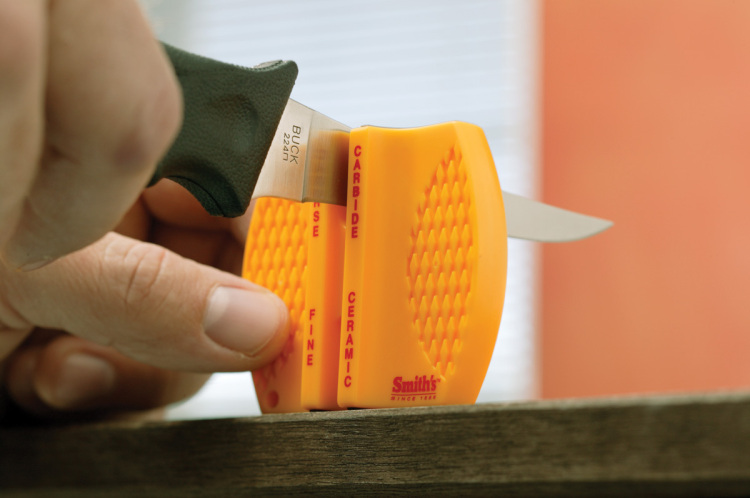
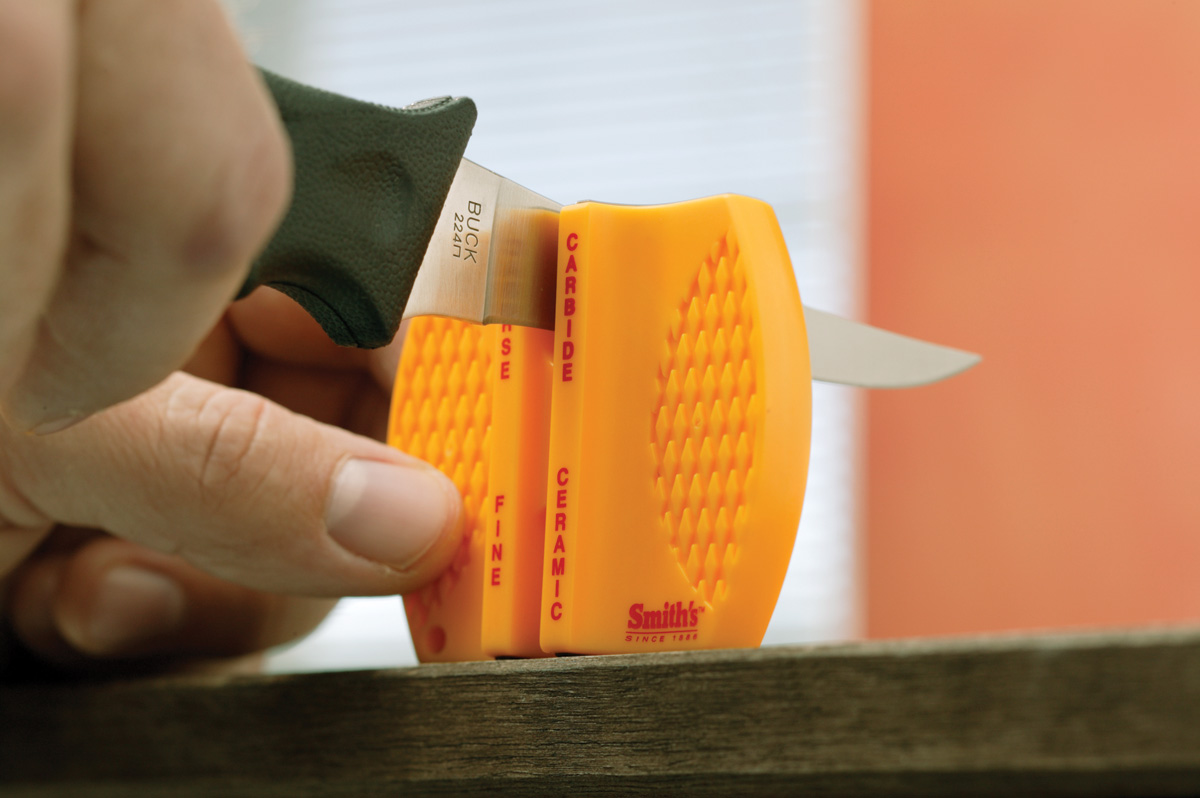
The CCKS 2-Step Knife Sharpener from Smith’s offers coarse tungsten carbide rods on top and extra-fine (1,000 grit) ceramic rods on bottom—both at pre-set angles for easy pull-through use—for sharpening and edge touch-ups/refinement, respectively. MSRP: $3.99. (Smith’s photo)

If sharpening stumps you, try one or more of these simple yet effective sharpeners

By Dave Rhea

A good working edge on a blade is one of the knife owner’s most important considerations, but sharpening is not always as easy as it seems. How do you hold the knife to the sharpener/which angle should you use? Do you use ceramic, stone or diamonds? How much sharpening is too much? How much is too little?

    Here is a better question: Since even thinking about sharpening can get complicated, why not idiot proof the subject?

Quick and Easy

Chris Fire is a sharpening expert. As the marketing manager for Lansky Sharpeners, Fire lives and breathes by the sharpening industry. His suggestion for the quickest and easiest sharpener is Lansky’s Quick Fix Pocket Sharpener.

    The Quick Fix has all the elements of an easy sharpener: Low price (MSRP: $5.99), small—about the size of a money clip—and fast results. A half-dozen or less strokes through one of the two slots clears up a problem blade edge in a hurry. One side holds a slight segment of tungsten carbide rod to return the edge to a proper geometry, and the other side holds a like-sized span of ceramic rod to deburr it.

    Fire drew a distinction between the quick-and-easy and something less expedient but perhaps wiser.

    “Tungsten-carbide sharpeners sharpen by tearing steel off the blade rather than slowly honing,” he warned. “They remove a lot of metal. Use them in a pinch, but for everyday edge maintenance you probably want to use something less aggressive like Lansky’s Turn Box Ceramic Sharpener.”

    The 4 Rod Ceramic Turn Box (MSRP: $21.99) offers a higher-grade sharpening experience but is also uncomplicated. It uses two pair of 5-inch alumina ceramic rods that are set at pre-determined angles: 20 and 25 degrees. Holding the knife upright vertically, you draw the blade down along the rods of the V-shaped sharpener. With internal rod storage, it also breaks down into a compact kit for stowing in a drawer or tool/tackle box.

    Fire added that perhaps as important as having a good sharpener is the knowledge that different tasks call for different knives. In other words, a chopping knife is not going to make a great slicing knife no matter what kind of edge it has.

    “Chopping knives have a more durable edge, but they’re not as sharp,” he professed. “Chopping potatoes with such knives is great. Achieving paper-thin tomatoes slices? Not so much. So keep a knife for slicing, a knife for chopping, a multi-purpose knife and maybe a fillet knife, and use each to its strengths.”

Hassle Free

Marketing manager for Smith’s, Russ Cowen adds that a seemingly insurmountable task is convincing the consumer on-going edge maintenance is the key to keeping a perpetually useful edged tool.

    “The best way to keep a knife sharp is to never let it get dull,” he explained. “If the consumer would just take a few minutes either before or after using a knife, and especially during use if doing lots of cuts for a longer time period, to touch up or freshen the cutting edge, he or she would see that not only would the knife cut better, but it would also take them half the time to accomplish the task.”

    For such hassle-free edge maintenance, he recommends Smith’s 2-Step Knife Sharpener, a small plastic-framed sharpener with an insanely low MSRP of $3.99. The two sharpening slots—in carbide and ceramic—offer two stages of edge work: 1) coarse “for re-setting the edge on very dull or damaged blades,” and 2) fine for finishing work that will bring a blade closer to the hair-popping sharpness so many knife users crave.

    “The 2-Step Knife Sharpener will sharpen any blade style with a flat grind on both sides of the blade as long as the blade will fit inside the sharpening slots. It works well on Euro/American style kitchen knives, everyday pocketknives, folding or fixed-blade hunting knives, fillet knives, outdoor sport knives, custom knives, and tactical/LE knives with little to no maintenance,” he said. “At most, the user may have to rinse it off or clean the ceramic rods after extended use.”

    For knives that suffer from the usual treatment—letting them go pretty much dull—Cowen offers this advice: “The best way to put a new, sharp cutting edge on a very dull or damaged knife blade is to use an abrasive surface that is aggressive enough to remove large amounts of metal from the blade quickly.”

    He suggests a sharpener with carbide blades or a low-grit diamond-coated surface. Such abrasive components are quite aggressive and remove metal from the blade very quickly—sometimes so fast you can see the metal shavings falling off the blade, he added.

Simplest Is Best

Pre-set angles and guides are all designed to make the obligatory task of sharpening a knife easier. However, according to Mark Brandon, president of Diamond Machining Technology (DMT), it does not get any simpler than the old-fashioned bench stone.

    “There’s a myth out there that sharpening is difficult,” Brandon began. “I don’t think the sharpening industry has done itself any favors—we’ve done our part to help convince people that it’s difficult by coming out with all these ‘we’ll-hold-your-edge-for-you’ kind of products.”

    He said the reality is that via its training videos available at www.dmtsharp.com, DMT has taught scores of folks to sharpen on a stone in less than five minutes.

    “We think it’s kind of idiot proof to begin with,” he stated. “Sometimes the simplest approach can be the best, and there is really nothing simpler than a 6-inch-by-2-inch stone.”

    Brandon’s two bench-stone suggestions start with the DMT Diamond Whetstone, which comes in 6- and 8-inch models. They have MSRPs of between $47.16 and $95.26, depending on the length and choice of either plastic or hardwood case. A diamond abrasive is the best and simplest material to put a great edge on a blade, he said.

    His other suggestion is the DuoSharp 8-inch model, another diamond stone that is double sided in fine and extra-fine grits to address both sharpening and refining the edge. The 8-inch DuoSharp has an MSRP of $105.03 for the stone alone and $114.58 with the stabilizing base accessory.

    “It’s all a matter of how much time are you willing to spend on it,” Brandon said. “If you have a fine stone, depending on how much time you want to take, you can get a dull knife sharp. But if you don’t have that much time, you may want to have a coarse stone available to get it to a certain level and a fine stone to get a good working edge, and if you really want to make it hair-popping sharp, go to an extra fine.”

Rule Of Thumb

No matter your preference, there are plenty of choices available. The key is to find your comfort zone and touch up the edge at least once for every three or four times you use a knife. The basic rule of thumb is do not let your knife go dull and it will be easier to keep a crisp, high-performing edge.

For more on the latest knives, knife legislation, knifemaking instruction, knife trends, knifemakers, what knives to buy and where and much more, subscribe to BLADE Magazine, the World’s No. 1 Knife Publication.
CRKT Interviews Ken Onion

Columbia River Knife & Tool (CRKT) interviews Ken Onion about his knife designs.

Click to order a limited BLADE Show edition Ken Onion Ripple from ShopBlade.com.

JS Knife of the Year 2012

Andersen Forge Journeyman Smith ABS Knife of the Year for 2012

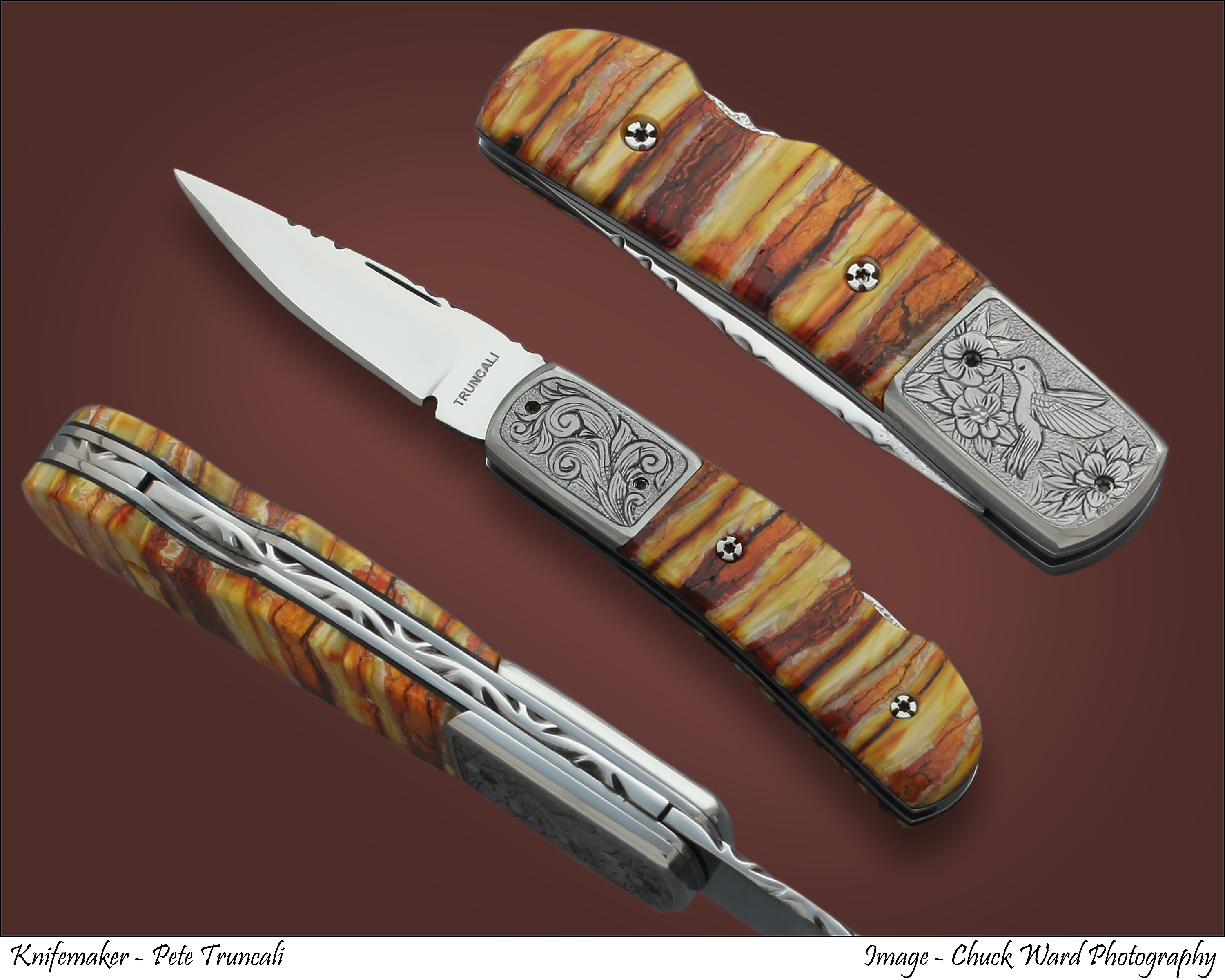
Knife Of The Day XXIV: Truncali Mammoth Tooth Lockback

A lockback folder with a stunning mammoth tooth handle, copious filework and engraved bolsters distinguishes one of knifemaker Pete Truncali’s latest offerings.

    Featuring a 2 9/16-inch blade of ATS-34 stainless steel, Pete’s folder was engraved by Tony Pitts. Closed length: 3 7/8 inches.

    For more information on Pete’s knives click www.truncaliknives.com or visit his table, 3E, at the 2012 BLADE Show (www.bladeshow.com) June 8-10 at the Cobb Galleria Centre in Atlanta .

For more on the latest knives, knife legislation, knifemaking instruction, knife trends, knifemakers, what knives to buy and where and much more, subscribe to BLADE Magazine, the World’s No. 1 Knife Publication.
BLADE® Knife Test: Busse’s Bodacious Blades

Author James Morgan Ayres said the Nuclear Meltdown Special Forces Natural Outlaw by Busse Combat Knife Co. split logs with ease. Blade Length: 8.25 inches. Blade Stock: .240 inch. Blade Finish: Satin. Handle: Brown and black G-10. Overall Length: 14 inches. MSRP starts at $327.

By James Morgan Ayres

    Busse knives are advertised as efficient cutters and durable, extreme hard-use combat knives—but are they really “hard use”?

    My son and I gave the Busse “Steel Heart” model a hard workout a few years ago in which I used it to cut through an auto body. There was no damage to the blade and it retained a usable edge afterward. Over a period of a few weeks we used the Steel Heart on about anything for which a big knife is suited. It was tough. It cut well.

    That was then. Do today’s Busse knives perform as well? We aimed to find out.

    Recently we tested four new Busse knives, though first, a few words regarding our field reviews. If a maker advertises his creation as a collector’s piece, we will treat it tenderly and review it appropriately. If he presents his knife as a tool and weapon for the military, as a combat knife or a survival knife, we will review it as it could be used and as similar knives have been used.

    Any knife designated as a combat knife by its maker we strike on the back with another knife as might be encountered in a blade-on-blade confrontation. We strike both the spine and the lateral surfaces. Some highly touted “combat blades” shatter on impact with another blade. Usually we use an old Sabatier carbon steel chef’s knife or an Old Hickory “Sticker” as the impact knife. If your $400 combat/survival knife will not stand up to this simple test, you need to have a talk with its maker.

    Along with yours truly, my fellow testers included my friends, Shawn Carlson and Richard Figueroa. In our reviews, we use any knife billed as “combat/survival/hard use” to grind mortar from between concrete blocks, cut through heavy sheet metal or steel doors and auto bodies, and for similar escape-and-evasion scenarios. Why? Because today’s conflict areas are often urban and because anyone, civilian or military, can find himself in a building that comes down around him, or could be trapped in an auto and needs to cut his way out.

    We also drive blades into trees or wedge them between rocks, stone blocks or whatever is handy, and use them as climbing aids and self-arresting devices. The need for a knife that will bear the owner’s weight in an emergency is desirable. We use this test with a large measure of caution and consideration for the designed function of the knife. It is unreasonable to expect a Swiss Army knife to support the weight of a 270-pound linebacker, but it is well within reason to expect a survival/hard use knife to support the weight of a 175-pound person.

    We did all these things with the four Busse test knives. Moreover, we used all of them to cut roasts and ribs, a pile of cardboard, and 20 yards of hemp rope.

    We encountered one problem with the Busse knives: All, regardless of model, performed so well the whole thing got kind of boring. Set up the object to be cut, apply edge to object, object is cut. Denim, rubber sneaker soles, pork rib bones, tri-tip roasts, stacks of wood, etc., all fell to the Busse edge. We struck the blades with the Sabatier and the only effect was a few more dings in the Sabatier. The mid-sized, colorfully named Nuclear Meltdown Special Forces Natural Outlaw (NMSFNO) easily supported the weight of a 235-pound reviewer.

    Jerry Busse has been making knives for 30 years. Busse Combat Knife Co. has been operating for 20 years and uses a proprietary steel and heat treat called INFI. According to Busse, “INFI brings the best elements and performance characteristics together in a steel and heat-treating protocol that we have found to be unmatched in an extreme performance blade steel.”

    All Busse knives have a convex grind. “We have found that a convex edge eliminates the ‘shoulder’ at the top of a flat edge, which in turn reduces the concentrated friction at that point,” Busse stated. “In our tests, the convex edge displayed greater strength under heavy impacts as well.

    He attributes many virtues to his INFI steel, including the ability to bend “over 70 degrees without catastrophic damage,” along with edge retention and an absence of edge damage in hard use. I am not a metallurgist or a knifemaker. I do not know how to analyze the technical properties of INFI. However, I do know a fair bit about using knives, and I can say with confidence that Busse knives are very tough and take and hold an excellent edge.

    In addition, over the years I have found—all things being equal (which they never are)—a convex edge will outperform other edge grinds in hard use. During this field review we found the Busse knives perform at the top of their class in each size range. The slab handles are reasonably comfortable, if not totally ergonomic. The blades cut efficiently. They showed no signs of damage in extreme use.

    Busse gives colorful names to his knives. The “Anorexic BOSS Street” is an example in a smaller size. Its 4.25-inch blade makes it handy for daily use, and probably is the most useful Busse model for utility cutting jobs. The “BOSS Jack LE” with a 6.25-inch blade and the NMSFNO with its 8.25-inch blade seem the best choices for active-duty military. If you need a knife that combines some characteristics of an ax, a hooligan tool and a butcher’s breaking blade, the “Nuclear Meltdown Fusion Battle Mistress” with its 11.25-inch blade—this issue’s cover knife—should suffice.

    In sum, the big Busse knives chopped better than the little ones, and the latter were handier for whittling. All shared similar performance characteristics. These are not delicate sushi slicers but tough field knives.

BUSSE SPECS

Busse Combat Knife Co.

attn: Jerry Busse, Dept. BL5

11651 Cty. Rd. 12

Wauseon, OH 43567

419-923-6471

www.bussecombat.com

Specialties: Hard-use fixed blades

Blade Steel: INFI carbon steel

Blade Grinds: Convex

Rockwell Hardness: 58-60 HRC

Handles: Options include but are not limited to textured canvas and paper Micarta® in a variety of colors, Tigerhide and Snakeskin; textured G-10 in a variety of colors, and Ghost; G-Rex black and green stabilized ash; G-10 and wood; and G-Rex and white bone

Sheaths: Kydex™ by Mashed Cat and leather by Armor All Leather

MSRP Range: $227-$597 and up


For more on the latest knives, knife legislation, knifemaking instruction, knife trends, knifemakers, what knives to buy and where and much more, subscribe to BLADE Magazine, the World’s No. 1 Knife Publication.
Knife Test: Alan Blackwood’s D3 Skinner

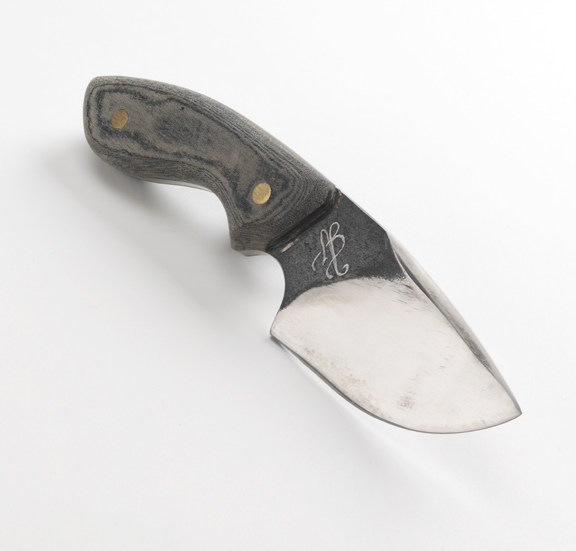
The blade of Alan Blackwood’s field-grade skinner shows some of the smudges from the test administered to it by BLADE® field editor Kim Breed.

Alan Blackwood’s D3 Skinner Tackles Deer, Squirrel and More

By MSG Kim Breed, 5th Special Forces (retired)

    As hunting season was fast approaching, I told knifemaker Alan Blackwood I would like to test one of his new and improved skinners. I received a knife that looked good and felt even better. Now to the woods to see how the skinner performs.

Squirrels ‘n Such

As luck would have it on the whitetail side, I was striking out—not good for the knife or me. However, I did manage to remove some nuisance squirrels from Mrs. Elder’s house that were chewing holes in her log cabin home. The skinner’s blade easily parted the squirrel skin so I could finish the cleaning. The wide blade came in handy while removing the heads and tails, keeping my fingers away from the cleaning board while applying pressure to crunch through bones.

    While the squirrels soaked, I did some cutting tests. I stropped the edge to clean it up and started in on some dense foam. The knife has a sweet spot for cutting right at the blade belly. The dense foam parted easily with a nice, slick pull cut. Since I was at the cutting board already, I grabbed some 3/8-inch sisal rope. Crunch, crunch, crunch—man this steel really cuts rope aggressively! After 83 cuts I had a little sliding going on and noticed the edge had a wire burr. A few strops on the leather took care of it and the edged was back to hair-popping sharpness.

    As long as my list of honey-do’s was keeping me out of the woods, I had a new batch of pine to cut and whittle. I really like the way the skinner feels for whittling. The knife is very easy to control and, when I wanted to power cut, the wide blade bit even better. The rounded-off handle really form fit my hand as I applied pressure—and then I hit a hard knot. The blade still cut but the convex edge wanted to roll away from the knot. No problem. I opted to use a soft-blow hammer to drive the blade through the knot. It worked and there was no damage to the edge.

    As I was on a roll and not hunting, I decided to do the brass-rod edge-flex test. I did not know how the blade’s D3 tool steel would handle it as it was the first time I had tested a knife of D3. With gloves and safety glasses on, I pulled the edge across the brass rod. A little hump formed and followed the stroke of the knife to the tip, then returned to normal. The edge did not chip or stay bent—a perfect flex test result indicating spot-on heat treatment.

Skinning/Quartering Marathon

We had a little cold snap and that changed my luck. I harvested two does on a Monday and two more the following Wednesday. It was time to see what the skinner could do. I was in for a skinning-and-quartering marathon! The skinner was aggressive on the skin and meat. I was able to skin and quarter four good-sized deer in two hours, which is fast considering I could hang only one at a time and had to return to the backyard to fetch each deer carcass. After I washed the blade, it would still shave hair.

    The little skinner comes with a nicely tooled 8-ounce, vegetable-tanned leather snap sheath by Steve Stapleton of B&E Shoe Service. The sheath really makes the skinner pop.

Great Hunter Package

As far as skinners go, this is a great one. It stays sharp and is very comfortable in the hand. It is a great package for any hunter.

For more information contact Alan Blackwood, 32082 Sidehill Rd., Rutland, OH 45775 740-742-2431 e-mail [email protected].

KNIFE SPECS

Knife: Field-grade skinner

Maker: Alan Blackwood

Blade Length: 3.25”

Blade Material: D3 tool steel

Rockwell Hardness: 58 HRC

Handle: Micarta®

Overall Length: 7.25”

Sheath: 8-oz., vegetable-tanned leather snap model by Steve Stapleton

Maker’s List Price: $125

For more on the latest knives, knife legislation, knifemaking instruction, knife trends, knifemakers, what knives to buy and where and much more, subscribe to BLADE Magazine, the World’s No. 1 Knife Publication.
Advertisement

Must Read Articles

Read this before you make a knife

Knifemaking 101 – Read This Before You Make a Knife

  by Wayne Goddard My experience has taught me that there's nothing like digging in and getting started. I've often said the hardest part of the...
how to forge damascus steel

How to Forge Damascus

Advertisement
Advertisement