

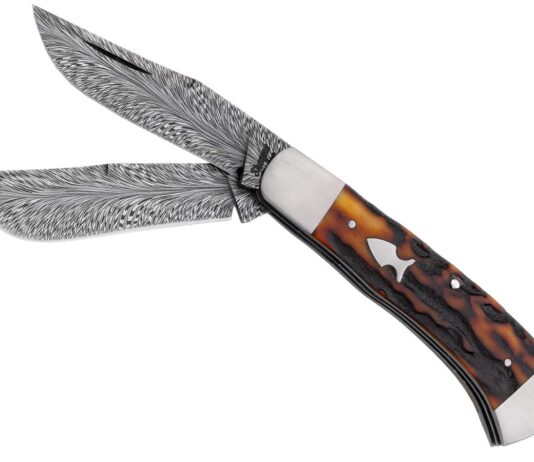

One of the 2012 ABS Director’s Knives of the Year was made by Master Smith and Board Member E. Jay Hendrickson.
FORGE FAVORITES: Adam and Haley DesRosiers
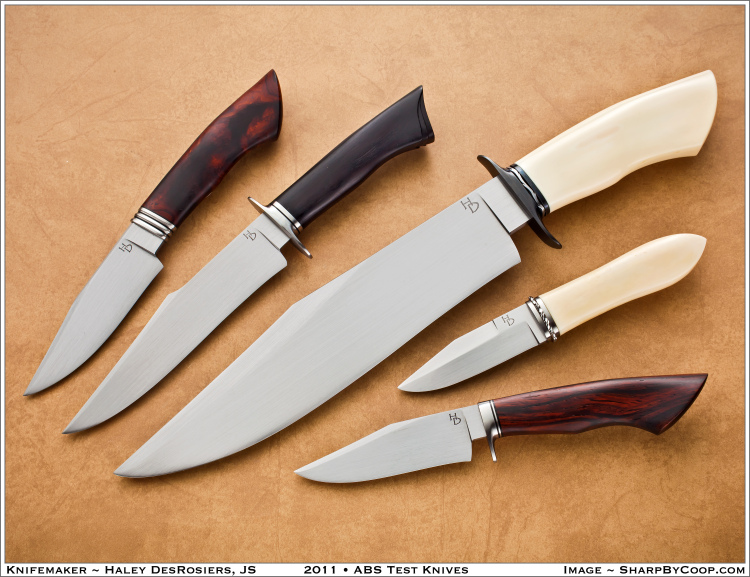
Haley DesRosiers’ five applicant knives for the rating of ABS journeyman smith include the one (center) judged best of all those submitted by JS applicants, thereby winning the 2011 George Peck Award. (SharpByCoop.com photo)
By B.R. Hughes, a founding member of the American Bladesmith Society, a member of the Blade Magazine Cutlery© and ABS Halls Of Fame, and BLADE® field editor
If you are old enough, you may recall a 1954 hit song written by Johnny Richards and Carolyn Leigh that went something like this:
Fairy tales can come true, it can happen to you,
If you’re young at heart …
Don’t believe in fairy tales? After reading the storybook saga of Adam and Haley DesRosiers and the adventures they experienced at the 2011 BLADE Show, you just might alter your thinking.
Let’s begin with Haley, a winsome lass born in Stika, Alaska, the daughter of a commercial fisherman and a mother who assisted in the family business. The future Mrs. DesRosiers spent many days on her dad’s fishing vessels working as a deckhand, and there were occasions when her boat was at sea for as long as several weeks.
At 17 she developed an interest in knives, and, inspired by a video, decided to be a bladesmith. Her first forge was a hole in the ground, the air power supplied by an electric hair dryer via a pipe.
As her skills improved, so did her smithy. One day she decided her beat-up anvil needed repairing. On an Internet knife discussion forum she learned her anvil could indeed be fixed, and ABS master smith Jason Knight e-mailed her about Adam DesRosiers, an Alaskan ABS journeyman smith who might be willing to help. In turn, Jason told Adam of the young Alaskan lady interested in bladesmithing. Adam promptly e-mailed Haley and offered his assistance.
Setting up the initial meeting between the future husband and wife was not so simple. Both lived in remote areas, approachable only by air or sea, so they agreed to rendezvous at a folk festival in Juneau on April 8, 2008. While there, Adam took Haley’s anvil to the shop of ABS journeyman smith David Mirabile, where it was refurbished. Haley gave Adam some caribou antler and he presented her with a handmade gas forge. At the time, Haley was still using a hairdryer as a blower. Many communications between the two followed. A bit later, Haley’s father offered Adam a job as a deckhand for the balance of the season. He accepted and so, in reality, Adam and Haley’s first date consisted of six weeks of offshore fishing, both working as deckhands.
Born in Anchorage in 1976, Adam is the son of a commercial fisherman and a nurse. After Adam was graduated from high school, he attended the University of Alaska, studying marine technology. While there he worked at a local boatyard and, after college, joined the Merchant Marine, serving as a deckhand for three years.
As for his first memory of making knives, at the ripe old age of 5 he took his mother’s butter knife and “improved it” in his father’s workshop, using the cement floor as a grinder. It must be noted that his mother was not impressed with the “improvements.”
Adam’s first forge was a galvanized washtub, also featuring an electric hairdryer. In 2001 he attended the William F. Moran School of Bladesmithing in Washington, Arkansas, for the introduction to bladesmithing class, where his instructors were Kevin Cashen and Dickie Robinson. The same year he took a damascus class taught by John Fitch at the school. Adam returned the following year to take another damascus class, one taught by Steve Dunn. In 2006, Adam received his ABS journeyman smith rating. I was the head judge of the review panel that year, and Adam received not one negative vote from the panel.
As Adam and Haley’s romance flourished, Haley took the introduction to bladesmithing class at Haywood College in Clyde, North Carolina. Adam joined her, deciding it would not hurt to take a refresher course. The instructors were Burt Foster and Jason Knight, the latter the man who initially introduced Adam and Haley. It was on the bank of Jason’s pond in South Carolina that Haley and Adam became engaged on April 12, 2009.
They were married Sept. 13, 2009. Haley was borne by a raft down an Alaskan creek to the ceremony. Using the anvil that had brought the bridge and groom together for the first time as an altar, the service was performed by Pastor Berry Byrd. ABS master smiths Knight and James Rodebaugh were among the groomsmen. Adam wore a sword for the ceremony, as did the groomsmen, and their swords provided the arch under which the happy couple departed. (For more, see Haley’s story “A Match Made in Handforged Heaven” in the October 2010 BLADE®.)
Haley set up bladesmithing in Adam’s shop. There they made their first knife together, featuring a blade of 5160 carbon steel. Adam prefers to make camp knives and Haley likes hunters, which is certainly natural enough since she is a devoted outdoors enthusiast. When I inquired what type of game she most enjoyed hunting, she quickly replied, “Deer, duck, caribou, black bear and brown bear.”
“Ever been charged by a bruin?” I asked.
“Once.”
“What happened?”
“I dropped him with my .30-06.”
Verily, a modern-day Diana!
As the 2011 BLADE Show neared, the DesRosiers were extremely busy. Adam was preparing to test for ABS master smith, while Haley was getting ready for her quest for a JS stamp.
“Did Adam do anything to help you get ready?” I asked. “Yes,” Haley smiled, “Among other things, he told me to quit playing with damascus!” For the ABS JS review, no damascus is permitted on any of the five applicant knives. Hence, she concentrated on knives featuring blades of 1084 and W2, her two favorite carbon steels.
During the BLADE Show, each took his/her five review knives to two separate rooms in Atlanta’s Cobb Galleria Center, where judging panels awaited. In addition to passing or failing the applicants, the panels were also required to select the winners of the George Peck Award and the B.R. Hughes Award. The former is for the best knife submitted by a JS applicant, the latter for the single finest knife made by an MS applicant.
A happy ending for this tale would have both Haley and Adam earning their respective ratings. They did—but there’s more. An incredible conclusion would have Haley winning the Peck Award and Adam receiving the Hughes Award—and they did! (See page 48, January BLADE.)
If that is not a fairy tale come true, it will do until one comes along.
THE DESROSIERS’ FILE
Adam and Haley DesRosiers
POB EXI
Juneau, AK 99850
907-321-7258
Adam’s Specialties: Forged fixed blades, especially camp knives
Haley’s Specialties: Forged fixed blades, especially hunters
Adam’s Steels: W2, damascus in 1084 and 15n20
Haley’s Steels: W2 and 1084; damascus
Handles of Both: Natural materials, including the ancient ivories, assorted woods and others
Adam’s Honors: ABS master smith, winner of 2011 B.R. Hughes Award
Haley’s Honors: ABS journeyman smith, winner of 2011 George Peck Award
For more on the latest knives, knife legislation, knifemaking instruction, knife trends, knifemakers, what knives to buy and where and much more, subscribe to BLADE® Magazine, the World’s No. 1 Knife Publication. For subscription information click on http://www.shopblade.com/product/blade-magazine-one-year-subscripti…?r+ssfb040912#BL1SU.
Knife Test: Buck 931 Chef Knife
Buck 931 8″ Chef Knife Review Knife: http://bit.ly/tdJql8 The Buck Knives 931 Chef Knife is amazing.
Survival Necker

Since the 1095 blade of Jonathan McNees’ Survival Necker is differentially hardened for a hard edge and softer back—which also results in a handsome hamon—a portion of the blade is not hard enough for sparking via the striker. As a result, McNees also includes a fire steel for the purpose. (SharpByCoop.com photo)
McNees’ PSK has the essentials to survive a short-term emergency
Jonathan McNees’ Survival Necker—PSK (Personal Survival Knife) for short—features the bare survival essentials all in one modular system. The 5.75-inch knife has a differentially hardened blade of 1095 carbon steel and a G-10 handle with hollow-tube construction to accept a lanyard. The handle sports a glow-in-the-dark dot for ease of location at night.
Included are a fire steel and striker, three-phase (high, low and blinking) flashlight, paracord and whistle. The handle of the fire steel is hour-glass shaped to contain two fish hooks wrapped with 30 feet of 30-pound Spiderwire® fishing line, which also can be used for snares and trip wires. In addition to the Kydex® sheath, a two-sided plate with a compass on one side and a mirror on the other rides on a necklace/bead chain. The system also breaks down for belt wear.
Knife: Survival Necker
Maker: Jonathan McNees
Blade Steel: 1095 carbon
Heat Treatment: Differentially hardened
Handle: G-10 w/glow-in-the-dark dot
Sheath: Kydex®
Survival Items: Fire steel and striker, compass, mirror, whistle, flashlight, paracord and fishing line with two fishhooks
Maker’s List Price: $185
For more information contact Jonathan McNees, 15203 Starboard Pl., Northport, AL 35475 205-915-3254 www.mcneescustomknives.com.
For more on the latest knives, knife legislation, knifemaking instruction, knife trends, knifemakers, what knives to buy and where and much more, subscribe to BLADE® Magazine, the World’s No. 1 Knife Publication. For subscription information click on http://www.shopblade.com/product/blade-magazine-one-year-subscripti…?r+ssfb040512#BL1SU.
Where To Keep Knives In Easy Reach
 Though not this particular model, Dan Delavan keeps a Gerber Mark II under his mattress “just in case.” (Gerber photo)
Accessibility depends on use, circumstances and, most importantly, the person’s imagination
By Stephen Garger
The idea of our car crashing into the water and sinking truly scares my wife. She fears the possibility similarly to the way a person afraid of flying worries the plane will crash. I had known of her concerns for some time but, when I saw her white knuckling the steering wheel while driving on a bridge across a lake in Northern Idaho, it finally occurred to me to do something to ease her anxiety.
I keep a small hand ax under the car front seat and a Spyderco Assist I rescue knife in the glove compartment, but, since I have plenty more knives, I thought one of them might hold a possible solution to her fear. As I thought about it, I realized should the car flip or an injury occur, it would be nearly impossible or require a great deal of luck to locate the ax. Likewise, the glove compartment could jam shut or fly open and spew its contents, and access to the rescue knife would be lost.
After thinking about such things as the position in which the car could end up, potential injuries, water everywhere and the overall impact of the crash, I found the solution in knifemaker Bud Nealy’s MCS II. MCS is short for Multi-Carry System, and the MCS II was part of the package I received when, sometime previously, I bought Nealy’s small, 3.5-inch, reinforced-point Pesh Kabz fixed blade after it was featured on page 117 of the April 2005 BLADE®. Part of the MCS II is a strong adhesive material and a sort of super fabric fastener, which can be used to firmly attach the Kydex® sheath just about anywhere and in any position.
I went through the vehicle and finally found a spot on the lower plastic part of the front driver’s seat where I could reach the knife easily with either hand. The location also was situated so the knife could not be seen from the outside with the driver’s door open during a rest or gasoline stop. Together, the small ax, glove compartment’s rescue tool, and the sheathed and attached MCS II largely alleviated my wife’s fears.
I was relating how we had addressed my wife’s water-crash fears to Dan Delavan of the Plaza Cutlery retail knife store in Costa Mesa, California, and he agreed Nealy’s MCS II lends itself to that sort of thing.
“It’s also not unusual for people to keep a knife somewhere on their bikes, wherever they can put it so they can reach if it they’re knocked down,” he said. “For bikes, they tend to use knives like those from Columbia River Knife & Tool (CRKT) and Kershaw with it in mind that the odds are they’re never going to use it, but it’s there if they need it.” Delevan had no suggestions as to how the knives are attached, but did mention that people he knows mount a knife under their car dashboard. “Any knife with a Kydex sheath is a good one to mount that way,” he noted. Though he did not say if he kept a knife in his vehicle, he did indicate he keeps an “old original Gerber Mark II under the mattress.”
House Knives
Jeff Hall of Nemesis Knives approached the idea of knives in unusual and easy reach from the point-of-view of where the knife replaces a firearm for home defense.
“Anywhere people would hide a gun they may hide a knife instead,” Hall began. “Nobody’s breaking any laws, and people uncomfortable with guns will have knives around the house—even the anti-gunners will have a knife.” Nemesis is in California, which has some of the strictest gun laws in the United States and gives perspective to Hall’s view. “People keep knives in their refrigerator, in the bathroom behind the toilet, and hanging from the door knob or above the front door frame, since you don’t always know who’s at the door,” Hall said. “I’ve also heard of knives between the bed linens, attached behind the TV, as well as between the cushions of the couch.”
Hall did not have many particular examples of what types or models of knives people use in such instances. “Everybody has different tastes,” he responded. “Size may relate to the spot. If it’s a small door frame, then our little Hellion neck knife will work fine.” Hall also mentioned another small Nemesis fixed blade, the 2-Zero, and its titanium pocket clip. “[The titanium pocket clip] reduces the weight and allows you to carry a fixed blade in a shirt pocket, giving it the convenience factor of a pen,” he explained. The idea appeals to me, given how I tend to leave the desk in my study unexpectedly and end up in a room where I need a knife.
“We have a knife we did for a police department that is mounted underneath the brim of a hat,” observed Mike Fuller of TOPS Knives. It is the TOPS Thumb Nail and can be bought attached to a TOPS cap, which provides pretty handy access while fishing. “A lot of people in the inner cities take our Cockpit Commander and wrap it so it hangs over the steering column and can’t be seen from the window,” Fuller continued. “It’s an excellent tool and you can place just about any neck knife in that location.” TOPS also provides knives with magnetic sheaths which allow for numerous concealment opportunities and several ALRT models, which range in length from 3.5 to 5 3/8 inches and lend themselves to assorted ways to stow the blade, including inside the belt, hanging from a shower curtain ring, or just about any place you may conceive a knife may be needed and in easy reach.
Brian Huegel of Country Knives retail knife store in Intercourse, Pennsylvania, has a slightly different take on keeping knives in unexpected places with convenient access. There are many seat-belt cutters available for emergency purposes “which provide a marginal amount of success in a crisis,” he opined. Huegel mentioned CRKT as offering a wide range of knife options for any purpose. “[Spyderco’s] idea of a pocket clip makes a folding knife easily accessible,” offered Huegel. “Lots of people who come into the store want to know how to defend themselves, but you want to be careful not to be construed as providing people ways to hide things for possible criminal purposes.”
A knife is first and foremost a tool. Like any tool, it must be readily available when needed. Factoring in current knife and carry systems offered, accessibility will likely be determined by the intended use, circumstances and, most importantly, the person’s imagination.
Editor’s note: Please be sure you are not in violation of your local and state laws when you store knives in out-of-the-way places. Also, be sure the places are such that small children cannot access the knives.
For more on the latest knives, knife legislation, knifemaking instruction, knife trends, knifemakers, what knives to buy and where and much more, subscribe to BLADE Magazine, the World’s No. 1 Knife Publication. For subscription information click on http://www.shopblade.com/product/blade-magazine-one-year-subscripti…?r+ssfb040112#BL1SU.
Knife Of The Day XXI: Buck Folding Omni Gut-hook Hunter
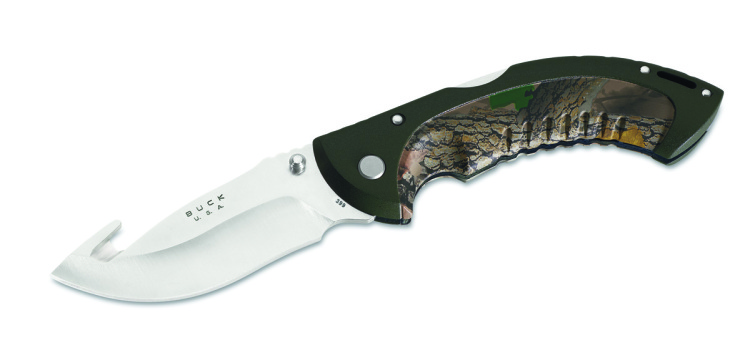
The 21st installment in our “Knife Of The Day” feature is the Buck 399 Folding Omni Gut-hook Hunter. The 4-inch gut-hook blade is 12C27Mod Sandvik stainless steel. The handle is Dynaflex rubber in RealTree Hardwoods Green HD camo. The sheath is heavy-duty nylon. Blade stock: .120 inch. Weight: 4.6 ounces. Closed length: 5.75 inches.
For more information click on http://www.shopblade.com/product/m16-14zsf/?r+ssfb032812 #Y4550
Celebrate The Gunny’s B-Day With His SOG Co-Design

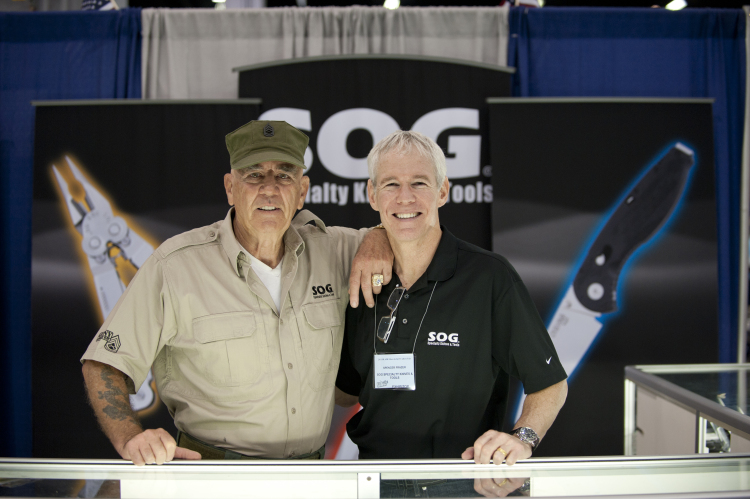 Co-designed by R. Lee “The Gunny” Ermey, the Gunny Folder (top) from SOG sports a 4-inch blade of VG-10 stainless steel and a cocobolo handle with The Gunny’s image inset in a nickel-plated coin. (Above) The Gunny and SOG CEO Spencer Frazer at last year’s BLADE Show (www.bladeshow.com). (Point Seven image)
Celebrate R. Lee “The Gunny” Ermey’s birthday today, March 24, with his Gunny Folder from SOG Specialty Knives & Tools. It comes with a leather pouch for easy carry. The cocobolo handle includes rayskin inlay. Limited to 1,000 pieces.
For more info click on www.sogknives.com.
For more on the latest knives, knife legislation, knifemaking instruction, knife trends, knifemakers, what knives to buy and where and much more, subscribe to BLADE Magazine, the World’s No. 1 Knife Publication. For subscription information click on http://www.shopblade.com/product/blade-magazine-one-year-subscripti…?r+ssfb032412#BL1SU.
Must Read Articles

Knifemaking 101 – Read This Before You Make a Knife
by Wayne Goddard
My experience has taught me that there's nothing like digging in and getting started. I've often said the hardest part of the...




