Knife Collecting

Knife collecting is an extremely rewarding experience for knife enthusiasts. There truly is a knife for everyone. Many increase or hold their value throughout the years, making collecting knives something to pass on to the next generation of knife collectors.

Cool Knife/Sheath Combos By John H. Davis

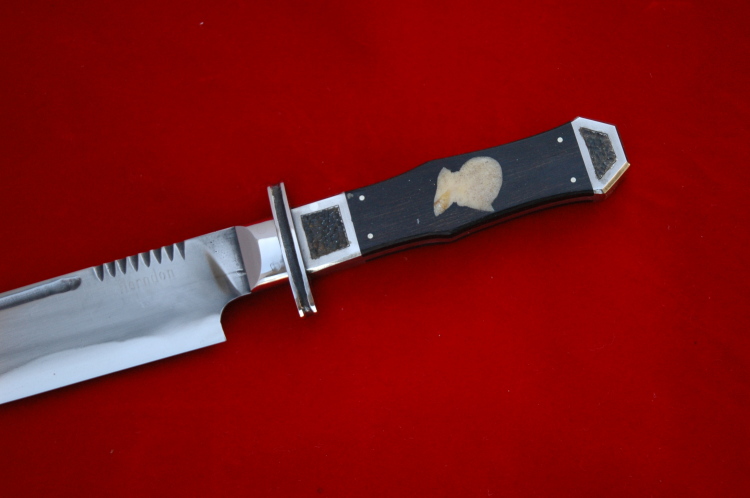
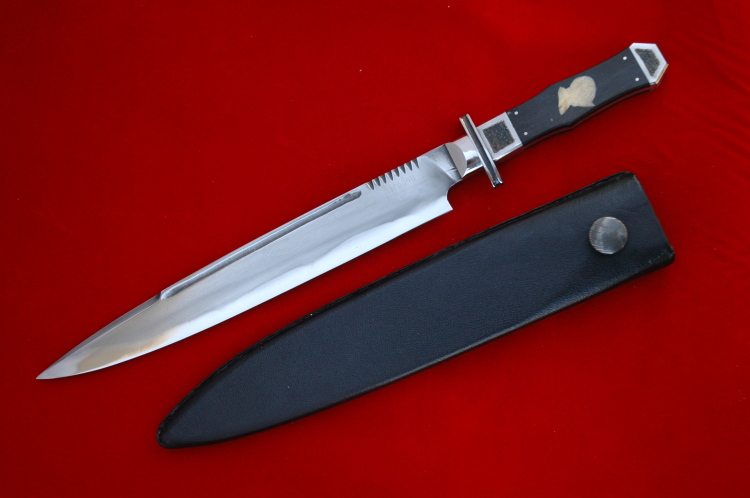
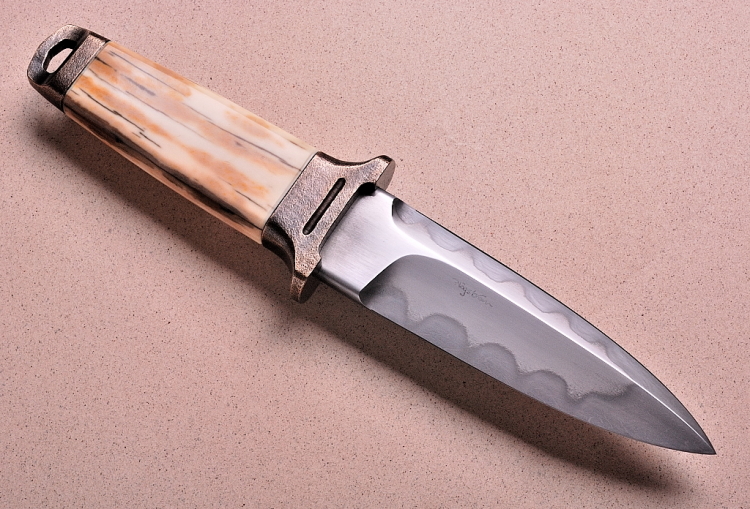
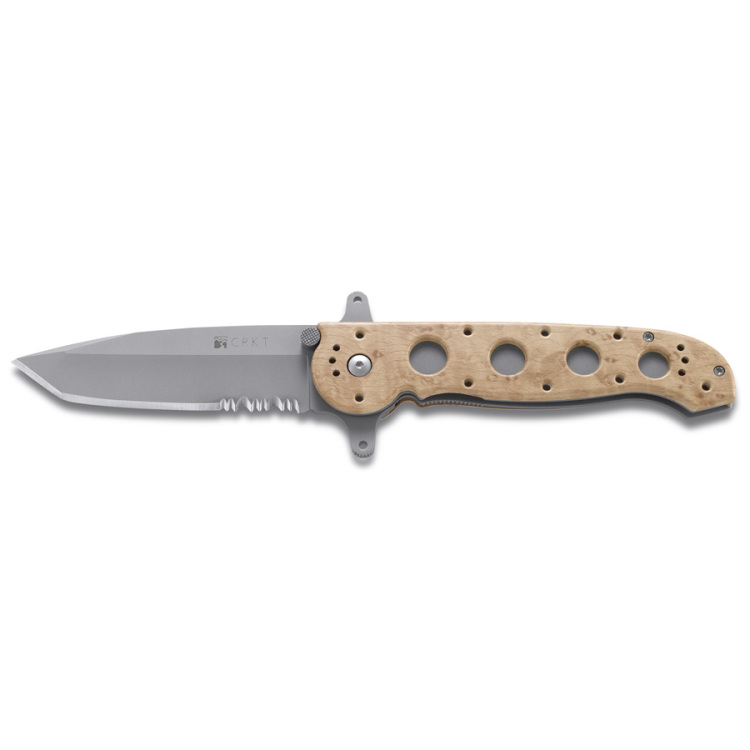
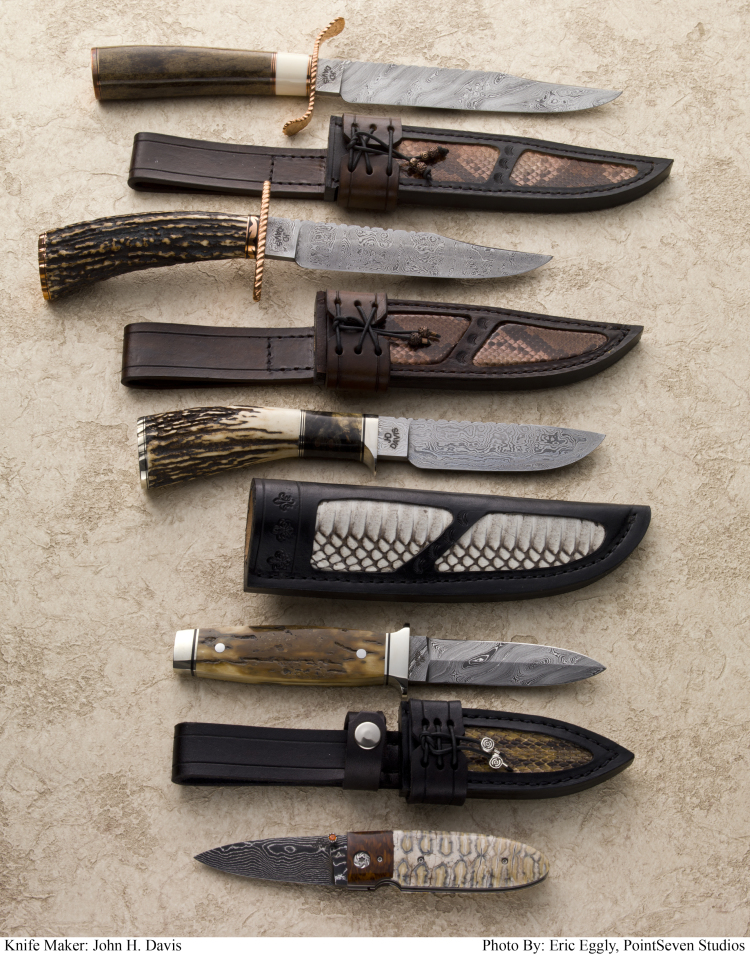
John H. Davis’ knives, from top: oosic/ivory bowie, twist damascus of 1084/15n20, copper guard, spacers and butt, 13 inches overall; India stag bowie, ladder-pattern damascus, copper guard, spacers and butt; India stag and buckeye burl drop point, 1084/A203E damascus, nickel-silver fittings; mammoth ivory boot dagger, 1084/15n20 damascus, nickel-silver fittings; and a mammoth tooth ivory and snakewood locking-liner folder, 1095/nickel damascus. Davis’ sheaths, from top: the first two are belt-loop pouch types in custom leather with python inlay; a pouch type in custom leather with cobra skin; and a belt-loop-and-snap pouch model in custom leather with snakeskin inlay. The maker’s list prices for similar outfits, from top (the prices include sheaths where applicable): $500, $400, $350, $350 and $350. (Point Seven photo)

John H. Davis offers nice knife-and-sheath combinations—and don’t forget the folder!

Some makers do not offer sheaths with their fixed blades. ABS apprentice smith John H. Davis is not among them.

    His selection of damascus fixed blades includes handsome sheaths, including one in a cobra-skin inlay he said “a couple of guys do back flips over.” Other sheaths have python and snakeskin inlays. A computer field engineer by day, Davis also has a background in metal fabrication, which helps explain the copper he uses for guards on some of his models. “I’m one of the few who uses it for guards,” he noted. “I love working with it. It’s an underrated material.”

    In terms of offering the total package of knife and sheath, underrated also would seem an appropriate way to describe Davis.

For more information contact John H. Davis, 33842 Picciola Dr., Fruitland Park, FL 34731 209-740-7125 [email protected], www.custom-knifemaker.com.


For more on the latest knives, knife legislation, knifemaking instruction, knife trends, knifemakers, what knives to buy and where and much more, subscribe to BLADE® Magazine, the World’s No. 1 Knife Publication. For subscription information click on http://www.shopblade.com/product/blade-magazine-one-year-subscripti…?r+ssfb022612#BL1SU


What’s Hot in Custom Tactical Folders

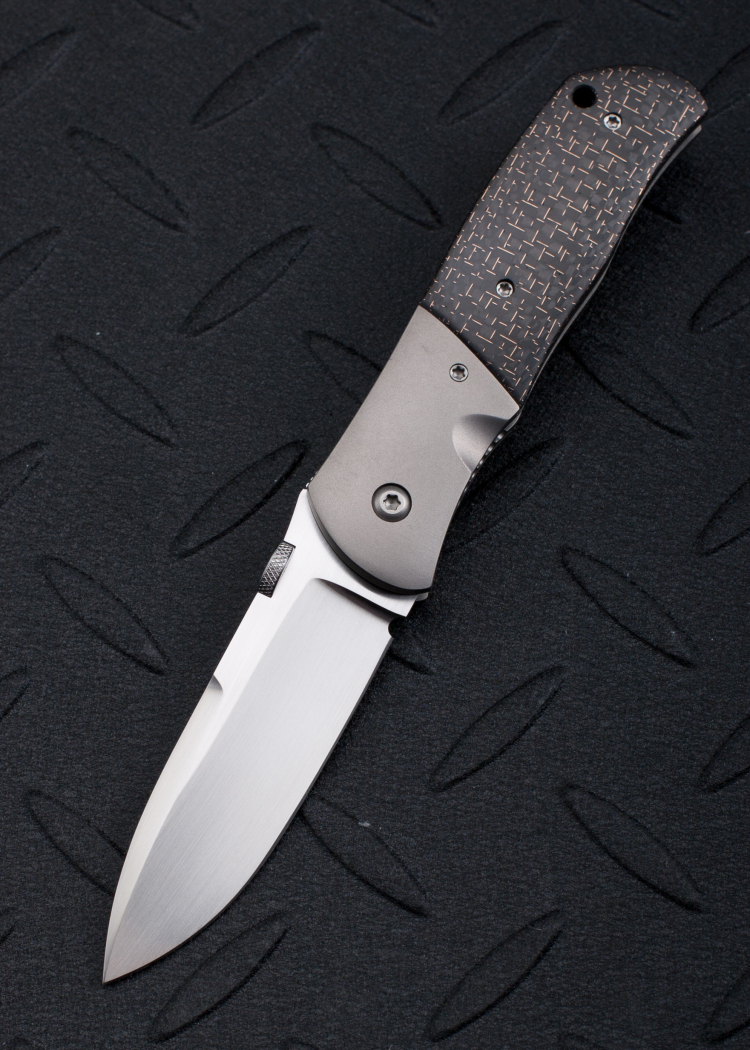
Custom knife purveyor Les Robertson hot listed the SD-2 by John W. Smith with a titanium bolster and lightning-strike handle at $550. Smith’s list price for his SD-2 with a 3-inch blade of CPM-S35VN stainless and a lightning-strike carbon-fiber handle (above): $495. (photo by Chris Smith)

by Mike Haskew, BLADE® field editor

As new knifemakers enter the arena and the competition raises the bar for all concerned, trends in custom tactical folders point to more choices for you.

    “The tactical folder market is without a doubt the fastest-moving, innovative sector of the custom knife market. The days of [dated blade-opening features] are rapidly coming to an end, for example,” purveyor Les Robertson opined. “Continued use of [such features] is telling potential collectors that the maker either can’t do some other kind of opener, or the maker chooses not to. Either way, collectors are moving past that. In components, most makers are moving at least to the IKBS [Ikoma Korth Bearing System], while others are using more advanced roller bearings. The days of washers being used [for the blade pivot] are also coming to a close.”

    In blade steels, Robertson talked of the rise of CPM-S35VN, CTS-XHP and Bohler Uddeholm N690. Meanwhile, blade lengths may be trending back toward a smaller average length at 3.5 inches in response to collector demand for something a bit different after several years of buying blades of 4.5 inches or more. Possibly three or four years from now, he said, buyers may reverse themselves again and seek longer blades. Dedicated tactical folder buyers are also looking for flipper opening systems, and makers are responding there as well. Moreover, lightning-strike carbon-fiber handles continue to boom.

    Robertson and Dave Stark of Steel Addiction Custom Knives agree that David Mosier’s work is hot. Robertson cited Mosier’s Spyro model, including titanium bolsters and a lightning-strike carbon-fiber handle at $675. Stark singled out Mosier’s Large Persian with an S35VN blade, titanium bolsters, a lightning-strike handle and $650 price tag.

    “David’s knives are well designed with top-of-the-line fit and finish,” Stark remarked. “The grinds on the Persian really make it stand out. It rides well in the pocket for a large knife. Recently, David teamed up with knife designer Tashi Bharucha on a knife called the Freak. That knife is smoking hot and never lasts long on our site.”

    Robertson hot listed the Dustin Turpin War Chief at $450 with a titanium bolster and carbon-fiber handle, John W. Smith’s SD-2 with a titanium bolster and lightning-strike handle at $550, and the Q36 from R.J. Martin with titanium bolsters and lightning-strike scales at $675. The Sniper Bladeworks LPC in a titanium frame is hot at $575, while the Cruze by Dave Curtiss is going fast at $575 in a titanium handle, and the Azrael from Will Zermeno with lightning-strike scales is selling well for $340. Frank Fischer’s Commander, Larry Chew’s Cujo, and Les George’s Hydra R each sport titanium frames or bolsters and are going fast at $625, $550 and $525, respectively. Other makers high on Robertson’s list include such perennials as Blade Magazine Cutlery Hall-Of-Fame© member Ken Onion, Ernest Emerson, Pete Carey, Tim Galyean, Scott Cook, Rick Hinderer and Michael Burch.

The Mayo Clinic

Duane Weikum of EDC Knives and Steel Addiction’s Stark concurred that Tom Mayo is gaining momentum with his Doctor Death and Junior Doctor Death flippers. In titanium scales and a satin-finished CPM-154 steel blade, the Junior Doctor Death carries the maker’s price of $800, while an aftermarket mark-up reaches $995. Weikum also hot listed Mayo’s Covert and Midnight Rambler.

    “Tom’s knives are in great demand,” Stark offered. “His grinds are incredible and his fit and finish are superior. I would say Tom makes the best framelock out there and sets the bar for fit and finish. Tom has incorporated the IKBS into his flippers, which makes them smooth and quick.”

    Weikum said the Vanquish, Revolution and Columbian from Jeremy Marsh, ranging in prices from $600 to $2,200, exhibit quite a bit of flair. Others Weikum indicated are surging in demand include Charles Marlowe’s balisongs and folders from $650 to $2,500; the Sentry and Reptile from Korth at $800 to $3,000; Flavio Ikoma’s Guardian Angel, Avenger, Sampa, Harrier and Keydashi running from $1,500 to $3,000; the “rock-solid” Bullseye from Sal Manaro at $600 to $2,000; the ever-present Strider line at $500 to $1,500 and more per piece; and Emerson’s CQC6 and CQC7, Commander, Roadhouse, Gentleman Jim and Horseman running from $600 to $1,500 and up.

    Both Neil Ostroff of True North Knives and Weikum lauded the recent contributions of Marisa Strider, wife of Mick Strider, whose popular knives include the custom PT with a blade just under 3 inches and the SJ75 Baby Hughie. Marisa and Mick make both models, which range from $800 to more than $1,000 depending on materials, with a popular variant sporting a damascus blade.

    Ostroff and Stark said new models from Bob Terzuola are taking off. These include the Athena and Eagle Rock in large models, while the ATCF remains one of Terzuola’s best sellers due in part to its triple-ground blade of satin-finished CPM-154, cermat bolsters and carbon-fiber scales with red liners. (Editor’s note: According to Ostroff, cermat is a pure acrylic similar to Corian used for workbench surfaces.)

    “The ATCF really identifies Bob as the godfather of the tactical folder,” Ostroff said. “An interesting note is that over the last few years, Bob has started to produce one-of-a-kind knives only to be sold off his table at shows. As one who has been his next-door table mate many times, I can attest to the fact that they’re all snapped up within a few minutes of the show opening.”

    Stark praised the ATCF and its maker. “Bob’s folders are legendary. His designs are timeless and very much in demand. The ATCF and Eagle Rock are what many tactical knives are patterned after,” he observed.

SNAP To!

According to Ostroff, the Kirby Lambert SNAP folder is another fast mover, featuring the IKBS bearing system and the “screaming sharp” blades for which Lambert is known. Stark called Lambert’s SNAP flipper with an S30V blade, lightning-strike carbon-fiber bolsters and a carbon fiber handle one of Kirby’s designs with “very natural flow, blending ergonomics and functionality.” Starting at $575, the SNAP is available in a variety of materials, and the ORION, a non-flipper version of the same knife, is popular as well. Ostroff also noted significant movement in the tactical folders of Brian Fellhoelter with blades from under 3 to well over 5 inches. The dress tactical folders of Gustavo T. Cecchini have stirred up a “feeding frenzy” at $1,000 to $2,000, Ostroff added.

    Stark singled out the Torrent flipper from D.B. Fraley with a hand-rubbed satin-finish CPM-154 blade and titanium body at $650; the J.L. Williams Shoreline Flipper with damascus blade and titanium scales at $1,200; the Gerry McGinnis Apex flipper at $675; Randy Doucette’s Armour flipper at $650; the Ground Fighter and new Chainsaw model from Greg Lightfoot at $550 and $600; Jens Anso’s Mofo with RWL-34 blade steel and G10 scales at $775; and the Jekyll and Hyde from Allen Elishewitz at $800.

    “Greg Lightfoot is constantly changing things up,” Stark observed. “He has recently started to bring back his old-school tactical designs with a new twist such as his Talon Tip. Allen Elishewitz continues to morph from design to design, really keeping his finger on the collector’s pulse. Allen does his knives in a standard tactical model and a full-dress model using high-end materials.”

For more on the latest knives, knife legislation, knifemaking instruction, knife trends, knifemakers, what knives to buy and where and much more, subscribe to BLADE® Magazine, the World’s No. 1 Knife Publication. For subscription information click on http://www.shopblade.com/product/blade-magazine-one-year-subscripti…?r+ssfb022512#BL1SU

There May Be No Time Like Now to Buy a Bill Moran Knife

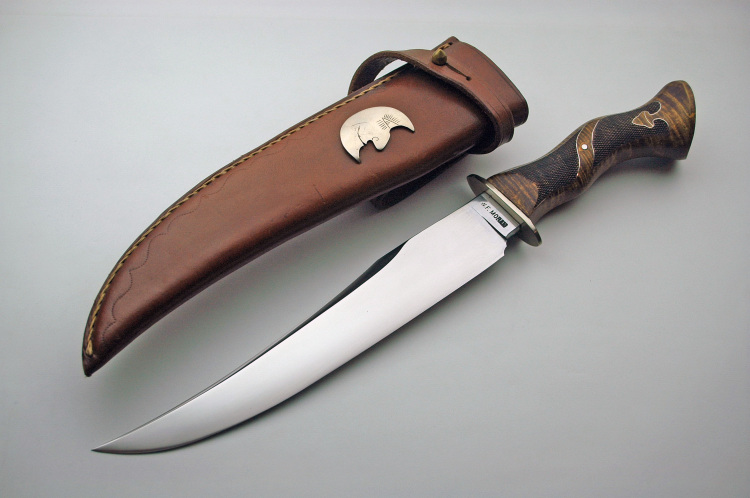
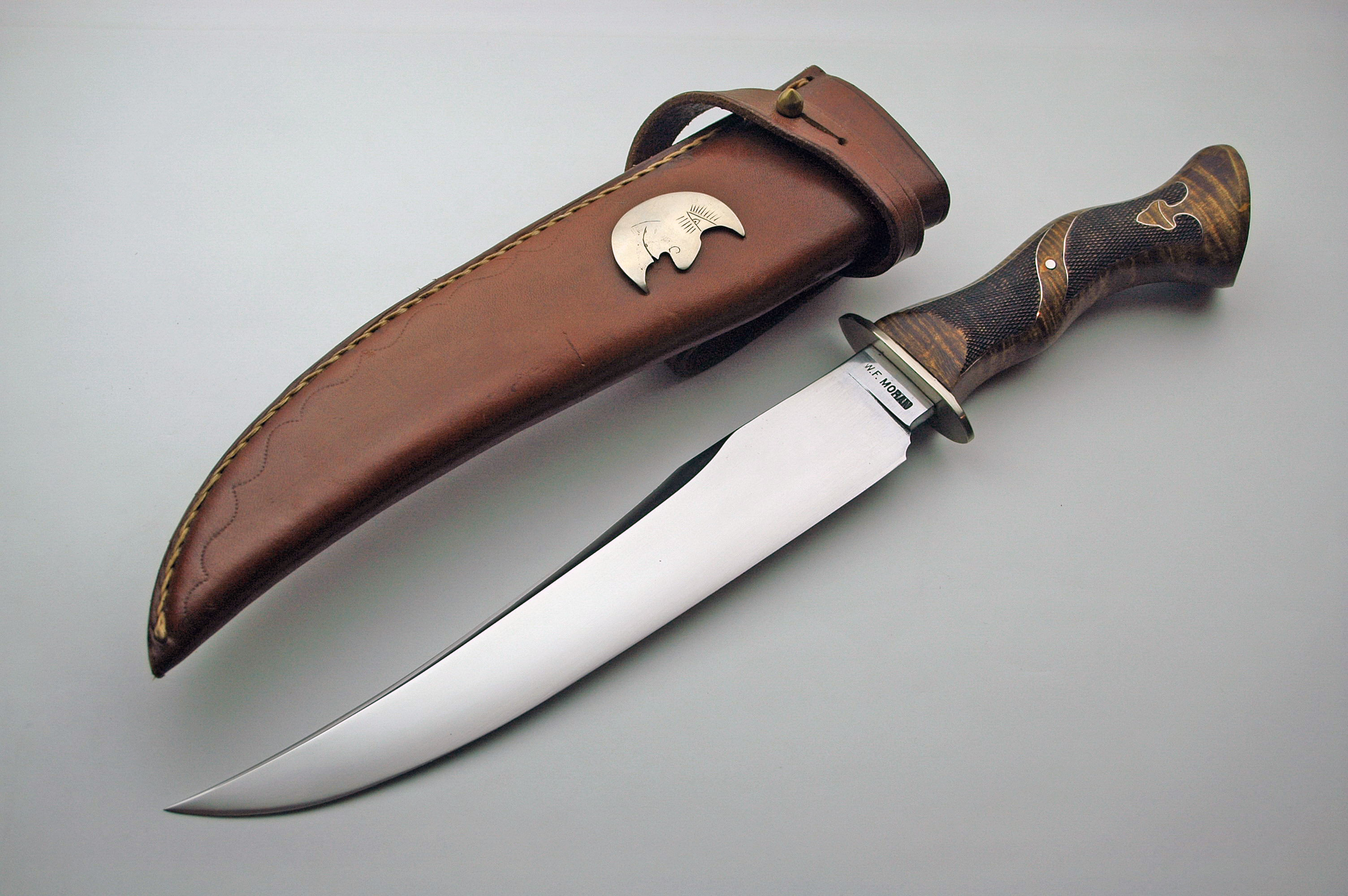
A coveted ST-24 by Blade Magazine Cutlery Hall-Of-Fame© member Bill Moran in wire inlay and checkering comes with a classic silver-half-moon leather sheath. Moran used the “W.F. Moran” stamp starting in 1980, typically on larger knives. It is not seen much anymore. (Dave Ellis photo)


By Dave Ellis


I still see Blade Magazine Cutlery Hall-Of-Fame© member Bill Moran each time I hold one of my many Moran knives. I miss visiting with Bill at the BLADE Show and the Art Knife Invitational. I miss showing him my latest Moran acquisition and watching his eyes light up as he explained how the knife came about.

    I have collected a wide variety of Moran knives over the past 30 years. The one I have found the easiest to resell because of their collectibility and historical importance, in no particular order, are the ST-24, cinquedea, Southwestern bowies, 50-year anniversary editions, his damascus pieces, folders—he made fewer than 50—and quillon daggers, especially those in damascus.

    In general, the more contemporary the Moran knife, the greater its value and collectibility. However, the cinquedea is an important exclusion to this rule. Bill made only about seven of them and most or all have Lime Kiln stamps, which indicates the knives were made sometime between the mid-1950s and 1973. I have sold a Moran cinquedea for over $30,000.


Value Enhancers

Some of the features that increase Moran knife values are wire-inlaid handles and sheaths, accompanying display boxes made by Bill, the knives that appear in the book written by Cutlery Hall-Of-Famers B.R. Hughes and Houston Price, Master of the Forge, the 50-yrs. stamping, and the newer raised-leather-style sheaths.

    Since Bill’s passing in 2006, his knives have had a slight increase in value, though nowhere near the jump that will occur down the road. Many of his pieces are finding their way to China, Russia and other countries. Bill was never a prolific maker, so with the limited number of knives he made, those that hit the market are coveted by collectors and dealers alike.

    Damascus Moran knives are in a class of their own. Bill is recognized as the father of modern damascus and his pattern-welded blades are highly prized, and can range from a low of $7,000 to upwards of $60,000! His damascus fighters and bowies seem to be the most desirable, followed by daggers and hunters.

    Curly maple is a common Moran handle material, so when you can buy one in stag or other materials, it typically costs a premium.

    The knives from the 1990s are probably among the finest to leave the Moran shop. They are lighter and quicker in the hand than Lime Kiln models and usually come with the newer-style sheaths. If you are lucky enough to find one with the 50 yrs. marking, you will see that it demands a premium.

    The future looks very bright for those collecting Moran knives. You can still pick up a great example at a reasonable price and rest assured that it will increase in value down the road.

    Bill made his knives one at a time by hand, no apprentices, no newfangled tools. His forge, anvil and hammer should reside in the Smithsonian!


    For more information on Moran knives and their values, contact the author at 760-945-7177 or visit his website, exquisiteknives.com.


For more on the latest knives, knife legislation, knifemaking instruction, knife trends, knifemakers, what knives to buy and where and much more, subscribe to BLADE® Magazine, the World’s No. 1 Knife Publication. For subscription information click on http://www.shopblade.com/product/blade-magazine-one-year-subscripti…?r+ssfb022312#BL1SU


Moran Knife Values


Carbon steel hunters $4,000-$10,000

Carbon steel fighters (ST-23 and ST-24) $10,000-$25,000

Carbon steel bowies (Southwestern bowies can bring the upper range, $6,000-$35,000

especially with composite stag handles)

Carbon steel folders $15,000-$25,000+

Damascus hunters $7,000-$20,000

Damascus fighters $18,000-$70,000

Damascus bowies $18,000-$40,000

Damascus folders (extremely rare) $20,000-“to way up there”


*All values are the author’s. Features such as matched sets, gold wire inlay—which is especially rare—special stampings and logos, handle materials and blade materials can have an impact on value.


Moran Tang Stamps


Most of Bill Moran’s knives can be valued based on their tang stamps. The rule of thumb is that newer Moran knives bring higher values. The author values each stamp using a star system, with five stars being the most valuable, four stars the next most valuable, etc.

•Damascus—Bill started using this stamp in 1973 and discontinued it around 1979. It was always used along with the MORAN stamp: 4-5 Stars

•50 yrs.—Starting in 1989, Bill began his 50-years knife project. The stamp appears only on 50 knives celebrating his 50th anniversary of knifemaking: 4-5 Stars

•WFM—Bill’s first stamp used in the late 1940s: 4 Stars

•MORAN—He started using this stamp in 1973 and still uses it today: 3-4 Stars

•M.S.—Denotes a master smith with the American Bladesmith Society, first used by Bill in 1981: 3-4 Stars

•W.F. Moran—Bill used this stamp starting in 1980, typically on larger knives. It is not seen much anymore: 3-4 Stars

•Moran (small print)—Bill used it on his miniature knives: 3 Stars

•By W.F. Moran, Lime Kiln MD—This is a common stamping first used in the mid-1950s and continued until 1973: 2-3 Stars


Moran Sheaths


Depending on materials used and how they are made, the sheaths can add significant value to a Bill Moran knife. The author values each sheath using a star system, with five stars being the most valuable, four stars the next most valuable, etc.

•Wooden sheath with silver wire inlay: 5 Stars

•New style wood-lined leather sheath with raised leather design: 4-5 Stars

•Wood-lined leather sheath with throat and tip (steel or ivory is better than brass for fittings): 4 Stars

•Wood-lined leather sheath: 3-4 Stars (rating varies depending on the quality of the half moon and other accouterments)

•Leather sheath with a silver half moon: 3 Stars

•Wooden sheath: 3 Stars

•Plain leather sheath: 1-2 Stars

 

Knife Of The Day: Bartlow Award Winner

Our Knife Of The Day for Feb. 22 is John Bartlow’s utility hunter in a 4-inch blade of ATS-34 stainless steel and a handle of bark elephant ivory.

    Winner of “Judge’s Choice, Hunting/Utility Knife” at last year’s Professional Knifemakers Association Show in Denver, the knife is 8 5/8 inches overall and boasts Bartlow’s trademark line cutter/choil where the edge of the blade begins.

    For more information e-mail John at [email protected].

For more on the latest knives, knife legislation, knifemaking instruction, knife trends, knifemakers, what knives to buy and where and much more, subscribe to BLADE® Magazine, the World’s No. 1 Knife Publication. For subscription information click on http://www.shopblade.com/product/blade-magazine-one-year-subscripti…?r+ssfb022212#BL1SU

A Special Knife for a President

On this Presidents Day, we are honored to show you a knife American Bladesmith Society master smith John Horrigan made for and presented to President George W. Bush on Dec. 4, 2009.

    John’s twin brother Robert, also a knifemaker and a member of the U.S. Army 7th Special Forces Group, was killed in action in Iraq on June 17, 2005. John met with President Bush a week after Robert’s death, and it was then he promised the knife to Mr. Bush.

    A spectacular bowie with a mosaic damascus blade forged with images of Old Glory and engraved with the words “To the Fallen,” the knife remains a reminder of Robert Horrigan and others who have made the ultimate sacrifice for their country.

    For more information contact John Horrigan at www.eliteknives.com.

For more on the latest knives, knife legislation, knifemaking instruction, knife trends, knifemakers, what knives to buy and where and much more, subscribe to BLADE® Magazine, the World’s No. 1 Knife Publication. For subscription information click on http://www.shopblade.com/product/blade-magazine-one-year-subscripti…?r+ssfb022012#BL1SU

The Lockback Takes a Lickin’ and Keeps On Lockin’

A representative example of a mid-lockback is the Spyderco C10 Endura, here in a plain edge and reversible pocket clip. (Spyderco photo)

Dating back half a millennium, the lockback is special and timeless

By Mike Haskew, BLADE® field editor

One of the most popular of folder locking mechanisms, the lockback is proof positive that everything old is new again. Most knife enthusiasts are aware of the influence the lockback has had for what is going on 60 years now, even though its origin goes back much further. Its ease of carry, safety and durability make for a winning knife, and in both the factory and custom segments of the industry, the lockback continues as a staple of production, craftsmanship and sales.

    “You can make the lockback strong and heavy duty,” remarked Blade Magazine Cutlery Hall-Of-Fame© member Sal Glesser of Spyderco. “We built a special machine to test and break stuff, and [the lockback] is a very heavy-duty lock at up to 200-inch pounds of strength for every inch of blade. By its geometry, the lockback is capable of as much strength as you build into it.”

    Glesser cites a couple of additional reasons for the rise and popularity of the lockback. The lockback spring can be easily positioned so it will not close inadvertently on the user, while the mechanism itself is easy to operate.

    “The lockback has evolved over time,” Glesser explained. “The configuration of the locking bar changed in the mid-’70s after Harvey McBurnette showed Al Mar how to do that. Now, there are front, mid and rear lockbacks, and the advantage of the lockback produced by Al Mar is that the kicker of the blade is located where the lock pivot is, so the edge of the blade did not hit the spring. We asked Al for permission to use his lock on our early knives and still use a lock that is essentially the same to this day.”

    One concern for the lockback has been the level of engineering required in its construction. “The lockback is an engineering challenge,” Sal concluded, “and shortening the [lock bar for the front- and mid-lockback models] makes it even harder to do. Because it is difficult to make, we have worked as recently as the last two years on refining the lock to virtually eliminate play in the blade.”

Lockback Lineage

Despite or perhaps because of its requirement for tight tolerances, the lockback has a substantial lineage. According to Bill Claussen, co-author of Sheffield Exhibition Knives, the lockback has been around in various forms since 15th-century Spain. Other European cutlers—including the French, Italians and English—have produced lockback variants during the past 500 years or so.

    In the modern era, Claussen cites the Buck 110 folding hunter, which hit the market in 1964, as an industry icon. “It changed the face of modern pocketknives,” he commented. “Although lockbacks had been introduced to the U.S. for more than 200 years, they were not made affordable and convenient in mass production until Al Buck introduced his knife. This knife was quickly adopted by sportsmen, tradesmen, truckers and other workmen as an ideal, all-around, heavy-duty work knife. Vintage 110s are hard to find today, and one in mint condition will cost a small fortune if you can find one.”

    Chairman of the board at Buck Knives, Cutlery Hall-Of-Famer Chuck Buck recognizes the pivotal role the 110 has played in modern lockback development, and acknowledges the challenges that surrounded the original premise of a practical production lockback. “The lockback actually is a bar that goes across the back of the blade with the spring under it, and when you push down on the bar it rocks on a stainless rivet,” he said. “So, that was always hard to get exact because you did not want it to be loose and it needed to fit perfectly.

    “You need to do fine blanking of the blades to achieve that and for years components had been machined, but with fine blanking you can get that done. We worked with the design for quite a few months, and it was all new to us. That was in 1963. The first knives on the market totaled about 250 in 1964, and then in 1965 we ended up making about 10,000 of them. It just grew from there. The 110 continues to be one of our most popular knives, and we are producing them now at a rate of over 1,000 per day. We have a whole crew that just makes the 110 folding hunter. To Buck, it has been something that has sold every year, and it just keeps getting better.”

    Over the years, there have been a few tweaks to the lockback design of the Buck 110. For example, during the 1970s it was discovered users were placing a great deal of pressure on the blade and the brass rivet in the mechanism itself was shearing. The brass rivet was replaced with a stainless steel component, and the 110 continues to sell well around the world. From large retailers to mom-and-pop hardware stores, from Main Street to Moscow, the Buck 110 is a knife user’s mainstay.

No Excess Motion

From a custom perspective, knifemaker Steve Hoel has wrestled with the lockback in his shop. “They’ve been making lockbacks for years, and everybody is making them now,” he remarked. “If the lockbacks are engineered right and the angles are right, then you have no excess motion. It’s simple to operate and strong, and can be done without a lot of expensive equipment. The lockback can be made with nothing more than a file if you know what you’re doing. They’re tough but, if they’re made right, you can eliminate all the slop and rattle.

    “I don’t think there are a lot of big weaknesses in the lockback. They’re more complicated to make right than a LinerLock™, and you’ve got to understand some engineering principles. It isn’t rocket science, but there’s some science involved, and Ron Lake [helped write] a book [How To Make Folding Knives] that you can read to help make a good knife. You can come up with some mechanisms that will work well and are reasonably simple, but you can’t scale them down to a small knife without running into problems. A lot of the strength of the lockback depends on the width of the lock bar and the position in front, back or above the blade. If you don’t pay attention, you can get down to some weak points.”

    The lockback mechanism itself, particularly among custom makers, has seen some streamlining and refinement over the years. While the principles are constant, improvements relate to the availability of better materials and higher-quality fit and finish. Some older lockbacks could not stand up to a lot of hard work and were clunky or overbuilt.

    “I started out taking old knives apart and fixing them and modifying things in them,” Hoel recalled. “If you back up 60 or 70 years ago, the old pocketknives had 90/1000ths holes with 84/1000ths pins in those holes a lot of times, so it was not like using a taper pin or bushing that holds things solid. The ones we make now are more solid, primarily through better craftsmanship and materials that have evolved.”

The Human Element

Claussen asserts another aspect of the popularity of folding knives and of lockbacks in particular has to do with human nature. “It’s their mystique,” he related. “People seem to have a fascination for complicated things, plain and simple. This is generally true in life and very specifically in the collecting field. Watches, clocks and other collectibles are favored because of their complication. The general rule, with all things being equal, is that the more complications, the more desirability, hence greater value. To have a locking feature with a knife definitely adds mystique, aura and increased value.”

    Perhaps therein lies the secret to the success of the Buck 110 and other production or custom lockback folders that have reached such prominence. Practical, strong lockup increases safety and security in operation. Folding knives carry more easily than fixed blades, and it can be argued that their deployment is somewhat easier than that of a fixed blade in certain situations. Modern materials and knifemaker experience have enhanced the quality of the lockback on all fronts, and the mechanism has become accessible to the general public like never before.

    Still, there is something about that tight, solid lock, the feel in the hand of the user, which makes the lockback so special and so timeless.

For more on the latest knives, knife legislation, knifemaking instruction, knife trends, knifemakers, what knives to buy and where and much more, subscribe to BLADE® Magazine, the World’s No. 1 Knife Publication. For subscription information click on http://www.shopblade.com/product/blade-magazine-one-year-subscripti…?r+ssfb021712#BL1SU

BLADE® Reader Addresses Made-In-The-USA Debate

I am a long-time subscriber—I think from volume one, number one—but have never, until now, been motivated to write. However, the “Web Chatter” section in the January “Readers Respond” of BLADE® magazine prompted my letter. With all due respect to Mr. Doug Metzger, not everyone shares his defeatist attitude. His statement, “American consumers will never pay the prices for a knife made in the USA,” amazes me.

    I favor Case (made in Bradford, Pennsylvania) and Queen (Titusville, Pennsylvania) knives and have quite a few of each. If I am clearing brush around the property, I use a Woodman’s Pal (Boyertown, Pennsylvania). I might take a break from brush clearing and light up with a Zippo lighter (Bradford, Pennsylvania), then haul the brush away in a Jackson Trailer Cart (Harrisburg, Pennsylvania) behind my made-in-the-USA Craftsman tractor. After a hard day’s work, I might hop—more likely crawl—into my F-150 (Ford didn’t take a stimulus handout) and go buy some Yuengling beer (Pottsville, Pennsylvania). Sometimes people even notice my made-in-the-USA N.R.A. cap. If it starts to rain, I know the beer will stay dry thanks to my Jeraco truck cap (Williamsport, Pennsylvania).

    Well, guess I’ll get in the F-150 and go to the hardware store. They have a neat Case I just have to buy.

Dale Wunsche, Chalfont, Pennsylvania

For more on the latest knives, knife legislation, knifemaking instruction, knife trends, knifemakers, what knives to buy and where and much more, subscribe to BLADE® Magazine, the World’s No. 1 Knife Publication. For subscription information click on http://www.shopblade.com/product/blade-magazine-one-year-subscripti…?r+ssfb021412#BL1SU

Advertisement

Must Read Articles

Read this before you make a knife

Knifemaking 101 – Read This Before You Make a Knife

  by Wayne Goddard My experience has taught me that there's nothing like digging in and getting started. I've often said the hardest part of the...
how to forge damascus steel

How to Forge Damascus

Advertisement
Advertisement