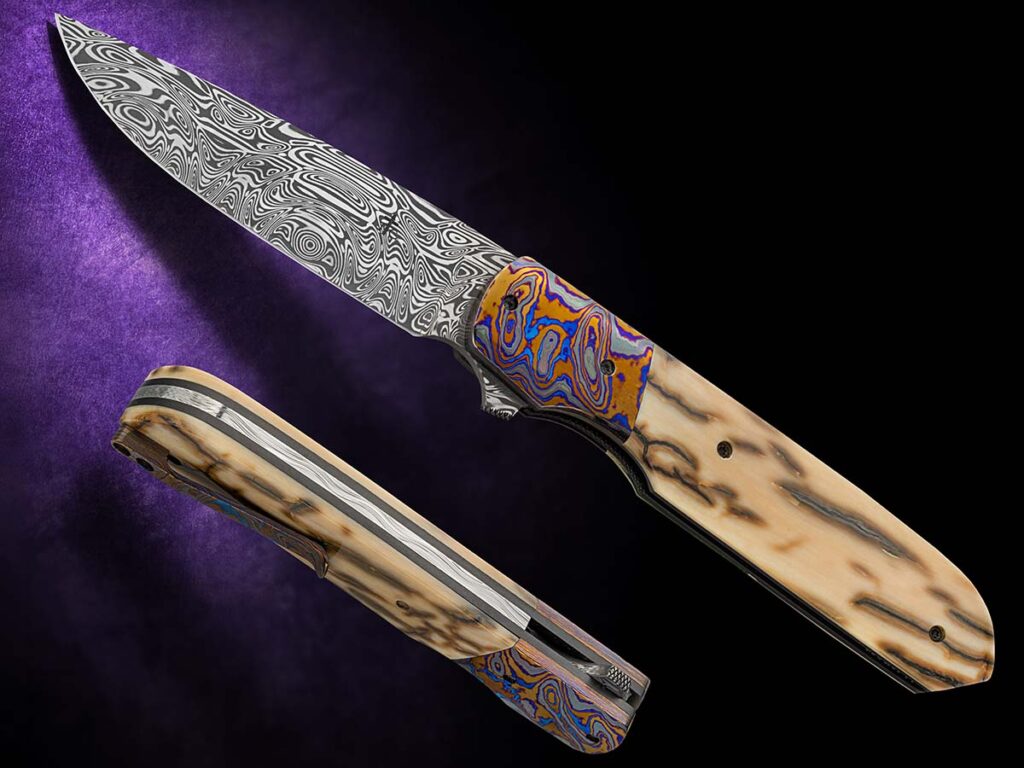
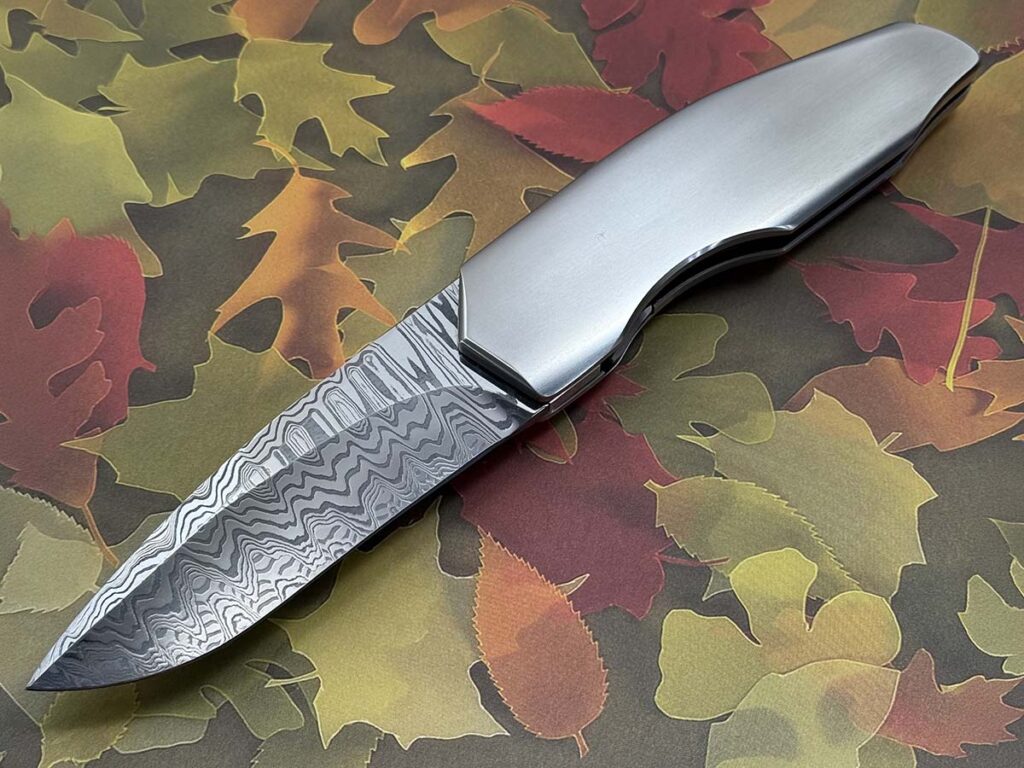
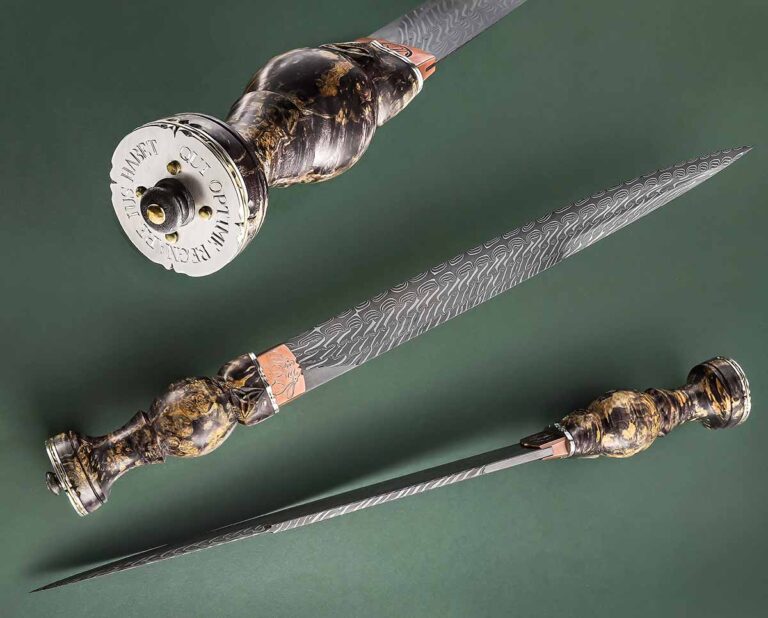
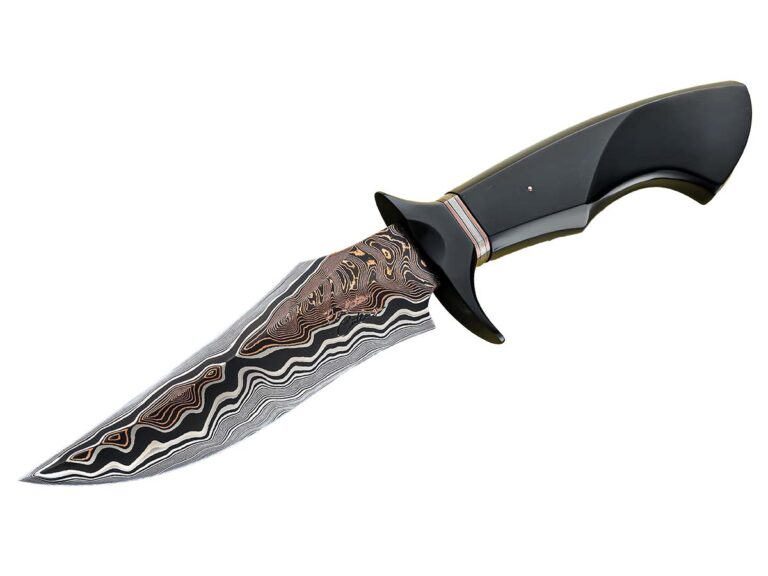
Knife collecting is an extremely rewarding experience for knife enthusiasts. There truly is a knife for everyone. Many increase or hold their value throughout the years, making collecting knives something to pass on to the next generation of knife collectors.
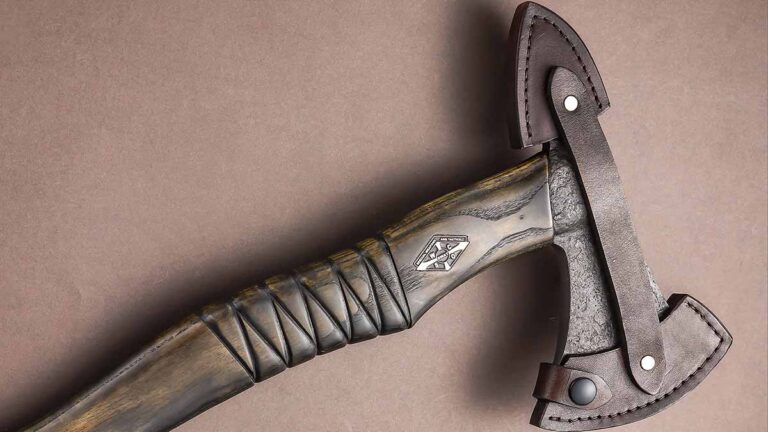
Ben Seward’s breacher SWAT Axe salutes officer’s 21 years of police service
When ABS journeyman smith Ben Seward went to make his first axe, he didn’t settle for something easy—he went the whole hog on a special breaching model as a retirement gift for a 21-year law enforcement veteran.
Sgt. Magnus Gervol retired from the Whatcom County, Washington Sheriffs Office after a career that included 15 years on the SWAT team and 14 years as a sniper.
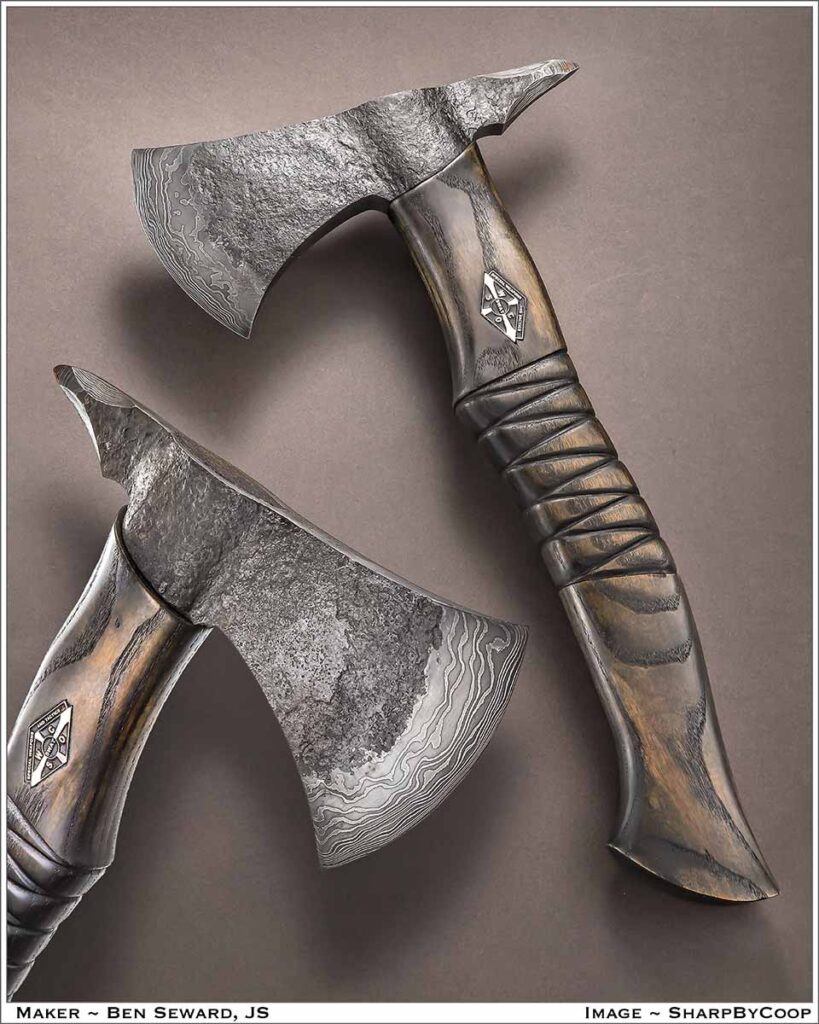
Members of the Sheriffs Office contacted Ben, who forged the axe from the barrel of a Remington 700 SPS tactical sniper rifle. The idea was to make a tactical axe with a beard and a tomahawk spike. The handle is Ozark white oak. Ben’s dad, David, who specializes in sheaths, made the leather sheath.
Ben forge welded the rifle barrel into a bar and layered it up with other carbon steels. He forged the two flats of the head roughly into a triangle and pieced in the bit for the cutting edge. All of the head, including the edge and spike, is forged of the same damascus.
SWAT Axe Specs Maker: Ben Seward Head Size: 7.75” Bit Size: 3.5” Head/Bit Material: Damascus forged from the barrel of a sniper rifle and 1080 carbon and 15N20 nickel-alloy steels; includes a rough-forged finish Handle: Ozark white oak Handel Length : 14” Maker’s Price For A Similar Breaching Axe (excluding the steel from the sniper rifle): $1,500
We talk with those who know Bill Moran best to determine how many damascus blades the godfather of the craft forged.
BLADE Magazine Cutlery Hall-of-Fame® member Bill Moran is and will forever be remembered as the father of modern damascus steel. He and a few early devotees popularized damascus during an era when the art of bladesmithing was an endangered species in the realm of the artisan.
Though Moran was partial to smoking a pipe, he liked an occasional stogie as well. (Pete Cohan knife image)
It was Moran who shocked the custom knife world in 1973 when he brought eight knives to The Knifemakers’ Guild Show in Kansas City, Missouri. Those historic eight sported blades of Moran’s damascus steel and they created a sensation. Cutlery Hall-of-Famer, longtime journalist and friend of Moran’s, and a respected member of the knife community, B. R. Hughes remembered how the event electrified those who attended.
This is the first damascus knife Moran ever made. He forged “No. 1” circa 1972. It was misplaced for 30 years until Nancy Hendrickson found it in Moran’s house. (Pete Cohan knife image)
“When my wife [Carolyn] and I drove up to the Muehlebach Hotel in Kansas City, a friend of mine came out and said, ‘You gotta get in there and see the damascus knives Moran has on his table.’ Those knives were the talk of the show. Bill also had mimeographed sheets that explained what damascus steel was and how it was made. He gave those sheets away to anyone who desired one.”
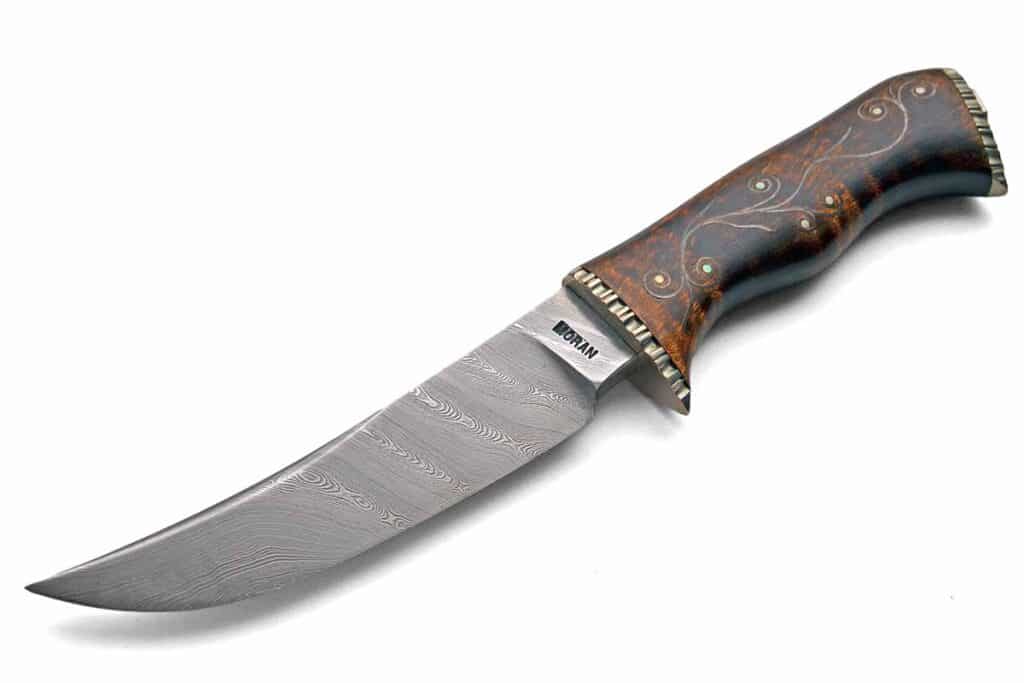
Moran made basic damascus knives. “They weren’t elaborate and this, that and the other thing, but most of them were for use,” B. R. Hughes noted. (Exquisiteknives.com image)
Three years later, Hughes joined Moran and bladesmiths Bill Bagwell and Don Hastings as the quartet that founded the American Bladesmith Society (ABS). When the ABS was founded in 1976, bladesmithing was on life support, and probably fewer than a dozen smiths were forging knives. Today, the Society includes more than 2,000 members and the future of the craft has been secured. Meanwhile, Moran deserves the credit as the catalyst for modern bladesmithing.
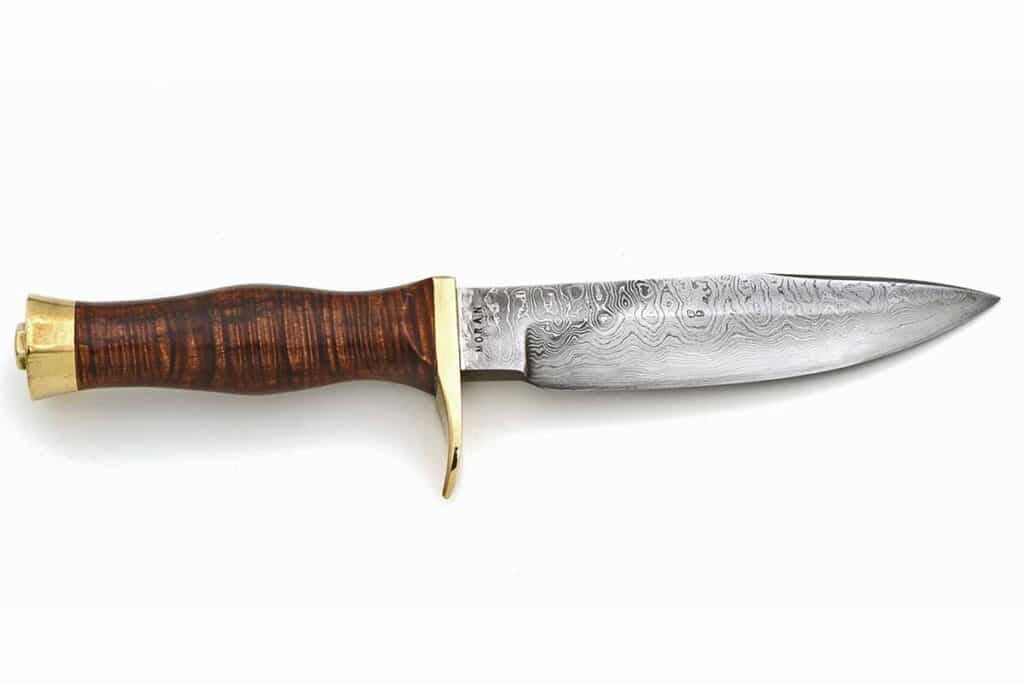
B. R. Hughes said Moran made some art daggers that “were a bit elaborate for the day.” An example is this large quillon dagger. (Exquisiteknives.com image)
How Many Damascus Knives Did Moran Make?
While there is no question that Moran and other dedicated disciples of the forged blade brought damascus and the ring of the hammer back to life in the early-to-mid-1970s, there is some conjecture as to just how many such knives the great Moran forged and completed himself. The thought of how many Moran damascus knives were made and exist today is tantalizing, and, of course, what’s a great legend without a bit of mystery and conjecture? Exploring Moran’s body of work and the damascus element within provides some insight into the man, the legend who padded about on the creaky floor of his Maryland shop, sometimes chewing tobacco, but rarely alone when his doors were open as crowds came to see the wizard work.
Back in the day, a Moran damascus knife was a challenge to own, considering the time Moran spent in his shop with the material actually able to work without the distraction of visitors, the many hours of labor required to produce a damascus billet, and the higher price for such a piece that naturally followed. (Exquisiteknives.com image)
Collectors such as Cutlery Hall-of-Famer Butch and Rita Winter bought the first of Moran’s damascus knives during that historic Guild Show more than a half-century ago, and, as Hughes relates, “Moran made basic damascus knives. Most of his were what folks would call ‘using’ knives. They weren’t elaborate and this, that, and the other thing, but most of them were for use. He did make some art daggers that I thought were a bit elaborate for the day.”
Dave Harvey, Nordic Knives
Hughes remembers that Moran himself was rather vague on the number of damascus knives he actually made. However, probably the best estimate is that fewer than 100 Moran damascus knives were made during a career that spanned more than 50 years.
“He liked the random pattern and the ladder pattern,” B. R. remembered, “and he could do some pretty good patterns, but it took a lot of time. He was very happy just making ladder pattern and stuff like that, and he continued making non-damascus knives and about 40 folders. When he was in his shop, there were always five or six locals in there talking to him and watching him work.” Agreed Cutlery Hall-of-Famer and ABS master smith Jay Hendrickson, a close friend of Moran for 30 years, “Bill had so many visitors to his shop on a daily basis that it is a wonder he ever got anything accomplished.”
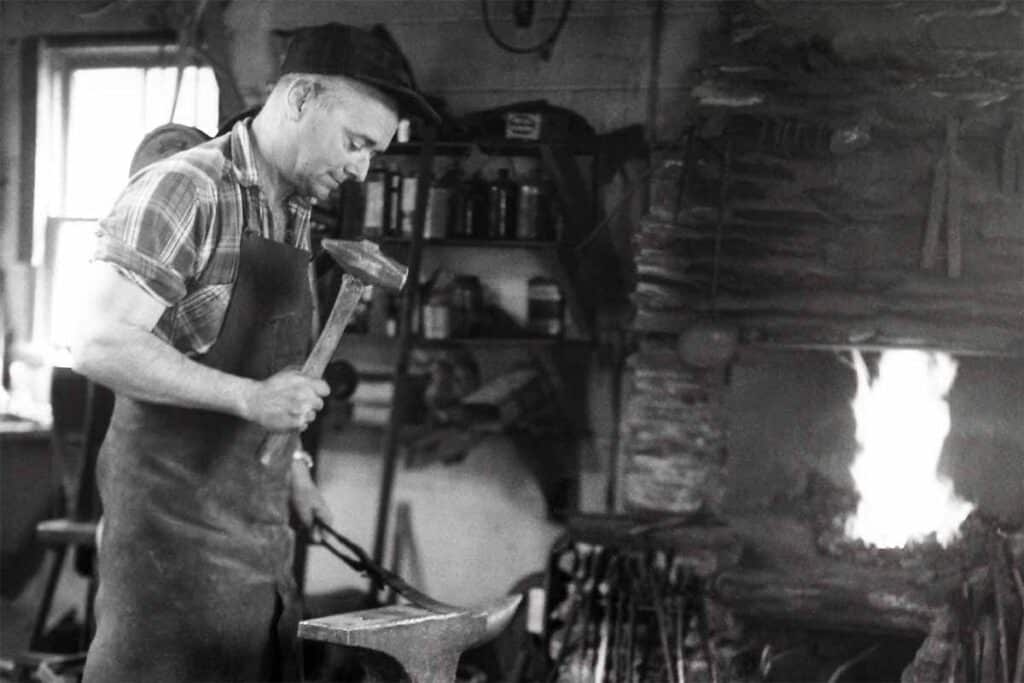
According to Jay Hendrickson, Moran made all of his damascus in a coal fire. “All of Bill’s experiments were with coal, as gas forges were not popular at the time,” Jay explained. “In today’s world, gas forges are almost always used for damascus making because of adjustable temperature and the cleanliness of propane gas.” (vintage photo of Moran in his shop circa the 1960s)
Hendrickson served as the executor of Moran’s estate and founded the Moran Foundation to preserve the great bladesmith’s legacy, serving as its president for 10 years. Jay observed that Moran made a workingman’s knife with quality that was spot-on, though there may have been an occasional flaw in the solder on his early pieces. Nonetheless, Jay says, Bill’s knives always cut.
As for Moran’s damascus knife productivity, Hendrickson offered, “This is strictly a judgment call on my part, but I would say Bill made less than 100 damascus knives. I counted 36 in our Forever A Legend book. I only know a few people that own Bill’s damascus knives, but I think they are sold and traded often between collectors. You also see Bill’s damascus knives occasionally sold at auctions.”
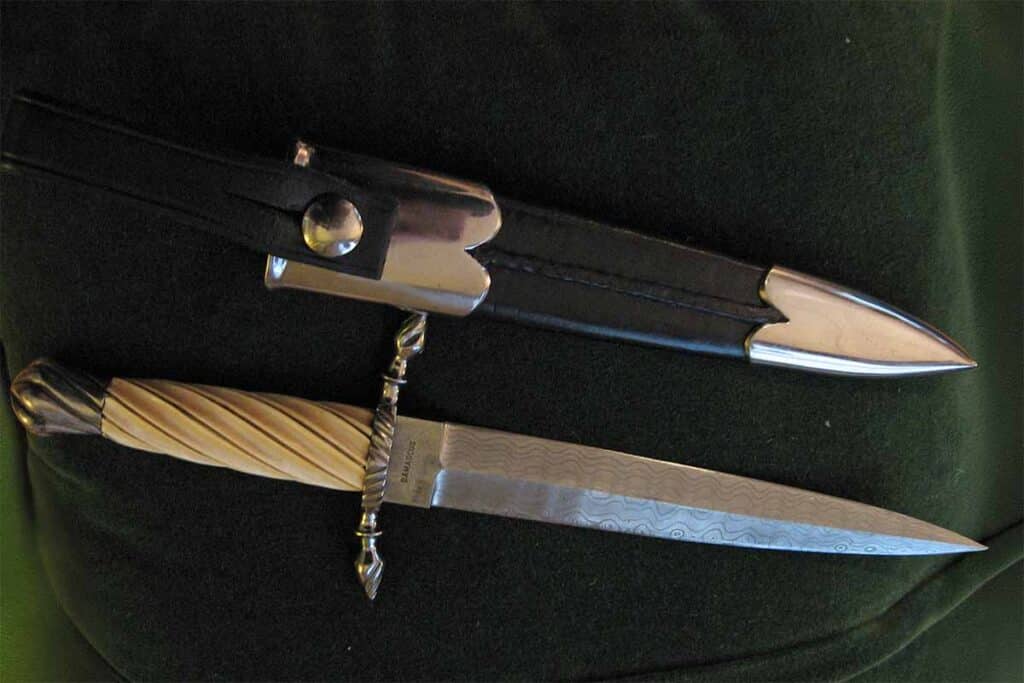
Butch and Rita Winter bought this damascus quillon dagger from Bill Moran at the 1973 Knifemakers’ Guild Show where Moran introduced modern damascus knives. It was one of eight damascus knives Moran brought to the show. The tang is marked DAMASCUS in all uppercase letters. (image courtesy of Rita Winter)
Jay verifies the original sale of a Moran damascus quillon dagger and sheath to Butch and Rita Winter and adds a bit more information. “Rita Winter recently sold Bill’s first damascus dagger to Mr. Doug Hook, a Tennessee collector,” he commented. “Two years ago, I repaired one of the twisted wires on the handle for Mr. Hook. Because of that contact I was able to confirm the original purchase as Doug has written verification of the original sales transaction and the invoice.”
So where are the majority of Moran’s damascus treasures today? Longtime purveyor Dave Harvey of nordicknives.com is straightforward—“in collections around the world. Values vary and depend largely on the particular knife. But they are generally worth at least double that of [one of Moran’s straight carbon steel blades], sometimes even more.”
Dave Ellis said the first of the Moran damascus knives are quite valuable and guessed they would start at least at $10,000 and go up from there. Dave holds an early 1970s Moran damascus hunter at BLADE Show 2023.
Back in the day, a Moran damascus knife was a challenge to own, considering the time Moran spent in his shop with the material actually able to work without the distraction of visitors, the many hours of labor required to produce a damascus billet, and the higher price for such a piece that naturally followed. Dave Ellis of Exquisiteknives.com reasoned, “I could not say how many damascus knives Moran made in his lifetime, but certainly not a large number. Many of Moran’s damascus pieces reside in private collections, as well as the Moran Museum. I personally have owned and still own some and have sold a number of the finer pieces to overseas clients.
“I believe he made four or five patterns. Damascus steel was and still is a laborious process. Bill’s prices for his damascus knives were quite high for the time, so he made and sold mostly carbon steel pieces. Damascus was reserved for higher-end clientele and foreign dignitaries. A good number of the damascus knives were fighters and bowies. Damascus hunters were also made, many with Bill’s twist pattern steel, maidenhair. I do not know of any mosaic steel knives that Moran made. The first of the Moran damascus knives are quite valuable, and I would guess that they would start at least at $10,000 and go up from there.”
Along with Bill Bagwell and Don Hastings, Bill Moran (left) and B. R. Hughes (right) founded the American Bladesmith Society in 1976. Hughes is the only surviving founding member. (Buddy Thomason image)
HOW HE MADE THEM Hendrickson is familiar with Moran’s most common damascus patterns, the maidenhair twist, ladder pattern and others. “He knew how to fuse metal, as he learned that technique working on equipment on the family farm,” Jay remarked. “On the farm he made knives from whatever he could get his hands on, old springs, files, and rasps, for example. He could also buy steel from a local hardware store in town. Bill also knew the difference between plain iron and high carbon steel. His first damascus experience began by using one piece of steel and one piece of iron. He welded the two together, drew it out and folded it many times.”
The process yielded insight for Moran, and he learned from experience. At times during the process of hammering and folding, he realized that the steel was absorbing heat quicker than the iron because it was on the outside of the billet. Therefore, he moved to one piece of iron with steel in the center, and then a second piece of iron, using O1 tool steel and a carbon mix of 33 percent. According to Jay, this combination gave the billet the right hardness without the need for tempering. Moran’s test of the finished knife was to carve wood for two hours with no loss to the cutting edge, and he was satisfied with the results using this mixture.
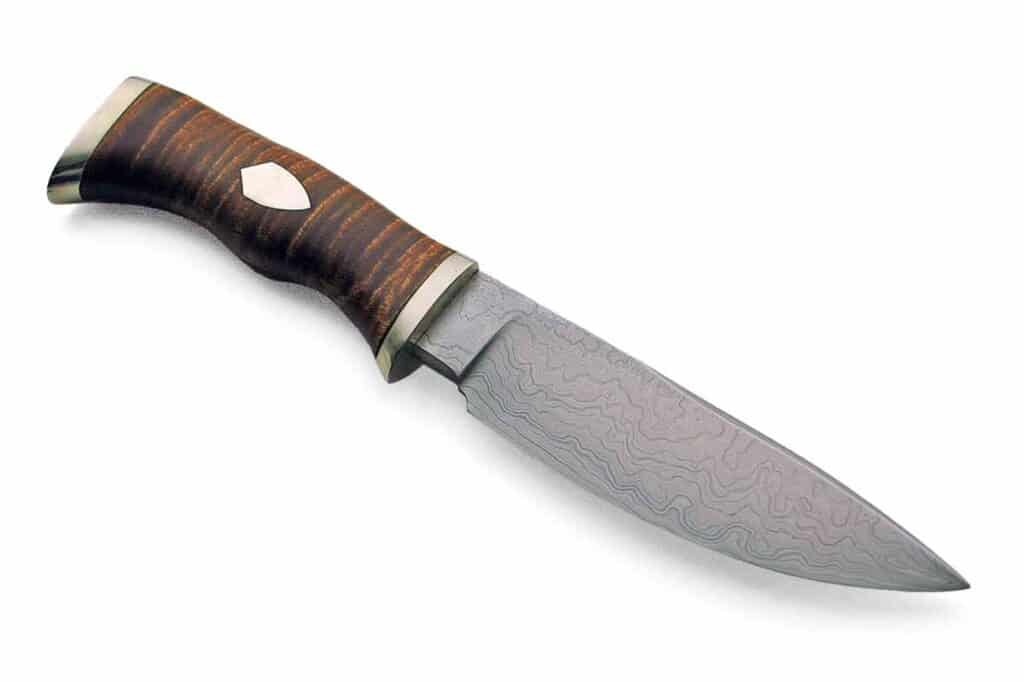
Moran’s test of the finished damascus knife was to carve wood for two hours with no loss to the cutting edge. An example is this clip-point model, again in a ladder pattern. (Exquisiteknives.com image)
“Bill made all of his damascus in a coal fire,” Hendrickson recalled. “A hot coal fire can melt steel as temperatures can reach over 2,700 degrees Fahrenheit, which is the melting point of steel. That is why Bill added iron to the outside of the billet, as iron is less apt to burn as quickly as steel. All of Bill’s experiments were with coal, as gas forges were not popular at the time. In today’s world, gas forges are almost always used for damascus making because of adjustable temperature and the cleanliness of propane gas. Therefore, the burning of steel to a great deal has been eliminated with the use of gas forges.”
Hendrickson attributes the relative scarcity of Moran damascus knives to the maker’s affinity for producing using knives, constraints on time and other factors. “Bill was truly a supporter of the art knife,” he noted, “and along with others they created that industry. Collectors were willing to pay big time for exceptionally well-made knives, and Bill, like other top-notch makers, profited as this industry took hold. However, Bill’s true passion was in using knives, such as camp knives, hunters and small utility knives, of which he made many. The vast majority of his knives came from customers wanting working knives.
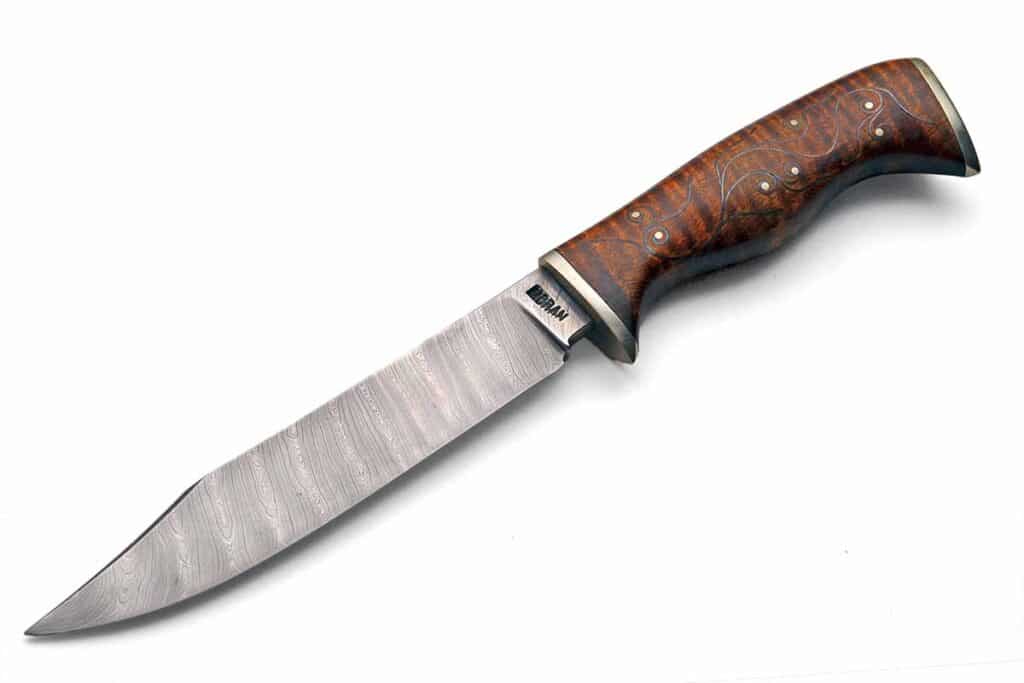
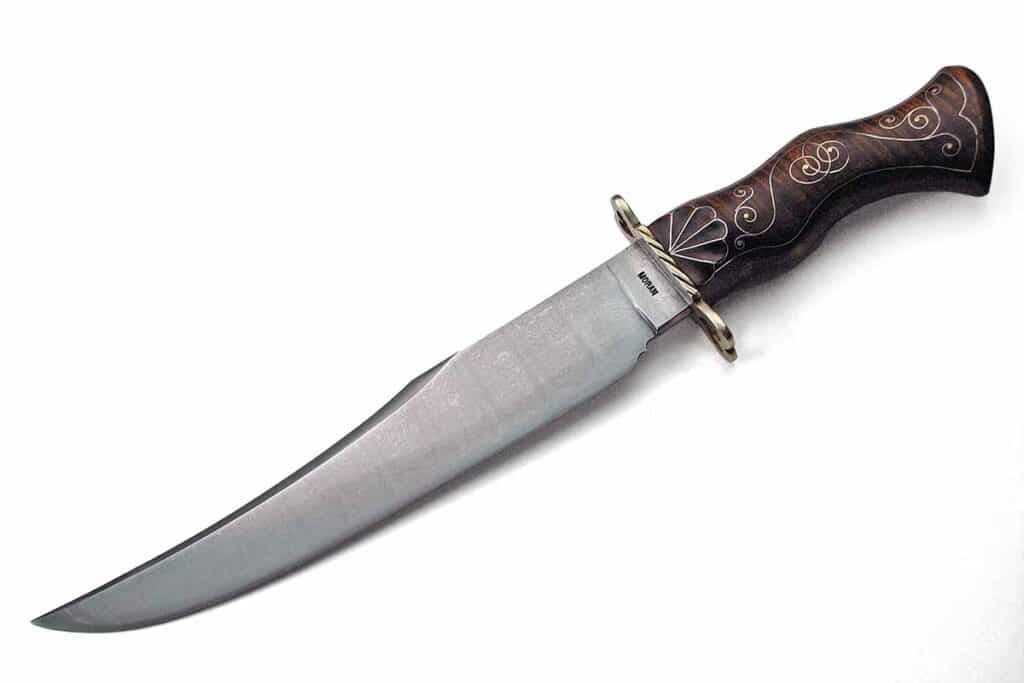
A good number of Moran’s damascus knives were fighters and bowies, according to Dave Ellis. This classic ST-24 in ladder-pattern damascus and curly maple handle with fancy wire inlay is a favorite of Moran collectors. (Exquisiteknives.com image)
“Bill liked to experiment with damascus. For example, he would slip in an added piece of iron after many folds to gain toughness in the end product. Another example was where he completed a damascus billet to the desired number of welds. He then cut it in two and added a piece of high carbon steel to form the middle and welded the two damascus pieces on both sides of the high carbon steel. Once that was completed, Bill forged the billet into a knife. One might call the finished product a damascus san-mai. Bill liked the various patterns that were being developed beyond the more basic patterns that he originally developed. To Bill, mosaic knives were art knives, not to be used but just admired. He didn’t like the process of welding pieces together to make a knife. Remember, he was more into using knives where the grain within the steel followed the entire edge of the blade.”
Through the years, Moran became a legend, leaving a legacy of learning, teaching, giving information freely, and welcoming many to his shop. He paid tribute in steel to the wonder of damascus, the art knife and the using knife. Today’s body of bladesmiths still looks to him as the guiding light that led them to the glow of the forge and the spark of the hammer on hot steel. Those who own or admire the few damascus knives that Moran completed continue to do so for their beauty, their imagination, their rarity, and simply because they bear the touch of the master’s hand.
The TiNy packs hefty performance into a light package.
Despite hailing from Germany, Philipp Utsch and Jan Gierse are fluent in the basest American vernacular—Twinkies and violence.
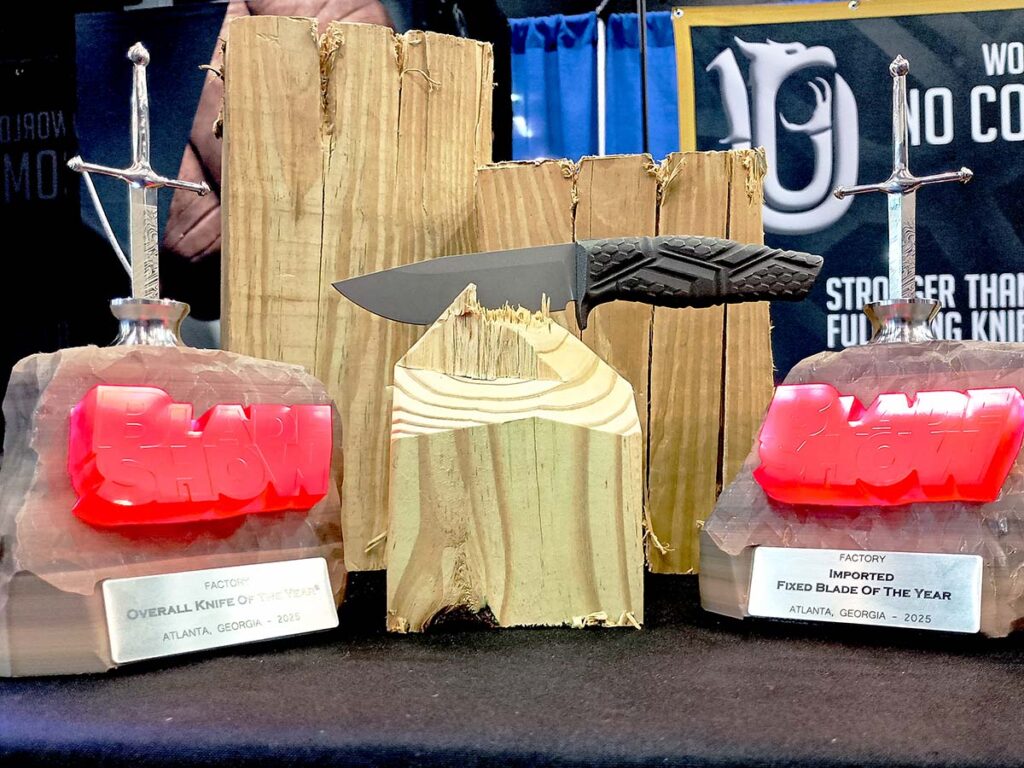
To say smashing a knife weighing all of two of the spongy confections through an 8-by-8 pine post was heard loud and clear at BLADE Show 2025 is an understatement. Aside from wowing some of the most discerning knife collectors, makers and users in the world, the tandem of Teutonic toolmakers also took home the event’s most coveted hardware.
It’s rare for fixed-blade knives to reach the pinnacle of edged tool accolades—BLADE Magazine’s Knife of the Year®. Yet, the German-made gem proved to have the edge over nearly 400 other knives clamoring for the singular honor. How?
Quite simple. Utsch and Gierse’s burgeoning knifemaking concern—UG Tools—and its award-winning knife—the TiNy—took the world’s oldest tool and firmly planted it in the 21st century.
One of the more interesting aspects of the TiNy’s meteoric rise is that this was UG Tools’ first official appearance at the BLADE Show. Utsch and Gierse were in attendance at the 2024 edge-stravaganze, but as attendees, not exhibitors.
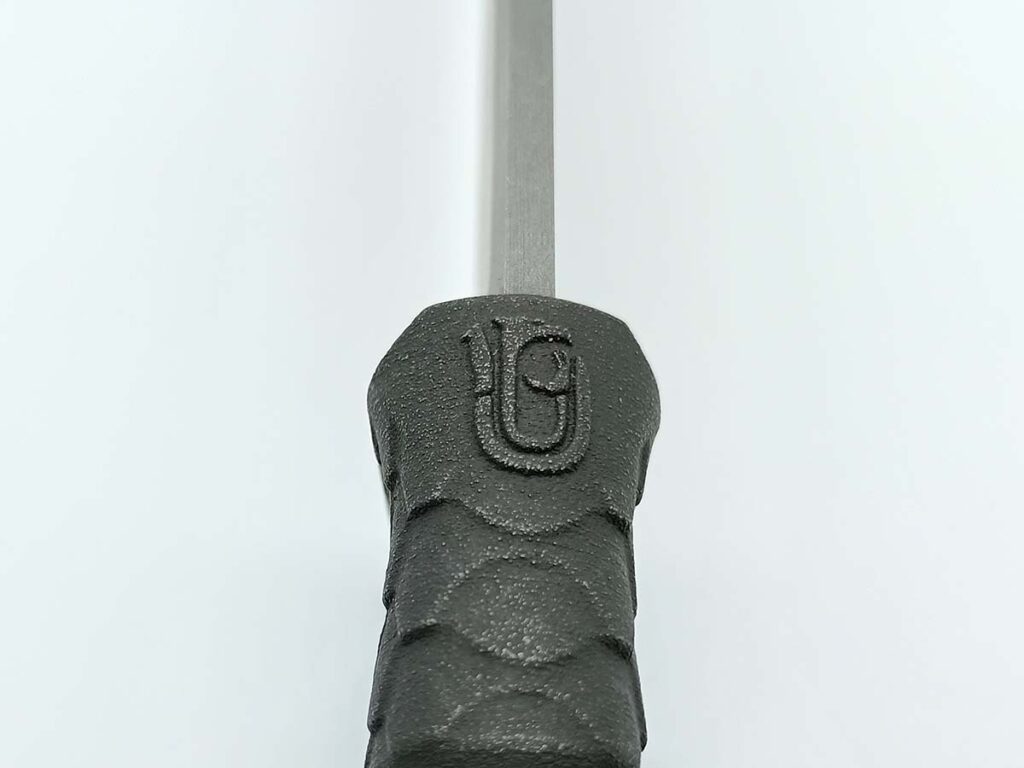
UG Tool’s mark is a combination of the founder’s last initials and some Teutonic ferocity.
The duo’s concern is also relatively new, founded in 2021. Not that knifemaking, fabrication and manufacturing were mysteries to UG’s founders.
Utsch has 20 years of knifemaking under his belt, but his daytime gig was a maintenance manager* in the founders’ hometown of Sundern. And Gierse’s career aspirations were focused on manufacturing, as he was pursuing his PhD in mechanical engineering.
It turns out, there was a lot of serendipity in those backgrounds.
Gierse’s topic focus is 3D printing—in particular, Selective Laser Melting (SLM). When he first moved into this field academically and got access to an SLM machine, a titanium knife handle was among his initial projects.
Down the line, that handle ate at him. He saw its potential, something revolutionary. He was acquainted with Utsch and approached him with the idea of teaming up to create a complete knife.
Thanks to its innovation and performance, the TiNy won both Imported Fixed Blade Knife of the Year and Knife of the Year® honors. It’s also stuck into some of its handy work, as the guys from UG Tools hacked through fence posts to demonstrate the knife’s resilience.
The bladesmith was instantly intrigued.
“[W]hen Jan suddenly sent me a photo of the first titanium handle out of the blue in 2021, I knew immediately what I was looking at. The potential was immediately clear to me,” Utsch said.
Getting A Handle On The TiNy
Funny as it might sound, the handle is the belle of the ball on the tiny. It’s where much of the innovation lies.
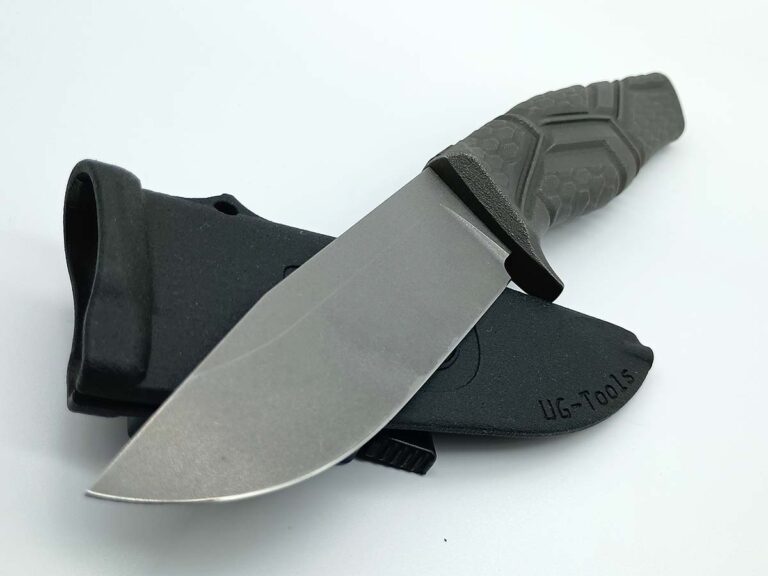
Additive manufactured, and hollow, the human-tool interface cuts the knife down to a scant 2.82 ounces—or two Twinkies. For a practical-tactical knife, this opens up a wealth of potential.
The old saying for backcountry hunting, military campaigns or just plain hiking is “Ounces make pounds, and pounds make pain.” At 8.27 inches in overall length, weight savings are substantial for a full-sized hunting, camping or military knife (the TiNy could fill all three roles).
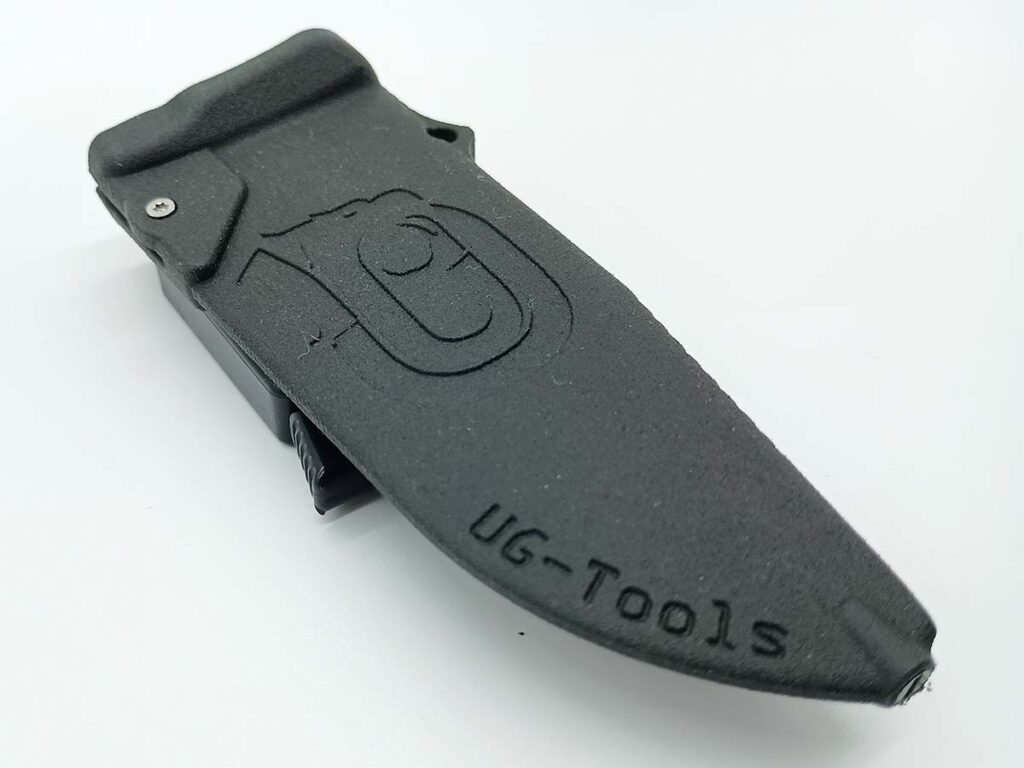
UG’s design prowess overflows to the TiNy’s sheath, a sturdy Kydex unit with a retention-adjustment screw and UltiClip UltiLink for unlimited attachment/carry options. An aside, given the hollow handle, it makes a very satisfying ping when clipped all the way into its sheath.
However, keeping things light isn’t the only advantage of the 3D printed handle.
TiNy’s Big Ergonomics
The sky is nearly the limit when it comes to SLM manufacturing, allowing for the TiNy’s advanced—if not nuanced—ergonomics. From the Pango model, I spentd time testing, which isit’s the most enjoyable aspect of the knife.
Plain and simple, in my medium-sized mitts, it feels good to hold.
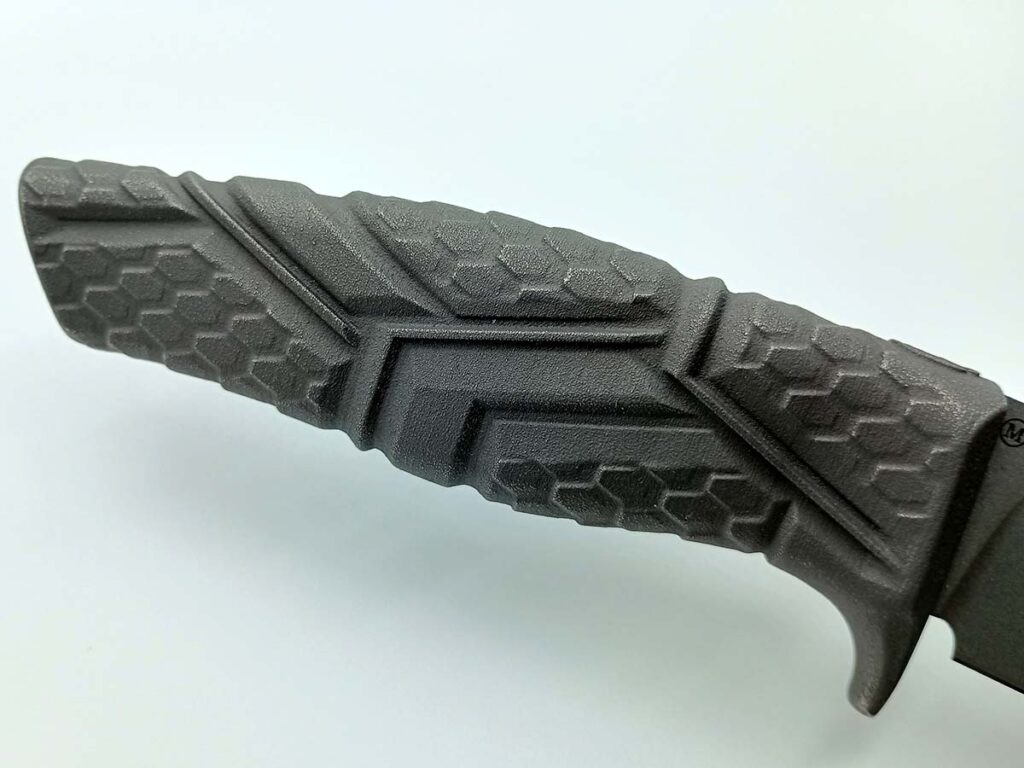
Well thought out, the handle swells and recesses at the right spots to form-fit my medium-sized hands. Yet, but for my money, the integral grip texturing gets the most accolades. A mixture of dragon scale and linear elements—with a fine pebble finish—the handle stays in place no matter what axis force is applied.
The TiNy’s 3D-printed handle isn’t only lightweight, but also as comfortable as the day is long. In testing, the Pango pattern stuck firmly to the hand without firing up a hot spot.
A final point, the knife is extremely well-balanced. Using my finger as a fulcrum, it’s right behind the guard, making the blade very agile and easy to manipulate.
TiNy Blade
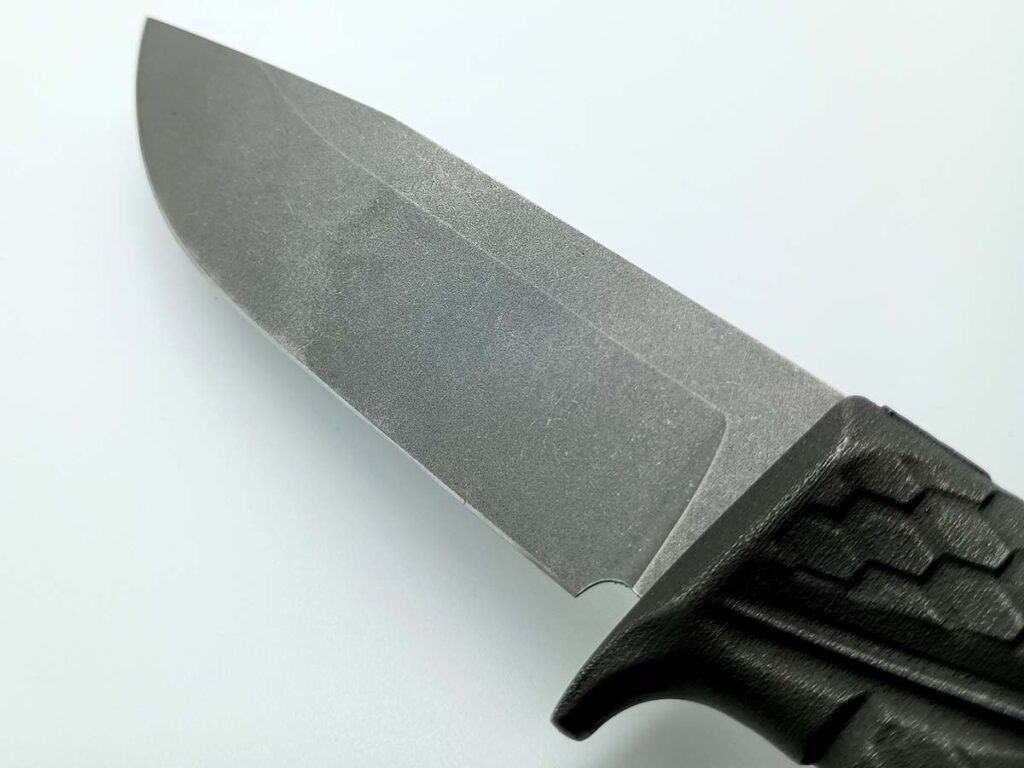
The 4-inch drop-point blade is very clean and understated, but well-formed for a general outdoor knife. Given UG pulled out all the stops and used MagnaCut steel, it’s also more than ready for hard use.
I appreciated the long, straight cutting surface just behind the belly. It is ample enough to facilitate larger push cuts and gives it plenty of edge on pull cuts.
Turning to Magnacut steel, UG produced a high-functioning cutting tool that requires little maintenance. Through general testing, the knife retained the same edge with which it came out of the box.
The drop on the point was just right for me to index when choking up on a pinch grip, like you might use field dressing a buck or the like. And the blade’s stonewashed finish gives it a level of tackiness, as well as hiding inevitable abuse.
TiNy Ruggedness
Interestingly, the TiNy is neither a full nor a classic tang knife, a fact that might get some traditionalists to clutch their pearls. Utsch and Gierse whacking it through an 8-inch by 8-inch post should put to rest any concerns about durability. But what’s going on to keep the blade and handle happily married?
“The extreme load-bearing capacity is achieved by the very precise press fit, in which the oversized blade is pressed into the undersized handle,” Gierse said. “This type of connection has been proven in industry for well over 100 years and transfers forces through a permanently elastic, form-fitting connection.”
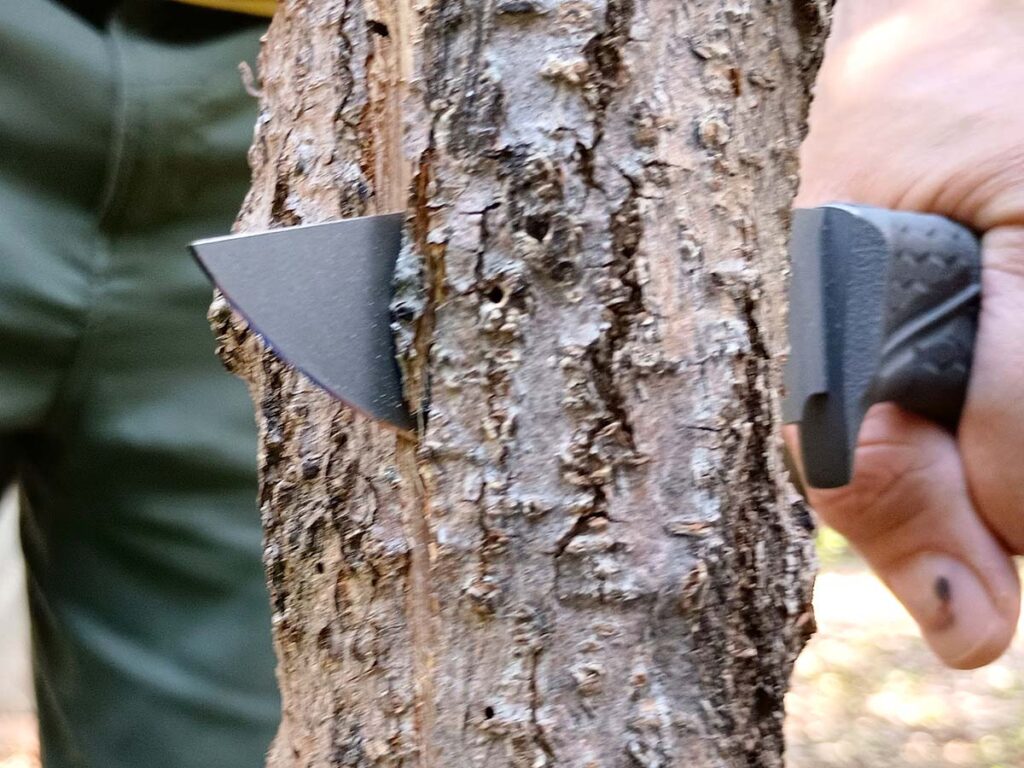
UG’s knife made quick work battoning through a nearly 3-inch diameter elm log.
UG has done its testing on the knife, as well as sold several thousand and has yet to encounter a blade-handle separation.
“So far, we have not been able to damage the connection between the handle and the blade, even under extreme stress tests,” Gierse said. “This makes the knife behave like an ultra-light, fully integrated knife. Of course, the blade can break under excessive overload, just like any other knife. Despite the best heat treatment and steel, there are natural physical limits that even we cannot overcome.”
Testing The TiNny
I would have liked to have tested the TiNy during hunting season, to really put the knife through its paces. However, I received my test model during the summer and deadlines call.
In turn, I put it through a small, very unscientific laboratory evaluation that included:
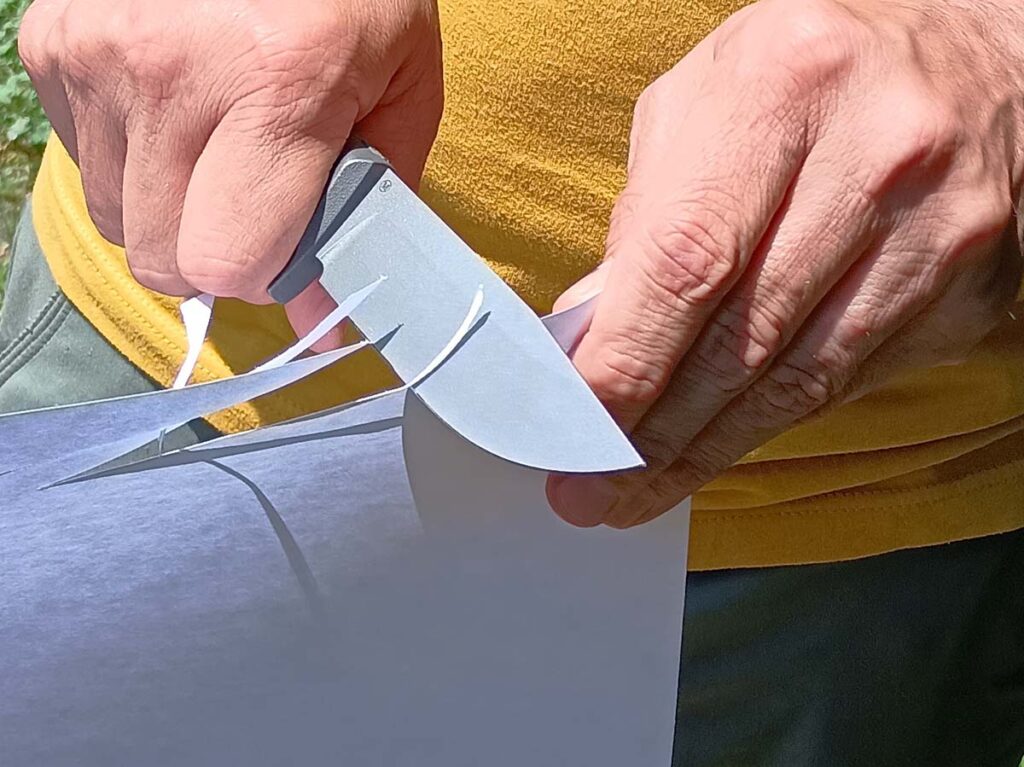
Initial sharpness test on 20-pound bond paper: The tiny passed my initial sharpness test with flying colors.
Push-cut test on 1/8-inch thick1/8-inch-thick leather: It snapped straight through the leather with an audible pop.
Pull-cut test on ¼-inch double-wall cardboard: The knife made quick work of the cardboard, through 100 some cuts.
Durability Test Battoning Siberian Elm Log: Had no problem passing through a seasoned 3-inch diameter log, splitting it roughly a third of the way through. Will note, this did mar the blade finish some.
Follow-up sharpness test on 20-pound bond paper: No edge loss from the initial test.
Overall Impression
I was impressed with the cutting performance of the TiNy; however, I wasn’t too surprised given the blade material. There’s a reason why MagnaCut continues to demand respect in the marketplace and this was proven out by the blade maintaining its edge after moderate use.
I walked away most impressed with the comfort and controllability of the knife, thanks to a well-thought-out handle. I did wonder if the linear aspects of the texturing would prove hot with extended work. This wasn’t the case. I could have worked all day with the TiNy and not thought twice.
Before and after testing, the TiNy’s blade was razor sharp, able to shave through 20 bond with ease.
I’m not the only one.
James Rodebaugh met Utsch and Gierse in 2024, when they attended the BLADE Show as attendees. The duo gave the ABS Master Bladesmith and custom knifemaker a TiNy for field testing, with Rodebaugh taking it on hunting trips in both Alaska and Wyoming.
Dressing game and spatchcocking fowl, the knife proved resilient. He also tested a concern I have with any metal-handled knife—performance in cold weather.
“The printed titanium handle surprised me,” he said. “I thought it would be cold to the hand but warmed to body temp from approximately 20 degrees Fahrenheit in a heartbeat.”
Good to know you won’t take off palm flesh if you’re gutting a deer in the bowels of winter.
Final Cut
Rarely do knives—even ones deemed top-of-class—vastly change the manufacturing landscape. Is the UG TiNy one of those sea-change pieces of cutlery? Only time—and likely mimicry—will tell.
What can be said is that Utsch and Gierse have concocted a version of the age-old fixed blade that firmly plants its feet in modern manufacturing. And they’ve done so at a level that should make the TiNy a useful and trustworthy piece of kit, be it in the backwoods or battlefield.
For two Twinkies’ worth of knife that’s pretty sweet.
Tips and tricks to get the most out of attending a knife show.
Magazines, websites, and social media only give you a two-dimensional look at a knife. Nothing replaces the experience of handling a knife in person. While the internet is convenient, it cannot match the visceral sensation of holding a knife at a show.
There are many knife shows across America. Some are big, like the BLADE Show, while others are smaller, regional events. All shows have one thing in common: custom knives. Makers offer blades in many styles, materials and price ranges. No matter the show’s size, you can gain an advantage—and get the knife or knives you want—by research.
Today, even smaller shows have websites or social media pages listing exhibitors. The exhibitor list will help you identify who will be at the show. Before every show I attend or consider attending, I go through this list, looking for both familiar makers and those of whom I am unfamiliar. In particular, I look for makers from outside the U.S. From this, I create my own list.
For unfamiliar makers, I visit their websites or social media pages to explore their knives. This research allows me to refine my list and home in on those I’m truly interested in. Once my list is complete, I prioritize the makers whose knives I want to see and handle.
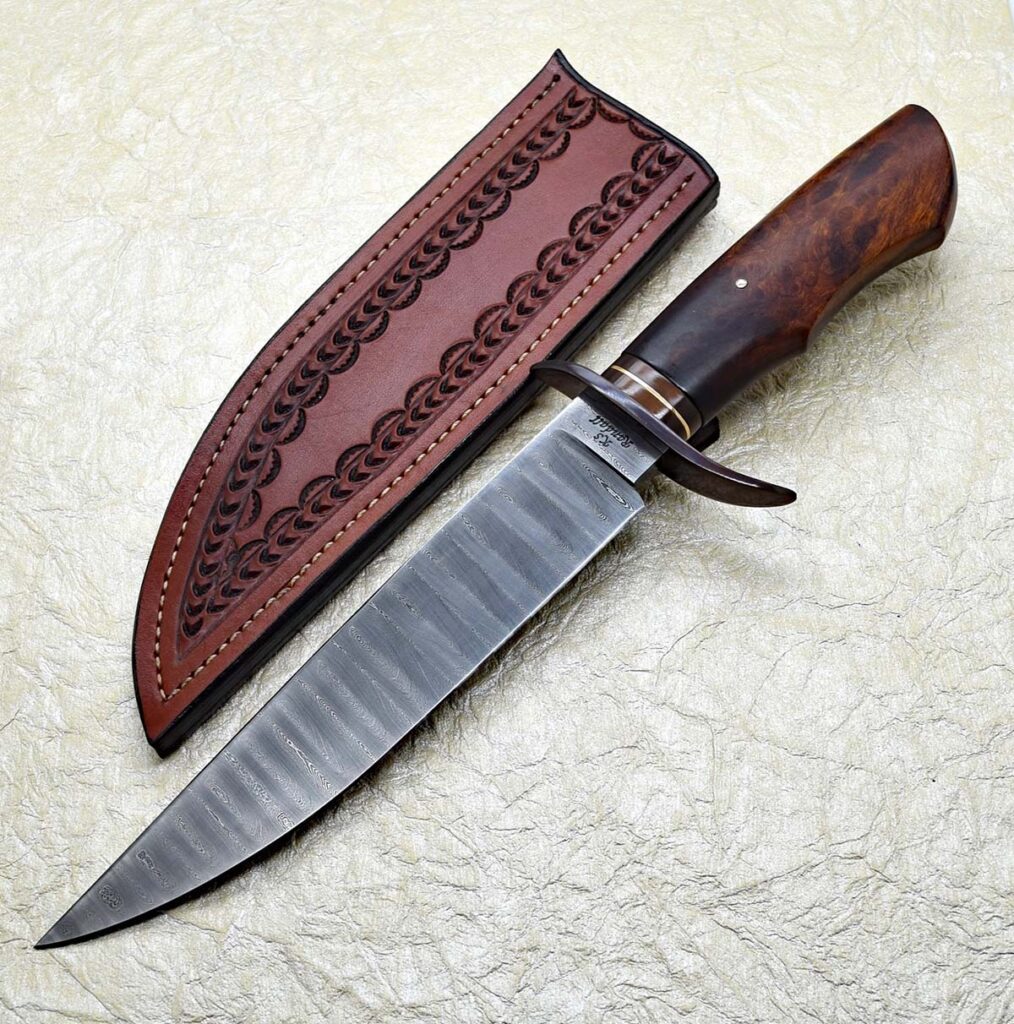
The ladder damascus on Steve Randall’s 8” bladed fighter hits the right balance between understated and complexity. (Alison Randall image)
The floor map is another invaluable tool for show planning. As its name implies, it is a map showing the location of each maker’s table or booth. The combination of the exhibitor list and the floorplan provides me with the first advantage of my show game plan—time management. The other aspect it helps with is money management; researching gives me an idea of how much a specific maker’s knives will cost. I adjust my priorities accordingly.
Bargain Hunting
Knowing who’s at a show out of the way, the next step is to use the various social media platforms again to discover what the makers are bringing to the show. Many show off the knives they are planning on displaying and selling well before the actual event. This helps me identify style, materials and prices of which I’m interested. Often, this information also further helps prioritize my list.
Note, due to constraints imposed by some social media platforms, pricing is not always included in knife descriptions on these platforms. There’s an easy way around this, given that there is nothing wrong with sending the maker a message asking for the price. Realize, for many makers, pricing the knife can be as challenging as making the knife. But knowing the price allows you to compare other makers’ prices for similar work.
Becoming familiar with pricing across the spectrum of a particular knife sector—say, bowies, EDC or hunting knives—ultimately helps you get the best knife for your money. And the best value often is a new maker discovered during list research. I make it one of my goals to find a new maker whose work I am unfamiliar with at every show I attend. While I am not successful every time, many of the makers I work with today I found exactly through this method.
Personal Logistics
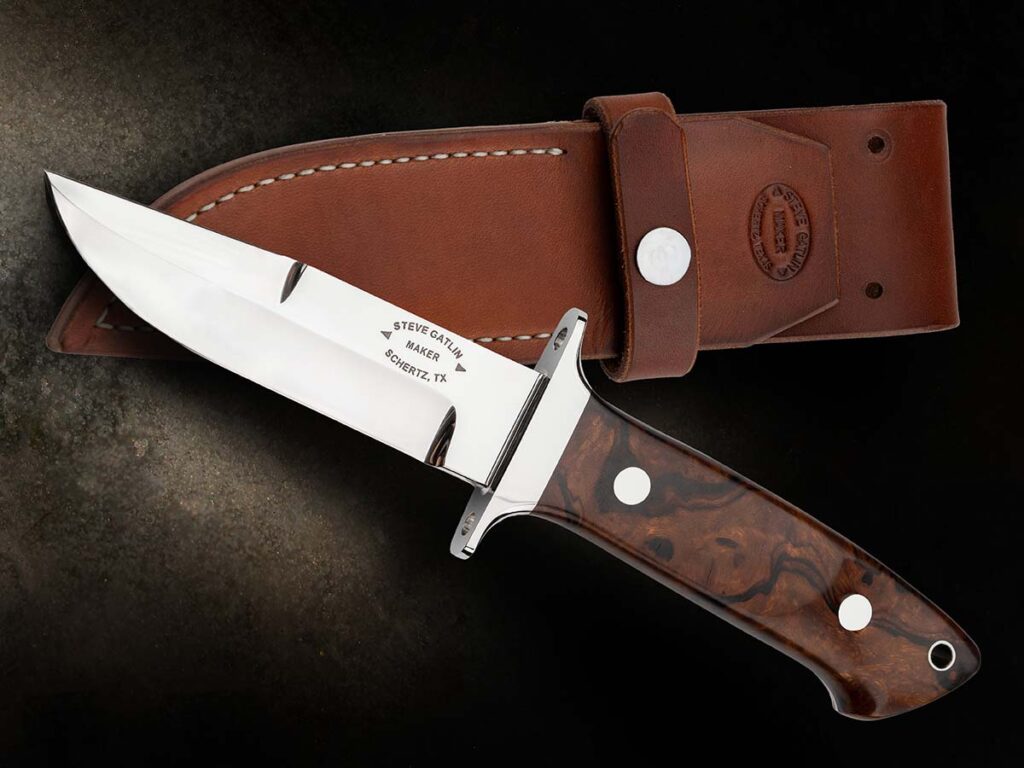
An homage to a classic design from BLADE Magazine Cutlery Hall Of Fame® member Bob Loveless. The author contends this is one of those knives you can only appreciate its lightness and quickness when it’s in your hand. (Karis Fisher image)
Research shouldn’t solely focus on the who and what at a show’s tables and booths. There is also a bevy of other factors to consider beforehand to make a show more pleasant.
It might sound obvious, but know where the show is located. Some smaller shows I have attended have been off the beaten path and difficult to find. I personally get frustrated having to hunt around for a venue, only to end up there after it’s already open.
Identifying the show hours is also crucial, as is understanding how most events organize their hours of operation. Most shows open earlier on the first day than on the second or third day. The inverse is generally true for closing—the last day usually ends earlier, especially for three-day shows.
It’s a good idea to also consider the restaurants you’ll eat at and the hotels you’ll stay in. The larger the show, the more crowded the restaurants and hotels. This is especially true with a large group; heading to a show with friends, plan on reservations for both room and board.
Don’t assume parking is right outside of the show’s location. That’s a recipe for trouble. Do your research and see if there is plenty of parking, where it’s located and, at some venues, how much it costs.
The final consideration is actually getting into the show—your tickets. If the show offers advance tickets, I recommend you purchase them before you arrive. You don’t want to be standing in line when the doors open.
Show Etiquette
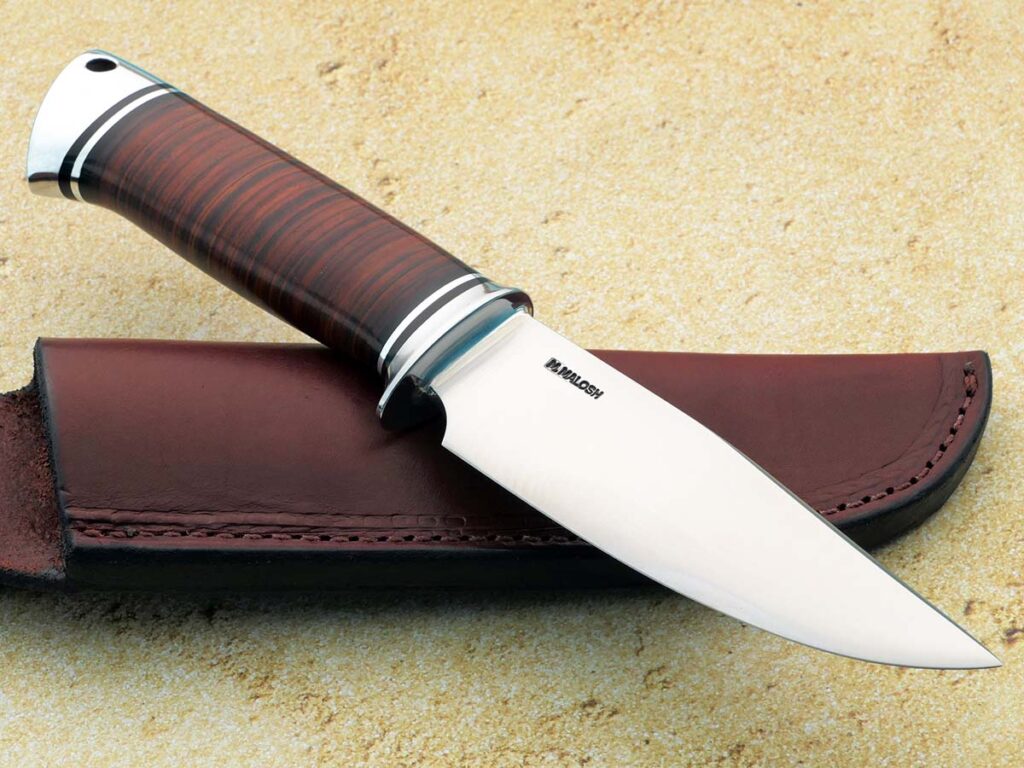
Beautifully spartan, Mike Malosh executes an extremely clean hunter that’s built for dead-serious work. (Robertson’s Custom Cutlery image)
It should come as no surprise that those attending a show are focused on the knives they came there to see. But don’t let your focus make you into a poor or even rude show attendee. Here are some recommendations to keep in mind while at the maker’s tables.
When in doubt, ask for permission to handle a knife. Makers want you to; they just want you to do so respectfully.
If you have children with you, watch their little hands. They want to grab the knives just like everyone else.
Replace the knife where you found it. Set the knife down and don’t just drop it on the table.
For those knife fighters out there, limit your moves at the table. Those knives are sharp!
Don’t put your drinks, backpacks, bags, etc., on the maker’s table. Accidents happen, and no one wants a knife scratched or damaged.
Wait for your turn. At a crowded table, more than one person has been cut trying to grab a knife.
Jason Clack has a lot going on with his liner lock, from it’s 3.5-inch damasteel blade to black Timascus bolster and mammoth ivory scale. (Jocelyn Frasier image)
Take your non-knife-related conversation away from the front of the table. Don’t block the table from potential customers.
Everyone loves a deal, but no one wants to be insulted by a lowball price. Makers may adjust their price, but ultimately, that is their decision. That said, cash can tip the negotiation in your favor.
Ask as many questions as you like. Education directly from the maker is part of your admission price.
Here’s The Deal
Like the makers, dealers range from brand new to very experienced. Also, like makers, many have specialties. Unlike makers, they deal in the aftermarket. The prices they ask for knives, and are willing to pay for knives, are based on current market prices. Like many collectibles, those prices fluctuate based on several factors.
A stunner from GTC Enigma, the titanium-handled spring-loaded tab opener is lightning fast. Even at first blush, this pocket gem looks like it’s built for speed. (GTC Knives image)
Additionally, keep in mind that when trying to sell knives to a dealer, you walked up to their table. The price they offer you may not be what you were hoping for. There is no reason to swear at them, call them names or accuse them of low-balling you. I have turned down thousands of knives because I didn’t think I could resell them. It was as simple as that.
Plan For Success
Even with a three-day show like the BLADE Show, time quickly slips away. Having a plan to get into the event and to the makers, in turn, the knives you’re interested in ensures you’ll have a good experience. In essence, it comes down to time and money—be sure to get the most out of each!
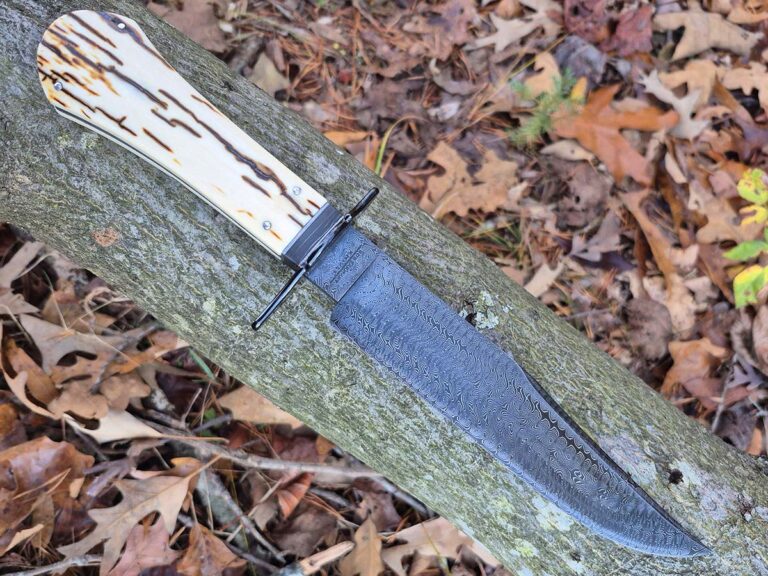
Maker: Bob Earhart Model: Frame Handle Fighter Blade Length: 7.5” Overall Length: 12.3” Blade Steel: 5-bar Turkish twist damascus Guard Material: Blued 1018 Steel Handle Material: Mammoth ivory Leather Sheath: Custom-made by the maker Comments: The knife has excellent balance and handle ergonomics. The frame handle is forged to shape, revealing the pattern. Bob is an ABS master smith. His BLADE Show Table Number is 19S. Price: $1,700 Email Address:[email protected]
Maker: Steve Randall Model: Damascus Fighter Blade Length: 8” Overall Length: 13” Blade Steel: Ladder pattern Damascus Guard Material: Browned carbon steel Handle Material: Desert Ironwood Leather Sheath: Custom-made by the maker. Comments: Contoured guard and handle create a knife with excellent balance and comfort in the hand. Precise ladder pattern damascus, competent work from an ABS master smith. BLADE Show Table Number is 3R. Price: $1,800 Email Address:[email protected]
Maker: Steve Gatlin Model: Loveless Style Chute Knife Blade Length: 4.5″ Overall Length: 9.25″ Blade Steel: CPM 154 Guard Material: Stainless steel Handle Material: Exhibition-grade Desert Ironwood Leather Sheath: Custom-made by the maker Comments: Steve’s exceptional version of the classic Loveless Chute. Light and quick in the hand. BLADE Show Table Number is 7E. Price: $1,400 Email Address:[email protected]
Maker: Mike Malosh Model: Bear Hunter II Blade Length: 4.5” Overall Length: 9 1/8” Blade Steel: W-2 Guard Material: Stainless steel Handle Material: Leather Leather Sheath: Custom-made by the maker Comments: Excellent balance and handle ergonomics. Classic look. It is built for serious work. BLADE Show Table Number 6O. Price: $425 Email Address:[email protected]
Maker: Jason Clark Model: 77 Liner Lock Blade Length: 3.5” Overall Length: 8.12 Closed Length: 4.5” Blade Steel: Damasteel Bolster Material: Black Timascus Handle Material: Mammoth Ivory Opener: Flipper Lock: Liner Clip: Black Timascus tip up Comments: Sleek and smooth. Great lock up! BLADE Show Table Number is 12E. Price: $1,550 Email Address:[email protected]
Maker: GTC Knives Model: Enigma Blade Length: 4″ Overall Length: 9 Closed Length: 4.5″ Blade Steel: Stainless steel Damascus Handle Material: Titanium Opener: SLT (spring-loaded tab) Lock: Inset liner Clip: Titanium tip up Comments: Slick and smooth. Next-level construction and precision. This knife features screwless and toolless construction. WOW. Blade Show Table Number 19A. Price: $3,500 Email Address:[email protected]
A bonnie blade to be sure, Kemper makes a statement with his Scottish dirk.
Derick Kemper celebrates his Scottish heritage with his sprawling reproduction of a Scottish dirk. It’s overstated to salute the legend and lore of his Scottish Highlander ancestors who fought so valiantly for their independence from Great Britain, beginning with the Jacobite rising of 1745.
The edge of the stunning damascus blade is a simple twist pattern of W2 carbon and 15N20 nickel alloy steels. The three bars above it are Derick’s version of Robert Eggerling’s paisley pattern—a modified twist of 203E carbon steel for the bright section and W2 and 15N20 as well.
The habaki has Derick’s Damselfly Forge stamp of two damselflies and his initials in the middle engraved on one side, and the white rose of Scotland’s “Bonnie Prince Charlie” (1720-1788) on the other.
Derick Kemper
The chess-piece-like handle is oversized as well, with the pommel engraved in Latin, Qui Optime Regnare Ius Habet. The English translation is “Who hath best right to reign,” a slogan that appeared on the flags and accouterments of many of the Highlanders in the 18th century.
We collected a group of custom creations that showcase the leaps in synthetic handles.
When you think synthetic handle materials, factory knives probably come to mind. However, synthetics play a larger role in custom knives all the time. Synthetic handles don’t swell or crack from the elements like some natural materials and are outstanding for use. As reflected by the pieces on this and the facing page, they look pretty good, too.
Darriel Caston Ultem
Ultem comprises the grip of Darriel Caston’s fixed utility model in CPM S35VN stainless steel. Blade and overall lengths: 4 and 9 inches. Sheath: Kydex. (SharpByCoop image)
Michael Jarvis Pocket Bowie XL
A G-10 coffin handle steers the AEB-L stainless blade of the Pocket Bowie XL by Michael Jarvis. (Jocelyn Frasier image)
Dustin Driver WISC
Dustin Driver opts for titanium for the handle and frame of his WISC folder. The 3.5-inch blade is hollow-ground CPM MagnaCut stainless steel. Closed length: 4.5 inches. (SharpByCoop image)
Kirby Lambert Phoenix
Kirby Lambert’s Phoenix folder sports a handle of Westinghouse Ivorite paper Micarta® with 6Al/4V titanium liners and a 3.25-inch blade of hollow-ground Reptilian damascus by Vegas Forge. Bolster: Timascus™. Closed length: 4.25 inches. (SharpByCoop image)
Maverick Murdock Dress Slip Joint
A handle of black paper Micarta® with straight twist damascus bolsters over a brass frame house a 3-inch blade of CPM 154 stainless on ABS apprentice smith Maverick Murdock’s dress slip joint. Hardware: titanium. Closed length: 4 inches. (SharpByCoop image)
Harold Parsons Skinner
Green Micarta® and G-10 liners highlight the handle of a skinner in 440C stainless steel by Harold Parsons, who also engraved the bolster. Blade and overall lengths: 4.25 and 9 inches. (Jocelyn Frasier image)
Erik Fritz Slip Joint
ABS journeyman smith Erik Fritz chose burlap Micarta® with 416 stainless steel liners and bolsters for what for him is a new direction: a slip joint. The 2.75-inch blade is flat-ground CPM 154 stainless. Closed length: 3.75 inches. His price for a similar knife: $500. (Jocelyn Frasier image)
The ultimate lineup of custom fighter knives—from integral designs and sub-hilts to exotic materials like copper damascus and mammoth tooth.
Fighters are some of the sexiest knives going. With many, even their curves have curves. Those less curvy make up for it with straight-line designs that look born to perform. If sex really does sell, fighters are the capitalists of cut.
Randy Caston
Randy Caston’s fighter features a 9 5/8-inch blade of 1084 carbon and 15N20 nickel-alloy steels. Scales: blackwood. The guard is mild steel. Overall length: 14.75 inche.(SharpByCoop image)
Adam Deville
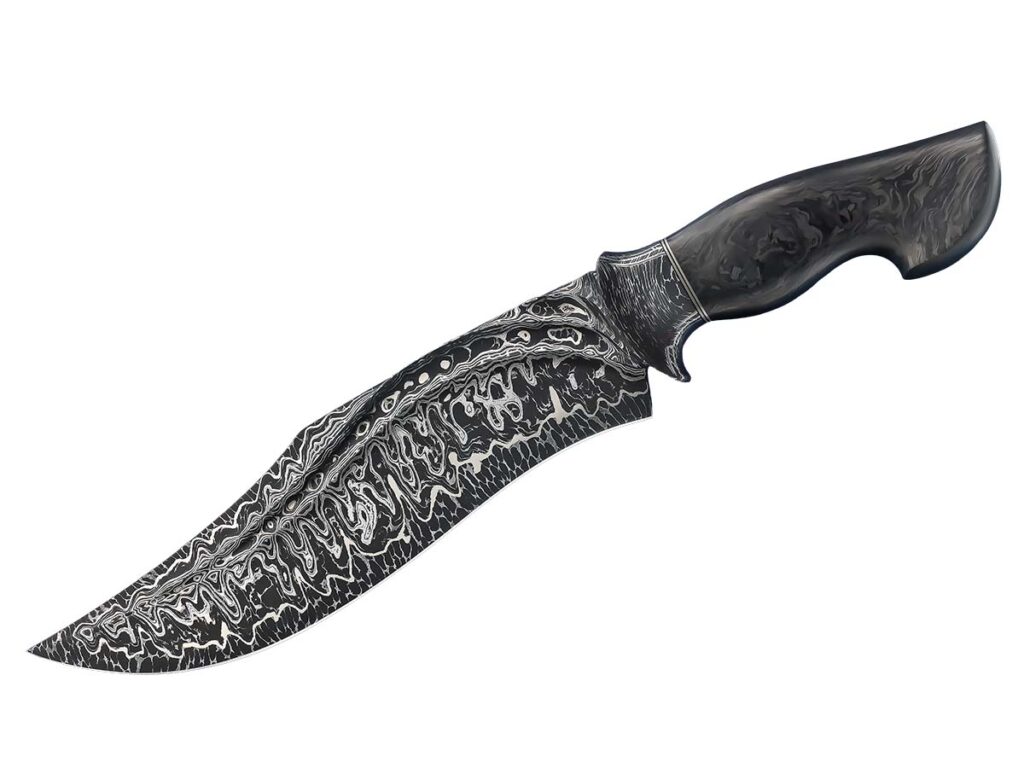
A nickel damascus with a Dragon Skin core forged by Adam Deville sporting a snakelike fuller completes the 10.5-inch recurve blade of Jordon Berthelot’s integral fighter. The scales are marbled carbon fiber. Overall length: 16.5 inches. (SharpByCoop image)
Dennis Friedly
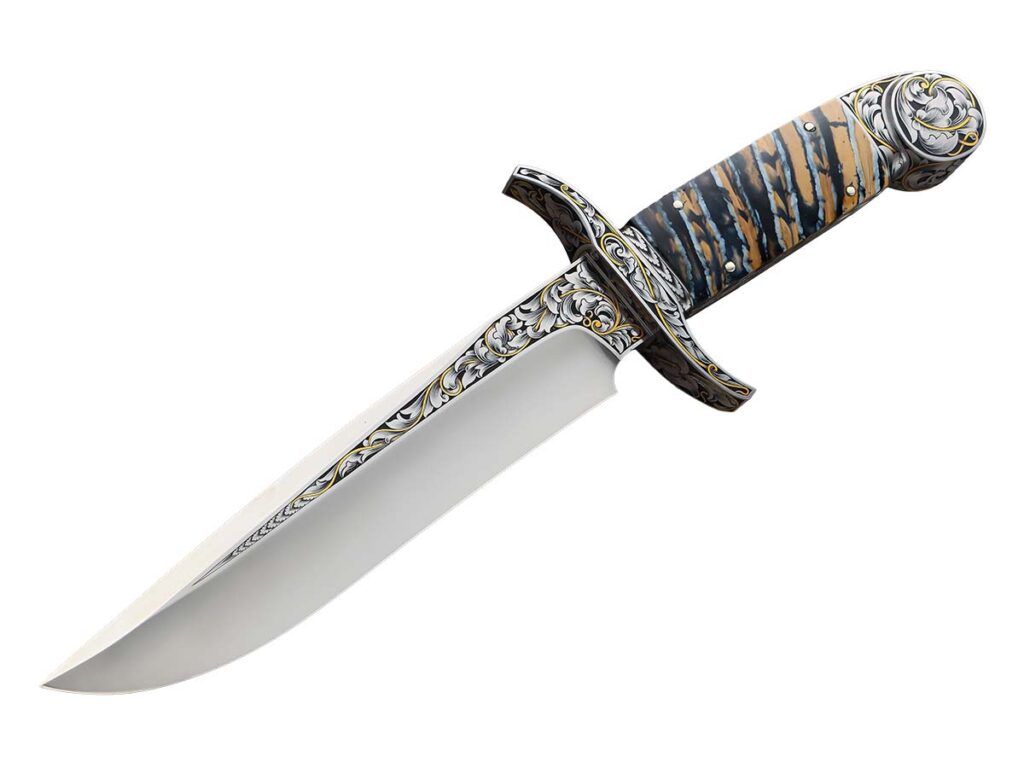
Dennis Friedly outfits his fighter-art knife in a 7.75-inch blade of hollow-ground CPM 154 stainless. The scales are mammoth tooth and the guard is 416 stainless. The engraving is by Ray Cover Jr. Overall length: 13 inches.(SharpByCoop image)
Patrick Harp
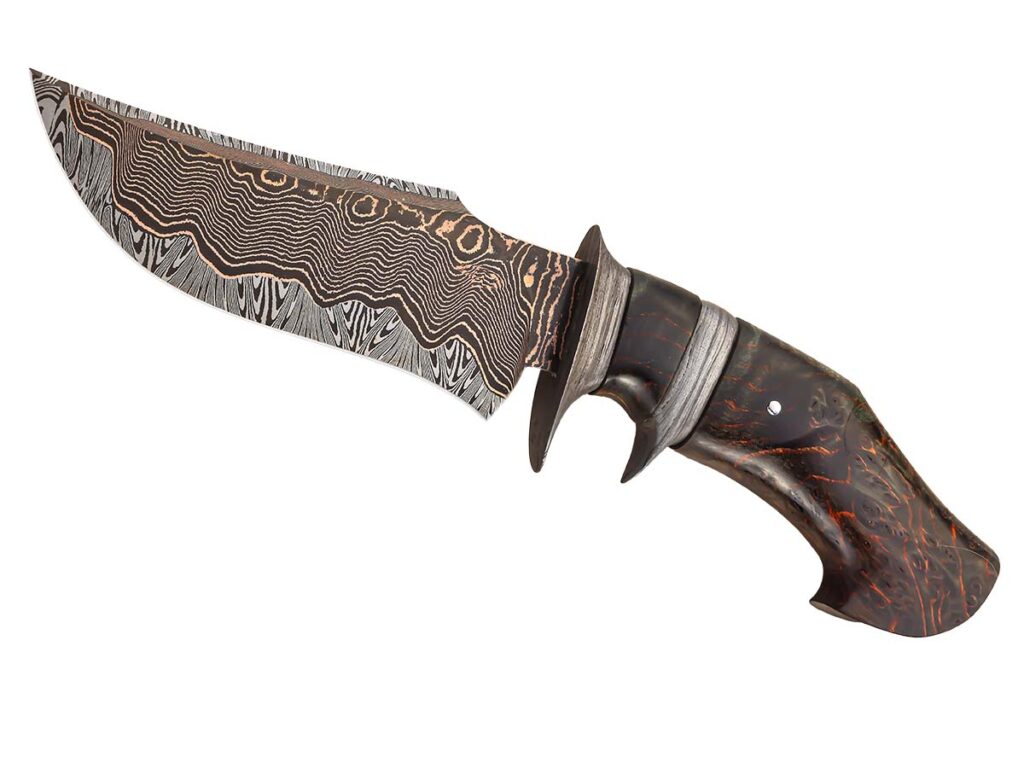
A 6-inch recurve blade in a full-flat-ground crushed W’s and copper damascus forged by Baker Forge & Tool top off a sub-hilt fighter by Patrick Harp of P. Harp Designs. The handle is basswood burl and the guard and sub hilt are wrought iron. Overall length: 11 inches. (SharpByCoop image)
Peyton Ramm
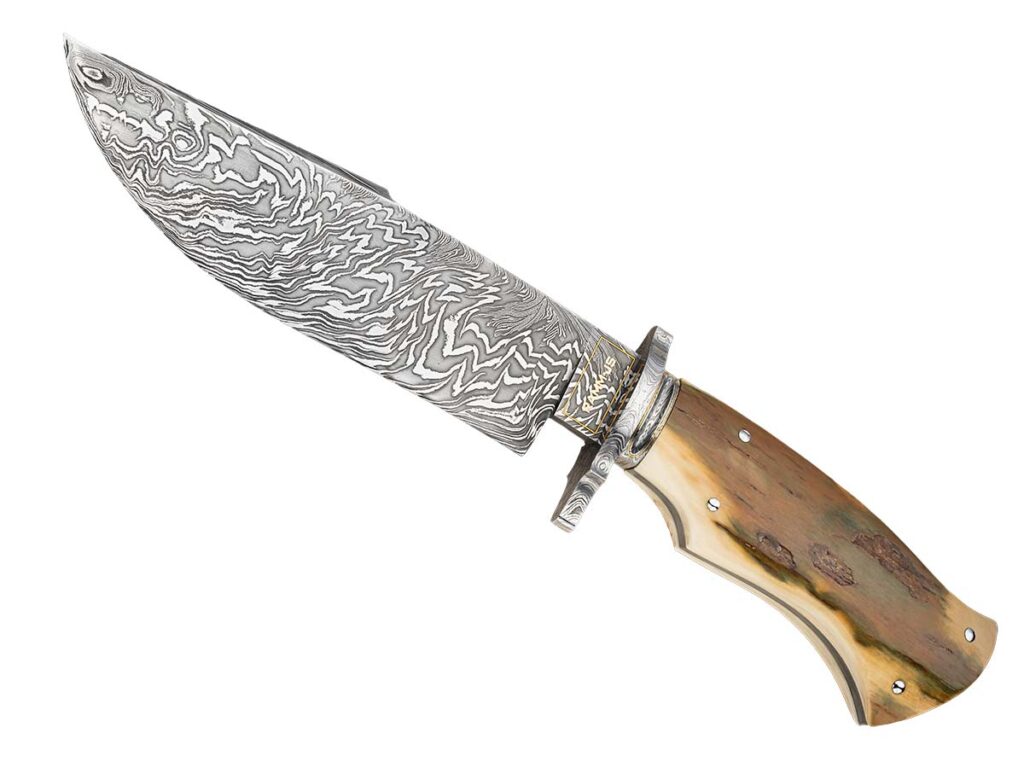
ABS journeyman smith Peyton Ramm opts for a 6 1/8-inch blade of a Transition damascus of 1084 carbon and 15N20 nickel alloy steels for his fighter. Handle frame: damascus. Scales: mammoth ivory. Guard: crushed W’s damascus. Fittings: same as guard but w/24k gold and silver inlays. Overall length: 10.75 inches. (Jocelyn Frasier image)
Steven Ramos
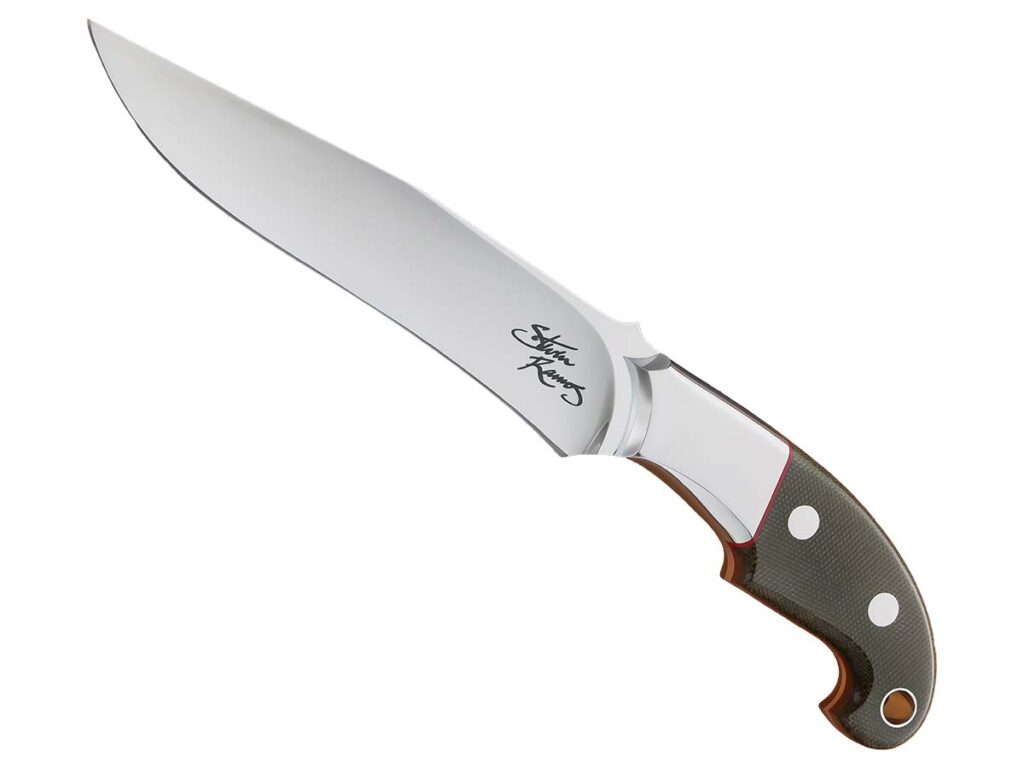
Peregrine by Steven Ramos offers up a 6-inch blade of hollow-ground RWL-34 stainless steel in a green canvas Micarta® handle with red fiber spacers. Bolster: 416 stainless steel. Overall length: 10.5 inches. (SharpByCoop image)
Dan Tompkins
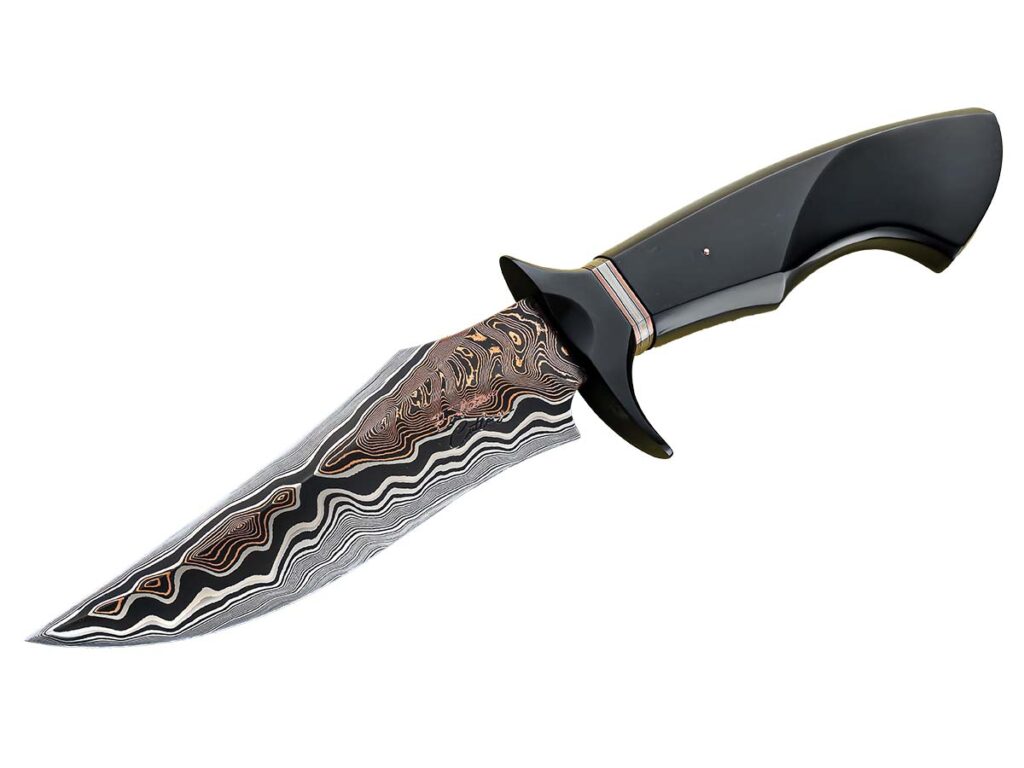
A 5.75-inch blade in convex-ground Riptide Ultra Coppermascus by Baker Forge & Tool and a black Richlite guard and handle comprise the double-edge fighter by Dan Tompkins of Evolution Cutlery. The copper spacers are also by Baker. Overall length: 11 inches.(SharpByCoop image)