Knife collecting is an extremely rewarding experience for knife enthusiasts. There truly is a knife for everyone. Many increase or hold their value throughout the years, making collecting knives something to pass on to the next generation of knife collectors.
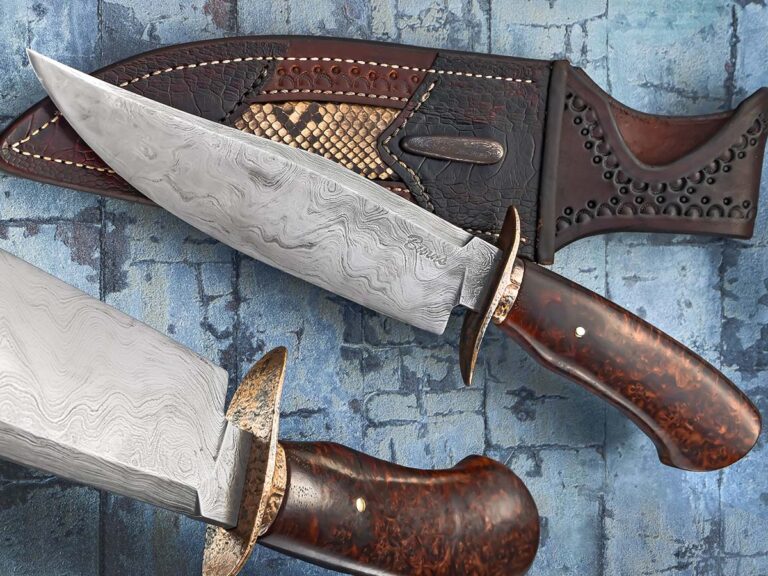
Explore the classic clip-point bowie knife from apprentice smith Robert Burns of Wilderness Ironworks.
ABS apprentice smith Robert Burns of Wilderness Ironworks wanted a project that would take him back to the roots of being a bladesmith, and appears to have satisfied that desire through his classic clip-point bowie.
“My goal was to combine the ancient and the contemporary,” he wrote.
For the ancient, he started with iron ore from Minnesota and iron sand from Connecticut. He smelted the two into bloom steel, which he then refined, “my goal being to make a steel fine enough that it could potentially pass for modern damascus”—thus the “contemporary.”
Robert Burns of Pittsburgh, Pennsylvania, used ancient materials such as iron ore and iron sand for the blade and a historic mix for the fittings of his sole-authorship bowie.
To augment the “ancient,” he used a “historic mix from the Bronze Age” for the bronze for the fittings.
As Robert noted, the knife is true sole authorship, from starting ore to the finished sheath.
Harvey McBurnette etched his name in high-dollar knife sales.
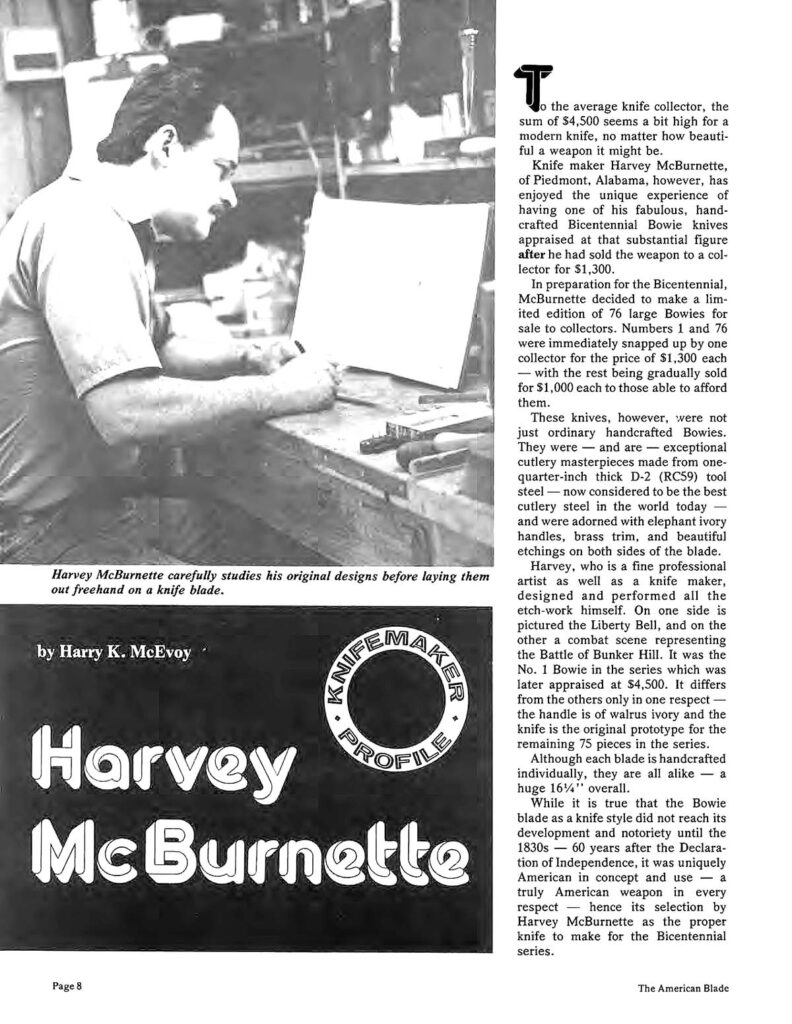
Harvey McBurnette of Piedmont, Alabama, landed in the July-August issue of the 1976 American Blade for somewhat patriotic reasons. Somewhat, because the lead of Harry K. McEvoy’s exposé on the maker was McBurnette’s celebrated Bicentennial Bowies. But there’s more to the matter than a simple commemoration of the nation’s birthday in steel.
McEvoy hooks readers by showing what the artistically talented knifemaker’s work commanded back when your dollar went a long way. In 1976, the exact sum was $4,500. As McEvoy wrote, “[O]ne of his fabulous, hand-crafted Bicentennial Bowie knives appraised at that substantial figure after he had sold the weapon to a collector for $1,300.”
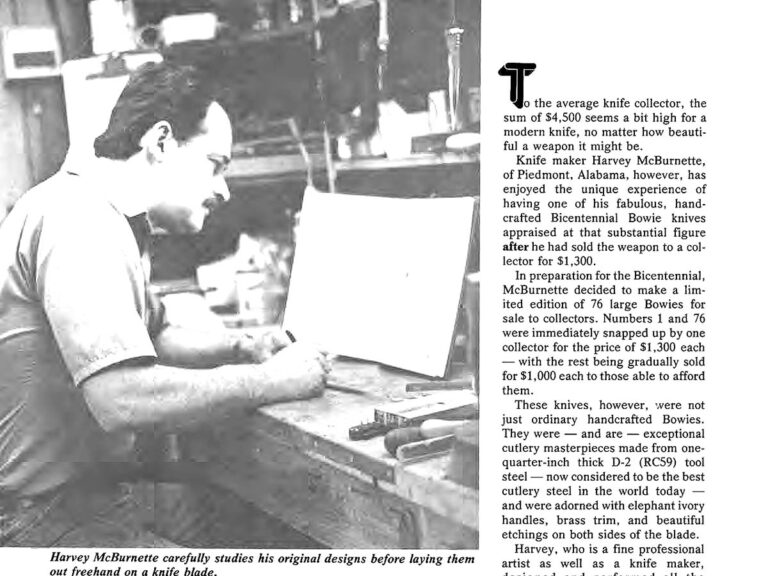
The lead image of the profile on Harvey McBurnette shows him studying his original knife design and free handing it to the steel. The maker had a strong artistic streak and was known, in part, for the embellishments he etched onto his knives.
For context, that’s roughly $26,000 in today’s dollars. What likely made the run of 76 bowies desirable was McBurnette’s unique system of adorning the knives—etching. This system, seen on many of his knives, was a very conscious choice on the maker’s part, as the story reports, serving to differentiate his work from other custom craftsmen of the day.
“I wanted to do something unique, or at least different, with my knives,” McBurnette was quoted as saying in the article. “And since I was an artist I thought if I engraved or etched my blade, I would add a touch I felt was needed to make them stand out. I chose the art of etching because there were a few other knife makers who engraved their knives. Besides, even a master engraver cannot do what an etcher can do.”
McBurnette’s Bicentennial Bowies had quite a motif etched on either side of their D2 tool steel blades. On one side of the 16.25-inch knife is an image of the Liberty Bell, and on the other a battle scene depicting Bunker Hill. The images are the same on all 76 knives, and 75 of them had elephant ivory handles. The knife appraised for the then astronomical sum did differ; the No. 1 of the series was a prototype with a walrus ivory handle.
Learn what the latest BLADE Show custom knife award is all about.
Some people are familiar with “Mack Daddy,” the 1992 Sir Mix-a-lot album with the smash hit “Baby Got Back.” On the other end of the cultural spectrum is the Mack truck, the reliable American long-haul vehicle revered by truckers and country songs. Knife enthusiasts may also be familiar with the Bobby Darin’s classic Mack the Knife: “O the shark, babe, has such teeth, dear …” Just now coming into the knife culture is the idea of a “M.A.C.K” knife, which stands for “machine assisted custom knife.”
Custom, Production And M.A.CKnives
Savvy BLADE® readers know the difference between a “custom” and a “production” knife. A custom knife is made by a craftsman using a combination of skill, experience and tools. The maker grinds the blade, polishes it, installs a handle and fittings, and so forth. Custom knives are often made one at a time or in small batches. Sometimes portions of the process are outsourced, such as waterjetting blade profiles or using a professional heat treater. In general, the maker’s name is prominently featured on the blade, such as Tom Overeynder, Gary Langley, etc. The price of custom knives can be quite high, particularly as the complexity of the knife and the magnitude of the maker’s reputation increases.
By contrast, a production knife is made in bulk using modern or traditional manufacturing techniques. Blades are made by the hundreds or thousands, ground and polished by machines, and assembled in a factory or large production shop. In general, the name of the company is prominently featured, like Case, Benchmade, White River Knife & Tool, etc. Sometimes a production knife will feature the name of the designer, such as the various CRKT production knives that have BLADE Magazine Cutlery Hall-Of-Fame® member Ken Onion’s name. Production knives may be expensive but are generally more affordable than custom knives of similar materials and construction.
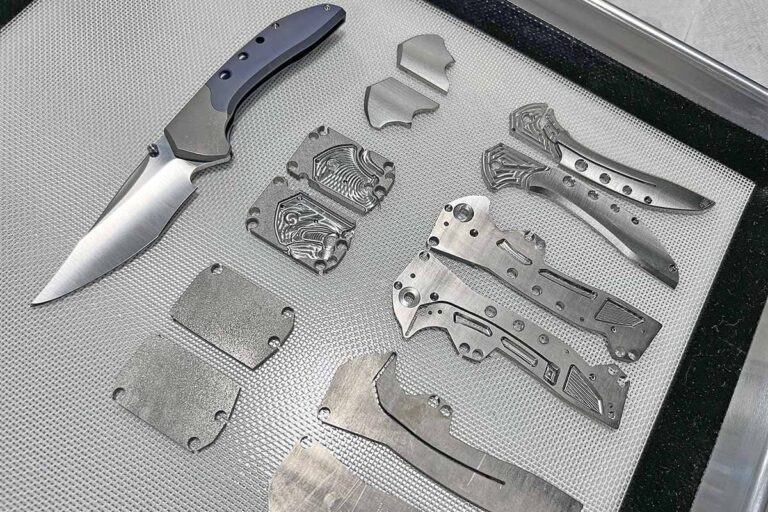
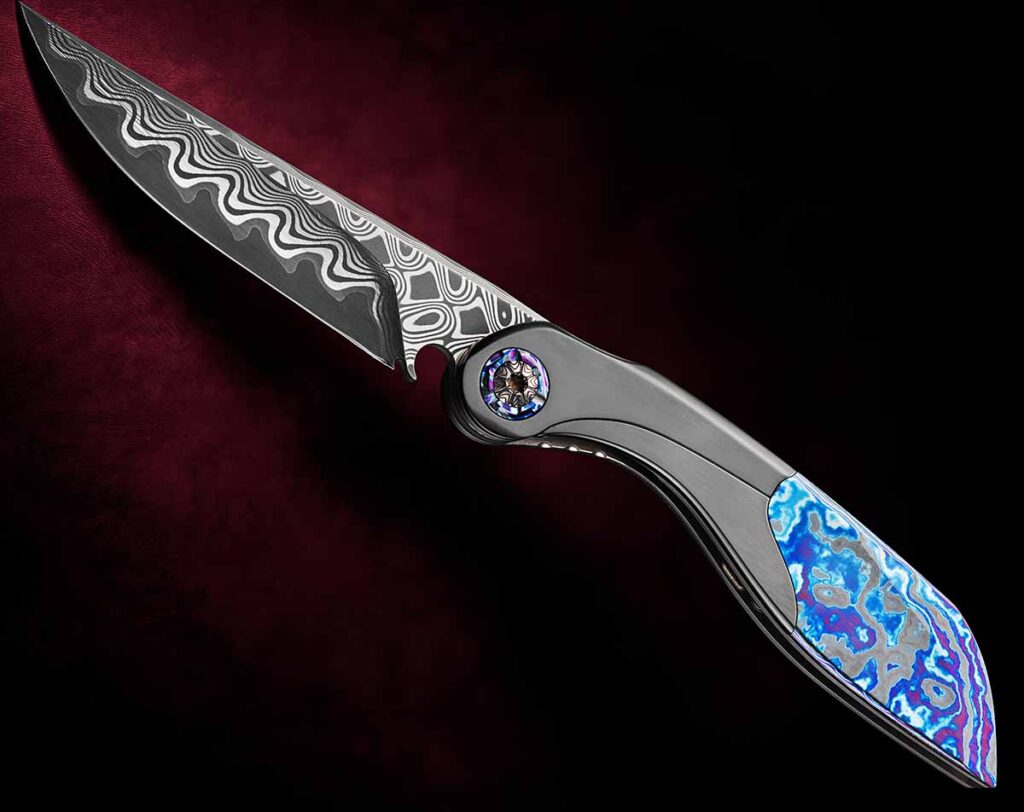
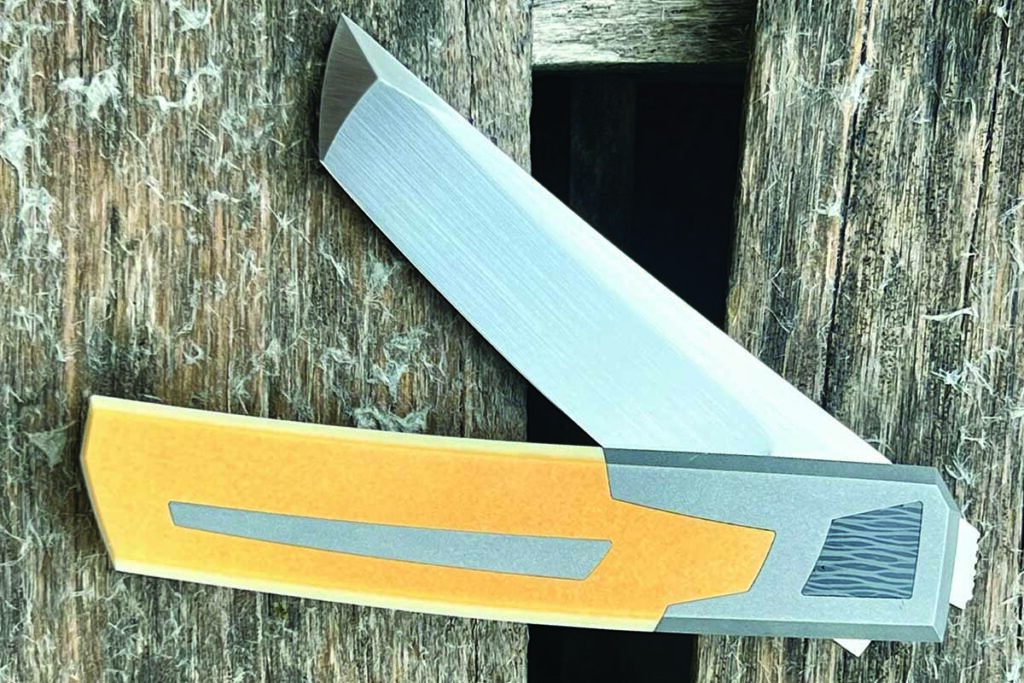
Princeton Wong has a five-axis waterjet in his machine shop, so he makes everything but the screws. An example of his work is this award-winning knife from the 2021 International Custom Cutlery Exposition, now known as BLADE Show Texas. (Caleb Royer image)
In between custom and production is a vast world described by the umbrella term mid-tech. It describes knives that use both production and custom techniques or methods in varying proportions. Some would say that any knife that has production techniques like waterjet is a mid-tech, while others would argue that as long as a person does the final assembly and fit up, a knife can be called a custom.
It takes talent, practice, education and skill to make a knife by hand. Many makers of such knives have no problem with using machines like a band saw, 2×72 belt grinder, manual mill or pantograph. At some level, almost every modern handmade, aka custom, knife is “machine assisted.” At the same time, the industry recognizes that when it’s primarily the maker’s dexterity and artistic vision that makes the knife, the label of custom or even “handmade” applies.
It also takes talent, practice, education and skill to program a series of CNC (Computer Numerically Controlled) waterjets, grinders and mills to make a knife by machine. Custom guys often make “polished turds” and “boat anchors” at the beginning. Beginner machine guys break tooling and crash expensive machines. In neither case does a person wake up one Tuesday and immediately become a competent knifemaker.
Think about the amount of variability in custom/handmade knifemaking. Each steel, each belt, each grinder speed, each brand of sandpaper, and every variable changes the process. If you heat treat your own steel, you must master temperature control, soak time, quench speed, decarb, warpage and tempering, and must use a different formula for each steel. After dealing with all that, is making a knife by machine any easier?
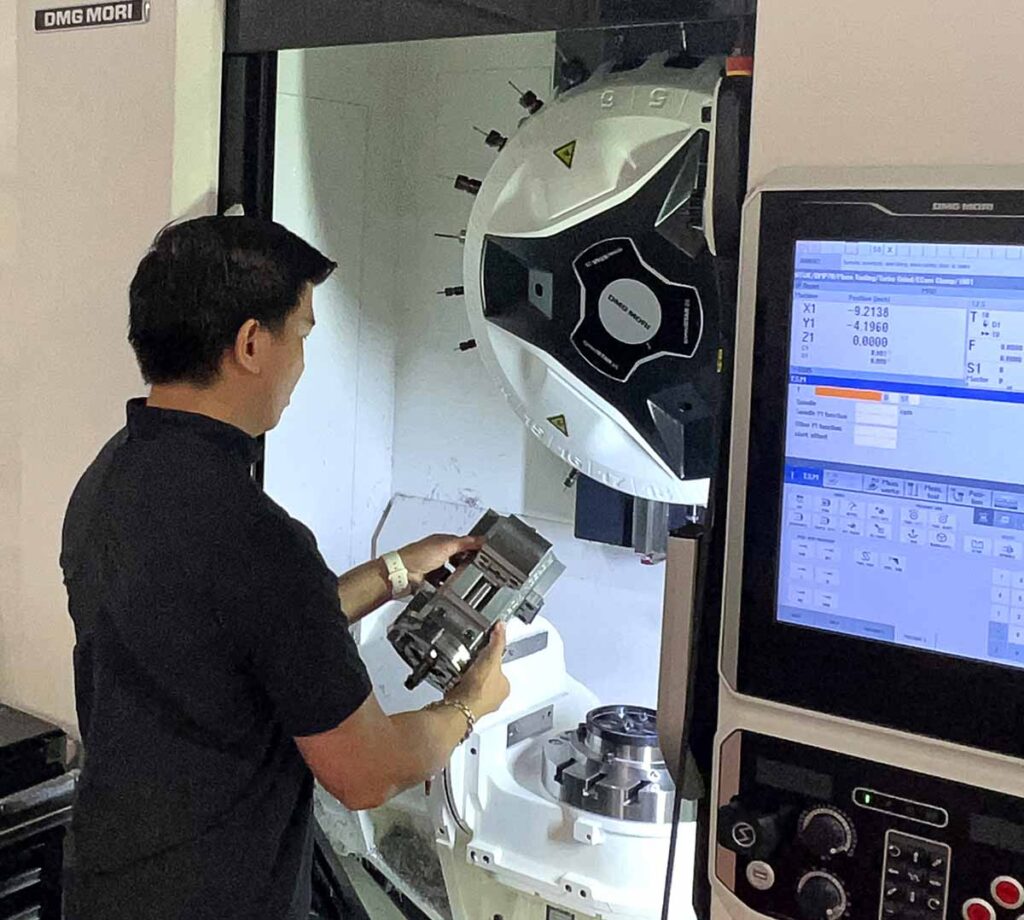
Princeton Wong operates the CNC mill. It can cut complex 3D shapes in metal and handle material.
Not according to M.A.C.K. knifemaker Princeton Wong. In CNC you deal with the geometry and composition of various cutting tools, plus the speeds and feeds at which you apply them. You must figure out fixturing to hold your workpiece, and how to work the tool in a way that leaves the desired surface finish. “It’s the same idea as using different belts or different files for each task,” Princeton explains, “but the variables are infinitely more complex. And then on top of that, you still have to learn and master all of the different hand-finishing techniques.”
So how does the knife industry show respect to the skills and talent of the makers who artfully combine programming with handwork? How do you showcase the ability of a maker who can run both a HAAS CNC mill and a belt grinder?
Defining M.A.C.K. Knives
BLADE Show 2023 included for the first time an award category for M.A.C.K. knives. According to the category rules:
The knife must be of the folding/locking, non-slip-joint, EDC variety that is first and foremost a cutting tool. It must be functional, beautiful and have great ergonomics, yet still have practical applications and uses. It must consist of both at least one handmade feature—such as hand-ground blades, hand-contoured scales, manually machined parts, etc.—and of automated features such as waterjet-cut liners/scales, CNC’d handles, etc. The judges will assume that the knife’s parts that are not handmade are made through a machine-aided process.
What background education and experience does it take to make a quality M.A.C.K. knife? Just like with any other skill set, the path is quite diverse. Take Princeton for example. Knifemaking for him growing up was a passion.
“As an Asian kid into martial arts, I’ve always had a love for bladed implements,” he notes.
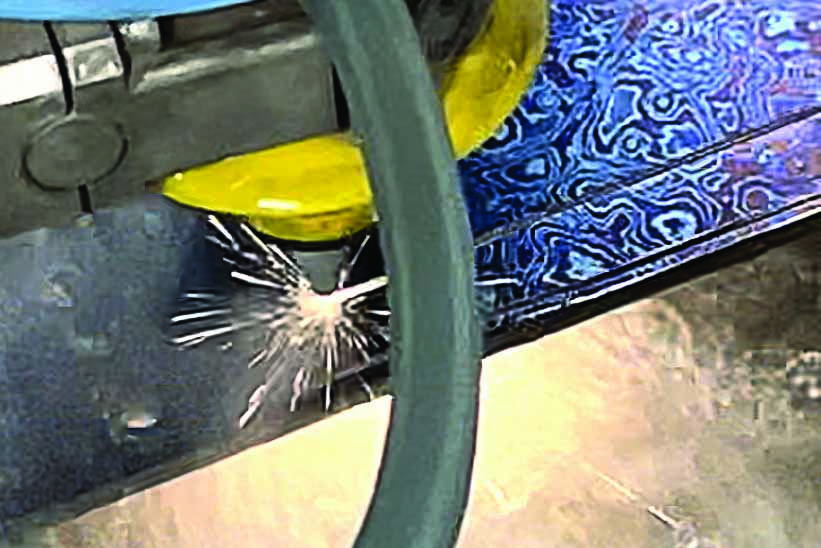
A waterjet machine uses a high-pressure stream of water and abrasives to cut profiles in flat stock. Princeton Wong uses his waterjet here to cut Timascus™ for folder handles.
He bought a Sherline mill after high school that had been converted to CNC, and learned by trial and error from there.
“After years of fiddling with stuff, breaking endmills and crappy software, I finally started figuring it out,” he observes. But for Princeton, learning wasn’t all trial and error. He studied mechanical engineering and graphic design in college. He had jobs in print, web, graphics and fabrication. Eventually, he started his own machine shop serving automotive and architectural clients. In 2018 he decided to use his machining skills to make knives.
“I didn’t know the knife industry or knife people but had a machine shop, so I gave it a shot,” he recalls. “I didn’t own a ‘real’ belt grinder until I was two years into making knives. I had a 4×36 from Lowe’s but was able to do very close work on the CNCs. By focusing on an intentionally machined look, I was able to get by.”
Princeton has a five-axis waterjet in his machine shop, so he makes “everything but the screws.” Earlier in his progress, he would bandsaw blanks and then fixture them in his CNC mill.
“I never had a need to outsource, but most people don’t have 70 amps of 480-volt three-phase electricity to run a $100,000 waterjet,” he says.
A waterjet cuts steel and other plates into shapes, “but it doesn’t make knives.” It’s a highly efficient profile-cutting tool.
Bridging The Gap Between Custom And Production
Most people don’t take Wong’s path and start out as fully equipped and capable machinists when they begin making knives.
Consider the precise fitting and complex geometry of the joints on Jared Oeser’s “Tachi” folder. Integral bolsters and Westinghouse Micarta® come together quite well.
M.A.C.K. knifemaker Jared Oeser started like many makers, with a mentor, a few tools and a new hobby. As a homebuilder, his business took a hit in the 2011 recession. Faced with spare time, he took up knifemaking. After a few fixed blades he moved fairly quickly into slip joints, merging modern materials into traditional designs at a time when that was a new thing. He continues to push the limits and bridge the gap between traditional designs and the “modern” folding knives.
About five years ago a friend needed a place to store a CNC mill. Oeser agreed to store it in exchange for lessons and use of the machine in the meantime. By the time the friend needed the machine back Oeser was hooked and bought his machine shortly thereafter.
After five years, he considers himself not good enough to make a knife completely on the machine. Coding for CNC is quite a different skill set, far beyond traditional knifemaking.
“I don’t want to go 100 percent machine,” Jared says. “I like the hand work, and I’ve gone about as far as I want toward machine-made. Everybody kind of finds their ‘spot,’ but the key is to disclose it, to say it. Don’t say ‘mine’s handmade’ if you’re afraid to say how you did it. At the end of the day, you’ve got to be good at hand work and have a skill set to make a quality knife.”
Handmade Vs Machine Assisted Knives
So what’s the difference between a “custom/handmade” and a “machine assisted” knife?
Wong suggested that a machine assisted knife should have a bit more precision than the typical custom knife. Because you can machine to exact tolerances and fit, there’s less room for error. He also suggested that the maker should try to push the boundaries of the machine’s capabilities. Just like there are a few knifemaking operations that can only be done by hand, such as Wolfgang Loerchner’s amazing hand-filed creations, there are also machinable features that people wouldn’t realistically try by hand. Creativity isn’t limited to hand tools.
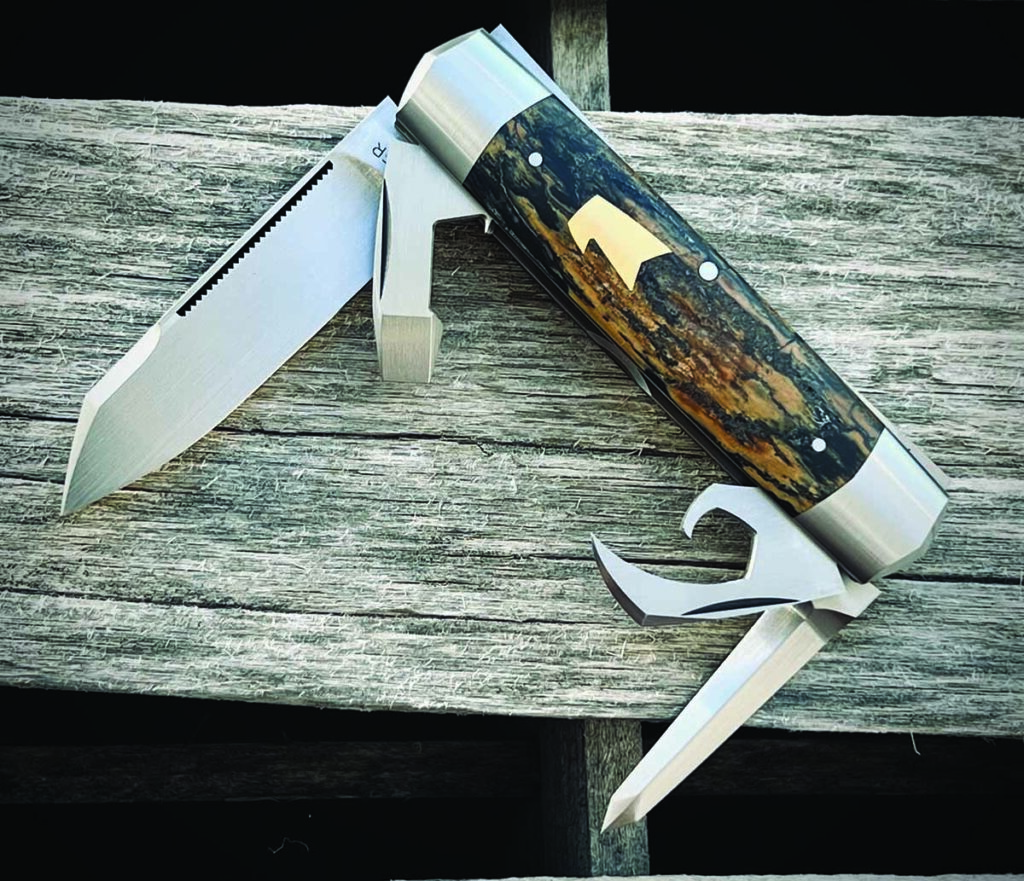
Jared Oeser’s “Eagle” is a four-blade slip joint. This one has mammoth ivory handles and a 14k-gold shield, combining modern techniques with traditional materials.
According to Oeser, “Among the makers and collectors I know, we’re OK with whatever a knife is, as long as you honestly disclose how you built the knife.”
He considers his knives machine assisted. On a slip joint, he uses a HAAS CNC mill to cut out the shapes of the liners, the shield inlay pocket, and to profile the blade and spring. Even though he uses a CNC mill that is squarely in the “machine assisted” category, using it primarily to cut profiles is pretty much the same thing as a waterjet.
Taking The Plunge Into M.A.C.K.
As a mostly one-off knifemaker myself, I was curious what it takes to build a knife that falls squarely into the M.A.C.K. category.
After talking with some M.A.C.K. makers, I found the process seems to typically begin with waterjet cutting. Either the maker has used a waterjet before and has his or her own CAD (Computer Aided Design) files, or the contracted machine shop will have a CAD expert on staff. Experienced CAD folks can work from a drawing or PDF for things as simple as profiles, and may use modeling software for contours and handles.
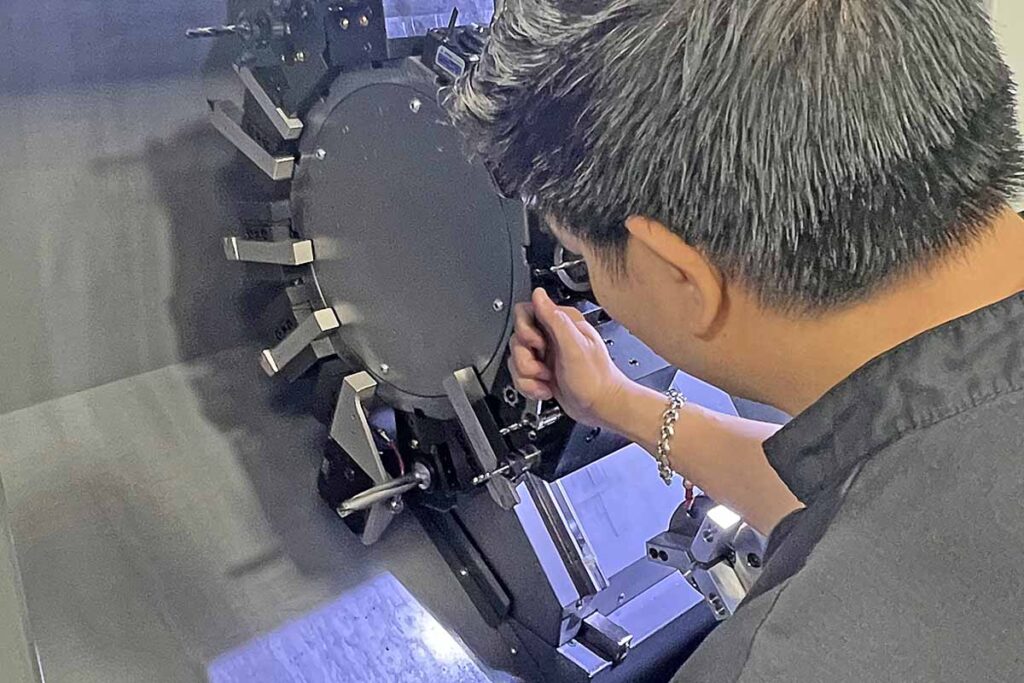
Princeton Wong checks the tooling on a CNC lathe. The lathe cuts precise round stock, such as screws and folder pivots.
Typically the liners are cut and the holes spotted, or are occasionally fully drilled and tapped. Pocket clips and backspacers come pre-cut. Handle profiles and contours are cut with a ball end mill, leaving a fairly clean finish. Sometimes this finish by itself is sufficient, while other times more hand polishing is necessary to achieve the final effect. Blades are typically delivered cut to contour, and the maker often does the bevel grinding by jig or by hand on a traditional belt grinder. Other times the blades come with machined bevels at varying degrees of surface finish. Once again, it’s up to the maker to decide if the machined finish is sufficient or if further hand work is necessary.
If you’ve ever used waterjet or milled parts, you know that the edge finishes are not precise. If you’ve had holes spotted but not drilled, you still have to drill and tap the holes. All in all, even in a knife that comes to you in a bag from a machine shop, there’s more to a cleanly finished M.A.C.K. knife than just assembly. If you want to be a winner in the M.A.C.K. category, you’ve got to have the hand finishing techniques down pat.
If you want a firsthand look at a quality M.A.C.K. knife, check out the applicable tables at a BLADE Show. Whether you prefer the events in Atlanta, Texas or Utah, there’s no doubt that “M.A.C.K. is back in town.”
Japanese blades have enchanted and endured for centuries with no end in sight.
The lure of the Eastern style has captivated cutlery artisans for centuries, and interpretations of it remain alive and well, blending tradition seamlessly with modern techniques and materials while staying true to their roots in Japanese culture. While there is plenty of skill required and the artist’s eye lends its perspective, custom knifemakers continue to produce wonderful examples in fusions of blade, tsuka (handle) and furniture—and they are quick to explain the reasons why.
Denis Tyrell
Quite a Japanese blade! Denis Tyrell’s aptly named Silver Moon katana features a 29-inch blade that is pure silver laminated: damascus over silver with an 80CrV2 carbon steel core. The traditionally wrapped tsuka (handle) has silver and mild steel fittings and silver inlay. The tsuba (guard) is mild steel. Overall length: 40 inches. Tyrell’s price for a similar sword: $9,500. (Jocelyn Frasier sword image)
“Japanese blades have both an elegance and a mystique to them,” said maker Denis Tyrell of Livermore, California. “They have subtle curves that really appeal to me. They are also very complex to build and get right—I’m still striving for a higher standard.”
Setting out on a creative path that brought modern and traditional methods together, Tyrell made great strides toward that standard in his Silver Moon katana. “I appreciate all the complex fittings on these swords, so I try to keep to that mix,” he noted. “The blade is where I step out a bit more into the modern, using damascus steel and other techniques to really show it off.”
The result of Tyrell’s effort succeeds in highlighting the 29-inch damascus blade and handle wrapped in faux leather. The fittings are silver, while the guard is mild steel with silver inlay. The blade presents something of a surprise with its damascus cladding over silver with a solid core of 80CrV2 carbon steel. To preserve the integrity of the damascus, the blade was not heat treated. The sword is 40 inches overall and the blade grind is convex.
“The melting point of silver is 1,763 degrees Fahrenheit,” Denis added, “so it’s challenging to forge that together with the damascus cladding and core without melting it. I also found getting the fittings perfect so a single pressure-fitted peg will hold it all together with no slack to be a challenge.” Denis said the Silver Moon sold for $9,500. The owner has invested in an authentic Japanese-style sword that not only exhibits great talent but also pays tribute to the historical appeal of those produced in the past.
Drew Lininger
A hollow-ground blade of AEB-L stainless steel and a jade-green G-10 handle highlight Drew Lininger’s Tanto Kwaiken. His price for a similar piece: $400. (Jocelyn Frasier knife image)
Drew Lininger of Belgrade, Montana, honed his knifemaking skills further with his Tanto Kwaiken, a stylized version of the small, single-edged dagger carried by the Samurai for close self-defense.
“I love slimmer, more streamlined knives, and the Japanese style really appeals to me with its simple lines that make for a complex knife,” he related. “I also like how you can scale the designs easily. You can basically make the same knife in multiple sizes without having to change anything but the dimensions.”
The Tanto Kwaiken has a 4-inch blade and 8.25-inch overall length. Drew decided on AEB-L stainless blade steel complemented with a handle of jade-colored G-10, its fibers presenting a pleasant textured look approaching the ricasso. The guard is Grade 5 titanium. The most difficult aspect of the knife’s production was succeeding with the precision required for the numerous angles and lines to meet at the same apex without variation on all sides of the handle.
One departure from tradition is the blade grind. “It is a 6-inch hollow grind,” Drew commented, “definitely not standard for traditional kwaikens. I had originally seen the full hollow grind on some folding knives and wanted to try it on a kwaiken.”
Jim Perkins
Jim Perkins’ wakizashi takes down by removal of the pin from the Japanese maple handle. The 19-inch blade is 1,724 layers of 1095 carbon and 15N20 nickel alloy steels. Overall length: 28.25 inches. Jim’s price for a similar piece and saya (scabbard) is around $2,500. (SharpByCoop knife image)
Jim Perkins of Garden City, Kansas, built a superb wakizashi at 28.25 inches overall with a 19-inch damascus blade consisting of 1,724 layers of 1095 carbon and 15N20 nickel alloy steels. The stunning blade is accented with copper habaki (collar), seppa (spacer) and tsuba (guard), and a handle of gleaming Japanese maple. Jim’s price for a similar sword would be around $2,500, and he likely would relish the opportunity to take another stab at such a piece.
“For me, the appeal of the Japanese style is in the history and the flow of the traditional blades,” he offered, “along with challenging myself to make the symmetry of mine as aesthetically pleasing to the eye as possible. If you look at traditional Japanese blades, you see a natural beauty that has been a tradition of the master smiths who have made them. It is hard not to be inspired by their work.”
Giving a nod to his preference for modern materials, Jim also takes advantage of some conveniences in the shop. “Since I’m a bit older, the hydraulic press is invaluable,” he explained. “It saves my shoulder from the abuse hammering out the steel would inflict. That said, while I am working the steel I try to keep in my mind’s eye the process the masters might have used, and attempt to honor their traditions the best I can using modern materials and methods. Examples of this would be that I ‘bed’ the tang in the handle and my milgraining treatment to the tsuba.”
Jim describes the wakizashi as full takedown with the removal of the handle pin. He fits the tang to each side of the handle using a saya nomi, Japanese for scabbard chisel, made by Walter Sorrells. Afterward, Jim glues the handle sides together for fitting to the tang, applies petroleum jelly to the fittings and the tang, and fills the handle cavity with epoxy, which he allows to cure for approximately three hours.
From there he removes the handle from the tang, cleans off the petroleum jelly, and resets the handle in the tang to allow final setup. Jim works the tsuba with a hammer from the center toward the edge, and hammers a design into the material with a small ball-pein hammer. In this particular case, he finalized a textured finish on the engraving bench with a milgrain tool.
“I allow the copper tsuba, seppa and habaki to patina naturally through handling as opposed to using a chemical application,” Jim said, “and I would be remiss not to mention the meticulous requirements of prepping the steel for each forging session. Keeping the steel as pristine as possible for the next forging session to eliminate any forge welding failures is tremendously important. The discipline required to do this increases as the layer count goes up, but it is an absolute necessity to avoid disappointment in myself or the final product.”
Kieren McNeilly
An 11-inch blade forged from W2 tool steel sporting a slanted choji (clover-tree flower) hamon and a raw stingray hide handle top off Kieren McNeilly’s traditional tanto. The stingray hide underwent no dying or tanning to keep it nice and hard. Overall length: 16.5 inches. (Rod Hoare knife image)
Capitalizing on available media such as books and YouTube videos while also talking with other makers, Kieren McNeilly of Warwick, Queensland, Australia, stepped into Japanese-style knifemaking with optimism. “I highly recommend anyone thinking about making one to just go out and do the same,” he smiled.
McNeilly’s work is a reflection of other aspects of his life. “My house has touches of Japanese art all around, from Samurai masks to antique tsuba and more things not related to knives,” he said. “Japanese knives are simple, well-thought-out designs, all built for a purpose. I’m also a big fan of a satin or polished finish on a blade with contrasting forged texture, which is another common thing you see in Japanese knives. Same for the swords. All parts of the katana serve a purpose, from differential heat treatment of the blade to the ray skin down to the mekugi [pin] that holds it all together.”
McNeilly’s traditional style tanto is 16.5 inches overall with an 11-inch blade forged from W2 tool steel. The saya (scabbard) is buffalo horn and the handle is raw stingray hide. The latter did not go through any dyeing or tanning process, which keeps the material hard and stiff.
“Three areas of this knife gave me issues,” he related. “The first was the heat treatment when the water quench failed. Luckily, I had no cracks. The blade didn’t fully harden, so as an easy fix I went back through my normalization cycles, clayed the blade again and then quenched it in oil.
“The second issue was the constant attention needed to get the width and diameter of the handle and saya to match as closely as possible when sheathed, with perfect fit-up and zero gaps. Lastly was working with the raw stingray hide. The calcium nodules are extremely hard and make cutting the material difficult. The hide also has to be soaked in water to take shape around the handle.”
To solve the problem of gaps developing as the raw stingray hide dried, McNeilly used masking tape to add mass to the handle and then removed the tape to allow the hide to shrink to the proper position. “It left just enough space for the hide to shrink that last little bit,” he remembered, “and this still took me a few attempts to get it right.”
Using a combination of Japanese and Western methods and materials, Kieren achieved magnificent results. “I have not used tamahagane, a precious bloomery steel, and if I were to, I would make a point to use all traditional materials and more traditional techniques,” he concluded. “Synthetic materials like G-10 and Micarta® work great as substitutes for more traditional materials like bone or horn, although I love how horn and bone can add a lot of character to a piece.”
Lonnie Williams steampunk folder is one fast, loud auto.
As the eighth entry saluting my addiction to steampunk folders, Steam Hunk is a giant, 2-pound, all-damascus auto. It’s powered by a standard leaf spring as well as two coil helper springs. It’s fast and loud!
Of the 48 individual parts, 18 move. I just can’t do the glued-on gear thing. The blade fires by a palm-activated rocker lock with the safety switch at the left rear. Steam Hunk represents about 300 hours of work and 32 square inches of damascus.
The Author Got To Spend A Weekend Making A Custom Knife With Legendary Maker Bob Terzuola
Over 30 years ago when I was just getting into the knife collecting hobby, I was at a gun shop on Long Island. I noticed the knife in the salesperson’s pocket and asked if I could see it. It was a custom Bob Terzuola.
I had my own Spyderco Terzuola factory/custom reproduction that recently had been introduced and I was amazed to see and handle a custom Terzuola for the first time. I thought to myself that someday I would own a custom Terzuola. Little did I know that one day I’d have a chance to make my own custom knife with Bob as well.
In the course of my “collecting career” I managed to get one Terzuola—to say the least. Now I have around 75 Terzuola knives! During this journey, I’ve met Bob many times and we’ve become friends. He’s a truly remarkable person who’s been making knives for over 40 years. More than just a knifemaker, he is an artisan, inventor, and craftsman, too. In addition, he has plenty of interesting stories to tell.
This past fall, Bob and his wife, Susan, were in Chicago and we met for dinner. It was around my 50th birthday (which, coincidentally, I share with Susan). As a gift, Bob invited me to come to his shop near San Diego to make my own knife.
So in March I flew to San Diego to spend a few days with Bob at his storied “Knife Camp.” I was a bit nervous. I don’t really have any knifemaking or even machinery type experience. My family came along with me—my daughter loves Bob’s dogs, while my wife enjoyed the local botanical gardens with Susan, who is an artist and a master gardener.
Who Is Bob Terzuola?
Bob’s knifemaking journey began in Central America. In the late 1960s, he served in the Peace Corps in Panama. After completing his service, Bob settled in Guatemala, where he managed a jade company. It was there, in the late 1970s, when Bob began to first make knives, mostly for military operatives in Central America. In 1984 he returned to the USA and set up shop in Santa Fe, where things really took off.
Bob is often referred to as the “father of the tactical folder” and is best known for his ATCF (Advanced Technology Combat Folder) model, which was released in 1985. Wanting to create a discrete yet robust, functional, and easily deployable knife, Bob was one of the first custom knifemakers to use titanium, pocket clips, and G-10.
He was among the first makers to use a thumb disc and have parts laser cut. Bob is also credited with being the first custom maker to do a knife collaboration with Spyderco. Made in 1989, the knife was the Spyderco C15, which held patents for being the first U.S.-made factory knife using premium steel and G-10, along with a linerlock.
Bob Terzuola’s Shop
Bob shows the author how to grind.
When you first walk into Bob’s shop, you’re immediately struck by how neat and organized it is. As far as equipment, he has all that’s required with over a dozen machines including a band saw, milling machine, grinders, drill presses, and blasting cabinets.
More than the equipment, though, Bob’s shop is like a history of his knifemaking. The shop is dotted with mementos of his career, gifts from customers, letters of praise, awards, and trinkets from over the years. There’s also a collection of police patches from all over the world, along with hats and photos. On one bench he even has an artillery shell. Of course, the C15 Spyderco knife patent is on display as well.
Knifemaking With Bob
Using the lathe, Bob helps the author trim the pivot barrel to the proper length.
Time to make a knife! We decided to go with a 3-inch tanto folder, which is one of my favorite overall configurations. Bob suggested basing it on his Mini Athena model. He already had two handle liners cut out that we could use. I had to do the rest.
He explained the basics of operating the machines and got me to work right away. Within 45 minutes of pulling into his driveway, I was using a bandsaw to cut a blade profile drawn on a sheet of MagnaCut steel. Then I was drilling the pivot and screw holes in liners, countersinking holes, and smoothing out edges.
Things got quite serious when Bob had me “practice” taking the blades out of the heat treat oven. It’s pretty crucial to not drop the blades, which are heated to 1900° each when removed from the oven. Oh, and you read right, I did say “blades” as Bob had me cut two in case I screwed one up at some point. Fortunately I didn’t drop the blades after the heat treat, so that was a relief.
Next, I picked out my scale material. I like Micarta® so green canvas Micarta was an easy choice for me. Bob gave me a sheet of the material and off to the bandsaw I went. Same for the backspacer, for which I used some yellow/white Micarta for a bit of contrast.
The next day a lot of time was spent cutting the lockbar—Bob set up the milling machine for me—smoothing out the scales, adjusting stop pin placement, and putting the handles together many times to make sure everything fit just right.
Of course, all the work was made a bit easier and more efficient by using the tools that Bob has made, often even invented, over the years. His shop is filled with a plethora of tools, devices, holders, clamps, and more, many of which he’s designed and made himself to make his knifemaking process more reliable and efficient.
Next came the grinding, probably what many think of as the hardest and scariest part of making a knife. One of the first things Bob said to me when I arrived at Knife Camp was, “We can always take more away but we can’t put things back.” I think that nowhere is this truer in the knifemaking process than in grinding a blade. If you make a big mistake here, there’s no fixing it. Obviously, there is a practiced art to this. I seemed to do OK on the grinding part—until I wasn’t.
Overall, I ground the blade well but got sloppy on one of my final passes. I started a bit too soon and ground some of the area near the detent hole. When we put the knife together, it was pretty clear that the mistake had implications. Basically, there was no detent. It was pretty disappointing, but then we remembered the second blade I cut in the beginning. Clearly, Bob had been thinking ahead.
Finishing My Blade
The finished knife is based on one of Bob’s Mini Athena models sporting a 3-inch tanto blade of MagnaCut stainless steel and a green canvas Micarta® handle with pocket clip.
On day three I got to work grinding the second blade and managed to not repeat my mistake of the day previous. Then I sandblasted the blade. After that, I began the process of putting the knife together, taking it apart, tweaking it a bit, putting it back together, all over and over again until it worked just right. Finally, the action, lockup, and centering were good. Bob sharpened the knife for me and it was done.
I don’t know that I’ll ever be a knifemaker but I made a knife, and I love it!
Over the years, I’ve gained a lot of knowledge about knives but to actually make one was something else entirely. The amount of planning and work, especially detail work, that goes into a handmade knife is truly remarkable. Being guided by and watching a master like Bob made my experience even more remarkable. He knows what works well functionally and artistically. He thinks several steps ahead and takes the time with each detail. That’s why his knives are highly desirable.
Thank you again Bob—and Susan—for your hospitality and for making this opportunity happen.
Designers and companies join forces to help consumers win with these knife collaborations.
A collaboration knife is produced when a designer or knifemaker partners up with a knife company to produce a particular knife. And more often times than not, such models offer the best of both worlds. Designers able to focus purely on designing and not confined to the limits of their shop can shoot for the stars. While companies take the reigns of producing the knife to exacting specs and usually at a buyer’s price. In the end, the knife consumer wins. Here is a handful of the latest collaboration drops certain to get knife aficionados juices flowing.
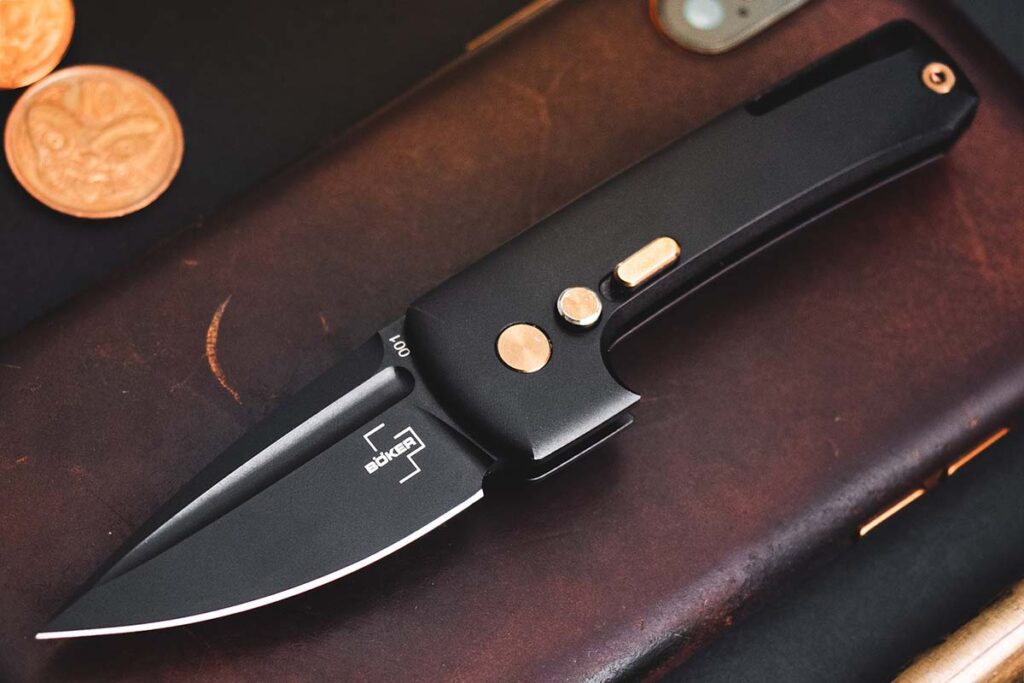
Harlock Mini / Boker Plus
A blade only .11 inch at the thickest helps the Boker Plus Harlock Mini tip the scales at a scant 2.19 ounces. At about 2.87 inches closed and with a lean, sexy pocket clip, the Harlock Mini is made for executive wear. It comes with a nylon pouch.
If you’re looking for an elegant knife present for that special someone, you could do a lot worse than gift him or her the Boker Plus Harlock Mini designed by custom knifemaker Darriel Caston.
Designer: Darriel Caston Knife type: Push-button automatic Blade length: 2.05” Blade steel: Black-coated 154 CM stainless Blade grind: Convex Handle material: Black-coated aluminum Hardware: Brass Knife to Know: A latching slide lock locks the blade closed and prevents accidental release Closed length: 2.87” Carry: Pocket clip and nylon pouch Country of origin: USA MSRP: $146
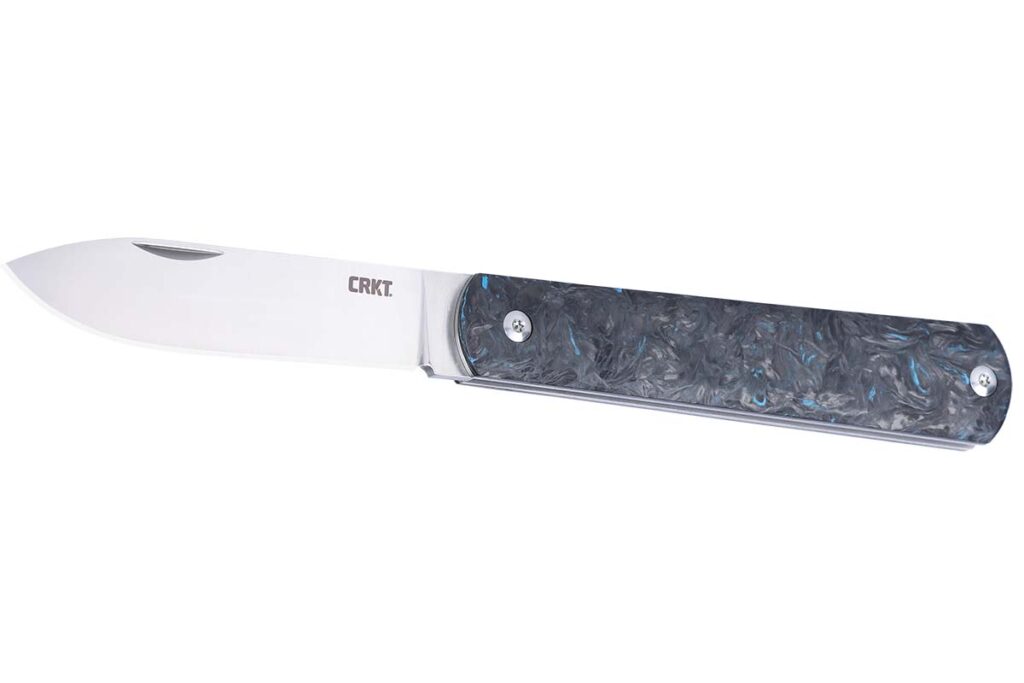
A.P.C. (Always. Pocket. Carry.) / CRKT
The A.P.C. is a two-hand opener, with the blade deploying via a traditional nail nick. The Fat Carbon Dark Matter handle material is strong and lightweight.
Unlike traditional slip joints, Steigerwalt’s new slip joint design for CRKT does not have a standard steel backspring. Instead, the slip joint springs from the liners and connects the liner springs with a hardened steel block that contacts the heel of the blade, eliminating the need for the backspring. Among other advantages, this reduces a fair amount of the weight a backspring would add, there is more space inside the handle to hold a wider blade, the position of the blade pivot pin can be changed and more.
Designer: Ken Steigerwalt Knife type: Slip joint Blade length: 2.88” Blade steel: Bohler M390 stainless Rockwell hardness: 59-61 HRC Blade grind: Flat Handle material: Fat Carbon Dark Matter Weight: 1.7 ozs. Closed length: 3.72” Country of origin: Taiwan MSRP: $175
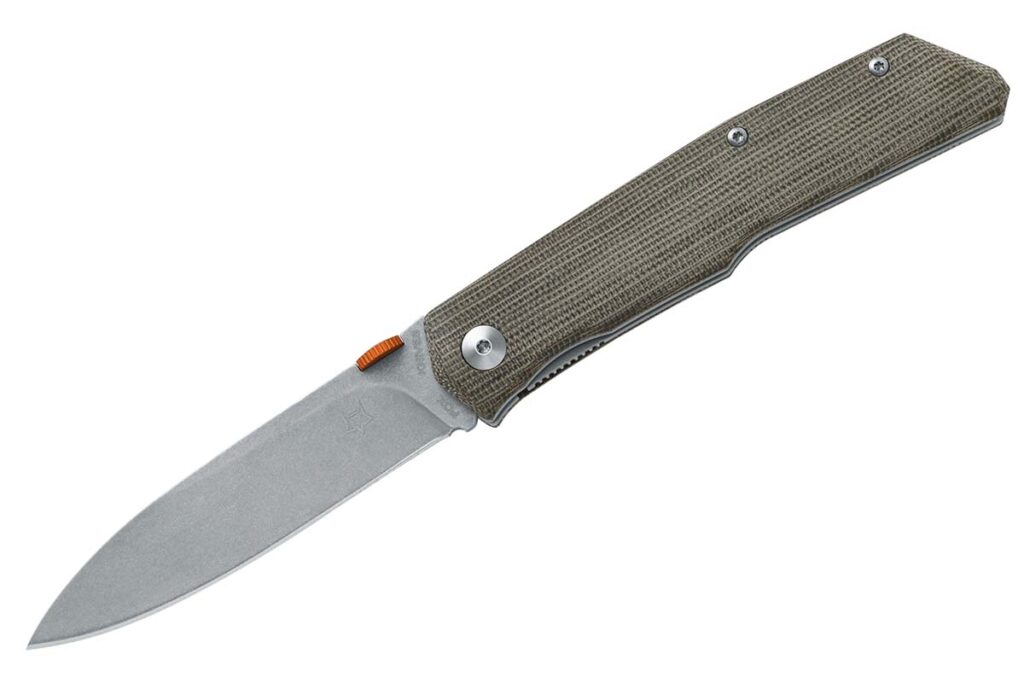
The Sicilian / Fox Knives
The Sicilian is a reinterpretation of Fox’s model FX-525, and the name pays homage to the Sicilian roots of Bob Terzuola’s family. Changes from the FX-525 include the BECUT stainless blade steel, the OD green canvas Micarta® handle and the wire pocket clip.
According to Fox’s Athena Greta Barbieri, “Bob Terzuola conceived the Sicilian taking inspiration from traditional knives used by ordinary people for everyday activities such as eating or working in the fields. The idea for this knife evokes images of landscapes warmed by the Sicilian sun and simple meals eaten among olive trees and vineyards.”
Designer: BLADE Magazine Cutlery Hall-Of-Fame® member Bob Terzuola Knife type: EDC folder Blade length: 3.35” Blade steel: BECUT stainless Rockwell hardness: 58-60 HRC Blade @ thickest: .12” Blade finish: Stonewashed Blade opener: Disc Handle material: OD green canvas Micarta® Spacer: Aluminum anodized orange Pocket clip: Wire Lock: Linerlock Weight: 3.53 ozs. Closed length: 4.52” Country of origin: Italy MSRP: $164
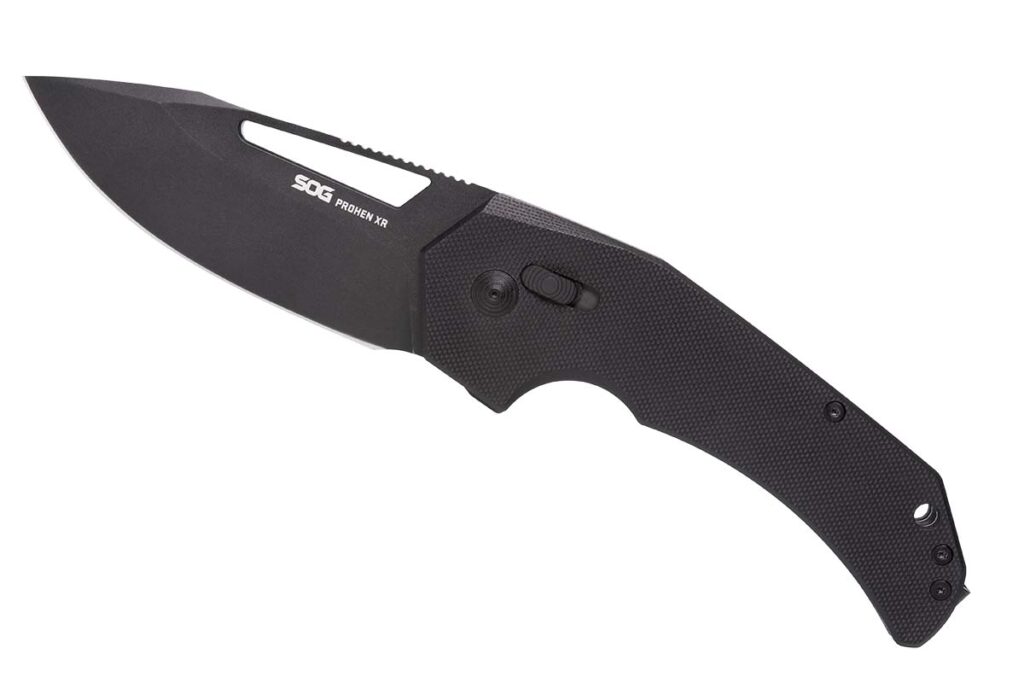
Prohen XR / SOG
The extremely strong G-10 handle is micro-textured for a secure, comfortable grip in wet or slippery conditions.
Designed by custom knifemaker Mikkel Willumsen for SOG, the beefy Prohen XR flipper folder is a mix of curves and angles that features the XR Lock, a sliding transverse bar that locks the blade in place and promotes ambidextrous one-hand operation.
Designer: Mikkel Willumsen Knife type: Flipper folder Blade length: 3.4” Blade material: Cryo D2 tool steel Blade @ thickest: .157” Blade grind: Flat Blade pattern: Drop point Blade finish: TiNi Blade opener: Flipper tab or thumb hole Handle: G-10 Pocket clip: Reversible, low carry Lock: XR Lock Knife to know: The XR Lock can withstand 1,500 lbs. of force Weight: 5.6 ozs. Closed length: 4.8” Country of origin: China MSRP: $70
Dmitry Sinkevich/ Spyderco
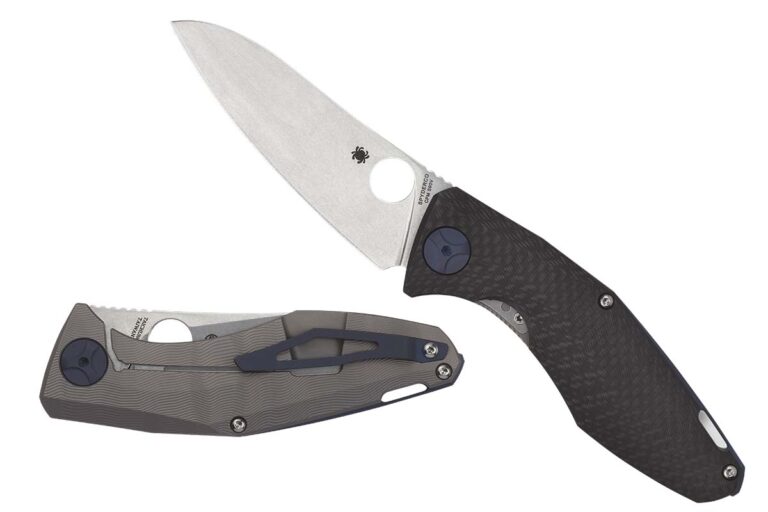
Drunken / Spyderco
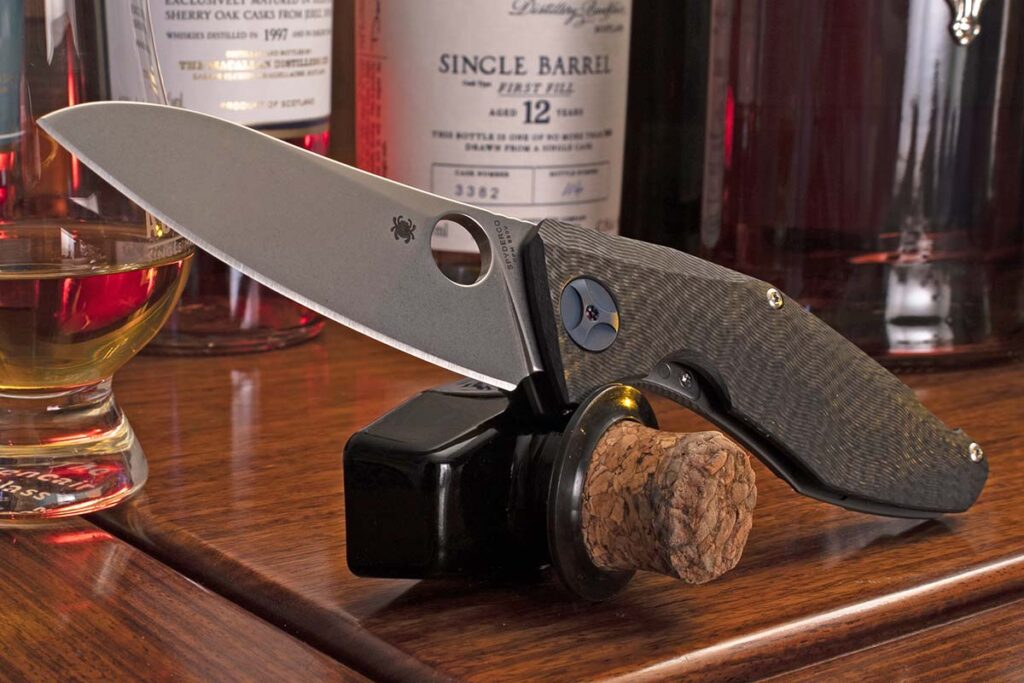
The Spyderco knife’s handle includes a titanium scale on one side and a solid carbon fiber scale and nested stainless steel liner on the other. The titanium scale is “webbed” to reduce weight and forms the basis for the knife’s Reeve Integral Lock (R.I.L.) mechanism, which includes a long-wearing stainless steel interface. Both scales are meticulously machined with the intricate “drunken” texture that gives the knife its name, and are accented by a matching color-anodized backspacer, pivot assembly, and right-side, tip-up pocket clip.
Designer: Dmitry Sinkevich Blade length: 3.45” Blade steel: CPM S90V stainless Blade grind: Full-flat Blade @ thickest: .138” Blade finish: Tumbled Handle: Carbon fiber/ titanium Pocket clip: Right-handed, blade tip up Lock: R.I.L. (Reeve Integral Lock) Weight: 3.8 ozs. Closed length: 4.61” Country of origin: Taiwan MSRP: $770