Knifemaking is the building of a knife, which includes the blade, handle and other accouterments. Blades are made by either removing metal from a steel blank via a grinder – known as stock removal – and the forging to shape of hot steel into a blade in the process known as bladesmithing. Other parts, including bolsters, guards, pommels, etc., are needed to complete the finished knife.
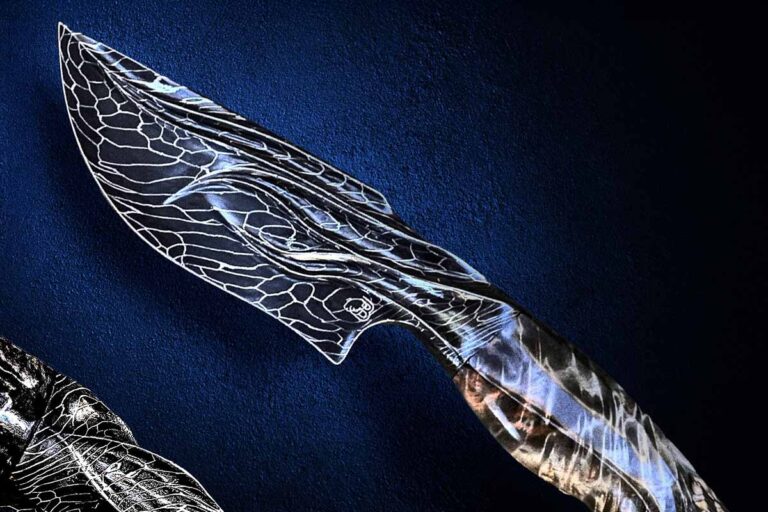
Jordon Berthelot marries two electric materials in one knife.
Jordon Berthelot achieves a hypnotic union of blade and handle materials in his integral hunter.
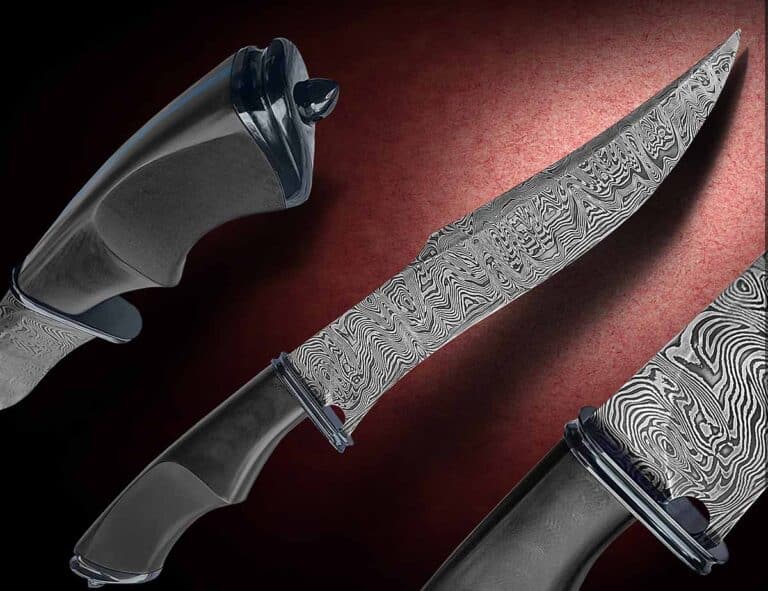
The blade is his HHH lightning damascus and the handle is cottonwood from Robswildwood.
“I used a wide variety of different bits and burrs with Foredom and Dremel tools to freehand carve the blade and handle,” he wrote.
“As my teacher Spencer Aplin always says, the most difficult part is deciding what to carve and how to give it the flow I want, which is so true,” Berthelot said. “I decided to incorporate the blade carving into the handle so it gave the whole piece a complete look, and also added some great purchase of the handle in multiple different grips.”
Berthelot Integral Hunter Specs Blade length: 4.5” Blade material: HHH lightning damascus forged from W1 tool steel/nickel rods w/4800 powder Handle material: Cottonwood from Robswildwood Overall length: 9” Maker’s price for a similar knife: $3,500
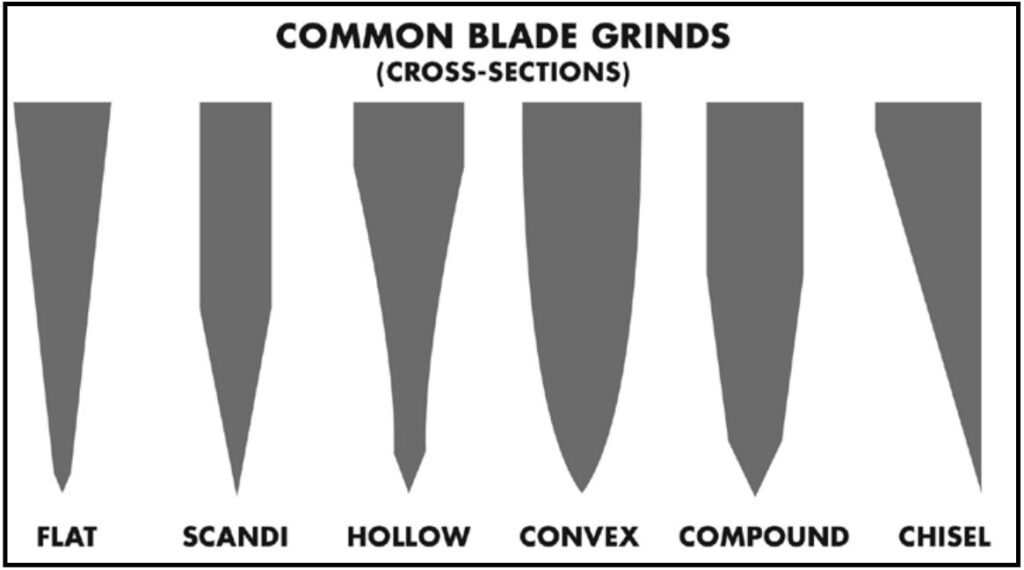
Knife edges come in all different styles. We break down the major types in this quick guide to blade grinds.
Cutting performance is greatly influenced by the way in which the maker grinds the knife. Each grind will have different cutting characteristics. A good knifemaker will consider whether the grind of the knife is suited to the chosen task. You as a buyer will also need to consider if the grind of a knife will suit the tasks you have in mind.
Blade grinds you’ll often come across can be seen here. (Image courtesy of Knafs.com)
Flat Grind
A flat-ground knife is a simple wedge and may be thick or thin. Flat grinds are good for slicing and deep cuts. I personally prefer a flat grind that goes all the way to the spine. A thinner flat grind will cut more smoothly than a thicker flat grind, where a thicker grind may be more durable.
Hollow Grind
A hollow-ground knife has a slightly concave bevel, which makes it thinner behind the cutting edge. This makes for good skinning and shallow cut work, without giving up overall blade heft or durability. Deep cuts or chopping are not well suited to a hollow grind.
Convex Grind
Convex grinds have slightly rounded bevels, which increases their edge stability. While they may not excel at slicing, they’re the way to go for hard use cutting and chopping.
Scandi Grind
Scandi grinds are a short flat grind with no secondary bevel. “Scandi” refers to the Scandinavian countries where that grind style is popular, especially Finland. This grind style cuts very well but can be difficult to sharpen properly.
Compound Grind
A compound grind may combine several of the basic grind shapes. Particularly on tactical and folding knives, many modern grinds are aesthetically interesting, but at the occasional sacrifice of performance. If you’re collecting for aesthetic reasons, however, these grinds could be all you ever wanted out of a knife.
Knife industry pros give their takes on what the hot knife steels will be in the year ahead.
Every cutlery buyer faces a dizzying array of steel choices when it comes to buying that next knife, an array that represents the proverbial “double-edged sword.” While it’s nice to have choices, it can also be hard to keep up with so many options. Fortunately, industry professionals are available to help sort out which stainless and carbon varieties are either catching fire or cooling off.
*The steels are listed in no particular order by the knife patterns/types for which they are favored most by users and makers, according to the story’s sources.
MagnaCut Reigns Supreme
Last year when BLADE took the temperature of steel suppliers, the clear-cut champion of blade materials was Crucible Industries’ CPM MagnaCut stainless. The creation of steel guru Larrin Thomas, MagnaCut remains on top and will stay there for the foreseeable future. Bob Shabala, president of Niagara Specialty Metals, praised the high-performance blade material last year and still does today.
CPM MagnaCut stainless ruled among knife steels in 2024 and will continue to hold sway in 2025. A representative example is the new CRKT Q, a folder in titanium and carbon fiber designed by Richard Rogers. Country of origin: Italy. MSRP: $225.
“We have sold about 320 tons of CPM MagnaCut since its introduction in 2020. It is our biggest selling cutlery grade right now and I don’t expect that to change anytime soon,” Bob said, adding the qualifier, “This is from Niagara Specialty Metals’ limited perspective. I’m sure other mills are working on new grades which I’m not privy to.”
One reason MagnaCut is so popular is it embraces all cutlery genres with ease.
“CPM MagnaCut remains in high demand across various knife patterns,” Bob observed. “Some customers currently using MagnaCut for fixed blades are expanding into folding knives and have expressed plans to continue using the steel for their new designs, reflecting its versatility and ongoing popularity.”
MagnaCut maestro Larrin Thomas
Scott Devanna, vice president of technology and a metallurgist for SB Specialty Metals, tends to concur.
“I’m not sure there will be a new ‘super steel’ introduced in 2025. The introduction of new steels seems to have a three-to-four-year cycle, and with the recent intro of CPM MagnaCut such new introductions may be a few years off. We sell a lot of MagnaCut,” he stated. “I’ve learned over the years that new is very often the primary driver when new grades are introduced. This is what happened with CPM S30V, CPM 20CV and its European equivalent M390, and a few other grades.”
It should be noted that MagnaCut technically is going into its fifth year of existence. As you can see, it takes a while for a steel to work its way into the manufacturing pipeline and be given a thumbs up or thumbs down by the end user.
Specialty Grade Steels
Meanwhile, other specialty grade steels aren’t being ignored. In fact, many knife consumers prefer other steels that suit their needs better, both of the stainless and carbon varieties.
CPM 154 stainless will continue to be a steel of choice for custom hunting knives, here on the Cowboy Knife by David Fleming in a handle of sheep horn from a Rocky Mountain bighorn. Overall length: 7 inches.
“CPM S30V, one of the original cutlery-grade steels, continues to be one of our best-selling products,” Shabala noted. “Despite its age*, S30V maintains a strong position in the market, demonstrating its enduring reliability and widespread appeal among knifemakers.
Devanna agrees.
“CPM S30V is still a favorite for hunting knives, as well as CPM 154,” he noted. “For everyday carry folders, M390, CPM 20CV and CPM 154 are still used quite a bit as well.”
Scott said CPM S30V and S35VN remain strong for tactical folders.
Bob Shabala, Niagara Specialty Metals
Custom knifemakers aren’t as easily swayed by trends and tend to go with steels they are comfortable using, are time-proven to them personally, or geared to their particular customer base. While many are on the MagnaCut train, they tend to be more diverse in their choices.
“Other steels popular among custom knifemakers are M390, CPM 20CV, CPM 154, and to a lesser extent CPM S30V and CPM S35VN,” Devanna stated. “I have heard that CTS-XHP will be re-introduced, and this grade developed quite a following when it was readily available—especially for kitchen knives and high-end folders.”
Added Shabala, “CPM 154 is always popular with the custom makers.”
Carbon Steel
THE CARBON EQUATION The outdoor crowd—bushcrafters, survivalists and open-air tactical users—has to be pleased with the attention they’ve been getting from the industry. These users’ requirements are different and they prefer a subset of steels all their own.
While major outdoor knife manufacturers like TOPS and ESEE still sell the bulk of their knives in 1095, they have been gradually offering their customers more steel diversity, including stainless versions such as S35VN. The TOPS Shadow Hunter has a 4.5-inch blade of 1095 carbon steel in a tungsten Cerakote®. Country of origin: USA. MSRP: $250.
“CPM 3V and 4V are favored for hard-use knives due to the steels’ toughness, while CPM S90V and 20CV are popular among users who prioritize wear and corrosion resistance,” Shabala observed. “CPM 3V and CPM 4V are carbon steels that continue to sell well in specific areas. 3V is in high demand for bushcraft knives and 4V is being used by the current national champion in BladeSports International cutting competitions, Ben Propst. His wife Sue Ann is now using it and in 2024 they both won cutting events in Kokomo and the Smoky Mountain Knife Works fall festival.”
“I think CPM 3V and CPM Cruwear—mostly for bushcraft/survival knives as well as tactical fixed blades—are gaining popularity in the market,” Devanna opined. “CPM 3V has proven itself over the years and continues to be a popular grade. CTS PD#1 was in this category but availability of this grade is a problem.”
While major outdoor knife manufacturers like TOPS and ESEE still sell the bulk of their knives in 1095 carbon steel, they have been slowly offering their customers more diversity in their lines, including such stainless versions as S35VN.
Overall Take
As Shabala and Devanna noted, MagnaCut will be the top dog among steels in 2025, but it’s certainly not the only hound in the kennel.
Shane Magnussen uses the CPM S90V supplied by New Jersey Steel Baron on his model BBV2 folder. Closed length: 4.54 inches. (SharpByCoop image)
The cutlery industry is so diverse in the competition among manufacturers, custom makers, genres of knives and budget categories, there’s room for many different stainless and carbon steels. While what’s in the works remains unknown to most, you can bet there are teams of metallurgists working on the next great knife steel as these words are written.
As a knife enthusiast and cutlery buyer your choices are bountiful in all categories—from EDC to outdoor, fixed blade to folder—and affordable to expensive. Some users buy one knife to last for years while others rotate their carry or require cutting fare for specific purposes.
The good news is your knife and steel options have never been better!
*Editor’s note: The first-ever steel both designed and made specifically for knife blades, CPM S30V has been used for knives since 2001.
Daryl Meier’s star pupil pays tribute to a mentor who taught him oh so well.
Daryl Meier is a pattern-welding legend. He has influenced more modern pattern-welding experts than almost anyone I know, both in the USA and worldwide.
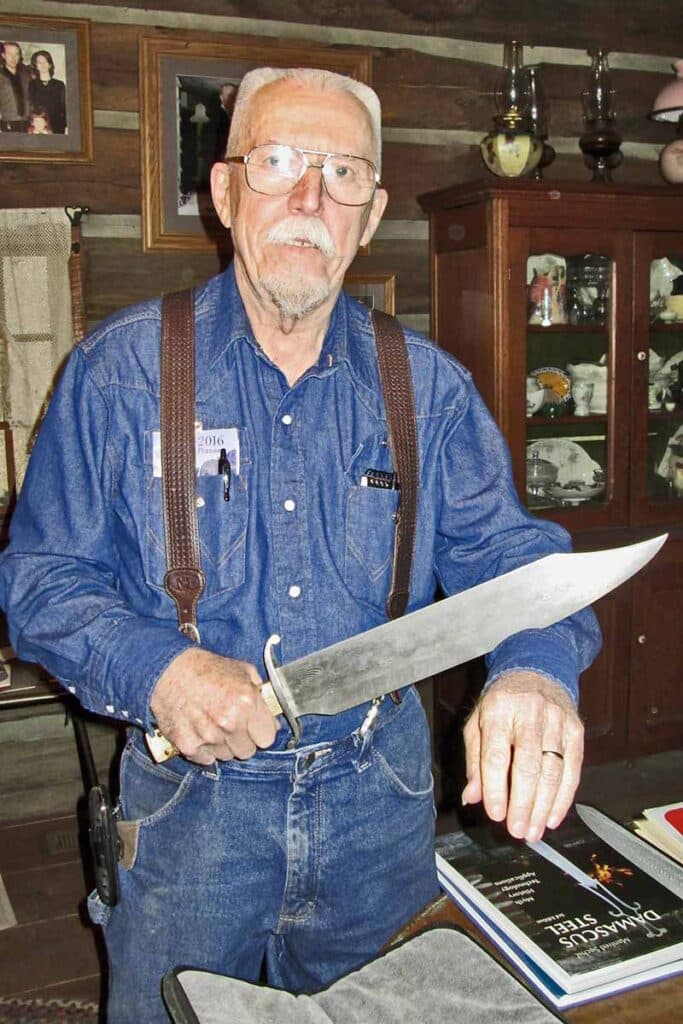
Daryl Meier in 2016 holding his American Spirit Bowie. (Tony Mannucci image)
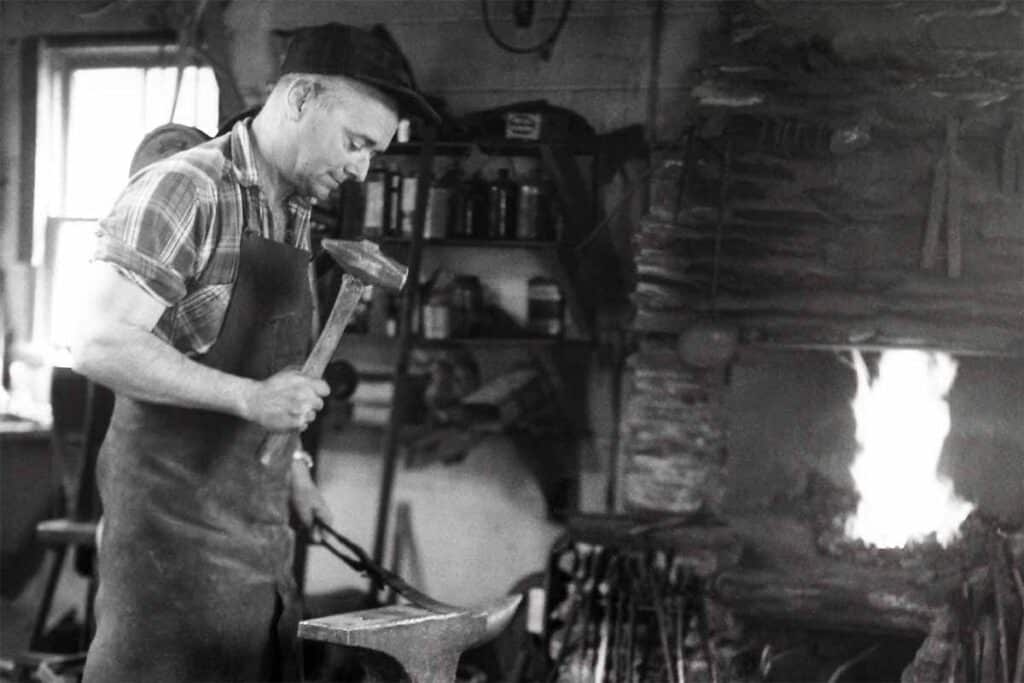
Daryl was born just outside Carbondale, Illinois. In 1958 he moved into the small city, which is situated in the southern part of the state. There wasn’t much to see in Carbondale back then, though a local blacksmith worked there. It was in the blacksmith’s shop that Daryl developed an interest in forging which influenced his entire future career.
He influenced my work at levels I can’t even begin to explain.
Damascus Knife Renaissance
I started forging blades in 1972. I went to Alfred Pendray’s shop to learn how to forge weld and I was fortunate enough to learn from Alfred’s father, John Pendray, a master ferrier and a great blacksmith. Mr. John took a lot of the mystery out of the forge-welding process. To him, it was quite ordinary. He grew up doing it for a living.
There are many legends about pattern welding that have gone out of favor. It never really did. The history of pattern welding goes back unbroken for at least 2,000 years. Alfred told me that in the 1940s and ’50s, there were probably 40 or so ferriers around Ocala, Florida, alone who were putting tongs and hammers together out of different pieces of scrap steel of different alloys that, when etched, would show a pattern. This indicated the tongs and hammers were pattern welded, as far as I know, a common practice around any blacksmith shop or horse farm back in the day.
Pattern-welded material being used in knives in the USA began getting noticed in 1973. BLADE Magazine Cutlery Hall-of-Fame® member Bill Moran launched it all with the damascus knives he exhibited that year at The Knifemakers’ Guild Show in Kansas City.
Daryle Meier Cutting Edge Damascus
At the same time, Daryl began to put a group of guys together to research pattern-welded steel in Carbondale that included Daryl, Jim Wallace and Bob Griffith. The research involved extremely complex patterns stemming from the Merovingian culture (circa 450-750 A.D.). The pattern-welded material in Europe and Asia had continued to be produced for hundreds of years. There were several European makers in the 1800s and well into the 1940s actively making blades from the material (see “Who Made the First Damascus,” January 2015 BLADE®).
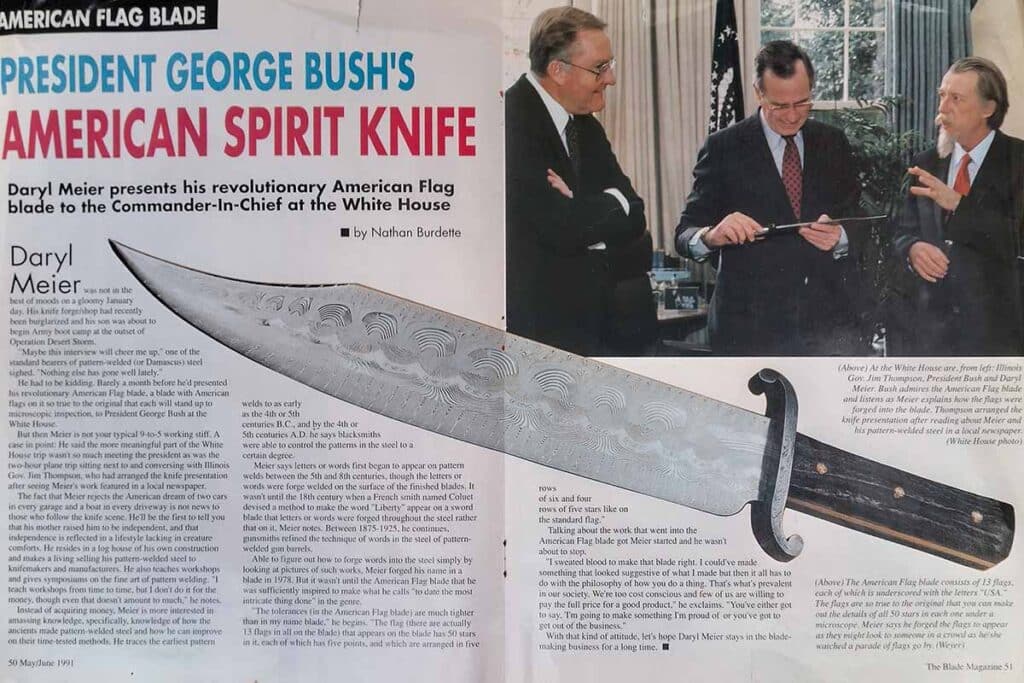
Daryl Meier made the American Spirit Bowie for President George H.W. Bush and presented it to the president at the White House in 1990. The story appeared in the May/June 1991 BLADE®.
The renaissance in America came in the early 1970s with Moran. A short time later, along with bladesmiths Bill Bagwell and Don Hastings and Cutlery Hall-of-Famer B. R. Hughes, Moran founded the American Bladesmith Society (ABS) in 1976. Moran made some simple pattern-welded knives and reintroduced the material to the knife industry. Through the ABS he spread the knowledge of pattern-welded steel to many.
Daryl and his crew were doing their research on very complex-style pattern welding in the early ’70s. They focused on redeveloping the complex techniques of the ancient smiths. Daryl was a great influence on Alfred Pendray, me and almost every other maker of pattern-welded material. As far as I know, Daryl was the first one who made steel for other knifemakers. There may have been some others making steel for other knifemakers—I don’t know for sure. If there were it was just a handful of guys, maybe a dozen or so, but by the early ’90s there were over 300 such makers producing steel in the USA.
Meier As A Teacher
I was extremely excited whenever I had the chance to talk to Daryl. I met with him on several occasions. Pendray and I stopped by Daryl’s shop on the way to a Kansas City Guild Show one year, and we were able to see his operation and gained a lot of useful information from him. Around 1982 I attended a big hammer-in held in Birmingham, Alabama, and Daryl was there. I’d been making pattern-welded steel for a while. I also was doing some mosaic damascus.
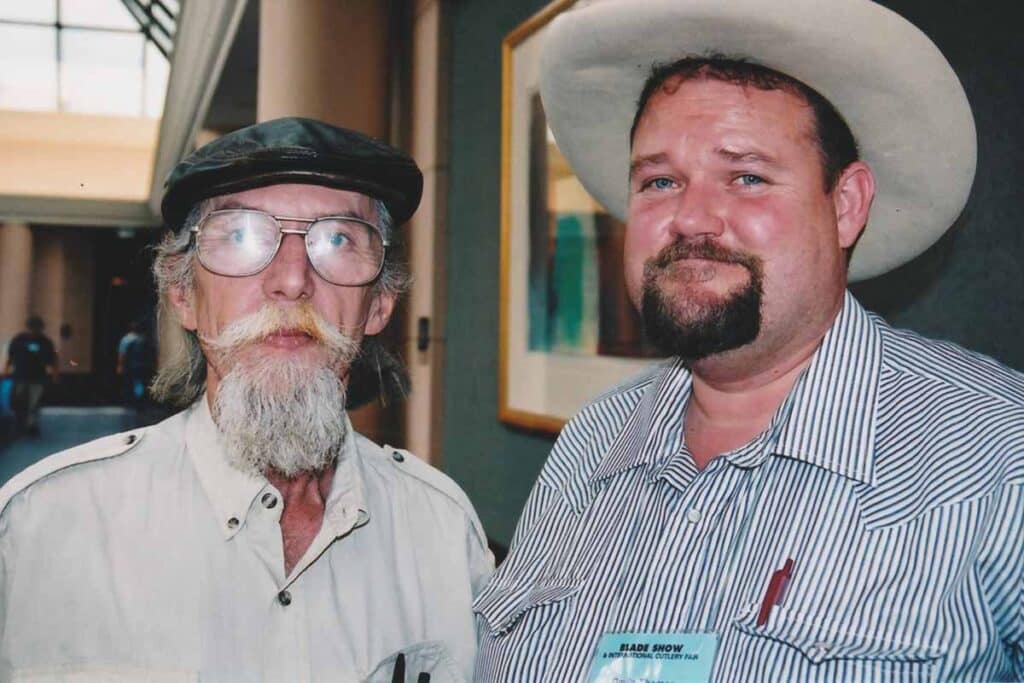
Daryl Meier (left) and BLADE Magazine Cutlery Hall-of-Fame® member Devin “Hoss” Thomas (right)—captured here at a past BLADE Show—comprise what is arguably the most dynamic duo of damascus makers in modern custom knife history.
Daryl was introducing me to a young man and I’m almost positive the young man was Rick Smith. He came up and they asked me how I did a particular pattern and when I explained how I did it, Daryl corrected me immediately. He said you don’t understand, Rick has his “ticket.” I said what’s his “ticket”? The young man immediately showed me a small slab of mosaic that had beautiful little chrome steps going up to a patterned center and a bar. He and I spent two hours together exchanging ideas. The lesson I learned: there were a lot of people working on mosaic damascus material who I did not know.
Later, as Daryl and I began to work on canister mosaic as a way to get around hot isothermal pressing, I devised a plan to use refrigeration hoses to introduce gas into the canister. I’d worked out this elaborate system with vacuuming and gassing, and, having experienced great success welding with very low temperatures, I could not wait to share the discovery with Daryl. He listened very patiently as I outlined the gear I used and said to me, “Well, what I do is add three or four drops of diesel or hydrocarbon [fuel] to my canister and I don’t have to use all that gear because the hydrocarbon will scavenge all the oxygen”—which is the bad thing, so my bubble was burst. It was one of many occasions where I approached Daryl with a new idea and he said either he thought it would work or, “I have a piece of that on my bench from a few years ago.” He has a great method of teaching.
Meier’s As An Innovator
Daryl was a great innovator and about 1990 made a knife called the American Spirit Bowie. Each side of the blade has 13 American flags all along its length with all 50 stars in each of them, and USA reading correctly from left to right no matter which side of the blade you viewed. It took Daryl 18 months and over 800 hours to build the blade, which he presented in person to President George H.W. Bush in the White House (see May/June 1991 BLADE®).
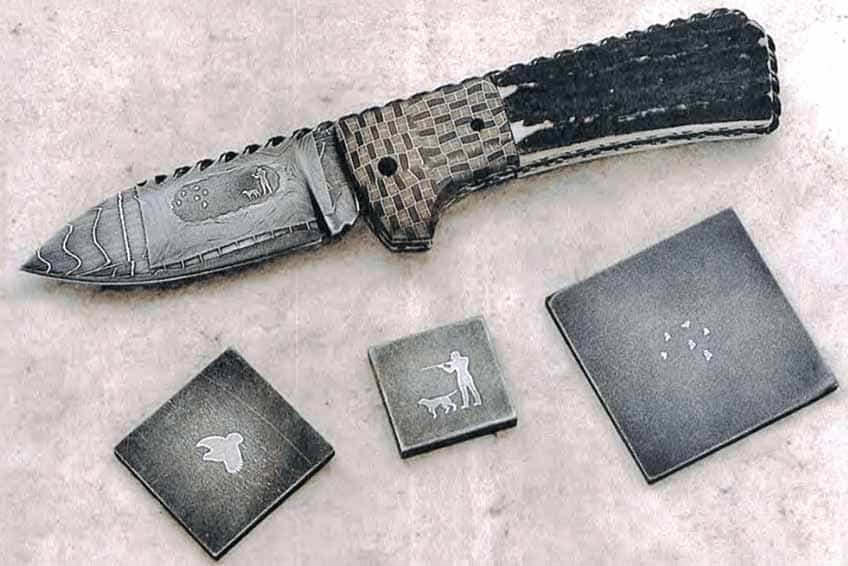
The Hunter’s Dream by the author is believed to be the first time anyone forged a scene into a mosaic damascus blade—and Daryl Meier played a large role in inspiring the author to do it.
Without doubt, Daryl’s work has influenced more makers than almost anyone else in the modern history of pattern welding. He’s still on the planet and still teaching from time to time. He’s done thousands of workshops over the years that added to the knowledge base of the entire industry. His presence influenced my work in more ways than I can count.
One of the major things he did for me was to push me to the limit of my abilities. After all, doing the easy stuff does not make you grow.
I made several panel blades consisting of all kinds of laminating and experimented with different patterns. I did some electrical discharge machining (EDM) work and Daryl used a bit of EDM in the American Spirit Bowie. He told me I should “make something real,” and that’s how my mosaic damascus shooting scene blade showing the hunter with his dog and the quail in flight came about. It was one of the most intense projects of my career.
Final Cut
Daryl’s students are legion and are some of the very best of the best—all the old guys that are considered the ancients, myself included, and a lot who are gone. A few of us are still around and Daryl was the guy we went to for information. We are standing on the shoulders of giants and one of the earliest ones is Daryl Meier. He may not give you a recipe for a cool new pattern, but he would give you the inspiration to go forward and explore it. He would always say the easy stuff does not make you grow. This is one of the main reasons I still teach because he took time with me.
Bladesmiths outline which carbon steel combos they use and why.
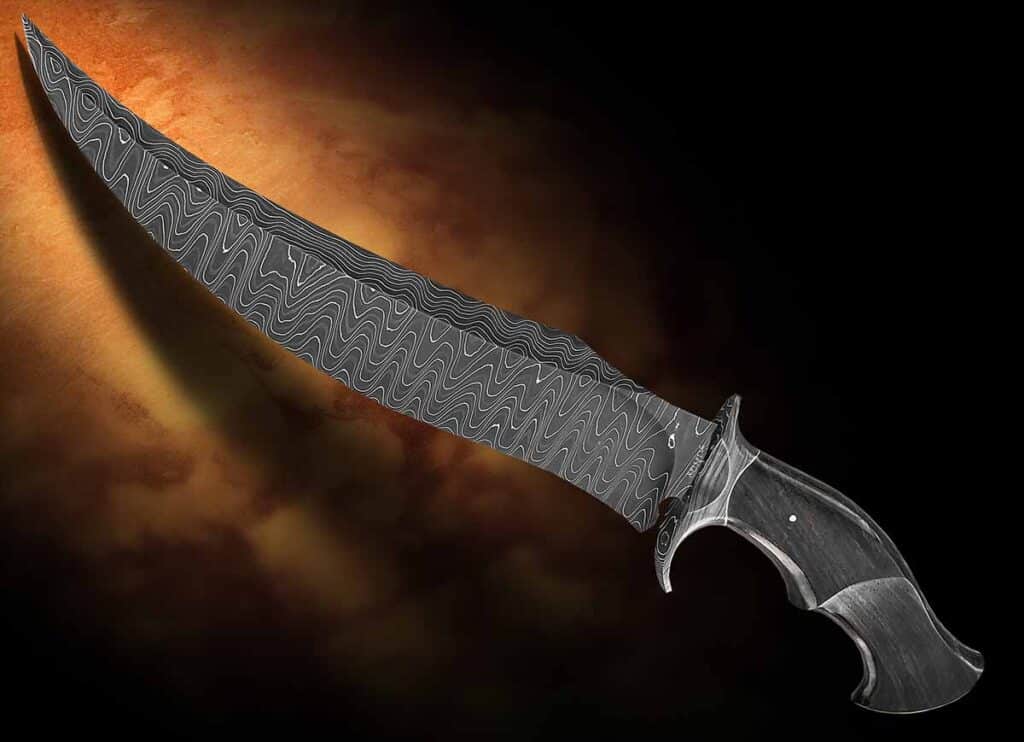
Damascus steel is a broad category with nearly infinite variations. It includes everything from low-layer random patterns to powdered canister creations and complex mosaic patterns.
The basics of damascus include forge-welded combinations of steels. Changes in the steel choices, in the welding or forging processes, and even in the etching method result in a wide variety of patterns and looks. Let’s dive into the many levels of damascus through the work of a few excellent smiths.
Smiths Takes On Damascus Steels
ABS apprentice smith Chris McPherson began making knives only four years ago, but he had a strong start attending classes taught by ABS master smiths Jason Knight and Josh Fisher. Now he forges his own damascus. One of his fighters (IMAGE 1) features a blade of 1075 carbon and 15N20 nickel-alloy steels.
Image 2 ABS journeyman smith Brian Sellers used three steels instead of the standard two to help provide a darker look for his blade of ladder pattern damascus. As he observed, “Adding a third steel to damascus gives a unique depth to the finished blade, kind of like adding shades of gray to a tattoo.” (Jocelyn Frasier image)
“I made the knife for a local state trooper benefit, for the teenage son of an officer who lost his life in the line of duty in March 2023,” Chris explained. When asked about why he chose 1075 for his fighter, he said he “just wanted to try it out” after making other billets with 1095, 1084 and 1080 carbon steels. Though he’d heard that the 1075 may have a bit less contrast due to its lower manganese levels, it came out with beautiful contrast after a deeper etch.
Knifemaker Brian Sellers likes to mix things up a bit. In addition to the standard carbon steels of 1095 or 1084, Sellers occasionally includes 1080, 5160 or 52100. “Adding a third steel to damascus gives a unique depth to the finished blade, kind of like adding shades of gray to a tattoo,” he says. For example, in a recent Persian fighter (IMAGE 2), Sellers included 1080 and 5160 along with 15N20 in a ladder pattern blade. Brian indicated all the steels work well with his equipment. He uses a 50-ton Riverside hydraulic press and a 50-pound Little Giant power hammer.
Damascus is time and labor intensive, and the maker loses a good bit of the steel in the forging process. Bladesmith Blake Nichols knows this and is from the “waste not, want not” school of thought.
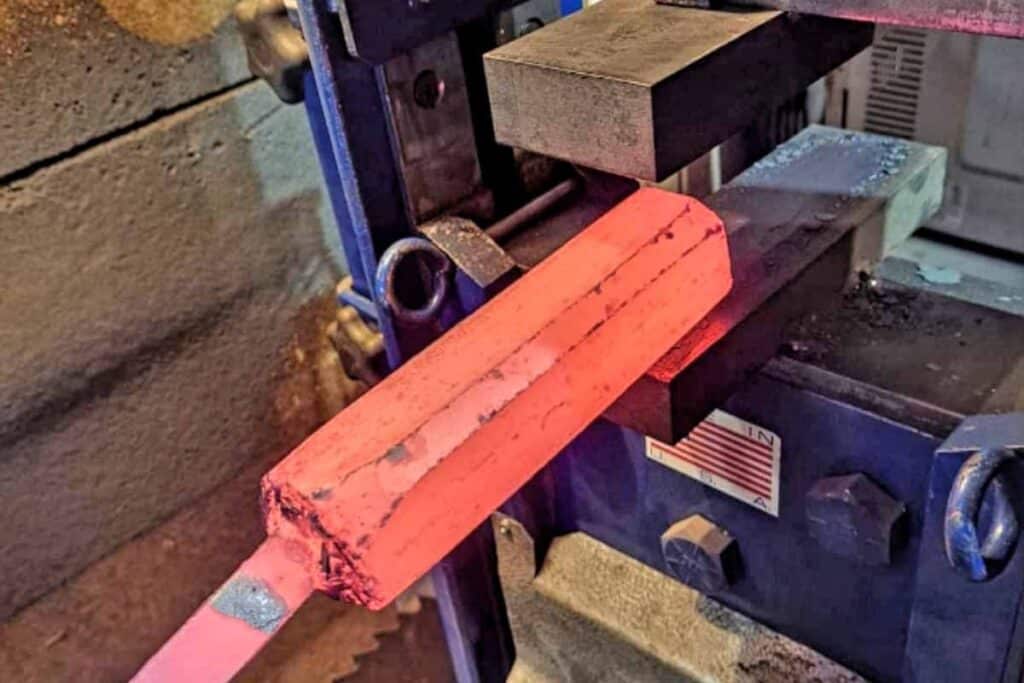
Robert Wayman uses a hydraulic press to weld and draw out his damascus billet.
“My mentor Greg Shahan gave me the end cut of a feather damascus billet a few years ago,” Nichols said. “It sat on my shelf for a long time before I incorporated it into [one of my] hunters.”
Regarding his damascus, he added, “I wish I had a profound scientific answer as to why I use 15N20 and 1095 but I do not. The simple answer is it’s what I learned on. I’m comfortable with the heat-treating process. I also feel like I get the performance out of that combination that I desire.” I agree with Nichols when he said, “No matter what it’s made of, it has to function like a knife. Even the fancy ones need to hold up to the performance standards.”
Why 15N20 In Damascus?
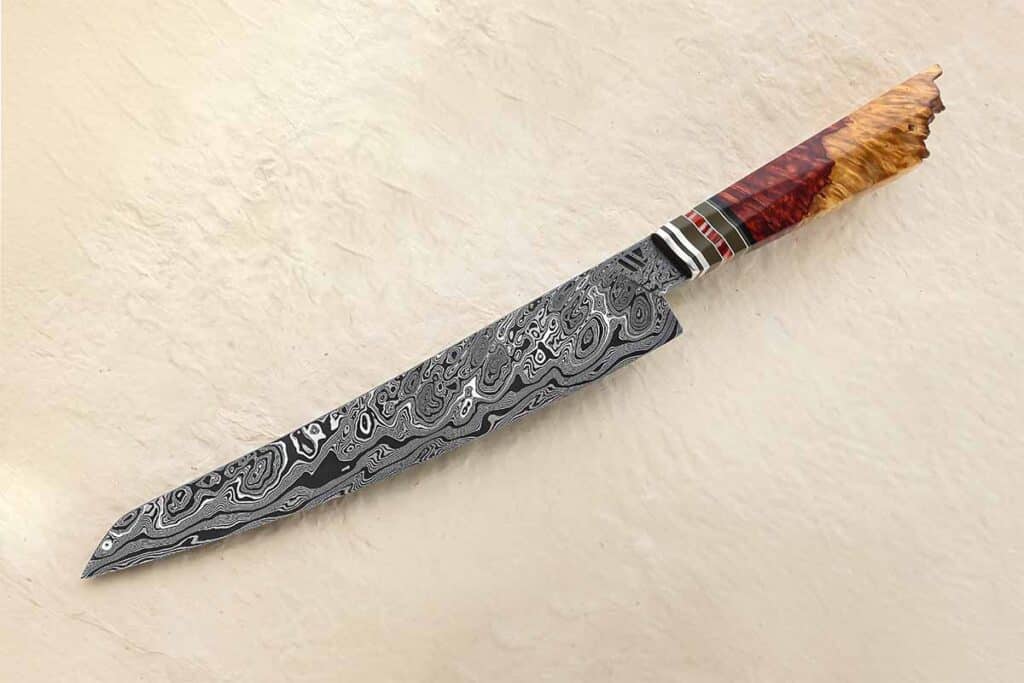
Image 3 For a great example of a go-mai (five layer) damascus blade with the visual “pop” of nickel, Robert Wayman provides the fireworks via his sujihiki. Damascus outer layers and a damascus core work together with the handle of live edge amboyna burl to make a stunning knife. Overall length: 16 inches. (SharpByCoop image)
You may have noticed one thing the featured bladesmiths all have in common: they include 15N20 in their damascus billets. The 15N20 is a simple carbon steel, basically 1075, but has a relatively large amount of a special ingredient: nickel. The nickel content makes 15N20 etch more slowly and show more brightly when polished. Because of the similar composition to the 10-series steels (1080, 1084, etc.), it welds well and hardens in similar temperatures, making it the perfect steel for high contrast in the damascus pattern.
Some smiths use pure nickel foil or sheet in their damascus for the same effect. The challenge is that the pure nickel won’t harden, so it must be kept away from the edge in the forging process. The contrast is great but the nickel itself won’t hold an edge. I like a nickel layer in between layers of san-mai or go-mai damascus. It really pops!
Bladesmith Robert Wayman illustrates the go-mai technique well on one of his kitchen knives (IMAGE 3). The blade was made from a patterned go-mai billet. There’s a core layer running down the center of the blade with two layers of material on each side. The core is 100-layer random pattern damascus forged from 1084 and 15N20. On each side of the core steel is a layer of nickel and on the outside of the billet is a layer of matching random pattern damascus.
Key Element Comparisons by Steel
Steel
1084
1075
1095
15N20
1080
5160
52100
C
.865
.750
1.000
.750
.75-.88
.60
.98-1.10
Mn
.750
.550
.450
.375
.06-.09
.80
.24-.45
N
—
—
.200
1.950
—
—
—
*C-carbon, Mn-manganese, N-nickel; the double hyphens indicate trace amounts. Note the relatively high amounts of nickel of the 15N20 and of manganese of the 1084, two elements beneficial for high contrast damascus. This chart is for the elements pertinent to the subject at hand only and does not list all the elements of each steel.
Once the final billet is forge welded, some of the cladding material is removed with a grinder to create a visual effect in the pattern, and then the billet is drawn out to length. Keeping the core material centered during the process is very important. “You want to take your time when laying out your billet,” Wayman advised. “I typically use a thicker core material and a thinner cladding material, but it’s definitely taken some time and practice to dial it in.”
Other Damascus Steels
Before 15N20 and 10-series combos became prevalent for damascus, one of the standard high-contrast combinations was O1 and L6 tool steels. While the latter combo makes great damascus, the two steels are harder to find in today’s market. Simply put, properly sized and affordable 15N20 and 10-series steels are much more available than all the other combos on the market.
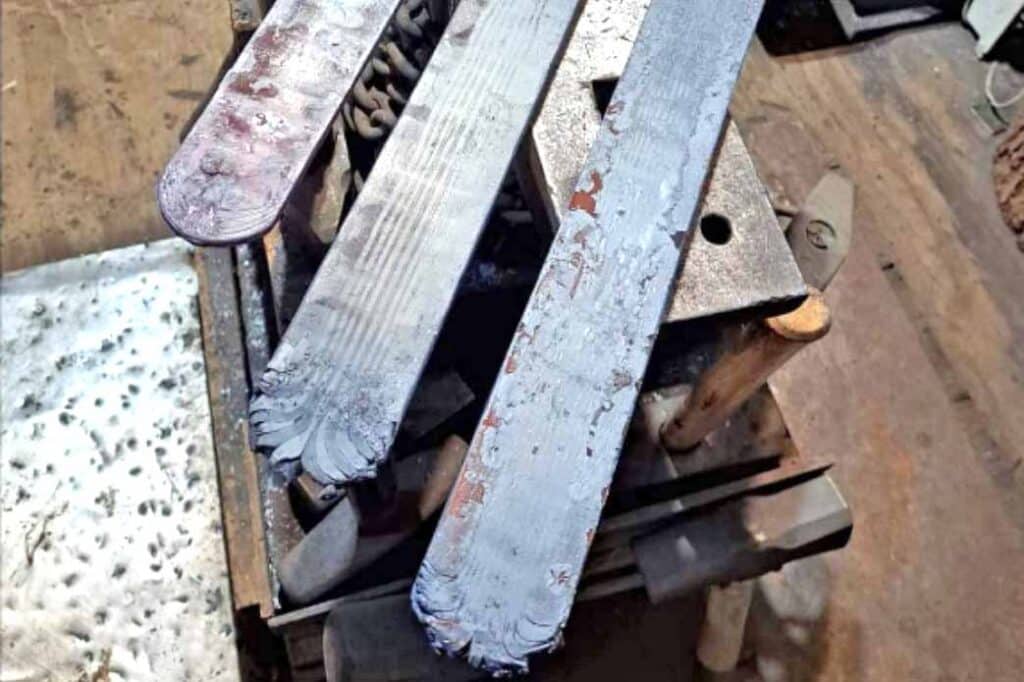
Damascus can be made of many things, including other damascus. These component bars became part of Robert Wayman’s chef’s knife.
Copper is another material that has caught on in the forging of copper-mai and other forms of copper damascus. Outfits like Baker Forge specialize in the process in which the copper is often clad over a standard carbon steel damascus core, as the copper itself won’t harden.
Titanium alloys have been pattern welded, often called Timascus™, and can be anodized in an array of wild colors. Unfortunately, it’s difficult to produce and doesn’t harden, so Timascus blades are probably not in your future. Instead, Timascus makes a great folder frame, bolsters and other non-blade knife parts.
What Metals To Avoid
Are there any materials that don’t make a great contrasting damascus? Sellers reports that the “S” series high silicon steels like S5 and S7 don’t work. He speculated that it was either the steel composition or improper heat control, but welds of S5 and S7 don’t stick during forging.
Robert Wayman welded these five pieces of steel together to make the go-mai damascus blade of his chef’s knife.
I can attest that meteorite is a tempting addition to damascus because various samples are often high in nickel and mostly made of iron. Unfortunately, every meteorite varies widely in terms of content, so that individual pieces of the same meteorite each may have a very different chemical composition. As another confounding factor, many meteorites contain high silicon or other elements besides iron, carbon and nickel. Each new element adds its own problems to the process.
I was able to produce a satisfactory pair of billets containing some meteorite by putting small chunks in a canister with 1084 powder, and then welding and re-stacking the billet with more 1084 bar stock until the final layer count was over 1,000. By adding only 1084, I was assured that any bright spots in the final pattern were from the nickel in the meteorite. Even with this process, there were a few inclusions/flaws in the final product. Could I have continued to push the layer count and minimized the flaws further? We’ll never know.
Some may think AEBL stainless steel is nice and shiny. Can it or another stainless steel be put in the mix with carbon steel? If you think that “shiny” makes sense for high contrast, that part is true. Unfortunately, the high chromium in stainless steels causes problems for damascus makers in two ways. First, chromium steels don’t like to weld together. The chromium oxidizes quickly and prevents the welds from sticking. Second, the chromium changes the hardening properties. In a hypothetical AEBL and 1084 billet, the AEBL hardens from 1,900°F while the 1084 hardens from 1,500°F. If you quench the hypothetical billet from 1,900°F, the 1084 will have huge, brittle grain. If you quench the same billet from 1,500°F, the AEBL won’t harden.
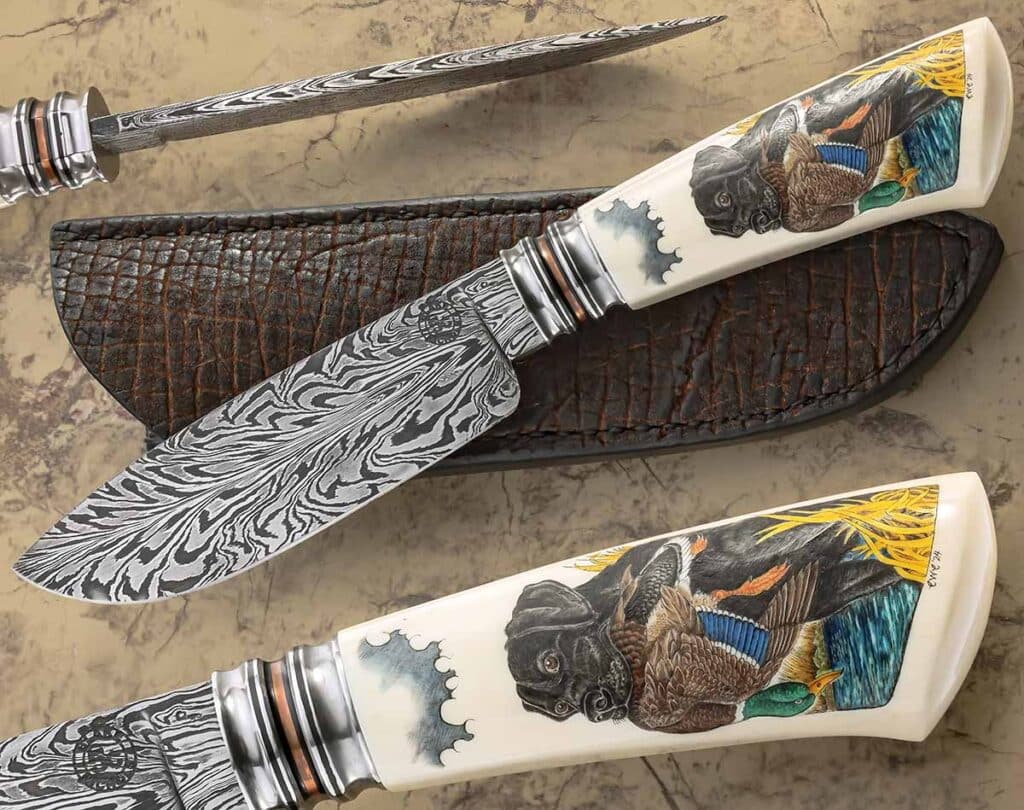
For the blade of his fancy hunter, Blake Nichols employs a damascus of 1095 carbon and 15N20 nickel alloy steels forged by Greg Shahan. Blake said he is comfortable with the heat-treating process and also feels like he gets the performance he wants from the combination of the two component steels. Overall length: 10 inches. The scrimshaw is by Charles W. Conner III. (SharpByCoop image)
While there are smiths who have figured out how to weld multiple types of stainless steel together in contrasting patterns, the process requires careful and precise heating and mitigation of oxygen, both procedures which are often beyond the scope of the backyard smith. Because of the complex process required to make it, stainless damascus commands premium prices.
Final Cut
Modern damascus retains strong demand in the knife market. By combining a choice of several standard carbon steels and 15N20, smiths can create damascus patterns that will make any knife stand out. Whether the pattern is random or ladder, raindrop or mosaic and more, a high-quality damascus knife is sure to be a winner.
In on the ground floor of the damascus knife movement, Daryl Meier has left an indelible mark forging and teaching.
I haven’t seen Daryl Meier for a number of years but there was a time when he was a regular at the BLADE, Guild and other knife shows. Sporting a cross between a goatee and a van dyke, glasses and his ever-present octagonal cap covering longish hair, Daryl stood out in a crowd. He looked equal parts World War II French Resistance fighter, 1950s beatnik and Vincent van Gogh (minus the red hair). In fact, it almost would have been more fitting if his name were Daryl van Meier. I can see him looking at me now, shaking his head in mild disgust at such a notion.
Daryl has a soft, laid-back way of talking that has kind of a hypnotic effect. Then, just when you think you’re going into a trance, he makes an observation that snaps you back to reality, elicits a laugh or otherwise makes you think. He has a great sense of humor and never takes himself too seriously. There is no ego in Daryl. He’s just Daryl.
BLADE Magazine Cutlery Hall-of-Fame® member Steve Schwarzer has known Daryl much longer and much better than me. When I asked Steve to write a story about Daryl, he jumped at the chance, and the result is very enlightening as to Daryl’s impact on damascus and the teaching of bladesmithing in general.
Steve writing the story was more appropriate than I thought at the time. In researching Steve and Daryl, I rediscovered that they each have entries in the top 13 custom knives from the years 1989-2000: Schwarzer’s groundbreaking Hunter’s Dream in mosaic damascus at No. 3 and Meier’s American Spirit Bowie at No. 9. The knives were selected in a poll of industry authorities and appeared in the June 2013 BLADE® story, “A Decade of Excellence.” Daryl presented the American Spirit Bowie in person to President George H.W. Bush in the White House in 1990.
Daryl Meier forging steel in 1976.
Daryl’s contributions to damascus are legend.
As early as 1976 he was teaching a four-week course on forging damascus steel, no doubt one of the first such courses in the modern custom knife era. He was one of the first if not the first to write a regular column on damascus steel called—surprise!—“Damascus Steel” for BLADE in the early 1980s. One of the columns was titled “Wootz Revisited” and featured an image of a misspelled “Stephen Swertzer”—aka Steve Schwarzer—doing the ancient silk scarf-cutting test.
As important as Daryl’s contributions to the forging of damascus have been his dissemination of his damascus in general he probably has had more impact on the knife industry. Call him the Sensei of Steel. He was among the first if not the first to make damascus for use by other knifemakers, and helped inspire others to do the same, including Cutlery Hall-of-Famer Devin Thomas, Mike Norris, Bob Eggerling, Chris Marks, Gary House and others.
Today, making damascus for use by other knifemakers has long been a sub-industry unto itself—and Daryl was there at the beginning of it all. For these and other contributions, he was awarded the BLADE Magazine Industry Achievement Award in 2008.
The last time I talked to Daryl was about a year ago by phone. He sounded chipper and upbeat as ever. In fact, even in his early 80s he remains physically active and was all excited about a new pursuit—dancing—and how he was attending local dances on a weekly basis. Always ready to try new things, even in the fourth quarter of life—that’s Daryl. And I bet he can beat a mean rug, too!
We talk with those who know Bill Moran best to determine how many damascus blades the godfather of the craft forged.
BLADE Magazine Cutlery Hall-of-Fame® member Bill Moran is and will forever be remembered as the father of modern damascus steel. He and a few early devotees popularized damascus during an era when the art of bladesmithing was an endangered species in the realm of the artisan.
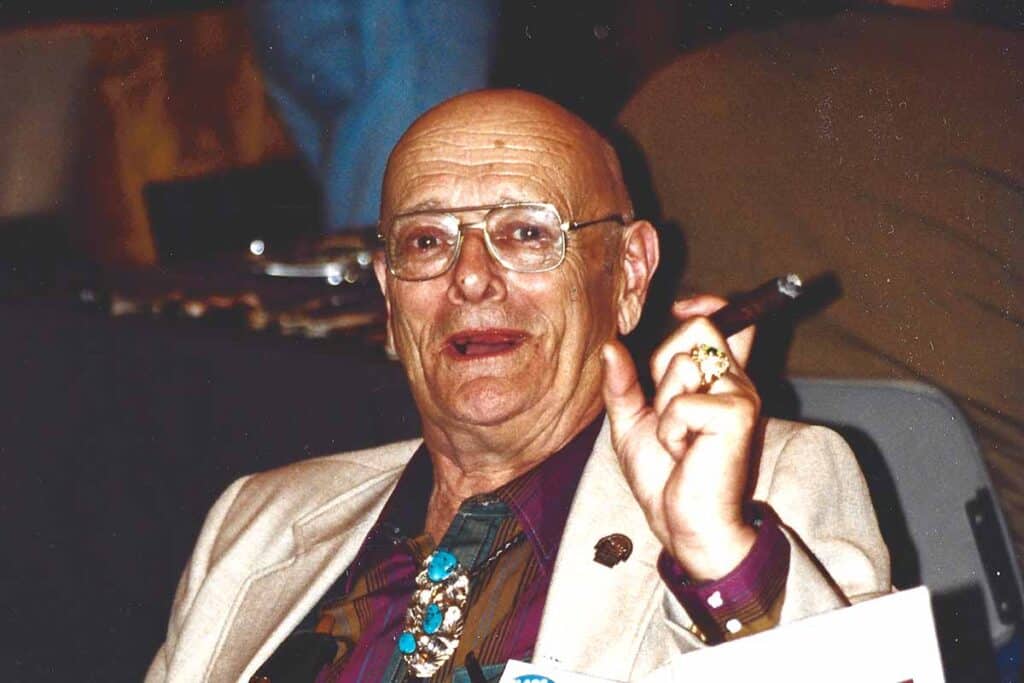
Though Moran was partial to smoking a pipe, he liked an occasional stogie as well. (Pete Cohan knife image)
It was Moran who shocked the custom knife world in 1973 when he brought eight knives to The Knifemakers’ Guild Show in Kansas City, Missouri. Those historic eight sported blades of Moran’s damascus steel and they created a sensation. Cutlery Hall-of-Famer, longtime journalist and friend of Moran’s, and a respected member of the knife community, B. R. Hughes remembered how the event electrified those who attended.
This is the first damascus knife Moran ever made. He forged “No. 1” circa 1972. It was misplaced for 30 years until Nancy Hendrickson found it in Moran’s house. (Pete Cohan knife image)
“When my wife [Carolyn] and I drove up to the Muehlebach Hotel in Kansas City, a friend of mine came out and said, ‘You gotta get in there and see the damascus knives Moran has on his table.’ Those knives were the talk of the show. Bill also had mimeographed sheets that explained what damascus steel was and how it was made. He gave those sheets away to anyone who desired one.”
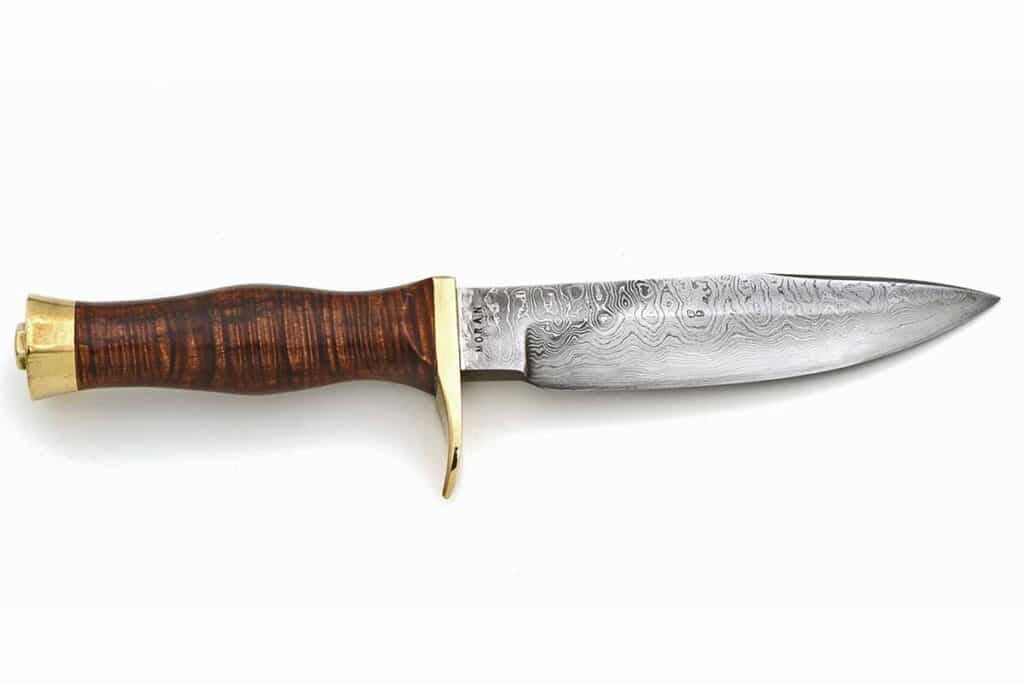
Moran made basic damascus knives. “They weren’t elaborate and this, that and the other thing, but most of them were for use,” B. R. Hughes noted. (Exquisiteknives.com image)
Three years later, Hughes joined Moran and bladesmiths Bill Bagwell and Don Hastings as the quartet that founded the American Bladesmith Society (ABS). When the ABS was founded in 1976, bladesmithing was on life support, and probably fewer than a dozen smiths were forging knives. Today, the Society includes more than 2,000 members and the future of the craft has been secured. Meanwhile, Moran deserves the credit as the catalyst for modern bladesmithing.
B. R. Hughes said Moran made some art daggers that “were a bit elaborate for the day.” An example is this large quillon dagger. (Exquisiteknives.com image)
How Many Damascus Knives Did Moran Make?
While there is no question that Moran and other dedicated disciples of the forged blade brought damascus and the ring of the hammer back to life in the early-to-mid-1970s, there is some conjecture as to just how many such knives the great Moran forged and completed himself. The thought of how many Moran damascus knives were made and exist today is tantalizing, and, of course, what’s a great legend without a bit of mystery and conjecture? Exploring Moran’s body of work and the damascus element within provides some insight into the man, the legend who padded about on the creaky floor of his Maryland shop, sometimes chewing tobacco, but rarely alone when his doors were open as crowds came to see the wizard work.
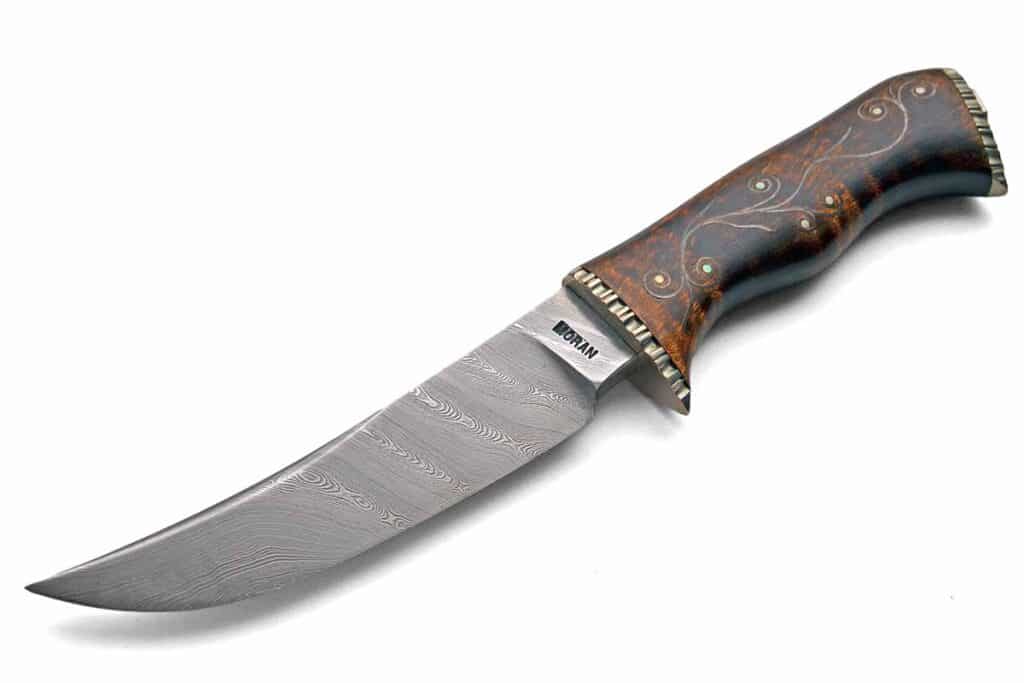
Back in the day, a Moran damascus knife was a challenge to own, considering the time Moran spent in his shop with the material actually able to work without the distraction of visitors, the many hours of labor required to produce a damascus billet, and the higher price for such a piece that naturally followed. (Exquisiteknives.com image)
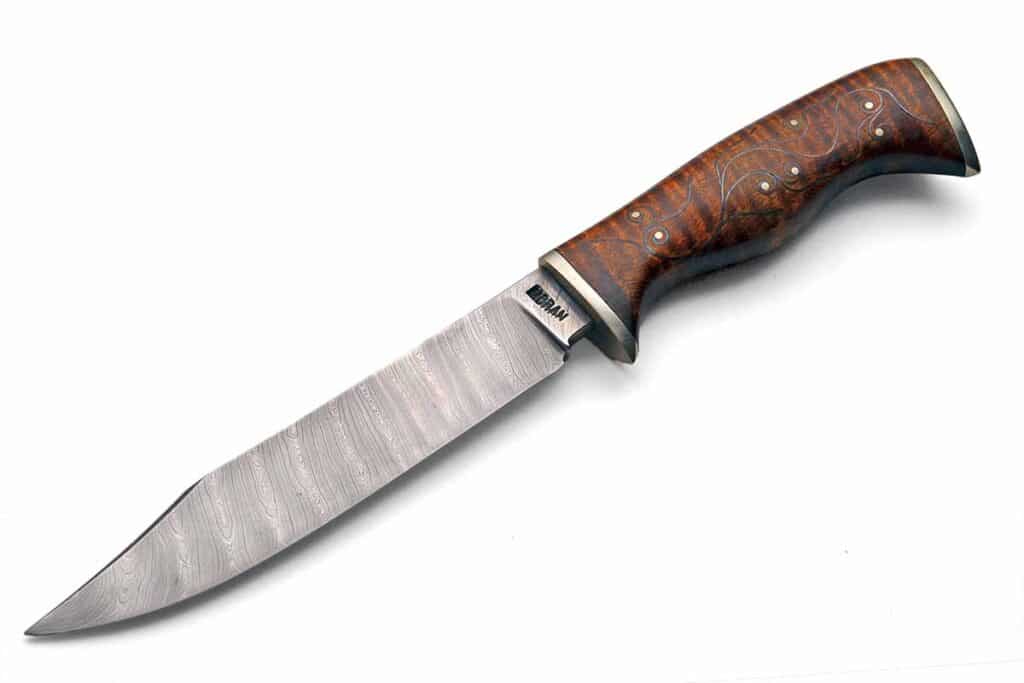
Collectors such as Cutlery Hall-of-Famer Butch and Rita Winter bought the first of Moran’s damascus knives during that historic Guild Show more than a half-century ago, and, as Hughes relates, “Moran made basic damascus knives. Most of his were what folks would call ‘using’ knives. They weren’t elaborate and this, that, and the other thing, but most of them were for use. He did make some art daggers that I thought were a bit elaborate for the day.”
Dave Harvey, Nordic Knives
Hughes remembers that Moran himself was rather vague on the number of damascus knives he actually made. However, probably the best estimate is that fewer than 100 Moran damascus knives were made during a career that spanned more than 50 years.
“He liked the random pattern and the ladder pattern,” B. R. remembered, “and he could do some pretty good patterns, but it took a lot of time. He was very happy just making ladder pattern and stuff like that, and he continued making non-damascus knives and about 40 folders. When he was in his shop, there were always five or six locals in there talking to him and watching him work.” Agreed Cutlery Hall-of-Famer and ABS master smith Jay Hendrickson, a close friend of Moran for 30 years, “Bill had so many visitors to his shop on a daily basis that it is a wonder he ever got anything accomplished.”
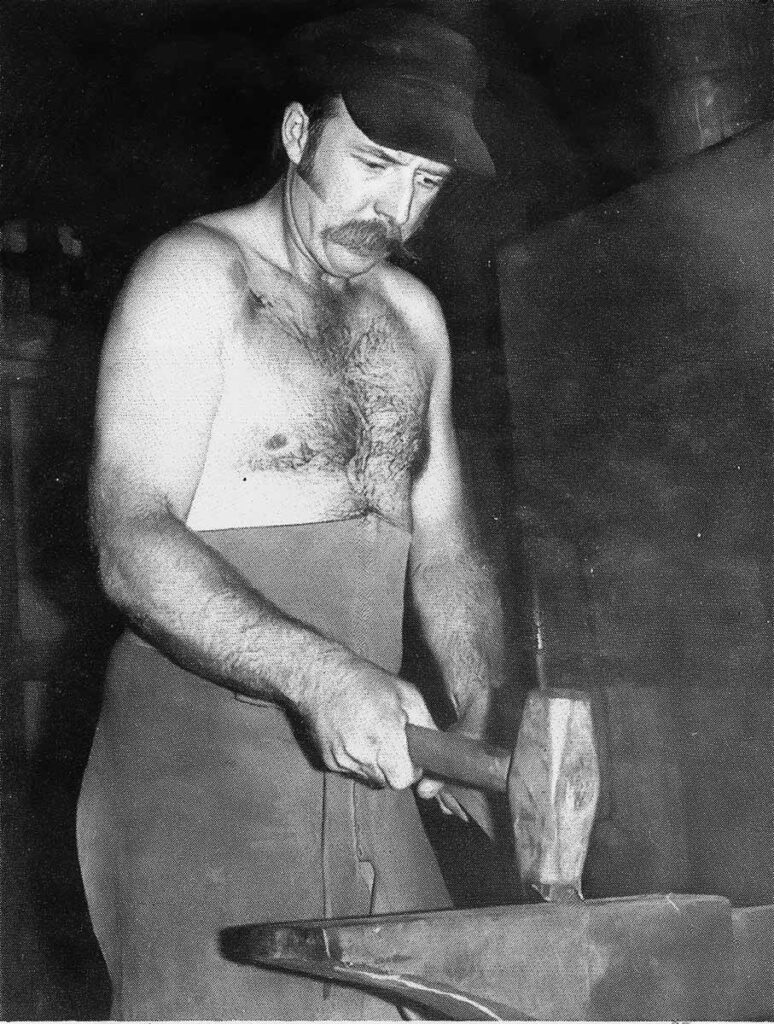
According to Jay Hendrickson, Moran made all of his damascus in a coal fire. “All of Bill’s experiments were with coal, as gas forges were not popular at the time,” Jay explained. “In today’s world, gas forges are almost always used for damascus making because of adjustable temperature and the cleanliness of propane gas.” (vintage photo of Moran in his shop circa the 1960s)
Hendrickson served as the executor of Moran’s estate and founded the Moran Foundation to preserve the great bladesmith’s legacy, serving as its president for 10 years. Jay observed that Moran made a workingman’s knife with quality that was spot-on, though there may have been an occasional flaw in the solder on his early pieces. Nonetheless, Jay says, Bill’s knives always cut.
As for Moran’s damascus knife productivity, Hendrickson offered, “This is strictly a judgment call on my part, but I would say Bill made less than 100 damascus knives. I counted 36 in our Forever A Legend book. I only know a few people that own Bill’s damascus knives, but I think they are sold and traded often between collectors. You also see Bill’s damascus knives occasionally sold at auctions.”
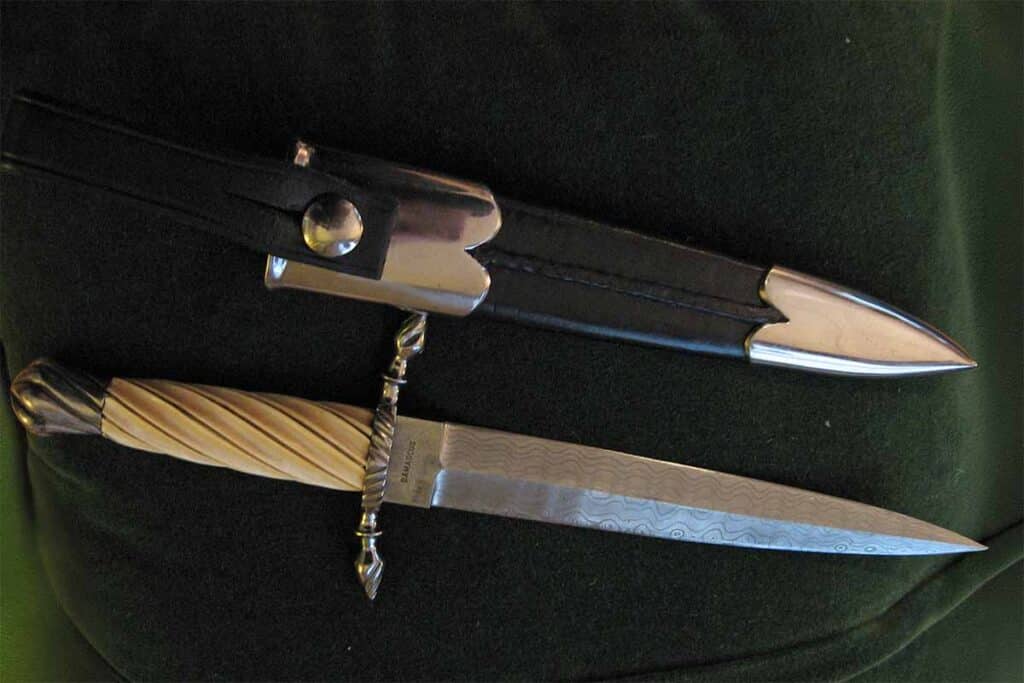
Butch and Rita Winter bought this damascus quillon dagger from Bill Moran at the 1973 Knifemakers’ Guild Show where Moran introduced modern damascus knives. It was one of eight damascus knives Moran brought to the show. The tang is marked DAMASCUS in all uppercase letters. (image courtesy of Rita Winter)
Jay verifies the original sale of a Moran damascus quillon dagger and sheath to Butch and Rita Winter and adds a bit more information. “Rita Winter recently sold Bill’s first damascus dagger to Mr. Doug Hook, a Tennessee collector,” he commented. “Two years ago, I repaired one of the twisted wires on the handle for Mr. Hook. Because of that contact I was able to confirm the original purchase as Doug has written verification of the original sales transaction and the invoice.”
So where are the majority of Moran’s damascus treasures today? Longtime purveyor Dave Harvey of nordicknives.com is straightforward—“in collections around the world. Values vary and depend largely on the particular knife. But they are generally worth at least double that of [one of Moran’s straight carbon steel blades], sometimes even more.”
Dave Ellis said the first of the Moran damascus knives are quite valuable and guessed they would start at least at $10,000 and go up from there. Dave holds an early 1970s Moran damascus hunter at BLADE Show 2023.
Back in the day, a Moran damascus knife was a challenge to own, considering the time Moran spent in his shop with the material actually able to work without the distraction of visitors, the many hours of labor required to produce a damascus billet, and the higher price for such a piece that naturally followed. Dave Ellis of Exquisiteknives.com reasoned, “I could not say how many damascus knives Moran made in his lifetime, but certainly not a large number. Many of Moran’s damascus pieces reside in private collections, as well as the Moran Museum. I personally have owned and still own some and have sold a number of the finer pieces to overseas clients.
“I believe he made four or five patterns. Damascus steel was and still is a laborious process. Bill’s prices for his damascus knives were quite high for the time, so he made and sold mostly carbon steel pieces. Damascus was reserved for higher-end clientele and foreign dignitaries. A good number of the damascus knives were fighters and bowies. Damascus hunters were also made, many with Bill’s twist pattern steel, maidenhair. I do not know of any mosaic steel knives that Moran made. The first of the Moran damascus knives are quite valuable, and I would guess that they would start at least at $10,000 and go up from there.”
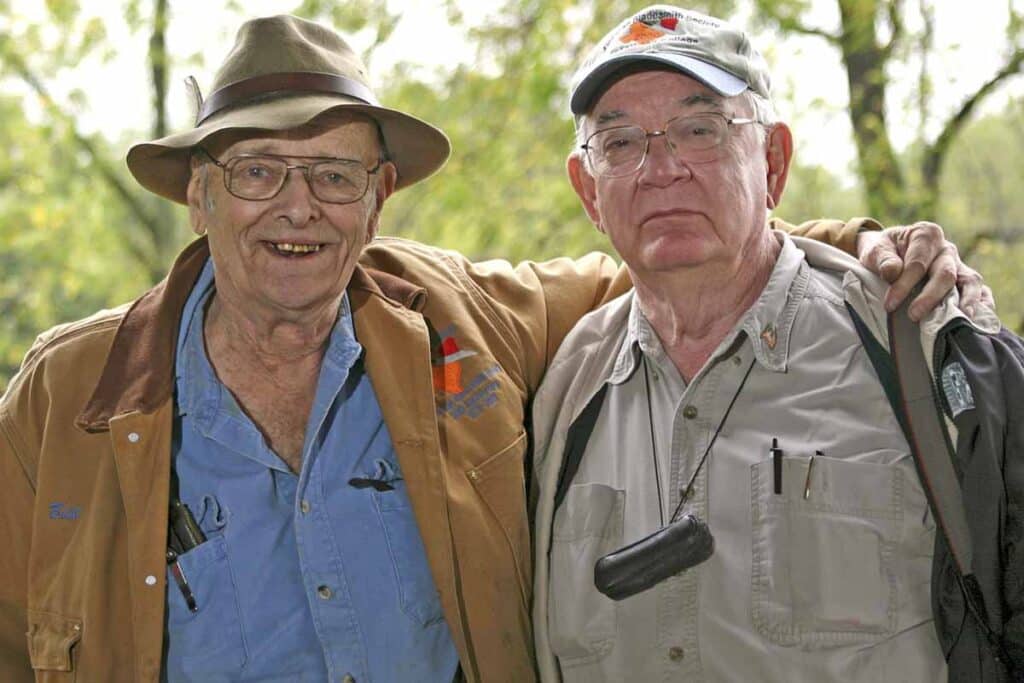
Along with Bill Bagwell and Don Hastings, Bill Moran (left) and B. R. Hughes (right) founded the American Bladesmith Society in 1976. Hughes is the only surviving founding member. (Buddy Thomason image)
HOW HE MADE THEM Hendrickson is familiar with Moran’s most common damascus patterns, the maidenhair twist, ladder pattern and others. “He knew how to fuse metal, as he learned that technique working on equipment on the family farm,” Jay remarked. “On the farm he made knives from whatever he could get his hands on, old springs, files, and rasps, for example. He could also buy steel from a local hardware store in town. Bill also knew the difference between plain iron and high carbon steel. His first damascus experience began by using one piece of steel and one piece of iron. He welded the two together, drew it out and folded it many times.”
The process yielded insight for Moran, and he learned from experience. At times during the process of hammering and folding, he realized that the steel was absorbing heat quicker than the iron because it was on the outside of the billet. Therefore, he moved to one piece of iron with steel in the center, and then a second piece of iron, using O1 tool steel and a carbon mix of 33 percent. According to Jay, this combination gave the billet the right hardness without the need for tempering. Moran’s test of the finished knife was to carve wood for two hours with no loss to the cutting edge, and he was satisfied with the results using this mixture.
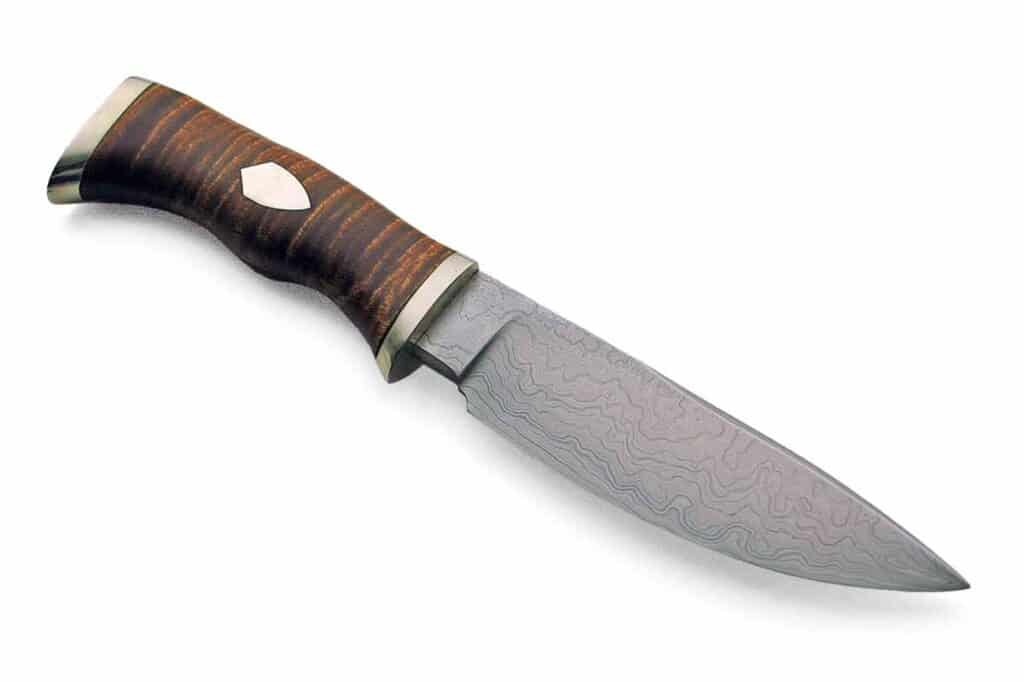
Moran’s test of the finished damascus knife was to carve wood for two hours with no loss to the cutting edge. An example is this clip-point model, again in a ladder pattern. (Exquisiteknives.com image)
“Bill made all of his damascus in a coal fire,” Hendrickson recalled. “A hot coal fire can melt steel as temperatures can reach over 2,700 degrees Fahrenheit, which is the melting point of steel. That is why Bill added iron to the outside of the billet, as iron is less apt to burn as quickly as steel. All of Bill’s experiments were with coal, as gas forges were not popular at the time. In today’s world, gas forges are almost always used for damascus making because of adjustable temperature and the cleanliness of propane gas. Therefore, the burning of steel to a great deal has been eliminated with the use of gas forges.”
Hendrickson attributes the relative scarcity of Moran damascus knives to the maker’s affinity for producing using knives, constraints on time and other factors. “Bill was truly a supporter of the art knife,” he noted, “and along with others they created that industry. Collectors were willing to pay big time for exceptionally well-made knives, and Bill, like other top-notch makers, profited as this industry took hold. However, Bill’s true passion was in using knives, such as camp knives, hunters and small utility knives, of which he made many. The vast majority of his knives came from customers wanting working knives.
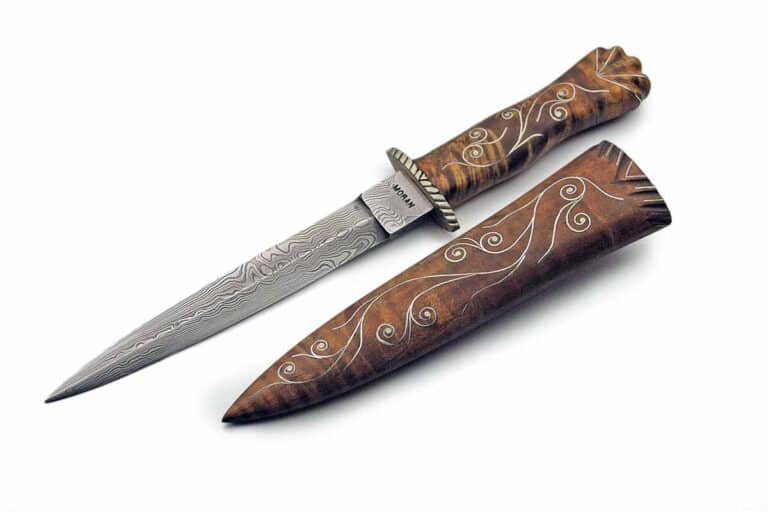
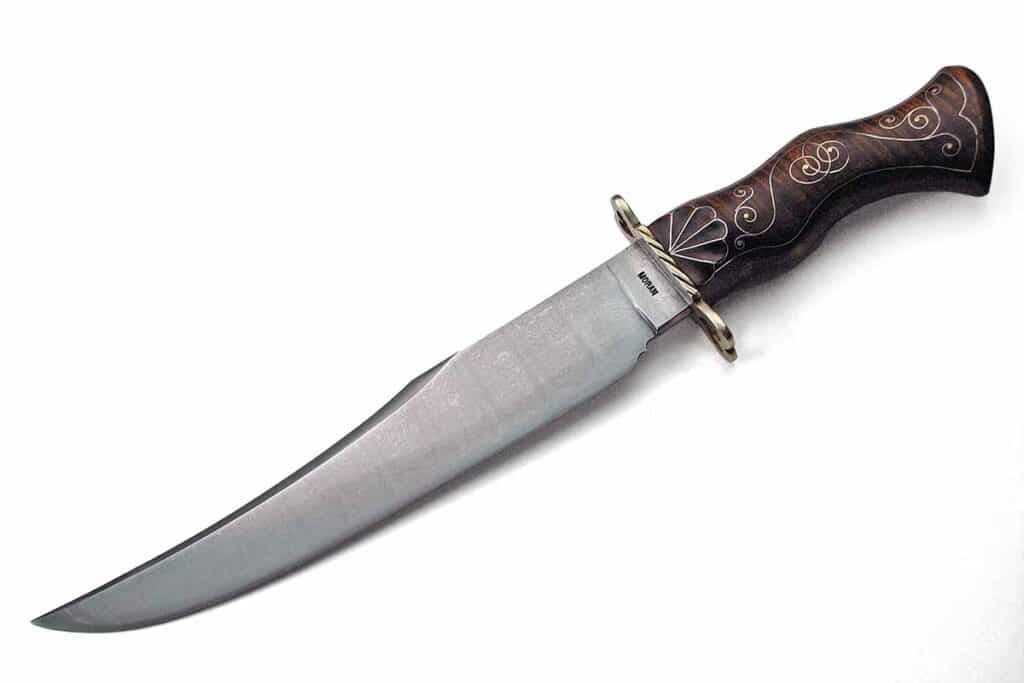
A good number of Moran’s damascus knives were fighters and bowies, according to Dave Ellis. This classic ST-24 in ladder-pattern damascus and curly maple handle with fancy wire inlay is a favorite of Moran collectors. (Exquisiteknives.com image)
“Bill liked to experiment with damascus. For example, he would slip in an added piece of iron after many folds to gain toughness in the end product. Another example was where he completed a damascus billet to the desired number of welds. He then cut it in two and added a piece of high carbon steel to form the middle and welded the two damascus pieces on both sides of the high carbon steel. Once that was completed, Bill forged the billet into a knife. One might call the finished product a damascus san-mai. Bill liked the various patterns that were being developed beyond the more basic patterns that he originally developed. To Bill, mosaic knives were art knives, not to be used but just admired. He didn’t like the process of welding pieces together to make a knife. Remember, he was more into using knives where the grain within the steel followed the entire edge of the blade.”
Through the years, Moran became a legend, leaving a legacy of learning, teaching, giving information freely, and welcoming many to his shop. He paid tribute in steel to the wonder of damascus, the art knife and the using knife. Today’s body of bladesmiths still looks to him as the guiding light that led them to the glow of the forge and the spark of the hammer on hot steel. Those who own or admire the few damascus knives that Moran completed continue to do so for their beauty, their imagination, their rarity, and simply because they bear the touch of the master’s hand.