
Knifemaking

Knifemaking is the building of a knife, which includes the blade, handle and other accouterments. Blades are made by either removing metal from a steel blank via a grinder – known as stock removal – and the forging to shape of hot steel into a blade in the process known as bladesmithing. Other parts, including bolsters, guards, pommels, etc., are needed to complete the finished knife.

Featured Knives – – Knife Collecting – – Tactical Knives – – Survival Knives

Knife Embellishment: When To Do It And When Not To Do It

0

To Bling or Not to Bling?

The best knives and stories are born from some essential reality that grows in the making and telling. For a knife, it is the nature of that reality that determines whether the ornamentations available to the knifemaker either reveal or conceal it. Simply put, some knives benefit from the generous application of various bells and whistles. Others are diminished by any additions beyond their essential form. Most fall somewhere in-between these extremes. But how do you tell the difference?
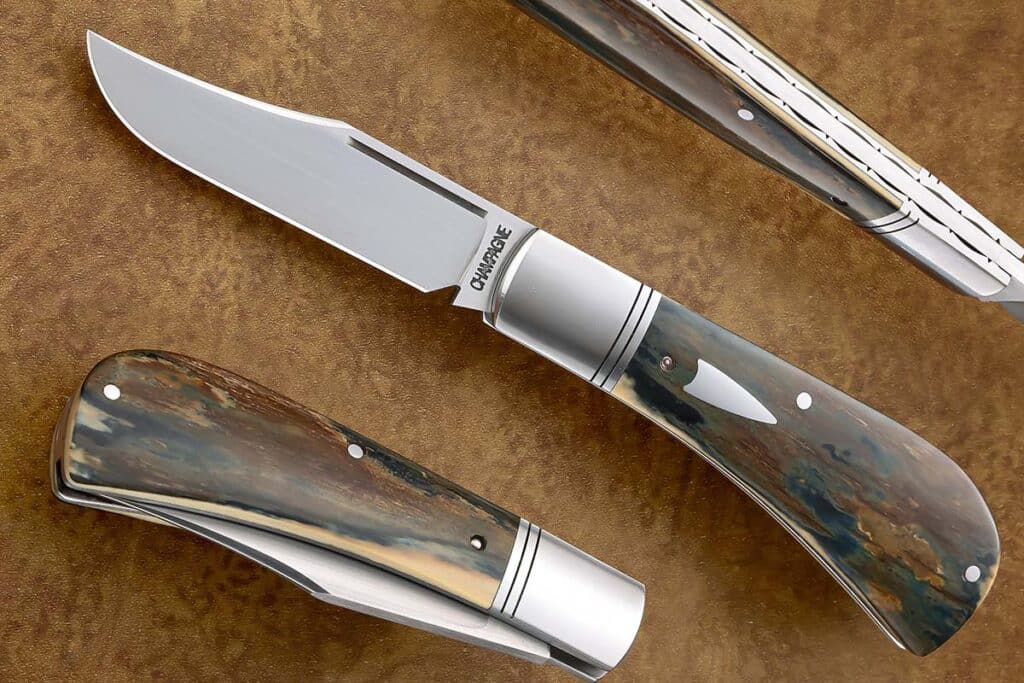
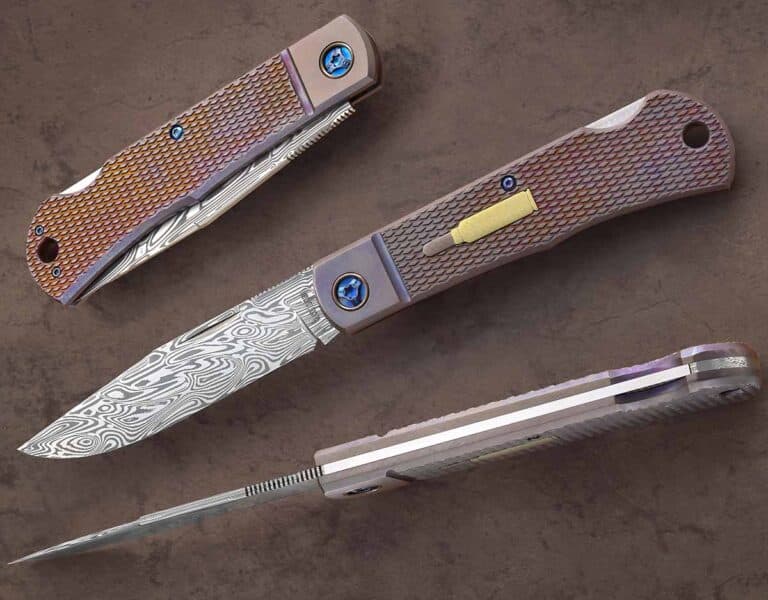
A Lanny’s Clip slipjoint by Ben Champagne is an example of how even a minimal knife embellishment that sends a clear message about the character of the maker.
A Lanny’s Clip slipjoint by Ben Champagne is an example of how even a minimally embellished knife sends a clear message about the character of the maker.

First, consider that much like the vehicle you drive, the knife you carry or make says something about you. It can shine light on your character, priorities, economic or social status, or simply your tastes. Each knife can reflect something important about the maker, or it can evoke a response from the person that encounters it. As the maker, what story are you trying to tell and to whom are you trying to tell it? Any embellishment should be designed to ensure that that something is exactly the thing you want to say.
A Lanny’s Clip slipjoint (IMAGE 1) by Ben Champagne is an example of how even a minimally embellished knife sends a clear message about the maker’s character. Every detail matters, even the ones that are invisible. Immaculate execution is a statement of its own.

In addition, each type of knife serves an essential purpose. Often the purpose is reflected in the name of the knife’s category—everyday carry (EDC), hunter, fighter, chopper, chef’s, even art knife—or by its shape, history and tradition, as in the case of daggers, machetes and bowies. In each case the design is constrained by the intended use, though with varying degrees of success.

Once you have a clear idea what your knife is for and the impact you want it to have, it is useful to write those down. The process of articulating your purpose in words has a way of clarifying things, and helps you keep a firm grasp on your idea as you move forward with your design. You have a much greater chance of creating an excellent knife if you allow your intent to guide your design decisions.
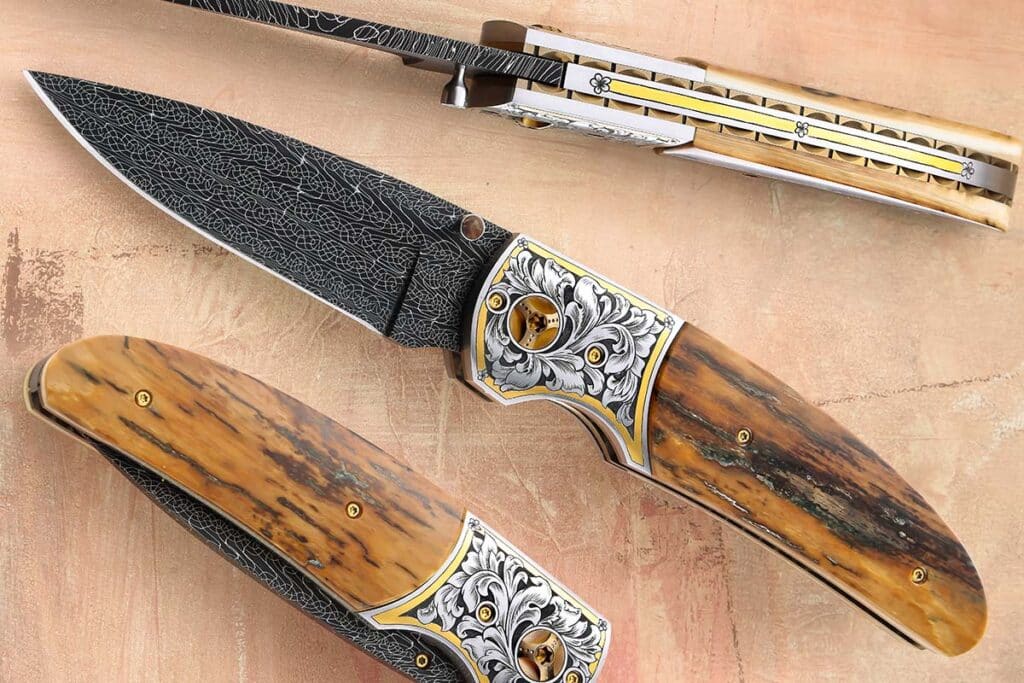
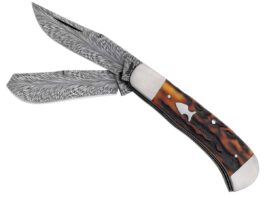
The mammoth ivory scales, subtle filework and damascus blade of Andy Isaacks’ elegant linerlock highlight the detailed engraving by Alice Carter. Closed length: 4.5 inches.
Image 3: The mammoth ivory scales, subtle filework and damascus blade of Andy Isaacks’ elegant linerlock highlight the detailed engraving by Alice Carter. Closed length: 4.5 inches.

A good next step is a detailed drawing, which will help you think through the details in a coherent manner; it is much easier to work through various design elements, material choices and additional embellishment ideas with a pencil than with steel. Here is your chance to test different ideas, keeping in mind that there will most certainly be deviations from your drawing that occur during the actual making process. Some ideas look good on paper but don’t translate as imagined into a three-dimensional object. The opposite is also true, and embracing the back-and-forth process yields the best results. Producing a cohesive design aligned with both your intended statement and the knife’s function is a process that often continues until the knife is complete.

Making A Knife Embellishment Plan

I don’t always embellish a knife, but when I do, I do it on purpose.

As you have gathered by now, the most valuable embellishment available to the knifemaker is outstanding, intentional design. Consequently, the best knives are those in which embellishments are specific, intentional design choices. Intentionality is essential; if you want to be good at something, you should do it on purpose. If a particular choice of ornament does not contribute to the function, visual impact or the statement you wish to make in a noticeable way, omit it. At the very least, choices of ornamentation should never inhibit the essential purpose of the knife.

Alice Carter’s gold engraving is the center of attention on a linerlock folder by G. Kent Carter. Closed length: 4 inches.

Selecting Type Of Knife Embellishment

When it comes to specific embellishments for a specific knife there are myriad choices at your disposal, but if you spend too much time thinking about it nothing will get done. Here are some ideas that can help you decide.

The first consideration is to determine what it is you’re trying to draw attention to. Certain shapes or lines like the S-curve, diagonal line and flow, and pointy or sharp triangular elements tend to naturally draw the eye. A dominant visual weight, strong contrasts of color or texture, or intentional disruptions in visual flow can also grab attention if used accordingly.
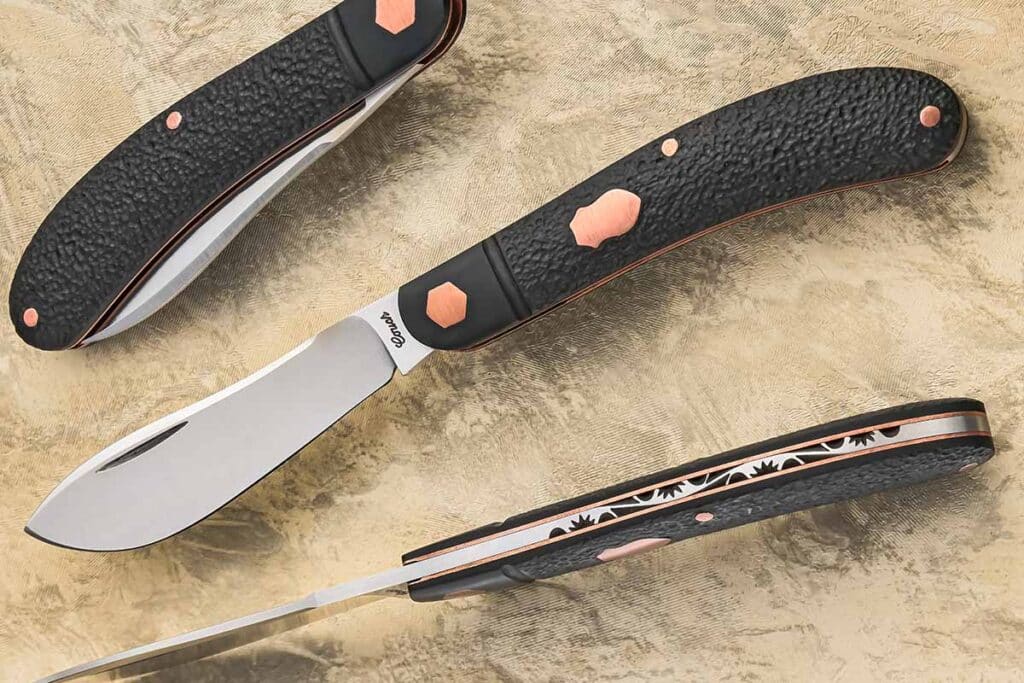
Tanner Couch uses copper to highlight the hardware of the textured black paper Micarta® handle and creative filework that covers only about half the backspring of his shadow pattern rabbit skinner. Closed length: 3.75 inches.

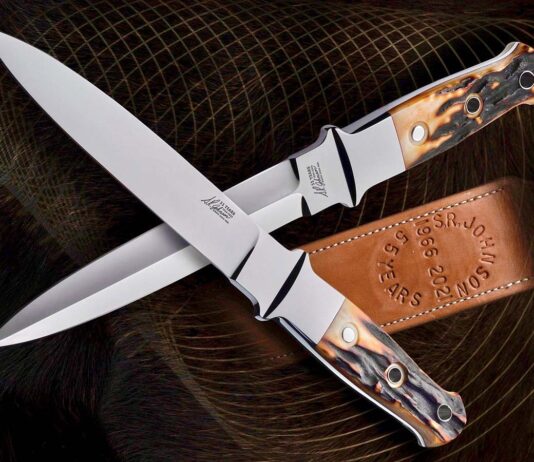
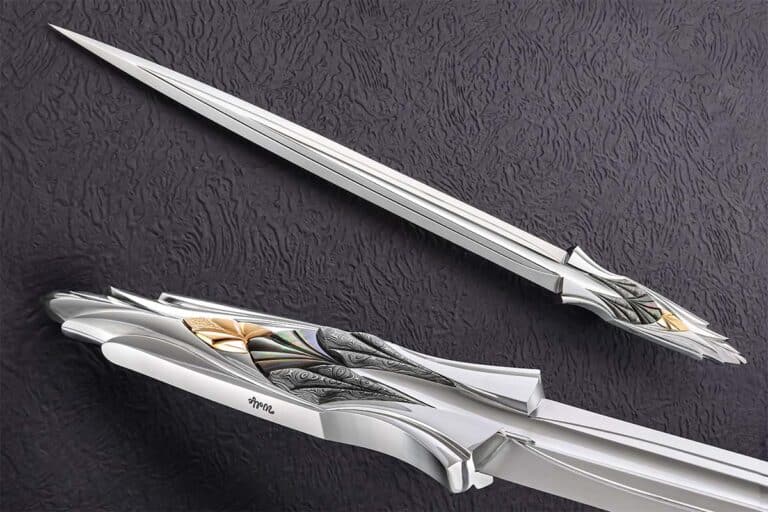
Usually, it is the clever combination of more than one of these elements that makes an arresting visual, and once the attention is firmly grasped the details can reveal themselves. An integral dagger by Wolfgang Loerchner (IMAGE 2) demonstrates how the masterful combination of curves, diagonals and triangles can command notice. Sharp contrasts in texture and color also arrest the eye. Once the attention is captured, it becomes clear that every element of the shape, materials and finish works together to create the essential whole.

The eye is also drawn to areas with more detail. A good rule of thumb is that for it to stand out, the area of sharpest detail should make up about a third of the overall visual composition. By applying this principle, an engraving can be the center of attention, can complement the overall knife design or can distract from it. When engraving is to be the center of attention, other design elements should be allowed to fade into the background. This does not mean that these other details are less important, but a handle with subdued colors and even texture, a satin polished blade, and understated filework will allow the engraving to be the focus.

A boldly patterned damascus blade paired with detailed engraving can overwhelm the eye and keep either element from being visually arresting. Counterintuitively, a finely detailed mosaic damascus blade can present a more neutral visual impact; the details become apparent only when you look closely. A wildly patterned or brightly colored handle material will similarly draw the attention, so use it if the handle material is what you want to visually emphasize.

For example, the mammoth ivory scales, subtle filework and damascus blade of Andy Isaacks’ elegant linerlock folder (IMAGE 3) highlight the detailed engraving by Alice Carter. Every element serves to ensure that the area with most detail draws the eye.

How Not To Embellish A Knife

The understated detail of the Star Crossed Lovers mosaic damascus blade provides a subtle contrast to the artifact walrus ivory handle with inlaid Oregon sunstone set in gold and pure iron guard covered in melted gold on the Behring Sea Artifact Dagger by ABS master smith David Lisch. Overall length: 10 inches.

No discussion about knife embellishment is complete without some reflection on what not to do.

Perhaps most importantly, if you can’t think of a good reason to add a particular type of embellishment, there’s a good chance that you shouldn’t do it. Sometimes it works out but often you waste time and possibly your money by adding elements that lack a clear intent. Similarly, if a knife is intended for hard use, consider what cumulative effects that use will have on your bling, and invest your enhancement efforts accordingly. Where does the value lie?

Despite everything else discussed, it’s worth saying that not every knife needs to be something other than a cutting tool. Indeed, some of the best knives make their statement with simplicity and function. There’s no minimum or maximum amount of embellishment you can add to a knife, but embellishments that aren’t done exceptionally well are worse than none. If you must err, err on the side of simplicity or subtlety. Extravagance can be beautiful but elegance is always understated. Both have a place in the alternatives of intentional design choice.
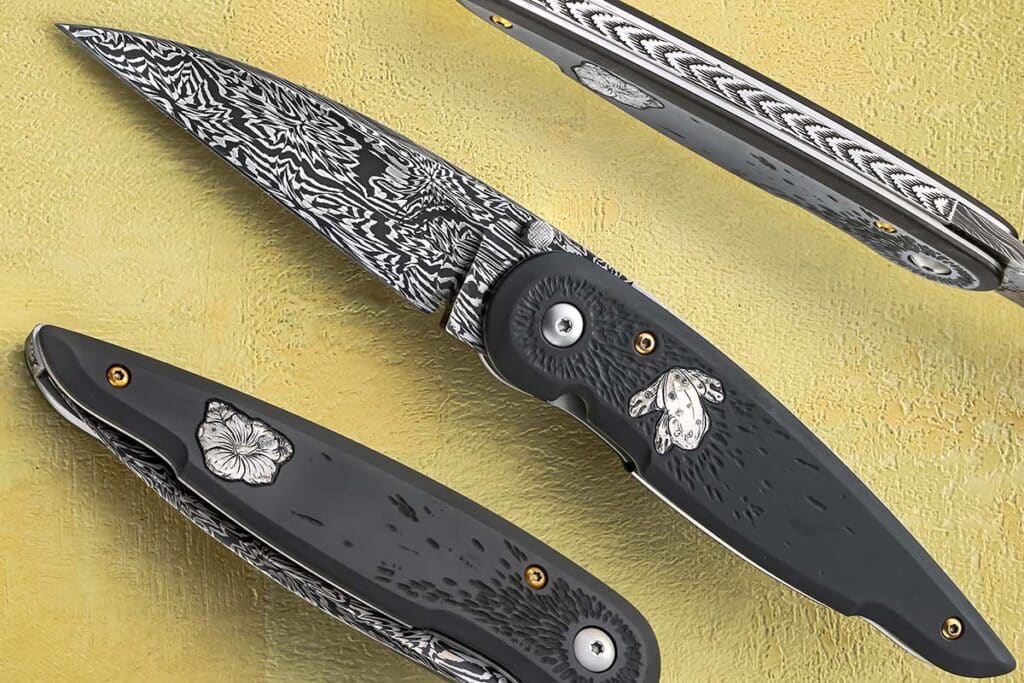
Is it a shield, modified unwrapped menuki or something else? Whatever the designation, the embellished reptile stands out from the all-black textured handle of an ABS master smith Andrew Meers peg-opening linerlock with a mosaic damascus wharncliffe blade.

Finally, your knives will benefit from embellishments done purposefully to increase impact, but can suffer from ornamentation added with the sole intent of increasing the sale price. Keep an eye on what’s best for the knife rather than simply tossing in expensive ornamentation for the sake of perceived collector or monetary value.

More On Knifemaking:

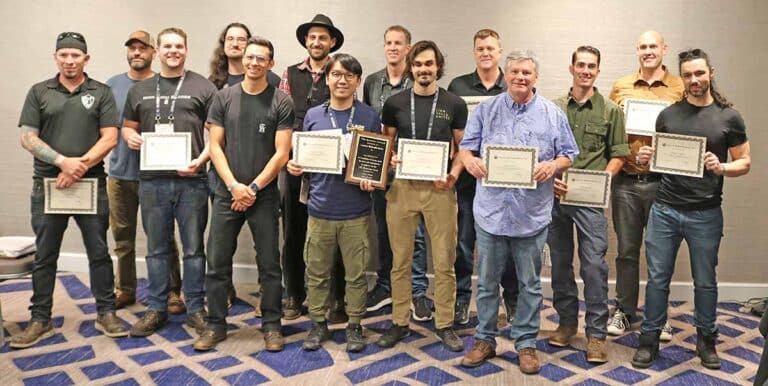
2024 ABS Award Winners And New Master & Journeyman Smiths

Fabulous forged knives, new smiths, new chairman top ABS annual meeting.

Some of the finest forged knives of the year, the newest American Bladesmith Society master and journeyman smiths and a brand new chairman helped highlight the annual meeting of the ABS held during BLADE Show 2024 at the Cobb Galleria Centre in Atlanta.

ABS master smith Kevin Cashen officially began his first term as ABS chairman at the annual meeting, succeeding ABS master smith Steve Dunn who passed away unexpectedly earlier this year. It was a bittersweet transfer of the office for all concerned, though a sparkling array of award knives and an impressive group of new master and journeyman smiths that includes those from Brazil, Europe, China, New Zealand and the USA were an appropriate way to greet the new chairman and pay tribute to the former one.

ABS Annual Awards

Award Winners

  • W. W. Scagel Award: Butch Sheely 
  • Paul Burke Award: Robert A. Wilson
  • Distinguished Service Awards: Karen Cashen, Joel Worley 
  • W. F. Moran Award: Matthew Parkinson
  • Antique Bowie Award, JS: Mace Vitale
  • Antique Bowie Award, MS: Karis Fisher
  • Joe Keeslar Award: Jason Chen
  • B. R. Hughes Award: Fabio Barros 
  • Chairman’s Awards: Kevin Cashen, James Rodebaugh

Fabio Barros

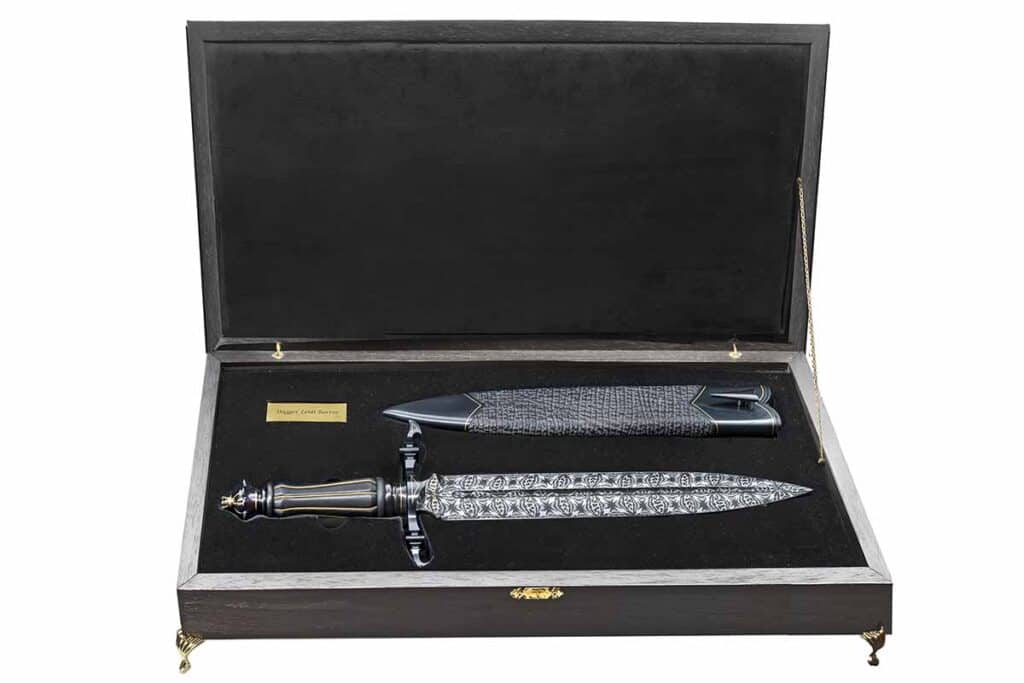
It was a weekend Brazil’s Fabio Barros probably will never forget. Not only was he the sole applicant to gain the coveted rating of ABS master smith, he also won the B. R. Hughes Award for the best knife submitted by such an applicant. In the eyes of some, that he was the only successful MS applicant might have detracted from his Hughes Award—if not for the fact that the same knife also won Best Art Knife at the concurrent BLADE Show.

B. R. Hughes Award Winner

B. R. Hughes Award
Winner: Fabio Barros
Knife name: Leidi Barros Dagger
Maker/designer: Fabio Barros
Blade material: Apricot pattern mosaic damascus w/four-sided roughing
Construction: Take down
Handle: Fluted ebony with gold-braid wire wrap Guard, shim and pommel: Black oxidation with gold appliqué
Pommel stone: Onyx
Sheath: Shark leather w/gold inlay
Display: Ebony case w/exquisite finish
Knife to know: The knife is named in honor of Leidiana Barros, wife of Fabio Barros; the handle design is inspired by the queen in a chess set

Karis Fisher

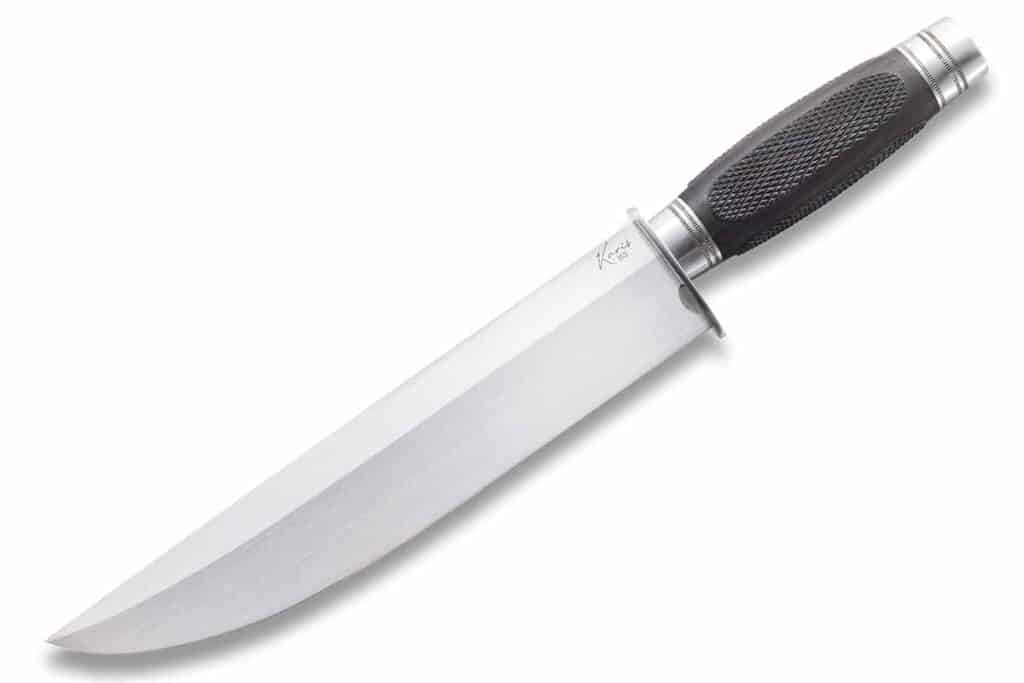
Karis Fisher added to her trophy case by winning the Antique Bowie Award for the best bowie in a 19th-century style by an ABS master smith. It was another feather in the cap of the young smith, who won for a reproduction of the Searles/Fowler bowie—with it being her first attempt at a repro to boot. Added Karis, “I’ve always wanted to try and make a reproduction, and I was drawn to the Searles bowie due to the mix of complexity and clean and timeless design.”

Antique Bowie Award, MS Winner

Antique Bowie Award, MS
Winner: Karis Fisher
Knife: Searles Reproduction
Blade length: 9.25”
Blade material: 52100 carbon steel
Blade width: 2”
Blade @ thickest: .25”
Blade grind: Double ground
Guard material: Stainless steel
Handle material: African blackwood
Ferrule and butt material: Stainless steel
Ferrule and butt embellishment: Coined liners
Overall length: 14.5”
Special features: Half-moon cutout in blade and raised checkered panels on handle
Knife to know: The knife is based on the Searles-Fowler bowie made by Daniel Searles in Baton Rouge, Louisiana, in 1828
Maker’s price for a similar knife: $2,500

The Challenge: “The most challenging part of this build was definitely the planning of the knife and trying to stay true to the original while building it solely off pictures.” 

Matthew Parkinson

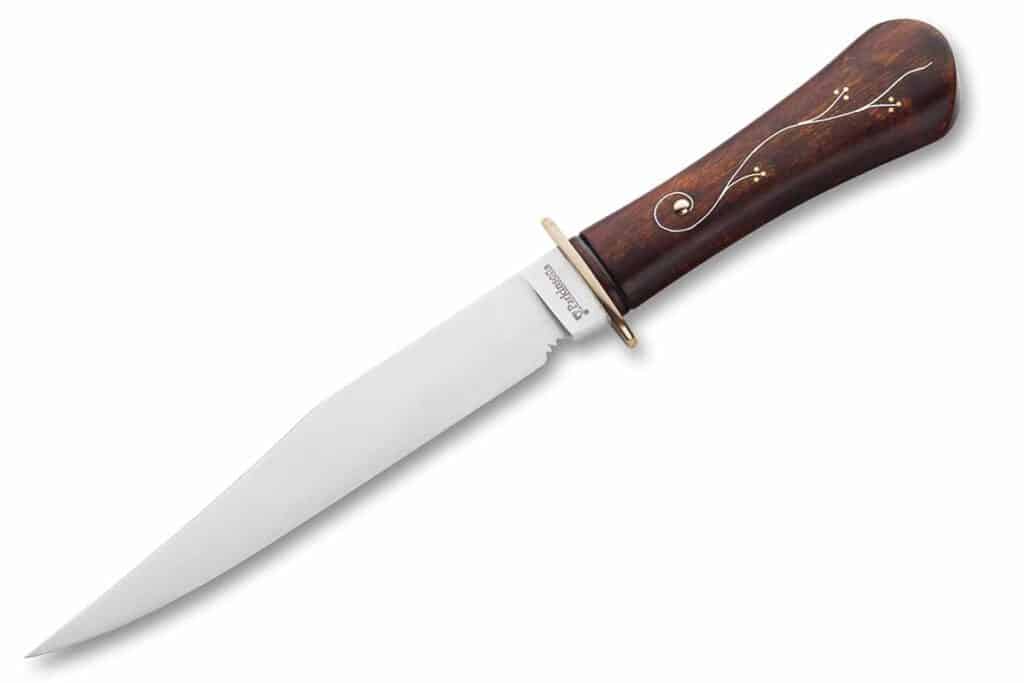
ABS journeyman smith Matthew Parkinson won the W. F. Moran Award for the best knife in the Moran style for his interpretation of a Moran fixed blade. “It wasn’t based on any one knife of his but more a general sort of impression of his body of work,” Matthew wrote. “That is to say, it is my design trying to work within his style—an interesting challenge!”

W. F. Moran Award Winner

W. F. Moran Award
Winner: Matthew Parkinson
Blade length: 7.25” 
Overall length: 12”
Blade material: 1084 carbon steel 
Blade @ thickest: 3/16”
Blade width: 1.125” 
Guard and pins: Bronze 
Handle: Maple 
Inlay: Sterling silver 
Maker’s price for a similar knife: $1,100

Maker’s remarks: “The Spanish Notch is just a detail to the choil rather than a plain rounded choil. I saw several similar examples on a knife that Mr. Moran had made and thought it might be a nice touch. The groove at the base of the handle is a carved molding. This is a detail I use frequently in knives that don’t have stabilized wood handles, as inlaid handles normally are. It helps keep a clean, even fit but still allows the wood to move, at the same time adding a nice visual feature that adds to the overall design.” 

The Challenge: “I think the most challenging part of doing these is working within another maker’s aesthetic, especially one like Mr. Moran who has a huge and varied body of work. That’s the part that teaches you the most, I think. I find building one of these can give you insight into why another maker chooses one feature over another, or why a line or form is there. Those design ideas become incorporated into your own style and help you grow as a maker.” 

Mace Vitale

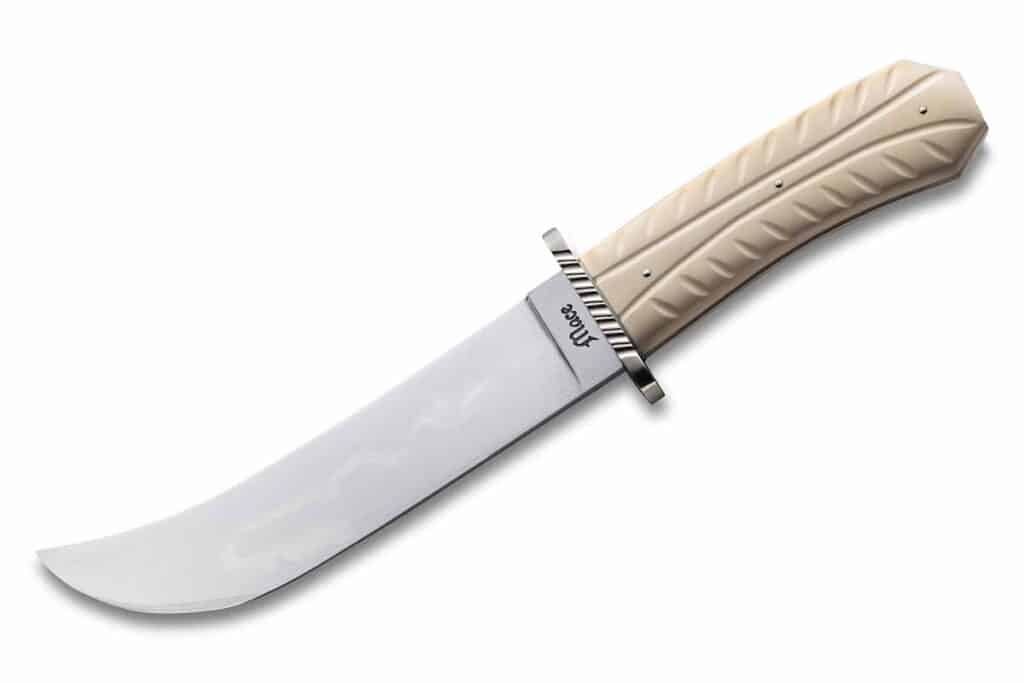
Mace Vitale captured the Antique Bowie Award for the best bowie in a 19th-century style by an ABS journeyman smith for a knife inspired by an antique piece made by Otto & Koehler of New York around 1850. The unusual knife features a markedly upturned blade tip and an ever-so-slightly downturned handle with a modified coffin-style butt featuring two carved lines and two rows of individually carved oblique divots that run its length. “The carving on the handles I’m positive were for extra grip. The knife has an excellent feel in the hand,” Mace observed. “There has been a bit of discussion as to the purpose of the original. As a knifemaker it was pretty clear to me when I picked up the original that it was very purposefully built to be a fighting knife.”

Antique Bowie Award, JS Winner

Antique Bowie Award, JS
Winner: Mace Vitale
Knife: Inspired by an antique fixed blade from New York makers Otto & Koehler from around 1850
Blade length: 6.5”
Blade material: W2 tool steel
Blade width: 1.25”
Blade @ thickest: 3/16”
Blade grind: Flat
Fittings and pins: Nickel silver
Handle: Mammoth ivory
Overall length: 11”

The Challenge: “The most difficult part of building this knife was trying to keep all the parts going the way I wanted. When making a knife like this, it is put together and taken apart many, many times, and I found myself constantly putting the handle or guard on upside down. I was glad once it was done.”

Jason Chen

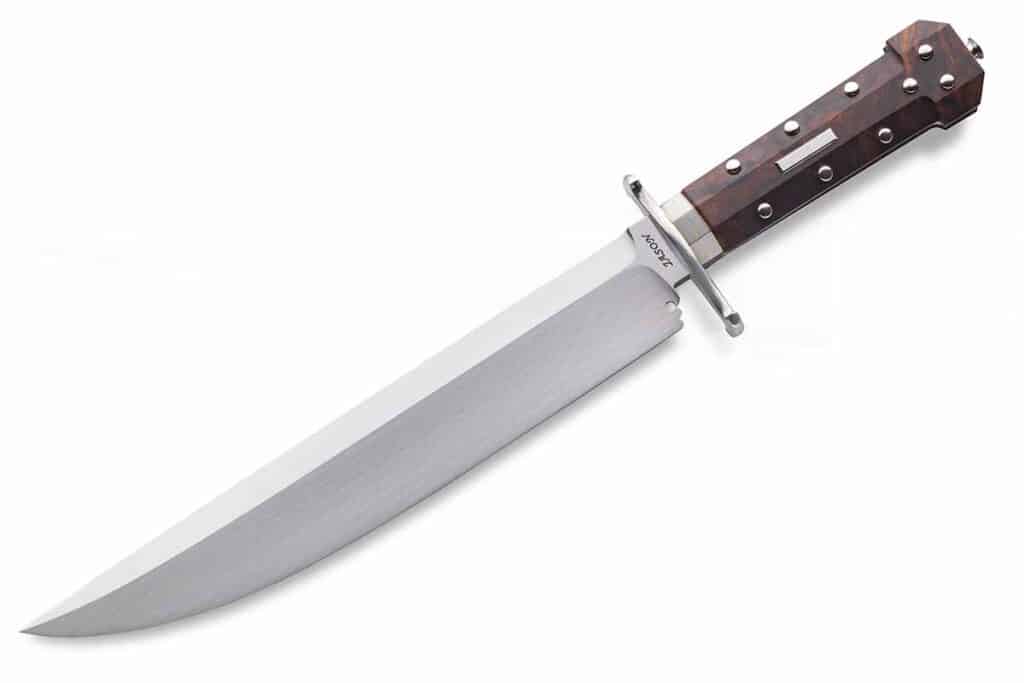
Newly minted ABS journeyman smith Jason Chen of YunNan, China, won the Joe Keeslar Award for the best knife submitted by a successful JS applicant for a spotless reproduction of a bowie not unlike the antique L. Kimball knife. The fact Jason prevailed over the best knives of 13 other successful JS applicants adds to the difficulty of his winning this year’s Keeslar Award. He is to be congratulated—as are all of those receiving top honors at the annual ABS meeting.

Newly minted ABS journeyman smith Jason Chen won the Joe Keeslar Award for the best knife submitted by a successful JS applicant for a bowie not unlike the antique L. Kimball knife.

New ABS Masters & Journeymen

Five applicants presented for ABS master smith and one passed. Twenty-four applied for ABS journeyman smith and 14 were approved. The panels of judges were chosen by the ABS. The smiths who made the grade were:
ABS master smith: Fabio Barros, Brazil;
ABS journeyman smiths: Cameron Alarcio, California; Jason Chen, China; Pieter-Paul Derks, Netherlands; Zane Dvorak, Ohio; Robin Gagchian, France; Chris Gardner, Nevada; Aidan Garrity, Connecticut; Erik Greiner, Texas; Tony Lewis, Arizona; Dan Lewis, New Mexico; Tony Severio, Louisiana; Warren Thacker, Tennessee; Thiago Vidotto, Washington; and Liam

More On ABS:

Cool Custom: Ryan Breuer’s Relic Dagger

Breuer’s Relic Dagger is Bronze Age solid gold.

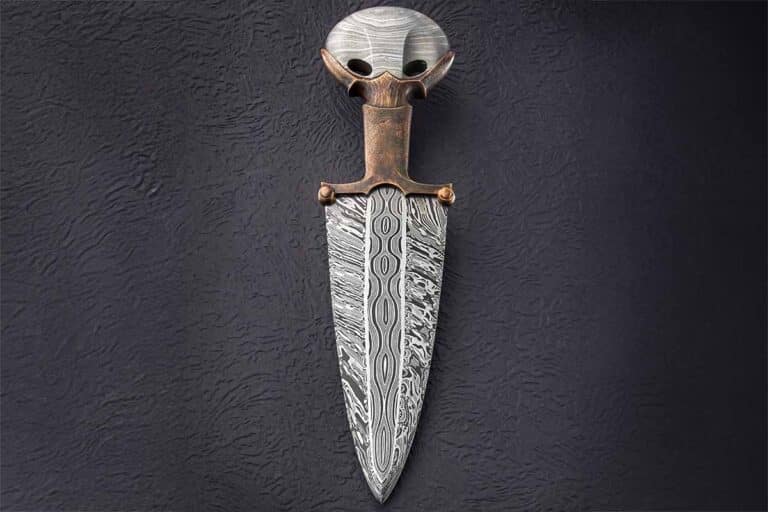
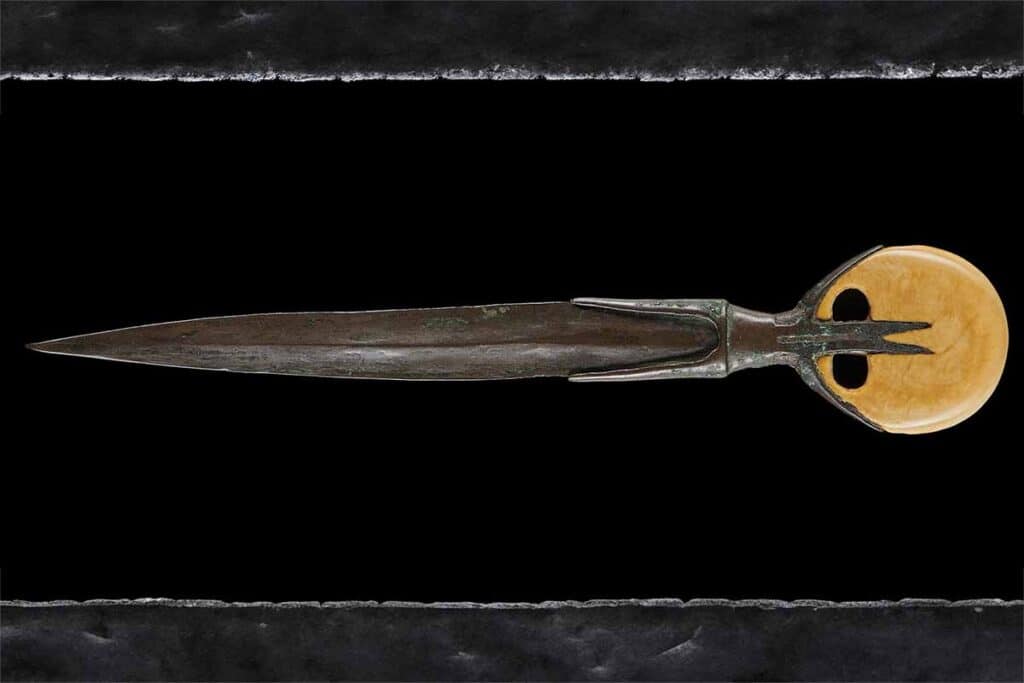
While it may appear to be an alien looking back at you, the Relic Dagger by ABS journeyman smith Ryan Breuer is inspired by Egyptian daggers from the Bronze Age that were made over 6,000 years ago.

The pommel on the originals are believed to have been made of hippo ivory.

“There’s such a striking shape to it,” Ryan said. “It very clearly looks like a human form in the handle holding up either a head or maybe the sun. It’s as if those who made the daggers thousands of years ago are looking back at me. It’s almost spooky.”

The damascus blade is a collaboration between Ryan and bladesmith Jason Morrissey, though Ryan gives Jason most of the credit for the steel. The blade is a composite mosaic damascus, with twisted mosaic edge bars of Jason’s steel and Ryan’s “eyes” mosaic in the core.

Ryan Breuer
Ryan Breuer

Ryan ground, heat treated and finished the blade. The hilt is cast bronze made with the lost-wax process. The pommel is pattern-welded wrought iron and pure nickel, manipulated to imitate layers of organic ivory. Ryan drilled the two holes for the “eyes.”

Breuer Relic Dagger Specs
Maker: Ryan Breuer
Blade length: 7.5”
Blade material: Composite mosaic damascus of 1084 carbon and 15N20 nickel alloy steels
Blade width @ base: 31/8”
Overall length: 12.75”
Maker’s price: $3,000

See More Custom Knives:

Cool Customs: Barret Chrisman Takes The Ol’ Bullet Hi-Tech

Barret Chrisman puts a modern spin on a vintage Remington design.

Barret Chrisman’s contemporary take on the classic Remington 1306 Bullet lockback combines tradition and hi-tech in one handsome custom pocketknife.

Barret outfitted his repro with all cutting-edge materials, including a blade of Loki pattern damascus by Damasteel, a handle of checkered titanium that resembles jigging and a titanium bullet shield. “I’ve seen people jig titanium before but I wanted to try checkering, so I made up a custom pantograph template and tried it out,” he said. He anodized the handle a purplish bronze.

Barret Chrisman
Barret Chrisman

“It’s a modern take on an old school knife everybody likes,” Barret noted, “and I’ll probably be doing the same kind of thing in the future.”

Remington 1306 Bullet Modern Reproduction Specs
Maker: Barret Chrisman
Blade length: 4”
Blade material: Loki pattern damascus by Damasteel
Blade grind: Full flat
Handle frame: Titanium
Handle scales: Checkered titanium w/inlaid titanium bullet shield
Lock: Lockback
Closed length: 47/8”
Maker’s price for a similar knife: $1,500

Check Out More Cool Custom Knives:

What Makes A Good Hamon?

Know the visual tells of whether a hamon is done properly or not.

For centuries, the hamon has served as a mark of excellence in the forging of blades.

Conspicuous by its picturesque line generally dissecting the midsection of a differentially heat-treated blade, it demonstrates a skill set highly valued among top bladesmiths and swordsmiths. Moreover, the difference between a good hamon and one that doesn’t hit the mark can help the maker, owner and user in understanding the prospective performance of the blade itself.

Basically, think of a hamon as the equator between the hard and softer or more malleable areas of the blade. Everything above the hamon is softer, which translates as making the back of the blade malleable and thus tougher. In other words, the blade will bend but not break. Meanwhile, everything below the hamon is harder, which is better for holding an edge.

Francesco Piccinin and Denis Mura provide hamon on their bowie collaboration.
Emiliano Carrillo indicated a hamon should be continuous, with no areas falling off the edge of the blade. Francesco Piccinin and Denis Mura provide such a hamon on their bowie collaboration. Blade material is C130 carbon steel, according to Eurotechni (eurotechni.com) a grade that makes it possible to obtain “pretty hamons.” Overall length: 13 inches. (Jocelyn Frasier image)

“There are several things that make the edge pattern successful,” explained bladesmith Emiliano Carrillo of Sun and Stars Forge. “The first two are practical.

The hamon should be continuous; there should be no areas of it that fall off the edge of the blade. It should be high enough that the knife can support a lifetime of sharpening and removal of edge material without biting into soft material. For kitchen knives this can be somewhat low to the edge, as the geometry will have to be adjusted if a large amount of edge material is removed.

“The rest are my own opinion and are purely subjective. I’m a bladesmith who works in the historical tradition and therefore my work draws on traditional Japanese metalwork when it comes to hamon aesthetic and technique.

“I think a good hamon should be active and rippling, showcasing your imagination and artistic vision,” Emiliano continued. “It should have good undulations and look like it’s been drawn on the blade with an ink brush. There should be ashi [legs], which are areas of hardening within the hamon that drip down towards the edge. Sometimes a repeating motif, like sanbonsugi [three cedars] or choji [clove] can be utilized to guide the way you want to design the hamon.”

ABS master smith Mike Quesenberry agrees that there are hallmarks to a good hamon that are readily discernable.

“First and foremost, a good hamon will not come down to the cutting edge,” he remarked. “That is a no-no because it is bringing down soft steel where you want hard steel. I want a bigger transition area, and you can credit the Japanese for starting it. As the technology evolved over hundreds of years, they found bits and pieces coming down from the hamon, giving strength to the edge.”

ABS master smith Brion Tomberlin adds that the proper hamon is visible to the eye even when the maker is finishing the grinding process at 120 grit.

“The Japanese have many terms for effects you see and want to see in a nice hamon,” he commented. “And you can spend years studying these. For our purposes, you want it to be very visible and make a very visible demarcation from the hardened area to the softer area. Additional effects such as ashi, which are wispy cloud-like formations hanging down from the main line, are nice and show control.”

Steel Selection

Brion Tomberlin stated that low-alloy carbon steels such as W2, W1, 1095 and 1075 yield the greatest success in producing good hamons.
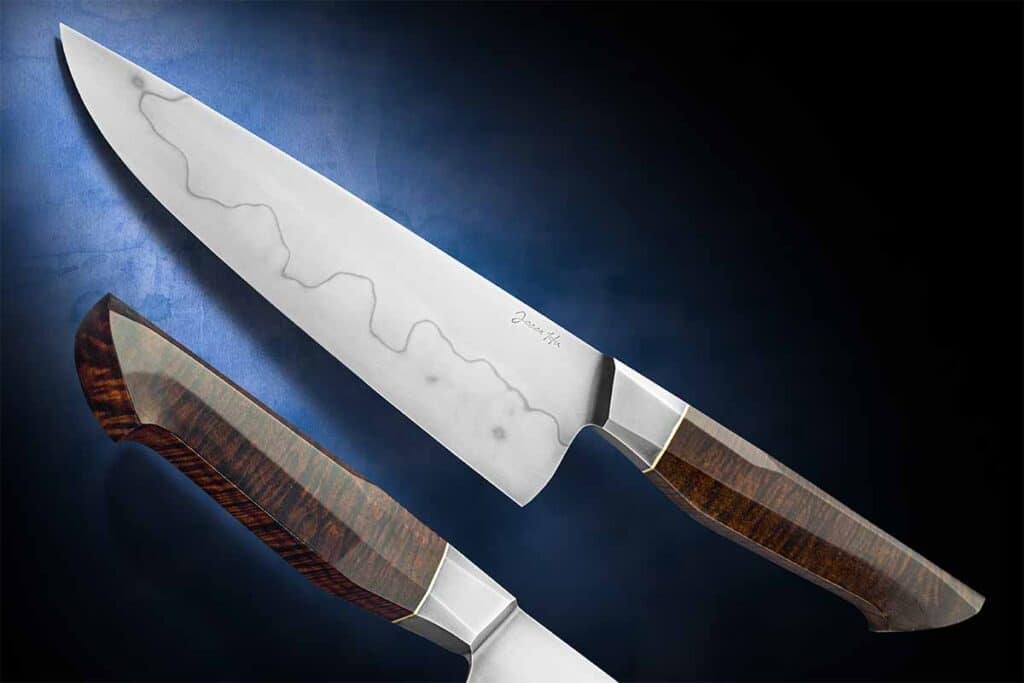
Brion Tomberlin stated that low-alloy carbon steels such as W2, W1, 1095 and 1075 yield the greatest success in producing good hamons. ABS apprentice smith Jesse Hu forged the 8.5-inch blade of his classic integral chef’s knife from W1. Overall length: 14 inches. (Jocelyn Frasier image)

Success or frustration in the hamon process begins with the proper steel, and BLADE Magazine Cutlery Hall-of-Fame® member/ABS master smith Steve Schwarzer emphasizes that point.

“Steel selection is critical,” he observed. “You want a simple carbon steel with .70 to 1 percent carbon, and guys are doing ‘gee whiz’ work using a formula with W2 steel, which is a very simple steel. The time-temperature-transformation curve is important, and alloy widens the curve. Too much alloy in the steel won’t transform fast enough to achieve the hamon pattern you want.”

Tomberlin added that low-alloy carbon steels yield the greatest success, and these include W2, W1, 1095 and 1075.

“The maker should look at the certifications for the steel to see the composition,” he recommended. “You want a steel low in manganese, as manganese promotes deep hardening instead of shallow hardening, which we want. We want the transformation of austenite to martensite to be fast upon quenching in order to achieve a hamon, and shallow hardening steels are what is needed. Can you achieve hamons with other steels? Yes, in some cases where the manganese is lower, but they usually do not have the activity or effects you would like to see. My go-to steel is W2.”

Creating A Hamon

Eliott Robinson provides ashi in ample supply on the 5-inch blade of his fighter.
Ashi, which Brion Tomberlin describes as “wispy cloud-like formations hanging down from the main line [of the hamon], are nice and show control.” Eliott Robinson provides ashi in ample supply on the 5-inch blade of his fighter. Blade material: U10A carbon steel. (SharpByCoop image)

After the heat treating and hardening process develops the desired hamon, bringing out the robust visual aesthetic is a process in itself that, according to Carrillo, varies from bladesmith to bladesmith.

“All makers have different ways of polishing out their hamon, and these methods evolve over time or to suit a particular project or aesthetic need,” he observed. “My technique has evolved over time but works for 90 percent of the work I do, and is a good way to practice bringing out all the activity you want to see in the steel.”

For his technique, Carrillo grinds the blade to 220 grit; polishes it to 800 grit using a hard backer for the sandpaper; cleans the blade completely using acetone, dish soap or rottenstone while making sure water does not bead up on it; etches it in ferric chloride; removes oxides completely using fine grit sandpaper; assembles; and then oils.

Quesenberry follows a similar protocol.

“I have a blade in front of me and I’m going to a hammer-in this weekend. I will take it up to 800-grit finish and dip it in ferric chloride,” he said, “and then I’ll wait until it turns black depending on the strength of the ferric. Once it’s black I neutralize it with Windex and then pull with a gray 3M polishing cloth in nice, even and straight lines, removing the black to get the white for the ashi to pop.”

Faux Hamons

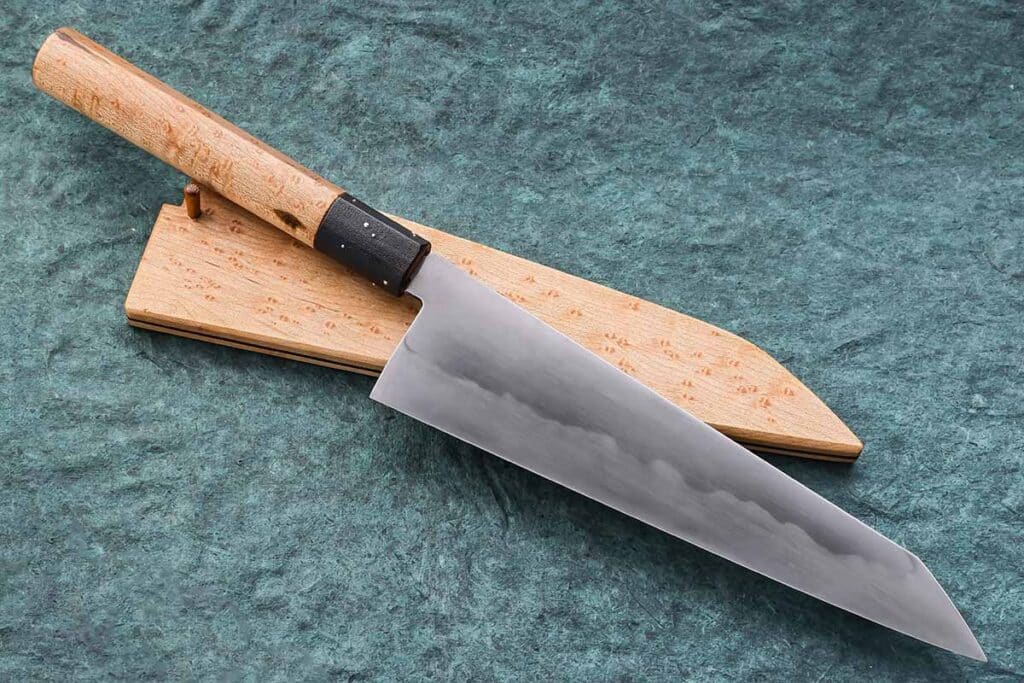
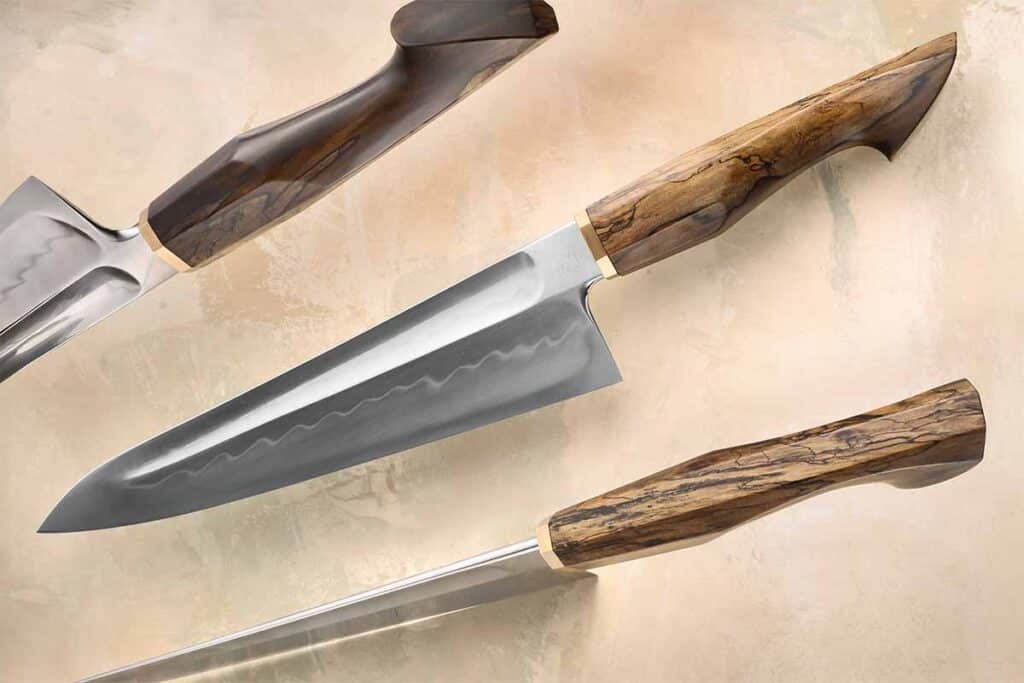
Emiliano Carrillo outfitted the blade of his K-Tip Gyuto with a clayed hamon.
Emiliano Carrillo outfitted the blade of his K-Tip Gyuto with a clayed hamon. The handle is bird’s-eye maple, as is the saya (sheath), which includes a black walnut liner and a bamboo menugi (ornament) to keep the blade in place. (SharpByCoop image)

To dispel one common question, bladesmiths confirm that all knives do not have hamons. As Carrillo says, “There may be areas of decarb on the blade that may be mistaken for a hamon, but it is only surface level.”

At the same time, some factory-produced blades may have a fake hamon etched onto the blade to make the piece more attractive to the potential buyer.

“If a hamon has been etched on, a perfectly clean line is generally seen,” he added. “It doesn’t have any of the cloudiness or desired fuzziness seen in the line on a real hamon. The fake ones are generally very white and too regular to be a metallurgical effect.”

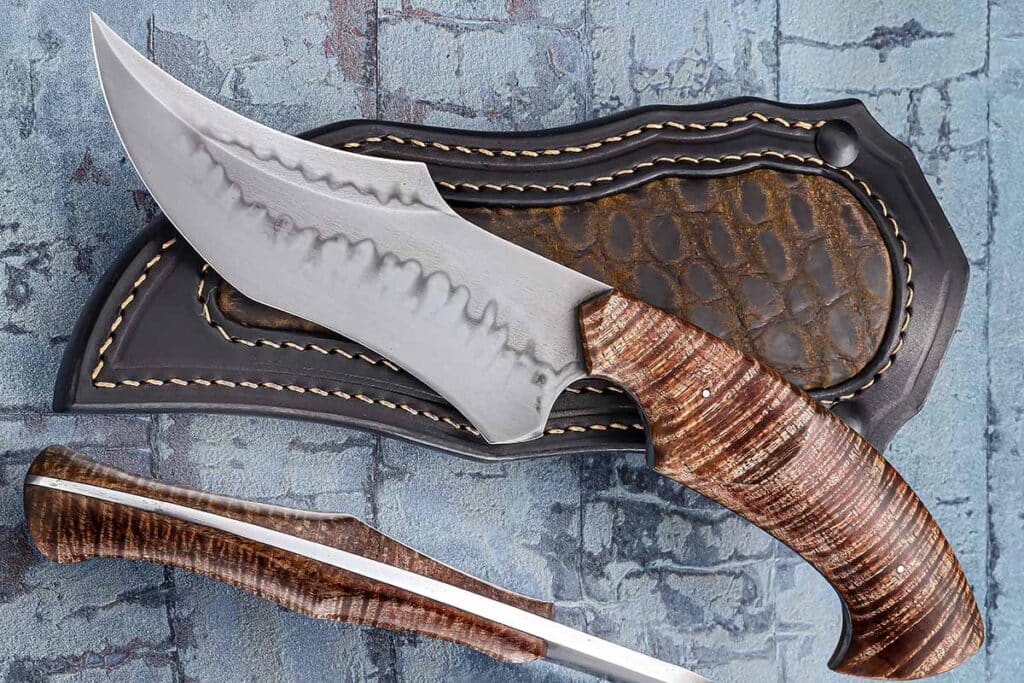
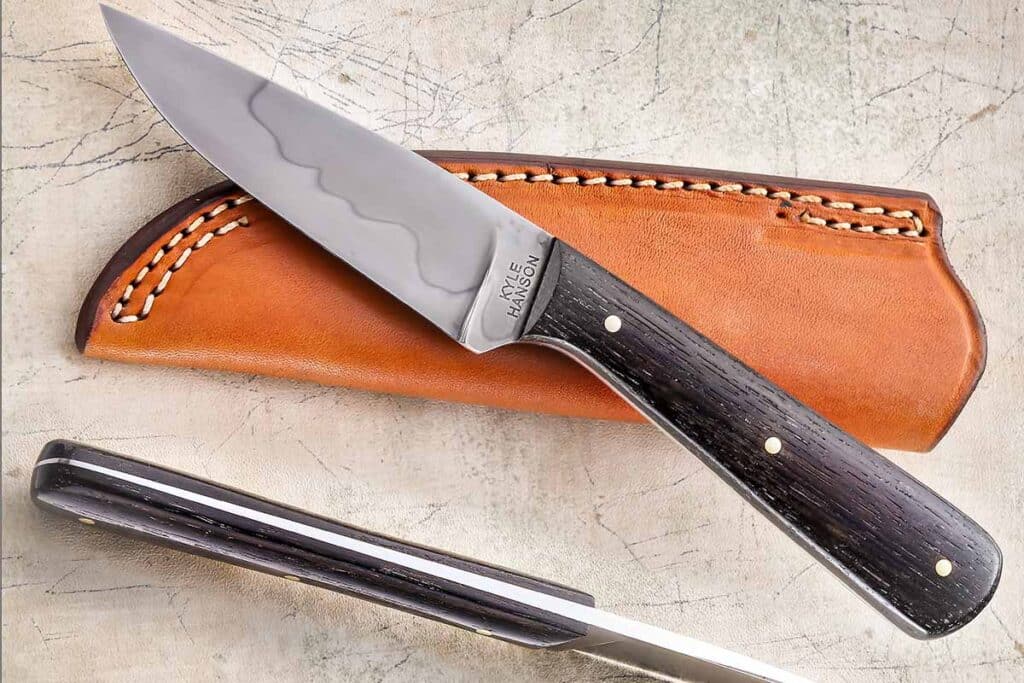
Kyle Hanson demonstrates a hamon here on his no-nonsense hunting knife.
The blades even of smaller knives such as folders and hunters provide a solid canvas for a hamon, as Kyle Hanson demonstrates here on his no-nonsense hunting knife. (SharpByCoop image)

Tomberlin has seen a false hamon from time to time and says the technique to achieve one is quite different from the genuine article.

“This is usually done by selective etching or different polishing techniques,” he advised. “It is hard to explain how to tell, but if you see one versus a true hamon it stands out immediately, usually as too regular with no effects at all. Also, there is usually a very sharp demarcation line from highly polished to etched, and this is especially prevalent in some pieces from overseas.”

What Makes A Good And Bad Hamon

Separating the good hamon from the bad hamon may require practice. In some cases the differences are obvious but in others, they are more subtle. The professionals have seen it all.

“The biggest issues of a poorly done hamon are things like fading away in some areas or, yes, going off the edge of the blade,” Tomberlin related. “If the hamon fades off the edge that means your edge is not hard in that area, which is not good. The main causes of this are clay coating being too thick and improper heating of the blade when bringing it up to quench temperature. The main issue I have seen is the hamon going off the edge. As long as you have the edge hard you have a hamon.

Will Newham achieved a hamon on his Best Chef’s Knife winner from the 2023 Sydney Knife Show.
According to Emiliano Carrillo, a hamon should be high enough that the knife can support a lifetime of sharpening and removal of edge material without biting into the soft material above it. Will Newham achieved such a hamon on his Best Chef’s Knife winner from the 2023 Sydney Knife Show. (SharpByCoop image)

“Poorly done polishing will show up also. A well done hamon takes time both before and after quenching. Trying to cut corners on polishing will definitely show. As for a lack of activity in the hamon, such as being straight instead of having hills and valleys, someone told me a number of years ago that one of the hardest things to do well is a simple straight hamon called a suguha.”

Schwarzer sees crispness in the boundaries of a good hamon and acknowledges that heat treating and polishing techniques are critical in bringing that out.

“In the early ABS [American Bladesmith Society] we used an edge quench to get a hamon, and that is the mainstay of the ABS today,” he said. “In testing now you rarely see a hamon because you don’t see as much polishing as necessary to get you through the test. You can’t bring it out with a buffer. It’s almost like a metallurgical polish so you can see the grain in the steel.”

The well done hamon represents an art form in itself, and Quesenberry is impressed with the current wave of artistic impression.

ABS apprentice smith Aidan Garrity outfits the hamon of the 10.5-inch blade of his V-44 repro with hints of ashi
ABS apprentice smith Aidan Garrity outfits the hamon of the 10.5-inch blade of his V-44 repro with hints of ashi. Blade material: W2 tool steel. Handle: carbon fiber. Overall length: 15.5 inches. (SharpByCoop image)

“People have ‘Americanized’ it I guess you could say, and I can do a decent hamon. But some guys out there have absolutely nailed it,” he smiled. “They can paint pictures with theirs using the clay and the heat treating process. You have to be careful not to over-refine the steel grain structure, especially in W2 shallow hardening steel, or you won’t get good results. There is a dance to it.”

The perfection of the hamon process, start to finish, steel and clay, temperature to quench and harden, has fascinated the bladesmith and the admirer of the finished product for centuries. Looking down the road, the possibilities are infinite.

Yet being aware of the good versus the inferior product adds even further to real appreciation of the process.

More On Hamons:

ABS Lose Two Long-Time Leaders In Passing Of Steve Dunn & Hanford Miller

Dunn and Miller left lasting impressions on ABS, students and custom knifemaking.

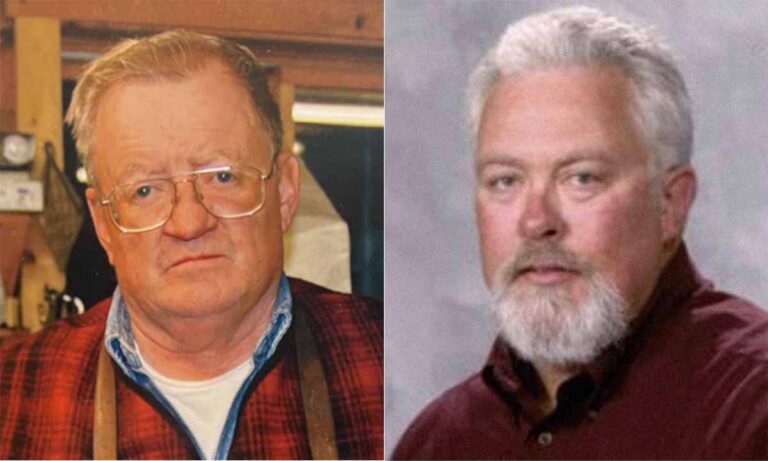
The American Bladesmith Society lost two of its finest leaders and bladesmithing instructors recently with the passing of ABS master smiths Steve Dunn and Hanford J. Miller.

Steve Dunn

Steve died on May 21. He was 68. Outgoing chairman of the ABS, he was a longtime Society member, receiving his master smith stamp in 1994 before going on to serve on the ABS board of directors and eventually being elected chairman.

“He was a craftsman of the highest level, as evident in the exceptional blades he made, and unsurpassed as an engraver, which he passed on to so many with his teaching,” americanbladesmith.org reported.

Many in the ABS were still recovering from the shock of the news as BLADE® was going to press, ABS master smith Billy Bob Sowell among them.

“I was stunned,” he wrote. “Steve was one of my judges for my master smith stamp. I took his engraving class and his folder class. I’ll miss him.”

According to his bio on the ABS website, Steve began making knives as a hobby in 1988. In 1990 he enrolled in the basic forging class at the Bill Moran School of Bladesmithing, where he started forging damascus. After achieving master smith, it wasn’t long before he began teaching at the Moran School. In 2003 he was selected to serve on the Society’s board of directors.

A strong believer in sole authorship of his knives, he enrolled in a basic engraving class at GRS Tools in 2002. He later studied with Chris DeCamillus on Bulino style engraving and was asked to be an instructor at the GRS school in 2005.

Hanford Dunn

Hanford passed away on March 25. He sold his first knife in 1968. He made knives in the Moran style, including bowies, fighters, camp knives and other large fixed blades, and also period pieces such as reproductions of the cinquedea. His mark was his initials or name within a bowie logo.

In addition to being an outstanding maker of forged knives, Hanford served on the ABS board of directors as treasurer for many years. According to americanbladesmith.org, he was best of friends with BLADE Magazine Cutlery Hall-of-Fame® member Bill Moran, with the pair being “like two peas in a pod.”

They first met in 1974 in Bill’s shop. Hanford read about Bill in a library book about knives and realized he was only a short drive away from Hanford’s home in Randallstown, Maryland.

“Bill was a great mentor,” the site observed, “and their friendship lasted long after Hanford moved to Colorado in 1976.”

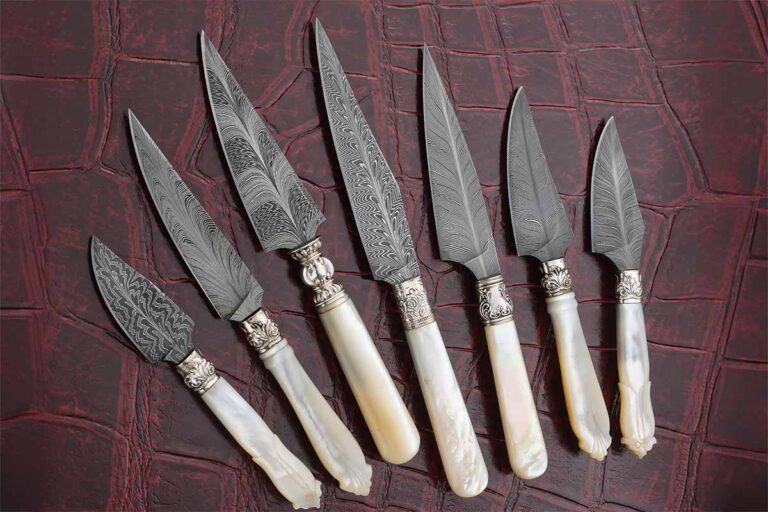
Cool Customs: Kevin Casey’s Little Feather Knives

Kevin Casey feathers his cap with an outstanding array of custom throwback blades.

Kevin Casey may have hit on a great idea for knives with both a custom touch and an antique look and feel.

Taking some old yet inexpensive late 19th/early 20th-century dinner knives with mother-of-pearl handles and silver ferrules, he replaced the original blades with those forged of assorted patterns of his feather damascus. The result, the Little Feathers, went fast at the Solvang Show, with two selling individually and five going to one shrewd buyer.

Kevin Casey
Kevin Casey

Kevin said similar versions of the original antique knives are available on eBay, Etsy, at jewelry stores, flea markets and the like. He cleaned the insides of the ferrules with acetone before epoxying his damascus blades into them. He cleaned the ferrules with Flitz and a toothbrush, polished the handles and the knives basically were ready to go. He plans to do more like them in the future.

Little Feathers Specs
Maker: Kevin Casey
Model type: Dinner knives
Blade lengths: 2.5 to 4.25”
Blade material: Assorted patterns of feather damascus in 1080 carbon and 15N20 nickel-alloy steels w/a thin layer of pure nickel; depending on the pattern, the layer count ranges anywhere from 50 to 500
Handle material: Mother-of-pearl
Ferrules: Silver
Overall lengths: 6.5 to 8”
Maker’s list price range for similar knives: $600 to $900 each

Check Out More Cool Custom Knives:

Advertisement

Must Read Articles

Read this before you make a knife

Knifemaking 101 – Read This Before You Make a Knife

  by Wayne Goddard My experience has taught me that there's nothing like digging in and getting started. I've often said the hardest part of the...
how to forge damascus steel

How to Forge Damascus

Advertisement
Advertisement