
Knifemaking

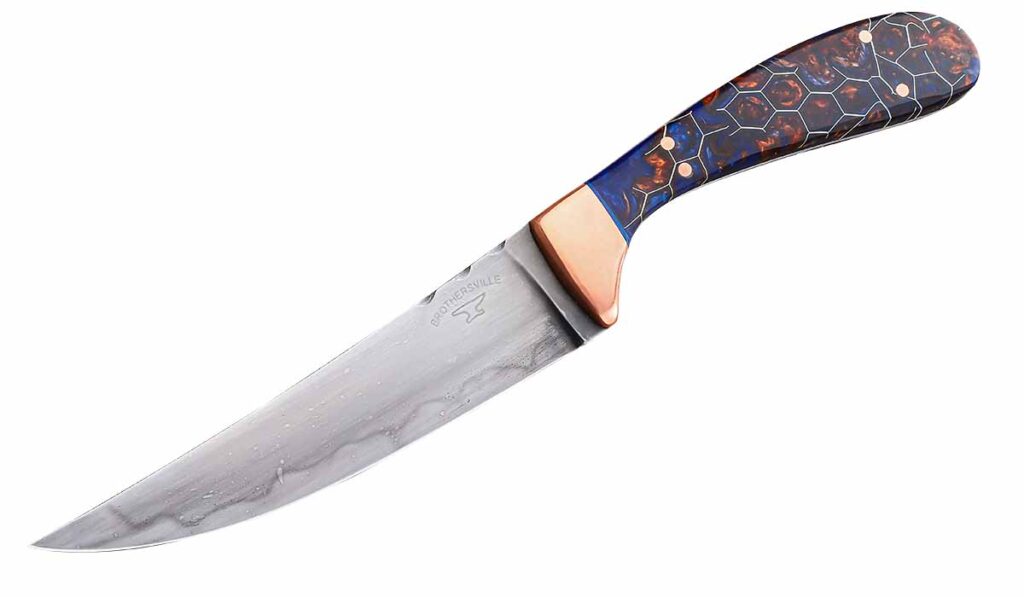
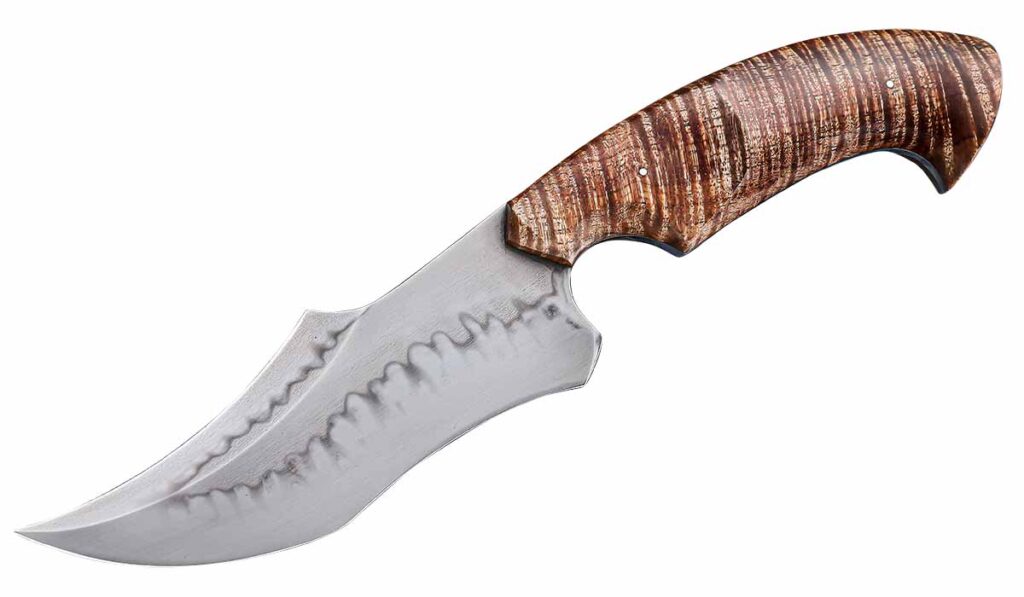
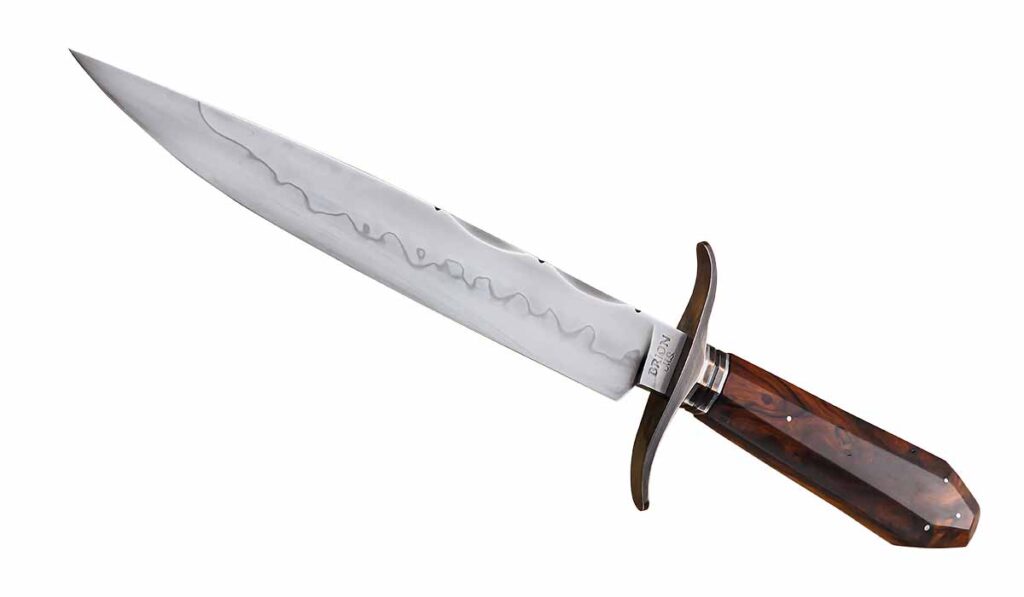
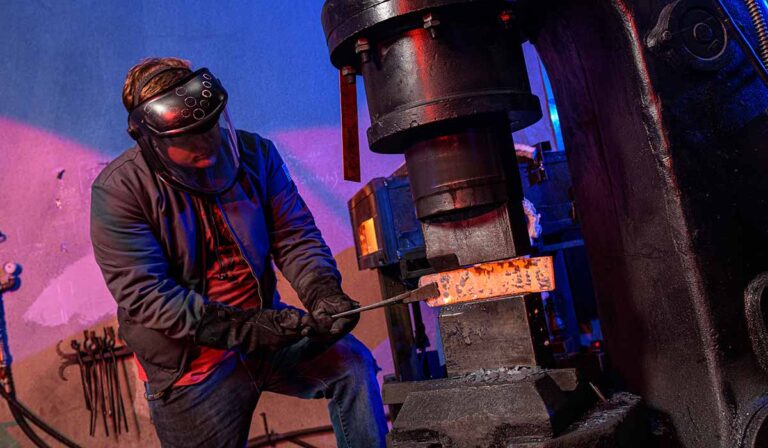
Knifemaking is the building of a knife, which includes the blade, handle and other accouterments. Blades are made by either removing metal from a steel blank via a grinder – known as stock removal – and the forging to shape of hot steel into a blade in the process known as bladesmithing. Other parts, including bolsters, guards, pommels, etc., are needed to complete the finished knife.

Featured Knives – – Knife Collecting – – Tactical Knives – – Survival Knives

Knife Handle Ergonomics 101: Getting A Grip On The Basics

1

Design factors are crucial in matching the knife handle and the hand.

It all started with a stone. Held between the thumb and index finger, it could be used to cut things efficiently if the user learned how to keep the edge sharp.
It was the birth of knife technology.

The next step was to attach the stone to a stick. The stick handle afforded more versatility on how the stone blade could be used. Even though it started out looking like a mere piece of broomstick, there is some obvious utility in it since many knives today have the same simple shape. As a result, though knife handle technology did advance quickly at first, it really hasn’t changed that much in several thousand years. The reason is hand ergonomics. There are only so many ways a handle can fit into the human hand, though small differences in handle design can sometimes be profoundly important.
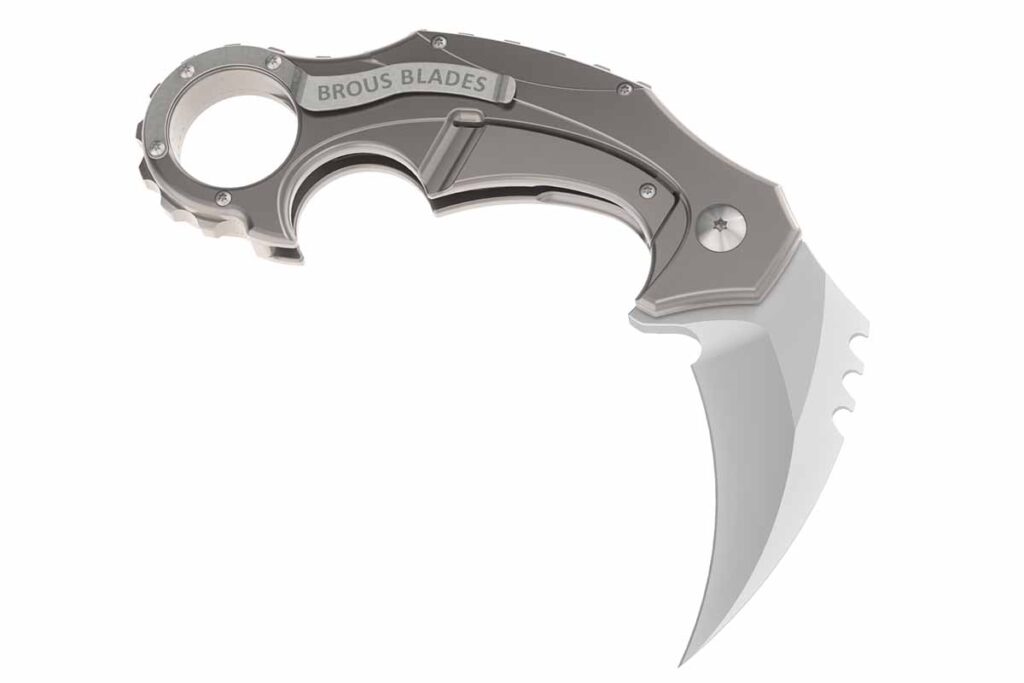
Asymmetric handles can improve grip but also limit versatility.
Asymmetric handles can improve grip but also limit versatility. An example is the karambit. The handle of the Elite Enforcer from Brous Blades is designed to provide a reliable grip in forward or reverse tactical positions. (Brous Blades image)

I bet that, as a knife collector, you have handled hundreds of knives and often exclaimed, “This knife is perfect.” We all have. What did we mean? What were we thinking? I would also bet the knife handle fit very snugly in your hand when you thought that. You were able to get a firm grip while you envisioned yourself using the knife on a camping trip, or perhaps defending your life, or doing a multitude of different tasks. The handle wasn’t too big, nor too little. There were no pressure points or sharp contours that caused discomfort. Your approval of the handle was probably appropriate to the task you were contemplating. However, while all blade configurations are not well suited for every possible task, likewise, for best use the knife handle design must complement the blade to which it is attached.

Cutting Jobs

Let’s simplify knife tasks into four basic categories:

  1. First are the simple everyday cutting chores, better known as “everyday carry” stuff. Open a package, cut a string, peel an apple, it’s just EDC. You think any tool with a sharp edge will do—and you’re right;
  2. Second is where you must open 500 cardboard boxes or a similar job that takes some degree of force and puts a lot of stress on your hand;
  3. Third is where you slice 10,000 tomatoes. Well, private, that’s a rough eight-hour shift in the mess hall! Many kitchen knives have some very non-ergonomic handles. Not a big deal if you’re cutting just one tomato, but in eight hours of doing that your hand might actually get some permanent damage. Yes, permanent;
  4. Fourth is an oft-used example and the pinnacle of all scenarios: defending your life. Oh yes, there has been many a knife made for extreme situations. It’s fun to own a big bowie!

The perfect handle for an EDC has so much latitude that the word perfect doesn’t seem like it should ever be used. Going to the other extreme of the fourth category, the concern would be on grip strength. You would not want to lose hold of the knife during a life-or-death situation. A handle that provides a good grip probably would sacrifice some versatility, though in an extreme situation grip strength is probably more important than versatility.

Size

Is the size of the handle’s diameter really important? There is some leeway here, but once you get into endless tomato and box cutting and especially the need for maximum “grip strength” during life-and-death situations, it is a very important factor. According to many studies, as the handle diameter is progressively increased, so too is the grip strength—at least up to a certain point. After that, grip strength starts to decrease.

It is a bit odd that shoe sizes come in a variety of lengths, even half sizes, and also various widths, but gloves are basically small, medium, large and extra large. Why not size gloves more like shoes? The expression “fits like a glove” might mean you are lucky to find a pair that actually fits.

Does one size fit all? Yes, sometimes. But just like buying shoes, you have to put them on and walk around the store a while. If you plan to climb a mountain, you better be damn sure that the shoes will fit, perform and not cause blisters. If a knife handle feels good, then is it good? Probably so. There are many knife handles that “look good” but the proof is how they feel in your hand, your particular hand.

Knife Handle Diameter
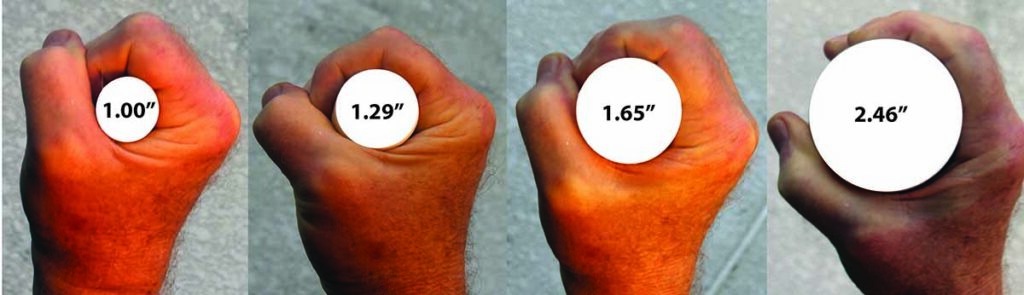
Knife Handle Grip Diameters

Gripping round sticks/knife handles of different diameters results in different ergonomic effects.

The first example shows less than optimal grip strength with a thin handle having diminished contact area between the palm and the handle surface. The force is maximum when the thumb and fingertips are directed parallel to the palm.

The second example favors a strong grip. The fingers are also able to wrap around the handle and there is more surface contact available.

The third example is near the peak of biomechanical advantage. Grip strength might be a little improved from the second example or perhaps a little diminished. Not very different there. Importantly, the thumb and fingers can still cross over each other. There is more advantage from friction. This might be the best fit for a baseball bat. Yet for a knife there will be less ability to change the hand position, which may be a disadvantage. Some consider a diameter of about 1.5 inches to offer the strongest grip and this example is a little larger than that.

The fourth example is loss of grip strength. The fingers can’t encase the handle. The strong ergonomic “power grip” is transforming to the ergonomically weaker “pinch grip.” —by LeRoi Price

Hand vs Handle

We already know about handle diameter. What about shape? Though the round shape of a broom handle works for a knife handle, an oval configuration fits well into the hand and, importantly, allows for indexing of the blade’s cutting edge. Most knife handles have a basically oval cross section.

Form follows function but it begins with ergonomics. There are several dedicated handle configurations that are suited well to a special purpose but are mainly limited to use for that single special purpose. One of the most notable examples is the karambit handle. Asymmetric handles can improve the grip but also limit versatility.

The anatomy, ergonomics and biomechanics of the hand present some challenges for handle design.

Palm Anatomy
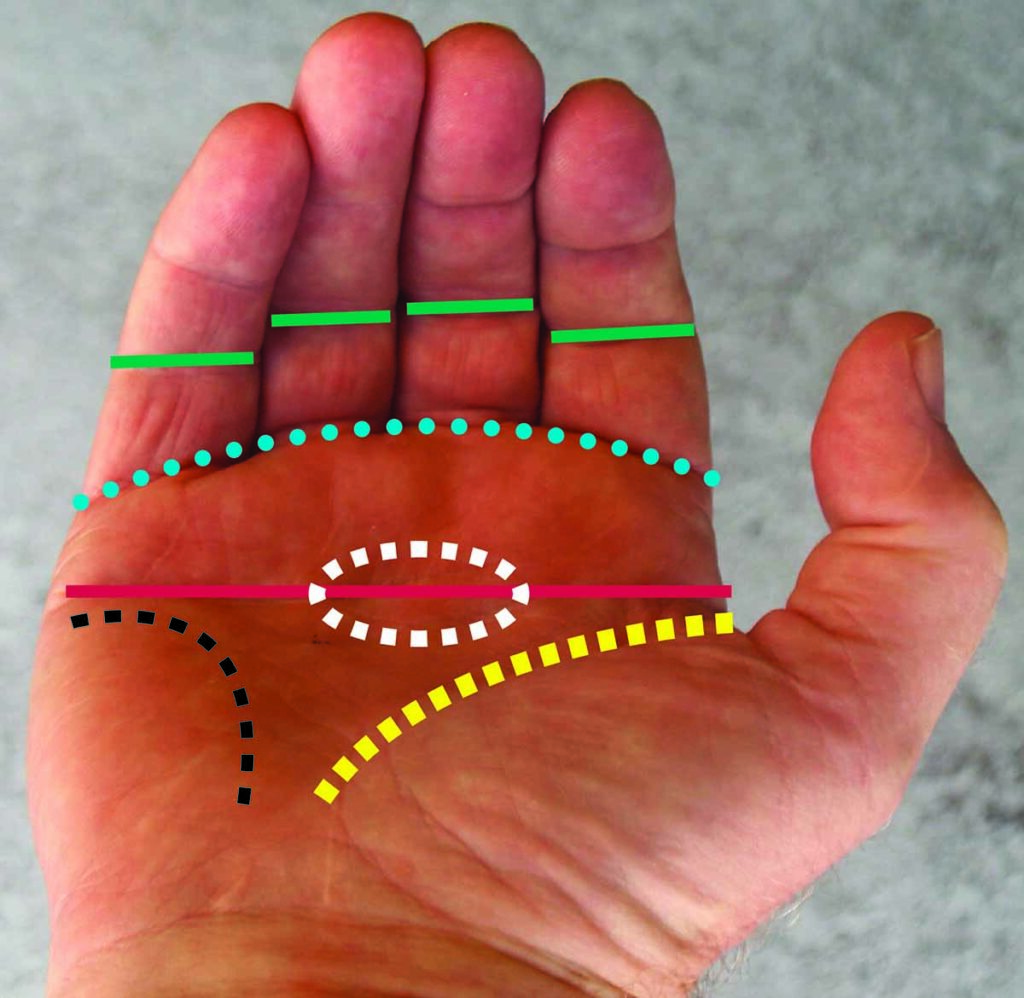
Palm Anatomy

Prominent features of palm anatomy play a pivotal role in hand ergonomics. The red line is the actual bending point of the fingers. The blue dots are where the fingers bend from the palm. The green dashes are the second of the three bending points of the fingers. The yellow squares represent the prominence of the base of the thumb. The black hyphens indicate the small prominence of the heal of the hand. The oval of white squares is a hollow space in the center of the palm.

Note: the hand is not like a door hinge. These lines move as the hand goes from flat open to a closed fist. Now look at the back of your hand as it goes from open to a fist. The knuckles go from a fairly flat line to a downward curve. The finger joints all have a different radius at which they bend.
Hand ergonomics is not a static condition, which makes things difficult for handle design.

Handle Subtlies
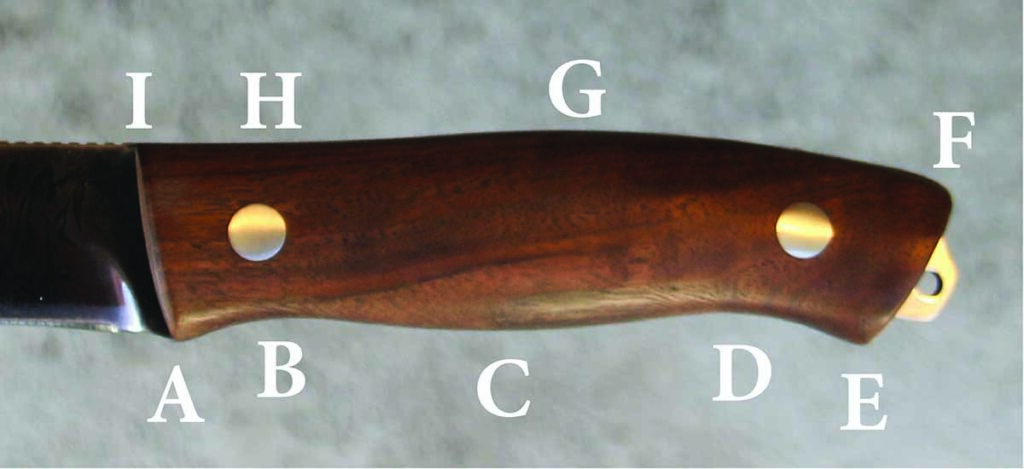
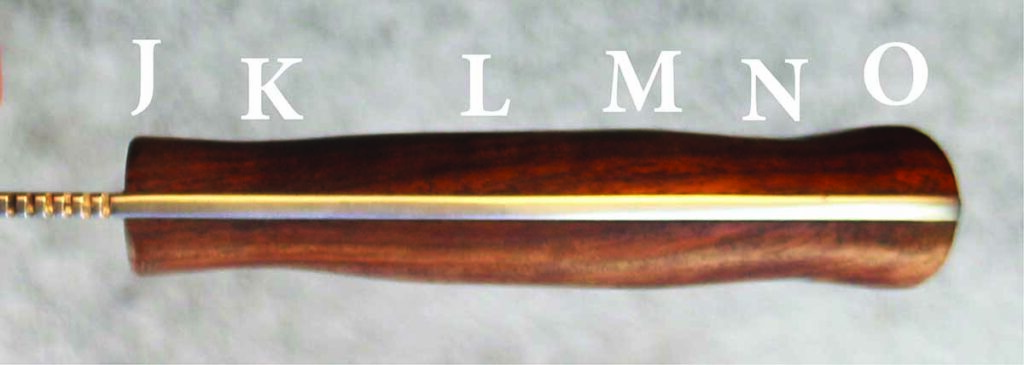
Here is a simple camp knife and somebody made it right. I’ll point out my reasons why starting with the finger groove (B). It is well demarcated though not deep nor very pronounced—just like all the subtle features of this handle. This allows the handle to be more easily manipulated than if the fingers are forced into deep recesses. The groove fits the index finger.

A slight forward rise (A) forms an integral guard. This is an important feature. Some knives like this one have a brass guard in front that is not just mere decoration. A rising protrusion (C) fits into the space of the middle and index fingers. Then it’s down to the groove where the little finger resides (D). Another protrusion (E) captures the little finger and forms a rear guard—again, important for a camp knife.

Area “F” extends more rearward and slopes down to contact the heal of the hand. A slight swell (G) fits into the palm. Some knives are flat in this area but that doesn’t fit hand anatomy well. The handle has a very subtle hollow at “H.” This is where the web of the thumb makes contact, which makes it best to keep it subtle. Area “I” rises slightly here but often is left flat in many knives. This is where you place your thumb when doing some tasks. Putting a guard on the handle spine is less effective than putting one underneath because there are no bones in the thumb web—though slightly rising at “I” is useful.

Conclusion

There is no agreement on the shape of the perfect handle, so you are left with my opinion. On the other hand, you have something to think about and can investigate further. My opinion is this: While there is no such thing as “perfect,” there is still “good enough.” The same can be said for a lot of things.
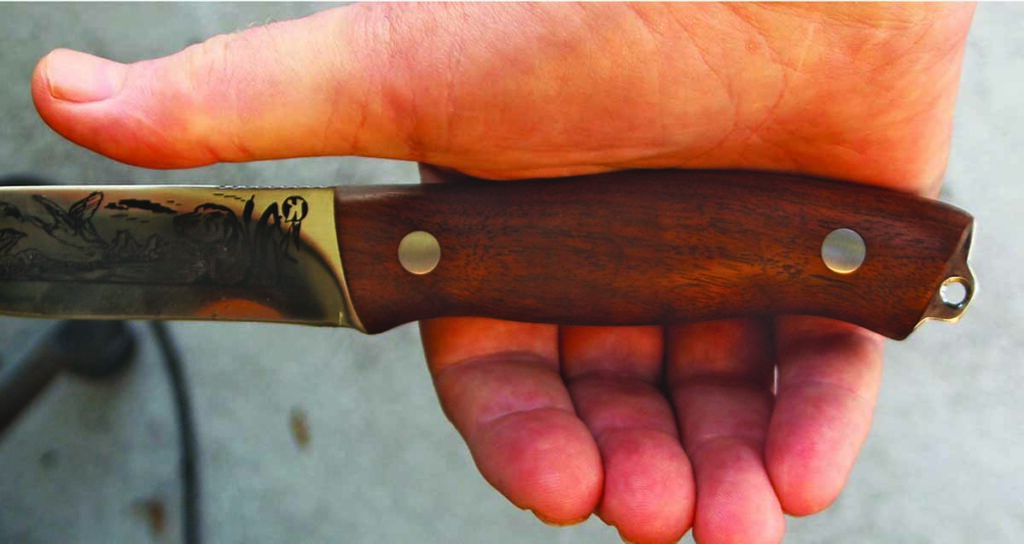
The handle’s outer contours attempt to nest into the hand’s inner contours
The handle’s outer contours attempt to nest into the hand’s inner contours. A perfect fit of the handle into the palm would not necessarily make for the so-called perfect handle since there are so many variables, such as the strength a particular finger can generate, the forces the blade will be subjected to during use, wrist angle to the blade, slippery conditions, etc. Non-slip handle texture is a different topic altogether, as well as a spongy outer surface that slightly conforms to the user’s palm.

I shouldn’t give numbers but I know you’re going to be curious about some. For a 5-foot-8-inch man, shoe size 9D which correlates to a large size glove, the handle configuration should be oval with a top-to-bottom dimension of 1.125 inch and 1 inch width. These suggestions are approximate, of course, but are the actual dimensions of the pictured camp knife seen with a handle length of 4.675 inches. (Go up to perhaps 1.5 inches height for a combat knife.) The back of the handle should be convex as well as the lower belly. A shallow groove for the index finger is a good option, and perhaps a second one for the middle finger as well. More finger grooves improve grip strength but are a detriment to the ability to manipulate the knife. They also add pressure points.
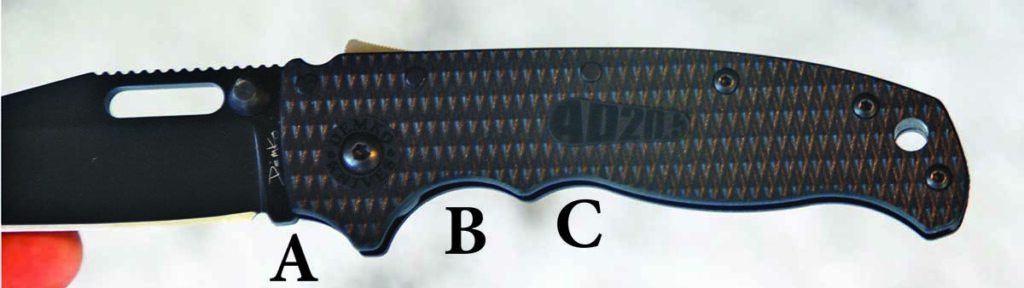
Ergonomics in a folder also? Absolutely!
Ergonomics in a folder also? Absolutely! A Demko AD20.5 has a protrusion/integral guard between areas “B” and “C” that creates two finger grooves. The extra finger groove as well as the protrusion/integral guard forward of “B” are good ideas in a folder. The features increase grip strength, which is hindered in folder handles since they are thin compared to fixed-blade handles. The front of the handle is not squared off, which provides for a finger groove at “A.”
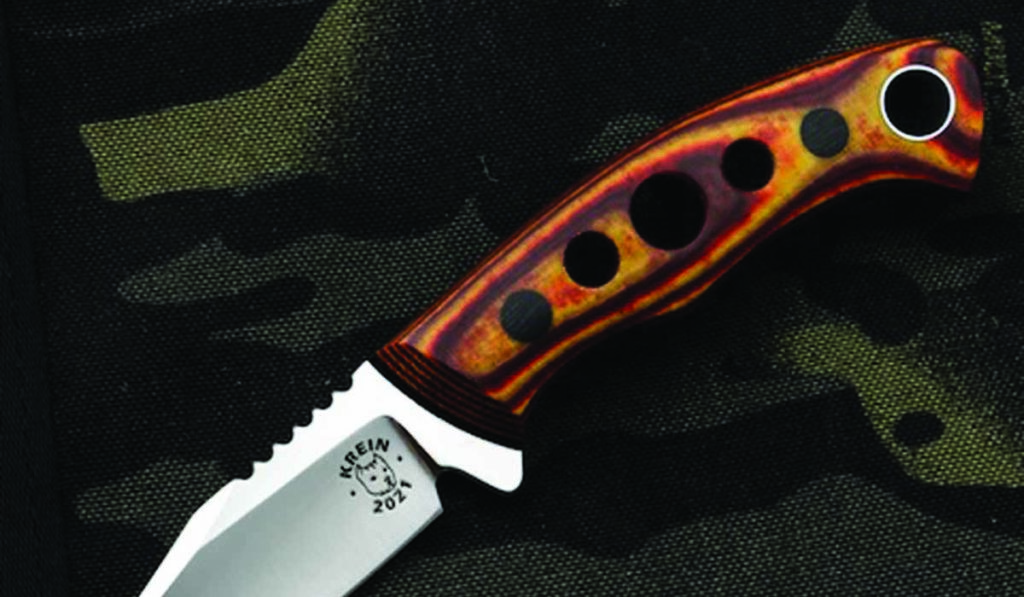
When you find a knife handle that doesn’t feel right, it is probably not right for you. Nonetheless, finding one that fits your hand “good enough” is probably the best you can do, and all you need to do.

More On Knife Handles:

Spectacles In Steel: A Look At Definitive Damascus Patterns

Modern makers’ takes on this age-old steel art.

When BLADE Magazine Cutlery Hall-Of-Fame® member Bill Moran reintroduced knives with damascus blades at the 1973 Knifemakers’ Guild Show, little did he know how much damascus would evolve, redefine itself, expand into new media, and no telling what other recreations and rebirthings it has experienced in the half-century since that fateful weekend in the Muehlebach Hotel in downtown Kansas City.

On this page are some of today’s reincarnations of the material in its various forms, methods, materials and more. What’s staggering to consider is there are so many more variations—not only now but also to come. It is a phenomenon that is truly unique to the custom knife industry and should be celebrated and promoted whenever possible.

David Lisch Templars Mosaic

David Lisch’s dagger
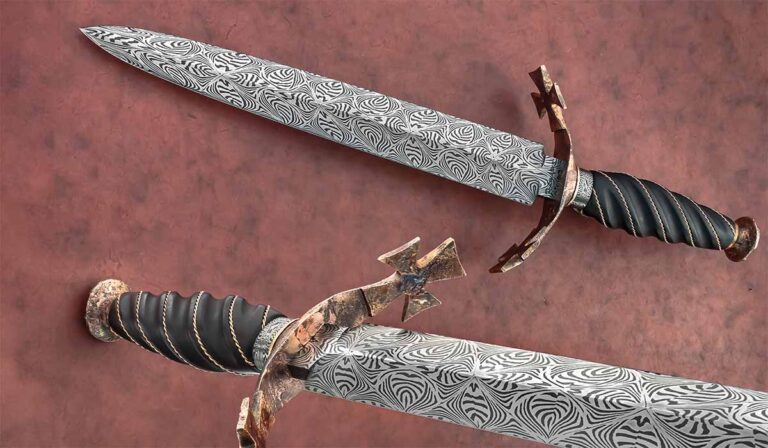
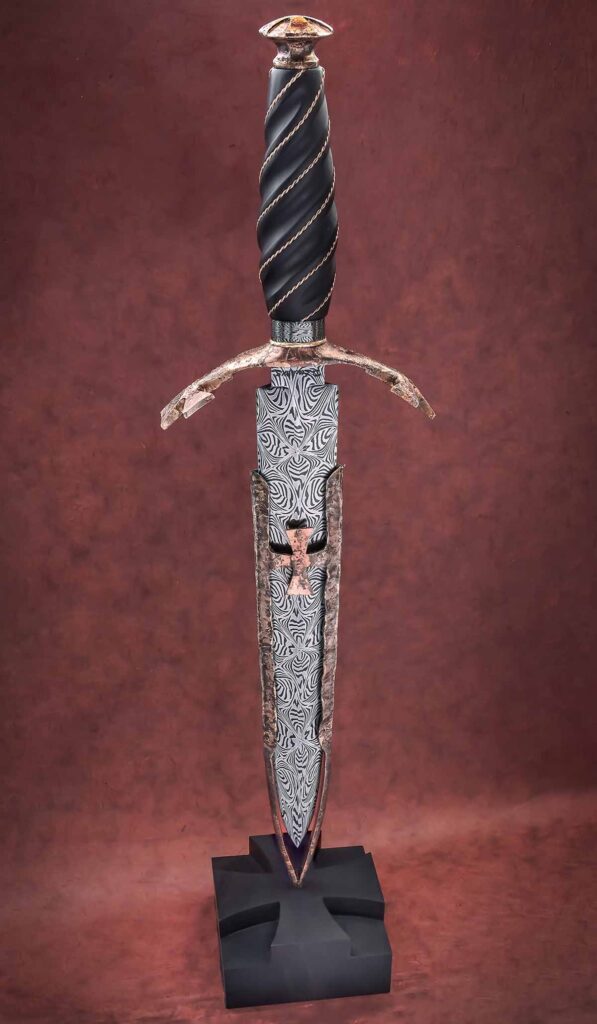
David Lisch’s spectacular art dagger features a 12-inch blade of his Templars Mosaic Damascus, a blackwood handle with gold wire wrap and a guard of pure iron covered in melted gold. Overall length: 17.75 inches. The knife comes with a stand that includes an embellished templars’ cross and one carved in the base as well. (SharpByCoop knife images)

Sporting a pattern ABS master smith David Lisch christened Templars Mosaic, the blade for his dagger is one he forged from 15N20 nickel-alloy and 1080 carbon steels and etched in ferric chloride.

“I was aiming for a bold, bright pattern that had a cross-like shape but wanted it to be a bit organic,” he wrote. The Templars’ cross also is represented on the guard and the finial, and there is one on the stand that holds the knife as well. “All these parts are pure iron covered in melted gold,” he noted. The dagger also has a domed gold spacer between the guard and Dragon Thunder damascus spacer that the fluted-blackwood-with-gold-wire-inlay handle butts up against.

“I made this dagger out of the love I have for creating art with no concern about how long it took or how much money I would make from it,” David stressed. “I did the handle twice and I did the big finial twice. I sold the piece for $10,000 and will not be making another one like this. You can be sure that the love I have for creating will take me to a new dagger, sword or bowie knife that tries to fill the void in me that can only be filled by creating art.”

Jeremy Yelle Jellyroll Mosaic Turkish Twist

jellyroll mosaic Turkish twist pattern damascus
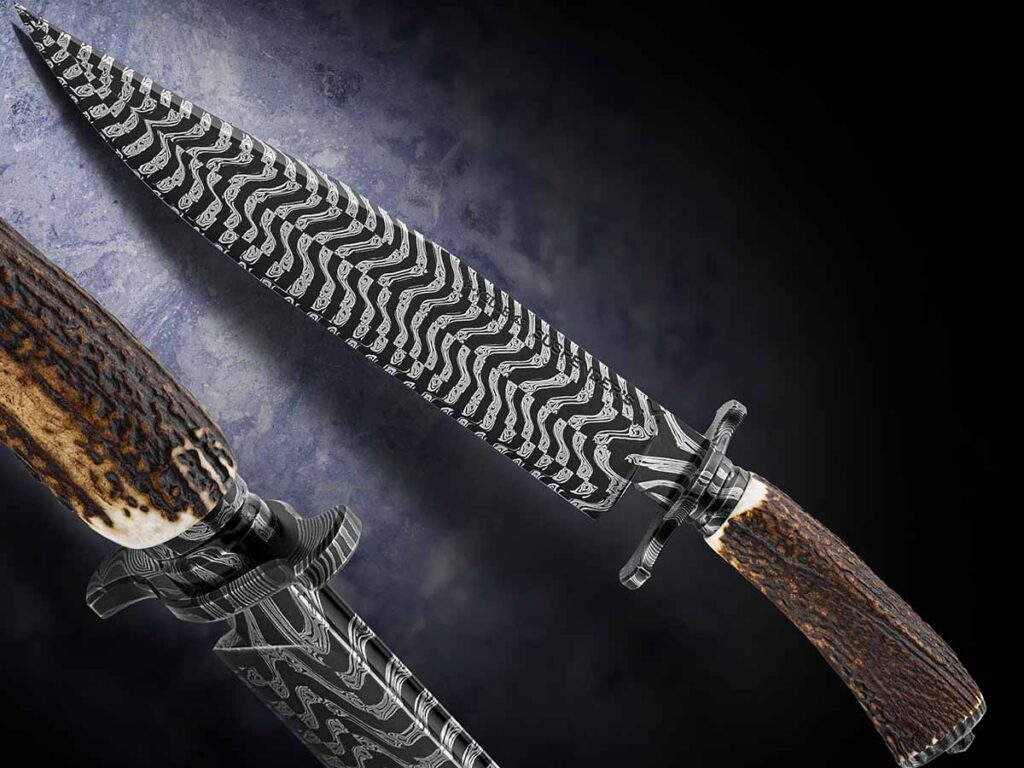
The steels for the jellyroll mosaic Turkish twist pattern damascus of the collaborative bowie by Jeremy Yelle (right) and Alex Houle (left) is forged from 1080 carbon and 15N20 nickel-alloy steels. Blade and overall lengths: 10.25 and 15.5 inches. Their list price for a similar knife: $2,600. (Jocelyn Frasier knife image edit)

The blade damascus of ABS journeyman smith Jeremy Yelle’s and SBK Cutlery’s stag bowie is a positively electric jellyroll mosaic Turkish twist pattern Jeremy forged in a collaboration with his friend Alex Houle of SBK. Alex forged the collaborative damascus into a blade and Jeremy made the handle.

“We began by welding a billet of alternate layers,” Jeremy wrote of the forging process. The pair drew the billet into a bar and jelly rolled it. “Then we squared it up and welded a four-way incorporating some 1-inch-square 1080,” he continued. They welded the billet, drew it out to ¾-inch square, cut and twisted it, and made a Turkish-twist stack that Alex forged into a blade. “You can also see the ‘fish mouth*’ weld Alex did so the edge bar and the spine meet properly,” Jeremy wrote. “He did a wonderful job making the blade.” Jeremy showed Alex how to work with stag and they finished the parts. Alex revealed the beautiful pattern via a two-step etching process using a solution of ferric chloride and finishing the etch with a coffee-darkening soak and hot wax finish.

Zane Dvorak Multi-Bar

multi-bar damascus
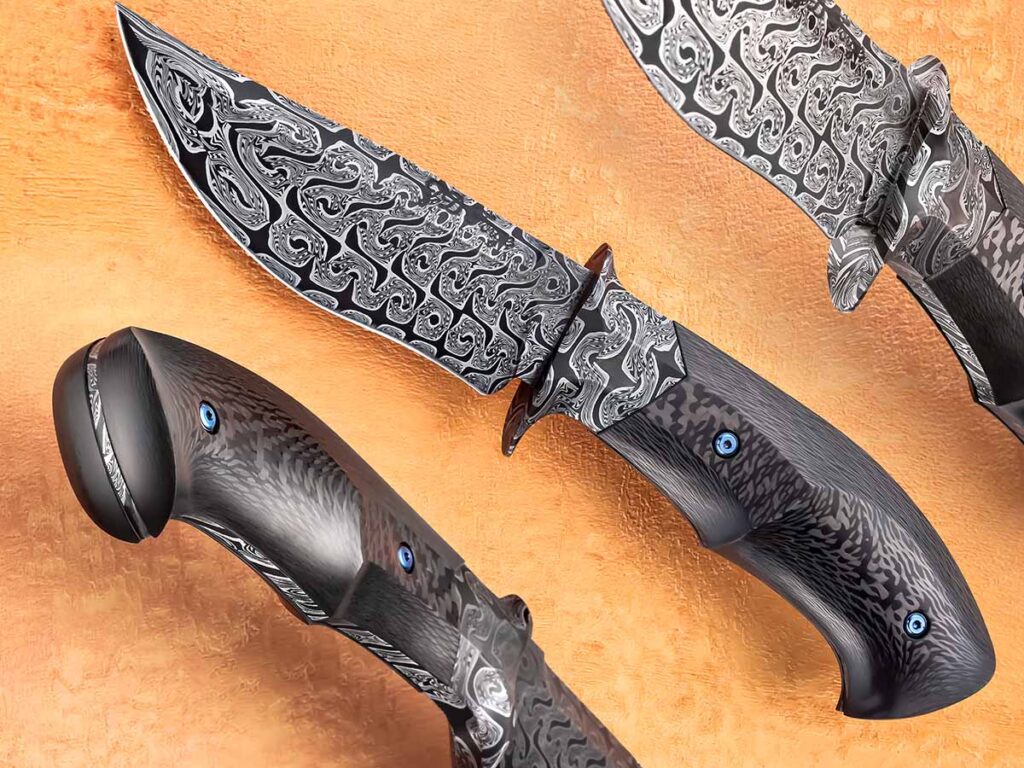
The 4.25-inch blade of Zane Dvorak’s hunter is a multi-bar damascus of 1084 carbon and 15N20 nickel-alloy steels. Overall length: 9.25 inches. His price for a similar knife: $2,400. (SharpByCoop image)

The blade of Zane Dvorak’s hunter is a multi-bar damascus of 1084 carbon and 15N20 nickel-alloy steels. Zane forged the blade/tang of four twisted bars of a twisted-bar pattern, and forged welded the guards and bolsters on with the same pattern. He bird’s mouthed the blade tip and rewelded it back together to create flowing outer bars. For etchant he used Gator Piss Acid from Baker Forge & Tool.

Bird’s mouthing is a process done on multi-bar, mosaic or other types of damascus patterns. According to Zane, it involves cutting a triangle out of the end of the rectangular parent bar—the shape of which somewhat resembles a bird’s mouth—then bringing the steel of the edge and spine back together to form the point of the blade. By doing so the blade exhibits a better consistency and overall flow of the pattern.

Andrew Blomfield Alternate Pattern

mosaic damascus Andrew Blomfield’s sub-hilt fighter
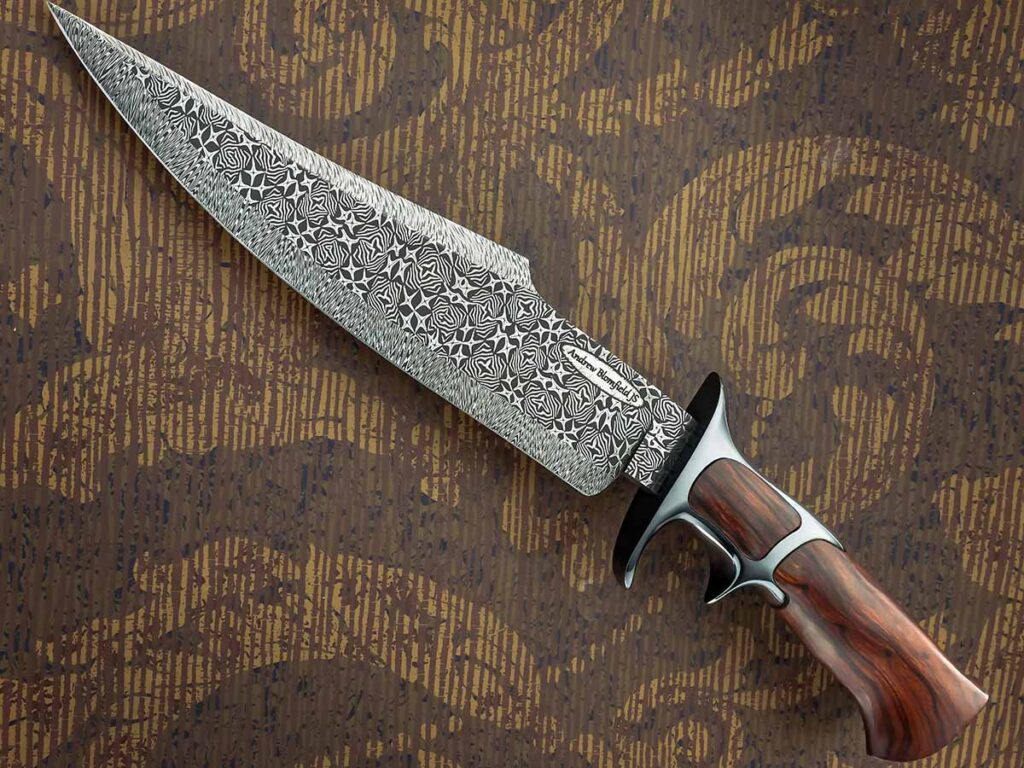
The mosaic damascus for Andrew Blomfield’s sub-hilt fighter is a combo of two separate billets welded in an alternate pattern. Blade and overall lengths: 9.5 and 14.5 inches. Blade grind: flat. Andrew’s price for a similar knife: $3,000. (SharpByCoop image)

The material mid-blade of Andrew Blomfield’s sub-hilt fighter is a combination of two separate billets of mosaic damascus welded in an alternate pattern. The edge is a straight feather pattern forge welded around the edge. The blade is a combination of pieces from three separate billets. The steels are 1084 carbon and 15N20 nickel alloy etched with ferric chloride.

The integral sub-hilt is 1020 low-carbon steel hot salt blued to a deep black finish. The handle is desert ironwood. The knife is of a full takedown construction.

Frank Edwards Palm Leaf Mosaic Pattern

 Palm Leaf mosaic damascus by Frank Edwards i
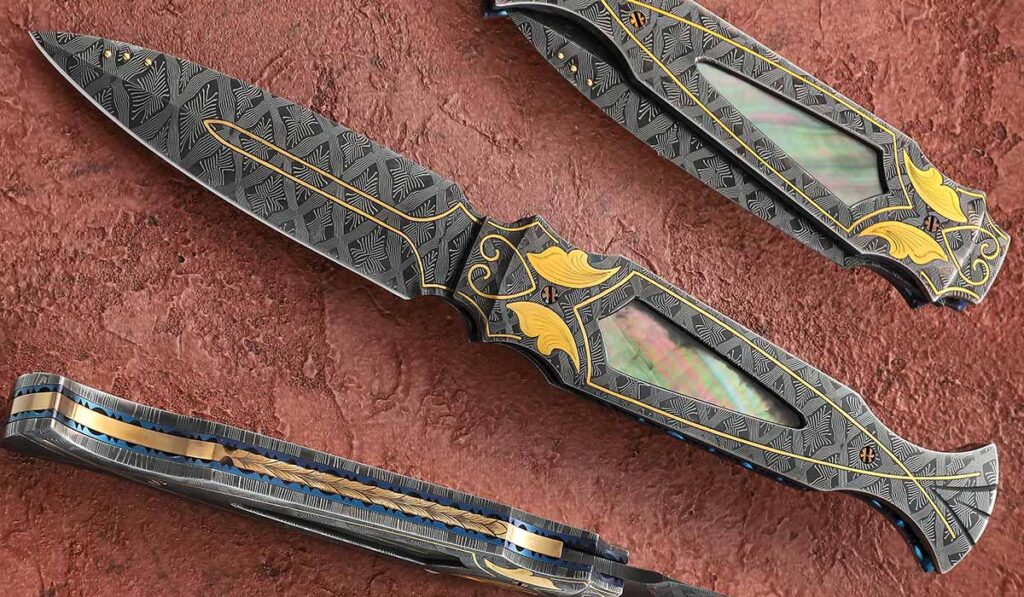
The Palm Leaf mosaic damascus by Frank Edwards is an interweaving river system of straight lines. The handle inlay is black-lip mother-of-pearl. Blade and closed lengths: 3 and 4.25 inches. His price for a similar knife: $1,900. (SharpByCoop knife image)

The multi-bar damascus of Frank Edwards’s folding dagger blade is in a Palm Leaf mosaic pattern. Starting with a billet of straight lines, he reduced it all into a square and then biased the squares, four-waying the billet into a 1.5-inch square.

As Frank explained his recipe, “Forge weld another billet of straight lines, keeping them straight as possible to .5 inch by 1.5 inches. Add that to the previous billet and forge weld and reduce to a 1×1-inch square. Then four-way it again. This will give you the frame around the palm leaves. Keep repeating that until you achieve the size of pattern for the knife you’re building.

“The key to getting good mosaics is a slower reduction [of the steel]. We have presses and power hammers that help but they can move too much metal too fast, which will destroy a mosaic in a hurry. The slower reduction allows the billet to stay uniform throughout the length of the bar.” 
To expose the pattern he etched the blade with a four-to-one mixture of water/ferric chloride in 10-minute cycles, using 2,000-grit sandpaper between cycles.

Jackson Rumble Stunning Pattern

unnamed damascus pattern
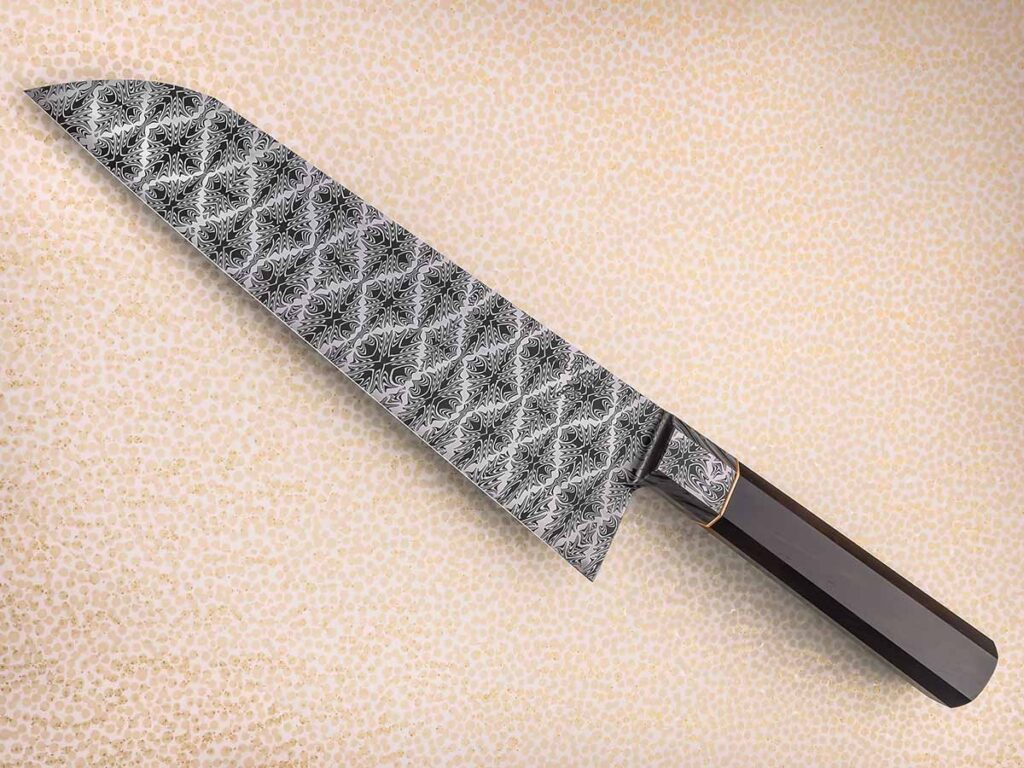
The 8-inch blade of an integral chef’s knife by Jackson Rumble boasts a mesmerizing and at press time unnamed damascus pattern forged from 1084 carbon and 15N20 nickel-alloy steels. The handle is African blackwood. Overall length: 13 inches. The maker’s price for a similar knife would start at $2,500. (SharpByCoop knife image)

The technique for the stunning pattern on newly named ABS master smith Jackson Rumble’s chef’s knife is what he calls a “pretty standard process” of four-way welding and re-square cycles. Not bad for “pretty standard,” eh (page 28, top left)? The initial stack has large sections of both light and dark steels interspersed through the alternating layers, and Jackson added extra-light steel to the billet in the later stages of the forging process.

“Finally, I used the Filicietti Flip method to transfer the pattern to the face of the billet,” he wrote. “For the etching process I used ferric chloride followed by coffee.”
OK, Jackson, so what’s the “Filicietti Flip method”?

“I’ve heard the Filicietti Flip called other names like the Ferry Flip, or just tile welding,” he explained. “Basically, after you’ve finished building the pattern in the end grain of the billet, you take it to a bandsaw and cut slices off the end at a 35-degree angle. This makes a bunch of pieces in the shape of parallelograms or tiles. The tiles can then be rotated and forge welded back together to form a new billet. Instead of having the pattern showing on the end of the billet, the pattern will repeat itself along the face of the billet.”

We’re glad we asked.

*Also called fish lips, fish mouth is when the tip of the billet begins to curl up on either side during rough forging to resemble a fish’s mouth or lips, thus the name. It is an easy fix for knowledgeable bladesmiths such as Alex Houle.

Check Out More Cool Custom Knives:

What Defines The Best Custom Hunting Knives?

What to look for in a custom hunting knife and some sharp examples.

For outdoorsmen, a knife of some kind is almost a constant companion. Most carry a knife that falls into the category of a hunter.

The Merriam-Webster Dictionary defines hunting knife as a large, stout knife used to skin and process game. When I started judging custom knife competitions at knife shows 30 years ago, the category with the greatest number of entries was always the hunter. Why? Because there are so many interpretations of what a hunting knife is. Often the judges refer to their own experience using knives in the category. Entries generally range in blade length from 2.5 to 5 inches. I have seen knives entered in the category with 10-inch blades.

Blade Lengths

Blade lengths are often designed to process a particular bird or animal. Smaller blades in the 2.5-to-3-inch range are primarily used for dressing birds. The short blade length allows the hunter to quickly extract the bird’s breast meat. The most common blade length is 4 to 4.5 inches, a length that will dress out most game hunted regularly in North America. The dropped hunter/drop-point hunter designed by BLADE Magazine Cutlery Hall-Of-Fame® member Bob Loveless (page 26) is the world’s most copied hunting knife. The standard Loveless drop point features a 4-inch blade.


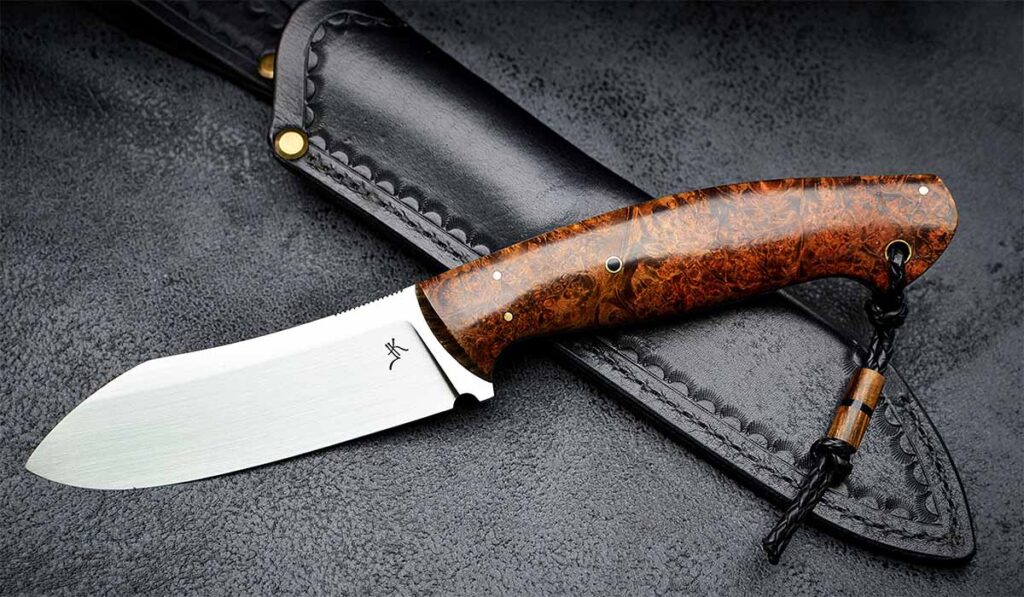
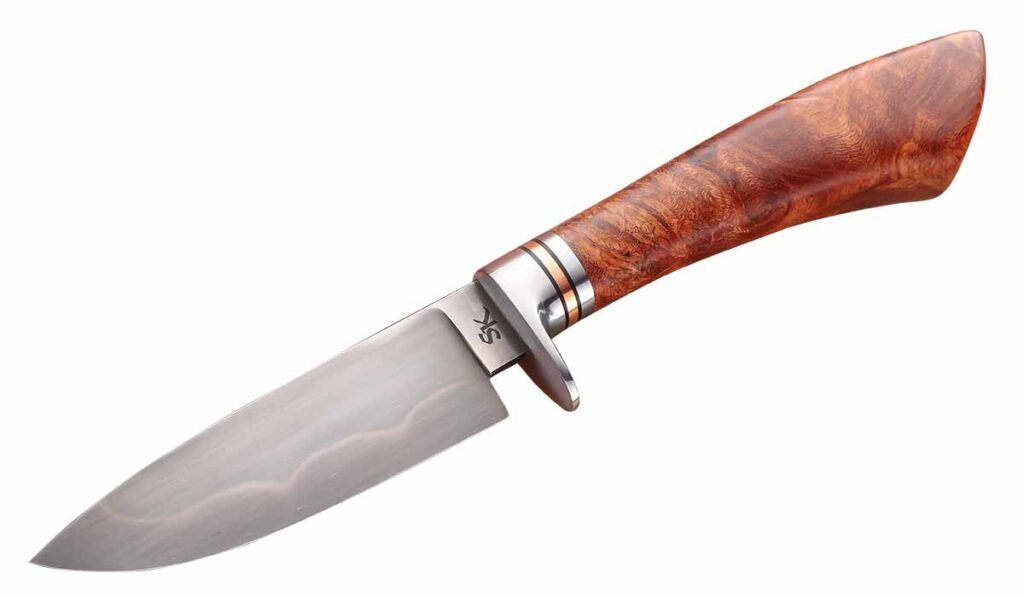
Custom Hunter Kuberski-Nessmuk-Hunter
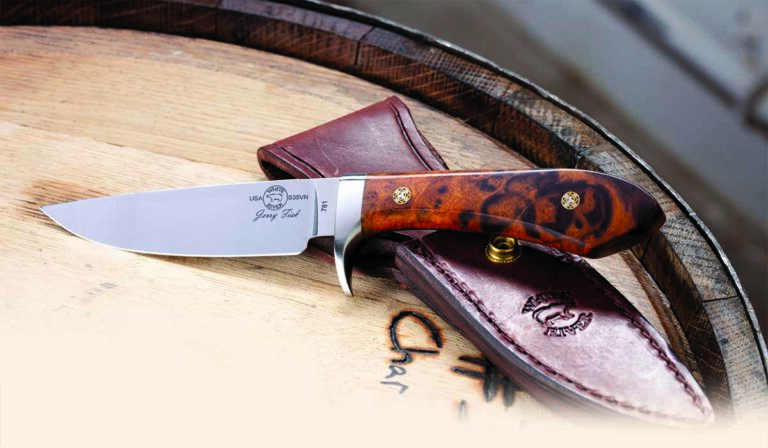
One of the more popular skinner designs is the Nessmuk, praised for its all-around versatility in the field. Luk Kuberski’s Nessmuk Hunter features Sleipner stainless blade steel with an impeccable satin finish and a mesmerizing handle of maple ash burl. (Luk Kuberski image)

Nessmuk Skinner 
Maker: Luk Kuberski 
Blade Length: 4.75”
Blade Steel: Sleipner stainless
Blade Finish: Satin
Blade Style: Drop point
Handle Material: Ash maple burl
Overall Length: 8.6”
Sheath: Leather pouch/belt model by the maker
Author’s Comments: Full-tang construction; excellent balance and handle ergonomics; serrated thumb ramp enhances control
Maker’s price for a similar knife: $350


When dressing out larger game such as moose or elk, many hunters prefer a longer blade because of the animal’s size. Why is the 5-inch blade the limit? The idea behind the hunting knife is to dress out the animal without losing control and cutting into the animal’s vital areas. Going much past a 5-inch blade can affect the average hunter’s ability to control the cutting edge. 

Blade Steels

Materials for hunting knife blades are primarily stainless and carbon steels, though damascus has been gaining in popularity in recent years. The environment the hunters will be in and their skill level at resharpening a blade will enter into the choice of steel.


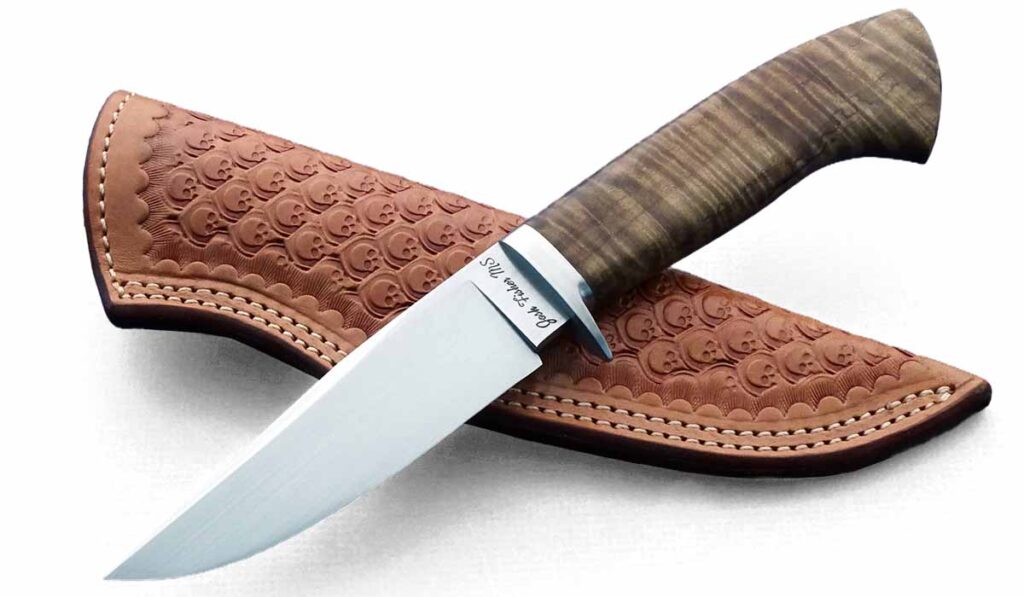
Custom Hunting Knife Fisher-Forged-Hunter-Blade-Mag
Wood is a popular handle material for custom hunting knives. Josh Fisher opts for curly maple on his drop-point hunter. And how about those skulls on the tooled-leather sheath by Bob Bobbert? (Robertson’s Custom Cutlery image)

Drop-Point Hunter 
Maker: Josh Fisher
Blade Length: 4.5”
Blade Material: 1084 carbon steel
Blade Style: Drop point
Guard Material: Stainless steel
Handle Material: Curly maple
Overall Length: 9”
Sheath: Tooled-leather pouch/belt model in a skull motif by Bob Bobbert 
Author’s Comments: Excellent handle ergonomics and balance; Josh is an ABS master smith
Maker’s list price for a similar knife: $625


Each steel has its advantage(s) concerning rust resistance, ease of sharpening and edge holding. Carbon steels such as 1084, 5160 and 52100 provide an extremely keen edge and can be easily resharpened. They do, however, require more corrosion maintenance. Stainless steels such as 440C, ATS-34 and CPM 154 make up the bulk of stainless steels used on custom hunters. These can be reasonably simple to sharpen and more forgiving regarding corrosion.  

Whichever steel you choose, the blade should be cleaned after use and a light coat of oil should be applied. It is best not to store your knife long-term in a leather sheath, as the tannic acid found in the leather can rust your blade. Additionally, leather does hold moisture, which can hasten the rusting process of the steel. It is best to store knives in something other than their leather sheaths. 

Handle Materials

A wide variety of handle materials are used for hunting knives. A favorite among makers and outdoorsmen is Sambar stag, either in its natural color or dyed to create amber stag. Stag is favored not only for its looks but because its contours provide an excellent gripping surface, even when wet. Another handle material gaining favor is elk and much for the same reasons. Two advantages of elk are it can be found in larger sizes and is less expensive. 


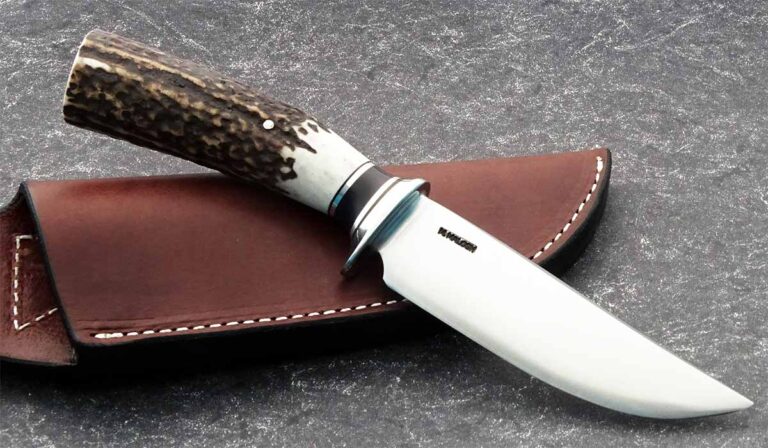
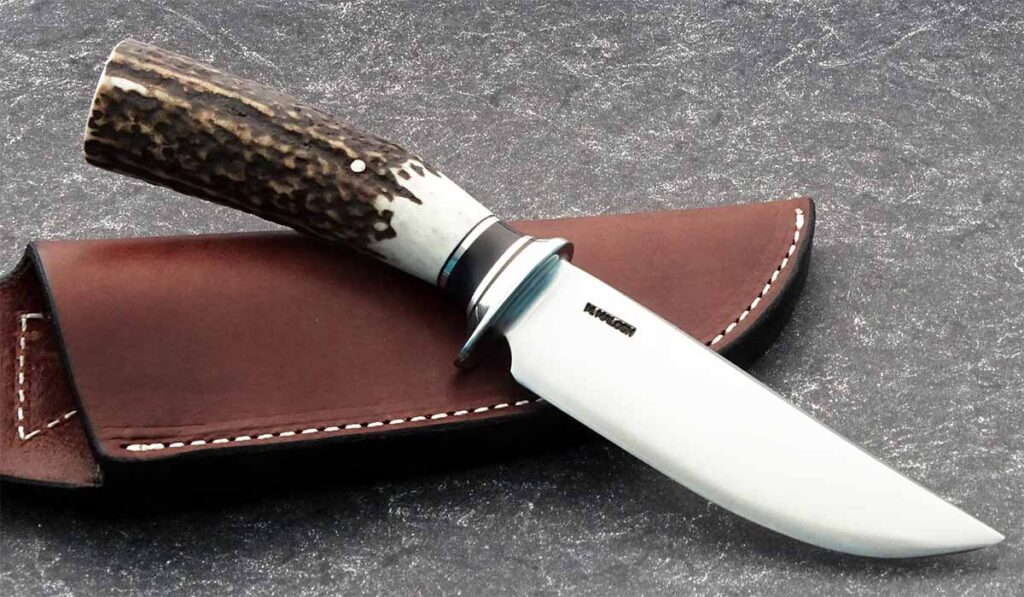
Custom Hunting Knife Malosh-Forged-Elk-Hunter
Sambar stag and elk are favored for their looks and because they provide an excellent gripping surface, even when wet. Mike Malosh’s Elk Hunter 23 custom hunting knife features elk scales.  (Robertson’s Custom Cutlery image)

Elk Hunter 23
Maker: Mike Malosh 
Blade Length: 47/8”
Blade Material: W-2 tool steel
Blade Finish: Satin
Guard Material: Stainless steel
Handle Material: Elk w/black Micarta® and stainless steel spacers
Overall Length: 9.5”
Sheath: Leather pouch/belt model by the maker
Author’s Comments: This knife is built for serious work; excellent balance and handle ergonomics
Maker’s price for a similar knife: $395


Desert ironwood, curly koa, California buckeye burl and curly maple are among various kinds of popular handle woods used for hunters. Other popular materials are synthetics such as G-10 and Micarta®. The main advantage of these materials is that, for the most part, they are impervious to the elements. As such, they tend not to shrink and crack as some natural handle materials can do over time.  

Guards

Guards are made primarily from either 304 or 416 stainless steel. If the knife features a hidden tang design, the joint between the guard and the blade should be soldered. Sealing the guard helps keep the moisture away from hidden tangs. Because their softness makes them prone to damage, along with their additional maintenance requirements, brass and nickel silver generally are not used for guards.  

Blade Styles

The drop-point hunter is the most commonly made hunting knife. The drop-point blade maintains its thickness along the spine and then gently slopes to the point. Generally, the drop point is slightly thicker than other hunting blade patterns at the point. The blade thickness provides the drop point the versatility not only to skin but to disjoint and pry. These advantages can be critical to the hunter when dressing larger game.


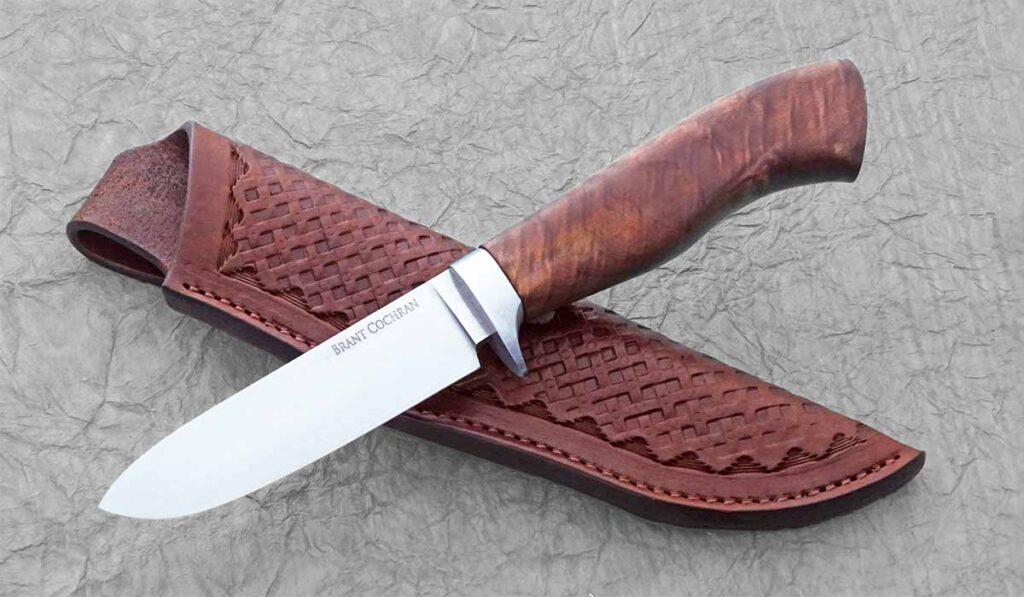
Custom Hunting Knife Cochran-Walnut-Drop-Point-Hunter
The slightly raised blade spine/hump extends the curved part of the semi-skinner blade for skinning while maintaining the drop point to avoid puncturing the abdominal cavity. Brant Cochran covers the pattern in a sturdy lightweight version of 80CrV2 carbon steel and walnut in his custom hunting knife. (Robertson’s Custom Cutlery image)

Semi-Skinner 
Maker: Brant Cochran
Blade Length: 4.25”
Blade Material: 80CrV2 carbon steel
Blade Finish: Satin
Guard Material: Stainless steel
Handle Material: Walnut
Overall Length: 9”
Sheath: Tooled-leather pouch/belt model by the maker 
Author’s Comments: 80CrV2 is a carbon steel that is both tough and provides outstanding edge retention; excellent balance and handle ergonomics; sturdy lightweight knife, perfect for your next hunt; Brant is an ABS journeyman smith 
Maker’s price for a similar knife: $300


The idea of a skinner is basically to remove the skin/fur from the game. The skinning blade shape features a slightly thinner blade and edge meant for a specific purpose. The skinner is designed for elongated cuts and better control of the blade, ensuring the game’s fur maintains its integrity. While primarily intended to remove the fur, a knife with a skinner blade can be used to dress game out, too. One of the more popular skinner designs is the Nessmuk, praised for its all-around versatility in the field. 

The semi-skinner blade is the middle ground between the drop-point and skinner blades. The slightly raised blade spine/hump extends the curved part of the blade for skinning while maintaining the drop point to avoid puncturing the abdominal cavity, which could taint the meat of the animal. 

Conclusion

Picking the right edged companion for your time in the field should require some research. As noted, hunting knives come in various shapes and sizes. This variety enables you to choose the right size, steel and handle material necessary to get the job done. It would benefit you greatly to hold the knife in your hand, primarily for sizing. You must always be able to control the blade’s edge.   


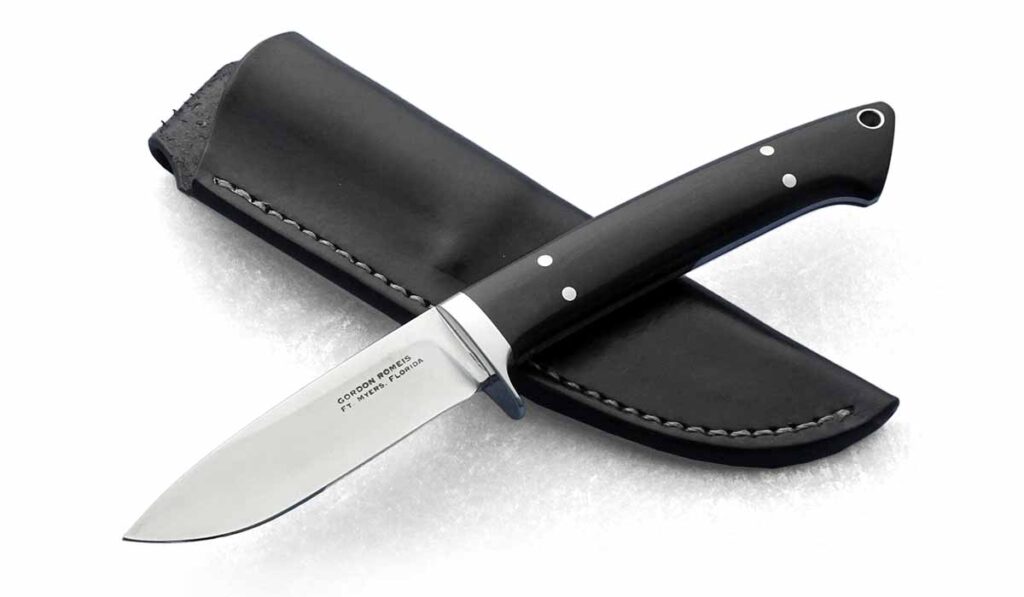
Custom Hunting Knife Romeis-Drop-Pt-Hunter
The drop-point hunter is the most commonly made hunting knife. A George Romeis drop point features CPM 154 stainless blade steel and a black G-10 handle. (Robertson’s Custom Cutlery image)

Drop-Point Hunter
Maker: George Romeis
Blade Length: 3.5”
Blade Steel: CPM 154 stainless
Blade Finish: Satin
Guard Material: Stainless steel
Handle Material: Black G-10 w/stainless-steel-lined thong hole
Overall Length: 8”
Sheath: Leather pouch/belt model by the maker
Author’s Comments: Full-tapered tang, excellent balance, very comfortable in the hand
Maker’s price for a similar knife: $300


Remember, the rifle or bow harvests the game but the knife creates what becomes dinner and the trophy.

Check Out More Outdoor Knives And Tools:

Cool Custom: Peyton Ramm’s 3D Printed Damascus

Peyton Ramm uses the 3D printing process for canister patterns to make his dream knife.

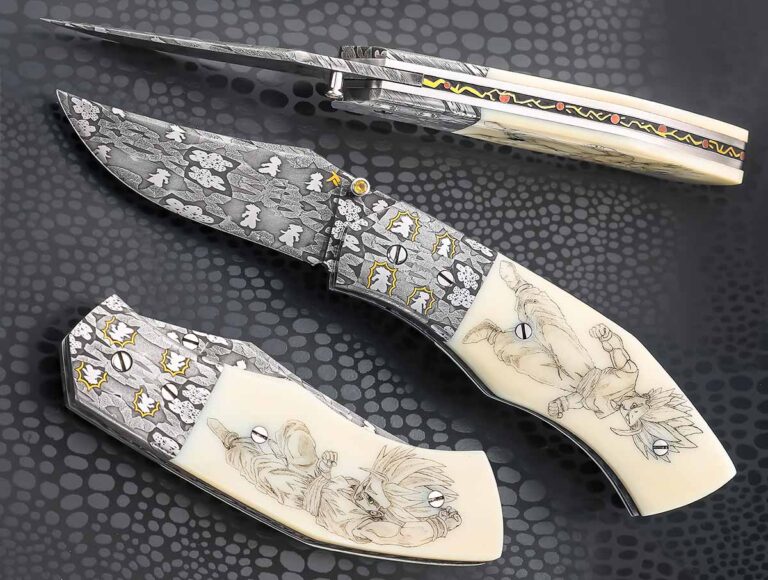
It was ABS journeyman smith Peyton Ramm’s dream to make a knife themed after his favorite childhood TV show, Dragon Ball, and the new 3D printing process for canister patterns provided him with the perfect vehicle to do so.

“Before I heard about 3D printing, I dreaded the idea of paying someone to wire EDM every single dragon ball out, but my good friend Ron Hardman introduced the idea,” Peyton wrote. “I sent him pictures of Gohan [a prominent character in the Dragon Ball series] and the dragon balls, and asked him to recreate the image in the best way possible to forge down. His students at Kilroy’s Workshop got a rough draft for me and once I approved it, they printed and sent it.”

Peyton Ramm

Peyton stated he had to build a new forge just to do the canisters, as he only had a vertical forge and it’s important to forge weld lightly on the two end caps first before welding the sides.

“My first billet fell apart because of this, a mistake I didn’t [repeat],” he wrote. He combined the two images with a flower mosaic he made with a damascus of 1095 carbon and 15N20 nickel-alloy steels to break the pattern up, and finally had his damascus. From there he matched the blade and bolsters as best he could so it would look like an uninterrupted transition.

Check Out More Cool Custom Knives:

Honey Hole Of Custom Knives Sporting Hamons

The hamons push these knives over the line.

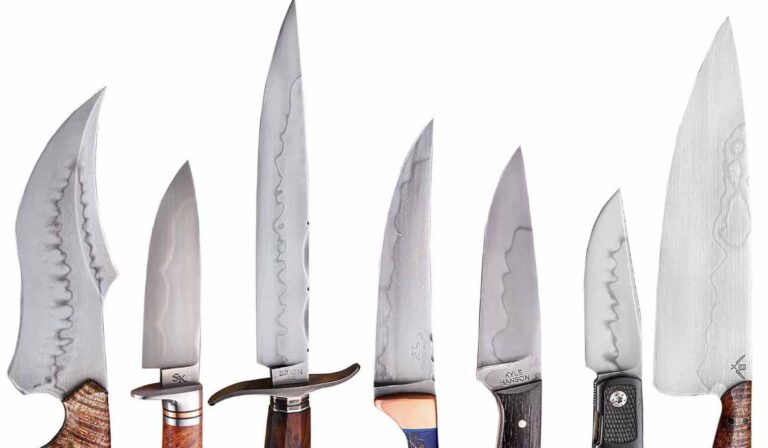
The often wavy hardening line running laterally and roughly midway from one end of the blade to the other on some knives is the hamon (pronounced ha-MOAN). Most if not all blades with genuine hamons are forged and differentially hardened. The wavy line serves as a demarcation point between the softer spine for toughness above and what extends down to a hardened edge for enhanced cutting below.


Steve Sando: Classic Hunter

Steve Sando: Classic Hunter

Steve Sando used a coffee patina to color the hamon of the 4 3/8-inch blade of 26C3 carbon steel on his classic hunter. Steve’s differential hardening of the blade resulted in a Rockwell hardness of 62 HRC on the edge and 40 HRC on the spine. Blade grind: flat. Handle material: Afzelia wood. Overall length: 9 1/8 inches. (SharpByCoop image)


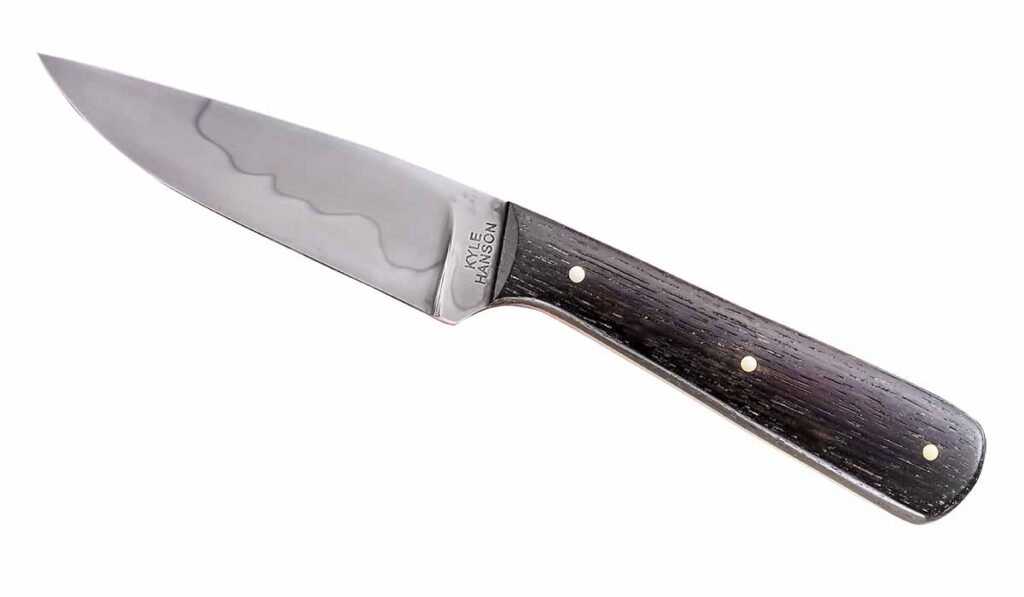
Kyle Hanson: Tapered Full Tang Hunter

Kyle Hanson: Tapered Full Tang Hunter

Not merely W2 but “Oldass W2” tool steel is the canvas for the hamon on the blade of Kyle Hanson’s tapered-full-tang hunter. Handle material: 5,600-year-old bog oak. Overall length: 8.25 inches. A leather pouch sheath (not shown) by Kenny Rowe accompanies the knife. (SharpByCoop image)


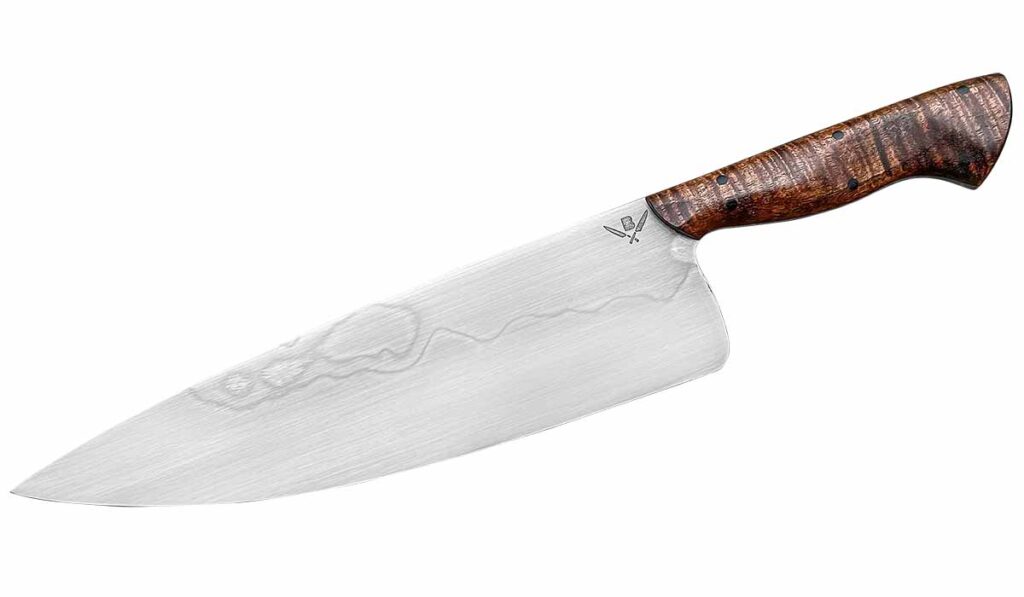
Geoffrey Baze: Chef’s Knife

Geoffrey Baze: Chef's Knife

ABS apprentice smith Geoffrey Baze opts for W2 tool steel to showcase the hamon on the 9.5-inch blade of his chef’s knife. The contoured bird’s beak handle is Tasmanian blackwood. (Jocelyn Frasier image edit)


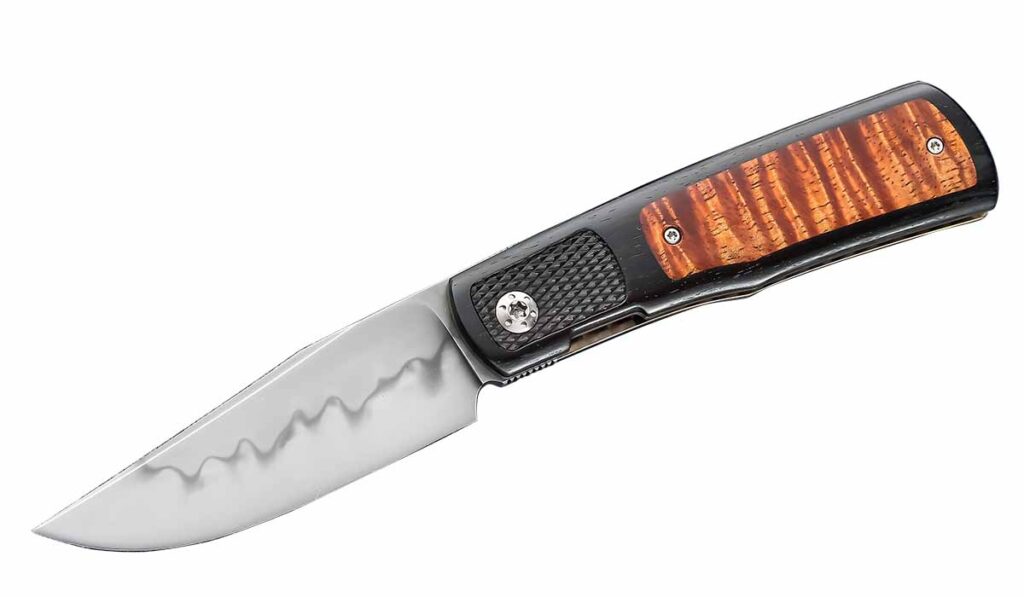
John Doyle: Dress Classic Gunstock Model

John Doyle: Dress Classic Gunstock Model

While not unheard of, folders with blades sporting hamons are not all that common. John Doyle does the deed on his Dress Classic Gunstock Model with pocket clip. The 3.25-inch blade is W2 tool steel and the handle frame is African blackwood with koa inserts. Lock: linerlock. Liners: jeweled, anodized titanium. Closed length: 4.125 inches. (SharpByCoop image))


Peter Pruyn: Boning Knife

Peter Pruyn: Boning Knife

Like many makers who differentially harden their blades, Peter Pruyn used the clay-coating method for his small boning knife. The 5-inch blade is flat ground from 1095 carbon steel. The blueberry crumble resin-based scales are from Voodoo Resins and the bolster is copper. Overall length: 10.5 inches. Peter’s price for a similar knife: $450. (SharpByCoop image)


Eliott Robinson: Fighter

Eliott Robinson: Fighter

An apprentice to ABS master smith Sam Lurquin, Eliott Robinson nails it with the hamon on his fighter’s upswept recurve blade of U10A carbon steel. The bird’s-beak handle is Tasmanian blackwood. Respective blade and overall lengths: 5 and 9.5 inches. A quality inlaid sheath (not shown) by Jeremy Guillaume completes the outfit. (SharpByCoop image)


Brion Tomberlin: Coffin-Handle Bowie

Brion Tomberlin: Coffin-Handle Bowie

The hamon of ABS master smith Brion Tomberlin’s coffin-handle bowie dissects the 8.5-inch W2 tool steel blade almost perfectly. Blade grind: flat. Handle material: ironwood. Overall length: 13.25 inches. Brion’s price for a similar knife: $2,200. (SharpByCoop image)


Check Out More Cool Custom Knives:

Damascus Steel: Mass Producing The Unique Knife Material

Damascus steel is produced on a mass scale by some of the best in the business

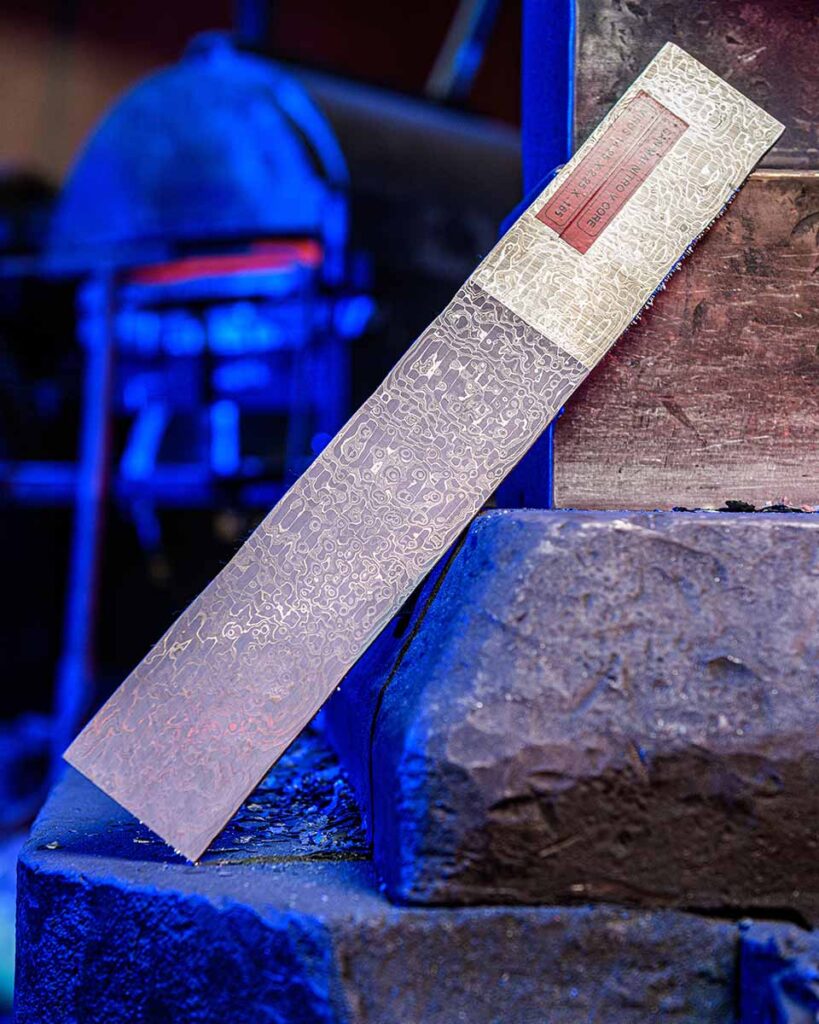
Forging damascus steel for knives and ancillary products on a broad scale makes the beautiful and highly popular knife material readily accessible to the marketplace, and drives the creativity of custom and factory knifemakers. The availability of the resulting damascus knives is reaching new levels while bringing on innovation at the same time.

At Nichols Damascus, owner Chad Nichols touts his willingness to put together “laminates of any kind we can think of.” Nichols Damascus is busy with titanium and copper alloys, carbon and stainless steels.

“We have a pattern called Boomerang, and any configuration we make it in sells very well,” Chad commented, adding that he believes the popularity of the material has increased dramatically due to the internet and social media.

One of the latest patterns in Damasteel’s Dragon series
One of the latest patterns in Damasteel’s Dragon series, Svavner was used to create the blade steel for the Valyrian swords of the Targaryen family on HBO’s House of the Dragon. Brian Brown uses the steel here on one of his sporty folders. (Damasteel image)

He asserts that his forging operation charts its own course. “We’re just having a good time playing with hot stuff,” he smiled, “and we make a lot of core material. This is where we clad a homogeneous steel like Magna Cut with a damascus on the outside.”

WANTS & DESIRES MET
A family-owned business situated just north of Sweden’s capital of Stockholm, Damasteel has focused for years on making top-quality steel for custom knifemakers, among other lines of business. “Over the last couple of years we have released our Dragon family of damascus patterns, culminating with the release of Svavner, which we launched alongside the release of HBO’s House of the Dragon,” noted owner and iron master Per Jarbelius. “They used our steel to create the Valyrian swords for the Targaryen family. It was an amazing project to get to work on.”

Damasteel has also just released Drakkar, a patterned steel in sheet form. It’s a first for the company and Jarbelius says it has been well received, emphasizing its nesting options with the ability to go from bar to sheet. A product line called Damacore has been available in DC18N and DC21R steel for a few years now and signaled a major expansion in the company’s repertoire. “It’s becoming even more popular as the number of san-mai offerings grows on the market,” Per noted. “We’re hoping to eventually be able to offer every pattern we do in both the DC18N and DC21R.”

Baker Forge & Tool damascus patterns are the copper and bronze laminates.
Among the most popular Baker Forge & Tool damascus patterns are the copper and bronze laminates. A current hot one is Elite CopperMai, a damascus blend of copper, 1084 carbon steel and pure nickel over a solid core of 80CrV2 carbon steel that creates either a chevron or a ripple pattern (the latter here on a knife by JB Blades). (Baker Forge & Tool image)

Philosophically, Jarbelius relates that Damasteel has always paid attention to the wants and desires of its market. “We make patterned and un-patterned stainless steel, and our priorities have always been performance and beauty,” he explained. “Our artistry is core to our identity, and we want to make patterns that connect with users on an emotional level. Research and development is a big part of what we do. But hearing from makers is equally important; we value the opportunity to get feedback from people using our steel.”

Damasteel further connects with its user community each year in hosting the Damasteel Chef Invitational, showcasing the talents of top-class culinary knifemakers. The evening event provides a glimpse inside the shops and workspaces of incredibly talented artisans. “It’s absolutely world class,” Per concluded. “It’s a great learning experience, too, for people who have never used our products. They can ask questions and connect with our team as well.”

Forging An Industry

Vegas Forge concentrates on the production of high-quality damascus steel in a variety of exotic patterns and alloy combinations. “In 2016, we opened our shop in Las Vegas and quickly discovered that many of our potential customers were extremely hesitant to use damascus steel again due to some bad experiences they had had in the past with other damascus steel companies or makers,” explained owner Jesse Harber.

Damacore is available in DC18N and DC21R steels
Damacore has been available in DC18N and DC21R steels for a few years now and signaled a major expansion in Damasteel’s repertoire. Persevere by Princeton Wong sports a 3.5-inch blade of Damacore DC18N handled in black Timascus™. Closed length: 4.625 inches. Princeton’s price for a similar knife: $2,700. (SharpByCoop image)

According to Harber, customer service is a watchword at Vegas Forge. Returning customer calls, handling inquiries, responding to emails, and delivering orders in a timely manner complete the full circle from outstanding damascus to overall satisfaction.

“Once we had solved that, we turned our focus on creating new, interesting patterns, new billet shapes and different alloy combinations,” Jesse advised. “In the beginning, we had 10 damascus patterns that we offered customers, all flat billets which are what knifemakers primarily use. Today, we offer 26 flat-billet damascus patterns. We offer most of those patterns in stainless or carbon damascus as well as titanium damascus and mokume gane. In addition, we have eight round-bar damascus patterns that we sell to customers who make things out of round bar like custom rings, pens, razors and such. We also make blocks of damascus in six different patterns for manufacturers of guns, golf putters and other products.”

The most recent patterns to emerge from Vegas Forge include Virus, Lytic, Forged Koa and one that is so recent that it remains unnamed thus far. Virus depicts what most people would think a virus looks like under a microscope—sporadic circles and lines that are “beautifully chaotic.” Lytic has the look of lytic DNA cycles under the microscope.

Baker Forge’s CopperMai
Baker Forge’s CopperMai was one of the first copper damascus steels to capture the imagination of custom knife enthusiasts. Bubba Crouch uses it on his trapper with an integral damascus frame and double-line antique Micarta® handle. Closed length: 4 inches. Bubba’s price for a similar knife: $3,000. (SharpByCoop image)

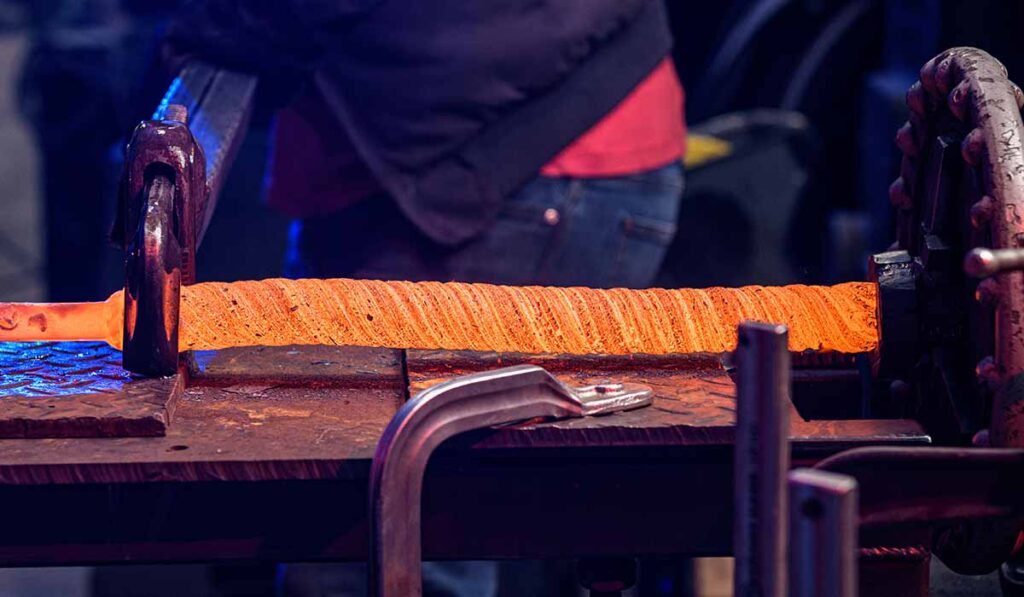
“Both of these patterns were created during the pandemic, so that’s where the inspiration—if you want to call it that—came from!” Harber laughed. “Forged Koa looks like a rare piece of twisted koa wood. It has multiple depths and contrasts to make it look like koa. It’s made by stacking 600-plus pieces of steel into a can and then lightly twisting it. As you grind into it, the pattern opens up and exposes all 600 layers, which is pretty spectacular.”

A few years ago, Vegas Forge began producing a titanium damascus that Harber dubbed Damtanium. The combination includes damascus with layers of Grade 2 and Grade 5 titanium. Almost simultaneously, the company introduced Zirmascus, an alloy of zirconium and titanium layers.

“We’re always trying out new steels in our san-mai damascus,” Jesse added. “San-mai is like damascus, but at the center of the damascus billet is a solid core. We have used Elmax, Magna Cut, and Nitro-V, to name a few.”

Vegas Forge san-mai damascus
Jesse Harber said Vegas Forge uses its san-mai damascus to try out a number of stainless-steel cores, including Elmax, Magna Cut and Nitro-V, the latter shown here in bar form. (Vegas Forge image)

All this experimentation and innovation is the product of an expanding horizon and an imagination that isn’t inhibited or afraid to step into some uncharted territory. Harber thinks the future is bright at Vegas Forge, and the new product array has brought ever-increasing interest to the doorstep.

“In the beginning, the knife world kept us alive,” he declared. “We were getting no love from other industries. Today, the knife world still accounts for half our business. There isn’t another industry that we love more. We’ve attended hundreds of knife shows over the years, and there is no doubt that knife people are our people. We sell to a lot of custom knifemakers as well as larger manufacturers. I love the custom world, and I don’t even know how many custom knives we own at this point.”

Incorporating Copper And Bronze

Coy Baker founded Baker Forge & Tool in 2019 with a focus on damascus and san-mai. That bedrock quickly elevated to include non-ferrous laminate steels. Baker Forge is now an industry leader in copper and bronze laminated steels with dedicated distribution centers in the United States, Canada, the United Kingdom and Australia.

Chad Nichols Damascus
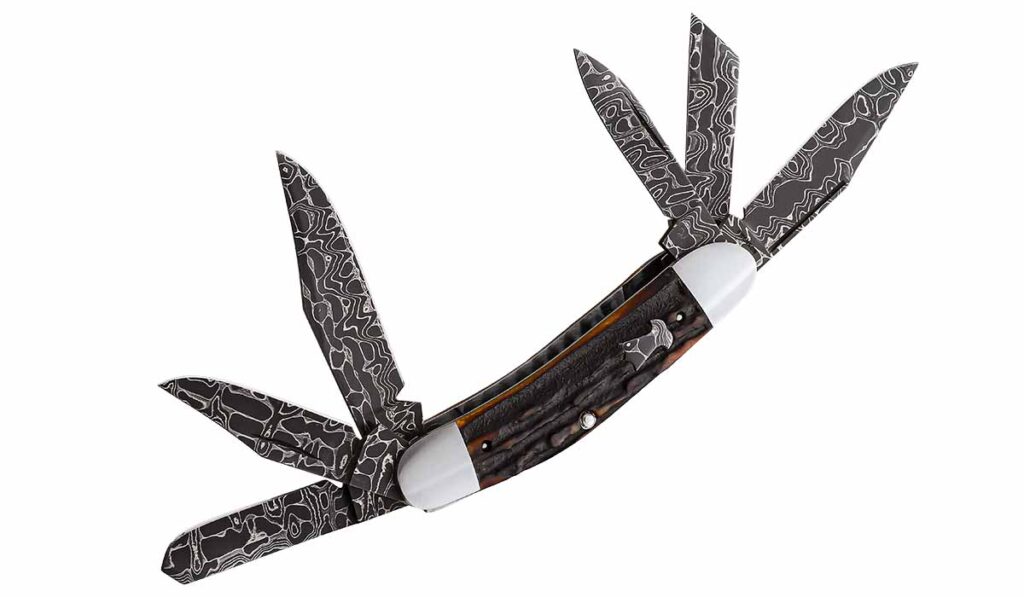
Chad Nichols Damascus offers a wide range of damascus patterns including the Intrepid on Luke Swenson’s six-blade stag sowbelly. Luke’s price for a similar knife: $4,000. (SharpByCoop image)

“Our current buying market is about 80 percent to the knifemaking industry, about a 50/50 split between retail custom makers and commercial knife companies,” Coy related. “We cut our teeth in the custom knifemaker market in the beginning and have slowly expanded into the commercial side. We aim to always be able to provide damascus steels to everyone from the hobby smith to the biggest knife companies.”

Among the most popular Baker Forge damascus patterns are the copper and bronze laminates. However, one-off custom runs generate real excitement. One trending steel group is Elite CopperMai, a damascus blend of copper, 1084 carbon steel, and pure nickel over a solid core of 80CrV2 carbon steel, creating either a ripple or chevron pattern.

“This layout is very appealing to customers due to the stark contrast between the layers and its ease of finishing,” Coy remarked. “We have been expanding into using new core steels in our laminates. Recently, we have used some Hitachi #2, which quickly became a crowd favorite for its edge-retention properties. Later this year we will be expanding into Apex Ultra steel and possibly some other stainless options.”

Forged Koa looks like a rare piece of twisted koa wood
“Forged Koa looks like a rare piece of twisted koa wood,” Vegas Forge’s Jesse Harber explained. “It’s made by stacking 600-plus pieces of steel into a can and then lightly twisting it. As you grind into it, the pattern opens up and exposes all 600 layers, which is pretty spectacular. (Vegas Forge image)

This quick look inside the damascus steel industry offers a glimpse of past, present, and future. The tried and true, the cutting edge, and what will be are coming together to keep pattern steels fresh and exciting among makers, users and then the wider buying market.

Read More On Knife Steel:

Knife Handle Material: Natural, Synthetic And Hybrid Moments

Natural and synthetic materials are equal parts fashionable and functional.

2024 Knives annual
This article appeared in the 2024 KNIVES annual.

They complement one another in an easy, seamless union—blade and handle. One without the other means the knife is incomplete, or it isn’t a knife at all.

Along with the search for proper blade steel, appropriate handle material is the second critical element in the presentation, form, and function of the knife itself. Natural and synthetic handles play their roles. They bring utility and aesthetics to the package, and the maker’s choice sets the tone. Availability, cost, and maker’s preference fit into the equation when choosing the right handle material. And then, of course, the intended knife use weighs heavily.

In the end, it’s the eye of the artist that drives the visual element, and the job to be done by the user that directs his or her choice. The handle makes the knife complete.

At Masecraft Supply Company, co-owner Chris Hartman sees the supplier’s role as the facilitator. Never interfering with the artist’s concept, he views Masecraft as a provider of the palette. “We don’t advise what to use,” he reasons. “We are not big fans of, ‘You know what you should do …’ or telling a customer what to use, but more in supplying a wide variety of options to choose from. We are always willing to answer questions about our materials a customer may have, but it’s just not a good idea to advise what is right for them. That’s the maker’s choice.”

With that said, where is the market headed today? What does the landscape look like in terms of availability, trends, and timing?

“The majority seem to be sticking with composite laminates like G-10, canvas and linen Micarta, and Richlite,” Hartman says. “Natural materials like bone and horn seem to be in a continuing decline. Exotic woods still do well, but availability and pricing have become issues over the last two years.”

John Cammenga, vice president of operations at White River Knife & Tool, Inc., deals primarily in synthetic knife handle materials. He indicates that knifemakers who build hard-use models often lean toward durable synthetic handles and that the laminate trend holds up there as well, particularly with material available in a variety of colors.

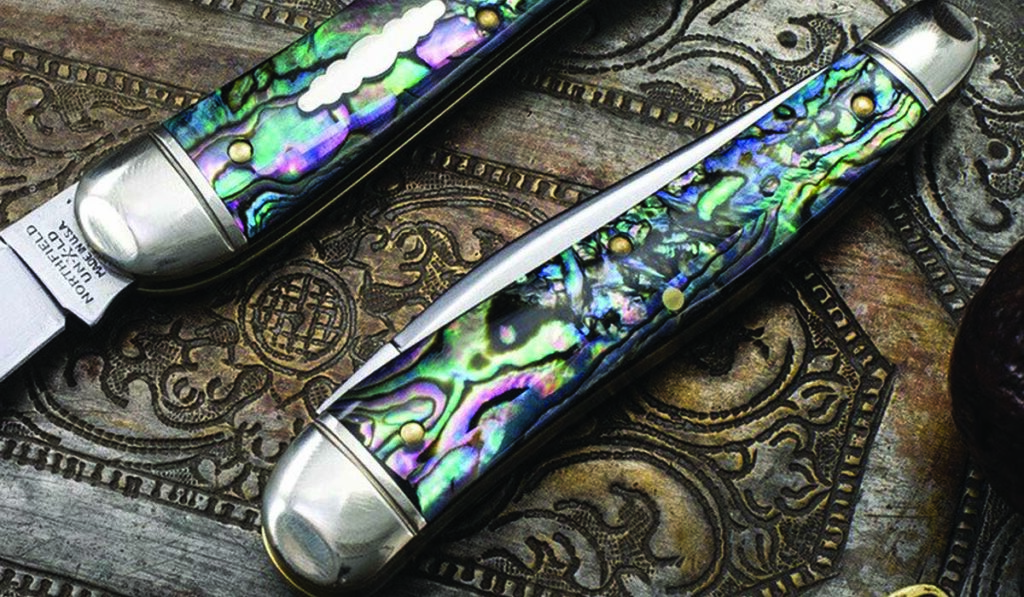
Northfield UN-X-LD knife
This Northfield UN-X-LD knife from Great Eastern Cutlery (GEC), which registered the trademark and uses it on premium GEC pocketknives, features ALVS (acrylic laminated veneer shell) handle scales from Masecraft Supply Company. The dazzling shell veneer consists of real shell and high-impact acrylic laminated together within the sheet.

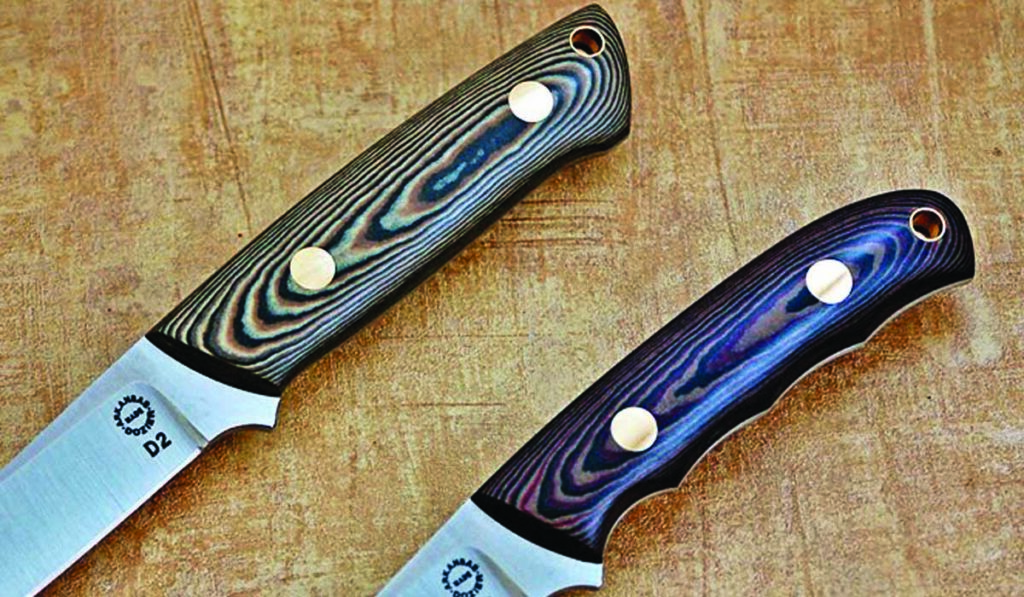
“The majority of our handle materials are synthetic,” Cammenga says, “and this is primarily due to stability and longevity. But many look great as well. Multi-color layers of fabric bonded with phenolic or polyester resin can have the look of wood, yet last much longer. Additionally, many of these are tackier when wet, giving the user additional hand purchase in tough weather or when processing game. Carbon fiber and G-10 are available in an ever-expanding array of colors and patterns and almost bulletproof when it comes to wear and tear.”

Choosing Knife Handle Material

The choice of materials, Cammenga explains, comes directly down to the proposed use of the knife. For hunting, fishing, camping or bushcraft, White River almost always recommends synthetic handle material. However, John still gives a nod to personal preference. Some users simply must have a natural handle, and the aesthetic factor comes into play there.

“It’s hard to beat the beauty of a highly figured burl!” he comments. “Some, such as desert ironwood burl, are not only beautiful but also extremely tough.”

Tom Krein is an experienced custom knifemaker who worked for the great Bob Dozier and ran the custom shop for A.G. Russell Knives before embarking on his own venture during 30 years in the business. Making small utility and hunting knives primarily, he agrees that handle material choice relates to a few simple concepts.

Tom Krein’s “Mako” model features a Dion Damascus san mai steel blade with a copper-color stag handle.

“It comes down to the customer’s needs, willingness to care for the knife, aesthetics, and budget,” Krein relates. “Natural materials should hold up nicely with proper care assuming everything goes according to plan. Sometimes stuff happens—a knife falls into a sink of water, or it starts to rain while hunting, or your knife gets lost in the yard for a week. Synthetics hold up better when stuff goes south. For customers, I recommend getting what you like and learning how to take care of it. For knifemakers, I suggest picking the mind of another maker who uses the material you want so you can learn how to use it. Overall, we are a helpful bunch of people.”

Traditional handle materials and their innovative, eye-popping counterparts coexist at Santa Fe Stoneworks, a provider of materials to the art knife market since 1978. Santa Fe not only affixes those materials to its own knives, but also provides the service for Spyderco and Kershaw while doing private label work as well.

President Bill Wirtel leads the family business, and the company’s roster of natural handle materials includes the best of the best. “We work with factory knives and apply gemstones, exotic woods, shells like gold- and black-lip pearl, and fossils such as woolly mammoth tooth, tusk, bone, and petrified dinosaur bone,” he remarks.

As for Santa Fe’s synthetics, Fordite, a car paint overspray, Surfite surfboard overspray, and a cholla cactus-like material that is made in the shop have found favor with makers and buyers alike.

Material Mash Up

“We are looking for design and color, so we mix natural with manmade stone and epoxies,” Wirtel explains. “Our fossils are all stabilized so they work great for a handle material. We see hybrid materials gaining popularity as they provide the best of both natural and composite materials. Fordite and Surfite have been selling well. Our synthetic cholla cactus line that we make here, stabilizing it with different colored epoxies, is becoming a big seller as well. We also have mammoth tusk fusion. This is stabilized fragments of mammoth ivory that are fused together under immense pressure. The result is a beautiful and hard composite that is densely packed with mammoth ivory.”

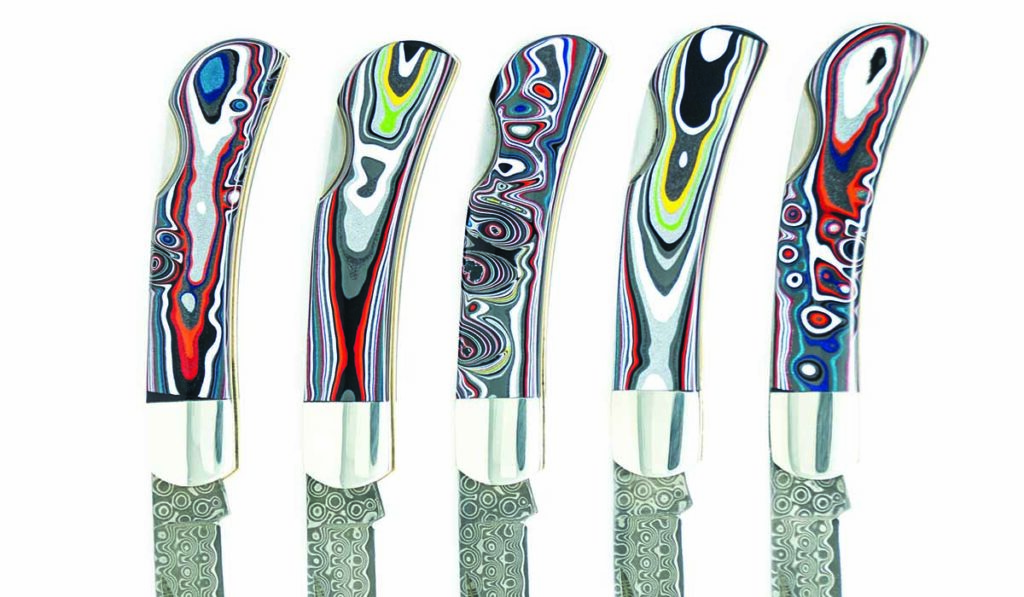
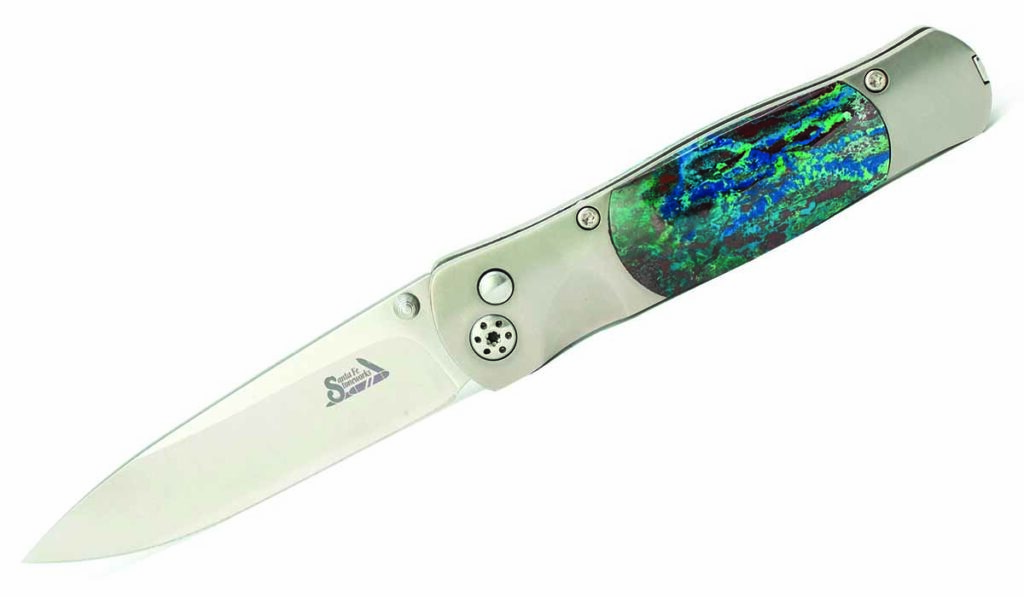
Fordite car paint handle material adds a fun flair to this series of Santa Fe Stoneworks 3-inch lock-back folders
Fordite car paint handle material adds a fun flair to this series of Santa Fe Stoneworks 3-inch lock-back folders with damascus blades.

Fordite is an interesting option that comes from a surprising source. Also known as Detroit agate or motor agate, the material consists of pre-1985 automobile paint that hardened sufficiently to be cut and polished. It formed from enamel paint slag, which built up over the years in layers on the tracks and skids where cars were hand spray-painted. The buildup hardened in ovens intended to cure the paint on car bodies. After so much of that buildup, the brightly colored and layered paint had to be removed. Its allure caught on with some autoworkers who brought pieces home with them. From there, the beautiful Fordite material, which can be cut and polished into a spectacular look, found its way onto knife handles.

The Masecraft perspective is somewhat dictated by availability. “Sambar stag is not coming back,” Hartman stresses. “It has been banned by India for export since sometime around 2005, I believe, so that’s almost 20 years now, and I see no chance of this ever-changing. What’s still available out there now is it. Game over!”

“Black-lip, gold, and white mother-of-pearl all are still available,” he adds, “just not in larger size pieces as they were 20-50 years ago. They are overharvested and not as healthy as before. Demand for shell is down overall. It is not very tactical, and we seem to be in a tactical and bushcraft market for the last two decades. Shell tended to be more of a gentleman’s pocketknife material, so it’s not exactly the big trend right now.”

Santa Fe Stoneworks El Rey model is handled in a spectacular turquoise/abalone/bronze hybrid gemstone
This Santa Fe Stoneworks El Rey model is handled in a spectacular turquoise/abalone/bronze hybrid gemstone and includes a mother-of-pearl button inlay.

“Many of the companies that used a lot of shell on knives are gone or simply don’t have the people who know how to work with it anymore,” Hartman adds. “Shell is still one of the most beautiful materials ever, so much so that it seems to be the hardest to reproduce in any type of synthetic alternative that even comes close to its natural beauty. We can come close, but there is still nothing like the real thing.”

Krein sees a swing toward synthetics and higher-end natural materials as well. “Right now, there is a huge push to find and use vintage Micartas,” he relates. “I’ve also seen G-10 usage go up a ton over the years. G-10 holds up to use extremely well, is relatively inexpensive, and machines and grinds easily. I’ve also noticed quite a few new businesses that specialize in exotic stabilized woods. Stag has always been a desired and quality knifemaking material, and with exceptional stag being much harder to find, it is even more desirable, particularly when done [harvested and finished] properly.”

Watching the high-end polymer Ultem begin to trend as a new synthetic handle material has been interesting for Krein, and his affinity for giraffe bone has not waned. It’s something he calls the “latest real pickup in natural materials.”

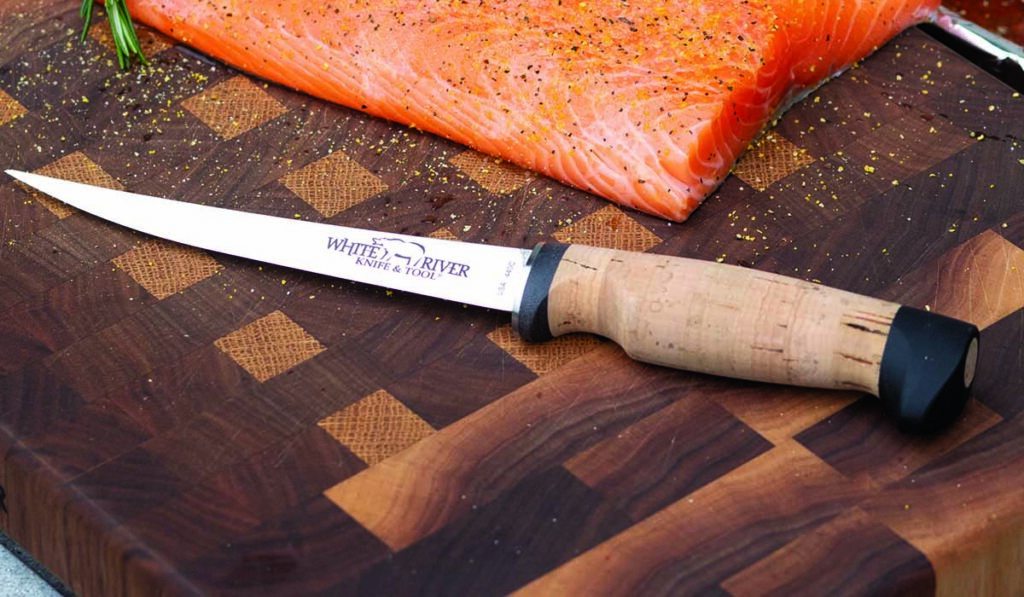
White River Knife & Tool fillet knife with cork handle
White River Knife & Tool purchases synthetic material made in the USA, so supply chain issues have not been a problem. The one material the company imports, cork, has increased in price, but its supply has been uninterrupted. White River’s Traditional Fillet knife incorporates a handle of imported cork for easy cleanup and a tight grip in slippery conditions.

“I often see new makers using very exotic materials,” Krein concludes. “These materials are costly and often not used anywhere close to their potential. I recommend that new makers learn to use simpler materials like Micarta to their full potential. This leaves funds available for other materials and equipment while allowing a new maker to develop their skills. Just because a knife has expensive materials doesn’t make it better or more interesting to me. It’s developing the skills to make simple materials look elegant that I appreciate.”

Those Hybrid Moments

Hybrid handle material is on the rise, and Cammenga is pleased with the growing popularity of marbled synthetics. “Right now, there is strong demand,” he notes. “This is true in both cloth/resin laminates and carbon-fiber/resin laminates. For those who want natural wood, bone or antler, acrylic ‘stabilized’ scales have been popular for quite some time. They provide the user with a natural material, which has been made tougher by introducing acrylic resin into the fibers. Currently the marbled look is in with almost all materials, but we have made several knife models using G-10 and rubber combinations, as well as others from polyester cloth and resins.”

Masecraft is keeping a close eye on the development of new materials, but the course is charted by ingenuity rather than discovery. “As far as new natural materials, that’s going to be extremely rare,” Hartman observes. “The earth is not really producing anything new, so unless we have not discovered it yet, the odds are low. More likely, some natural materials will disappear and become endangered, banned, or extinct. Human history tells us the availability of natural material will decrease while prices increase. You will see more hybrids of natural and synthetic combinations, and all kinds of new synthetics will continue to be introduced.”

vintage Micarta
Knifemaker Tom Krein says there’s a huge push to find and use vintage Micarta, such as on the handle of his pocket bowie model.

Supply often dictates how well demand is satisfied, and the inherent scarcity of some handle materials has been exacerbated by supply chain concerns in areas. Even as the COVID-19 pandemic has eased, the resilience of the supply chain remains an open question. Some suppliers and makers have faced shortages of stock items, while others have adapted, moved on to other, more readily available options, or simply been patient.

“I have been sourcing materials for over 44 years, and most of our suppliers know us and what we want,” Wirtel relates. “Obviously, we’ve had supply chain issues, but we have been able to work around them. We make our product to order, so we range in delivery time from a few weeks to a few months.”

Krein is positive regarding availability, saying, “There have been slight wait times for some synthetics, particularly Micarta, during the pandemic, but it seems like everything is back on track here. There has and will continue to be more demand for quality stag than availability. I’ve seen a bit less of quality exotic stabilized woods like exhibition-grade ironwood and Koa.”

While the supply chain phenomenon has been universal, Hartman is pragmatic. Going with the flow makes the Masecraft operation run as smoothly as possible. “There are supply chain issues with everything globally,” he observes. “I can’t think of anything on the planet that hasn’t been affected in some way, shape or form and that doesn’t have a price increase or isn’t in short supply, and it’s all things, countries, and markets.”

Dozier Knives produced this fixed blade with a Richlite handle from Masecraft Supply Company
Dozier Knives produced this fixed blade with a Richlite handle from Masecraft Supply Company composed of approximately 65% Forest Stewardship Council (FSC)®-certified recycled paper and 35% phenolic resin.

“If you don’t have the chip, you can’t produce the car,” Hartman says. “If you don’t have OD Green dye, you can’t make OD Green G-10. If one key part is missing due to supply chain issues, the product simply cannot be made, and that is affecting all things.”

Staying domestic has been a problem solver for White River Knife & Tool, according to Cammenga. “Because White River purchases synthetic material made within the U.S., our supply chain has not been a problem. The one material we do import, cork, has increased in price, but our supply has been uninterrupted.”

Considering the handle-blade combination that makes the knife come together for the spectrum of customers and users, today’s material options appear more diverse than ever. Although some shortages in natural materials may never be plentiful again, fusions of natural and synthetic options open the door to creativity. And the imagination is always fertile ground for innovation.

More On Knife Handles:

Advertisement

Must Read Articles

Read this before you make a knife

Knifemaking 101 – Read This Before You Make a Knife

  by Wayne Goddard My experience has taught me that there's nothing like digging in and getting started. I've often said the hardest part of the...
how to forge damascus steel

How to Forge Damascus

Advertisement
Advertisement