



Here’s a look at the classes offered by the American Bladesmith Society at the New England School of Metalwork.
Dad Makes Knife For His Deer-Hunter Daughter
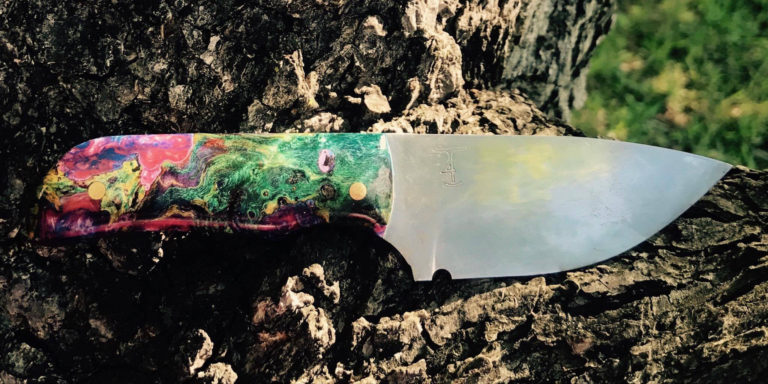
Ten-year-old Jordan Toerck had been pestering her knifemaker father, Bobby Toerck, to make her a knife for a while. But she was still young, so Bobby held her off. He promised to make her a knife when she got her first deer. Well, in January, she did just that and true to his word, Dad made a knife for his deer-hunter daughter.
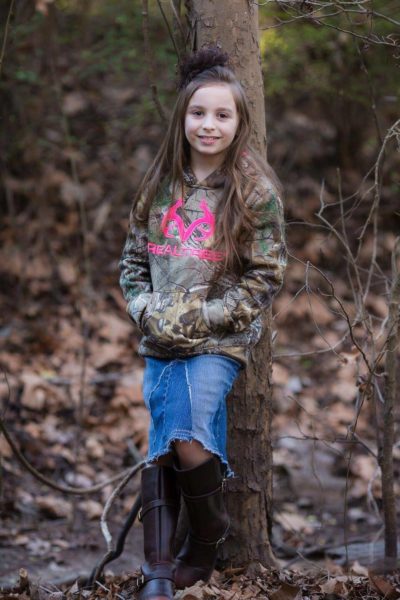
It was bitterly cold that January day: 14 degrees, which is “almost unheard of in East Texas,” Bobby said. Jordan had been accompanying her father on hunting trips off and on for about four years, since she was 5 or 6. This was her second year of active hunting. It was youth season, which follows the general season. This particular morning father and daughter were set up in a tent blind on the ground half an hour before dawn. By 7:30 Jordan said her feet were cold. Her father admitted his feet were cold too, but if they sat still and were quiet, they’d see something.
They saw a feral hog run through at a high rate of speed, but that was about it. By 9:30, Bobby decided that they could go in. They went back out at 3 p.m. and conditions were much more favorable for father and daughter. The temperature had risen to the upper 30s and there was no wind because they were protected by a wind block. “Around 5:30 Jordan got antsy, as kids do,” Bobby said. He told her to sit still and be quiet and they’d see something.
Sure enough two other does came into view, and then a third and larger one. Jordan sighted through her Leupold 4.5-14x50mm Long Range scope and put the crosshairs where her father told her to aim. Her Remington 700 BDL Custom Deluxe bolt-action rifle was propped up on Jim Shockey-style shooting sticks, which her father had fashioned with ¾-inch dowels and paracord.
“The next thing I know, I hear a bang,” Bobby said. The deer ran off into the brush. Jordan knew she had hit it and so did her father. They waited about 10 minutes for things to calm down then walked to where the deer had been standing. “We found blood and I immediately started teaching Jordan about tracking,” Bobby said. They didn’t go more than 40 yards before they found Jordan’s deer. It was dead and had been hit exactly where she told her dad the crosshairs had been when she pulled the trigger.

It was a 110-yard shot, according to Bobby’s estimations. “I should also mention that there is a Briley muzzle brake” on that rifle, he added. It brings the kick of a 25-06 caliber rifle down to the approximate equivalent of a .22 magnum, “taking 90 percent of the recoil out of it.” The setup certainly set Jordan up for success. When they found the deer, “she was jumping up and down, screaming and hollering, then she took out her phone and starts texting her momma,” Bobby said.

Right then and there, they filled out the tag and attached it to the deer’s ear. Bobby got his pickup truck as close as possible and they transported the animal home where they hung it in a tree. “She was hands-on, blood up to her elbows,” Bobby said. Even his 5-year-old daughter, Morgan, wanted in on the action. “I’m not raising girls here; I’m raising boys,” Bobby said with a chuckle. At one point he told his wife Amy, that he didn’t want their girls to “have to depend on some man to clean their animal.”
They gutted, skinned and quartered the deer, packing the sections in ice and switching the ice out for three or four days to get the blood out. Then they processed the meat, grinding some, making steaks, ribs for barbeque, even saving the neck bones for soup, noted Amy.
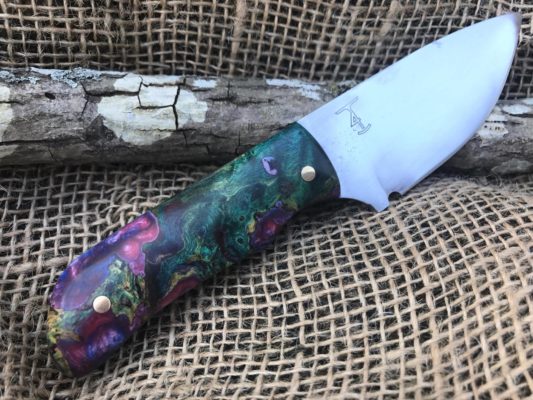
Bobby knew he’d be making a knife for Jordan so when he attended the Long Star Knife Expo in early April he was on the lookout for the exact right handle material. He found it in a triple-dyed box elder offering by Terry Dunn. “The colors in it looked like mixed up Play-Doh, or bubblegum,” Bobby said. It was perfect for Jordan, and the size fit her petite hands.
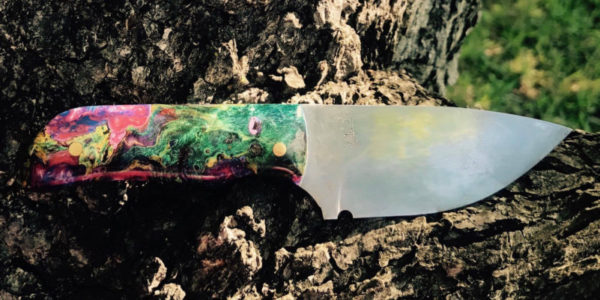
The full-tang knife is 6 ¾ inches overall with a 3-inch flat-ground drop-point blade made out of 80CrV2 steel. “To me the drop point is the best overall shape for a skinning-gutting knife because you are much less apt to puncture an intestine or stomach with a less pointy front end. And the drop-point will lift the skin slightly before cutting when making the initial cuts up the legs of an animal,” Bobby explained.
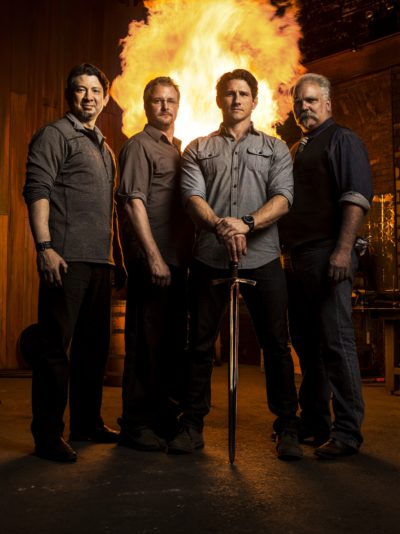
What did she think when he gave it to her? “She loved it,” Bobby said. “And, of course, she said ‘It will cut,’ because she’s a huge fan of Doug Marcaida in ‘Forged In Fire.’ She loves to watch that show with me,” Bobby said.
Contact Bobby Toerck at T4 Custom Knives on Facebook or at 903-812-1173. Maker’s list price on a knife like the one he made his daughter would be $175 with a Kydex sheath, $275 with a leather sheath.
Help Dad Realize His Knifemaking Workshop

Dad’s money has to cover many expenses, but he should still be able to indulge his knifemaking interests with a modest investment. In “Wayne Goddard’s $50 Knife Shop,” dad can read what’s essential for his work area and what isn’t. This is also a terrific back-to-the-basics read for more established makers. At 50 percent off, it’ll be a $10.99 expenditure that will be referred to again and again.
Larry “The Hammer” Harley Passes Away
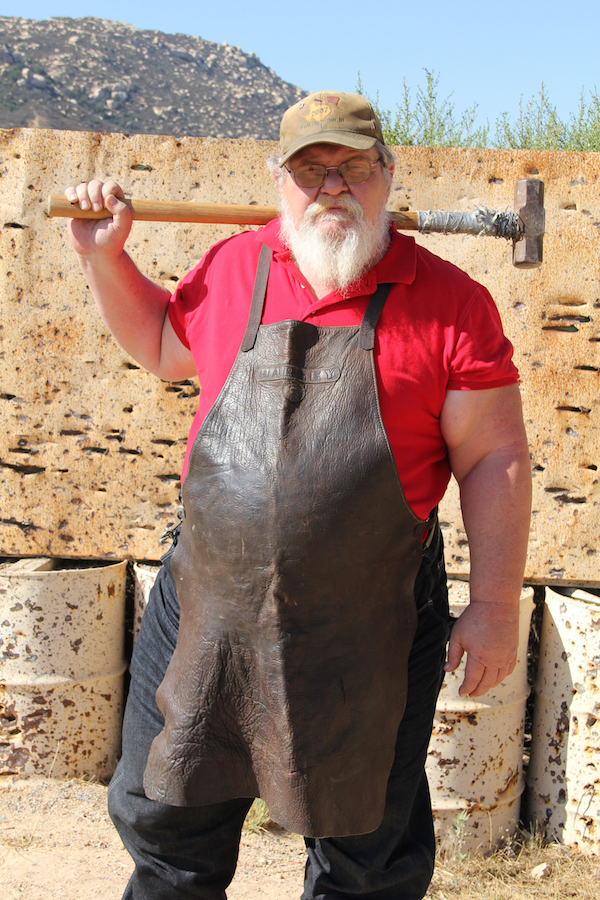
Larry Wayne “The Hammer” Harley, friend, knifemaker, bladesmith and knifemaking teacher to anyone who showed an interest—especially kids and “wounded warriors”—passed away in his sleep Feb. 12. He was 66.
A lifelong resident of Bristol, Tennessee, Larry made knives under the business name of Lonesome Pine Knives. An American Bladesmith Society journeyman smith, he was the chair of the ABS Youth Program and was involved with the Wounded Warriors Project. He was best known outside the knife industry as one of the stars of the National Geographic television show Lords of War, on which he went simply by the nickname of “The Hammer,” specializing in identifying and judging the worth of assorted knives, swords and other edged weapons.
Though not a tall man, Larry was large with burly arms and a massive chest—which was no doubt needed to contain his huge heart. He conducted bladesmithing symposiums at his shop in Bristol, entertaining youths, veterans and anyone and everyone who wanted to make knives. He also taught at the Batson Bladesmithing Symposium, youth programs at the BLADE Show and Smoky Mountain Knife Works, and just about anyplace he could find that would allow him to teach the craft, and interact with the people involved, that he loved so much. “Larry always felt that the real payment for teaching a youngster of any age was the irrepressible smile that was always on their face when they realized they could do it,” wrote ABS journeyman smith Wes Byrd, who, along with Larry, taught kids how to make knives in the ABS Youth Program.
As BLADE Magazine Cutlery Hall-Of-Fame© member A.G. Russell noted, everyone in the business liked Larry. “If you knew Larry at all, you probably knew where he stood on all of the issues of the world that you and he had in common,” Byrd noted. “I also knew he had my back no matter what.” Added Larry’s friend Mike Crenshaw, “Larry was a remarkable bladesmith, friend and outrageous character that will be sorely missed. He passed the fire on to many, young and old.”
Larry learned to make knives from his father, the late B.L. “Pap” Harley. “It just so happened that my daddy made knives and that’s how come I’m a knifemaker,” Larry said in the February 2015 BLADE®. “I remember my daddy working on bowie knives on the kitchen table when I was 4 or 5 years old. He also read me books by Raymond Thorp, author of Bowie Knife and Crow Killer, for bedtime stories, and I remember we saw the Alan Ladd movie about Jim Bowie, The Iron Mistress.”
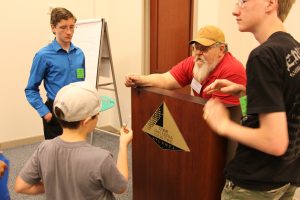
Larry’s friends were too many to count. In fact, if you met him he probably counted you as one of his friends and you counted him one of yours. His infectious laugh and twinkling eyes immediately broke the ice. A regular exhibitor at the BLADE Show in the early years, he was known then for his “hog-killing knives” and excursions on which he would take customers to hunt wild hogs in the Appalachian Mountains of East Tennessee and the surrounding area. He was also known as a top competitor in the early years of the ABS cutting competitions, winning at least one championship before the competitions became more organized and eventually evolved into today’s events conducted by BladeSports International, including the BLADE Show World Championship Cutting Competition, the 15th annual rendition of which will be held at this year’s BLADE Show June 2-4 in Atlanta.
Larry is survived by his loving wife of 35 years, Kristine; sons Richard and Nicholas; goddaughters Sarah and Julia Denton; aunts, uncles, cousins both in the Holbrook and Harley family; and many friends.
The family will receive friends from 5 p.m. to 7 p.m. tomorrow, Feb. 15, at Oakley-Cook Funeral Home in Bristol. The funeral service will follow at 7 p.m. with the Rev. Steve Playl officiating. The committal and inurnment service will be at 2 p.m. Feb. 16 at Glenwood Cemetery in Bristol.
In lieu of flowers, memorial contributions may be made to the Wounded Warrior Project, POB 758517, Topeka, KS 66675-8517 woundedwarriorproject.org.
New BLADE® Salutes Military On 9/11
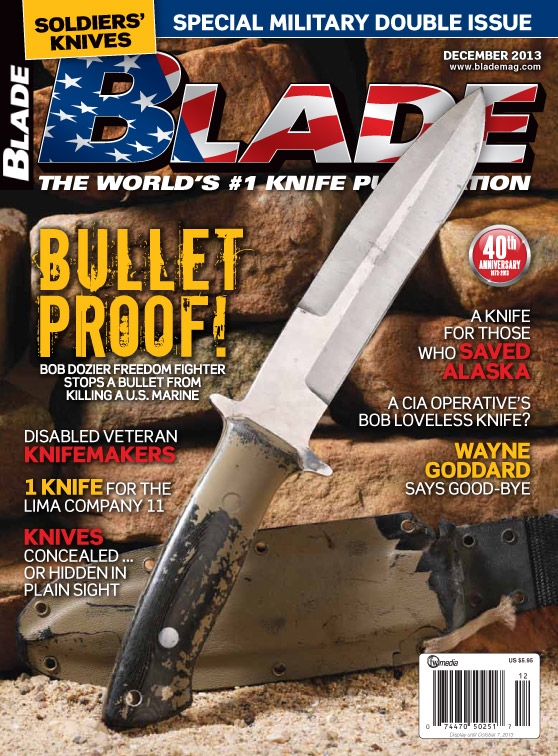
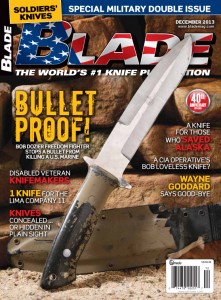
Military heroes past and present and their favorite knives are the focus of the new BLADE® (www.blademag.com) on the 12th anniversary of 9/11—on many newsstands NOW!
Featuring a Bob Dozier Freedom Fighter on the cover that stopped a bullet and likely saved U.S. Marine Lance Corporal Josh Clysdale’s life, the latest issue of BLADE (www.blademag.com) is our 4th annual military issue, and it covers the subject of military knives like no other.
The issue kicks off with a heart-rending story about Lima Company, 3rd Battalion, 25th Marines, all save one of whom—Lance Corporal Travis Williams—were killed by an enemy IED in Iraq. Williams eventually returned home and began making knives part time under the tutelage of knifemaker James Behring Jr. Williams made a knife in honor of Lima Company that was auctioned to raise money to support the work of an artist who was painting life-size portraits of the Lima Company Marines killed by the IED. It’s must reading for military and knife aficionados alike.
There’s much more, including stories on the aforementioned Lance Corporal Clysdale and his “bullet-proof” knife; one on if a soldier had just one knife in a military emergency, what that knife would be; a knife collaboration between Andy Sharpe and Chuck Richards to honor the American GIs who fought off a furious Japanese Banzai attack in a little-known battle on Attu Island in Alaska during World War II; a ground-breaking new program to not only teach returning vets how to make knives but also to help equip them with the tools and equipment they need to do the job; a new “Arkansas Veterans” knife from A.G. Russell Knives, with $10 of the sales of each knife going toward an emergency fund for vets who are students at the University of Arkansas; a one-of-a-kind Bob Loveless Lawndale boot knife made specially for Pat R. Dailey, thought to have been a CIA operative; and much more.
For your copy, check your newsstands. To subscribe to the digital version of BLADE, click on
www.shopblade.com/blade-1-yr-digital-subscription?lid=ssfbbl091013
Making Knives By Smelting Bog Iron
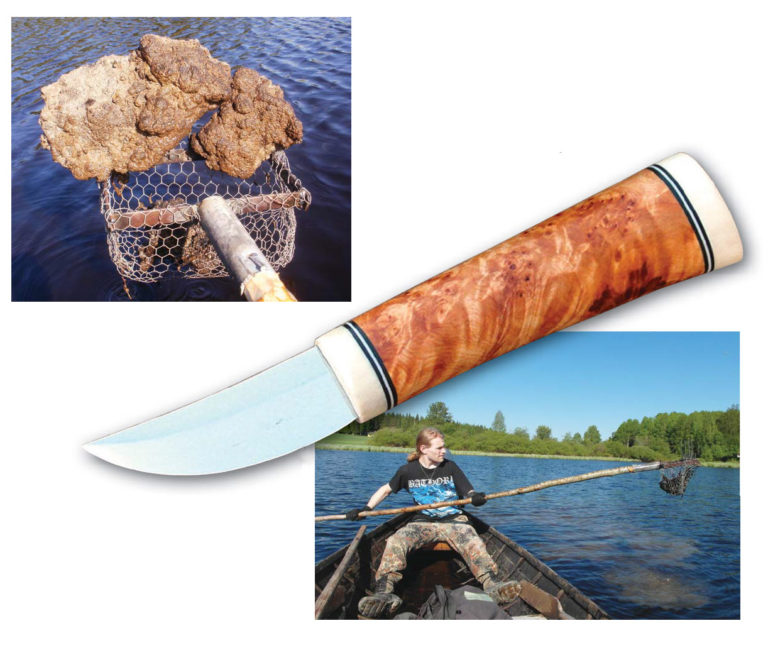
Making Knives the Old-Old-Fashioned Way
Many knifemakers use today’s best stainless steel money can buy. Other, more do-it-yourself types may scrounge a scrap yard for car springs or ball bearings. Still others go further because all that metal came from somewhere. What if a knifemaker went back to the beginning—starting with the iron pulled from the ground?
In recent years, some smiths have started from square one, pulling raw material from their surroundings to create metal from scratch—just like mankind did for thousands of years. Since the beginning of the Iron Age circa 1200 B.C., man has turned to the iron found in bogs. There, thanks to springs and bacteria, the iron forms into a spongy iron-bearing hydroxide mineral called a goethite.
This renewable source of iron was so important that even the first iron works in America, Saugus Iron Works in Massachusetts, gathered its raw material from nearby bogs. But to turn bog iron into a knife? It’s not a project for the faint of heart.
“You have to prepare hundreds of pounds of charcoal; find, harvest and prepare the ore, build the smelter and then monitor and feed the fire for hours just to produce the bloom,” ABS master smith Kevin Cashen notes. “Then the real heavy work begins of forging it down into a piece of steel that is historically interesting but nowhere near the quality product you get from your modern steel supplier.”
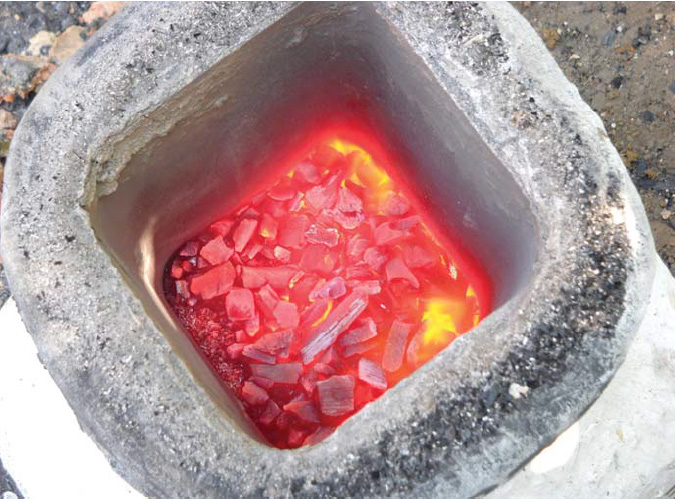
And then there’s the problem of smiths not knowing exactly how the ancients smelted iron.
Darrell Markewitz is a Canadian artisanal blacksmith and historical interpreter of the Vikings who settled in Vineland. He says he is “concentrating on rediscovering lost historic smelting methods.”
For example, he had to make intelligent guesses as to how Vikings tracked time during the smelting process, and how the ancients designed bellows because no bellows from that time exists today.
Sourcing Bog Iron For Making Knives
Relatively speaking, Jarkko Niskanen had it easy when he harvested iron out of a bog in Finland. From a boat, the 26-year-old blacksmith simply felt along the bottom of a bog for spongy chunks of material. Markewitz found himself kneeling over a rivulet running through a Canadian bog, feeling for deposits of iron.
Cashen indicates his home state of Michigan is filled with iron. However, only a small portion is bog iron, small chunks of concentrated iron deposited by bacteria on the slow-moving side of streams running through the bog.
“I have found entire cliff faces in the wilds of Michigan’s Upper Peninsula that a magnet will stick to, and huge sections of magnetic black sands on the shores of Lake Superior,” he observes. “But bog iron requires special conditions. I have found some scant deposits locally but not enough to work with regularly.”
There are different kinds of bog iron. All require the same kind of process to turn out a metal. Some types of bog iron react slightly different than others in the smelter, reducing to a smaller amount of usable material, for example. The end result is the same, however: a lump of relatively pure iron.
Once the smith harvested the bog iron, then he cleaned and dried it. Niskanen put his bog iron in a fi re to dry the pieces, and then broke them up until they were small and uniform.
Making Knives Like The Vikings
The process all happens in the bloomery furnace, in what looks like a chimney with an air pipe going into the side to pump in oxygen. It’s a design going back at least as far as Viking times.
“In operating a ‘short-shaft ,’ direct process bloomery furnace, higher air volumes have proven to produce larger, more dense iron blooms—in fact, blooms most like those few found in the archaeology,” Markewitz states.
As the temperatures rise and charcoal continues to be shoveled in, a chemical reaction takes place inside the furnace.
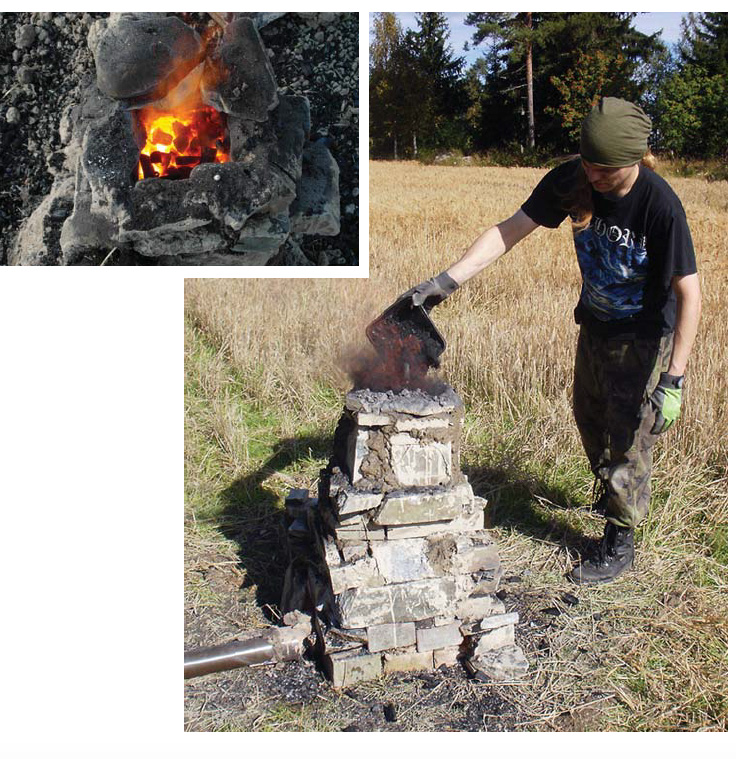
“The ore is always an oxide,” Markewitz continues. “The smelting furnace is a reduction process removing the oxygen from the ore.”
Charcoal produces carbon monoxide, which reacts with the oxidized iron. As oxygen leaves, the iron particles are left behind and fall to the bottom of the furnace. At the interior temperatures, typically something around 2012-2192°F or more, the heavier iron particles are slightly “sticky” and sinter together has they fall, Markewitz adds.
However, bog iron is also filled with non-iron materials, such as ash and sand. In the furnace, the latter liquefy and fall to the bottom of the furnace where they create a greenish-black glass, or slag, in the shape of a bowl.
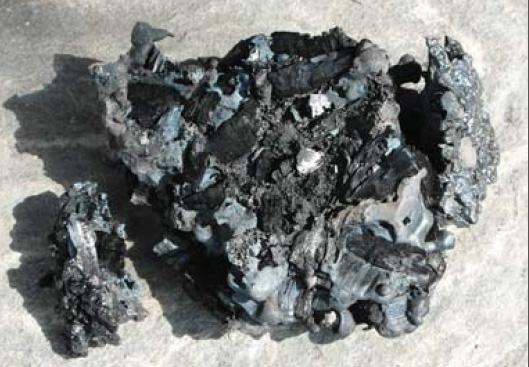
“The top surface of this bowl is closer to the hot area of the furnace [at the blast level and] so remains a liquid,” Markewitz explains. “If too much of this slag is produced, its interior level can rise up to block the air blast. Before this happens, ideally you want to let some slag run out [by tapping the furnace].”
If all goes well after hours of running the furnace, a ball of iron that is fragmented and filled with pockets of slag, but iron nonetheless, will result in the bottom of the smelter. However, what if the metal workers make the furnace too hot? Then, instead of iron, cast iron may be the result—unusable for forging.
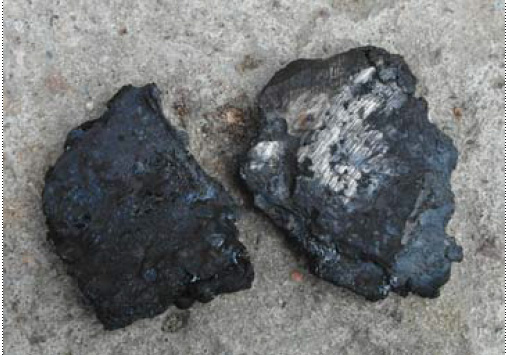
“If the iron particles are made too hot, they liquefy. As a liquid, iron will frantically absorb carbon—so fast, in fact, that the iron almost certainly shifts into a too high-carbon cast iron,” Markewitz states. “This material cannot be forged, and is so hot it usually melts through the bottom slag bowl and collects at the ground level of the furnace … The real truth is that it takes skill and experience not to get high carbon cast iron.”
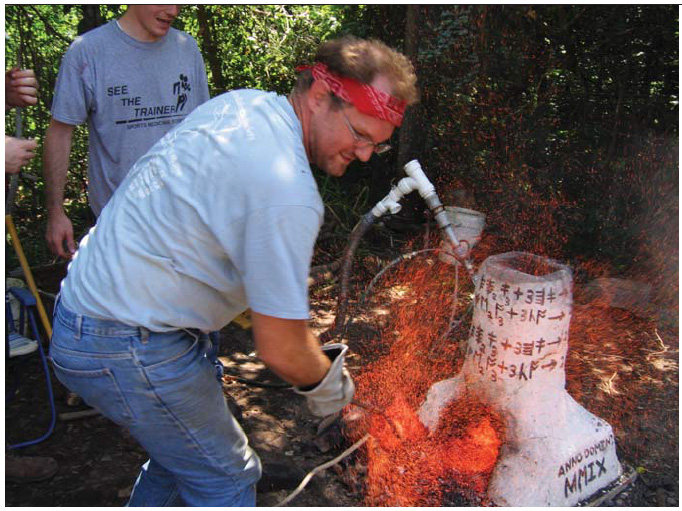
Most smelts are a community effort. Cashen says his most satisfying smelt was in 2009, one he dubbed “The Matherton Forge Iron Age Challenge.” The goal was to smelt and forge an iron sword in three days as a public demonstration. When Markewitz reenacts Viking smelts, he does it with a team of three other people.
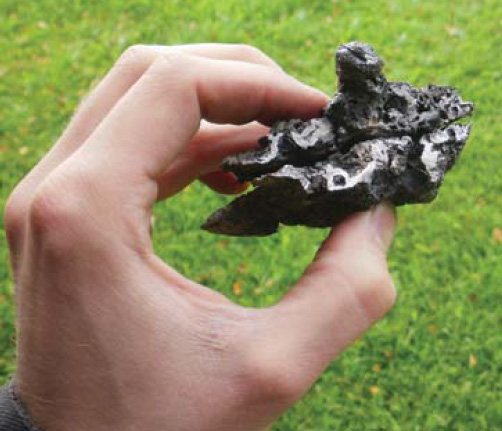
Niskanen took photos of the smelts, which he published online. For ancient metal workers, team effort was out of necessity. After all, bellows are hard to operate for hours at a time to feed a hungry furnace. To keep time, Markewitz’s team chanted, sang songs and focused on heartbeats—possibly historical timekeepers.
“The effective pumping rate was one stroke per second, alternating between the two chambers. Individuals varied on their stroke force [delivery pressure], but averaged 60-to-75 strokes per minute. This was without interruption over the course of the entire firing sequence extending roughly five hours,” he stresses. “We found that to maintain the needed consistency, we needed four individuals working in roughly 10-minute shifts. This labor force needed to be at least semiskilled to the task. This is a requirement totally separate to the needs of feeding and operating the furnace itself.”
Every few minutes, another person would shovel more charcoal into the furnace. Niskanen said he also added crushed limestone to his furnace to enhance the smelting process.
Making Bog Knives
The metal worker is not done once the iron is pulled from the furnace.
“To actually form a solid working bar, the sponge needs to be compressed at welding heat to collapse the voids, squeeze out any glass slag and fuse to a solid block,” Markewitz explains.
While every bloom is different, the smith needs to fold, weld and hammer the metal until it’s a unified—and, hopefully, homogeneous—metal bar.
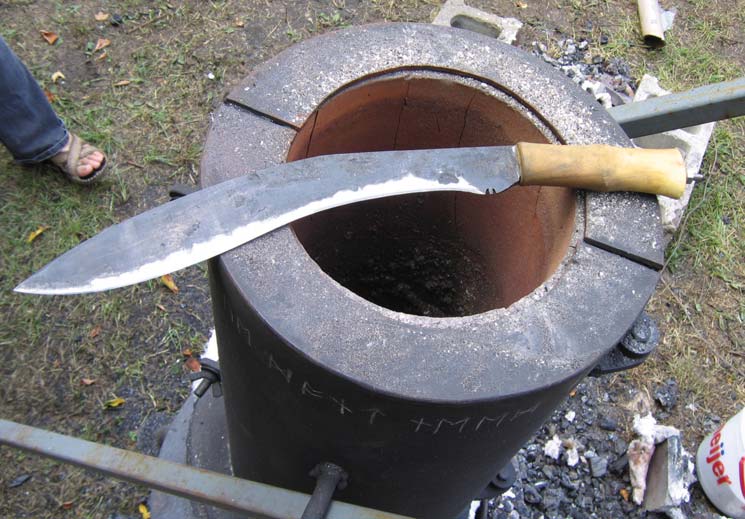
“And every bloom is a bit different in terms of just how solid it might be at the start, how much slag needs to be ejected, and in what the actual starting carbon content might be,” Markewitz notes.
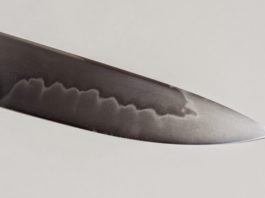
Then, finally, the bladesmith can practice his craft. For Niskanen, it was only natural to use the iron for a traditional knife. He made a puukko, an ancient Finnish knife (pictured at top of this article).
“Since the Iron Age, the knife has been used as a multifunctional tool in everyday life,” he opines. “And for a hunter it is, and always has been, one of those items you can’t go without into the wilderness.”
Niskanen was there from the beginning, when the knife was only a lump of iron oxide resting on the bottom of a Finnish bog, “It makes the blade really personal,” he says.
Markewitz used his iron as a decorative part of the knife.
“For the modern designs, I use the bloom iron specifically to highlight its unique texture,” he observes. “Blades like [my Hector’s Bane model] have bloom-iron exterior slabs forge welded to a carbon steel core. As with other inset-styled blades, it is this modern alloy core that is forming the actual cutting edge.”
He did it that way because iron blades don’t perform as well as blades of modern steel.
During the Iron Age, Markewitz says iron knives were so soft that users carried a small sharpening stone with them because they had to constantly hone the edges. Nonetheless, some knives no doubt performed better than others.
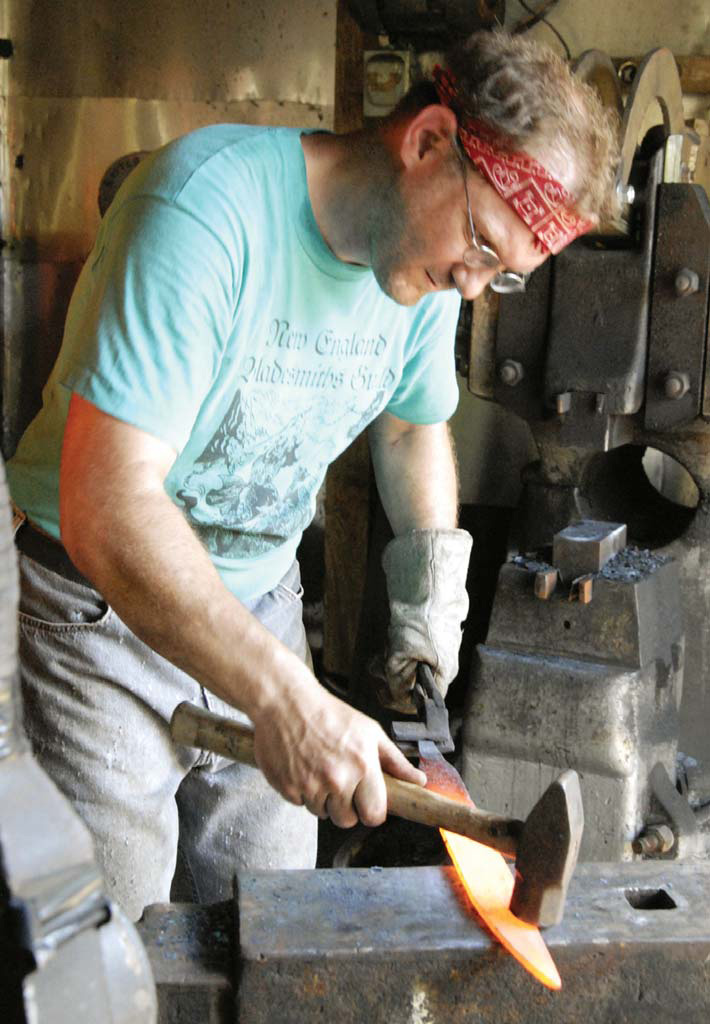
In a 2013 study published in The World of Iron London, archaeo-metallurgists Quanyu Wang and Peter Crew compared the performance between three knives made from bog iron. Their paper, titled “Three ores, three irons and three knives,” found that the performance of the knives probably was determined by the skill of the smith and the trace elements in the blade, such as phosphorus, which is known for making iron stronger and harder in trace amounts.
However, phosphorous also can make the metal brittle in cold weather. They compared three bog-iron knives by examining the microstructure of the blades and using the knives to butcher a pig.
Wang and Crew concluded their study by writing, “The quality of bloomer iron depends very much on the smelting and refining techniques used, which may not always be recognizable from the structure and composition of the final metal.”
These smiths have more furnaces to build, iron to smelt and possibly blades to make.
“I have studied older bloomery steel, as well as modern smelted materials under the microscope, and tested the properties, and am quite impressed with the smelting skills of the ancients,” Cashen concludes. “Modern academics had only their best guesses about this process until people started actually doing it again, and then we learned how little we actually knew. We are fumbling our way through a process that our ancestors had completely mastered, developed to its highest levels and then discarded in favor of newer and better processes of making steel.”
Midweek Maker Military-Style: Tracy LaRock
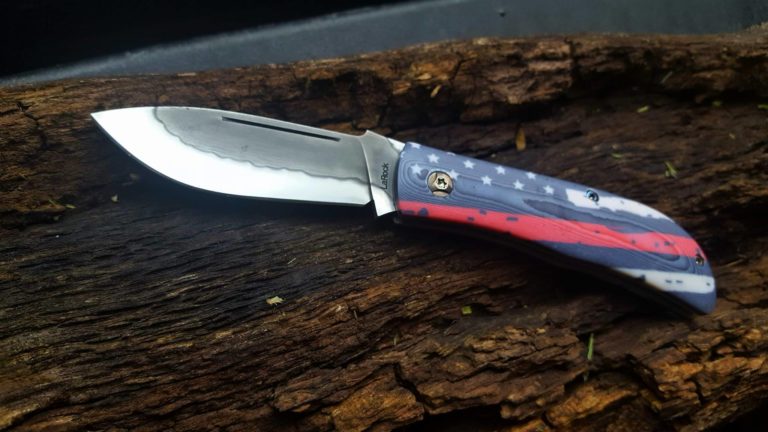

Tracy LaRock grew up on a dairy farm and spent every spare moment hunting, trapping and fishing. He served as a mortarman in U.S. Marine Corps from 1990 to 1995, but he didn’t stay out for long. In 1997 he signed on with the Texas Army National Guard, in artillery and recruiting, and still serves today. “So knives have been a part of my daily life since the beginning,” he commented.
“In 2008 Atmar Lester was showing a knife he made to some folks at church. I asked him some questions and he pointed me in the direction I needed to go,” Tracy related. “To start off it was basic tools and head-scratching, then I discovered the forums and tutorials.” Thomas Rucker and Percy Richardson let Tracy visit their shops. In 2014 he started making slip joints. After completing a few he reached out for help and received helpful insights from knifemakers Luke Swenson, Jared Oser and Enrique Pena among others.
“I hope to become a full-time maker in a couple years when I hang this uniform up for the last time,” he noted. Tracy lives in Lufkin, Texas with his wife, Mia, and their three sons.
- Best-selling knife patterns: TimberJack and TimberJack Jr., traditional slip joints
- Favorite blade steels: W2, 1095, O1. “Most are W2 because I have long since fallen down the hamon hole,” Tracy quipped.
- Blade grinds: flat
- How he tests his knives: rope, cardboard
- Favorite handle materials: green canvas Micarta and ironwood
- Price range: $350-$850
- Forums he participates in: Facebook Group like Making Slipjoints and Lockbacks
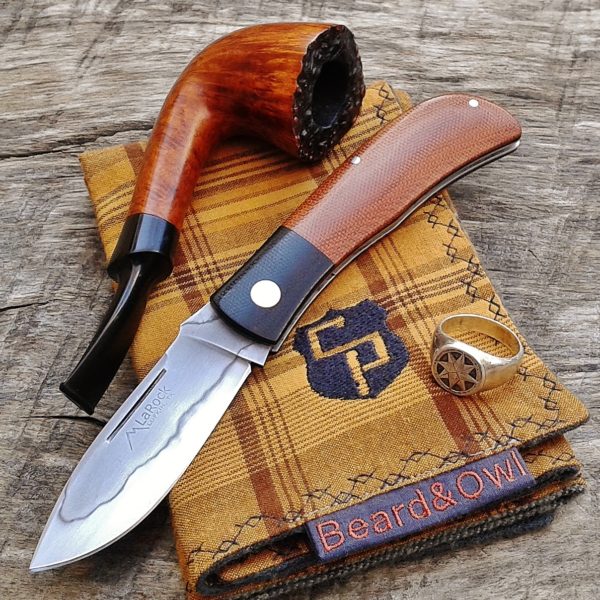
The above TimberJack has a 3-inch blade of W2 with hamon. The handle is fashioned from canvas Micarta scales. Overall length is 7.25 inches. Maker’s list price: $425.
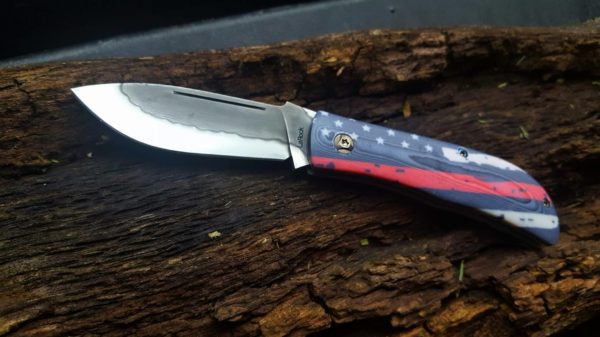
Contact Tracy or Mia LaRock at 936-238-9077, [email protected], on Facebook at LaRock Knives or on Instagram @tracylarock.
Subscribe To BLADE For More Stories Like This
A one year’s subscription to BLADE® will ensure you’re the first to read all six Knifemaker Showcase stories. You’ll also get the latest knife news, knifemaking how-tos, knife reviews, plus knife history and articles that tap into the knowledge of both the legends and the up-and-comers. Don’t miss out. Subscribe.
American Bladesmith Society Announces 2014 Hammer-In Schedule
One of the things that makes the knife industry such a pleasure to be involved with is artisans, bladesmiths and knifemakers in general sharing their knowledge, teaching people their craft and passing down the handcraft from generation to generation.
Some of the best at this are the members of the American Bladesmith Society, as well, of course, as those in the Knifemakers’ Guild and countless other knife clubs and organizations. The ABS claims to have had record attendance at its hammer-ins across the country in 2013, and has already announced its 2014 Hammer-In Schedule. Click here for a Complete Knifemaking Collection of books and digital downloads to get you started in your knifemaking endeavors. And without further ado:
ABS Hammer In Schedule for 2014
March 7, 8, and 9, 2014
Spring Great Smoky Mountain Hammer-In
Haywood Community College, Clyde, North Carolina
ABS Contact – Bill Wiggins (828) 226-2551 or Email [email protected]
April 26 and 27, 2014
Spring Piney Woods Hammer In
Texarkana College – Moran School of Bladesmithing, Washington, Arkansas
ABS Contact – BR Hughes (903) 838-0134 or Email [email protected]
June 2014
ABS Youth Hammer-In
Smoky Mountain Knife Works, Sevierville, Tennessee
ABS Contact – Houston Price (865) 397-0053 or Email [email protected]
July 11, 12, and 13, 2014
New England Hammer-In
New England School of Metalwork, Auburn, Maine
ABS Contact – Mace Vitale (203) 457-5591 or Email [email protected]
August 22, 23, and 24, 2014
Mid America Hammer-In
Miami County Fairgrounds, Troy, Ohio
ABS Contact – Butch Sheely (419) 832-5801 or Email [email protected]
September 13 and 14, 2014
Fall Piney Woods Hammer-In
Texarkana College – Moran School of Bladesmithing, Washington, Arkansas
ABS Contact – BR Hughes (903) 838-0134 or Email [email protected]
October 4 and 5, 2014
Heartland Hammer-In
Washburn Institute of Technology, Topeka, Kansas
ABS Contact – Steve Culver (785) 484-0146 or Email [email protected]
October 2014
California Hammer-In
College of the Sequoias, Tulare, California
ABS Contact – Mike Vagnino (559) 636-0501 or Email [email protected]
October 18 and 19, 2014
Smoky Mountain Fall Hammer-In
Haywood Community College, Clyde, North Carolina
ABS Contact – Bill Wiggins (828) 226-2551 or Email [email protected]
Must Read Articles

Knifemaking 101 – Read This Before You Make a Knife
by Wayne Goddard
My experience has taught me that there's nothing like digging in and getting started. I've often said the hardest part of the...


