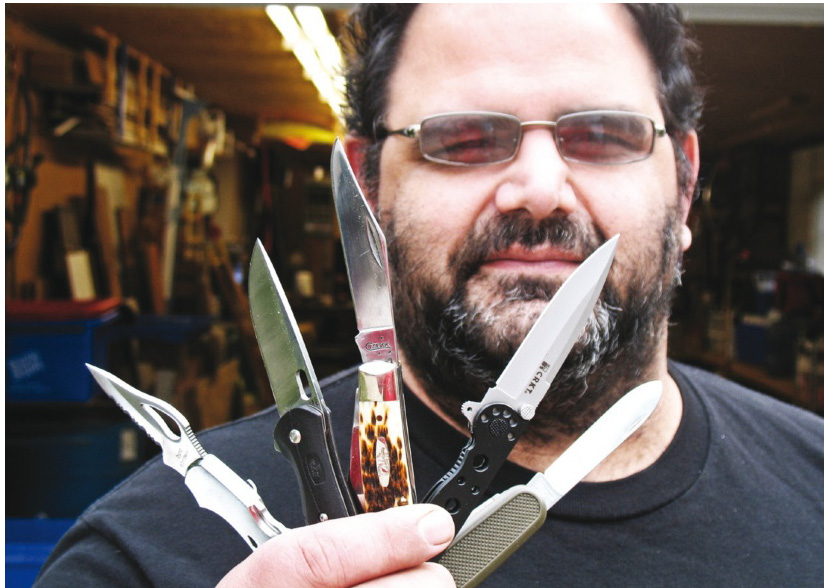
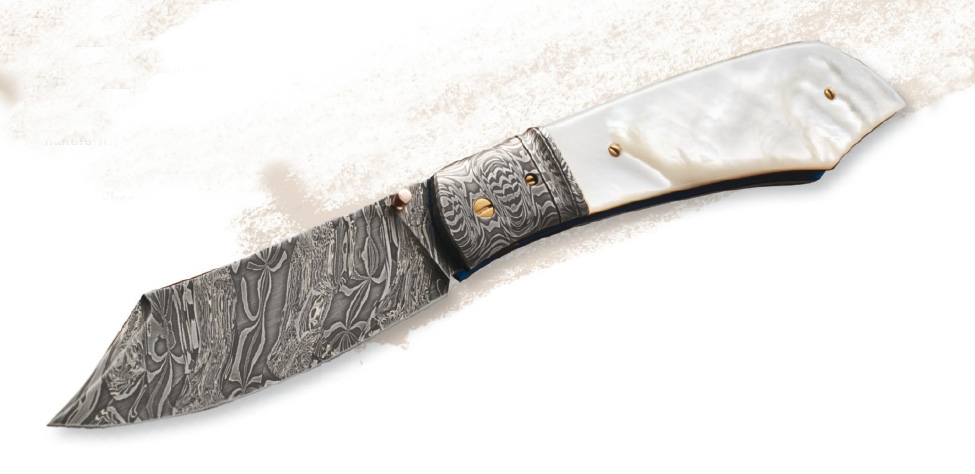
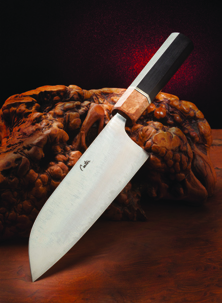
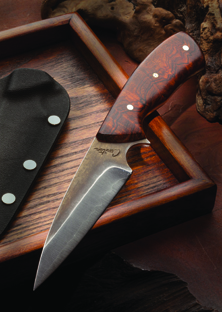
Knifemaking is the building of a knife, which includes the blade, handle and other accouterments. Blades are made by either removing metal from a steel blank via a grinder – known as stock removal – and the forging to shape of hot steel into a blade in the process known as bladesmithing. Other parts, including bolsters, guards, pommels, etc., are needed to complete the finished knife.
An object of art or music should give you a sense of life, an idea what it’s like to be in the artist’s shoes.
Technical control.
An endless flow of ideas.
J.D. Smith: Dancing in the Shop
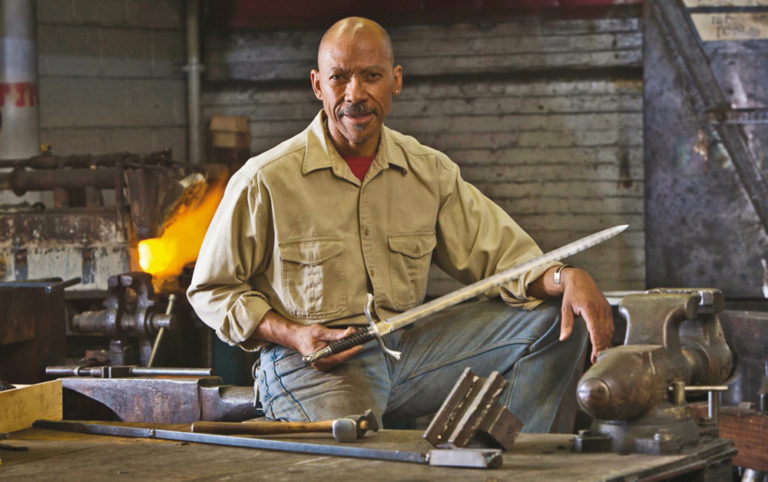
J.D. Smith and I were neighbors for three years and, as it was a short walk, would frequently wander down to the Massachusetts College of Art and Design (MassArt) together, sometimes for class, sometimes just to work.
Boston’s a very diverse city, and it wasn’t uncommon for him to stop and start speaking Russian or Spanish with various friends along the way before getting to class and beginning to speak Korean with a student.
Neither was it unusual for J.D. to dance around the shop, especially while making damascus. Dance, music, sculpture: They all have a flow to them, and some people simply love to incorporate and live with all three. J.D. dances through the music, the work, and the awards. I was with him at the 2013 Oregon Knife Show when I watched him win four awards, and his study at home was littered with many more.
Two of the pieces were collaborations: one a hunting knife with now American Bladesmith Society master smith (MS) and past apprentice Zack Jonas, the second a precious metal and stone-laden sword crafted with the talented Joseph Shnayder, J.D.’s partner at AmeRRuss Blade Arts.
J.D. received the MS stamp in 1998, along the way winning the B.R. Hughes Award for the best knife submitted by an MS applicant at the BLADE Show. This made J.D. the first black MS, though he tries not to dwell on this because he feels it detracts from the bladesmithing.
“The field should be blind to age, sex, and race,” he noted. “The focus should be on the work.”
Developing A Style
In 1991, J.D. walked into Joe Wood’s office, who at the time was head of the MassArt sculpture department. J.D. told Joe that the school’s officials couldn’t say they were teaching the most up-to-date metals program without teaching damascus. Joe agreed and offered J.D. a guest teaching position. In 1996, George Greenimire offered J.D. a regular class to teach.
As a teacher, J.D. would encourage students to do what he thought they were naturally inclined to do without controlling their sense of design, or discouraging them from pushing their limits. The goal isn’t to replicate other people’s work, but, if you can understand what you’re attracted to, you will have an easier time designing your own work and, hopefully, developing your own style.
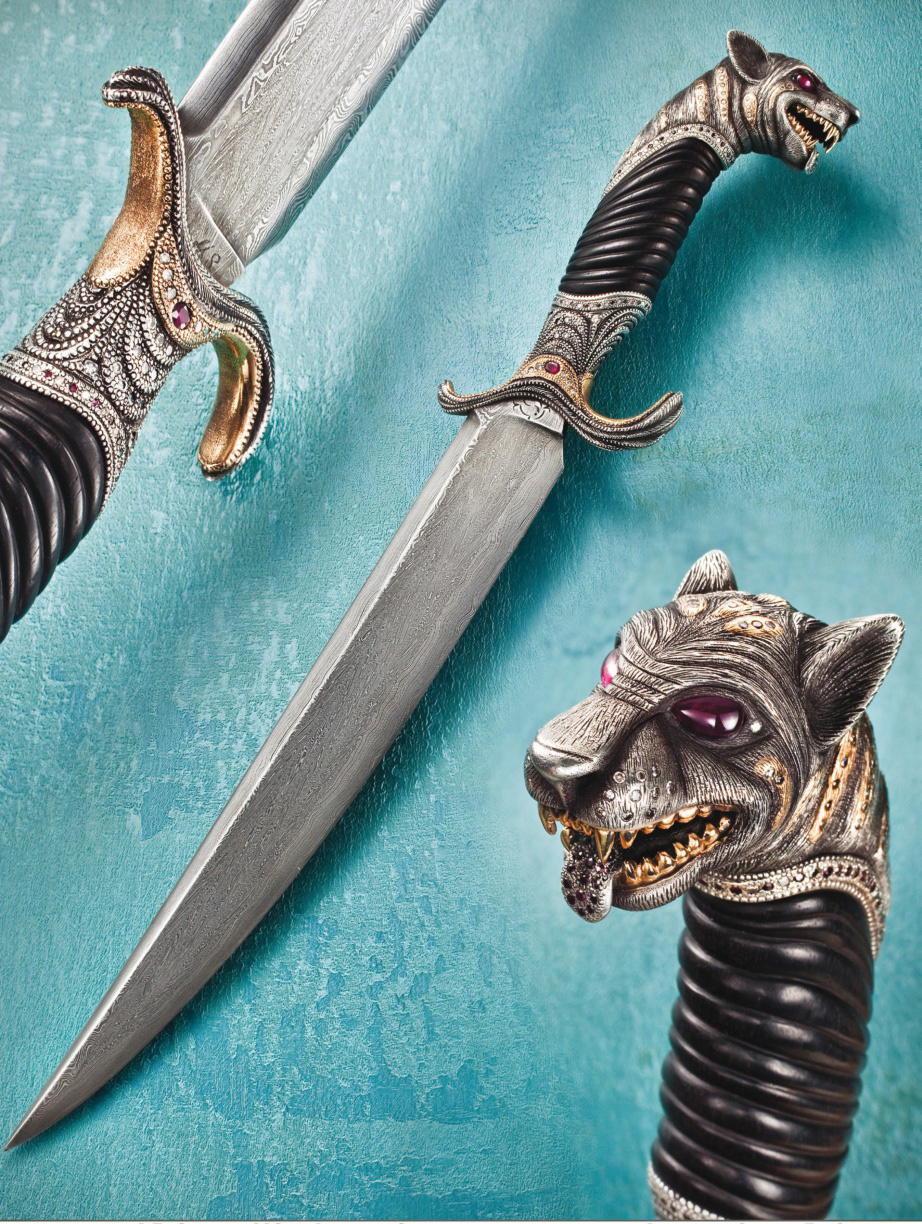
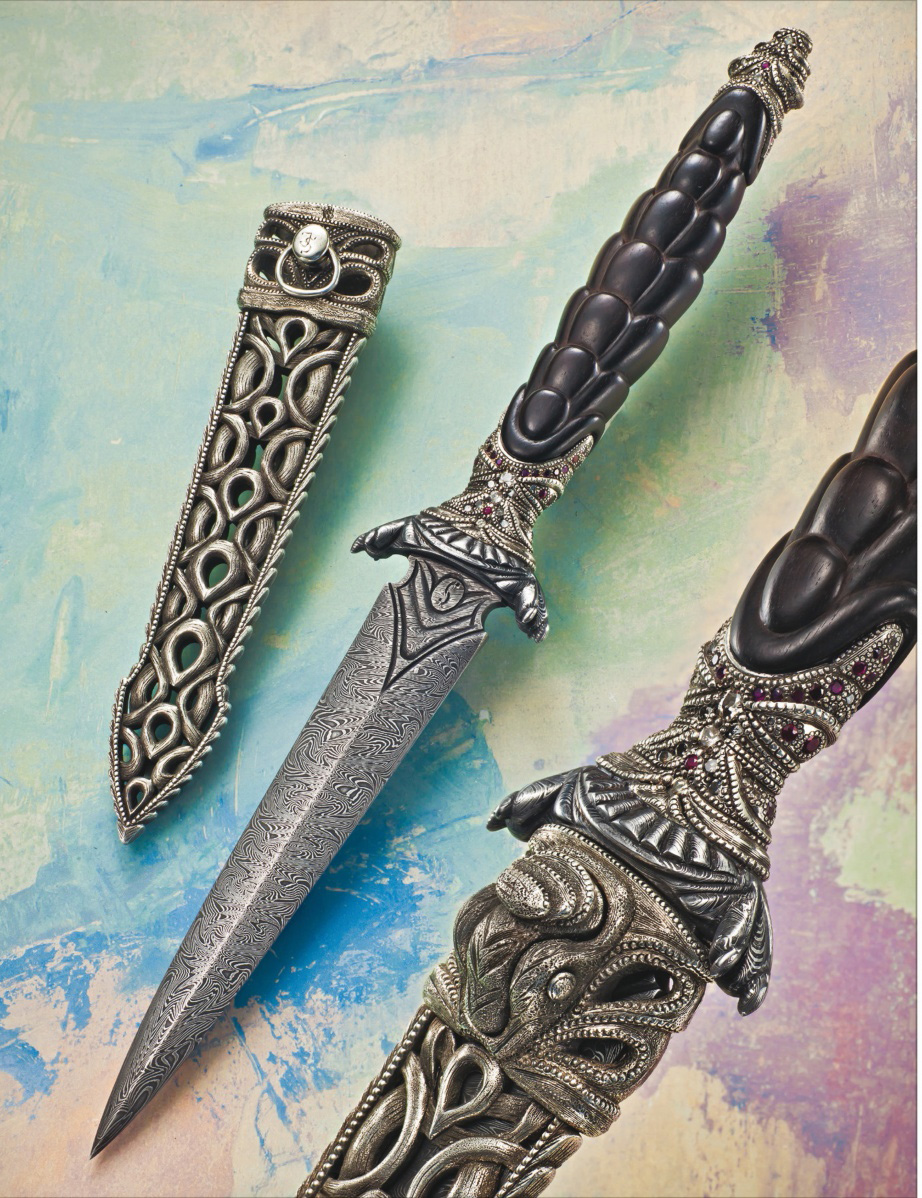
Another collaboration with Joseph Shnayder, this arresting art knife features a 6-inch blade of J.D.’s explosion damascus in 1084 carbon and 15N20 nickel-alloy steels. The handle is carved African blackwood, highly detailed silver work and gemstone settings. The quillons are carved in the shape of claws. Overall length: 12 inches. (SharpByCoop image)
“If there’s a table with 500 different knives on it,” he observed, “someone should be able to pick out your work with ease.”
When I asked him how he started to develop his style, he mentioned it being “cobbled together from Don Fogg, Wayne Goddard, Jimmy Fikes, and Wayne Valachovic—Valachovic especially for folders—Bill McHenry and Jim Schmidt.”
Bill and J.D. had become good friends over the years, and J.D. credits much of his knowledge of folders to him. Bill passed away in 2019 and is greatly missed by many inside and outside the knifemaking community.
Knifemaking: ABS Master Smith J.D. Smith’s 4 Principles of Superior Art
Over the years, J.D. has developed his Four Principles of Superior Art:
A personal approach and style.
An object of art or music should give you a sense of life, an idea what it’s like to be in the artist’s shoes.
Technical control.
An endless flow of ideas.
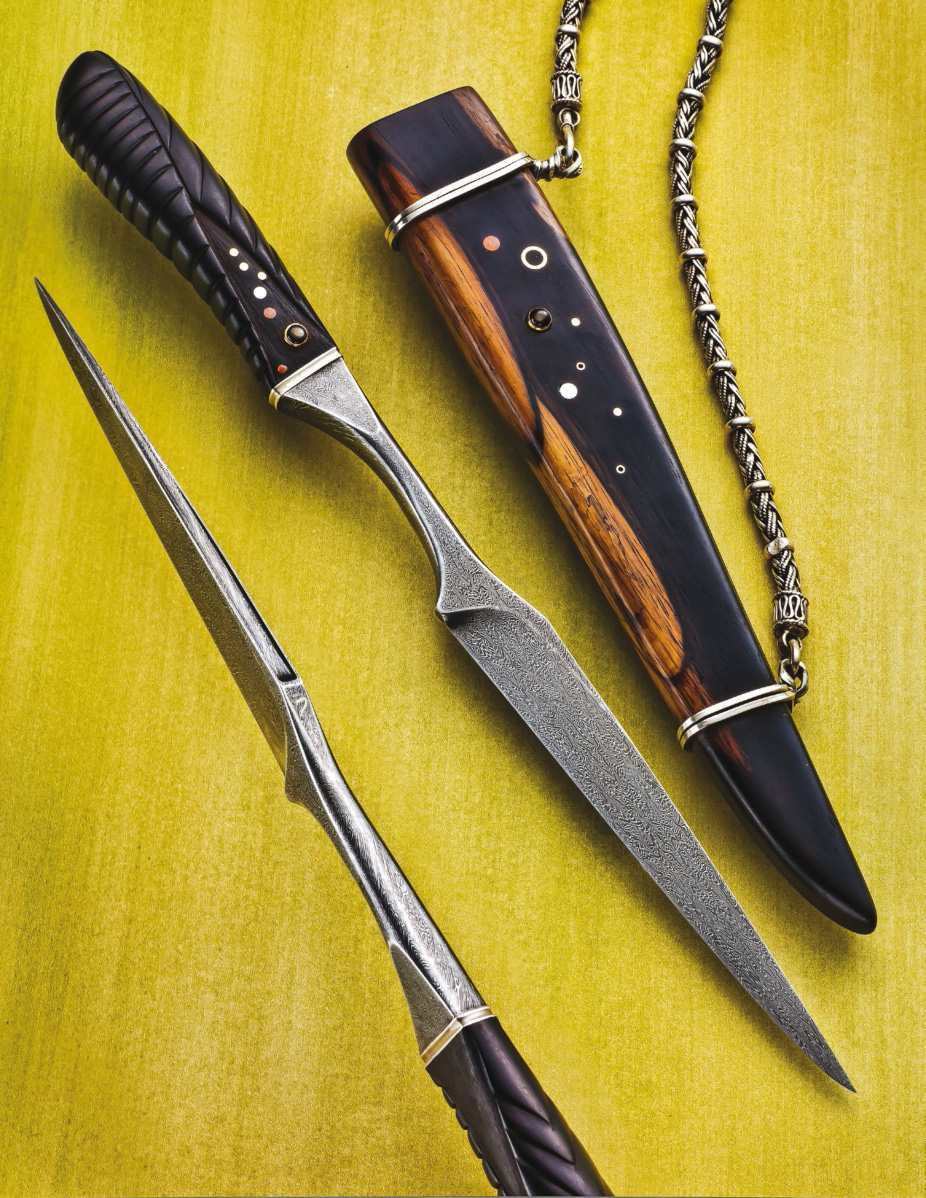
The author collaborated with J.D. on this stylish fixed blade in damascus, a carved handle, and stunning wooden sheath. (SharpByCoop image)
Further explaining his sense of style, he said, “Style is every technique that you use as part of your personal toolbox, and the things you choose not to use. That equals your style. As an artist progresses, he starts to limit his options. It shows a level of maturity. You use four or five techniques, and you develop your style off the permeation of those techniques.”
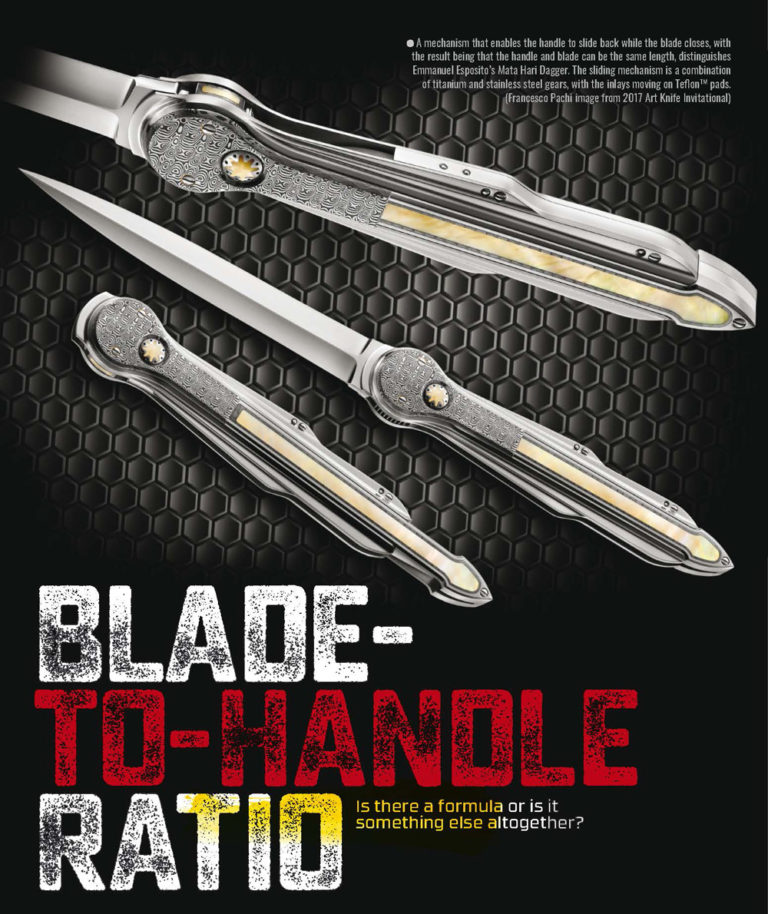
It’s the critical cooperation of handle and blade that makes the knife perform. One supplies the cutting edge, while the other allows you to exert control. So, then, the age-old question follows in finding the right ratio of length for each in a knife of proper construction.
In many cases, the experienced knifemaker follows his gut feeling to achieve the best knife handle-to-blade ratio, his understanding of just what it takes. Instinctively, the design brings balance and function to the piece.
Certainly, the process would be simpler if a formula existed to guide the maker in the optimal handle-to-blade ratio. However, according to those consulted for this story, there is no such formula.
The best knife handle-to-blade ratio, they reason, is driven by intended use.
Use, Not Size
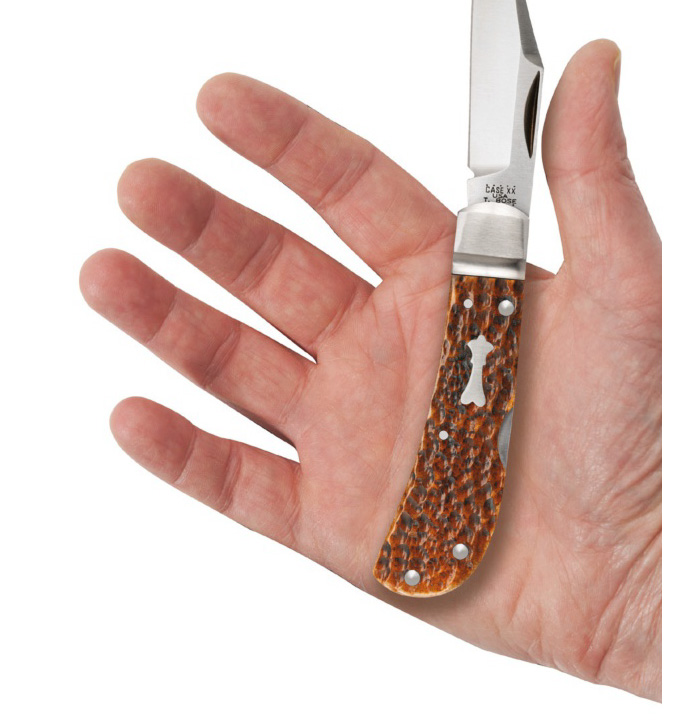
It’s hard to establish the best knife handle size because no two hands are the same.
“I base the ratio on use, not size,” explained knifemaker and BLADE® field editor Abe Elias. “For instance, when you look at the knife you carry every day, you’re not usually out there skinning animals or felling trees. You’re cutting open boxes and packages, snipping string or tape, and—if you trust the cleanliness of the blade—cutting a piece from a block of cheese or peeling an apple. In the end, everything is based on what you do with the knife.
“So when you look at all that, everyday use versus bushcraft or camp use, then you might say to yourself that you don’t need a lot of handle for torque or control if you’re cutting a piece of tape or your Amazon box open. If the blade is small, you don’t necessarily have to put a small handle on it; but, if the job doesn’t require a good, full grip, I’ll shorten the handle to make it easier to carry in an urban environment to do non-strenuous jobs.
“Bushcraft requires that you do strenuous stuff related to torque, and with carving or craft ing or skinning an animal,” Abe concluded. “Therefore, the handle must be full size to provide the ability to control the blade and put enough force behind it. Small jobs need control but not always a lot of force.”
Instead of the knife’s size, knifemaker/BLADE® field editor Abe Elias bases handle-to-blade ratio on its use.
What Pleases the Eye
Don Hanson, making knives for three decades with the Sunfish Forge mark, has no exact, best knife handle-to-blade ratio formula, and he readily asserts that any standard such as a “handle length an inch longer than the blade” falls apart pretty quickly.
Don Hanson said he does not have a formula for the blade-to-handle ratio. “I just do what looks good to my eye,” he noted. “With folders I make the blade as large as possible to still be able to fit inside the handle when closed.” (SharpByCoop image)
“I don’t have a formula for the ratio,” he commented. “I just do what looks good to my eye. With folders I make the blade as large as possible to still be able to fit inside the handle when closed. I don’t think making the handle an inch longer than the blade on a fixed blade is accurate. That would not work for bowies or fighters, where blades are typically seven to 12 inches. On these the handles are usually 5 inches.
Now, it could be true for a hunting knife if it has a 3.5-inch blade. A 4.5-inch handle would be perfect for that hunter.”
The Golden Mean
Hanson allows that the mathematical “Golden Mean” ratio may be helpful, though he does not specifically use it in his work. Without launching into a prolonged Algebra lesson, two quantities are in the Golden Mean if their ratio is the same as the ratio of their sum to the larger of the two quantities. Dust off that old high school math book for the actual formula and a clearer definition.
“Handle-to-blade ratio is function first,” Hanson added, “but in this time of images on the internet and magazines, the visual aspect is very important. Sometimes we see a knife that looks pretty good but just doesn’t seem right—and it’s not apparent why. In most cases the handle-to-blade ratio is off.
“The Golden Mean ratio is a good way to get handle-to-blade ratio right. I don’t use it, but most knives that look right will fall within the parameters of that ratio. Still, there is no rule or ratio in folding knives. The handle is always longer than the blade.
“A folder just looks bad when the blade is too small. I just design knives that function well and look good. I rarely measure anything or use any rules. The knife has to look good to get someone to pick it up. Then, if it feels good in the hand you have a winner.”
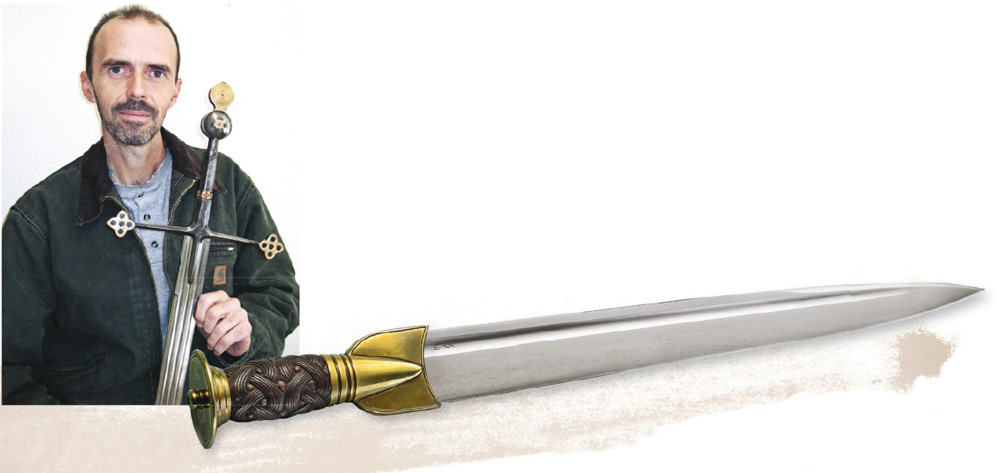
The old adage that the handle should be about 1 inch longer than the blade doesn’t work with large knives. “In period pieces such as an 18th century Scottish dirk, the grip was typically in the 4-to-5-inch range despite a blade length that could be up to 16 inches,” Vince Evans (inset) noted. His Scottish dirk repro was the cover for the March 2020 BLADE®.
Function, Comfort, Looks
According to Vince Evans, a full-time maker since 1981, some handles do require a certain length or shape depending on function, and some hunters prefer a small grip that is completely in the hand to avoid getting in the way when field dressing an animal.
“Personal preference probably plays a big part in that idea,” Vince said. “In period pieces such as an 18th century Scottish dirk, the grip was typically in the 4-to-5-inch range despite a blade length that could be up to 16 inches. Knives of the past tended to have more similar grips than modern ones.
“People carried a knife all the time for various purposes, so I would think that the ratio worked out naturally over time, and I would imagine that overall weight had a lot to do with the size.”
“Aesthetically, if you have a blade that is too big for the handle, it can become wonky,” Joe Flowers, a knife designer for Condor Tool & Knife, reasoned. “If you don’t balance the blade with the handle on a fixed blade, it can become messy. The human eye picks up on imbalance, so, if you have a short blade and a long handle, you’d better have a good reason.
“For fixed-blade bushcraft knives the most popular example is a 4-inch blade with a 4.5-inch handle, with a point down the center line. As a designer, especially recently, I’ve tried to jump out of the ‘rule’ rut that I’ve made more or less for myself.”
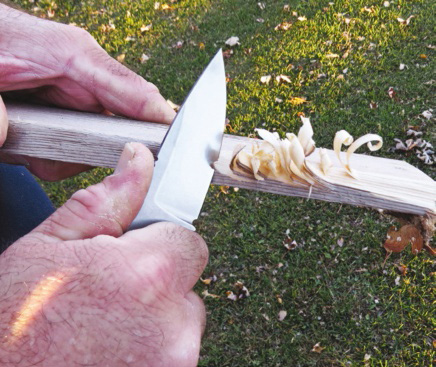
The White River Knife & Tool M1 Backpacker makes nice, tight curls. “Bushcraft requires that you do strenuous stuff related to torque and with carving or crafting or skinning an animal,” Abe Elias observed. “Therefore, the handle must be full size to provide the ability to control the blade and put enough force behind it. Small jobs need control but not always a lot of force.” (Abe Elias image)
Ergonomics are an integral component of the best knife blade-to-handle ratio, and the user surely appreciates that balance in the field.
“I’ve done a lot of research on human hands/tool use ergonomics,” Flowers offered. “More ergonomic knives have less geometry in their handle design for long-term use. Sometimes these handles don’t look very special, but after the third hour of whittling a kuksa [a Scandinavian drinking cup carved from birch burl] or an axe handle, you will appreciate them.”
Flowers adds that torque and dexterity dictate handle length in relation to a knife blade. In other words, if more force must be applied, then more surface area in the right points of contact with the hand allow the user to apply that torque.
“If it’s something like a neck knife,” he interjected, “you probably aren’t going to be applying that much torque, and are using it more for miniscule tasks such as cutting line rather than chopping down a tree. The handle length can sometimes dictate what the blade is capable of doing. An axe with a 3-inch handle would work differently than one with a 23-inch handle.”
The perfect combination of handle and blade is ultimately put to the test with intended use. In the absence of a formula, the true judgment may be found in the fatigue or the number of blisters on the palm when the job is completed.
Overthinking Handles?
Years ago, a well-known knifemaker offered Elias some advice.
“He said two things,” Abe smiled. “‘You’re spending too much time on your handles. You’ll never get your money back for it. And your handles are too long. They should be the bare minimum.’ Now, my whole thing is that the knife is only as good as your ability to control it.
“I will ask a customer what size their hand is. I’ll ask them to go to a store and find a pair of metric-sized gloves that fit and give me the number. That way I know the dimensions of their hand and can work from that accordingly.
“Still, it would be good to say that there is some kind of ratio that always applies, but like I’ve said, I don’t have a mathematical formula—I have a use formula.”
The best knife handle-to-blade ratio is, after all, the product of evolution, experience and the trained eye. Placing these elements in perspective produces the balance and control necessary for the knife to function as it should, while also making a pleasing presentation from a visual standpoint.
Lim Loong Hoi hammers steel in his old school knife shop in Selangor, Malaysia. (photo courtesy of Philip Lim Chin Guan)
Every morning, Lim Loong Hoi is at his dirty workshop—it looks more like a shack from the front—at about 8 o’clock. Beyond the open door in the rear, the passage leads to a hallway and a few small rooms.
The boneshaker of a wooden shop has been home to Lim and his family for decades. He said he has been making utility tools, including parangs, goloks, large fisherman’s blades and sickles, since his school days.
His instructor and mentor was his grandfather. Back in the day, Lim found time after school to help his grandpa at the workshop. Picture a teenager’s delicate hands with a heavy hammer and a pair of tongs when, during morning hours, he was holding a pen or ruler in school. That was about 50 years ago.
Called Sin Sam Hup Lee, Lim’s shop still stands firm against fluctuating economic conditions and the ravages of time. His back is slightly bent from the long, dreary years of standing before the furnace or hydraulic pump, pounding away at pieces of elongated steel.
Pasir Penambang is a small village on the outskirts of Kuala Selangor in the state of Selangor, Malaysia. The locals, especially the Chinese, are mostly fishermen, shopkeepers or fish wholesalers.
The Chinese fishermen are Lim’s regular customers. The edged tools he makes for them are larger than usual. The blades are similar to huge butcher knives, having a curvature that helps in slicing a big fish in two with one swift, downward stroke.
The Malay farmers usually ask for long sickle blades used in dislodging oil palm fruits, a.k.a. kelapa sawit nuts. Each sickle is hollowed out at the handle to accept a long pole. The pole enables the user to extend the blade about 7 to 8 feet to harvest the nuts from the palm trees. Each sickle costs $2 to $2.60. The price depends on the quality of the steel and blade size.
In Lim’s workshop, stacks of Jeep leaf springs used for blade steel rest in a corner. The four-wheel-drive springs are rusty and grimy. The haggard bladesmith likely sourced the spring steel pieces by the ton from an old junkyard. He probably got them cheap, too. Most of the time they are cut to required lengths. It is a low-tech, slightly primitive method of stock removal.
Practicality and function rule the land. Almost nobody here has heard of CPM-S30V, VG-10 or ZDP-189. The most convincing line Lim uses is, “This is Jeep spring steel.” That alone gives his customers some assurance they are getting quality steel.
Edged tools used by fishermen or farmers in the fields have no time to get rusty because they are used regularly and on a daily basis. After six to eight years, the parang, golok, fisherman’s blade or farmer’s sickle may be deemed unusable. The user simply buys another one from Lim. After all, it costs just a few bucks. Compared to its long-term usefulness and hardiness, the cost per blade is minuscule—which is why the agrarian folk in Pasir Penambang and nearby villages are Lim’s loyal customers.
Lim’s assistant is taciturn, works like a well-oiled machine and knows the blade-making process intimately. Like his boss, the assistant relishes the feel of steel in his hands.
Of course, the untidy workplace is not exactly ideal for a private conversation. Customers determine what they want, haggle over the price and depart with the edged tool they bought wrapped in a newspaper.
Occasionally, some outsider brings a drawing of the piece he wants made. The bladesmith examines the drawing and then determines whether his outdated equipment and other machines are suitable for the order.
The volume of edged tools he sells will not even make Lim a member of the middle class. He obviously is not making a fortune, as some people may suspect.
Ah Pee
A couple of doors away along the same row of wooden shops is another knifemaker, Ah Pee. A sign at the front of his establishment says “Chuan Lee Chan.” Originally from China, he has aged before his time, though his eyes have a certain fire that belies his years.
Pee said his children, especially his son, have absolutely no interest in knifemaking. “The young men today prefer air-conditioned offices and as little dirt on their hands as possible,” he told me.
The long hours and intense heat from the furnace are enough to deter most from pursuing such a profession. It is backbreaking work with the added disadvantage of low and slow financial returns.
After about five decades of using the hammer, tongs and grinder, Pee is long past set in his ways. He probably does not know how to do anything else. Perhaps he feels he is too old to learn and master another profession.
Not all the edged tools sold at both shops are fashioned by the resident makers. They also stock production parangs and some made-in-China models, both more affordable than the handmade models. Lim’s and Pee’s knives cost more because they factor in labor, time and the type of spring steel used. The sharpness of the blade is guaranteed.
Sometimes each bladesmith will ask the customers how the parangs or knives will be used. Then he might recommend another type of edged tool. The heavy-duty blades—those for chopping hardwood, the bones of livestock, etc.—are made to different specifications than those for skinning and other light work. The smiths’ skills with iron and steel are invaluable to those who need their tools to make a living.
Heat Treating and Sharpening
Heat treatment consists of quenching the steel in a trough of water. There is no set formula for giving a hardened edge. Pee said it all comes down to “feel.” The long years of experimenting with quenching a red-hot blade in water have given him the intuition and the right recipe of crucial seconds of sinking a piece of hot steel into a trough, and then lifting it up at just the right moment. I have seen Pee do it on several occasions. He said without the special “water treatment” the blade would not hold an edge.
Sharpening a parang or any kind of blade is done on a hand-held metal grinder. The way Pee does it looks easy—until you put the same grinder in your hands. A flat grind is apparently the way to go.
First, he clamps the blade on a table vise, covers his mouth with a piece of cloth and dons plastic goggles. He moves the grinder side to side and applies just the right amount of pressure.
A shower of bright orange sparks fly past his body but Pee pays them no heed. When he is fully satisfied the blade has the correct grind, he unclamps it and adds the finishing touches to the edge with a smooth stone.
Again, it is all “touch and feel.” When a man has spent three-quarters of his life sharpening blades, you do not question his judgment. He said, “The blade can easily shave the hair on the arm.” I believe him totally.
He then gives me a piece of invaluable advice. After the blade has been used, wash it in running water. Do not wipe the water off but put the knife out in the sun to dry. Allow the sun to dry the steel blade and it will remain sharp indefinitely.
It took awhile before I realized the wisdom of his words. The tropical weather, coupled with the scorching Malaysian sun, acts as a form of heat treatment on the sharpened blade. Perhaps the sun’s rays strengthen the already hardened molecular structure of the blade’s edge? Who knows better—the bladesmiths of Pasir Penambang or me, the end user from the city?
Paying Homage
There are only two bladesmiths along the main road in Pasir Penambang. Both are advancing in age. This is a dying trade. The youngsters are not interested. Those of us who appreciate all things steel and sharpened tools come to this tiny town, away from the hustle and bustle of the bigger cities, to pay homage to men of steel who live a life of quiet desperation.—By Philip Lim Chin Guan
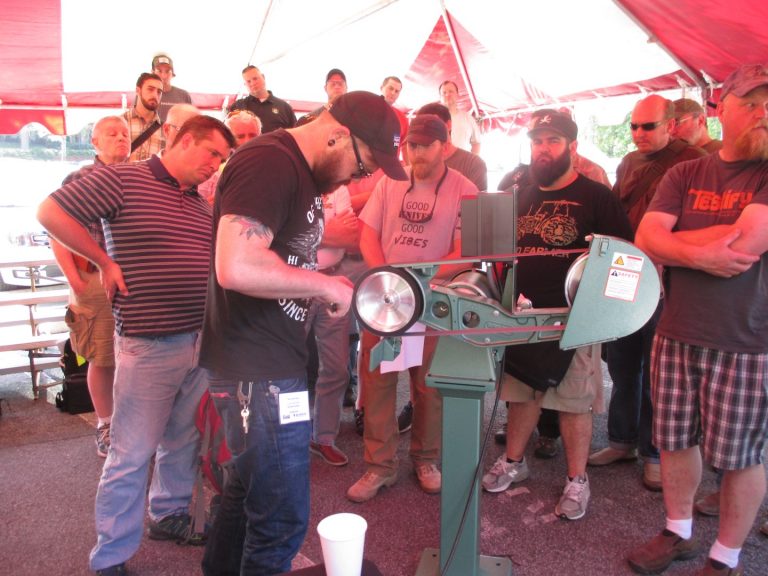
Knifemaker Lucas Burnley shows students how it’s done on a Burr King 960-272 belt grinder under the Burr King-sponsored tent during the 3rd Annual BLADE University at this year’s BLADE Show.
When it comes to the go-to machine for knifemakers, the Burr King 960-272 2×72 may be the Ford of knife grinders.
“The 960-272 has been in production for 40 years. It’s a knifemaker’s grinder. It started with Bob Loveless,” noted Burr King’s James Krier during the grinding classes conducted by Tom Krein and Lucas Burnley in the 3rd Annual BLADE University at the 2016 BLADE Show. “It’s kind of interesting to have a machine over 20 years old that you can still get parts for.” Add the fact that Burr King is celebrating its 65th anniversary this year and you have a source for parts that’s been here for the long haul. “The knifemaker doesn’t have to worry about the company who made it [Burr King in this instance] going out of business,” Krier added.
In sales and marketing for Burr King for 10 years now, Krier said a number of companies that make grinders have passed by the boards in recent years. Not so with Burr King.
“I was talking to a guy about how many grinding companies there had been in the past 20 years and he was saying there were about 25 he could think of that are just out of business, that were up for about two years and then were gone,” Krier said. “That’s why pros who do it for a living will buy something they can actually get parts for 20 years later. It’s gonna be there when they need it.”
The 960-272 is cast aluminum construction. “Every machine is going to be the same. It’s not like it’s a fabricated design or this machine is different from that machine,” Krier continued. “If someone buys a machine and they have one that’s 10 years old and buy another one today, the parts are interchangeable. It’s like having a Ford you can get parts for.” Like old Fords, it’s tough as nails, too. “That’s thing’s bulletproof and ready to go,” Krier assessed.
Burr King makes about 15 different belt grinders, including those for factory knife companies, but the 960-272 remains the bell cow of the lot.
Learn How to Grind Knives
The BLADE staff put together this guide to grinding knives as a way to help new knifemakers jump into these essential skills. Download it now and start reading right away.
The June issue of BLADE® magazine features a story about wilderness survivalist Creek Stewart and his line of Whiskey Knives, made by Hank Gevedon and crew at Reptile Toolworks in Mt. Vernon, Kentucky. Whiskey Knives are carefully tested, but Hank likes to destroy a few from time to time to spot-check their quality. He starts by bending a Whiskey Corvid model to show that the hard outer layer of the A36 carbon steel will crack when bent in half, but that the knife will stay intact because of the tough inner core. Then he gets to shooting them. Besides, Hank’s just entertaining to listen to.
A Bent Whiskey Corvid Knife Still Chops and Slices
Hank Shoots A Whiskey Corvid with an 8mm Mauser FMJ
So what does all that mean to the knife owner? Well, you won’t want to bend your knife in a vise or shoot it at the range, but the following review of the destructive testing explains how the makuri method of construction can produce a sharp, yet tough knife, ideal for hard-use bushcrafting needs.
What Does Destructive Testing Reveal About Whiskey Knives?
Sure They’re Sharp, But How Sharp?
Know How to Sharpen Your Knives
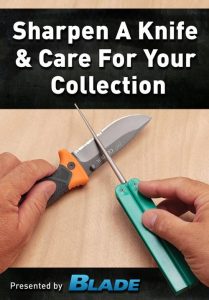
A collection of knives is only as good as it is sharp. Understand how to sharpen all styles of grinds, along with other tips on caring for your collection.
The blades on Whiskey Knives are asymmetrical hollow-ground, meaning that you only need to sharpen one side, the one with the Creek logo on it. The other side just requires a touch-up. Reptile Toolworks puts instructions in the crate with each Whiskey Knife it sends out, but what about your other knives? “Sharpen A Knife, And Care For Your Collection” by BLADE editors covers all aspects of sharpening, demystifying the process and ensuring you have the knowledge to keep your knives sharp at home and in the field.
We’re kicking off a new series at BLADEmag.com called Midweek Maker. Each Wednesday we’ll feature a different knifemaker. The first six installments feature active-duty military or veterans. This week: Midweek Maker Military-Style: Dustin Driver of Driver Defense Knives.
Dustin Driver of Guntersville, Alabama served in the U.S. Army from 2004 to 2010. He was a communications expert, deploying to Iraq, 2005-2006, and Kuwait, 2007-2009. He uses that training and experience in his current job as a system and network administrator for a government contractor.
In October 2015 he was looking for a hobby. “I have always been into knives and have always been creative and good at making things,” Dustin noted. Aside from some You Tube videos and Internet research, he is essentially self-taught. “I have a beautiful daughter who has cerebral palsy, so I try and do a few charity knives a year to benefit cerebral palsy and other special needs areas.”
Best-selling knife patterns: Belladonna, an EDC mini cleaver; Toxin, an everyday carry with several blade styles; Timber Rattler, a small neck knife
Favorite blade steels: 1095 for consistent heat-treat; S35VN as a good all-around steel; pattern-welded steel from Alabama Damascus Steel
Blade grinds: flat with plans to offer hollow. “I like thick blades with full or high flat grinds. The thick spine makes for a strong blade, and the high flat grinds make them nice slicers.”
How he tests his knives: chopping 2-by-4s, field use, slicing paper
Dustin Driver bought a mill and he’s experimenting with fullers. He likes the looks of them when they end in a bevel. His Toxin model comes in a variety of blade styles, including a drop-point with or without hamon.
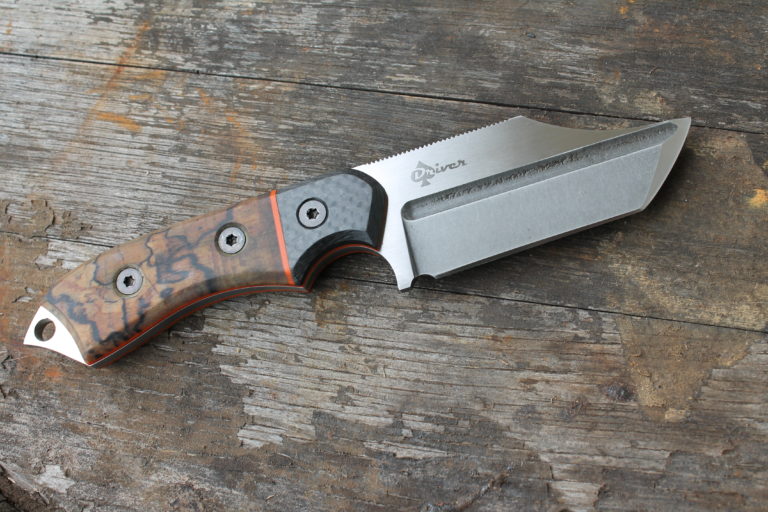
The 7.5-inch Driver Defense Toxin is a tanto-bowie with fuller made out of S35VN steel. The flat-ground blade measures 3 inches. The scales are stabilized spalted maple with carbon fiber bolster and orange G10 liner and spacer. Maker’s list price: $350 with Kydex sheath.
Contact Dustin Driver, 256-975-9857, [email protected], on Facebook at Driver Defense and on Instagram @driverdefenseknives. His Facebook Group is Driver Defense EDC. You’ll want to ask to join that one. Dustin makes beef jerky, too, and he’s a big-hearted guy with frequently donates portions of proceeds to charity.
Subscribe To BLADE For More Stories Like This
An annual U.S. subscription to BLADE is $21.98. You can get your 13 issues sent to Canada for $39.98 and internationally for $49.98. Or go green and get your issues sent digitally for $17.98.
A one year’s subscription to BLADE will ensure you’re the first to read all six Knifemaker Showcase stories. You’ll also get the latest knife news, knifemaking how-tos, knife reviews, plus knife history and articles that tap into the knowledge of both the legends and the up-and-comers. Don’t miss out. Subscribe.
With over 100 knife designs to choose from—101 to be exact—there’s plenty to mull over in coming up with an ultimate favorite blade design or pattern. Renowned knifemaker and heckuva nice guy, Murray Carter, known to stand behind his table at knife shows, including the BLADE Show, honing knife blades and demonstrating to attendees how to sharpen their own edges, reveals his favorite 101 Knife Designs.
In his book, 101 Knife Designs, Carter displays not only gorgeous knife photography by none other than famed photographer Hiro Soga, but drawings, patterns, scaled designs and supportive text, allow aspiring bladesmiths to create their own knives using Carter’s popular, time-honored designs. Dazzling, full-color images of the completed knives provide inspiration and direction. 101 Knife Designs will show the reader why certain distinct blade designs have stood the test of time and remain popular even to this day. Practical blade patterns follow several rules of thumb. When these rules are applied to new knife designs, there is a greater chance the design will stand the test of time and use.
About the Author: Murray Carter (cartercutlery.com), one of the most popular custom knifemakers at the annual BLADE Show, regularly conducts wildly popular seminars on shaving with a machete, and is known for standing at his booth sharpening knives while teaching the techniques to interested attendees.