
Knifemaking

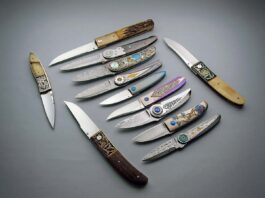
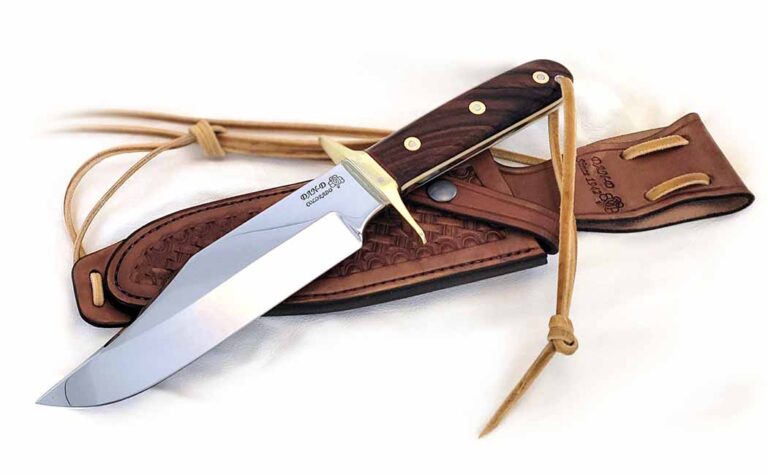
Knifemaking is the building of a knife, which includes the blade, handle and other accouterments. Blades are made by either removing metal from a steel blank via a grinder – known as stock removal – and the forging to shape of hot steel into a blade in the process known as bladesmithing. Other parts, including bolsters, guards, pommels, etc., are needed to complete the finished knife.

Featured Knives – – Knife Collecting – – Tactical Knives – – Survival Knives

Huber Foxworth Bowie: The Men Behind The Blade

The men behind the Huber Foxworth Bowie are as captivating as the knife itself.

This is the story of a knife named in honor of an incredibly special man. In this highly populated world not many people get their name attached to anything. I do, however, know for a fact that Craig Fox Huber was very proud of the idea that people would be wanting the knife that bore his name for decades to come. He told me so in person. He lived a life that so many would aspire to but very few would have the moxie to follow through on. He was the real deal.

So, how did Craig impact a knifemaker to the point of naming a knife the Huber Foxworth Bowie? Here’s what my father, BLADE Magazine Cutlery Hall-Of-Fame® member Dan Dennehy, wrote about Craig in his 1970 Dan-D Knives Brochure:

Many self-styled “experts” have stopped by my shop from time to time to suggest to me how I should design the “perfect” knife … Not long ago a trim bearded crewcut type found his way to my shop, and we started talking knives. [Circa the late 1960s] I took an immediate liking to this handsome, rather cocky gent and was pleasantly surprised to learn that he spoke about knives with a rather rare understanding of design and more than just a rudimentary knowledge of metallurgy that I found uncommon even among some men whose names would be familiar to you as supposed “experts.” He not only talked good theory and design, but he spoke with considerable authority on how a fighting knife should be used.
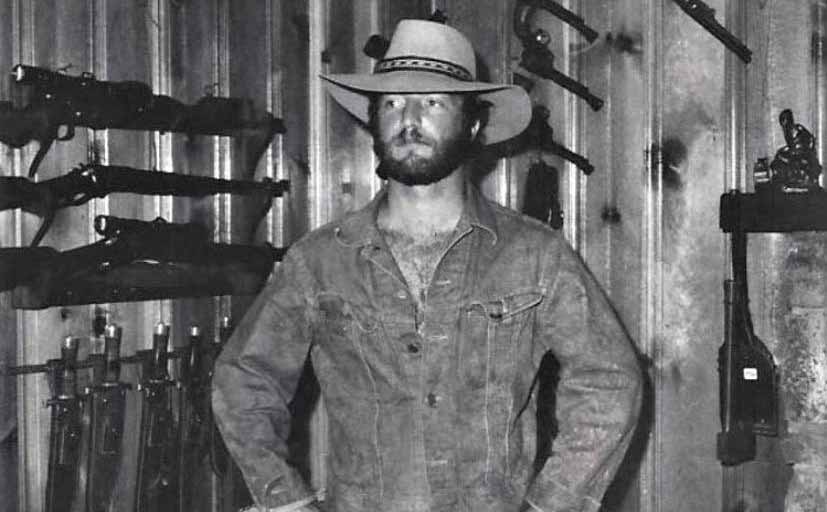
Craig Huber
That’s Craig Fox Huber inset circa 1970 at the Fox Den’s second location in Mountain Home, Arkansas.

During our conversation I learned that he had earned three Purple Hearts while serving with a Marine Recon Unit in Viet Nam, and enough other “breast hardware” that when he spoke, I listened with both ears, and rather attentively.

Those who knew Dan might realize that these comments mean he really respected the “cocky gent.” And Craig respected Dan. Their long friendship stayed the course until the end. I also had a lot of respect for Craig and his vast knowledge of knives and other things.
I met him in the early ’70s at The Fox’s Den, his gun shop located in the small ranch community of Kirkland, Arizona. Dan took me there to meet Craig when I was about 13. I shook hands with a man wearing a drop-loop gun belt with rounds in every loop and a .45 Long Colt pistol in the holster. I was in awe. I also got to see some of the knives he carried and to learn why he carried them.

About a year later my family bought a small ranch in the area. I visited the gun shop at every chance. Dan would take me to Craig’s home occasionally. I was equally impressed at his collections. The next summer I worked for Craig, helping with his horses and other stuff around his place. They were good times and I must say that it was from his influence that I went to see the United States Marine Corps recruiter a few years later.

Craig Huber: Christian Patriot

Craig’s son Hunter can tell you better than anyone about his father. Of Craig he wrote:

Dad was a lot of things. He was a soldier, a gunfighter, inventor, storyteller, adventurer, hunter, fisherman, survivalist, outfitter, collector, gunsmith, writer, and the list goes on. He was a patriot and a Christian. He lived his life to the absolute fullest and would fight for everything he believed in and loved.
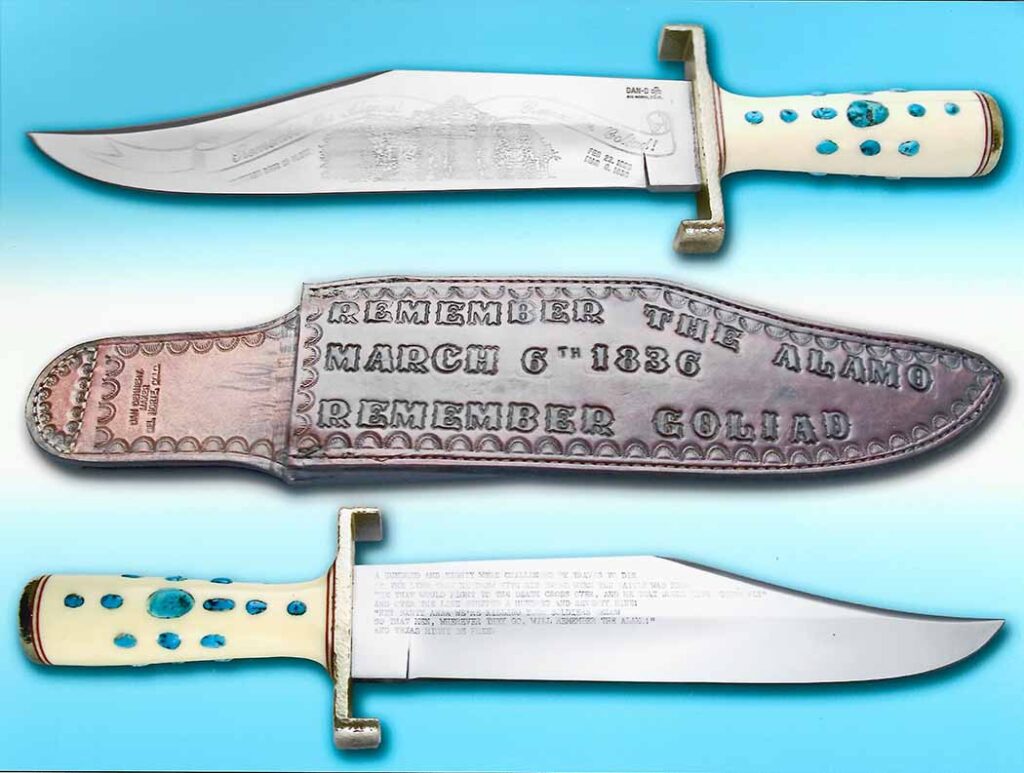
Two sides of bowie knife
In his vast collection of Dan Dennehy knives, Craig’s favorites were the Dan-D Alamo Bowie and the Huber Foxworth Bowie. The Alamo Bowie has a 12-inch hollow-ground blade a quarter-inch thick and 2 inches wide. The blade’s non-mark side is etched with an eight-line poem that commemorates Col. Travis’s call for “defenders to step forward.” The handle is walrus ivory inlaid with 18 turquoise cabs. Overall length: 16.5 inches. The custom sheath is cowhide. (Bob Glassman image)

Despite having the option to go work for his father’s rapidly growing company in York, Pennsylvania, that was obviously of no interest to Dad so he went into the military. Even though he had trouble with authority and rules, he thrived in the Marines.

After the military his life got really interesting. His resume speaks for itself but here is a summary: police officer; sheriff; private investigator; horse wrangler; hunting guide, Ozark Mountains; fishing guide, French River, Canada; gun shop owner, Fox’s Den (Kirkland, Arizona, and Mountain Home, Arkansas); salesman, Camillus Knives and Levis; personal protection, bodyguard for Saudi Royal Family; professional hunter, South Africa; writer, Whitetail Times magazine and several personal protection books; gunsmith; gun dealer; private security, consulting and training; fugitive recovery; and much more. This is a very general overview and it took him to some very interesting places and dangerous spots, and he met some really interesting people along the way.

So here is what Dad loved. He loved his country and God. He loved our mom. He loved me and my sister. He loved adventure. And he loved guns and knives. Dad was an encyclopedia of firearms, handloading and ballistics. He had a real passion for Rugers, Ruger M77s in any and every caliber they make, but especially 7×57 and Ruger single action pistols. He was also a 1911 fanatic. I don’t remember a single occasion in my life where I ever saw Dad without a 1911 on his side or in a shoulder holster.

And he loved knives. Man did he love knives. I don’t know exactly where in his life this interest started, but he was as passionate about knives as guns, and maybe more. And this is coming from a guy whose gun collection is over 500. He loved all knives and always carried at least two at a time. He had a real appreciation for a good blade and considered knives the most valuable tool an outdoorsman or soldier could have.
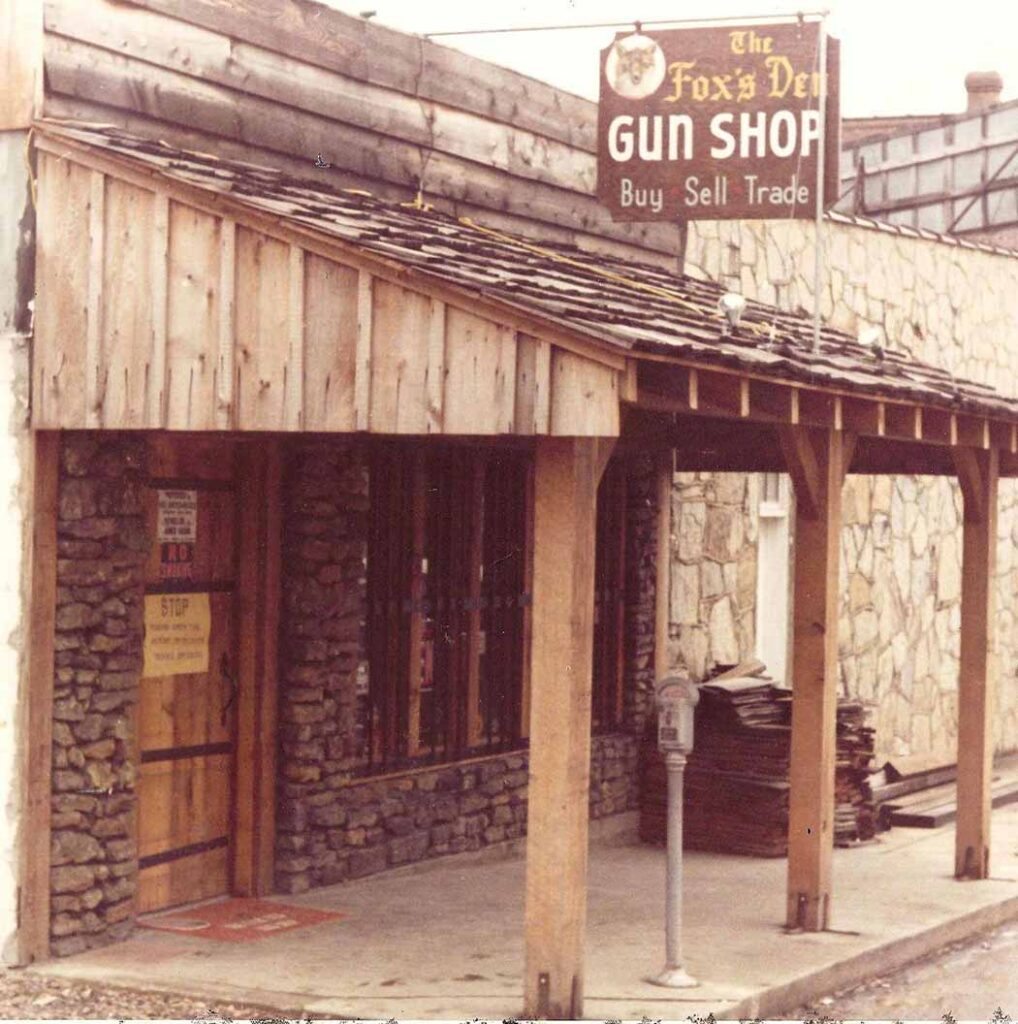
Fox's Den Gun Shop
Here’s the second iteration of The Fox’s Den Gun Shop as it appeared in Mountain Home, Arkansas. Note the sidewalk parking meter.

As you would expect, just like factory rifles with factory ammo were not suitable for Dad’s standards, neither were factory knives. As a result he started reaching out to custom knifemakers and collaborating. He formed relationships with Bo Randall, Jimmy Lile, Art Wiman, Clyde Fischer, Blackie Collins, Harold Corby and George Herron, and most notably Dan D. Dad spoke of Dan D. with a manner of respect and admiration that he did not offer up lightly to many. A shared respect and appreciation for the art and skill behind making the ultimate tool, something that was practical and efficient, beautiful and deadly. Dad’s collection of Dan D. knives is vast but his two most prized are the Alamo Bowie and the Huber Foxworth Bowie.

Dad was the toughest man I’ve ever known. A real fighter, rock solid, set in his ways and unshakeable. No matter, if you had a problem, my Dad would be your first call and the man you wanted in your corner. Dad had a lot of fans and a lot of enemies. He had many acquaintances and peers and only a small handful of good friends. He always said if you get through life and only have a few good friends, real true friends, then consider yourself lucky. Dan D. was a true friend of Dad’s.
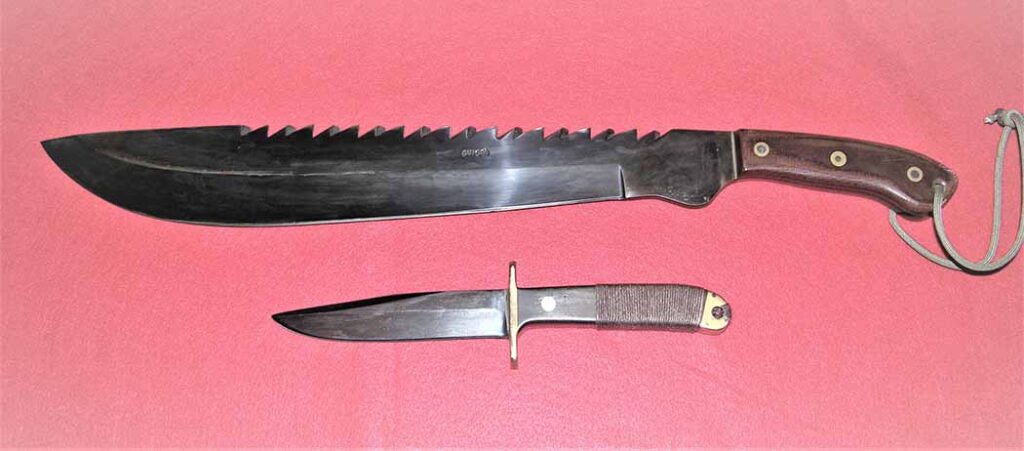
Machete and knife
Two of Craig’s favorite Dan-D users included a survival machete and a Woodsman model. Craig designed both, with Dan-D making the former and helping Craig make the latter in the Dan-D shop. Craig carried the Woodsman more than any other knife for over 40 years.

Craig was one of those rare characters you meet along the road of life and always remember. Later he told me stories of discussions with Cutlery Hall-Of-Famer Bo Randall and knife designs for different purposes. Another story was how he talked to Cutlery Hall-Of-Famer Bob Loveless about the simplicity of balancing a knife using his personal theory of the tapered tang. He visited with his friend Cutlery Hall-Of-Famer Jimmy Lile long before the Rambo knife was created. John Horrigan told me about their hunting trip in Africa. Since Craig was a licensed guide the trip was arranged in exchange for a knife identical to the one John presented to President George W. Bush.

Huber Foxworth Bowie

But back to the Huber Foxworth Bowie. The brochure description continues:

This knife is a pure and simple Bowie style but with the handle dropped slightly which seems to give it a much better “pointing” ability and maneuverability not found in most common Bowie styles. [Craig] had a prototype of this knife made for him by a Philippine Negrito instructor while he was attending the armed forces Jungle Survival School in the Philippines. Pound for pound these little Negritos are about as slick and fierce a knife fighter as will be found anywhere.
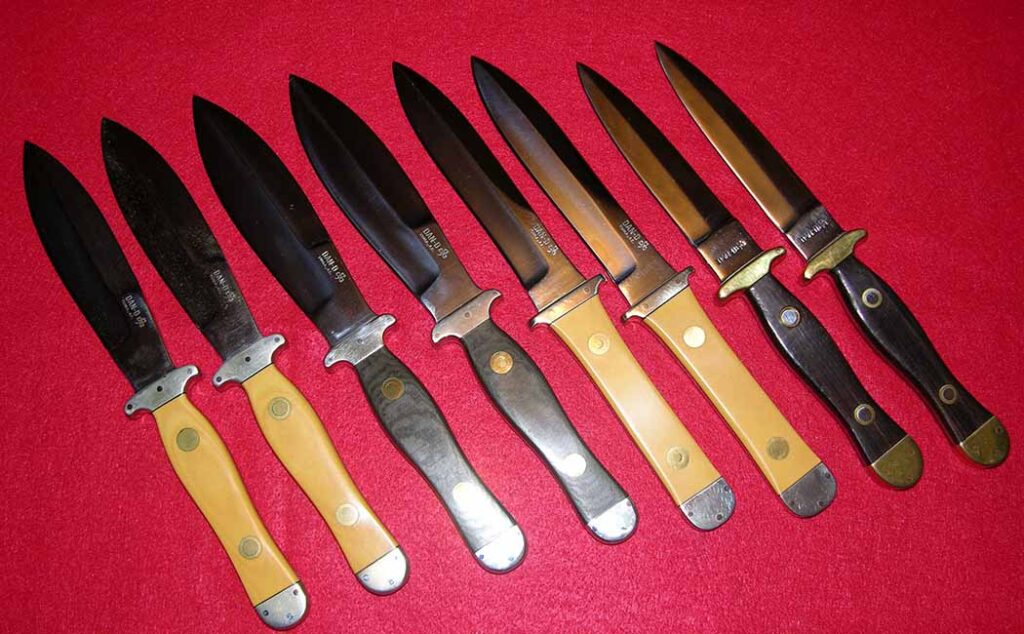
Knives
In a 2011 email to the author Craig wrote, “This [image] shows all four pair of boot knives your Dad did for me, including two pairs of my Model III. All have been carried extensively over the past 40 years, and two of the knives have saved my life.”
The blade is 8 inches long, 1.75 inches wide and in quarter-inch stock of 154 CPM stainless steel heat treated by Cutlery Hall-Of-Famer Paul Bos. It has a double guard and a 4.75-inch handle. According to the brochure, “This is a knife you could bet your life on.”

A couple of years ago, Hunter contacted me and told me of his father’s passing. Craig lived 76 years his way and made his mark in the world. His passion for God, his country and living life to the fullest extent had been accomplished. Hunter went on to explain that out of all the knives they cannot find the one that meant more to Craig than the Huber Foxworth Bowie.
Check Out More Cool Custom Knives:

Shop Dump: TOMMY “BUBBA” CROUCH

0

Part of the Texas Slipjoint Cartel, Bubba Crouch shares the tools with witch he crafts his creations.

Tommy “Bubba” Crouch is a Texan through and through. In fact, he lives only minutes from Cutlery Hall-Of-Famer Bill Ruple, who has mentored more slip-joint knifemakers than a little bit. Crouch is one of those pupils and was also the spark in naming a merry band of talented custom makers who studied under Ruple the South Texas Slipjoint Cartel.

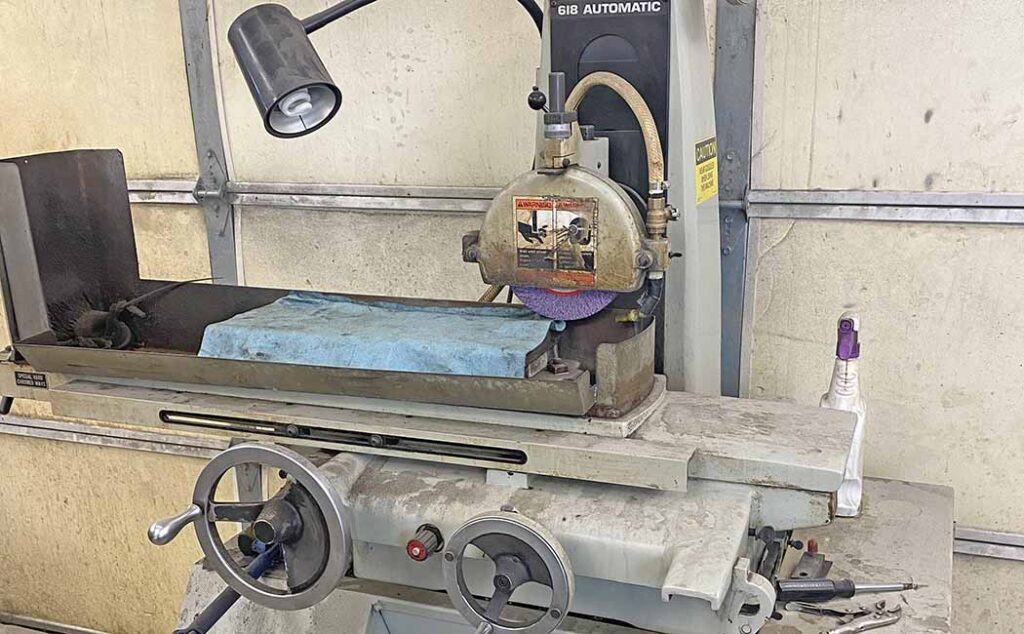
Harig 618 automatic surface grinder
Crouch employs his Harig 618 automatic surface grinder for bringing parts to thicknesses pre-heat treat and for clean-up post-heat treat.

“Bill Ruple and I were sitting around one day in his shop and we were just talking about knives and such,” Bubba recalls. “We were talking about our bladesmithing friends in the Montana Mafia, so we came up with the name South Texas Slipjoint Cartel. It was mainly just to mess with our Montana knifemaking friends who’d formed such a group. We decided to make it an LLC. Our group has done many donation knives for charity events. It mainly consists of friends sharing techniques and better ways to do things. I have been blessed to have Bill Ruple five miles away and he has helped me tremendously. Other members sharing their knowledge have also been something that helped me personally.”

It can be truly said that Bubba is all cowboy and all hat. He grew up ranching, spent time on the competitive roping circuit, and even had a stint driving a cattle truck. He took up knifemaking in 2009 and credits his apprenticeship under Ruple as the key to where he is today.

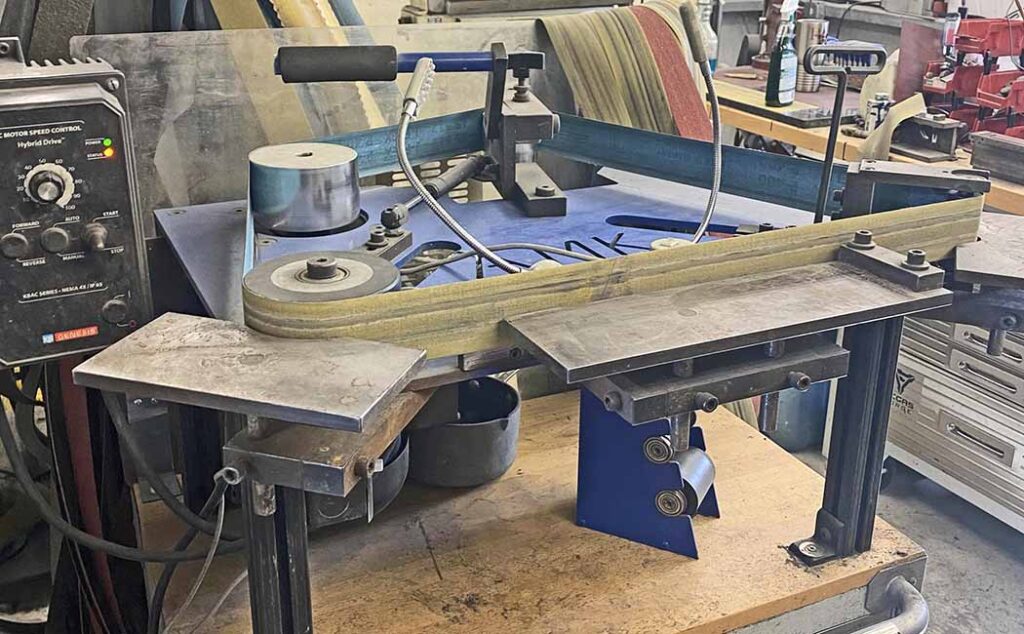
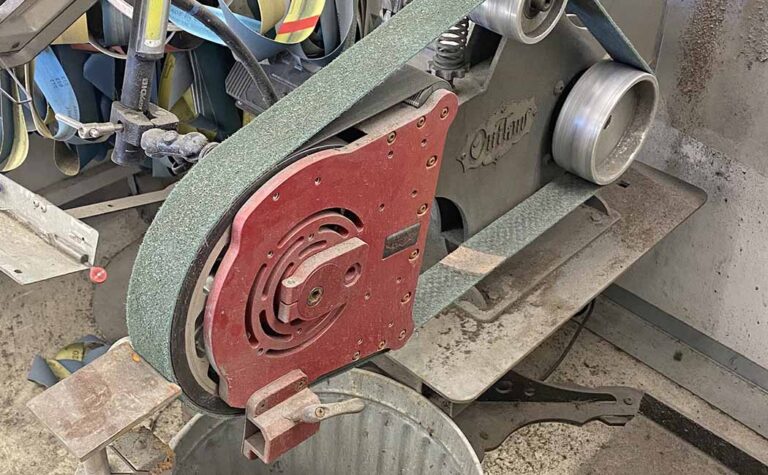
Moen platen
Bubba uses The Outlaw grinder with the Moen platen (above) for grinding blades exclusively. “Both work well together,” he observes.

First Crouch calls out his milling machine. “The Bridgeport Mill is an adjustable speed head that I use for milling integrals, liners, relieving liners and spinning center handle pins,” he notes. As for shop grinders, he has a plethora. “My automatic surface grinder is a Harig 618. This machine I use for bringing parts to thicknesses pre-heat treat and for clean up after heat treat. The Outlaw grinder with the Moen platen is used for grinding blades only. Both work well together,” he observes. “The Northridge grinder I use for roughing out and shaping parts.

“My green grinder is made by Enrique Pena and is a great piece of equipment. The wheel and platen flip around and the back side can be used as a loose belt. The horizontal grinder is an AMK and is a necessity for making slip joints, in my opinion.”

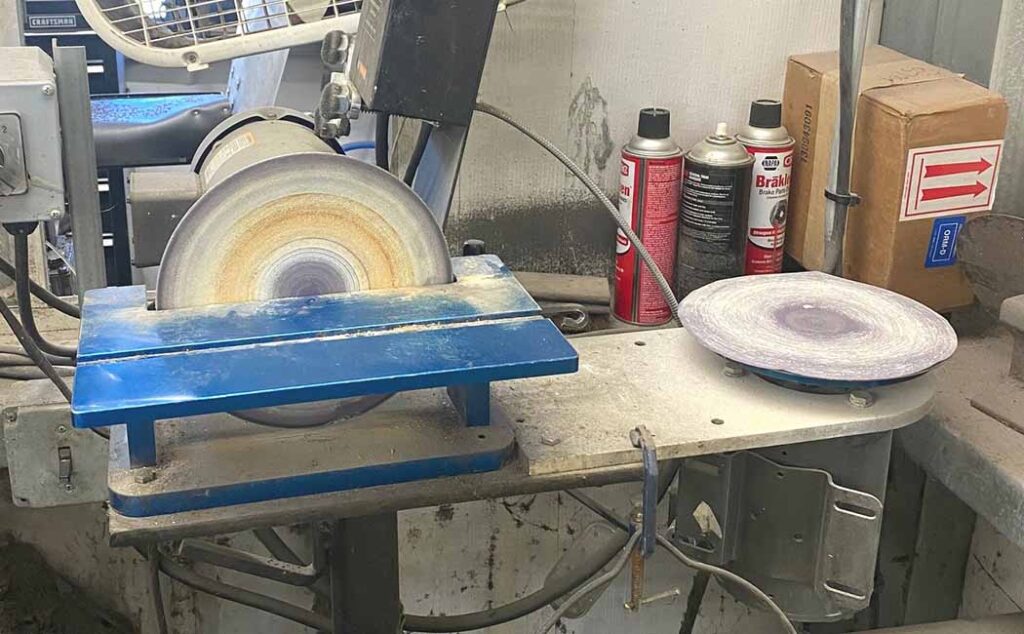
disc grinder setup
For his main disc grinder setup, Crouch uses a Hardcore model for cutting blade tangs and fitting handle material into the liners. The flat disc is homemade for thinning and flattening handle material.

Last but not least on the grinder front Bubba lists his disc grinders. “My main disc setup came from Hardcore and is used on cutting in the tang on the blade and for fitting handle material into the liners,” Bubba explains. “The flat disc is homemade and used for thinning and flattening handle material.”

Bubba Crouch
Bubba Crouch

He has two ovens for heat treating. “My heat-treat ovens are both newer models. The Paragon Pro is a great oven that gets to tip really quickly,” he notes. “The Evenheat has been a great addition and is very accurate.”

Bubba also keeps two pantographs in his shop. “The first is an Alexander 1B that I use for inlays and cutting shields. It’s an older machine from the early 1880s,” he states. “The second pantograph is a Gorton P1-2. I use this machine for engraving my name into the blades.”

He also keeps another specialty machine for shop duty. “The Oliver drill point thinner has been converted with a table and a cupped stone to cut nail nicks in the blades,” Crouch advises, wrapping up with something no maker can do without: “The workbench came from Sam’s Wholesale Club and I have three of them—very well built for the money.”

Check Out More Shop Dumps:

Cool Customs: Jim Poor’s Slip Joint

0

With A Background In Being A Farrier, Jim Poor Makes Knives Just As Tough As His Horseshoes And His Slip Joint Folding Hunter Is No Exception

Jim Poor provides two modes of EDC in one with his slip-joint folding hunter—carry it the traditional way in your pocket or, for a change of pace, on your belt in a leather pancake sheath.

Jim made the knife and he and his son Tyler collaborated on the sheath. Tyler did the leather tooling, cut it out and laser engraved it, and Jim glued and sewed it together. The knife features milled liners of 416 stainless steel, with the liners and bolsters all one piece.

A blacksmith by trade, the 63-year-old Poor has been making knives about eight years, starting with fixed blades before going to pocketknives four years ago. He forges damascus, including the Riptide pattern on his folding hunter, and also sells his damascus, including to a number of his slip-joint making friends in the South Texas Slipjoint Cartel.

Flatland Forge

Along with making custom knives, both fixed blades along with slip joints and some feather damascus folders, Jim and his wife Kathleen forge horseshoes and farrier tools of all types. They’ve been working together for decades and today, the shop makes more than two dozen different types of hammers and other tools.

You can take a tour through Flatland Forge, led by Jim, in the video below.

Contacting Jim Poor

Address: Flatland Forge, attn: Jim Poor, Dept. BL1, POB 39, Tuscola, TX 79562 
Phone Number: 325-554-7552 
Email: [email protected]
Website: flatlandforgeusa.com

Slip Joint Knife Specs

Knife: Slip-joint folding hunter
Maker: Jim Poor
Blade length: 3-⅜ inches 
Blade material: Riptide damascus of 1084 carbon and 15N20 nickel-alloy steels
Handle: Jigged cow bone dyed red
Bolsters and frame: 416 stainless steel
Bolster engraving: By Tyler Poor
Backspring: CPM 154 stainless
Closed length: 4.5 inches
Sheath: Leather pancake model tooled and laser engraved by Tyler Poor
Maker’s price for a similar knife and sheath: $850

Cool Customs: Andrew Meers’ Pizza Cutter

0

You Can Never Have Too Much Pizza, And You Can Never Go Wrong Buying A Pizza Cutter Made By Andrew Meers.

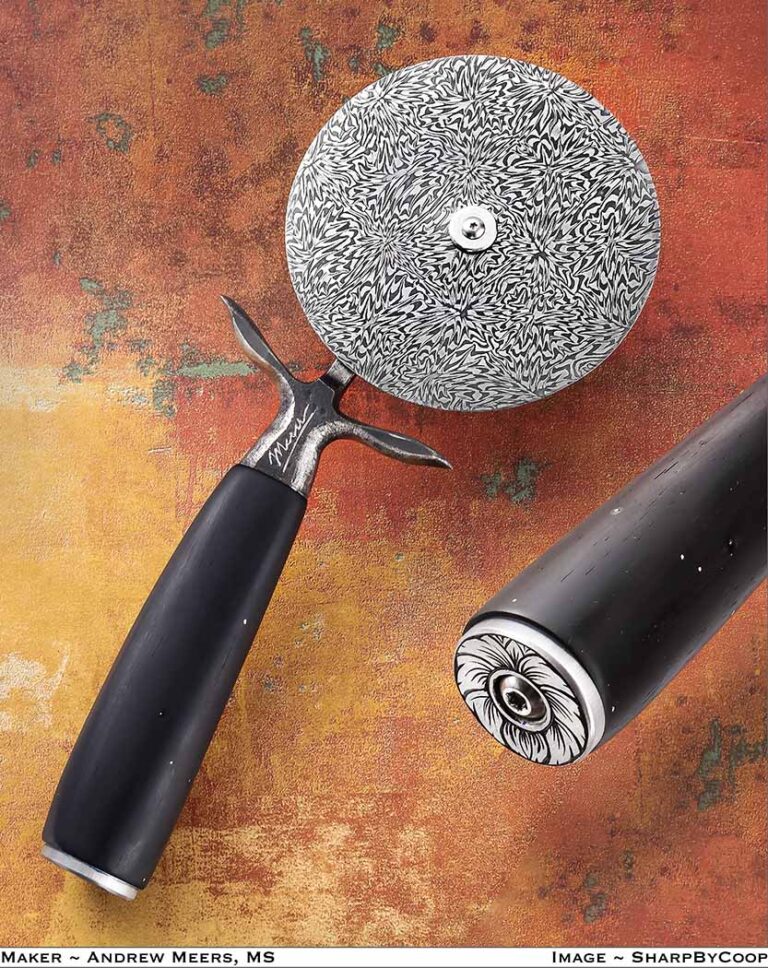
Andrew Meers loves pizza, so when his factory pizza cutter broke, he fixed it—and then made his first-ever custom version of one. The result has features only an award-winning ABS master smith such as Andrew would include.

Fresh out of the oven is the mesmerizing disc cutter in a W’s explosion pattern mosaic damascus. A pet peeve is loose pizza cutter discs that rattle, so he tightened his down with the help of a folding-knife pivot fitting.

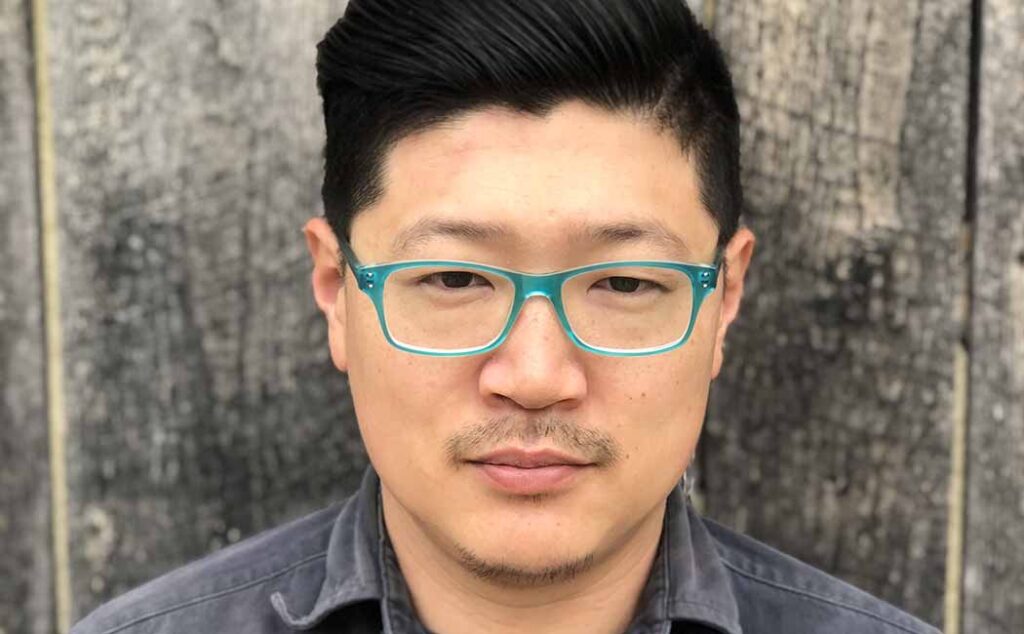
Andrew Meers

The arm and guard are forged stainless with a blackened brut de forge look. He forged the crossguard in a plant-like shape, drawing the quillons out and giving them fullers for a bud-like appearance. The grip is ebony inlaid with bits of silver to resemble stars in the night sky.

If 20th-century actor, comedian and singer Dean “The King of Cool” Martin were here, he might croon, “When the moon hits your eye like a big pizza pie, that’s amore.”

For more information on his pizza cutter, contact Andrew Meers:
Email: [email protected]
Website: andrewmeersstudio.com.

Pizza Cutter Specs
Model: Pizza cutter
Maker: Andrew Meers
Dimensions: The cutting disc is 3.5 inches in diameter; the cutter’s overall length is 9 inches
Disc Material: W’s explosion pattern mosaic damascus of 1084 carbon and 15N20 nickel-alloy steels
Handle frame and guard: Blackened forged stainless w/a brut de forge look
Scale material: Ebony inlaid w/silver “stars”
Engraving: In a traditional Japanese line style by Andrew Meers
Andrew’s price for a similar piece: This one sold for $850
Andrew’s favorite pizzas: Meat Lovers, including the Whole Hog (red sauce, pepperoni, bacon, red onion, green pepper, jalapeno and mozzarella), and the Margherita, a typical Neapolitan pizza w/San Marzano tomatoes, fresh mozzarella, fresh basil, salt and extra-virgin olive oil

Read More

Cool Customs: Kurt Swearingen’s Buffalo Hunter Set

From One-Day Course To One-Of-A-Kind Knives, Kurt Swearingen’s Buffalo Hunter Set Shows How Quickly The Knifemaker Has Honed His Craft

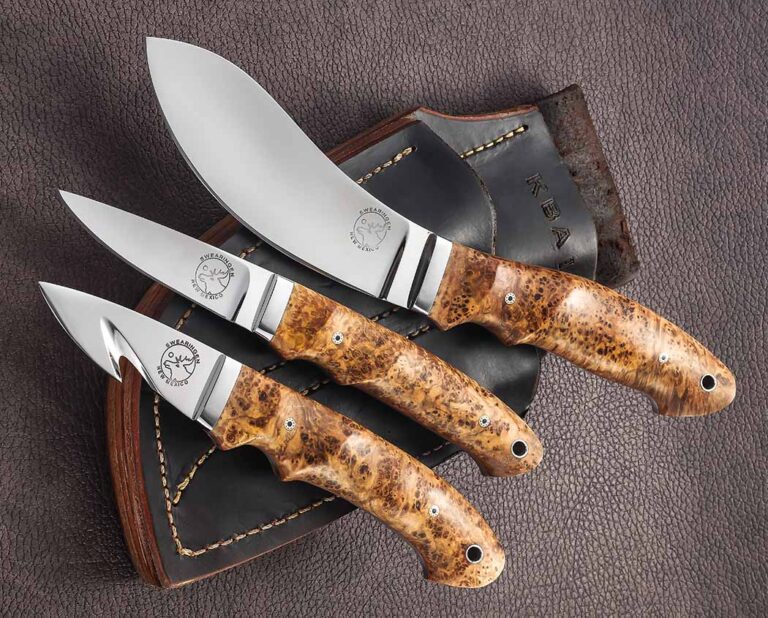
ABS Journeyman Smith/Knifemakers’ Guild member Kurt Swearingen went with tradition and what works in his three-piece buffalo hunter set.

Made for North American big game, the set includes a Green River-type skinner, caper, and gut hook in CPM 154 stainless steel blades and black ash burl grips. Kurt based the design on a similar set he’d seen from the 1800s. He chose CPM 154 because that’s what he uses on his fixed-blade hunting knives and the ash because it’s a wood native to the Great Plains, home of the American bison. 

He made the sheath from three layers of stacked 9-ounce leather with two layers of welts. The sheathed set weighs 2-3 pounds so he hollow ground the blades and outfitted them with bolsters instead of guards to save on weight and size. The set wears on a belt, though Kurt modified it so you can string it on a pack or a saddle.

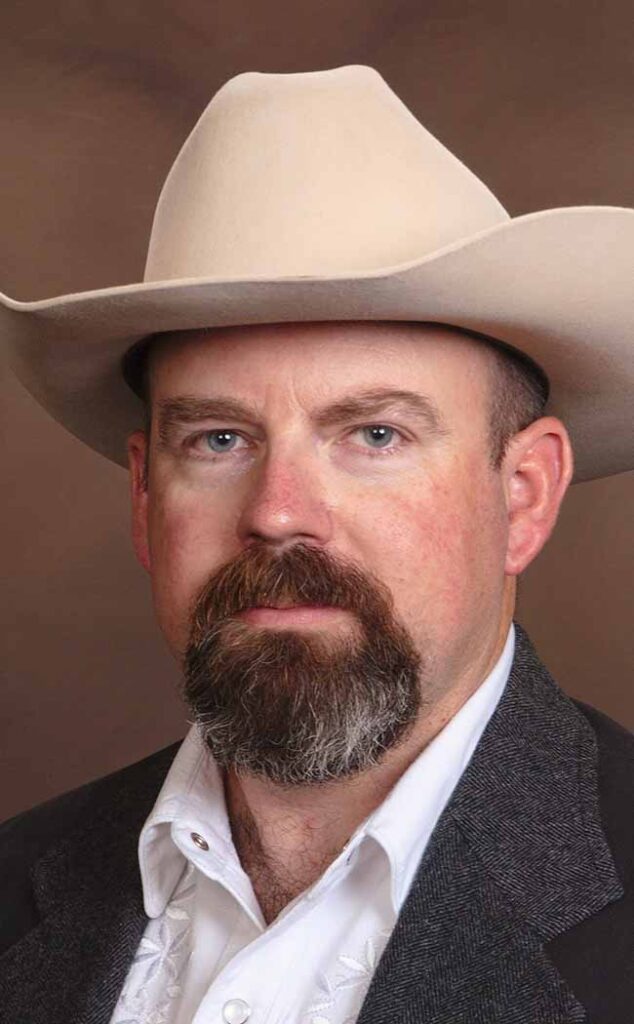
Who Is Kurt Swearingen?

Kurt Swearingen

Swearingen’s knifemaking journey began back in 2007 after taking a one-day class. From there he learned from one of the all-time greats, Lin Rhea, who helped him to perfect forging and heat treating techniques that have helped make his knives stand out from the pack.

Just seven years after that course that started it all, Swearingen earned the rank of journeyman smith. Today he specializes in hunting and camp knives of all types.

Buffalo Hunter Set Specs

Model: Buffalo Hunter Set
Maker: Kurt Swearingen
Patterns: Green River skinner, caper and gut hook
Blade lengths: 4.75 inches, 3 inches, and 2.75 inches
Blade steel: CPM 154 stainless
Handle material: Black ash burl
Sheath: Three layers of 9-ounce stacked leather
Maker’s price for a similar set: $1,850

Read More

Cool Customs: Isaiah Schroeder’s Gyuto

Isaiah Schroeder’s Gyuto Comes In A Spectacular Damascus Pattern And Showcases The Maker’s Skill.

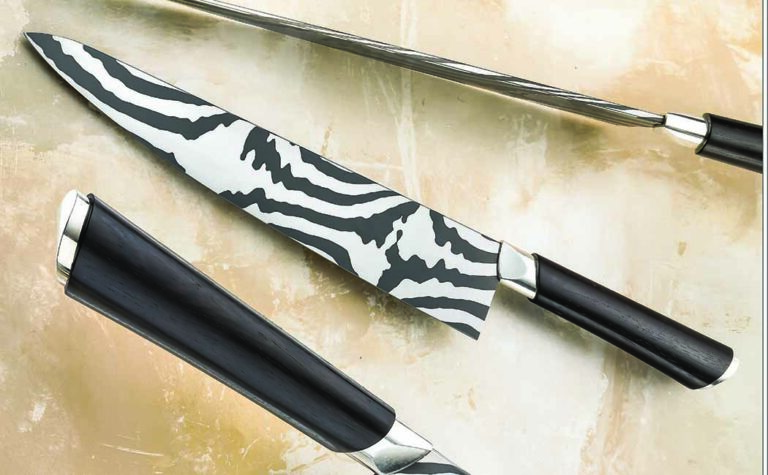
Isaiah Schroeder considers his gyuto the best knife he’s made, and the blade’s electrifying stainless damascus pattern and the ergonomic handle make it hard to argue the point.

Of the blade Isaiah said, “It’s a pretty simple pattern, one I’ve done in carbon steel quite a bit. A low-layer lazy twist is what I call it.” It consists of only 11 or so alternating layers that he twists three or four times. “That’s pretty much all it is,” he observed. “I love the way it turns out with the bold layer lines and everything. It looks kind of topographical and I always like that.” The darker steel is AEB-L stainless and the lighter parts are 154CM stainless.

He said the convex blade grind works great for food release. He is especially proud of the look and feel of his thin handle design that includes silver fittings done in the lost-wax-casting method. Combined with the 1/8-inch-thick blade, he said it’s, “Thin to win for a kitchen knife.”

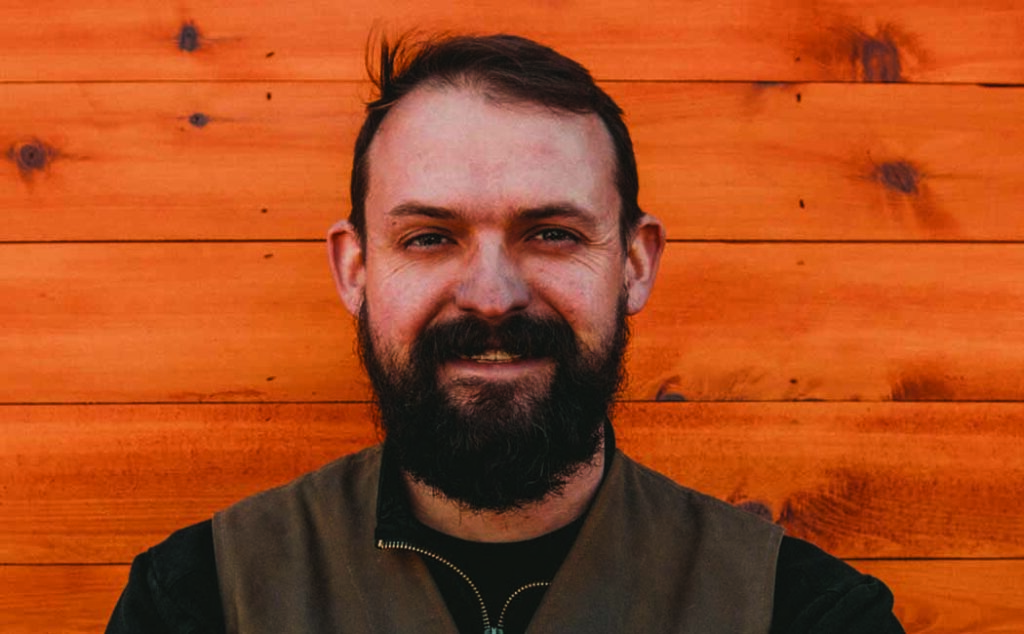
A full-time knifemaker based in Madison, Wisconsin, Schroeder makes kitchen knives of all types in the Japanese style including a sujihiki, a long knife made for fine slicing of meats, fish, and precisely cutting through sinew. He also makes a petty knife as well in damascus. 

Gyuto Knife Specs
Pattern: Gyuto Japanese chef’s knife
Blade length: 9.44 inches
Blade material: Low-layer lazy twist damascus of AEB-L and 154CM stainless steels
Blade grind: Convex
Handle material: African blackwood
Fittings: Fine silver (2 ozs. worth)
Overall length: 14.44 inches
Maker’s price for a similar knife: $2,000
Knife to know: Isaiah is a full-time knifemaker

Read More

Mastersmith Lin Rhea Honored As Arkansas Living Treasure

Master bladesmith Lin Rhea was recently recognized as an Arkansas Living Treasure by the Arkansas Arts Council.

Knifemaker, blacksmith, teacher … Lin Rhea has many titles. Hang another one on the master craftsman—living treasure.

That honor was bestowed upon him by the folks in his home state with Rhea recently being named the Arkansas Arts Council’s 2023 Arkansas Living Treasure. The annual award—chosen through a panel of independent judges—recognizes masters of traditional crafts and folk art in the state, of which Arkansas has a rich and wide-ranging tradition. Since the award’s inception in 2002, it has honored craftsmen (and women) from basket makers to log-cabin carpenters. Given Rhea’s propensity for traditional knifemaking and blacksmithing techniques, the Arkansas native fits right in the honor roll.

“Lin Rhea is an outstanding addition to the Arkansas Living Treasure program,” Mike Mills, secretary of the Arkansas Department of Parks, Heritage and Tourism, said in a news release. “He has contributed so much to the rich creative culture of Arkansas.”

Rhea is the second bladesmith to earn Arkansas Living Treasure recognition. In 2007, James R. Cook of Nashville, Ark., was recognized for his contributions to the craft.

Rhea has been a blasdsmith for more than 20 years and earned his master bladesmith rating through the American. Bladesmithing Society. He studied the craft at the Bill Moran School of Bladesmithing, centered at Arkansas’ Old Washington State Park. And he is known as an avid and expert historian of the state’s knifemaking tradition.

Along those lines, he presented the finer points of James Black and his creation—the Bowie Knife—at the 2023 BLADE Show Texas. The seminar not only delved into the technological advancements Black introduced to knifemaking but the ethical considerations of reproducing his work. This is a hot-button topic, given Black never signed his work.

Despite rooting himself in the traditional aspect of knifemaking, Rhea also has a keen eye for advancing the craft. Perhaps one of his more notable endeavors to this end is his X-Rhea knife, which he set out as a personal challenge to create a knife—handle and all—from a single piece of steel. As always, he turned to two tools to complete the task—fire and steel.

“Moreover, I wanted it to look good and be comfortable and as structurally sound as any good knife should be, without being overly heavy,” Rhea said in a 2021 BLADE Magazine article he authored on the genesis of the X-Rhea Knife.

As for being recognized as an Arkansas Living Treasure, Rhea admits to being quite humbled.

“I’ve gone back and looked at other videos the museum (Historic Arkansas Museum) has produced of the other Living Treasures and I know one or two of them personally, and I’ve known them for quite some time,” Rhea said, in an Arkansas Times article, “But to be associated with that group is quite an honor.”

Rhea will be honored with a reception 4-7 p.m. June 17 at Little Rock’s Historic Arkansas Museum. This coincides with the reopening of the museum’s Knife Gallery, which displays several of Rhea’s creations.

Read Up On Knife History:

Advertisement

Must Read Articles

Read this before you make a knife

Knifemaking 101 – Read This Before You Make a Knife

  by Wayne Goddard My experience has taught me that there's nothing like digging in and getting started. I've often said the hardest part of the...
how to forge damascus steel

How to Forge Damascus

Advertisement
Advertisement