Knifemaking is the building of a knife, which includes the blade, handle and other accouterments. Blades are made by either removing metal from a steel blank via a grinder – known as stock removal – and the forging to shape of hot steel into a blade in the process known as bladesmithing. Other parts, including bolsters, guards, pommels, etc., are needed to complete the finished knife.
Inspired By His Time Fly Fishing In The Pacific Northwest, Joe Mangiafico’s Trout Knives Are Durable, Eye-Catching Tools.
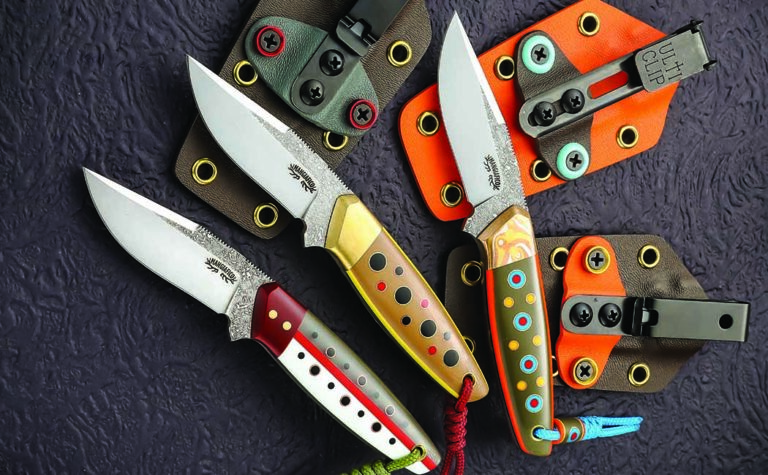
Joe Mangiafico’s trout knives not only are built to use but are cool and colorful to boot.
The 28-year-old Massachusetts maker acid etched the flat areas of the blades for a damascus look, yet it’s the handles and sheaths that really stand out.
The grips are structural mosaics of G-10, brass, and copper. For instance, the blue haloed red center pins of the model with the green handle are inlaid plugs, and the brass pins are press fit and epoxied all the way through. He designed the Kydex sheaths with centered pocket clips to attach to your pocket or waders while fishing. The red-banded model is inspired by the redband trout Joe fly fishes for in the Deschutes River Valley of central Oregon.
Who Is Joe Mangiafico
Mangiafico began making knives while still a college student several years ago. Joe makes his knives in his shop in Cotuit, on the southern coast of Cape Cod. While the majority of his work is custom knives, he does have a factory collaboration with the German company Boker Knives. His Brook fixed blade is made from VG-10 steel and, like his trout knives, showcases his deft ability to craft an eye-popping handle. It retails for $156.95 and can be found on Boker’s website.
Trout Knife Specs Model names: Brook Trout, Brown Trout and Rainbow Trout Knife type: Trout knife Blade lengths: 3 inches Blade steel: Nitro V stainless Blade grinds: Flat Handle materials: G-10, copper and brass Bolster materials: Brass, Micarta® and mokume gané Overall lengths: 6.5 inches Sheaths: Kydex Maker’s price for similar knives: $375 each
Utilizing Steel From An Iraqi Tank, John Thunert’s Capemaster Is A Skinner Built On The Foundation Of A Caping Knife.
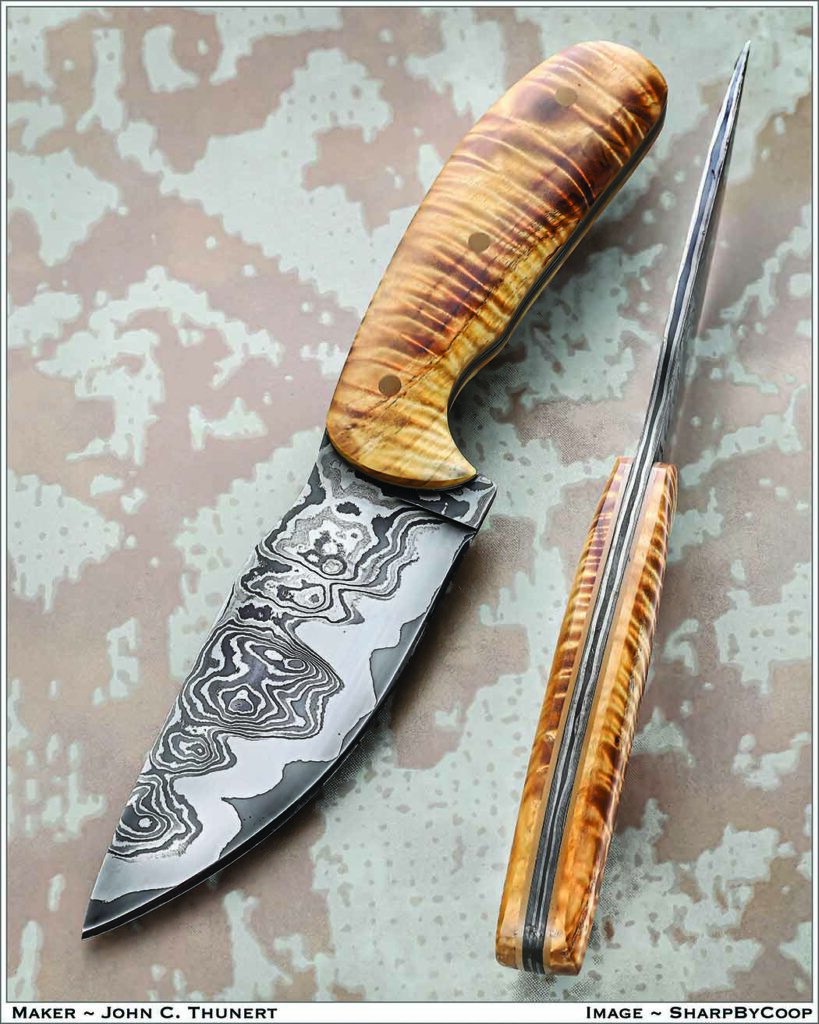
When John Thunert learned an acquaintance had some spare steel from an Iraqi tank, he jumped at the chance to buy some of it and forge it in the damascus of his Capemaster skinner.
Strips of steel 3×3 inches and 4×4 inches, each 3/16-inch thick, were torch cut from the armored vehicle, which was stored in a “tank graveyard” in Iraq. John cleaned the steel up, including removing some paint. He also got a copy of the form his friend had to fill out on the steel as a “war trophy,” which is how he was able to legally ship the steel stateside. “It kinda gives me some bona fides,” John noted.
He said an analysis of the material identified it as a very pure form of mild steel containing 99 percent iron and few impurities. Though the knife started out as a caper, it kept “growing” until it became a skinner, but John kept the caper name. The handle is quilted poplar with pins of a subdued coyote brown G-10 to match the liners.
Who Is John Thunert?
John has been making knives since 2017 and has competed on The History Channel’s Forged In Fire show. He sells more than a dozen varieties of his Capemaster knife on his website, with the majority made from exclusively 80CrV2 steel. The majority of his Capemasters retail for $245.He has also made Bowie knives as well as multiple types of kitchen knives.
Capemaster Knife Specs Blade Length: 4.75 inches Blade Grind: Flat Blade Steel: 80CrV2/1095/15N20/Iraqi tank steels Overall Length: 9.25 inches Handle Material: Quilted Poplar with Coyote Brown G-10 Price Of A Similar Knife: $625
A Woodworker By Trade, Matt Williams Crafts Knives Meant For Rugged Use, Including His BBQ Chef’s Knife.
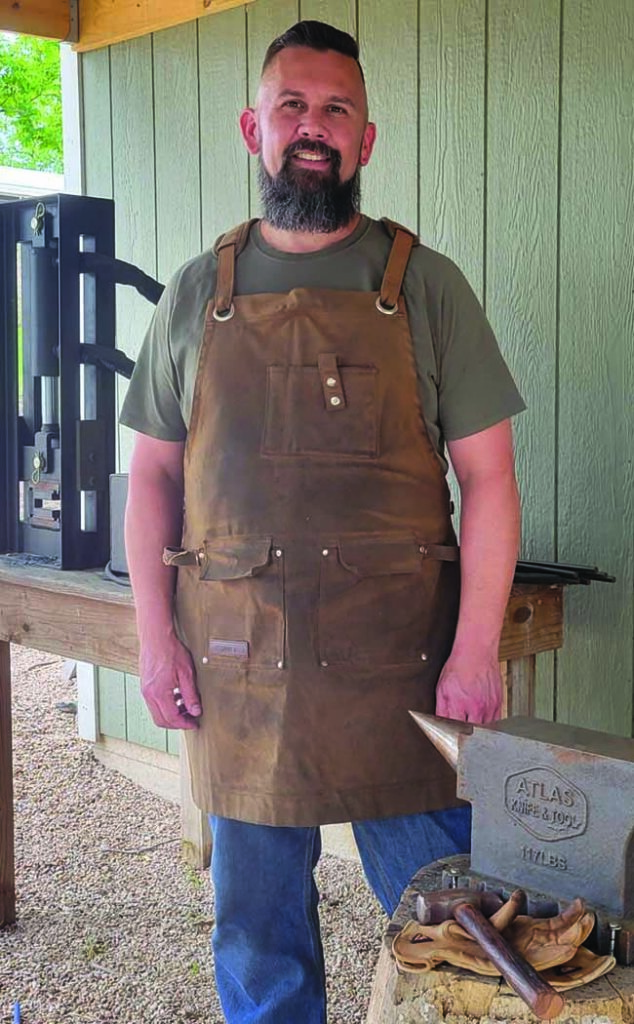
A woodworker by profession that includes making cutting boards, Matt Williams got into knifemaking too and is glad he did because of the feedback he gets from customers. His BBQ Chef’s Knife is a case in point.
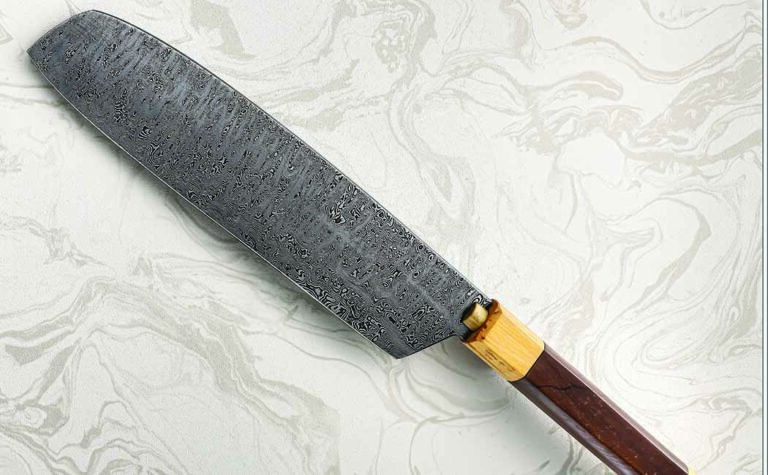
His clients told him his chef’s knives were too thin, especially the local Texas barbecue chefs who need thick, tough blades for separating ribs and joints in competitive barbecue events. As a result, he built the BBQ Chef’s Knife on a santoku cutting base with a thicker blade and a “really aggressive feel” built to take abuse.
Matt lives on an old pecan orchard by the Colorado River and stabilizes and spalts the pecan for his turned-wood handles. The handle for his BBQ model is done in a wa style split down the middle with round dowels of white oak left proud to contrast with the darker pecan. He also forged the steel and made pretty much everything but the coffee for the blade etch.
The combination of his new-style chef’s knives and cutting boards is just the ticket for the highly competitive local Texas barbecue chefs. Along with his custom knife work, Williams also makes one-of-a-kind cutting boards as well that he sells through his website.
BBQ Chef’s Knife Specs Blade Length: 9 inches Blade Material: 400-layer damascus of 15N20 nickel alloy and 1084 carbon steels Hande Material: Spalted pecan, cedar elm and white oak Handle Style: Wa Overall Length: 15 inches Knife To Know: The blade tapers from .169 of an inch at the thickest point to .05 of an inch at the thinnest point Maker’s Price For A Similar Piece: $750
Les George Leans On His Decade Of Service In The Marines To Guide His Knifemaking Philosophy
A veteran of the United States Marine Corps and the Iraq War, knifemaker Les George loves vintage military fixed blades and collects, designs, and reproduces them on a regular basis.
About four years ago, Kershaw asked him to design a folding version of one of his military favorites.
“It’s hard to translate from fixed blades to folders,” he noted but he went ahead and designed one based on the M3 trench knife. Kershaw made a prototype from the design—sold today as the XCOM—and sent the knife to Les. Today, the XCOM sells for $53.99 and is well reviewed on the Kershaw site.
He carried it for a while and was cutting with the folder one day when he laid it down and began admiring it. “I saw the prototype lying there and it was way cooler and much more utilitarian than I thought it would be because of the military vibe,” he said.
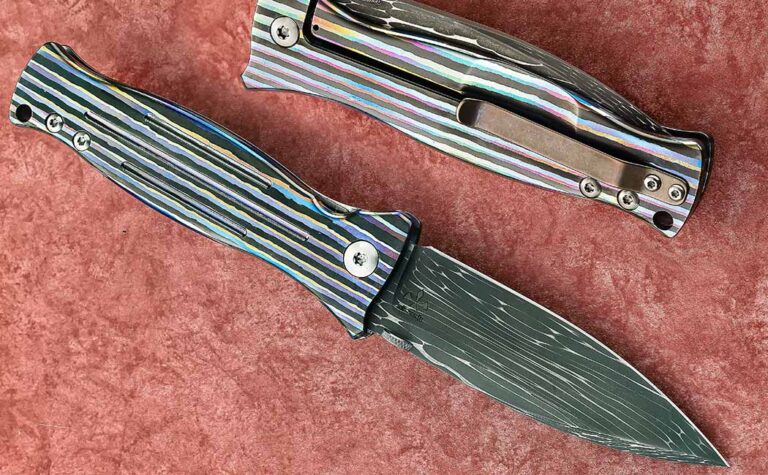
He dropped everything he was doing and made the custom M3 Folder with a blade of a stainless damascus forged especially for the knife by Chad Nichols, and a handle of Zircuti, a laminate of titanium and zirconium. The result is one stunning folding dagger.
Who Is Les George
Les George first started making knives in 1992. Many of his pieces are inspired by his 10 years of service in the Marines where he, among other jobs, worked as an explosive ordnance disposal technician. Overseeing hundreds of EOD missions has given up a unique view of how tools should be made that carries over into his knifemaking. George makes both fixed blades and folders.
M3 Folder Knife Specs
Maker: Les George Blade Length: 3.9 inches Blade Material: Chad Nichols stainless damascus Handle: Zircuti Pocket Clip: Titanium Lock: Framelock Closed Length: 4-⅝ inches Maker’s Price For A Similar Knife: $2,400
A Disciple Of Bill Ruple, Burt Flanagan Has Been Making Knives For Nearly A Decade And Crafts Some Of The Finest Slip Joints In The Lone Star State.
Burt Flanagan has been making knives part-time since 2015 and also is a member of the South Texas Slipjoint Cartel of understudies of Cutlery Hall-of-Famer Bill Ruple. Burt’s father was a knifemaker before him but due to extenuating circumstances—he lost his equipment in a robbery—he never achieved the heights he could have.
Flanagan’s mother passed away in 2014 and shortly thereafter a Fedex package from Burt’s father arrived at the door. Inside Burt was shocked to find a 2×72 grinder and called his dad to find out about the gift. His father told him his mother had always supported his interest in wanting to make knives, and through the proceeds from her life insurance policy he knew she’d want to help Burt get started.
In no time Flanagan was grinding away at becoming a highly respected knifemaker. He had a chance to meet Ruple at a Johnny Stout hammer-in in South Texas and—long story short—the legend invited him down to learn how to make slip joints. He did so with his dad in tow and the three have all been great friends since.
Burt also credits The Knifemakers’ Guild for its guidance and is now a member of the organization’s board of directors. When not making knives he works full time for Paragon Industries, makers of fine heat-treating ovens, as the company’s knife industry manager.
Inside Burt Flanagan’s Shop
Burt Flanagan caled down Tony Bose’s Back Pocket model, giving it a 3.25-inch blade of CPM 154 stainless steel and antique Westinghouse Micarta® scales with an abalone shield. (Mitchell Cohen knife image)
The shop tour begins with a piece of equipment Burt knows quite well.
“I am a very blessed man to have a career in the knife industry with Paragon Industries. I would never endorse something that I did not believe in,” Burt states. “My Paragon Pro will reach 1,000 degrees Fahrenheit in six minutes. You may think that’s not possible but it’s true. I will tell you that this is most likely the most important single piece of equipment in my shop because this is where it all starts. The heart of the blade is in the hardness, and my Paragon Pro is the ultimate. When I first got my Paragon oven it immediately cut my heat-treating time by two-thirds over a conventional brick-type oven that took over an hour to reach 1,925 degrees. This is to heat treat CPM 154 stainless steel, which I use pretty much exclusively for my blades, along with carbon steel damascus.
“An absolute must for a slip-joint maker is a surface grinder and I use a DoAll D-8. I was taught that two of the most important things in slip-joint making at a high level are for your parts to be flat and perpendicular. The D-8 takes care of the flat part of the equation. I surface grind my blades and springs to within one-half-of-one-thousandth of an inch with this machine. There are many different quality brands of surface grinders available from old to new. Mine happens to be an older model that has been restored and is in great condition. It weighs close to 5,000 pounds and is a hydraulic two-axis automatic beast that can get the job done.”
Big Tools For Big Jobs
Burt indicates the Moen Turbo Platen eliminates the belt-bump factor during grinding while also blowing a tremendous amount of air over the work, cutting down the heat on the blade big-time.
Next up Burt extols the virtues of his Oliver of Adrian drill point thinner machine.
“I’ve found it to be true that the first thing a dealer, collector or purveyor—as well as many knowledgeable customers—look at in a custom pocketknife is the nail nick. A proper nail nick, no matter what the method used, should have needle sharp points and be thin and consistent throughout. This machine is the beans as we say here in Texas,” Burt explains, “and allows the maker to properly place the nail nick just before assembly. It is equipped with a built-in diamond dresser with a lever that keeps the 5-inch stone sharp all the time. Although there are many ways to cut a nail nick, most makers say this machine arguably does the best job.
“As with a nail nick there are numerous ways to inlay a shield on a pocketknife. I believe the most versatile way is the pantograph. Mine is a Gorton P1-2 model, which has been restored to almost new condition by the pantograph guru, Tim Robertson. There are many different makes and models that work great. These machines are the predecessor to the CNC machines of today. Gorton machines were made from the mid-’60s up to the early ’90s. My machine was made in the mid-’80s. These machines are capable of doing so much more than just shields; it enables the maker to create just about anything your mind can imagine. I believe we are only beginning to explore what is possible with these machines in the knife world.”
Lastly, Burt highlights his Moen Turbo Platen.
“Jerry Moen continues to change knifemaking for the better,” Flanagan praises. “This great tool virtually takes away the belt-bump factor while blowing a tremendous amount of air over your work, cutting down the heat on your blade big-time. It also greatly reduces the amount of belts necessary to achieve the same finish. I actually use three-to-four grits to accomplish a mirror finish. An LED light kit makes it even better.”
Inspired By The Keen Kutter Pen Knife, Tim Britton’s Badger Is A Refined, Modern Version Of The Classic Knife.
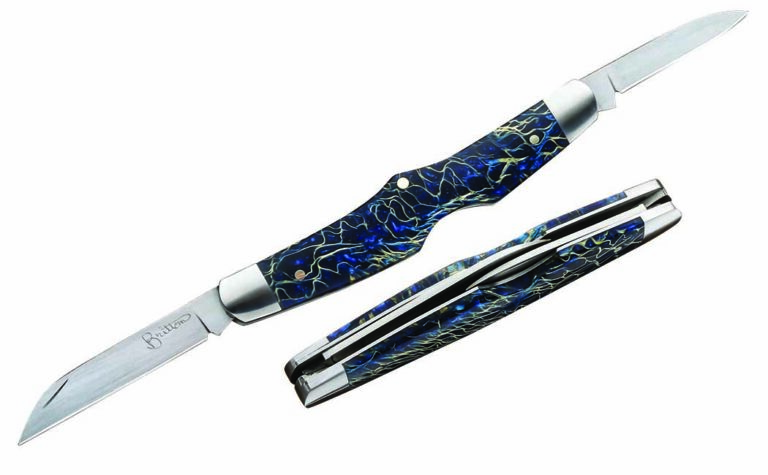
When ABS master smith Bruce Bump showed an old Keen Kutter penknife pattern to veteran knifemaker Tim Britton, Tim fell in love with it and immediately set to making his own iteration.
The blades of his version are BG-42 stainless steel that, as Tim noted, has high ductility and holds an edge forever. He flat ground them on his “ancient” 18-inch, 200-pound Porter Cable disc sander. However, it’s the handle that really stands out.
Consisting of stabilized diseased ash burl from Whistle in the Woods, the material looks synthetic but isn’t. “The light stuff in it looks like explosions,” Tim said. “I’ve never seen anything like it.” The projection on the spine fits right in between the user’s index and middle fingers and the groove on the underside cradles the latter for a comfortable, secure grip.
Calling it the Badger, Tim made 10 of them and showed them off to the world at BLADE Show 2022 in Atlanta.
Who Is Tim Britton
Britton has been making knives since 1971 and has spent much of his time recently creating slip joints, of which the Badger is one of his latest. While his knifemaking career started by making hunting knives for dressing game to crafting tactical knives and small folders and slip joints from his shop in Winston-Salem, North Carolina.
With more than a half century of experience, Britton has carved a place, pun intended, for himself among the top knifemakers in the country.
Badger Knife Specs Maker: Tim Britton Blade Steel: BG-42 stainless Blade Grind: Flat Handle Material: Stabilized diseased ash burl from Whistle in the Woods Closed Length: 3.5 inches Maker’s Price For A Similar Knife: $375
Custom Pocketknives Always Seem To Make Us Feel Nostalgic. These Models From Talented Custom Makers Are All Gems.
There’s something about classic custom pocketknives that tugs at the heartstrings. Once you get bitten by the bug it’s an itch you can never quite finish scratching. It becomes indelibly etched in the DNA.
Fortunately, custom knifemakers never tire of building them and every year provide new offerings and fresh looks. Meet four of those makers, each highly skilled at the craft who build exquisite knives with personalities all their own.
With its beefy bolster and no-nonsense stout handle, the barlow slip-joint pocketknife is designed for hard use. Adam Rogers gave his two-blade iteration all the right stuff for a million-dollar look.
“I see the barlow as the perfect example of a gentleman’s folder, very universal and great as an everyday carry,” the Aussie maker observes. His upscale workhorse is 3.35 inches closed with a 2.2-inch spear-point main blade and a 1.57-inch secondary pen pattern. He chose CPM 154 stainless steel to do the cutting chores and the fluted bolsters are 416 stainless. “The long pull works well with the shape of the spear blade, whilst giving easy access to open,” Adam notes.
The upscale liners are jeweled and the backsprings are CPM 154.
Why did he choose giraffe bone for the scales? “Giraffe bone is a great product to work with, easy to use with a large variety of colors available,” Adam assesses. “Paired with the fluted 416 stainless steel bolsters it gives the folder a clean, sophisticated look.” Other traditional pocketknife patterns Adam offers include the sowbelly, saddlehorn trapper—both single and twin blades—small and medium trappers, wharncliffe trapper, Lanny’s Clip and the muskrat.
Trapper By Bubba Crouch
Bubba Crouch goes the unusual materials route for his dress slip-joint trapper, including a 4-inch blade forged from old Schrade trapper blades and handle wood from the pole that held up the original telephone lines from the house to the office of famed Texas cattle baron Charles Goodnight. (SharpByCoop image)
You might say custom knifemaker Bubba Crouch doesn’t walk the straight and narrow. Instead, he infuses interesting stories and twists in his slip-joint pocketknives that make them truly remarkable. Take, for instance, his dress trapper.
“A customer gave me the wood for the handle he bought at a fundraiser auction from the estate of Mr. Charles Goodnight,” Bubba says. “The historical wood was holding up the original telephone lines from Goodnight’s house to his office.” Just so you know, Goodnight was a living legend among cattle barons in the latter half of the 1800s.
If that isn’t enough to set Crouch’s trapper apart, the 4-inch clip-point blade with the deep belly is forged by Jason Fry from old Schrade trapper blades. The integral bolsters are made to resemble the beaten copper pots Bubba’s mom acquired in New Mexico when Bubba was a child. “I’m always hunting for something unique with a historical past,” he states. “It’s really challenging trying to find these items.”
Like Tom Ploppert (read on for more on him) and many other slip-joint makers, Bubba gets no small part of his inspiration from BLADE Magazine Cutlery Hall-Of-Fame® member Tony Bose.
“I build mostly trappers in three sizes but I have also built Saddlehorn trappers from the Tony Bose design,” he says. “I’ve built a few lockbacks too but my market is mainly the trapper.”
The Lincoln Folder
Eugene Shadley’s Lincoln Folder is a reproduction of the six-blade congress pocketknife that was on President Abraham Lincoln’s person when he was assassinated. The blades are CPM 154 stainless steel and the handle is smooth white bone. Maker’s price for a similar knife: $5,000.
Custom knifemaker Eugene Shadley is royalty among slip joint aficionados, so it’s only fitting we feature his reproduction of a pocketknife owned by one of our most famous presidents.
“The Lincoln Folder is my rendition of the congress pocketknife Abraham Lincoln had in his pocket the night he was assassinated,” Shadley notes. “A customer asked me to make a copy.”
The Lincoln Folder is only 3.5 inches closed yet features six blades inside its compact frame. The liners and bolsters are 416 stainless steel with smooth white bone scales topped with a gently curved round bar shield. The blades include a large spear, large sheepsfoot, a cutoff pen, two pen blades, and a manicure blade with a nail cleaner and a file on either side.
Just how tough is it to make multi-blades, especially one with six blades? “Anytime you make a knife where blades pass each other, everything really does need to be in its place,” the award-winning maker and a past president of The Knifemakers’ Guild explains. “A lot of factory knives had a little longer and thinner blades that passed each other. Those knives tended to be more utilitarian and rubbing was the norm. We custom makers are expected to make sure blades do not rub each other.”
Wilbert Saddlehorn Trapper
The Wilbert Saddlehorn Trapper by Tom Ploppert is a lockback with a rich factory history. BLADE Magazine Cutlery Hall-Of-Fame® member Tony Bose introduced Tom to the knife many years ago. Tom’s price for a similar reproduction: $2,100. (Mitchell D. Cohen photography)
Tom Ploppert’s Wilbert Saddlehorn Trapper is a reproduction of a lockback with a rich factory history.
“Wilbert Cutlery Co. was located in Chicago and was a retail brand sold by Sears Roebuck & Co. through a contract with Napanoch Knife Co. and Empire Knife Co.,” he explains. “They were made from approximately 1908 to 1921. Tony Bose introduced me to this knife and its history many years ago and shared the pattern with me as well.”
The scales are a gnarly premium stag and the integral bolsters are 416 stainless steel. Closed length: 4.5 inches. The Wilbert’s 3.75-inch clip-point blade of CPM 154 stainless steel features a classic nail nick. “There is a lot of blade to fit into a narrow handle and bolster area,” Tom states. “It requires a lot of adjustments along the building process.”
Another notable feature is the blade’s well-defined grind. “I hollow grind all my blades with a 20-inch Burr King grinder using a 1-inch-wide wheel,” Tom notes. “I get crisp grind lines using fresh new belts. Bill Ruple [page 12] taught me early on that nothing cuts like a fresh new belt—along with years of practice.”
Bruce Barnett’s Peanut Pocketknife
Australian ABS journeyman smith Bruce Barnett likes serpentine pocketknife patterns. His peanut with its curvy handle is an example. (Rod Hoare knife image)
Australian knifemaker Bruce Barnett found the peanut pocketknife pattern to his liking and fashioned a striking example of it.
“I really like the subtle and serpentine-shaped knives, and took it upon myself to stretch it to 3.5 inches and reshape the pivot end,” he related. “Shaping up a nice, long wharncliffe for the second blade was challenging in itself, and I think this one looks pretty cool.”
Barnett’s peanut features a blade of his damascus forged from 1080 carbon and 15N20 nickel-alloy steels in a ladder pattern, mammoth ivory scales, and a 410 stainless frame and bolster. He wanted to make a working knife true to the classic peanut style and succeeded, commenting, “I realize it was generally a small two-blade that fit in your money pocket, but so does this one in today’s working man’s jeans.”
This particular knife is available for $1,350 from Bruce, and a similar piece would run roughly the same price. He uses his forged damascus in about half the knives he produces, both in traditional work and for specific custom orders. His 410 or 416 stainless frame and 154CM stainless spring materials are common, and he appreciates the understated surprises sometimes present in mammoth ivory.
“I find these materials easy to use and can trust them not to fail,” he commented, “and with mammoth ivory, it’s very stable and durable, and you never know what colors are hiding under the bark.”
After 12 years as a part-time knifemaker and working as a mining maintenance manager, Bruce began making knives full-time in 2017. His farming and mining background had always involved knives, but the catalyst for a move into making his own came from another passion.
“I was introduced to custom-made knives by Max Harvey, who donated a large bowie for me to raffle to help fund my drag racing habit running a nitro-methane-powered Harley-Davidson, which I went on to win the Australian championship on,” he remembered. “After a pretty serious accident, I gave up racing and was instantly looking for something else to do. I had never forgotten that knife. I decided I would try and make one—and here we are.”
Harvey Dean’s Texas Tornado
ABS master smith Harvey Deanmarries 24k-gold engraving and escutcheons, antique shell and Dellana Dots on the blade of Texas Tornado pattern damascus to cap off his ornate Coke bottle pattern. (SharpByCoop knife image)
The famed Case Coke bottle pocketknife took on a new twist when Harvey Dean paired the well-known handle shape with a sleek dagger blade in his Texas Tornado damascus of 1075 carbon and 15N20 nickel-alloy steels.
This beauty sports a blade of 4-3/8 inches, closed length of 5.5 inches, and lustrous scales of antique shell. Distinctive Dellana Dots accent the blade to assist in opening, while Harvey did his own engraving in 24k-gold overlay with 24k-gold escutcheons. The bolster and guard on each side are integral 416 stainless steel pinned together.
The dagger blade and Coke bottle handle are traditional, but Harvey’s variation marries them in a stunning display that literally makes the “old” something new and exciting in this custom pocketknife.
“I just thought it looked good,” Harvey commented. “I kind of modified the Coke bottle shape from the Case pattern as their bolsters are straight. Dellana is the first person I know of that instead of using a nail nick or thumb stud, put gold-raised pins in the blade so you could open it with them. I liked that when she started with it.”
Harvey made his distinctive Coke bottle dagger for the Art Knife Invitational (AKI) and said it sold for $9,600. So, with the pricing benchmarked, another similar knife would sell for around the same. In addition, however, the owner receives not only the knife made by one of the premier makers in the world today, but also a fine example of Harvey’s engraving skills.
“I don’t remember how many years ago I started engraving,” Dean mused, “but it’s been close to 10 since I went to the GRS Engraving School [grs.com]. This engraving is overlaid gold instead of inlaid, and the background is also engraved. I called [engraver and AKI coordinator] Barry Lee Hands when I was doing it and told him the pucker factor was very high. This is the first knife I’ve ever done with that much stuff on it, and one of the most ornate knives I’ve ever done. If you look closely, the leaves are actually shaded with round cuts instead of regular cuts like most shading is done to catch the light and get a lot of glittering in the look.”
Tobin Hill’s Custom Cheetah
Tobin Hill said the tough part about reproducing the old Case folding-guard Cheetah pattern is getting the guard to lock tight in the open and closed positions with no rattle or play. (SharpByCoop knife image)
Another tribute to the Case brand comes in the form of Tobin Hill’s version of the venerated Cheetah folder. His take on the Cheetah features the folding guard that made the pattern famous. Both the 3.5-inch blade and guard are CPM 154 stainless steel, while the handle is a superb amber red stag. Closed length: 4.3 inches. The spring and lock guard are also CPM 154, while the liners are 410 stainless and the bolsters are 416 stainless.
Tobin said this particular Cheetah sold at BLADE Show 2022 for $1,100, while its twin, handled in mammoth ivory, sold at $1,200. Pricing would be similar for another such piece.
“I chose to build the swing-guard Cheetah because of the uniqueness of the mechanism,” Tobin said. “I haven’t seen many other custom makers try it and I like the challenge. The tough part is getting the guards to lock up tight in the open and closed positions with no rattle or play. I’ve seen several production models over the years that did rattle.
“Case has produced several versions of the swing guard. The pattern has always been called the 11½ series. They started making them between 1896-1915. I’ve seen models stamped ‘Case Brothers,’ ‘Case Tested,’ and ‘Case XX.’ The Cheetah pattern I copied was first made in 1973. They also produced the Cheetah Cub, a three-quarter version. The blades were mainly flat ground but I’ve also seen dagger grinds, some with crescent nail nicks and some with long pulls. I hollow ground my knife and thought it would be cool to put both a crescent and long pull in.”
Tobin has made knives for about seven years now and completed his first work on April 16, 2016. While he is still a part-time knifemaker, he hopes to devote more hours to it after possibly retiring soon from his own insurance agency following 42 years in that industry. Prior to making knives, his hobby was no less challenging—restoring violins to their original condition.
Tyler Turner’s Custom Pocketknife
“I was wanting to make a slip joint that was not made by custom makers often and that had some sex appeal to it,” Tyler Turner smiled. “And the graceful curves of the toothpick fit that bill perfectly.” (SharpByCoop knife image)
When Tyler Turner took on a toothpick project, he was looking for a certain flair that he knew was otherwise hidden.
“I was wanting to make a slip joint that was not made by custom makers often and that had some sex appeal to it,” he smiled. “And the graceful curves of the toothpick fit that bill perfectly.”
His long, smooth toothpick features a 3.25-inch blade of damascus forged by Damasteel in the Fafnir pattern, with integral bolstered liners in 416 stainless steel, a CPM 154 spring, top-grade mother-of-pearl scales, and 24k-gold engraving and inlay by Jody Muller. Tyler said the handsome toothpick sold for $2,200, and another in a similar composition would command about the same price.
“The materials were chosen to accentuate one another,” he explained. “The most challenging aspect to the build was grinding the blade. My design led to a very acute angle at the tip. I always grind post-heat treatment, so a lot of care went into grinding it slow and cool so the tip did not turn color and ruin the temper.”
Tyler indicated the toothpick pattern, custom versions of which are less often seen than other patterns nowadays, originated in the early 1900s. It became popular with its easy carry and useful clip blade. And the blend of an older, traditional pattern fit in nicely with the maker’s perspective on his art.
“I would say I have a very eclectic style,” he remarked. “I invite the challenges of making a wide variety of knives so that it always pushes me to be better. Plus, it keeps people guessing!”
A resident of Hopkins, Missouri, Tyler is a part-time custom knifemaker and fourth-generation farmer. He grows amylose corn and soybeans with his father and has been making knives for about nine years now, primarily in the summer and winter. For Tyler, the family farming tradition goes hand in hand with another vocation, a foray into traditional knife patterns with the imprint of his own style.
Editor’s Note: Mike Haskew contributed to this piece.
Read More
Sharp In Reverse: 5 Reverse Tanto Blades Worth Your Time