
Knifemaking

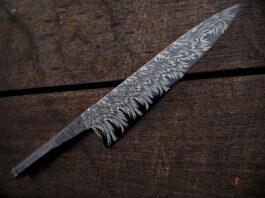
Knifemaking is the building of a knife, which includes the blade, handle and other accouterments. Blades are made by either removing metal from a steel blank via a grinder – known as stock removal – and the forging to shape of hot steel into a blade in the process known as bladesmithing. Other parts, including bolsters, guards, pommels, etc., are needed to complete the finished knife.

Featured Knives – – Knife Collecting – – Tactical Knives – – Survival Knives

My Five Favorite Makers

0

After Decades In And Around The Knife Industry, The Author Reflects On His Five Favorite Knifemakers And What Makes Them So Memorable.

Over the past 38 years, I’ve met thousands of knifemakers with work ranging from newbie to legend. Being a newbie myself at first, I found myself gravitating to the newer makers, primarily because I could afford their knives and could get one without waiting years or decades.

Today I approach things differently and look for outstanding makers who share the following traits:

•Each is charismatic in his own way;

•Each gives of both his time and talent(s) to educate others, and;

•Each has a great sense of humor and is serious about his knives.

Here are my five favorite American makers who share the traits I look for most.

Walter Brend

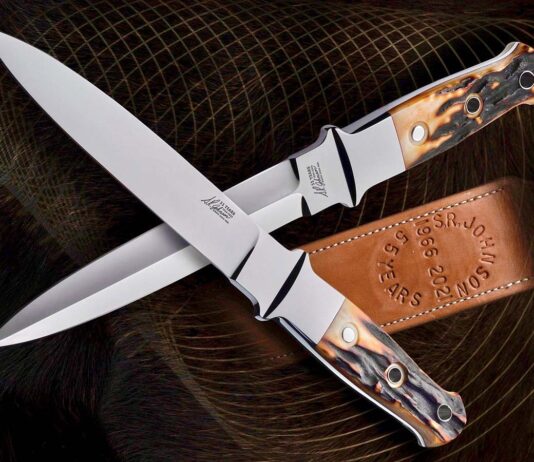
 The SF Dagger by Walter Brend features an 8-inch blade of D2 tool steel with a satin finish and Walter’s impeccable grind lines. Handle: black Micarta®. Guard: stainless steel. Special features: Full-tang construction, double edge, thong hole and a skullcrusher pommel. Overall length: 12.75 inches. (SharpByCoop knife image)
 The SF Dagger by Walter Brend features an 8-inch blade of D2 tool steel with a satin finish and Walter’s impeccable grind lines. Handle: black Micarta®. Guard: stainless steel. Special features: Full-tang construction, double edge, thong hole and a skullcrusher pommel. Overall length: 12.75 inches. (SharpByCoop knife image)

During my military service in the U.S. Army 101st Airborne, my unit went through processing for an overseas deployment. At the time I was carrying a Robert Parrish hollow-handle fighter with a serrated blade. It was suggested to me that I find a new knife that didn’t have serrations. That was the bad news. The good news is I had to buy a new knife, and the search began.

Scanning a magazine I saw a photo of three knives, all different lengths of the same model. I was immediately drawn to one of the knives, found the maker’s contact information and called him. On the other end of the line was Walter Brend and I ordered the knife: an 8-inch Model 2. In October 1985 I bought my first of hundreds of knives from Walter. In my opinion, his Model 2 is the finest tactical fixed blade in the world.

What draws my eye to the knife are the impeccable grinds. Perfect symmetry runs the length of the blade, including both the top and bottom grinds. The radiused guard and contoured handle are also trademarks of Walter’s work. These features may not be more evident anywhere than in his daggers. Clean, precise, sleek and lethal are words that all come to mind.

David Broadwell

According to the author, David Broadwell makes the world’s best sub-hilt fighters. An example is his Fuller Sub-Hilt Fighter in a 9-inch blade of Delbert Ely damascus. Handle: ancient ivory. Guard, sub-hilt and pommel: damascus. Overall length: 14 inches. (Image courtesy of Photography By NB Designs)

I was visiting family and friends near Chicago in 1988 and attended a small knife show. I had recently started buying guardless fighters, as the knives’ clean lines appealed to me. On the show table before me was a beautiful guardless fighter with an engraved bolster. The knife felt great in my hand and the price was more than reasonable. I bought the fixed blade from David Broadwell.

My favorite knife has always been and still is the sub-hilt fighter, and David excels at making one. Having written about him for several publications, I have always pointed out I think he makes the best sub-hilt fighter(s) in the world.

David is an artist in the true sense of the word. His eye for detail and beauty in steel is exceptional. He and I have collaborated on several designs over the years. He takes my basic two-dimensional linear drawing and brings it to three-dimensional life.

Diversification is one of David’s hallmarks. In the early 2000s I asked him to build knives that featured stone handles. Most were sub-hilt fighters and today remain some of my favorites.

When Bob Neal and I did our LDC Custom Knife series, David was the only maker to contribute both a folder and a fixed blade to it. Today he creates masterworks of art that would be at home in any museum in the world. While my design ideas were not always his favorites, David delivers knives that were everything I had hoped for—and more.

RJ Martin

RJ Martin has won awards for both best tactical folder multiple times and also best tactical fixed blade at past BLADE Shows. His Ghost Pepper Q36 cover knife sports a 4-inch blade of Chad Nichols damascus, a titanium frame and hand-rubbed zirconium bolsters. Scales and spacer material: black carbo quartz w/orange G-10 back-side inlays. (SharpByCoop knife image)

I was at The Knifemakers’ Guild Show in 1996 and, like everyone else, walked up and down the aisles looking for that one special knife or 12. I passed a maker who had Japanese-style tacticals on his table. I took two steps, did an about-face and walked back to the table. I was greeted by the big friendly smile many now know belongs to RJ Martin.

The guards, handles, sheaths and particularly the blades were the cleanest I had ever seen on a Japanese-style tactical. Trends change and I suggested to RJ that he should consider making a tactical folder. Within a month he sent me his first one, the Q30. I couldn’t believe it was his first folder. It easily rivaled most of the well-known tactical folder makers of the day. Then again, I should have expected this from a lead airframe engineer for Sikorsky helicopters such as RJ. He lives in the world of thousandths of an inch and milligrams.

From 2000 to 2010, RJ made 12 different limited designs for my Robertson’s Custom Cutlery Vanguard series. They featured hollow-handle fighters, a sub-hilt fighter, Japanese-style tacticals and, of course, folders. He is one of the few knifemakers in the world skilled enough to do it all with equal excellence. Quite notably, he has won the award for both best tactical folder a number of times and also best tactical fixed blade at past BLADE Shows.

Today his folders are among the most sought after in the world. Unlike so many of the tactical folders built over the past decade, his increased in price in the aftermarket. For those in pursuit of a level of perfection most of us cannot appreciate, RJ is that perfectionist.

George Herron

The author stated the knives George Herron made are design-driven, exactly what you would expect from a lifelong hunter and fisherman. The Herron Model #12 boasts a 6.5-inch blade of ATS-34 stainless steel with a mirror finish. (Impress By Design knife image)

I was attending the 1987 BLADE Show when a friend introduced me to BLADE Magazine Cutlery Hall-Of-Fame® member George Herron. With his pipe hanging from his lip, George said, “Lad, what is it you do for a living?” I said, “Mr. Herron, I’m in the Army.” He smiled and said, “I was in the Army, too. You see anything on the table you like?” 

Had I known then what I know now, I would have bought every knife on the table. His knives were clean, lightweight, possessed exceptional handle ergonomics and were design-driven—all traits you would expect from a lifelong hunter and fisherman.

Years after meeting George and his wife, Miss Barbara, I attended the Southern Wildlife Expo in Charleston, South Carolina. This was long before the drawings and bid-up knives that have become common today. It wasn’t long before I noticed over 90 people waiting in line. I asked the person at the end of the queue if this was the line for admission to the show. He said, “No, this is the line to get a knife from Mr. Herron.” With that, I bought my show ticket and went to the table where Miss Barbara was standing.

There I was treated to an experience akin to watching children waiting to visit Santa Claus. They all had ordered their Herron knives long in advance of the Wildlife Expo. They approached the table, paid Miss Barbara and she handed their knife to George. It was then you would see young and old alike light up as if it were Christmas morning as they received the “toy” they had longed for—a Herron knife from George himself. I saw three generations of knife buyers—first-time knife buyers, hardcore Herron collectors, they were all there. It was truly a sight to behold.

Steve Randall

As the author noted, there is never any backward movement with the work of ABS master smith Steve Randall—his knives always continue to improve. Steve’s 7-Bar-Twist Sub-Hilt has a 10-inch blade of a seven-bar-twist damascus in 1080 carbon and 15N20 nickel-alloy steels, and an ancient walrus ivory handle. Maker’s price at press time: $3,300. (Alison Randall knife image)

Before the 2015 BLADE Show, I was checking out custom knifemakers’ work on various social media platforms. I kept returning to one maker in particular, ABS journeyman smith Steve Randall.

While photos can be deceiving, I have a pretty good eye for knives. Looking at images of his knives, I could tell he too had a good eye and understood making knives well beyond the short time he had been making them. He combined all the dimensions and aspects of the knife to make it flow.

I bought my first knife from Steve at that 2015 BLADE Show. In 2016 he earned his ABS master smith stamp. In 2022 his knives continue to impress me. There is no backward movement with his work and his knives continue to improve.

One of Steve’s best attributes is that he is willing to learn and try new things. In my opinion, many ABS master smiths are reluctant to work outside their comfort zone. I have asked Steve to build knives for me and my clients that may have some aspects he had never done before. Steve and his work never disappoint.

I was fortunate to have worked with or still work with my five favorite American makers. They have taught me so much about the art of knifemaking, and those who are with us still do. (Mr. Herron passed away in 2007). Perhaps more importantly I consider each of them a friend.

Read More

Learning How To Make A Knife

The Author Learned What It Took To Make A Knife From The Legend Les George In Mississippi.

When I finally met him in person, Les George had been making knives for 30 years. I had never made a knife in my life. 

I had spent most of the years preceding our meeting in the Marine Corps. Les spent a decade as a Marine himself and, though we just missed overlapping in Iraq, we came to know one another through mutual connections in the Corps.

After a few years of exchanging texts featuring the kind of sarcastic insults and self-deprecating jokes in which we both seem to specialize, we found ourselves driving south from Memphis and discussing designs for the blade I intended to make in his shop.

His approach is to “try and reimagine what the guys who designed the classics were trying to do, and then do it with the advantage of 100 years of technology.”

That seemed perfect for the knife I wanted to make, one my potential grandkids might remember me carrying but that used modern design and technology to its fullest advantage. I envisioned a classic utilitarian field knife I could use to dress a deer, cut a rope or hack some limbs for a duck blind, yet one with sufficient aesthetic value to pass on someday.

As we drove down US 78 in Mississippi, I chose one of several full-tang designs Les had drawn on wood and then cut with his computer numerical control (CNC) machine. Given my experience level and general facility with machinery, the potential for catastrophic injury seemed high.

A sign on one of the shop machines confirmed that impression on arrival at George Knives: “DANGER: NOT ONLY WILL THIS KILL YOU, IT WILL HURT THE ENTIRE TIME YOU’RE DYING.” Still, given that Les started making knives at 12 with a SKIL® saw blade, a hack saw and step-by-step book, I figured I was in good hands.

Learning The Machinery

We started work as night fell on the Mississippi woods where George Knives are made. With the door of his shop open, the sound of tree frogs joined the smell of machine coolant as I chose a piece of Chad Nichols damascus steel because I liked the look of it, and because Les considers it the best in the nation. 

Safety is Job 1 in the knife shop and while the sign in Les’s shop may seem flippant to some, the point it stresses is—pardon the pun—dead serious.

Nichols can pattern his steel with almost anything a customer desires. I chose the undulating lines of classic damascus because they hearken back to the old damascus shotguns my great-grandfather carried hunting quail. I laid the wooden blank out on the steel and used a scribe to trace the knife’s outline.

For me, making a knife was an introduction into a world of machines designed to strip away parts of a purposefully hard material; a jungle filled with new things specifically designed to maim me. As we prepared to rough cut the knife’s profile with a bandsaw, Les smiled and pointed at the saw blade. “This is the part you don’t touch under any circumstances,” he warned. I had visions of my suddenly amputated fingers spinning onto the cement floor of the shop. 

My fears proved unfounded but I still approached both the grinder we used to bring out the knife from inside the steel, and the drill press we used to create holes in the tang for bolts, lanyard and to lighten it with the same trepidation as the bandsaw.

Asked whether I needed protective equipment, Les replied, “No, you don’t need protective equipment, you need a better plan. Remember, all the machines in the shop hate you. They think you’re a big bag of grease they can use to lube their parts.” 

Despite my new-guy fears, when you are open to learning something new and are guided through a process by a craftsman, it becomes easier. Simply put, Les is a great knifemaking teacher as well as a great knifemaker, and, as a cascade of metal shavings fell to the floor and my idea took the general shape of a knife, I began to have a kind of focused fun.

Heat Treating Steel

 With the steel still red hot, the boys placed it between aluminum plates for plate quenching to reduce the temperature quickly, making the steel hard.
With the steel still red hot, the boys placed it between aluminum plates for plate quenching to reduce the temperature quickly, making the steel hard.

Heat treating steel is not the most exciting step in making a knife but it may be the most critical. Les explicitly says it is not art but a science of repeatable numbers—just simple math. Did I mention I write because I am atrocious with numbers? 

Undaunted by my incompetence, we hardened the steel. Les explained the purpose: “Heat treating determines how long the knife cuts. Knifemaking is always a balance between toughness, which means it resists breaking, and hardness, which means it resists dulling.” 

To avoid scale, in which the steel flakes and is decarburized, we sealed the blade inside a pouch made of stainless-steel foil, placing a piece of paper inside the pouch with the blade. The paper ignites at what is known as critical temperature and consumes all the oxygen in the pouch. 

On emerging, the steel was brittle and sounded different than before when lightly struck. With the steel still red hot, we placed it between aluminum plates for plate quenching to reduce the temperature quickly, making it hard. That hardness was drawn back to a usable level by again sending it for a longer, lower temperature ride in the heat treat oven while we headed off for a well-earned night’s sleep.

Creating A Badass Knife

The next morning, Les said, “You’ve got all day to do once what I can do thirty times in a short day.” So, supervised by Les, I scribed a centerline on the thickest part of the blade to guide the bevel grinding process. 

This was what I had envisioned knifemaking to be and it turned out I was not wrong. As Les relayed to me, “Bevel grinding is knifemaking. The grind establishes the cutting geometry, which determines how the knife cuts.” I watched Les for just a moment before he took off the training wheels and I began grinding the transition from tang to cutting edge, a design feature called the plunge. 

It’s a cosmetic factor and Les cautioned me against chasing a refined plunge. “If you’re chasing perfection,” he said, “you’re setting yourself up for failure. We don’t set goals we can’t meet. There has to be technical correction, but after that I’m chasing badass.” I wanted badass, but the lesson was to let it come to me.

 The author’s finished fixed blade features a blade of Chad Nichols damascus and a Micarta® handle in a brown finish. The blade etch reads “RW Parker Rio 2021.”
The author’s finished fixed blade features a blade of Chad Nichols damascus and a Micarta® handle in a brown finish. The blade etch reads “RW Parker Rio 2021.”

With Les watching me grind while calling our mutual friends to make fun of me and narrate my progress, I began to produce something worthy of being called a knife. Les offered corrections from time to time but allowed me to get the feel of both the belt and the emerging blade. He also eased my concerns by telling me, “The cool thing with fixed blade knives is we never make a mistake, we just make a smaller knife.” Once the blade was ground to the point that it really began to look like what we had envisioned, it was time to choose handle material.

For the handle, Les had a pile of Micarta® samples from which I chose a brown finish as a nod to wood or oiled leather. We cut and fitted roughly shaped Micarta to the tang, then disassembled it all again to submerge the blade in ferric chloride to bring out the pattern of the damascus. 

The soak time of the steel gave us a window to grind the Micarta to shape the grip. There is no detail left unconsidered in a Les George knife design. We talked through how I wanted the handle to feel, how I envisioned using it, and how to make sure that the aesthetic I had in my mind’s eye materialized. Then we ground the two pieces of the handle and wiped them down with oil to create a bit of the wood or leather-like patina I wanted.

Finally, we arrived at the last major step—sharpening the blade on the grinder. We walked outside the shop for a moment and Les asked whether I wanted to sharpen the blade. “It’s pretty much the last chance you’ll have to really screw it up,” he said. I was unsure and said so. In a rare moment of genuine seriousness, Les looked at me and said, “When I made my first folder, Stan [Fujisaka, master knifemaker and his mentor] sharpened it. The last stroke Michelangelo took on David was the only thing he could do. It’s a funnel of decisions. We started with a huge sheet of steel. The closer to the end we get, the fewer decisions we have.”

Though I had proudly done every previous step—with a lot of adult supervision—I decided to let Les handle it. Seeking to salve my pride, I asked him, “How long did it take you until you were confident at this stage of the game?” Looking down at the blade as he addressed the spinning grinding belt, he smiled and said, “I’m still not.” Then he put a razor edge on the blade before telling me we’d reached the point at which we would stop chasing perfect and accept damn fine.

Finding Meaning In My Knife

A Les George knife is a hybrid born of technical mastery, space age technology, and a timeless artistry that is sometimes simply the application of physicality to metal. Mine was no different. While Les acknowledges his biggest strength as a knifemaker is the ability to “work at any level of tech, from hand tools to computers,” the essence of his designs is that he takes his craft seriously without taking himself so. 

He knows that the core of his business is in innovating blades in the pursuit of “a badass design that speaks to your inner 13-year-old” and, as such, he spends little time navel gazing. He is an artist who doesn’t so much reject the title as the contemplation thereof, saying, “I don’t think about it. I don’t know what art is. I rebel against the idea that men have to define themselves by what they do.” 

That may be difficult when you’re a man who makes knives that sell before they’re even made. And whether he defines himself as a knifemaker, a craftsman, an artist or just a guy in a shop, there is no question that he is still answering a call he heard when he was 12 years old. 

Nonetheless, he says, “I try not to base my life on what happens in this shop. Sometimes I want to quit this. But what else do I want to do more? I do this because I have to. I know I’m going to make knives. I want to not have to make knives after a day of doing something else.”

As I looked at the knife I had wanted and now held, one I created with my own hands, I understood the compulsion.

Read More

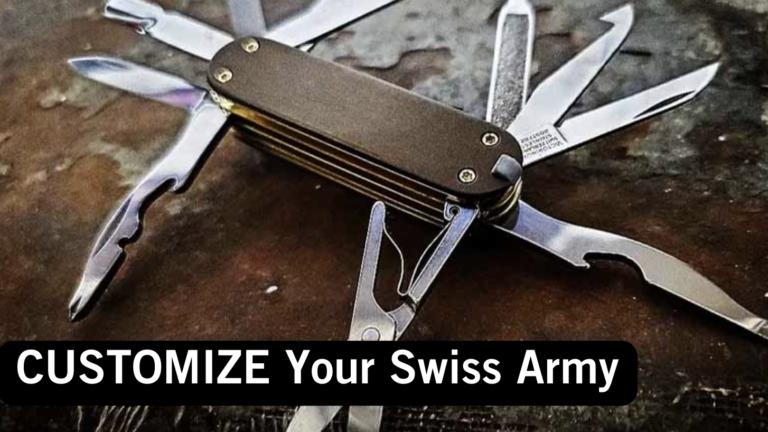
How To Create A Custom Swiss Army Knife

0

An Icon In And Of Itself, You Can Still Customize Your Swiss Army Knife To Make It Your Own.

There are few, if any, knives as instantly recognizable as the famous Swiss Army knife. The multi-tool is beloved around the world for its versatility and quality construction. 

While the famous red color is a global icon, there are far more ways to make the knife look how you want it. Some of these customizations are offered by Victorinox itself while others are more DIY. 

Either way, there is no shortage of ways to create a unique custom Swiss Army knife wholly your own.

Factory Customizations

Victorinox calls them “personalizations” and there are many ways you can find a Swiss Army knife that fits your needs and make it your own.

Different Sizes

The Swiss Army knife comes in a variety of sizes. Small knives weigh less than an ounce while the largest models can come with their own carrying/display case. Different sizes mean different types of blades and tools so you can pick the knife perfect for you.

Scales

Another excellent option from Victorinox is the ability to change the scales on many of their knives. Yes, every option defaults to the famous red but you can choose from many other colors and designs. You can choose camouflage, flags, and even transparent scales among a whole variety of solid and textured colors.

You also have the option of custom engravings on the scales to personalize them for yourself or a friend.

Specific Tool

While no two Swiss Army knife models are exactly alike in terms their tools, it’s possible to go a step further and order custom implements. For instance, Victorinox filled an industrial-sized order in Europe for a batch of knives featuring a toilet-paper holder key.

True enough, this isn’t something you’d need on a single knife for yourself. But, having the option for custom bulk purchases set the knife apart.

Knifemaker Customizations

There are makers today that make custom Swiss Army knives. Some stick to the aesthetic and make scales from exotic materials or designs. Others turn the knife on its head and make their own tools for the knife. Regardless, there are brilliant craftsmen creating one-of-a-kind Swiss Army knives around the world.

Chris Custom Works

Black Cerakote Grooved Soldier. Price $202.37

Based in Germany, Chris Custom Works specializes in detailed custom Swiss Army knives to order. From a handmade set of scales from wood or other materials to a fully modified suite of tools, the sky is the limit. As you can see above, the company’s Black Cerakote Grooved Soldier, not only are the scales one of a kind but the tools are finished with black Cerakote to match the micarta handle.

Andrzej Woronowski

Woro Knight: $221.95

Woronowski is based in Gdansk, Poland and makes beautiful custom scales for Swiss Army knives. His designs aren’t as loud and eye-popping as some other makers, but his craftsmanship is remarkable. With the help of his brother Kamil, Woronowski works with metals such as titanium, brass, and copper to create custom SAK models that are elegant and stand out. 

Sean Dooley

74mm Spydernox Clipitool Saw Executive.

Through his Sak Custom 58mm brand, Dooley has thumbed his nose at the traditional Victorinox designs and created magical works in their place. For starters, he removes the famous spear point blade from many of his builds and replaces it one-to-one with a blade from Spyderco.

This “Spydernox” hybrid, and Dooley’s creativity, are on full display with the knife above. The Spyderco blade and neon yellow G10 liners, the whole construction could convincingly seem like a completely different model, not a custom Swiss Army knife. It’s truly remarkable what Dooley has been creating from his shop in Connecticut.

Read More

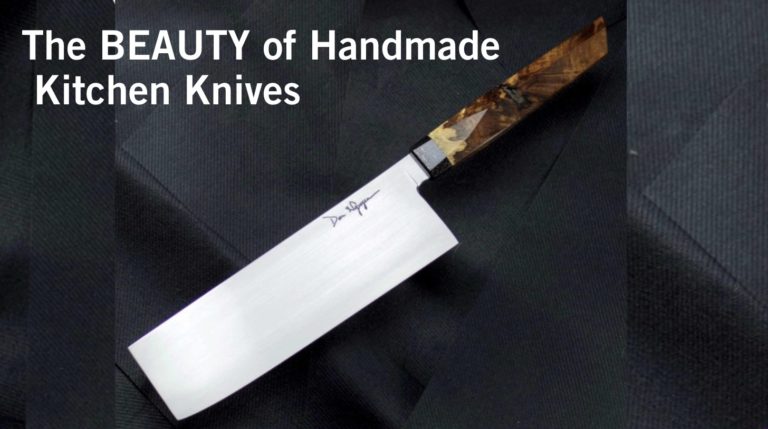
The Beauty Of Handmade Kitchen Knives

Handmade Kitchen Knives Reimagine What A Kitchen Knife Can Be

Don Nguyen didn’t know what he wanted from life when he was in college. An evening cooking at a friend’s apartment changed him forever. He was frustrated using his friend’s subpar, dull knives and wanted something better.

“It was that weird moment sharpening at a friend’s place where I said ‘I’m tired of this,’” Nguyen recalled. “I watched a bunch of YouTube videos, and those videos led me from sharpening to seeing Japanese makers make knives. I didn’t know what I wanted to do in life at that point so I was like OK, I want to do this. I dove in from there.”

Dive in he did, and now Nguyen has been making handmade kitchen knives, also commonly called custom kitchen knives, since 2017. He’s one of many makers entering the growing kitchen knife space and finding success.

Custom Kitchen Knife Advantage

Of course, the biggest difference between factory makers and custom makers is scale. A company like Wusthof can turn around hundreds of new knives every month. By contrast, Nguyen and his assistant complete a knife every one to two weeks. This allows for more delicate work when it comes to the actual knifemaking and makes getting different steels much easier.

Large Carbon Gyuto. Steel: 52100. Price: $3700

“Right now we’re probably averaging one knife every two weeks depending on the complexity, but we’re working on multiple knives at once so it’s hard to dictate how long a single knife takes,” Nguyen said. “I have an assistant and he helps me work on a bunch of stuff. We’re juggling projects all the time.

“I don’t have a lot of steel that I need to go through, and the steel choices I tend to use aren’t exotic steels. I go with 52100 for the most part for carbon steel knives. When I go with stainless I go with AEB-L or RWL-34. Those are fairly accessible. They’re usually in stock.”

Why Buy A Handmade Kitchen Knife?

When you talk to him, Nguyen’s passion is clear, and even with that passion, a big question remains: why should someone spend money on handmade kitchen knives instead of buying from a well-known factory maker?

He spoke honestly about how handmade kitchen knives won’t be for everyone, but for those who want them, they want only the best.

“Custom knives are made for a specific type of person,” Nguyen said. “They need to have food as their hobby. If they don’t like cooking all that much, they aren’t the intended audience for that. But if you love food, you follow it, buy books, read up on chefs, then you get into custom knives. Then you get knives in the [top] percentile of performance that are unique, made by someone you admire.”

Steel Sharpens Steel

As more makers enter the market, finding out ways to make your knives that are little bit better than your competitors has become the key to knifemaking. So much so that, according to Nguyen, many makers are working on what the knife does after it cuts the food.

“There’s a lot of interesting trends in knifemaking and the pursuit of the last 1 percent in performance,” Nguyen said. “A lot of makers now are working on food release. Being able to cut the food and having it pop off the [blade] without any effort at all. That’s a huge difference between a knife you buy off the shelf and a custom-made knife.”

Nguyen is one of the highly-skilled makers producing handmade kitchen knives. The below makers are also making exciting knives.

Best Handmade Kitchen Knife Makers

Mert Tansu

Nine-inch Damasteel gyuto in Heimskringla pattern. Price: $1,100

A former executive chef, Mert Tansu has been making remarkable kitchen knives in his native Australia for several years, learning to forge san-mai and damascus, and officially hung up his chef’s coat in 2018 to focus solely on making knives. 

His current knives are made in the Japanese tradition and fetch a tidy price, but the craftsmanship is clear from the moment you lay eyes on the blade.

Mareko Maumasi

4″ Phoenix Rising Mosaic Damascus Brute de Forge Bench Knife. Price: $650

Located in Washington state, Maumasi apprenticed under Bob Kramer, who we’ll talk about shortly, and makes multiple types of knives. He’s made many a wild damascus piece as well, and is a magician at working the steel to create exciting patterns.

“I think he’s one of the best makers out right now,” Nguyen said of Maumasi. “I talk with him all the time about business strategy, techniques, everything we’re going through.”

Bob Kramer

Meiji 10″ Chef’s Knives by Zwilling J.A. Henckels. Price: $379.99

He worked as a professional chef for a decade before asking himself “why can’t I and other chefs keep our knives sharp?” 

That question led him down the path to becoming one of the most accomplished makers of custom kitchen knives in the country. Kramer earned the title of ABS master smith in 1998, and since then he’s been “devoted … to the single-minded pursuit of crafting the perfect kitchen knife.”

His Kramer Knives not only turns out top-tier blades, but now features a small team to help keep the company strong and growing for decades to come. Additionally, his company has licensing agreements with a handful of major knife companies including Zwilling J.A. Henckels.

Andreas Kalani

The Dahlia. Price: $175

Andreas Kalani spent nearly a decade teaching himself the craft of knifemaking. He took his lumps and learned from his mistakes. Those years of trial and error have paid off as Kalani is now an accomplished knifemaker.

He makes beautiful Japanese-style knives as well as other kitchen utensils. Kalani even makes hunting knives and tools for skinning and processing your hunt. It all started with a dream for Kalani, and it has paid off handsomely thus far.

Will Brigham

Pattern-welded Sepharim Knife

Knives from Will Brigham are just as much art as they are kitchen tools. He specializes in pattern-welded damascus and mokume-gane knives. His sells his knives through his company, The Artificery, and he’s pushing hard to make the most distinctive damascus designs and highest-quality blades.

“Will Brigham is making crazy stainless steel damascus,” Nguyen said. “I think he’s kind  of the pioneer of modern stainless steel damascus.”

Read More

A Day At The New England Bladesmithing Symposium

Knifemakers From Around North America Came To Auburn, Maine For The 2022 New England Bladesmithing Symposium

The 12th annual New England Bladesmithing Symposium brought nearly 100 knifemakers and enthusiasts together for the first hammer-in since 2019.

The event ran from July 15-17 in Auburn, Maine at the New England School of Metalwork and featured classes and workshops galore. Throughout the weekend there was something to scratch any itch you may have had about knives.

Master Smith Lin Rhea presented a tutorial on how to make his dynamic X-Rhea knife. There were workshops on everything from how to build out your knifemaking business to forging recurves. 

It was a brutally hot Saturday in the Pine Tree State, yet it didn’t dampen spirits, particularly for the main event– the Battle of the Bladesmiths. The 2-hour competition to pushed four makers to their limits, and drew the largest crowds and interest.

Learning From The Best

The classroom at the NESM is covered wall to wall with tools and other metalwork made by past students just like this.

During the afternoon I was able to drop into a few of the classes. The one I got the most out of was led by Master Smith Christoph Deringer. 

Derringer class about the anatomy of the knife was a joy, particularly the care he gave answering questions. His wry sense of humor even out, like when he called flux a crutch pertaining to forge welds. In that particular case, he suggested simply listening to the metal and letting it guide you when you forge weld, no flux is needed.

He taught everyone a neat trick for adding patina to a blade, as well. The crux, you hang the knife above a piece of heated copper. Heating the copper causes it to emit gasses that rise up and patina the blade to an almost bronze color.

A Successful Weekend

It was a big weekend for the school, gathering makers from the Northeast, Eastern Canada, and even as far west as California. For NESM director Dereck Glaser, it was a successful weekend, particularly given the COVID-related lapse in the symposium the past few years.

“The school, in general, draws from around New England,” Glaser said. “I’m excited to see more Canadians here, to be honest. We can’t forget we have a whole other country on our border. I can’t be pulling students out of the Atlantic Ocean so Canada’s a really good option.”

It’s important for anyone with even a passing interest in knifemaking to visit their local school and learn. Not only can you save yourself toil and trouble, but supporting the broader community of makers helps it survive and thrive even in the lean times.

Journeyman smith Mace Vitale runs a workshop on handle shaping.

“It saves exponentially the number of years,” Glaser said. “Indebting yourself to a week and about $600 could potentially save you 3-5 years of trial and error on your own. The amount of compressed skill and support you get in 4-5 days of a course, answering those questions that’ll take 3-5 years to figure out on your own.”

Glaser said that even with the uncertain economy, he believes the future of the school and knifemaking is bright because the passion is boundless.

“The fiscal issues we’re having is making it rough. It’s 90+ percent an enthusiast kind of hobby and craft for most people,” Glaser said. “Where inflation and cost of living’s gone, everyone’s seeing a toll in the crafts. We’re even seeing it in the welding, which is an employment-based skill. But on a whole, I  think the energy is still there. The love for it is greater than ever. A lot of people did a lot of things to better themselves in it through the pandemic, so I think coming out on the other end I think people are kind of stronger.”

The Passion For Knives

A nice bit of camraderie. Two of the battle contestants Leo Potter (in the hat) and Jeremy Yelle share a fun moment ahead of the contest.

As informative and enlightening as the classes were the attendee’s conversations. Everyone was excited, whether it was to learn from a particular smith, show off a piece they made, or for the battle at night, everyone was open and welcoming.

A Previous winner of the Battle of the Bladesmiths, Emiliano Carrillo (owner of Sun and Stars Forge), was particularly poetic in what he said about the process of making his own steel.

“When I started the smelt earlier in the day the sand runs through my fingers, and by the time the day’s done it’s a lump of material that can be turned into something,” the owner of Massachusetts-based Sun and Stars Forge said. “It goes from being this throwaway material to something that’s actually useful. I think that’s crazy. It really is alchemy to me. It’s addictive. You do it and it works and you do it again and again and it breaks your heart, and then you have some successes.”

The day ended with the battle. Four young smiths were tasked with turning a one-foot bar of 1084 into a complete knife in just two hours. You can read all about the contest here.

In total, the symposium was absolutely worth the trip and should be on your checklist if you’re a serious maker in the Northeast U.S. or Eastern Canada.

To learn more about the New England School of Metalwork, click here.

Read More

New England Battle Of The Bladesmiths

0

Four Young, Talented Bladesmiths Battled The Clock Under The Sweltering Maine Sun To Craft A Knife In Two Hours.

It was brutally hot under the Southern Maine Sun on the campus of the New England School of Metalwork, It was made even hotter when a pair of forges were fired until they were an electric glowing orange. It was all part of the build-up to the Battle Of The Bladesmiths as part of the New England Bladesmithing Symposium.

The rules were simple: given a one-foot bar of 1084 steel, four bladesmiths had two hours to make a knife at least 7-inches long. This meant forging the blade, sculpting the guard, making the handle, and assembling it all within the allotted time.

The theme for the contest was young guns as the youngest competitor was 19 and the oldest was just 24.

“We pick people that are at an equal level of skill,” NESM director Dereck Glaser said. “We had 25 applicants, and we picked these guys based on a moderate level of skill, they’ve all been making knives around the same length of time. And I wanted to get an [similar] age range. I didn’t want big old-school guys coming in against people nobody knew.”

Who Hammered In The Battle

Leo Potter shows off his sword before the battle. Blade: 1084. Guard & Pommel: 1045. He dried local birch for the hilt core.

The foursome was from all over.

There was Leo Potter, already an accomplished smith from New Hampshire who came with pieces to proudly show off and display. Up from Martha’s Vineyard with his parents was 20-year-old Luke Nivala, and down from Quebec was Jeremy Yelle. Kemper Feuerzeig rounded out the field, and he had flown in all the way from California.

Glaser said he was excited to have the field he had and was thrilled to see the battle return for the first time since 2019 due to the COVID pandemic.

“We started doing the battle in 2010 or 2011, and shortly after, Forged in Fire caught on,” Glaser. “That’s where the show came from, this whole battle concept. The ABS was doing this at their events long before the show existed.”

In The Thick Of It

The contest started fast as everyone got their steel into the heat within the first minute. Like dancers, the smiths bounced back and forth from their stations to check on their steel. Every second was used to the fullest.

The smiths used different techniques to make their blades. Feuerzeig forged and ground his blade with authority and was ahead of everyone when he quenched just 30 minutes in. By contrast, after forging the blade to shape, Yelle put his blade in the vice to normalize so he didn’t quench until 70 minutes into the competition.

Nivala kept a steady pace throughout and didn’t let the pressure get to him, or at least kept a cool, confident face. His mother was beaming the whole time with pride in her son.

Lisa Nivala captures video of her son Luke as he competes in the battle.

The contest was to be judged by a trio of renowned smiths, Emiliano Carrillo, Matthew Parkinson, and Lin Rhea. Other legends of the field like Mace Vitale watched on intently and tried to help guide the younger smiths when given the opportunity to do so. 

It was great to see the camaraderie as day turned to night not only between the competitors but among the judges, staff, and other symposium attendees. No one wanted anyone to lose. Everyone was cheering for four successful knives.

Potter putting all his weight into making the handle work.

However, bad luck hit both Potter and Yelle. The former’s first attempt at a handle didn’t work, putting him way behind on time. He tried mightily to get the handle married to the blade but it wasn’t to be.

“I made the hole way too big so when you stuck it on the knife there was a big gap,” Potter said after the contest. “You could see the gap around the guard.”

Yelle’s attempt to normalize the blade put him behind on time and he wasn’t able to get the most out of grinding.

The two youngest competitors, Nivala and Feuerzeig, were a sight to behold. Kemper’s forging and grinding was magic and Nivala’s ability to maximize every second at the grinder was great to see. Both of them made beautiful knives.

Testing The Knives’ Mettle

After the contest concluded, the knives were all put through a series of three tests. They had to poke and pop a water balloon hanging from a piece of twine, push cut through a piece of rope, and slice through a rolling paper.

Feuerzeig (left) and Nivala (right) grinding away at their blades.

Nivala and Feuerzeig’s knives performed the best although none of the knives were able to fully cut through the rolling paper. Carrillo chipped in to help cut so the competitor’s adrenaline-filled hands, didn’t play a role in the slice.

All the knives were judged on a scale of 25 points and Feuerzeig beat Nivala for the win, and the $5,000 prize by a single point. He said his strategy was to keep things straightforward so he could put all his energy into the process and not have to re-design on the fly.

Kemper Feuerzeig’s winning knife.

“This is the first Bowie I’ve done in forever so I just wanted to do something very simple,” Feuerzeig said. “The one mistake I made on the knife was the ricasso got a bit longer than I would like. I think it’s not super elegant; in the future, I’d try to do that better. I wanted something where I wouldn’t have to think about the lines too much.”

Feuerzeig with his winnings, the judges, and the staff from the NESM

Even though he didn’t win, Potter said that the battle taught him a lot about himself as a smith and showed him new ways he can go about making blades.

“I think it sped up a lot of my other work,” Potter said. “I figured out yeah, I can cut this. I don’t need to be so careful if I’m making the back of my guard exactly flat because I can take it to belt grinder, and I can make it as flat as I need. It’s little things where you try it and you realize it’s doing the same amount of work as when you spend 20-30 hours getting it just right. It’s really taking that time to blow through it. I like to do things big and it teaches you about the little bits. When you go and slow down you know can take some time and here you can act with reckless abandon and blow through it.”

Final Cut

You can watch Forged In Fire, but nothing prepares you to see the process up close. It’s remarkable watching four people take the same rod of steel in the same amount of time and all come to vastly different ends. The crowd loved it, the judges loved the knives, and everyone had a great time as day turned to night in the Pine Tree State.

The New England School of Metalwork in Auburn, Maine offers courses in blacksmithing, bladesmithing, and welding. You can learn more here.

Editor’s Note: This article was written by Mike Ableson.

The Soft-Backed Blade

For Maximum Toughness Without Sacrificing Edge Performance, Consider A Soft-Backed Blade.

For centuries, smiths from various cultures recognized the necessity of blades that do the job without critical failure. Some Eastern cultures specialized in differential hardening, particularly the Japanese. European cultures tended to forge weld a hardenable edge to a softer spine. In each case, the end result is an edge hard enough to cut well and a spine tough and resistant to breaking.

One of the measures of a modern knifemaker is the willingness and ability to successfully navigate the certifications processes of the world of knives, such as the American Bladesmith Society’s (ABS) journeyman and master smith certifications. Similarly, one measure of a knife blade is its ability to perform various tasks that put its edge geometry and heat treatment to the test. 

If you’ve been around the knife industry any time in the past 40 years or so, you’ve no doubt seen stories of blades that demonstrate edge holding ability that also have the strength and flexibility to bend without breaking. The key to this kind of performance is for the blade to have a hard edge and a soft back. Pardon the pun, but let’s break that down a bit.

First things first—a knife must cut. One key to premier cutting performance is a well-hardened edge. A properly hardened edge comes from the use of steel with adequate carbon, brought to the proper hardening temperature, quenched in the proper quench medium, and tempered to the proper hardness.

Each of these variables has an impact, but at the end of the day if the maker does things right, the edge of a well-performing blade will be hardened and tempered martensite in the 58 to 60 HRC Rockwell hardness range, plus or minus a point or two depending on geometry. If the edge is left too soft, the blade will not cut as it should.

Shawn Ellis originally learned the edge hardening process from ABS master smith Jim Crowell in the early 1990s when Jim—here at the grinder—demonstrated edge hardening using an acetylene torch. (Jay Morrissey image)

But what about the blade’s spine? Does it need to be as hard as the edge? The answer is “it depends.” Hardness as a metallurgical property is directly opposed to toughness, in that the harder the blade the more brittle it is. At the same time, an unhardened blade of annealed steel is very difficult to break but won’t hold an edge. If the maker hardens the blade fully from edge to spine, the knife will be more likely to break under chopping or bending loads.

Let me talk about “more likely” in this case. Are you more likely to be struck by lightning or bitten by a shark? As it turns out, you’re about 7.5 times more likely to be struck by lightning than bitten by a shark, but the odds of being struck are only 1 in 500,000. Either way, neither is very likely. I state that because while it is empirically true that a fully hardened blade is “more likely” to break than a blade with a soft back and hardened edge, if the maker does the heat treatment properly and the user uses the blade properly, either will perform very well with a very low risk of catastrophic failure.

Soft-Backed Bennies

Even if the overall risk of breaking in normal use is small, it still makes sense that some makers want to chase that last bit of performance by taking advantage of the strength of the soft-backed blade. So what does a soft-backed blade do? What are the benefits? By hardening the edge but intentionally softening the spine, the blade is more resistant to breaking when subjected to extreme force. This remains true whether the force comes to the blade parallel as in chopping or perpendicular as in bending.  

ABS journeyman smith and past Forged in Fire champion Shawn Ellis is a proponent of the soft-backed blade. He originally learned the edge hardening process from ABS master smith Jim Crowell in the early 1990s when Jim demonstrated edge hardening using an acetylene torch. 

He heated the edge only, quenched the blade, and then used the torch to draw the temper back. To temper, he started with the torch at the spine and used a wet rag to keep the edge cool. When he was finished, the edge was a light bronze and the spine was blue.

Even though that was quite a few years ago, the method Crowell taught Ellis remains viable. Heating only the edge  leaves the spine soft and annealed but transforms the edge into the tempered martensite required for cutting performance. Using the torch afterward to “blue back” the blade relieves any internal stresses that may result from heating only the edge to the critical temperature, that is, to a non-magnetic state. 

Ellis found that heating the blade at least a third of the way from edge to spine resulted in better performance. Subsequently, he switched to heat treating in a forge, and then later in an oven. 

While it’s possible to edge harden with a forge or an oven, the methodology changes. Edge hardening in this way results in a martensitic edge and a spine that retains the microstructure it previously had. If the blade was forged and normalized, the spine would be soft pearlite. If the blade was ground from bar stock, the spine would be spheroid carbides.

Another way to achieve a hard edge with a soft back is to quench the edge only. You can bring the whole blade up to temperature in a forge or oven, and then place only the edge of the blade in the oil for hardening. This is the method currently taught at the ABS schools. 

In this case, you need enough oil volume to cool the steel properly, so you can’t just fill your quench tank with oil to the half-inch level. Instead, use a limiter plate to keep the edge at the right depth while allowing the tank to have an increased volume of oil. You rock the blade in the oil in such a way that the edge is quenched properly while the spine cools slowly. 

The slow cooling of the spine results in a pearlite microstructure, while the quenching of the edge results in martensite. The result is again a hard edge and soft back, and a “blue back” draw is again recommended. Blades that are edge hardened are resistant to breaking, though the soft spine may bend and stay bent.

The final way to achieve a soft-backed knife is the most difficult but results in the highest performance. In this method, the blade is hardened completely, with the whole blade up to critical temperature and the whole blade quenched fully. After regular tempering in the oven, the blade is then torch tempered on the spine. 

In this scenario, the spine is pushed past blue all the way to gray, but not to the point where it starts to show heat color. Essentially in this case, you’re applying differential tempering rather than differential hardening, adding heat in the 650-800°F range to the spine only, resulting in highly tempered martensite. Since you’re working with higher temperatures, extra care must be taken to keep the edge cool by keeping it immersed in water or wet sand.

ABS master smith Scott McGhee’s Mamba damascus fighter features forge-finished flats with bronze fittings and a koa wood handle. He prefers 1075 carbon steel and uses two propane torches to draw the spine evenly, keeping the edge cool in wet sand.

ABS master smith Scott McGhee teaches the Introduction to Bladesmithing class at Haywood Community College in Haywood, North Carolina. Students learn from McGhee how to make a knife that will pass the ABS performance test using a full quench and a torch draw. He prefers 1075 carbon steel and uses two propane torches to draw the spine evenly, keeping the edge cool in wet sand.

STRUCTURAL RESULTS

I asked metallurgist Larrin Thomas for insight on the structural results of the different edge hardening approaches. According to Larrin, “When it comes to Rockwell hardness, torch tempering a fully hardened blade to 650-800°F results in hardness in the Rockwell hardness range of 45 to 55 HRC, depending on the steel and the time spent at the tempering temperature. Slow cooling the spine by quenching the edge will result in soft pearlite similar to air cooling during normalizing and grain refining. This puts the spine in the range of 20 to 40 HRC, depending on the steel. Some steels have such high hardenability that they will partially harden during air cooling, such as oil quenching steels O1 or L6, and may even reach 60 HRC if the cross section is thin enough.

“The softer the spine, the more resistant the blade is to breaking but the more likely it is to take a “set” during bending. In other words, less bending of a softer spine would be required for the blade to stay permanently bent. The ideal condition would be one where the steel has sufficient hardness to avoid staying bent but sufficient toughness where it will not fracture. This combination of properties is best achieved by a full quench and a spine torch temper.”

For many years now the certified smiths of the ABS have demonstrated competence at these processes. If you want to climb the ladder of knifemaking skills and certifications, or if you want to climb the ladder of high performance hard-use knives, the heat treatment of a soft-backed knife is a skill you’ll want to master. If you’re the kind of knifemaker or the kind of knife buyer who wants 100 percent of the toughness a blade can offer without sacrificing edge performance, consider a soft-backed blade.  

Read More

Advertisement

Must Read Articles

Read this before you make a knife

Knifemaking 101 – Read This Before You Make a Knife

  by Wayne Goddard My experience has taught me that there's nothing like digging in and getting started. I've often said the hardest part of the...
how to forge damascus steel

How to Forge Damascus

Advertisement
Advertisement