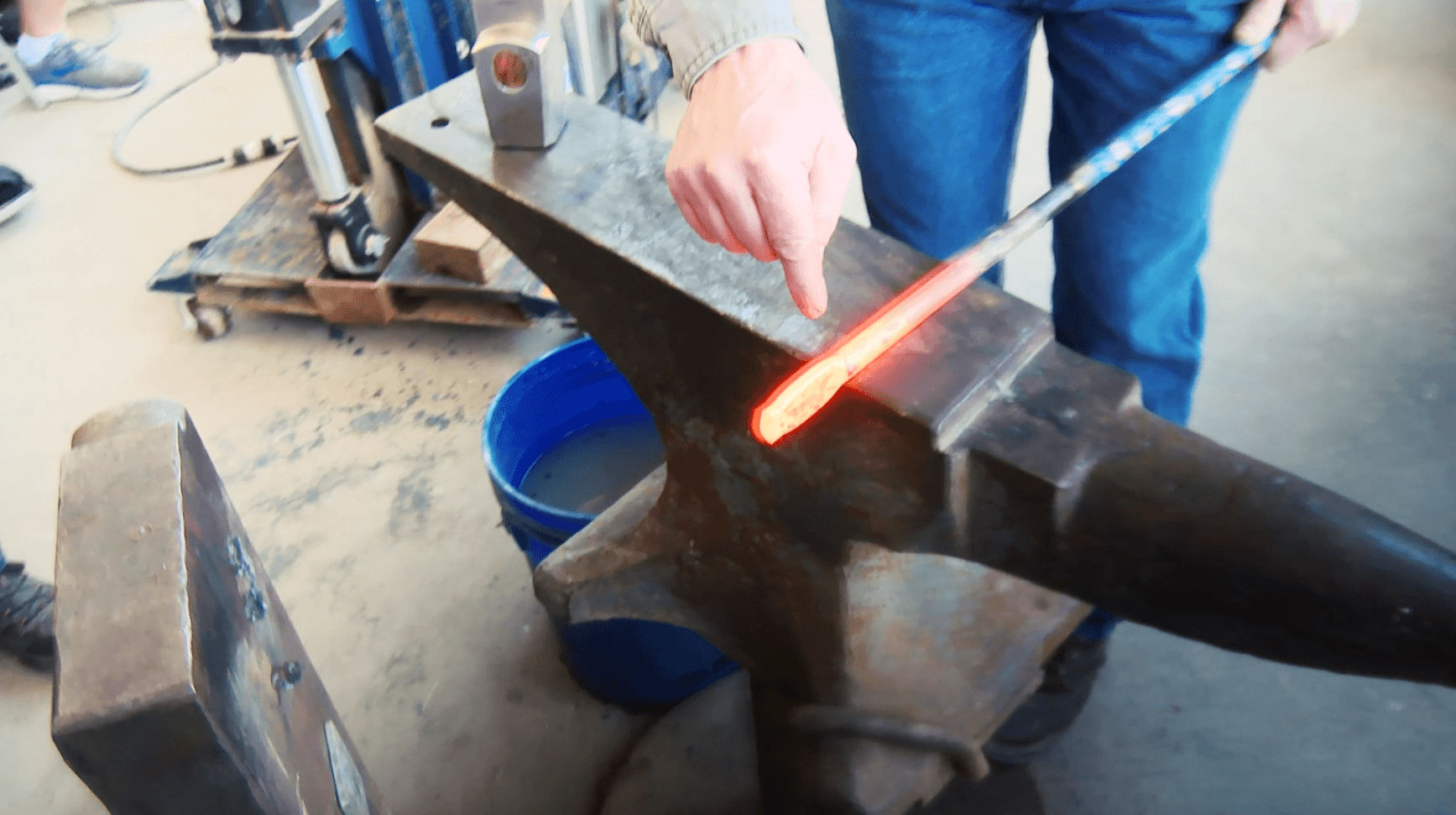
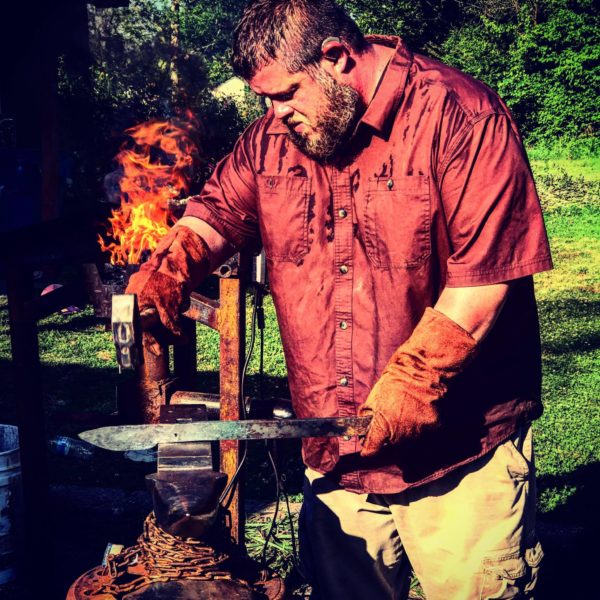
Knifemaking is the building of a knife, which includes the blade, handle and other accouterments. Blades are made by either removing metal from a steel blank via a grinder – known as stock removal – and the forging to shape of hot steel into a blade in the process known as bladesmithing. Other parts, including bolsters, guards, pommels, etc., are needed to complete the finished knife.
Here’s how one knifemaker forged a knife from 9/11 wreckage to fundraise for families affected by the attacks.
Do you remember where you were on Sept. 11, 2001, at 8:45 a.m. EDT when an American Airlines Boeing 767 loaded with 20,000 gallons of jet fuel crashed into the north tower of the World Trade Center in New York City? That day was forever etched in many of our minds as a reminder of how paramount it is to safeguard our freedoms.
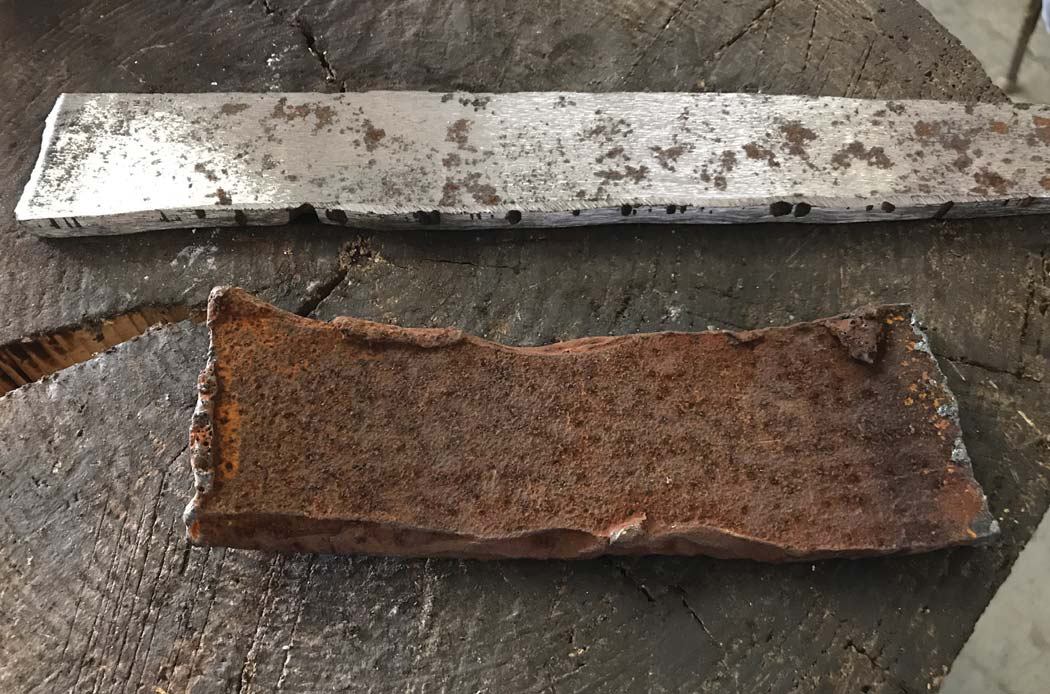
Pieces of iron from the World Trade Center appear as they looked before (bottom) and after (top) light surface grinding to facilitate forge welding.
Building Homes for Heroes is a national non-profit, non-partisan 501(c)(3) organization founded in 2006. It has been at the forefront of making a significant difference in the lives of wounded American service members and their families, including those affected by the 9/11 attacks.
The knife Murray made went to auction, with all proceeds from the auction to be distributed to first responders who were directly affected by the 9/11 attacks.
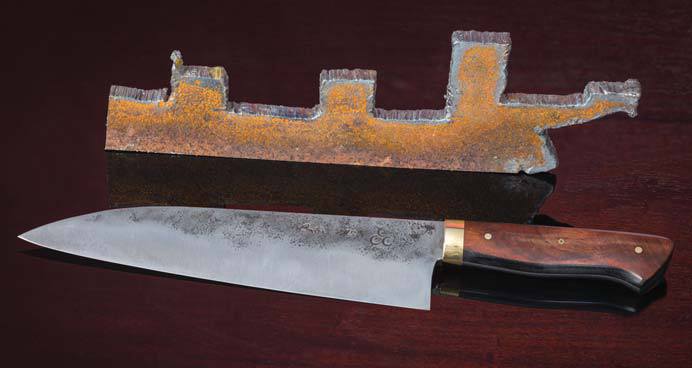
The three-layer blade of a Carter Cutlery chef’s knife is forged with WTC steel and a 1084 carbon steel core. The ironwood handle has a brass bolster. Judging from how much use Carter’s kitchen knives get, Murray opined this is probably the most valuable use of the precious WTC steel. Above the knife is a portion of the raw material from which the blade was forged.Here are the beginning (bottom level), middle (mid-level bar of steel) and end products (top level) of forge welding World Trade Center iron into a usable blade with a 1084 core. The blade is water-quenched for maximum sharpness and edge retention, and the blade surface still retains the soul-infused character of the WTC steel.
As he noted, “Being entrusted to recreate useful cutting tools from remnants of the WTC was an honor and one of the most humbling tasks of my 29-year career.”
This past November, FDNY 343 RIDE flew Murray to New York to give a presentation and explain what he did with the WTC steel and how it was used in a three-layer laminate to create high-performance knives. It was an experience Murray said he will never forget.
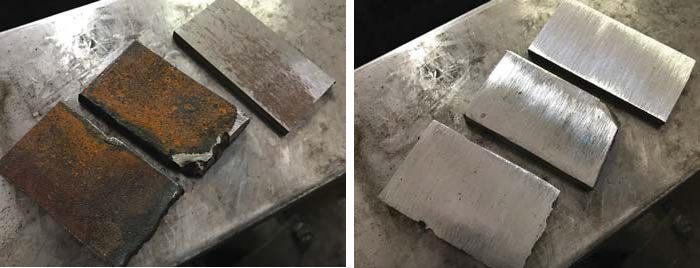
The three pieces to be forge welded into a blade are, from left, two pieces of WTC iron and 1084 core shown both before grinding and polishing and after.
“It went incredibly well,” he noted. “Best of all was that I got to meet many of the New York Fire Department members, as well as many American military heroes—they are all heroes, all first responders—and there was such a huge sentiment of being proud to be American. It was a very refreshing spirit to witness.”
The knife went for $10,500, with all proceeds going to Homes for Heroes.
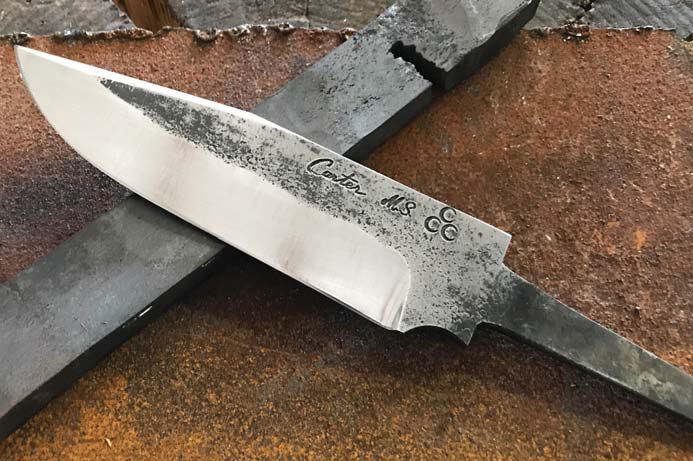
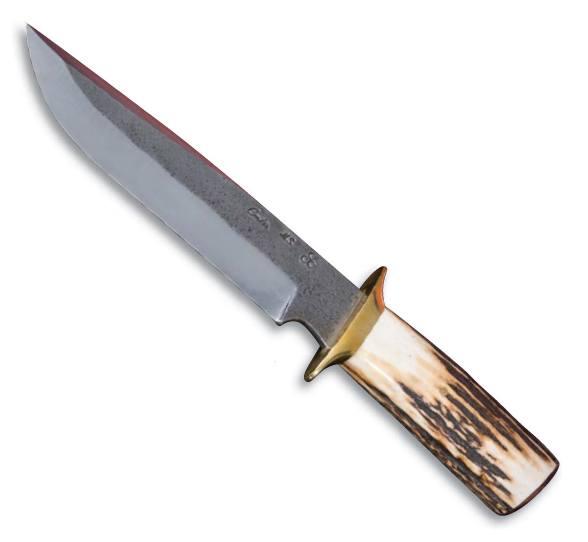
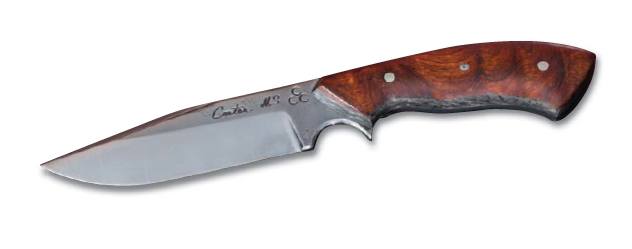
A Carter Cutlery bowie sports a three-layer blade of WTC steel with a 1084 steel core, a brass guard and Sambar stag handle.A Carter Cutlery neck knife gets the three-layer WTC/1084 carbon steel blade treatment and an ironwood handle.
In the knife world, titanium has been at the forefront of space-age metals for well over two decades, due in great part to the boom in the tactical knife genre borne out of the first Gulf War in the early 1990s. Titanium was originally used in the U.S. space program for its weight savings and toughness, and from there bled into military programs for the very same characteristics.
Titanium is also nonmagnetic, proving useful in certain applications. While tough, titanium is softer than steel, and although some knifemakers have used it as blade material, it never quite caught fire like the new exotic stainless steels that dominate the upper end of the market today.
Aluminum is also nonmagnetic and anodizes quite well, but it gets little respect in the knife industry because as an extremely soft metal it’s considered an inexpensive alternative to titanium.
Titanium is a reactive metal—its characteristics can be changed by outside influences. Heat-treating knife handles or dipping them into an electrolyte solution that has been both positively and negatively charged color enhances the metallic surface. The amount of heat or electric charging can be varied by the amount of direct heat or voltage applied, and this determines the color hue that the metal takes.
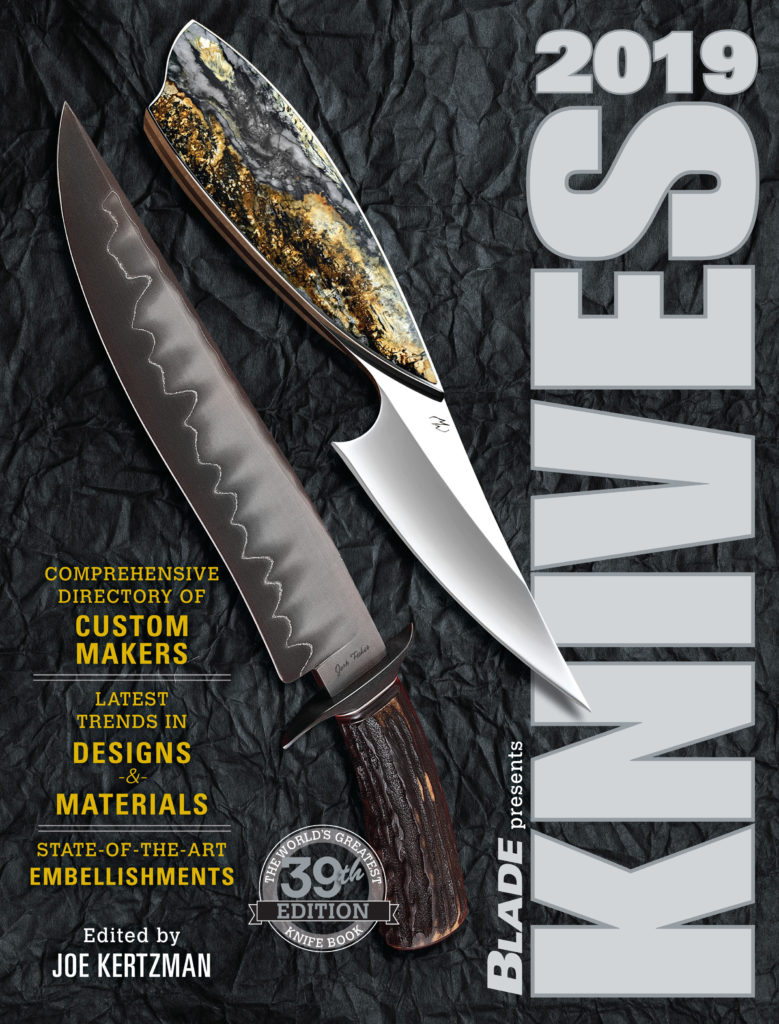
Learn More About Knifemaking in the World’s Greatest Knife Book
Nitinol, also referred to as “Ni-Ti-Nol,” was first discovered back in 1959 by scientists William Buehler and Frederic Wang at the Naval Ordnance Laboratory. The Ni-Ti-Nol acronym stands for “Nickel-Titanium-Naval Ordnance Laboratory.”
Beuhler and Wang were searching for a super-elastic alloy for missile nose cones that would be pliable at extreme heat, yet return to its original shape after cooling. Their efforts were a success, but because the incredibly tough alloy was so difficult to process and machine, it wasn’t used until much later.
Knifemaking Discovers Nitinol a Half-Century Later
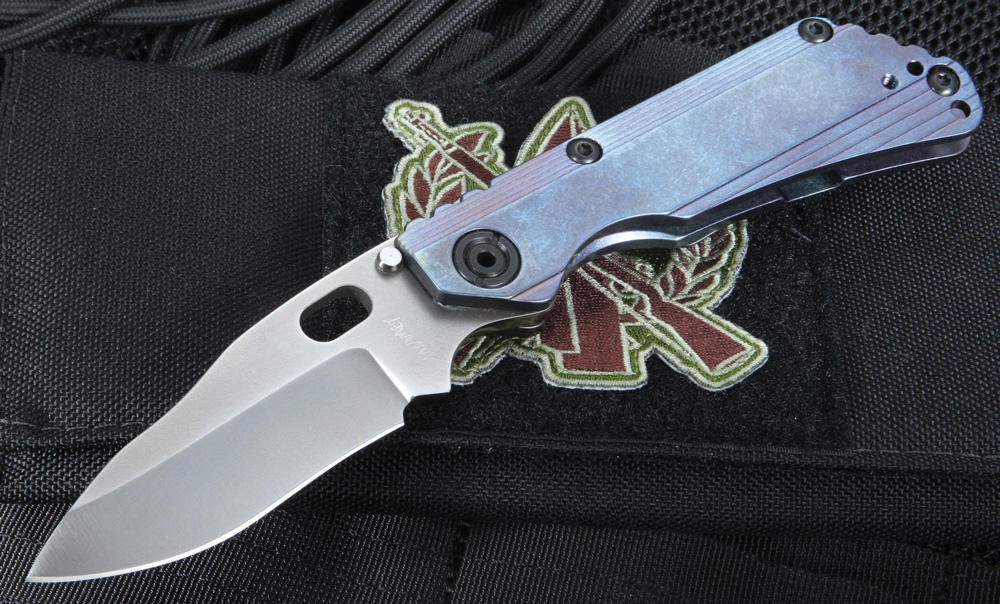
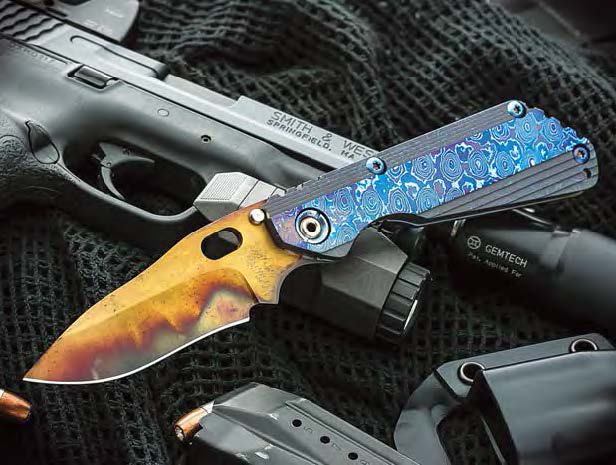
Duane Dwyer of Strider Knives was the main force behind SM-100 (HIPTiNite), and his signed custom Strider MT2 showcases a brilliantly heat-treated SM-100 blade mated to machined carbon fiber handle scales. (Brady Miller image)
Custom knifemaker Duane Dwyer of Strider Knives became interested in Nitinol back in 2005 while searching for a super hard metal alloy that would not rust. He approached metallurgist and friend Scott Devanna, vice president of technology at SB Specialty Metals, and inquired about the possibility of producing Nitinol using the particle metallurgy process, which had never been done.
Shortly afterwards Devanna introduced Dwyer to Eric Bono, a metallurgist and knifemaker who also had an interest in the alloy, and the three men began to explore the possibilities of incorporating the alloy into knives.
Nitinol Becomes SM-100 (HIPTiNite)
Duane Dwyer of Strider Knives was the main force behind SM-100 (HIPTiNite), and his signed custom Strider MT2 showcases a brilliantly heat-treated SM-100 blade mated to machined carbon fiber handle scales. (Brady Miller image)
With his metallurgical knowledge and experience, Bono developed a working, powdered metal version of the alloy in 2006, which the partners dubbed “SM-100.” It took several more years to refine the alloy and processes, and in 2009, Bono and business partner Fred Yolton formed a company, Summit Metals LLC, to produce SM-100.
Since that time, SM-100 (60 percent nickel and 40 percent titanium), which the company markets under the name “HIPTiNite,” has garnered interest not only in the knife industry, but also by NASA and the Formula 1 racing industry.
Properties of SM-100
The SM-100 brand of Nitinol, like its forerunner, is extremely tough. While a typical sanding belt can be used to grind several typical, mono-steel knife blades, it requires several belts, in many cases six or more, for the same process using the SM-100 alloy.
Made and sold in small quantities, the cost of SM-100 isn’t cheap. Add to that the cost of belts and additional time to shape and grind the material, and the cost per knife skyrockets.
On the positive side, SM-100 is noncorrosive, and while stainless steel will rust, Devanna says you can throw an SM-100 knife into saltwater for 50 years without the material corroding.
An Explosion of Coloring
Bono discovered during his development of SM-100 that it can be heat colored into an exquisite rainbow of colors. Due to the titanium content, SM-100 oxidizes into a blaze of bright hues just like other alloys incorporating titanium, but the process of achieving the color effects is quite different.
Bono confides that the magic happens during the heat-treating process, in which he allows small pockets of air to leak onto the surface of the knife. Prior to heat treating, the blades are wrapped in foil and small holes are punched into the wrapping.
When heat treated, different colors occur depending on the oxygen content of certain areas of the blade material as the surface oxidizes. The end result is the explosion of color on the SM-100 blades.
The price for bright, eye-popping colors doesn’t come cheap, but then new innovations rarely do.
Edmund Davidson’s “Goliath” integral appears here state. The finish is hand rubbed, requiring hours of laborious work. The finished knife weighs in at 6 pounds, a fraction of the original bar’s weight. Jere Davidson did the spectacular engraving. (PointSeven photo)
Are Integral Knives The Strongest Kind of Knife?
Is an integral knife inherently stronger? According to our gurus, strength in numbers—of parts, that is—is not necessarily applicable here.
“The concept is so much different it changes up the whole equation,” knifemaker Edmund Davidson states. “A hard-use integral knife is stronger than a typical fixed blade. There’s nothing to go wrong. That’s not to say some great [non-integral] fixed blades aren’t being made, but you can’t get any stronger than one big chunk of steel.”
“An integral knife is theoretically stronger, but I’ve never had one of my standard knives break at the guard junction through regular use, either,” knifemaker Marcus Lin says. “I destruction-tested one of my Loveless fighter designs several years ago and it took numerous overhead slams from a 50-pound slab of concrete to break it.
“In terms of getting the job done there’s no difference in either method of construction, as both will result in a knife that will last generations. But I can see the allure for the integral knife because of the time and additional skills involved in making it, which some customers can appreciate.”
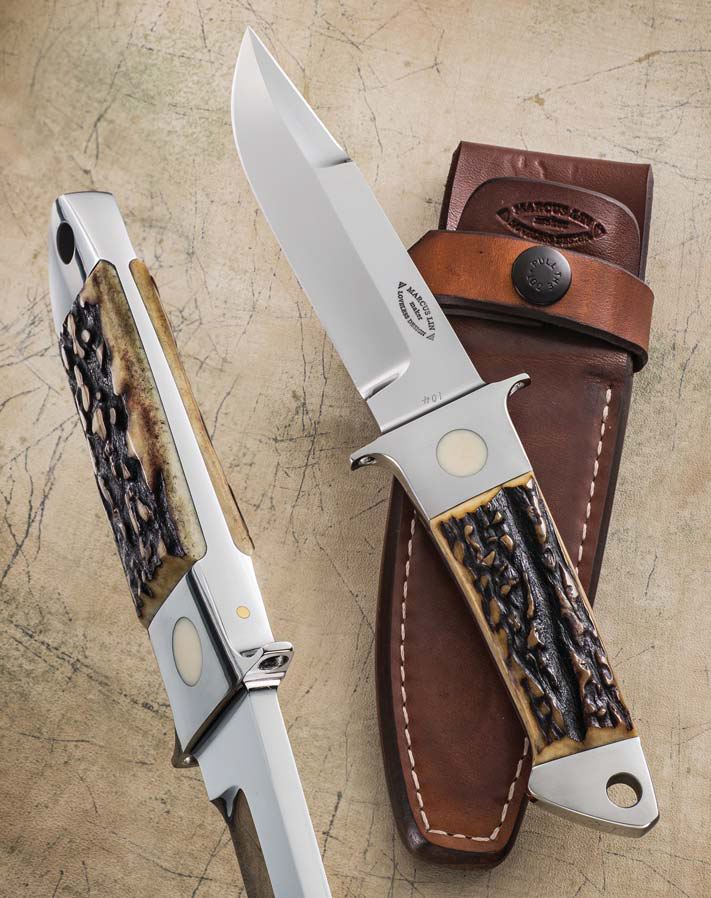
Marcus Lin does the Bob Loveless legend proud with this send-up of the famed integral Loveless Chute Knife. The steel is mirror-polished D2 with a satin finish on the flats of the bolsters. Scales are Sambar stag and a synthetic ivory plug sets off the bolsters. (PointSeven image)
What Is An Integral Knife?
Integral knives, short of the addition of handle scales, are literally sculpted from one piece of steel. Making a knife in this way presents difficult challenges not found in making knives in separate parts, and soldering or screwing them together.
Imagine grinding not only the blade with all its intricacies, but the handle, guard and pommel from one solid piece of steel and sculpting it to perfection. Such a knife is called an integral and any knifemaker who’s ever made one will tell you it’s a whole new ballgame.
How Integral Knives Are Made
“The primary difficulty for me is getting rid of the stock,” Lin relates. “You start out with a couple pounds of tool steel and the finished knife is several ounces. Bob [Loveless]‘s original integrals were made on his horizontal mill. I use a full-size Jet [Bridgeport clone] vertical milling machine, angle grinder, band saw and my 2×72 grinder to make mine. I try to make them as close as possible to Bob’s originals.”
Davidson makes no bones about the difficulty he faces in constructing a one-piece knife.
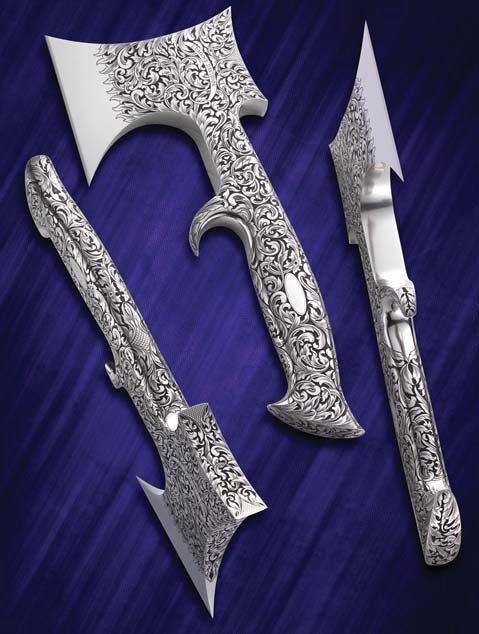
Several views of the “Psycho-Tron” integral hatchet from Edmund Davidson’s Safari Trio appear here. This monster was cut from a 7/8-inch-thick piece of CPM 154 stainless steel. Jere Davidson engraved it. (PointSeven image)
“It takes tenacity to build an integral,” Davidson stresses. “You start with a block of steel instead of a strip. You must have the equipment to saw the knife out and machine it. You’re working with all the basics that go into a complete knife in one single piece of steel. The complexities are physically and mentally demanding, and it’s very labor intensive because of the vast amounts of filing and sanding—not to mention hand rubbing the finish.
“There are so many aspects of making an integral that are not associated with making a standard knife.”
In this video, Tom Ward explains how to unfold forged mosaic damascus steel during the Wuertz Machine Works 2019 Hammer In. The event took place in March.
Ward’s overview provides a fascinating look at one of the critical steps in how mosaic damascus is made.
* Learn more from bladesmiths around the world each year at BLADE Show!
BLADE had a blast at the Wuertz Machine Works 2019 Hammer In last month in Arizona. Check out the action with Mike Quesenberry. That’s Neil Kamimura in the beginning, too.
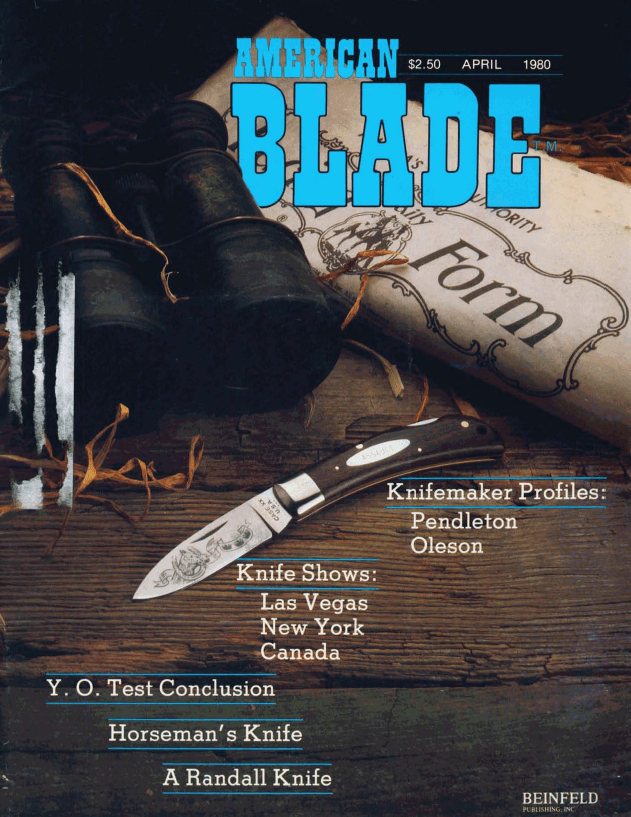
Editor’s Note: The following article by Pat Crawford was originally published in the April 1980 issue of BLADE, but the advice still holds true today.
New Knifemakers: You’re Not That Special (Yet)
The cover of the April 1980 issue of BLADE.
Any knifemaker can make almost any kind of knife, but some knifemakers are better than others. Knowing where you fit in the scheme of things is important, especially for developing a pricing structure that is compatible with the quality of your work.
Those makers who can command big bucks for anything that leaves the shop have paid a lot of dues for this success. And just because your work looks just as good doesn’t necessarily mean that you’ll be able to compete with the big names and legends whose work is priced at the higher end of the spectrum.
Remember, even today’s legends got their start by turning out quality work at fair prices.
Make Up Your Mind: Why Are You Here?
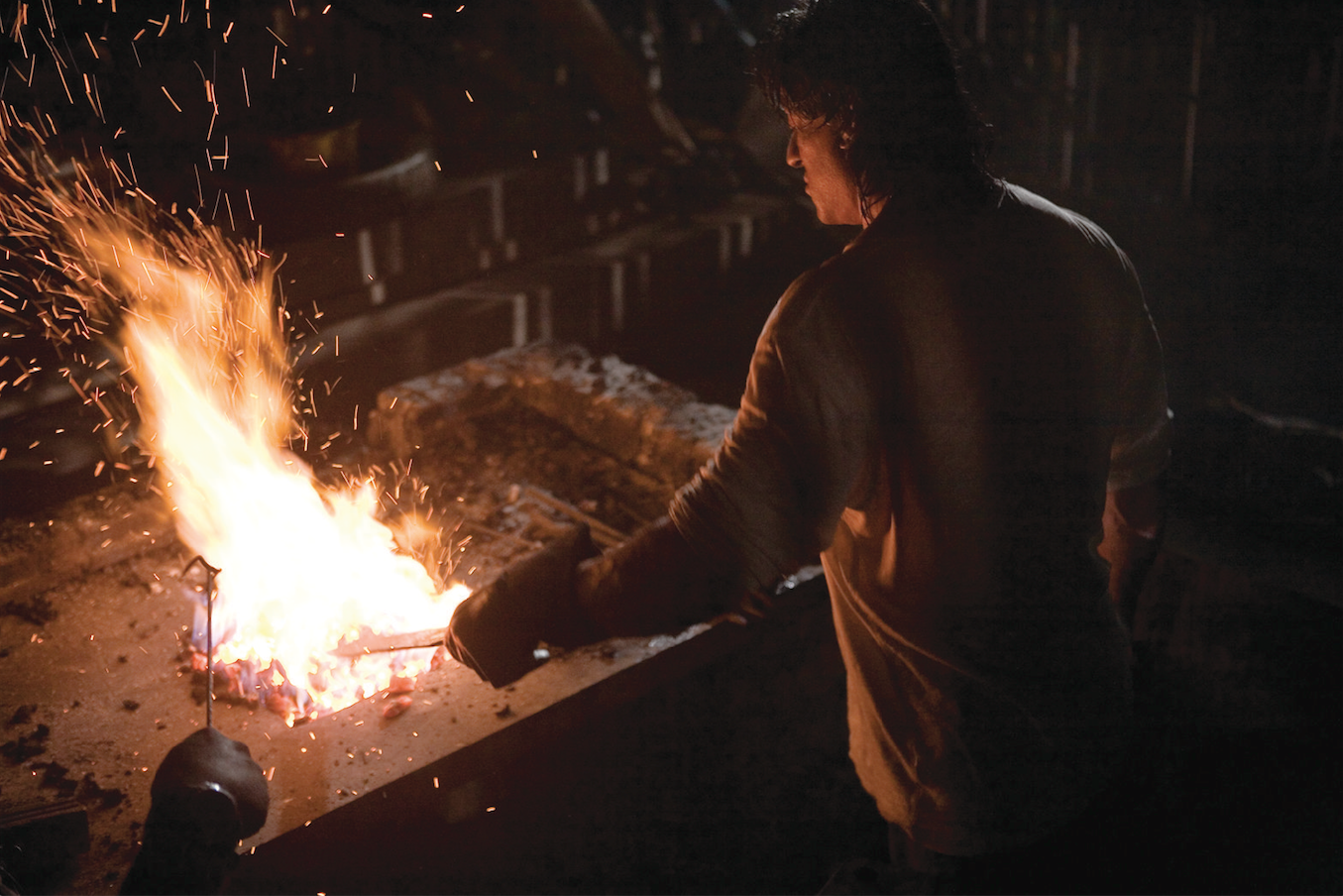
TV and movies can drive a lot of interest in knifemaking. That’s good, but it can also mean naive knifemakers wind up sinking their personal and financial lives. You’d better figure out your purpose in this market. This still from a deleted scene from “Rambo III” shows the titular character forging a knife.
Decide where you want to compete in the market. Should you specialize in something unique or should you offer a wide range of products?
The latter strategy has the potential of appealing to a larger share of the knife buying public. One example of this approach is the addition of folding knives to many makers’ offerings.
However, this type of market coverage won’t work for everyone making knives. You will have to decide whether diversification will capitalize on your strengths or spread your resources too thin.
Whatever you decide, the wrong choice could end you up making something that nobody wants. “Being there” at the right time with the right product takes as much hard work as it does luck, whether that product is one knife or a whole line of knives.
Knifemaking Isn’t A Romantic Business
Knifemaking is tough work. Here, Norman “Buddy” Thomas, of Tree of Liberty Bladecraft and Forge, hammers on his latest project.
If you think making knives is a fun, romantic way to make a living, you may be overlooking a very important point. Making knives is enjoyable, but it is hard work.
There is a big difference between hobby knifemaking and doing it full-time. Hobby knifemakers (and there are some super part-timers) don’t have to depend on their knives for a living, while full-time makers do.
And the transition from part- to full-time can be a traumatic experience. For the first time, there’s the pressure of getting the work out and meeting delivery dates just to put bread on the table, and what used to be an activity you enjoyed in your spare time is suddenly a job you must do to exist.
Living with a constant backlog, increasing demands, and monthly quotas takes a certain amount of nerve and self-discipline. Roses wilt and so do some knifemakers under this kind of pressure. But, if you enjoy the challenge of a sink or swim kind of life, you may not want to do anything else for a living.
You’re Not Setting Trends, So Jump On One To Get Noticed
Remember when “zombie knives” were red hot? A new knifemaker could hop on that trend to get noticed. This Kharon Tanto Folder is from from KA-BAR’s Zombie Knives line. (KA-BAR image)
It’s a business world fact that some products are more popular than others, and what was popular yesterday may be a dog tomorrow. However, makers who are unable or unwilling to make what the people want have seen once loyal customers flock to those who do.
People will not automatically knock down your door just because you make knives. You have to let the public know what you have to offer; then if you’re lucky, they’ll knock down your door.
Of course, word of mouth advertising is great and it’s free, but a lot of mouths would have to do an awful lot of talking to reach as many people as are reached by a good magazine in even one issue.
Customers’ Attitudes Aren’t The Problem; You Are
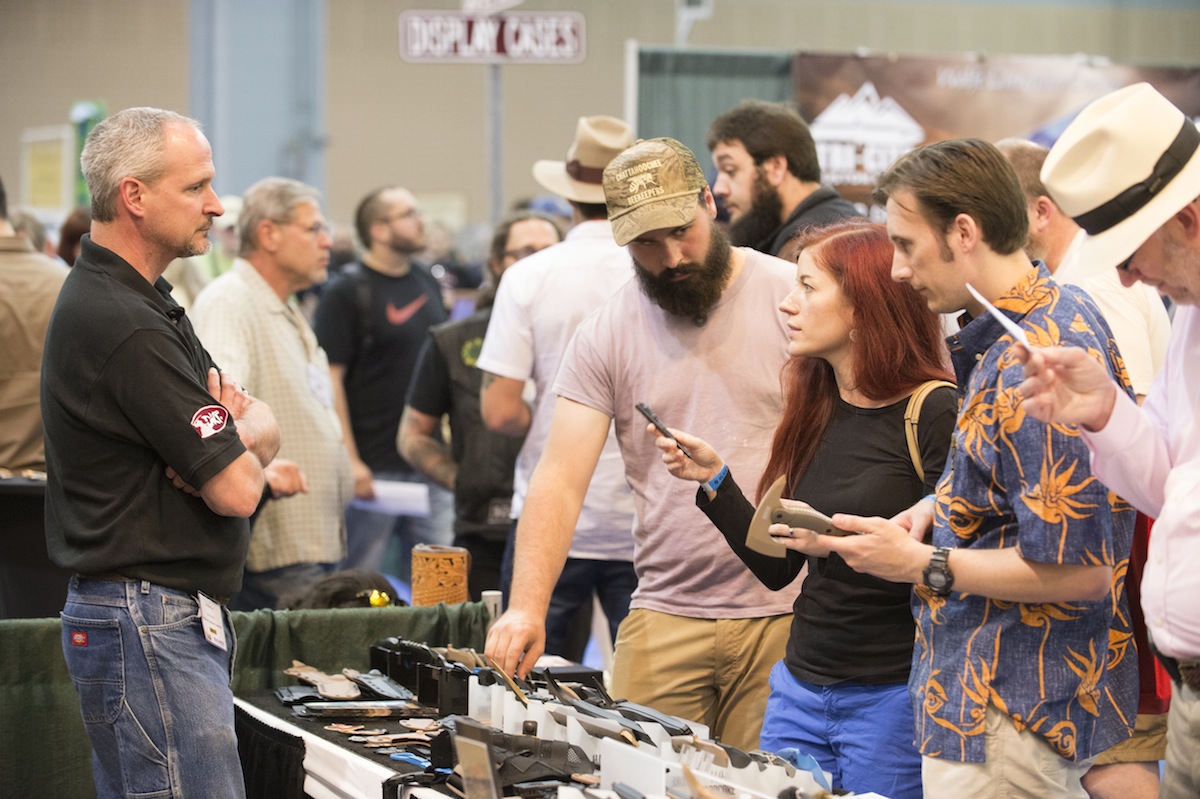
When you exhibit at a knife show, you’re not only there to sell knives. You’re also there to sell yourself. (PointSeven image)
People are more likely to buy your knives if they like you as a person. A personal relationship is one of the most important parts of the custom knife trade.
Knifemakers who are unfriendly, too busy to answer questions, too sold on themselves, or just plain rude to potential customers are shorting themselves as well as other makers.
Buckle Up, You’ve Got A Long Way To Go
Even the greatest knifemakers are constantly striving to better their product. Whether it’s a new design, material, or method of construction, there is always something you can do to perfect your product. And believe me, if you don’t, the competition will.
The One Thing That Sinks More Knifemakers Than Anything Else
Sure, you can make knives, but can you work a calculator? (Pexels photo)
No knifemaker can get away from the fact that he or she is a small businessman as well as a craftsman. Neglecting the business side of knifemaking has probably put more makers out of business than any other single factor.
You don’t have to be a business whiz to know you can’t have more money going out than you have coming in. To keep track of cash flow, accurate recordkeeping is imperative. This includes knowing the cost, both in time and materials, to produce one knife so the revenue from its sale is enough to cover costs and produce a profit.
See You At BLADE Show
If you’re serious about getting into knifemaking, there’s only one place you need to be: BLADE Show. See you in Atlanta.