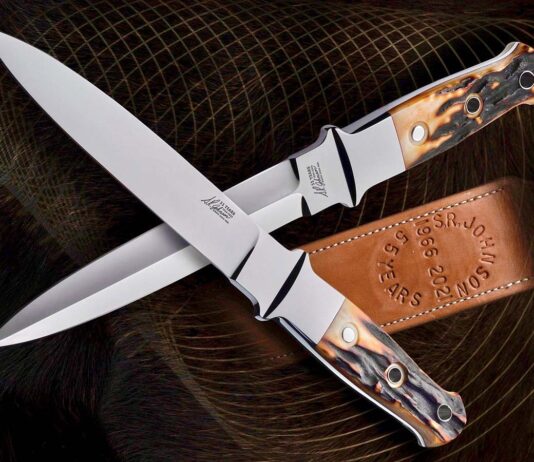
Knifemaking is the building of a knife, which includes the blade, handle and other accouterments. Blades are made by either removing metal from a steel blank via a grinder – known as stock removal – and the forging to shape of hot steel into a blade in the process known as bladesmithing. Other parts, including bolsters, guards, pommels, etc., are needed to complete the finished knife.
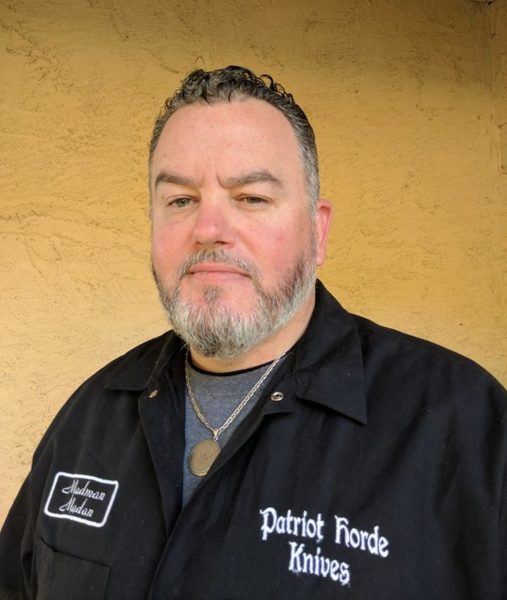
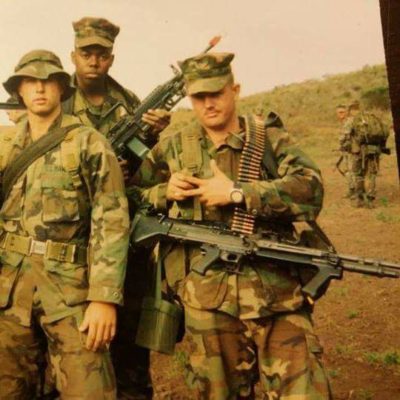
Randy Madan, known as JR on social media, served in the U.S. Marine Corps from 1992 to 1996 as a combat engineer. “I blew things up,” he said, laughing. Now, at 43, he has been a federal correctional worker for 20 years.
Randy Madan of Patriot Horde Knives hopes to be able to keep making knives when he retires from his job in the federal correctional system. Randy is supportive and encouraging of other veteran makers.
He always loved and carried knives, but he got his start in knifemaking in October 2016. “The knifemaker that I idolize, Michael Cleveland from Half Lives Knives, afforded me the opportunity to join a knife build-off for a veteran charity. Me being a vet myself, I jumped at the opportunity,” he explained. He has continued to make knives and to encourage other veteran makers.
Randy Madan of Patriot Horde Knives served in the U.S. Marine Corps from 1992 to 1996 as a combat engineer.
“I am just a small-time maker, wanting to perfect my knives so that when I retire in a couple of years I can make more,” he said. Other makers who have helped along the way include John Savage, Ryan Schreiber, Denny Furey and Mark Wagoner.
Favorite blade steels: 1095 with plans to start using O1 and 80CrV2
Blade grinds: flat with plans to add hollow
How he tests his knives: shave hair, skive 7- to 9-ounce leather, cut ¼-inch bolts, chop 2-by-4s
Favorite handle materials: Voodoo Resins, Rob Carper Innovations, 8th Dimension Concepts and J Hue Customs. “I am a big fan of the hybrid materials,” Randy noted.
Price range: $250 and up
Forums he participate in: The Real Knife Makers of America, Global EDC and other Groups on Facebook
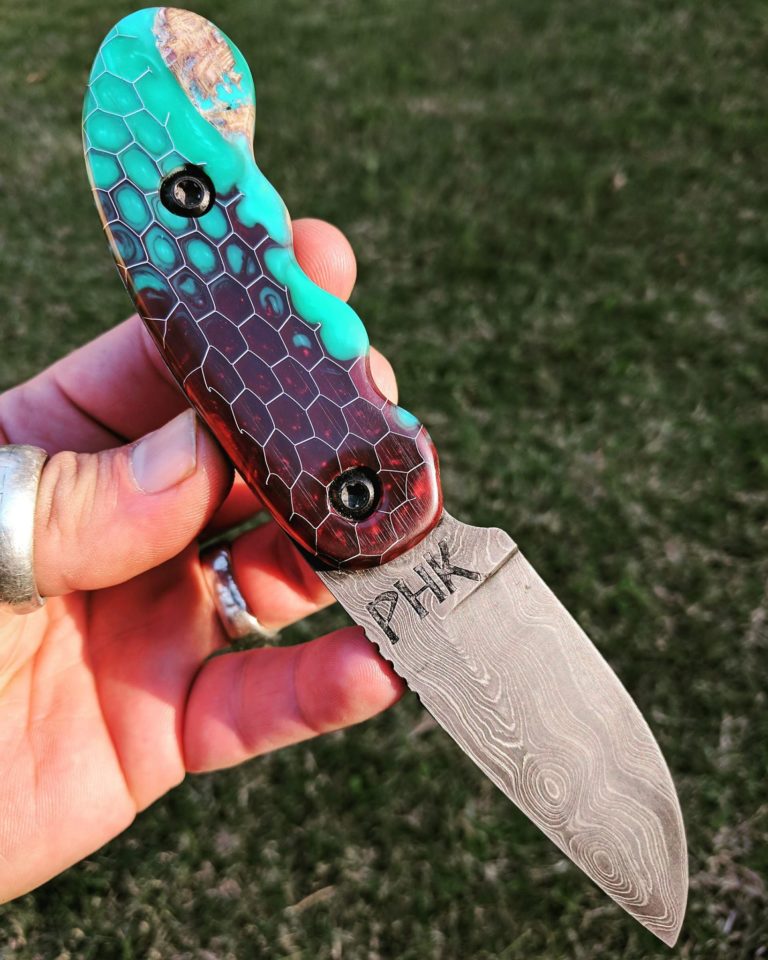
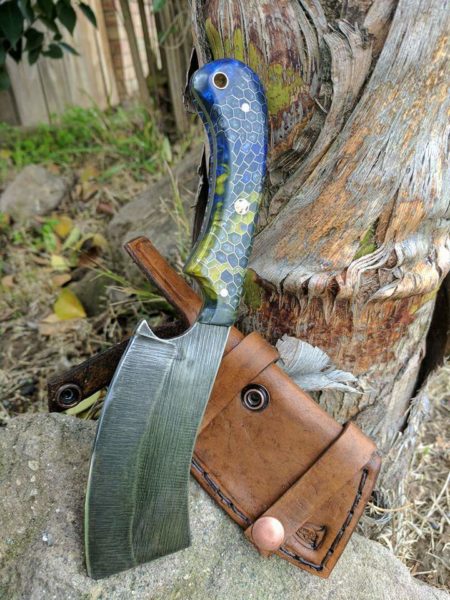
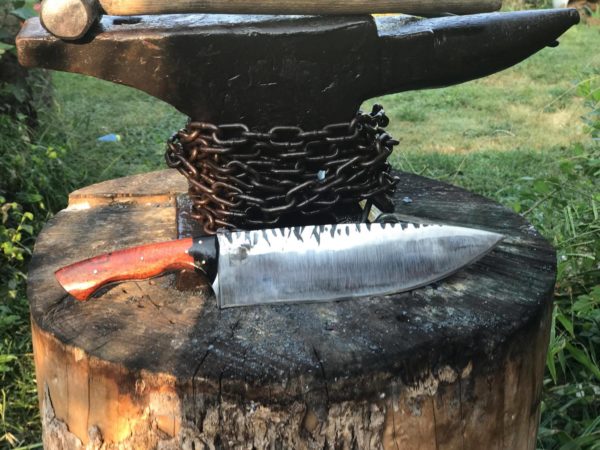
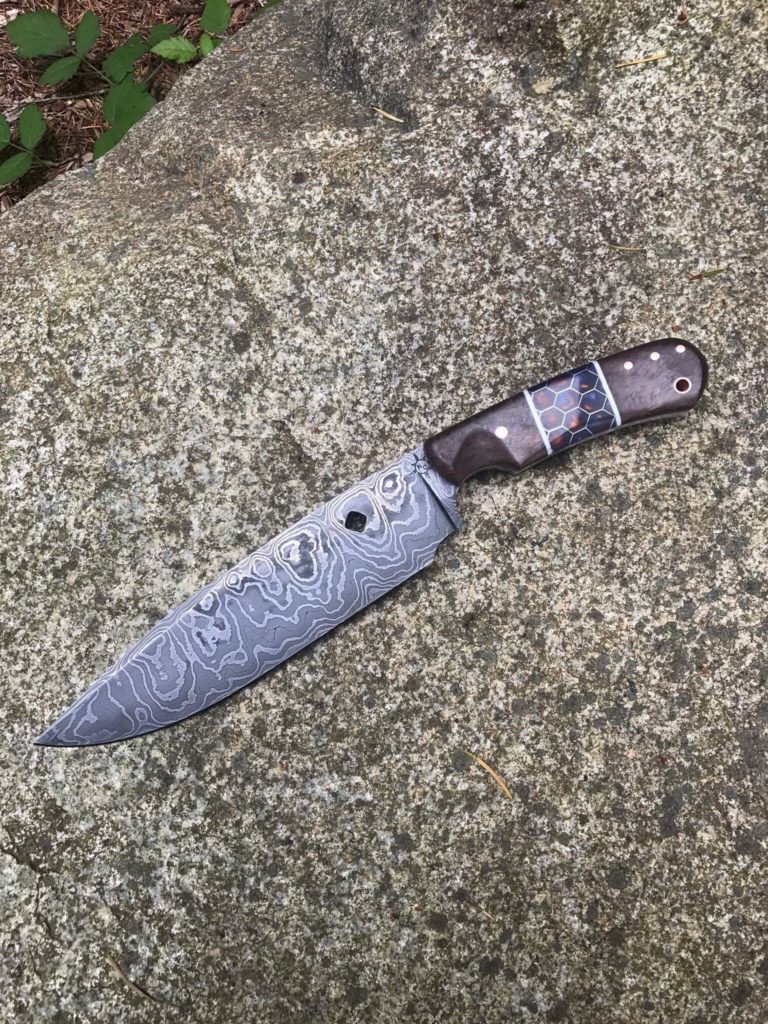
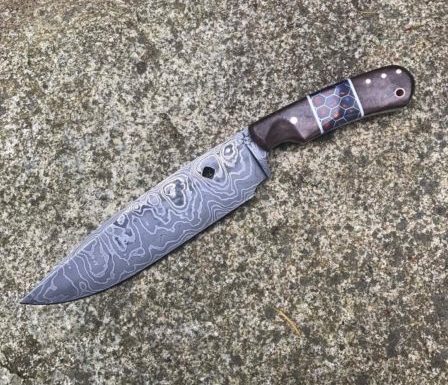
DaCleva has a 4-inch flat-ground blade made of 1095 steel with an acid-washed finish for a battle-worn look. Overall length is 9 inches. Scales are by Norman Robbins at 8th Dimension Concepts. Maker’s list price: $250 with Kydex sheath; $325 with leather.The Lil Chubby drop-point is 8 inches overall, with a 3.5-inch flat-ground blade made with random pattern Alabama Damascus Steel from Lacy Smith. The handle scales are from Norm Robbins from 8th Dimension Concepts. Maker’s list price: $300 with sheath. In 1095 steel at $200. Contacts listed at the bottom of this article.
Randy uses All Star Abrasives in Lawrenceburg, Tennessee, for his abrasive supplies, which is what he puts to his hybrid scales to bring out their color.
Contact Randy Madan at [email protected], 760-885-9370 on Facebook at Patriot Horde Knives and on Instagram @the_patriot_horde.
A Digital Subscription to BLADE Is The Anwswer
You can read your digital issues of BLADE Magazine anywhere you have your phone, tablet or computer, and there’s no need to find storage for all your old issues.
If piling-up issues of magazines seems like a waste to you… If you feel like you don’t have time to read a magazine… If you like the stories we offer in BLADE, but want a more economical option, then a digital subscription is the answer. An annual subscription to BLADE is $17.98, $4 off the print price.
When Jerry Davis was a baby he was scooting across the floor and his grandmother dubbed him Scooter. He is a third-generation welder and fabricator. His dad made knives as a hobby, and by the time Scooter was a teenager, he, too, was making knives.
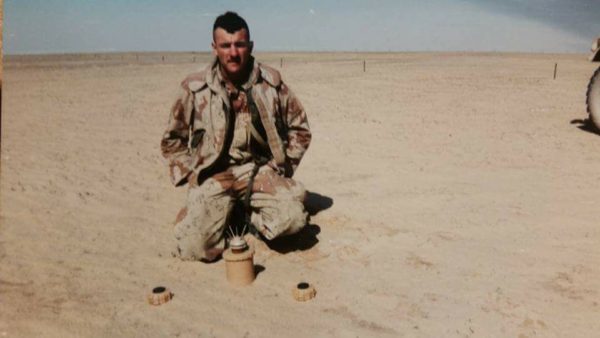
Schooter Davis, a Desert Storm US Marine Corps veteran, specializes in small everyday carry knives, skinners and survival knives.
At 19 he entered the U.S. Marine Corps and served as a heavy equipment engineer during Desert Storm. The Gulf War veteran served four years then returned to West Virginia.
Scooter Davis served in the U.S. Marine Corps during Desert Storm. The Gulf War vet then returned to his native West Virginia.
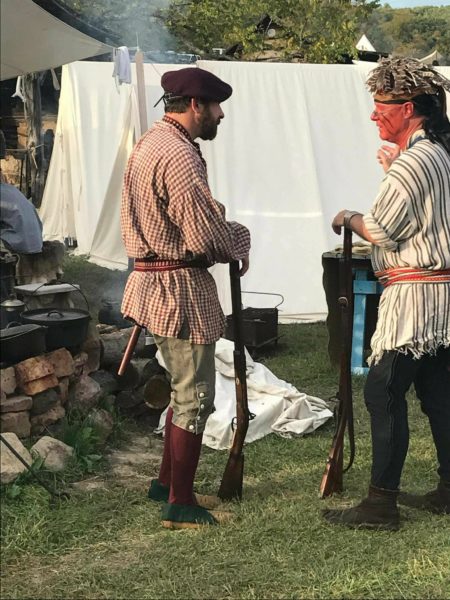
When he isn’t making knives, he’s attending rendezvous, living history gatherings that bring early American frontier days to life. He makes many items in his kit and, of course, period-appropriate knives.
“A primitive rendezvous is a living history event,” Scooter Davis explained. “I have enjoyed them since I was a child. It’s like taking several steps back in time and I enjoy crafting knives and other items that represent that time period [early American frontier].”He’s also a singer and musician, playing weddings, parties and other events, equally comfortable with Sinatra or Stevie Ray Vaughan.
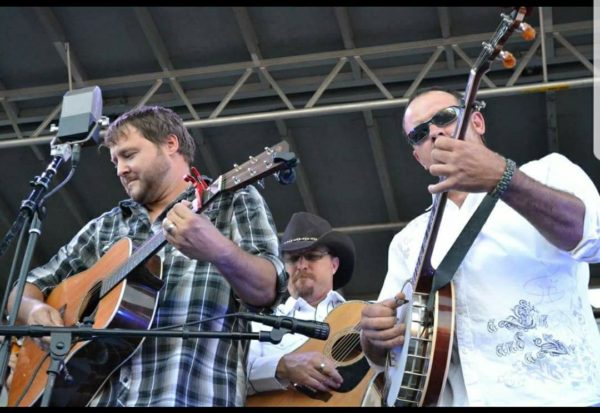
The quintessential Renaissance man, Scooter Davis of Rough Run Forge, can also perform anything from smooth jazz to country.
“I’ve always been an artistic feller, always making things. I can make just about anything,” Scooter said. But what really inspired him was the quality of the work he saw coming out of other knifemakers. John Savage has been a good friend along the way. “My goal is to create blades worthy of being used in the outdoors.”
Best-selling knife patterns: small everyday carry, skinning, survival
Favorite blade steels: 1095 for ease of forging, toughness; 52100 for toughness, edge retention
Blade grinds: flat for deep cutting and skinning, convex Scandi for durability in hard use
How he tests his knives: field use, chopping mountain laurel, slicing paper, cutting small bolts, shaving
Favorite handle materials: Micarta for toughness and durability; wood and bone for beauty and value. “I am partial to rare and hard-to-find materials,” Scooter noted.
Price range: $150 and up
Online purveyors: Pendleton County Outdoors, www.pendletoncountyoutdoors.com
Knife shows he attends: Greater Shenandoah Valley Knife Show, Harrisonburg, Virginia
Member of: American Bladesmith Society
Forums he participate in: Facebook Groups, Knife Dogs, BladeForums.com
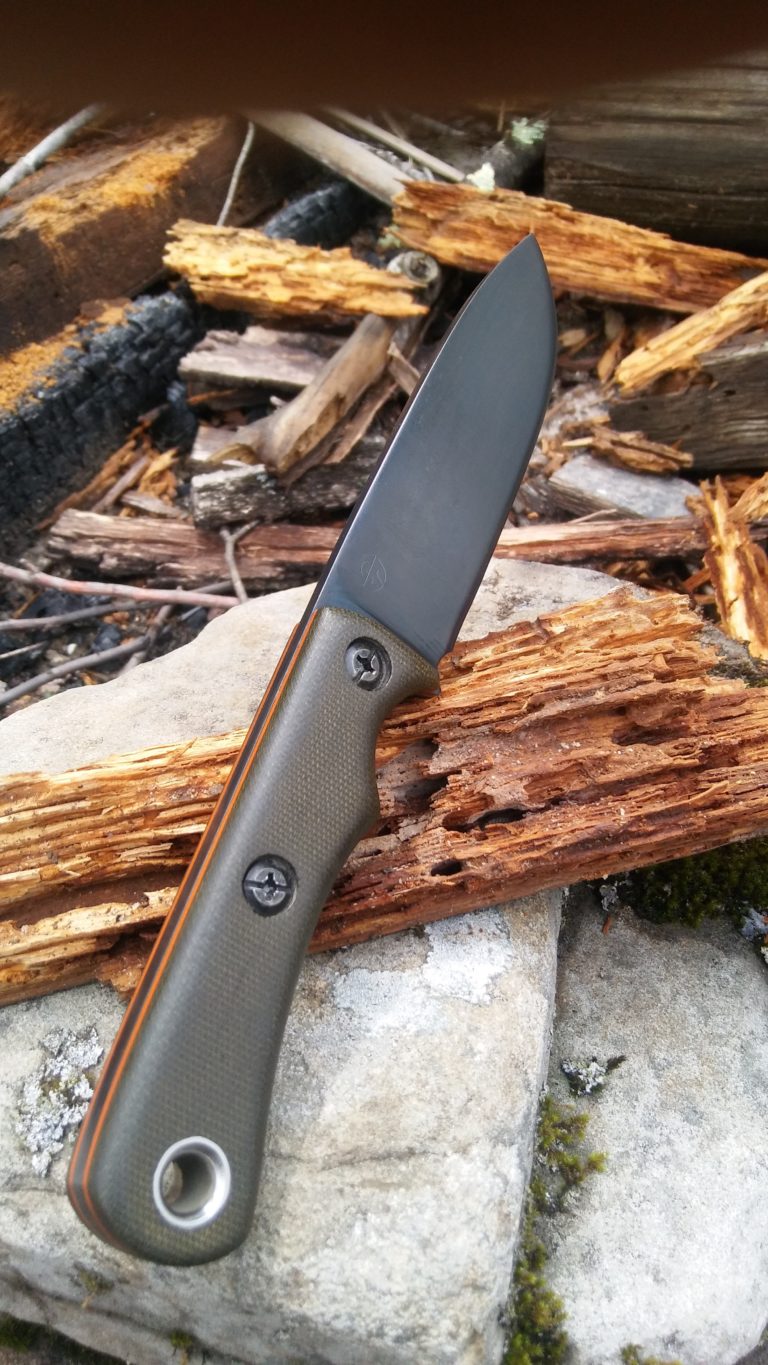
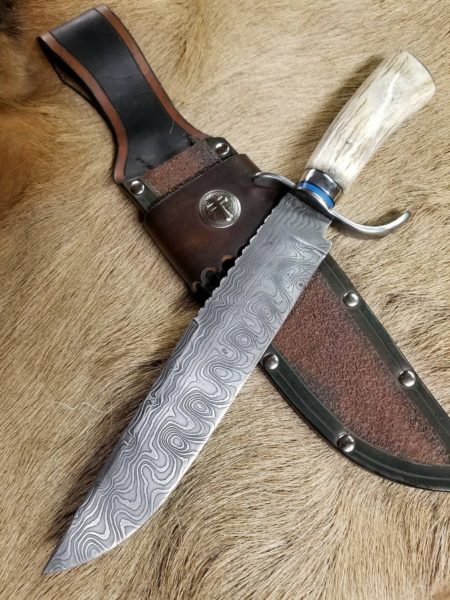
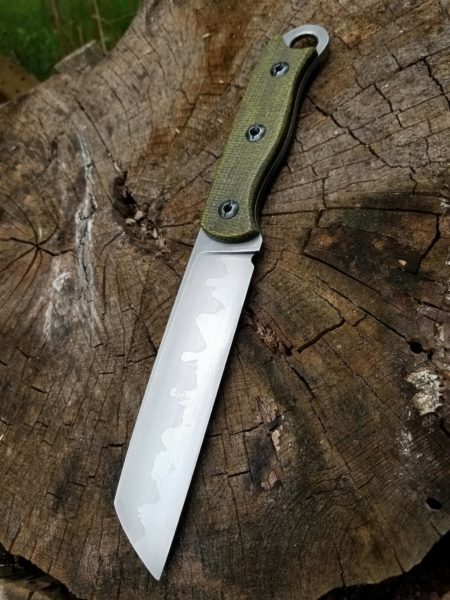
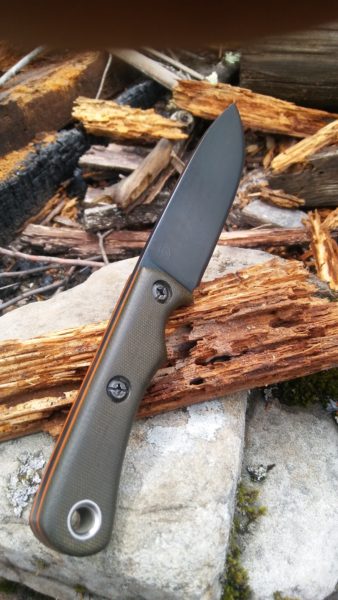
This bowie has a 13 1/2-inch blade made of pattern-welded steel by Zoe Crist Knives. The handle is comprised of elk antler, stainless steel and G-10 spacers. The maker’s own pattern-welded steel was used on the guard. Maker’s list price: $800. Contacts listed at the bottom of this article.Scooter Davis’ seax is 10 1/2 inches long with a 5 1/2-inch blade made from W2 steel with hamon. Avocado Micarta scales were used for the handle. Maker’s list price: $250. Contacts listed at the bottom of this article.The W.A.C.K.-1 (Wilderness Area Camp Knife) has a 5-inch blade forced from 1095 high-carbon steel. The scales are fashioned from OD green canvas Micarta with hunter orange G10 liners and a ½-inch stainless steel lanyard tube. Contacts listed at the bottom of this article.
Contact Scooter Davis at 540-560-1672, [email protected], on Facebook at Rough Run Forge and Instagram @roughrunforge.
A Digital Subscription To BLADE is the Answer
You can read your digital issues of BLADE Magazine anywhere you have your phone, tablet or computer, and there’s no need to find storage for all your old issues.
If piling-up issues of magazines seems like a waste to you… If you feel like you don’t have time to read a magazine… If you like the stories we offer in BLADE, but want a more economical option, then a digital subscription is the answer. An annual subscription to BLADE is $17.98, $4 off the print price.
“I was born a tinkerer,” Dwayne Horvath of Aku-Strike Knives of Pittstown, New Jersey, related. He was always taking things apart, from his father’s reel-to-reel video recorder to his car. By his own admission he was not great at school, but it was during those moments looking out the window, daydreaming, when ideas came to him—lots of ideas. It carried over into his car-racing days, his career as a successful fix-it man and now in retirement as a full-time inventor who daydreamed a trainer knife.
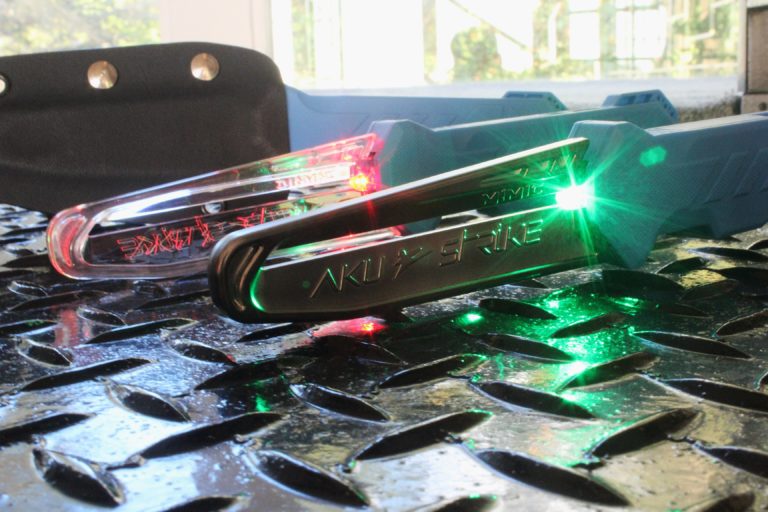
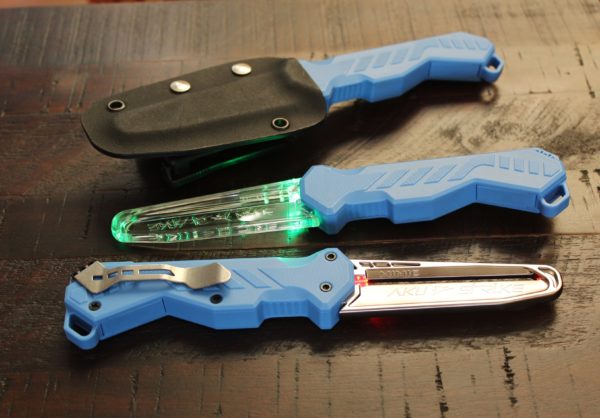
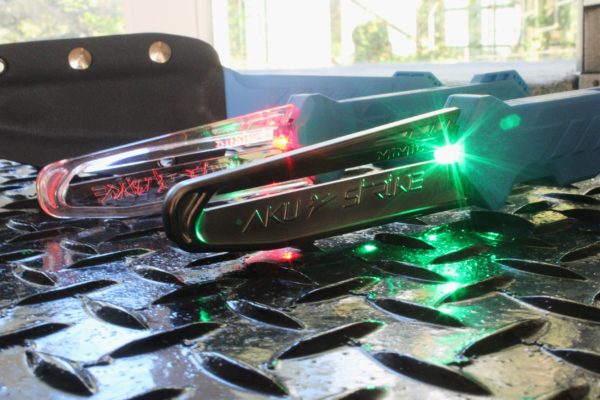
The Aku-Strike Mimic T-16 confirms contact with a red or green LED light and different tones for daytime use when lights are not as visible. Available in nickel or clear. MSRP: $41.95-$43.95. Contacts for Aku-Strike Knives appear at the bottom of this article.
The Aku-Strike Mimic T-16 came to Dwayne in a vision driving home one night from a training session at Alex Wilkie’s Martial Arts Academy in Bridgewater, New Jersey. “It was not a thought before it was a vision. The vision was possibly stirred by an emotion or feeling from training that night,” Dwayne explained.
Dwayne knew about the Shocknife, which is indeed useful for inducing fear in combatives training, but it’s is not something you want to learn on or use every day. Chalking the edges of training knives indeed leaves a mark to inform you and your training partner of a strike, but it’s messy and may not fully wash out of some shirts. There was a real need for another alternative.
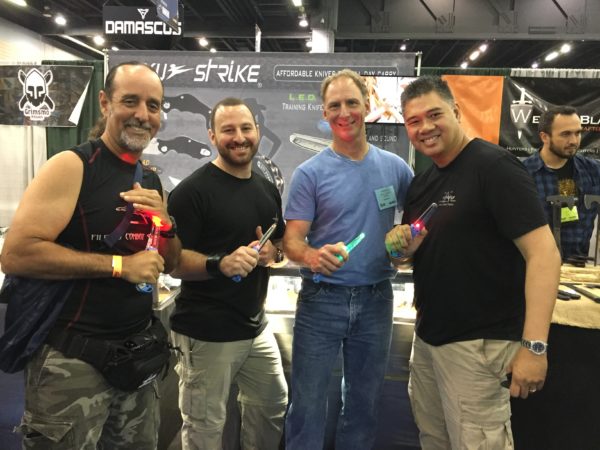
Carlos Pipo Lopez and Samuel Yaron Brill, on the left, and Ray Dionaldo, on the right, all of FCS (Filippino Combat Systems) Kali, give Dwayne Horvath’s (second from right) Aku-Strike Mimic 16-T, an LED training knife with tones, resounding thumbs-up.
“I noticed some students going through the motions of training with the knife and wondered if they realize how deadly a knife can be. I then asked myself, ‘How could I be more aware of being cut and the danger of the blade and also convey to my partner that he is in danger or is being cut? We need something to alert us when contact is made, or what I coin, ‘confirmation of contact,’ while training,” Dwayne explained.
When you take away shock and chalk, you have light or sound left. “Now how do I make this work?” Dwayne asked himself. He had some knowledge of patents. He knew that if he designed something simple, he could get a broad patent. That would in turn mean he would need to minimize parts and keep the construction of the training knife simple. That is a challenge with all the patents out there. He knew he needed at least one switch to turn it on. Any more and he might be infringing on someone else’s design.
Then Dwayne asked himself, “What would be the best way to make the blade send a signal to the electronics? I started drawing and one hour later I figured out the basics. Of course, there were many thoughts and designs in between,” he added.
With the Aku-Strike in the sheath, the battery tray angle also serves to register your fingers to hook the handle for a quick draw. This is one feature that attracted Ray Dionaldo, of FCS Kali, as the feel was similar to his quick-draw knife. The knife also has a secure feel when your hands sweat. Contacts for Aku-Strike Knives are listed at the bottom of this article.
Dwayne was on his last chance with the U.S. Patent and Trademark Office. After reading many patents and going through a few attorneys, he got the patent worded appropriately. He then contacted an attorney who secured a patent. Two months later, Dwayne received the kind of broad patent he had hoped for. Then he got an additional patent.
The Aku-Strike Mimic T-16 has received endorsements from law enforcement agencies whose members must be thoroughly trained for whatever they might find on their beats, including an aggressor with a knife. Martial artists like Ray Dionaldo of FCS (Filipino Combat Systems) Kali, Doug Marcaida of “Forged in Fire” fame and Funker Tactical, the home of all kinds of fighting videos, have all given the Aku-Strike their nod of approval. Even, Setcan, the company that invented the Shocknife, has endorsed the Aku-Strike. The two training knives are not really competitors since one can be used on a more regular basis, while the other can be used periodically to maximize the intensity of a particular training session.
Dwayne had originally envisioned an aluminum blade. “I took it to an Airsoft range. Kids were swinging for the fences. OK, not safe with aluminum for teens, plus you know it hurts—that’s a given,” Dwayne commented. He moved on to polycarbonite. “The polycarbonite had limitations with flex and strength, but overall it was a win, and much more forgiving,” he emphasized. “As a matter of fact, it hurt much less than many rubber trainers and, of course, aluminum.”
Dwayne’s goal was to appeal to a wider, younger demographic that was just starting out with their combatives training to hardcore adult players of Airsoft and paintball. He also wanted to reach law enforcement and martial arts professionals. He finds the inventing to be easier than the marketing. But without that creativity, there would be nothing to market. Dwayne received the kind of encouragement and validation he needed throughout his life, later when his business was a success, but also earlier around the race tracks of New Jersey.
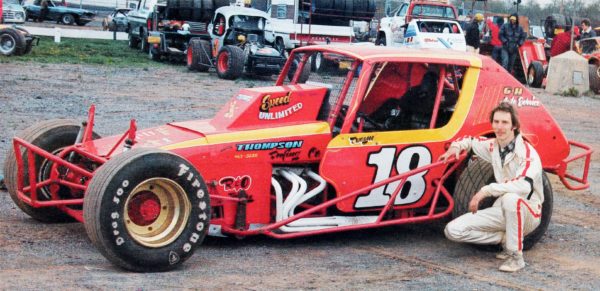
Dwayne Horvath of Aku-Strike Knives spent his formative years on the dirt-track speedways of New Jersey. He was given the encouragement and leeway to tinker, to daydream and now in his retirement he has invented a training knife that gives instantaneous pressure-based feedback through LED light and tone during combatives training. (Photo by Bob Snyder)
“At an early age, I loved racing and would go to Flemington Speedway, a local dirt track…It was a family event every weekend, consisting of fast cars sliding around the dirt track and a bucket of fried chicken,” Dwayne recalled.
“One night my favorite driver crashed real bad, destroying the starter’s stand,” Dwayne felt terrible and wanted to help. He got his father’s permission, and Howie Cronce took Dwayne to his house and let him help. “After school I would ride my bike about 10 miles to his shop, work to the wee hours.” Dwayne would eventually fall asleep and Howie would wake him, put his bike in the back of his pickup and take him home.
“In high school I wasn’t the sharpest tool in the shed. I usually wanted to look out the window and daydream, but I did rebuild a teacher’s engine on his Studebaker and built go-carts from scratch.
“In my racing days, I had what some would call some crazy ideas (probably from daydreaming) about the workings of a car suspension,” he explained. He needed to learn more, but from where? In those days, access to the Internet wasn’t readily available. He decided to sneak into the library at a technical college and hit the books and microfiche to research the effects of tire-slip angles and G-force on race cars.
“I then saved money to buy a G-meter to put in our dirt car, which had never been done before. When uploaded to a laptop, this would show all the forces of breaking, acceleration and cornering in real time so we could see what and when things were happening.” Then adjustments could be made to the shocks, springs and geometry on the car. “I was invited to the Penski shop to study the new shocks we used and got to know Ray Evernham before he teamed up with Jeff Gordon and Hendrick Motorsports.”
And it’s been like that ever since. If grades were given out in daydreaming, Wayne would score an A-plus.
You can read your digital issues of BLADE Magazine anywhere you have your phone, tablet or computer, and there’s no need to find storage for all your old issues.
If piling-up issues of magazines seems like a waste to you… If you feel like you don’t have time to read a magazine… If you like the stories we offer in BLADE, but want a more economical option, then a digital subscription is the answer. An annual subscription to BLADE is $17.98, $4 off the print price.
Once upon a time, two little boys were smashing their toy cars with hammers. An errant swing caused a brain injury that left one of them without his hearing. Thirty-four years later the deaf boy grew up to be a man who swings a hammer in the forge. He holds no grudges. They were just boys playing, neither knew any better. “I’m a forgiving person,” wrote Norman “Buddy” Thomas of Quapaw, Oklahoma, in a Messager note. Today Buddy is a graphic artist and runs a screen printing shop by day, making knives part-time by stock removal and forge. He also strives to set a positive example in the deaf community. So, in essence, the hammer that took a bladesmith’s hearing gave him his craft. Another loss would wound Buddy further, but he is grateful, always grateful, for the love of his family and the means to create beautiful knives.
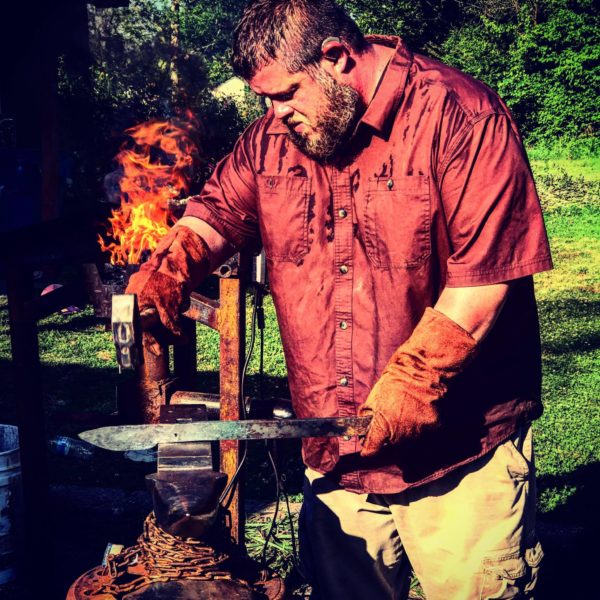
Norman “Buddy” Thomas of Tree of Liberty Bladecraft and Forge lost his hearing when he was accidentally hit in the head with a hammer. Today he’s the one wielding the hammer as he forges knives that run from frontier-style to post-apocalyptic.
Buddy was born in 1980. He and a neighbor boy were beating on their Hot Wheels with a hammer. Buddy was 3, the other boy, 5. The other boy’s swing went wild, hitting Buddy in the head. But a baby’s crown is not as forgiving as a die-cast model car. He irreparably lost his hearing. At first his parents tried the speech therapy route. Buddy began displaying social issues. It doesn’t seem like a bad idea to teach a non-hearing child to speak, but it confuses people who can hear and who do not realize the person is deaf. “No matter how well you can hone the speaking skills of a deaf individual, one thing is concrete certain, you can’t fix deaf,” Buddy explained.* He has one ear that is slightly better than the other and a hearing aid can maximize what remains, but it can’t cure the problem.
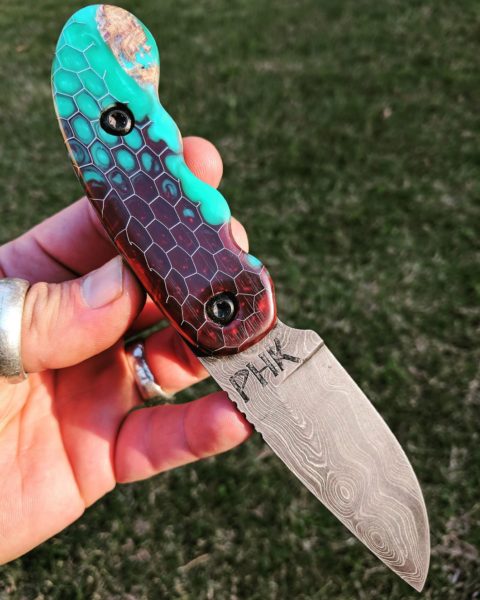
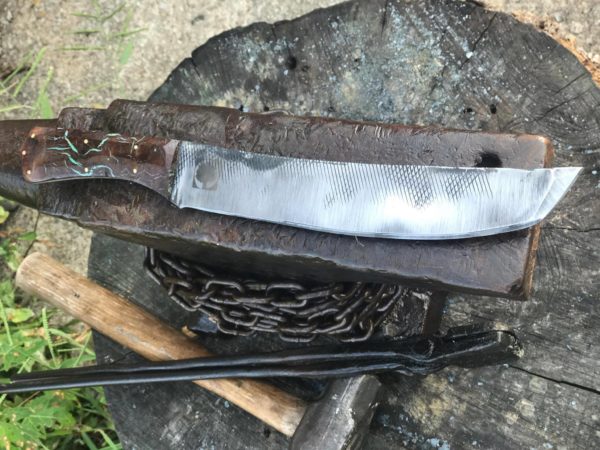
Buddy Thomas’ tanto chopper is made from a farrier rasp drawn out to 15 inches overall with a 9.75-inch blade length. The frontier-style coffin-shaped handle is stabilized maple burl with turquoise casting. Maker’s list price: $375. Contacts for Tree of Liberty Bladecrafting and Forge are listed at the end of this article.
Pre-kindergarten began for Buddy in an all-deaf environment. Throughout elementary and middle school Buddy was educated through a public-school system that focused on teaching deaf students to speak. His parents saw that he needed a change and enrolled him in Oklahoma School for the Deaf in Sulphur, which, funny enough, is one town over from where Jantz Supply is located in Davis. Jantz has been offering knifemaking supplies to craftsmen worldwide for 50 years. It was at OSD where Buddy flourished and his interest in metalwork began.
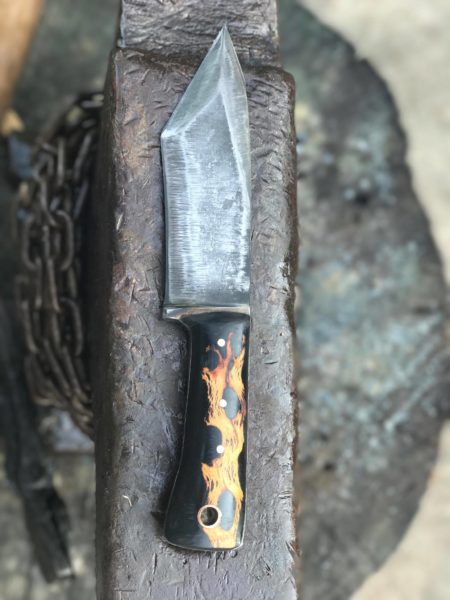
The American tanto hybrid from Tree of Liberty Bladecraft and Forge is made with 5160 spring steel. The blade length is 5.75 inches; overall length is 9.75 inches. The handle material is stabilized cholla cactus cast in black epoxy. Maker’s list price: $350. Contacts for Tree of Liberty are listed at the bottom of this article.
Meanwhile, at this time there were not a lot of American Sign Language courses for Buddy’s parents, but he taught them what he learned. His sister, Kalley, picked up on it quickly. Today, hearing parents are teaching sign language to their pre-verbal hearing children. Science is showing, in all mammals not just human babies, that possessing a non-verbal means of communication minimizes frustration and thereby aggression. Later these babies and, say, puppies who are taught means of communicating as early as three to four weeks of age, are more confident and better able to cope with the inevitable challenges of life. There are also positive physiological benefits. Buddy said that it was easiest to conduct a non-sign conversation with his parents, but even now he uses ASL frequently with his father. His mother passed away after an illness in 2014. Both of his parents encouraged Buddy tremendously, and his father, along with his fiance, June, remains one of his biggest supporters.
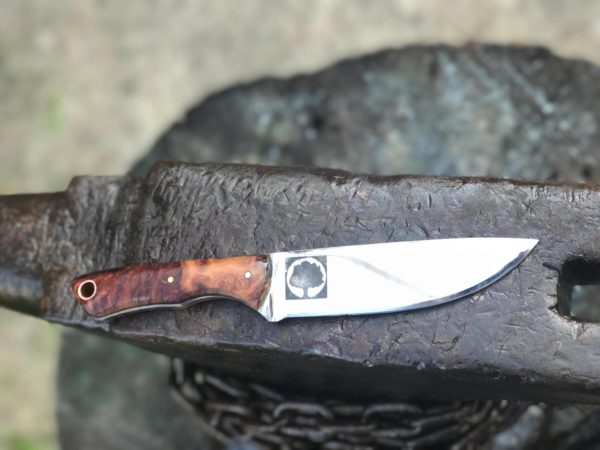
This small hunter has a 5.75-inch blade of 1095 high carbon steel. The overall length is 8.75 inches. The handle material is stabilized Australian red mallee burl cast in blur Alumilite by Lucas Free. Maker’s list price: $350. Contacts for Buddy Thomas at Tree of Liberty Bladecraft and Forge are listed at the bottom of this article.
Buddy didn’t realize how much his machine shop/metal working class would impact his life. He was focused on going to college. He graduated from OSD as a Salutatorian with a 4.0 grade point average, serving as president in the local National Honor Society. “The only mismatched puzzle was my machine shop/metal working class, which I loved because when I tried the first semester out in that class I got hooked to the welding and metal fabrication,” Buddy wrote. His instructor Dwayne Bryant spent hours of one-on-one time with him, helping him develop his welding skills. Each advancement in his metal fabrication skill fueled his creativity. “In fact, my very first nonfunctional knife was made in that class in 1997 when I was just 17 years old,” he recalled. “A piece of mild steel plating, ground into the shape of a knife roughly 8 inches overall. A DeWalt angle grinder was used to taper a bevel and create an edge. The handle was from a can of spray-on rubber. I wish I still had it. Well, after that it would be years before I attempted another knife build again.” Buddy sprinkled laughing emoticons throughout that description.
“It was pretty much just a plain little skinner, probably only an inch wide but at least a quarter-inch thick,” he noted with tears of laughter.
Buddy was also the co-editor of the school newspaper along with his good friend James Mitchell, who in his own right has had an impact on the deaf community supporting various organizations. Then it was off to major in visual communications art at the University of Oklahoma (UO) in Norman. “I was one of only three deaf students on campus: a football player recruited from Lee’s Summit, Missouri, a French major and myself, an art major,” Buddy wrote, revealing how isolating it can sometimes be for a deaf person in a hearing world.
Buddy Thomas’ large bushcraft chopper is made from reclaimed early-1900s saw mill high-carbon steel. It is 16 inches overall with a 10.25-inch blade. It is 2.75 inches wide at its widest point. The handle material is figured cedarwood with a black epoxy bolster guard. Maker’s list price: $425. Contacts for Tree of Liberty Bladecraft and Forge are listed at the bottom of this article.
But Buddy got to work, putting his art and journalism experiences into play as a cartoonist and copy editor for The Oklahoma Daily, the school newspaper. “My childhood dream was to be a comic book artist. Of course, dreams change as we go through life,” Buddy noted. He grew up around several talented comic artists, including Steve Erwin, the original penciler for DC Comics’ Deathstroke the Terminator, a character portrayed on the television show “Arrow.” “I had originally wanted to attend the Joe Kubert School of Cartoon and Graphic Art in Dover, New Jersey, but I was persuaded to apply to UO and was accepted, so I went that route.” It was nice to have UO on his resume, but by the end of his first semester all the visual communications art slots were filled and he was assigned to a painting major. That was definitely not where he wanted to take his art, so he did not return, despite his good grade standing.
Buddy now manages a screen print shop and does graphic designs and color separations. “Part of my time I’m out running the automatic press and printing T-shirts, and the other part of my time I’m cooking up some wicked graphics, either for the storefront or a customer order,” he wrote. “At night and on weekends I work my forge and knife shop.” Care to guess what the name of the print shop is? Metal Fab Trophy and Screen Printing. You don’t have to hit Buddy over the head for him to get that he may be exactly where he was meant to be all along. The name he chose for his business: Tree of Liberty Bladecraft and Forge, invoking the freedom that he experiences through his creativity.
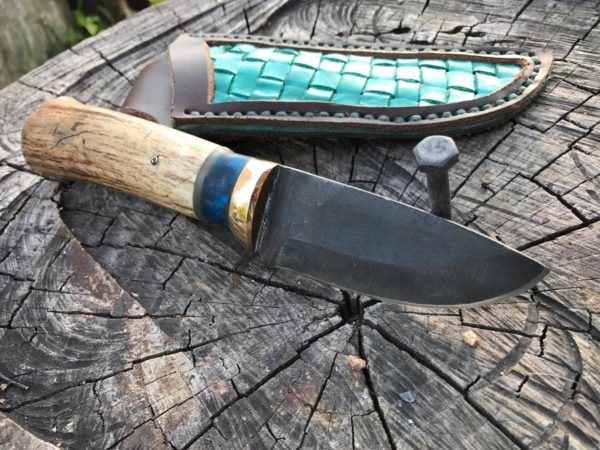
This Buddy Thomas creation comes with a turquoise leather weave sheath. It is made from CPM S90V steel, 9.5 inches overall with a 4.75-inch blade. The handle is elk antler with a rustic coffee stain and a blue Alumilite spacer and solid brass guard. Maker’s list price: $575. Contacts for Tree of Liberty Bladecraft and Forge are listed at the bottom of this article.
Buddy’s design skills do help him when he’s working up a pattern for a stock-removal knife on card stock, “but when forging, it’s all in the eye,” he wrote. Buddy started in stock removal and worked his way into forging by trial and error with lots of research and time spent learning from other forge artists. “A guy I ran into in a forum a few years back—his name was Ethan Paul Dobbins—he sent me tons of material to read up on. Another was a lifelong friend who did some blacksmith work as a tool maker, James Moore. I have actually learned most of my blacksmithing skills at the anvil from James, who was there to help me correct my hammering form and help guide me through and recognize heat requirements and steel reactions,” Buddy explained.
Buddy can read lips and his hearing aid, although not the best, helps him hear a little. “James is as hearing as they come! Maybe selectively deaf at times,” Buddy joked with a laughing emoticon. “I can read him pretty well, but sometimes have to have him repeat himself.”
Deaf bladesmith Buddy Thomas and his hearing wife, Sundae, have two daughters, Anna, 12, and Kaity, 9.
Buddy’s wife, Sundae, is also hearing. They met at a football game in Picher, Oklahoma, and were married in 2001. She did not know sign language at the time, but she has learned from Buddy. They have two daughters, Annaleigh, 12, and Kaitlynne, 9, who also know sign language. Their first child, also a girl, Daisy Elizabeth, would be 15 now, but the couple lost her two weeks after she was born, to infection. “She passed in my arms,” Buddy wrote.
Buddy and Sundae Thomas lost their first child, a daughter, at 2 weeks of age, due to infection. Buddy lost his hearing at the age of 3; his wife is hearing.
“She was beautiful. I always wonder what she might have been like as their older sister. I’m so grateful and thankful for those two.”
If you converse with Buddy for any length of time, you will sense the sad undercurrent of the tragedies in his life, but you simultaneously get the feeling of a silent, gentle but unwavering determination to not just live, but thrive. He doesn’t minimize the impact of his losses—his hearing, his daughter, even his childhood aspiration to become a comic strip artist though he admits to outgrowing that aspiration—but the Tree of Liberty gives him more than solace; it restores his life-battered spirit.
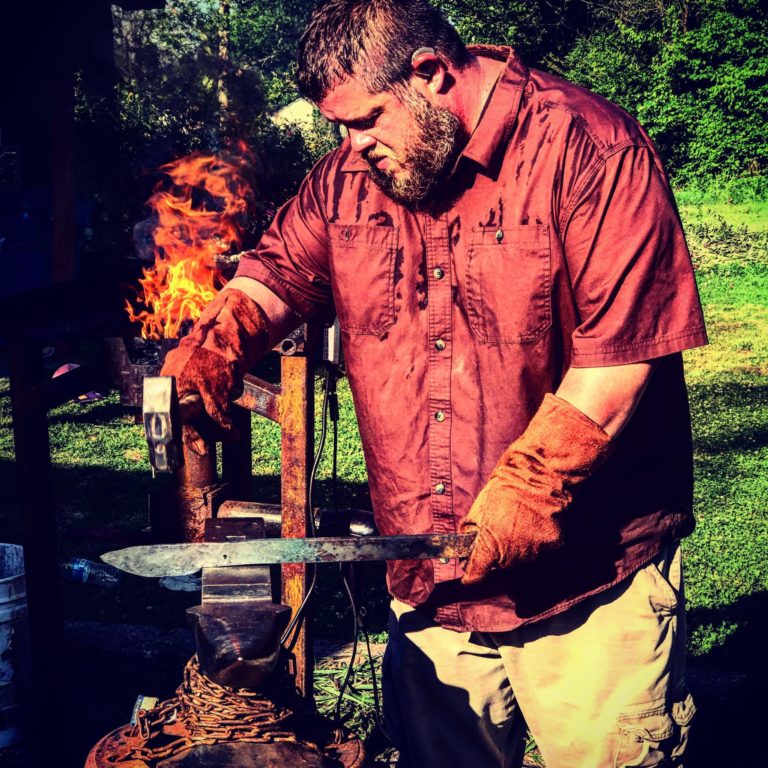
He enjoys the stock-removal method of knifemaking, but whenever possible, he prefers to forge. He started on a coal forge and still loves it, but he often goes to the propane forge because it’s quicker and cleaner. “Most CPM steels are difficult to forge,” he observed. “Stock-removal methods work much easier for such jobs. Most of my stainless and powder steels I apply the stock-removal method to, but my high carbons benefit me better at the forge. Ultimately, they all go in the forge for heat treating.”
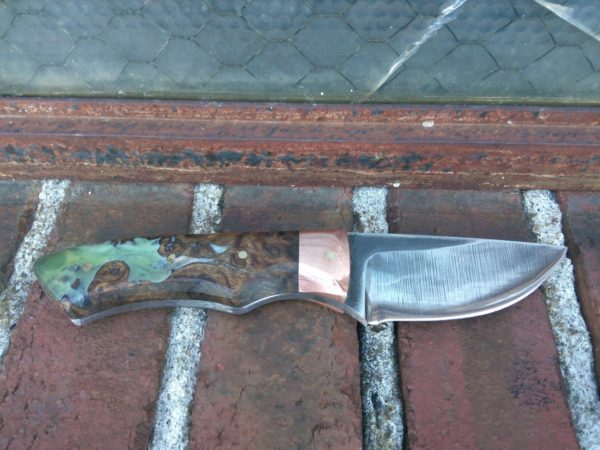
This Tree of Liberty Bladecraft and Forge creation has a 4-inch Elmax steel blade and an overall length of 8.75 inches. The handle material is rare black nargusta cast in a jade green Aluminite by Rob Carper of RC Innovations. The bolster is copper. Maker’s list price: $475. Contacts for Buddy Thomas listed at the bottom of this article.
Buddy’s knifemaking style swings from old frontier to post-apocalyptic utilizing reclaimed steel. He also makes everyday carry knives and has a preference for using copper bolstering. “One of my biggest goals as a maker is to get a prop knife made for ‘The Walking Dead’ show,” Buddy notes. His forging buddies, Aric Davis, Ryan Edwards and Louis Stark, often get together for Sunday forge-ins. In other words, the forge is the hearth of Buddy’s heart.
“I would not be where I am in this world if I did not have the deaf community behind me, specifically my best friend who has always had great words of encouragement,” Buddy said of a deaf woman who is like a sister to him. He recommends that deaf people who are interested in learning about knifemaking and forging do so through a deaf school or access vocational rehabilitation departments in their state for guidance and research. The next step is to seek out experienced bladesmiths who offer classes in their shops. “A deaf individual would acquire an interpreter to accompany them to the classes. It is actually my goal to establish a stronger bridge in that direction,” Buddy added. His plan is to work toward his American Bladesmith Society journeyman smith rating and eventually his master smith rating so he can offer classes to other deaf people. He knows they would be more comfortable learning from a deaf instructor. Three-way conversations with an interpreter can lead to a loss in focus.
Buddy lives out his favorite quote, attributed to Helen Keller: “Optimism is the faith that leads to achievement. Nothing can be done without hope or confidence.”
*Editor’s note: For this interview Buddy and I Messaged about using Facetime, but we felt it would be easier for him if we Messaged. It forced me to slow down and try to pick up on all of those nuanced things that happen even in phone conversations, like tone. In the end, Buddy and I both felt that he had told his story and I had heard his story in all its bittersweet humanness.
Buddy’s Links for Deaf-Related Services And Assistance
September is National Deaf Awareness month. Here are a few organizations that deaf bladesmith Buddy Thomas of Tree of Liberty Bladecraft and Forge in Quapaw, Oklahoma, recommends.
Empowers Oklahomans with disabilities to live healthy, active, smoking-free lives.
A Digital Subscription To BLADE Is The Answer
You can read your digital issues of BLADE Magazine anywhere you have your phone, tablet or computer, and there’s no need to find storage for all your old issues.
If piling up issues of magazine seems like a waste for you… If you feel like you don’t have time to read a magazine… If you like the stories we offer in BLADE, but want a more economical option, then a digital subscription is the answer. An annual subscription to BLADE is $17.98, $4 off the print price.
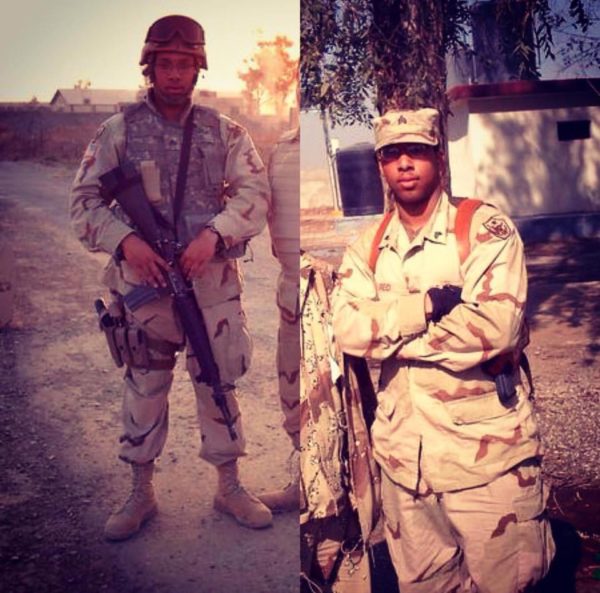
Allan Reid of Allan Reid Cut Throat Custom Knives is a part-time knifemaker who is a nurse by trade. He served in the U.S. Army. as a combat medic, obtaining the rank of sergeant.
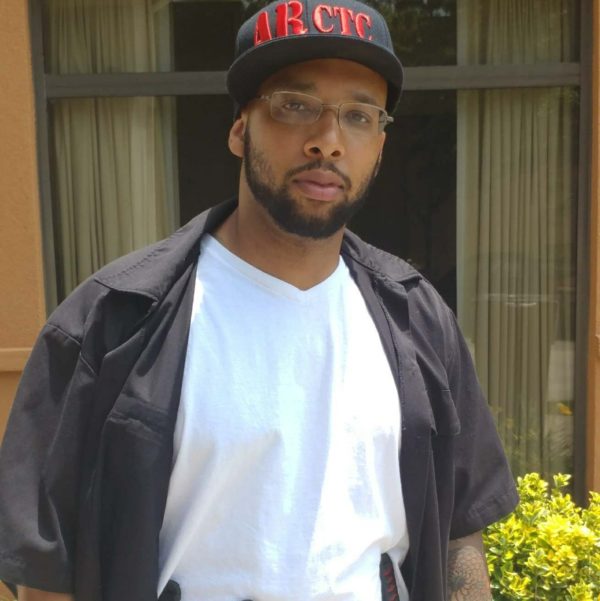
Allan Reid of ARctc Knives, which stands for Allan Reid of Cut Throat Custom Knives, is a part-time maker who currently works as a nurse. He served for six years as a U.S. Army combat medic, achieving the rank of sergeant. In 2005-2006 he deployed on Operation Iraqi Freedom. Most recently, he earned his registered nursing credentials.
Allan Reid of ARctc Knives parlayed his combat medic training into a nursing career. He has completed his schooling and is awaiting his state board certification.
Allan has been fascinated with blades and martial arts since childhood. “I was exposed to several custom knives while on deployment, which spurred my interest in knifemaking,” he noted. He learned about stock-removal methods by reading and asking questions on knife forums. He is now learning to forge blades under the mentorship of close friends James Helm and Tobin Nieto.
Allan is the father of four with another on the way. He and his family live in San Antonio, Texas.
Best-selling knife patterns: tactical, utility and bushcraft; Alpha-1, Nessmuk and Mini-muk models
Favorite blade steels: high-carbon and tool for edge retention; 1084 for ease of heat-treat and durability. “I also utilize 5160 spring steel for my larger blades, and often incorporate O1 and 1095.”
Blade grinds: full flat or saber
How he tests his knives: If Allan knows the intended use, those mediums will be cut, however, almost all of his blades are tested on 2-by-4s.
Favorite handle materials: G10 and Micarta for toughness, durability, color selection and low maintenance
Price range: $145-$400
Knife shows he attends: Texas shows, BLADE Show 2018
Forums he participates in: BladeForums.com when time allows
As a former soldier, knifemaker Allan Reid of ARctc Knives is a fan of easy-to-maintain and cost-effective handle materials.
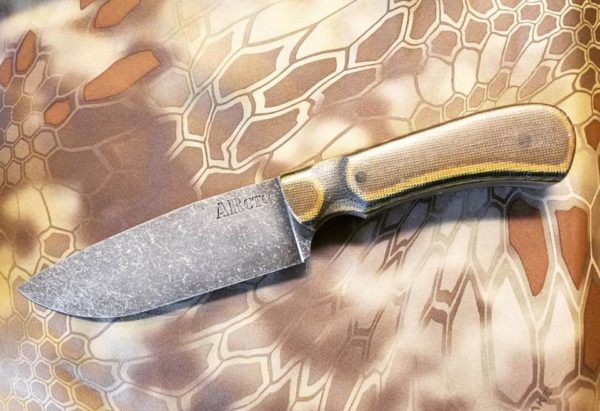
The Alpha-1 above has a 5-inch blade made out of 1084 steel with a full flat grind and acid stonewashed finish. The scales are Camo Micarta fitted with Black Micarta pins. Overall length is 9 ¼ inches. Maker’s list price: $165.
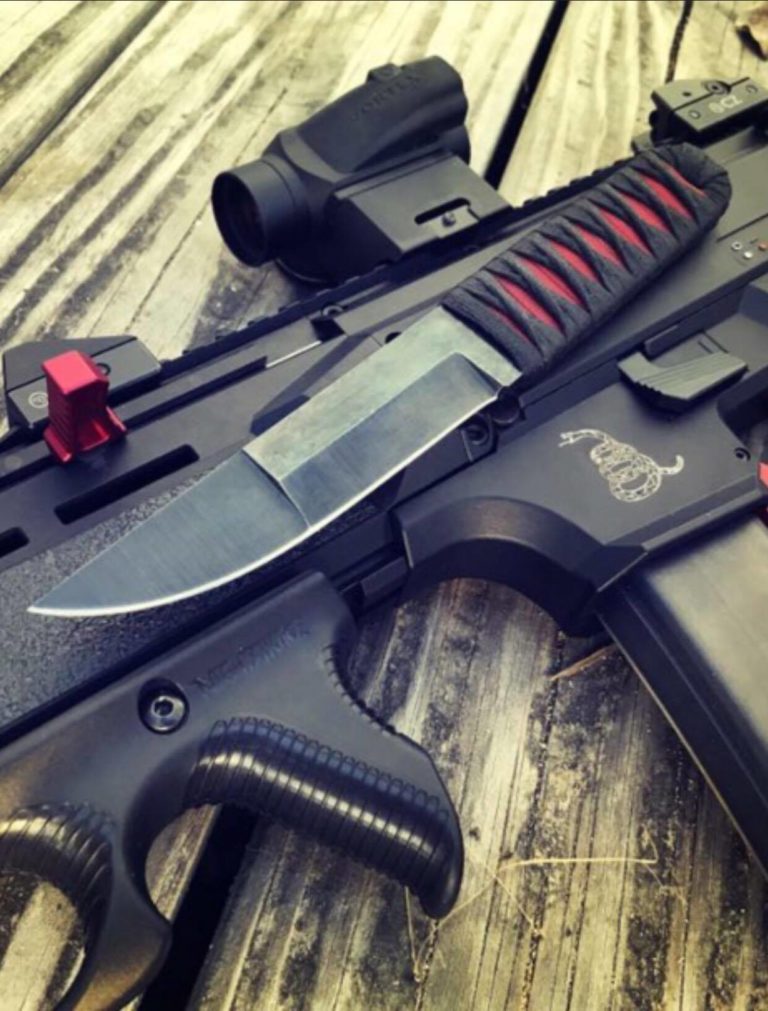
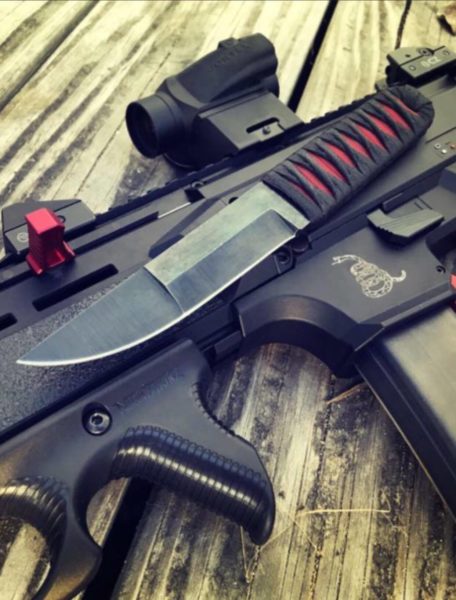
The ARctc Knives kwaiken-design knife has a 4.5-inch combination-ground blade made out of O1 tool steel. It’s 9 inches overall. The handle features an epoxy-sealed red paracord base under a black Japanese lace wrap. Maker’s list price: $180 with Kydex sheath and belt attachment.
Contact Allan Reid at [email protected], on Facebook at Allan Reid and on Instagram @arctc_knives.
In BLADE®’s continuing series entitled Midweek Maker, we are in our third installment of Midweek Maker Military Style: Tracy LaRock of LaRock Knives.
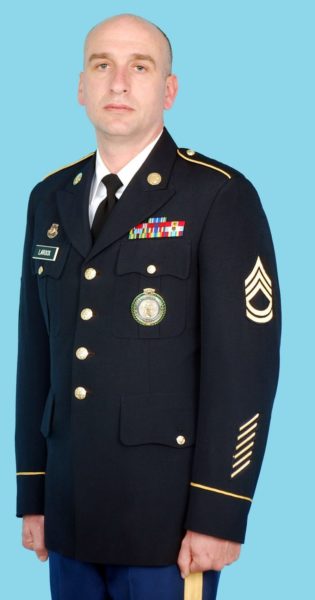
Tracy LaRock grew up on a dairy farm and spent every spare moment hunting, trapping and fishing. He served as a mortarman in U.S. Marine Corps from 1990 to 1995, but he didn’t stay out for long. In 1997 he signed on with the Texas Army National Guard, in artillery and recruiting, and still serves today. “So knives have been a part of my daily life since the beginning,” he commented.
“In 2008 Atmar Lester was showing a knife he made to some folks at church. I asked him some questions and he pointed me in the direction I needed to go,” Tracy related. “To start off it was basic tools and head-scratching, then I discovered the forums and tutorials.” Thomas Rucker and Percy Richardson let Tracy visit their shops. In 2014 he started making slip joints. After completing a few he reached out for help and received helpful insights from knifemakers Luke Swenson, Jared Oser and Enrique Pena among others.
“I hope to become a full-time maker in a couple years when I hang this uniform up for the last time,” he noted. Tracy lives in Lufkin, Texas with his wife, Mia, and their three sons.
Best-selling knife patterns: TimberJack and TimberJack Jr., traditional slip joints
Favorite blade steels: W2, 1095, O1. “Most are W2 because I have long since fallen down the hamon hole,” Tracy quipped.
Blade grinds: flat
How he tests his knives: rope, cardboard
Favorite handle materials: green canvas Micarta and ironwood
Price range: $350-$850
Forums he participates in: Facebook Group like Making Slipjoints and Lockbacks
As Tracy LaRock retires from the military, he will be able to focus more time on making his TimberJack slip joints. His wife Mia LaRock does a terrific job running the Facebook Group at LaRock Knifes.
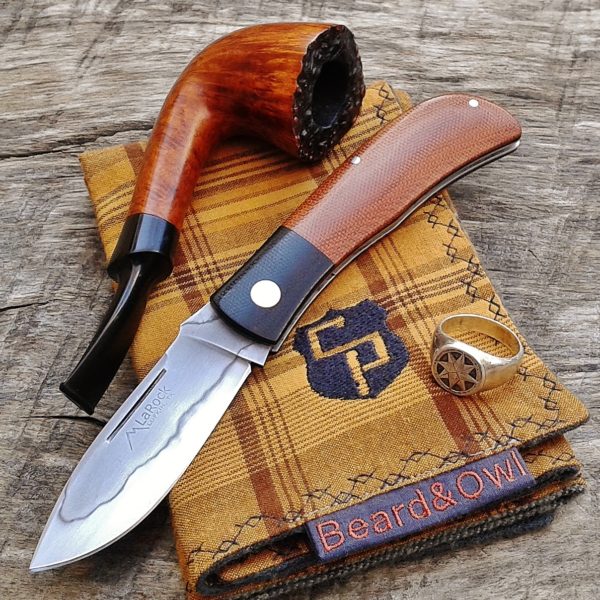
The above TimberJack has a 3-inch blade of W2 with hamon. The handle is fashioned from canvas Micarta scales. Overall length is 7.25 inches. Maker’s list price: $425.
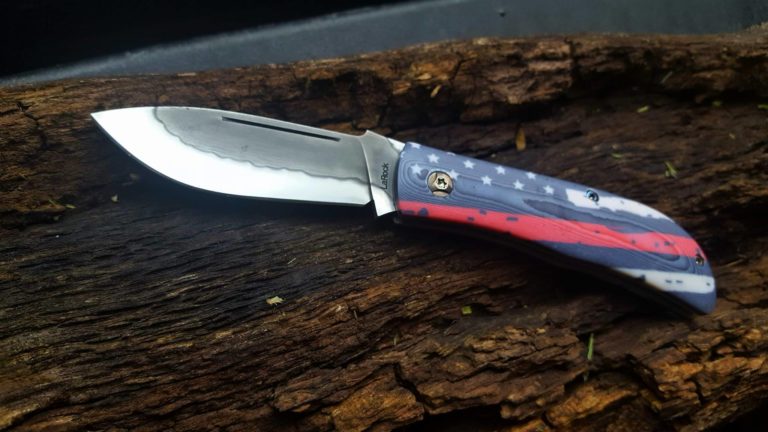
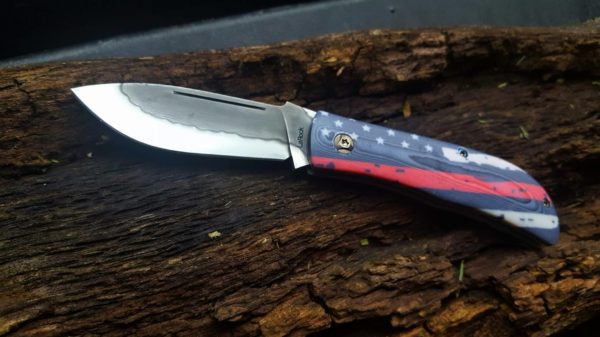
This Tracy LaRock creation is also a TimberJack with a 3-inch blade of W2 steel with hamon. The handle is American flag Carv-X. Overall length is 7 3/4 inches. The screw construction is done with titanium screws from TiConnector. Maker’s list price: $750.
Contact Tracy or Mia LaRock at 936-238-9077, [email protected], on Facebook at LaRock Knives or on Instagram @tracylarock.
Subscribe To BLADE For More Stories Like This
An annual U.S. subscription to BLADE is $21.98. You can get your 13 issues sent to Canada for $39.98 and internationally for $49.98. Or go green and get your issues sent digitally for $17.98.
A one year’s subscription to BLADE® will ensure you’re the first to read all six Knifemaker Showcase stories. You’ll also get the latest knife news, knifemaking how-tos, knife reviews, plus knife history and articles that tap into the knowledge of both the legends and the up-and-comers. Don’t miss out. Subscribe.
In the second of BLADE’s Midweek Makers series we continue with our armed forces active-duty members and veterans. This week: Midweek Makers Military-Style: Chris Rowley of Nomad Customs.
Chris Rowley was a farrier for 12 years or more before he joined the Army at age 34. During his seven years of service he deployed six times to Afghanistan with 2nd Battalion, 75 Ranger Regiment, winding up his service this year as a weapons squad leader with the rank of staff sergeant.
He always loved blacksmithing and found time after work and on weekends to keep his hand in it by making knives. “Pretty soon half of 2nd battalion had one of my knives,” he said.
When Chris entered blacksmithing competitions, his horseshoes were hammer-finished, essentially going from the forge to horse. He tries to carry those shaping skills over to his knives, completing as much work in the forge as possible. Although not applicable with all steels or designs, many of his knives maintain a richly textured hammered finish.
Chris lives with his wife in Rainier, Washington.
Best-selling knife patterns: small everyday carry knives and 4- to 10-inch bowie-fighters
Favorite blade steels: 1084, 1075 and 15N20 for ease in forge-welding and the contrast with 1084 and 15N20; also W2
Blade grinds: hollow and flat
How he tests his knives: cardboard and random materials for everyday carry knives; chopping kindling and prepping game for camp-oriented knives
Favorite handle materials: resin-and-burl-wood combinations by Voodoo Resins and J Hue Customs. “Both finish really well,” he added.
Price range: $275 and up
Forums he participate in: BladeForums.com
The diamond hole you see in Nomad Custom knives is representative of the U.S. Army unit in which knifemaker Chris Rowley served, 2nd Battalion, 75th Ranger Regiment.
This knife has a 9-inch flat-ground forge-welded blade of 1084 and 15N20 steels. The handle is made of redwood burl with Voodoo Resins spacers and G10 liners. His maker’s mark is a diamond cutout to represent the Ranger Battalion emblem. Maker’s list price: $500 with sheath.
Watch Chris Rowley Cut Out His Maker’s Mark
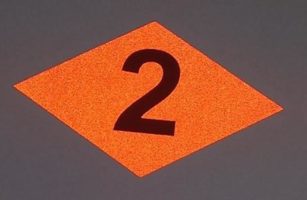
The diamond-shaped insignia is used to represent the battalion within the Ranger Regiment. Often in comments, you will see it typed as < 2 > for 2nd Battalion, for example.
This sticker, offered by Scroll Factory, shows what the 2nd Battalion, 75th Ranger Regiment diamond looks like that bladesmith Chris Rowley of Nomad Custom Knives & Tools cuts out of his blades as his maker’s mark.
An annual U.S. subscription to BLADE is $21.98. You can get your 13 issues sent to Canada for $39.98 and internationally for $49.98. Or go green and get your issues sent digitally for $17.98.
A one year’s subscription to BLADE will ensure you’re the first to read all six Knifemaker Showcase stories. You’ll also get the latest knife news, knifemaking how-tos, knife reviews, plus knife history and articles that tap into the knowledge of both the legends and the up-and-comers. Don’t miss out. Subscribe.