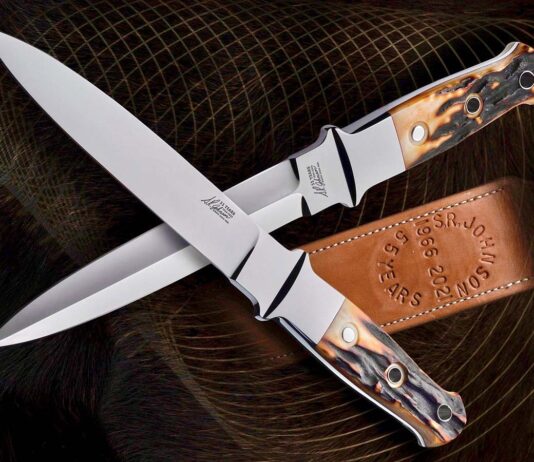
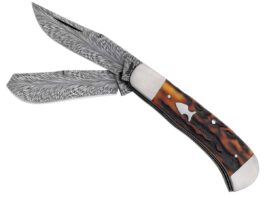
Knifemaking is the building of a knife, which includes the blade, handle and other accouterments. Blades are made by either removing metal from a steel blank via a grinder – known as stock removal – and the forging to shape of hot steel into a blade in the process known as bladesmithing. Other parts, including bolsters, guards, pommels, etc., are needed to complete the finished knife.
We’re kicking off a new series at BLADEmag.com called Midweek Maker. Each Wednesday we’ll feature a different knifemaker. The first six installments feature active-duty military or veterans. This week: Midweek Maker Military-Style: Dustin Driver of Driver Defense Knives.
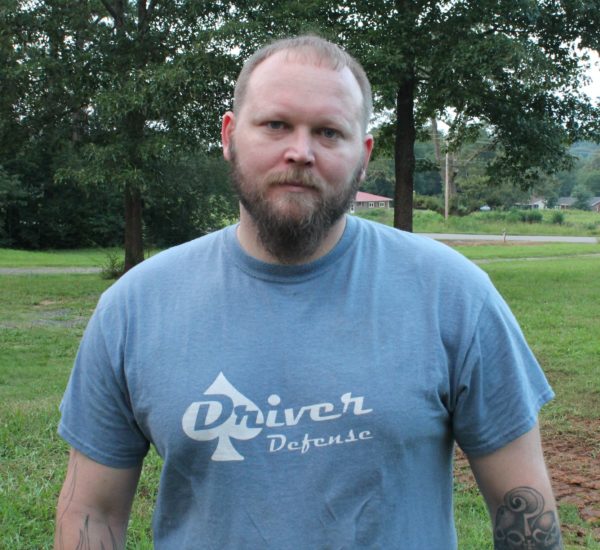
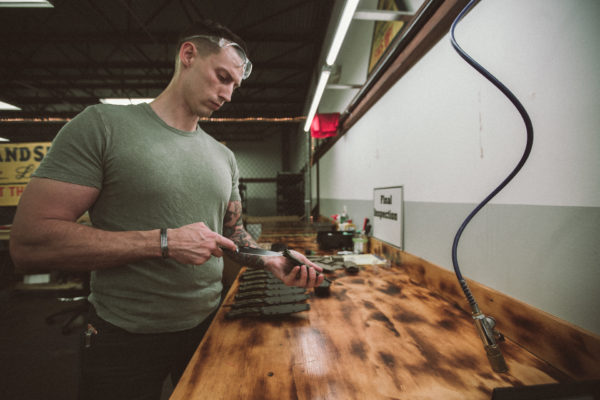
Dustin Driver of Guntersville, Alabama served in the U.S. Army from 2004 to 2010. He was a communications expert, deploying to Iraq, 2005-2006, and Kuwait, 2007-2009. He uses that training and experience in his current job as a system and network administrator for a government contractor.
In October 2015 he was looking for a hobby. “I have always been into knives and have always been creative and good at making things,” Dustin noted. Aside from some You Tube videos and Internet research, he is essentially self-taught. “I have a beautiful daughter who has cerebral palsy, so I try and do a few charity knives a year to benefit cerebral palsy and other special needs areas.”
Best-selling knife patterns: Belladonna, an EDC mini cleaver; Toxin, an everyday carry with several blade styles; Timber Rattler, a small neck knife
Favorite blade steels: 1095 for consistent heat-treat; S35VN as a good all-around steel; pattern-welded steel from Alabama Damascus Steel
Blade grinds: flat with plans to offer hollow. “I like thick blades with full or high flat grinds. The thick spine makes for a strong blade, and the high flat grinds make them nice slicers.”
How he tests his knives: chopping 2-by-4s, field use, slicing paper
Dustin Driver bought a mill and he’s experimenting with fullers. He likes the looks of them when they end in a bevel. His Toxin model comes in a variety of blade styles, including a drop-point with or without hamon.
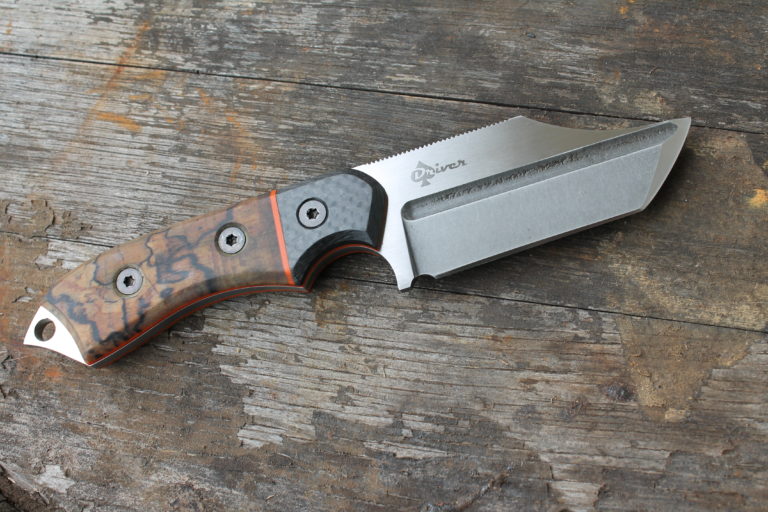
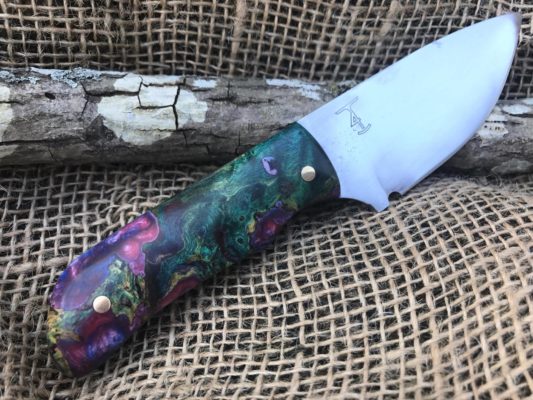
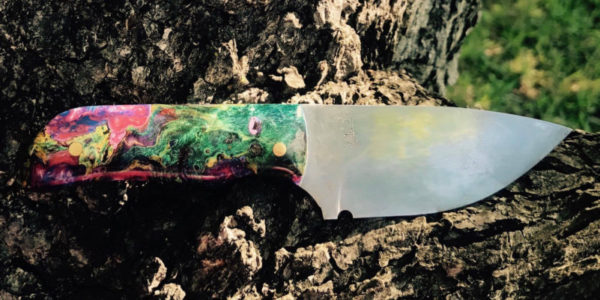
The 7.5-inch Driver Defense Toxin is a tanto-bowie with fuller made out of S35VN steel. The flat-ground blade measures 3 inches. The scales are stabilized spalted maple with carbon fiber bolster and orange G10 liner and spacer. Maker’s list price: $350 with Kydex sheath.
Contact Dustin Driver, 256-975-9857, [email protected], on Facebook at Driver Defense and on Instagram @driverdefenseknives. His Facebook Group is Driver Defense EDC. You’ll want to ask to join that one. Dustin makes beef jerky, too, and he’s a big-hearted guy with frequently donates portions of proceeds to charity.
Subscribe To BLADE For More Stories Like This
An annual U.S. subscription to BLADE is $21.98. You can get your 13 issues sent to Canada for $39.98 and internationally for $49.98. Or go green and get your issues sent digitally for $17.98.
A one year’s subscription to BLADE will ensure you’re the first to read all six Knifemaker Showcase stories. You’ll also get the latest knife news, knifemaking how-tos, knife reviews, plus knife history and articles that tap into the knowledge of both the legends and the up-and-comers. Don’t miss out. Subscribe.
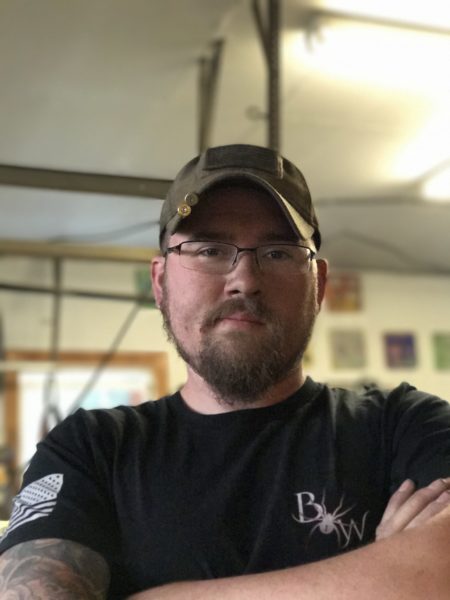
Brent Vaccaro of Black Widow Knifeworks & Tactical Gear left high school in his junior year. He already knew carpentry inside and out. But it was when he turned to knifemaking that he found a way to identify himself that had eluded him during his other business attempts. This dropout knifemaker is a master at marketing.
Brent Vaccaro of Black Widow Knifeworks & Tactical Gear attended high school in New Jersey where he was born and raised. He excelled in woodworking, banging out projects that those two years ahead of him struggled through. His teacher helped him, Brent said, but perhaps most by giving him the freedom to do his own thing. Brent grew up building houses. His family lived in the middle of an open subdivision field and every day after school Brent would work on the other eight houses that needed to be constructed. In his junior year, bullying got too much. He left school and became a carpenter. Over the course of 15 years he worked in construction, running his own business and working for others. He also started a tactical gear company, and he dabbled in beard accessories during the height of facial hair resurgence. He never could quite establish an identity for himself in any of his three businesses, he admitted, but when he started making knives, everything came together. Now, no matter how different Brent’s knives are from each other, when you see a Black Widow knife, you recognize it immediately. The dropout knifemaker is a master of marketing.
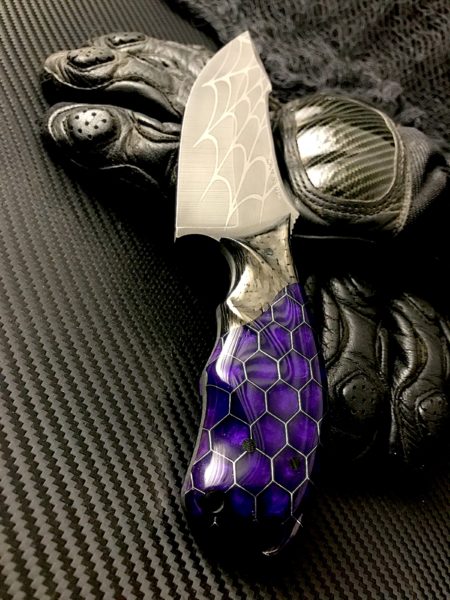
Model: H.E.R.L Blade Length: 4.25 inches Blade Steel: CPM-S30V Blade Finish: acid wash with spider web etch Scales: Voodoo Resin’s Purple Haze with KS Carbon bolster Overall Length: 8″ inches Maker’s list price: $250-$350 shipped with Kydex sheath and Tec-Lok Contact: Message Brent Vaccaro on Facebook at Black Widow Knifeworks & Tactical Gear. (Additional contacts at end of article.)
Around the time that Brent was struggling with being in school, when he was 16, his father gave him a pocketknife. It was a now-discontinued Kershaw model. “I still have it. I loved that knife,” Brent said. But he never had the money to collect knives, and some days he gets a mock scolding from his wife, Megan for forgetting to carry a blade on him. He was getting disillusioned with the diminishing level of artistry within carpentry, the lack of appreciation from the customers and the sense that the industry was solely focused on money. Although the skill sets are similar in woodworking and metalworking, it took some time to transition. Now Brent loves metalworking. It’s not months or years to finish a project with barely a handshake and never a thank you. It’s the instant gratification of seeing a knife come to completion over a course of days, sending it out and having the customer write him that they have no words for how impressed they are with his knife.
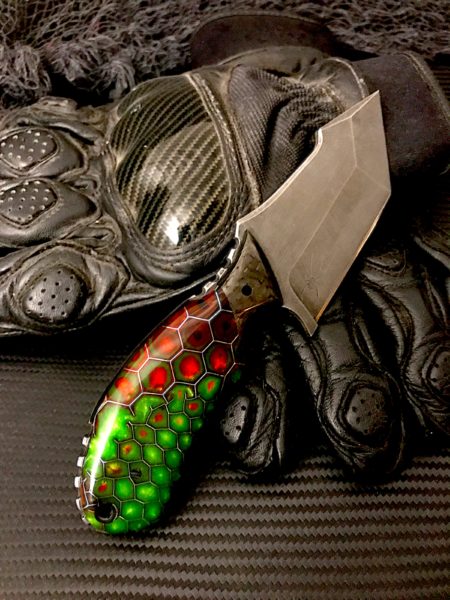
Model: BW Tac Tanto Blade Steel: CPM S30V Blade length: 3.5 inches Blade Finish: dark acid wash and stonewash finish with aggressive gimping Scales: Voodoo Resins’ Bloody Hulk with KS Carbon Fiber bolsters. Overall length: 7 inches Maker’s list price: $230-$330 shipped with Kydex sheath and Tec-Lok Contact: Message Brent Vaccaro on Facebook at Black Widow Knifeworks & Tactical Gear. (Additional contacts at end of article.)
And therein lies his mastery. Brent is fulfilled by that appreciation for his craft, and he knows exactly how to represent his knives to the world in the best possible light—literally—without ever crossing into exaggeration. It means a lot to him that he has created an identity for himself that is true to him, celebratory of his knifemaking and honoring to the client. “It’s an extension of self,” Brent said, adding that he wants his knives to be passed on as a part of his and his client’s heritage. You only have to look at a photo of a Black Widow knife to get the “feel” for the candied richness of the colors, the smoothness of the handle and the badassery of the blade itself.
“I don’t keep them,” Brent said. So each night he takes the time to shoot exceptional photos of each piece, a running catalog of his work, for him to remember by and for the client to share. He takes 10 to 15 photos of every knife and picks the best ones. And that’s because he’s found a system that works for him. At first, you’ll need to shoot far more to find the right lighting and angles. “You have to take the time to do it. It’s part of marketing,” he said.
If you want to take great photos of your knives, upgrade your cell phone, make yourself a lightbox, buy some handheld lights and take the time to learn how to make your knives look, not OK, but fantastic.
Building A Lightbox That Works
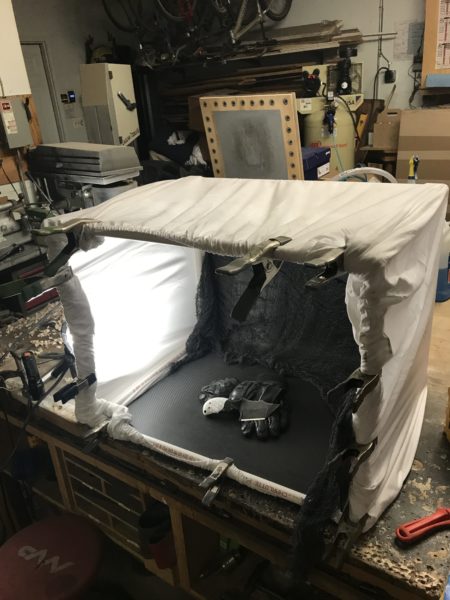
Brent invested $50 in his lightbox. At The Home Depot he bought 1-inch PVC and eight 90-degree T connections. With those he made his two squares for the box ends. He also got alligator clips. At Walmart he bought a king-sized white sheet and clipped it taught to the PVC frame. The whole thing is collapsible so that he can move it out of the way when he’s working. And, of course, the white sheet is no longer white.
The Backdrop
Normally, light boxes are made with white construction paper on the floor that bends up the back. Not Brent’s. He does a lot of Kydex. He was heating up a 2-by-4-foot sheet of carbon fiber one day and as it bent, it occurred to him to use it in the lightbox. He had to buy more Kydex, but he likes the look of it. That was probably anther $50, but wouldn’t be necessary for everyone since every knifemaker’s style is different. Brent strives to build tough knives that military and law enforcement can respect, while still appealing to the civilian population with his Candy-Crush-like handles. He mostly uses Matt Peterson’s Voodoo Resins scales, but he’s also using some of J Hue Customs’.
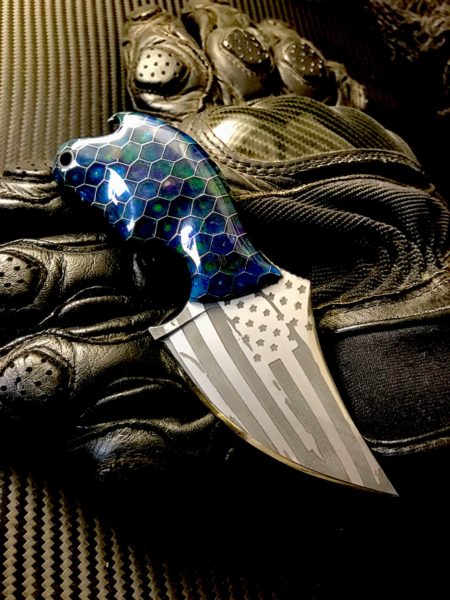
Model: Recluse Neck Knife Blade Steel: CPM-D2 Blade Length: 3.25 inches Blade Finish: acid wash with American flag etch on both sides Scales: Voodoo Resins’ Chameleon Overall length: 5.5 inches. Maker’s list price: Price range: $165-$200 with Kydex neck sheath Contact: Message Brent Vaccaro at Black Widow Knifeworks & Tactical Gear
Lights! Camera! Action—No Really, Move Around!
For lights he purchased round Utilitech LEDs that he can hold while he shoots. “The light is never stationary,” he explained. He waits until complete darkness because he has two windows in his shop and he wants total control of the lighting. Because the LEDs are very white lights, bluish even, he adds a 60-watt lightbulb to add a yellow hue to balance out the lighting. He moves around with his iPhone 7 Plus (“There is a difference with the Plus,” he notes.) and his light and gets exactly the angle and lighting he wants. Not only are the knives well lit, especially for mood-inducing vignettes, for which the majority of a knifemaker’s photos will be used, especially online, but they are in crystal clear focus. Brent does not use the focus feature on the phone. That will only cause the camera to focus on one point on the knife, when the objective is to show the entire knife in full focus, even if you have the point or butt stylistically in the background. He also does not use the flash, which only washes out colors and overexposes the image.
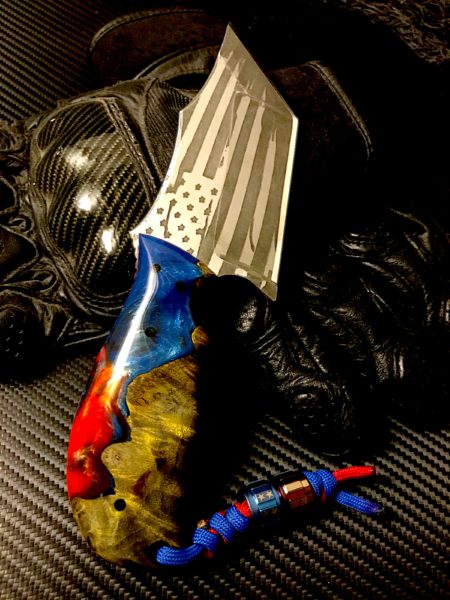
Model: The Carnage Blade length: 4 inches Blade Steel: CPM S30V Blade Finish: acid/stonewashed with American flag etch on both sides Scales: J Hue Customs’ hybrid red, white and blue resin with maple burl Overall length: 8 inches Maker’s list price: $320-$500 shipped with Kydex sheath and Tec-Lok Contact: Message Brent Vaccaro on Facebook at Black Widow Knifeworks & Tactical Gear (Additional contacts at end of article.)
Props Never Steal The Scene
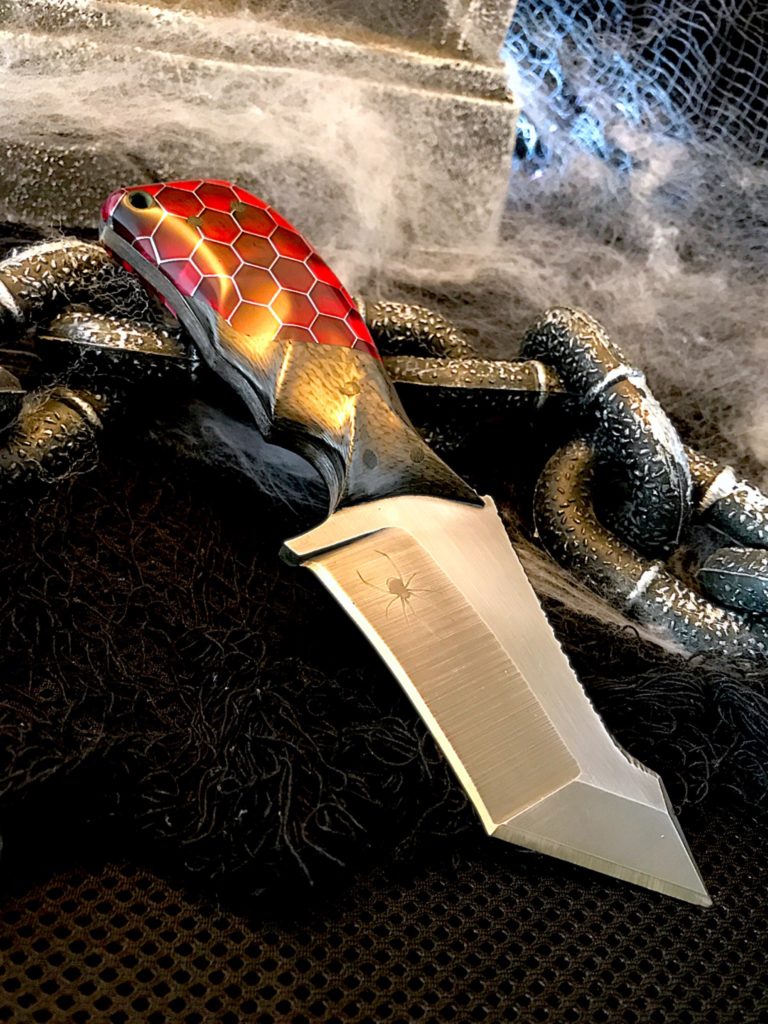
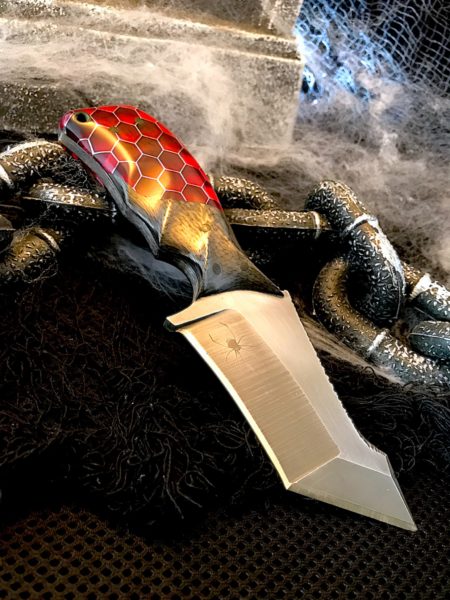
Brent uses all kinds of props in his still-lifes. Because he also produces tactical gear, like custom Kydex sheaths, you will often see pistols, ammunition and other gear as accessories in his pictures. Chain, motorcycle gloves, even Halloween webbing have been used in Black Widow images. His artistic eye is always at work, not only in the making of the knives, but in his ability to let the knives do the talking. They are always center stage. They are the first things you see in the picture and the props are there only to compliment the knives, never upstage them.
Editing
Brent uses two apps to edit his images: PicLab and Aviary. He bumps up the saturation until the image represents what you see in person. It’s important not to overdue saturation because then your customers will be disappointed that your knife doesn’t live up to how it was displayed online, all back-lit by the computer screen. It’s equally important, though, that the knife not appear duller than it is in real life.
Creating An Image
Brent is one of those men who is smart, learns quickly and follows directions. He is also a good man, turning away from an industry that couldn’t fulfill his creativity and abraded his integrity. He has been rewarded with great success. “I’m outgrowing my shop,” he said. Brent knows he’ll have to return to carpentry to build himself more space. He can’t believe it sometimes when he thinks how far he’s come in his year of knifemaking. Metal work comes easier to him. “I don’t get nearly as angry as I used to get doing carpentry,” he said. He’d be thinking artistically and make a little strip of wood for something and it would break. Sometimes he’ll find a scratch in a knife handle and he’ll have to go back and grind it out and re-sand—normally, he goes all the way from 150 to 2000 grit—but it’s not nearly as frustrating as woodworking had been.
Model: The Patella Recurve Blade length: 4 inches Blade Steel: CPM S30V Blade Finish: acid wash Scales: Voodoo Resins’ Red Honeycomb with KS Carbon bolsters Overall length: 7.75 inches Maker’s list price: $380-$500 with Kydex sheath and Tec-Lok Contact: Message Brent Vaccaro on Facebook at Black Widow Knifeworks & Tactical Gear. (Additional contacts at bottom of article.)
Brent takes great pride when someone in the industry tells him they recognize his work right off. He has been an apt student of life. The years of entrepreneurship that didn’t work, prepared him for the one that would work. But no matter how much marketing you apply to your knifemaking, the knife must still cut. It must still hold up to wear and perform as expected upon arrival and for generations to come. Time will tell, but sometimes dues get paid behind the scenes and a meteoric rise is well-earned.
Meanwhile, Brent will have to break away for the birth of his first child, a son, Blake—due any day—and at some point, he’ll need to expand his shop, but he never closes his books for long. He doesn’t think it reflects well to just drop a knife. He refuses to do it. He respects reliability in the people he does business with, so he holds himself to that standard for his customers. Just get in touch, but be aware if you do, you’ll get caught up in the Black Widow web.
Contact: Brent E. Vaccaro by email at [email protected] or Message him on Facebook at Black Widow Knifeworks & Tactical Gear. He also has a website at www.blackwidowtac.com. If you need to call, Message first, otherwise he might not hear you over the machines, 908-328-2049.
It’s All In The Grind
Mastering this one skill will improve your craft immensely. For less than $5, you can add an essential to your knifemaking library.
Author R.J. Martin instructs on flat and double hollow grinds. He discusses chisel grinds, tip shaping, the two-hand pass and lots more in “Knife Grinding Secrets.” Most importantly the finesse of grinding will be covered so that you can master the skill. Downloadable version availabe for $4.99.
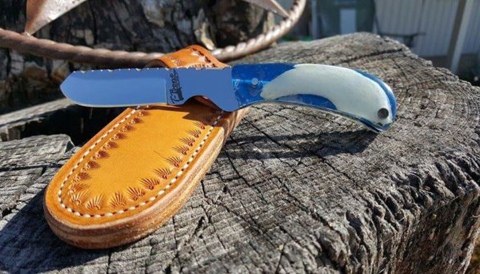
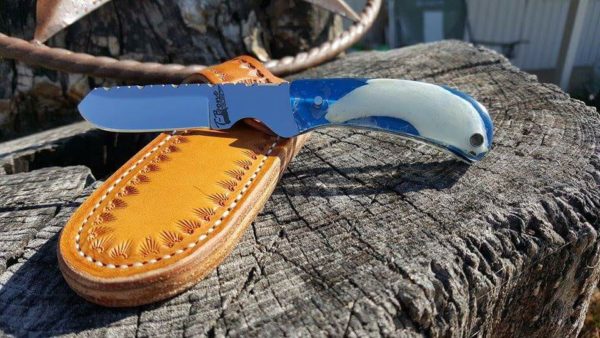
Travis Payne of T-Bone’s Custom Creations was hesitant at first, but when Kelly Pilcher asked, he made a knife with her rib. The overall length on this spey knife is 6.75 with a 2.5-inch cutting edge.
Kelly Pilcher of Collinsville, Texas, was 20 years old when doctors told her that hope of regaining feeling in her right side lay in having her first rib removed. She put the surgery off for as long as she could, but at 22 opted to go under the knife to alleviate her thoracic outlet syndrome. During surgery preparations Kelly asked, “‘What happens to body parts that come out of people?’” She was told that they were disposed of properly, but that if she wanted to take her rib home with her, she could. It was hers. She was adamant that she wanted to keep it. When she awoke from surgery, her dad was there and he had an idea of what to do with the bone. Shane Pilcher works at the New Gainesville Livestock Auction barn and when someone had mentioned making a knife with the rib, they knew just who to ask. Travis Payne, of T-Bones Custom Creations in Telephone, Texas, makes castration knives so all the cattlemen knew he could fashion a knife made from her rib. “Let’s do it!” Kelly remembers saying.
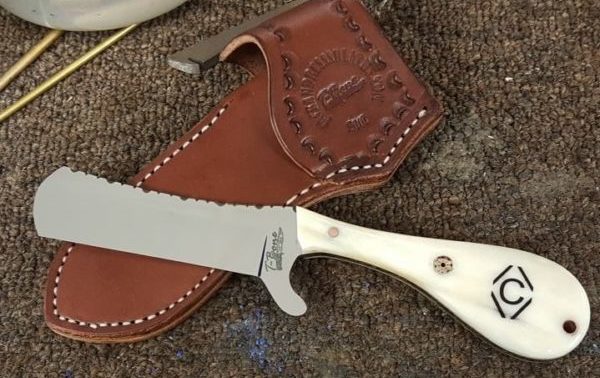
Travis Payne is renowned for his castration knife design. It is often copied by manufacturers using low-grade steel. Look for the T-Bone’s makers mark to ensure you’re getting the real thing.
TOS is a condition in which the surrounding soft tissue constricts nerves and blood vessels between the collar bone and first rib. Normally it is something diagnosed in people in their 40s to 60s, more commonly women, or perhaps mail carriers who consistently carry a heavy bag on their shoulder. Kelly was diagnosed when she was 14. It is believed in her case that years of catching slow-pitch softball as well as playing volleyball may have constituted the kind of overuse usually only seen in older patients.
By 17 Kelly had undergone a year of physical therapy. Although the therapy improved the symptoms of her TOS, it did not eliminate them. She went for an additional course of physical therapy a couple of years later, but the results were not as good. Her condition continued to worsen. “It’s different in each person,” she explained. She endured numbness that started in her arm, but then advanced to her whole side. Although she learned how to teach her body to move when numb, she was left with few options if she wanted to become fully functioning again. She decided to have her rib removed.
Shane Pilcher wasn’t sure about his daughter Kelly’s plan to keep her rib, but the cattlemen at the livestock sale barn convinced him that a knife might be the perfect solution. “I don’t leave home without it,” Kelly said of the knife Travis Payne fashioned from her first rib.
Shane had been at the livestock sale barn and was expressing some hesitation about Kelly’s decision to keep her rib. Someone pointed out that knives are made with animal bone and antler all the time, why not a human bone? “‘And doesn’t T-Bone make a knife?’” Travis said, recreating how the conversation may have gone at the barn. Since 1993 when Travis was still in high school he’d been making knives. His father and brother work the ranch where he lives in Telephone, Texas, but he makes knives full time. He is renowned for a style of castration knife that is frequently copied, most annoyingly by manufacturers using cheap steel. Since Travis’ father-in-law frequents the same sale barn where Shane works and the barn owner had purchased several of Travis’ knives and many of the cattlemen owned his knives, he was the first knifemaker that came to mind. Shane warmed to this idea and presented it to Kelly in the recovery room.
Travis Payne was nervous about slicing Kelly McGuire’s removed rib. What if it broke?
Like everyone involved in the project—except Kelly—Travis was hesitant, but he agreed to make the knife. He decided on his 3100T everyday carry model, a spey in cowboy parlance, usually the second blade on an old-school slipjoint trapper. Only this would be a fixed version. “It came to me in a hospital specimen jar,” Travis said, taking a drag on his cigarette and waiting for the laughter. “With the meat still on it.”
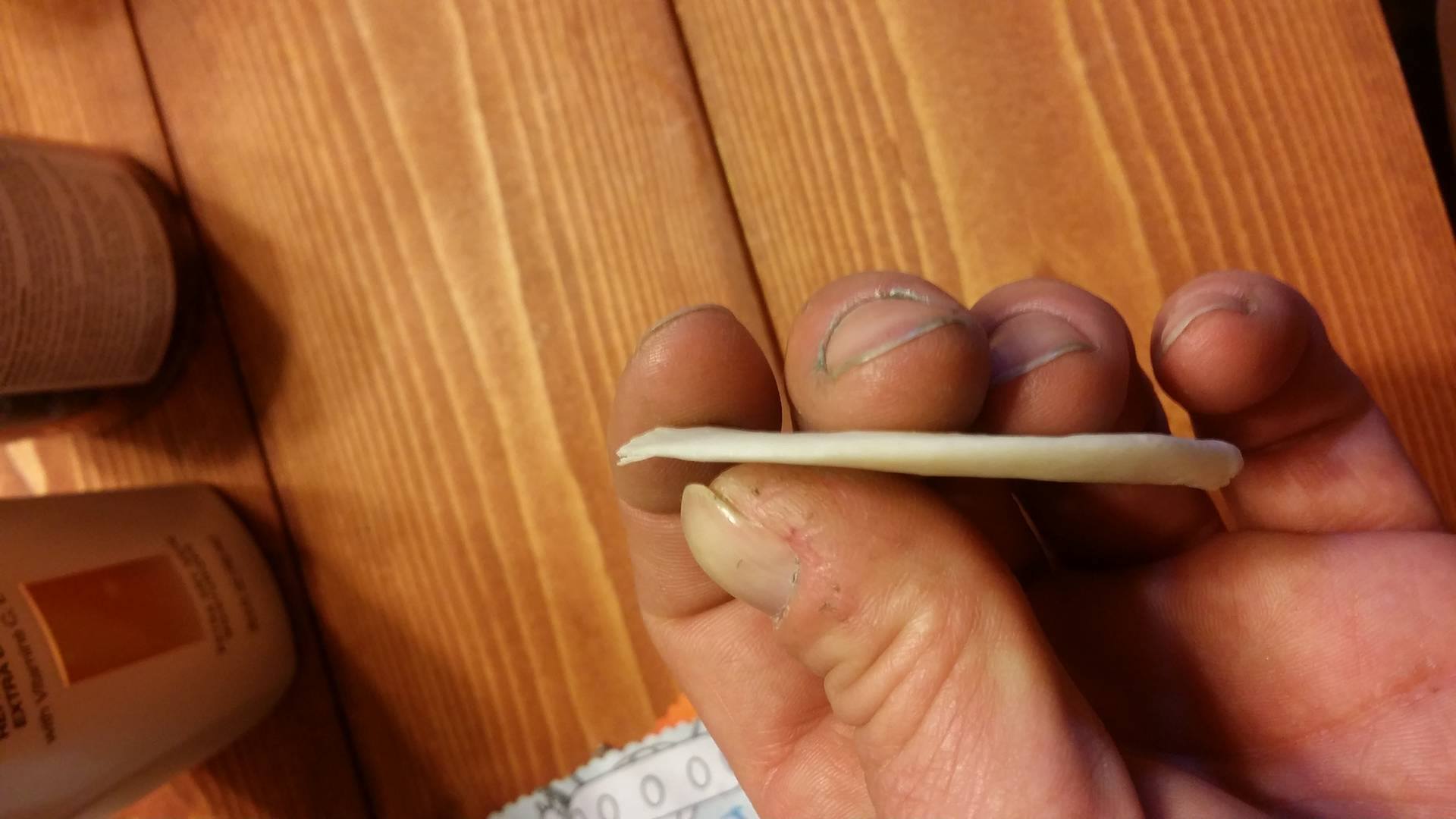
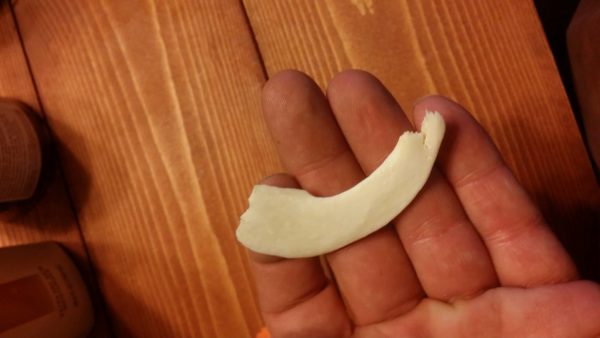
He approached the project like he would any deer skull. “Only I knew I wasn’t going to be using my wife’s cook pot,” Travis said, laughing. He bought a throw-away pot and boiled the bone to get off any connective tissue. Although bleaching a bone works, it also can break the bone down. Travis soaked the 3-inch bone in hydrogen peroxide for a week. The same whitening was achieved without compromising the strength of the bone. Then he let it dry for several months, providing a convenient delaying excuse. The bone was very thin, only an 1/8-inch at its widest point. Travis feared breaking it.
Once the rib was clean and dry, knifemaker Travis Payne was able to see its true size. It would need to be cast in resin if it was going to be used as a knife handle.
“I had to regroup and talk to Kelly,” he said. She remembers the call. He explained to her that the bone was too small and thin to make a handle out of, but that he could arrange for it to be cast in resin. Only he would need to slice it down the middle to have bone on each side of the handle. He could break it in the process. “I told him to go for it,” Kelly said.
“Anyone who knows me, will tell you that I procrastinate,” Travis said. He continued to analyze the problem. Meanwhile, he needed to find someone who would cast a human rib. Travis figured if anyone would do it, it would be Robert Belcher of Mental Co. Robert eschews phones and social contact, but his resins like Plantstone are innovative. “‘No, but hell no. I can’t be touching that,’” Travis recalled him saying. Travis moved on and got similar responses, but at least there was no point cutting the rib if he didn’t have someone lined up. Finally, he took the rib to a show and unwrapped it for Pat Ankrom, of Ankrom Exotics in Centerville, Iowa, specializing in natural and cast scale materials. “Pat was like, ‘I’m leery, but I also think it’s kind of cool,’” Travis said. The men discussed the casting, and Pat agreed to do the job. Pat did not want something to happen to the bone in the process of packing up from the show, so Travis said he would mail the rib to him.
Travis Payne, 41, started making knives in high school before everyone had access to the Internet. He’s been a knifemaker for 20 years.
Now Travis had no choice but to cut the bone, but it was a nerve-wracking proposition. Travis wasn’t about to charge a young woman who didn’t have a lot of money and who had a debilitating condition more than the $200 he normally charged for such a knife, but in hindsight the cost to attempt something like this again would be closer to $500, Travis said. Kelly, of course, was excited to both see the knife and to have her rib back in her possession, so periodically she’d call for a status update. Finally, Travis got his courage up and sat down with a jeweler’s saw. “Even with a jeweler’s saw it was a tedious process,” he said. The whole project was “intense,” he said, laughing.
The two halves were packaged up and shipped to Pat, an exercise in trust in itself. Meanwhile, the blade awaited. It was made out of PSF27, a powered version of D2 that allowed for a true mirror finish. The lack of a point on a spey design means it’s ideal for active cattlemen, ensuring nobody stabs themselves or punctures a sheath. It has a hollow grind, and a finger groove for more controlled cutting. The file work on the spine increases a sure grip in what can be wet or messy work.
The bone was cast in clear resin so you could see it, but so that you couldn’t see the full tang Travis consulted with Kelly about colors. She was open to a turquoise or blue. Travis added a blue liner, which casts the clear with a blue tone. The knife was then sent to Jack Andress, who made a sheath in a yellow leather, complimenting the blue perfectly.
How’d it come out? “I love it,” Kelly declared. Shane and Kelly came together to pick up the knife from Travis. Kelly said that she’d had that rib her whole life and she saw no reason why she shouldn’t have it with her for the rest of her life. She carries it everywhere, either on her person or in her vehicle. Although she does use it, she tries not to. Her surgery was a success, and feeling has mostly returned. There is no cure for the many variations of TOS and symptoms can return, however, Kelly’s pluck and resolve are ever-present. “I can’t complain,” she said.
Which Knife Designs Work?
Do you want some fresh inspiration for your knife designs? The best inspiration is to look at the designs that have lasted and learn why.
“101 Knife Designs” gives you 101 scaled patterns that you can use to design your own knives. Learn how to compare patterns and understand how some designs survive the test of time. If you’ve enjoyed Murray Carter’s other writings, you will be sure to enjoy this one. On sale now for $19.53.
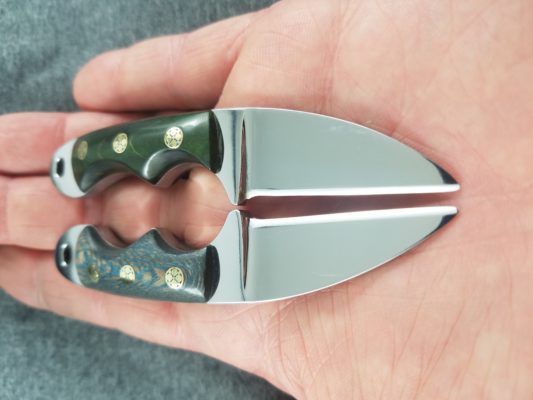
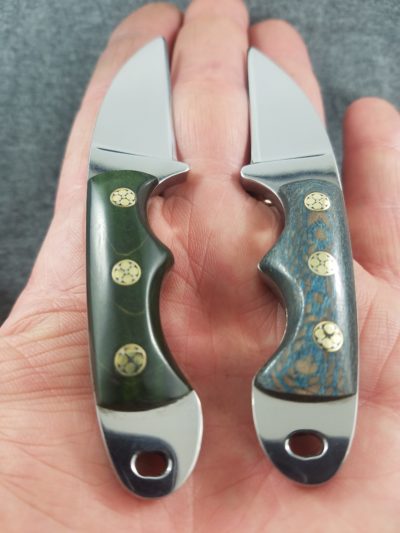
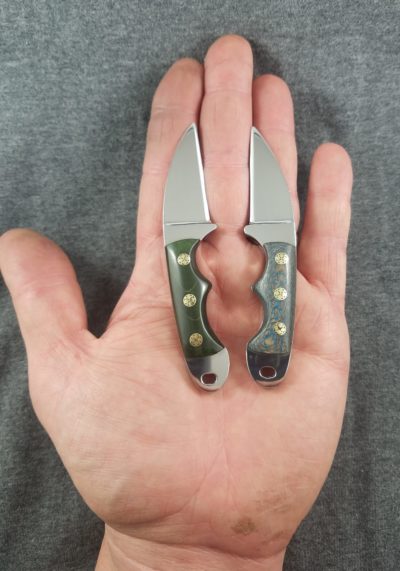
Pete Sloan made two neck knives for the wife and son of his friend and fellow maker Spencer Aplin. He used his daughter’s hand to perfect mini knife’s design, ensuring it fit the tiny hands of Lisa Johnson Aplin and son Alexx who suffer from brittle bone disease.
“One thing that Spencer is very good at is knowing what I’d like,” Lisa Johnson Aplin said. Lisa is the co-founder and chief operating officer of STA Custom Knives out of Brazoria, Texas. She and knifemaker Spencer Aplin were married in 1993, and together they have a son Alexx who will be 24 in a couple of months, a journalist and sometimes quality controller in his father’s shop. Lisa had no idea that a Sloan Custom Knives creation she admired had already been custom-ordered for her by her husband. Lisa suffers from osteogenesis imperfecta, or brittle bone disease, so although she does not have dwarfism and is therefore not a “little person,” she is a very little person. The one thing that Pete Sloan has plenty of access to is little people in the form of children, 9 to be exact. So, he used one daughter’s hand to perfect the mini knife fit and design.
Erin Sloan is 9 now, but she was 5 when her dad, Pete, asked her to help him custom-fit a tiny neck knife. Erin is one of 9 Sloan children.
Lisa’s favorite color is green and Spencer had been admiring a green knife he saw on Facebook that his friend Pete had made. “He asked me if I could make one for his wife,” Pete said. Pete was surprised and honored that Spencer, a maker he greatly admires for his knifemaking in general and blade-carving in particular, would ask him for a knife. Pete told Spencer that he was welcome to make the knife if he wanted, but Spencer said, no, that Pete had a good command of the Wharncliffe design and he wanted Pete to make it.
Pete Sloan started out with an old 4-by-36-inch belt grinder–generally considered underpowered and not ideally configured for knifemaking–and some hand files. “I liked it,” he said.
Humbled, Pete was determined to get it right. But he lived in Medina, Tennessee, and had never met Lisa. He only had Spencer’s description of her size to go on. Lisa is 2 feet, 10 inches tall. Pete’s daughter Erin was 5 at the time. So, he roughed out the 440C stainless steel blades and then with a Sharpie marked the first finger groove using Erin’s grip as a guide, grinding until it was just right for her petite hand. Spencer requested the stainless steel because the Aplins live next to salt water, and he wanted to minimize corrosion. Pete said he mostly gets requests for pattern-welded steel.
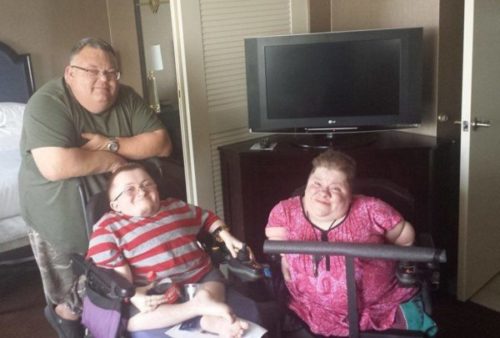
Spencer Aplin of STA Custom Knives, standing, took his son, Alexx, and wife and business partner, Lisa, to the 2015 BLADE Show.
If you’ve ever seen the movie “Unbreakable” starring Bruce Willis, you know what osteogenesis imperfecta entails. Mr. Glass’ character, played by Samuel L. Jackson, has a form of the condition that allowed him to grow to full height, but his lifestyle is still hampered by debilitating bone breaks. Lisa and subsequently her son Alexx have Type III OI. A genetic mutation causing a lack of collagen, subsequently prompting connective tissue issues. The result is that bones fracture easily and those with the affliction will be short in stature with a curved spine and barrel-shaped chest. Type I is the most mild form of the condition, Type II and Type VIII the most severe and most often fatal. Types III through VI vary in symptoms and genetic causes. OI has been traced through mummies back to 1000 BC Egypt. Even though the condition has been around a long time, there is still no cure.
Pete Sloan used green-dyed curly maple for the scales on Lisa Aplin’s knife and blue-dyed and natural sycamore for Alexx’s. You can contact Richard Beam on Facebook for such impregnated wood products.
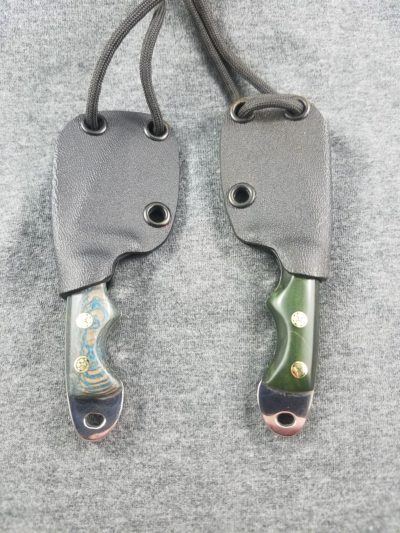
Pete used stabilized curly maple dyed green from Richard Beam at Nicholas Impregnated Woods to make the handle for Lisa’s knife and a combination blue-dyed and natural sycamore for Alexx’s. Each came with a Kydex sheath and cording to wear around the neck. At the 2015 BLADE Show, Lisa finally met Pete in person and he presented her with the knife. She loved it! “Green is my favorite color,” she said. She uses the knife all the time, opening boxes that come to the shop and for everyday uses around the house. Although it can be used for food preparation, Lisa doesn’t cook, she said laughing. Spencer does the cooking. She treasures the knife. “It’s one of my favorite’s in my collection.” She continues to be impressed with the fit and with how Pete obtained it.
Push Kydex sheaths away with your thumb rather than struggling to pull the knife out. If they are too tight, contact the maker. He can heat and loosen the fit while still ensuring the knife does not fall out.
The only thing that Pete could not have accounted for was hand strength or lack thereof. Both Lisa and Alexx had a hard time drawing their knives. Spencer simply heated up the sheaths and worked the knives in them so that they released more easily without falling out. “It not something he could have known about,” Lisa said. “I think he did a great job.”
When asked how she adapts to daily activities in a full-size house at her stature and in a wheelchair, Lisa’s answer was immediate and delivered in as cheery a tone as everything else she talks about. “The great thing about being married to someone who works with his hands,” Lisa explained, “is that Spencer can make me anything I might need customized.” The Sloan Custom Knife was an unexpected surprise, but in hindsight typical of Spencer to have picked out exactly what she would have picked out for herself long beforehand.
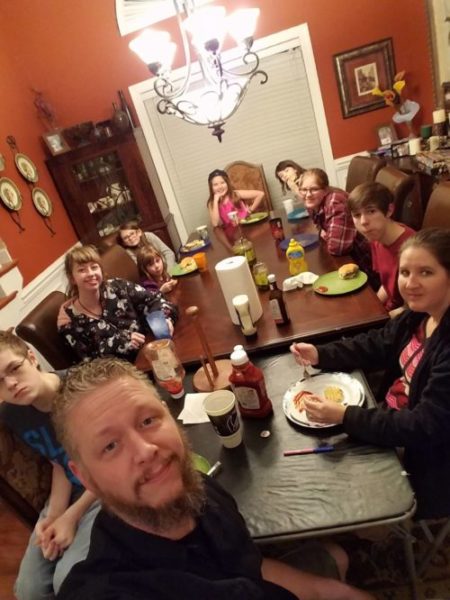
It’s a challenge to get all the Sloans in one place. This is the whole family minus oldest daughter, Becca, who is in the U.S. Air Force.
Pete visited Spencer before the 2017 BLADE Show and the two slept little working hard to finish up knives to sell. Spencer and Pete make knives with similar styles as Spencer shares his knowledge with Pete. And if Pete ever needs another hand model, he can turn to one of his and his wife, Holly’s, nine children, some biological, some adopted, some that came by other means: Becca, 19; Carson, 18; Gage, 15; Brant, 14; Makenzie, 13; Leigha, 10; Erin, 9; Madeline, 8; and Grace, 7. The couple used to be foster parents. “There a story to just about all of them,” Pete noted with a laugh.
Contact Pete Sloan at [email protected] or on Facebook at Sloan Custom Knives.
These mini neckers are 4.25 inches overall. The 440C stainless steel blades are 2 inches. The full-tang construction allows for a lanyard through hole. These were designed for child-sized hands, but come in larger versions. Handle material is impregnated wood from Richard Beam. Maker’s list price: $200 shipped with Kydex sheath.
Are You Looking to Perfect Your Own Everyday Carry?
Another thing you’ll learn more about in Wayne Goddard’s “Making The Everyday Carry Knife” is selecting the right materials for a handle that lasts.
“Making the Everyday Carry Knife” by Wayne Goddard includes information on how to determine the best blade and handle length. You’ll also get tips on how to use your computer to assist you in designing your knife, plus lots more including grinding and tempering techniques and tool suggestions. At only $4.99 in digital format it’s a wealth of information at a steal.
Ten-year-old Jordan Toerck had been pestering her knifemaker father, Bobby Toerck, to make her a knife for a while. But she was still young, so Bobby held her off. He promised to make her a knife when she got her first deer. Well, in January, she did just that and true to his word, Dad made a knife for his deer-hunter daughter.
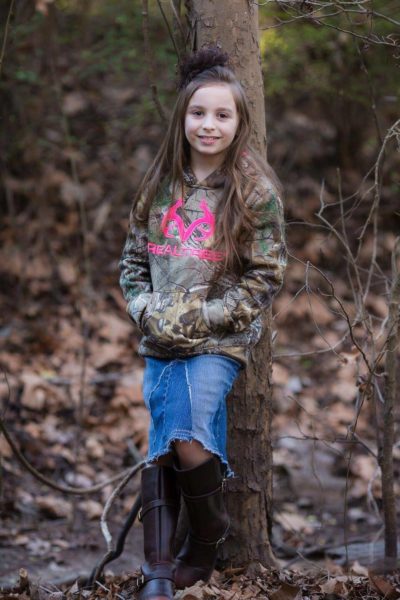
Ten-year-old Jordan Toerck was in her second season of deer hunting when she got her first deer. As promised, dad made her a knife to mark the occasion.
It was bitterly cold that January day: 14 degrees, which is “almost unheard of in East Texas,” Bobby said. Jordan had been accompanying her father on hunting trips off and on for about four years, since she was 5 or 6. This was her second year of active hunting. It was youth season, which follows the general season. This particular morning father and daughter were set up in a tent blind on the ground half an hour before dawn. By 7:30 Jordan said her feet were cold. Her father admitted his feet were cold too, but if they sat still and were quiet, they’d see something.
They saw a feral hog run through at a high rate of speed, but that was about it. By 9:30, Bobby decided that they could go in. They went back out at 3 p.m. and conditions were much more favorable for father and daughter. The temperature had risen to the upper 30s and there was no wind because they were protected by a wind block. “Around 5:30 Jordan got antsy, as kids do,” Bobby said. He told her to sit still and be quiet and they’d see something.
Sure enough two other does came into view, and then a third and larger one. Jordan sighted through her Leupold 4.5-14x50mm Long Range scope and put the crosshairs where her father told her to aim. Her Remington 700 BDL Custom Deluxe bolt-action rifle was propped up on Jim Shockey-style shooting sticks, which her father had fashioned with ¾-inch dowels and paracord.
“The next thing I know, I hear a bang,” Bobby said. The deer ran off into the brush. Jordan knew she had hit it and so did her father. They waited about 10 minutes for things to calm down then walked to where the deer had been standing. “We found blood and I immediately started teaching Jordan about tracking,” Bobby said. They didn’t go more than 40 yards before they found Jordan’s deer. It was dead and had been hit exactly where she told her dad the crosshairs had been when she pulled the trigger.
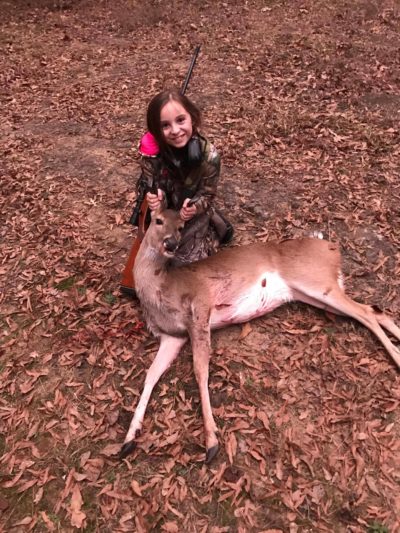
On a cold day in January Jordan Toerck tagged her first deer. She aimed where her dad instructed, learned how to track and was so excited when she found her deer that she jumped up and down, whooped and hollered and, of course, texted her mother.
It was a 110-yard shot, according to Bobby’s estimations. “I should also mention that there is a Briley muzzle brake” on that rifle, he added. It brings the kick of a 25-06 caliber rifle down to the approximate equivalent of a .22 magnum, “taking 90 percent of the recoil out of it.” The setup certainly set Jordan up for success. When they found the deer, “she was jumping up and down, screaming and hollering, then she took out her phone and starts texting her momma,” Bobby said.
Ten-year-old Jordan and 5-year-old Morgan both love spending time with their father. Soon Morgan will be accompanying Bobby on hunts. “I don’t know what I’ll do. I can only take one at a time. I’ll let them decide which one’s going to get up early,” he said with a laugh.
Right then and there, they filled out the tag and attached it to the deer’s ear. Bobby got his pickup truck as close as possible and they transported the animal home where they hung it in a tree. “She was hands-on, blood up to her elbows,” Bobby said. Even his 5-year-old daughter, Morgan, wanted in on the action. “I’m not raising girls here; I’m raising boys,” Bobby said with a chuckle. At one point he told his wife Amy, that he didn’t want their girls to “have to depend on some man to clean their animal.”
They gutted, skinned and quartered the deer, packing the sections in ice and switching the ice out for three or four days to get the blood out. Then they processed the meat, grinding some, making steaks, ribs for barbeque, even saving the neck bones for soup, noted Amy.
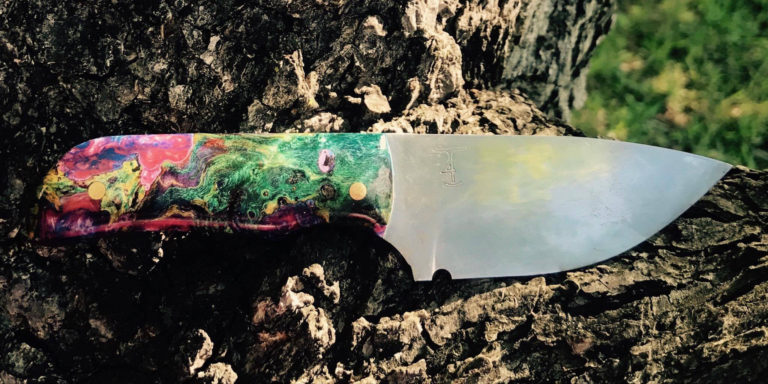
Bobby Toerck made this 6 3/4-inch skinner for his 10-year-old daughter Jordan when she got her first deer. The handle colors, made of triple-dyed box elder by Terry Dunn, reminded him of “mixed up Play-Doh or bubblegum,” and he knew it was perfect for her.
Bobby knew he’d be making a knife for Jordan so when he attended the Long Star Knife Expo in early April he was on the lookout for the exact right handle material. He found it in a triple-dyed box elder offering by Terry Dunn. “The colors in it looked like mixed up Play-Doh, or bubblegum,” Bobby said. It was perfect for Jordan, and the size fit her petite hands.
Visit T4 Custom Knives to see more of Bobby Toerck’s knives. Visit Terry Dunn to check out more handle materials like this.
The full-tang knife is 6 ¾ inches overall with a 3-inch flat-ground drop-point blade made out of 80CrV2 steel. “To me the drop point is the best overall shape for a skinning-gutting knife because you are much less apt to puncture an intestine or stomach with a less pointy front end. And the drop-point will lift the skin slightly before cutting when making the initial cuts up the legs of an animal,” Bobby explained.
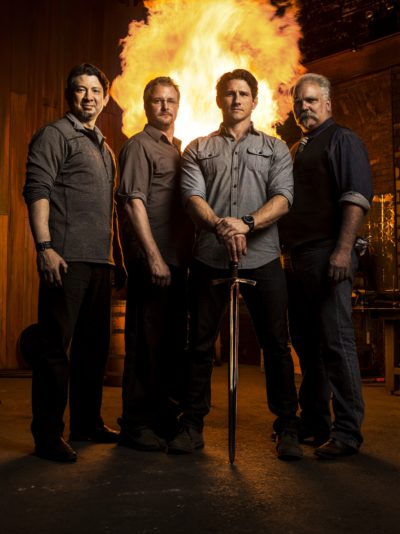
HISTORY’s “Forged in Fire” personalities include from left, Jordan Toerck’s favorite, judge Doug Marcaida; judge J. Neilson, host Wil Willis and judge David Baker. Jason Knight is also a judge. (Image by Miller Mobley/HISTORY)
What did she think when he gave it to her? “She loved it,” Bobby said. “And, of course, she said ‘It will cut,’ because she’s a huge fan of Doug Marcaida in ‘Forged In Fire.’ She loves to watch that show with me,” Bobby said.
Contact Bobby Toerck at T4 Custom Knives on Facebook or at 903-812-1173. Maker’s list price on a knife like the one he made his daughter would be $175 with a Kydex sheath, $275 with a leather sheath.
Help Dad Realize His Knifemaking Workshop
“Wayne Goddard’s $50 Knife Shop” is the perfect Father’s Day gift for the dad who wants to get into knifemaking, but who doesn’t have a lot of flexibility in his budget.
Dad’s money has to cover many expenses, but he should still be able to indulge his knifemaking interests with a modest investment. In “Wayne Goddard’s $50 Knife Shop,” dad can read what’s essential for his work area and what isn’t. This is also a terrific back-to-the-basics read for more established makers. At 50 percent off, it’ll be a $10.99 expenditure that will be referred to again and again.
Every day is Memorial Day for the family of Master Sergeant Robert Mark Horrigan. The weeks leading up to the holiday and through June 17, though, mark an intensified period of mourning for Robert’s identical twin brother and American Bladesmith Society master smith John Horrigan of Elite Knives. Robert was a member of C Squadron, 1st Special Forces Operational Detachment, Delta Force, JSOC and June 17, 2005, was the date he was killed in action in Al Qa’im, Iraq. Gentlemanly, soft-spoken, John says, “Excuse my language, but I’m an asshole for about two weeks” leading up to Memorial Day. And with that, you know that no matter how courteous, no matter how elite the warrior pedigree of either man, John knows exactly how hard it is for Gold Star* families and fellow veterans, and he’s willing to get in the dirt and help.
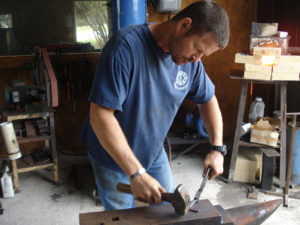
John Horrigan owns Elite Knives and works out of his home shop in Burnet, Texas. His knifemaking began in earnest after returning from his service as a U.S. Army Ranger in 3rd Battalion, 75th Regiment.
The Horrigan twins learned to hunt and fish growing up on a farm in Limestone, Maine, which is in Aroostook County, so far north it might as well be in New Brunswick, Canada. When the boys were 10, knowing jobs would be scarce, the family moved to Florida. The humidity exacerbated their father’s emphysema and tuberculosis, however, so two years later thy moved to Austin, Texas. John and Robert enlisted together and advanced to become U.S. Army Rangers, serving in 3rd Battalion, 75 Ranger Regiment. After three years, John left the military—for love. He had met Donna when he was 17 and she was almost 15. He has now been married to his high school sweetheart for 29 years. They have a daughter and a son, with one grandchild and another on the way. “I just knew the military life was not for her,” John said.
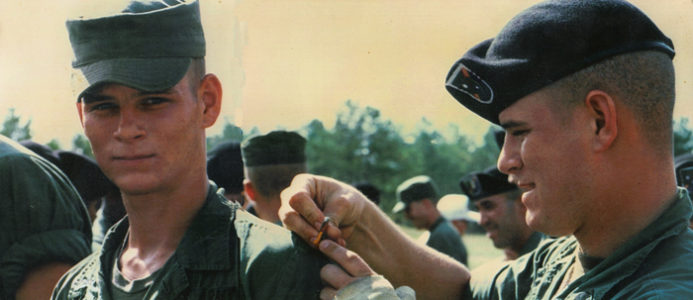
Then-U.S. Army Ranger Robert Horrigan pins the Ranger Tab on his twin brother John Horrigan’s shoulder at a graduation ceremony on Fort Benning, Georgia.
John performed security for the U.S. Department of the Treasury for a short while and then became a deputy with the Travis County Sheriffs Office as well as a fireman. In 1983 John made his first knife. After his brother’s death, he made a commemorative knife for Bob’s unit and another for President George W. Bush. He makes everything from swords, daggers and the occasional tomahawk to camp knives, hunters and bowies. John also continues to make his brother’s design, the Bob Horrigan Military Fighter. You can read more about the brothers and their knives in an article by Kevin Jones that ran in the December 2010 issue of BLADE Magazine entitled, “Twin Brothers, Makers and Heroes.”
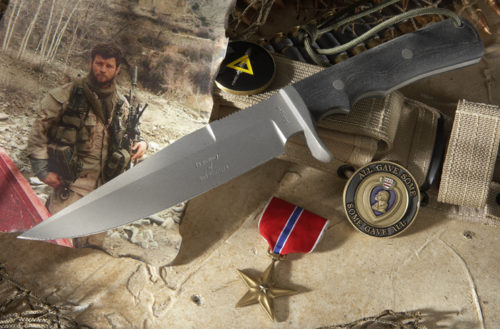
The Bob Horrigan Military Fighter has a 6 1/2-inch blade made out of 440C stainless. The guard and handle bolts are made of 303 stainless. The handle is fashioned with Black Linen Micarta. Overall length: 11 1/4 inches. Maker’s list price: $550. This design is also available with a double guard at 13 inches overall at the same price, or in pattern-welded steel with ironwood handles at a maker’s list price of $720.
While love and love of knives determined the course of one brother’s life, the warrior spirit could not be quenched in the other. Over the course of his 19 ½-year career, which culminated in Special Forces, Robert, who his brothers-in arms called Bob, deployed five times to Iraq and three times to Afghanistan. “Badass” and “real deal” can be overused, but not with Bob Horrigan. Delta operator George E. Hand IV wrote two eulogies of Bob for SOFREP News that get to the heart of the quintennial gentleman warrior: “Delta’s Robert Horrigan: A Better Man Than I” and “Delta Forces’ Own Robert Horrigan: Dwarfed By The Presence of Giants.”
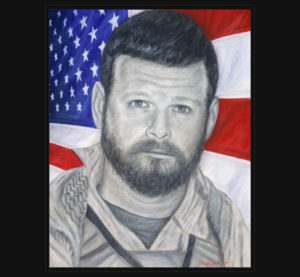
Robert M. Horrigan left the service when his twin brother, John, did but reenlisted, moving into Special Forces after his time in Ranger Regiment. He was killed in action in Iraq, June 17, 2005, in Al Qa’im, Iraq.This portrait of MSG Robert M. Horrigan was done by Phil Taylor for the non-profit The American Fallen Soldiers Project. It was present to the Horrigan family in accordance with the 501(c)(3)’s mission of bringing comfort and healing to Gold Star* families. You can watch the video about this particular portrait at the bottom of this post.
Bob did not have to go on his last mission. He was closing in on retirement. He had plans. He was going home to his wife and daughter and he was going to make knives with his brother. Five years before, John had introduced Bob to knifemaking, and he liked it. While living in base housing on Fort Bragg Bob would run an extension cord outside to work on his creations. “I’m not sure they would have been happy about if they knew,” John says, a warmth in his voice. Like John, Bob loved the artistry of knifemaking, but he only had time for making combat knives.
In addition to medals depicted here by ribbons, Robert Horrigan was posthumously promoted to Master Sergeant and awarded the Legion of Merit Medal, the Bronze Star Medal with Valor Device and the Purple Heart. In addition to his mother, Mary; twin brother, John; and sister Lisa Shine, he is survived by his wife, Denise; his daughter, Courtney; and another brother, Daniel. He is buried in Section 60, Site 9131 at Arlington National Cemetery.
John continues to live out this dichotomy. “I could make a lot more money making fighters,” he said. After banging out 40 of them, though, he longs to delve into the art of the craft. Then, when he’s deep into a showpiece and it seems like it will never be finished, he begins to long for the refreshing simplicity of hammering away on combat knives. “I flip flop,” he says. “I used to have six or seven pieces, 80 percent done” for BLADE Show. He laughs about what he refers to as his attention deficit hyperactivity disorder. Now he works on two at a time and finishes them before he moves on to the next one. After the show he enjoys being able to relax and resume his own pace.
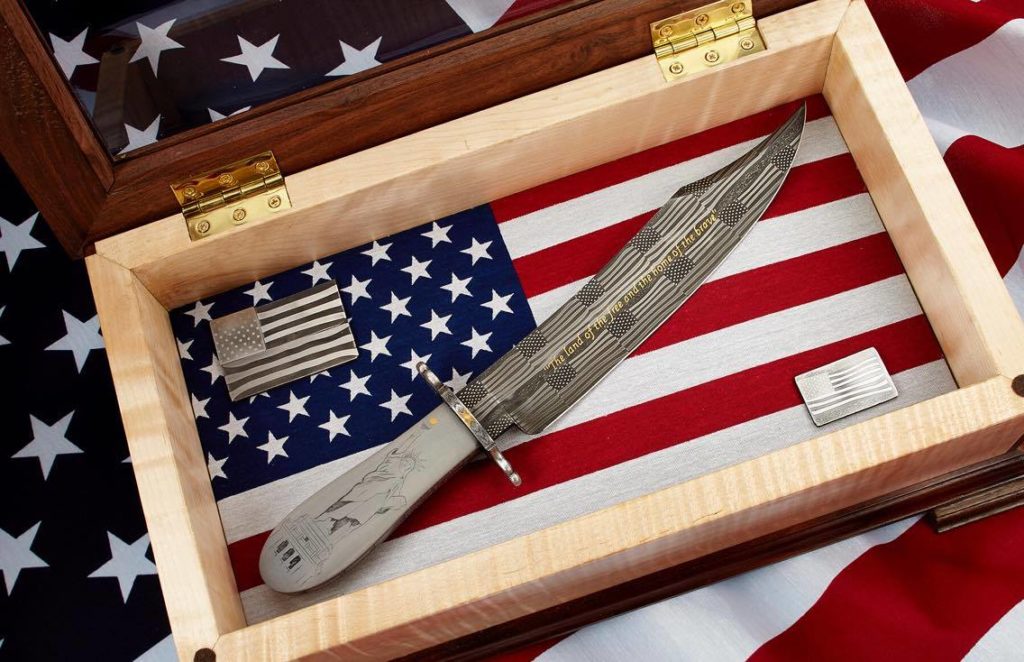
When he needs a break from combat knives, maker John Horrigan switches to crafting high-end pieces of art. This bowie is made in American flag mosaic-pattern steel. Although you can’t see it, “In God We Trust” is engraved along the spine. The handle scales are 416 stainless steel engraves with the Statue of Liberty. The quote on the blade is done in 24-carat gold. Contact: Elite Knives
So although Robert didn’t have to go on that last mission, he wanted to be with his unit. And with that decision, the dream the twins shared of living out their days together with their families and making knifes ended—hard, on the other side of a breached door. The objective was to sneak in, target Abu al-Zarqawi, the al-Qaida leader in Iraq, and get out. The problem was that by the time the mission was underway, the enemy knew the Americans were coming. Bob Horrigan was the number-one man. He got inside the room and was immediately engaged in an intense firefight. The number-two man, Master Sergeant Michael L. McNulty—also a twin—was shot down on the threshold. While teammates extracted Mike from the doorway, Bob took hits to his femoral artery and head. Both men held on while their brethren simultaneously continued the battle, plugged their wounds and extracted them to a secondary airfield approximately 1000 meters away because a closer one was under attack. Both men were alive when they were put on the aircraft and when they landed at the medical facility. Heart massage was performed on Bob. But, as John explained, when you’ve been hit that many times, when you’ve lost that much blood, no matter how much they hold on, it’s only a matter of time before they succumb.
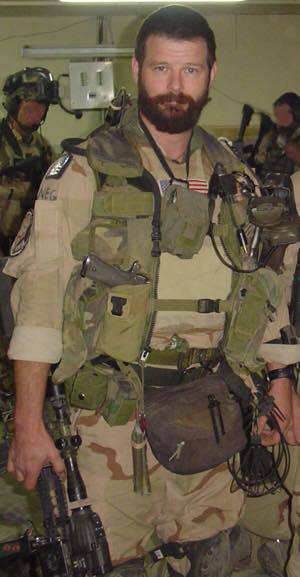
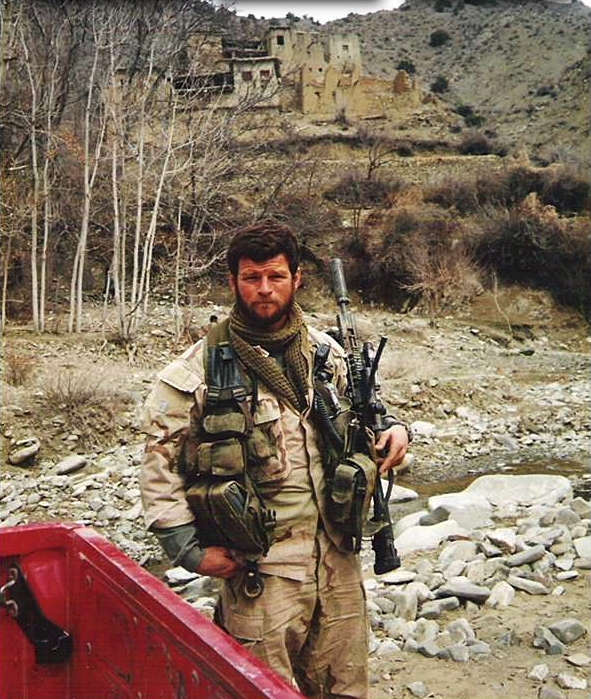
John 15:13 reads this way in the New King James version of the Bible: “Greater love has no one than this, than to lay down one’s life for his friends.” John Horrigan will tell you that his twin brother, Robert, did just that for his brothers-in-arms. Jesus did the same for us. This photo of Robert was taken taken March 19, 2002, east of the Shahi-Kot Valley on the route to Khost during the post-Operation Anaconda chase.
The part about both men being twins, was only the first of endless seeming coincidences. Robert’s wife kept his remains in an urn at home for a few years before he was interred, but John also wanted to visit the grave of the man who had died with his brother. He made the trip to Arlington National Cemetery, and when asked who he was looking for, gave McNulty’s name. There were three men also standing at the information desk. “Who did you say you were looking for?” one of them asked John. John repeated the name. He tried to introduce himself. Being an identical twin, the men already knew who John was. They were from his brother’s unit, and they too had come to visit McNulty’s grave.
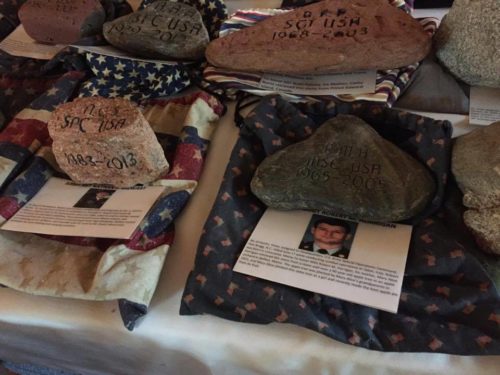
Another time the Horrigans had planned a family trip back to Maine. Many people were involved and Donna was looking at a particular house to rent. It was expensive so John suggested checking Craigslist. She found the same house listed for less. As the process continued, the twin’s sister, Lisa, began to suspect a scam. John wasn’t sure at first, especially since he was so used to dealing with wire transfers through the course of selling his knives internationally. He was busy in Boston and directed his sister to handle it. On the way to Maine, John thought, ‘Maybe it is a scam,’ and called the Ellsworth Police Department. A detective, Dotty Small, confirmed that it was indeed a scam. John called Lisa who was standing on the porch of the house, which already had tenants living in it. John told her what he had learned. In an event to commemorate Maine’s heroes called The Summit Project, Detective Dotty Small had hiked Baxter Mountain carrying a stone with the initials of a fallen warrior on it: M.R.H.
“Maine is good to its veterans,” John Horrigan said. According to The Summit Project nearly 1 in 7 Mainers are veterans or approximately 15 percent of the state’s population, one of the highest rates of any state in the nation. The Summit Project honors fallen heroes and brings awareness to the challenges of grieving families. The Bangor Daily News covered the event in 2014. The article was entitled “Feeling the weight: Hikers carry tribute stones for Maine heroes to Baxter mountaintop.”
One night at the firehouse, John had a dream. In it, Robert came to him and told him to look up Al Qa’im. “I’m thinking, ‘I’ll never remember that,’” John said. Al Qa’im was a center for insurgency near the Syrian border, and the town in which Bob was killed. It means ‘I have risen.’” John pauses. “Another translation is ‘I have ascended.’”
It is like this all the time, Bob seemingly orchestrating serendipitous exchanges for his family and especially his twin. “I lost half of me,” John said. It took me a year and a half to get beyond wanting to blow my head off,” he admitted. “God really had to hit me with a sledge hammer…It’s not about you anymore. It’s about Me.”
John and Robert’s mother was a novice nun. After five years in the convent, she knew she wanted to have children so she left. The Horrigan children were given a Catholic upbringing. “In the Army, you drift away,” John said. About two years before he died, Robert told John that he was coming back to God. John accepted the news in his easygoing manner, but perhaps didn’t think as much of it as he does now in hindsight.
“All this macho ‘I can handle it.’ Well, obviously, you can’t. You have to talk to someone,” John said. “There has to be a support network, and having God can help.” John is quiet for a moment. “Bob was a sniper,” he reveals. Bob told John that he’d killed 50 to 60 enemy combatants. “He did not have PTSD, that I know of,” he emphasized. Bob told John that he was OK, because he was “alright with God.” The Old Testament is filled with killing, John said. “Evil exists in this world and you have to exterminate it. It’s like when you have an infestation of bugs. You have to kill every one or they’ll come back. When you’re fighting an ideology where (the enemy is) hiding behind women and children, it’s like a cancer of the highest magnitude” that must be eradicated.
“Memorial Day is not a happy time,” John said. He acknowledges the day by telling people about his brother and the tragedy of leaving a hurting wife, 12-year-old daughter, mother, siblings and especially a twin with whom he did everything. But perhaps because of the leadership ingrained in him as a Ranger, John understands that he cannot be consumed by the grief of his own loss. God channels his pain in a way that reaches people just like him, veterans and family members who are wracked with unbearable grief. John recently lost a firefighting co-worker to suicide. It left him shocked because the man was always so cheerful “Everyone has demons. Call me. We’ll fight them together.”
Knifemaker John Horrigan Remembers Fallen Twin Brother Robert Horrigan
*Gold Star families are those that have lost a service member in combat. You will see the vertical red-rimmed banners most commonly on vehicles. Each blue star represents a family member serving in the military, while a gold star represents a fallen service member.
In addition to a review of Robert Horrigan’s Military Fighter from Elite Knives, you’ll also get a rundown on Old West-style push daggers in the October 2011 issue of BLADE.
So what does fellow Special Forces member Kim Breed think of Elite Knives’ Bob Horrigan’s Military Fighter? Read his review right away in this downloadable version of the October 2011 issue of BLADE for $5.95.
Marine Explosive Ordnance Disposal Technician Staff Sergeant Johnny Joey Jones inspects a knife at Zac Brown’s knife company. The Southern Grind spokesman remembers the fallen, especially the mine sweeper who died in the explosion that took Jones’ legs.
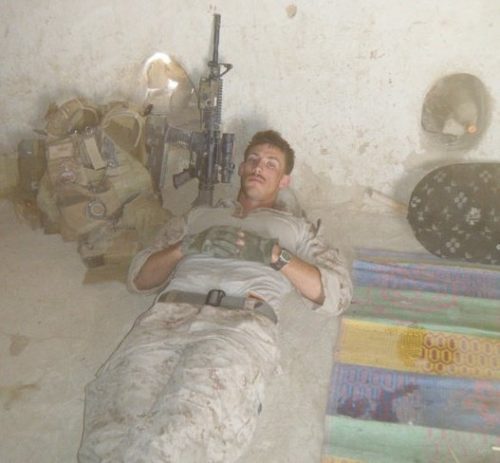
In 2010 ABC Nightline produced a three-part series on Marine Explosive Ordnance Disposal (EOD) Technician Staff Sergeant Johnny Joey Jones. During eight years of service, Jones deployed to both Iraq and Afghanistan. It was while in Helmand, Afghanistan, on August 6, 2010, that Jones stepped on an improvised explosive device, losing both his legs and severely injuring one arm. In the face of inordinate challenges, Jones not only maintained a positive outlook, but became a beacon of hope to his fellow amputees, his fellow veteran collegiates and the public who follow his charity work and appearances on Fox News. Triple J or Joey, as his friends call him, is now spokesman for Zac Brown’s Camp Southern Ground, a 400-acre camp and retreat for children and military families that is funded by the proceeds of numerous artisan shops, including Southern Grind, the musician’s knife company. You can read more about Jones and some of the substantial knives offered through knife-lover Zac Brown’s company in the September issue of BLADE Magazine. (If you can’t find BLADE near you, subscribe.) But no matter how far Jones progresses physically, no matter what business pinnacle he reaches, the Southern Grind spokesman remembers the fallen, one fallen in particular, the man who died in the explosion that took Jones’ limbs: Marine engineer and mine sweeper, Corporeal Daniel Greer.
In the course of eight years of service in the Marine Corps, Staff Sergeant Johnny Joey Jones was deployed to both Iraq and Afghanistan as an Explosive Ordnance Disposal technician. In 2010 he lost both his legs in an explosion. No matter what he does: recovering from his wounds, inspiring fellow veterans as they recover, making motivational presentations, representing charity organizations, appearing on Fox News as a commentator, or as current spokesman for Zac Browns Camp Southern Ground and Southern Grind, the musician’s knife company, Jones is always positive and never fails to remember the Marines, soldiers, sailors and airmen who died in service to our country.
A TV Crew Interviews Jones in Afghanistan, Unaware Of The Fate To Befall Him
Jones’ Recovery Is Motivated By Fellow Wounded Brethren And The Fallen
Jones Remembers The Marine Who Died In The Explosion That Took His Legs
Jones’ Second Chance At Life Is In Honor Of Those Who Died In Combat
No Matter The Obstacle Jones Has Some Marine-Tough Encouragement
Read about the styles of knives most often carried into war and lots more in this two-pack of BLADE’s Military Knives issues for 2010 and 2011.
Boldly designed military knives, stories of knives that saved the lives of men in combat, soldiers who make knives for soldiers, and makers who support the troops, it’s all covered in these two special issues. Normally, $11.90, this download .pdf pack is on sale for $5.99.