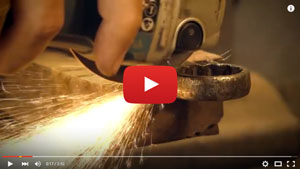
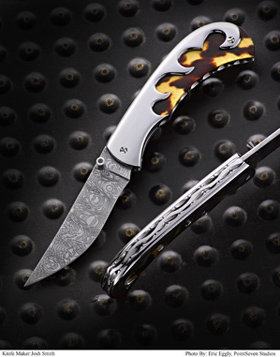
Knifemaking is the building of a knife, which includes the blade, handle and other accouterments. Blades are made by either removing metal from a steel blank via a grinder – known as stock removal – and the forging to shape of hot steel into a blade in the process known as bladesmithing. Other parts, including bolsters, guards, pommels, etc., are needed to complete the finished knife.
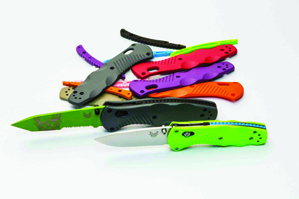
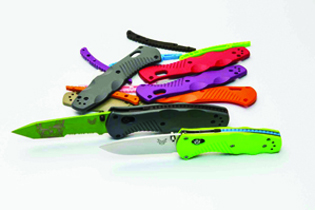
When it comes to production knives, says Dexter Ewing, BLADE® field editor, as a consumer you are not afforded much say-so in terms of aesthetics or blade and handle materials. The knives are offered as-is. But what if you played an active role in helping create your own distinctive production knife? Well, you can. There are a few manufacturers offering build-your-own-knife programs online. They enable you to play a pivotal role in selecting the handle color and material, blade material and shape, and even the coating choices. Be aware that these options and their number vary by manufacturer.
Nonetheless, the end product is a factory knife influenced by and for you. You can custom tailor it most any way you want based on the options provided.
Benchmade offers such a service on its website in the Custom Knife Builder section. Four models are available: large and small Griptilian AXIS™ Lock, and large and small Barrage AXIS assist folders.
“The entire experience is very intuitive and walks the customer through the process of customizing the knife selected,” explains Derrick Lau, Benchmade public relations and communications manager. “Starting with the blade for the Griptilian or the Barrage, customers can select from drop-point or tanto styles …. See the June 2016 issue of BLADE to read the rest of the fascinating feature article. Enjoy!
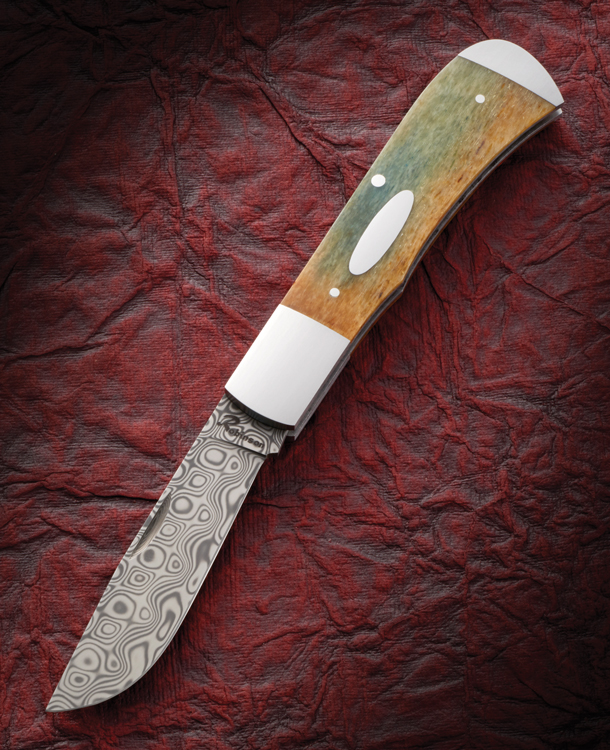
According to Joe Culpepper, cattle bone constitutes 98 percent of the total bone sales at Culpepper & Co., with camel and giraffe bone being the remainder. H.L. Holbrook employs stabilized giraffe bone on his hunter in CPM 154 stainless. Overall length: 8.25 inches. (PointSeven image)
Bone handle knives are good to the bone, including some of the latest blades made today.
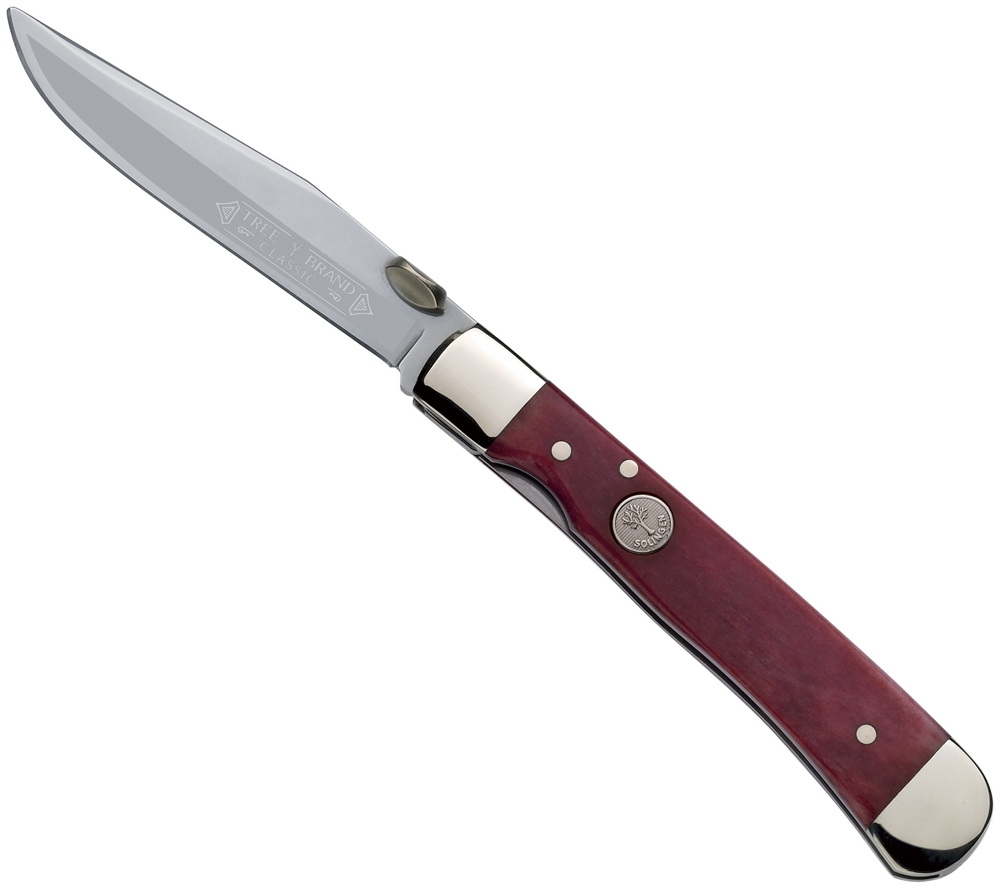
Smooth redbone completes the handle of the Boker Trapperliner. The 3.25-inch blade is 440A stainless steel. Closed length: 4 3/8 inches. MSRP: $107.95. (Boker image)
Bone is one of the earliest materials used on knife handles, becoming a high art during the early and mid-1800s when the factories in Solingen, Germany, and Sheffield, England, were peddling their wares to eager American consumers. When tariffs on the old-world manufacturers were imposed in the waning years of the 19th century, U.S. manufacturers gained a toehold on the domestic pocketknife market, and by the early 1900s were in high gear. Bone was the most prominent and popular handle material in those days—and remains among the most prevalent, if not the most prevalent, to this day.
Many offerings by pocketknife manufacturers are graced with bone scales, and custom knifemakers use it frequently on both fixed blades and folders. BLADE® went inside the knife industry to find out why bone remains such a dominant handle material on today’s knives.
Where’s the Bone?
Most bone used on knives is bovine—that is, from cattle. When you think about how much beef is consumed annually in this country, you have to believe there’s a whole lot of cow bone available. There is. We asked proprietor Joe Culpepper of Culpepper & Co.—a large wholesale supplier and processer of all types of handle materials to both factories and custom artisans—about the importance of bone on his bottom line.
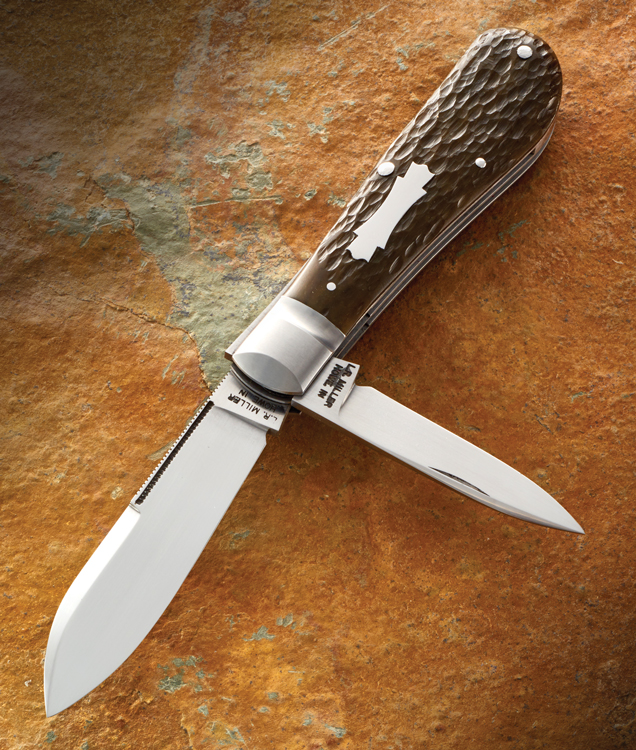
Joe Culpepper of Culpepper & Co.—shown inset with his wife and business partner, Kristi—said both factory and custom makers, though more custom than factory, lean heavily toward bone in browns, ambers, reds, oranges, blacks and other more conservative colors. Levi Miller opts for brown jigged bone on his trapper in 52100 carbon blade steel. Approximate closed length: 3 5/8 inches. (PointSeven knife image)
“Cattle bone constitutes 98 percent of our total bone sales, with camel and giraffe being the remainder,” Joe says. “The overwhelming majority of the cattle bone that we use is from South America, although it is available in nearly every country that has a beef industry.
“We find that cutlers, both factory and custom alike, lean heavily toward browns, ambers, reds, oranges, blacks and other colors that are more conservative. This is probably a bit truer for the custom makers than manufacturers. As for surface texture, we sell a lot of the more traditional jigging patterns that resemble patterns used before World War II. Approximately 60 percent of our sales are to factories, custom knifemakers the other 40 percent.”
Joe indicates he has seen an increase in demand for bone in recent years and, along with it, an jump in prices.
“As with anything, costs are always rising. The cost of jigging, polishing and cutting bone is nearly always a product of labor costs, which is somewhat predictable. Coloring is a different story,” he notes. “All of the dye components have risen exponentially in recent years.
“As far as overhead goes, we have to buy the raw material, have it shipped to our processing plant, treat it, cut it into scales, bleach the scales, sort for characteristics, identify outliers, texture and jig the bone, stack it into vats, color with dye, and test and document a sample before we make the final product available to the industry. There are also hundreds of other smaller processes involved, but these are the major things.”
While jigged bone is the most popular, Joe has seen an uptick in stag or carved bone patterns made to simulate deer antler.
“Most of our varieties of our carved stag bone have seen a rapid increase in popularity in recent years,” he says. “This is primarily because of the ban and scarcity of genuine stag. To my knowledge, we made the first variety of carved stag bone in the 1980s. It was made based on a Delrin [a type of thermoplastic] sample. Carved stag bone is popular in a variety of colors including amber, green, and various shades of brown and orange.” While smooth bone is still popular, it lags behind the jigged and carved varieties—but it does have the advantage of being laser etched and scrimshawed.
A Case Study
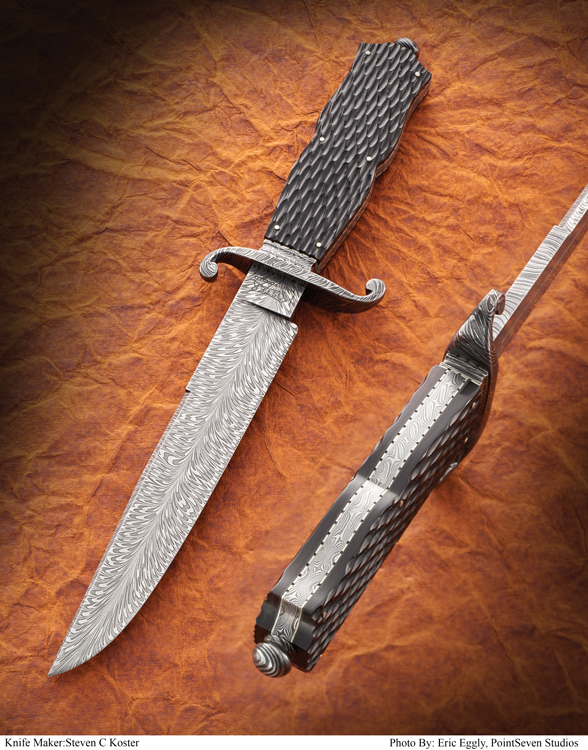
ABS journeyman smith Steven Koster combed through the entire box of bone scales at a Tru-Grit knife show booth to arrive at the nice matched pair of black jigged ones for his English bowie. The blade is Koster’s feather-pattern damascus in 1084 and 15n20 carbon steels. Overall length: 11.5 inches. (PointSeven image)
“Bone handles have always given Case knives their distinctive look and feel,” begins Fred Feightner, Case marketing coordinator. “While all of our handle materials cycle from time to time in terms of consumer favoritism, bone remains our most popular. Right now we are using our traditional cattle bone, the same we’ve been using for generations. Beyond that, some of our synthetics, woods and shells, like mother-of-pearl and abalone, continue to be very popular.”
According to Fred, Case handles its own jigging and color-dying processes. “We receive the bone in smooth slab form, then do all of the work needed to turn it into beautiful Case knife handles—including jigging, dying, drying and cutting to size. There are costs implicit in our manufacturing plans as the bone is sometimes stored before it goes to the production floor. The slabs also need enough time to take just the right color shade before being moved to assembly operations.”
Feightner sees no let-up in the popularity of bone handles in the near future.
“Bone is such a traditional knife handle material. It remains among our top sellers at Case, which is probably true of most makers of traditional folding knives today. Even with all the new handle materials that continually enter the marketplace, there’s still something special about the way a bone handle completes the look of a Case knife. We see demand for traditional folders to continue to grow, especially for Case knives, as our distribution and reach continue to expand into new markets.”
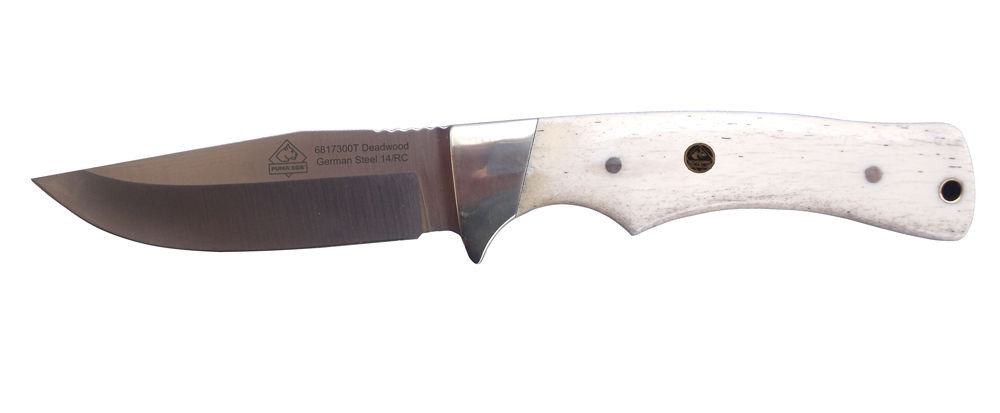
Puma USA opted for smooth white bone on the appropriately named Deadwood Canyon White Bone hunter. The 3.8-inch blade is 440A German stainless. Weight: 4.6 ounces. Overall length: 8 inches. It comes with a leather sheath.
Tried and True
The giraffe bone grip of Calvin Robinson’s “Little Bill” slip joint exhibits a two-tone color effect. The 2 5/8-inch blade is Damasteel damascus. Approximate closed length: 3.5 inches. (PointSeven image)
Steve Koster is an American Bladesmith Society journeyman smith who specializes in traditional fixed blades, most featuring his exquisite handforged damascus as seen in the English-style bowie on page 37. It sports a forged 1084/15n20 feather-pattern damascus blade and a boxed-frame handle topped with thick jigged bone scales.
“I do not jig or dye any of my scales. I get most of them from various manufacturers and suppliers at knife shows,” he states. “The cheekbone scales on my English bowie came from Tru-Grit. I picked through the whole box to find a nice matched pair with a fine jigged pattern. Some of the jigged-bone patterns are not uniform so I have to spend time selecting a matched pair of scales to fit the tang or frame.”
Though Steve uses a wide variety of handle materials on his knives, bone finds its way onto a healthy percentage. “I do about two out of 10 knives with bone scales,” he says. “I like using natural handle materials, and bone has been used for knife handles for hundreds of years. It is very durable and I really like the look of anything natural or antique looking on handles. Natural cow bone, camel bone or any of the ancient bones can be used as they are, or can be stabilized.”
Koster opts for bone with a traditional look. “The imitation stag I don’t care for,” he notes. “I prefer bone that has been picked or jigged, and also bone sanded smooth with a natural finish.”
Rest Assured
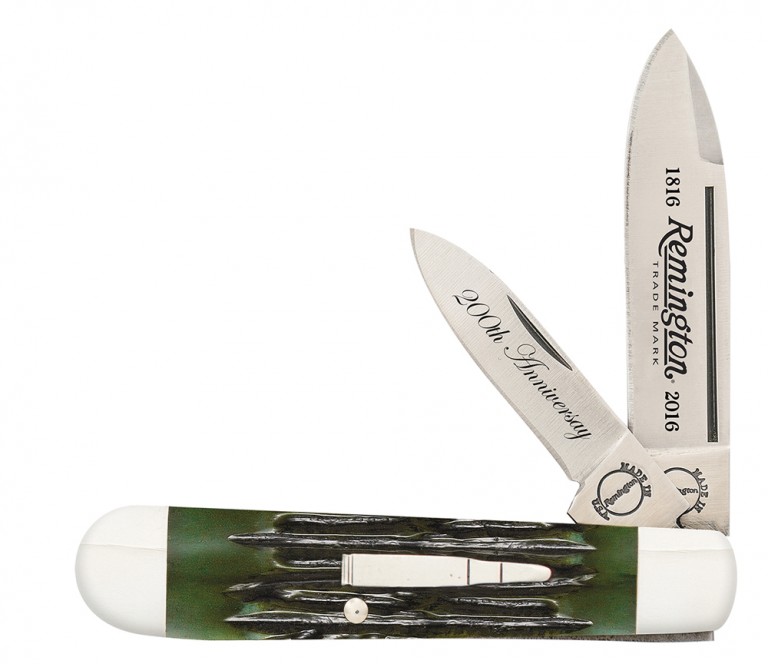
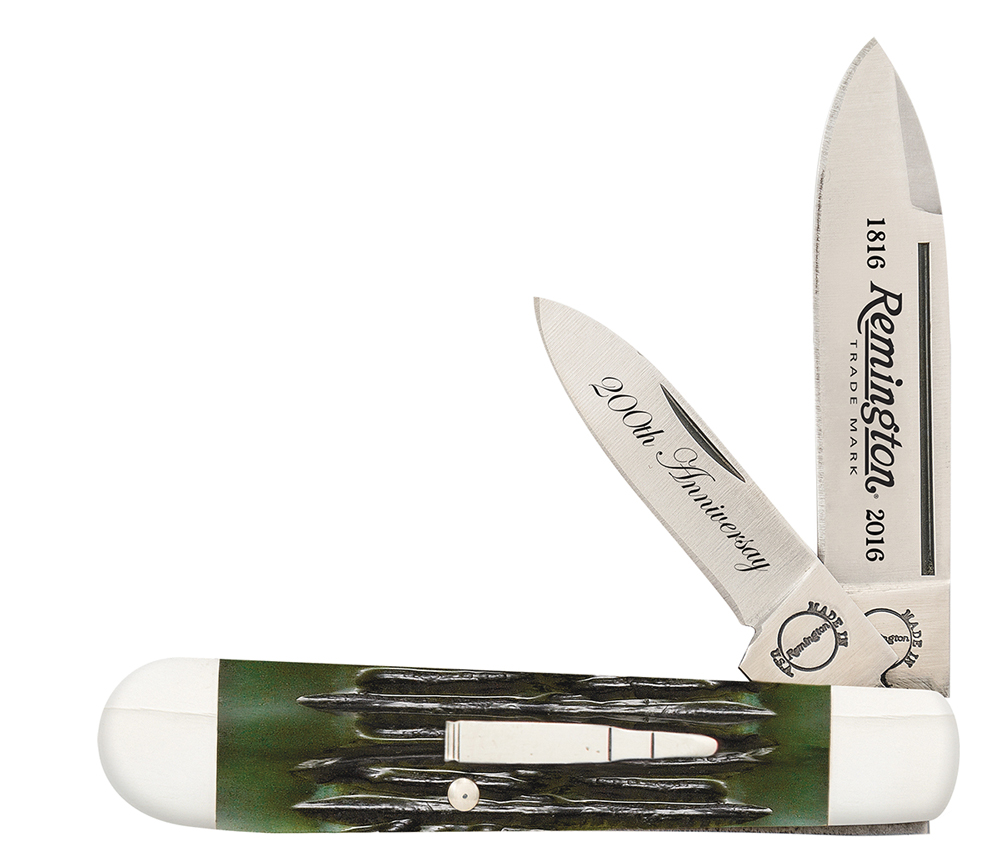
Green bone is a traditional favorite and the Remington Bullet 200th anniversary R11035 jackknife employs it along with blades of 440A stainless. Weight: 3.2 ounces. Closed length: 3.5 inches. Made in a limited edition of 5,000, it has an MSRP of $115.99. (Bear & Son image)
The tactical end of the cutlery industry (page 12) has ruled the roost for many years—and with it synthetic handle materials such as Micarta®, G-10 and carbon fiber—but traditional knives (page 12) still garner a sizable segment of the market. If you’re one of those who appreciate old-school pocketknives and fixed blades, rest assured—the factories and custom knifemakers have your back!one is one of the earliest materials used on knife handles, becoming a high art during the early and mid-1800s when the factories in Solingen, Germany, and Sheffield, England, were peddling their wares to eager American consumers. When tariffs on the old-world manufacturers were imposed in the waning years of the 19th century, U.S. manufacturers gained a toehold on the domestic pocketknife market, and by the early 1900s were in high gear. Bone was the most prominent and popular handle material in those days—and remains among the most prevalent, if not the most prevalent, to this day.
Many offerings by pocketknife manufacturers are graced with bone scales, and custom knifemakers use it frequently on both fixed blades and folders. BLADE® went inside the knife industry to find out why bone remains such a dominant handle material on today’s knives.
According to a new History™ Channel video trailer and television commercial, Season 2 of Forged In Fire premieres on February 9th at 10 p.m. EST/9 p.m. CST. All-new participants/bladesmiths are ready to forge edged tools and weapons, so tune in to History Channel and see for yourself.
ABS master smith J. Neilson tests a blade on History Channel’s Forged In Fire. (Miller Mobley/HISTORY image)
Forged In Fire (page 84, December BLADE) pits bladesmiths against each other to see who can make the best knife in a limitedamount of time, with the winner of each episode earning a $10,000 first prize. Last year’s FIF included such well-known forgers as ABS master smiths Murray Carter, Ray Kirk and J.D. Smith, David Goldberg, Peter Martin, ABS journeyman smith Mace Vitale and others, as well as many relatively unknown bladesmiths.
The combination of having to complete knives in a set time limit along with the other contestants before television cameras and over a million viewers makes for a great pressure environment and high drama. As a result, some of the smiths struggle to perform at their best. See the December 2015 issue of BLADE to find out more.
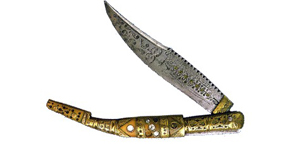
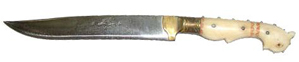
I received an email from Roberto Mazzarella of knifeplanet.net saying he did some research on traditional European knives, and contacted museums and associations to find one traditional knife for every European nation. He, of course, found out that some nations have many knife patterns they claim as their own, and others were a little more difficult to uncover. But his research did result in a fascinating and diverse array of European knives. He agreed to allow me to link to his resulting article, “Around Europe in 47 Knives: The Most Iconic Knives of Europe.” Whether you agree with his findings or not, it’s at the very least neat to look at the knives.
As Mazzarella states in his opening paragraphs, “Knives have been around since caveman chiseled stones to meet their daily needs. Nowadays, thankfully, knife making has progressed quite a ways. In Europe, knife making and knives have a rich, deep and complex history, dating back to cavemen themselves. Therefore, the continent is home to thousands of diverse and unique knives and knife making cultures stretching from medieval Belgium to Ottoman Turkey. Being such a diverse and unique area, however, we wondered how knives differed around the continent. For example, is an iconic knife in Belarus the same as a knife in Bulgaria? Is there an iconic knife from Albania? Due to the fact that there has never been any in-depth research of this kind before, we took it upon ourselves to find these answers. We contacted local knife makers, museums, knife collectors, and local historians from every country in Europe. This never-before done research took over a month of grueling research and labor.”
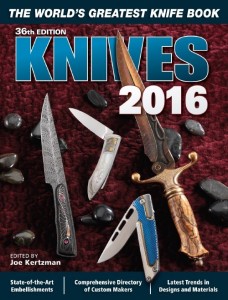
Putting on display custom knifemaking at its finest, Knives is back in its 36th edition. The trusted guide for knife collectors, enthusiasts, knifemakers, and dealers around the world, this knife book covers the latest and greatest from front to back. Get it here
I was watching American Pickers on the History Channel last night, and the stars were looking at an anvil, and Mike said something to the effect of, “More and more people today are going back to the basics and learning to forge, and learning the art of glass blowing and things like that …”
And it got me thinking about how my wife, Tricia, and I do this art tour every year where they give you a map and you go to artisans’ houses for kind of an “open house” art tour. And there’s usually a glass blower every year.
And then there’s that other History Channel show, Forged In Fire, and it seems like new knifemakers keep coming out of the woodwork …
What do you think, are more people forging today than in recent past?
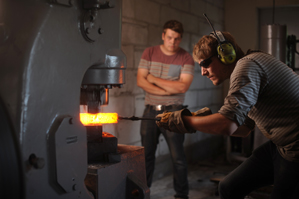
Shown in the image are Finnish brother knifemakers Jakob (forging) and Simon Nylund.
It’s not too early to pre-order the KNIVES 2016 book, which hits bookstores, newsstands and online in late August/early September. And staying true to form, KNIVES 2016 showcases nearly 800 of the newest, finest handmade, custom knives in the world in “Trends” and “State Of The Art” categories, as well as in-depth, truly fascinating feature articles on a variety of knife subjects, a “Factory Trends” section and, of course, the coveted Custom Knifemakers Directory.
The Custom Knifemakers Directory lists the names of 2,000-plus handmade knifemakers, their complete contact information, including addresses, phone numbers , emails and websites, their specialties, patterns, technical information, remarks, tang stamps and price ranges.
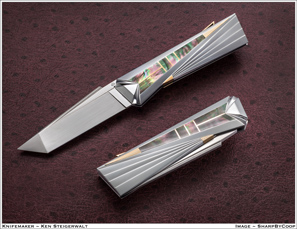
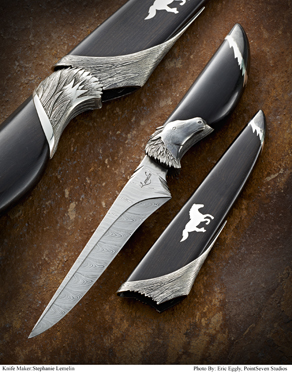
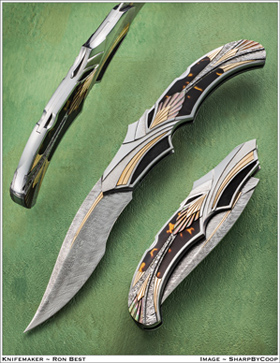
Within the “State Of The Art” section is a chapter titled “Sculpted Bods” that really speaks for itself, and here are a few of the incredible knives that parade their sculpted bods before an appreciative audience.


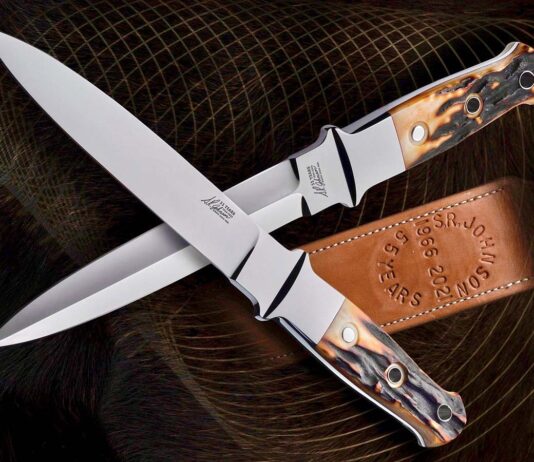
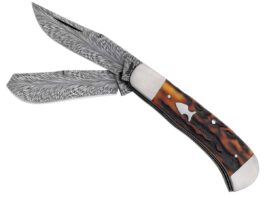
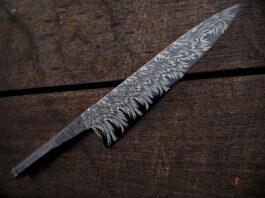

 There are a few manufacturers offering build-your-own-knife programs online. They enable you to play a pivotal role in selecting the handle color and material, blade material and shape, and even the coating choices. Be aware that these options and their number vary by manufacturer.