
Knifemaking

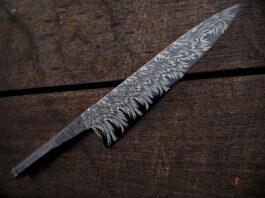
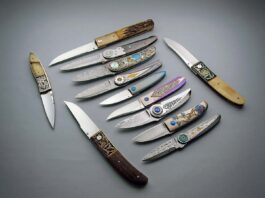
Knifemaking is the building of a knife, which includes the blade, handle and other accouterments. Blades are made by either removing metal from a steel blank via a grinder – known as stock removal – and the forging to shape of hot steel into a blade in the process known as bladesmithing. Other parts, including bolsters, guards, pommels, etc., are needed to complete the finished knife.

Featured Knives – – Knife Collecting – – Tactical Knives – – Survival Knives

How to Select a Steel for Forging

0

Editor’s Note: This is an excerpt from Murray Carter’s new book, Bladesmithing with Murray Carter. Click here to learn more from this renowned knifemaker.
The first and most logical approach is to select steel by doing some research on cutlery grade steel. Topics to especially pay attention to are the chemical composition of different steels and the effects of each chemical; isothermal transformation graphs for different steels; the effects and importance of thermal cycles, including annealing, quenching and tempering; the availability and cost of the steels and, perhaps most importantly, how easy the steels are to work by hand.

The above paragraph only took a few lines to write and a few minutes to compose, and yet many metallurgists will spend their whole lives researching those points. Pursue it to your heart’s content, and to that end I have included a thorough bibliography at the back of this book. However, to get you focused back on the task at hand, suffice it to say that there are some specifi cs you will need to concentrate on when selecting steel. These are:

• The amount of carbon in the steel

• Forging temperature range

• Annealing temperature, quenching temperature and tempering temperature

• Availability

• Overall workability

Let’s examine each of these in a little more detail.

Carbon is added to iron (Fe) to make steel. Carbon is the element that enables steel to harden when it is quenched at the proper temperature. Steel is unique in this aspect; all other metals soften when subjected to the same thermal cycle. The amount of carbon is very important. Too little carbon will fail to make steel harden when quenched, and too much carbon turns cutlery steel into cast steel. Generally speaking, less than 0.5 percent carbon is considered low carbon steel, and not suitable for blades. More than 1.6 percent carbon is considered extremely high carbon steel, and is very tricky to make into a blade. More than two percent usually equates to cast steel. Hence, most blades in the world have a carbon content between 0.5 percent and 1.5 percent.

In this range, all other factors being equal, the more carbon, the harder the blade gets when quenched. The harder the blade, the finer an edge and the longer it will stay sharp.

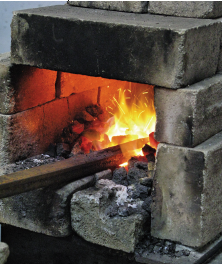
Forging temperature range is the temperature at which you can “work” or manipulate the steel. Most steel can be worked between a bright red heat and orange/yellow heat (approx .700~900 degrees Celsius, 1290-1650 Fahrenheit) and it will yield under the blow of the hammer, bend or twist etc.

Below this range the steel will cease to yield to manipulation and can be damaged by subjecting it to stress. Likewise, steel can be irreversibly damaged from working it at too high a temperature.

Annealing, quenching and tempering are the three phases of heat treating steel. These temperatures are very critical figures to commit to memory for the steel you are working. The heart and soul of a blade is the heat treat, as the final quality of the blade will be determined by how successfully these three operations are accomplished. Knowing the proper temperatures, and knowing what they look and feel like, is a critical skill for the bladesmith.

Availability determines whether or not you will be able to try forging that ‘super-steel’ you have been reading about. If you cannot locate or buy the steel in question, the pursuit becomes meaningless. Cost is another factor. Even if you locate the steel of your dreams, it may cost too much to have it shipped to your location. You want to know if you can acquire the steel for a reasonable cost and if it will be available in the foreseeable future.

Overall workability considers how the steel in question compares to other steels. Is it easy to manipulate under the hammer when you are forging it? How does it heat treat? Is it prone to warping, bending or cracking? Is it easy to straighten after heat treating? How does it take a final polish?

These questions are easier to answer once you have experience with a few of the common steels.
 

Click here to get 40% off Bladesmithing with Murray Carter and take the next step in the knifemaking journey.

4 Steps to Perfect Freehand Sharpening


1) Select a Sharpener

Invest in a good bench stone. You have the natural ones like the Arkansas stones and the manmade ones such as the Norton India stone. There are also the diamond-bonded stones that many companies produce.

2) Color the Edge

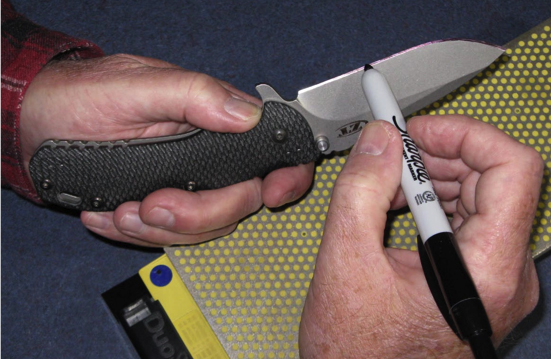
With a black ink permanent marker, color the entire cutting edge or primary bevel on both sides of the blade. The objective is to sharpen off the black ink. After you remove the ink from both sides of the blade, it will be sharp.

3) Adjust Accordingly

Take a few strokes on the stone and then examine the edge bevel. If you see ink toward the top of the bevel, decrease the angle of the blade to the stone. Conversely, if you see ink toward the bottom of the bevel, increase the angle to capture that part.

4) Remove the Ink

After you sharpen the ink from the cutting edge, you will have to remove any stray marker ink. A liquid-based adhesive and paint remover is ideal for the job. Place a few drops on a paper towel and very carefully wipe the cutting edge.

Going Forward

After you get the hang of it, skip the permanent marker step. Congratulations, you’re now a freehand sharpening pro!


Silver Wire Inlay Techniques by Joe Keeslar, MS

0

Master Smith Joe Keeslar demonstrates Silver Wire Inlay work techniques including stabing chisel cuts, wire forming, wood selection, and wire cutting.

Tools for Silver Wire Inlay by Joe Keeslar, Master Smith

0

Master Smith Joe Keeslar describes the tools needed for Silver Wire Inlay work on knife handles and sheaths.

Hunter’s Edge: 2 Kommer Skinners, How To Make a Hunter Video

Get hunting knives designed by Alaska hunting guide/award-winning maker Russ Kommer or build your own via a Gene Osborn video at ShopBlade.com.

    The CRKT Kommer 2-Shot Skinner is a smaller semi-skinner designed for the biggest game. The 3.15-inch blade is 12C27 Sandvik stainless and the handle is orange G-10. The accompanying horizontal sheath also has two pockets to handle ammo from .243 up to .338. ShopBlade’s price: $104, a savings of $26 over the regular cost.

    For more info click on http://www.shopblade.com/kommer-2-shot-skinner-2840?lid=blss092912.

    For a limited-edition Kommer skinner built in Russ’s Fargo, North Dakota, shop, check out GATCO’s 20th Anniversary Kommer model. The 3 9/16-inch blade is ATS-34 and the handle is black ash burl. ShopBlade’s price: $600, a savings of $150 over the regular cost.

    For more info click on http://www.shopblade.com/gatco-20th-anniversary-kommer-knife-6020?lid=blss092912

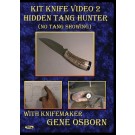
    If you’d rather build your own hunter, Gene Osborn’s “Kit Knife Video 2 Hidden Tang Hunter” takes you through the process from start to finish. ShopBlade’s price: $25.

    For more info click on http://www.shopblade.com/kit-knife-video-2-hidden-tang-hunter-no-tang-showing-with-gene-osborn-w5378?lid=blss092912


ABS Journeyman Smith Performance Test

0

The ABS Journeyman Smith Performance Test of Apprentice Smith Ben Seward which is administered by Master Smith Lin Rhea. During the video Master Smith Rhea gives some very useful advice about test preparation and techniques. For more information on the educational programs of the American Bladesmith Society please visit our Website and Forum at www.americanbladesmith.com


BLADE Recommends: Guide to Making Knives, 2nd Edition

Before going through the rigorous certifications the ABS offers, it’s essential to get the best knifemaking information. BLADE’s Guide to Making Knives is required reading. It offers extensive knifemaking instructions, including full-color photographs.

Click here to order BLADE’s Guide to Making Knives from ShopBlade.com for the best price.

Bill Moran Making a Guard for a Quillian Dagger

0

American Bladesmith Society Founder William F. “Bill” Moran, Jr demonstrates his technique for making and attaching a guard to a Quillian Dagger.


BLADE Recommends: Spyderco Bill Moran Drop Point

Bill Moran’s legacy can be felt every time a knifemaker fires up a forge. It’s also the force behind the Spyderco Bill Moran Drop Point. With a VG-10 blade and ergonomic grip, it’s the perfect knife for the upcoming hunting season.

Click here to order a Spyderco Bill Moran Drop Point knife for 20% off at ShopBlade.com.

Advertisement

Must Read Articles

Read this before you make a knife

Knifemaking 101 – Read This Before You Make a Knife

  by Wayne Goddard My experience has taught me that there's nothing like digging in and getting started. I've often said the hardest part of the...
how to forge damascus steel

How to Forge Damascus

Advertisement
Advertisement