Knifemaking is the building of a knife, which includes the blade, handle and other accouterments. Blades are made by either removing metal from a steel blank via a grinder – known as stock removal – and the forging to shape of hot steel into a blade in the process known as bladesmithing. Other parts, including bolsters, guards, pommels, etc., are needed to complete the finished knife.
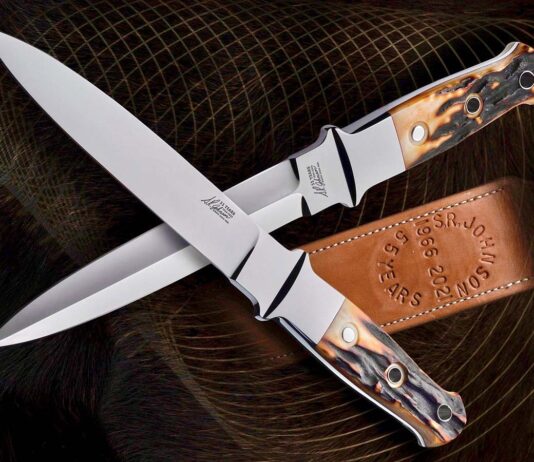
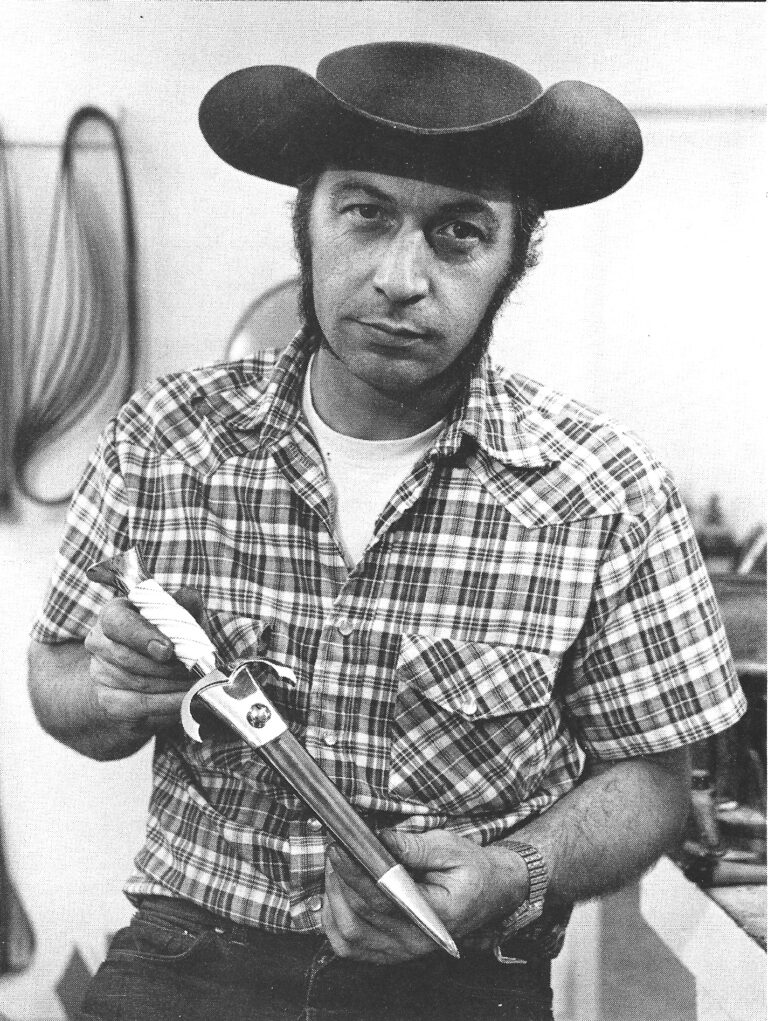
BLADE Magazine Cutlery Hall-of-Fame® member Buster Warenski was the subject of an extensive six-page profile a half century ago in the January/February 1976 issue of The American Blade. He was larger than life then and would get even larger in the years to come.
Unmistakable in the low-crowned Stetson and mutton-chop sideburns he wore back then, Buster was interviewed in his new Richfield, Utah, knife shop by then editor L.V. Baker. Richard Barney, co-author with Cutlery Hall-of-Famer Bob Loveless of the landmark How To Make Knives book, was along to take photos. The lead image of Buster holding one of his latest knives at the time is about as iconic as it gets.
Done about half a decade before Buster would go on to make his reproduction of the King Tut Dagger, the story and spread reflect how consequential Buster was to the handmade knife movement of the 1970s. It covers from his early influences, including Harvey Draper and Cutlery Hall-of-Famers Gil Hibben and Bo Randall, the first two knives Warenski ever sold, some invaluable magazine publicity from Cutlery Hall-of-Famer B. R. Hughes, Buster’s first Guild Show in 1973 and his position on the Guild Board of Directors at the time of the interview.
One of Buster’s best quotes: “I think the industry is going to get bigger and better, just as our customers and collectors are going to become better educated about the knives they buy and are going to demand a better product.”
Buster was right, of course—and would be among the vanguard of makers to supply the knives for which he predicted there would one day be such great demand.
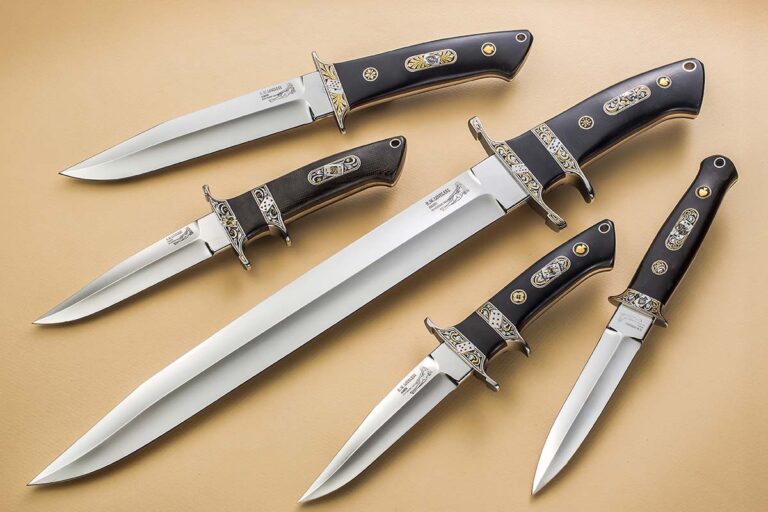
The sub-hilt is at once belligerent and beautiful, adding a strange allure to the knives that sport it.
There is no consensus as to the origin of the sub-hilt knife, though most agree the sub-hilt fighter was popularized by BLADE Magazine Cutlery Hall-of-Fame® member Bob Loveless in the 1970s, if not earlier. Some believe the sub-hilt design was for hunting, and that the main purpose for the added hilt was for greater leverage when a surer grip was needed. A few have even postulated the additional hilt was for use as a brace in pulling the knife out after being stabbed into bone or another hard material, a use that it would no doubt accommodate most effectively.
Gary Langley: Gentleman’s Fixed Blade
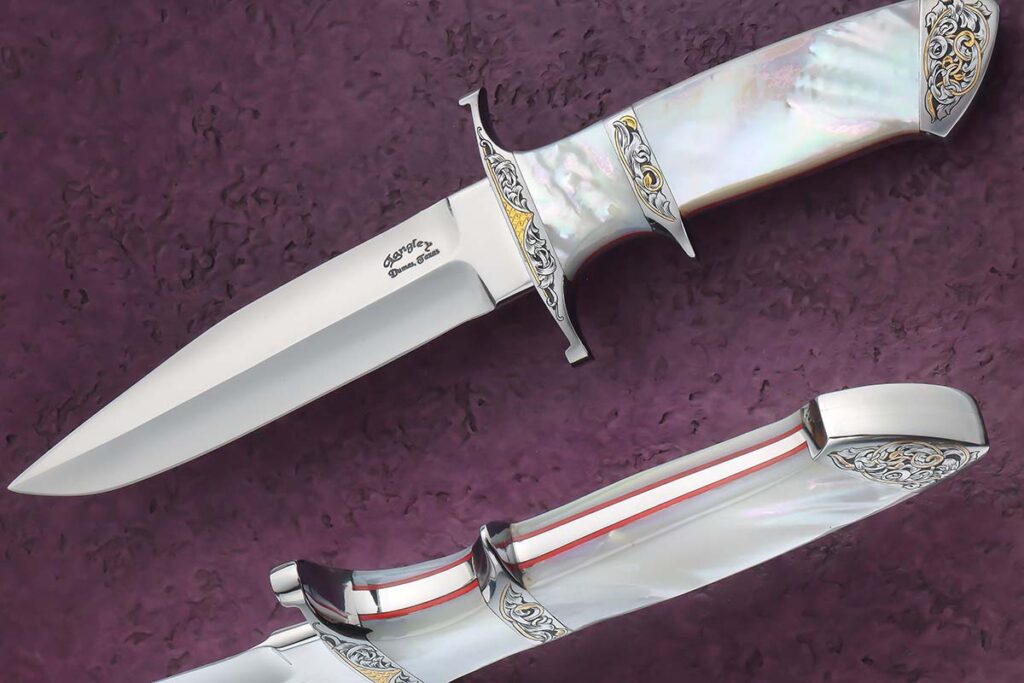
Custom maker Gary Langley’s sub-hilt fighter may be small at 9 inches overall but makes up for its size in sleek blade grinds, exquisite mother-of-pearl scales and gold inlay. Blade and overall lengths: 4.5 and 9 inches. Alice Carter did the engraving. (SharpByCoop knife image)
Many knife enthusiasts think of a sub-hilt fighter as being a heavier-edged companion—and in many cases it is—but custom knifemaker Gary Langley’s iteration is a little gem of a knife.
“The small Loveless-style sub-hilt fighter is 3/16-inch CPM 154 steel with a double hollow grind on a 3-inch wheel,” the Dumas, Texas, maker notes. “The heat treatment is by [Cutlery Hall-of-Famer] Paul Bos. I originally designed the knife without the rear bolster. I added it when I couldn’t source the mother-of-pearl scales long enough—and I believe it turned out even better.”
It has what might be called a 19th-century Michael Price San Francisco knife look that makes it a prime candidate for a true gentleman’s fixed blade.
Andrew Blomfield: Sub-Hilt Bowie
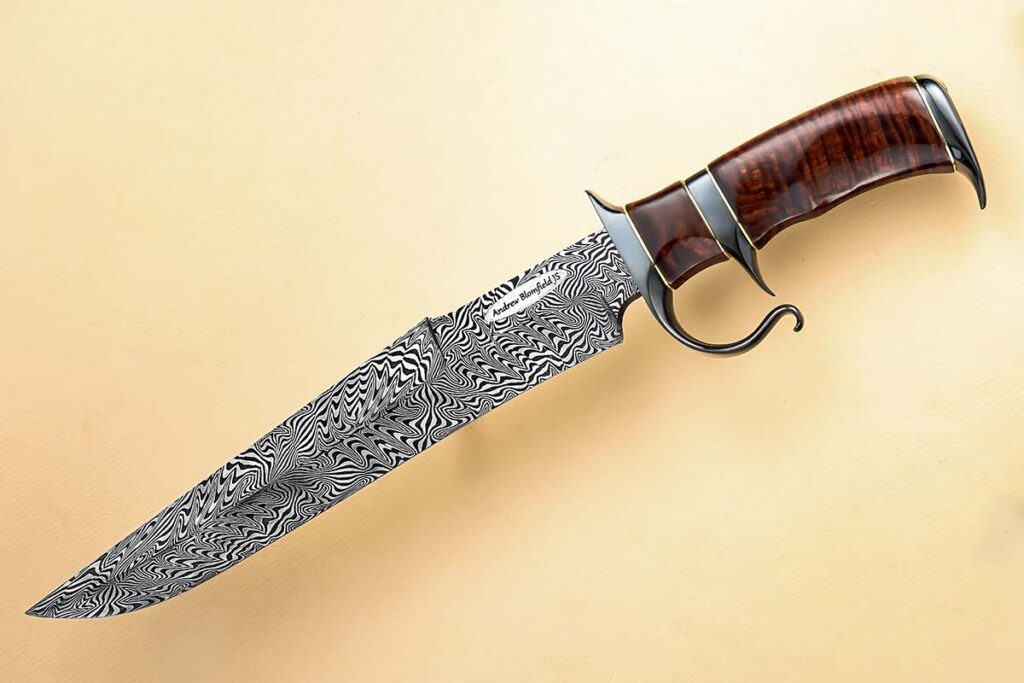
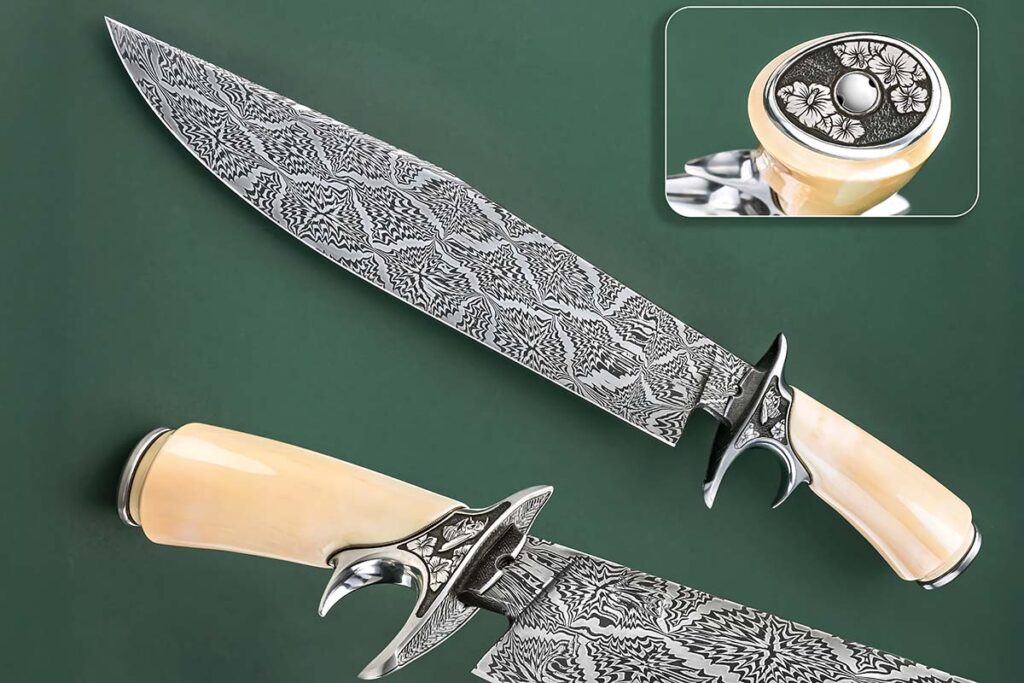
ABS master smith Andrew Blomfield’s sub-hilt bowie is a tour de force of explosive mosaic damascus, salt-blackened steel, brass spacers, and exquisite Australian ringed gidgee wood. Blade and overall lengths: 11 and 16 inches. (SharpByCoop knife image)
An ABS master smith from New South Wales, Australia, Andrew Blomfield enjoys building large knives such as bowies and daggers. “The bigger the knife the better,” he states. An example is his sub-hilt bowie.
“I feel that this knife has great flow and balance,” he begins. “The blade is an explosion mosaic pattern damascus hardened to 59 HRC. The guards and pommel are salt-blackened steel with brass spacers and the handle is a beautiful piece of Australian ringed gidgee.”
The guard’s bottom quillon curves back toward the sub-hilt to partially enclose the user’s hand a la a D-guard, but also has hints of both a C- and an S-guard to it. Very unusual!
Andrew Meers: Rose of Sharon
ABS master smith Andrew Meers calls his 16.5-inch sub-hilt fighter Bees and Flowers, due in no small part to the Rose of Sharon and bees engraving. The 12-inch blade is a damascus of 1084 carbon and 15N20 nickel-alloy steels in a mosaic pattern. Guard and furniture are 416 stainless steel. Overall length: 16.5 inches. (SharpByCoop knife image)
ABS master smith Andrew Meers of Raleigh, North Carolina, says, “I started with the sub-hilt in mind, which is a departure for me.” To say his deviation from the norm worked out well is an understatement.
“I like to incorporate Japanese influences wherever I can, and I wound up adding an integral habaki into the guard design as well,” he explains. “I wanted a blade that was able to feature a mosaic pattern, so I chose a broader shape that expands towards the point rather than tapers. The handle is a simple design to contrast the visual complexity of the guard.”
The engraving theme is of the Rose of Sharon and bees.
“The client had requested a floral theme, and we worked on the rest of the design and layout from there,” Andrew says. “The engraving was meant to complement the layout of the guard and furniture.”
Justin Harrington: A-Team
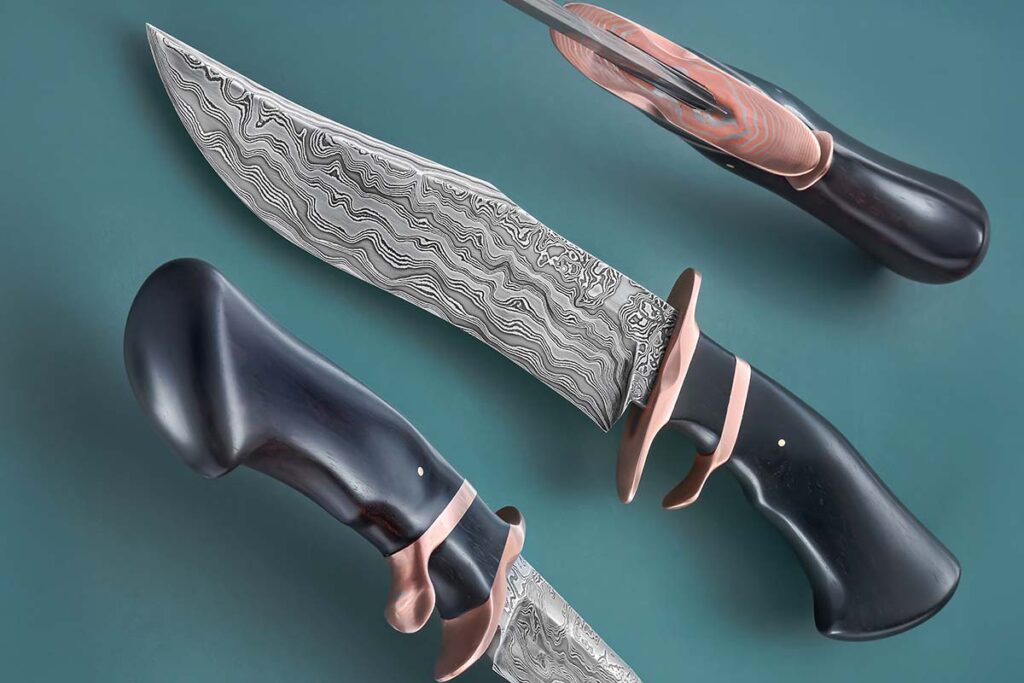
Built for an Army buddy, Justin Harrington’s superb sub-hilt fighter incorporates a masterful balance of random pattern damascus, mokumé gané and African blackwood. Blade and overall lengths: 8.5 and 13.5 inches. (SharpByCoop knife image)
Justin Harrington of Clemmons, North Carolina, began smithing 18 years ago and is the owner of Cyclops Forge. Of the sub-hilt he says, “It’s the racecar of fighting knives—weight, balance, curvature, tip control and placement all are important variables to be employed to reach a harmony which is felt right away when correctly done.
“This knife started its life as a phone call from an Army A-team member who wanted a special combat retirement gift for his buddy. The three of us got together and forged a damascus billet for the knife over three days in my shop. The 8-inch recurve blade is a random-pattern damascus of 1084 and 15N20 carbon steels. The guard and sub-hilt are made from a copper-and-nickel mokumé gané I make in my shop. The handle is around 5 inches of sculpted African blackwood with a bronze pin.”
The sub-hilt has a forward lean and spoon-cupped quillon that slants toward the guard to capture the user’s index finger. The result is a handle that seems to want to grab your hand.
Cool & Sexy
Whether fighter, bowie or what have you, the sub-hilt-knife genre may be more recognizably custom than any other. From the classic Loveless Big Bear fighter to the wide array of today’s renditions, top sub-hilts are cool, sexy and in harmony with the best custom knives extant.
Marine Corps hero feted with Nawrocki knife at The Battleship Ball.
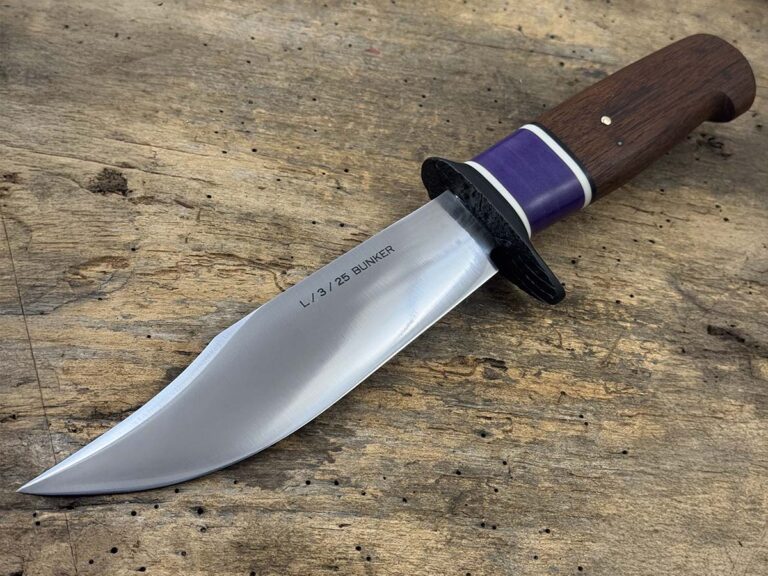
An unforgettable setting for a memorable event celebrating an American hero—all complemented by a beautiful knife by Brian “Rocco” Nawrocki—completed a tribute to USMC Sergeant Scott Bunker during last year’s 250th anniversary of the United States Marine Corps.
Assigned to Lima Company in 2005 during the Iraq War, Sergeant Bunker took multiple machine-gun rounds at point-blank range in house-to-house fighting, resulting in the loss of an eye, half a lung, several ribs and soft-tissue damage to his left arm. He was the guest of honor at The Battleship Ball 2025 on November 1, held on the deck of the vintage World War II Battleship USS North Carolina in Wilmington, North Carolina.
Event organizer/USMC veteran Dean Smith (left) congratulates Sgt. Scott Bunker after delivery of the Nawrocki tribute knife (in display case on the dais) during The Battleship Ball.
The handsome fixed blade Rocco made for Sergeant Bunker includes steel from the North Carolina for the blade and guard. The wood handle is teak from the battlewagon’s deck, along with purple heart ribbon spacers.
Stainless, high-carbon, super steels, see what 2025’s shakeups mean for knife steels in 2026.
Twenty-twenty-five saw radical change in the cutlery industry, but somehow the business of blades not only survived, in some ways, it also thrived. With new steels in the offing and despite a business environment made murky by the specter of tariffs, 2026 has several things going for it that could point to a year of continued resilience for knives.
Ironically, one of ’25’s biggest changes—the closing of Crucible Industries—did not turn out to be as debilitating as some thought it would be. While by mid-year there was no more Crucible, most of its coveted cutlery steels remained available, albeit under new manufacturer names (Knife After Crucible).
A steel processing company that came out quite well during the transition was Niagara Specialty Metals (NSM). Bob Shabala, NSM president, provided a look at the changes from an insider’s perspective.
Several sources say companies that manufacture their knives solely in the USA should experience little to no tariff-induced price increases in 2026. Case is such a company. The Crossroads Barlow features S35VN stainless blade steel and a black and tan Richlite handle. Closed length: 3.375 inches. MSRP: $118.99.
“Crucible’s decline didn’t happen overnight,” he notes. “Long before the shutdown, we saw signs of trouble: inconsistent allocations, slipping ship dates and growing uncertainty around future melts. As a steel processor that lives or dies by delivery reliability, we didn’t wait. We started to order more steel from Crucible to bolster our inventory in case something happened. We also reached out to Erasteel and Carpenter Technology to gauge their interest in supplying PM [powder metallurgy] steels. We have a long history with both companies and they were receptive to our requests. In September 2024, we started placing orders with both mills, not knowing that Erasteel would eventually buy the IP [intellectual property] and trademarks of Crucible in early 2025.
“In short, Crucible’s demise raised costs in the short term but also created an opportunity for us to buy high-quality steel from multiple suppliers. We diversified melt sources, invested in grinding/laser/ti capacity and kept steel flowing. The industry will come out of this with a more resilient supply chain, and makers will see faster builds and better consistency where it counts. If you’re a one-man shop or a major brand, you can get the material and the prep you need.”
Introduction MagnaMax Steel
Dr. Larrin Thomas, metallurgist.
Dr. Larrin Thomas is an acclaimed metallurgist whose web column knifesteelnerds.com is great reading if you want to stay current with knife steels. He sees the industry’s ability to bounce back over time as key to predicting events for the coming year.
“The huge changes in the ownership among steel manufacturers for cutlery consumers were minimal, mainly because the major players had a year to settle into their comfort zones,” states Thomas, whose portfolio as a steel designer includes the uber-popular MagnaCut. “Nothing changed as far as the king-of-the-hill steel. MagnaCut, which has been the most popular stainless steel among knife consumers for over two years, remains the top choice. That could change in 2026 because MagnaCut will be joined by a sibling dubbed MagnaMax.
“MagnaCut isn’t going away—its balance of edge retention, toughness and true ‘stainlessness’ keeps it the all-around benchmark. What’s new is MagnaMax: think MagnaCut-level corrosion resistance with meaningfully higher wear resistance, so edges hang on longer in abrasive cutting. That combination is why I expect MagnaMax to be one of 2026’s headline steels, especially in EDC folders, hunting/skinning knives, and pro kitchen blades that see lots of board or hide contact. MagnaMax complements MagnaCut rather than replacing it—pick MagnaMax when maximum edge life is the priority, MagnaCut when you want the ultimate do-everything balance.”
Knife Steels To Watch
AEB-L stainless will be one of the top blade steel choices for custom folders in 2026. Terry Jellison employs it on the blades of his Hobo Knife. Scales: mammoth ivory. Liners: brass. Closed length: 4 inches. The knife is not for sale. (Jocelyn Frasier image)
Despite or perhaps even because of the Crucible shakeup, manufacturers and custom makers have many steel options. Following is Larrin’s recap of the diversity of top-shelf options for 2026. First, the leading stainless steels for factory knives:
MagnaCut: Expanding across EDC folders, hunting knives and premium automatics as brands refresh the legacy of S30V/S35VN;
MagnaMax: Expect it to appear in the same knife types as MagnaCut and beyond. The appeal is simple: MagnaMax has the qualities of a stainless steel users already love (MagnaCut) but with more wear resistance for longer edge life, and;
LC200N and Vanax: Limited but visible in dive/fillet and salt-exposed knives where “no rust, period” is the spec.
Larrin’s top carbon steels for factory knives in ’26:
CPM 3V and CPM CruWear (aka NSM Wear): Factories use these steels selectively in choppers and survival/tactical fixed blades where warranty-safe toughness matters.
D2: The popular tool steel will persist in value lines, but you’ll see a gradual shift away from it toward tougher, easier-to-sharpen options. In the realm of carbon steels for custom knives, Larrin says Pop’s ProCut, a new blade material designed for use by bladesmiths, including in damascus, will shine. Its combination of nickel, tungsten and vanadium gives it high toughness and wear resistance while still being easy to forge and heat treat. It can be hardened in a 200°F window, which makes it extremely easy to heat treat. The high nickel content also makes it produce a bright layer in damascus. On the stainless custom side, Larrin says to watch these:
MagnaMax: Alongside MagnaCut and AEB-L, MagnaMax will be a go-to for customs where makers want a “set-and-forget” edge on EDC folders, hunting knives and chef’s knives. It delivers premium corrosion resistance plus a clear wear-resistance bump, which lets makers grind thin and still give customers long service intervals between sharpenings, and;
LC200N: It will fill a growing niche for dive knives, fillet knives, coastal EDC and pro kitchens where rust is the enemy.
Tariffs’ Affects On Knife Steel
Bear & Son is another company that manufactures its knives exclusively in the USA and that should experience little to no tariff-induced price increases in ’26. Its 11 7/8-inch White Smooth Bone Professional Fillet Knife features Sandvik 14C28N stainless blade steel. MSRP: $139.99.
Several sources say American consumers will see the effects of U.S. tariffs on both imported knives and/or the steel used in them in ’26—a double whammy in some cases. However, it’s too early to tell the overall impact tariffs will have on the prices American consumers will pay for imported knives. That said, enough has been done in the overall market to draw some conclusions as to what direction those numbers are heading in the knife market in general.
As for those who manufacture their knives in the USA, there will be little to no increase in prices, except for models that include some foreign-made parts. This is uncommon but a possibility, though for the most part, not a liability that cannot be overcome. Case, Bear & Son and others are among those that fall into this category.
The second group contains companies that do a large part of their manufacturing in the United States. Among those that fit into this group is Spyderco, which also has its “value line” of knives produced overseas. Sources say Spyderco can go with a bump in tariffs on its foreign-made knives, move all manufacturing in-house or ditch the value line entirely, though there was no indication at press time that the company will choose either of the latter two options.
Dr. Larrin Thomas says the new Pop’s ProCut blade material is designed for use by bladesmiths, including in damascus. Cliff Ivey combines it with 80CrV2 carbon steel for the damascus blade of his small hunter. Overall length: 6.25 inches. Cliff’s price for a similar knife: $450. (Jocelyn Frasier image)
Then there are American companies that produce the lion’s share of their knives overseas. CRKT is one such company. Sources indicate CRKT can work the tariff costs into existing pricing, move its manufacturing to a country that pays lower tariffs, or figure out a way to manufacture more of its knives domestically. Considering CRKT’s track record, it probably would be a mistake to underestimate the company’s ability to endure.
Bottom Line
While 2026 will have its challenges, barring any surprises, it should be relatively calmer than 2025 due to last year’s upheavals in the manufacturing sector and tariff-induced changes. Meanwhile, the cutlery industry remains healthy in both the budget, moderately priced and upscale sectors—and that is a very good sign.
Get a gander at what’s on the slate for NSM in 2026.
According to a recent post by Niagara Specialty Metals (NSM) on BladeForums, NSM (nsm-ny.com) had several steels and materials available either now or that were “incoming” as BLADE was going to press.
The list includes: MagnaCut; CPM154; S30V; S35VN; S45VN; S90V; 3V; 4V; CruWear (aka NSM Wear); 154CM; 20CV; M4; CPM D2; D2; 440C ESR; 416; and 6-4 titanium. The new MagnaMax (page 66) should be available in 2026.
The post stated that all particle metallurgy grades are “coming in from Erasteel and Carpenter and the quality has been excellent.” All of NSM’s air-melt steels and 6-4 titanium are domestic.
The only grades off the list at press time were 15V, 110V and Rex 121. “They were Crucible exclusives,” the post noted of the three grades not on the list, “and we’re working with the mills to bring them back once production can be re-established.”
From maintaining symmetry to adding fullers, we break down the intricate process of making a dagger design into a physical knife.
A dagger is not a kitchen knife in disguise. It is a purpose-built instrument of thrust and that purpose demands precision at every stage of construction. Small errors that might pass unnoticed in a hunter or utility knife compound on the exacting canvas of the dagger. A centerline that begins drifting by a fraction at the ricasso becomes an off-center tip, an uncentered bevel a blade that twists, the result a thrust off target. The difference between success and failure is geometry, and nowhere does geometry matter more than in the making of a dagger.
The process begins with detailed design and planning. The execution begins with precise layout. The central axis is the spine on which the whole piece will rest, and without it symmetry is impossible—the whole blade will stand or fall on getting this right. There are some tricks that will help ensure success.
Dagger Half Template
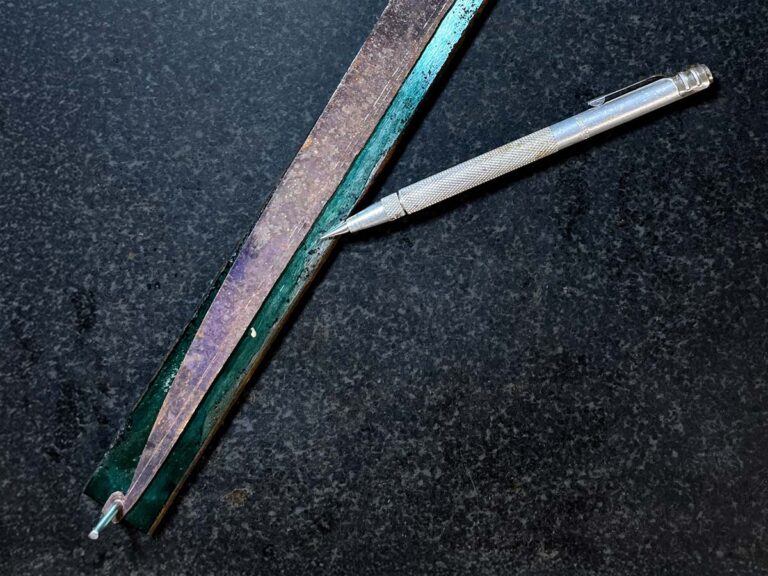
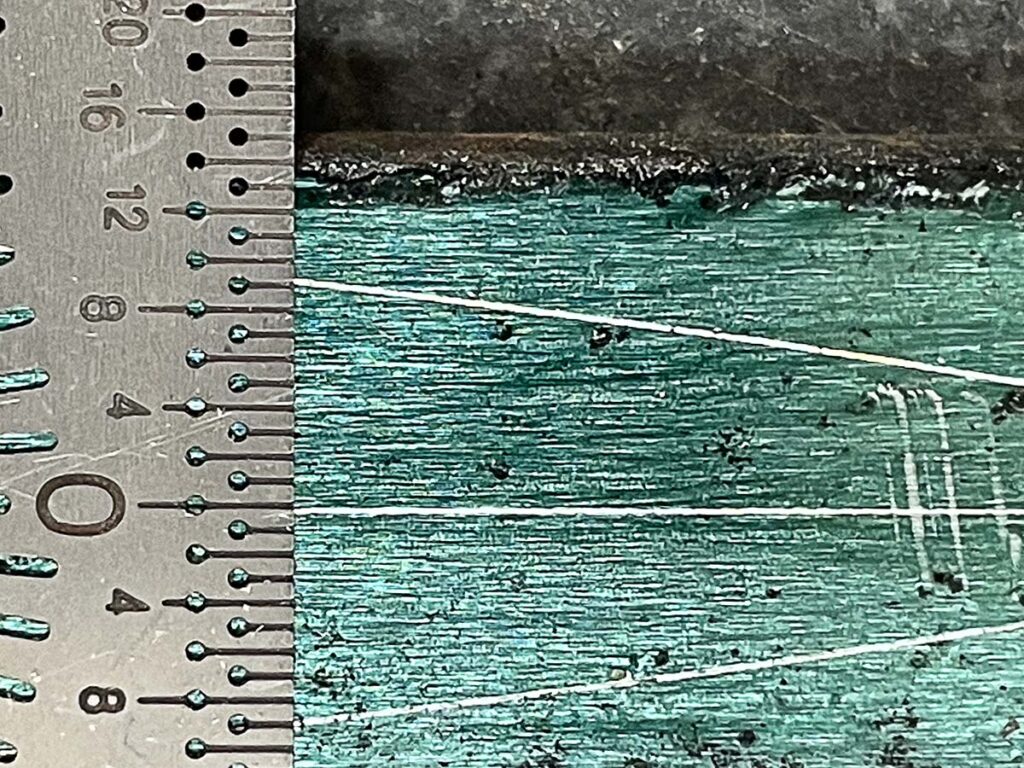
The Line That Rules Them All. A cleanly scribed centerline on both edge and flats sets the maker up for successful layout. A centering ruler can be a useful tool to check this.
Once you have determined the blade profile, preferably in some physical form like a drawing, make a template so it can be accurately transferred to steel. Here’s the thing, though: you only need half. A template representing only half of the blade profile will allow you to use it for each edge, ensuring perfect symmetry. Include the tang on your profile, not just the blade.
If you’re careful, your half template can be held on your blade stock aligned on a scribed center line and scribed on each side. If you’re less careful, oversize your blade stock and template so you can drill holes for alignment pins in the end of each that is outside the final profile. Using these holes to align the half template for marking each edge is the most precise way to lay out a symmetrical profile. If the stock is oversized, you’ll grind off the alignment holes when grinding the profile.
Planning Plunge Lines
Once you’ve accurately laid the profile out on the blade stock, take the time to scribe in the planned plunge lines on the blade flats and the edge. Sweeping, curved plunges are more visually appealing and careful layout will help ensure that your vision becomes reality. These lines are not decorative. They are the stops, targets if you will, that prevent the grind from slowly creeping toward the ricasso with each grinding pass.
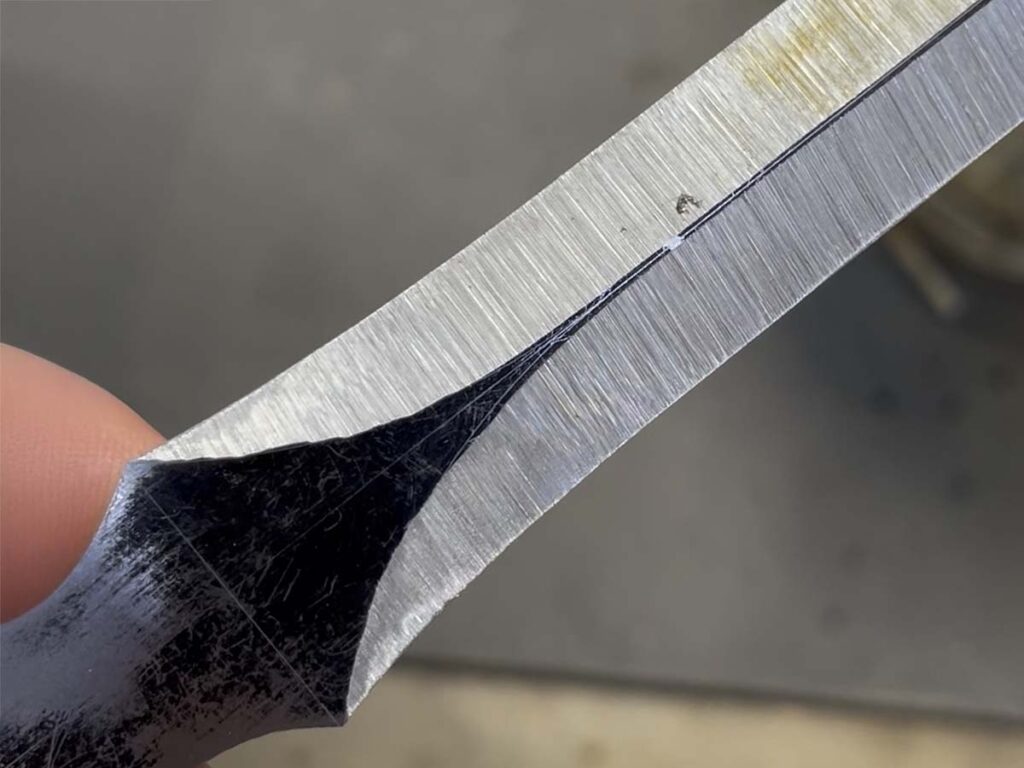
Grinding the Plunges. Gradual, sweeping plunges are much more appealing to the eye than straight ones. Draw them in and grind to the drawing. This is more easily done on a wheel than with a flat platen but can be accomplished either way.
When it comes to grinding these sweeping plunges, hollow grinding on a wheel is easier than flat grinding on a platen—it’s easier to grind a curve with a curve—but by all means use a flat platen if that’s what you have. If you’re already grinding on a wheel, a 1-inch-wide wheel with a 1-inch belt will be an easier path to success than the standard 2-inch wheel and belt.
Sweeping plunges also will result in a thicker edge toward the ricasso. This is fine—you shouldn’t try to sharpen this part as doing so most likely will ruin all your careful design work. Will the unsharpened part of the edge impair the stabbing function? Perhaps, but only a little. Though it pains a serious knife person to admit it, most handmade modern daggers are for show. In most societies stabbing others is frowned on, and if you’re going to all this effort, choosing to focus on aesthetics is a good bet. However, if your dagger will be deployed in combat, ignore the aesthetics, grind sharper plunges and take the edge all the way to the ricasso.
Dagger Grinding And Stock Removal
Grinding and stock removal are the way to go for daggers. This is admittedly a hot take but in a game where winning is determined by symmetry, forging introduces unnecessary variables and distorts the base stock, making accurate layout more complicated—not impossible, just not as easy. There is little to gain by forging unless the steel itself or the situation requires it, or if you simply like doing it that way. If you want a damascus pattern to taper toward the tip, or if you’re making a dagger for American Bladesmith Society testing, by all means forge. It’s an impressive skill set. If you want to make the best dagger possible with an eye toward efficiency, and thereby your profit margins, grind it. Stock removal is the more predictable path, and predictability is the soul of symmetry. Every forged blade is a stock removal blade before it’s completed; don’t get hung up on this unless you have reason to.
Delicacy Of The Dagger Tip
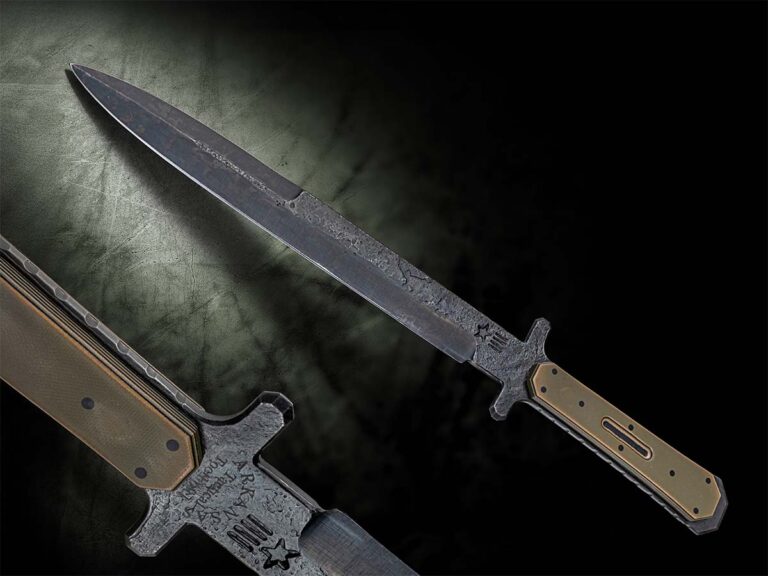
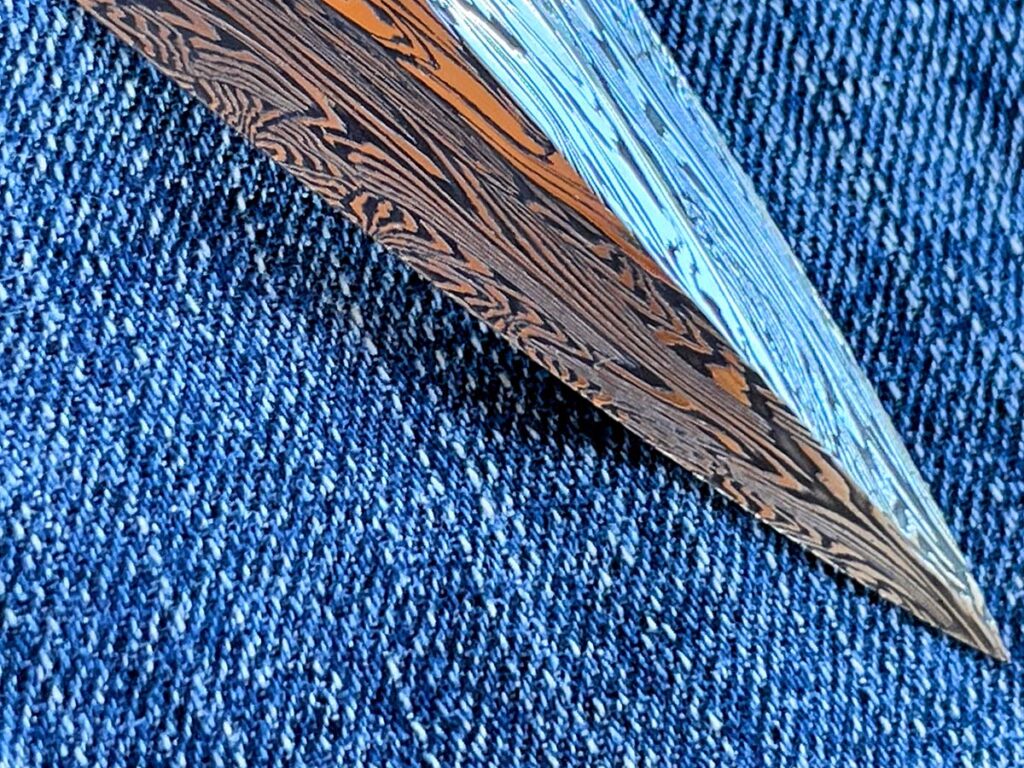
Forged for Continuity. An intricately patterned damascus dagger by Gregory Verizhnikov shows why sometimes forging is worth it—forging through the tip preserves the pattern’s flow.
Where the mass of the ricasso anchors the entire weapon and provides strength at the critical juncture of guard and tang, the tip, by contrast, demands delicacy. Once your profile is carefully ground to shape and you turn to grinding the bevels, grind the tip first. More specifically, grind it at a steeper angle than you plan for the main bevels, and try not to cross the centerline even at that obtuse degree, except at the very end. After that, leave it alone.
Grind the main bevels like you normally would, paying perhaps more attention than usual to your scribed lines, and try to avoid that last inch toward the tip until everything else is pretty much done. This seems a bit odd at first, but consider that the final inch must maintain its thickness in order to be strong enough to pierce effectively without deformation or fracture. If you do it right, you’ll end up with a bevel at the transition. Some makers polish the transition so it remains crisp, while others blend it smooth while polishing. Either way, it should be deliberate. Neglect this and the point will be too thin.
When To Add Fullers
Lay Out Everything. Scribe curved plunge lines on the flats and edge mark exactly where each bevel begins and ends.
Fullers, if they are to be included, should be cut early while the blank still has parallel flats. Attempting them later invites misalignment, or at the least inserts a potentially unnecessary level of difficulty. Better machinists than this writer/dagger enthusiast will likely have little difficulty either way, but life has enough complications of its own without inviting them into play.
Dagger Balance
Balance matters as much as steel. A well-made dagger should balance at or just ahead of the guard, a neutral point where the hand feels neither burdened nor abandoned. This can be tested with nothing more elaborate than a rod beneath the mostly assembled knife, shifting it until it rests level. It’s really just as easy to adjust weight distribution by feel, removing or adding weight to the component parts until it feels right. Don’t forget to consider the added weight of your epoxy. When balance is right, the blade becomes an extension of the wrist, alive and responsive.
Tang & Spacers
How Not to Do It. This dagger blade poorly ground by the author clearly demonstrates that the easy way out usually leads back in. Off-center bevels and an off-center tip are predictable results of poor initial layout.
Even the tang deserves forethought. When profiling the blade blank, leaving the tang longer than necessary provides room for correction and fitting, and a threaded end can serve as both a work-holding aid during construction and a permanent anchor if a pommel or nut will close the assembly.
Spacers, fitted between guard and handle and again between handle and pommel, make alignment easier and allow pins to register each component precisely during glue-up. They’re also relatively easy targets for weight adjustment when working on overall balance. These details are seldom glamorous but are what let the final assembly come together without struggle.
Embellishments
What results from this attention is not decoration but readiness. The embellishments will come later… the fluted handles and twisted wires and all the flourishes that mark the master’s hand. But none of that matters if the design is poor, the execution haphazard, the details unconsidered.
Tony Lewis knife honors the late ABS master smith and chairman.
American Bladesmith Society Master Smith/past ABS chairman Steve Dunn was admired by many in the knife community and died way too soon at 68 in 2024. ABS Journeyman Smith Tony Lewis never met Steve but is a fan of his work, including Steve’s damascus pattern known as Thorns and Thistles.
Tony was fortunate enough to buy Steve’s Riverside hydraulic press, a purchase that included several of Dunn’s die sets. Among the dies was a saddle die—maybe the very one Steve originally used to make the Thorns and Thistles pattern.
Tony Lewis
“Recreating the Thorns and Thistles pattern was both a challenge and a joy,” Tony wrote. “Forging triangles and combining them into a cohesive mosaic was a new technique for me, but after some trial and error I managed to pull it off. When I finally etched the billet and saw the intricate pattern revealed, I felt a deep sense of satisfaction—and connection.”
After studying Steve’s signature style, Tony chose a bowie that he believes “embodies the spirit of Steve’s work.” The result is a terrific tribute to a most talented man.