Knife kits have helped launch more than a few of the careers of today’s custom knifemakers, and have been well-documented in BLADE® (www.blademag.com) and elsewhere. The competition among knife kit companies continues to be keen and, largely as a result, the variety and quality of the kits has never been better.
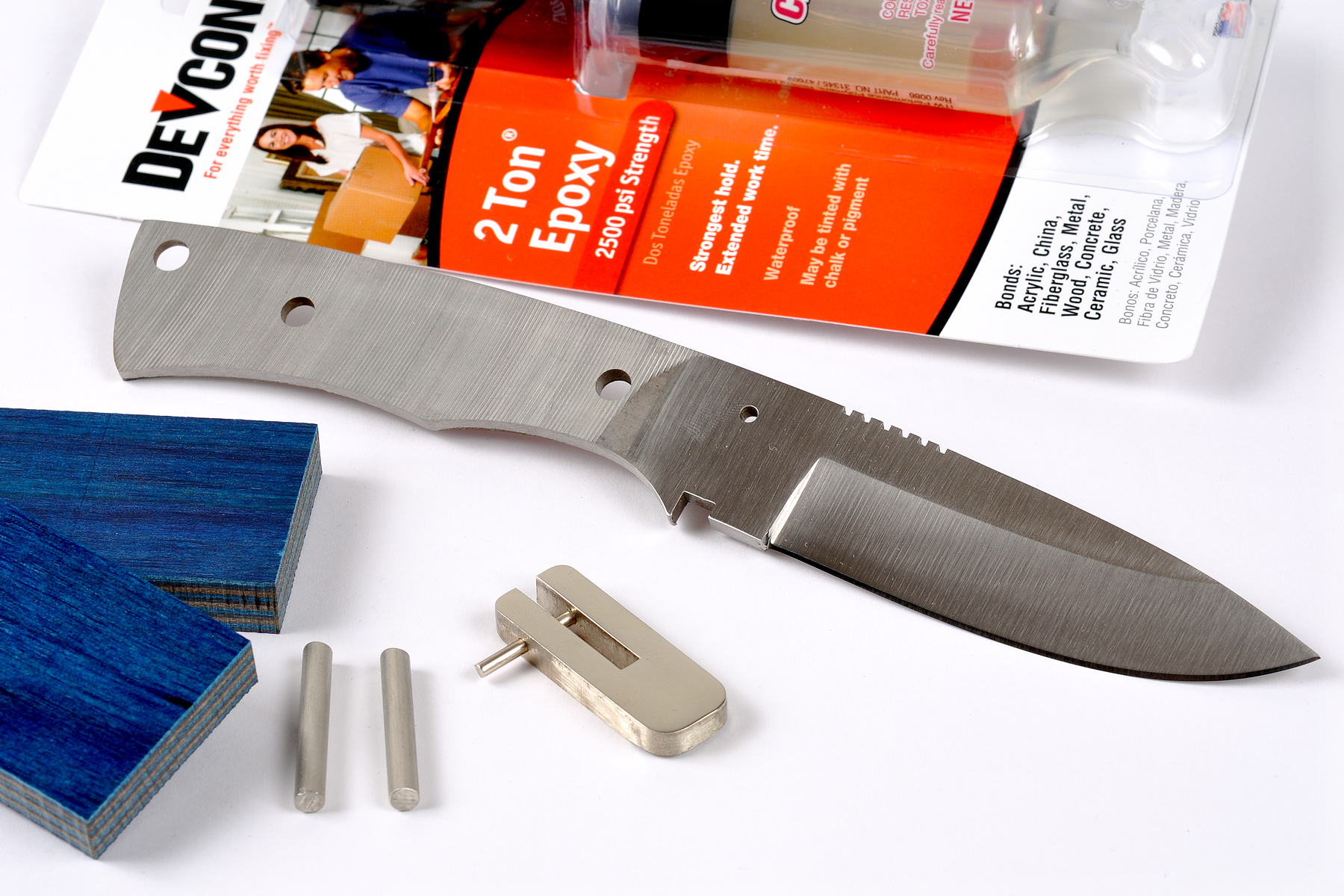
The top kits provide most of the components of the folder or sheath knife, including blade, handle materials, pins, springs, bolsters, even glue for the final phase of the construction project. Many knifemaking suppliers offer kits with skill levels ranging from basic to advanced, and shop tool requirements, affordable prices, and even instructions to guide you from start to finish. Blade steels vary from carbon to stainless and damascus options, while handle materials run the gamut from G-10 and other synthetics to various woods, stag or horn.
“We do our own cryogenic blade treating, and that’s an advantage for our kits,” related Lance Reid, manager of Texas Knifemakers Supply. “We have a lot of kits available, and they’re very popular right now because they allow you to express your own artistic ability and influences. LinerLock™, lockback, slip joint and trapper kits are all selling well, and the tools needed for them are generally a belt sander, drill press, buffer and ball-pein hammer.”
The Judge’s Favorite hunter kit (pictured above) is one of the hottest at Texas Knifemakers Supply (TKS). Retailing for $36.45, the kit includes a 4-inch blade of cryogenically treated 6A stainless steel, a Dymondwood™ handle in a choice of more than 30 colors, and 30-minute epoxy to set the knife for use. The Sam Houston Skinner kit has an MSRP of $30.45 and comes complete with a 3 5/8-inch blade of 6A stainless with a slightly dropped point, Dymondwood handle, brass pins, and epoxy.
TKS offers beginner, medium and advanced kits. Beginner kits include premade guards and bolsters, and requirements are simple assembly, grinding and shaping. Medium-skill kits involve the shaping of the guard and bolster, while advanced assembly requires the maker to fabricate the guard and bolster.
BEGINNER TO ADVANCED
Jantz Supply’s latest knife-kit entry is a new line of handles for its U.S.-made pattern blades. The preshaped and contoured handles crafted from G-10, Micarta® and Dymondwood include a variety of textures, and enable enthusiasts at all levels to choose their favorite handle material, color and texture, along with the guards and screws. “Our pattern blades are manufactured from tool steels, including D-2, and stainless steels such as CPM-S30V, 154CM and 440C,” Ken Jantz noted.
By offering fixed-blade kits, Jantz affords beginners an opportunity to learn the basics of knifemaking without the hassle of moving parts and the requirements of close-tolerance fittings. Kit components require only basic tools such as rasps, files and hammers, and the final knife can be completed with hand sanding and finishing.
“Beginners like the kit concept because it provides them with a strong foundation and process for creating a solid, high-quality knife they can be proud of when finished,” Jantz said. “Advanced [enthusiasts] like the ability to customize basic knife kits, showing off their personal creativity and ability to take something standard to an entirely different level. In the hands of someone who knows what they are doing, a kit knife can be truly special.”
Jantz provides beginners and advanced enthusiasts alike many customizable components, unusual materials and opportunities for personal inspiration in the creation and personalization of their fixed kit blades.
When asked about his company’s most recent improvements in folder kits, Jantz stated the availability of the thrust ball bearing in 440C stainless designed by custom maker Gustavo T. Cecchini of GTC Knives brings a new level of quality customization options to knife kits. The bearings are built to provide motion with minimal friction and a smoother action.
PERIOD ORIENTED
“Our knife kits are oriented toward the long hunter and pre-1840 style, and we have only fixed-blade kits,” advised Rex Reddick of Texas-based Crazy Crow Trading Post. “We sell a lot of knifemaking supplies and have been importing blades from Solingen, Germany, since about 1980.
“Our Rocky Mountain Drop Point in either carbon or stainless steel comes with black walnut handle scales and brass rods for rivets,” Rex continued. “It sells for $17.95 and $19.95, depending on the blade steel.”
Other kits of choice from Crazy Crow include the Green River series, which features seven different combinations ranging in manufacturer’s suggested retail prices (MSRPs) of $14.95 to $20. The bowie kit retails for $56 and includes a 6-inch carbon steel Solingen blade and curly maple handle material. Patch knife kits for muzzleloader enthusiasts retail for $14.95.
“We are putting bone scales in some of the kits now,” Reddick said, “and the kits are new this year and also available with curly maple or walnut. The kits are pretty simple. Basically, you drill the scales and glue them with epoxy and hammer the rivets in, drilling the countersink. You need basic tools to put them together, something like a coping saw to saw out the blade blanks. The handle scales come in rectangular form, so a rasp might be needed to file them down if you want to put some taper on the edges.”
DRIVING KIT SALES
At Knifekits.com, the designs of Darrel Ralph are driving kit sales, and the company’s hottest folder going is the SS 2.0 Super Squirt (MSRP: $39.95). “This manual button-lock folder can be built as a standard manual release or converted to automatic by simple modification,” explained Steven Andrews, Knifekits.com general manager. “These are very popular for kit builders who like small folders or who reside in automatic-legal areas, especially those who are engaged in jobs that permit or require automatic carry.”
The AUS8 Super Squirt blade is 2 inches long and available in a black or satin finish. Handle scales are black G-10 or carbon fiber but are not included in the kit. They are premilled and require a simple finish option with basic handwork. The hottest fixed-blade kit from Knifekits.com is the Clip Point Skinner (MSRP: $17.95) available with a stainless or brass guard. The hollow-ground, satin-finished blade is AUS8 stainless. Handle material is not included.
“Both knives are skill level 1-to-2 for basic construction,” Andrews added. “We would not hesitate to recommend these kits to entry-level builders as well as advanced builders. The fit, finish and precision on these models are unsurpassed in their genre. For the basic build on the SS 2.0 folder kit, the No. 6 and No. 8 Torx wrench tools and medium or fine sandpaper are the only tools required. For a basic build on the fixed blade, a peining hammer, a drill bit for creating the handle recess, and sanding materials are sufficient. Epoxy is also recommended for secure, gap-free handle mounting.”—by Mike Haskew
Editor’s note: In the case of Knifekits.com’s Super Squirt, which can be converted to an automatic by simple modification, be sure to check the laws in your area concerning automatic knives.
For more on the latest knives, knife legislation, knifemaking instruction, knife trends, knifemakers, what knives to buy and where and much more, subscribe to BLADE® Magazine, the World’s No. 1 Knife Publication. Click on http://www.shopblade.com/blade-magazine-one-year-subscription-us/?r+ssfb070412 for more information.



 BLADE Recommends