Knifemaking is the building of a knife, which includes the blade, handle and other accouterments. Blades are made by either removing metal from a steel blank via a grinder – known as stock removal – and the forging to shape of hot steel into a blade in the process known as bladesmithing. Other parts, including bolsters, guards, pommels, etc., are needed to complete the finished knife.
Jesse Harber and Coy Baker forecast the hottest damascus steel for ’26.
There’s something about predicting the future that has intrigued humanity for ages. If you could just somehow know which stocks would turn a profit, which crypto would “go to the moon,” or which numbers were coming in the PowerBall, you like to imagine that you could really take advantage. Thus far the ability to accurately predict the future has been a challenge, which begs the question—what damascus steels and patterns will be hot for 2026?
Jesse Harber of Vegas Forge doesn’t hesitate to jump right in.
“Our Reptilian pattern stayed hot in 2025,” he observes, “and it should continue to do well.” Vegas most often uses a combination of AEB-L, 440C and 302 stainless steels for contrast in its stainless billets. It prefers the combination of O1 tool, 1075 carbon and nickel-alloy steels for its carbon varieties.
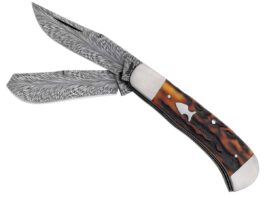
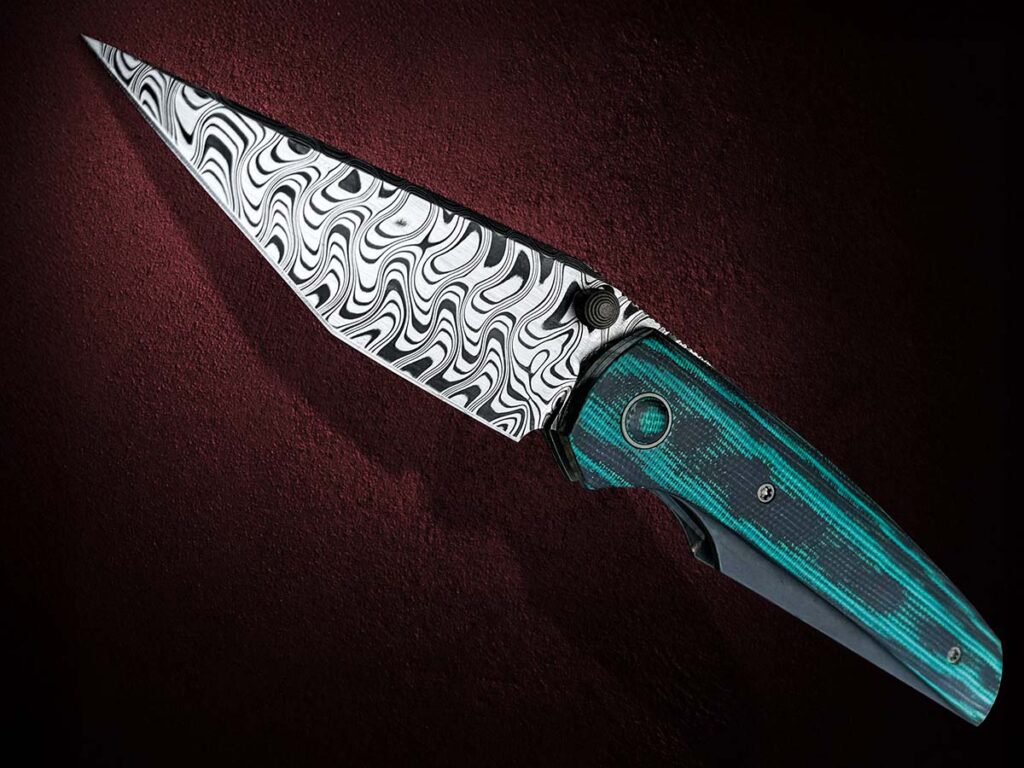
Jake McCoy used Baker’s Zeus stainless damascus for the blade of his folder.
Twenty-twenty-five was a fun year for Vegas Forge. It was able to continue making the steel it loves, the steel most knife enthusiasts all love to use—and it still managed to find time to innovate.
Makers have been using EDM cutouts in canisters to make unique figures and shapes for some time now. Over the past few years, a few have experimented with 3D-printed shapes inside canisters for truly limitless possibilities. Vegas has taken a different approach of using smaller cutouts within canisters that are then layered into “regular” damascus. There are obviously other critical details of the process not mentioned here, but the end result is small shapes or logos within the layers of the steel, not just as a shape like the other canister types you usually see.
Hammering Away At Baker Forge & Tool
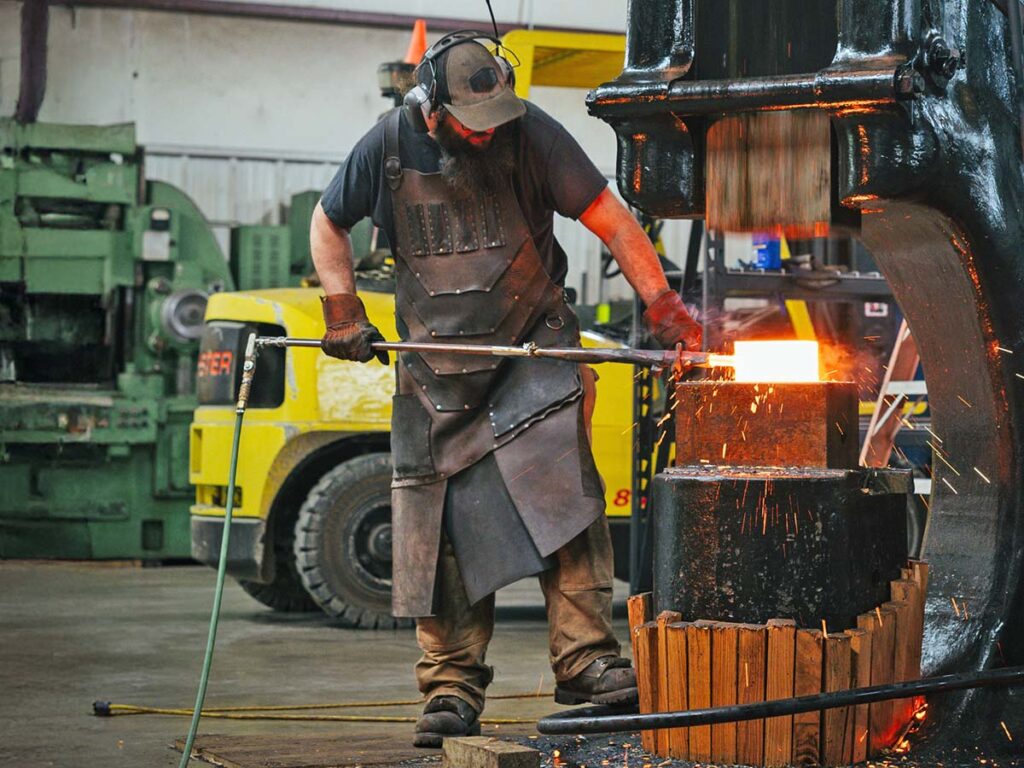
Coy Baker said Baker Forge & Tool is “really moving and shaking” for 2026, partly because of a new Chambersburg steam hammer converted to air. With a die surface of 6-by-14 inches and a 750-pound ram, the whole shop shakes when the hammer pounds on a giant billet. The hammer originally was used to make jib cranes for the Charlotte Railroad and runs on a 50-horsepower compressor with multiple 750-gallon air tanks. Coy stated he hasn’t pushed the hammer to its max, but said he thinks it can handle billets up to 35 pounds.
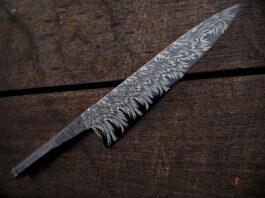
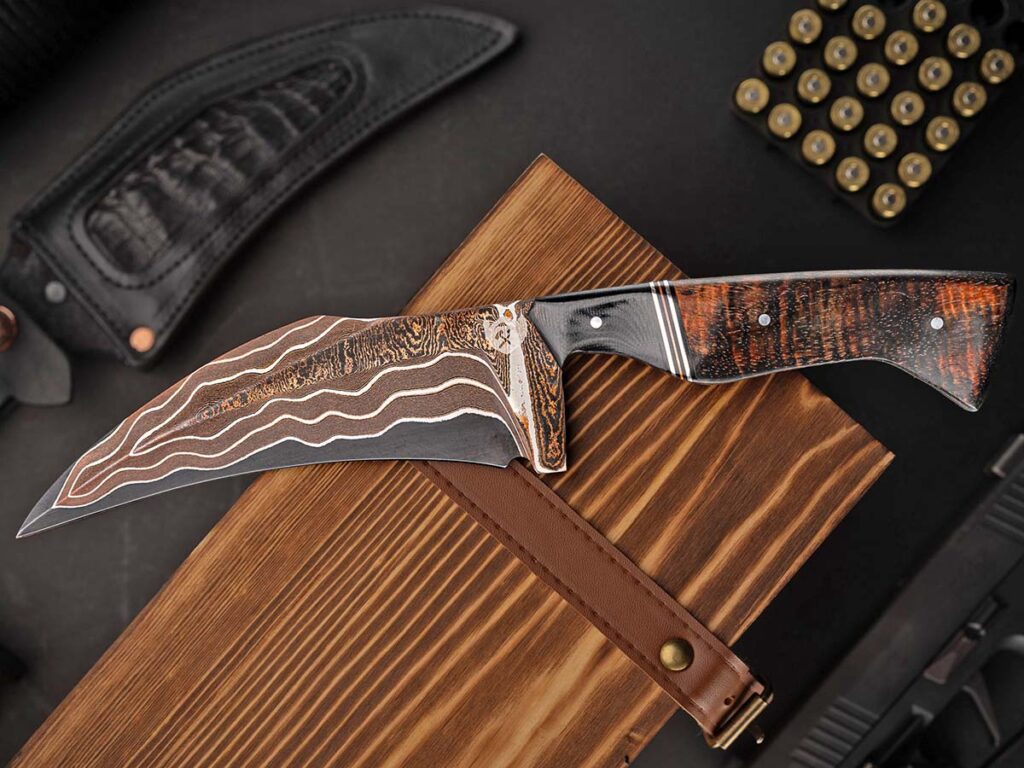
Baker’s Tsunami copper-mai steel is the material for the blade of a piece by Hans Molenkamp of Crimson Knife Co. (crimsonknives.com).
Why in the world would Baker Forge need such a giant hammer? Because the company, too, has been innovating and expanding into the production of stainless damascus. After two years of research and development and fine-tuning Baker’s processes for production, the prodigious pounder is finally up to speed. Baker prefers a combination of AEB-L and 154CM for its stainless damascus.
“The steel is really hard even when it’s hot,” Coy said. “Even with our 350-pound hammer it was like pounding on a rock.” The giant Chambersburg, on the other hand, moves a giant stainless billet with ease.
For those of you who don’t know, forging stainless damascus is quite a challenge, beyond the capability of many backyard smiths. Stainless steels contain high chromium, sometimes 12-to-15 percent, and chromium oxide doesn’t forge weld. Any oxygen at all in the forging environment and the welds simply will not stick. There are multiple ways to get around that, including inert gas purges and welding inside canisters. Add that to the fact that the stainless doesn’t like to move under the hammer and has only about a 100-degree-temperature window when you can safely work it, and you get a very difficult process.
Baker Forge & Tool’s Will Spears forges a billet of stainless damascus on the Chambersburg high-frame power hammer at Baker. Built in 1946, the power hammer has a 750-pound ram and weighs just shy of 11 tons. “It took us 14 months to install,” Coy Baker laughed. “The foundation for it is over 12 feet deep.”
Baker isn’t just producing stainless damascus in run-of-the-mill patterns, it is innovating. It has developed patterns it will use in its stainless steel exclusively, particularly one called Zeus.
Copper damascus has long been Baker’s hottest commodity, and it’s still producing it at high volume and quantity. The company is pushing the limits there as well and has developed a method to weld and manipulate copper on the end grain. While the technique is under wraps, the results will be broadcast far and wide: copper damascus in formerly unobtainable mosaic patterns. When clad over a monosteel or carbon damascus core, the patterns stretch the imagination of what’s possible.
Steel Industry Challenges
Both Baker and Harber mentioned challenges and areas for growth in the steel industry. Baker was the first to put BLADE® on the story about Buderus apparently closing its primary mill for 10xx series steels. Coupled with the recent closing of Crucible on the stainless side (see our article on Crucible Industries closing), both Baker and Harber have been exploring new steel options in case their mainstays become unavailable. Vegas in particular is moving toward more cores of Nitro-V and Elmax and moving away from MagnaCut and XHP.
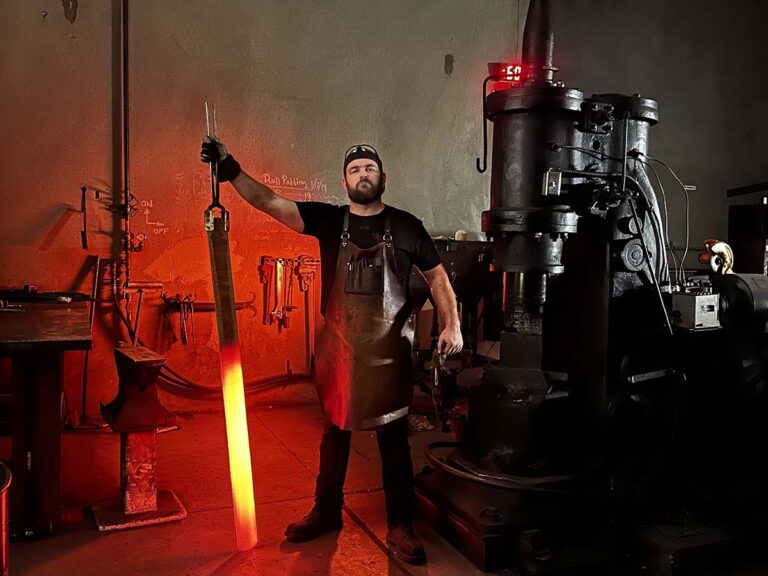
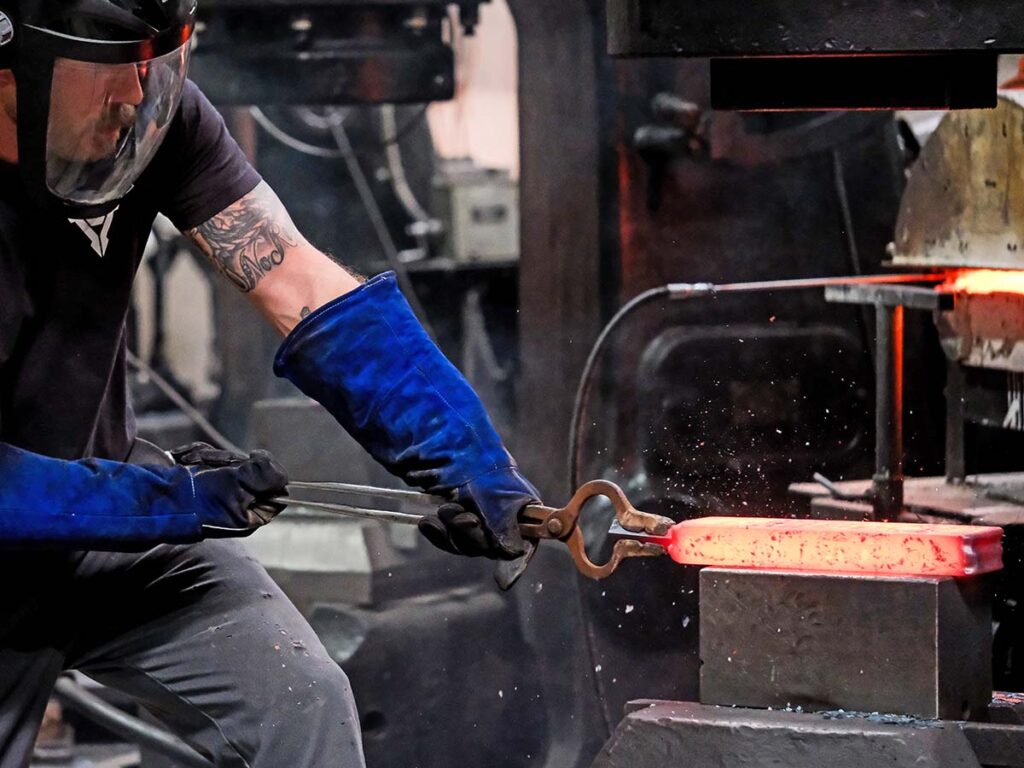
Vegas Forge team member Franklin draws out a 40-pound canister of stainless Raindrop-pattern damascus on the company’s 5B Nazel hammer.
The hot new kid on the block is ProCut, the brainchild of a partnership between Larrin Thomas and Pop’s Knife Supply. Both Vegas and Baker are looking forward to pushing the limits of ProCut. As a high-alloy steel, when combined with Apex Ultra, the maker achieves high performance out of what looks like “ordinary” 1084/15N20 damascus. If you think of the difference in performance between 1084 and 52100 carbon steels, you’re on the right track. Baker Forge is currently in the lead on the ProCut “arms race” but Vegas Forge has steel in hand and is ready to go.
What fun new things can we expect in the world of damascus in 2026? Vegas Forge is entertaining a few recent orders that sound interesting. There’s a maker in Alaska using Vegas material to make high-end custom ice skates, and another customer using the company’s material to make stainless damascus computer keyboards. Who’d a thunk it? For those who enjoy a good picture show, Vegas has another top-secret project in the works. Think aliens with amazing damascus weapons and tools and you’re on the right track.
Take two leaders in the field like Baker and Vegas, factor in the demand for their top steels and add lots of innovation, and you get the makings of a really great year to come in the world of damascus.
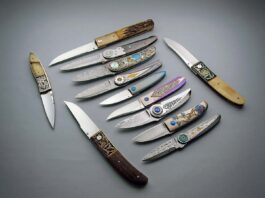
The best in blade and handle materials decorated some of the most creative folder designs anywhere at the recent New York Custom Knife Show. Enjoy seven of them in all their glory on this and the facing page.
Alan Hollerbach Flipper Folder
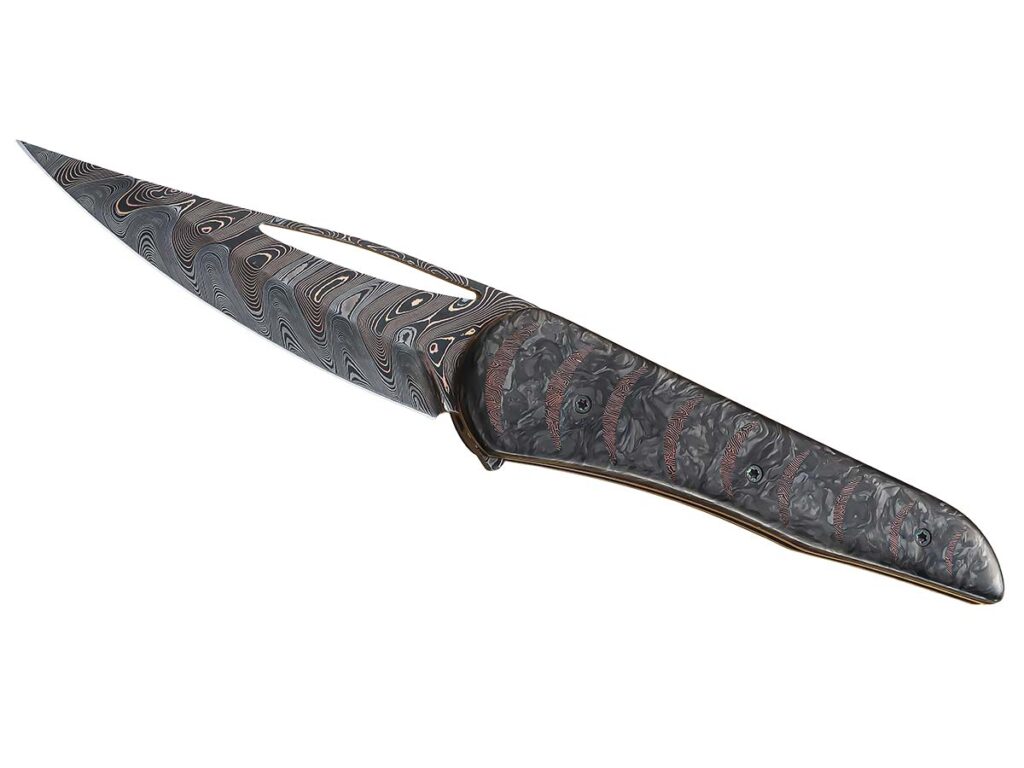
Alan Hollerbach’s flipper folder has a 4-inch hollow-ground blade of damascus forged by Baker Forge & Tool, and scales of Fatcarbon carbon fiber and carbon fiber inlays. All hardware is titanium. Closed length: 4.5 inches.
Eyal Landesman Mini Tritan Flipper
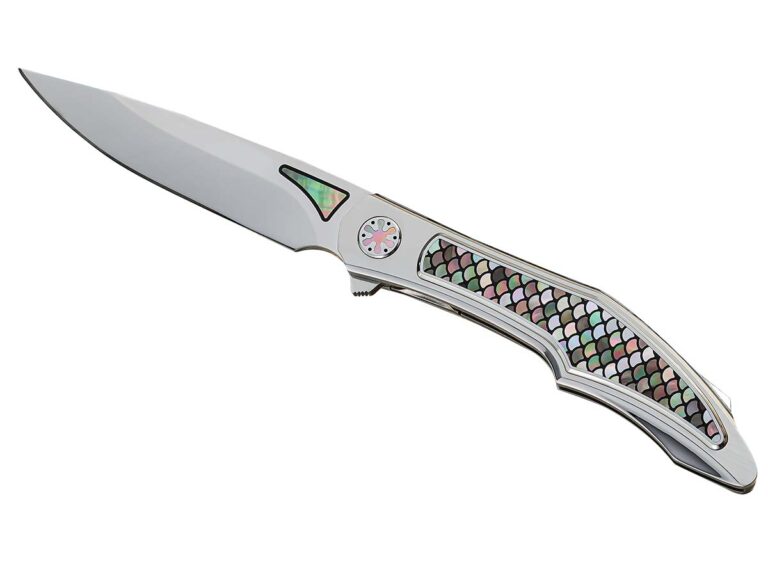
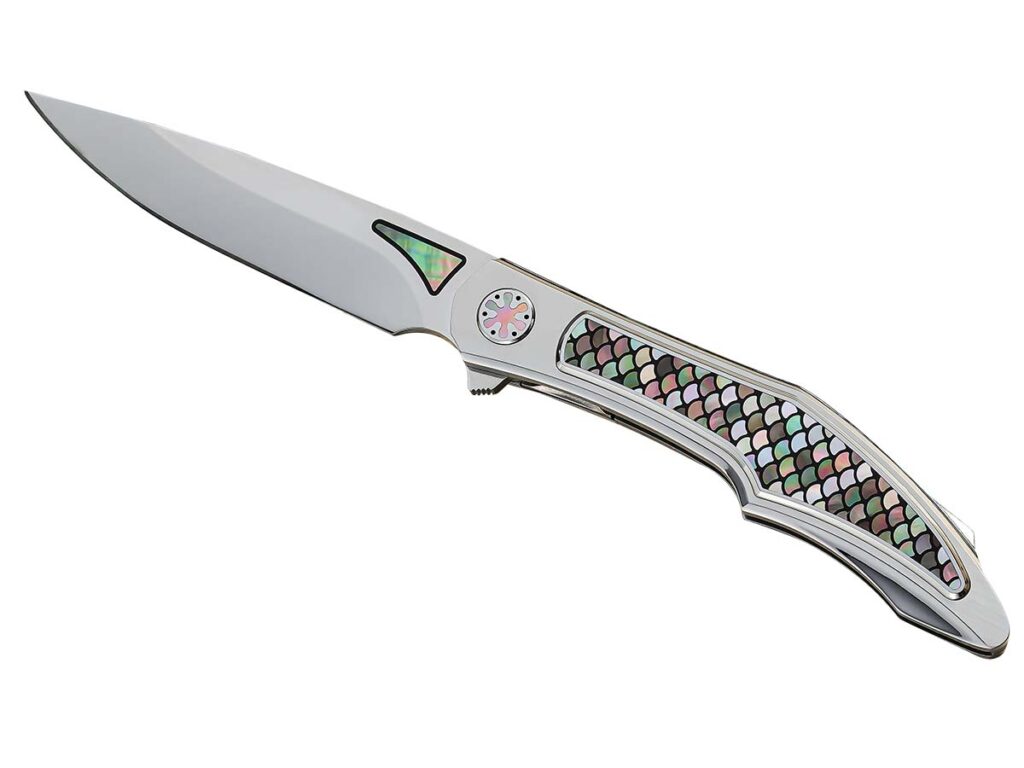
The Mini Tritan flipper folder by Eyal Landesman sports a 3.5-inch blade of mirror-polished RWL34 stainless steel. The mosaic “fish scale” inlay includes assorted “scales” of black-lip and white mother-of-pearl. Closed length: 4 inches.
Corrado Moro Vantage Framelock Flipper Folder
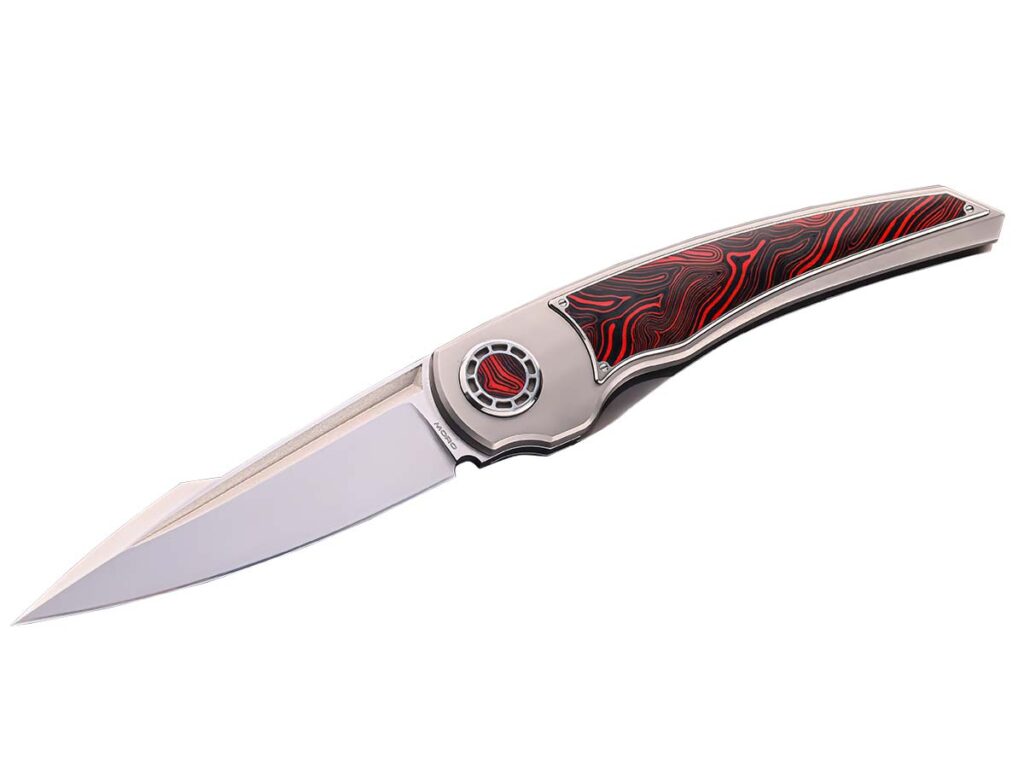
The Vantage framelock flipper folder by Corrado Moro features a 3.38-inch harpoon-pattern blade of RWL34 stainless steel with a tapered fuller in the flat. The frame and pocket clip are Grade 5 titanium and the handle and pivot inlays are a G-10 composite. Closed length: 4.62 inches.
Chris Richardson Lockback Folder
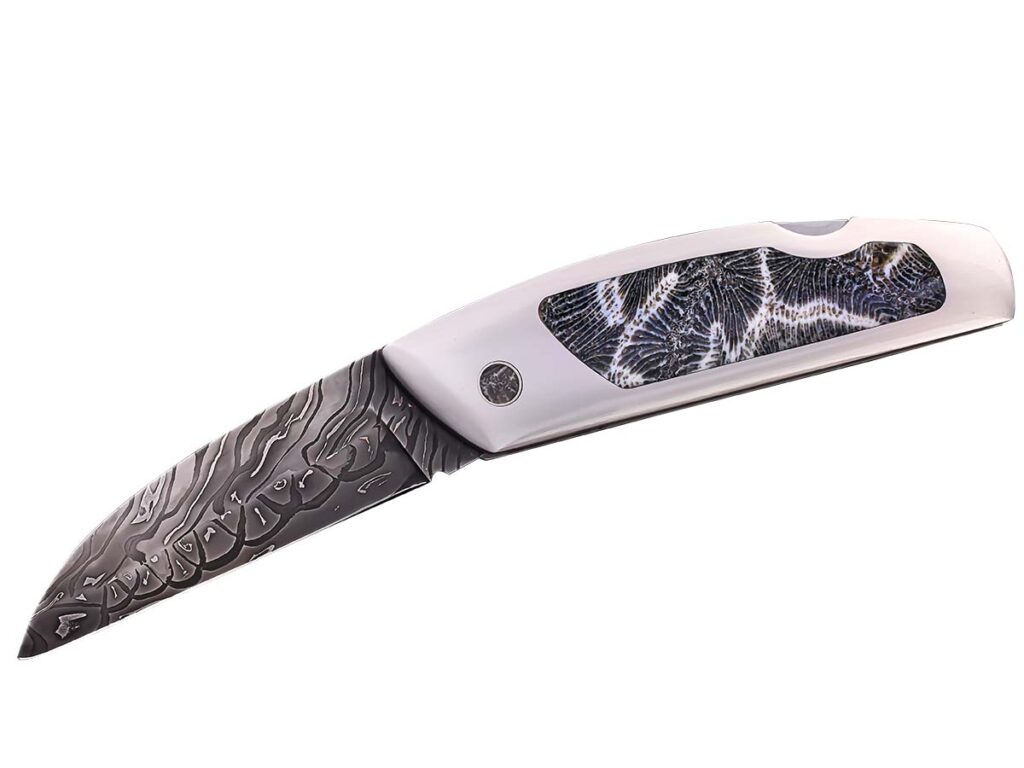
Panel and pivot inlays of fossilized coral and a 3.5-inch flat-ground blade of mosaic twist damascus top off Chris Richardson’s lockback folder. Frame: 416 stainless steel. Closed length: 4.5 inches.
Jeremy Krammes Helix Flipper Folder
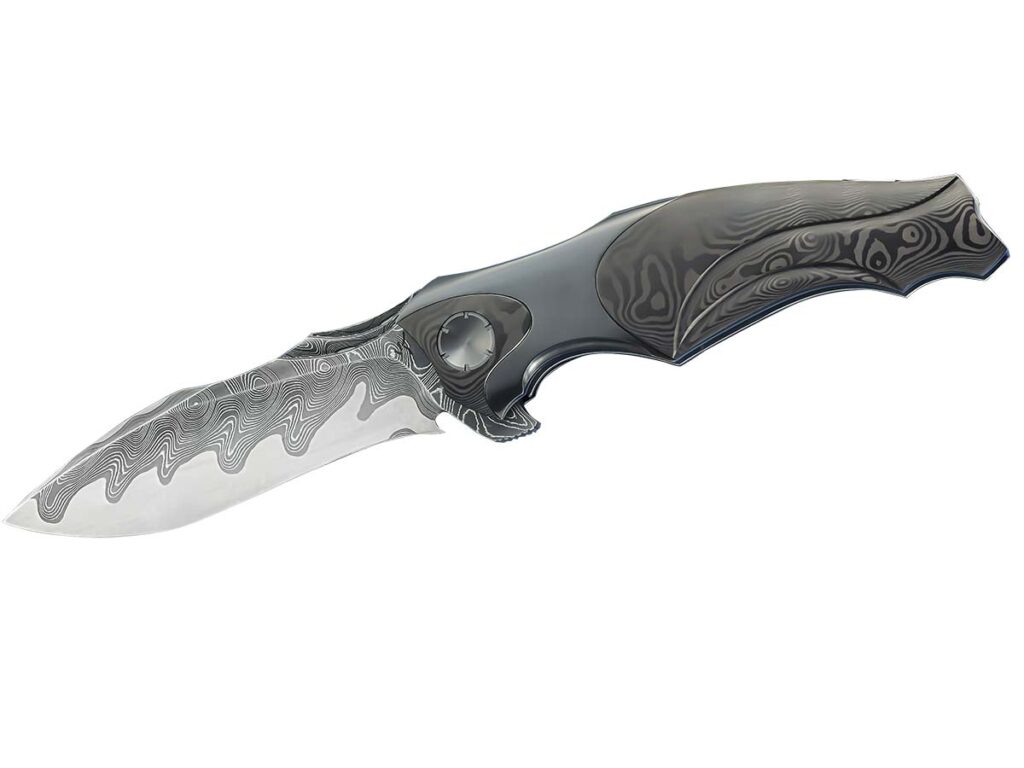
Jeremy Krammes helps celebrates his 20th year of knifemaking with his Helix flipper folder in Chad Nichols damascus blade steel, a titanium frame, carbon fiber scales and a zirconium bolster and pocket clip. The 3.5-inch recurve blade is hollow ground.
Edison Barajas Waka Folder
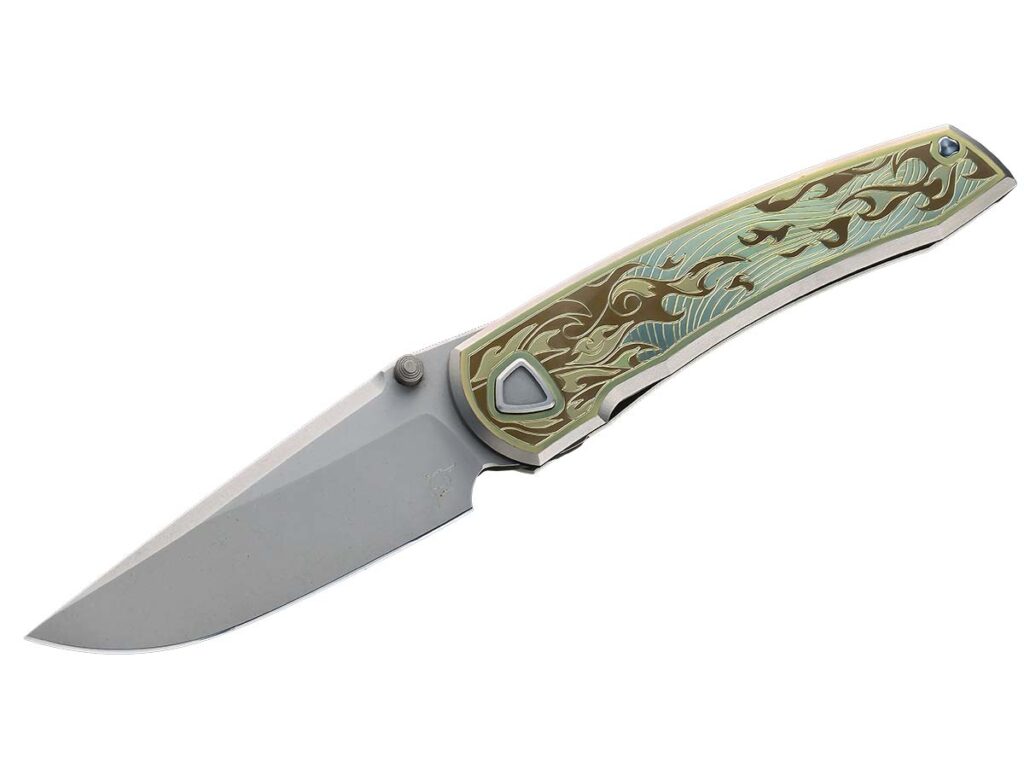
Edison Barajas combines new school with old on his Waka folder, using titanium for the scales engraved by Wilfred Valtakis II and a thumb stud to open the 3.25-inch blade of premium stainless steel. Closed length: 4.5 inches.
Stefano Compostella Stria XL
Stria XL by Italy’s Stefano Compostella sports a 5-inch wharncliffe blade of premium stainless steel. The linerlock flipper folder features Damasteel handle overlay and titanium liners.
In this look at dagger design, we move beyond history and symbolism to the structural realities of geometry and construction. From the curve of the edge to the presence—or deliberate absence—of a fuller, each feature serves the dagger’s singular purpose: to deliver a clean, decisive thrust and to endure long enough to do so again.
Dagger Profile & Point Geometry
A single, shallow fuller lightens the blade without compromising stiffness—proof that subtle geometry changes transform handling. Kelly Vermeer-Vella and Bruce Bump do the honors here.
A dagger’s profile is its outline when viewed from the flat side; its point geometry is the shape of its cross-section near the tip. Mastery in dagger design comes when the two elements merge into a seamless conduit for force, guiding energy from the wielder’s hand into the target.
One guiding principle is to avoid parallel edges along the portion of the blade intended for penetration. On utility knives, parallel edges are excellent for long, slicing cuts, but in a dagger they can create excessive suction and drag during withdrawal. They also represent a missed opportunity to enlarge the wound. A blade with gently convex curves tends to create a wound tract that widens as it penetrates, then releases more easily on the way out. The effect is twofold: the strike inflicts substantial damage on entry, and the blade slips back out with minimal resistance. In a fight where fractions of a second matter, ease of withdrawal could determine whether the wielder stays alive.
The balance point rests just forward of the guard, lending a stab-ready steadiness that rewards control. The author made this balanced dagger.
Cross-sectional design reinforces how a dagger behaves in the hand. The Roman pugio often carried a pronounced central ridge that gave it a triangular cross-section, lending the blade excellent stiffness. Later European daggers frequently adopted a diamond-shaped section that struck a balance between rigidity and lighter mass. In practice, triangular sections feel solid and grounded, with the ridge channeling force straight to the point. Diamond sections distribute the force across four bevels, trimming weight just enough to make the blade a touch quicker, though sometimes at the cost of absolute stiffness.
Experimental archaeology adds nuance to this comparison. Triangular sections resist torsional stress more effectively, while diamond sections tend to slip more cleanly into soft targets. Renaissance arms rooms often contained both forms, chosen with intent: defense versus assassination, battlefield versus court intrigue.
Dagger Ergonomics & Balance
Careful placement of a ricasso notch ensures consistent hand alignment, turning technique into muscle memory. Note the refined handle and ricasso detail on Cutlery Hall-of-Famer Billy Mace Imel’s piece.
Even the finest blade geometry falters without a grip that enables control. Here, ergonomics and balance determine the dagger’s effectiveness.
Early medieval daggers often featured grips as short as 3-to-4 inches. This compact length forced the hand into a firm grasp close to the guard, a practical safety measure when blood, rain or sweat made surfaces treacherous. Fourteenth-century Germanic examples show how a modest flared guard and compact handle could prevent slippage while preserving agility.
Balance points were just as carefully managed. In many 16th-century Italian stilettos, the center of gravity sits just ahead of the guard, giving the weapon a stab-ready steadiness. The narrow, edgeless blade minimizes rotational drag. Highland dirks, by contrast, often used teardrop pommels to counterweight the blade, shifting balance closer to the hand and allowing forceful thrusts whether on horseback or on foot.
A weighted pommel counters blade weight, shifting balance back toward the hand and straightening the thrust on a Renaissance-influenced dagger by the author.
Makers sometimes introduced subtle refinements. A ricasso notch carved two or three centimeters from the guard ensured that the user’s thumb returned to the same anchor point every time. A shallow fuller reduced forward weight, so that an 8-inch stiletto might balance almost identically to a heavier 10-inch combat dagger. These small calibrations transformed the blade from a piece of steel into an extension of muscle and bone.
Dagger Strength Features
There are no gimmicks on Joe Syverson’s minimalist dagger with clean taper—just clear profile, rigid spine and reliable balance. The design reflects simplicity that serves performance.
The dagger’s tip, however slender, must withstand resistance from mail, bone or even poorly placed strikes. European smiths between the 14th and 17th centuries developed several overlapping solutions that remain relevant today. Fuller placement was one of the most important: a carefully cut longitudinal groove reduced weight while preserving stiffness, as seen in 16th-century Venetian stilettos where the fuller often ran from just below the guard almost to the point.
Ricasso thickness was another safeguard. A blade too thin at the base was liable to flex and buckle under pressure, and even worse, a weak ricasso translated into a fragile point once the final bevels were ground. By keeping this area stout, smiths not only gave the blade strength but also provided a tactile zone of unsharpened steel where the thumb or index finger could anchor securely.
Even with an ornate sculpted handle and dramatic damascus, the blade remains an unbroken taper from guard to tip on Henning Wilkinson’s art dagger. Note the lavish surface detail.
Hardening practices added a third layer of reliability. Most European daggers were quenched and tempered uniformly to a Rockwell hardness in the neighborhood of 48-to-52 HRC. A few Italian masters appear to have experimented with clay tempering to leave the ricasso slightly softer, but this might also have been accidental. In any case, the visible temper lines familiar in Japanese blades were rare. What mattered was consistency: a uniform temper that balanced edge retention with toughness made it so the dagger could survive repeated thrusts against armor and bone alike.
Avoid Feature Creep
Next-generation work in this forward-looking piece by Jean-Pierre Potvin proves the old lessons endure: blade geometry is still central even if the rest of the dagger is fantastical.
Through all the refinement, one lesson emerged repeatedly: every extra feature risked undermining the dagger’s true purpose. Serrations, pry tips and decorative piercings might look clever but each introduced problems. Serrations can snag on clothing and tear rather than pierce. Pry tips disrupt the straight thrusting line. Even ornate cut-outs, while attractive, create weak points that could split under stress.
Historical makers knew better. Even the most extravagant Renaissance daggers—with gilded hilts, inlaid gems or etched scrollwork—maintained an unbroken distal taper from guard to tip. Embellishment was typically reserved for the surfaces, not the structure. However adorned, the dagger kept faith with its defining role: the straight, unyielding line of the thrust.
Conclusion
Inventive cross-sections and flawless transitions demonstrate that modern makers can push design without breaking the rules. Elizabeth Loerchner captures the concept in the strong geometry of her experimental modern dagger.
From the Roman pugio to the Renaissance stiletto, the dagger’s identity rests not in ornament but in discipline: geometry over gimmicks, strength over flourish, function over feature creep. Clear profiles, rigid spines and balanced grips remain the hallmarks of a true dagger. These principles are as relevant to the modern craftsman as they were to the smiths of Venice, Florence or Solingen. A dagger’s promise, after all, is measured not by extravagance but by the sharp integrity of its point.
Form, function and purpose of daggers–the most stab-ready knives.
Few weapons are as simple in concept yet as demanding to design as the dagger. At first glance, it is merely a blade—sometimes short, sometimes long, usually but not always double edged—yet every aspect of its form has been refined over millennia for one purpose: stabbing. Unlike blades that balance cutting, slicing or chopping, a dagger’s geometry, materials and ergonomics allow no compromises in pursuit of its one purpose.
From early Bronze-Age thrusting knives to the stilettos of the Renaissance, every angle in any dimension maximizes straight-line penetration. Whether for combat or display, understanding this purpose is essential for anyone who wishes to design, craft or appreciate these edged weapons. Even the most ornate ceremonial dagger should appear “stab-ready” at a glance, communicating the implied threat of the utilitarian tool with a statement of status and opulence.
This modern cinquedea by Vince Evans has a blade with a broad, rigid base tapering to an unforgiving point. Fullers down the middle serve to make the blade both lighter and stiffer. Equal parts status symbol and lethal instrument, it embodies the dagger’s refusal to compromise between beauty and purpose.
Dagger Design Points
Every deadly stab starts with three critical design choices that define a dagger’s unwavering purpose. A dagger blade must have sufficient spine thickness and ricasso rigidity to resist excessive bending under thrust load; it should be tapered to an acute but robust point for minimal tip-entry resistance; and it requires flexibility balanced with rigidity so it can reach vital organs, often protected by armor, without breaking.
Early thrusting blades illustrate this principle as far back as the late Bronze Age. A broad base near the guard tapers rapidly to a narrow point, ensuring rigidity at the grip and sharpness at the tip. By the 1st century A.D., the Roman pugio perfected it. With a base often exceeding 5⁄16 inch in thickness and a central ridge tapering to a sharp apex, the pugio shed weight without losing stiffness. In practice, its point could pierce leather, flesh or weak links in chain mail, while its spine endured repeated jabs against shield bosses and bucklers.
Extreme ornament, unconventional design, and opulent materials cannot disguise lethal intent and pure stabbing functionality in Bertie Rietveld’s ornamental dagger.
Yet precision in stabbing demands more than brute strength, it requires avoiding gratuitous cutting‐oriented features in a thrusting design.
Serrations, upswept points, hooked tips, prying points and even bottle openers can be handy on a knife, depending on the task, but all of these undermine the straight-line force a dagger needs and disrupt smooth entry. If you ever find yourself in a situation where stabbing is required, by all means use whatever you’ve got—just don’t complain when your bottle-opener tip gets snagged in an assailant’s clothing. However, if you have the luxury of time and thought to design and make a dagger, strip away anything that doesn’t serve pure penetration. A dagger’s geometry remains laser-focused on stabbing effectiveness.
Lastly, a dagger must balance penetration depth with material limits. A tip too slender might break or bend against bone or metal, while a tip too blunt simply won’t enter. Ancient workers of bronze and iron didn’t have modern labs or spreadsheets, yet somehow found the Goldilocks Zone that balanced reach and resilience. A well-tempered tip is tough enough to survive bone contact without snapping, yet with correct geometry stays stiff enough to slip between armor plates. Only through precise taper and temper can a dagger achieve depth without sacrificing strength.
Even in this highly stylized dagger by Jordan Lamothe, the spine ridge provides the stiffness and rigidity required for uncompromising penetration.
Combat Daggers Vs Art Daggers
From the earliest times, daggers fell into two broad categories: weapons of combat and symbols of prestige.
The combat dagger was stripped to essentials—minimal ornamentation, maximum toughness—while the art or status dagger has always been free to bend the rules of pure function to satisfy aesthetic expression and make statements of personality and prestige. Nonetheless, even the most ornate display piece must exude “stab-readiness” at first glance, a silent promise inherited from its lethal lineage.
The complex damascus pattern and construction style of this dagger by Australia’s Jackson Rumble demonstrates that while he understands the essentials of a dagger, he’s not afraid to push the boundaries of expression without compromising either the stabbing function or his artistic vision.
Surviving examples of Roman pugios from army camps demonstrate the utilitarian design, but gilded pieces from the same era, with elaborate inlays and inscriptions, do not stray far from purpose despite the decoration. All share the same fundamental geometry: a stiff, thick base, reinforced spine and unwavering taper to a sharp, flat-ground point.
The ornamented variants—often gifted as symbols of rank or worn by the wealthy and powerful—could feature ivory grips or gilded fittings without diminishing their stabbing credibility. Regardless of personal status or the knife’s level of ornamentation, no one who saw a pugio drawn in malice would misunderstand the message or the danger. Combat heritage endows art daggers with an unmistakable threat that no amount of embellishment can conceal, though the pugios that did in Julius Caesar probably looked rather nice.
The complex damascus pattern and construction style of this dagger by Australia’s Jackson Rumble demonstrates that while he understands the essentials of a dagger, he’s not afraid to push the boundaries of expression without compromising either the stabbing function or his artistic vision.
Another example is the pesh-kabz, a Persian-born dagger later adopted and lavishly ornamented by Mughal weaponsmiths. Its single-edged blade featured a thick spine and acutely tapered point, designed to pierce heavy mail and laminated armor. As Mughal craftsmanship flourished in Agra and Delhi, artisans added damascened patterns, jeweled pommels and silk-wrapped grips. Yet even a fully jeweled pesh-kabz retained the same reinforced spine and narrow, forward-weighted geometry as its battlefield ancestors. Worn at court in gilded sheaths, these daggers exhibited status while making it clear that underneath the glamor was a blade as deadly as any used in war. Art and combat, then, remain entwined.
The junction of the handle, guard, and blade is where the true masters separate from the merely good—every element is a decision between comfort, control and ornament that fit together with no gaps. (Mike Quesenberry, Best of Show/Best Art Knife, 2011 OKCA Show)
This enduring marriage of lethality and ornamentation sets the stage for a deeper question: what separates an ordinary dagger from one that truly masters its intended purpose? The answer lies not just in history but in the details of profile, geometry, balance and structural refinement—each a mark of a dagger designed to do exactly what it must.
The Emerson Family shares decades and generations in knives.
Through the years, the name Emerson Knives has come to represent outstanding craftsmanship, quality and overall excellence in the knife industry. And each member of the Emerson family has contributed in his and her own way.
“They grew up in the shop, both Megan and Rachael while my shop was at home, and Lucas was born after we opened our production factory,” Ernest Emerson remembered. “So we fenced off a corner in Mary’s office for him as a baby and a toddler. They have all worked in the company since the beginning, and today Mary is the overall manager, Megan is director of marketing, Rachael is operations director, and Lucas is engineering and is being groomed to run the shop. Me, I’m the government mule.”
For some it would be enough to say with pride that the family has built the Emerson Knives brand together, each contributing in his or her own way. But the Emersons have taken their commitment to excellence and the already incredible story of their enterprise to a new level. Each one of them has completed an Emerson original, a knife of their own from concept to finish, and Ernest has had the pleasure of watching the extraordinary conclusion of this labor of love and pure knifemaking joy.
“I didn’t know any of them would ever want to make a knife,” he confessed, “and with their personal lives being so busy outside of work I didn’t know if they would ever have time to do something else. Megan is busy raising a family and runs a working ranch in Colorado. Rachael is busy with Jiu Jitsu and finishing up her second degree in nutritional therapy. Lucas is hardcore into training and computer programming, and Mary runs our business, which by itself is a 24/7 job, and still manages to cook dinner, keep our house in order, and even fits in a round of golf when she can.”
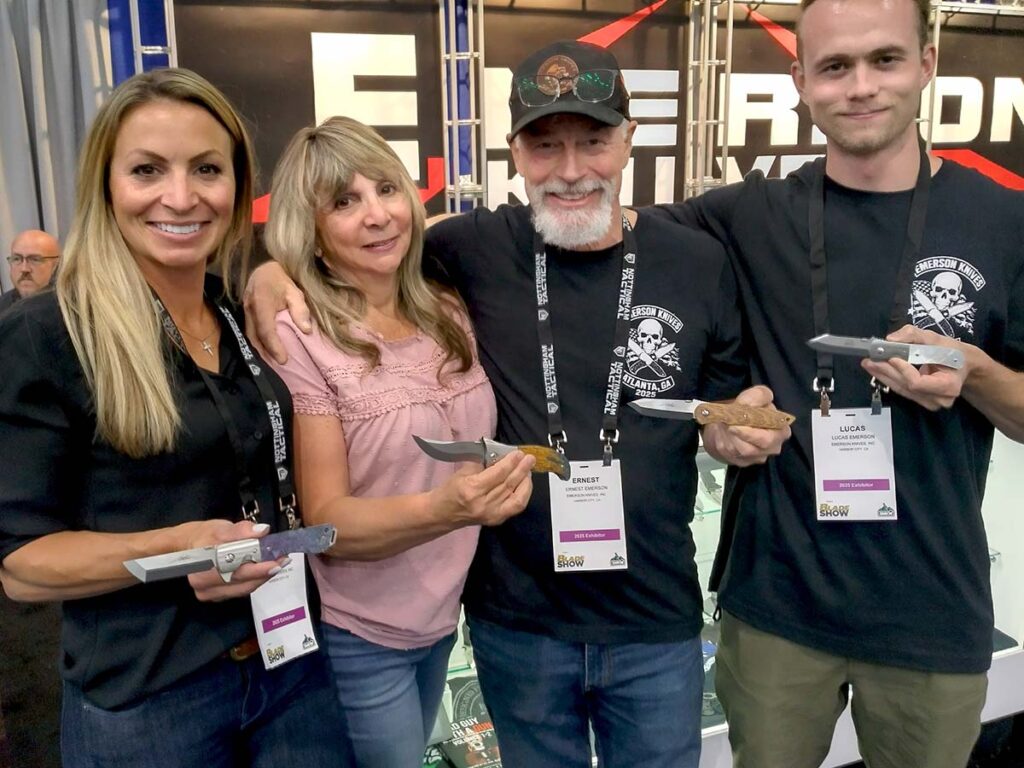
(From left) Megan, Mary, Ernest and Lucas hold their knives at BLADE Show 2025. Megan, Mary, Lucas and Rachael all had their knives debut at the show. Rachael was unable to attend due to a special family event. (BLADE® image)
Still, with everything else that demands their most precious commodity—time—the Emersons have expressed themselves in the actual completion of the tool that has been the centerpiece of their lives as long as they can remember. It almost feels like destiny, like it had to happen. And despite the headwinds, it has.
Earliest Memories
Twenty-four now, Lucas started making knives officially in January 2023, though he has watched and learned since his earliest memories.
“I have always had a passion for making things, and with my dad as a mentor knifemaking has become second nature to me. For me, making knives was never a question of ‘why?’ but of ‘why not?’”
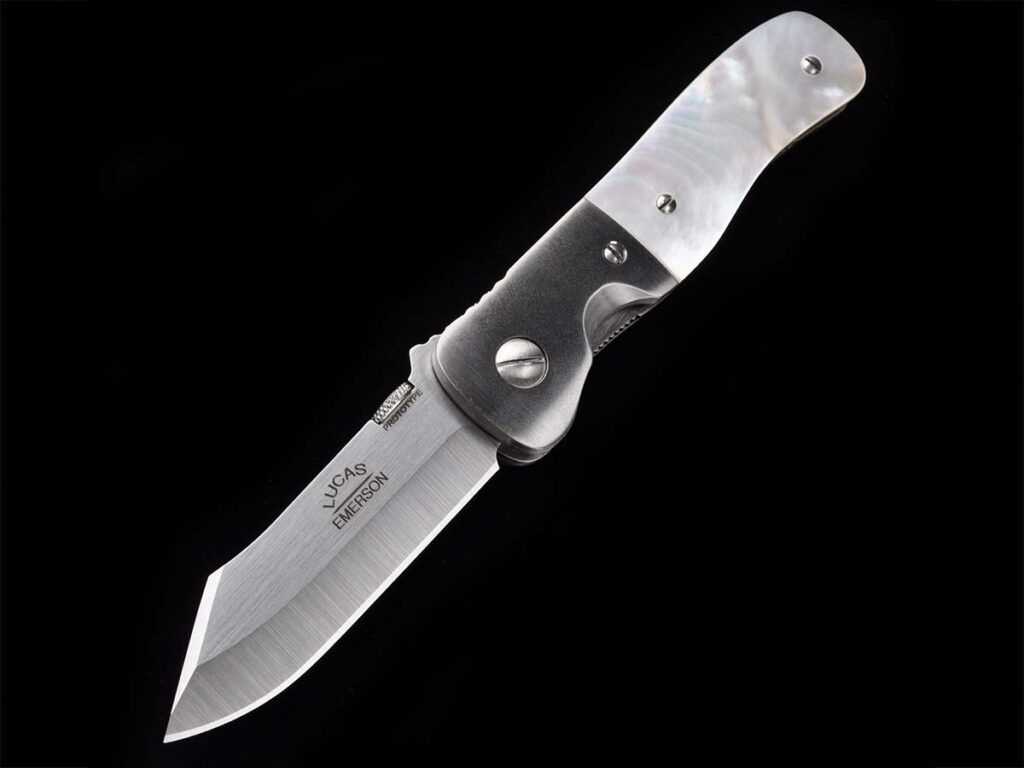
At BLADE Show 2025, Lucas chose to debut his newly designed MX-400 model. He wanted to produce a compact knife ideal for everyday carry.
“The MX-400 I had on display at the BLADE Show with pearl-handle scales will go into my personal collection,” he said. “I did bring three other MX-400s to the show, which I sold via lottery.”
Lucas makes knives part time and devotes plenty of energy first to the production company, Emerson Knives, Inc. At some point in the future, he may turn to knifemaking full time, but for now he manages the best of both endeavors. The most difficult part of the knifemaking process, he says, is grinding the blades.
Lucas Emerson debuted his MX-400, “a compact knife that is ideal for everyday carry,” at BLADE Show 2025. He put the one in mother-of-pearl scales he displayed at the show in his personal collection.
“This is the quickest way to make mistakes,” he advised, “and it tends to be quite time consuming. Luckily, I’m pretty consistent and at this point I’ve got nothing to do but improve. On the other hand, the easiest part of my knifemaking is the hand finishing. This is where I take my time making sure everything is clean, even and symmetrical. I would consider it foundational for the knives I intend to create.”
For his next knife, Lucas intends to design a fixed blade for his own everyday carry. “I want something that I can carry with me at all times,” he noted, “and which I can rely on for any situation that may arise. It will need to be versatile, easy to maintain and easy to conceal on my person.”
Stay tuned!
Iron Lotus
Rachael Emerson Hardin has been making knives for about 20 years now, much of her experience being directly engaged in the business.
“I started assembling knives when I was in high school,” she remembered. “I would leave school after lunch my junior and senior year, drive to work, and assemble until they turned the lights off. I’m still here making knives years later, so I guess you could say I enjoy it.”
For years, the idea of designing and finishing her own knife had been in the back of Rachael’s mind.
“I always had favorite designs of my dad’s and thought how cool it would be to make something like that but with my own flair,” she reflected. “It wasn’t until recently when Lucas began coming up with his own designs that it dawned on me—maybe I can try this too! I’ve been around this my whole life. I know what works and what doesn’t. It couldn’t hurt to try.”
Rachael took the knifemaking plunge with her own design that she calls Iron Lotus, and she is enthusiastic about more knives to come. To date, there are two prototypes. It is her first design, and the plan is for her to keep one and possibly sell the other.
So Rachael took the plunge with her own design that she calls Iron Lotus, and she is enthusiastic about more knives to come.
“It’s hard to say that this is my favorite yet,” she related. “My favorite knives aren’t because of the way they look on paper generally. It comes after the production process. Behind the scenes I experience all the hiccups and fallbacks firsthand. Some knives go together like peanut butter and jelly. Others need tweaking.”
As for her own creations, the 37-year-old Rachael is optimistic about the future.
“Heck yeah, I’m going to make more knives. I live, eat and breathe knives. It’s in my blood. Eventually, the Emerson kids will take over the business. Making knives is fun. There is something very freeing about it. And I have the best teacher in the world.”
To date, there are two prototypes of Rachael’s Iron Lotus. It is her first design, and the plan is to keep one of them and possibly sell the other.
“I’m not sure about carrying it because it is a little fancy,” she observed. “I have a few ideas that I’ve been brainstorming. Currently I’ve been diving deep into Japanese-style blades. I’m a big fan of the Japanese tanto. I love simple designs too, like the gentleman’s folder.”
Paying Tribute
With her completed knife, Megan Emerson Gomez, 41, fulfilled an ambition that had lingered for many years. She has also been captivated by Japanese-style blades and used that energy in her own creation.
“I have always been a big fan of the traditional tanto,” she commented, “so I thought I would design something with that look. My design is called the Shinobi or M-Shinobi [Ninja]. This was the first knife I have entirely designed, but I have been involved and making design suggestions for many years. The CQC-17 model blade design was my idea, and I am sure you can see the similarities in my latest design.”
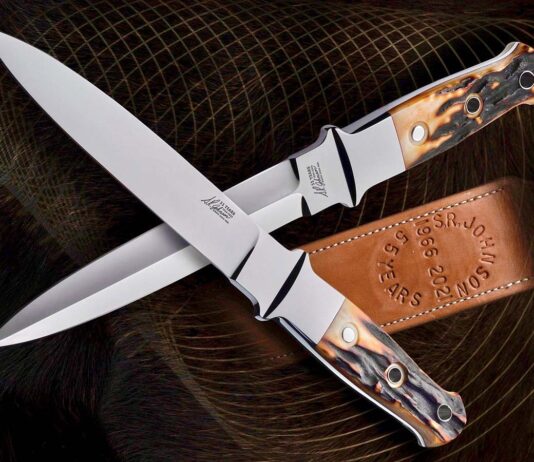
Megan parlayed her long-time admiration for tantos into the Shinobi/M-Shinobi. Though she has been involved in making design suggestions for many years, it is the first knife she designed entirely by herself. As she noted, “The CQC-17 model blade design was my idea, and I am sure you can see the similarities in [the Shinobi].”
Megan was positive about the outcome of her completed project from the moment it began, and she looks back at the experience with quiet confidence.
“I never once doubted that I could finish it, but there was a moment where I had to decide if I was willing to push forward with a design that really didn’t look like a typical ‘Emerson.’”
Staying the course, she produced an exceptional piece and recalls that the most challenging aspect of the experience was paying tribute to history.
“The most difficult part was respecting the traditional tanto shape while still making it feel like mine. The style carries serious weight. It’s steeped in warrior culture, precision and intention. I wanted to channel that strength into something functional, modern and personal. Getting the balance right between tradition, aggression and clean design took the most time and thought. The easiest part then was handing it over to my dad. Once the design was dialed in, I knew exactly who should bring it to life.”
Mom’s Time
Each of the Emerson children accomplished an ambitious task that required a step up in devotion to the art and craft, the imagination and precision, that come together in a completed knife. Then, of course, Mom tried her hand as well, and the effort produced a beauty.
“I just started making knives about a year ago,” Mary remarked. “I have been around knives and knifemaking for years and years, so I kind of had a head start on things. I wanted to make a knife for a long time but it was hard to find the time. I’ve had lots of ideas and designs just sitting on the backburner for quite a few years.”
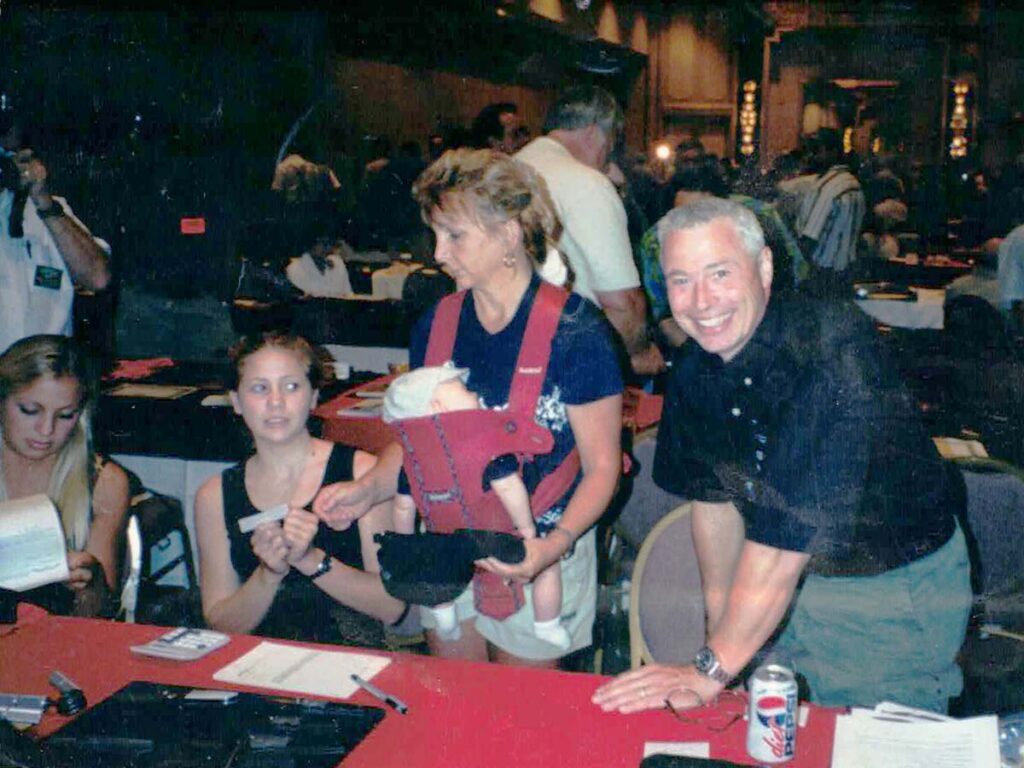
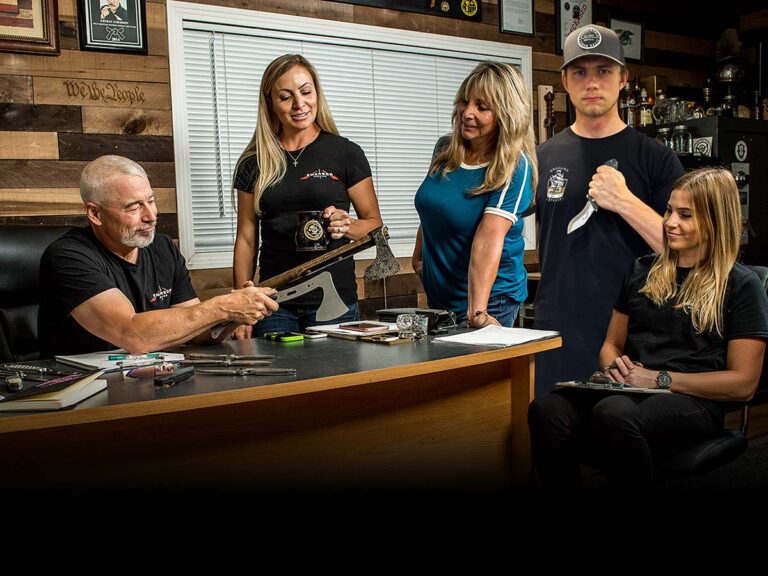
From left at right are Megan, Rachael, Mary with Lucas asleep in the baby carrier and Ernest. Among those in the front of the table at left are knife purveyors Bob and Linda Neal, Karen and Jay Sadow and BLADE Magazine Cutlery Hall-of-Fame® member Dan Delavan.
At long last, Mary’s time did come.
“I really have liked our CQC-15 and the Persian-esque blade styles, and I liked our Specwar handle,” she noted. “I like the curved and recurved blades, so my two designs, the Denali and the Falcon, reflect my likes in blade designs.
“Grinding the blade was the hardest part. It’s the dirtiest and most gritty part of the process. Getting one side ground the way I wanted it still left the other side to match up. The easiest part was the design. That was an easy day for me.”
During one grinding session, Mary toyed with the idea of halting the project—but only for a moment. “Ernie kept coming in and checking my grind lines. I told him to get out,” she smiled, “and I locked the grinding room door!”
Mary’s next knife adventure, though she will probably never be full time due to all her commitments to the business, is a fixed blade that is small enough to wear on her belt while riding her horse.
Next Mission
Along with Ernest, Mary looks at the body of work that surrounds the family, the business enterprise with so many facets and opportunities, the work of a lifetime, and the possibilities of the future. And yes, there is something else.
“Additionally,” she stated, “I’m very proud that my children are so interested in carrying on the family legacy. My next mission is to get the grandkids interested and involved. I’m very much looking forward to that.”
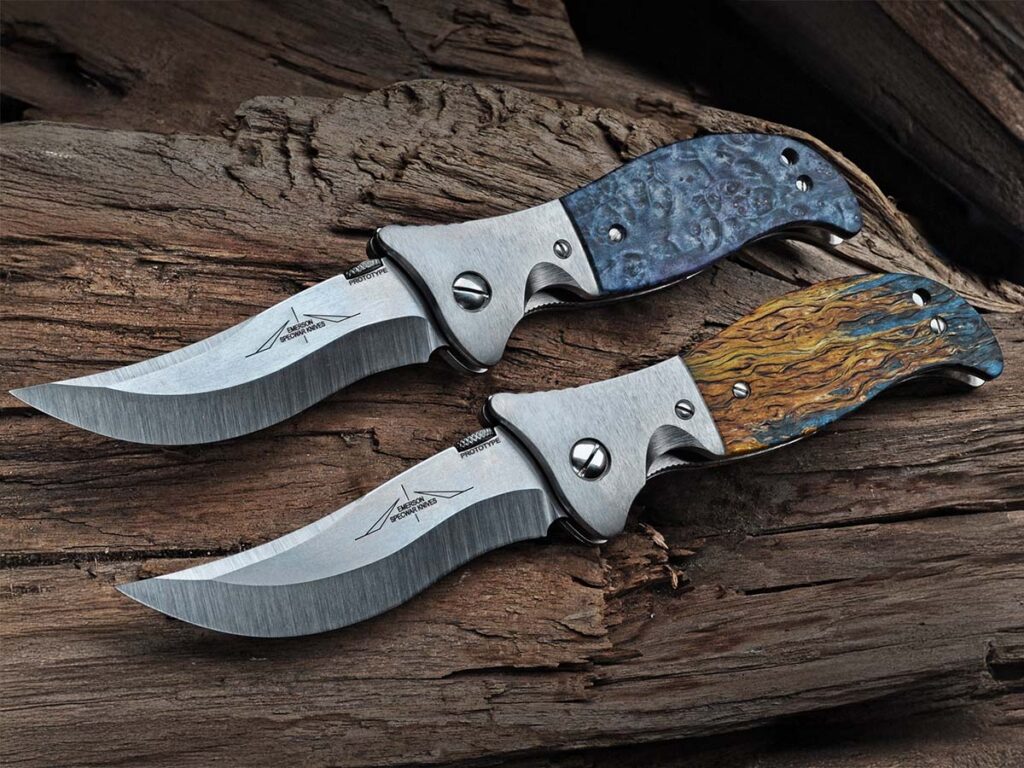
Mary’s partiality to curved and recurved blades is reflected in her two designs, the Denali and the Falcon, the latter here in two handle iterations. “Grinding the blade was the hardest part,” she noted. “Getting one side ground the way I wanted it still left the other side to match up.” During one grinding session, she considered halting the project—but only for a moment. “Ernie kept coming in and checking my grind lines. I told him to get out,” she smiled, “and I locked the grinding room door!”
Meanwhile, Ernie surveys the current scene with satisfaction and gratitude. He wanted to be surrounded by a family of knifemakers and that has actually come to pass. His quiet observation has made the situation even more satisfying.
“I never expected any of them to make knives, but deep down of course I wanted them to,” he reflected. “In any endeavor you undertake, if your heart is not in it you will never have the same enthusiasm and drive than when you are doing something you love and want to do. It is very satisfying because I never pushed any of them to pursue the craft. All of them chose to do it of their own accord, and that makes it even better.”
Just to put the experience in perspective, Megan, Rachael and Lucas validate their father’s approach. They confirm that he encouraged, advised and taught but never forced a single grind, pin or hand finish on them.
“I wanted to design a knife for as long as I can remember,” Megan said, “and I think my whole life he has been training me to make knives and run the business. I have been involved in the business since I was a little girl. I watched him grinding knives in our garage, and the ladies we hired assembled knives in our living room.”
Rachael offered, “My dad has always provided feedback to me over the years. His father and sister, my grandpa and aunt, were both teachers. So, it’s always been something he has done.”
Lucas was a hands-on learner.
“From a young age, I remember my dad allowing me to help him with his own custom knives,” he recalled. “This is where I spent most of my time learning, not only the craft but also the principles behind Emerson designs. I work on my own now, but if I ever have any questions my dad is there to provide the best answers he can. He is an excellent teacher in this regard and has always been my go-to person for advice.”
In a most rewarding way, the knife life of the Emerson family has come full circle. The generations have discovered and honored that common thread, one that binds them together like nothing else.
Some knife warranty claims stretch the limits, while others are just plain bizarre.
It’s an honorable option, a sensible aspect of a purchase contract, but can be the source of confusion, head scratching and plain ridiculousness.
The warranty is the buyer’s insurance policy. It’s the seller’s willingness to stake a reputation for quality on the performance of the product—in this case, a knife—or at least that’s what it’s meant to be. However, there are times when real life strains what is actually believable. So, when we explore the nature of the warranty with some of the finest knife companies in the world, a few of their warranty claims simply flirt with the edge of reason.
Wacky warranty claims, contentions from supposedly “dissatisfied” customers, are out there. Frankly, when some of these are brought to light, they are simply unbelievable. Give a nod to customer creativity, but then get real and consider what happens to a solid performing knife that is not simply put to good use, hard work and tough labor. Beating a knife with a hammer, soaking the handle and blade in corrosive liquid for an extended period, or shooting the defenseless edged tool with a gun are all beyond the pale. Follow such escapades with a dose of sheer audacity and what you get are warranty claims that would make a rational individual shake his or her head.
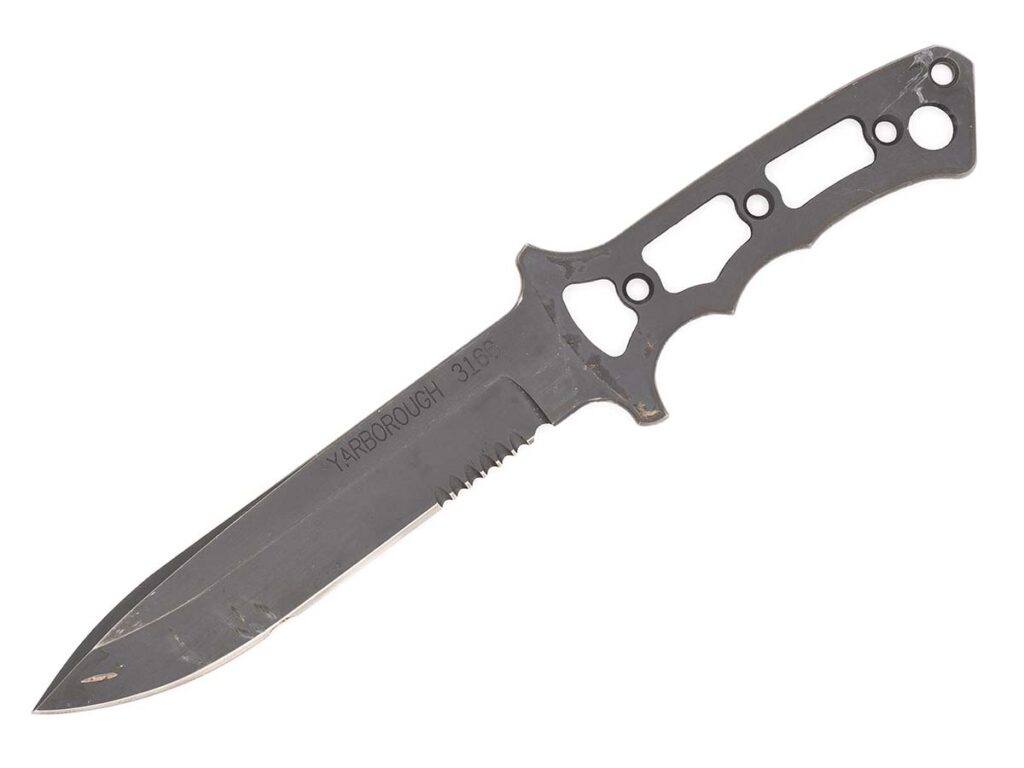
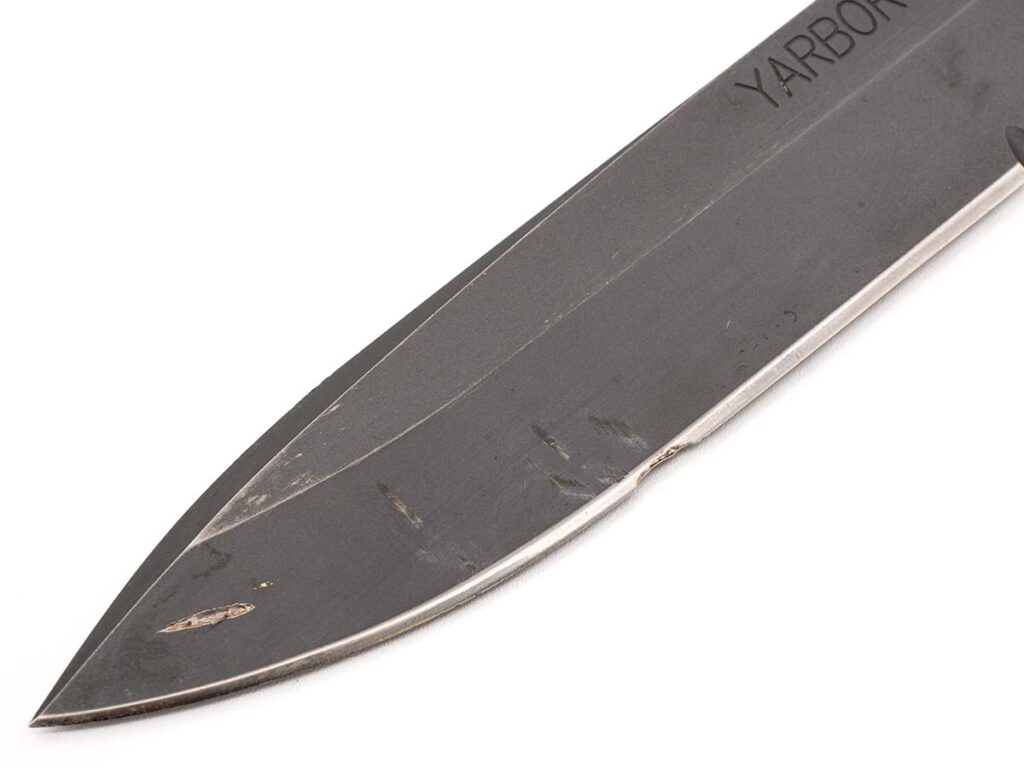
After an Army Special Forces soldier used his Chris Reeve Yarborough to cut a live electric cable during a mission, he sent in the damaged knife with $50 asking for repairs. The company sent the $50 back along with a new knife. Anne Reeve keeps the original knife, shown here, in her safe deposit box.
“A customer put a MagnaCut blade in a glass of saltwater for seven hours and claimed the rusting and pitting should be covered by our warranty!” recalled Anne Reeve of Chris Reeve Knives. “Another requested we replace the packaging of the parts he ordered because they smelled too strongly of perfume or lotion. A customer sent a knife in for a re-blade, and the original blade had an arrow and a smiley face welded onto it.”
Really? Try a few more from Chris Reeve Knives. A customer complained that the phosphor bronze washers of his Sebenza had stains on them and simply would not accept that it was normal patina. He also complained that the knife was not sharp and he had to sharpen it himself. He ground half the blade away and then said he should get a completely new knife. A customer shot his knife with a 9mm pistol and then sent the company a photo of the broken knife while requesting a new one under the standard warranty.
At Chris Reeve Knives, reputation is everything, and the company stands by its knives. But let’s sanity check. Warranties are not “get out of jail free cards” for new knives.
“We try to keep consistency in our warranty, but we do sometimes vary on case-by-case situations,” Anne explained. “Over the years we have tightened things up a bit because often we felt we would give an inch and the customer would take a mile.”
“Normal blade finish wear is not covered under warranty,” Daniel Winkler observed. “Working knives should look used.” The Winkler Hunter Axe LT shows some normal finish wear here. (Covert image)
Still, going out of their way to accommodate, the folks at Chris Reeve Knives have had some remarkable experiences.
“Mostly the customers who push back are simply rude,” Anne related. “Some just hang up or threaten to sell their knife. A customer informed us once that they had cut very acidic fruit multiple times and refused to clean the knife afterwards. They were furious we would not warranty their now rusted blade. Another customer took his brand new Umnumzaan and stabbed in into a tree. He then pried it 90 degrees to ‘tip test’ it. The tip snapped, and he claimed we should warranty the blade because what he did should not be considered misuse or abuse.”
Among unusual requests that Chris Reeve Knives went beyond the call of duty, or warranty, to make right, Anne has great memories. When a customer sent a 5.5-inch Green Beret in for recoating and it was lost in return shipping, the company made a custom iteration of the discontinued 5.5-inch knife from a 7-inch Green Beret blade blank. A sheath was available from the company archives and both were sent to the customer. When Reeve knives were abused by U.S. Customs officials, the company removed the scratches caused by bouncing around loose in transit, making the owner happy even though there was no warranty obligation. After an Army Special Forces soldier used his Yarborough to cut a live electric cable during a mission, he sent in the damaged knife with $50 asking for repairs. The company sent the $50 back along with a new knife.
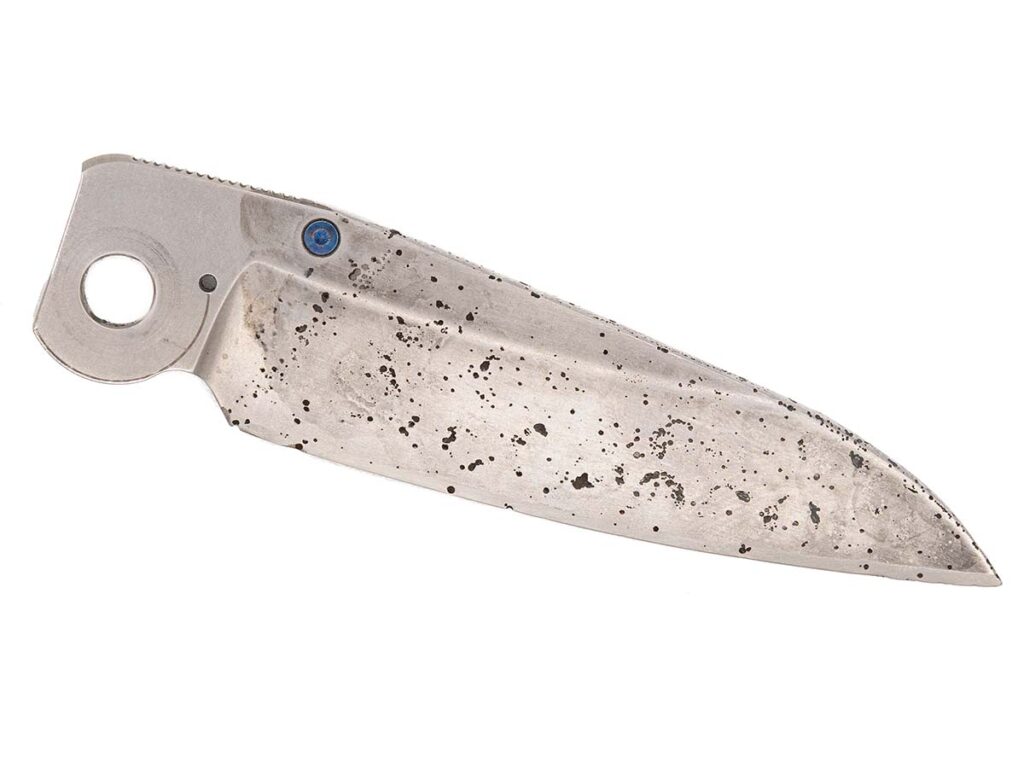
Anne Reeve said a customer put the MagnaCut stainless steel blade of a Chris Reeve knife in a glass of saltwater for seven hours and claimed the rusting and pitting should be covered by the company’s warranty. Of course, like all stainless steels, MagnaCut stains less but is not stain proof. Quite understandably, the warranty request was denied.
“That original knife lives in my safe deposit box now,” Anne smiled. “On a few occasions we have older knives returned for sharpening and we can tell that the knife has been lovingly sharpened so many times that the blade is worn out. We have replaced the blades. When we made the One Piece Range, the paperwork specifically said that it was not a throwing knife and breakage from throwing would not be covered by warranty. A couple of times we had knives returned that were broken in two. The dings made it quite obvious that the knife had been thrown. Back then, we would replace the knife and give the customer a verbal slap on the wrist.”
Though Reeve, like other companies, has found it necessary to scrutinize warranty requests more closely in recent years, the dedicated effort to make the customer happy remains strong. At Chris Reeve Knives, the warranty is, as Anne puts it, “phenomenal.”
Judgment Calls
When did the rules change? Where does the line between normal expectation and radical knife recklessness blur?
A closeup of the blade and edge damage the Chris Reeve Knives Yarborough incurred after being used by the SF operative to cut a live electric cable is a tribute to the toughness of the company’s knives.
“We’ve had a few forgeries sent to us for repairs,” commented BLADE Magazine Cutlery Hall-of-Fame® member Daniel Winkler of Winkler Knives. “Reactions from customers can get hot when they learn they have been duped. Not many warranty requests are really ‘crazy’; normal sharpening or sometimes fixing a damaged tip. People also request a re-finish for worn blades. If a knife fails for any reason we will either fix it or replace it, and normal blade finish wear is not covered under warranty. Working knives should look used.”
Winkler is sensitive to certain situations and sees extraordinary conditions for what they are.
“On a few occasions we have sent replacement knives without receiving damaged ones back,” he remarked. “One was a military user that used his knife to destroy a communications location in a war zone. He fried the power supply, and it fused the knife in the connection. Another was a hiker who saved his dog in a rockslide. His knife fell to the bottom of a gorge, so we replaced it, too. A third was used in a home situation where a man used his Winkler knife to stab an intruder to save his family. His knife was held as evidence, so we sent him a new one.”
A tornado destroyed a home and carried away a safe full of knives, including several TOPS Knives models. Two to three years later, the safe was found. The knives were intact and basically undamaged. When TOPS was contacted for help with slight rust on the blade and engraving, the company obliged at no cost.
There lies the real judgment call in rendering the warranty verdict. Does the customer’s story pass the simple test of reasonableness? If so, most companies might feel a pang of compassion and try to resolve the request in the interest of good customer relations. Still, it’s a tough challenge sometimes. As much as a customer might feel slighted if a warranty request is dishonored, the maker might well feel used when the circumstances are not plausible or strain the normal standards that most people would accept.
“We go out of our way to promote positive customer relations,” Daniel added. “We have replaced or refunded knives and axes that we probably shouldn’t have due to how they were damaged in abuse, like prying or throwing. We will normally take the hit, but if it happens again we do not honor any warranty.”
Case-By-Case Decisions
At TOPS Knives, warranty requests are evaluated with the best outcome in mind. “Our philosophy on our warranty is that we have some things that will void a warranty or won’t be covered under warranty, but we still handle them all on a case-by-case basis,” remarked general manager Craig Powell. “The people that are honest and level with us are way more likely to get their issue handled under warranty—even if it shouldn’t be—than people that are rude or clearly lying to us.
“I always find it funny when someone says something happened to their knife and then the actual damage to the knife in no way matches their description,” Powell continued. “Like, maybe they think we don’t actually use or test our own gear and so we don’t know what would cause certain things to happen. But really, in the end very few people that contact us with an issue treat us poorly. So the vast majority get help under warranty.”
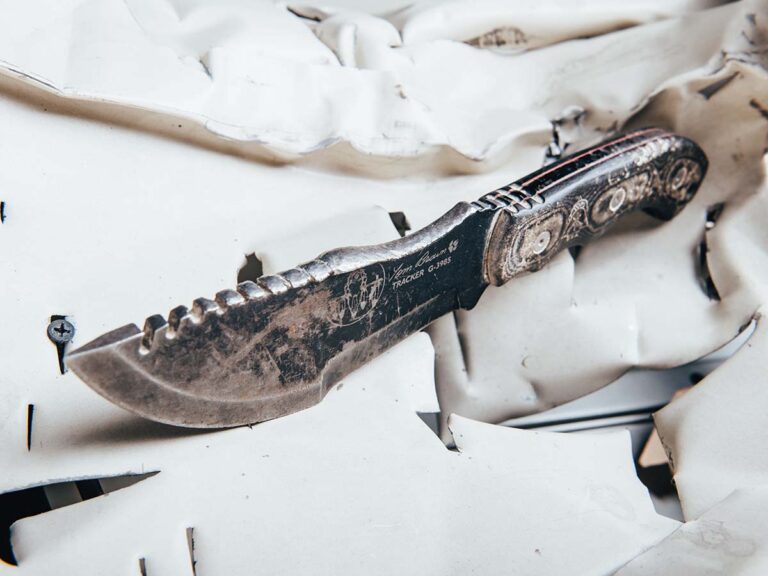
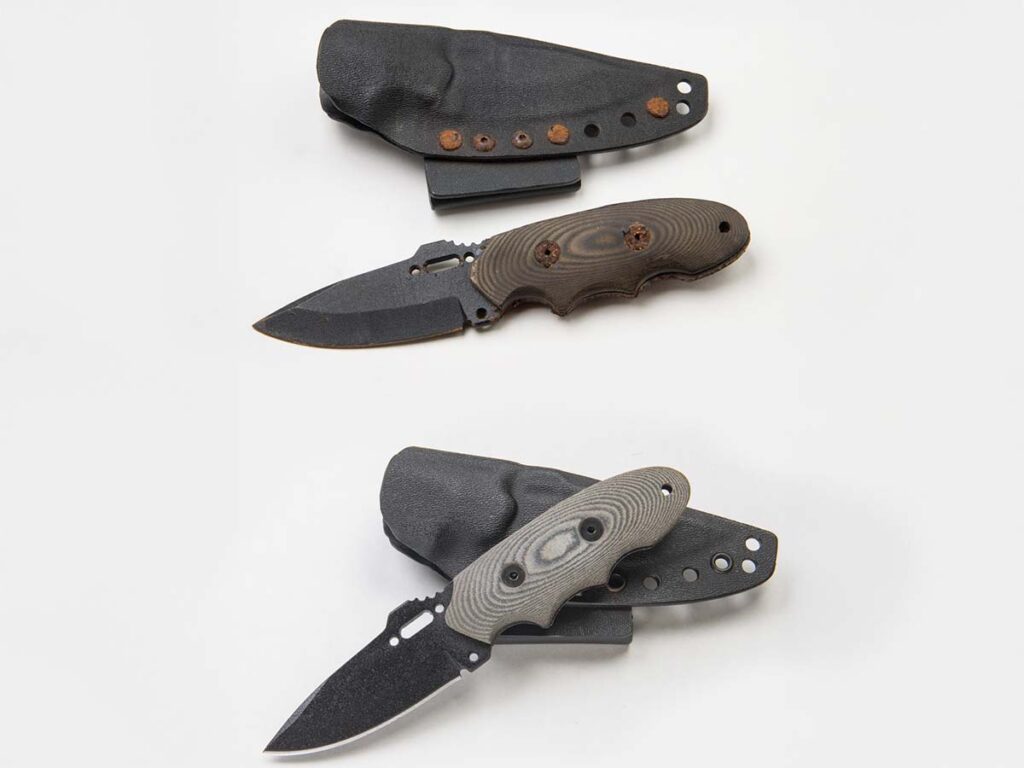
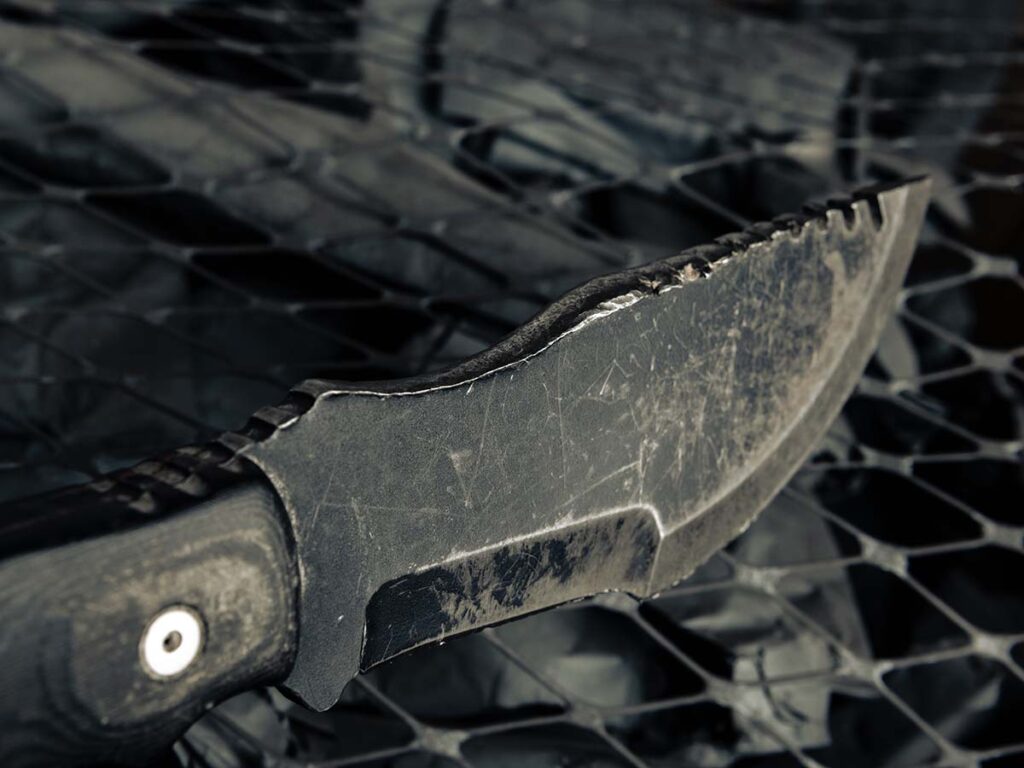
Back to the TOPS Tom Brown Tracker that was lost in the Iraqi IED incident: the local who originally found it after the explosion used it to split wood. The saw teeth had basically been mushroomed out of existence from the local beating on the knife with a piece of metal. Considering how the U.S. serviceman originally lost the knife, TOPS fulfilled the warranty.
Powell remembers certain circumstances that were somewhat unusual prior to a warranty request.
“When I had only been working here for a year or two, I took a call from a guy that was concerned about an issue with his Silent Hero. I talked to him for probably 15 minutes trying to figure out what was wrong. He kept saying that the knife was getting deformed and all he was doing was [batonning the blade spine to make] firewood. It probably took me longer than it should have, but I finally thought to ask what he was using as a baton. Turns out he was using the hammer side of a hatchet as his baton. So, a thick piece of metal is what he was using rather than a stick. I chuckled to myself and then we talked through the process of having a hatchet in your hand and choosing to use a knife to process firewood rather than the hatchet. He said ‘Oh!’ Then he basically apologized and said he understood. We didn’t end up fixing that knife for him, but that was because he realized what he had done and probably kept it as a reminder or trophy.”
On another occasion, a tornado destroyed a home and carried away a safe full of knives, including TOPS models. Some two to three years later, the safe was found. The knives were intact and basically undamaged. When TOPS was contacted for help with slight rust on the blade and engraving, the company obliged at no cost. Hikers have been known to lose TOPS knives on the trail and then miraculously find them months later. When the owner of one of these calls for warranty assistance, the TOPS folks fix the knives up, cleaning and refurbishing before sending them back in the context of a lesson learned: hold onto your valuables while out in the woods, especially your knife.
Extreme Situations
Military experiences have brought up several warranty requests, and these are sometimes caused by extreme situations. A Tom Brown Tracker was lost during the horrific explosion of an IED (improvised explosive device) in Iraq. The soldier involved was a chaplain, who returned some time later to the village where the explosion occurred. An old lady came forward with his knife after an interpreter and a $20 bill did some talking. The knife had been used in splitting wood.
“It was beat to hell,” Powell remembered. “The saw teeth had basically been mushroomed out of existence from this lady beating on it with a piece of metal. We swapped the soldier a new one and still have that knife [above] here today.”
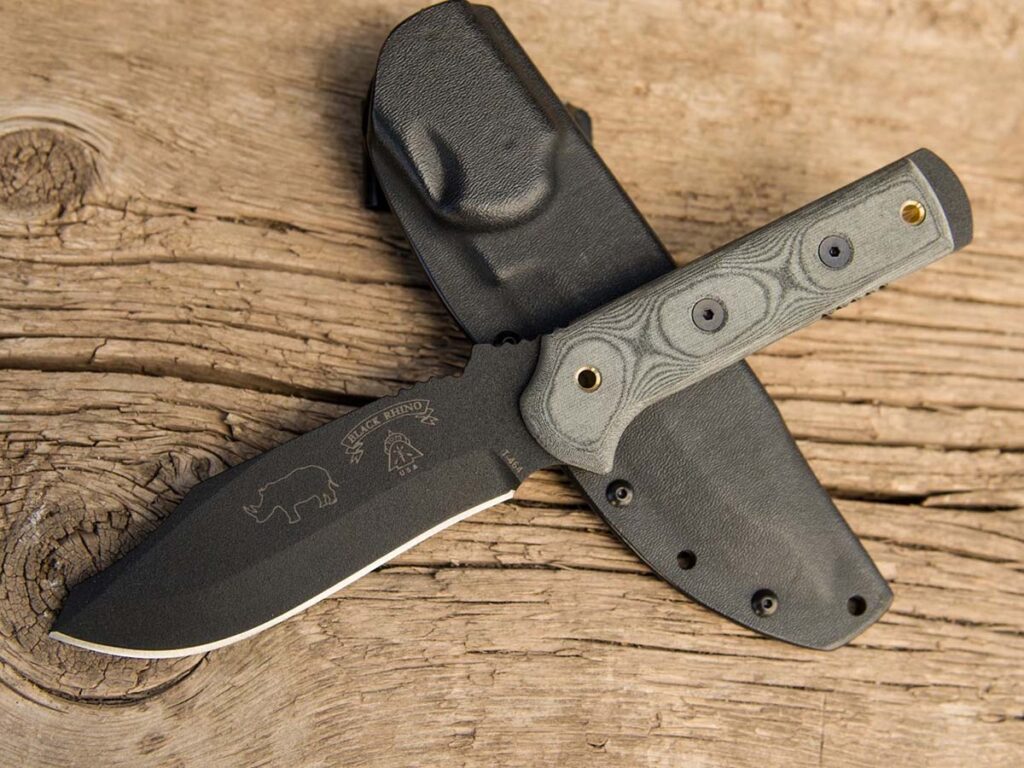
A TOPS Knives Black Rhino was lost when a desert barracks burned to the ground. The scales were completely gone and the knife could not be repaired. TOPS sent the destroyed piece back to the serviceman along with a brand-new Black Rhino like this one.
A Black Rhino was lost when a desert barracks burned to the ground. The owner recovered the knife. Its scales were completely gone and the knife could not be repaired. TOPS sent the destroyed piece back to the serviceman along with a brand-new Black Rhino.
“While our policy isn’t a no-fault policy, we still cover most issues,” Craig said. “We know what we’re making is quality, and we strive for that on every knife. So anything that a customer’s knife should be able to do but doesn’t is going to get covered.”
In the broadest sense, the warranty works both ways. It protects buyer and seller and invokes the sense of quality and pride of craftsmanship, with reasonable performance expectation and use. There are outliers, but for the most part both knifemaker and knife user work together with warranties to achieve positive resolutions.
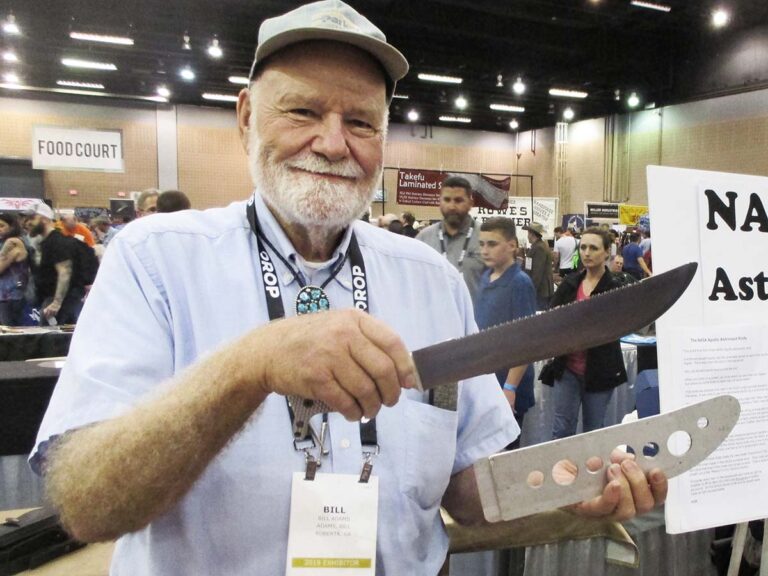
William “Bill” Adams was a revered knife entrepreneur, author and Cutlery Hall-of-Fame member. Learn about his immense impact on the knife community.
William Calhoun “Bill” Adams, knife entrepreneur, defender of all things knife, BLADE Magazine Cutlery Hall-of-Fame® member and invaluable friend of the knife community, passed away August 10. He was 87.
Known for his easy smile, snow white beard and amiable North Georgia drawl, Bill was liked and admired by many in the industry. He founded Atlanta Cutlery and, with Hank Reinhardt, co-founded Museum Replicas, both in Conyers, Georgia. Bill’s retail operations required him to travel the globe in search of the finest knives, swords and accouterments, including England, Ireland, Africa, India, parts of Central and South America, and all over the USA.
He served as president of the Antique Bowie Knife Association and helped found the Military Equipment and Weapons Collectors Association. He also helped found the Cutlery Collectors Legislative Committee, aka the CCLC, forerunner to today’s two leading pro-knife-legislation groups, Knife Rights and the American Knife & Tool Institute. In 1995, Bill was inducted into the Cutlery Hall of Fame.
He was a knowledgeable, gifted author, editing Sheffield Exhibition Knives and co-writing The Antique Bowie Knife Book, both of which are go-to guides for fans and aficionados of vintage Sheffield-made and antique bowies, respectively. He also was a dedicated knife collector, winning several awards for his wide-ranging collections at the BLADE Show. He retired to Roberta, Georgia, to live along the Flint River, where he enjoyed a quiet, peaceful and happy life.
He is survived by his sister-in-law Dee Anne Adams, his nephew David A. Adams and wife Cheryl, and dear friend and travel partner Elaine Barnes. The family wishes to express its thanks to Bill’s Roberta, Georgia, friends, especially Charles and Kate Rice, who cared for and treated him like family.
Remembering Others The Knife Industry Has Lost:
Betty Dowell, Driving Force Behind Knifemaker Ted Dowell, Passes
B. R. Hughes, Pioneering Writer And Bladesmithing Teacher, Passes Away








![Megan parlayed her long-time admiration for tantos into the Shinobi/M-Shinobi. Though she has been involved in making design suggestions for many years, it is the first knife she designed entirely by herself. As she noted, “The CQC-17 model blade design was my idea, and I am sure you can see the similarities in [the Shinobi].”](https://blademag.com/wp-content/uploads/Family-5-1024x768.jpg)