
Knifemaking

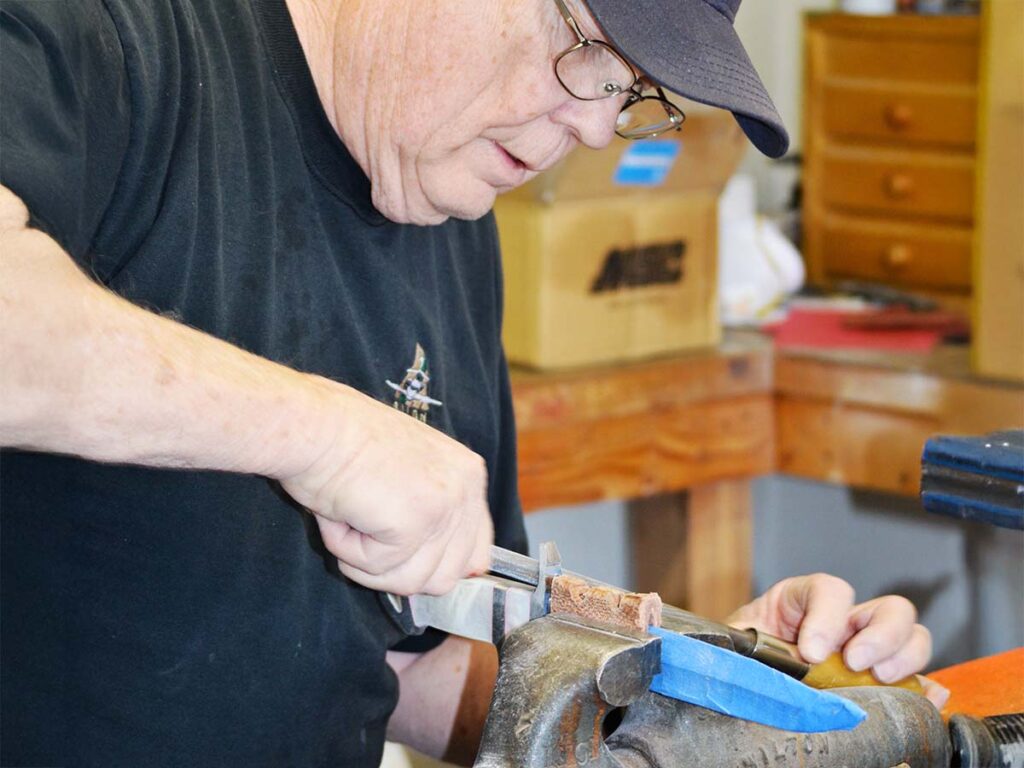
Knifemaking is the building of a knife, which includes the blade, handle and other accouterments. Blades are made by either removing metal from a steel blank via a grinder – known as stock removal – and the forging to shape of hot steel into a blade in the process known as bladesmithing. Other parts, including bolsters, guards, pommels, etc., are needed to complete the finished knife.

Featured Knives – – Knife Collecting – – Tactical Knives – – Survival Knives

Hunting Knives: What Makes The Perfect Blade Geometry?

0

From razor-thin slicers to heavy-duty choppers, here’s how edge geometry and grind thickness impact real hunting performance—and what makes the perfect hunting knife.

Whether it’s a secret lure, special scent, backwoods honey hole, a custom-tuned call, or even camo boxers or lucky socks, all hunters have some kind of secret weapon, superstition or technique that they believe will give them an edge over their quarry. But when it comes to the actual edge—the blade of your knife—are you that particular? Are you that picky, that much caught up in hype or that much committed to tradition? Let’s explore the “hunter’s edge” as we consider what kind of grind and edge geometry makes a so-called perfect hunting knife.

Hunting is a game of tradeoffs. If you hunt the field, you can’t hunt the hill. You may be stuck at work on the nice weather days and sitting in the trees in the rain on Saturday. You may sit one time and kill a record buck, or you may sit all season and not see a single “shooter.” There’s seldom a way you can have it all at the same time.

Sojourn by Alex Harrison of Night Watch Knives features a blade of CPM 154 stainless in a blackened War Wash finish. The handle is textured, blasted G-10 with black liners and hollow pins. Guard: nickel. Construction: tapered tang. Overall length: 8 inches. Blade grind: hollow. Edge thickness: .010 inch. Alex said the ligature notch is meant to be a safe way to conduct an aggressive gross motor skills reverse cut and sever a ligature under tension. His price for a similar knife: $500.

The hunter’s knife is no different. In general, “small game, small knife, large game, large knife” holds true, but what characteristics make it so? A big knife can be an advantage or a small knife can be sufficient, depending on whether you’re hunting whitetails in Saskatchewan or Texas. Do you want to use the same knife for wild pigs and moose?

Hunters want a knife that will stay with them through thick and thin. But should the knife’s edge be thick or thin? I have hunted and harvested game since I was a boy, but it was not until I was nearly 40 that I put a caliper to a knife edge. A knife just was, an omnipresent tool taken for granted. Some worked better than others, though I had never thought about why it was that way. Let’s talk a little about edge thickness and numbers.

Optimal Hunting Knife Edge

An experienced hunter may want a knife to chop trails and trim brush, do camp chores or fire-building tasks, or split a deer’s pelvis or sternum. Those tasks lend themselves to a larger, heavier knife with a thicker edge. The heavy-use knife may be 10 or 11 inches overall of 3/16-inch-thick steel and maybe forty thousandths (.040) of an inch or more behind the edge.
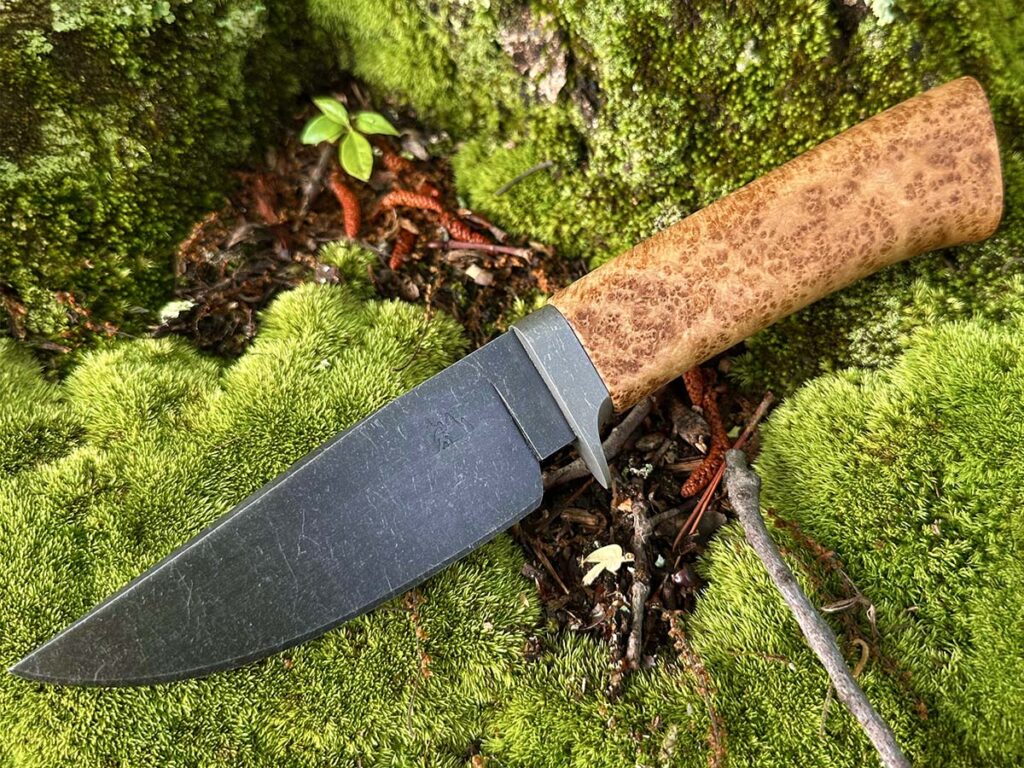
A 4-inch blade of 8670 carbon steel in a stonewashed finish and a maple burl handle help complete the Wagu Cattleman by Guild probationary member Chip Carlisle of Skjeggmenn Knives. Handle: maple burl. Overall length: 9.5 inches. Blade grind: full-height flat. Edge thickness: .020 inch. His price for a similar knife: $400.

The grind is more likely to be full flat with a convex edge, or even full convex. The tradeoff is no matter how sharp such a knife gets, it won’t excel at fine work like making the initial cuts through fur or opening the abdomen. It’s not impossible to field dress a deer with a thick-edged knife, it’s just a bit more difficult.

Another hunter of equal skill may carry his knife on his belt or in her pack, only taking it out for the finer tasks of skinning, quartering and deboning. Such a knife could be as little as 3/32 inch thick and as short as 7.5 inches overall. The grind could be full flat or hollow, and somewhere in the 15-to-20 thousandths (.015-to-.020)-of-an-inch-thick-range, or even thinner.

If you use a caliper, you’ll need one that measures down to the thousandths-of-an-inch level.

On a small knife, you may not have the handle or blade length to give you the leverage you want to easily split the sternum on an elk. No matter how sharp the small knife is, it won’t excel at chopping or tasks that require leverage. It’s presumably not impossible to field dress a grizzly bear with a small, thin knife, it’s just a bit more difficult at some points in the process.

My “eyecrometer” doesn’t measure very precisely. As a simple frame of reference, 10 pages of BLADE® are roughly .020-inch thick. If you use a caliper, you’ll need one that measures down to the .001 (thousandths)-of-an-inch level.

Well, that was a nice theoretical discussion. Now let’s look at some concrete examples.

Different Hunting Knives

I asked a group of knifemakers to send me examples of knives that fit the hunting knife description. I was part of the judging panel for the Knifemakers’ Guild awards at the BLADE Show and got the chance to handle a wonderful knife from Guild voting member Alex Harrison of Night Watch Knives. Of all the knives in the judging, this one really spoke to me as an excellent hunting knife.
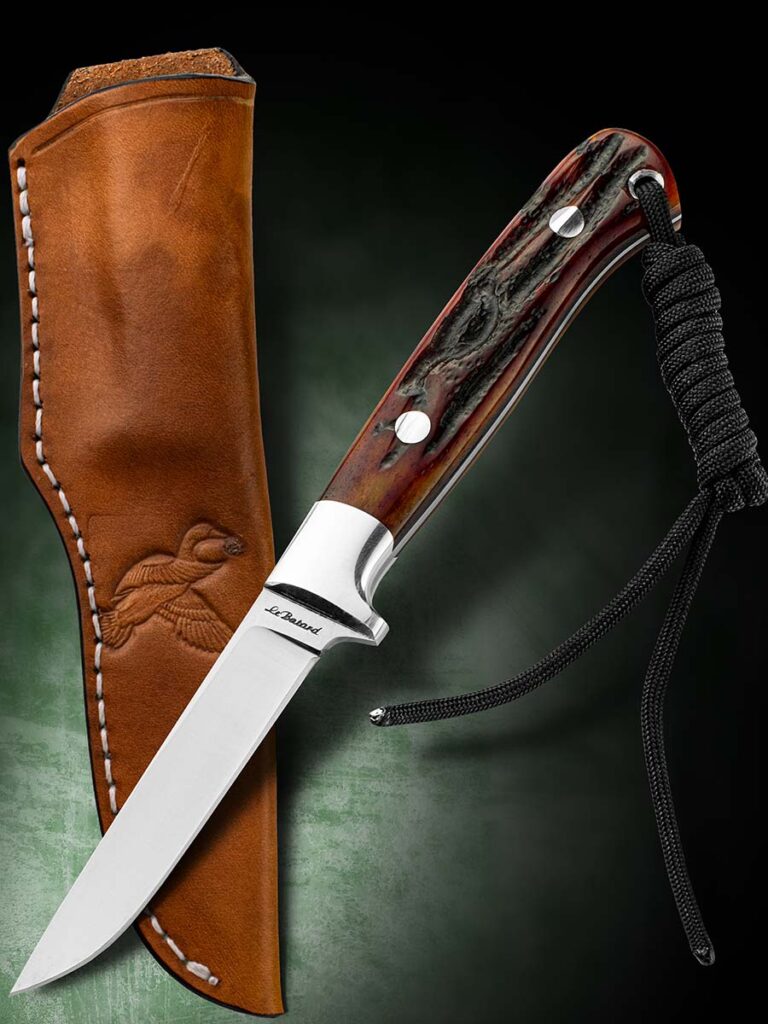
Field and Stream by newly elected Knifemakers’ Guild board member Paul LeBatard boasts a 3.5-inch blade of CPM 154 stainless and jigged bone scales.  Overall length: 7.75 inches. Blade grind: hollow. Edge thickness: .020 inch. His price for a similar knife: $400. (Jocelyn Frasier image)
Field and Stream by newly elected Knifemakers’ Guild board member Paul LeBatard boasts a 3.5-inch blade of CPM 154 stainless and jigged bone scales. Overall length: 7.75 inches. Blade grind: hollow. Edge thickness: .020 inch. His price for a similar knife: $400. (Jocelyn Frasier image)

First, there are the intentionally muted textures and tones. It’s all dark, rough and tough, and even the bright orange G-10 has subtlety from the combination of the ground-in divots and blasted grain of the material. Next, the shape was pleasant in the hand and the blade was all business. At first glance it’s a fairly standard drop point but it has all the small details: the short-serrated section near the ricasso, the swedged point, the ground edge at the top of the point. Underneath it all, the hollow grinds are simultaneously effective and pleasing to the eye.

“This knife is hollow ground, probably ‘ten thou’ behind the edge. That’s the sweet spot for me,” Alex explained. “Everyone loves a razor blade but people do stupid [stuff] with their knives, and even skilled users aren’t always gentle. I often have requests for serrations for game processing, so I taught myself how to grind them in such a way that they still slice paper.” I dare you to try to slice paper with the serrations on the standard big-box store hunter! Added Alex, “The ligature notch is meant to be a safe way to conduct an aggressive gross motor skills reverse cut and sever a ligature under tension.”

Guild probationary member Chip Carlisle’s take on a hunter is a bit bigger, a bit beefier and a bit more traditional. The Wagu Cattleman from Chip’s Skjeggmenn Knives is 9.5 inches overall with a 4-inch blade of 3/16-inch-thick stonewashed 8670 carbon steel. A precise, full-height flat grind comes to a thin .020-inch edge. The clip point is swedged, giving the blade a sleeker look than its height would automatically provide. Carlisle said the knife “delivers uncompromising performance where it matters most—at the edge of work and wilderness.”
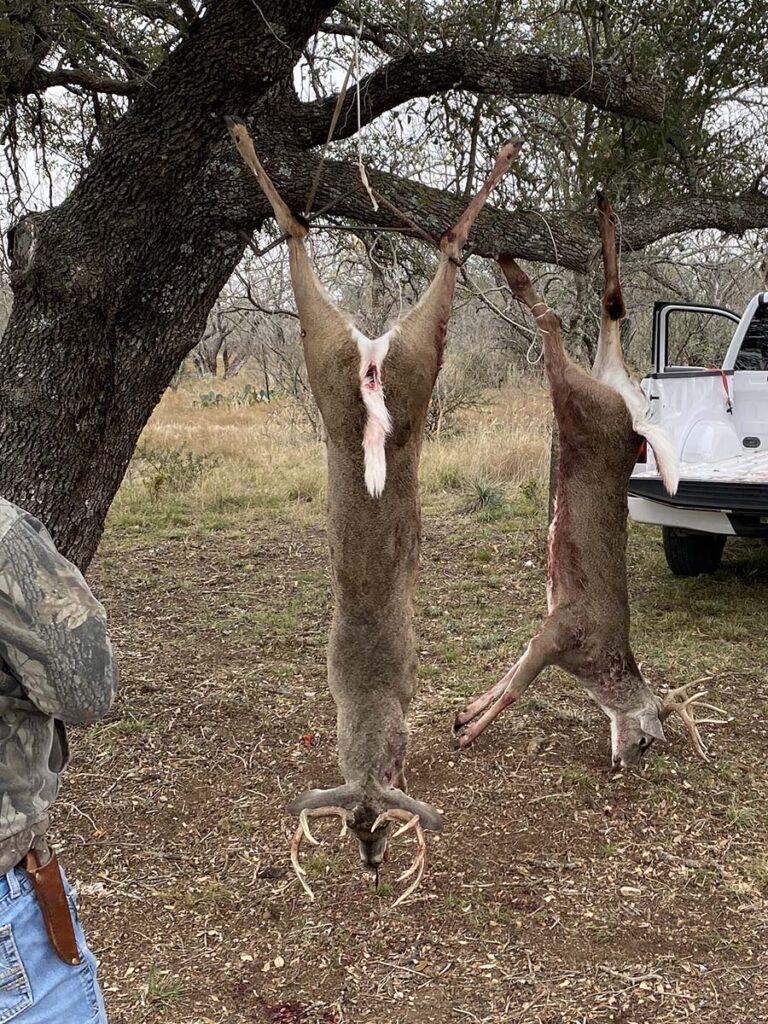
All hunters have some kind of secret weapon, superstition or technique they believe will give them an edge over their quarry.

Newly elected Guild board member Paul LeBatard executes the traditional hunter with modern materials and an eye for precision. The 3.5-inch blade of his Field and Stream model is 3/32-inch stock hollow ground on a 12-inch wheel to an edge thickness of .020 inch. Overall length: 7.75 inches. The same design comes in two larger sizes called the Personal and Personal Plus. The profile reminds me of the old Case and Western hunters from years past.

Critiquing Work
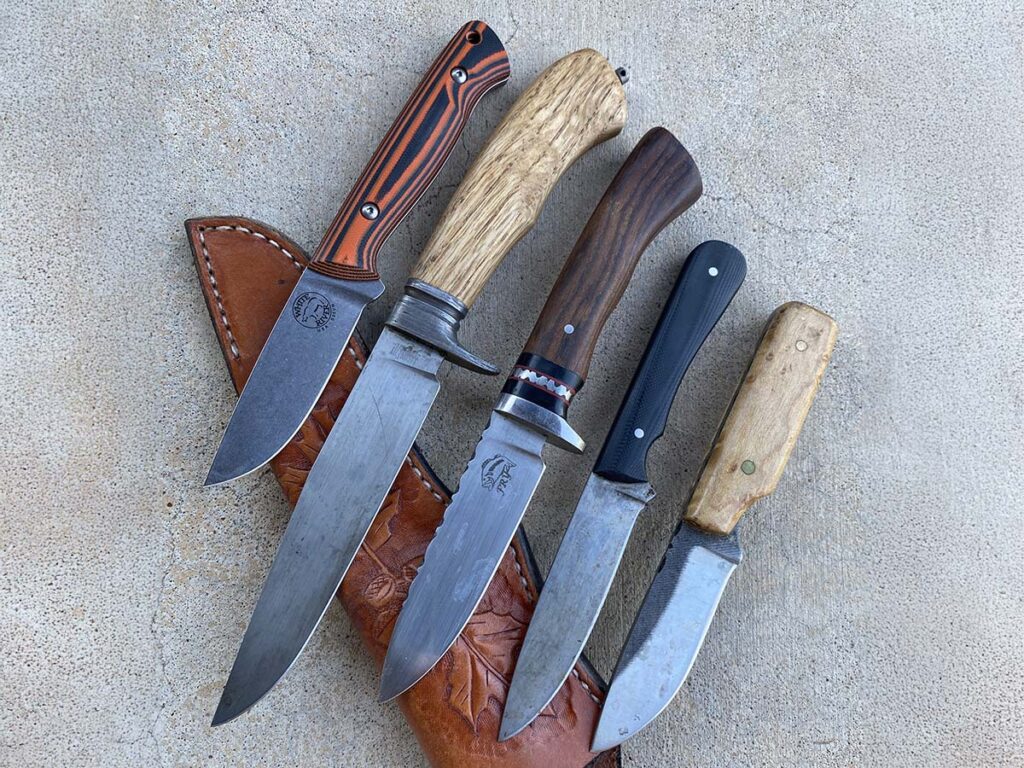
 Knives the author has designed and/or made over the years, from left: his Jason Fry Hunter for White River Knife & Tool; his first real forged knife; the 100th knife he ever made, circa 2010; the 50th knife he ever made; and his first-ever knife, the Deer Disassembly Device, aka Triple D. For the knives’ grinds, edge thicknesses and other specs, see the story.
Knives the author has designed and/or made over the years, from left: his Jason Fry Hunter for White River Knife & Tool; his first real forged knife; the 100th knife he ever made, circa 2010; the 50th knife he ever made; and his first-ever knife, the Deer Disassembly Device, aka Triple D. For the knives’ grinds, edge thicknesses and other specs, see the story.

One of the unspoken rules of the knifemaking world is to not offer unsolicited criticism of another maker’s work. Now that I’ve put that rule in writing, I’ll be consistent and point out some flaws in some of my own early work to illustrate some points of error to look for.

At far right in the accompanying image (above) of my five knives is the first knife I ever made, stock removal from a file, that I enthusiastically called the Triple D for Deer Disassembly Device. I was a bit delusional. Although I’ve processed many deer with this knife, the handle is too short for the blade, which causes problems with leverage while splitting the sternum. Also, the knife was made with files and sandpaper, not a grinder.

The original edge thickness was somewhere beyond .060 inch. Eventually, as my skills improved, I re-ground the knife a bit, pushing the edge back to a slightly more respectable .035 inch. The knife doesn’t slice well at all, mostly as a function of the thick geometry, but also of the shorter bevel grinds on thicker stock.
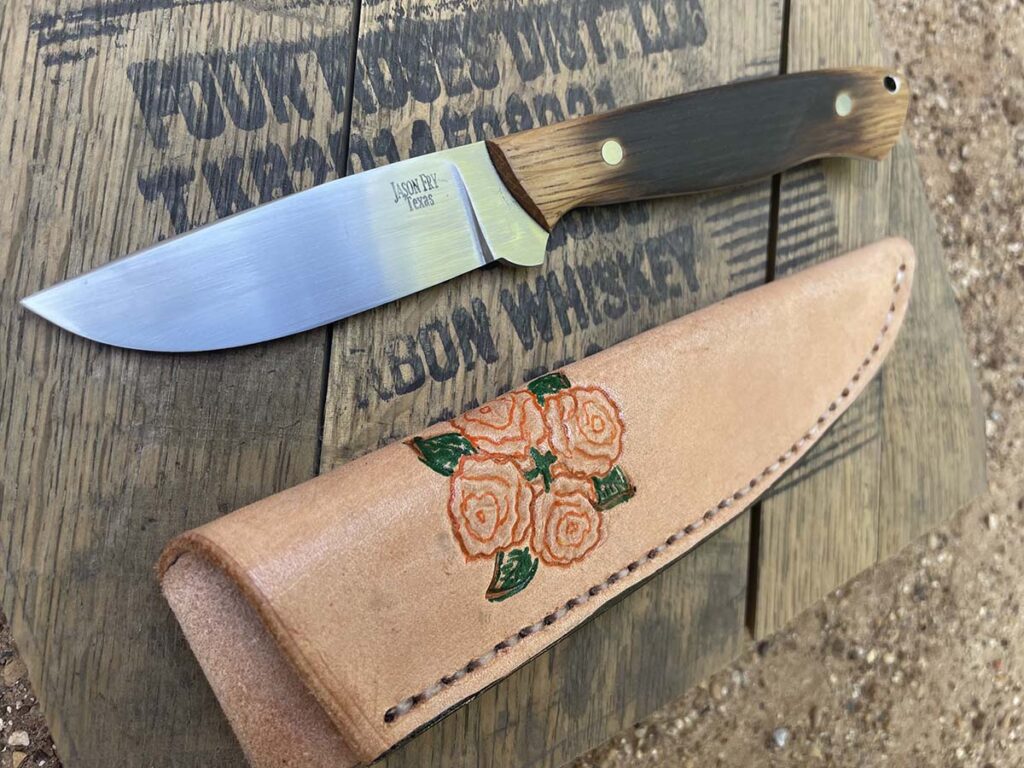
The author’s Four Roses sports a 3-inch blade of Nitro V stainless and scales from a Four Roses whiskey barrel. Construction: tapered tang. Overall length: 7.75 inches. Blade grind: flat. Edge thickness: .020. His price for a similar knife: $350.

Next from right in the image is my 50th knife, stock removal, ⅛-inch-thick 1084 carbon steel. This one also has handled its share of game. The edge thickness is .025 inch and works great but the handle is too thin. With ⅛-inch-thick steel and ⅛-inch-thick G-10 scales, there’s just not enough handle for my aging hands. The center knife is my 100th circa 2010.

I was into D2 and filework at the time, neither of which are particularly suited for a hunter, and the handle is fat and boxy. Next is my first real forged knife, from a drag harrow tooth from my grandfather’s ranch. The handle is 1955 white oak floorboards from my house at the time.

The knife is the best of those pictured in many ways, with a thin edge at .010 inch, a large enough handle, easily sharpenable steel, and a great story of how the original customer gave the knife back to me before he passed away. The full flat grind and distal taper make it a pleasure to use.
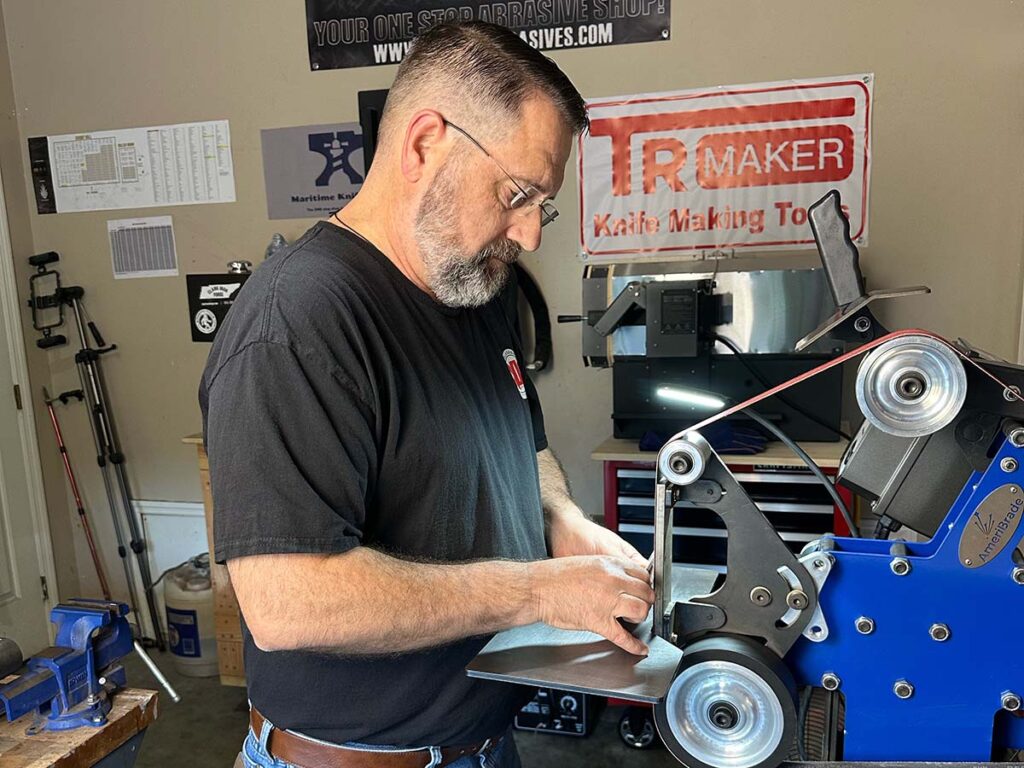
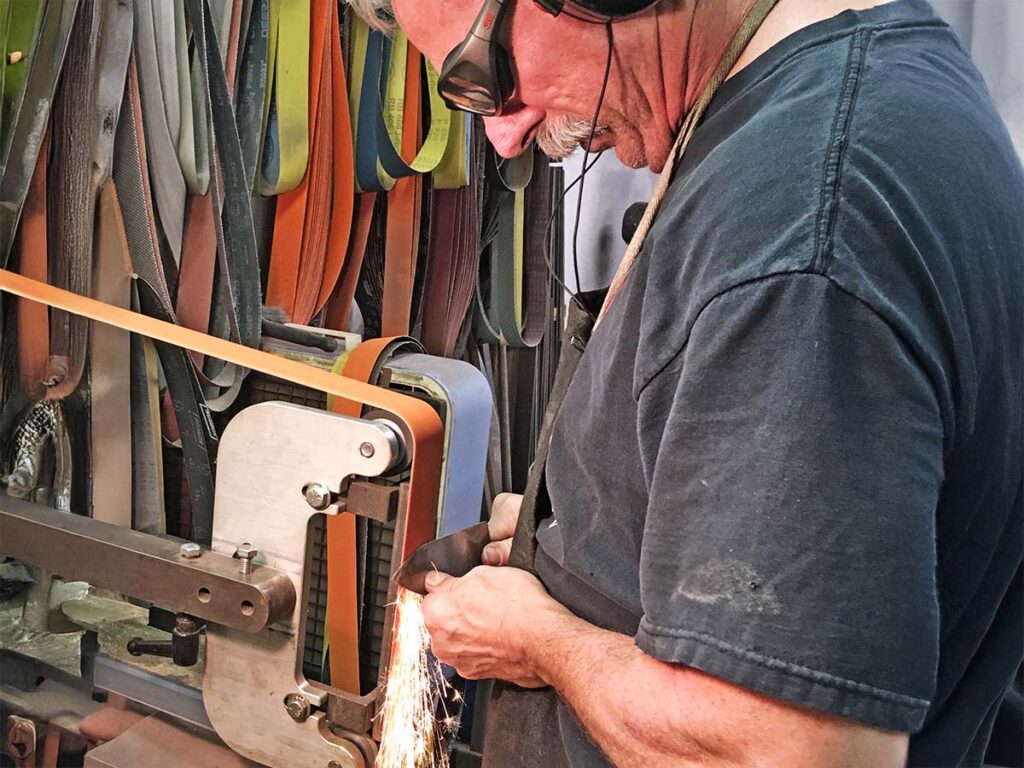
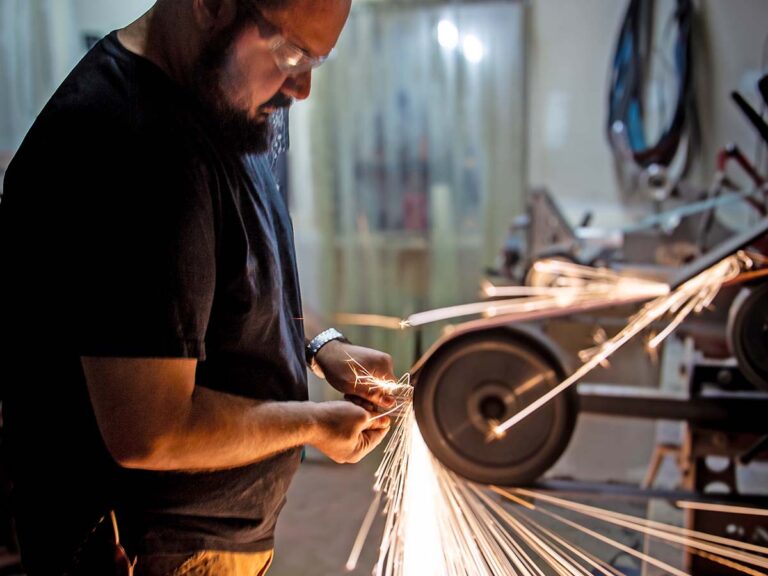
Chip Carlisle applies a flat blade grind using his belt grinder.

At far left in the picture is what I’ve settled on as my hunting knife of choice, the Jason Fry Hunter I designed for White River Knife & Tool in a full-flat-bevel-ground blade of S35VN stainless and black/orange G-10 scales. It’s just shy of 8 inches overall with a 3.5-inch blade. The handle length is enough to provide the necessary leverage, and the blade length is enough to do the cutting.

I’ve made this design for a decade by hand, both one-offs and small batches. For a general-use hunting knife for mass production, I wanted to split the difference between thin razor and beefy chopper. I specified the thickness at .020 inch and the White River guys nailed it.

The Perfect Hunting Knife

What makes the perfect hunting knife edge? It must be sharp. It has to be thin enough to slice fur yet burly enough to split a pelvis or sternum. It must have a handle big enough to provide leverage. It has to hold an edge through its primary tasks. Most of all, it must be with you when you hunt, an integral part of the package of secret weapons that set the hunter above the prey.

More On Knifemaking:

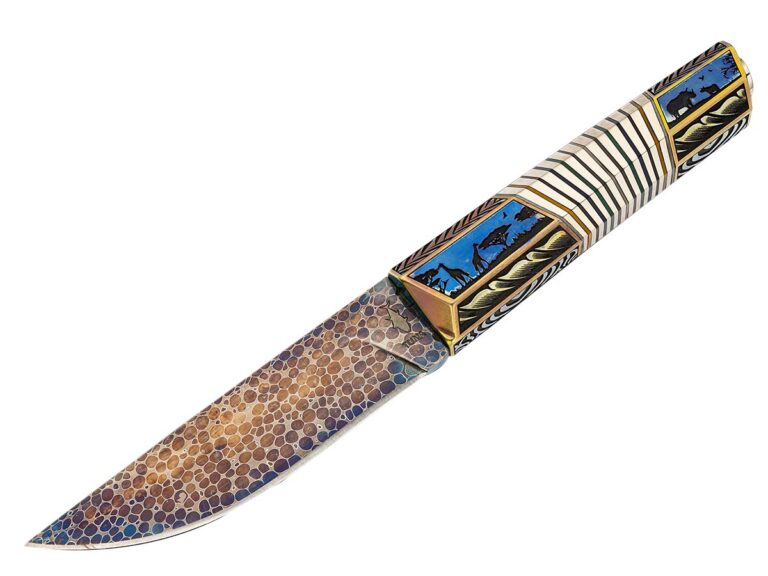
Summer’s Finest: Custom Damascus Knives You Need to See

Explore 11 jaw-dropping custom knives featuring premium damascus steel blades, exotic handle materials, and master craftsmanship.

This summer’s crop of custom knives brings damascus front and center. From twisted and ladder patterns to stainless blends and copper-clad creations, each blade in this collection highlights not just the maker’s skill, but their artistry with steel. Whether forged for daily carry, culinary precision, or collector prestige, these knives turn heads with standout materials—think crystallized titanium, crosscut mammoth, and ringed Western Myall—paired with performance-driven designs. Featured makers range from journeyman smiths to Guild members, each offering a unique take on the timeless beauty and cutting power of damascus steel.

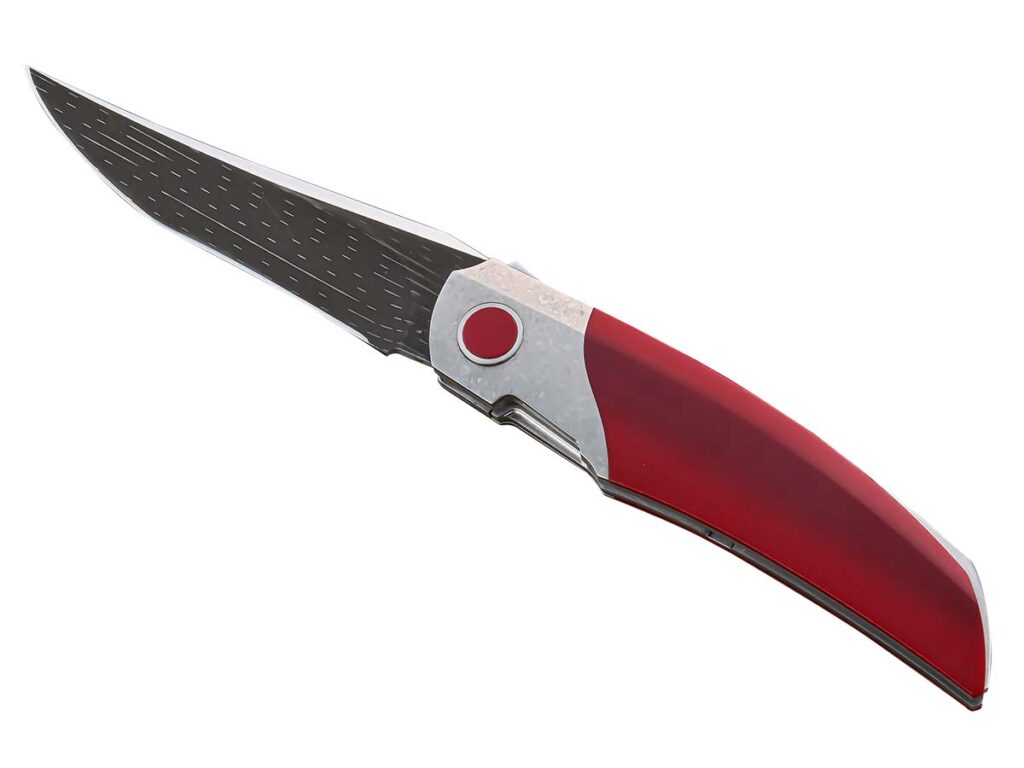
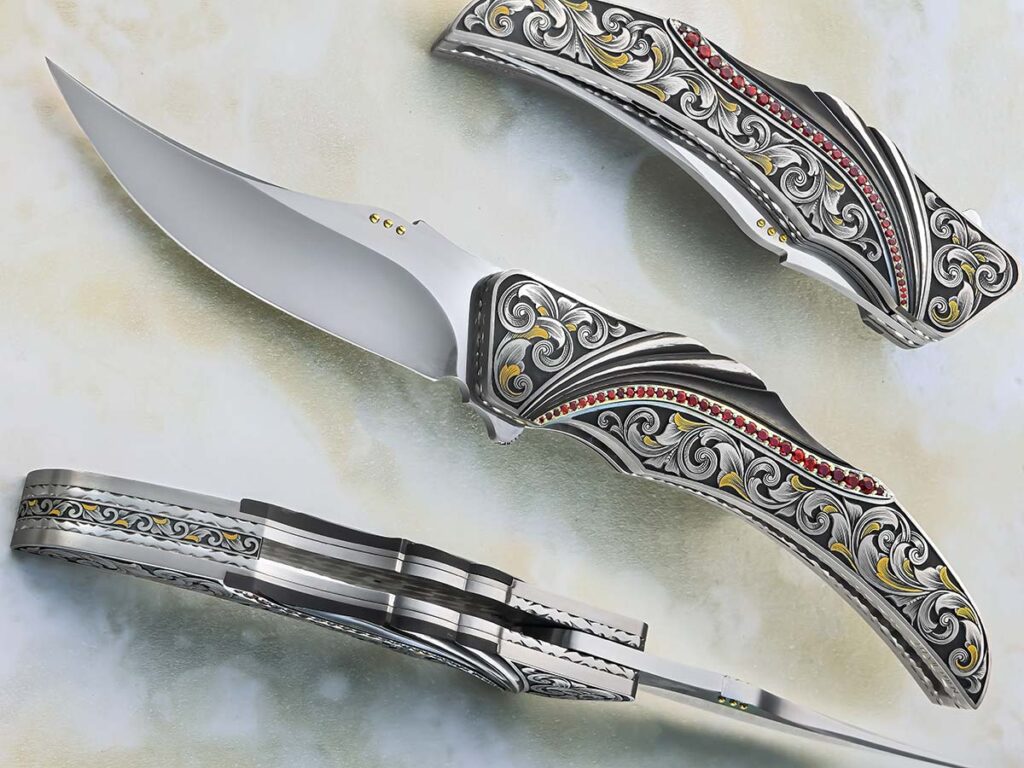
Carlos Queiros Thorn Persian TRS

Carlos Queiros Thorn Persian TRS

Knife type: Folder
Blade length: 3.35”
Blade material: Chad Nichols Starfire stainless damascus
Blade grind: Flat
Scales: Vintage bright red linen Micarta®
Bolsters: Crystalized titanium
Pocket clip: Yes
Closed length: 4.53”
Maker’s price for a similar knife: $4,700-$4,800 at press-time exchange rate
Maker: Carlos Queiros (SharpByCoop image)


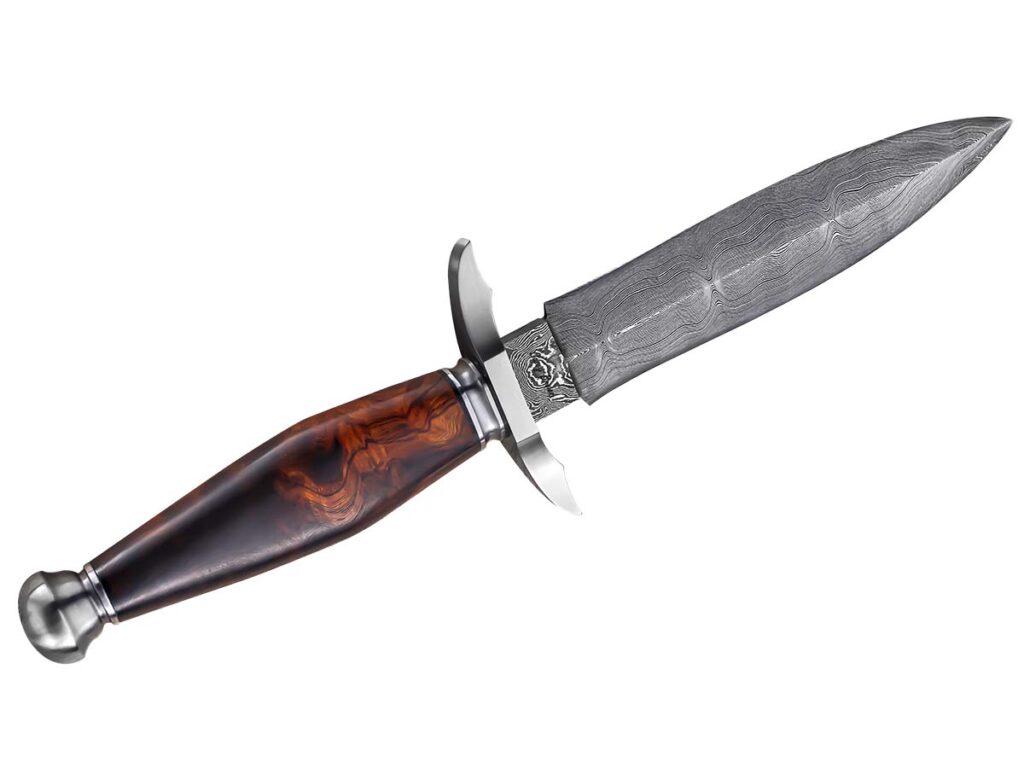
Casey Brown Dagger

Casey Brown Dagger

Blade length: 5.5”
Blade material: Ladder-pattern damascus
Blade grind: Flat
Scales: Desert ironwood
Guard/fittings: 416 stainless steel
Overall length: 10.25”
Maker’s price for a similar knife: $900
Knife to know: The maker is an ABS journeyman smith
Maker: Casey Brown (SharpByCoop image)


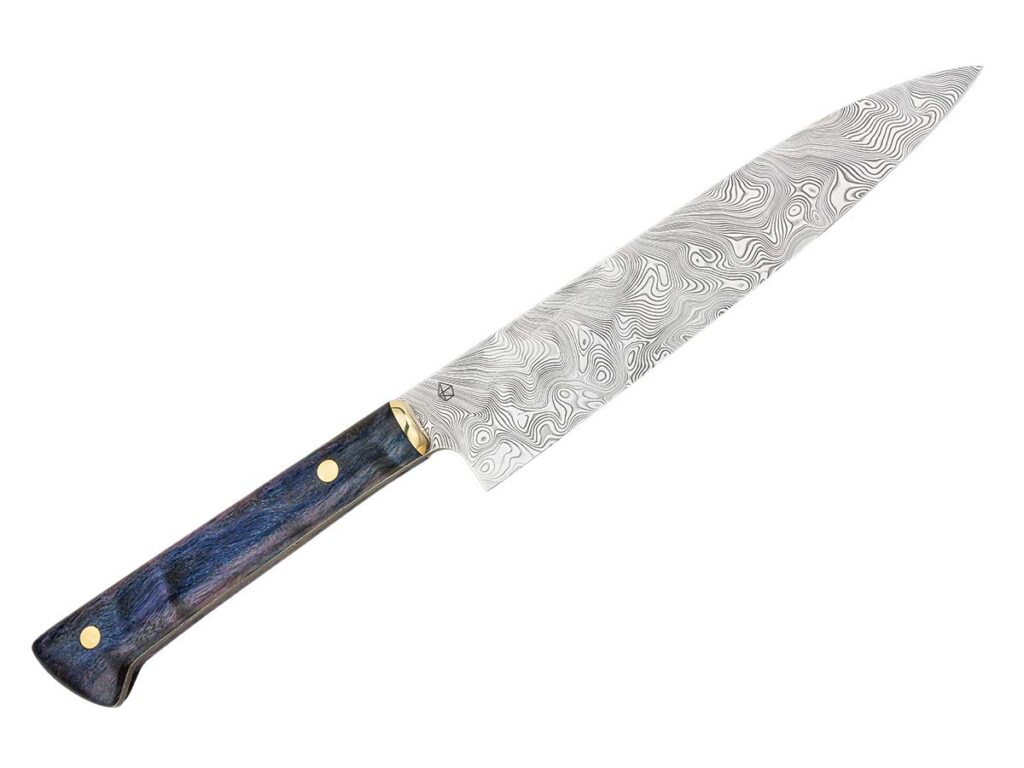
Luka Allen Petty Knife

Luka Allen Petty Knife

Blade length: 5 5/8”
Blade material: Bjorkman’s twist damascus by Damasteel
Blade grind: Flat
Scales: Cottonwood
Fittings: Brass
Overall length: 9.75”
Maker’s price for a similar knife: $450
Maker: Luka Allen, lukaallen.com (Jocelyn Frasier image)


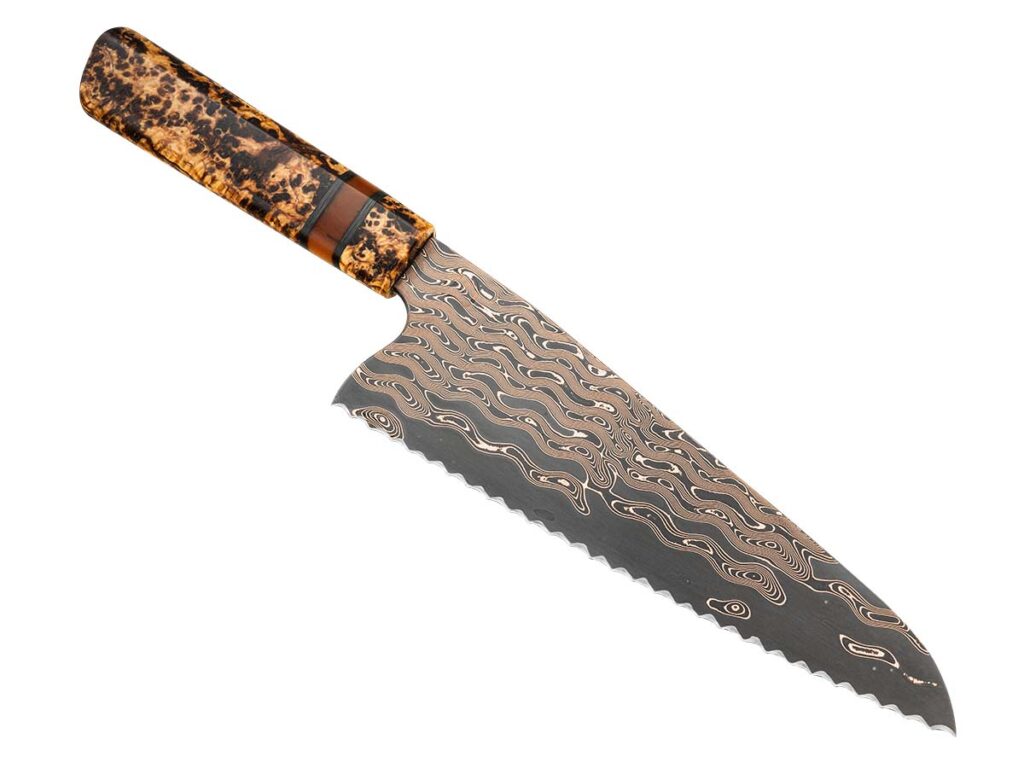
Micah Dunn Chef Bread Knife

Micah Dunn Chef Bread Knife

Blade length:7.5”
Blade material: Baker Forge & Tool copper-mai Surge pattern
Blade grind: Flat
Scales: Spalted chestnut burl and vintage Micarta®
Overall length: 12.25”
Maker’s price for a similar knife: $1,200
Maker: Micah Dunn, mdedgeworks.com (Jocelyn Frasier image)


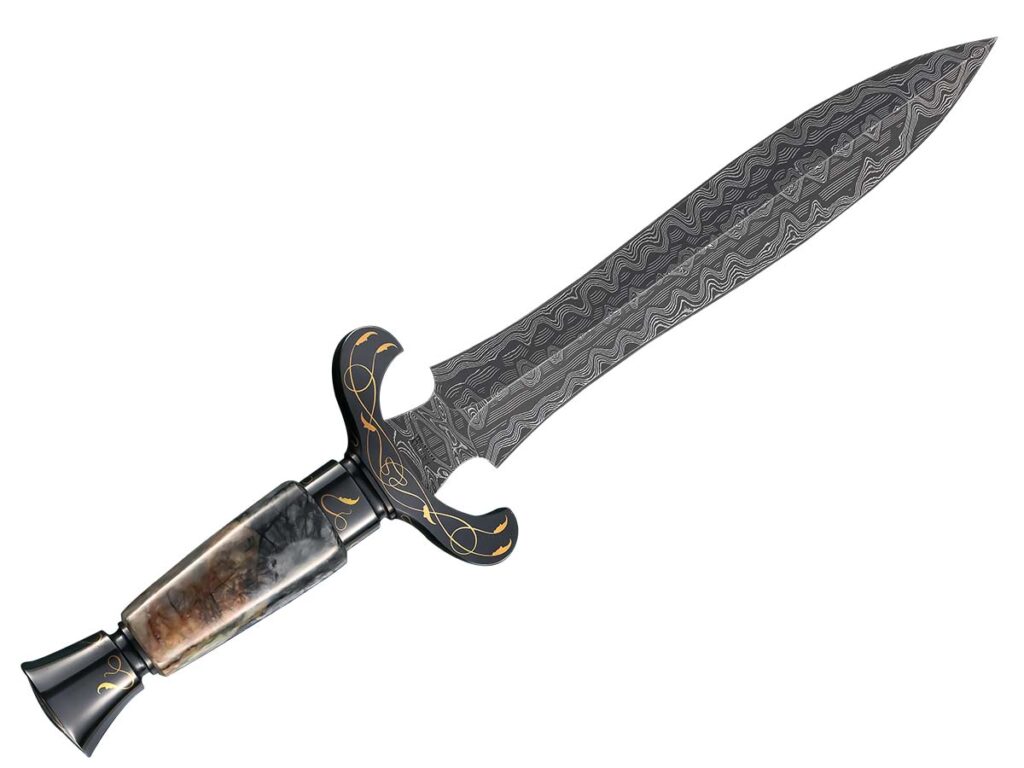
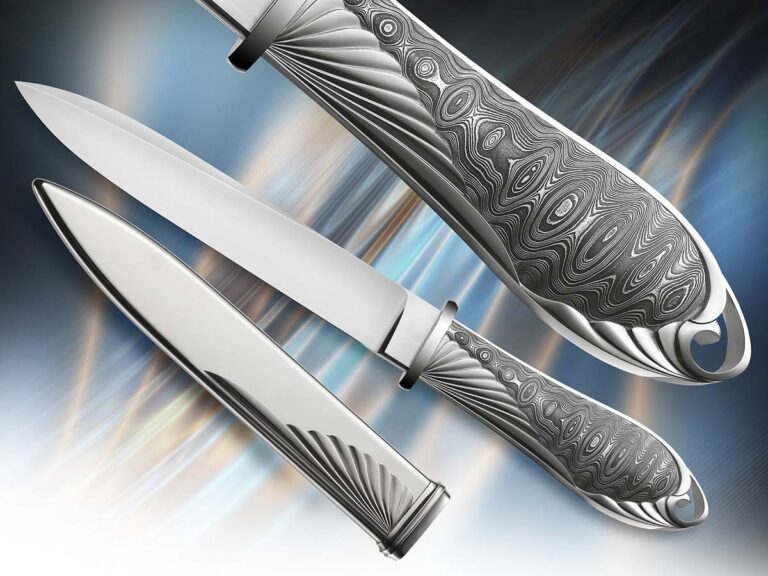
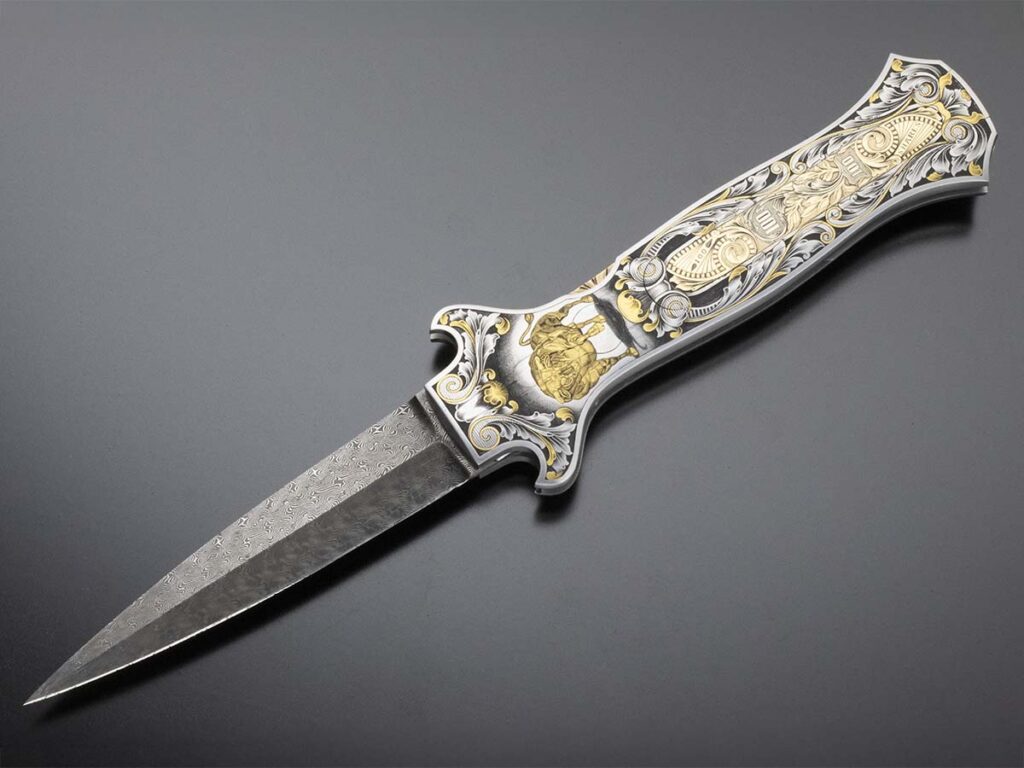
Dennis Friedly Art dagger

Dennis Friedly Art dagger

Blade length: 9”
Blade material: Mike Norris damascus
Blade grind: Hollow
Scales: Picasso marble
Fittings: Blued steel
Embellishment: 24k-gold inlay by Ray Cover Jr.
Maker’s price for a similar knife: $7,200
Knife to know: The maker is a voting member of The Knifemakers’ Guild
Maker: Dennis Friedly, friedlyknives.com (SharpByCoop image)


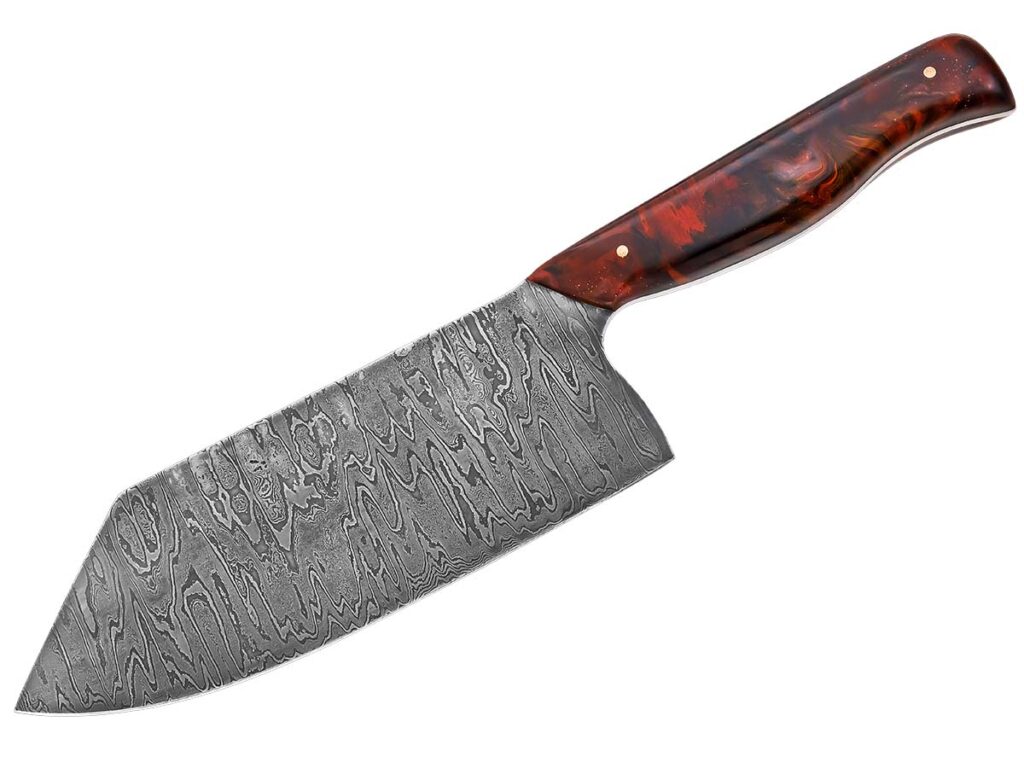
Dane Standen Cleaver

Dane Standen Cleaver

Blade length: 7.3”
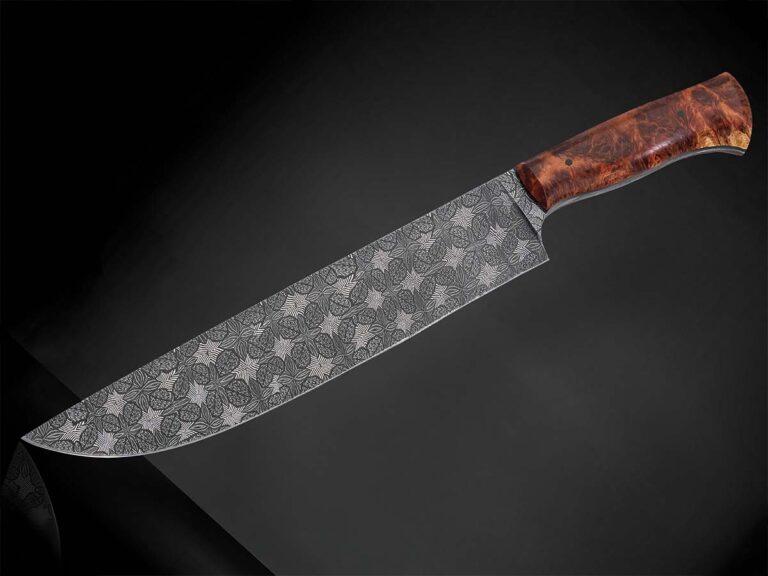
Blade material: 243-layer textured damascus of 1084 carbon- and 15N20 nickel-alloy steels
Blade grind: Flat
Scales: Colored resin
Pins: Copper
Overall length: 12.2”
Maker’s price for a similar knife: Contact maker for info
Knife to know: The maker is a probationary member of the Australian Knifemakers Guild
Maker: Dane Standen (Rod Hoare image)


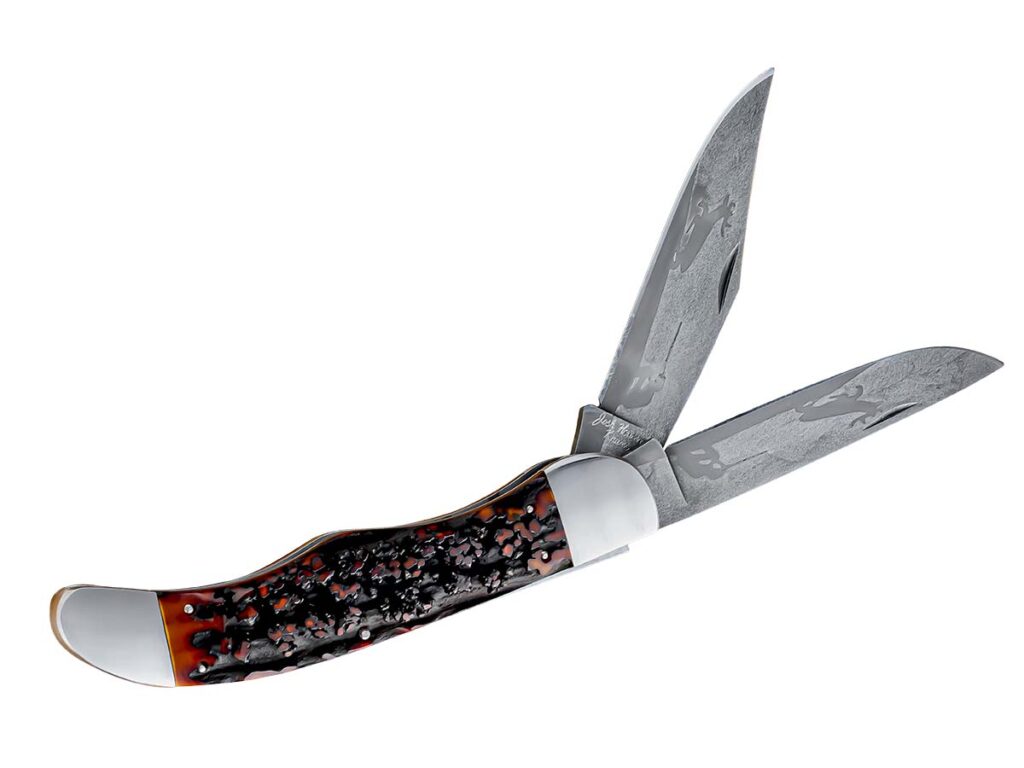
Josh Howard Folding Hunter

Josh Howard Folding Hunter

Action: Slipjoint
Blade length: 3.5”
Blade material: Pattern-welded deer hunting scene
Blade grind: Hollow
Scales: Amber stag
Handle frame & bolsters: Stainless steel
Closed length: 5.25”
Maker’s price for a similar knife: Contact the maker for info
Maker: Josh Howard, deerlickridgeforge.com (SharpByCoop image)


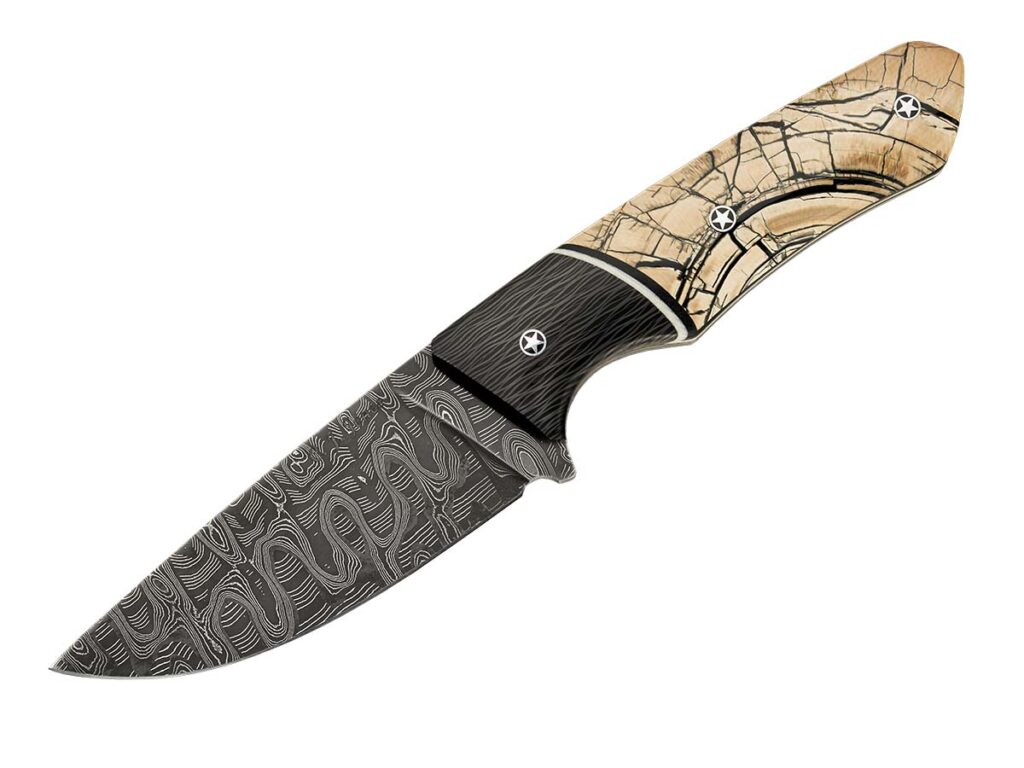
Chad J. Jones Hunter

Chad J. Jones Hunter

Blade length: 3.75”
Blade material: Mike Norris Hornet’s Nest stainless damascus
Blade grind: Flat
Scales: Crosscut mammoth tusk
Liners: Black and white G-10
Bolster: Zebra carbon fiber
Overall length: 8”
Maker’s price for a similar knife: $1,250
Maker: Chad J. Jones (Jocelyn Frasier image)


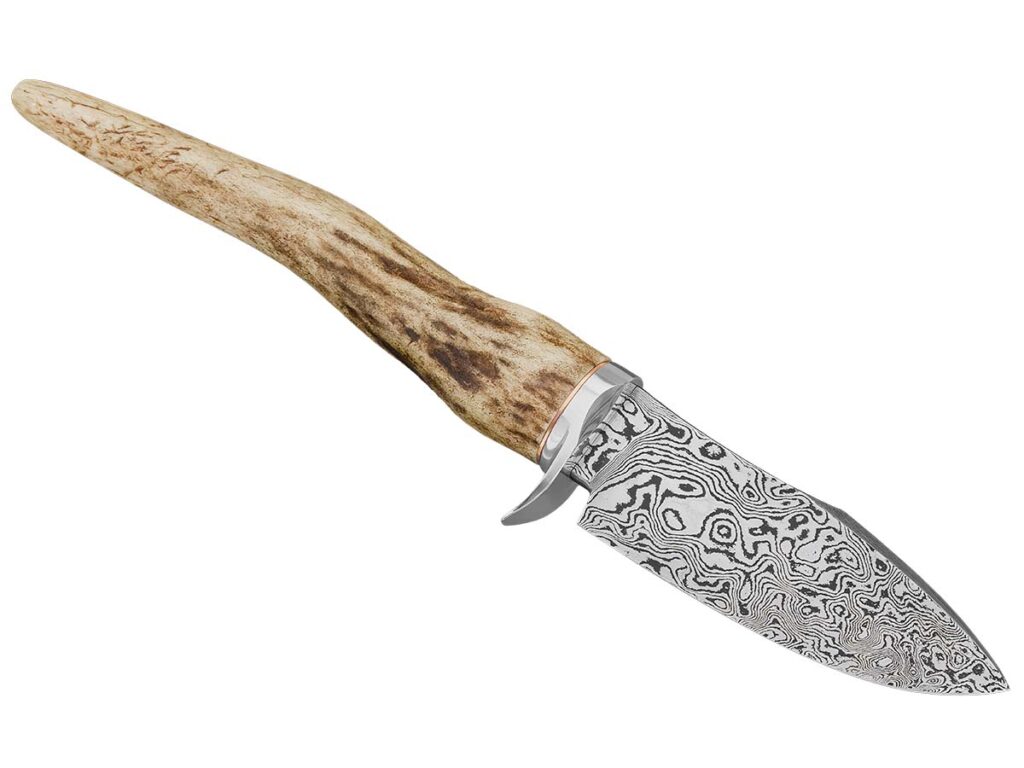
William Manning Hunter

William Manning Hunter

Blade length: 3.35”
Blade material: Random-pattern damascus of 1084 carbon-and 15N20 nickel-alloy steels
Blade grind: Flat
Scales: Antler w/copper spacer
Guard: 416 stainless steel
Overall length: 8.27”
Maker’s price for a similar knife: Contact maker for info
Knife to know: The maker is a probationary member of the Australian Knifemakers Guild
Maker: William Manning, manningblades.com (Rod Hoare image)


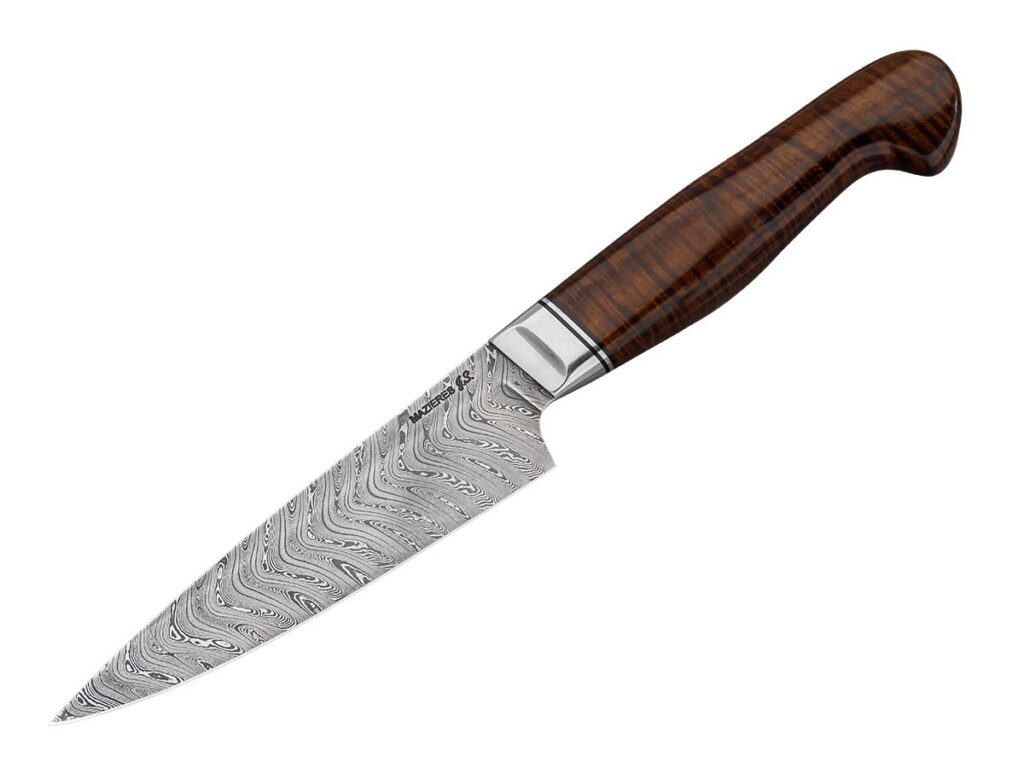
Francois Mazieres Medium Paring Knife

Francois Mazieres Medium Paring Knife

Blade length: 5”
Blade material: Pattern-welded damascus in 150 layers of 1084 and 1075 carbon- and 15N20 nickel-alloy steels embossed using
chevron dies for the final pattern
Blade grind: Flat
Scales: Stabilized South-Australian ringed Western Myall wood shaped in a composite Western/cowboy style
Spacers: G-10 and stainless steel
Bolsters: Scalloped, pinned and soldered 416 stainless steel
Construction: Hidden tang
Overall length: 10”
Maker’s price for a similar knife: $320.62 at press-time exchange rate
Knife to know: The maker is a member of the Australian Knifemakers Guild and a journeyman smith in the American Bladesmith Society
Maker: Francois Mazieres, Yandiwa.com.au (Rod Hoare image)


Nate “Tuna” Grant Utility Fixed Blade

Nate “Tuna” Grant Utility Fixed Blade

Blade length: 4”
Blade material: Rietveld Dragonskin damascus by Bertie Rietveld
Blade grind: Flat
Handle: Titanium, nickel silver, fiber liners, laser engraved
Overall length: 8”
Sheath: Guster leather; inlaid w/exotic animal skin; belt model with snap
Maker’s price for a similar knife: $5,000
Knife to know: The maker’s utility fixed blade won Best Utility at the 2024 Lost Pines Knife Show
Maker: Nate “Tuna” Grant, madebytuna.com (Jocelyn Frasier image)


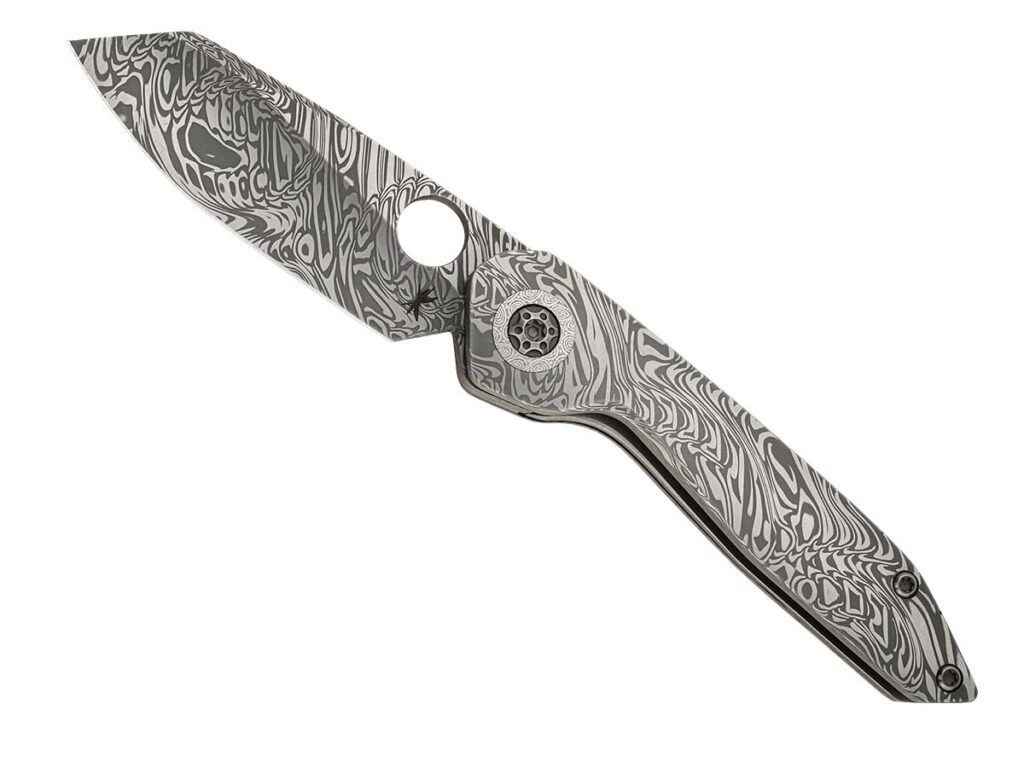
Bryan Montalvo Basset

Bryan Montalvo Basset

Knife type: Folder
Blade length: 3.25”
Blade material: Grabak damascus by Damasteel
Blade grind: Hollow
Blade pivot: Skiff caged ceramic bearings
Handle: Same material as blade
Lock: Linerlock
Pocket clip: Same material as handle
Closed length: 3.5”
Maker’s price for a similar knife: $3,000 at press-time material costs
Maker: Bryan Montalvo, keanisonknives.com (Jocelyn Frasier image)


More Knife Reviews:

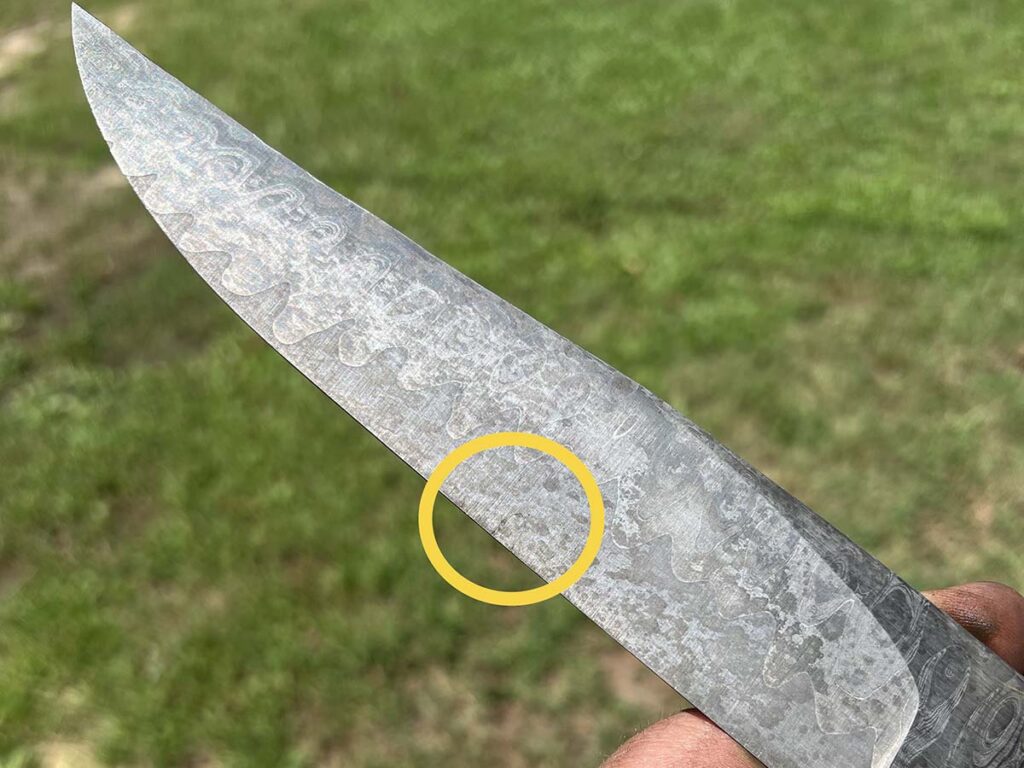
Damascus Flaws: How To Spot Imperfections in Custom Knives

Learn how to spot flaws in Damascus steel blades, like delamination and inclusions, with expert tips from master bladesmiths.

They may be small and insignificant or obvious and glaring, but the skill that is involved in forging damascus steel and then fashioning blades and furniture that adorn custom knives like no other component naturally produces the potential for flaws in the steel itself.

Ironically, the structure of damascus steel, the allure of its beauty and texture, images and etched artistry, is brought together with the potential for a flaw. The production of billets that contain welded elements of 1080 carbon- and 15N20 nickel-alloy steels or other variations involves the marriage of metals. And like any union there is the possibility of a fault. The flaws may be serious or inconsequential. For the buyer, the ability to spot an imperfection and make a value judgment is highly beneficial in the ownership experience.

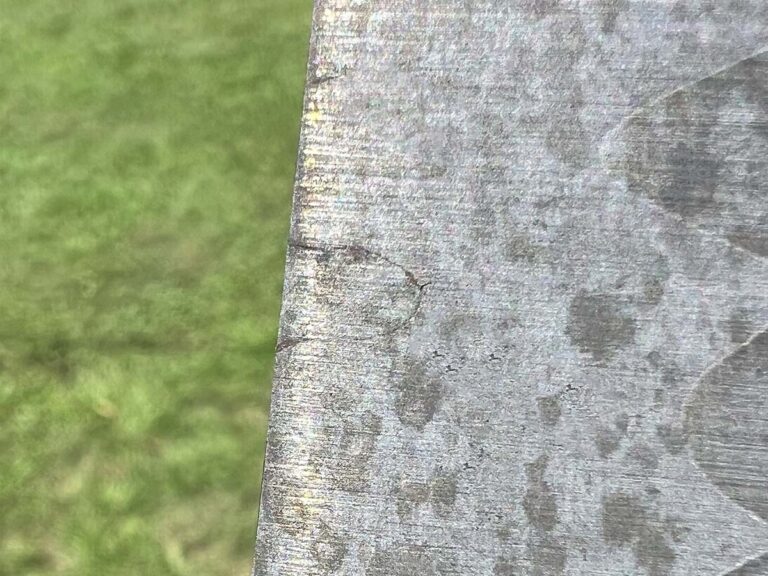
“I would say the most common flaw in a damascus blade is delamination,” ABS master smith Lin Rhea opined. “This shouldn’t be in a knife that is offered for sale. It’s usually evident as a hairline void in the layering and could occur anywhere on a blade. But I see them mostly in the deepest part of the blade as they are revealed in the bevel grinds. I believe this could be prevented by being sure the billet is up to proper welding heat before extracting it from the forge for the first weld in the particular stage of pattern development.”

In a similar perspective, ABS master smith Bill Burke sees imperfections as “a closed shut or incomplete weld that can be found anywhere on the blade. It can be seen as a dark or silvery line in lightly etched damascus or becomes a deep crevasse on heavily etched damascus—and it is caused by the smith not letting a billet soak at heat long enough before welding, or by manipulating a weld that has not been fully set and then working this tear back into the pattern.”

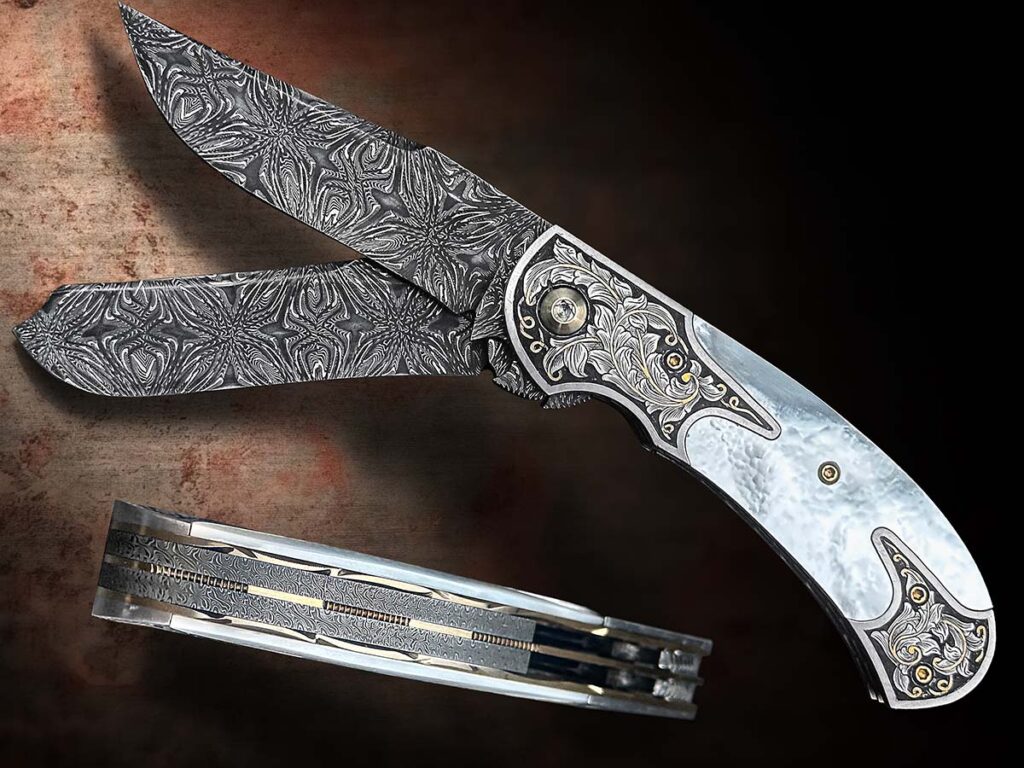
Fortunately for knife enthusiasts, most quality damascus knives are free of flaws, such as Eliot Maldonado’s saddlehorn trapper in Blackbird damascus by Chris Zimmerman. (Jocelyn Frasier image)

ABS master smith Steve Randall agrees and sees these types of imperfections and other potential flaws as well.

“The most common flaw on a damascus blade is the cold shut or an area where the pieces did not weld,” he observed. “It is not so much where it occurs on the blade such as the tip, edge or spine, but where the two different steels meet in the pattern. It’s the two steels that didn’t weld together that creates the flaw, and sometimes they aren’t noticed until [the maker starts] grinding into the blade.

“I would say another common flaw for damascus, mosaic specifically, would be shadow lines from the tiling process,” Steve continued. “Structurally they don’t change the steel, but they can detract from the mosaic visually.”

Both Rhea and Burke have encountered other flaws related to the fusion of the two steels in damascus.

“Less common is an inclusion of some kind,” Burke explained. “Twenty years ago flux inclusions were fairly common. Now one sees inclusions of weld filler material, though, overall, inclusions are less common now than 20 years ago. Inclusions are always found in between the elements that make up the pattern in a bar of damascus.”

Lin added, “I’ve also seen where the maker has left a bit of welding rod material within the damascus blade. This appears as a cloudy gray area and is pretty distinct in appearance from the hardened damascus. In the event wrought iron or mild steel is mixed with high carbon and the layering is of a relatively low number count, this could be part of the intended pattern, so it might be acceptable.”

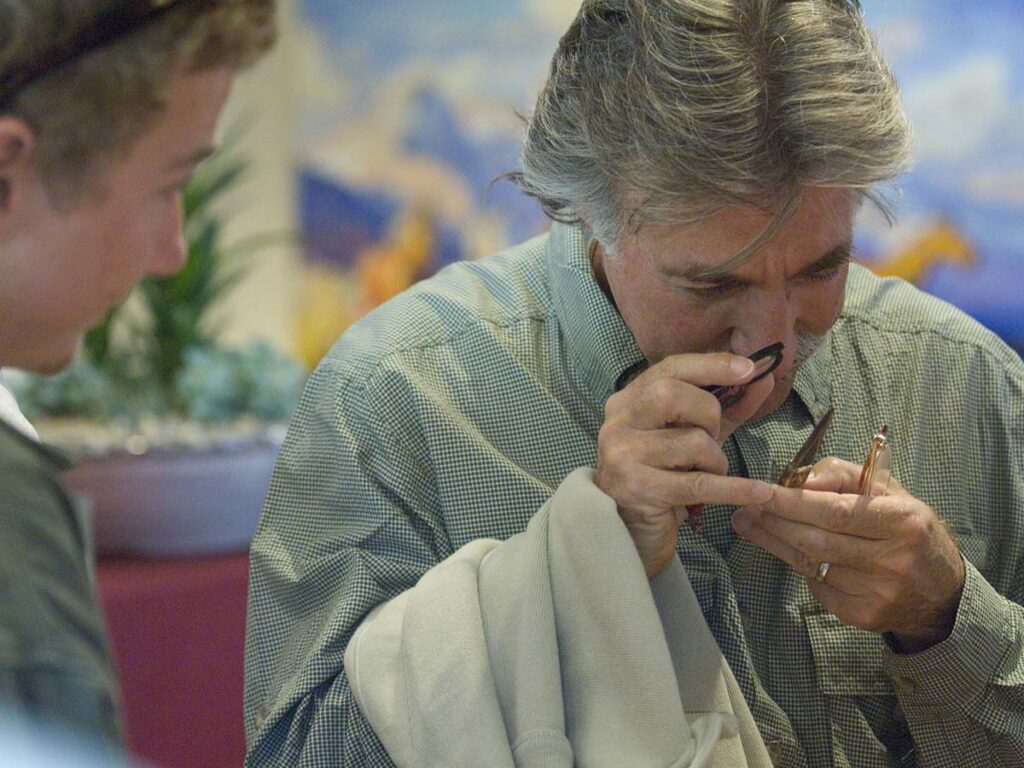
“If you’re at a show and feel you want to look at the blade under a magnifier, then you should ask the maker if he minds,” Bill Burke noted. “If he says ‘no’ or gets upset, then thank him and walk away.” (Eric Eggly/PointSeven image)

According to ABS master smith/BLADE Magazine Cutlery Hall-of-Fame® member Steve Schwarzer, the particular combination of steels might raise the prospects for a flaw to develop, especially when the skills of the maker are evolving. He commented.

“The worst flaws are the delaminations and inclusions,” he said. “These might come from poor welding practices and the choice of alloys involved. Some welds are much easier to make than others and a higher level of skill may be required. Most of it is visual—bad welds are bad welds and don’t have the necessary molecular bond.”

For a potential buyer the ability to spot a flaw is an attribute that pays off when dollars are exchanged for the finished product. Although a flaw may have no impact on the structural integrity of the damascus steel itself, the degree of impairment—if any—ultimately lies with the potential buyer who assesses the level of discrepancy. Approaching a maker’s table, discussing the damascus, and taking a closer look at the blade will sometimes generate relevant conversation and exchange of information. Flaws can show up anywhere in damascus construction, so visual inspection comes with the territory.

Schwarzer advises buyers to check the knife thoroughly.

“Using magnification helps. If the blade doesn’t look right, it probably isn’t. A flaw may show up as a bright spot in a dark area, and some skilled people can reweld their billets. I do that regularly and especially when I do guards and stuff, taking a light hammer and welding heat to fix it, but not everything can be repaired. Sometimes there is no way to repair it, and that is one reason why I hardly ever sell damascus steel—[and if I do] only to skilled professionals.”

Visual Signs

When a buyer’s interest is piqued, the next steps involve courtesy and cordial exchange with the knifemaker.

“Flaws in damascus can range from very hard to see to blaring and obvious,” Burke remarked. “An experienced eye in good light and magnification are the best ways I know to detect them. Some can be felt, but feeling the blade and running your fingers up and down and across it are not reliable and can cause rust and tarnish. If you’re at a show and feel you want to look at the blade under a magnifier, then you should ask the maker if he minds. If he says ‘no’ or gets upset, then thank him and walk away.”

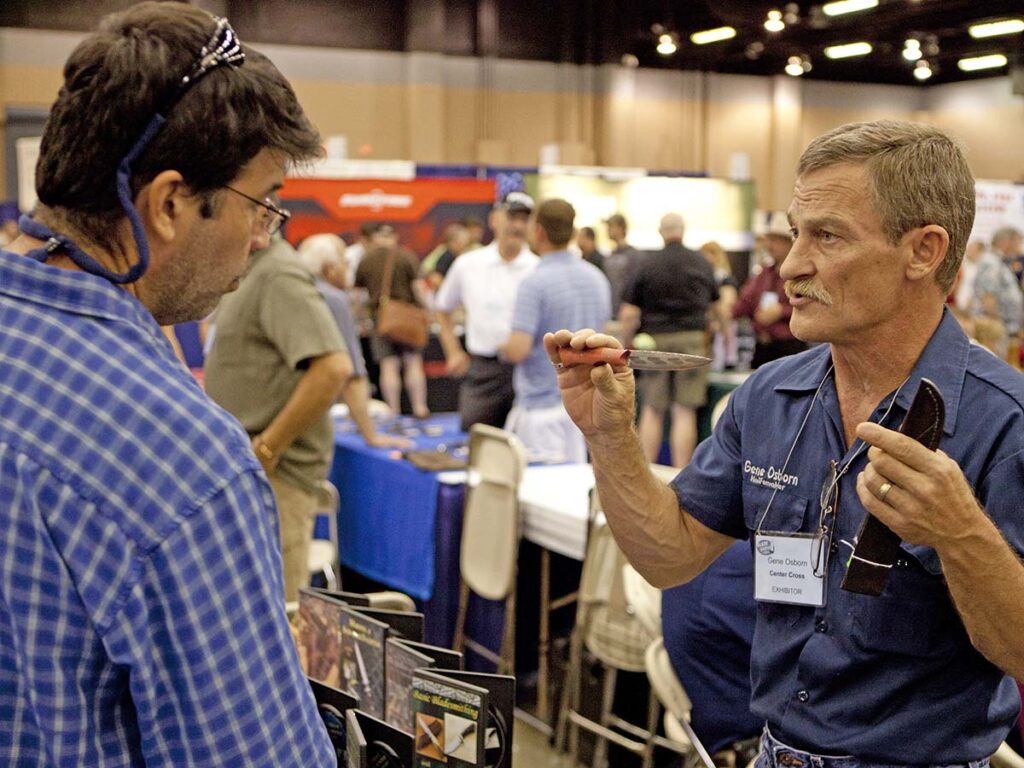
Steve Randall said most makers would not intentionally sell a knife knowing it had a flaw or without first pointing it out to the buyer. Gene Osborn (right) discusses a damascus knife with a customer at a past BLADE Show. (Eric Eggly/PointSeven image)

Randall concurs with that point of view.

“Bright light sure helps,” he observed. “It is difficult to find small flaws once a damascus blade has been etched. Running your fingers over the blade won’t tell you anything, and if you’re at a show I advise not doing it. Using a magnifying glass at the maker’s table could be awkward, and I would suggest respectfully asking before doing it.”

Historically, skilled makers and smiths have assessed their own work and identified flaws, correcting them or chalking up a flawed blade to the hazards of the craft. When ABS master smith Mike Quesenberry considers the flaw in context, he is frank in his response.

“The smith sees the weld lines with flaws before the steel is etched. To me that is something the smith has to deal with. I don’t have any problem scrapping a blade if [a flaw] shows up in the process. The hand sanding and grinding are where the time is really invested, and makers should be honest with their work. If you see a flaw, scrap it,” he stressed. “The best way to fix a flaw is to throw that blade away and start over again.”

Schwarzer smiles when he relates the style of an ancient practice.

“Japanese smiths worked out a way to hide a flaw if it didn’t mechanically affect the viability of the blade. They would do a nice little gold inlay. That was done in Persia, too, and a lot of other places. They would put artwork over something that was unseemly. If you have $300 in a blade and there is no mechanical problem, then that is a way to make it go away. It’s been said that the difference between a journeyman and a master smith is the size of the screw-up you can fix.”

Rhea acknowledges the human side of the situation. There may be a temptation to continue working on a knife with a flaw in the damascus, but then comes the realization on the part of the maker that causes him to refrain from that option. “When a buyer sees any odd discoloration in the form of surface treatment, color or texture, ask questions and give the maker the opportunity to explain or rethink his position,” he noted.

Resolving Situations

Bladesmiths and custom makers are genuinely committed to excellence. However, at times there may be a situation involving a flaw. When a purchaser detects something that may or may not be an imperfection, talking with the maker can resolve the situation to mutual satisfaction.

A welding flaw might pass a cursory glance, which is why you should always inspect any damascus blade you plan to buy closely.

“If you buy a blade and then find a flaw, you should contact the maker and ask them about it,” Burke advised. “If it is something you cannot live with, ask for a refund or allow the maker to replace the flawed knife. In most cases, the maker is going to be unaware of the flaw. If the maker is aware of the flaw or refuses to do anything for you, then you either have to keep it and say, ‘Oh well’ or sell it to someone else with full disclosure of the flaw.”

“When I have a buyer who experiences issues of any kind, I would prefer that they contact me and give me the opportunity to evaluate, discuss and make it right,” Randall noted. “I’m sure most makers would not intentionally sell a knife knowing it had a flaw or without first pointing it out to the buyer.”

Rhea sees the interested parties taking the high road in almost every case. “Most makers will honestly make a sale with good intent and in good faith,” he reasoned. “If there’s a problem just contact the maker and let him or her explain or make it right. Ultimately his reputation is on the line and he deserves the chance to make it an overall pleasant experience.

“When it comes to flaws and issues,” Lin concluded, “we all have them and we handle them in our own ways. To the degree we act to prevent problems for the buyer we also prevent problems for ourselves as makers, as well as enhance our reputation. Leaving flaws in damascus will reflect on our honesty and our attitude toward the buyer. This is something to think about very seriously. So, will there be problems? Yes, but we should go to great effort to prevent them rather than having to correct things that might be perceived as an oversight. In the end, we are human and will want to use common courtesy and humility in our dealings.”

More On Damascus:

ABS Names New Smiths At Blade Show 2025

0

Celebrate the new class of master and journeyman smiths! See who received the top honors from the American Bladesmith Society at the recent BLADE Show.

The American Bladesmith Society awarded its coveted ratings of master smith and journeyman smith at the recent BLADE Show in Atlanta.

Three applicants achieved the rating pinnacle of master smith:

  • Andrew Blomfield (Australia)
  • Luiz Gustavo Gonçalves (Brazil)
  • Erik McCright (Weatherford, Texas)

Gonçalves also won the awards for Best Kitchen Knife and Best Fighter during the BLADE Show custom knife judging competition.

Argentina’s Matias Funes was awarded his ABS journeyman smith stamp during the 44th Annual BLADE Show after his five test knives met with the approval of the ABS JS judging panel. (SharpByCoop image)

Journeyman smith stamps were awarded to:

  • Felipe Cavallin (Brazil)
  • Jason W. Coy (Squires, Missouri)
  • Viktor De Bonte (Woodinville, Washington)
  • Adam Fromholtz (Australia)
  • Matias Funes (Argentina)
  • PJ Gouws (South Africa)
  • Nate “Tuna” Grant (Seguin, Texas)
  • Matthew Hartwig (Bozeman, Montana)
  • Nishan Mood (Fullerton, California)
  • Christopher Moss (Asheboro, North Carolina)
  • William Porto (Brazil)
  • Willie Van Der Merwe (South Africa)
  • Jan C. Vatelau, (Boise, Idaho)
  • Michael Hobbs (Shelbyville, Tennessee)

In addition, Gonçalves won the award for the best knife presented by a master smith applicant for judging, and Funes won the award for the best knife presented by a journeyman smith applicant for judging.

Journeyman smiths are the second highest level of ABS member bladesmiths, surpassed only by master smiths. Each must pass rigorous tests before achieving their respective rates, with the journeyman smiths having to wait a specified time once making JS before they can apply for the top rating of MS. For a complete rundown of the tests, requirements and other bona fides of both ratings, visit americanbladesmith.org and click on “Member Resources.”

More On BLADE Show 2025

Knifemaking Business: Commission Knives, Designs And More

0

A veteran maker shares timeless advice on commissions, design, and running a successful craft business.

I rarely do commissions. It’s difficult to keep some clients from wanting to take part in the process. Their job is to tell you how much they like the piece when it is finished and gather the money to cover their overextended budgets. In your role as crafter/knifemaker, don’t let them bully you. There are no grounds for complaints if you give them what they originally approached you about.

The most difficult part of doing commissions, aka taking orders, is keeping everything on schedule. A delivery date is just that. Even if it’s a couple of years out, don’t wait until the end to go looking for materials and services. Casters work better with a heads-up beforehand and engravers may need a year to get past what they are working on. As a result, get your name on the list with others waiting for a bit of the crafters’ time to cast your pieces and for the engraver to work out a design for your project.

I run on satisfied customers. One black mark cancels out a slew of gold stars. I’ve never had a customer who wasn’t satisfied, period. I give even my smallest work the same close attention to detail as the larger and more standout ones. Every piece deserves the most attention I can give it to bring it to the right state of finish when everything is done.

I don’t spend time debating how much it costs if they are paying up front. It’s out of your hands at that point. If they insist and it does make for a tighter presentation, I have no complaints—if I’m still doing it my way.

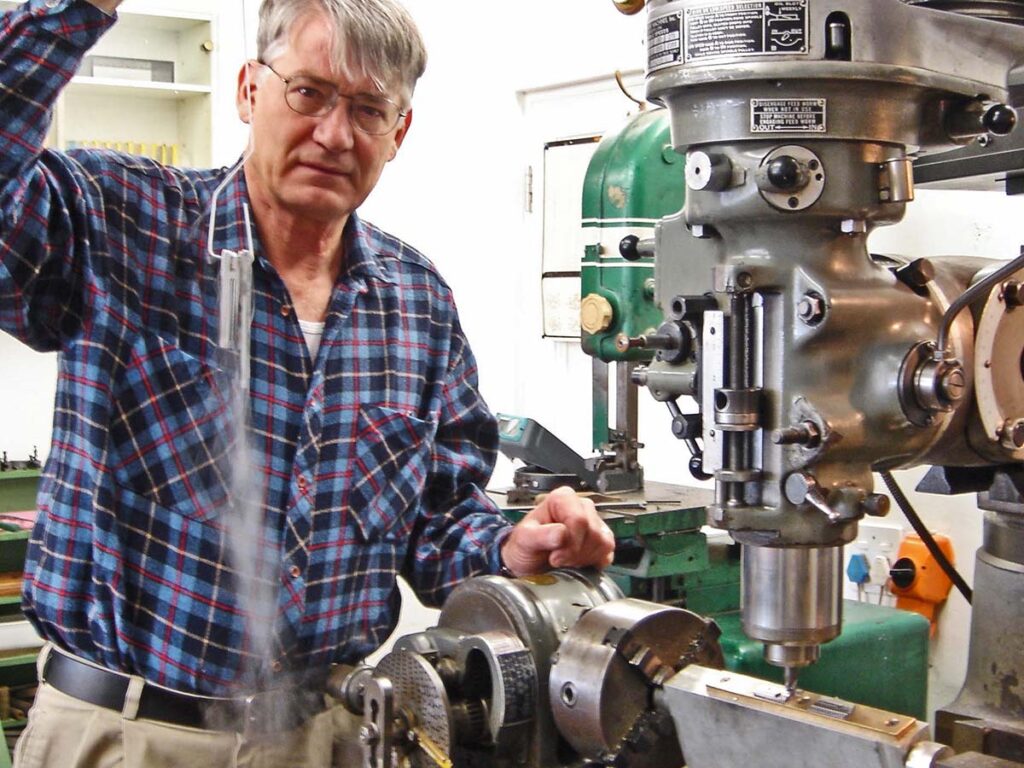
When buying tools think about their longevity—good ones last, cheap ones don’t. South African knifemaker Des Horn’s Bridgeport milling machine is one of the good ones. (Des Horn image)

One time I had a 36-carat uncut ruby for a specific part of a presentation. The clients changed that out and added another $10,000 to the materials list. Put a pound of 24k gold in the mix, two feet of AAA lapis lazuli and another pound of silver and you have nearly a year of work making it all look like something that befits the materials. There is nothing finer than 24k gold and large ruby star sapphires set in deep blue AAA lapis lazuli.

Of course, there is the matter of it not existing until you do it. That part can be intimidating at times. Then there are the occasions when the client goes well over the beginning budget. If this happens, you must deal with the backlash from him blaming you, when all was done at his request.

Maintain Your Health

People were making wondrous things with simple ingredients 4,000 years ago, without the benefit of dental care, bifocals and electric lights and on a diet that barely sustained them most of the time. They died by 45 usually, so had only the time between when they were 9 or 10 until their eyes began to fail them by 40 or so. I have been making and selling my work for more than 50 years with all the benefits living in a civilized time can bring. I am still excited about projects, no matter the size. I still eat lots of fruits and greens and shredded wheat large biscuits.

If you want to do your best work, you must stay healthy. Like any other working mechanism, your body tissues need the time to relax and rejuvenate. For example, if you don’t give the fingers in your hand enough time off, they will give you problems later in your career. The cartilage in your joints will only take so much punishment, so give the muscle tissues in these areas time to relax a bit before moving onto your next project.

Engravers may need a year to finish an ongoing project before they can accept your order. As a result, get your name on the list with others waiting for an engraver to work out a design for your project. The engraving on a Herucus Blomerus folder is by Henk Viljoen. (SharpByCoop image)

Sometimes it may take a few days for an overworked appendage to return to normal if you’ve stressed it in some way. Always protect your eyes and ears from foreign objects and stressful sounds. I finally took the large subwoofer out of my studio because it was leaving me partially deaf by the end of the day, even more so than most of my tools.

Design Process

Design is where you make your identity come to life with a few pencil marks and colored markers. You want to present a consistent image that people will remember and that you can live with in the future.

The most important thing to know when you begin making anything is what it’s supposed to look like when it’s finished. That’s where those blank sheets of paper and erasures come into play.

Make your design mistakes on paper. Don’t wait until you’re well into something before admitting to there being some mystery grey areas concerning how it’s supposed to work. Wait to start something until you have a good idea as to how to feasibly do it. The sketches are just that; they allow you to put a bunch of feasible ideas down on paper next to each other and put big X’s on the ones that don’t work with the others. It may take a few tries to get what you’re looking for down, but now you can start thinking about materials, colors, etc., and establish the theme of the drawing. This will help you decide the things needed to make it real.

Your body needs time to relax and rejuvenate. For example, if you don’t give your fingers enough time off, they will give you problems later in your career. Steve Johnson files a guard in his shop. (Steve Johnson image)

Once you’re working, don’t deviate from the drawings unless it will make it a stronger presentation. I always try and give the piece the best ideas I can to make it able to stand with the other things I have made, and give the customer the best I can do at the time. It makes for more hours but also gives a much stronger presentation.

Money Matters

All crafters have money fixed firmly in their minds. If you can just get the circumstances right, you know people will like your work and you will sell it.

As a group, crafters are undercapitalized and have no backup cash for when calamity strikes. Until you can show a profit and can pay your suppliers, you don’t have enough funds to sustain your business when the bottom falls out of your market, either locally or globally. All of today’s crafters have experienced this. I wish I had an answer—I wish someone had an answer.

Maintaining Materials

Materials are “the paint” of my work: silver for white, gold for yellow of differing shades, bronze for brown gold, jade for green, emeralds for green, Nigerian green tourmaline for green, rubies for red, carnelian for orange/red, lapis lazuli for blue, etc. Your stockpile of materials controls the variables in your work. Where would Van Gogh have been without yellow, orange and electric blues on his pallet?

Always protect your eyes and ears from foreign objects and stressful sounds. ABS master smith Steve Randall shows how it’s done. (Steve Randall image)

It has always been considered easier to do color photography than black and white photography. I think there is a correlation in craft. The simpler the design, the more important it is not to deviate from the original line. A fine example of this is the work of Wolfgang Loerchner; it is so clean and simple in design, with wonderful materials, and no room for any deviation in the completed piece. That’s difficult for me. His work is spotlessly fine while I spend part of my time trying to make it look like I didn’t have any difficulties in the making.

If your budget allows it, always stockpile unusual materials that are necessary in your work so there are no down times while you wait for four feet of Madagascar ebony, or a pallet of clay to be dropped at your step. If you already have it on hand, there are no delays.

Buy quality materials. You don’t want your turned goblet to twist and crack and eventually fall apart because the wood wasn’t properly dried or treated after it was done. Most natural materials will take no heat because they were created at normal earth temperatures. Too much heat and anything will crack—if not today, weeks or years later. Epoxies usually give way at anything over 150° F. Buffers will bring the temperature up to that point quickly, making the epoxy no more than a filler rather than bonding the materials together.

Knifemaking Tools

Every craft has its list of necessary items you need to do it well. When you’re buying those things think on the longevity of the tool—good tools last, cheap ones don’t. I’m still using items I purchased in the early ’70s on a regular basis. They don’t always have to be “show dog quality” in appearance if they still work well.

Conclusion

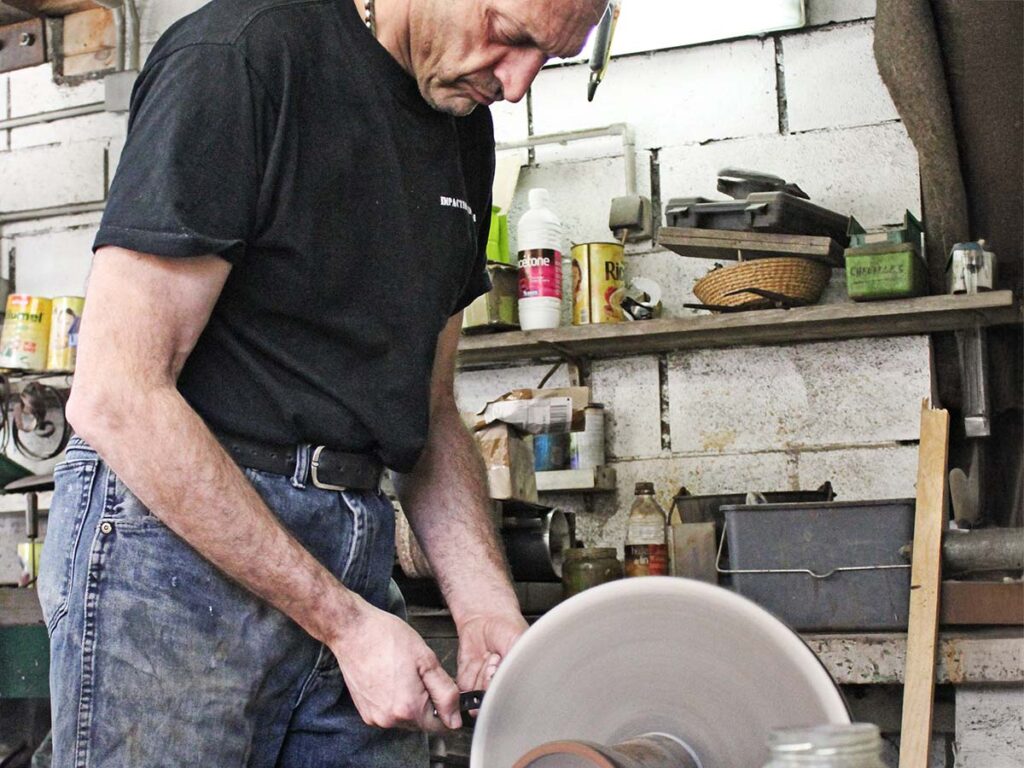
Too much heat and anything will crack—if not today, weeks or years later. Epoxies usually give way at anything over 150° F. Buffers will bring the temperature up to that point quickly, making the epoxy no more than a filler rather than bonding the materials together. Veteran French knifemaker Fred Perrin polishes a knife on an old-school buffing wheel in his shop. (image courtesy of Michael Janich)

To you out there who have jumped on the craft wagon: always think things all the way through beforehand. It will make your landing much more enjoyable. I know I have given you a list of things that is larger than you want to deal with, but if you want to see your name in lights someday, you must follow the simple rules every business must have to survive or you will only make it more difficult for yourself, your career as a crafter, and, most of all, your family standing behind you.

It’s always a swim against the current for all of us.

More On Knife Marketing:

Master Bladesmiths Showcase Their Best Long Swords

See the artistry and craftsmanship of seven custom swords from some of the best bladesmiths in the world.

Not only do swords bring out the best in some makers, those who make quality versions of them often seem to be among the best makers as well. Check out the long blades on this and the facing page and see if you agree.

Garbriel Turner: Jineta

Garbriel Turner: Jineta

The Jineta by Garbriel Turner has a 28-inch wootz blade, an ancient walrus ivory grip and iron/gold fittings. Blade grind: flat. Overall length: 36.5 inches.


Eric Estlund: Oak Themed Storta

Eric Estlund: Oak Themed Storta

Eric Estlund’s Oak Themed Storta is in a 17th-century Italian style. The 28-inch blade is 8670 carbon steel and the handle is oak burl. An acorn pommel helps complete the theme. A high-relief scabbard (not shown) and steel leaf chape with carved acorn finial add to the presentation.


Matt Parkinson: Arming Sword

Matt Parkinson: Viking Sword

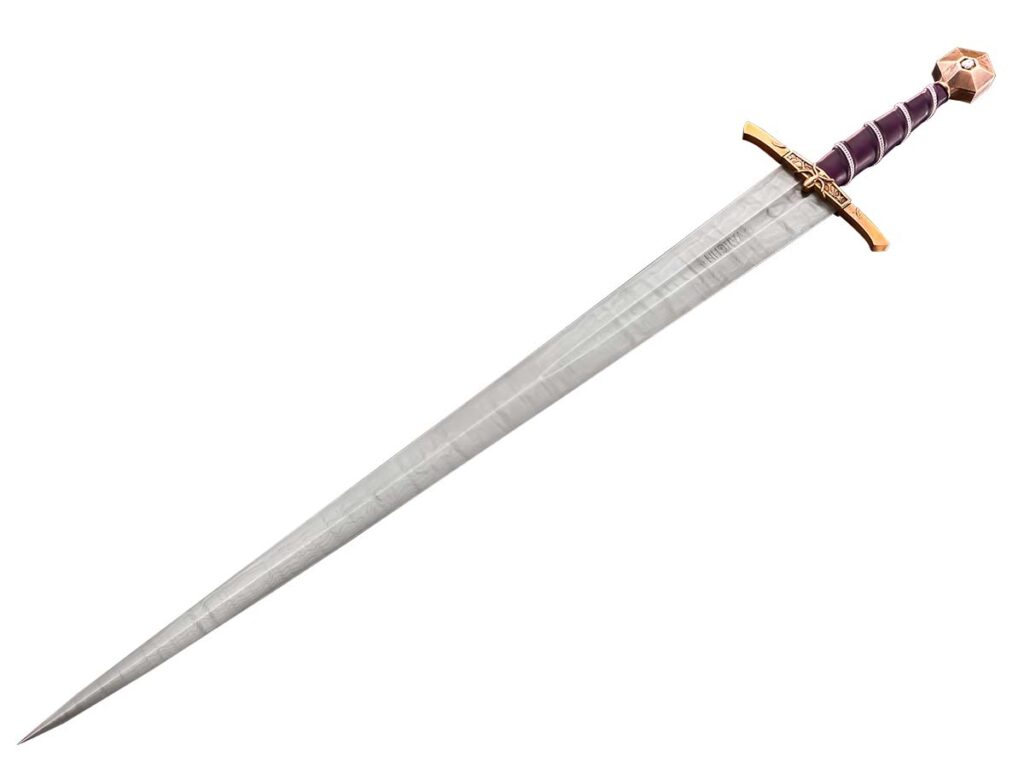
The sword shown is an Arming sword with a complex laddered and mosaic damascus blade. Polished steel fittings and a spalted maple handle. 29-inch blade 36-inches overall, weighing in at 2 pounds 10 ounces.


Zack Jonas: Wakizashi

Zack Jonas: Wakizashi

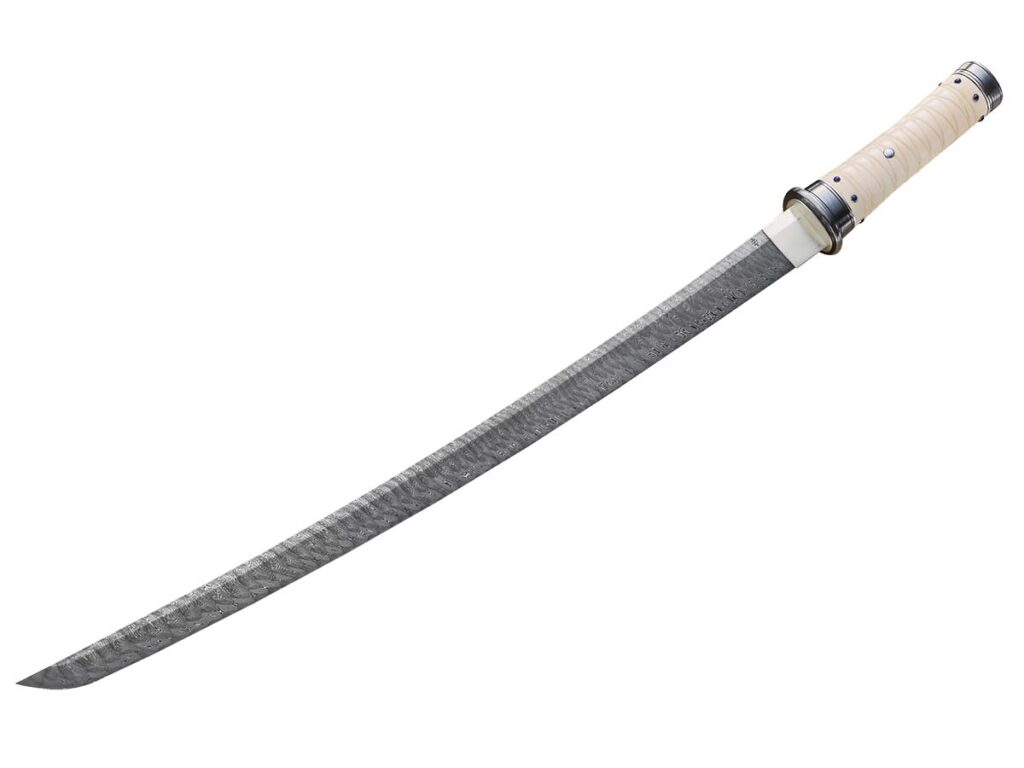
A Gordian core twist damascus completes the 22-inch blade of a Zack Jonas wakizashi. Fittings: W’s damascus and silver. The handle is interior mammoth ivory. Blade pattern: shinogi-zukuri. Overall length: 28 inches. The colorful scabbard (not shown) is by Matt Venier.


Ben Abbott: Viking Sword

Ben Abbott: Viking Sword

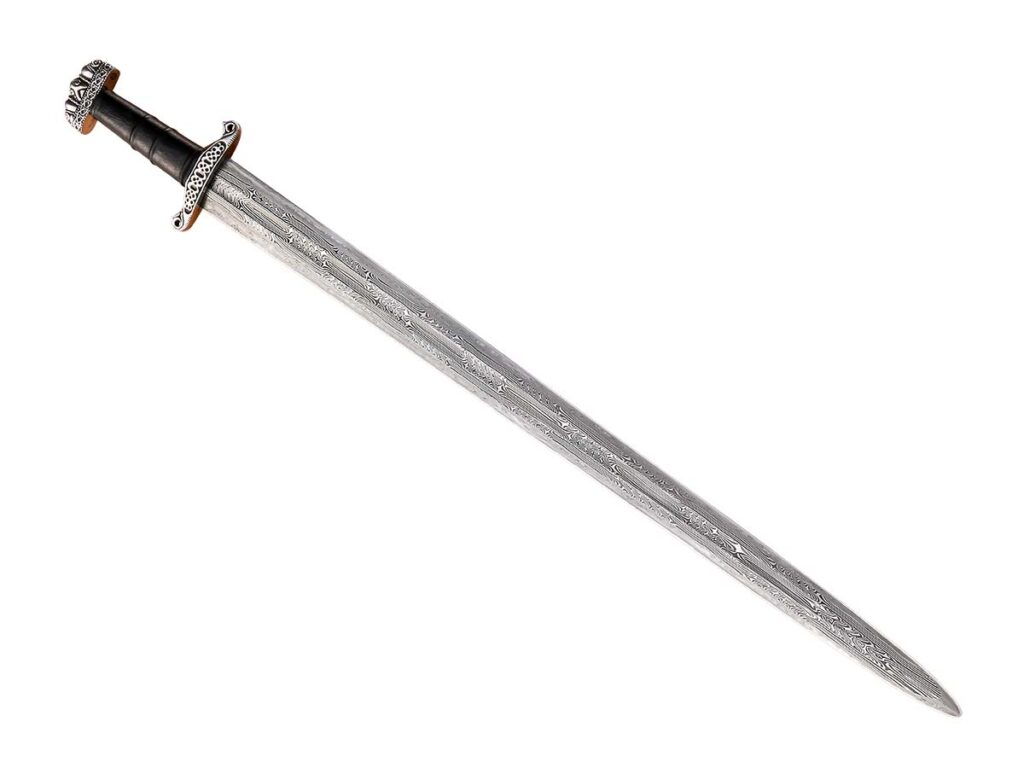
A 26-inch blade of multi-bar damascus, a leather-covered wood handle and cast sterling silver fittings outfit Ben Abbott’s Viking sword repro. Ben carved the waxes for the guard and pommel.


Ryan Breuer: PhD Sword

Ryan Breuer: PhD Sword

We published a closeup of the handle of Ryan Breuer’s PhD Sword the September 2025 issue. Here’s the full-blown model. The 32-inch blade is a damascus of 1084 carbon and 15N20 nickel-alloy steels. The handle is birch, leather and sterling silver.Overall length: 40 inches.


Jordan Borstelmann: Elmslie Type I

Jordan Borstelmann: Elmslie Type I

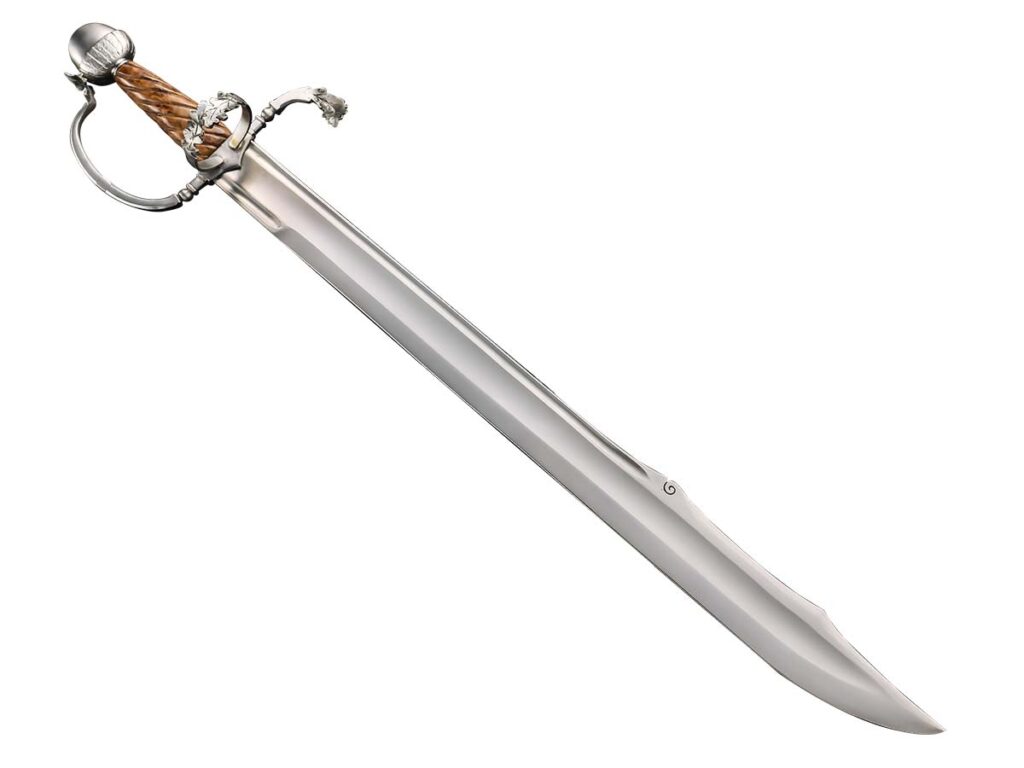
Jordan Borstelmann’s Elmslie Type I of a falchion sword boasts a 28-inch blade of 1075 carbon steel and a handle of leather, cord and wood. Blade grind: flat. Guard: 1045 carbon steel. Overall length: 35 inches.

Read More On Swords:

Hottest Damascus Patterns, According to Top Bladesmiths

0

Top bladesmiths discuss the three hottest damascus patterns.

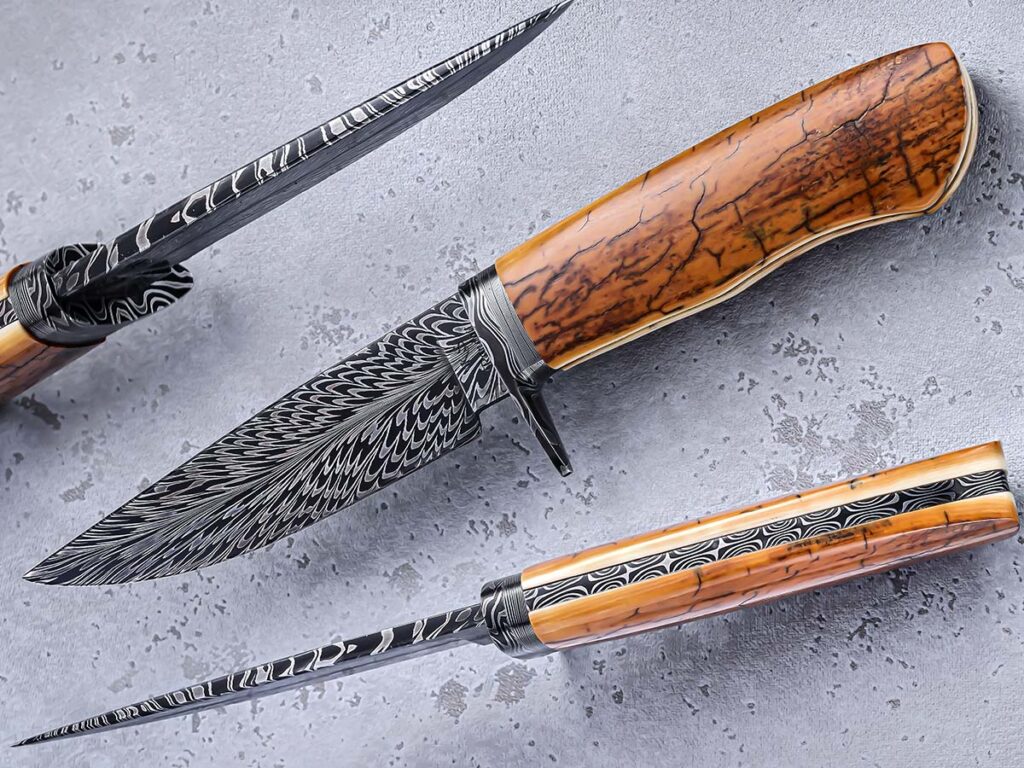
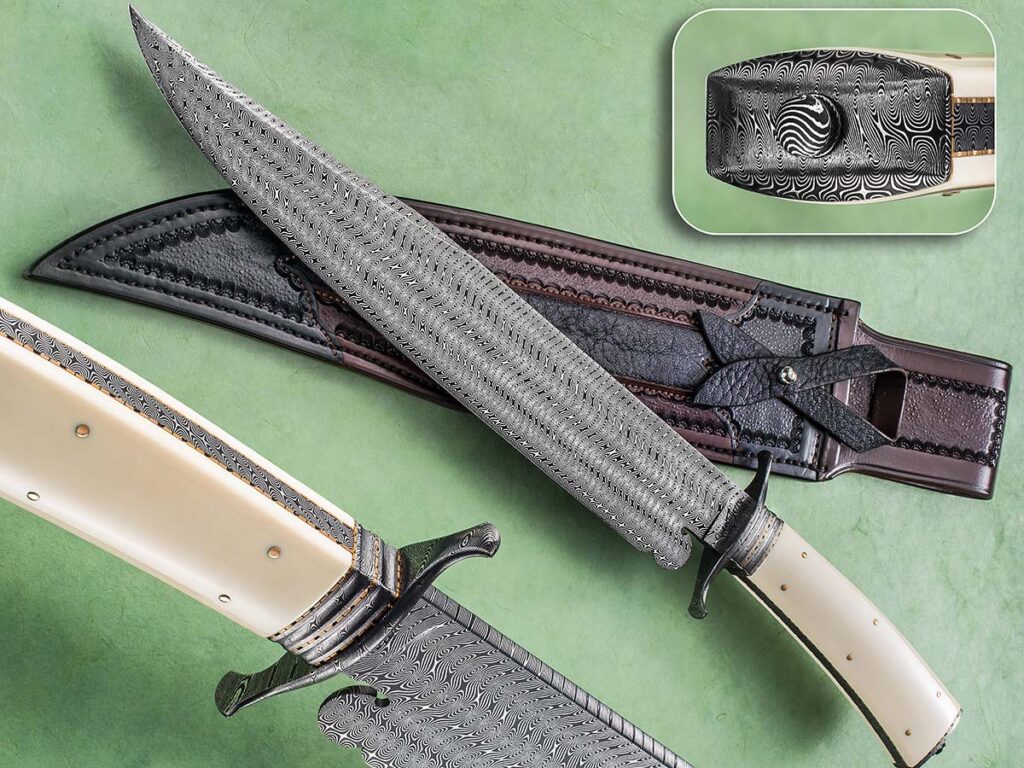
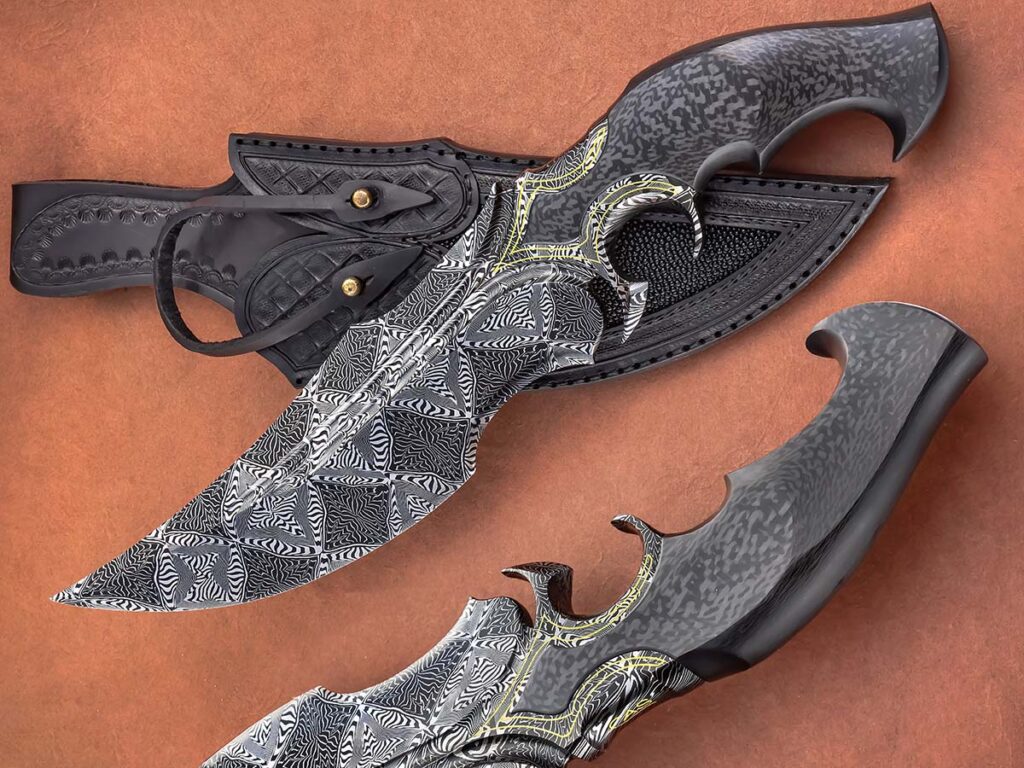
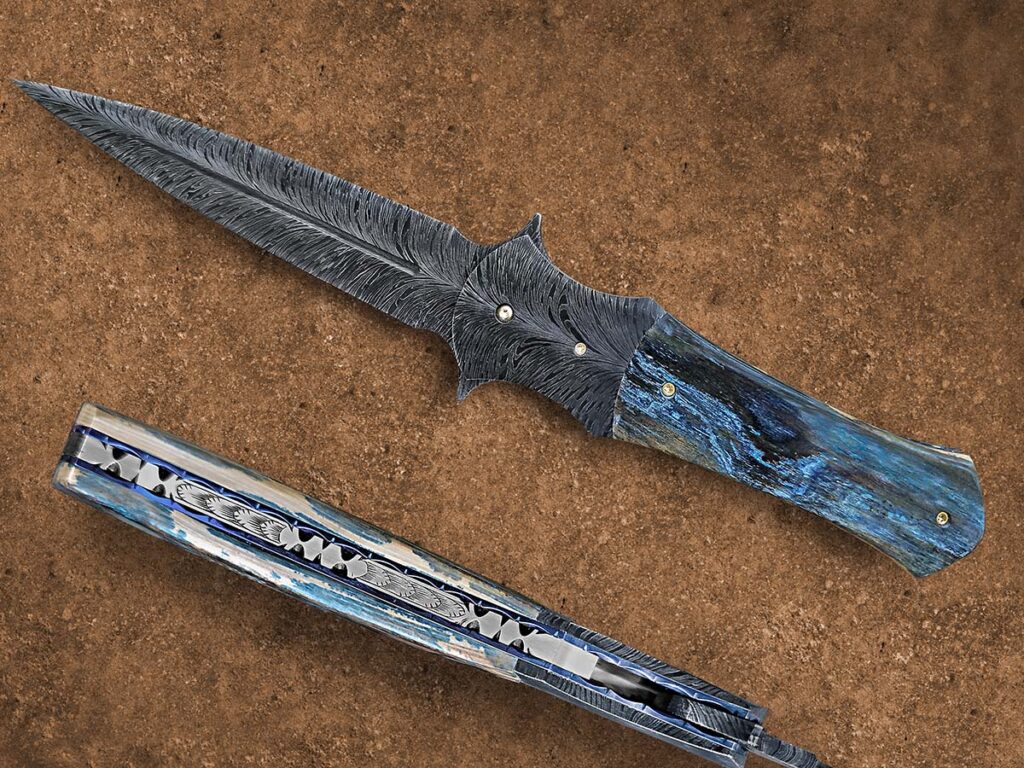
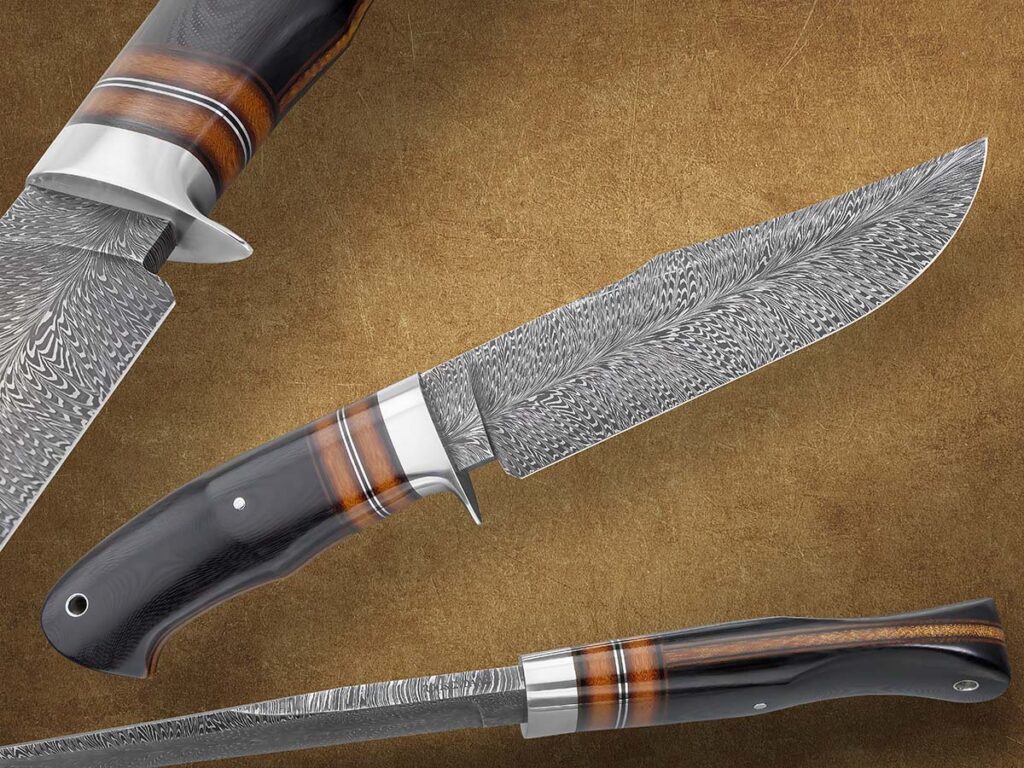
As damascus patterns emerge through the years, their popularity waxes and wanes. The steel itself, layers of intrigue and interest, experimentation and innovation captivate the steel forger, the custom maker and the knife-buying public like nothing else. The patterns abound and in recent reviews of photos, commentary from those in the business and observation it appears that the feather and mosaic, with twist not far behind, have been and continue to be hot.

“I agree that feather and mosaic patterns are predominantly what is made, or certainly what is getting photographed [a lot],” related ABS master smith Steve Randall. “Both patterns are popular because they have lots of character and can be pretty dramatic. Feather patterns are very cool because they can be unique yet still hold true to the feather pattern. The mosaics can move off into so many different styles. They allow the maker to be really creative.”

Feather Damascus Pattern

ABS master smith Bill Burke praises the versatility of the feather pattern and its breadth of presentation.

“I think that you see a lot of feather pattern because it is so striking and looks good on almost any knife style,” he commented. “It is also quite a challenge to produce. A well-done feather will have a flow from end to end with nicely curved veins, while a feather that has interruptions in the pattern or has the center area drawn out into a long ‘V’ shape then curves out rather sharply to the edge is not done so well. I don’t feel a feather pattern is difficult to do after one has mastered pattern welding. It becomes difficult when an inexperienced smith rushes into trying to make a feather before mastering basic pattern-welding techniques.”

“Feather patterns are very cool because they can be unique yet still hold true to the feather pattern,” Steve Randall observed. He matches up the feather pattern with a mastodon ivory handle on his frame-handle hunter. Overall length: 9 inches. (SharpByCoop image)

BLADE Magazine Cutlery Hall-of-Fame® member and ABS master smith Steve Schwarzer sees the artistry in the feather pattern as well, and when he considers the magnitude of its relative surge concludes, “Absolutely. What you don’t see much of is images and the forge skill required to put that in damascus. Both the feather and mosaic damascus are fairly easy to do, and with the internet there are thousands of recipes out there with visual step-by-step instructions. I did the first feather pattern ever done in a folding knife, and [Cutlery Hall-of-Famer] Don Fogg in his Life and Death Dagger was the only one who did a feather pattern before me. I did the first that was recognizable in the folding knife.”

Degree of difficulty is and will forever be a matter of individual perspective and opinion. Randall stresses the experience level of the maker in fashioning the feather pattern.

“I would say that feather damascus can be a difficult pattern,” he offered. “There are a lot of pieces that have to forge weld together, which opens the opportunity for cold shuts or poor welds. Once that happens, you’ve pretty much got a paper weight.”

Mosaic Damascus Pattern

The perspective on mosaic damascus is similar to that of the feather pattern. Its uptick in popularity is driven by the skill of the maker and the diversity of the presentation. Mosaic makes its statement in both subtle and bold blade aesthetics.

“While a simple twist pattern is rather mundane,” Bill Burke noted, “when four or more bars are twisted in opposite directions and stacked one on top of the other to create a Turkish twist, the result can be striking.” A lavish five-bar Turkish-twist damascus comprises the blade, including the Spanish notch at the base of the edge, on Mike Quesenberry’s Mediterranean bowie. (SharpByCoop image)

“Mosaic patterns do lend themselves to individual creativity,” Burke remarked. “They can vary from not too hard to extremely difficult to do. Mosaics are limited only by the smith’s skill and imagination. Mosaics that are done well will have the patterns lined up with no unintended interruptions in the elements and all the individual tiles matched up well.”

Tiles, incidentally, are the small, angled pieces of steel that are carefully assembled and then forge-welded together to create the distinctive, repeating mosaic pattern. The tiles are cut from the billet or block of welded steel that forms the basis for the creation of any damascus pattern. The tile cuts are made with a scarf joint that facilitates the joining of the surfaces to be mated during the forge welding process.

ABS master smith Mike Quesenberry is a big fan of the mosaic pattern, particularly its possibilities for expression.

Mike Quesenberry stated the black and silver contrast of mosaic patterns can do “all kinds of crazy, wild things. It is huge with so many possibilities, and it turns out to be a really good pattern that some like in a fine look and others prefer in a bold statement.” The Sobral Brothers go bold with the pattern on their keyhole subhilt fighter. Overall length: 13 inches. (SharpByCoop image)

“I love mosaic and its creativity,” he declared, “along with the fact that smiths can take mosaic and make it bold or fine and there are all sorts or variations that make it fantastic, from W’s to many others. You can add different layers to fine and thick material, 1080 or 15N20 or whatever alloy. That black and silver contrast can do all kinds of crazy, wild things.

It is huge with so many possibilities, and it turns out to be a really good pattern that some like in a fine look and others prefer in a bold statement.”

Things To Look For

Assessing the quality of the individual feather and mosaic product is an exercise in discernment and preference along with the display of basic skill that is evident. Randall takes a subjective point of view.

“One of the most important signs of a feather pattern that is well done is its flow through the blade,” he observed. “The feather should flow from the center of the ricasso through the blade and out the tip. Both feather and mosaics being well done are in the eye of the beholder. Layer count has a big impact. The higher the count does not always make the pattern better.”

Bill Burke indicated a well-done feather pattern will have a flow from end to end with nicely curved veins. ABS master smith Scott Gallagher nails the concept in the feather-pattern blade of his Dolan Dagger Folder. Closed length: 5.25 inches. (Jocelyn Frasier image)

Schwarzer agrees that the individual’s taste has a tremendous weight in the interpretation of well-done damascus.

“It’s all subjective,” he related. “It involves how pleasing to the eye the fine or bold patterns are. The whole thing can’t be just a hodgepodge of stuff stuck together. It has to tell a story, and if it tells a story, then it is art—and to a lot of people it is great art. There is stuff out there that is incredibly complicated to do that looks simple on the face of it, but it isn’t. We are in the infancy of pattern welding, and a lot of it has come from Daryl Meier.

“There have been patterns out there with faces and images in them since the 1700s,” Steve continued, “and now we are painting with steel. When Bill Moran showed up with random-pattern blades in the early ’70s, he was continuing something that had never stopped. Pattern welding has probably been going on for 4,000 years, and you have to forge, fold and weld the iron to clean it. Then, when you get the alloy in there, it shows the pattern. Pattern welding, including feather and mosaic damascus, is a technique and a skill set that is developed. Once you develop that skill, the trick is to get it back together without flaws, turning something mundane into something striking. Mosaic requires more planning and skill than feather.”

One of the pioneers in—and a most outstanding forger of—Turkish twist damascus is Jerry Rados (inset), who forged the steel for the Wall Street Knife by Joe Kious. Jerry’s Turkish twist has what Steve Schwarzer calls a kaleidoscopic appearance.  (KnifePurveyor.com knife image)
One of the pioneers in—and a most outstanding forger of—Turkish twist damascus is Jerry Rados (inset), who forged the steel for the Wall Street Knife by Joe Kious. Jerry’s Turkish twist has what Steve Schwarzer calls a kaleidoscopic appearance. (KnifePurveyor.com knife image)

Twist Damascus Pattern

Although some patterns may stand out from others for a while, there are always those that maintain their place among the most popular. Twist patterns and specifically Turkish twist are regularly in the conversation when collectors are seeking their prize blade.

“Twist and Turkish twist are the same and totally different at the same time,” smiled Burke. “While a simple twist pattern is rather mundane, when four or more bars are twisted in opposite directions and stacked one on top of the other to create a Turkish twist, the result can be striking. However, like almost all other patterns these two can also be drawn out or stretched too far, which detracts from the looks of the pattern. While a simple twist is relatively easy, the Turkish twist billet is wrought with potential for failure and is very labor intensive.”

A key element in producing twist patterns is control, and Schwarzer respects the precision required.

“Very precise control is necessary in the twisting so you get that twisting the same in fine or coarse layers,” he said. “Jerry Rados was the American guy who did the most of that, and we both learned from Daryl Meier in Carbondale [Illinois]. The early blades made by Daryl in the 1980s are beautiful, but you’ve got to be almost [obsessive compulsive] to produce that stuff. It involves a lot of planning and the turns have to be precise. You can twist mosaic and make it look like a kaleidoscope.”

Chris Roosendaal’s feather pattern in 1084 carbon- and 15N20 nickel-alloy steels borders on the mesmerizing. The scales are black G-10 and Micarta®. Overall length: 11.22 inches. (Rod Hoare image)

Randall says that a Turkish twist done right is “very classy.” Its degree of difficulty is a cut above basic twist, but in his experience, it isn’t quite as demanding as feather pattern work due to the requirement of fewer pieces to “cut, flip and weld together.”

When Quesenberry talks Turkish twist, he affirms his love of the look but decries the amount of waste he sees in its production.

“I’m a huge fan,” he commented, “and I love the fact that it’s an appealing pattern. But I don’t like the huge amount of waste. To me, the cool pattern is in the middle third of the bar. There aren’t really a lot of American and European guys into Turkish twist, but some of the South Americans are really pros who are turning out some bold patterns.”

Shifting Damascus Pattern Preferences

Of course, the shifting preferences and envelope of creativity that is constantly pushed keep the damascus conversation going. And it is likely to remain lively long into the future.

“Trying to say one pattern or another is more popular is always subjective,” Randall concluded. “There are some great classic patterns that are very appealing. For example, the ladder, twist, crushed W’s and others. Sometimes the mosaics get visually busy, so some people don’t enjoy them as much, but who doesn’t love a feather or explosion pattern? They are too cool. Some of it does depend on the overall knife design. The blade design and size with guard and handle can enhance—or take away—from a pattern.”

Considering damascus pattern popularity past, present and future, one element is certain. The driving force of creativity and the artistry of the forge will keep this ancient steel relevant for generations to come.

More On Damascus:

Advertisement

Must Read Articles

Read this before you make a knife

Knifemaking 101 – Read This Before You Make a Knife

  by Wayne Goddard My experience has taught me that there's nothing like digging in and getting started. I've often said the hardest part of the...
how to forge damascus steel

How to Forge Damascus

Advertisement
Advertisement