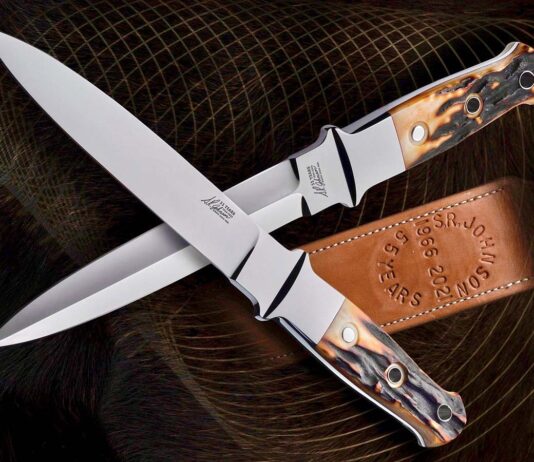
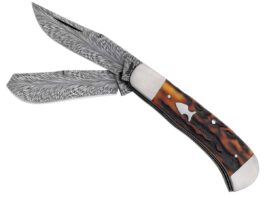
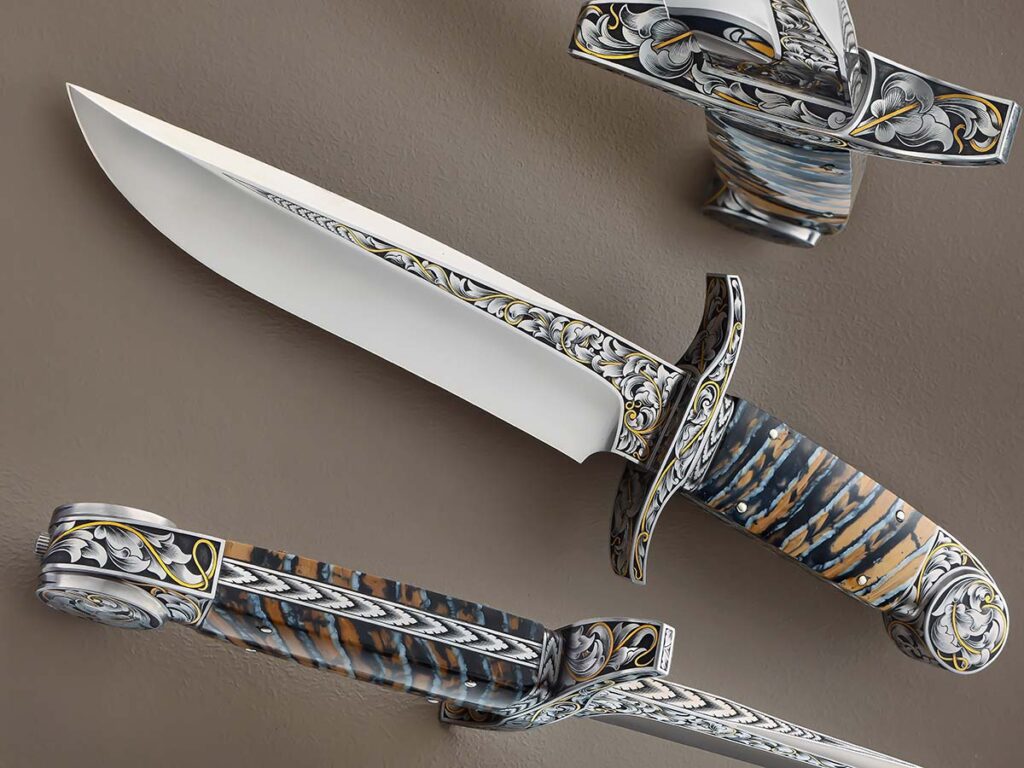
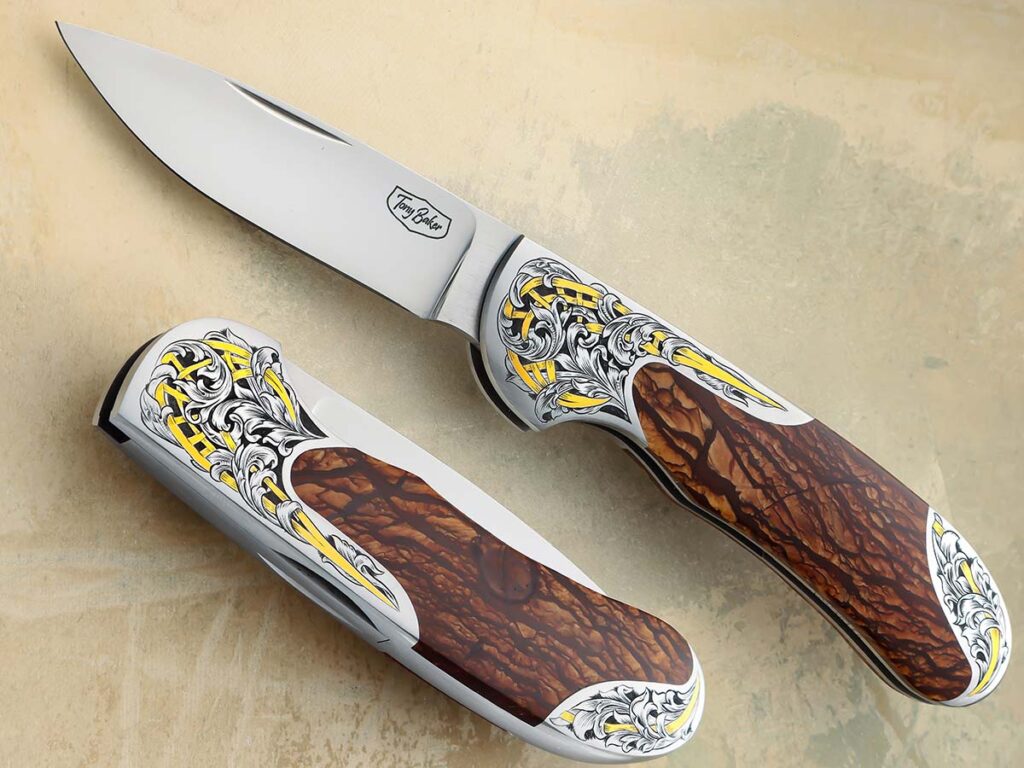
Knifemaking is the building of a knife, which includes the blade, handle and other accouterments. Blades are made by either removing metal from a steel blank via a grinder – known as stock removal – and the forging to shape of hot steel into a blade in the process known as bladesmithing. Other parts, including bolsters, guards, pommels, etc., are needed to complete the finished knife.
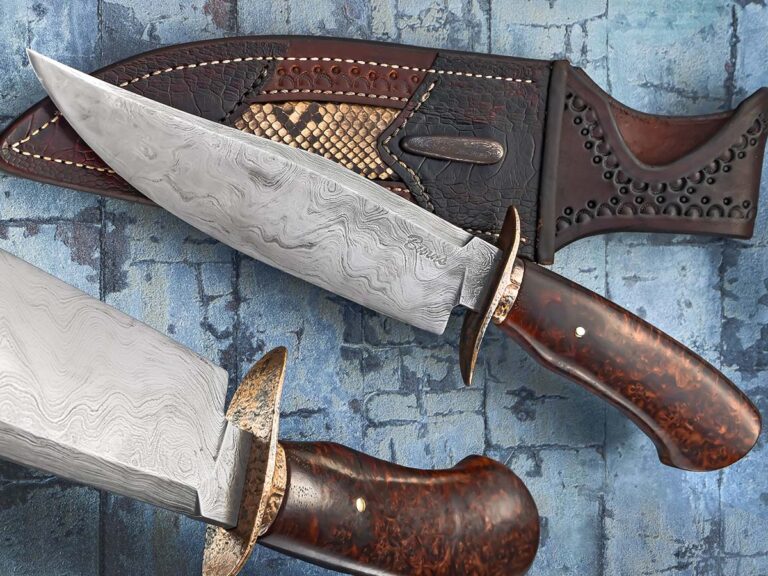
Explore the classic clip-point bowie knife from apprentice smith Robert Burns of Wilderness Ironworks.
ABS apprentice smith Robert Burns of Wilderness Ironworks wanted a project that would take him back to the roots of being a bladesmith, and appears to have satisfied that desire through his classic clip-point bowie.
“My goal was to combine the ancient and the contemporary,” he wrote.
For the ancient, he started with iron ore from Minnesota and iron sand from Connecticut. He smelted the two into bloom steel, which he then refined, “my goal being to make a steel fine enough that it could potentially pass for modern damascus”—thus the “contemporary.”
Robert Burns of Pittsburgh, Pennsylvania, used ancient materials such as iron ore and iron sand for the blade and a historic mix for the fittings of his sole-authorship bowie.
To augment the “ancient,” he used a “historic mix from the Bronze Age” for the bronze for the fittings.
As Robert noted, the knife is true sole authorship, from starting ore to the finished sheath.
From copper-infused patterns to stainless steel sheets, discover the innovations driving the red-hot market for production damascus.
Are we seeing a bit of “global warming” in the knife industry, where red-hot damascus steel is getting even hotter? BLADE® spoke with some industry leaders, and 2025 and beyond looks good to them when it comes to production damascus in both carbon and stainless steels.
There are many individual makers who make high-quality damascus in simple and complex patterns in their home shops, backyards or shared maker spaces. This article focuses instead on production damascus forged by specialized outfits such as Baker Forge & Tool, Damasteel, Chad Nichols Damascus and Vegas Forge. At a level beyond “regular” damascus makers, these companies make steel for the masses, for production companies, and specialize in innovative new materials that are sure to delight the industry.
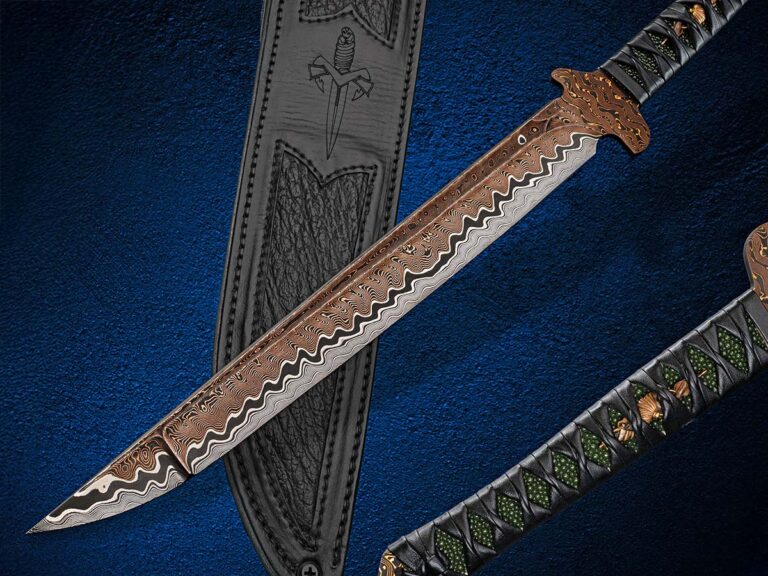
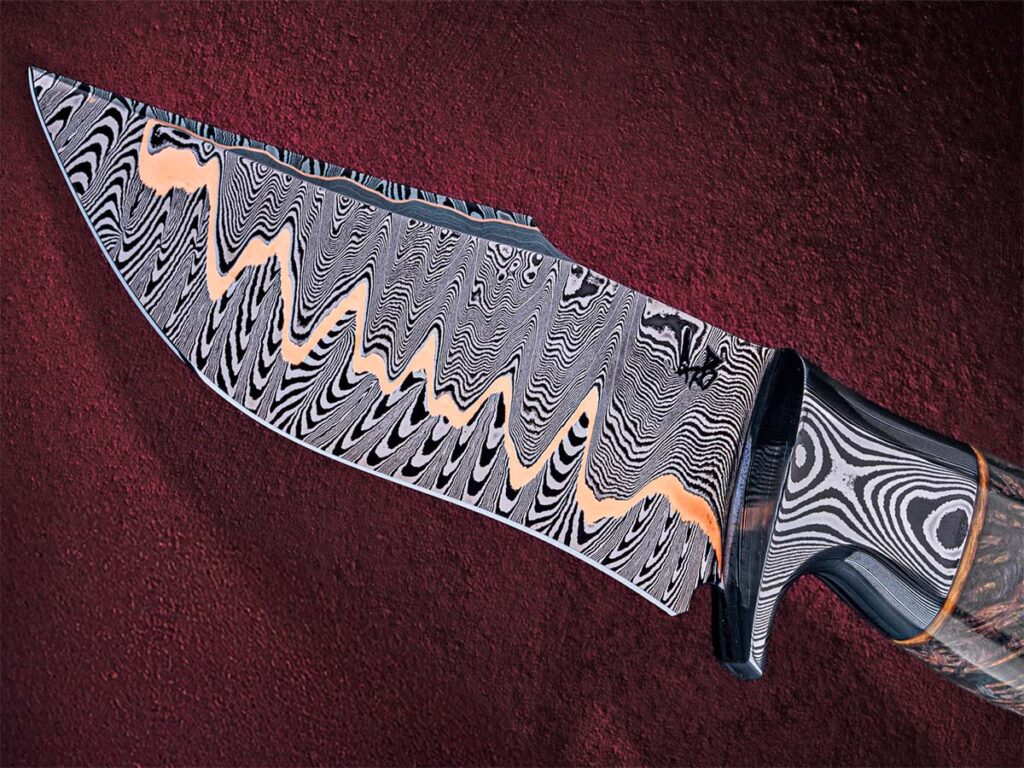
BLADE readers will be familiar with Baker Forge & Tool, a prolific producer of innovative damascus patterns that include copper, such as CopperMai, TigerMai, GoMai and others.
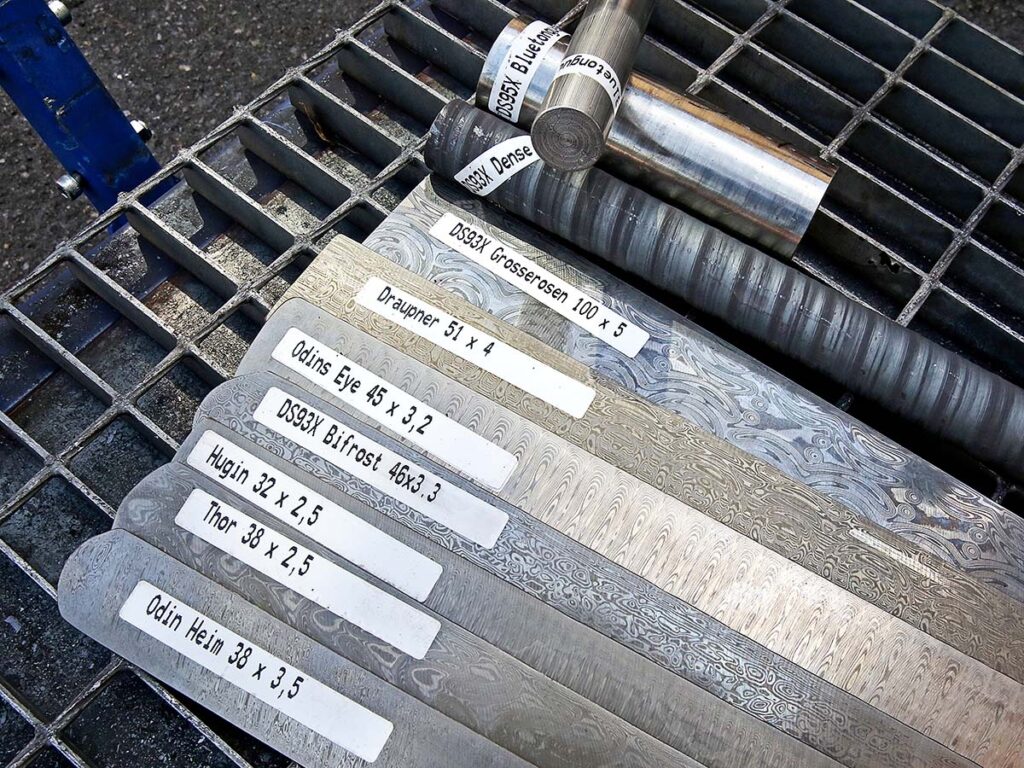
DS93X steel—fourth from bottom in bar form—is Damasteel’s standard mix, “combining good performance with good looks.” “For us it’s more about expanding the patterns than about trying new steel combos,” noted Per Jarbelius. The other patterns in bar form are representative examples of what you can expect from the Swedish steel maker.
“We make carbon steel damascus patterns with copper, and they’ve been hot. We expect them to stay hot through 2025,” Coy Baker said. When it comes to steel selection, the company most often sticks with the gold standard combination of 1084 carbon and 15N20 nickel-alloy steels.
Baker also has been experimenting with Apex Ultra as a core steel for its copper san-mai. For those unfamiliar, Apex Ultra is a tungsten steel alloy, kind of a super-52100 carbon steel. It’s made in small batches and is hard to get in the USA, but Baker has found that the material makes a great damascus core.
“Demand for our Apex core billets far outpaces supply,” Coy noted.
Baker has also been experimenting with stainless and copper damascus and san-mai, using 154CM and AEB-L stainless steels. This writer also makes knives and that combo sounds quite challenging to forge. Baker confirmed that it was very challenging and wouldn’t reveal any secrets, other than the 154CM etches light and the AEB-L etches darker.
Growth In The ‘Sip
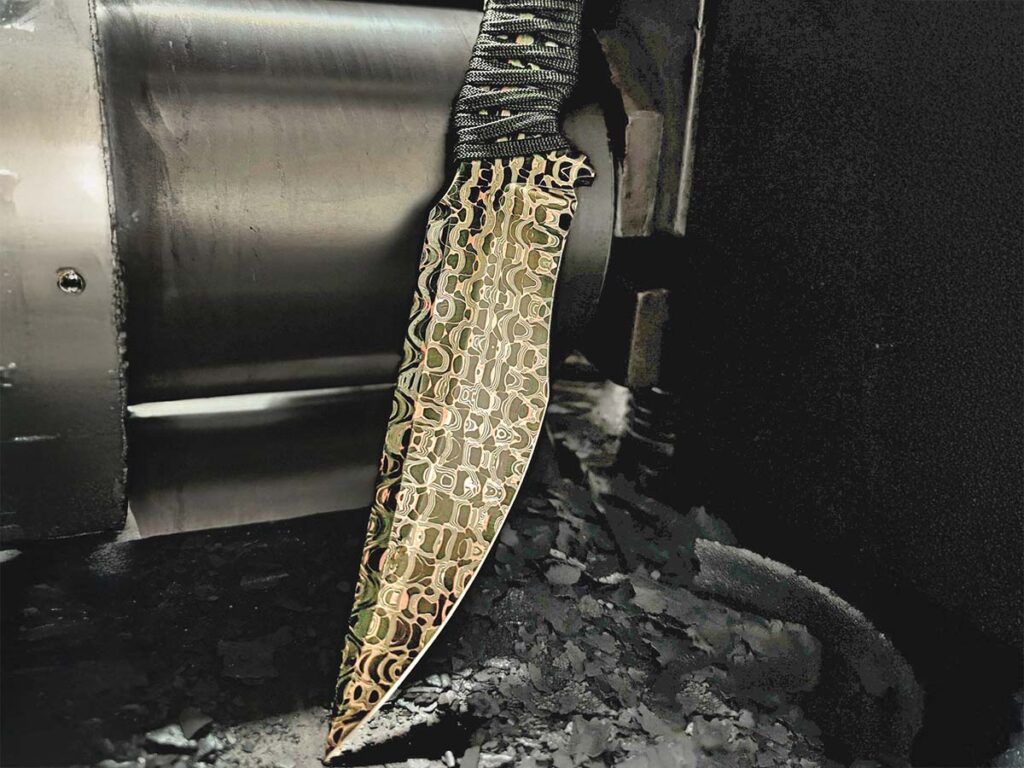
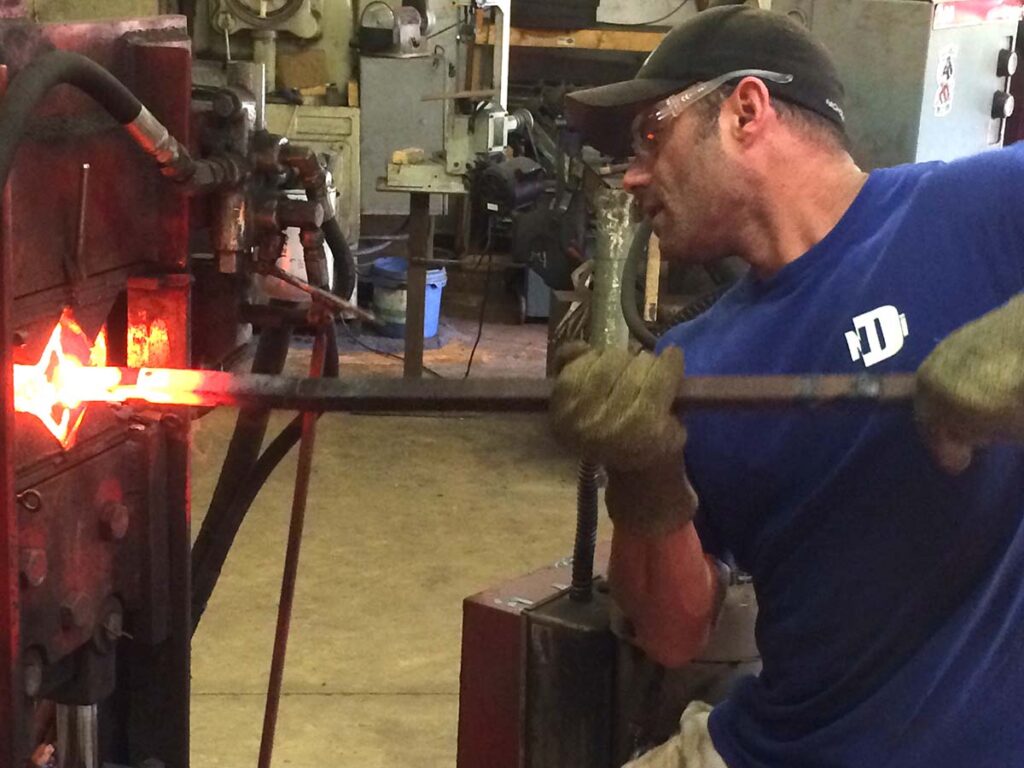
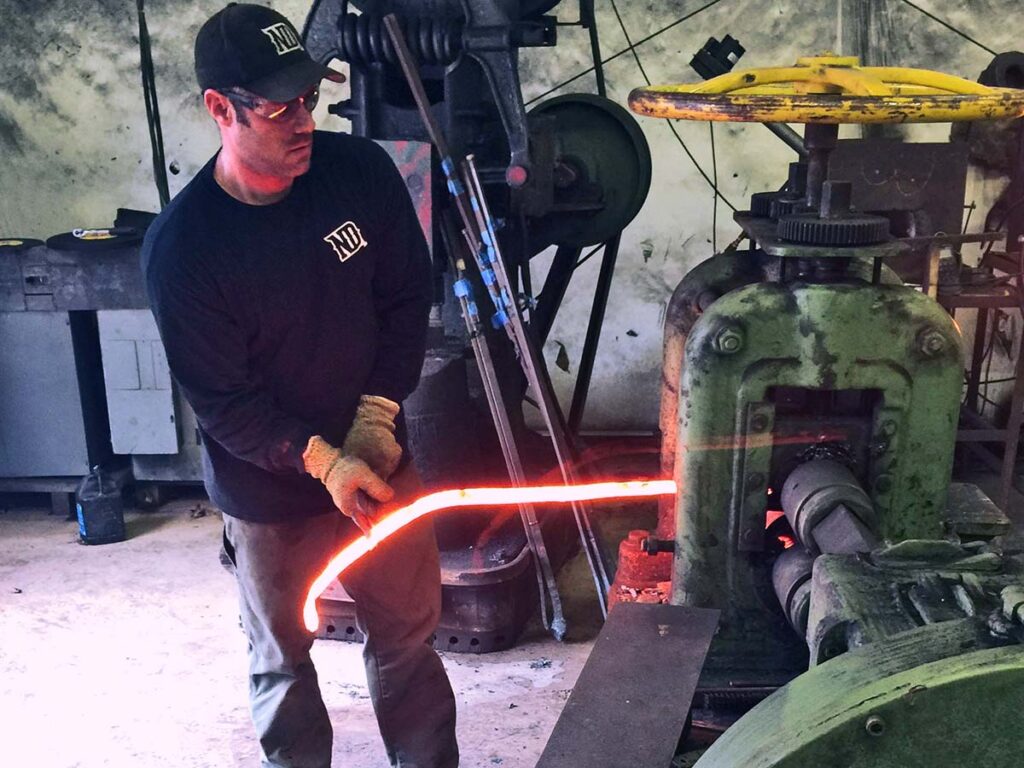
Down in beautiful Bush Springs, Mississippi, Chad Nichols makes traditional carbon steel damascus at a production level.
Vegas Forge has always been innovative and 2025 will be no exception. “We’ve figured out how to do copper in with the damascus pattern manipulation, not just as a line between san-mai,” Jesse Harber noted. (Vegasforge.com image)
“I stick mostly to carbon steel 1075 or 1095 plus 15N20 with occasionally a little bit of 3V,” Nichols explained. “I’ve got my process down and these steels go together well.” He makes a variety of mosaic patterns, most of which go to a single manufacturer. “The carbon steels are so much more organic,” Nichols said. “You can do so much more with them in a cost-effective way.”
Nichols’ goal for 2025 is to increase his production of mosaic patterns.
“There just aren’t many people doing production mosaics,” he said. “It’s a great opportunity for growth.”
Another area he’d like to see grow in 2025 is the use of exotic and historical materials. He’s made a run of steel for Boker with steel from a German Tiger tank, and has a run coming for William Henry with some leaf springs sourced by WH.
Collab Designs
Damascus isn’t just a U.S. product. Damasteel produces high-quality stainless steel damascus in Sweden.
Chad Nichols (above) stated the goal at Chad Nichols Damascus for 2025 is to increase the production of mosaic patterns.
“Our DS93X steel is our standard mix, combining good performance with good looks,” Damasteel’s Per Jarbelius remarked. “For us it’s more about expanding the patterns than about trying new steel combos.”
DS93X is described as a “patented powder metallurgy product” that includes “two different hardenable steel grades.” “We use only stainless steel,” Jarbelius explained, ‘because it doesn’t rust and has the same or better performance.”
Damasteel historically produces a new pattern each year. For 2025 it also has begun a special project to collaboratively design patterns. Benchmade collaborated with Damasteel to make a steel pattern called “Monarch” exclusively for the Benchmade Gold Class Necron balisong. Jarbelius is excited for the potential to expand the collaborative effort with other companies who want proprietary patterns.
In another innovation, Damasteel has developed the capability to produce stainless damascus in sheets, not just bars. This will come in handy for small-batch and mid-tech production. The sheet steel pattern is called “Drakkar,” which is the old Norse word for the dragon-shaped Viking longboats.
Copper In The Pattern
What happens in Vegas may stay in Vegas, but that’s not the slogan for Vegas Forge, whose damascus is well known worldwide. It is a consistent producer of high-quality carbon and stainless damascus in complex patterns.
Baker Forge & Tool has been experimenting with Apex Ultra as a core steel for copper san-mai. This integral fighter by Greyson Weltyk features Baker copper damascus for its recurve harpoon blade. (Bakerforge.com image)
“One of our most popular patterns is ‘Reptilian,’ which has three alloys included: O1, 1075 and nickel,” observed the company’s Jesse Harber.
Vegas Forge has always been innovative and 2025 will be no exception.
“We’ve figured out how to do copper in with the damascus pattern manipulation, not just as a line between san-mai,” Jesse noted. “We can take our Reptilian pattern with copper in it, and then clad that billet over an O1 or 1095 core.”
As far as stainless goes, Vegas Forge continues to push the complexity of its patterns. Its most popular pattern, “Virus,” begins with a single stack of 1200 pieces! The company uses 154CM cores for most of its stainless san-mai, along with CTS XHP when available.
Ultimate Hotness
What kind of knives do the manufacturers predict for ultimate hotness in 2025?
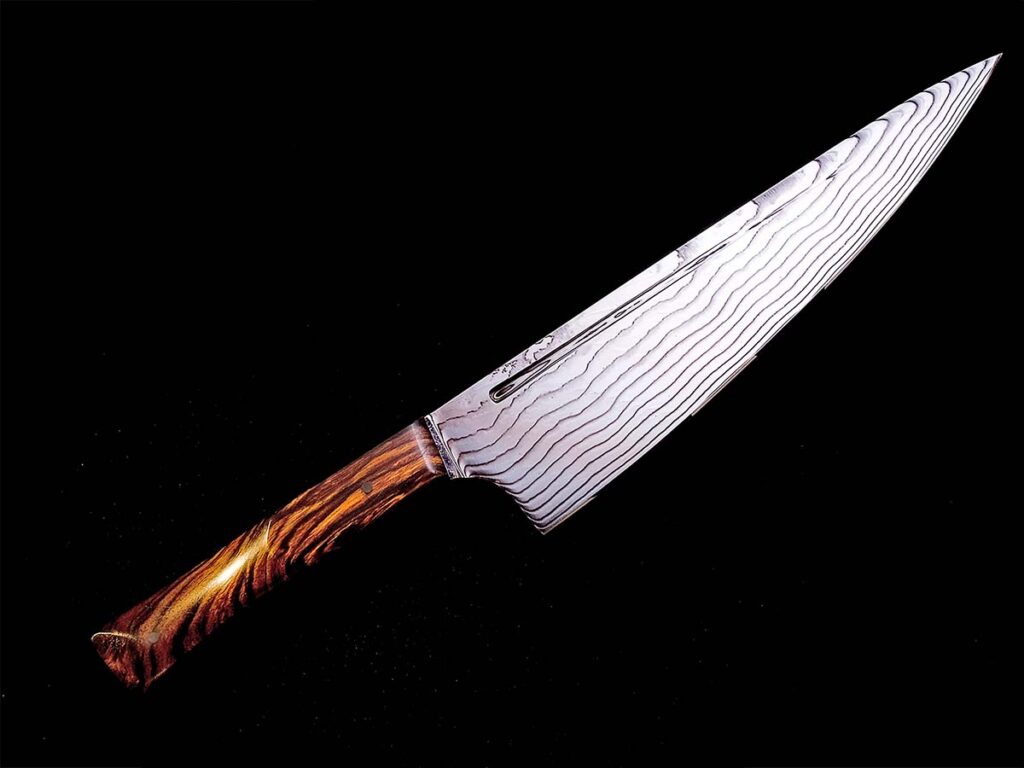
Damasteel has developed the capability to produce stainless damascus in sheets, not just bars. The sheet steel pattern is called “Drakkar,” the old Norse word for the dragon-shaped Viking longboats, and is used here on a chef’s knife by a local Swedish cutler.
Both Baker and Jarbelius indicated culinary knives will stay hot, especially in stainless. Baker pointed out that stainless steel handles kitchen abuse better, and this writer agrees. Per said Damasteel’s Damacore and DC18N nitrogen steels are top of the line, and the company has a culinary knife coming in partnership with BLADE Magazine Cutlery Hall-of-Fame® member Ken Onion and CRKT. Both Damasteel officials and Chad Nichols agree that complex patterns are expected to do well for the pocketknife and one-off makers.
Jarbelius “expects growth in the complex pattern market” even as Damasteel’s basic traditional rose, ladder and twist damascus patterns remain best sellers. Nichols states that the mosaic niche he addresses will continue to grow.
All four steel makers expect growth in the production side of the market. Even in a slower economy, the big knife manufacturing companies are still producing limited runs of high-quality damascus knives. Baker looks for growth in his damascus-core san-mai steels.
“They’re easier to get a consistent etch on than the mono-steel cores,” he explained.
Chad Nichols stated that he expects growth in the use of mosaic damascus steels by factory knife companies in 2025.
Manufacturing is all about consistency and efficient processes. Damasteel achieves consistency by using the same steel combo for all its patterns. Nichols gets there by batch building for specific manufacturers so that each run is internally consistent. Harber mentioned that he was approached at BLADE Show West* by multiple production companies looking to order steel for 100-to-200-piece runs. He indicated he expects the mid-range sub-$800 production folders to stay hot.
Gonna Be Intersting
The new year is going to be an interesting one for the economy and politics, both of which are inextricably entwined. Fortunately, thanks to the work of those in the damascus industry, it’ll also be an interesting year in the world of knives. If nothing else, knife enthusiasts will have plenty of beautiful damascus production knives coming off the assembly lines to keep them entertained.
Davidson’s integral salutes a unit that lost over 800 men on D-Day.
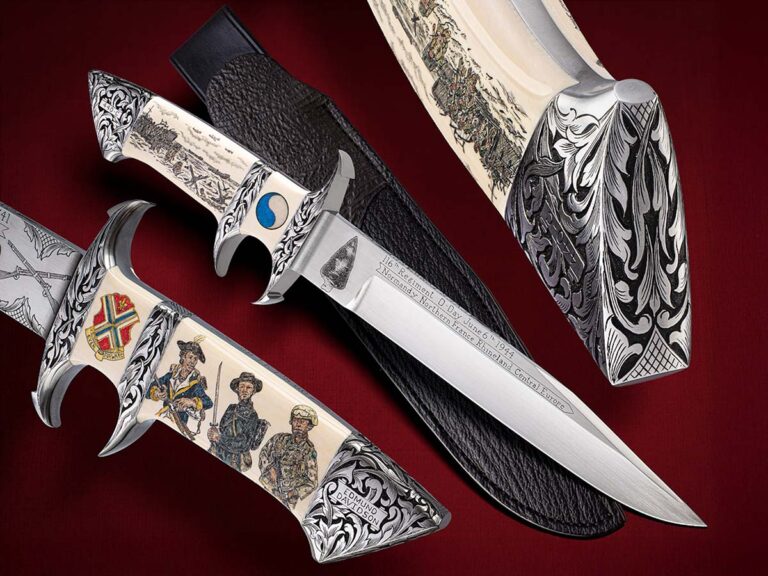
Made to support The 29th Division Museum in Verona, Virginia, Edmund Davidson’s integral subhilt fighter celebrates an American combat unit that’s served valiantly for almost 284 years.
The Augusta County Regiment formed on Nov. 3, 1741, in Staunton, Virginia, and fought in most every American war, including the American Revolution and the battle of Manassas in the Civil War. It became part of the U.S. Army’s 29th Division in World War I and adopted the theme of “Ever Forward.”
As the 116th Regiment it was in the first wave on Omaha Beach on D-Day, where it lost over 800 officers and men and was later cited by the War Department for extraordinary heroism and outstanding performance of duty. The regiment also saw action in the Iraq and Afghanistan Wars. Today, the 116th remains active as a National Guard Unit.
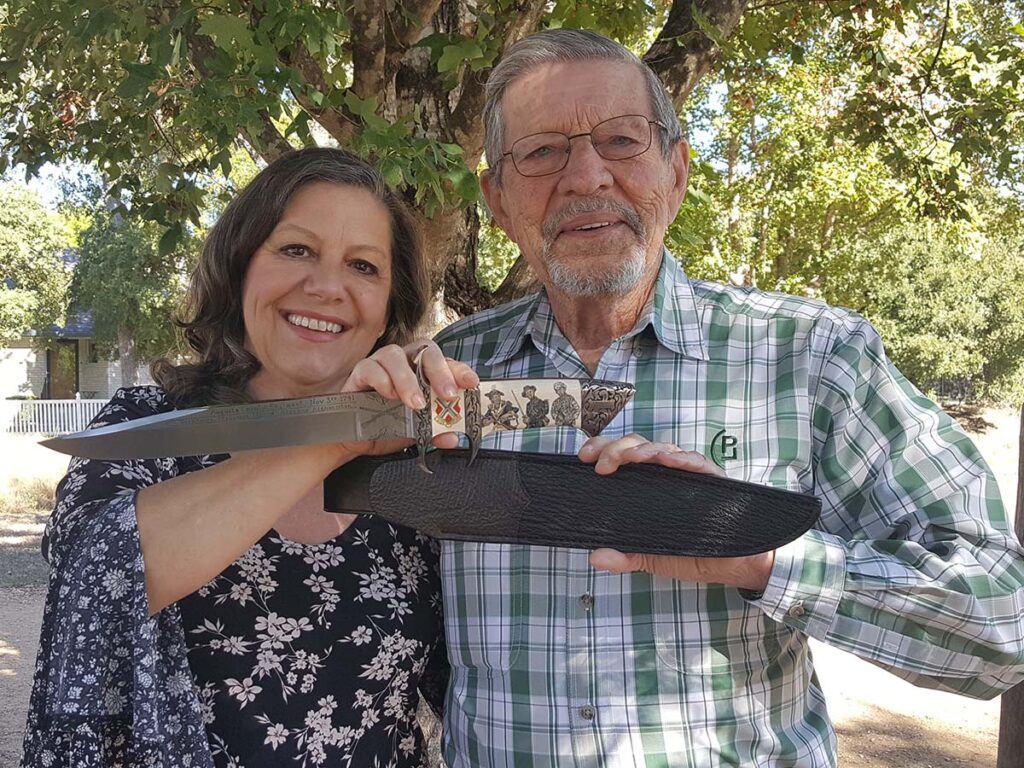
Scrimshander Linda Karst Stone (left) and sheath maker Paul Long (right) hold the completed project. (knife image by Whetstone Studio)
Linda Karst Stone scrimmed the Omaha Beach battle scene on one side of the handle and unit members from the American Revolution, Civil War and today’s 116th on the flip side. The copious scroll engraving on the butt and guard is by Jere Davidson. Paul Long made the shark-skin sheath.
Niagara will help fill the shoes of an industry icon.
The recent demise of Crucible Industries LLC not only marked the end of a celebrated name in the manufacture of blade steels, it denoted the dawn of a new age—not only for the steels famously known by their CPM prefix, but other premium blade materials as well.
Used by Crucible and short for Crucible Particle Metallurgy*, CPM prefixed such Crucible steels as CPM S30V, CPM S35VN, CPM MagnaCut—today’s hottest CPM variant—and others among some of the most-used blade materials since Chris Reeve Knives popularized S30V on Reeve knives beginning in 2004-2005. S30V, in fact, was the first modern steel manufactured specifically for knife use. All other manufactured steels used in blades were originally made for purposes other than knives.
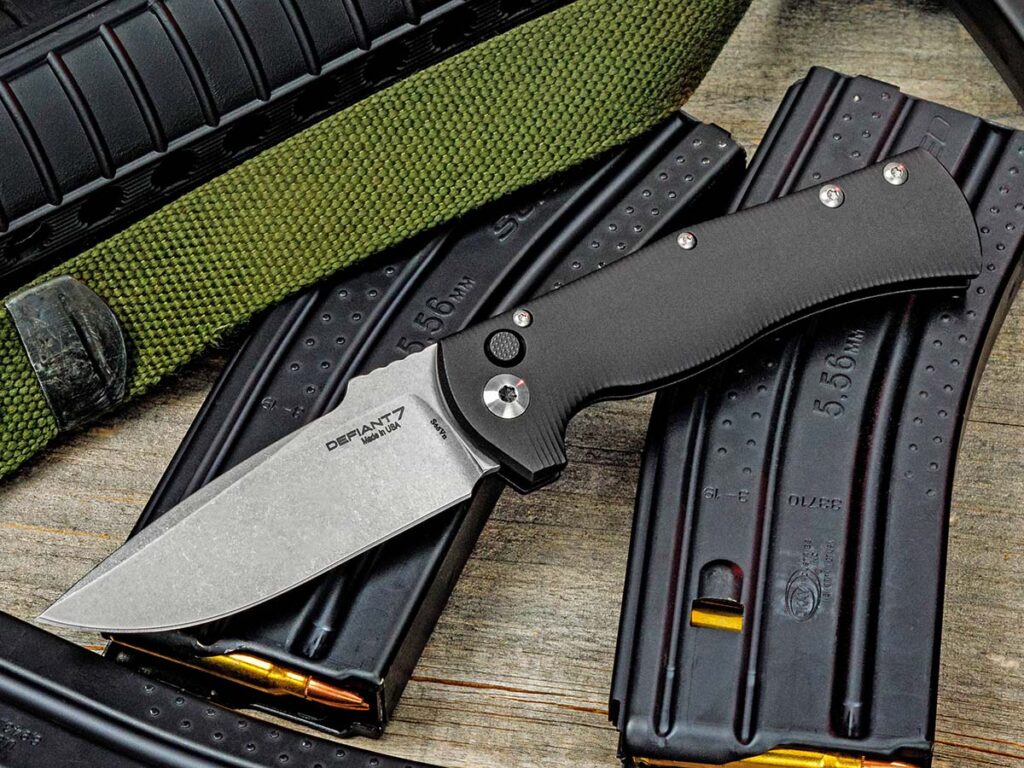
CPM S45VN is one of several of the old Crucible steels Niagara offers. The Defiant7 Auto Eagle has a stonewashed blade of the stainless steel and a black aluminum handle. Blade grind: flat. Weight: 4.4 ounces. Designed by Les George, it’s 4.75 inches closed. Country of origin: USA. MSRP: $285.
Crucible closed its doors earlier this year and sold most, if not all, of its assets at auction in February. So what happens to all those wonderful steels that both the factory and custom knife industries use in mass quantities?
According to Bob Shabala of Niagara Specialty Metals (NSM), NSM will do its part to have/supply most, if not all, of them, as well as other up-and-coming steels, to the custom and factory knife industries.
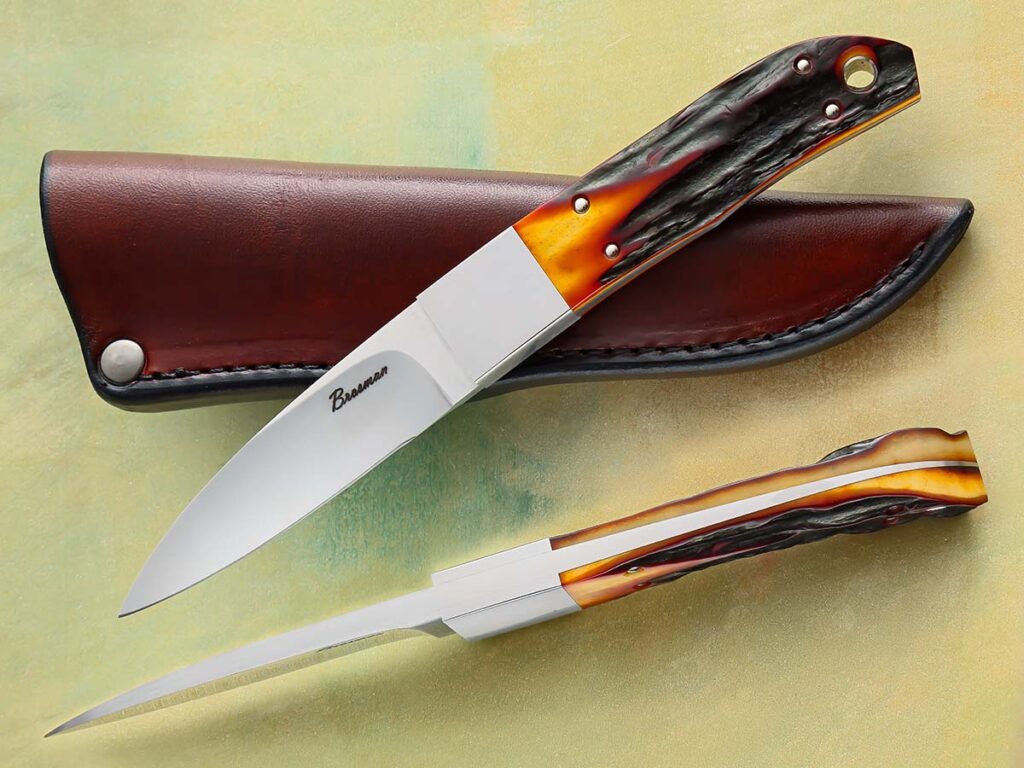
Among custom knifemakers especially, CPM 154 stainless is extremely popular. Craig Brosman employs it in a hollow grind and amber-dyed European red stag on his utility fixed blade. Overall length: 7.5 inches. (SharpByCoop image)
Opined Scott Devanna of steel service center SB Specialty Metals, “The majority of steel sheet in the U.S. comes out of Niagara. They’re the only [domestic mill] that can make it right now. It’s been that way for the last 25 years. They’re the only game in town.”
Erasteel And The Name Game
Erasteel, with state-of-the-art steel mills in France and Sweden, is owned by Syntagma Capital, a private equity group based in Brussels, Belgium. Erasteel acquired a part of the assets of the old Crucible Industries during the February auction, including working capital, steelmaking equipment and, perhaps most importantly, the trademarks for all the CPM steel names. A manufacturer and supplier of steels not only to the knife community but also the aerospace and other hi-tech industries, NSM had worked with Erasteel before the auction, processing millions of pounds of the Swedish mill’s steel for industrial applications.
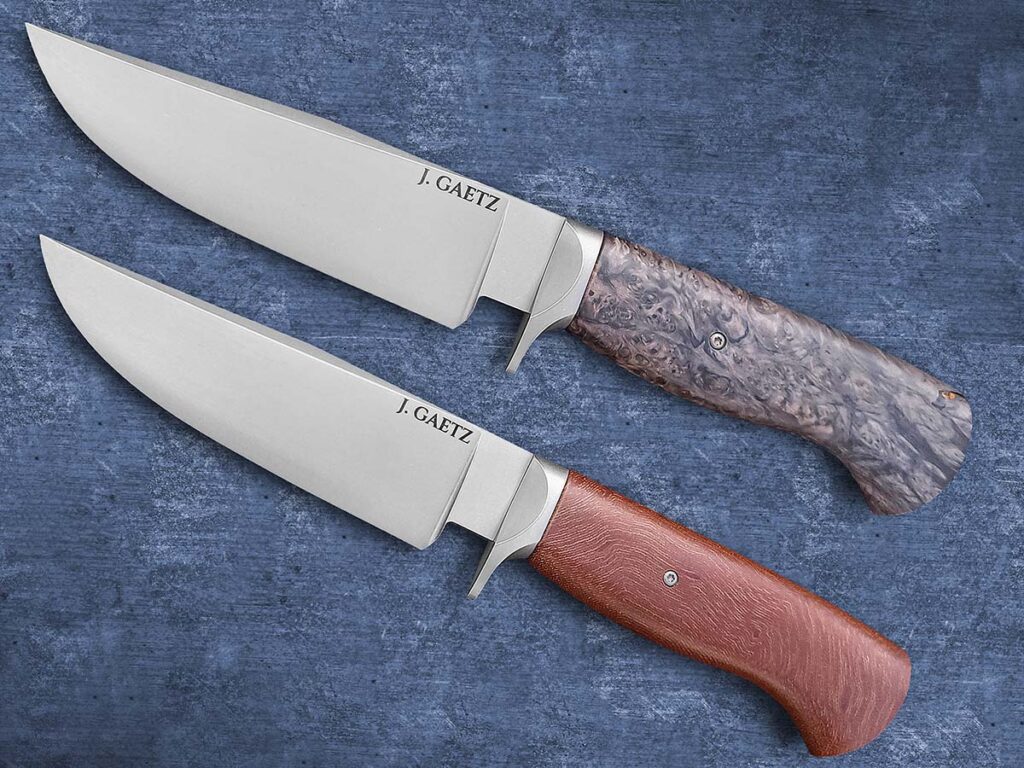
The 4.75-inch blade of Jacob Gaetz’s Large Field Hunter is CPM 3V carbon steel cryo-treated to a Rockwell hardness of 60-61 HRC. Handles are Apocalyptic box elder burl (left) and vintage Micarta® (right). Overall lengths: 9.875 inches. (Jocelyn Frasier image)
“We’d been doing that for several years,” Shabala noted, “so we know the quality of their steel is good.”
Together with Crucible, Erasteel is the pioneer in gas-atomized metal powders and started with the process in 1969. Today, it has the largest installed capacity in the world to produce metal powders, with two large atomizers built and designed by Erasteel.
Shabala said NSM officials understood their knife customers wanted the assorted CPM steels to keep the old names to avoid confusion among knife-buying consumers.
“They didn’t want to change the names and have to educate consumers on what the new names would be and how they related to the legacy Crucible names,” he explained.
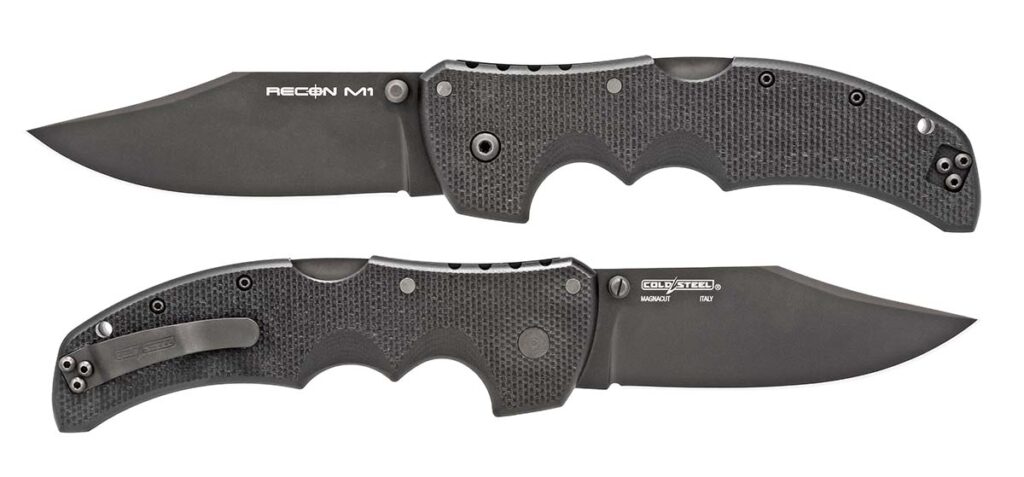
The Cold Steel Recon M1 sports a black-coated blade of MagnaCut stainless, which remains the hottest of the CPM steels used by both factory and custom segments of the sporting knife industry. Handle G-10. Lock: Atlas Lock. Weight: 5.2 ounces. Blade and closed lengths: 4 and 5.5 inches. Country of origin: Italy. MSRP: $309.99.
Meanwhile, the two companies reached an agreement where if NSM buys the steels exclusively from Erasteel, NSM can use the original names too, including S30V, S35VN, S45VN, MagnaCut, S110V, 3V and CPM 154. NSM and its customers can still use the full designation of CPM S30V, CPM S35VN and so on, though the customers can omit the CPM if they so choose.
“The reason we’re keeping the CPM 154 name is because everybody knows that it’s the powder metallurgy version of 154CM, so we want to keep that designation alive so people will know what’s going on there,” Shabala noted.
There will be a couple of exceptions. The steels formerly known as CPM Cruwear and CPM S90V will be renamed NSMwear and NSM 90PM, respectively.
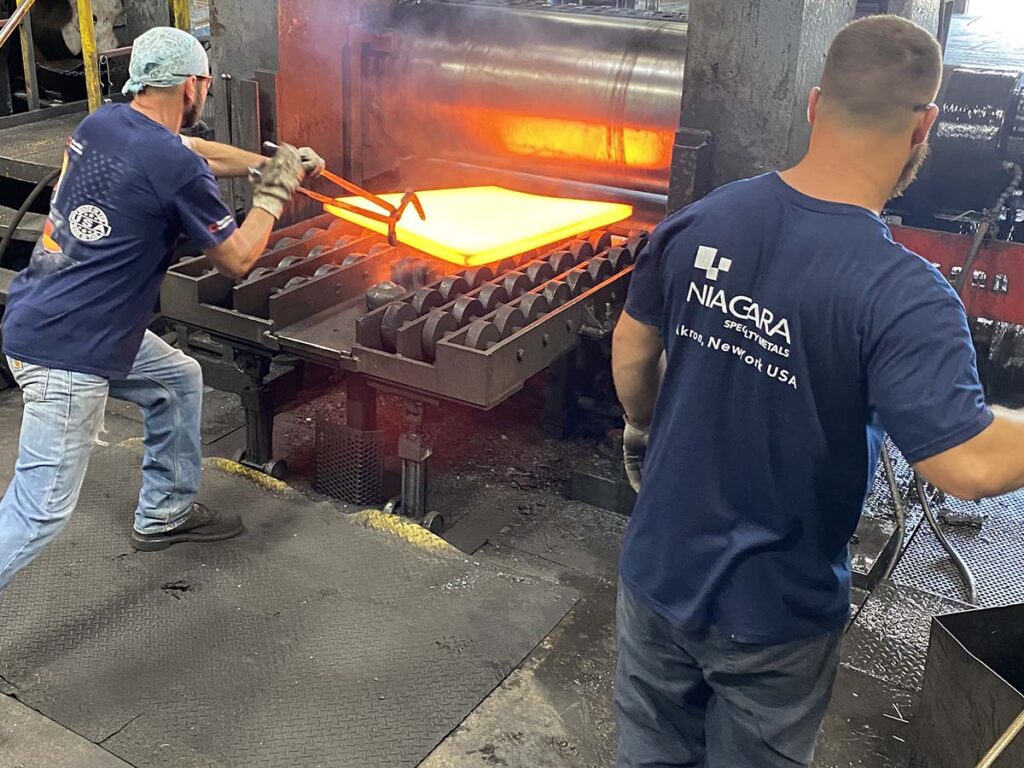
Niagara is both a manufacturer and distributor, not only of knife steel but also steel for the aerospace and other industries. It is employee owned and employs 41. (NSM image)
“Erasteel already had an agreement with another distributor to buy Cruwear exclusively, so we worked out a deal with them where we can buy the steel, we just can’t use the name,” Shabala explained. “It’s on us to educate people and let them know they can still get CPM Cruwear, it’s just a different name.”
As for CPM S90V, NSM already had Carpenter Technology’s version of it in stock and wanted to rebrand it so that it’s not sole-sourced to one mill. By renaming it NSM 90PM, “hopefully people will understand that it’s coming from us,” Bob said.
Steel Tariffs
Concerning steel supplies in stock, Shabala indicated NSM officials had been aware of Crucible’s coming demise, and in January 2024 began ramping up purchases to build inventory for any future supply disruptions.
Dennis Friedly opts for CPM 154 stainless blade steel and a mammoth tooth handle for his Art Knife Invitational fighter. The copious engraving is by Ray Cover Jr. Overall length: 13 inches. (SharpByCoop image)
“We started placing orders with Carpenter and Erasteel in September 2024, though not knowing Erasteel would be the eventual owner of the CPM trademarks,” Shabala noted. “The steel we bought in September is starting to arrive. There will be some disruptions in MagnaCut and CPM 154, but everything else we still have a decent amount of and there should be no disruptions.”
In case you hadn’t heard, President Trump has instituted tariffs on most countries, including France and Sweden. At press time, the European tariff was 25 percent.
“Everything we buy from Erasteel as it stands right now is subject to a 25 percent tariff,” Shabala said. “Even the steel we buy from Carpenter, the powder for it is atomized in Sweden, so that’s subject to at least a 10 percent tariff.”
Dennis Friedly opts for CPM 154 stainless blade steel and a mammoth tooth handle for his Art Knife Invitational fighter. The copious engraving is by Ray Cover Jr. Overall length: 13 inches. (SharpByCoop image)
Another concern is whether knife companies can continue to mark their knives built with NSM steel “Made in the U.S.A.” Bob said he is up front with his customers, telling them that Erasteel will be supplying a “good chunk of our CPM alloys,” though it’s all hot rolled at NSM.
The question becomes if the raw materials are imported but don’t officially become a steel until they’re hot isostatic pressed, does that make the steel American made or imported? He indicated it will be up to his customers’ lawyers to hash out what the customers can and can’t do concerning U.S.A. markings on their knives.
NSM Innovaions
What’s on the horizon at NSM? One thing is a new grade developed by steel guru Larrin Thomas. Called Magnamax, it won’t be widely available until the end of the year. Since NSM has both patented and trademarked Magnamax, it can have it made by any mill it wants, and had it on order with both Erasteel and Carpenter at press time.
Bob Shabala of Niagara Specialty Metals
Meanwhile, along with Erasteel, Bob had high praise for the steel being made by Carpenter.
“We’re getting powder now that is atomized in a vacuum furnace. It’s a step forward in quality. We hardly ever had an issue with any CPM product from Crucible,” he qualified, “but I think Erasteel’s and Carpenter’s steel has a finer grain size. It’s a little microscopically cleaner than what we were getting before, so it really is an opportunity to provide a better product.”
As Shabala noted, Carpenter has made lots of cutlery steel, and NSM has processed a huge amount of it, hot rolling it into sheets and sending it back to Carpenter’s warehouse for sale to various customers. One of Carpenter’s best-known steels is CTS XHP stainless.
“It’s a grade that customers really like,” Shabala said, adding that NSM had over 20 tons of it and was in the process of preparing to make a big marketing push on it at press time.
Having steel manufactured in the USA remains a big selling point with many of NSM’s customers, so the company remains on the lookout for new melt sources, one of which is Prime Metals & Alloys (PMA) of Homer City, Pennsylvania. A manufacturer and supplier of a wide range of steels for assorted hi-tech and other uses, PMA was in the process of making steel for NSM at press time, which Shabala seemed to think holds great promise.
Larrin Thomas, metallurgist and knife writer
“We should receive it in a couple of months, but if it works out it’s going to be an ESR version of stainless steel that we’ve always supplied, so it should be a noticeably better product than what our customers were used to before,” he said. “It’s really a good find for us to be able to get a higher-quality steel with a shorter lead time, so we’re really excited about that.”
ESR stands for Electro-Slag Remelting, a process that results in a very clean steel devoid of contaminants.
“In a traditional melting process, you heat the steel up, get it in a molten state, pour it in an ingot and that’s it,” and later forge and finish it out, he explained. “With ESR you take that ingot and you remelt it again and all the slag and contaminants float to the top, and they’re skimmed off. What remains in the new ingot is a cleaner version of the original.”
Shabala added that two different grades of NSM stainless steels that had always been air melted will now be ESR melted.
NSM’s Role
People often misunderstand a company’s role in any endeavor, and Shabala said that seems to be the case with NSM.
“Larrin Thomas was concerned that people had the misconception that NSM is just a distributor, that we just got sheets from Crucible and resold them,” he observed. “He said we should emphasize the fact that we’re a lot more than a distributor, we’re a manufacturer, we buy slabs of steel, we process it into the final dimensions and ship it. Cutlery is a big part of what we do. We do a lot with the aerospace industry, so we know a lot about quality standards.”
NSM is 100 percent employee-owned, so all 41 employees in its mill in Akron, New York, just outside Buffalo, own a piece of the company.
“Everyone here has a vested interest in ensuring that we’re successful and doing everything we can to put out a good product,” Shabala said.
A last point of emphasis Bob made was that just because Crucible went out of business doesn’t mean NSM is going out of business—in fact, far from it.
“We’re very financially sound. We just put out a $7 million upgrade in our sheet mill, we’re rolling out finished product, it’s the biggest expansion we’ve ever done and we’re getting ready to expand our grinding and laser-cutting capability,” he noted. “We’re really, really in good shape.”
*Editor’s Note: For more on the particle metallurgy process, visit Knife Steel Nerd’s post on powder metallurgy.
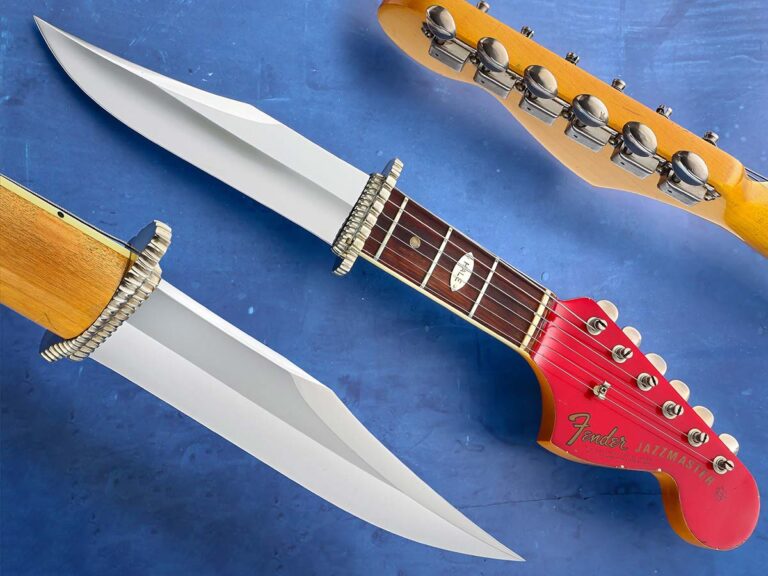
Lloyd Hale made the singular knife circa 2000 from the neck of a 1960s Fender Jazzmaster.
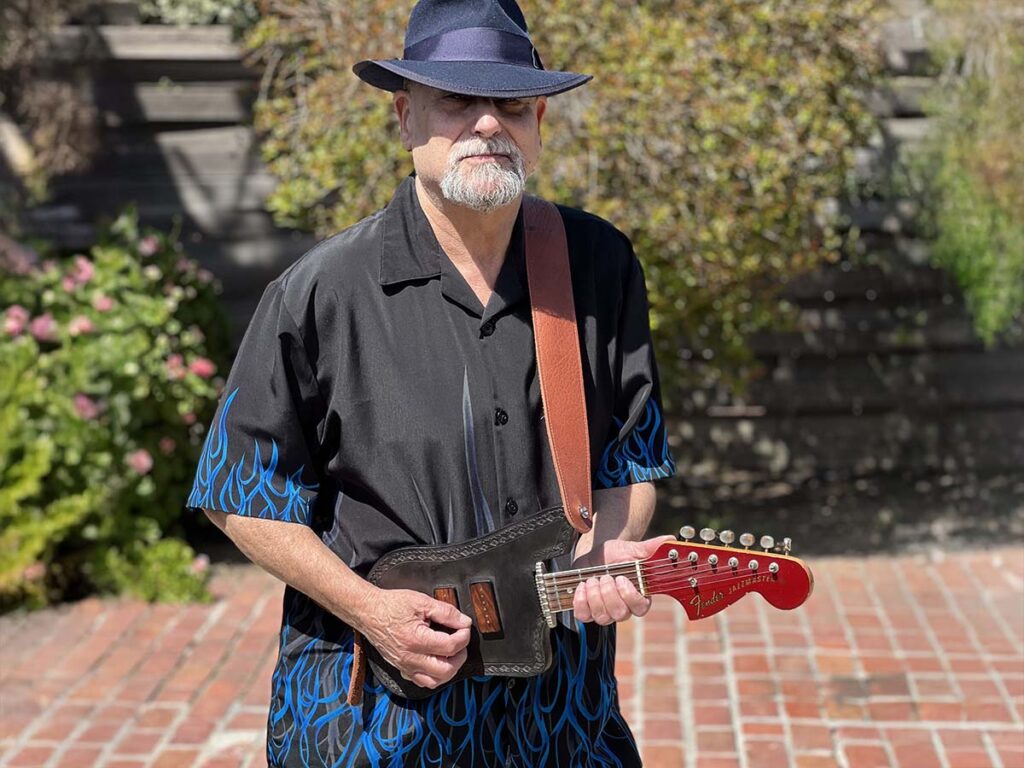
A self-described child of the ’60s, Larry Hirsch jumped at the chance to buy the DeFender when a collector offered it for sale.
Made by Lloyd Hale a quarter century ago from the neck of a 1960s-era Fender Jazzmaster guitar, the knife did not have a sheath originally, so Hirsch got with Hale earlier this year and brainstormed one in the shape of the main body of the guitar, complete with strap and volume and tone control knobs.
Larry Hirsch rocks his world with the DeFender. (Hirsch image)
“I told Lloyd the knobs had to turn because everyone that sees it, the first thing they will do is turn the knobs,” Hirsch said. Sure enough, when Larry displayed the knife at the 2025 Solvang Show, the first person that saw it turned the knobs.
Oh, left whole a 1960s-era Fender Jazzmaster—just the neck alone—would be worth obscene amounts today, but we won’t go there.
Allen Elishewitz/Les George knife collaborations are four point oh.
If you are into custom tactical knives, chances are very good that you have heard of knifemaking United States Marine Corps veterans Les George and Allen Elishewitz.
The two are at or near the top of the list for anyone wanting a high-quality custom tactical. Both possess an excellent knowledge of tactical design and the ability to execute same gained through their years of making knives—Les has 33 years of experience and Allen has 37. Their talent levels are extremely elevated.
Their time in service to their country walking the walk and talking the talk has helped each to fully understand the strengths and weaknesses of tactical knives. They have collaborated with factory brands such as Kershaw and Zero Tolerance (George), Benchmade, CRKT and Hogue Knives (Elishewitz), and Fox Knives and Pro-Tech (both of them). They also have collaborated with each other on some special custom knives.
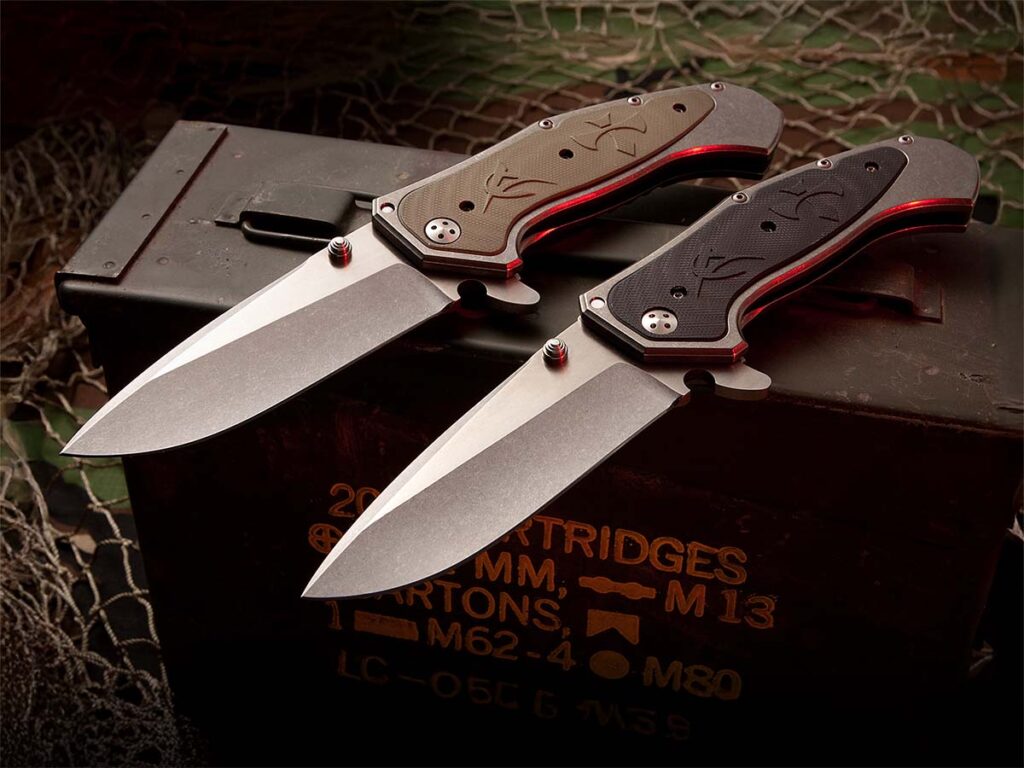
One of the more recent collaborative efforts between Allen Elishewitz and Les George is the Cerberus, a flipper folder in CPM 154 stainless blade steel and a titanium frame with insert. Closed length: 5 inches.
Perhaps most importantly, they are really good friends and inspire each other in many ways.
“I knew Allen by reputation and from the internet knife forums,” Les said. “When I moved to Texas, we were not far away [from each other].” It was about 15 years ago that Les first reached out and paid Allen a visit.
“He contacted me after he got out of the USMC. He happened to be in Texas and wanted to swing by my shop,” Allen recalled. “I guess we hit it off OK,” Les undersold the moment with his trademark brand of sarcasm.
In that initial meeting the two not only bonded over their service to their country but also their love of knifemaking, common grounds to forge a solid friendship. Each is outgoing and has a great sense of humor, not to mention an outstanding feel for knife design and ergonomics.
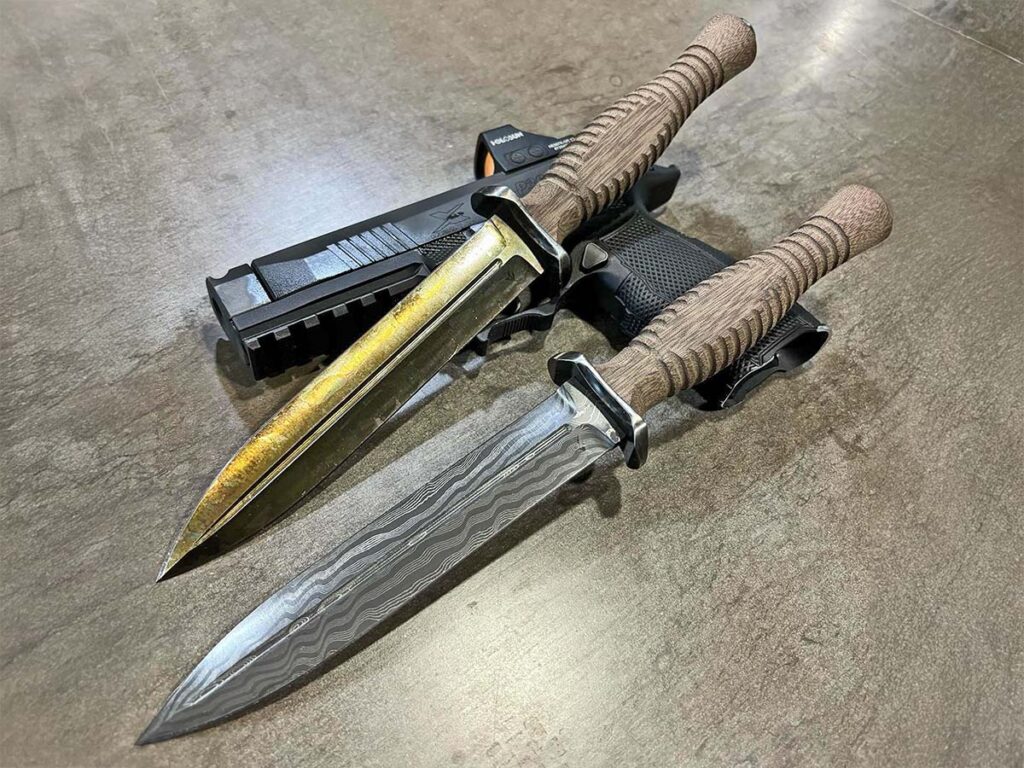
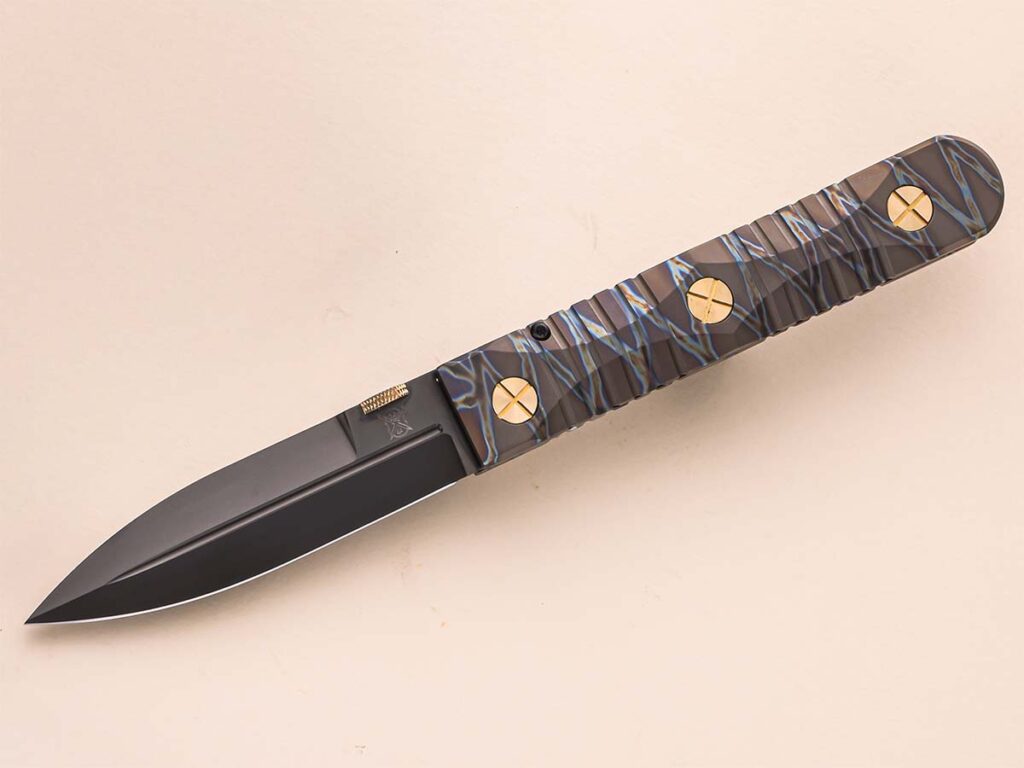
An excellent example of a collaboration between U.S. Marine veterans/knifemakers Allen Elishewitz and Les George is two iterations of the EGA (Elishewitz/George Association) Dagger, their spin on the iconic Fairbairn-Sykes dagger. The blade comes in a choice of CTS XHP stainless steel ($875 MSRP) and Chad Nichols stainless damascus ($1,200).
Allen’s first Military Occupational Specialty, or MOS, was designated O861 for Fire Support Marine, and his second was designated O321 for Reconnaissance Marine. In O861, he called in naval artillery and air support on targets, while in O321 he honed his recon skills in scouting and patrolling, small boat operations, long range communications and reconnaissance.
George’s path was slightly different.
“I started out as a heavy equipment mechanic, then volunteered for embassy guard duty,” he said.
Following embassy duty, he became an EOD (Explosive Ordinance Disposal) technician*.
“You know, making the bad bombs stop,” he quipped.
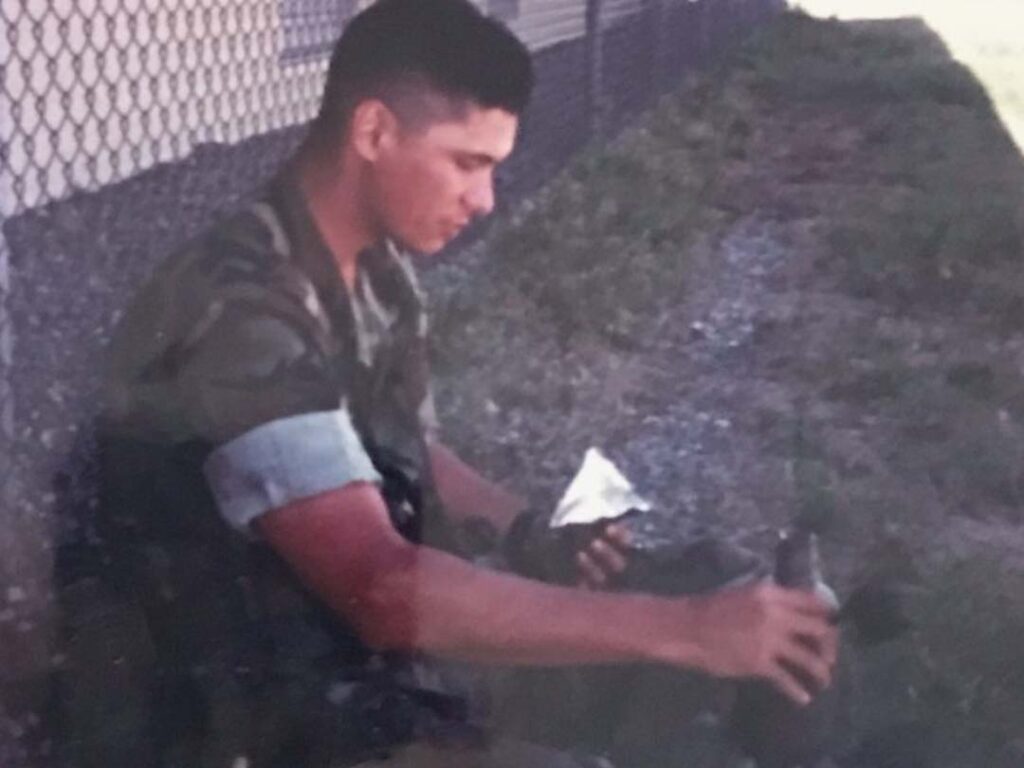
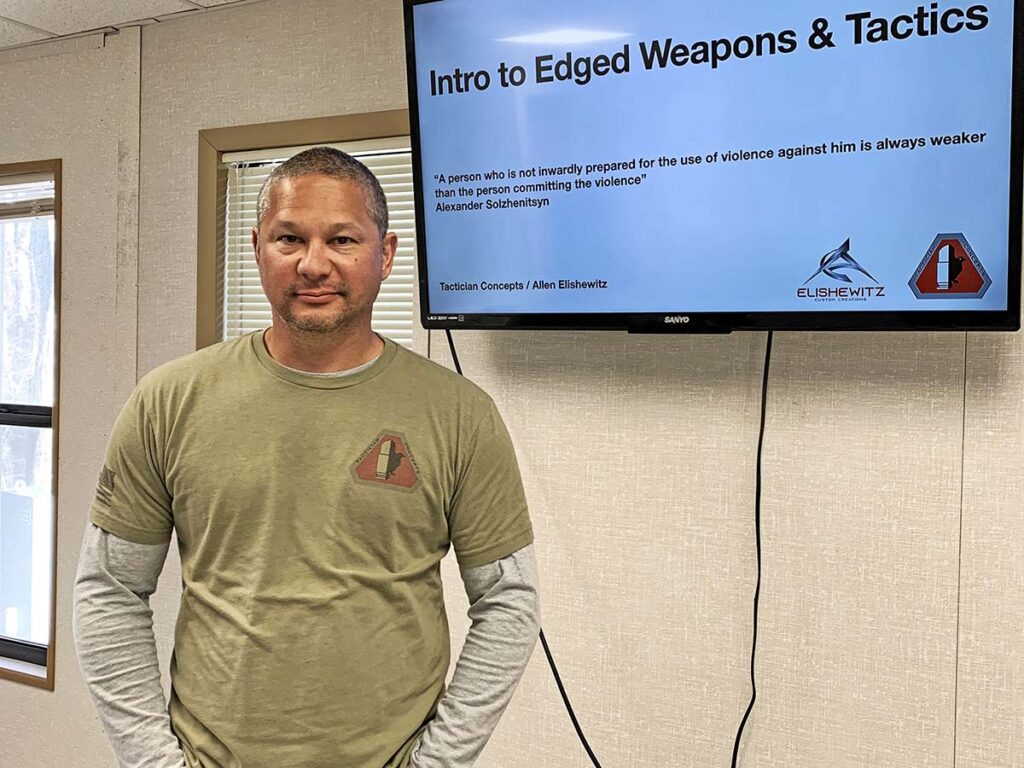
USMC Sergeant Allen Elishewitz takes a lunch break outside a Marine facility in the early ’90s.
The discipline and fortitude each gained in his respective duties set the stage for them to become solo entrepreneurs as knife designers and knifemakers. It also had a major influence on their approach to tactical knife design.
Their knifemaking styles are highly complementary.
“There are a lot of overlapping skill sets,” George observed.
For instance, Les has CNC experience while Allen has more manual machine know-how.
“Les uses CAD and CNC, I am strictly handmade,” Elishewitz reiterated.
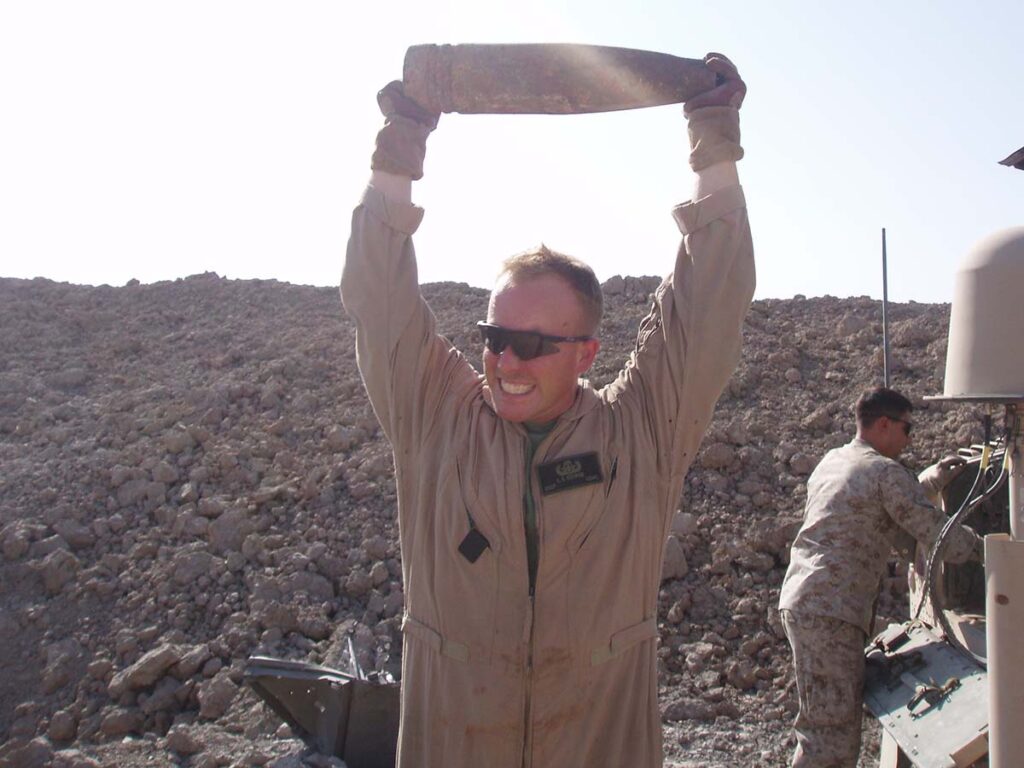
USMC Staff Sergeant Les George holds an artillery shell aloft somewhere in Iraq in the early 2000s.
“We can take a design and I can help scale it up and make more knives, while Allen can add the final touch,” Les noted.
“I see Les’s knives as very practical and utilitarian,” Allen said. “I have the same approach but with a little more emphasis on artistic flair.”
Both makers craft excellent cutting tools that are highly utilitarian. You can see the imagination and style in each of Elishewitz’s pieces. Meanwhile, form follows function with George’s work, where the beauty lies in how he builds his designs.
Long-Distance Teamwork
As with any business relationship, especially long-distance ones, it takes work to maintain along with the help of technology. Les lives in Blue Springs, Mississippi, and Allen in New Braunfels, Texas.
Allen Elishewitz has made and designed award-winning tactical and other hi-tech folding knives since 1988.
“We send designs back and forth through emails and texts,” Elishewitz explained. “Les has 3D printing capabilities for quick prototyping that has been a game changer.”
Making use of technology almost makes it feel like you are working with someone in the same space even though there is a significant physical distance. Despite the distance, these two always find ways to make things work and to collaborate on beautiful edged pieces.
Behind every good man is an even better woman, and it was never truer than with Allen and Les. Both are happily married and their wives wholeheartedly support their husbands’ endeavors in the knife industry.
“Bianca is interested and supportive but not usually super involved,” Les stated of his better half. His passion is knifemaking, hers is abuzz with a passion for beekeeping.
“Lots and lots of bees!” George affirmed.
Les George is heavily influenced by classic military fixed blade designs and modern tactical folders and fixed blades.
Meanwhile, Valerie Elishewitz not only is very supportive of her husband’s career, she plays an active role in it.
“Valerie is a crucial part of my business,” Allen stressed. “She takes care of all the administrative tasks which would eat up a lot of my time if I had to do it.”
Valerie sometimes answers emails, private messages, posts on Allen’s Facebook and Instagram accounts, helps pack and ship knife orders, and even helps her husband staff his table at knife shows. If you have bought a knife from Elishewitz at a knife show, chances are you met Valerie.
Upcoming ventures hold promise.
“Allen is doing several designs with my production company, Defiant7,” George observed.
“I’m really excited about the way those projects are shaping up.” Added Elishewitz, “We are going to do more of the Fairbairn-Sykes custom daggers. We made them a few years back and they were very popular.”
He also hints that he submitted designs to Les for what Elishewitz calls the BK, or Bangkok Special, a compact fixed blade for concealed carry for the Defiant7 line. He also submitted a blade design to accompany the handle of George’s M320 model for Defiant7.
Last but not least, Allen said, “Later this year I am going to send Les a crossbar-lock SOG bowie that is going to be killer!”
Allen and Les designed the Ek Integral Folder for Ketuo, winner of Best Imported Knife in the factory knife judging competition at the 2024 BLADE Show Texas. The knife is based on the Model 2 Ek Commando fixed blade. (SharpByCoop image)
All this in addition to keeping up with orders for their custom knives, too. Not too shabby for a couple of Marine veterans, right?
*Les George won the BLADE Magazine 2023 Publisher’s Award for his humanitarian effort in making 300 mine probes for shipment to Ukraine to help remove the thousands of deadly explosive devices buried throughout the war-torn country.
The father of modern sporting knives was busy making them a half century ago.
Editor’s Note: BLADE Magazine is celebrating more than 50 years of bringing the knife community sharp coverage of the knife world at large. Given a more comprehensive picture of where the industry comes from—thus, where it’s going—we’re running a series of vignettes on important articles marking milestones in the knife design, knife making and knifemakers from 50 years ago.
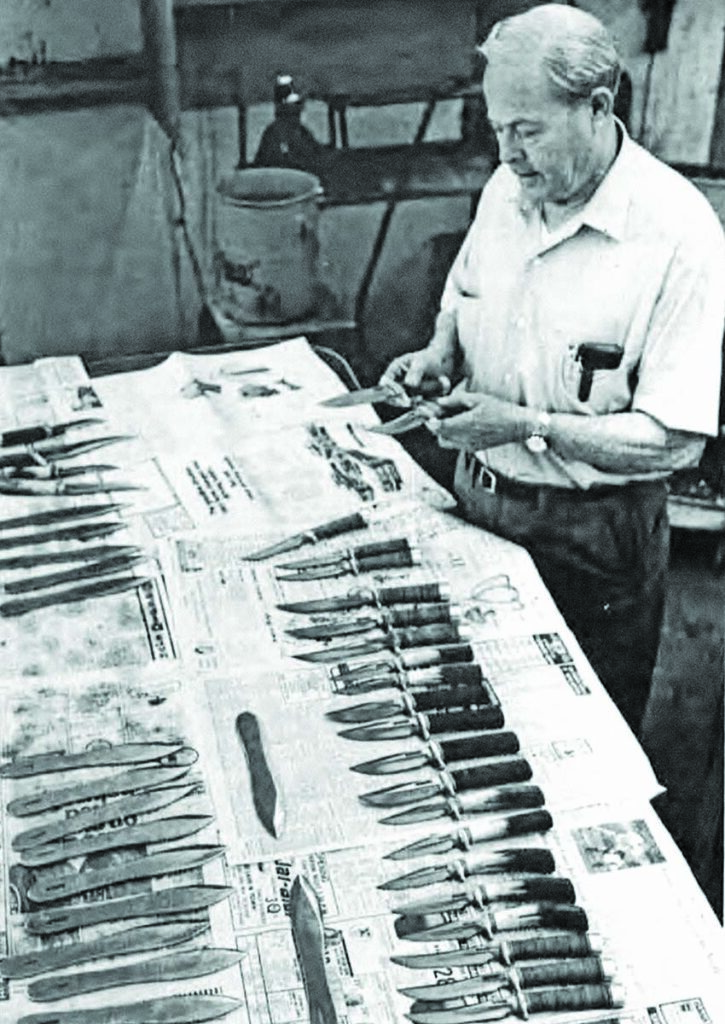
A pioneering writer and photographer, Sid Latham chronicled his visit to the Orlando, Florida, shop of Randall Made Knives in the May-June 1975 issue of The American Blade to detail how Bo Randall and his staff made knives.
As Latham noted, Bo believed in the Cutlery Hall-of-Famer William Scagel theory that every blade shape should have a purpose and be practical—and the Randall utility, hunting, combat and survival patterns reflected the Scagel approach. The most popular Randall knife in ’75 was the Model 3 hunter. It was a Model 3 that pilot Francis Gary Powers was carrying when his U-2 spy plane was famously shot down over Russia in 1960.
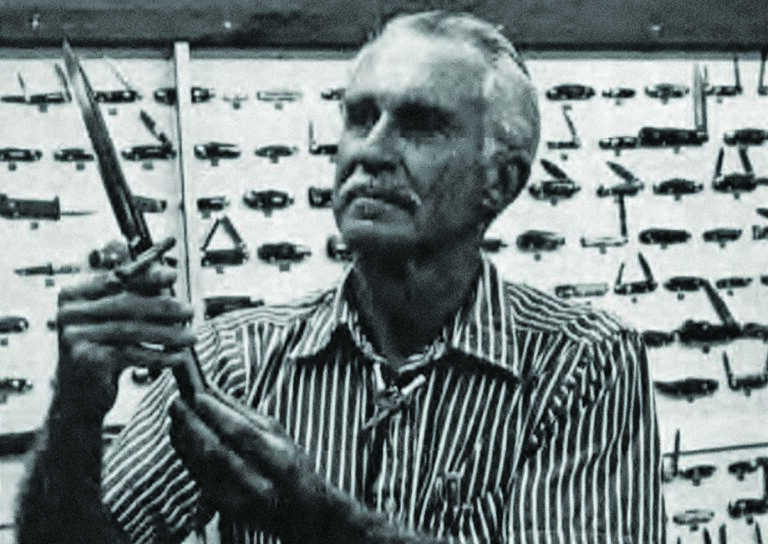
Bill Platts was closing out his career as Randall shop foreman.
Latham wrote of what Bo considered his proudest achievement of specially designing knives for the astronauts of the Project Mercury NASA space mission. The final design was worked out by Major Gordon Cooper, who took one along on his 22-orbit flight. The knife was subsequently offered as the Model 17.
Latham also covered most of the Randall staff, including shop foreman Bill Platts, who was in the process of retiring and being replaced by Pete Hamilton, to Bo’s son Gary and more. Bo Randall had already been making knives for 37 years at the time—and Randall Made Knives (randallknives.com) continues turning them out to this day.
Editor’s note: Beginning with this issue, “50 Years Ago in BLADE®” journeys back in time to recall what was happening in the early days of BLADE—formerly The American Blade—and the world of knives. This time: BLADE Magazine Cutlery Hall-of-Fame® member Bo Randall and Randall Made Knives.