
Knifemaking

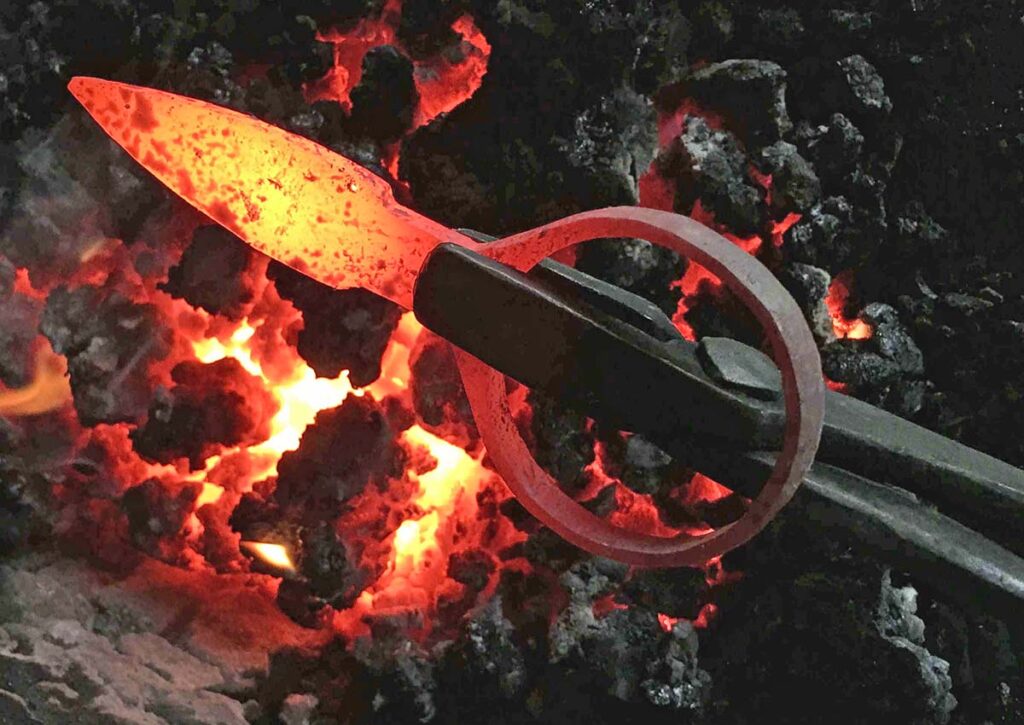
Knifemaking is the building of a knife, which includes the blade, handle and other accouterments. Blades are made by either removing metal from a steel blank via a grinder – known as stock removal – and the forging to shape of hot steel into a blade in the process known as bladesmithing. Other parts, including bolsters, guards, pommels, etc., are needed to complete the finished knife.

Featured Knives – – Knife Collecting – – Tactical Knives – – Survival Knives

Collaboration Knives: How Do They Come Together?

Top makers explain how they collaborate with knife companies.

The old cliché of the win-win holds a real grain of truth. Any successful partnership must be mutually beneficial, and in the knife industry the phenomenon of the collaboration has come to exemplify the upside of working together.

Years ago, a veteran custom knifemaker described his relationship with a major manufacturer as serving as the company’s research and development department. Such a description is accurate in that the manufacturer often relies on the custom maker for new design inspiration, from good looks to materials and mechanics. The collaboration has emerged in the last 35 years or so as an outstanding means of bringing innovation to the public and putting first-rate knives in the hands of the mass market.

The ins and outs, nuts and bolts, and give and take of the collaboration process raise questions for makers interested in striking deals of their own. A few comments from makers who have achieved great success on the collaboration frontier offer helpful insights.

“It goes both ways,” observed BLADE Magazine Cutlery Hall-of-Fame® member Bob Terzuola, who indicated he completed his firstfactory collaboration with fellow Cutlery Hall-of-Famer Sal Glesser and the design team at Spyderco in 1989. “You can go to the company or the company can come to you depending on your notoriety. If you are just starting out, you probably have to go to the company.”

On the business side of the ledger, Suzi Terzuola takes the lead and has demonstrated proficiency in making the deal work for everyone involved. Her flair for negotiation and finding the right blend of maker-manufacturer cooperation has been demonstrated through the years as Bob has worked not only with Spyderco but also the old Camillus, Boker, Fox, Pro-Tech, Tactile Knife Co. and others.
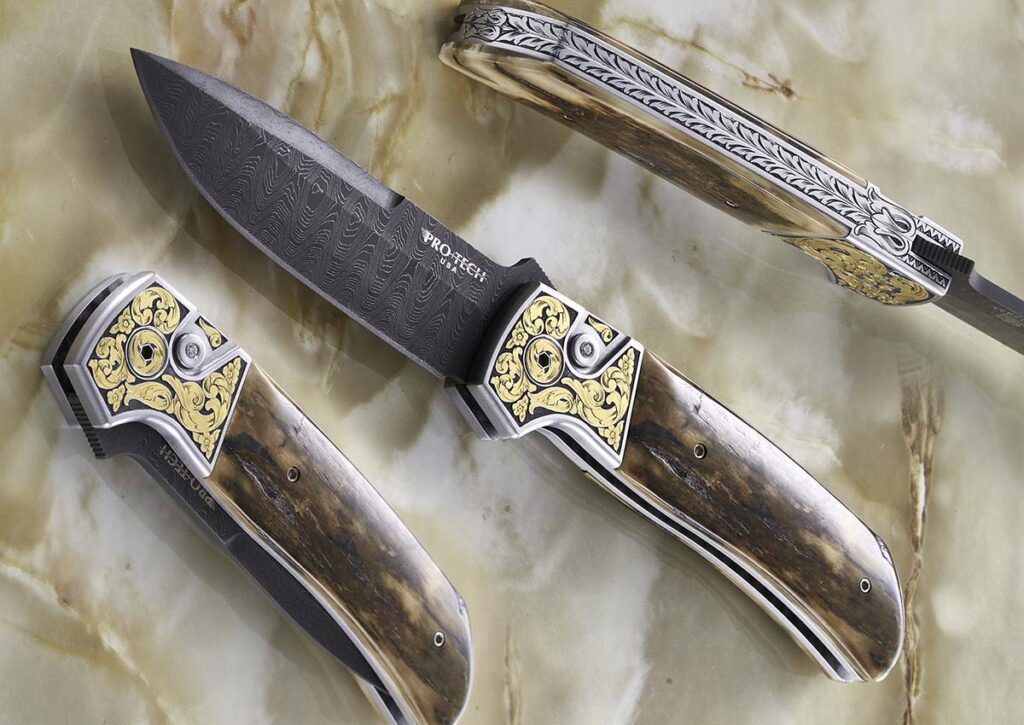
BLADE Magazine Cutlery Hall-of-Fame® member Bob Terzuola has done collaborations with many companies, including the Bob Terzuola ATCF Auto Ultimate from Pro-Tech, the BLADE Magazine 2022 Investor/Collector Knife Of The Year®. (Eric Eggly/PointSeven knife image)

“I was raised by parents with their own successful businesses,” Suzi observed, “and I saw Bob receiving passive income from Spyderco and Camillus, and of course passive income is how you survive after having only so many years to make knives. I began looking at the knife designs Bob had and tried to match the design to the company. Bob has patents lining the walls, and when he lends his name to a knife he should receive a signing bonus and a bonus against the royalties.”

In return for his design skill and the use of his name in promotions, Bob has certainly established himself as a leader among successful custom collaborators. His contribution to a company’s success has enhanced his reputation of excellence across the industry, while Suzi has forged a business posture that results in security for the future.

Knife Collaboration Contracts

The contract is the key component of a collaborative deal, and depending on the circumstances everything is negotiable. Although early agreements made among friends were sometimes done on a handshake, it has become a “best practice” to hammer out the terms of the collaboration on paper, invest in an attorney’s review, and formally memorialize the discussions. Standard royalties run roughly 5 percent of the price at which the company sells the knife.

The Terzuolas include a period of time in which the company is allowed to produce the knife; the period may be extended at maturity with the agreement of both parties. Further, there may be a requirement that the company produces a certain number of knives in a given time period, also renewable. Restrictions on wholesale pricing or discounts that affect royalties may also be negotiated.

For those considering a foray into collaborations, Bob and Suzi offer some advice: “If you’re a new maker, you shouldn’t just walk up to [the company’s] booth at a show. Make an appointment to see them because they are at the show to deal with customers. Approach a company with one or more finished designs. They want a package presented to them, a prototype or existing model, something they can hold in their hands, and in the case of a prototype it’s good to have as many innovations and design creations as you can—anything that will set the knife apart from other potential deals out there.”
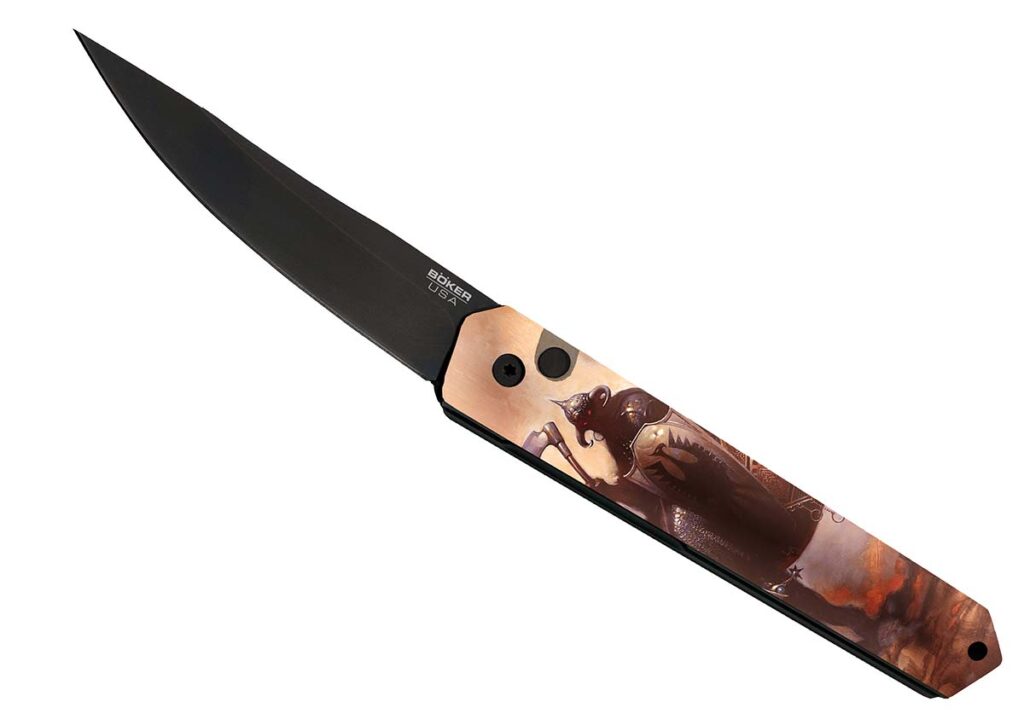
Lucas Burnley has designed several iterations of his Kwaiken for Boker, including the Kwaiken Auto Frazetta.

Suzi added that a higher profile in the industry can drive success.

“We are the R&D for a knife company,” she noted, “and when you approach them for a collaboration your social media resumé is very important.”

Making custom knives since 1994, Darriel Caston has concluded collaborations with numerous companies, including CRKT, Spyderco, Boker, V Nives, Kansept Knives and more.

“I’m prolific when it comes to designs,” he affirmed. “There are probably about 300 that I will never get to making. I’m an engineer by trade and my 3D drawings are almost ready for production, and that helps with the deals. They ask for STEP files [standardized 3D model data files for CAD and 3D printing] that can go right into machining. Sometimes we work with a prototype, and sometimes we work with a knife that I have been doing for quite a while.”

According to Darriel, one significant element of the collaboration is the retention of the rights to the design.
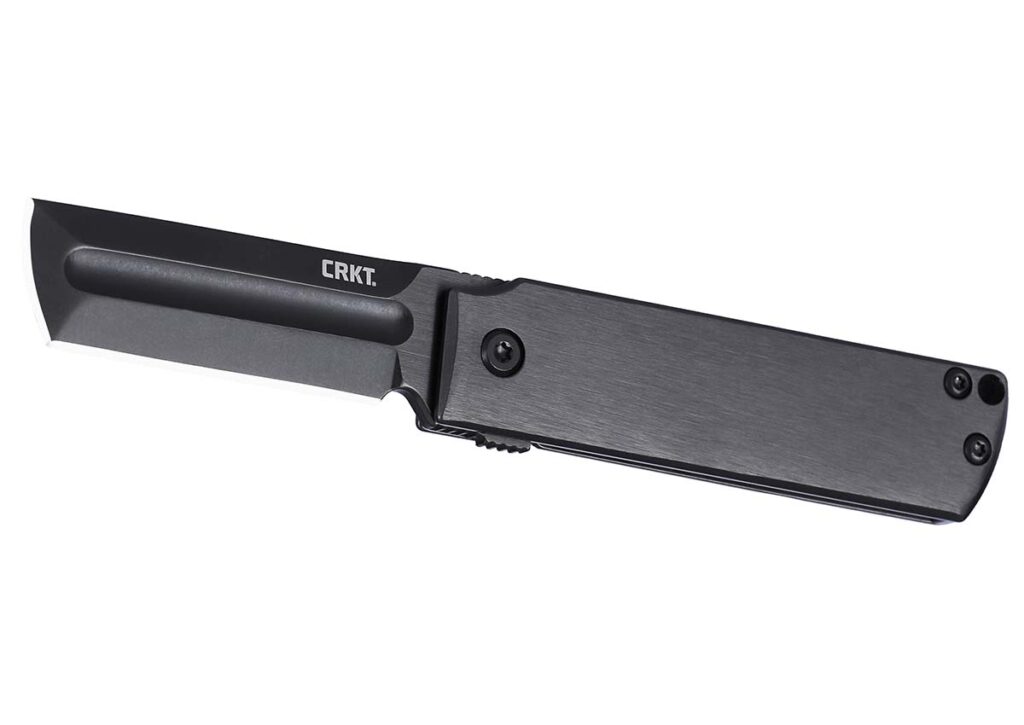
“Anybody who wants to do a collaboration must put footprints in the sand, get their work out there and show a story,” custom knifemaker Darriel Caston observed. One of his latest designs for CRKT is the blacked-out MinimalX framelock folder, an evolution of a knife originally made for SpaceX to commemorate a rocket launch.

“You never want to give up your design,” he warned. “I would license the design to the company usually up to four or five years, and the average is three years. After that, you can discuss if you want to continue if the relationship has been good for both parties. License the design and never sell it. If a company buys the design, then they own it forever. If it became their best seller, I could never make the knife again, and I would have to stay away from anything that looks like it.”

For Caston, every deal starts with a friendly conversation. As progress is made, attorneys draw up the contract. He sees the process as straightforward, whether dealing with an American manufacturer or a company headquartered in a foreign country.

“I find the knife community for the most part to be very honorable,” he commented. “I haven’t run into any bad juju. When you want to do a collaboration, I tell people they need to have a name and a track record of good designs with people following them on social media and stuff.”

Since his first collaboration—with Spyderco in 2015—Darriel can speak with confidence regarding the potential for success.

“It would be rare for someone to take a design to a company without a history or a footprint there. They look for your story,” he noted. “Anybody who wants to do a collaboration must put footprints in the sand, get their work out there and show a story. Then it becomes easier.”

Getting A Collab Off The Ground
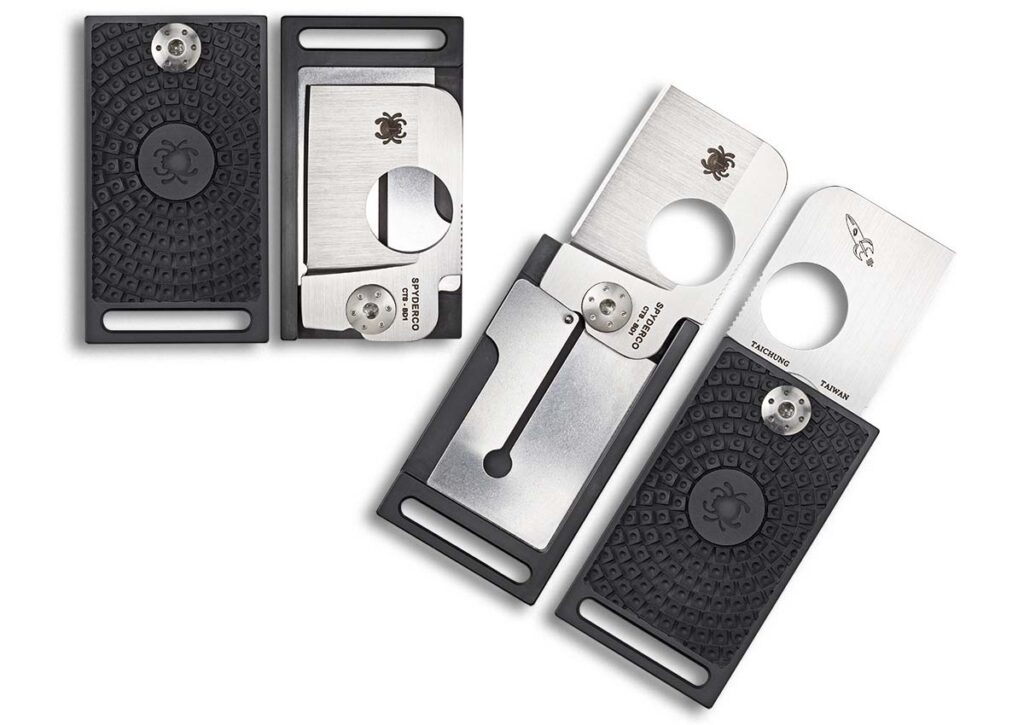
Darriel Caston has concluded collaborations with several companies. “I’m prolific when it comes to designs,” he affirmed. “There are probably about 300 that I will never get to making.” Now discontinued, the Squarehead was one of his early collaborations with Spyderco.

Custom maker/U.S. Marine Corps veteran Les George found early collaboration success at the SHOT Show some years back. He approached Pro-Tech a decade ago, and the association has continued since then.

“I had just finished my first batch of VECP [Value Engineering Change Proposal] mid-tech knives,” he remembered, “and I thought it would be cool to see Pro-Tech make the knife in an automatic. So, I did the CAD work to change the knife to an automatic and walked up to their booth at the SHOT Show. I asked to speak to the owner, and Dave Wattenberg came over and shook my hand. I drew a big breath and told him, ‘My name is Les George and I am a knifemaker and I have a design I think would be a great knife for you to make as an auto and I already have the CAD done would you like to see it?’ I said that all as one sentence in one breath!”

Still, a pragmatic view of the collaboration landscape demands preparation and planning. A so-called “cold call” may not meet with success.

“It depends on the company whether a direct approach will work or not,” George conceded. “Don’t walk up to a company at the BLADE Show and tell them you’re a hot maker and they should pay you to make one of your designs. Instead, walk up, introduce yourself, and show them with CAD pictures, a 3D printed model, or a real knife, and tell them why you think it would be awesome to work with them on a production project.”
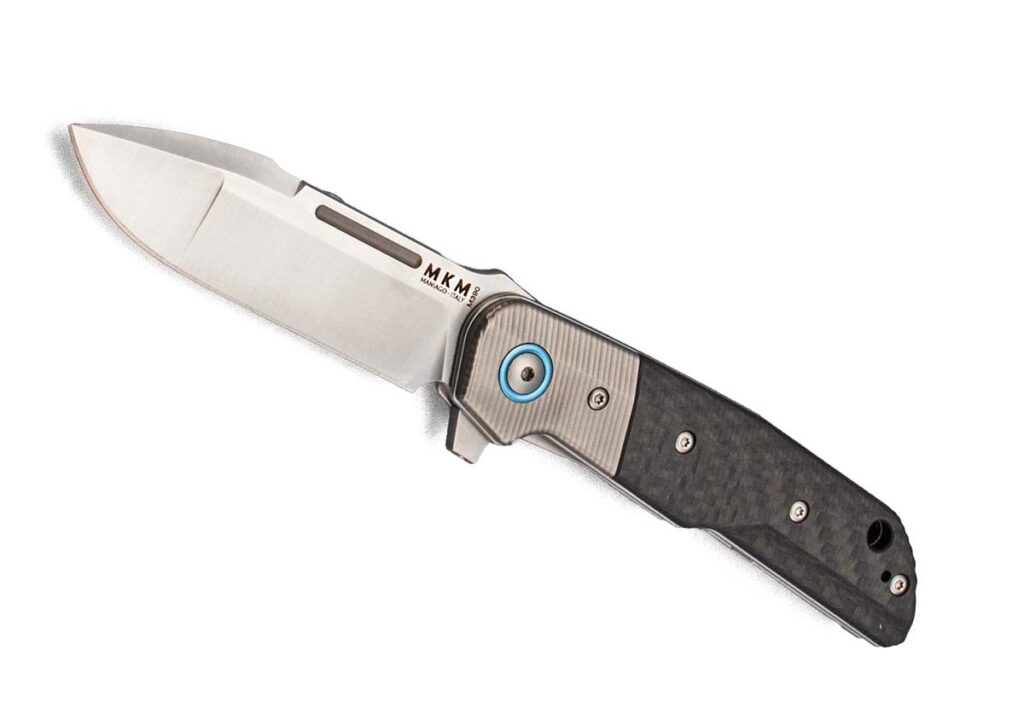
When it comes to her husband Bob’s collaborations, Suzi Terzuola takes the lead and has demonstrated proficiency in making the deal work for everyone involved. An example of several overseas Terzuola collaborations is the Clap from Italy’s Maniago Knife Makers.

Les sees the components of a particular collaboration deal varying. Of course, some of the structure depends on the negotiating skills of the parties. Commonly, the compensation may revolve around a percentage of dealer or distributor pricing on each unit, and particular deals may extend as long as each party is pleased with the progress.

“Collaborations should run as long as they are profitable,” Les remarked. “Companies don’t generally kill a successful project unless there is a capacity constraint issue or something else outside hindering it. Both parties can end the deal at any time with some allowances for production to finish with the things they have in progress already. Every contract I have ever seen gives one company the rights to exclusively make a particular model. My contracts have a provision that I can make as many customs of my models as I want. In the end, it would be counterproductive to license the same model to multiple companies. The maker would be competing with himself at that point, and it’s not helping the companies.”

Priming The Pump

Award-winning maker Lucas Burnley appreciates the help of friends in establishing a firm footing for collaboration.

“In general, I’m a big fan of pulling on my network,” he said. “If you have someone you can reach out to for an introduction, that’s always a strong move. If you don’t have someone to make an introduction, you might be able to ask around and at least figure out who you need to talk to. Regardless of how you get your foot in the door, I highly recommend going to a knife show and trying to set up a meeting in person.

“A design is only one part of a collaboration,” he continued, “so bring your ‘A’ game and think about what other value you can provide for the company. I was introduced to Boker by Jens Anso and Jesper Voxnaes, and Ken Onion put in a good word for me with Columbia River Knife & Tool. I’ll be forever grateful for those introductions and the relationships behind them. I’ve been able to pay it forward a few times, and hopefully I’ll be able to do it many more times in the years to come.”
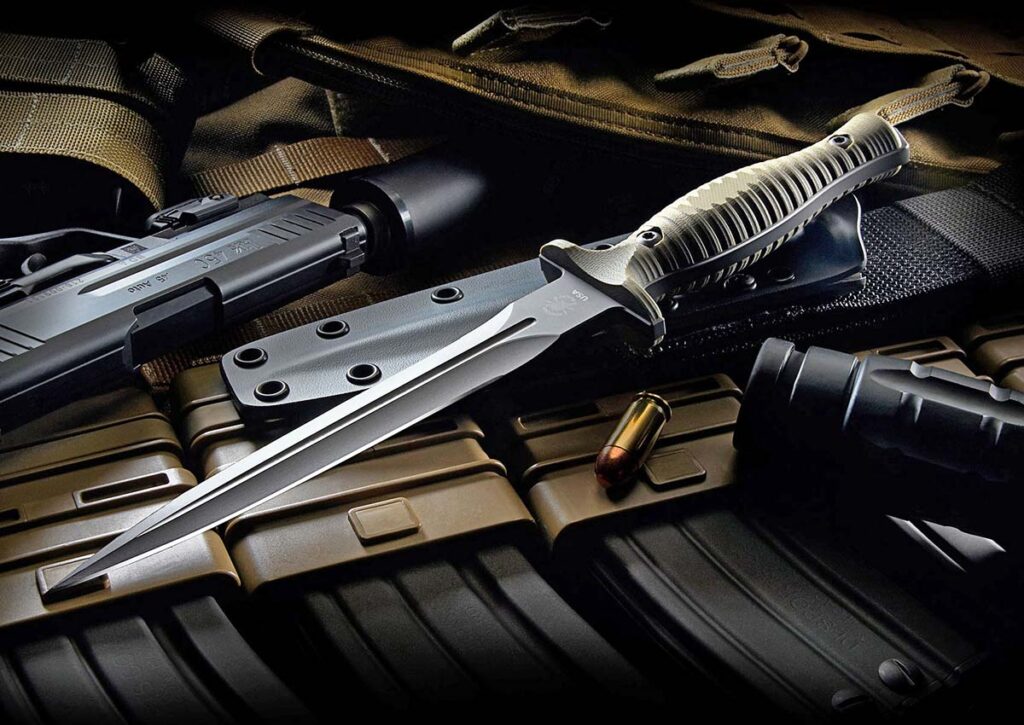
Les George’s V14 dagger design for Spartan Blades was the BLADE Magazine 2014 Investor/Collector Knife Of The Year®.

In Burnley’s experience, contracts provide compensation most often in the form of monthly or quarterly royalties based on a percentage of sales. One-time lump sum payments are also seen; however, the income generated depends on the goals of the two parties involved.

“I want my designs to run until my grandkids are old enough to thank me for my good decisions,” he laughed. “If a model is selling, I want it to keep selling. On the flip side, I will routinely ask what models we can kill if they aren’t pulling their weight.

“One caveat here is that if a design is still in production, I want to get paid for it,” he concluded. “Some companies will offer a contract for a set period of time but have the option of continuing to produce the model. I view this as somewhat akin to a one-time payout. If it works for you great; just make sure you are paying attention.”

George specifically limits the number of companies he works with in order to give the relationships the priority he believes they deserve. Consistency, he says, is huge. Real, solid collaborations are not “get-rich-quick schemes.” He remembers getting his first collaboration check in 2014 totaling a whopping $6.
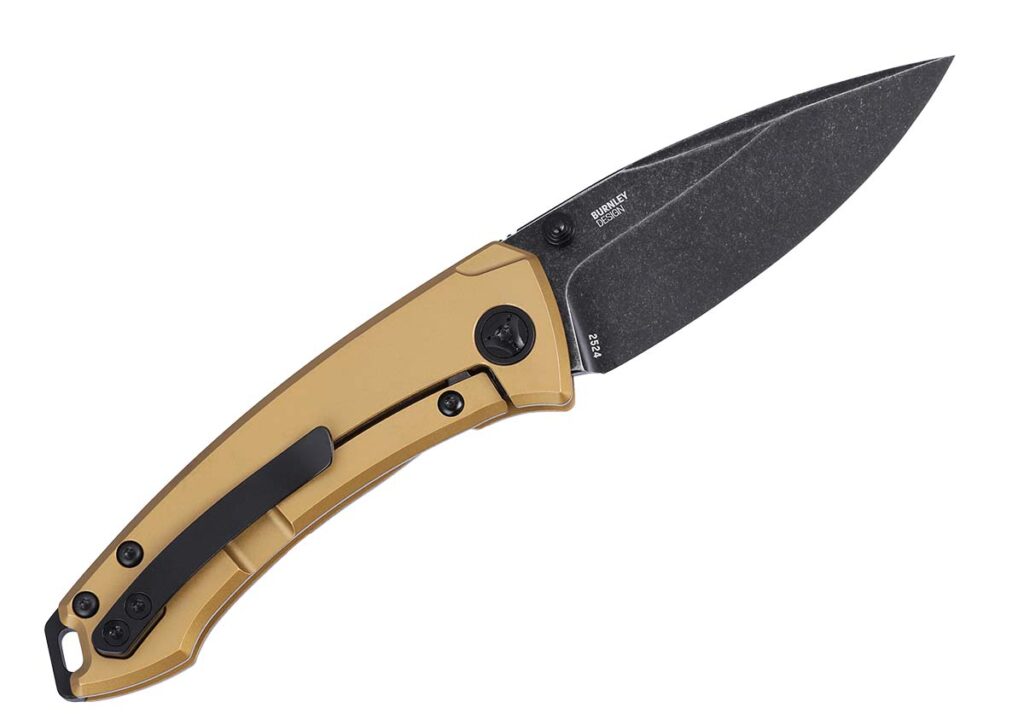
 “A design is only one part of a collaboration,” Lucas Burnley observed, “so bring your ‘A’ game and think about what other value you can provide for the company.” His Tuna Compact framelock design for CRKT is one of his latest collaborations.
“A design is only one part of a collaboration,” Lucas Burnley observed, “so bring your ‘A’ game and think about what other value you can provide for the company.” His Tuna Compact framelock design for CRKT is one of his latest collaborations. “A design is only one part of a collaboration,” Lucas Burnley observed, “so bring your ‘A’ game and think about what other value you can provide for the company.” His Tuna Compact framelock design for CRKT is one of his latest collaborations.

Times change—and checks change with good business practices, commitment, follow through, and most of all a process from contract to design and product that proves profitable for everyone.

More On Knife Collecting:

Knife World Mainstays Hughes, Klotzli and Rexroat Pass

Great friends to the knife community, Hughes, Klotzli and Rexroat leave a hole publishing, sales and knifemaking.

The knife community lost three great friends with the recent passing of Carolyn Ann Hughes, H.P. Klotzli and Kirk Rexroat, all three of whom were extremely well liked and well respected within the knife fraternity.

Widow of BLADE Magazine Cutlery Hall-of-Fame® member B. R. Hughes, Carolyn served as editor of The ABS Journal, the official publication of the American Bladesmith Society, for many years. She won several ABS honors, including the Margaret Moran Silver Slipper Award. Inseparable at various ABS and other knife events, Carolyn and B. R. helped lead the Society for almost 60 years, as B. R. was one of the four original ABS founding members. He passed away September 17 and Carolyn joined him on February 22. She was 86.

For many years H.P. Klotzli was the headman of Klotzli Messerschmiede of Switzerland, a wholesaler/distributor of Spyderco, CRKT, M-Tech and Fallkniven knives, as well as hi-tech knives made in Switzerland, scissors and more. He took over the business from his parents in 1972 and ran it until 2019. He was among the first to use carbon fiber for factory knife handles, including on a linerlock folder based on a design by Cutlery Hall-of-Famer Michael Walker. H.P. worked on several other custom and factory collaborations as well.

An ABS master smith, Kirk E. Rexroat forged fixed blades and folders part time out of his shop in Banner, Wyoming. He made his first knife in 1981 and did his own engraving. His stag-handle/damascus Rendezvous Bowie was the cover knife for the May 1999 BLADE®. He also designed and built knife prototypes for Al Mar Knives, one of which, the Havana Clipper, was the BLADE Magazine 1998 Most Innovative Imported Design. He passed away February 27 at the age of 67.

More About Custom Knives:

Cool Custom: Jose Santiago-Cummings BBQ Knife

The Jose Santiago-Cummings BBQ Knife will rock your brisket.

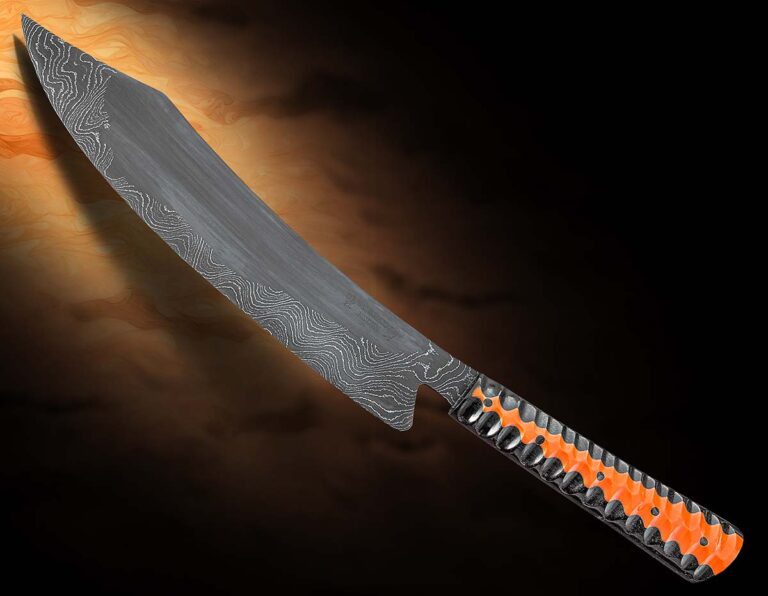
Among Jose Santiago-Cummings’ growing ranks of customers are those he describes as “foodies,” and he built his second BBQ Knife expressly for them.

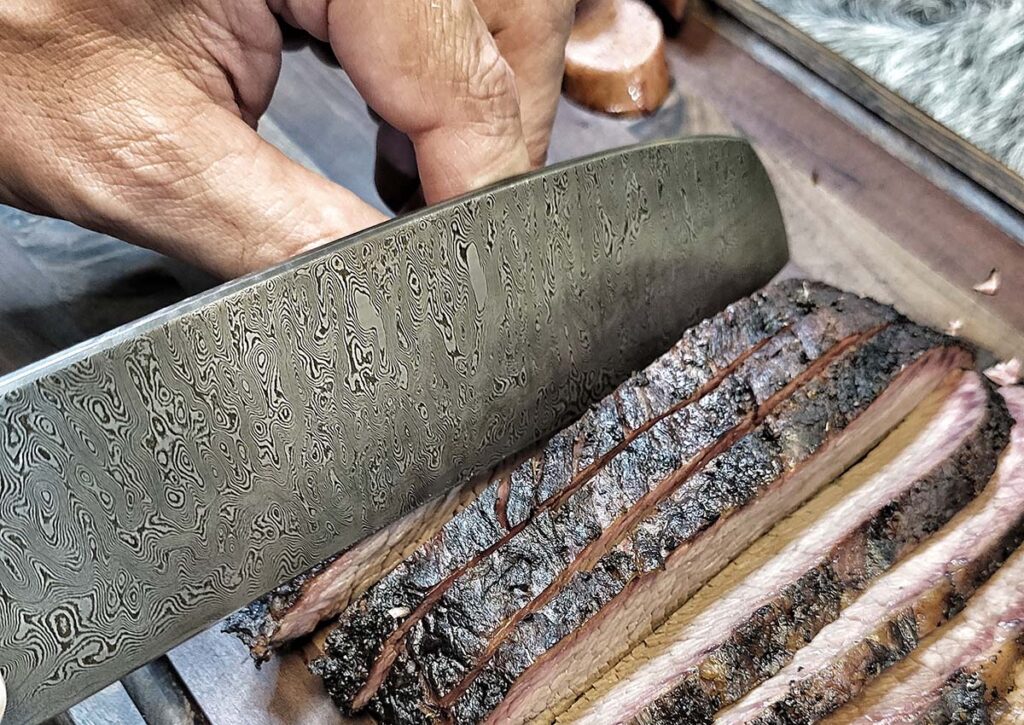
Not unlike a pirate boarding cutlass in appearance, the long, curved blade is designed for the rocking slices needed to cut meat and brisket. It’s similar to how a slicer is used as opposed to, for example, a nakiri for chop cuts.

Jose Santiago-Cummings

Jose, 62, used a cylindrical drum-sander-like attachment on a Ram tool to carve the grooves in the long, upswept handle. Jimmy Floyd forged the clip-point blade of damascus clad in wrought iron.

BBQ Knife Specs
Maker: Jose Santiago-Cummings
Blade length: 8.5”
Blade steel: Damascus of 1084 carbon and 15N20 nickel-alloy steels clad in wrought iron
Blade grind: Flat
Handle: Black and orange G-10 resin
Overall length: 13.25”
Maker’s price for a similar knife: $450-$475

More Custom Knives:

Suprlativ Knives: How Three Makers Blend Artistry and Innovation

A knifemaking trio with little to no ego keeps Suprlativ super.

If you’re going to carry a knife every day, then it should be functional and stylish, a joy to use and look at. Otherwise, what’s the point? That’s Enrique Peña’s design philosophy. In addition to owning Peña Knives, along with Jared Oeser and Javi Garcia he is one of three founding members of Suprlativ Knives. Suprlativ (pronounced like superlative) offers limited-edition folders in eye-catching designs, constructed with modern materials, artistic colorways and a machinist’s attention to mechanics—all at an affordable price.

How do three creatives run a knife company without conflict? Easy—no one’s ego is so tied to an idea that he can’t incorporate suggestions from the others. All three maintain their own companies, their homes for signature work, so when they come together to design for Suprlativ they can push boundaries. The diversification means there’s no stress when they work on collaborative projects.

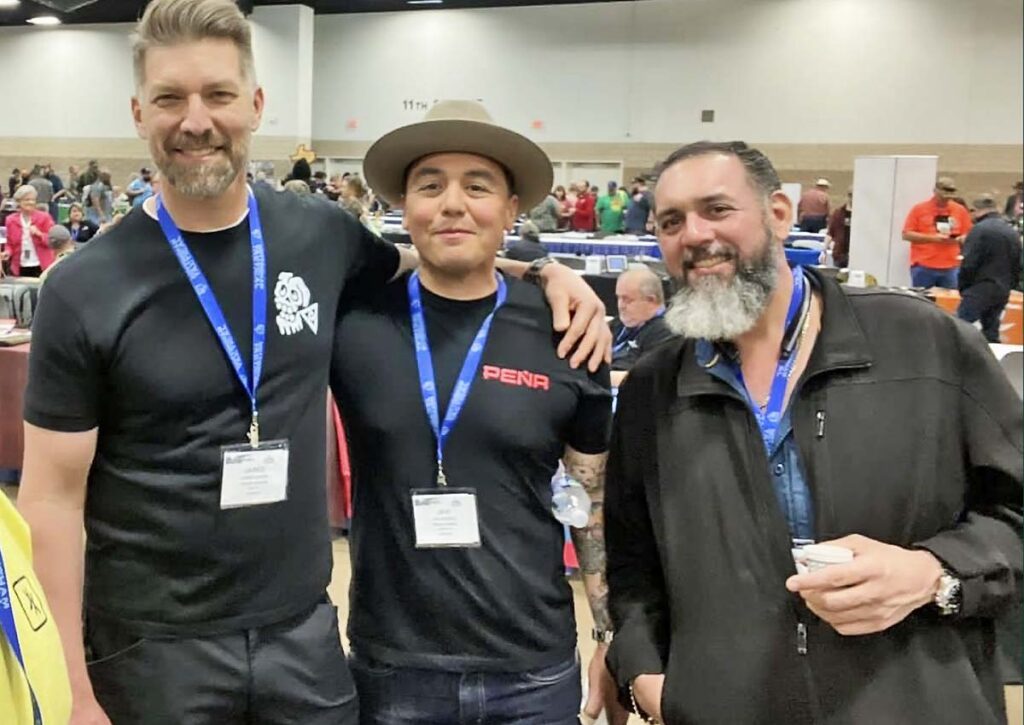
Suprlativ’s 3 Musketeers, from left: Jared Oeser, Javi Garcia and Enrique Peña.

As Garcia explained it, the mindset shifts to, “What can we make that would nurture the community?”

Enrique Peña

Peña is an associate of the South Texas Slipjoint Cartel. For the uninitiated, the cartel is a group of knifemakers that got together to honor BLADE Magazine Cutlery Hall-of-Fame® member Bill Ruple, each making a knife in the Ruple style. Bill, in turn, began sharing his knowledge with them, inviting them to his shop and answering questions by phone and email. He has been making knives since 1988 and is a master at multiblade slipjoints.

He sat on the board of the Texas Knifemakers and Collectors Association, the predecessor of the Texas Knifemakers Guild. Other Cartel members—all serious about preserving traditional knifemaking—include Bruce Barnett; Tanner Couch; Tommy “Bubba” Crouch; Burt Flanagan; Jeff Hawkins; Tobin “Toby” Hill; Bobby House; Matt Humphries; Phil Jacob; Tom Ploppert; Tim Robertson; Kendall Schorsch; Tyler Turner; Trae Gaenzel; Roan West; Rusty Preston; and Luke Swenson.

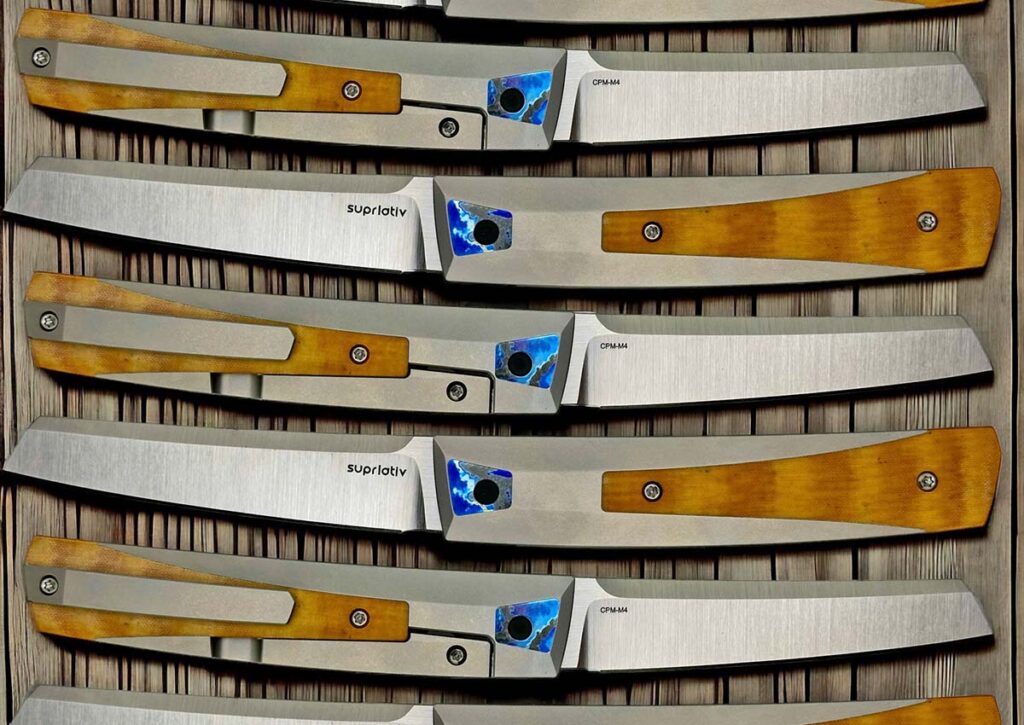
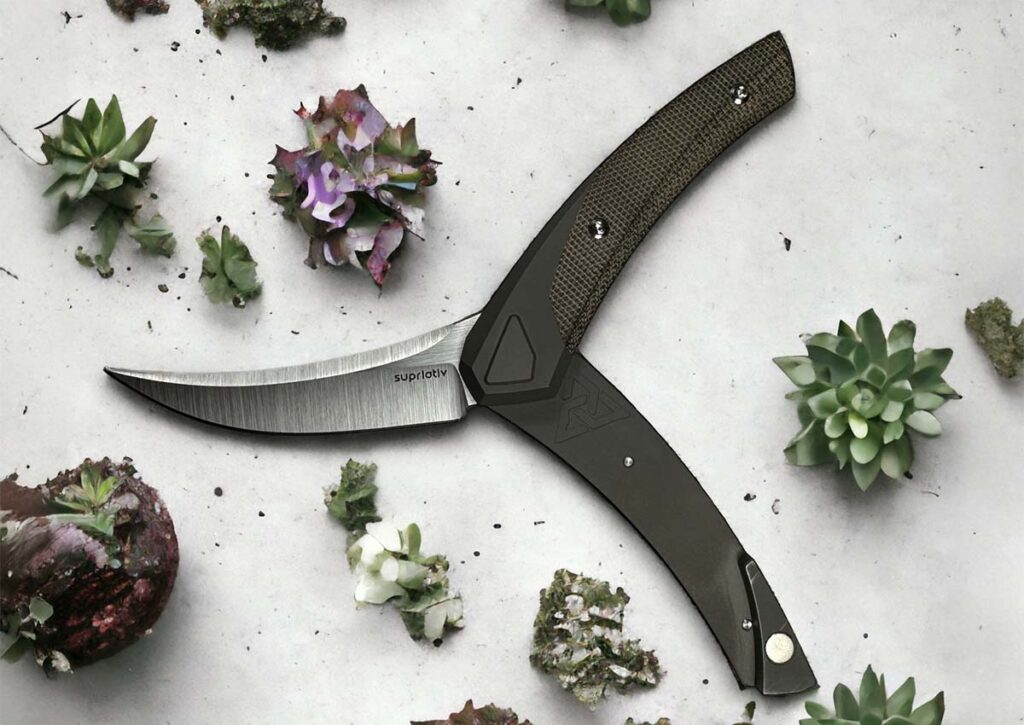
A swayback look complemented by a modified sheepsfoot blade highlights the Tirant. Blade length and material: 3 inches and CPM M4 carbon steel. Blade opener: Front flipper. Blade grind: Flat. Pivot: Ceramic caged bearings and detent. Frame: 6Al-4V Grade 5 titanium. Handle: Linen Micarta®. Weight: 3.4 ounces. Closed length: 4 3/8 inches. Country of origin: China. MSRP: $298.

In 2008, Peña was laid off from his job as a diesel mechanic and turned his knifemaking hobby into a full-time endeavor. He simply drove to Ruple’s house, knocked on the door and asked to learn knifemaking. Bill began mentoring Peña and credits him with being a quick learner. Ruple shared more than his craft; he guided Peña with business wisdom as well, which ensured the success of Peña Knives.

Peña’s X-Series offers the design and mechanical excellence of his custom knives in a more affordable production knife. Whether traditional or tactical, Peña’s fit and finish displays a respected exactitude. He maintains that clean, crisp, simple designs are harder to master because you can’t hide mistakes with bells and whistles. For example, to the experienced eye, grinder marks, or the lack of them, reveals something about the maker. Hand rubs take time. Peña, if you couldn’t tell, is a traditionalist.

Jared Oeser

Around three years after Peña took to knifemaking full time, Jared Oeser, owner of Oeser Knives, did the same. A building developer by trade and with little to do during the 2008 recession, he looked to his knifemaking hobby as a potential moneymaker. He said his wife can attest to the fact that his stress level plummeted during this time. Making knives provided an outlet for a creativity he had possessed since boyhood but couldn’t concentrate on as a profession except through designing houses.

Suprlativ’s 3 Musketeers, from left: Jared Oeser, Javi Garcia and Enrique Peña.

He asked his friend, fellow Salt Lake City resident and longtime knifemaker Dave Lang, to help him make knives. Lang swapped knifemaking ideas with the likes of Bob Loveless, Buster and Julie Warenski (now Warenski-Erickson) and Earl Black (Loveless and Buster are Cutlery Hall of Famers). Oeser’s father always carried a knife and brought his son up hunting, fishing and camping, traditions that Oeser passes on to his children.

Oeser’s first knives were bushcrafters. He couldn’t find exactly what he wanted—a bushcrafting knife that was both functional and good looking—so he made one. He and Peña communicated now and again, exchanging ideas and figuring out problems together. Now, though Oeser’s custom knives normally sell for around $1,000, some can go for over $10,000. In other words, he found his creative outlet and realized that the knife-art market still exists.

Prior to Suprlativ, he held a three-year contract with Benchmade, designing its Tengu and Tengu tool, so his design abilities have received praise from both collectors and industry giants.

The fully serrated blade of the Piranha deploys via a Rare Earth Magnet Lock. Blade material: CPM M4 carbon steel. Pivot: Bronze washers. Frame: 6Al-4V Grade 5 titanium. Handle: Brown canvas Micarta®. Weight: 2.1 ounces. Closed length: 3.76 inches. MSRP: $284.

Though Peña lives in Laredo, Texas, and Oeser in Lehi just outside Salt Lake City, and Peña is a staunch traditionalist and Oeser blurs the lines between traditional mechanisms and modern frames and furniture, the two had a working relationship that grew into a friendship.

Javi Garcia

Enter Javi Garcia. Formerly of South Texas and now living in central Texas, Javi first was a Peña customer, then a potential hire, then a friend and mentee. The two socialized together with their families, compatible in their shared Mexican heritage. Even though Garcia’s design approach is decidedly modern, Peña could appreciate his style.

Javi knew that Enrique was a master of knife mechanics, taking Garcia’s ideas and showing how they could be brought to fruition. Garcia began to share ideas with Oeser, too. He found himself going between the two veteran makers and telling each how the other approached a design idea or challenge. During these exchanges, the idea developed that the three of them start a separate company. Peña credits Garcia with bringing the three together to form Suprlativ.

How Suprlative Operates

Javi Garcia’s last-minute decision to enter the Canibl Phantom Lock resulted in Suprlative taking home Best Custom Knife Collaboration at BLADE Show 2024. The 3 1/8-inch blade is hollow-ground CPM MagnaCut stainless steel. Closed length: 4 inches. (Jocelyn Frasier image)

The men knew they could bring knives to the market that got the job done expertly and looked really good doing it, knives of high quality, high tech and high precision. Garcia and Oeser are extremely creative, and Peña’s hands-on skillset is, well, superlative. Garcia says Peña is more creative than he thinks he is. And that’s the way it is with these three.

They are endlessly encouraging and positive with each other. In a situation where three chiefs and no Indians could seem problematic, Garcia explained that the collaboration works because they relate to each other with positivity, respect and warmth. They reserve their individual knifemaking styles for their independent work and let loose with ideas for Suprlativ.

Part of the contentedness and success is that Suprlativ designs come from all three knifemakers, including Peña. It’s an equal contribution of creativity. “The designs never start in the same place,” Garcia said. It’s fluid. Once the design is finalized, Peña initiates contact with what’s considered the fourth member of the group: Reate.

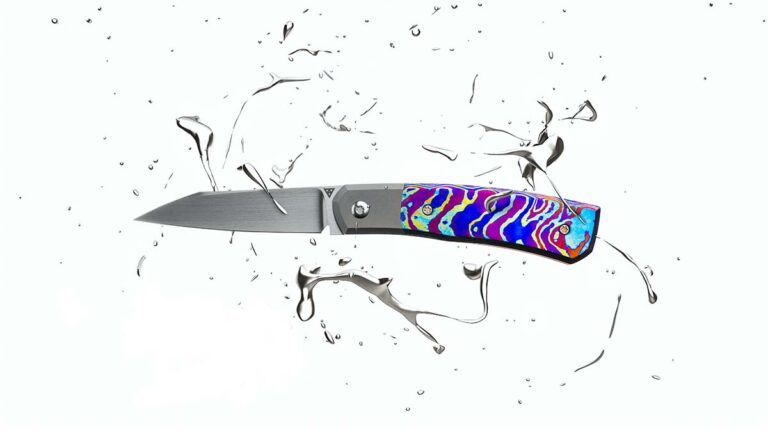
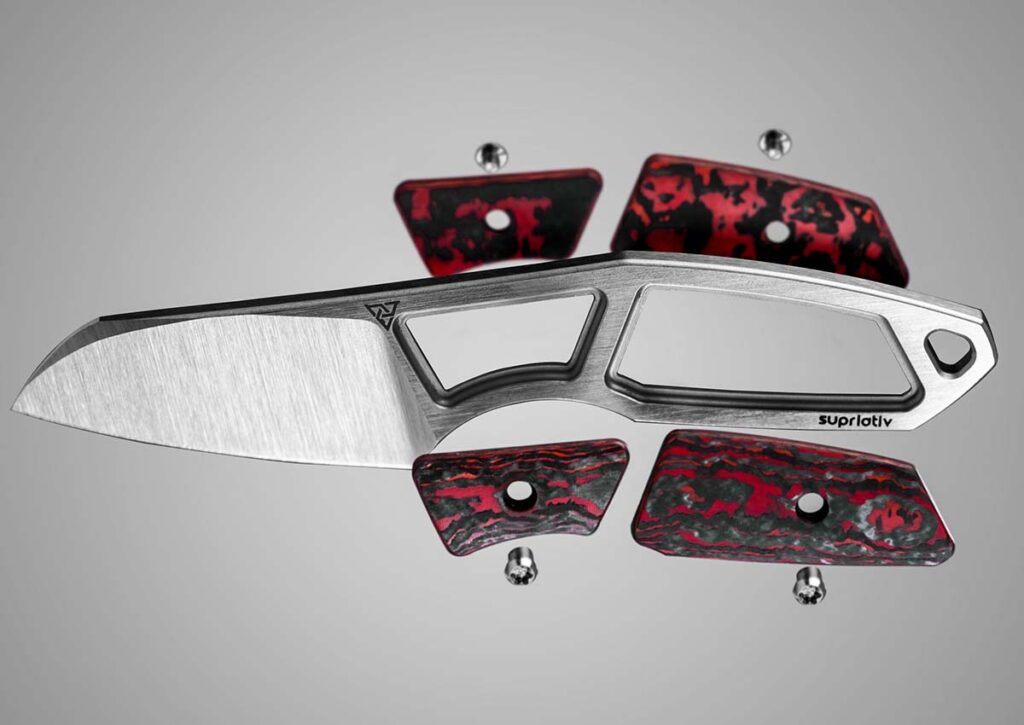
The home-page image for Suprlativ’s website, an exploded view of the Hella showcases one of its various inlay options—carbon fiber—and a 2.07-inch blade of flat-ground Böhler M390 Microclean stainless steel. Weight: 1.2 ounces. Frame: 6Al-4V Grade 5 titanium. Closed length: 2.88 inches. Sheath: Premium vegetable leather. Country of origin: China. MSRP: $194.

Peña already had a relationship with Reate Knives, the high-end Chinese original equipment manufacturing (OEM) operation that makes knives for other companies. Peña said that Reate offers the highest quality production and is also more costly, but not exorbitantly so. Plus, Reate officials never seem to say no, he noted. For its part, Reate considers any deviation from the norm as a way to learn how to incorporate new production procedures. The company reportedly considers Suprlativ’s vision to be unique.

Steel choices depend on what Reate can get in stock, but M390 and CPM 154 stainless and CPM M4 carbon steels all have been used in prior releases. The most recent order will be in CPM MagnaCut. Handle materials include a mixture of titanium, carbon fibers and Micarta® with shield inlays—a nod to tradition—and come in an artistic array of color patterns. Each run is different, never just a colorway change. Peña, Oeser and Garcia determined early not to chase steel or frame material fads since it can take upward of a year to receive an order.

At the last minute during BLADE Show 2024, Garcia decided to enter the Suprlativ Canibl Phantom Lock in the custom knife competition. Once the three determined the design, Oeser cut the parts, did the precision grinding, fit the locks—every type of lock is on the table at Suprlativ—did the surface grinding and ensured the knife was functional.

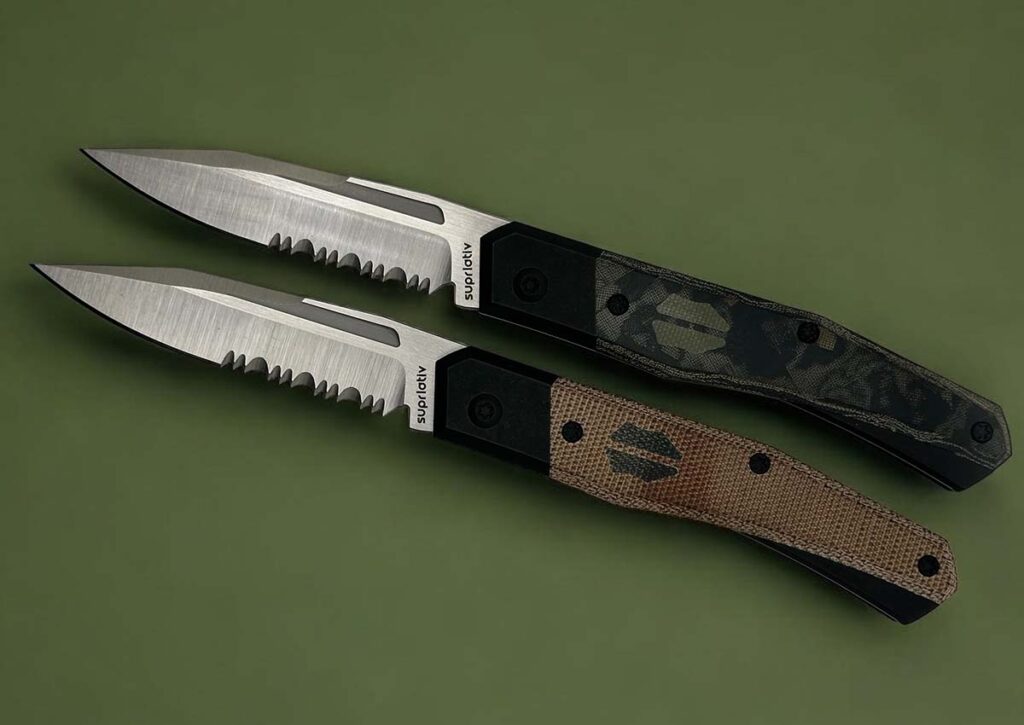
The Cruzador slipjoint has a 3.224-inch semi-serrated/nail-nick-fullered blade of flat-ground CPM M4 carbon steel and a 6Al-4V Grade 5 titanium frame. It also comes in a plain edge. Blade pattern: Clip point. Handle material: Jungle Wear Fatcarbon® ($274 (top) and brown canvas Micarta® (bottom). Weight: 3.3 ounces. Closed length: 4.25 inches. Country of origin: China. MSRPs: $274 each.

Garcia did the blade grinding; he’s the youngest and is humble enough to take on the difficult and time-consuming part of the job, which is just one more example of the goodwill dynamic between the three. Then the knife went to Peña for hand-rub finishing, shield inlay and blade edging. It was an equally shared labor of love.

The effort paid off. The Canibl Phantom Lock won Best Knife Collaboration. The men each expressed surprise, excitement and a sense of validation that what they set out to accomplish resonated within the community. Their collaboration, peaceable interactions and professionalism obviously generated increased creativity for them, loyalty from customers and now well-deserved notice and approval from knifemaking standard-bearers.

Read About Custom Knives:

Tony Bose: The Legend’s Effect On Pocketknife Designs

How the iconic custom maker transformed pocketknives and the knife industry.

The story of the knife is one of evolution, with thousands upon thousands of steps along the way. When you boil it down, however, it’s really just the passing of knowledge gained from one individual to the next. One who earned an immortal slot in that incredibly long span of time is BLADE Magazine Cutlery Hall-of-Fame® member Tony “Old Dog” Bose.

Born of humble beginnings, Tony suffered the loss of an eye at an early age—a setback for anyone, though especially a craftsman—and grew up in Indiana far from any cutlery center. Nonetheless, what he did have was a job repairing knives, and that was all the springboard he needed to launch him into becoming a highly revered custom knifemaker.

Tony produced his first custom knife in 1975 and by 1990 was going full steam—this while the Gulf War was inspiring the modern tactical knife movement. But he had his own plans and continued to gain popularity with the traditional slipjoint crowd, a popularity that surged throughout his knifemaking career. He had a huge impact in his day, not only for the sheer quality of his work and innovative styling, but for his lasting contributions to both the custom and factory knife industries.

Tony Bose As Mentor

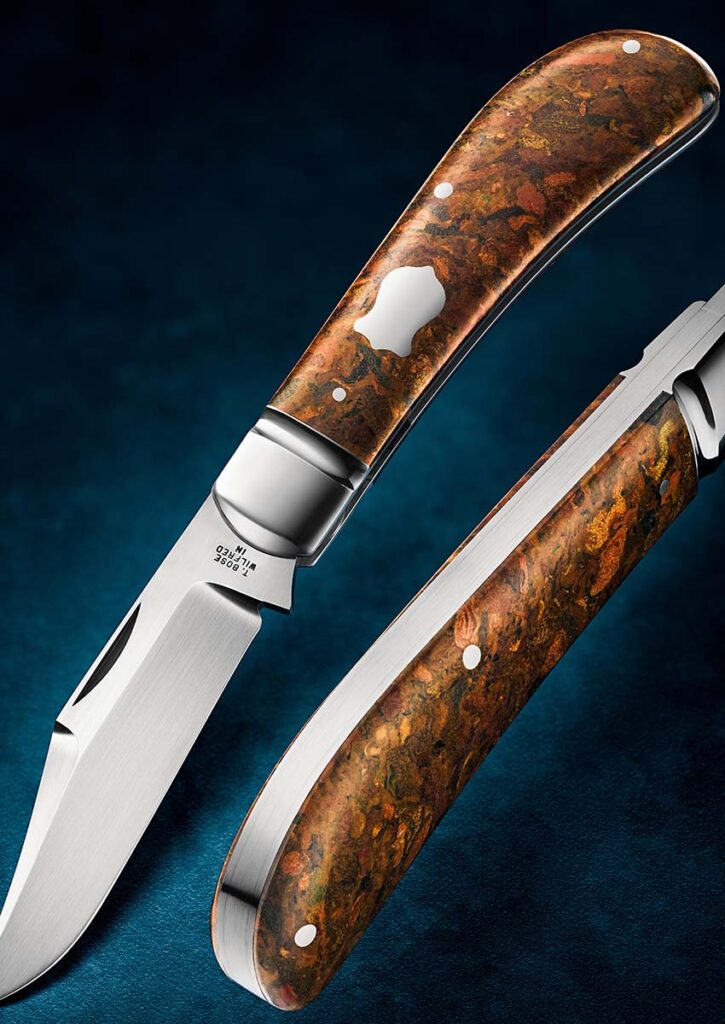
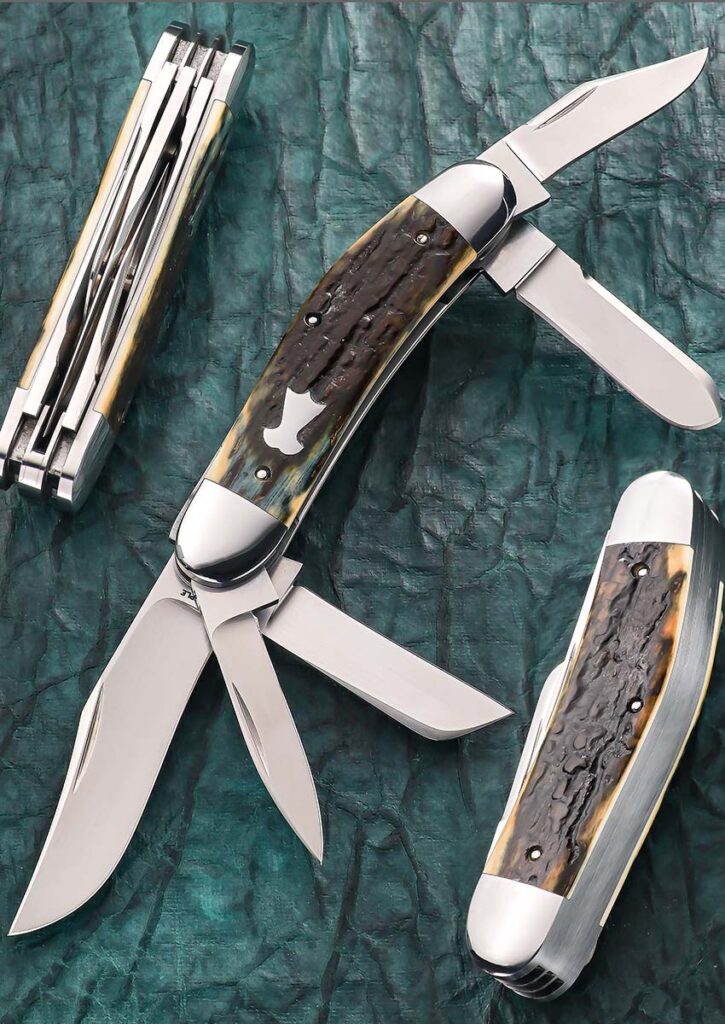
Another of Tony’s slipjoint standards is the Lanny’s Clip. “In 1989 I met a good ol’ boy named Lanny Shell,” Tony wrote. “He asked me to make him a knife between 3¾ and 4 inches closed for heavy work with a clip blade in it. I didn’t know what to call it, so I called it Lanny’s Clip.” (Caleb Royer image)

One way to judge a master craftsman is by the people he taught.

“I first met Tony at the Guild Show in Florida,” notes Cutlery Hall-of-Famer Bill Ruple, a knife legend in his own right. “I had just begun making knives and when I saw what he had on his table I was blown away! Before that I was making folders and a few fixed-blade knives. After seeing his work I focused on multi-blades. As time went on, we became great friends. One of my biggest regrets was not taking time to go and visit him. He invited me many times.

“Any time I had a problem, Tony was there to talk me through it. I’d always pick what I considered to be my best knife and have him critique it at the BLADE Show. He set the standard for all of us multi-blade makers. Reese [Tony’s eldest son] is continuing to set that standard today. I was just one of many who benefited from Tony’s generosity to share his knowledge.”

ABS master smith Harvey Dean, who makes top-notch slipjoints in addition to his award-winning fixed blades, has fond memories of Tony’s mentoring and friendship.

“I met him around 1993 at the New York Custom Knife Show,” Harvey recounts. “He had quite a few slipjoints for sale, and if I recall they did not last long [before they sold out]. I remember most of the people that bought them had memories of carrying his type of knives many years ago. Tony brought them back into popularity.

“Tony’s influence, I think, was his approach to making slipjoints. His grinds, swedges and the function of the knife were all spot on. His handle material was always exceptional. For me, Tony’s generosity in sharing his knowledge was the most important thing. I could call Tony anytime for help and he always helped me out. I still have, I think, three patterns Tony made for me, mailed them to me, and would not take any payment for them.”

Tony did the same for Ruple and ABS master smith Steve Dunn. “Tony sent me many patterns over the years and never charged me a penny,” related Dunn, who passed away last year. “He will go down in the books as the best slipjoint maker ever.”

At a BLADE Show circa 2010, Ruple told Tony his favorite knife ever was the Bose saddlehorn trapper.

“After the show I received a package from Tony,” Bill writes. “Inside were two different-sized saddlehorn trapper patterns. He had hand ground them! That’s the kind of guy Tony was. He was a kind, generous gentleman, always willing to share his vast knowledge of knives.”

One look at Tony’s knives at a Knifemakers’ Guild Show and Cutlery Hall-of-Famer Bill Ruple started focusing on making multi-blades. The rest is history, including Bill’s five-blade sowbelly. (SharpByCoop knife image; image of Ruple by Chris Wellhausen)

One of Tony’s greatest achievements, in his own words, was teaching his son Reese to make folding knives. Tony commented on mentoring him in about as strong a statement as it gets.

“I have helped a lot of guys figure out how to make pocketknives,” he noted, “but Reese is the only one I have taught.” Today, Tony’s son is considered one of the world’s best slipjoint makers.

Reese has fond memories of his father.

“When I’m asked about Tony, a few things come to mind: generosity, influence and impact,” Reese says. “Tony’s generosity with his time and knowledge were truly something special. I can’t even begin to count the number of phone calls we had over the years. I do remember one of our first conversations when Tony told me, ‘Boy, you are gonna have to learn swedge work.’ He was always ready to give advice about knifemaking and even the day-to-day of running a knife business.

“Many makers went in and out of his doors with no money ever exchanging hands. It was this time spent sharing advice, knife patterns, and even loaning out vintage knives that illustrated the influence Tony will continue to have in the knifemaking world.”

Tony Bose & Case Knives

The knife collaborations Tony did with W.R. Case & Sons increased the awareness of and interest in the company to much higher levels, even during times when the cutlery world was consumed with tactical fare. His was also a constant presence at assorted Case collector events for knife enthusiasts of all ages, giving seminars, meeting and greeting all in attendance, etc.

His contributions were such that on July 14, 2023, he became the first person in over 20 years to be honored with a Wall-Of-Fame induction ceremony at the W.R. Case & Sons facility in Bradford, Pennsylvania. The induction included a plaque of Tony installed on the Wall Of Fame in the Zippo/Case Museum. Tony’s son Reese, Bill Ruple and others were on hand for the event.

Fred Feightner, Case director of marketing communications, remembers the early years in 1999 when Case hired Tony as a designer to elevate the company’s folding knives to a greater level of quality and relevance.

One of Tony’s greatest achievements, in his own words, was teaching his son Reese to make slipjoints. “I have helped a lot of guys figure out how to make pocketknives,” Tony noted, “but Reese is the only one I have taught.” From the looks of his son’s five-blade congress pattern, Tony taught Reese well. (Eric Eggly/PointSeven image)

“My first one-on-one interactions with Tony came nearly 20 years ago as a result of an assignment I was given by Tom Arrowsmith, our company president at the time,” Fred recalls. “I had only been with the company a couple of years, so I was pretty new to the knife industry with very little exposure to the world of custom knives. The assignment was to produce an eight-to-10-minute video about Tony to support the introduction of the swayback pattern, our latest online edition of our Case-Bose series.

“Naturally, I was excited to be traveling to meet this famous knifemaker. So, with stars in my eyes, off I went to Tony’s shop in Indiana. The address I was given took me to Tony’s house. Once there, I was surprised to learn this superstar was making his impeccable knives from inside his attached garage. Tony came out to meet me and took me inside, showed me around the shop a bit, and introduced me to his son Reese, who was situated in a far corner. Then Tony offered me a cup of ‘cowboy coffee,’ which turned out to be coffee boiled in a camp pot and kept warm over a hot plate that was within easy reach from his desk all day.

“Over the next two days I would be treated to the most in-depth knifemaking tutorial series one could only imagine,” Feightner exclaims. “Being an eyewitness to the painstaking care that Tony took in preparing even a single knife for one of his customers was truly awe inspiring. I still recall watching him hunched in his shop chair, sanding down knife parts by hand for hours until they fit to perform perfectly when assembled. He was such a patient teacher! It was never a problem for him to answer questions while he was working away. That visit really provided me with the foundation I needed to do my job better as a Case marketing communicator.”

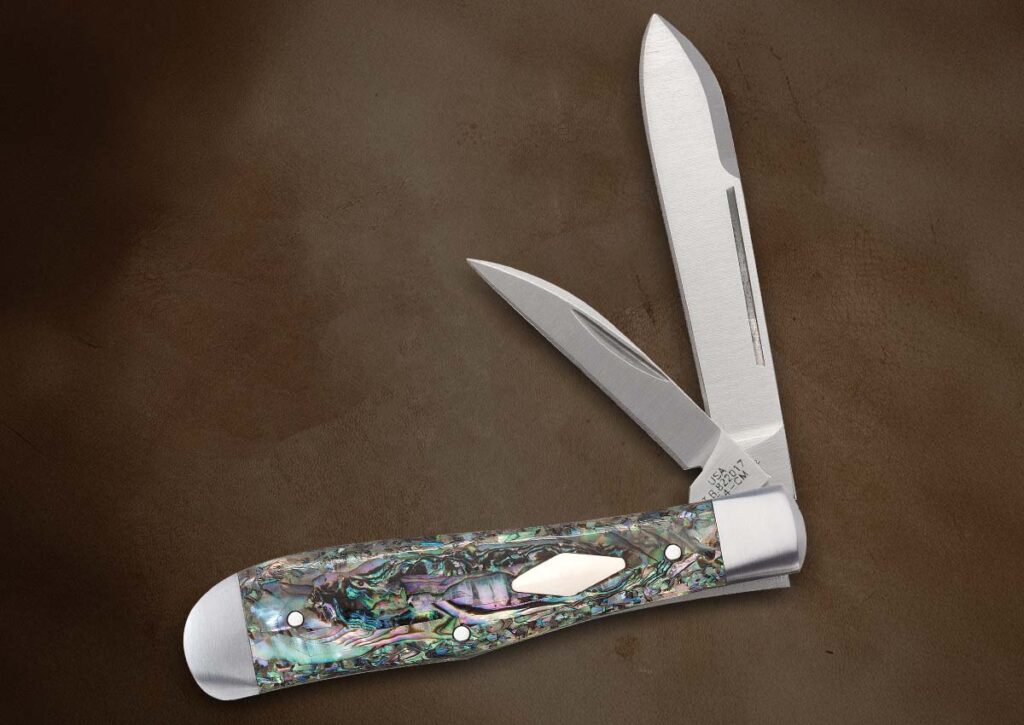
Tony collaborated on knives with Case for two decades, including this Eureka jack in abalone and 154CM stainless steel in 2017. (Case image)

Tony’s collaborations with Case worked like magic. His upscale Case XX limited editions, delivered in signed brown leather zipper pouches, are some of the finest pocketknives ever produced by the company—or any company for that matter—and his Bose-branded boxed knives are highly collectible.

His signature Lanny’s Clip, designed for a friend, has become legend among both custom folder makers and Case collectors alike. Tony passed away in 2020, only one year after being inducted into the Cutlery Hall of Fame, but his imprint on the cutlery industry will last as long as his knives walk and talk—which will be a long, long time.

More Pocketknife Info:

How To: Marketing Knives On Social Media

How to get the most from your knives on social media platforms.

It’s immediate. It’s visual. It’s effective.

These are just a few of the attributes that describe the impact of social media on modern life. Whatever the topic, some form of social media allows participants, observers, critics and commentators to weigh in, expressing their views and—of course—buying and selling.

For instance, the platform of Instagram has become a prominent factor in the marketing of many custom knifemakers, purveyors and collectors, and the reasons for the phenomenon are varied. They center around the immediacy, visual quality and effectiveness in showcasing and selling, developing a following, and generally in raising a knifemaker’s profile in the all-important marketplace. Setting up an Instagram account is simple, cost-effective and for many generates the desired results.

“Instagram and other social media platforms are an excellent way to put yourself in the public’s eye,” noted purveyor/ABS master smith Dave Ellis of exquisiteknives.com. “Through good knife photography, clear and precise descriptions of the same, and reasonable follow-up you can publicize your products as well as introduce your website. TikTok is rapidly gaining popularity, and YouTube is an excellent way to achieve your goal of spreading the gospel of custom knives.”

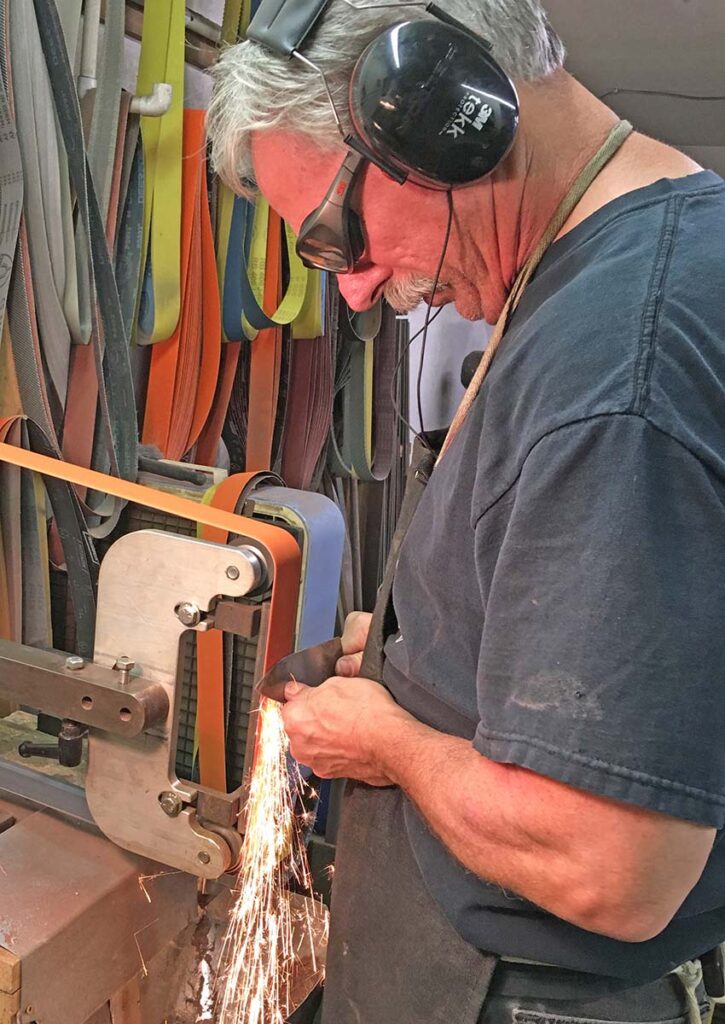
“I do videos and tutorials and just basically little blurbs of me building a knife,” Kim Breed commented. “Tutorials let people know this is why I charge what I charge, the little steps that you do when you’re making a knife.” ABS master smith Steve Randall grinds a blade in his shop. (Steve Randall image)

Kim Breed, knifemaker and BLADE® field editor, uses Instagram to generate sales and promote awareness among the buying public while also offering some insights into the knifemaking process. The value of experience is levered through the visual, and everybody gains.

“I do videos and tutorials and just basically little blurbs of me building a knife,” Kim commented. “I show the blade when I’m finished grinding and then the final product. That’s when it is put up for sale. Tutorials let people know this is why I charge what I charge, the little steps that you do when you’re making a knife. For example, when you’re forging you can show that process.”

Breed, whose videos are available on Instagram at kimbreed1911, advises that would-be Instagram users monitor their posts, beware of hashtags that are too generic, and frequently assess the return on their investment of time.

“A lot depends on the hashtags,” he said. “People can copy stuff, come up with a fake account, or hack into anything. Once you start, you’ve got to stay on it. I’ve gotten messages that don’t make sense, and you can catch situations where people have set up fake accounts and used your pictures to get people to send money first when they are scamming. Check every hashtag you do and make sure it’s going to a knife site. That was something I’ve picked up in the five or six years I’ve been doing Instagram.”

For those who choose to display their wares on Instagram or any other social media, Ellis recommends, “Scammers are everywhere, so do your due diligence and look deeper into anything that looks too good to be true. Haters are very common, so expect some negative comments and take them in stride. Getting into a heated battle only fuels the folks that like to fan the flames, so keep a cool head and remember that your goal is to promote the use and collecting of custom knives as an art form and tool.”

Knife Makers & Knife Collectors Connect

ABS master smith Neels van den Berg, who runs Black Dragon Forge based in South Africa, keeps his Instagram use in perspective. There are obvious positives and potential pitfalls, but he sees an incredible opportunity to raise visibility.

Showcase your knives as tools for culinary use, outdoor adventures or collectible art. The BBQ Chef’s Knife by Matt Williams has a 9-inch blade of 400-layer damascus forged from 1084 carbon and 15N20 nickel-alloy steels. Overall length: 15 inches.

“Instagram is a free platform designed primarily for sharing photos and videos to foster social interaction,” Neels commented. “Users can reasonably expect to engage with its 2.11 billion users worldwide by uploading and interacting with content through likes, comments and direct messages [DMs#]. However, it’s important to understand that Instagram’s core purpose isn’t sales, it’s connection. Social media users should approach the platform as a tool for storytelling, networking, and building a community rather than expecting it to function as a direct sales engine. Understanding this distinction is critical when crafting a marketing strategy for your business.”

According to van den Berg, Instagram can amplify a knifemaker’s reach, create brand awareness and build credibility, which may lead to sales. But these are byproducts of fostering genuine engagement and building relationships through the platform.

“For a knife business or hobby, this means showcasing the passion and craftsmanship behind your work,” Neels remarked. “People will follow you for who you are—your skills, values and story—not just for what you have to sell. Social media users are often turned off by hard sales pitches, so the focus should be on creating content that resonates emotionally or intellectually with your audience. While sales might be part of the eventual outcome, it shouldn’t be the primary intent. Instead, aim to captivate your audience by showing the process behind your craft: the highs and lows, the struggles and triumphs, and the sheer joy of creating. When you build this level of connection, your products naturally become a way for followers to support you rather than a commodity you’re trying to sell.”

Videos of forging are another great way to demonstrate how knives are made and build interest among viewers. (Lin Rhea image)

The secret to Instagram and social media success is certainly influenced by the delivery. Setting up a presence and presenting a perspective on the maker’s work and creative journey do make a difference.

“Users should expect to display their point of view in a clear and cohesive way,” related ABS master smith Nick Rossi of Vassalboro, Maine-based Nick Rossi Knives. “That means who they are, what they make, and why they make it. Social media is a relatively efficient way to project that to a potential customer. Sales and cultivating a customer are byproducts of that action.”

Setting Social Media Goals

Finding the right combination of social media outlets depends on the knifemaker’s perspective. Analyzing what the maker hopes to achieve drives the investment of time and attention.

“The best social media platform depends entirely on your goals, audience and the type of content you want to share,” van den Berg observed. “Each platform serves different purposes and attracts unique demographics, so a thoughtful combination works best.

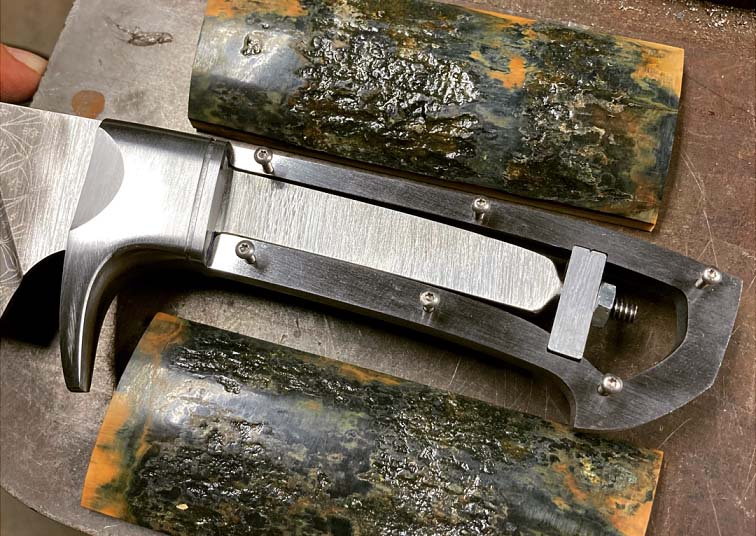
According to Neels van den Berg, using in-progress shots can sidestep direct visual triggers while still highlighting a maker’s work. In his version of frame handle construction, bladesmith Salem Straub uses a threaded fastener in an internal slot in the frame to mechanically lock all the parts together tightly. (Salem Straub image)

“I have three primary goals on Instagram: 1) Showcasing my craftsmanship—I aim to highlight the intricate details and artistry of my creations, emphasizing their quality and uniqueness. This draws attention to the skill and effort behind each piece, making my work stand out in a crowded marketplace; 2) Building my brand identity—My goal is to establish a recognizable and authentic brand that resonates within the knifemaking community. This isn’t about a logo or maker’s mark, it’s about the story, values and personality behind my work; 3) Engaging with my community—Social media is about relationships. By actively participating in discussions, responding to DMs and comments and sharing insights, I foster a sense of community among knife enthusiasts and artisans.”

To achieve his goals, Neels relies on high-quality visual content, educational posts, consistent branding, and authentic interaction through responses to comments or joining a relevant conversation.

Ellis commented, “For retail sales, I prefer TikTok and YouTube. By utilizing every media that you can, your products are constantly put in front of not only the buying public, but you are also promoting yourself to show promoters and attendees.” Instagram and Facebook are the priorities for Rossi “because that’s what most of my customers use.”

He added, “I only have time to manage two platforms on top of being a professional craftsperson. For collecting and very niche topics, Facebook groups provide a wealth of knowledge. I have a private Facebook group for only my online and in-person students that has worked very well for advice and troubleshooting.”

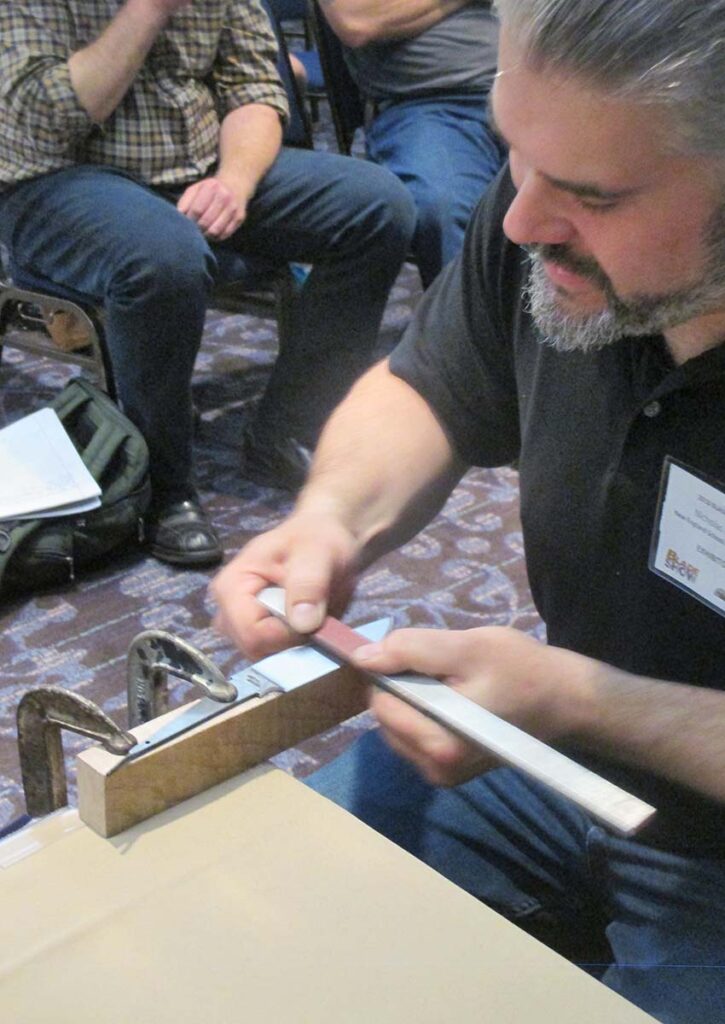
 “I want people to think of me as a skillful knifemaker with a focus on forging, a maker of interesting and innovative knives, and an experienced educator,” noted ABS master smith Nick Rossi, here giving a class on how to hand rub a blade to a satin finish in a BLADE University class.
“I want people to think of me as a skillful knifemaker with a focus on forging, a maker of interesting and innovative knives, and an experienced educator,” noted ABS master smith Nick Rossi, here giving a class on how to hand rub a blade to a satin finish in a BLADE University class.

Variations of content help keep social media posts entertaining and business related, and encourage a possible exchange of information.

“We live in a world of short, informative, and, let’s face it, lively. Clicks mean interaction, potential video formats,” Rossi observed. “Attention spans have grown shorter, and social media users have come to expect shorter, action-packed video. If you are going to have narration, subtitles are important. Users want the option of viewing without sound. Choosing popular songs may help your videos pop up in the algorithm more readily. I want people to think of me as a skillful knifemaker with a focus on forging, a maker of interesting and innovative knives, and an experienced educator. Each post focuses on one of those three things.”

Social Media Do’s And Don’ts

An awareness of certain standards provides knifemakers with extra assurance that their posts meet the chosen platform’s guidelines and minimize the risk of being flagged or taken down. Though Breed said he has done well with Instagram sales, the limitations of filters can have negative effects on viewership.

“Filters can hurt a knifemaker, so before you might get 100,000 or 200,000 views,” he said, “but you can’t do that if you picture a knife as an item of war, and watch out what you say about politics and whatever. Stay away from there.” Ellis agrees. “Stay away from animals or any violent visuals when posting,” he added. “Stick to the art or utilitarian uses for custom knives, and you should be OK.”

For van den Berg, compliance and creative communication are essential to success when visualizing or discussing knife-related topics on social media.

“The key is to reframe how your work is presented, ensuring that it aligns with platform guidelines while still engaging your audience,” he remarked. “Avoid flagged terms like ‘knife,’ ‘blade,’ or ‘weapon,’ and instead use neutral or creative alternatives such as ‘tool,’ ‘craft,’ or ‘functional art.’ These terms emphasize the artistry and utility of your pieces, shifting focus away from their potential as weapons. Repositioning your knives within broader contexts is another effective tactic. Showcase them as tools for culinary use, outdoor adventures or collectible art. Using in-progress shots, close-ups of handles, or images that emphasize materials and craftsmanship can sidestep direct visual triggers while still highlighting your work.”

Another knifemaker option is to place the work in context.

Knifemaker/BLADE® field editor Kim Breed advises that would-be Instagram users monitor their posts, beware of hashtags that are too generic, and frequently assess the return on their investment of time.

“To further circumvent restrictions, use storytelling and indirect messaging,” Neels encouraged. “Instead of explicitly saying, ‘Check out my new knife,’ share the inspiration behind the design or challenges faced during its creation. Platforms like Instagram and TikTok, which favor storytelling and visual diversity, are ideal for this approach. Additionally, private groups, email newsletters, or niche forums provide safer spaces to share uncensored content with your core audience.”

Reaching as many followers, shoppers, and potential buyers as possible, custom knifemakers who take advantage of social media routinely find that the reward is in lock step with the attention and time devoted to originate and maintain a strong presence. For those who manage it well, social media exists in the present and will remain a formidable asset in the future.

More Knifemaking & Knife Collecting:

Cool Custom: Robert Young’s New York Flipper

Robert Young reinvents a classic Loveless fixed blade in flipper form.

Robert Young reproduces BLADE Magazine Cutlery Hall-of-Fame® member Bob Loveless’s New York Special fixed blade in a flipper folder format, and it’s something that would probably please even Bob himself.

Young also makes a standard fixed-blade repro of the knife. He holds it and the folder—when the folder’s open, both knives are the same size—side by side at shows to see if customers can tell which one’s which, and nine times out of 10 they can’t. Around 1976-77 when he was 16 and a California resident, he learned a man making knives lived three doors down from a friend’s grandfather’s house. Robert visited the man and it turned out to be Loveless. He had no idea who Bob was until later and then visited him about a dozen times.

  Robert Young, 64, has been making knives off and on since 1976 and has been full time for two years now. He moved from California to Arkansas in 1993. He’s made about a dozen of the New York Special flippers and also reproduces Loveless City Knife, Junior Bear and Big Bear fixed blades, the latter with a 1-inch-wide sub-hilt. At press time he was working on a folding version of the City Knife and a less expensive version of the New York Special folder. Loveless, of course, never made a custom folder. (Jocelyn Frasier knife image)
Robert Young, 64, has been making knives off and on since 1976 and has been full time for two years now. He moved from California to Arkansas in 1993. He’s made about a dozen of the New York Special flippers and also reproduces Loveless City Knife, Junior Bear and Big Bear fixed blades, the latter with a 1-inch-wide sub-hilt. At press time he was working on a folding version of the City Knife and a less expensive version of the New York Special folder. Loveless, of course, never made a custom folder. (Jocelyn Frasier knife image)

“He taught me and I improved a lot real quick,” Robert said. “I wished I’d stuck around there more than I did but I was kind of embarrassed once I found out who he was. I didn’t want to bug him a whole bunch, but he did teach me quite a bit.”

New York Special Flipper Specs
Blade length: 3”
Blade steel: RWL-34 stainless
Rockwell hardness: 62 HRC
Blade grind: Double hollow on a 3-inch wheel
Blade pivot: Ceramic bearings
Scales: Stag
Liners: 416 stainless, integral
Closed length: 4.25”
Maker’s price for a similar knife: $1,500

More Custom Knives:

Advertisement

Must Read Articles

Read this before you make a knife

Knifemaking 101 – Read This Before You Make a Knife

  by Wayne Goddard My experience has taught me that there's nothing like digging in and getting started. I've often said the hardest part of the...
how to forge damascus steel

How to Forge Damascus

Advertisement
Advertisement