Home Blog Page 170

The Swords of “The Lord of the Rings: The Fellowship of the Ring”

swords from the lord of the rings
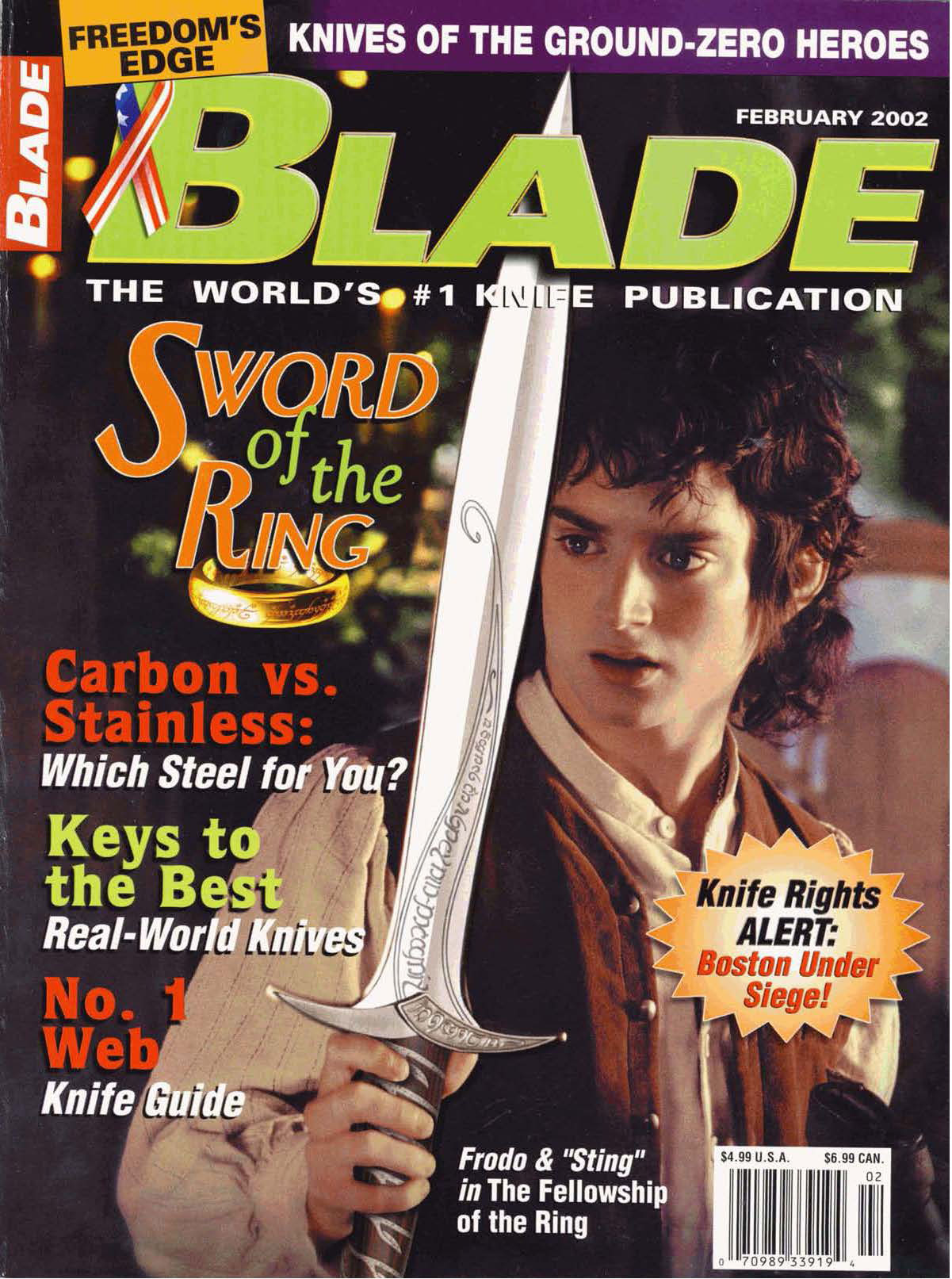
The February 2002 issue of BLADE magazine.

Editor’s note: The following appeared in the February 2002 issue of BLADE magazine. Read more from the deep archives of the world’s foremost knife publication in this download of 25 years of back issues.

A Movie that Knows How to Do Swords

When New Line Productions’ The Fellowship of the Ring, the first in a series of three movies based on J.R.R. Tolkien’s The Lord of the Rings trilogy, debuts just days from now, blades will be among the stars of the film—and reproductions of three of those pieces are available from United Cutlery.

Moreover, they are but the first in a series of swords United Cutlery (UC) will reproduce in conjunction with the debuts of the Rings sequels in 2002 and 2003.

UC art director Kit Rae oversaw the reproduction of the three swords. It was a dream job for Kit, who’s been a fan of The Lord of the Rings since elementary school.

“It was one of the first fantasy books I read, though I first read The Hobbit [the prequel to the trilogy],” he recalled. “That had more influence over me and the direction with what I do [as a blade designer] than anything I’ve ever read.”

None Shall Pass on Naming These Sweet Swords

The blades of The Fellowship of the Ring are Sting, the short sword of the movie’s hero, Frodo Baggins; Glamdring, the sword of Gandalf the Grey, a powerful wizard and Frodo’s friend and guardian; and The Sword of the Witchking, the blade of one of the film’s villains.

In addition to the three pieces, the movie sequels-one to debut around Christmas 2002, the subsequent one around Christmas 2003-will feature more blades that also will be reproduced by UC, thus setting the stage for all of the pieces to be collectible as a series.

A Precious Partnership: United Cutlery and the Box Office

The Fellowship of the Ring is the latest movie for which UC has either designed and/or reproduced blades, including the three Rambo films, Indiana Jones and the Temple of Doom, Total Recall, Mortal Kombat, The Mask Of Zorro and others.

However, Fellowship represents UC’s most ambitious project to date.

“This is the biggest movie license that we’ve ever had,” Rae noted. “We’re planning on making reproductions of nine swords from all three films to be released over the next three years. Three swords have been released this year, with another two to four swords next year. Each will come with a hardwood wall plaque. We may make scabbards for them at a later date.”

Staying True to the Movie
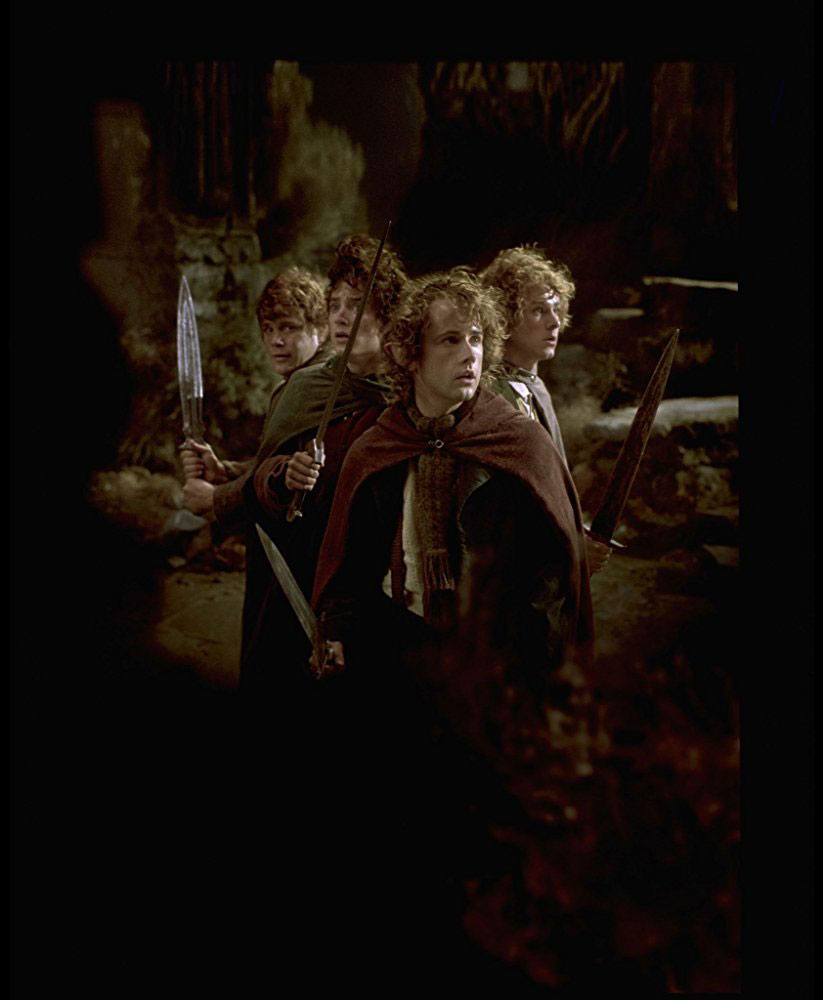
swords lord of the rings
The hobbits of “The Fellowship of the Ring” brandish their short swords. Click for a larger view. (image via imdb.com)

The swords are meticulously reproduced from the description in the script, photos of the actual props and the props themselves as supplied by New Line Productions. There were several copies of each sword made for filming and each was slightly different.

“We have combined those differences into our reproductions while remaining faithful to the original designs,” which were done by the Weta Workshop in New Zealand, Kit said.

Each sword prop has an “aged” or worn look to it in the films, as if it’s been around for many centuries and seen many battles.

“We did our best to copy that look for our reproductions,” Rae maintained. “We want the swords to be as authentic as possible. We’ve found that it’s actually harder to make the swords look aged than to make them look shiny and new. The plaques’ shapes are tailored to each sword and feature screen-printed gold designs that I’ve styled after the look of each character in the film. New Line gave us a great style guide with art from the film to work with.”

No Pressure: 100 Million Books Sold
the lord of the rings swordsHaving sold over 100 million copies in over 40 languages, Tolkien’s epic trilogy is considered by many to be the greatest fantasy adventure story ever written.

Penned in the 1950s, it chronicles an epic struggle in “Middle-earth” involving humans and a collection of Hobbits, Dwarves, Elves, Wids, Ring Wraiths, Ents, Orcs and other fantastic creatures over possession of a magical ring that can shift the world’s balance of power.

Frodo’s Short Sword: Sting

Frodo, played by Elijah Wood, is a Hobbit and one of many in search of the ring. In The Hobbit, Bilbo Baggins, Frodo’s uncle, uses his short sword, Sting, many times in his adventures. In Fellowship, Bilbo (Ian Holm) passes Sting down to Frodo. The piece is magical and, in the movie, its blade glows blue when the evil Orcs are present.

“This is probably the most popular sword in the books,” Rae stressed, “and is probably going to be the one most people will want to own after they see the film.”

Sting’s blade and guard feature runes in the Elven language of Sindarin that translates to, “Maegnas is my name, I am the spider’s bane.”

According to Kit, the runes are true to the actual Sindarin created by Tolkien. Maegnas comes from the Elven word “maeg,” which means sharp. The hardwood handle of UC’s Sting repro is inlaid with an Elven vine design.

“If we hand inlaid the metal just like the real thing, these swords would have been extremely expensive,” Rae related, “so we tried many other processes, including powdered metal and a laser, but finally settled on a special inlay process.”

Scaling a Sword for a Hobbit

Hobbits are about half the size of a man, so several tricks are used in the film to make the human actors look smaller, including making the sword props larger than they appear on screen.

“We had to scale the prop sword, which was 1:1.38 scale, down to the actual size that it appears, on film,” Rae explained. “The prop we had was a full-size sword but on film it appears as a short sword or dagger. We cheated a little and made the blade a bit longer, but otherwise it’s the correct scale.”

The overall length of the UC Sting repro is 22 inches, including a 15-inch blade of 420 J2 stainless steel etched with Elven runes. The metal guard and pommel feature and antique metal finish. Sting comes with a wood plaque silk-screened with Elven runes.

Gandalf’s Glamdring Sword
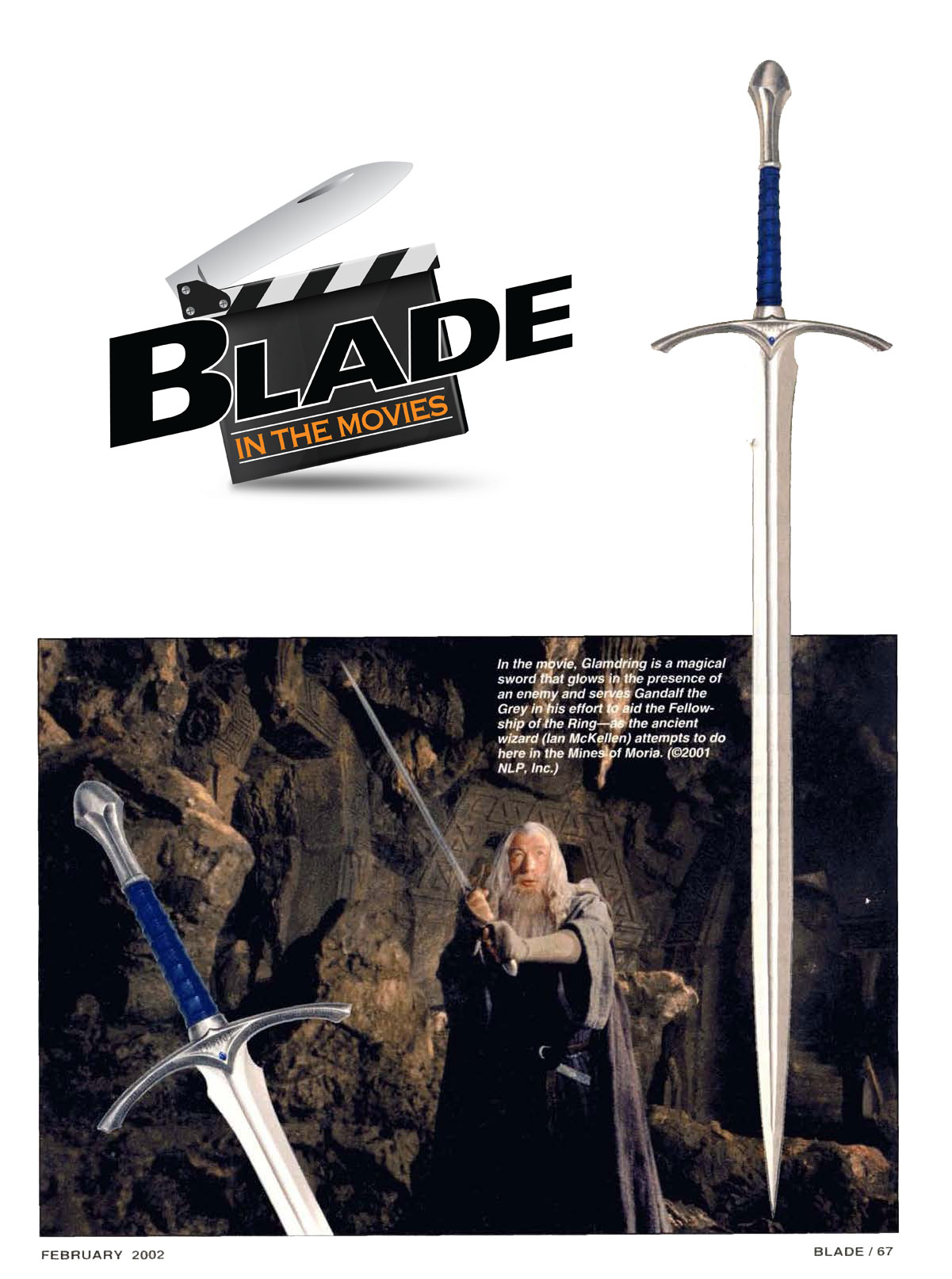
what is gandalf's sword in the Lord of the Rings movies
In the movie, Glamdring is a magical sword that glows in the presence of an enemy and serves Gandalf the Grey in his effort to aid the Fellowship of the Ring. (NLP image)

Gandalf the Grey (Ian McKellen) found his sword, Glamdring, along with Sting in the troll hoard in The Hobbit. Gandalf is an old and powerful wizard and uses a wizard staff to cast his spells, but he pulls Glamdring from its scabbard for battle several times in the film.

Like Sting, Glamdring’s blade glows in the presence of an enemy in the movie. (Editor’s note: the blades of the Sting and Glamdring repros don’t glow.)

“The repro is made with three hollow grinds and the handle is wrapped in leather,” Rae commented.

The metal crossguard and pommel are engraved with Anglo-Saxon-styled runes in the Elven language, which basically say that Glamdring was forged for Turgon, the King of Gondolin.

“Gondolin is only vaguely referred to in the Rings books but is from Tolkien’s earlier work, the Simarillion, a history of Middle-earth,” Kit explained. “That how much research the designers did for the movie. To true Tolkien fans, that will mean a lot.”

Sporting a 36-inch blade of 420 J2, UC’s Glamdring repro is 47 5/8 inches long overall. The hilt is leather wrapped and the metal crossguard and pommel feature an antique finish and engraved Elven runes. The accompanying wood plaque is decorated with silk-screened designs.

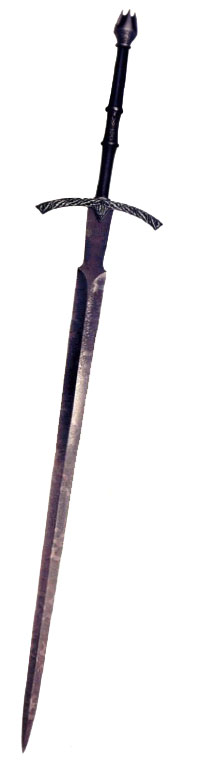
The Sword of the Witchking
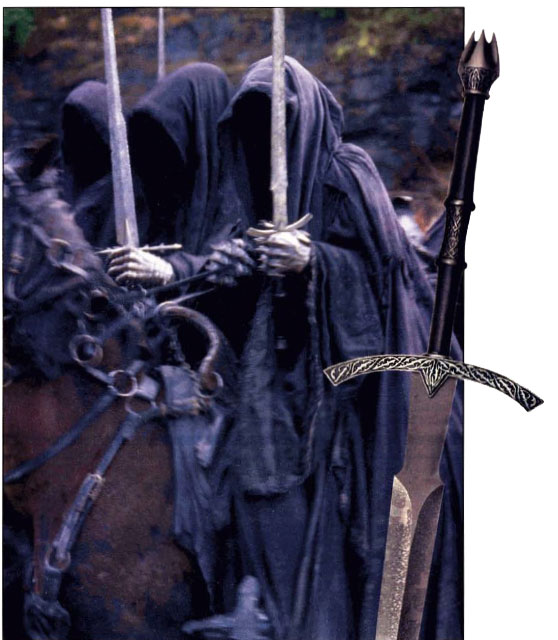
swords of the lord of the rings
The Ring Wraiths with their swords. (NLP image)
sword ring wraith
A sword made for some of the baddest dudes in the Lord of the Rings.

The Witchking is the leader of the nine Ring Wraiths and uses the Sword of the Witchking, as well as a dagger. The Ring Wraiths are sent to find the ring and return it to their dark master, Sauron (Christopher Lee).

They appear evil in the film, cloaked in black and riding black horses. They are very ancient beings, no longer human. The swords they carry look thousands of years old with corroded and worn blades and handles.

“We have developed a special chemical process to make the blades look like they are 3000 years old, as they appear in the film,” Rae remarked. “The crossguard and pommel have an aged iron look, and the grip is leather wrapped.

“They are huge swords, almost like European two-handed broadswords. This sword is one of the largest we have ever made–over 54 inches long overall.

UC’s Sword of the Witchking repro boasts a 39 3/4-inch blade of 420 52 steel, a leather-wrapped hilt, and metal crossguard and pommel with an antique finish and engraved designs. The accompanying wood plaque is silk-screened with Naszul designs.

Sword Scenes
read knife magazine
Read more articles from BLADE’s archives with this collection of 25 years of back issues.

At press time, Kit had seen a short preview of the movie’s highlights. Though he didn’t want to give too much away lest he spoil the film for BLADE readers, he did reveal a few “sharp teasers.”

He said the most memorable scene with Sting is when Bilbo passes it on to Frodo. However, one scene particularly special to Rae is when Frodo first pulls Sting from its scabbard, the blade pulsating blue due to the proximity of the Orcs.

“It’s something I’ve waited for years to see,” he said, adding that Sting really doesn’t have any big fight scene in the movie other than Frodo using it in the Mines of Moria.

“Sting will have its best scene in the third film,” Rae confided. In the climax of Fellowship, there’s a huge battle in which Gandalf uses Glamdring.

“I can’t give away what happens but Glamdring has a big part in it,” Kit said. As for the Sword of the Witchking, it’s prominent throughout the film in the hands of the Witchking.

Another sword in the film, Narsil, is shown in a flashback that updates viewers on the history of the ring. The blade is shattered and appears later in its broken form.

UC’s “flashback” full-blade repro of Narsil will be available in April 2002, and the repro of the broken Narsil, along with the repros of the Ring Wraith swords, will be available in September 2002. UC also will be offering 1:4 scale collectible miniatures of the movie swords in early 2002.

As with the full-sized swords, UC will be releasing the minis over the span of the three films. UC will release other sword repros from the first sequel in November 2002.
Sinners & Saints: Actor Makes and Uses Knives for Movies

Johnny Strong knifemaker musician actor
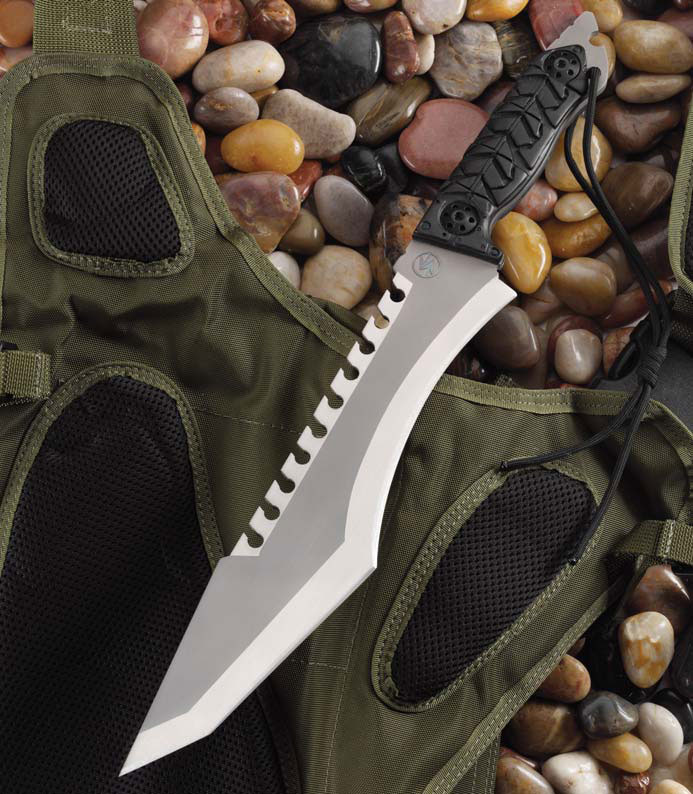
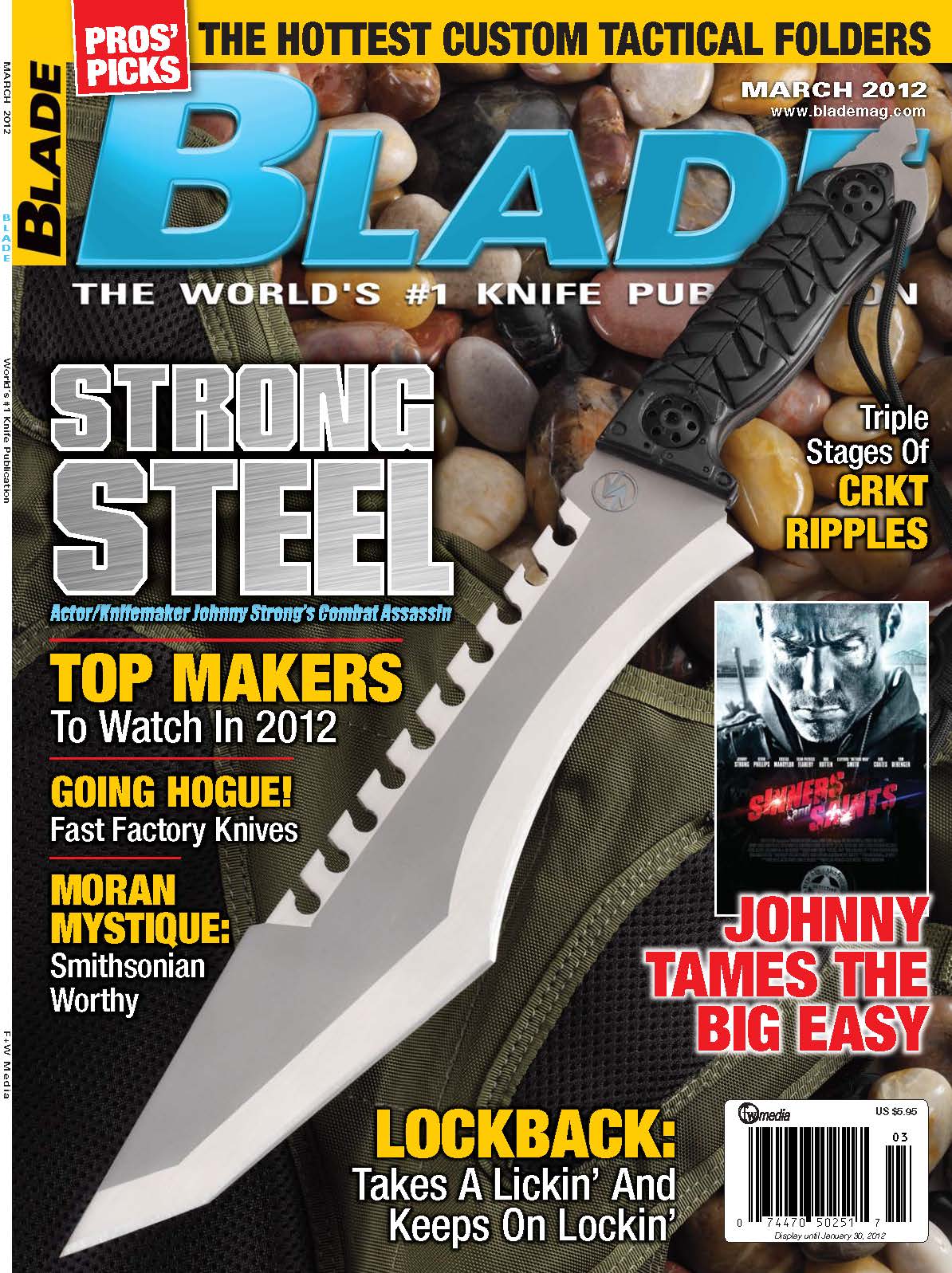
The Combat Assassin, made by actor Johnny Strong, appears on the cover of the March 2012 issue of BLADE magazine.

Editor’s note: This article originally appeared in the March 2012 issue of BLADE. Keep exploring BLADE‘s extensive archives with this download of back issues.

custom knives action moviesThrough knives I have met some of the most amazing people, one of whom is actor Johnny Strong.

Last summer I received an e-mail from Johnny. He was interested in my Dragon Waki he had found on Bladeart.com’s website. We exchanged e-mails about his new waki, music and his interest in knifemaking. I learned Johnny is an actor, musician, martial artist and artist. He has been collecting knives since he was 8.

From Collecting to Making Knives

making knives johnny strong wally hayes
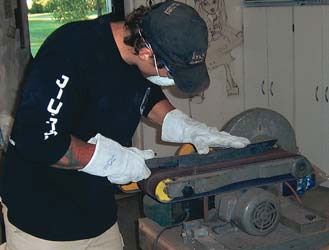
Strong uses the author’s belt grinder on one of his blades. (Wally Hayes photo)

“It was when I was on tour with my band, Operator, that I got serious about collecting custom knives. I would be on the tour bus searching the web for knife dealers,” he said.

After talking with Johnny and learning a little about him, I suggested he visit my shop and hang out for a weekend. He did—and he jumped in with both feet.

We started out forging two blades to shape. Then I taught him grinding and heat treating. The crash course was three long, fun-filled days. As Johnny told BLADE®, “It was a great experience coming to Wally’s and having him share all his knowledge with me. I learned how to manipulate steel and apply these skills to my edged art.”

As soon as Johnny returned home, he ordered a belt grinder, drill press and some steel. In the past year he has created some very original designs. His computer-drawing skills enabled him to develop a practical and aggressive-looking knife style. As he noted, “With my knives, I like to paint in tactical colors.”

Johnny Strong’s Knives

sinners and saints movie knives
A recessed sawback and what the maker calls his “three-edge design” distinguish the 11.5-inch blade of Johnny Strong’s Combat Assassin. Blade steel: CPM-S35V stainless. Overall length: 17 inches. The pack is the Jumbo L.E.O. S-Type from Maxpedition.
johnny strong makes knives
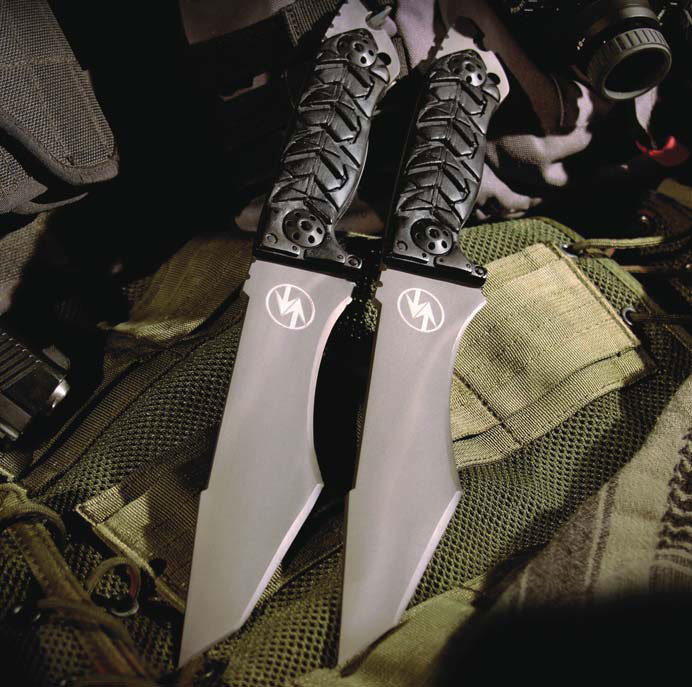
As with all Strong knives, the Urban Assassins are fl at ground from CPM-S35V stainless and
heat treated by Paul Bos Heat Treating. Overall lengths: 11.5 inches. (Katie Summers photo)

His blades are flat ground from CPM-S35V stainless steel and heat treated by Paul Bos Heat Treating.

Johnny has created some unusual blade finishes with a combination of bead blasting and etching. The blades are ground with a wide secondary bevel that makes his knives razor sharp, similar to those by Shiva Ki.

Johnny hand carved a mold to make his handles. He casts them one at a time. The handle material is an impact/chemical-resistant resin. The cutouts in the handle butts are multi-purpose prying/shaping tools. He also designed and ordered custom-made black titanium handle fasteners. Three of Johnny’s models are the Urban Assassin, Canine Assassin and Combat Assassin.

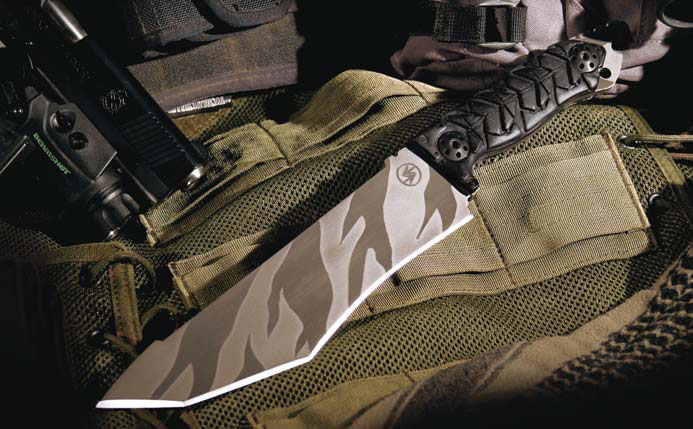
Respective blade lengths are 6.5, 8.5 and 11 inches. The blade of the Canine Assassin has a tiger-stripe finish, while the Combat Assassin blade features a sawback. Each blade has what Johnny calls his three-edge design, which was inspired by the knife-combat training he has received. All his knives come with custom leather sheaths.

Johnny Strong knife
Featuring a tiger-stripe finish and Strong’s three-edge design, the 8.5-inch blade of the Canine Assassin is CPM-S35V. Overall length: 14 inches. (Katie Summers photo)

Sinners & Saints

knife fight saints and sinners movie
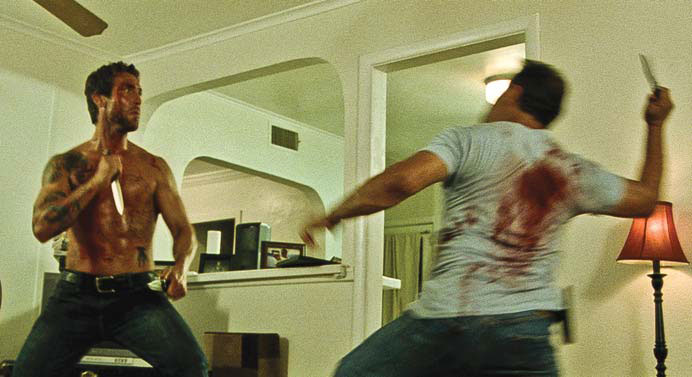
Strong (left) as Detective Sean Riley and martial arts instructor Ron Balicki as Rucker (right) have it out in a scene from Sinners and Saints. Strong trained with Balicki for three months for the scene, which took two days to shoot. The knives in Strong’s hands are an Allen Elishewitz “Phalanx” folder (right) and a Cold Steel Tai Pan dagger (left). Balicki’s knife is a Cold Steel Voyager folder. (photo by Mark Rutledge)

Johnny has starred in Black Hawk Down, The Fast and The Furious, Get Carter, The Glimmer Man and his new (as of the original publication of this article) action movie, Sinners and Saints. Johnny plays the lead role of Sean Riley, a New Orleans detective.

To prepare for one of the movie’s knife fight scenes, Johnny trained with Ron Balicki for three months. Balicki is well known as a practitioner and teacher of the martial arts, and is a student and son-in-law of Dan Inosanto, a legendary martial arts instructor who studied under Bruce Lee. Balicki is also a top Hollywood stuntman and plays the role of Rucker in Sinners and Saints.

Johnny learned both one-handed and two-handed combative drills. In a knife-fighting scene in the movie, Johnny uses an Allen Elishewitz “Phalanx” folder and a Cold Steel Tai Pan dagger. Balicki plays Rucker, a bad guy Johnny’s character must kill. The knife-fighting scene took two days to shoot. Balicki uses a Cold Steel Voyager folder in the scene.

“Ron has a ton of experience and was great to work with,” Johnny noted. “We wanted to make the knife-fighting scene as realistic as possible.”

Johnny has a strong background in martial arts with a black belt in Brazilian Ju-Jitsu, and is training hard to get in shape for his next movie.

Movies, Music and Knives

johnny strong music

read knife magazine
Read more articles from BLADE’s archives with this collection of 25 years of back issues.

This past fall I flew down to Johnny’s to help with his knifemaking and have some fun playing music as well.

Music is a big part of Johnny’s life. When not acting, he works on music either for film scenes or his own CDs.

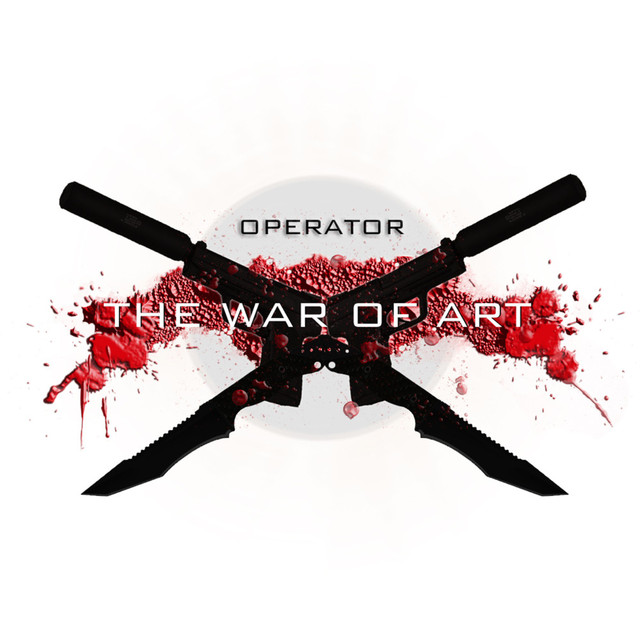
Prior to press time he had released his new album, The War of Art, on iTunes. It features two of his Urban Assassin models silhouetted on the cover. I was asked to bring my guitar so I could play lead on a couple of songs in his studio.

What a blast—mixing knifemaking with recording music! Stay tuned for more movies, music and knives from a very talented guy.

The Subtle Survival Knife of “The Edge” Movie

the edge survival knife
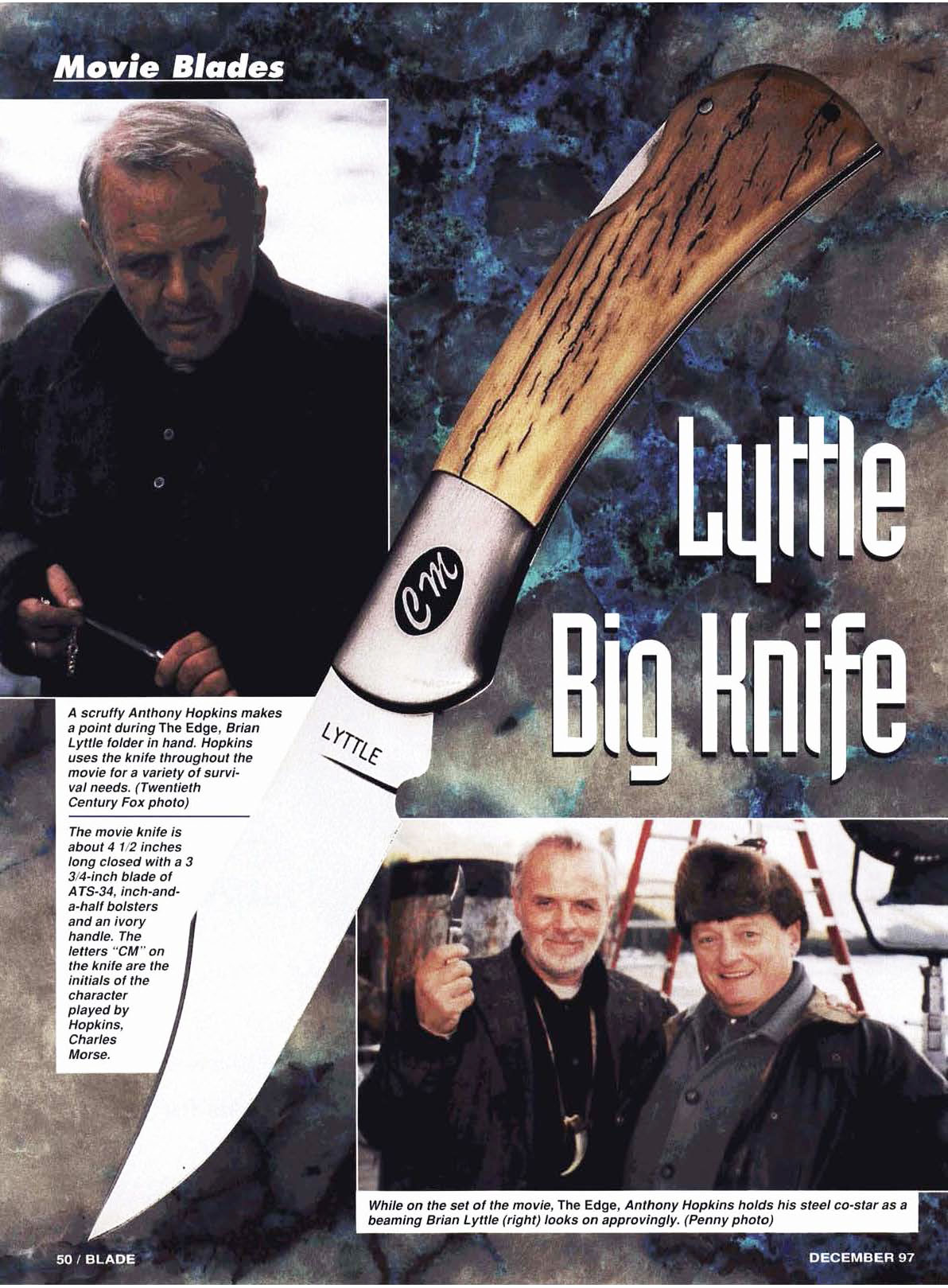
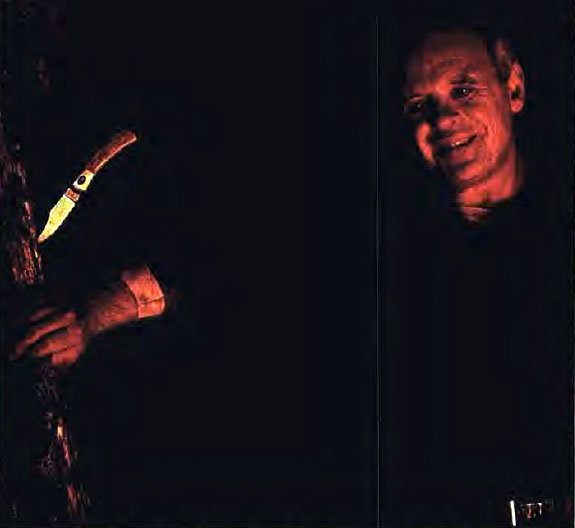
“The Edge” movie knife is about 4.5 inches long closed with a 3.75-inch blade of ATS-34, inch-and-a-half bolsters and an ivory handle. The letters “CM” on the knife are the initials of the character played by Anthony Hopkins, Charles Morse, in the 1997 movie, “The Edge.”

Editor’s note: The following originally appeared in the December 1997 issue of BLADE. Find more from BLADE‘s extensive archive in this download.

Brian Lyttle’s Blade Get Top Billing in Survival Epic, The Edge

custom knives action moviesCould this be THE movie where a knife will come across as what it truly is, an inanimate yet indispensable tool, instead of a living, breathing, killing demon that irrational crusaders and inept politicians constantly point to as the root of all evil? Let’s hope so.

Meanwhile, The Edge, starring award-winning actor Anthony Hopkins as a man trying to survive in harsh environs with the help of his knife and his ingenuity, may be a movie worth watching not only for the way he employs his blade but because it’s just fine entertainment.

One thing’s certain: Canadian knifemaker Brian Lyttle will be much more than just an interested observer because he made the “steel star” of the film and even appears in the flick as an extra.

The Design

The Edge movie survival folding knife
Anthony Hopkins, with Lyttle’s folder nearby, during a scene from “The Edge.” (Twentieth Century Fox photo)

The knife is a large folding hunter designed for the applications to which Hopkins puts it in the movie.

“It’s a gentleman’s piece in an old-time style but large enough for use as a tool to make traps and spears and for other survival needs,” Lyttle (pronounced LITTLE) observed. According to the maker, a voting member of The Knifemakers’ Guild who specializes in highly embellished folders and straight blades, film officials inspected similar knife patterns by assorted U.S. manufacturers to arrive at the piece they wanted.

“They liked big folders with clip-point blades,” he noted.

The result is a knife about 4 1/2 inches long closed with a 3 3/4-inch blade, inch-and-a-half bolsters and an ivory handle. Though Brian specializes in damascus, he used ATS-34 for the blade because movie officials said they wanted a material that wouldn’t stain. The letters “CM” on the knife are the initials of the character played by Hopkins, Charles Morse.

Multiple Models

the folding knife from the movie the edge
Lyttle died in 2016, but his knives live on. See his legacy at lyttleknives.com.

Lyttle did five knives in all for the movie-four lockbacks and one sliplock. Of the four lockbacks, one is sharp for scenes where cutting is required; one’s dull for scenes where the prevention of any “accidental cutting” is the main concern; one’s a standby; and one’s the presentation piece used in the film. The sliplock appears in an underwater scene where the knife is used to cut a seat belt.

“They didn’t want the performer to have to worry about unlocking the blade while underwater,” Lyttle explained the reason for the sliplock.

He sold four of the knives to movie officials and rented the fifth one to them so he could get it back after filming.

The Knifemaker Steps Into the Movie

hunting folder folding knife the edge survival movie
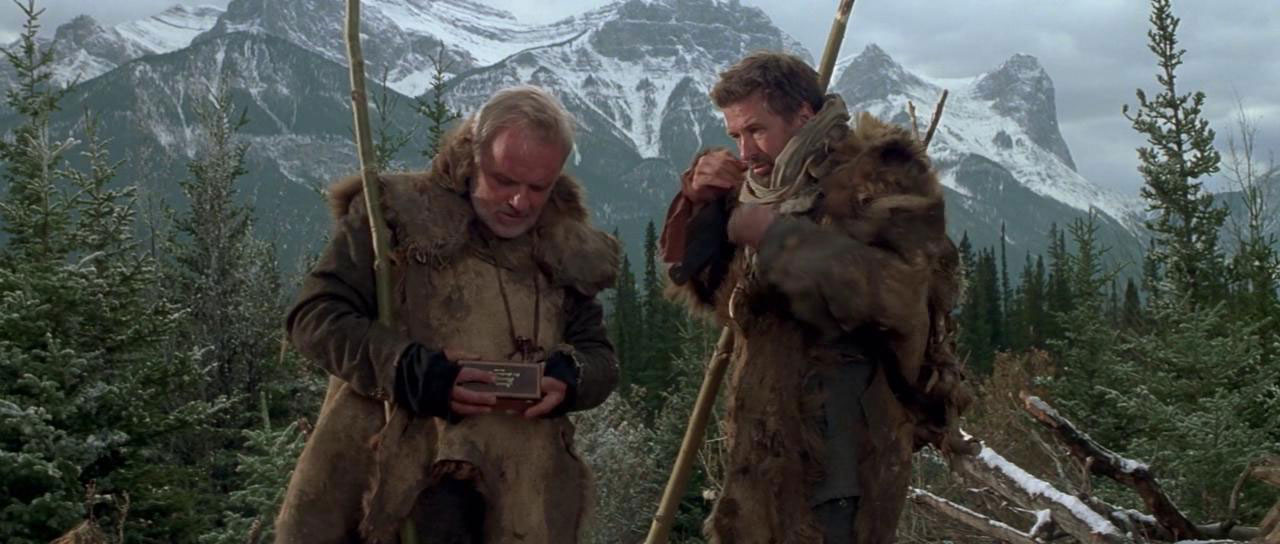
In this scene from “The Edge,” Hopkins (left) holds one of the presentation boxes Lyttle made. (image via imdb.com)

Don’t look for Lyttle’s name in the credits at the end of the movie. However, do look for a reference to the maker during the scene where the knife is presented to Hopkins. Inside the blade’s presentation box is a certificate that says, “Lyttle Knife Co.” By the way, that’s the blade Brian rented to the movie and is the one photographed with this story.

Knives are not the only examples of Brian’s work in the film. A skilled engraver, he engraved two watches (a gold one for Hopkins and a stainless steel Omega for co-star Alec Baldwin) and the presentation knife that appears early in the flick.

“The engraving will be easily visible and there’s a special reason for it to be seen,” he winked. “I read the script and it looks like one helluva movie. Hopkins doesn’t do duds.”

A Connection Through Brad Pitt and Legends of the Fall

read knife magazine
Read more articles from BLADE’s archives with this collection of 25 years of back issues.

How did the movie officials learn of Lyttle and his knifemaking? During the filming of Legends Of The Fall, an earlier flick also done in the High River area starring Hopkins and Brad Pitt, Lyttle’s work came to the attention of Pitt.

Pitt visited Lyttle’s home and bought some knives and gave them to some of the movie’s cast, including Hopkins. The same man who put Lyttle in touch with Pitt introduced Brian to an assistant props master.

When it came time to select the knives for The Edge, the assistant props master brought along Lyttle’s knives during a meeting of movie officials, a meeting attended by Hopkins. When Hopkins saw the blades he recognized the maker’s name on them.

Hopkins reportedly said, “They’re damn sharp!”

His reaction no doubt helped sway the movie officials’ decision and Brian had almost every knifemaker’s dream job: making movie blades.

“A Pain in the Neck”

As with most movie relationships, however, it was no picnic for Lyttle. He had to work long hours to get the pieces ready.

“I had three weeks to get the first knife done and I had a knife show to do in-between,” he recalled. “I had to work day and night to meet their deadlines. I had two days off one month and worked some days through midnight until four in the morning.”

And, of course, the movie officials could be a pain in the neck.

“They were very fussy over stuff,” Brian related. “Twelve presentation boxes (for the knife presentation scene) had to be made before they were satisfied with one.”

Worth the Trouble

Still, as almost any knifemaker will tell you, all the toil and trouble is worth it for the dividends such exposure does not only now but down the road, and specifically for Lyttle when people will come up to his table at a knife show and say, “Wasn’t that your knife in that movie with Anthony Hopkins?”

Gil Hibben Raptor: The Knife of the “Mortal Kombat” Movie

0
knife in the mortal combat movie
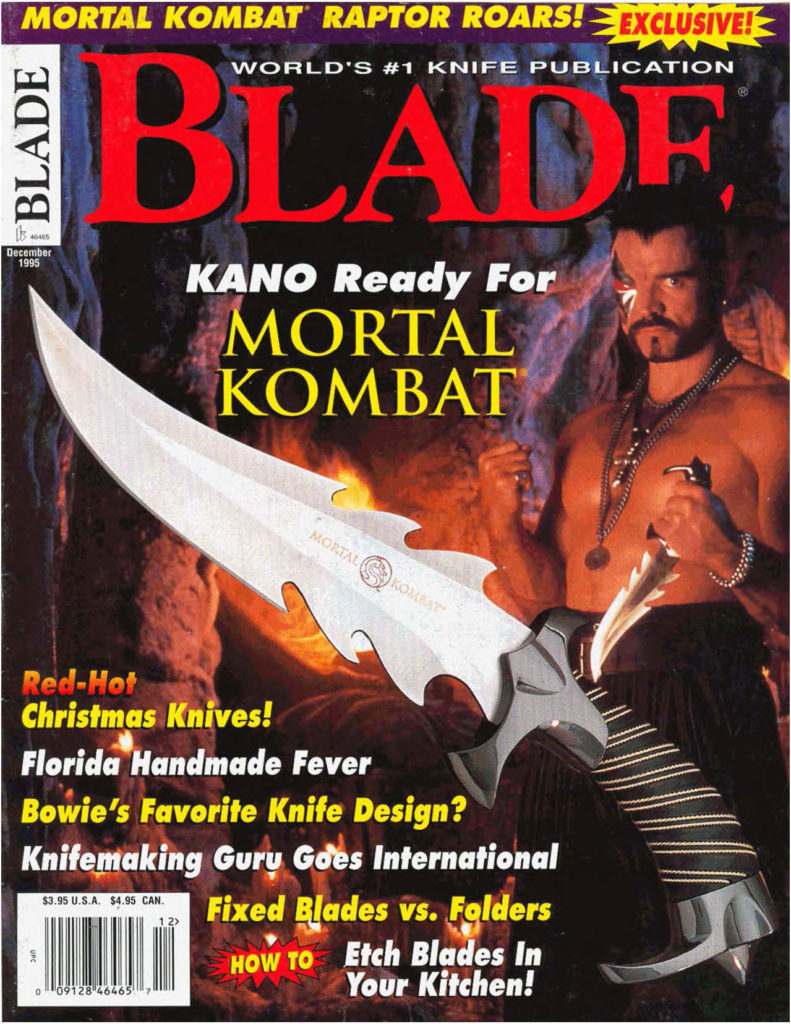
The December 1995 cover of BLADE magazine.

Editor’s note: the following originally appeared in the December 1995 issue of BLADE. Read more from the archives with this collection here.

Mortal Kombat®, based on the video game series of the same namehit screens in 1995. The story of the knife that appears in the movie is anything but linear. It’s a good example of how things work in Hollywood. 

How the Gil Hibben Raptor for Mortal Kombat was Created

gil hibben raptor knife
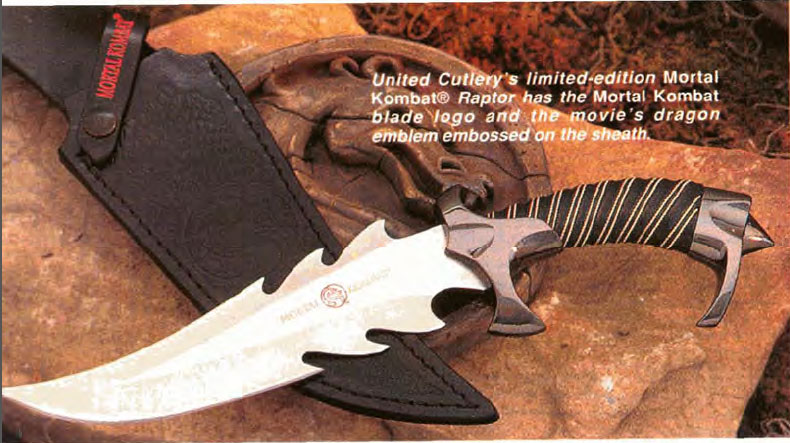
United Cutlery’s limited-edition Mortal Kombat Raptor has the Mortal Kombat blade logo and the movie’s dragon emblem embossed on the sheath.

custom knives action moviesAs with many movie knife projects, the Mortal Kombat Raptor materialized not by design but by some behind-the-scenes events that are typical of movie productions. Let me explain.
Originally, the producers of Mortal Kombat asked United Cutlery to design custom knife props for the movie. They wanted a knife with a mermaid handle for a specific scene that was to take place on a wooden ship that takes the characters to the island where the Mortal Kombat tournaments are held.

While on the ship, three heroes and three villains. including the captain, were to fight below decks. I t was during this scene that the captain was supposed to use the mermaid knife. As soon as he was to bring the knife to bear, a blue ball of energy would streak through the passageway and turn into the character of Kayden, Lord of the Dominion of Earth (played by Christopher Lambert).

The knife and everything in Rayden’s path would crackle with energy. There was even talk of having the eyes of the mermaid open as the energy went through the knife. It all sounded fascinating but in the movie knife business strange things happen, and this was no exception.

Evolution of the Mermaid Dagger

Knife mortal combat movie
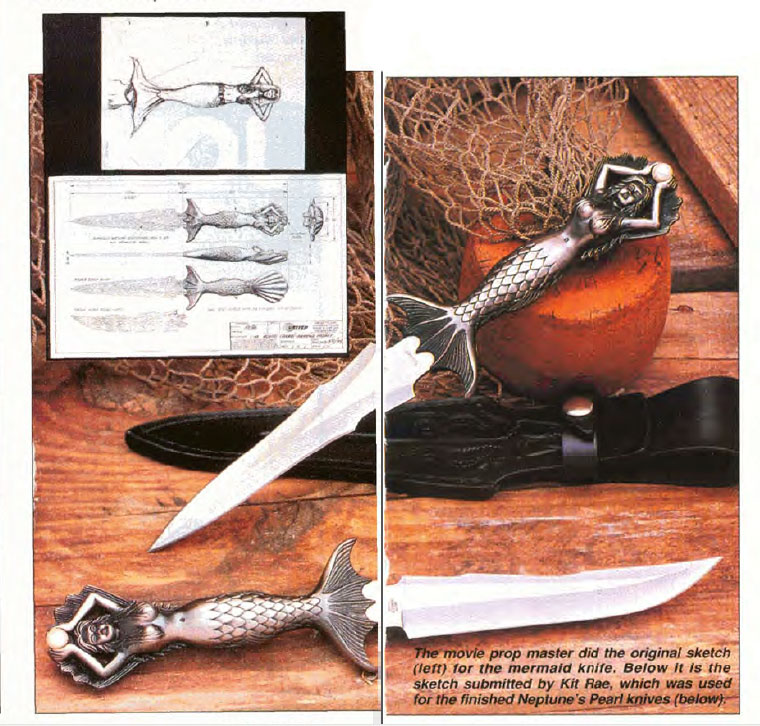
The movie prop master did the original sketch (left) for the mermaid knife. Below it is the sketch submitted by Kit Rae, which was used for the finished Neptune’s Pearl knives (below).

In July 1994, Mortal Kombat‘s prop master, Eugene McCarthy, sent United Cutlery a sketch of the handle he wanted for the movie knife. It was based on an existing mermaid dagger he had seen in UC’s catalog. except he wanted it to have a damascus tanto blade. I designed two versions of the knife around his requirements, one with a dagger blade and one with a tanto blade. The handle had to be metal so that the electricity could dance over it. I added a pearl and a seashell to make the handle different from United’s existing mermaid design.

The movie’s officials picked my dagger blade design, and United sent them a handmade blade with a carved wood handle. Since they needed to use rubber knives in the combat scenes for safety reasons, they were going to use the United prototype to make casts for rubber props that would be painted to look like real metal.

At United, we proceeded to make the molds and tooling for the version that we were going to sell to the public.

However, movie officials told us a few months later that the scene had been cut from the film. That kind of thing has happened in other movies we’ve worked on in the past, so we weren’t too upset.

Enter The Raptor Knife

Mortal Kombat knife fight scene movie
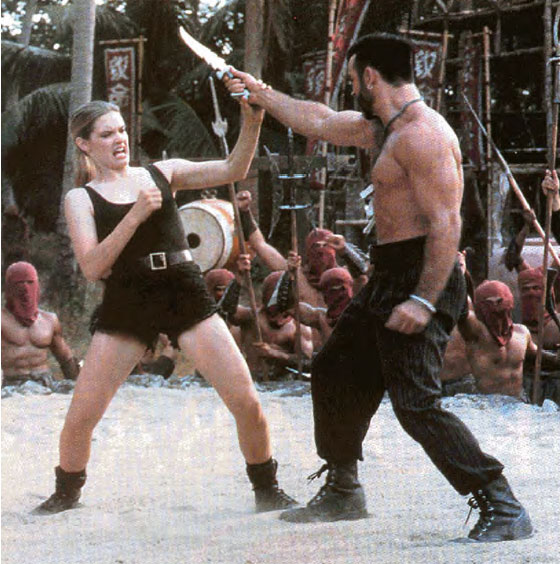
With Raptor in hand, the Mortal Kombat character of Kano (right), played by Trevor Goddard, lunges at Sonya, played by Bridgette Wilson. (R.E. Aaron/New Line Cinema photo)

Fortunately, the movie officials told us they had used one of our other knives, the Raptor. in another scene. The director, Paul Anderson, earlier had requested some samples from our existing line to consider for other characters in the movie. Two of the knives were our Gil Hibben Double Shadow and the Raptor.

The Raptor is the 1994 edition of United’s Hibben Knives Custom Design Series. Each year we produce a new knife for the series. Hibben’s knives have been featured in many films, including Rambo III and Under Siege. The Double Shadow has been in several TV shows and films, but to our knowledge the Raptor had not been used in a film yet.

Anderson wanted the character Kano (played by Trevor Goddard) to use the Raptor in a fight scene with Sonya (played by Bridgette Wilson), one of the heroes of the film. In the fight, which is mostly hand-to-hand and martial arts, Kano uses the Raptor but is disarmed in the end. The movie is targeted for kids, so no blood is shed with our knife in the film.

Collector Raptor

read knife magazine
Read more articles from BLADE’s archives with this collection of 25 years of back issues.

We are producing a special Mortal Kombat edition of the Raptor for movie knife collectors. It is the same as the one seen in the film, except that it features a two-color deep etch of the Mortal Kombat logo on the blade and an embossed dragon emblem on the sheath.

Each knife will be individually serial numbered, and will come in a special box featuring movie graphics and photos. We liked the original mermaid knife so much that we produced a modified version of it and added it to our line.

We omitted the damascus-etched blade but otherwise it is the same as the one designed for the film.


Who Knows the Knife from “The Shadow” Movie? The Shadow Knows

the dagger of the shadow movie alec baldwin
The December 1994 cover of BLADE magazine.

Editor’s note: This article originally appeared in the December 1994 issue of BLADE. Read more from BLADE‘s extensive archive here.

Again and again, when knives hit the silver screen, they become characters unto themselves. Some knives take that more literally than others. Here’s one example.

A Movie Knife with Tibetan Influences

custom knives action moviesThe Phurba, the knife from the 1994 motion picture, The Shadow, breaks new ground for movie blades because it’s the first to take advantage of new computer-generated special effects. For the dagger in The Shadow, that means the creation of a living, breathing character, so to speak.

“It growls a couple of times, flies through the air, sprouts legs and even bites Alec Baldwin’s hand,” United Cutlery’s Kit Rae said of the knife. “They used a lot of computer graphics so the face on the handle moves, and the handle twists around.”

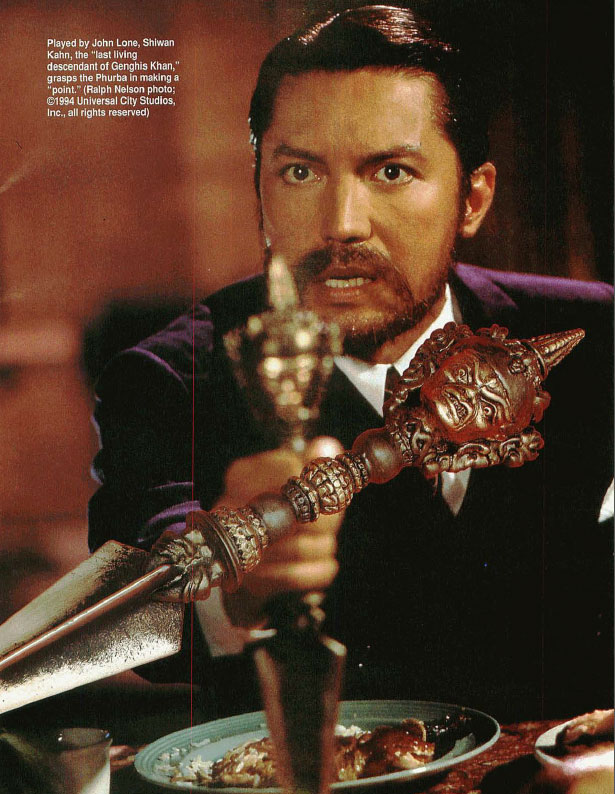
Designed for the movie by Joe Nemec III, the Phurba – or “Phurbu” as it is also spelled – is based on an actual Tibetan exorcising knife or “ghost dagger” used by lamas (Buddhist monks) to drive out evil spirits. The Phurba dovetails with the theme of The Shadow since the movie begins in Tibet.

movie knife the shadow
The Phurba from “The Shadow” sports a three-sided blade.

A Three-Sided Blade

According to A Glossary of the Construction, Decoration and Use of Arms and Armor, by George Cameron Stone, the original Phurbas had, “a three-winged blade and a hilt made up of lamaistic symbols. The pommel is usually a head with three faces crowned, with an animal’s head and neck projecting from the top. Thunderbolts (vajras), dragons and dragon’s heads are frequently present. Usually the blades are made of iron and the hilts of brass; sometimes the entire knife is of brass, and occasionally of wood.”

The knife from The Shadow movie
Played by John Lam, Shiwan Kahn, the “last living descendant of Genghis Khan,” grasps the Phurba in “The Shadow.” (Ralph Nelson photo; 1994 Universal City Studios, Inc., all rights reserved)
read knife magazine
Read more articles from BLADE’s archives with this collection of 25 years of back issues.

Nemec couldn’t get an authentic Phurba, so he based the movie knife on research, Rae said. The movie Phurba is true to the original knife in looks, right down to the three-sided blade. The main difference is in the number of faces on the handle, which was sculpted by Nemec. Where authentic Phurbas have three faces, the movie version has but one.

“[The movie’s officials] decided on a single face because it fit in with the idea that the knife was a living character,” Rae said.

Hidden Blood Bladders? The Knives of “The Last of the Mohicans”

tomahawks knives of the last of the mohicans
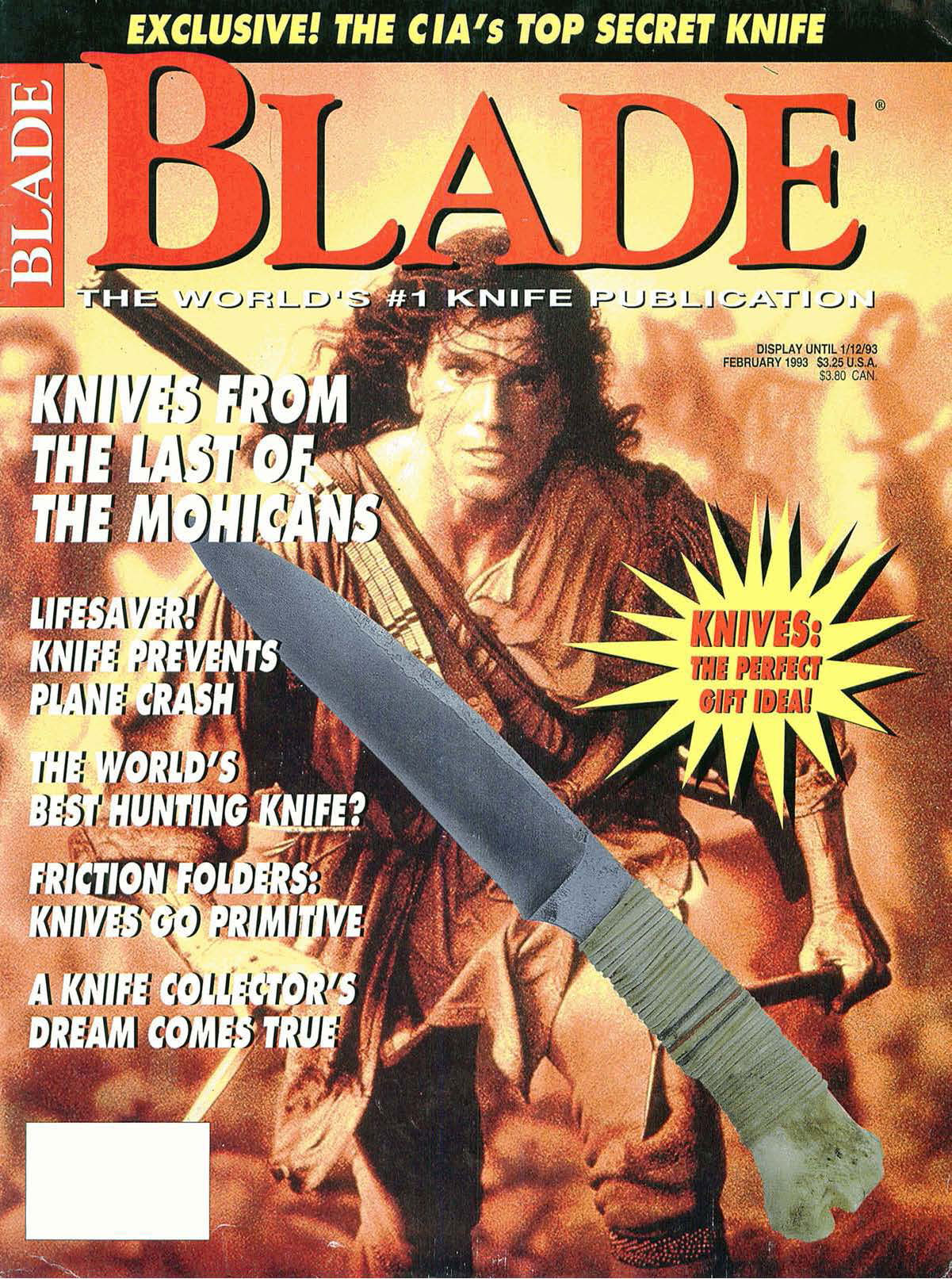
The February 1993 issue of BLADE magazine.

Editor’s note: The following appeared in the February 1993 issue of BLADE magazine. You can read more from BLADE‘s extensive archive here.

Knifemakers keep the candle lit for traditions going back generations. It’s no wonder Hollywood would turn to these keepers of history when making movies set in centuries past. 

Winkler: It Started with a Casting Call

custom knives action moviesKnifemakers Daniel Winkler and Randall King capitalized on being at the right place at the right time to make the knives for 1992’s box-office hit, The Last of the Mohicans.

Winkler, who lives in Boone, North Carolina, (the movie was filmed in the nearby North Carolina mountains) read about a casting call for the movie in a local newspaper. A maker of period pieces for and a participant in mountain man rendezvous, Winkler and his knives would seem a good match for the movie’s mid-18th century time frame, but not even he and his business associate, Karen Shook, could have foreseen the good fortune that would befall them when they met with movie prop master Ron Downing.

Movie knives of The Last of the Mohicans
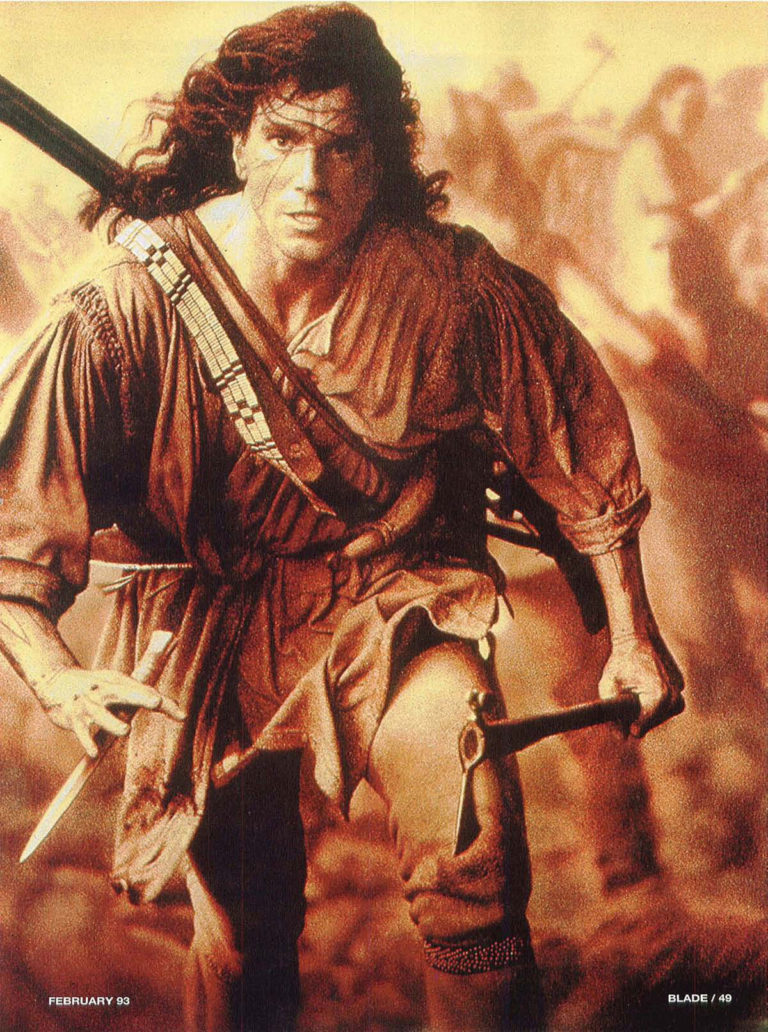
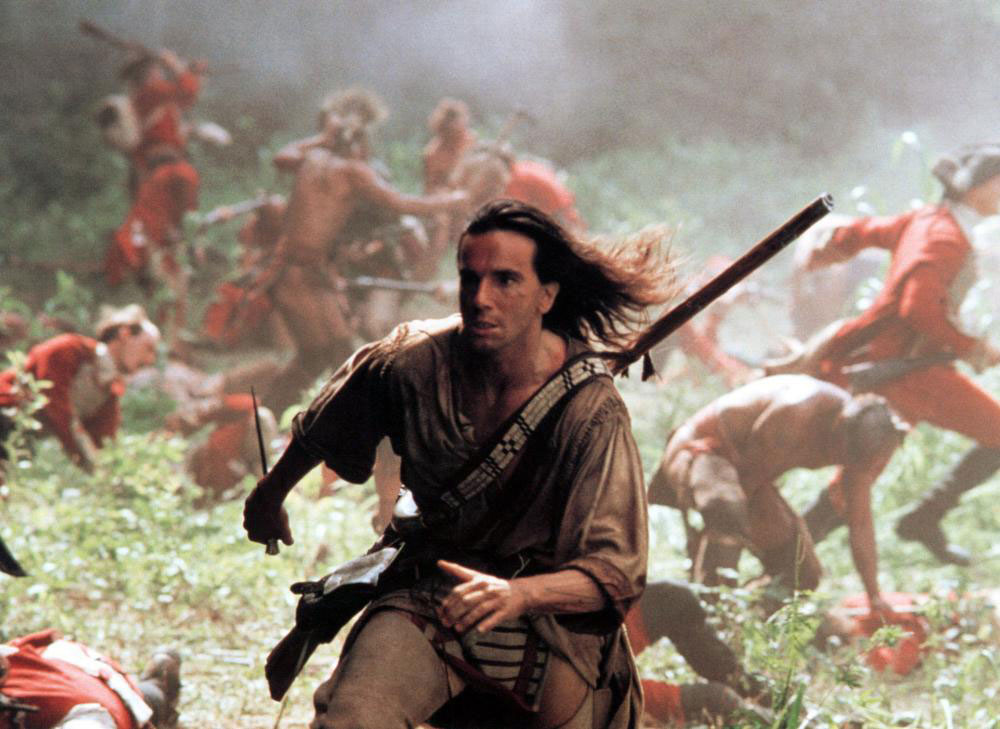
Hawkeye (Daniel Day-Lewis) carries the knife Winkler made in this scene from “The Last of the Mohicans.” (Image via imdb.com)

“Karen and I introduced ourselves to Downing’s secretary and got a map to his office,” Winkler recalled. “We spoke with Downing and he told us he had a meeting that night with the movie’s director, Michael Mann, at which time he was supposed to show Mann the knives that were to be used in the movie.

“But Downing didn’t have any knives! Karen and I ‘happened’ to have a suitcase full of knives and Downing asked if we would stay for the meeting with Mann. Though no specific knives were agreed upon at the meeting, they decided our knives were appropriate and gave them some idea of what they wanted.”

Designing, and Re-Designing, the Knives

Blades The Last of the Mohicans
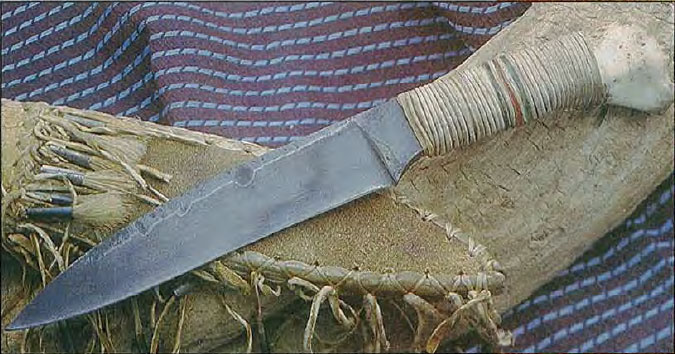
The knife Hawkeye (Daniel Day-Lewis) carries is shown above. Made by Daniel Winkler, the piece is 11 inches long overall. The blade is forged from L6, a steel Winkler said he chose to show “the right-age patina “for the French and Indian War time period. He said the blade design is not an exact straight edge because of its slight upswept tip. The handle is deer leg bone wrapped in rawhide and red and green bands, also inspired by handles from the mid-18th century.

From there, Winkler learned just how tough a job he had taken on. He met with production officials to decide on a specific knife design. From that design Winkler made a knife and brought it to the next production meeting, where movie officials suggested more changes.

“I went to six weeks of meetings and they’d change the knife at every meeting. They continually changed the design until the final knives were an evolution of changes,” Winkler said.
Once the final designs were agreed upon, he had to make three of each knife in case any one was damaged or lost, all of which had to look alike.

“It was difficult to get the same shape bone for each handle,” he noted.

The knife can be seen in the first few seconds of this video clip:

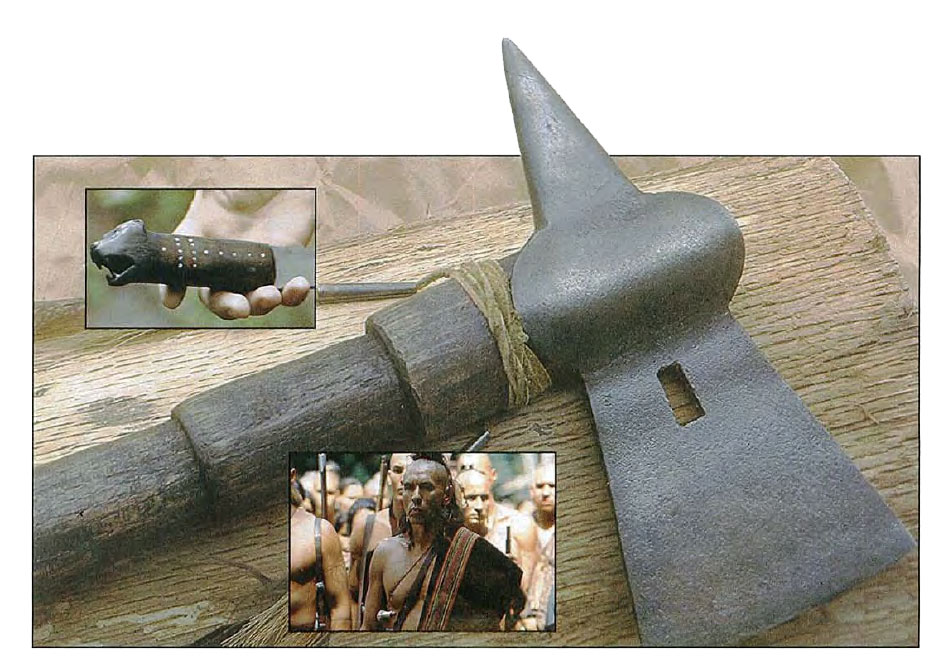
Winkler made the knives for Hawkeye (Daniel Day-Lewis) and his adopted brother, Uncas (Eric Schweig), and the tomahawk for the movie’s villain, Magua (Wes Studi). Magua’s tomahawk was one piece Winkler didn’t have to change. It gets the best close-up shot of any of the movie’s edged pieces early on when Magua attacks one of the English soldiers escorting Cora (Madeleine Stowe) and Alice (Jodhi May) Munro to see their father. Winkler said it was copied from a design on display in a French and Indian War museum in New York.

“(The movie officials) didn’t change the reproduction I made,” Winkler said. “When they got it, they liked it.”

King: It Started with Breakfast

King can thank his father for his opportunity to make the movie knives.

“Jim Morgan, the assistant prop master, ate breakfast where my Dad does every morning,” said King, who lives in Asheville, North Carolina, also near where the movie was filmed. “They got to talking and Dad said I made knives they could use in the movie. Jim said to send me down.”

The next thing King knew, he was making movie knives.

Hiding “Blood Bladders” Inside Knife Handles

bad guys knife the last of the mohicans
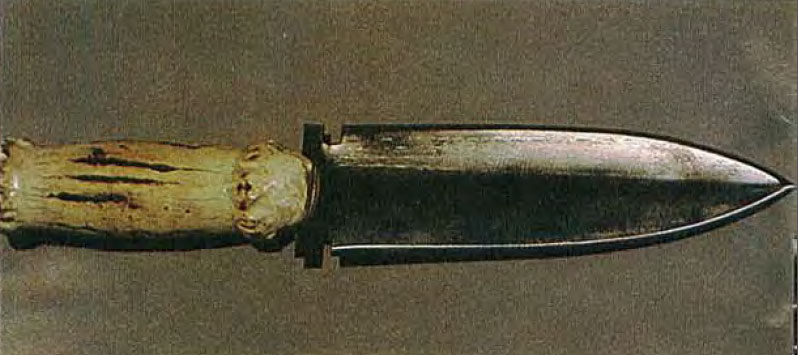
Randall King made Chingachgook’s English dagger from a design by movie prop master Ron Downing. Like all of the knives made for the movie’s stars, King had to make two duplicates in case any of the knives were damaged or lost. To duplicate the stag handle, King sawed a piece off a moose antler 2 inches in diameter, sanded it down to the same shape as the original, and cut the same “character lines” in the stag with a Dremel tool. Finally, he burned the slabs in places for the brownish stag effect.

The knife King made for Chingachgook (played by Russell Means) is a combination of two knives-an English dagger blade with a handle designed by Downing. Like Winkler, King had to make several copies of the knives.

“Do you know how hard it is to duplicate a piece of stag? I took a moose antler and sawed a piece from it about 2 inches in diameter,” he explained. “I sanded it down to the same shape as the original and took a Dremel tool to cut the lines in it and then burned it in places for the stag effect.”

King also had to duplicate the carved bear-head handle of Magua’s knife, and made two special effects knives for Magua with removable handles that hid “blood bladders,” which squirted fake blood when squeezed for the movie’s action scenes. King also made the knives and sheaths for the movie’s extras.

Winkler said the huge gunstock war club that Chingachgook cames in the movie, as well as the other tomahawks used by movie extras, were made by in-house prop people. A lot of the tomahawks were based on authentic designs illustrated in blackpowder catalogs, he noted.

tomahawks of the last of the mohicans
Magua’s tomahawk gets probably the best exposure of any edged piece in the movie early on (Magua is at bottom, played by Wes Studi). Daniel Winkler carved the handle from hickory and hand forged the head from L6 steel. He reproduced it from an authentic piece provided by Ft. Meigs, a restored fort from the French and Indian War period located in upstate New York. (Magua picture courtesy Twentieth Century Fox)

Working with the Stars

read knife magazine
Read more articles from BLADE’s archives with this collection of 25 years of back issues.

Both makers said they got to meet the stars and were impressed with how cordial they were, King even to the point of having his picture made with Studi and Day-Lewis.

Though neither maker “got rich” from the money they made-King used the proceeds to make himself a new knife shop-both viewed the experience as educational.

“Working on a movie production is not something I would want to do very often,” Winkler admitted. “It was fun but it took a tremendous amount of time. They wanted everything right away. I had to put off some of my custom orders and missed some knife shows to meet their deadlines, and a lot of what I did for them was put on the shelf. We (knifemakers) are suppliers, not actors.”

The makers may not be actors but, in a way, the knives and tomahawk were. And if the past is prologue-as with the Rambo knives that helped boost the knifemaking fortunes of Gil Hibben and the late Jimmy Lile-Winkler and King may reap even more benefit to their knifemaking careers from the pieces for The Last Of The Mohicans.

The Story Behind Arnold Schwarzenegger’s Knives in “Commando”

commando knife arnold schwarzenegger
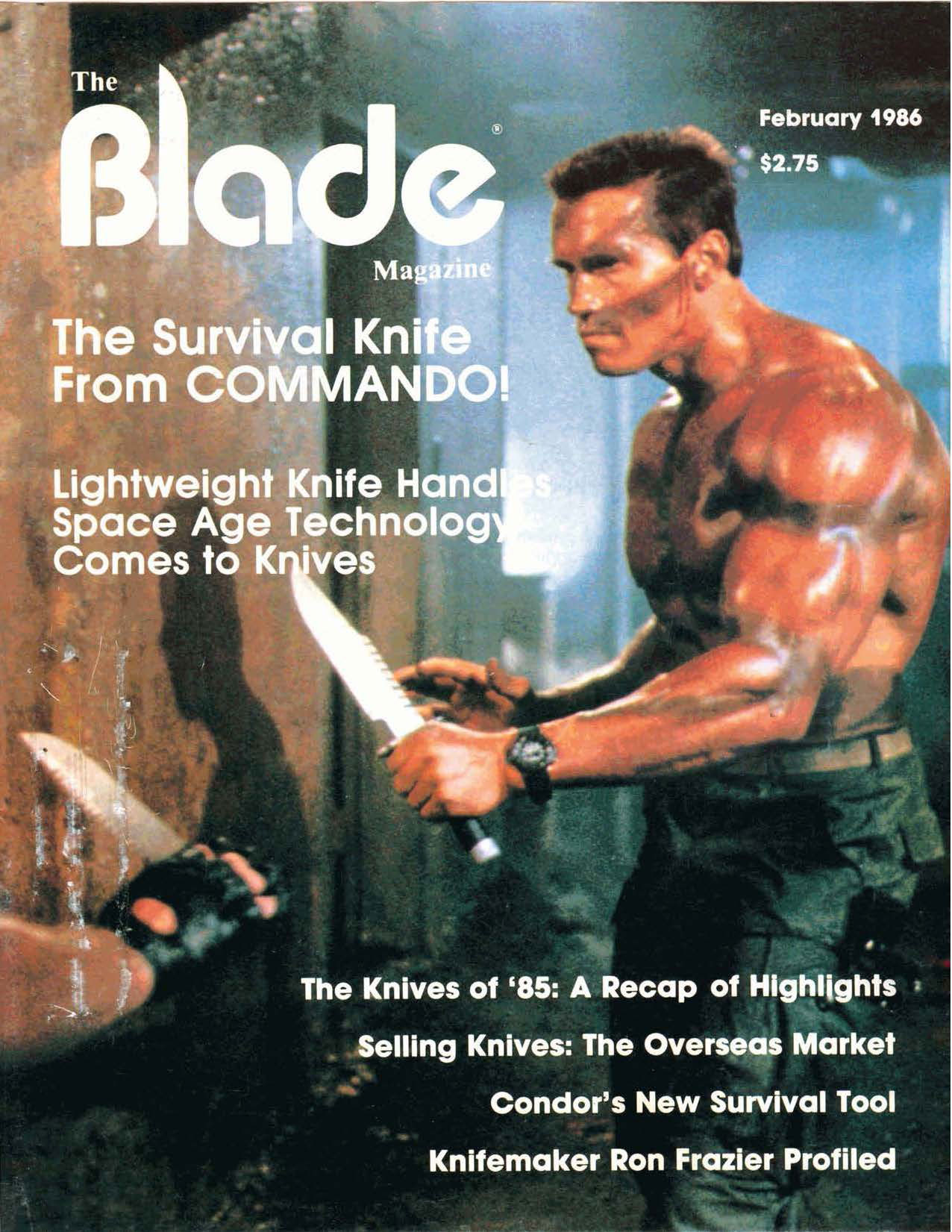
The cover of the February 1986 issue of BLADE magazine.

custom knives action moviesEditor’s note: The following originally appeared in the February 1986 issue of BLADE magazine. Read more from BLADE‘s archives in this collection.

Jack Crain passed away in September 2016 at the age of 70. He’s best remembered for the knives he supplied for many Hollywood movies, including Commando, Predator, Road House, Predator 2, Demolition Man and Executive Decision.

However, it was Commando that solidified Crain’s reputation as a knifemaker to Hollywood. Here is the complete article about his work for that action film.

Hollywood Loves Custom Knives

Hollywood is sold on the custom knife, and knifemaker Jack W. Crain of Weatherford, Texas, has reason to be pleased.

Why? Because one of Crain’s knives has recently “co-starred” in a Hollywood production. The knife, a model Crain calls the “Life Support System I,” was recently featured in the popular motion picture Commando starring Arnold Schwarzenegger.

The knife also appeared in the Airwolf television series, and later this season it will appear in an episode of The Fall Guy.

Knives on Silver Screens Inspire Knifemakers

jack crain knifemaker
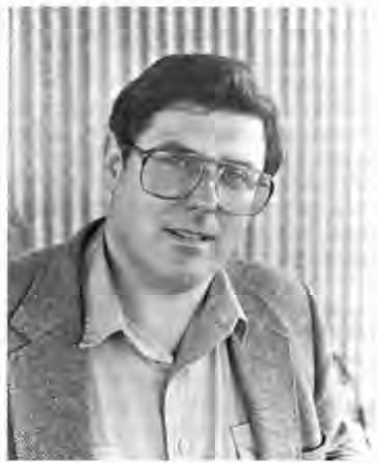
Jack Crain, as photographed in 1986.

Indirectly, explains Crain, the relationship between Hollywood and the custom knife began about three decades ago with the motion picture The Iron Mistress. That film, a romanticized biography of James Bowie starring Alan Ladd, had a tremendous impact on the early custom knife industry. Knife collecting became more popular, and several of today’s prominent makers readily concede that their careers were launched by that movie.

Crain was building knives before he ever saw the film.

“I can’t remember a time when I wasn’t making knives,” he states. But he admits to having watched The Iron Mistress “several hundred times.”

And since he prefers to make Bowie knives over all other styles, he assumes that the movie influenced his career as well.

Occasionally a knife will surface which purports to be the Bowie knife used by Alan Ladd in The Iron Mistress. Of course, it will be accompanied by a formidable price tag. Crain admonishes would-be investors that these knives are almost certainly fakes.

All of the Bowies from The Iron Mistress are in a private collection, and they are not likely to be sold in that collector’s lifetime.

The Renaissance

Handmade knives flourished in the years following The Iron Mistress and Jack Crain was part of the ensuing Renaissance of custom cutlery. He sold his first knife in 1969. A decade later he became a full-time maker and joined the Knifemakers Guild.

Initially, Crain forged his blades. Later, he adopted the stock-removal method. He occasionally returns to the forge to make a damascus blade.

He has produced folders and hunters and fancy daggers, but Bowie knives remain Crain’s primary interest. His fellow knifemakers have cautioned him that the popularity of the Bowie is waning.

“Perhaps they can’t sell Bowie knives, and perhaps I couldn’t sell the kinds of knives they are making,” declares Crain, “but I’m having no difficulty selling my Bowies.”

Limited edition commemorative Bowie knives have become Crain’s specialty, because they allow him to merge his talent for knifemaking with his passion for Texas history. In 1982, he introduced a 13-piece set in which each knife represented one of the 13 days of the heroic siege of the Alamo.

Then came a 20-piece series commemorating Isaac Millsap, one of the Alamo defenders. The Bowies for both sets were loosely patterned after the Bart Moore knife, which allegedly belonged to Jim Bowie.

A Bowie knife found on the San Jacinto battlefield (and currently on display at the Texas Ranger Hall of Fame in Waco) provided the design for the Captain Jack Hays series of 20 knives. Hays was a legendary Texas Ranger during the period when Texas was a Republic.

Another series commemorated Noah Smithwick, a blacksmith who fought in the Texas Revolution (and left a detailed account of his exploits). Smithwick actually made Bowie knives-Jim Bowie bought the first one-and the knives in this set replicated the only known Smithwick Bowie in existence.

Survival Knives Get Hot

In 1982, Hollywood released a motion picture whose impact on the custom knife industry rivaled, or surpassed, that of The Iron Mistress. That film was First Blood, and it showcased a handmade survival knife built by James B. Lile. Suddenly the market was flooded with both factory and custom knives featuring sawteeth and hollow handles.

Crain also felt the movie’s impact. He received numerous requests to produce his own version of a survival knife. Since such knives are essentially modified Bowies, the task would appear simple for a Bowie knifemaker. But Crain perceived some inherent challenges in those modifications. He would not replicate Lile’s design or any other pattern. Rather, he would incorporate his own notions of what a combat-survival knife should be.

The LS-1 is Born

Jack Crain knives
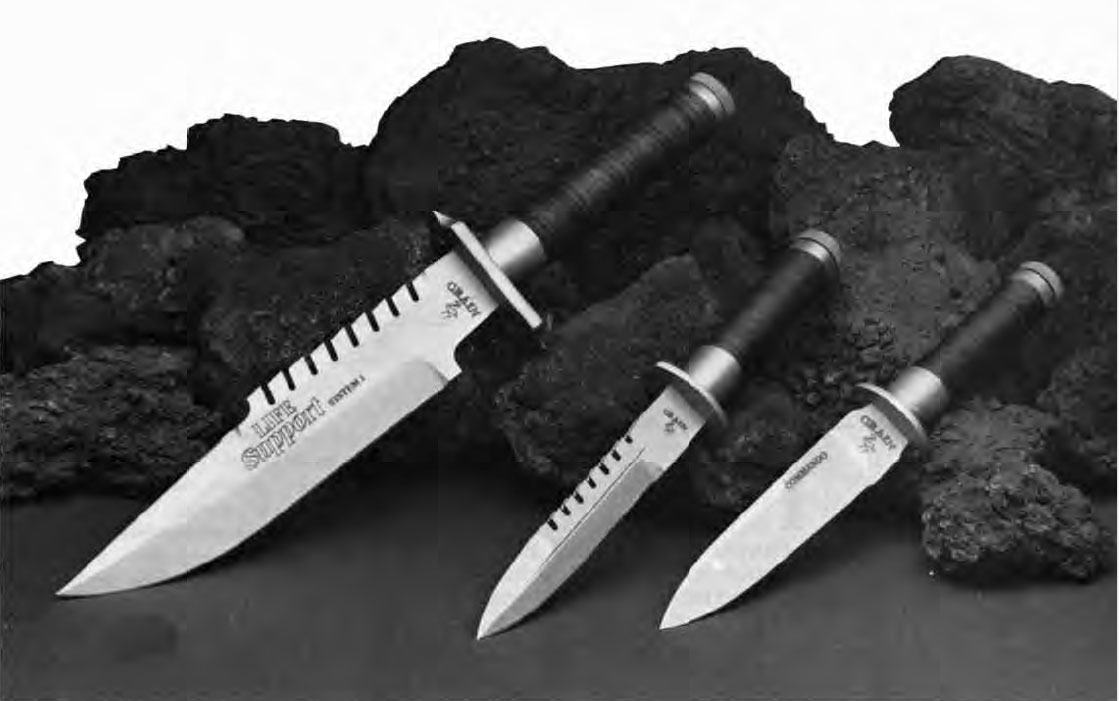
The LS-1, Scorpion and Commando are pictured from left to right, respectively.

The end result was the Life Support System I, which featured a nine-inch by two-inch by 1/4-inch blade, flatground for strength. When this knife was introduced in 1982, Crain offered it with either a 440-C blade in a matte finish or a 1095 spring steel blade with a black finish.

However, Crain became dissatisfied with the quality of the 1095 and later substituted 01 steel on the black-finished knives. He has also added D-2 as an alternative steel for the knives with a matte finish.

A single row of sawteeth is standard on the LS-1. Crain says that, in general, a single row of teeth cuts better and binds less. However, he offers a double row of teeth as an option. The knife is also available with either a square or sharpened back instead of the sawteeth.

Another distinctive feature of the LS-1 is the cut-out at the choil. This indentation accommodates the index finger. This grip provides the knife’s user with better balance for close-up work or more leverage for difficult tasks. It also affords room for a two-handed grip.

In designing the LS-1, Crain recognized that a critical area was the junction of the blade to the handle. On many survival knives, the tang is a short, thin rattail which is merely epoxied or bolted into the handle. Thus, these knives are liable to break at the guard. Crain attempted to correct this problem by strengthening the tang and then welding it into the handle.

Quality Control

However, during strenuous testing he discovered that his blades were still vulnerable at the junction. Through his research, he learned that the airhardened 440 steel had actually been weakened by welding the blade after it had been heat-treated. He successfully resolved the problem by welding the blade into the handle first and then heat-treating the steel.

When Crain discovered the internal flaw, he had already sold a number of his Life Support knives. None of them had been broken and returned. However, he assumed the responsibility of recalling and replacing every knife he could locate. Some knives had changed hands and were lost; a few collectors had prototype knives and refused to return them.

The hollow handle of the LS-1 provided other problems. At first, Crain experimented with the same kind of tubing used on other survival knives. But he determined that the wall thickness of the tubing was too thin. He also discarded the notion of casting the handles (or any other parts of the knife). The alternative was to fabricate the handle out of a solid block of steel.

Because Crain does not possess a lathe or milling machine, he found it necessary to subcontract the production of the handles. They are manufactured to his exacting specifications. Otherwise, Crain performs all of the construction: from free-hand grinding of the blade, to hand-cutting of the sawteeth, to hand-fitting of the guard and handle.

The LS-1 Reaches Arnold Schwarzenegger and the Commando Movie

commando movie knife
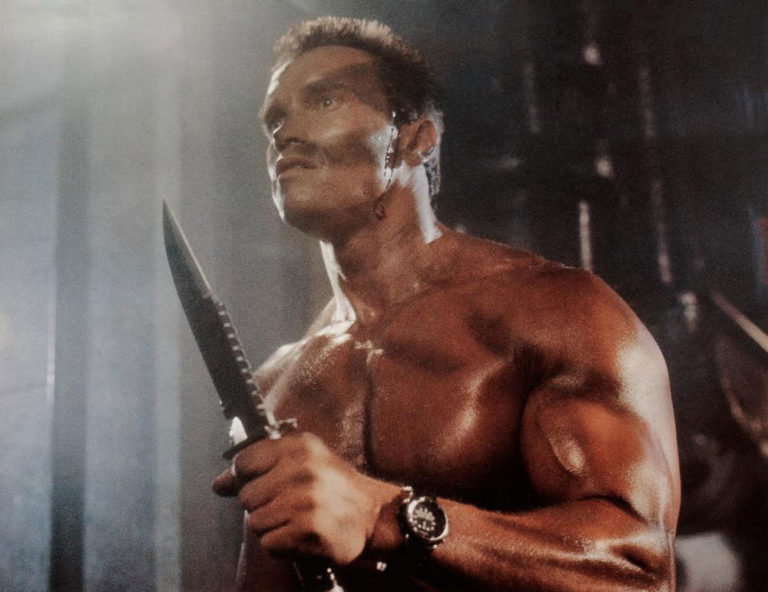
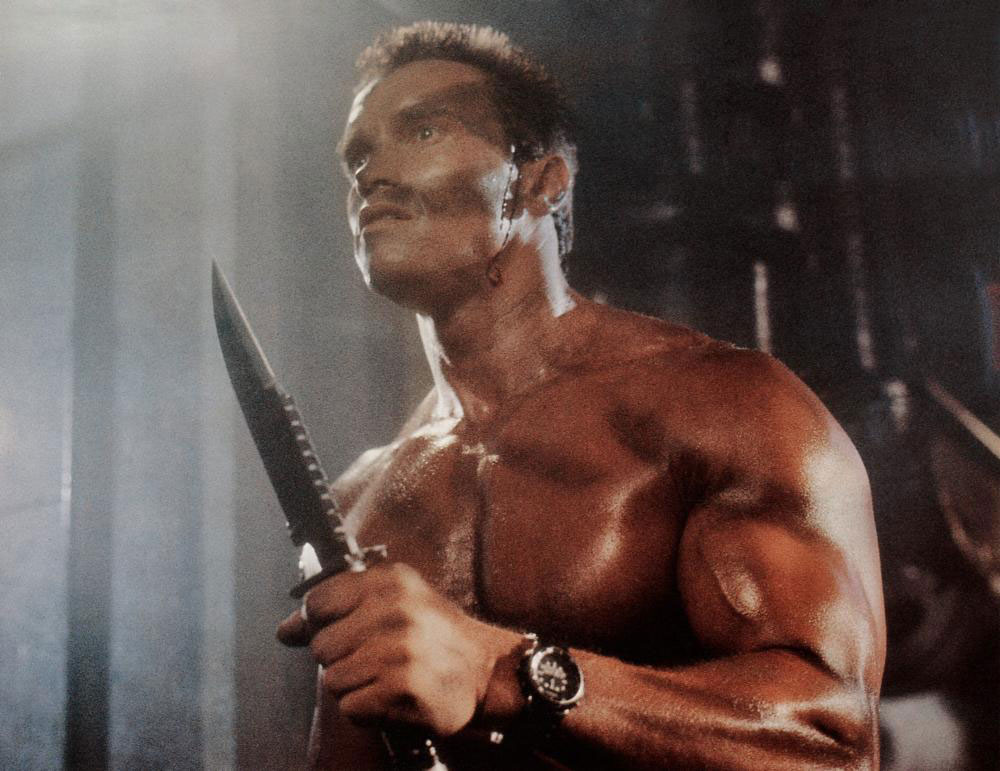
Arnold Schwarzenegger as Col. John Matrix squeezes Jack Crain ‘s LS-1 in Commando. According to Commando propmaster Tom Shaw, Schwarzenegger liked the LS-I so much that he wanted it included in the movie. (image via imdb.com)

Crain’s agent took several Life Support knives to California. It was a model with a black finish that was “discovered” by Hollywood and featured in the Airwolf series.

In January of 1985, Crain’s agent was contacted by Tom Shaw, the propmaster of a soon-to-be-made motion picture which would be called Commando. The movie would star Arnold Schwarzenegger, who had used custom swords made by Jody Sampson in the Conan films. Shaw reported that Schwarzenegger had seen a Life Support knife. He liked it and wanted to include it in the movie.

“The thing that impressed me,” remembers Crain, “was that these people were trying to get actual working guns and knives-no dummy props.”

Crain was asked to supply three matte-finished Life Support knives and six scabbards for the production. (Schwarzenegger’s character, Col. John Matrix, only carries one LS-I; the extra knives and scabbards were required as back-up.) Then the movie folks requested that Crain design a “small and concealable stiletto-type” knife for Matrix to carry.

Crain complied by developing the Commando model. The single-edged, spear-point blade is flat-ground and measures six inches by one and one-quarter inches by three-sixteenths of an inch. It is affixed to a hollow handle by the same sturdy method as the LS-1.

Three Commando knives were sent to California. The film producers were delighted with the model, but they decided that Col. Matrix would carry two small knives instead of one, and they asked Crain for yet another pattern. Within the movie’s limited production schedule, there was simply no time for Crain to design and construct another new knife. However, he had previously been commissioned by a private company to develop a limited edition of 50 small “all-around survival knives” to be called Scorpion.

These knives featured a six-inch by one-inch by three-sixteenths-inch blade with a sharpened top edge and a double row of sawteeth. Crain secured permission for the Scorpion to be used in the movie, and serial numbers eight and nine were shipped to Hollywood.

Key Scenes from Commando

In the released version of the film, the Commando and Scorpion knives appear very briefly. Matrix jerks them from his scabbard and flings them simultaneously into two attacking “bad guys.”

The LS-1 is displayed much more prominently. Matrix carries it on the front of his combat vest throughout the second half of the movie and utilizes it in the final confrontation with his arch-nemesis, Bennett (portrayed by Vernon Wells).

Contrary to the film’s publicity, Crain did not make the D-guard combat knife carried by Bennett in the movie. That knife, explains Crain, was composed of a factory blade attached to the handle of a 1918 trench knife.

Crain’s Rules for Knives in Movies

read knife magazine
Read more articles from BLADE’s archives with this collection of 25 years of back issues.

In fact, Crain will not permit one of his knives to be used by the villain in a film.

“Knives have a bad enough reputation,” he states. “People associate them with street gangs and psychopathic killers in the ‘slasher’ movies. I don’t want to see my knives doing that sort of thing.”

He stresses that knives are sometimes favored by the “good guys,” too.

Crain has another rule which applies whenever he is asked to design a knife for a movie. He requires creative input from the filmmakers, either the producer or director or the actor who will carry the knife.

“I had several pleasant conversations with the producer of Commando, Joel Silver,” states Crain.

“They treated us real well,” he recalls. “It was quite enjoyable working with them.” Crain adds that Twentieth-Century-Fox provided him with the movie’s press kits and forwarded all inquiries about the knives directly to him.

Crain thoroughly enjoyed watching Commando, noting that it was “fast-paced and fun.” However, he does not recommend that his customers try to emulate Matrix by throwing their Scorpion and Commando knives.

“Blades that are tempered hard enough to take a good edge are generally too brittle for throwing,” he observes.

Limited Supplies

He also notes that it would be extremely unlikely for anyone to find one of his LS-1 knives in an army surplus store, as Matrix did in the movie (above). To date, only about 80 have been made. None of Crain’s knives are mass produced.

He has no employees other than his wife, Toni, who answers the phone so her husband can get some work done in the shop.

“We’re not trying to make a whole lot of knives,” he explains, “just a few good ones.” (Crain also states, with justifiable pride, that Toni is rapidly developing into a talented engraver).

“Actually, the movie has slowed my production,” Crain reports. More people are writing and calling. Some of them want to come to his shop and select a knife from his stock. Crain politely informs them that he has no stock. Every knife is custom ordered and shipped upon completion.

Crain is pleased that Commando was a commercial success and that it has generated more interest in his work. However, he regrets the film’s timing.

“It would have been more convenient if the movie had come out last year-or next year,” he states.

He will have less time to devote to his survival knives in 1986, the year of the Texas Sesquicentennial, and Crain has been commissioned to make commemorative Bowies honoring several Texas cities, including Dallas, Fort Worth, and Houston.

Collecting Jack Crain Knives

The fact that Crain’s knives have become “movie stars” has not affected their price. The Life Support System I still costs $450 (in 1986 prices). The Commando sells for $300.00 (in 1986 prices).

However, Crain has introduced a special limited edition set containing both the LS-1 and the Commando. The series, restricted to 50 numbered sets, sells for $1,500. Sets have been presented to Arnold Schwarzenegger and producer Joel Silver.

Crain also makes the Life Support System 11, a scaled-down version of the LS-I with a seven-and-three-quarter-inch by one-and-three-quarter-inch by one-quarter-inch-blade. Although it has not yet appeared in any movies, Crain reports that the LS-2 has been more popular than its big sister with campers and backpackers and others who actually want a using knife.

Will there be more Jack Crain knives “starring” in future motion pictures? Crain thinks so.

There may be a sequel to Commando he states, adding, “We’ve been approached to make some knives for other movies. We’re considering it.”

Advertisement

Must Read Articles

Read this before you make a knife

Knifemaking 101 – Read This Before You Make a Knife

  by Wayne Goddard My experience has taught me that there's nothing like digging in and getting started. I've often said the hardest part of the...
how to forge damascus steel

How to Forge Damascus

Advertisement
Advertisement