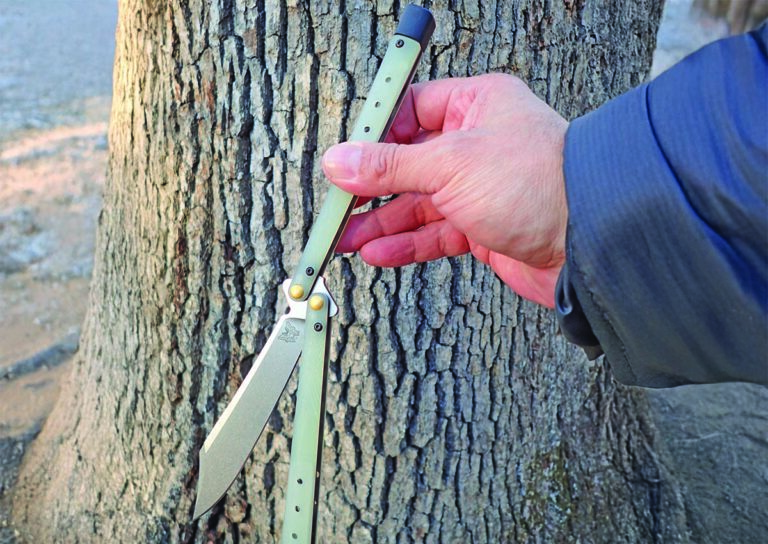
Let’s end the 67-year scourge of the Switchblade Act.
There are knives more American in terms of historic origin but none more American in terms of being persecuted by the federal government than automatics. As such, the effort underway by Knife Rights and its fellow plaintiffs challenging the constitutionality of portions of the Federal Switchblade Act should be of special interest to knife enthusiasts.
Originally enacted in 1958 with the help of Sen. Estes. Kefauver (TN) and other elected leaders apparently more interested in suppressing rights than upholding them, the Act restricts the introduction into interstate commerce of common automatically opening knives, popularly known as switchblades.
It also bans the knives’ possession on Native American reservations and in U.S. territories and on U.S. lands. The Act’s definition of a “switchblade knife” includes gravity knives and butterfly knives/balisongs, despite the fact that few if any balisongs operate according to the Act’s definition of doing so “automatically.”
In fact, since the original Act targeted knives that were blackballed at the time of the Act’s passage as those used by gang members, a significant percentage of whom were minorities, a strong case can be made that the Act is patently racist. Moreover, also racist is the Act specifically targeting the approximately 5 million people of color on 326 Native American reservations and in U.S. territories and U.S. lands that include Puerto Rico, American Samoa, Guam, the Northern Mariana Islands and the U.S. Virgin Islands.
In the two most recent developments in the case, on Dec. 9 KR and its fellow plaintiffs filed a Motion for Summary Judgement requesting the Court to find the Act unconstitutional, and that the portions restricting the knives in interstate commerce and on Native American reservations, U.S. territories and U.S. lands be permanently enjoined. Meanwhile, the Act’s existing import ban of autos would not be disturbed. In response, on Jan. 13 the Department of Justice filed a Reply Brief and Motion to Dismiss the plaintiffs’ federal lawsuit challenging the Act.
Among the DOJ’s reasons for the motion to dismiss is that the Plaintiffs’ claim has no standing because the Act “is not enforced.” This DOJ reason for dismissal is contradicted by the facts. As KR noted in an entry on its website dated Sept. 27, it was as recently as 2020 that federal agents staged a violent raid on a business, a raid that included forced entry into the home/business.
The upshot of it all: authorities seized/confiscated approximately $2.8 million worth of automatics and automatic parts and shut down multiple retail websites, forcing the business to close. Of course, even if the Act were not enforced, its mere presence serves to intimidate knife entrepreneurs who are or may be considering the manufacture or sale of automatics from doing so.
BLADE® will continue to follow the effort by KR and its fellow plaintiffs to rescind portions of one of the longest running federal acts of oppression and racism in U.S. history. While it is hoped the new administration will be more amenable to the effort, please take nothing for granted.
Contact your elected federal representatives—and anyone you know who may have pull with any and all federal reps—and urge them to help free automatics from the 67-year scourge that is the Federal Switchblade Act.
England has had an uptick in knife crime in recent years, including the horrible incident costing three young girls their lives in Southport. Certainly, crime of any kind deserves scrutiny and solutions so that society can conduct its daily affairs in a safe and secure environment. Unfortunately, it’s never the calmer heads that prevail when dark winds blow.
Case in point, the utterly asinine suggestions emanating from the host of a BBC documentary on UK knife crime.
“Actor Idris Elba announced amid his forthcoming knife crime documentary that the United Kingdom must consider “innovative” prevention methods such as blunting or banning knives.”
Let that sink in… blunting or banning knives. And he’s not talking about neutering simply what might be considered “scary” knives—tactical fixed blades, karambits and the like. No, it’s the whole megillah.
He said in the Post article:
“The truth is that kitchen knives are perhaps 25% of the knives used in most terrible crimes. That’s one of the stats in the film. And those kitchen knives are usually a domestic situation,” Elba warned. “So kitchen knives… of course, it’s very difficult. They’re a domestic knife.”
This walks hand in hand with other extreme actions that have taken place in England regarding knife sales. One of the more atrocious, ID requirements and live video sales to purchase knives online. Why, the next thing you know there’ll be a proposal for licensing knives.
Well, you don’t have to wait long for that either.
Elba thinks this might be the panacea for his country’s woes, banning nearly everything, and licensing those scant few deemed worthies to own their family’s cherished sword or knife.
“So let’s ban them all, and if you have one of those knives, get a license for it,” he suggested of people wanting to keep family heirloom swords. “Simple as that.””
And if you think this sentiment is contained to one crackpot actor, well you’d be wrong.
“A ban on the sale of pointed kitchen knives has been backed by the Church of England, judges, top trauma doctors and psychiatrists, the police and victims as they argue that it would make life-threatening injuries far less likely.”
It’s unfortunate England has endured an uptick in knife crime, yet this isn’t the license for it or certain segments of it to go off the deep end. I know it might sound crazy, but perhaps the English should address the root of the problem—the perpetrators.
The harsh truth is this: no amount of blunted blades, banned kitchen knives, or bureaucratic licensing schemes will stop individuals hell-bent on violence. You can’t legislate evil out of existence by targeting inanimate objects. England doesn’t have a knife problem—it has a people problem. A system problem. A failure-to-act-when-it-matters problem.
Axel Rudakubana—the perpetrator of the Southport killings—wasn’t some shadowy figure hiding in the margins; he was a neon warning sign flashing in plain sight. Reported repeatedly, known to authorities, radiating red flags—and yet, nothing substantial was done. But instead of holding systems accountable for their glaring incompetence, the knee-jerk reaction is to demonize cutlery.
Blaming knives for violent crime is as absurd as blaming spoons for obesity. The issue isn’t the tool; it’s the hands that wield it—and the institutions that refuse to act until it’s too late. England doesn’t need another ban. It needs accountability, courage, and the will to confront the real problem: violent individuals, not the utensils in their kitchens.
They’re role is more than making a knife look groovy.
At first, it’s an item of curiosity. The fuller, the symmetrical groove that runs along the partial or full length of a knife or sword blade, might function simply as an aesthetic touch. It could have some utilitarian purpose. Or maybe it’s a bit of both.
Makers of knives and swords have included the fuller with their work for centuries, and today it remains a focal point in the process. Its presence is often prominent but its purpose is at best somewhat obscure. Why, then, is it common among the work of accomplished makers?
“The primary purpose of the fuller is to lighten a blade without compromising strength,” explained award-winning custom knifemaker and swordsmith Vince Evans. “Many cultures incorporate a decorative aspect into the fullers on their blades. Italians are well known for segmented fullers. You also see segmented fullers on Chinese swords, as well as some German hunting swords.”
Evans took home the custom awards of Best of Show for his Italian Cinquedea and Best Sword for his Italian Schiavona—the former at last year’s Solvang Custom Knife Show and the latter at BLADE Show 2024. He also won Best Sword for his Roman spatha and Best Fixed Blade for another of his cinquedeas at BLADE Show 2022. All four feature multiple fullers. Vince sees the fuller as operational on more than one level, from practical to pretty.
Thomas Taylor’s kukri sports a 12-inch fullered blade of W2 tool steel with a compound bevel grind and heart-shaped Spanish notch. Handle: buckeye burl. Overall length: 17 inches. The sheath is cowhide and water buffalo. Taylor’s price for a similar knife and sheath: $550. (SharpByCoop knife image)
“Even in the Bronze Age you see multiple fullers,” Evans continued. “Sometimes they are very narrow. Multiple fullers can give more rigidity to a blade but with reduced weight, and a wide blade lends itself to multiple fullers. Typically, fullers are on both sides of the blade, although not always. There are examples of 2nd-century Germanic swords that have fullers on only one side or have different numbers of fullers on each side. Their purpose may be partially aesthetic.”
Evans uses a fullering tool to press the groove into the hot steel when working with a larger blade. On smaller blades he usually grinds the fullers into the steel after the blade has been shaped and beveled. Other techniques involve the use of round or flat tools to scrape the groove in, depending on the blade style.
Much of Vince’s work is an homage to history, and the fuller finds its place there for sure.
“Since my work is primarily historical in nature, I use fullers where they were seen on originals,” he remarked. “A fuller may be used on any blade that you want to lighten without losing strength.”
Varied Methods Of Creating Fullers
Seth Lopez outfitted each side of the 9.38-inch recurve blade of his BLADE Show 2024 Best Fighter winner with a stylized fuller. The blade is a damascus of 1080 carbon and 15N20 nickel alloy steels and the grind is a combo convex/hollow clip. The handle is African blackwood with 416 stainless steel domed pins. Overall length: 14.5 inches. (SharpByCoop knife image)
Seth Lopez is an accomplished master of the fuller and took home the custom award for Best Fighter at BLADE Show 2024. His take on the fuller lies in function, helping the blade to perform as optimally as possible.
“In a sword, the fuller will provide rigidity through surface area while also taking out a lot of weight,” he remarked. “In smaller knives, I like the way they look, and they help take out some weight. Fullers can be on one or both sides of the blade. Many single fuller blades are ground only on one side, so the fuller on the opposing flat side relieves that area. Many culinary knives and sushi knives are made this way.”
According to Lopez, fullers can be achieved via several methods. Traditionally forged blades may have them scraped in, while they can be milled, ground or filed in as well. Seth’s method is dictated by the size and shape of the blade he intends to create. The application from a practical standpoint is seen easily in the sword or chef’s knife, while in smaller knives he says fullers add “some completeness and flow to the overall design.”
When custom maker Thomas Taylor includes a fuller, his methods are varied.
The 3.4-inch fullered blade of Eyal Landesman’s folding dagger is RWL-34 stainless steel with a hand-rubbed finish. The handle is zirconium with mosaic paua shell inlay. Closed length: 4.75 inches. (SharpByCoop image)
“There are dies available for a press, and a fuller can be pressed in or hammered in,” he related. “Most bladesmiths will grind the fuller in before grinding the bevels in. After the initial grinds are done, fullers and bevels, then the heat treating and tempering are done. Then the long, tedious process of hand sanding begins.”
Taylor agrees that strength and weight reduction are primary purposes for the fuller.
“I think when you get to smaller blades under five inches, that it’s really for looks at that point. Yes, it does take some weight off, but it’s very little and any added strength is not noticeable in use. However, a tapered fuller can really dress up a knife, and the shape of the blade can be very pleasing to the eye. I believe that fullers should be on both sides of the blade and of the same depth and length. This, in turn, gives an even balance and slice. In my opinion, if a knife has a fuller on one side of the blade it would cause more drag on one side versus the other and would cause an arc in the slice.”
When knifemaker Eyal Landesman uses the fuller, it expands the aesthetic appeal of his blades.
Robert Wayman goes the cleaver fuller route on the damascus go-mai/damascus nickel core/damascus clad blade of his Kitchen Chopper. The handle is crosscut carbon fiber, G-10, stainless steel, malachite, ancient brain coral and amboyna burl. Overall length: 14 inches. His price for a similar model: $1,850. (SharpByCoop image)
“My work is mainly making folding art knives,” he commented, “so my experience with fullers is always on the small scale. I mainly use them for aesthetic reasons as I love to mix traditional classic design with a modern touch.
“The fuller on a pocketknife has both utilitarian and aesthetic purposes,” Eyal continued. “From the practical standpoint, the fuller can help with weight reduction as it removes material from the blade without compromising strength. This can be a plus for making lighter-weight everyday-carry pocketknives and even enhances the knife’s rigidity under stress, like an I-beam. Aesthetically, my main reason for using them is that they add a distinct, sleek look to the blade, as well as for the historical appeal that I draw inspiration from.”
Landesman says that the single fuller is rather uncommon in blade construction, and when it is used the reasons are generally aesthetic or to facilitate a specialized design. Fullers on both sides help with balance, structural integrity, symmetry and reliable performance.
“Fullers are most appropriate for swords and larger knives, such as daggers where weight reduction and structural integrity are important to performance by making them easier to handle and therefore more maneuverable,” Eyal added. “While they can add aesthetic value, the functional benefits are mainly seen in blades used in combat or heavy-duty use. Fullers are less essential for smaller, precision-focused knives such as scalpels.”
There’s no machine work—including the tapered blade fuller—just all hand filing and sanding on the Hauteclere by Wolfgang Loerchner. Blade length and steel: 13 inches and 440C stainless. The handle is 440C, carved gold, black-lip mother-of-pearl and Bertie Rietveld damascus. Overall length: 19 inches. (SharpByCoop image)
His fuller process is straight forward.
“After I cut the blade profile, I then harden it,” he explained. “Once it has been through heat treatment, I then hard mill the fuller into the blade before grinding it.”
Blood Groove, I-Beam
Accompanying the positive elements of the fuller are a couple of interesting observations related to its function. The I-beam phenomenon as noted by Landesman is described by some as providing additional strength or rigidity, and by others as allowing flexibility while lightening the overall weight of the knife or sword. Its principle has long been utilized for steel beams in the construction industry.
“The I-beam effect does lighten the blade and can help in flexibility, but I don’t know that it will make the blade stronger,” Evans observed.
Ryan Breuer abbreviates the fuller on the clip-point/false-edged blade of 80CrV2 carbon steel for his recurve fighter. Guard and ferrule: blued damascus. Handle: ironwood. (SharpByCoop image)
Added Landesman, “I agree that the main job of the fuller is to lighten the blade and increase its strength through the ‘I-beam’ principle used in construction. However, its main job is to look good.”
Blood groove is often associated with the fuller, and while there is plenty of speculation as to the origin of the term, practical evaluation doesn’t lend itself to validating that purpose.
“I think the term came with the use of the fuller in bayonets,” Evans said. “I don’t believe this is an accurate name for the fuller or its purpose.”
Lopez commented, “With many aspects of weapon history there is a lot of speculation on why certain features existed on different blades. Many of these speculations are made up, and it’s my understanding that there is no ‘blood groove’ function to a fuller on any blade.”
Billy Salyers covered almost the complete blade length with the fuller of his Best Sword winner from the 2024 Texas Select Custom Cutlery Event. The blade is a Rohans Mane damascus of 1095 carbon and 15N20 nickel alloy steels and the handle is African blackwood. Overall length: 35 inches. Billy’s price for a similar sword and scabbard: $7,500. (SharpByCoop image)
Perhaps in the hunting application there is some remnant of actual usefulness in the role.
“Some call the fuller a ‘blood groove,’” Taylor said, “thinking that it gives the blood a way out of the entry point of the carcass and makes it easier to remove the blade. This may help in these areas some but it is not the intended reason for the fuller.”
The consensus is summed up well by Landesman, who related, “The ‘blood groove’ term stems from the theory that it was designed to allow blood to flow out of a wound, supposedly preventing a vacuum from forming and thus making it easier to withdraw the blade in battle. In my opinion this is probably not an accurate representation of the fuller’s purpose, which has much more to do with its utilitarian and structural benefits, unconnected to blood or wound dynamics.”
There it is. Practical, pretty and adding a touch of class, the fuller brings along a bit of historical conjecture, completing a package that delights in many ways.
A somewhat new player, Sharps Bros. makes the cut with the Meanstreak.
Relatively new to the knife arena, Sharps Bros. made its original mark in the gun world. The company team used their machining know-how to produce some well-built fixed blades and folders. The Meanstreak 3-inch Button Lock Folder is one of the latter.
The author said the machining of the Meanstreak’s titanium frame is “superb.”
It’s a button lock—to unlock the blade, simply depress the logo button on the bolster. The blade opens manually via a flipper. The machine work on the titanium frame is superb. Opening and closing the knife is smooth. Question is, does the blade cut?
I used the Meanstreak straight from the box to slice 20-pound bond paper. The knife did so smoothly and aggressively. I could hear every slice. The handle shape aided in positive control. (I had already nicked the meat of my thumb on the blade tip. Ouch.)
The edge withstood 30 antler whacks and then cut the paper smoothly to culminate testing. Spot-on heat treatment!
Single-walled cardboard was next on the test menu and the Meanstreak made short work of slicing it up. The relatively small blade cut straight with no hangups. From there it was time to slice leather scraps. I cut sideways into the 8-ounce leather and the CPM S35VN blade zipped through the medium as fast as I could move my fingers out of the way. The folder made some very nice crunching noises.
I wanted to hear more crunching, so I started skiving the leather. It was easy to control the Meanstreak, so I didn’t cut all the way through the material. This is a sharp little knife!
Heavy-Duty Cutting
Next up: whittling a fire stick. To get it to curl I used dry wood and shallow cuts. With my thumb on the spine notches, the curls started coming. Controlling depth was easy, though the inside of the frame was a little too sharp on my hand for the grip I was using. The Meanstreak made nice curlicues.
The Meanstreak made nice curlicues. However, the inside of the frame was a tad too sharp on the author’s hand for the the grip he used.
On to my favorite test medium: sisal rope. The Meanstreak produced 225 crunching cuts and was ready for more, but my arm was done. It was very forceful cutting. I wore a thin glove to protect my hand against hot spots as I used more pressure with the cuts. A fine emery board would take care of the unwanted sharp areas.
To check the edge for brittleness, I subjected it to several whacks on my trusty whitetail deer horn. After 30 hard whacks there was no edge damage. Heat treatment is spot on—excellent job! To prove it, I sliced up the other half of the 20-pound bond paper from the initial test. I could not tell the difference in blade performance between the first and last paper slices.
Final Cut
As for changes, soften the inside edges of the handle frame. (Editor’s note: The pivot could use better action as well as the blade is a bit sluggish when opened via the flipper.)
For a factory knife especially, fit and finish is impressive.
The Meanstreak is one sharp knife. Since there was no dulling of the blade it seemed like I didn’t cut anything with it at all. Plus, it’s made in the USA!
When it comes to crafting a knife, Pat Antuzzi works one flake at a time.
“What I do is go back to the Stone Age,” Pat Antuzzi says of his knapped obsidian knives. He has been knapping blades for almost a quarter century.
In that time he has found the best of the best obsidian to be the royal Mexican variety from the state of Jalisco in Mexico, a variety that’s basically been mined out. He used the material for the blade of his straight-edged fixed blade, as well as Portoro marble from Italy for the handle. But it’s the royal Mexican obsidian itself and how it’s knapped that are the keys.
“Every indentation you see on the blade is one flake removal from [the obsidian], and if it’s done right, you’re going to see it one flake after the other, just like the ancients would’ve done it,” he explained. “It’s wicked sharp.”
Hand-Knapped Fixed Blade Specs Maker: Pat Antuzzi Blade length: Not quite 5” Blade material: Mexican gold obsidian volcanic glass from Jalisco, Mexico Handle material: Portoro marble from Italy Overall length: 9.5” Maker’s price for a similar knife: N/A
Check out a few of the new blades that caught our eye in Las Vegas.
It was a busy week at the Sands Expo Center in Las Vegas for the outdoor and shooting extravaganza known as the SHOT Show. Of course, there were plenty of factory makers in attendance with plenty of new releases for the coming year.
Sadly, we were unable to make every cutler in the house for the big dance but we did stop by a good number and caught a glimpse of some of the new blades for 2025.
Kronos Knives Gung Ho! Line By Ken Onion
Kronos is a new kid on the block, one-year-old as of SHOT Show 2025. The upstart knifemaker had a heck of an anniversary surprise at the home of its launch. The South Carolina-based company unveiled four Ken Onion-designed Gung Ho! line of fixed blades. The four knives that make up the line are all outdoor/tactically angled with 1095 steel blades and G10 handles. The models include the Stiffneck (MSRP $220), Maxhunter ($228), Elitesurvival ($256), and Truedefender ($228, pictured above). Kronos will have them for sale at the end of February.
Case Sculped Ridgeback
Case gives a modern and rugged look to its Ridgeback Hunter line with the introduction of the Sculpted Ridgeback. The fixed blade still has the sexy sweeping stainless steel blade true to the line but is dressed out in a durable and attractive new handle. In this case, canvass Micarta with G10 liners. The texturing is aggressive, making a workhorse that’s not afraid of bad weather but just as attractive as its rosewood predecessor which it is pictured with above. Case has a $128 MSRP on the knife.
Vero Engineering/Pro-Tech Custom Synapse
The Custom Synapse Auto is a pretty sweet meeting between two of the knife industry’s heavy hitters. Given the fanbase of both companies, expect these to fly off the shelves with the $525-$700 price points. Jeez, who doesn’t want an auto Synapse? Especially one done up with Pro-Tech’s typical flare—pearl inlay button, an action that snaps like a wet gym towel, etc. Mouths will have to water for a while, the auto Synapse doesn’t go public for another six months or so.
CRKT Provoke X Axe
An axe in your pocket? You bet—thanks to the mad geniuses at CRKT. Unveiled at the show, the Provoke X Axe is the latest in the forward-thinking Provoke line. Designed by Joe Caswell, the axe’s head and spike fold flush against the handle, deploying with a flick of the wrist. Built from D2 steel, it’s too light for felling trees but perfect for its tactical role—and it looks like it means business. With an MSRP of $350, the Provoke X Axe is set to drop to the public later this year.
The author explains why tactical fixed blades will “come into focus” in 2025.
It’s 2025, and no doubt the new year will bring many changes. The same can be said for custom knives.
I was interviewed for a recent article in BLADE®. I was asked my opinion about several custom knife market sectors and how they would perform in the new year. As with any collectible market, interest in specific sectors ebb and flow with time.
The year past started to see a shift in the custom knife market. Specifically, it was because of inflation impacting most everyone’s daily lives. Multi-thousand-dollar knives, sales of which began to slow in 2023, almost came to a complete halt in ’24.
The Vanguard Guardian by David Broadwell has an 8-inch blade of CPM 154 stainless steel with a hand-rubbed satin finish and scales of black Micarta® with black canvas Micarta. Overall length: 13 inches. Leather sheath by Nita Broadwell. Author’s note: “This is the epitome of what a tactical sub-hilt fighter should be. This knife features a fuller to provide lateral strength to the blade. The integral guard and sub-hilt are titanium.” Maker’s price for a similar knife and sheath: $2,500.
The trend I saw was collectors were still buying custom knives—they just changed their strategy. The primary strategy I saw was to purchase high-quality, less expensive knives. In times like these, collectors will often look around to check out the work of makers they were previously unfamiliar with, or new makers. I have done this for the past 40 years and I highly recommend it.
No matter the custom knife sector, while it may seem to disappear, no sector ever disappears completely. When a sector heats up, other sectors cool off. It is only a matter of time before they all get their turn again. No matter how hot a market sector seems or how popular the style of knife or maker is, eventually they all cool off. The increased popularity brings an increased demand, which causes a rise in prices, which brings more makers into the market sector. And often all but a few makers will continue to maintain their popularity.
Why Tactical Fixed Blades Are On The Rise
Because I watch the custom knife market closer than most, I often become aware of trends before most custom knife buyers. In marketing terminology, this is referred to as being an early adopter. Early adopters are the ones who start the path that, months later, others will begin to walk down. The market sector of tactical fixed blades is once again coming into focus.
The Nomad by Tomasz Dziubinski features a 10-inch blade of Sleipner stainless steel with a black Cerakote® finish, full-tang construction and a sculpted handle of OD green G-10. Overall length: 15 inches. Kydex sheath by the maker. Author’s note: “The quarter-inch stock, weight slightly forward, makes it perfect for chopping. Its razor edge gives it the ability to perform smaller knife chores around the camp. An excellent all-around knife.” Maker’s price for a similar knife and sheath: $395.
There are three reasons for this:
Diversity of styles: The word tactical is a marketing term that first appeared in the knife business circa 1995 (page 10). It was more about the look of a knife than its style or function. As the BLADE Show added best tactical knife awards to its custom knife judging competition, I was asked to help define the parameters for the category. It was straightforward. There were no parameters for style, length or materials, with one exception: the handle material had to be synthetic, not natural. Also, the blade and guard/bolster materials, if there were any of the latter, had to have a non-reflective finish. You would not believe the grief I have received over this simple definition.
With this definition in mind, most any variation of blade length, grind, single or double edge, double guard, single guard, no guard, integral guard, or bolster could be utilized in the design and subsequent build of the knife. The only stipulation was that the knife had to have a synthetic handle material. The variety of custom tactical knives was mind-blowing once this became a category. Finishes ranged from machine satin, bead blast, tumble and, finally, blackened.
Diversity of materials: In this instance, the materials are primarily those for blades and hardware. Tactical fixed blades and folders introduced an explosion of steel to the custom knife market. The knives featured a wide variety of steels not previously associated with custom knives. Such materials as Stellite®, Talonite® and powdered steel were utilized for blades, and these were introduced to the custom knife world through tactical knives.
The initial choices for tactical handle materials were limited to G-10, Micarta® and 550 para cord, though the options changed rapidly. G-11 was introduced as an alternative, as were various carbon fibers, including lightning strike and copper, and also Carbo Quartz, Fat Carbon, antique Micarta and others.
Phillip Patton outfits his Vanguard Cheetah Sub-Hilt Fighter in an 8-inch blade of satin-finished W2 tool steel, stainless steel guard with an indexing radius cutout, a black Micarta® handle and a leather sheath by the maker. Overall length: 12.75 inches. Author’s note: “This knife features a full double hollow grind, exceptional balance and enhanced handle ergonomics.” Maker’s price for a similar knife and sheath: $825.
Price Point: The price of a custom knife was a significant consideration in 2024 and will be a major factor in 2025. Due to their diversity, tactical fixed blades will offer the collector numerous choices in the sweet spot of $300 to $800, which is in just about every serious custom knife buyer’s budget.
Tactical Fixed Blade Visual Appeal
As with most knives, the initial attraction to tactical knives is visual. Once a knife catches your eye, you impulsively want to handle it. Because most tactical knives are built to use, they often have more attention to detail toward that end than other knives. Consequently, a visceral reaction happens when you put the knife in your hand. The knife instantly becomes an extension of yourself. The knife’s symmetry, balance and handle ergonomics all combine to make the knife effortless to use.
Because of the variety of styles and materials, you can easily match up the tactical knife to meet your needs, whether a smaller utility knife for camping, bushcraft work or even an EDC. A knife like the Ridgeline by Rafal Kolakowski or the Trail Head EDC by Tomasz Dziubinksi can be used for many tasks in the field. Both combine light weight, excellent handle ergonomics and very durable materials.
Rafal Kolakowski’s Ridgeline sports a 4-inch blade of Becut stainless steel in a black Cerakote® finish and a carbon fiber handle. Overall length: 8.75 inches. Kydex sheath by the maker. Author’s note: “Double hollow ground blade with fuller for added strength. Full tang, sculpted handle material for enhanced handle ergonomics. A small knife but built for hard work. Stainless steel tube lined thong hole.” Maker’s price for a similar knife and sheath: $350.
At the other end of the spectrum are the choppers. The large, heavy blades are designed to do what small knives can’t, including break trail, create firewood and assist in processing large game. The Piotr Gosciniak Tracker offers several options with its unique blade design. A straight primary edge is designed for baton work, the cleaver-style grind for chopping and slicing, and a distinctive grind on the top edge for cutting cord. Dziubinski’s Nomad is another example of a serious tactical to get things done.
Then there is the sexiest tactical knife: the sub-hilt fighter. It is my favorite knife style and my favorite maker of it is David Broadwell. Dave’s limited-edition Vanguard Guardian is highlighted by its unusual fuller and integral titanium guard and sub-hilt. Phillip Patton’s Vanguard Cheetah features a sexy recurve blade with a more traditional guard and sub-hilt.
This article wouldn’t be complete without a tactical knife showing off its military influence. For that, consider the Spektra dagger by Rafal Kolakowski. It’s sleek, compact and built for serious use.
Less Is More
A 3.5-inch blade of Sleipner stainless steel with a black Cerakote® finish and black G-10 handle highlight Tomasz Dziubinski’s Trailhead. Overall length: 8.25 inches. Kydex sheath by the maker. Author’s note: “Flat-ground, upswept utility-style blade. Full tang, excellent handle ergonomics. A small knife but built for hard work. Stainless steel tube lined thong hole.” Maker’s price for a similar knife and sheath: $325.
Please do your research. Understand what the knife can and cannot do. Try to get one with a guard or at least handle material over the guard. Integral guards with square edges will tear up your hands. Often, “Tacti-Cool” features—extra holes, extra serrations or saw teeth, etc.—may look cool but seldom, if ever, add anything to the knife except extra expense. With tactical knives, usually less is more. Balance and handle ergonomics are essential on a knife that will be used hard.