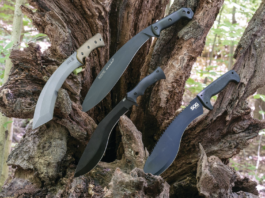
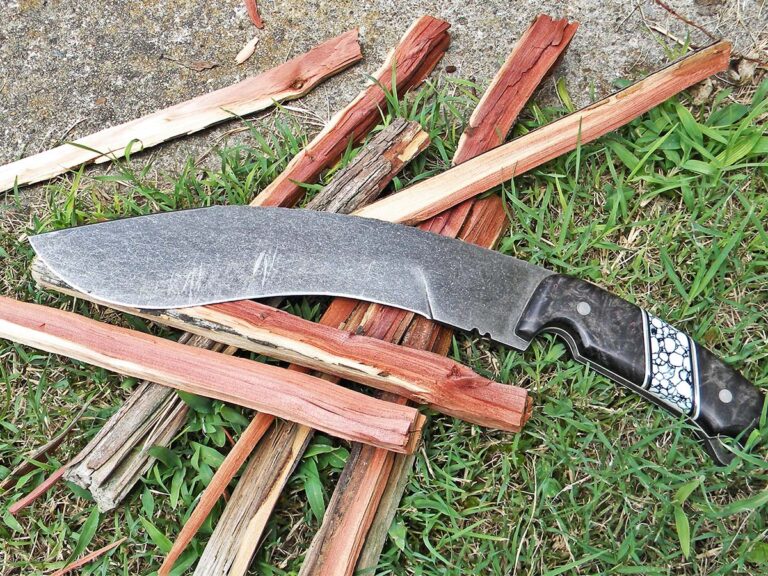
Blades and Bands Kukri is a forward-cutting knife design.
In the search for knives to test for “Spec Sheet,” I get referrals. Tracy Price is one. He’s a fairly new knifemaker but does quality work. The Kukri is a knife he made for himself to push his skills, something most makers do.
It’s always good to learn a different way to do things or a new shape. The more skills, the wider variety of knives the maker can build. No matter how pretty they look, form and function must be there. Let’s see how the Kukri functions.
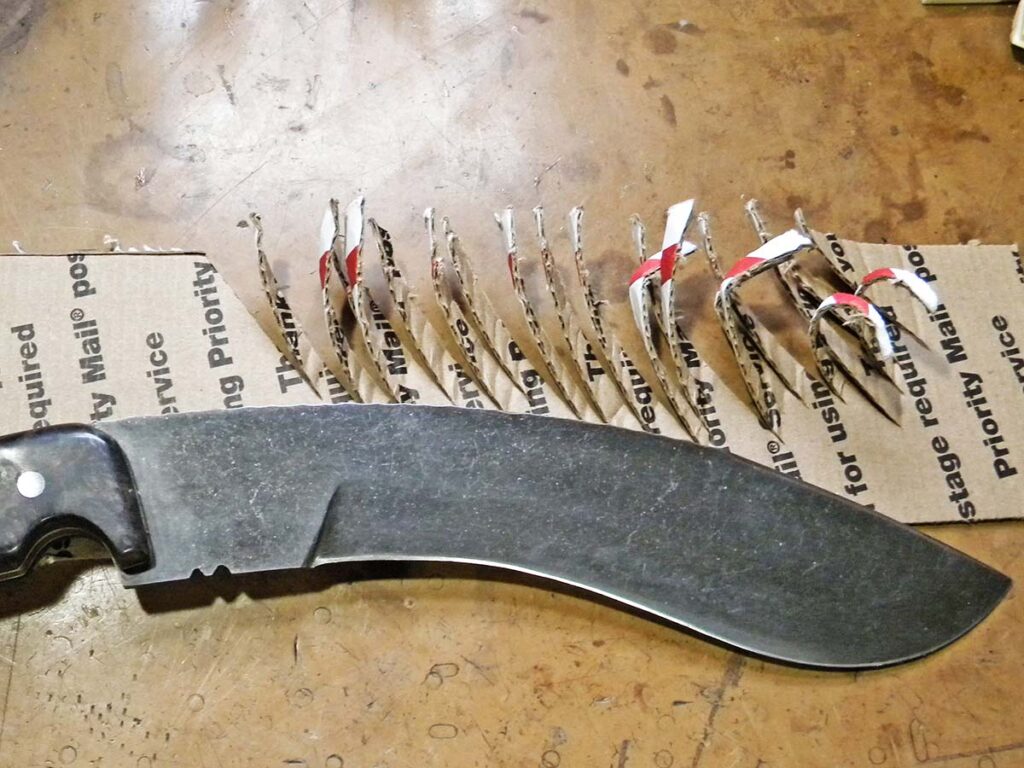
The cardboard slices curled from the edge geometry but resulted in no slowing down of the edge.
For a quick edge check, I use the paper slice. The knife cut smoothly and fast. The blade shape pulled the edge through the paper. I had to control the knife’s forward weight, but after a few slices, it was no issue. It’s a sharp blade for sure.
I cut up an old postage box and used a side of it for a single-walled cardboard cut. The knife sliced aggressively and was easy to control. The slices curled from the edge geometry but resulted in no slowing down of the edge.
Kukri Medium-Duty Cutting
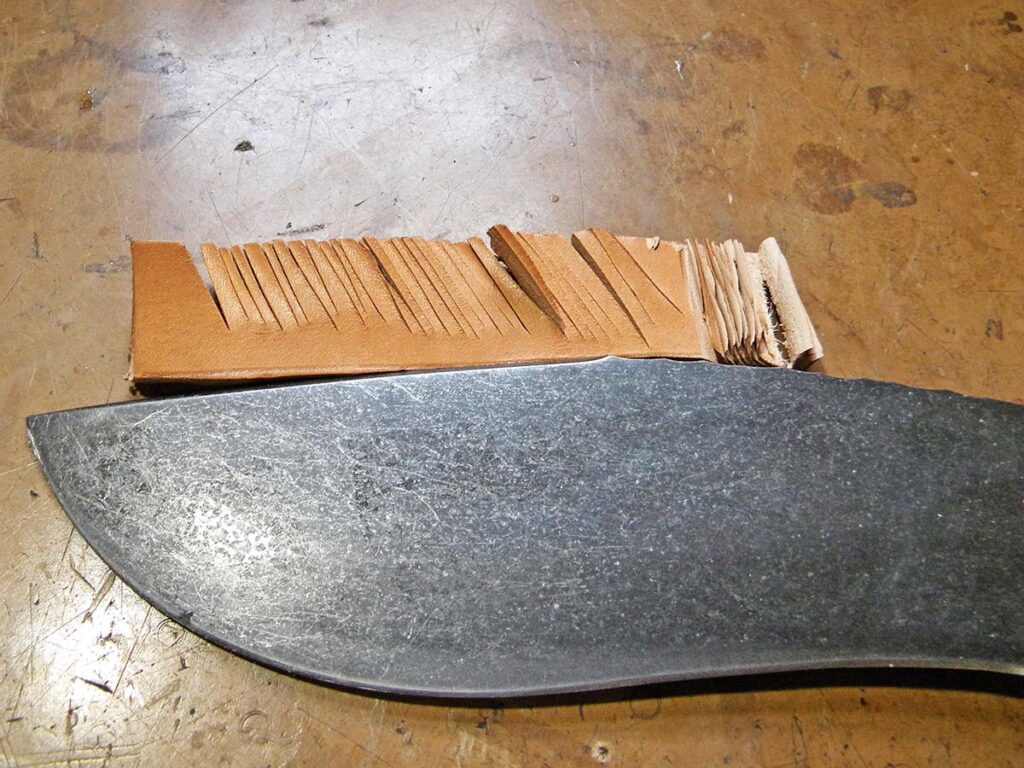
The Kukri smoked the leather cut.
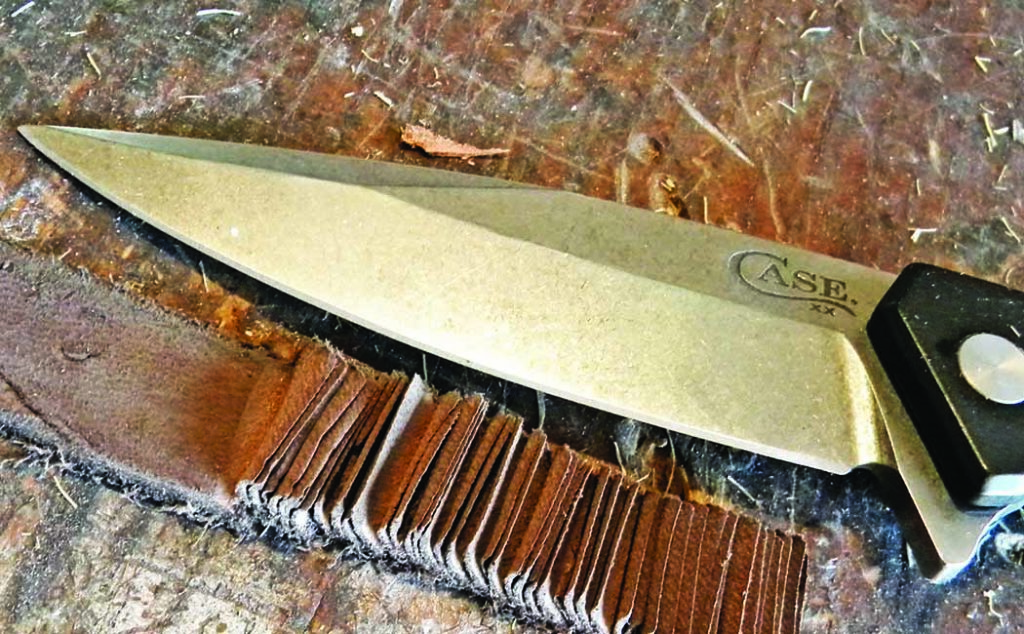
Next up: 8-ounce leather for skiving. I shaved a thin slice of leather to remove the squared-off cut during sheath construction to get the leather to flow together. It was fairly easy to skive the leather; I just had to be careful of the excess part of the blade I was not using. In other words, I was both skiving leather and shaving wood off my workbench at the same time.
Cutting leather was one push and the edge hit bottom. The Kukri smoked the leather cut. I moved up and down the blade and couldn’t find a dull spot. The blade belly was the smoothest. Again, I forgot to check the clearance on the first cut and carved into my benchtop. I’m blaming it on the heat.
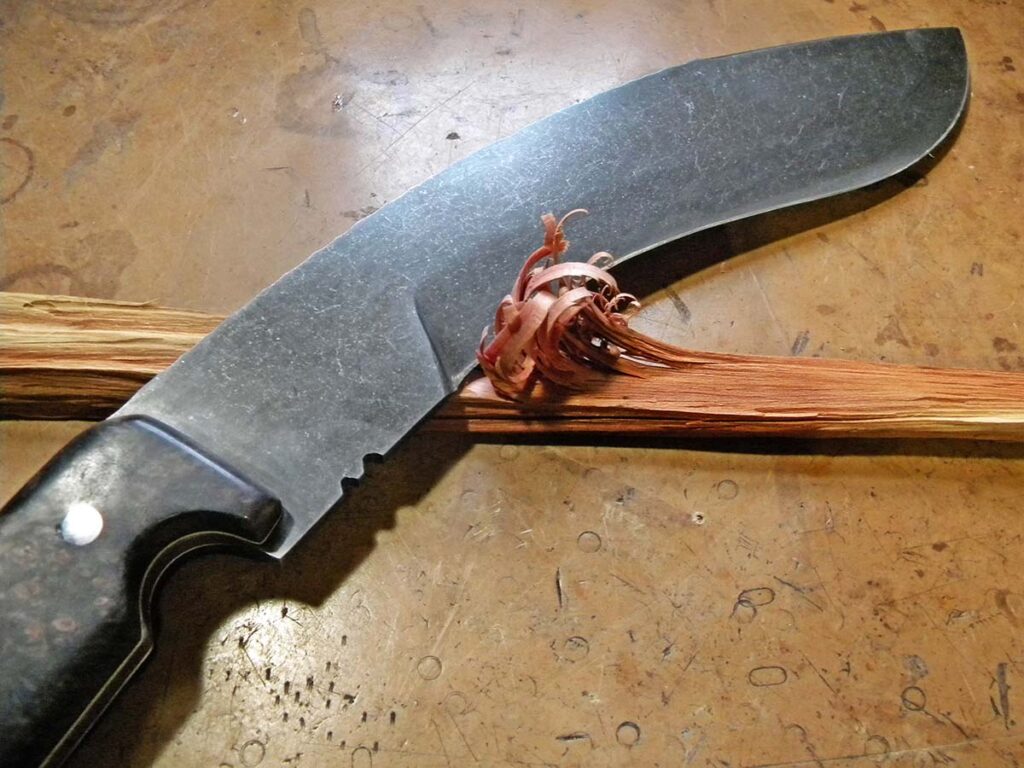
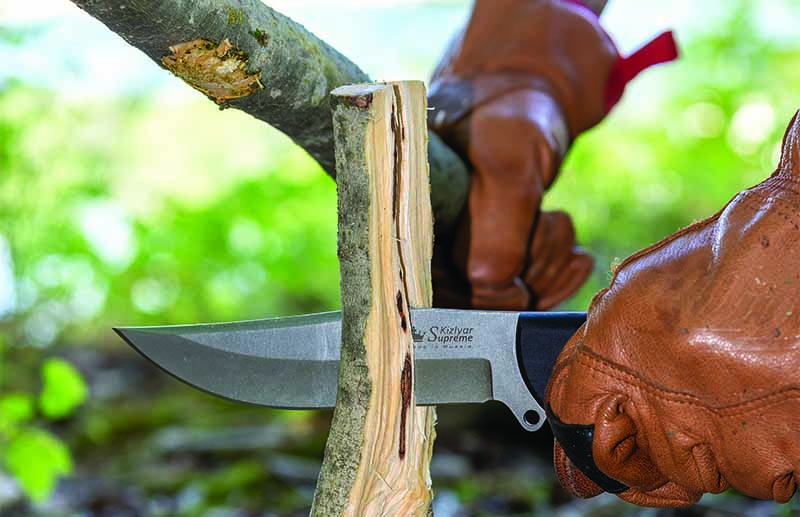
It was time to whittle some fire sticks. I easily controlled the depth of the curlicues by choking up on the handle. The knife curlicued the cedar very quickly. Yes, the Kukri can be used for finer chores, too.
Kukri Heavy-Duty Cutting
The author easily controlled the depth of the curlicues by choking up on the handle.
Chopping was next on the test menu. Finally, I got to use the Kukri and put some whacking into it. Using some red cedar firewood as a base, I started chopping kindling. One whack and I was halfway through the piece. The forward balance worked perfectly for splitting—and man, does it whack! The choil does have a sharp spot but that was easily fixed.
I went back to slicing the original piece of paper to check for dulling and/or chips. The Kukri sliced the now-damp paper very well (97° F and 90 percent humidity make paper kind of soggy). It was simply too hot to stay in the shop—test over!
Final Cut
The Kukri is an excellent field/camp knife. It’s made to chop and whack in the outdoors. However, I soften the edge of the steel at the choil.
If it needs cutting, do it in style with one of these gems.
Of any class of knife, there’s nothing handier than an EDC blade. From mending hoses to knocking down cardboard boxes and prying open stuck latches, these knives trim down daily chores. Though what exactly defines an EDC knife? Honestly, anything could be an everyday carry if you simply carry it every day. And while a few of our new knife picks aren’t precisely what you call your typical EDC, they’re certainly worthy of keeping at hand to cut into your workload.
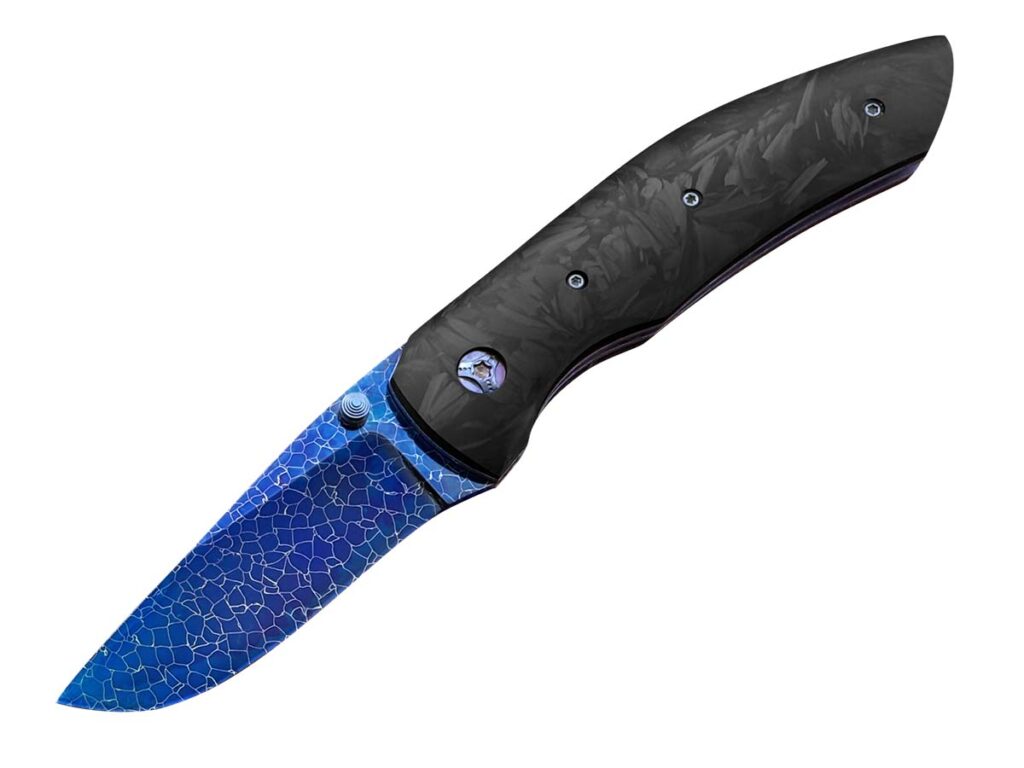
Brian Milinski Paratrooper
BLADE LENGTH: 3.25” BLADE MATERIAL: Dragonskin damascus by Bertie Rietveld BLADE GRIND: Hollow BLADE FINISH: Nitre salt blued SCALES: Carbon fiber CLOSED LENGTH: 4.5” MAKER’S PRICE FOR A SIMILAR KNIFE: $1,650 MAKER: Brian Milinski, mrknives.com (Felipe Silva image)
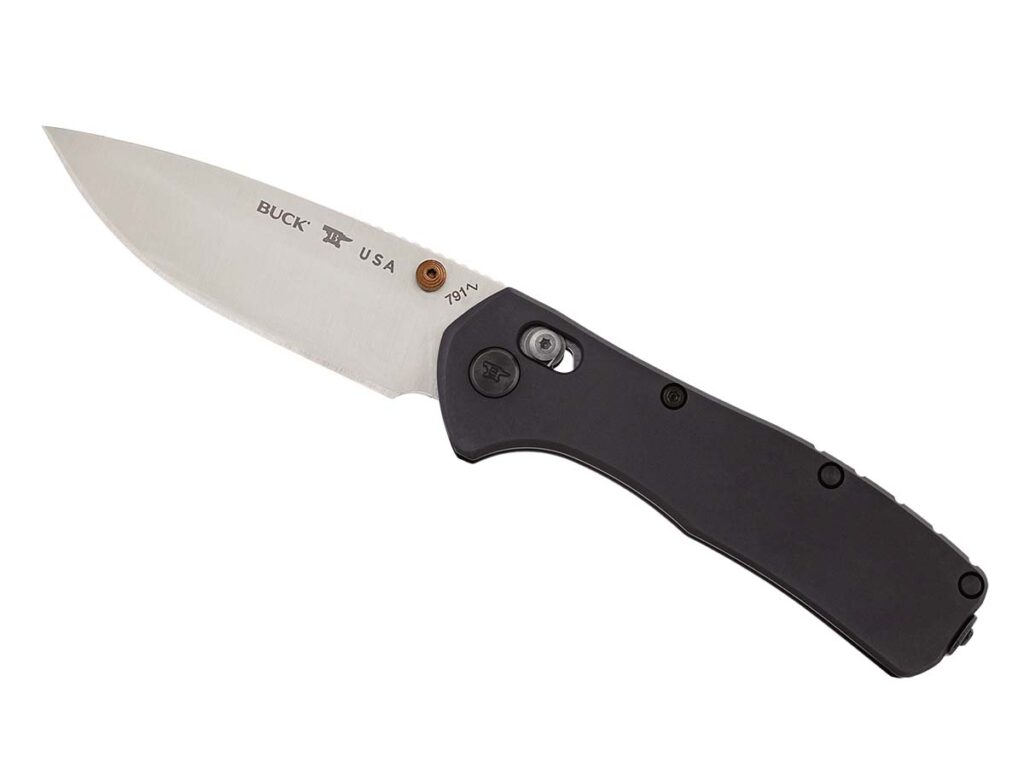
Buck Knives 791 Range Elite
KNIFE TYPE: Folder BLADE LENGTH: 3 3/8” BLADE STEEL: MagnaCut stainless BLADE GRIND: High-panel flat BLADE OPENER: Thumb stud HANDLE MATERIAL: Anodized aluminum LINERS: Tumble-polished stainless LOCK: Crossbar POCKET CLIP: Deep carry, reversible WEIGHT: 3.3 ozs. CLOSED LENGTH: 4.5” SPECIAL FEATURES: Spine gimping COUNTRY OF ORIGIN: USA MSRP: $275 COMPANY: Buck Knives, buckknives.com
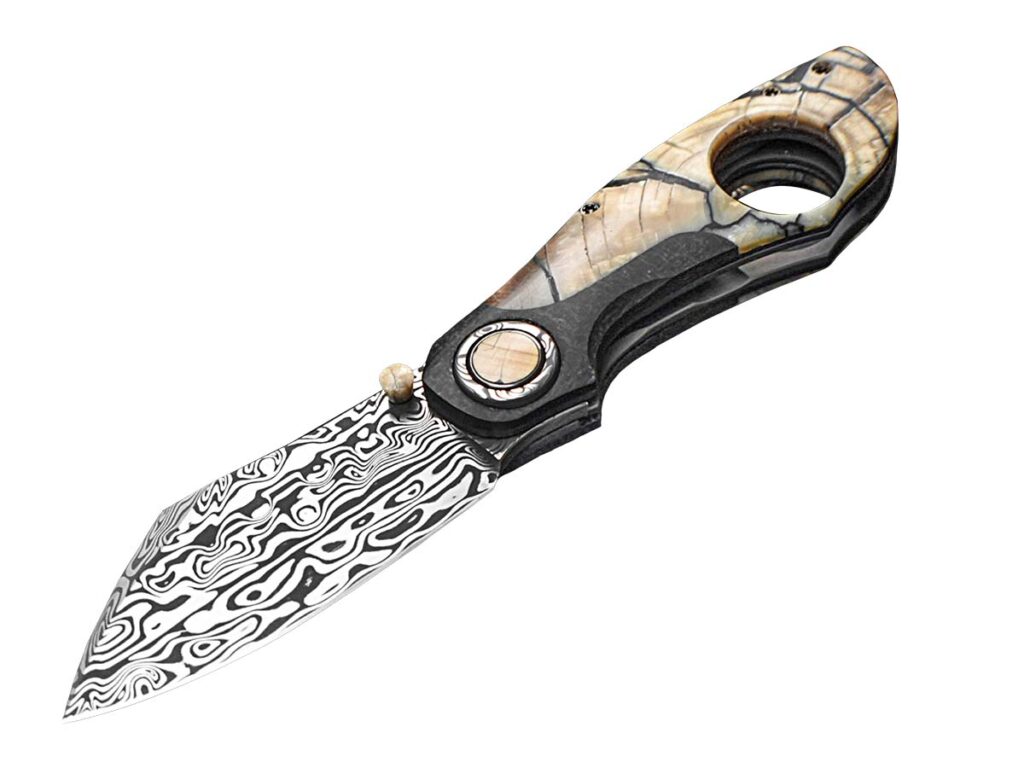
Sean Alonzo Dalisay 2.8 Cigar Cutter
BLADE LENGTH: 2.8” BLADE MATERIAL: Yggdrasil pattern damascus by Damasteel BLADE GRIND: Single bevel SCALES: Mammoth tusk ivory BOLSTER: Black burlap Micarta® KNIFE TO KNOW: Pivot collar, inlay and thumb screws are mammoth ivory; zirconium pivot and backspacer MAKER’S PRICE FOR A SIMILAR KNIFE: $4,200 MAKER: Sean Alonzo, baleteblades.shop (Jocelyn Frasier image)
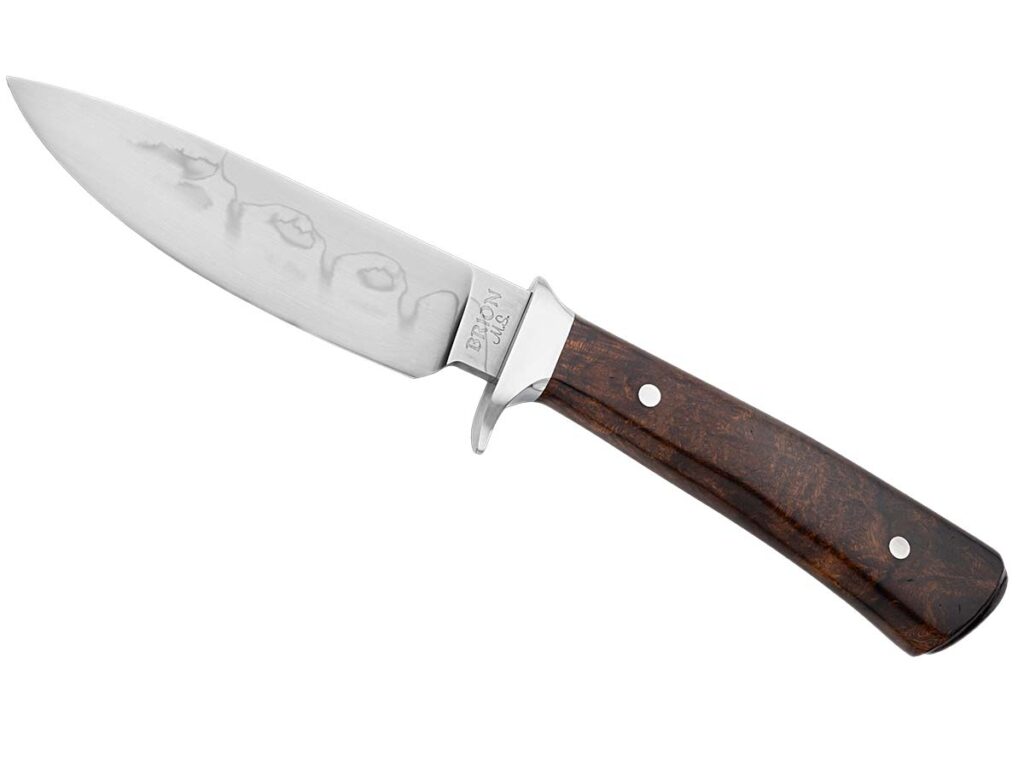
Brion Tomberlin Personal Carry Fighter
BLADE LENGTH: 4.5” BLADE MATERIAL: W2 tool steel w/hamon BLADE GRIND: Flat SCALES: Ironwood GUARD: 416 stainless steel OVERALL LENGTH: 9.5” MAKER’S PRICE FOR A SIMILAR KNIFE: $650 KNIFE TO KNOW: Brion Tomberlin is a master smith in the American Bladesmith Society MAKER: Brion Tomberlin (Jocelyn Frasier image)
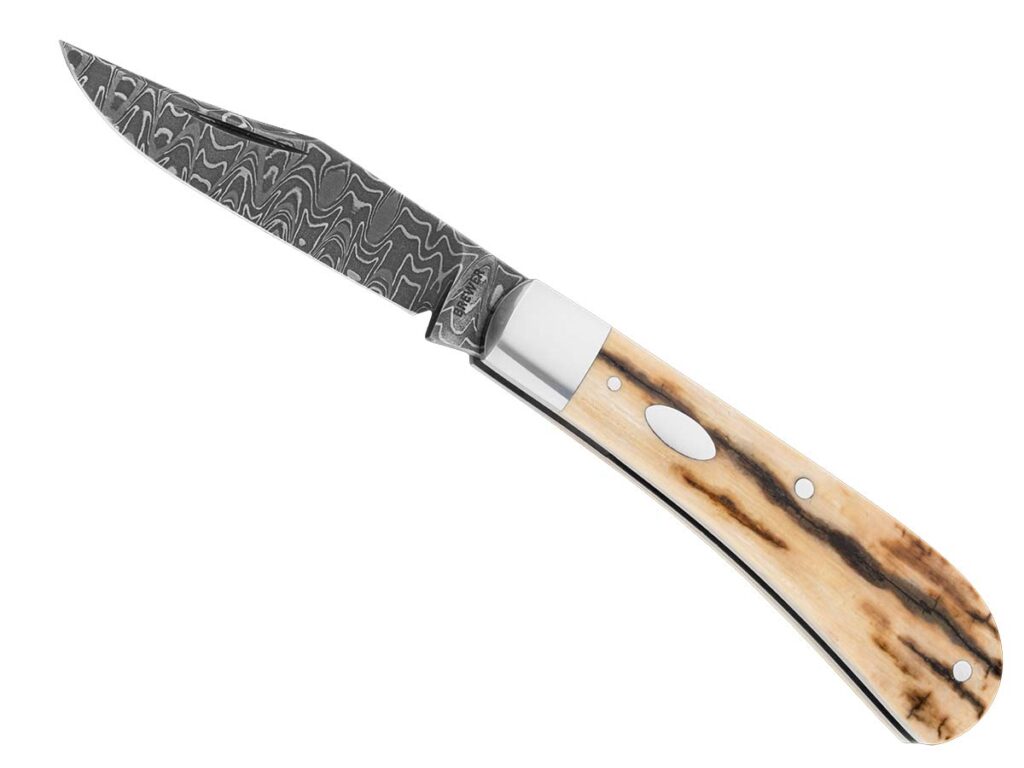
Craig Brewer Slipjoint
BLADE LENGTH: 2.5” BLADE MATERIAL: Mike Norris stainless damascus in a Frequency pattern BLADE GRIND: Hollow SCALES: Mammoth ivory CLOSED LENGTH: 3” MAKER’S PRICE FOR A SIMILAR KNIFE: $1,100 KNIFE TO KNOW: Craig Brewer is an apprentice smith in the American Bladesmith Society MAKER: Craig Brewer (Jocelyn Frasier image)
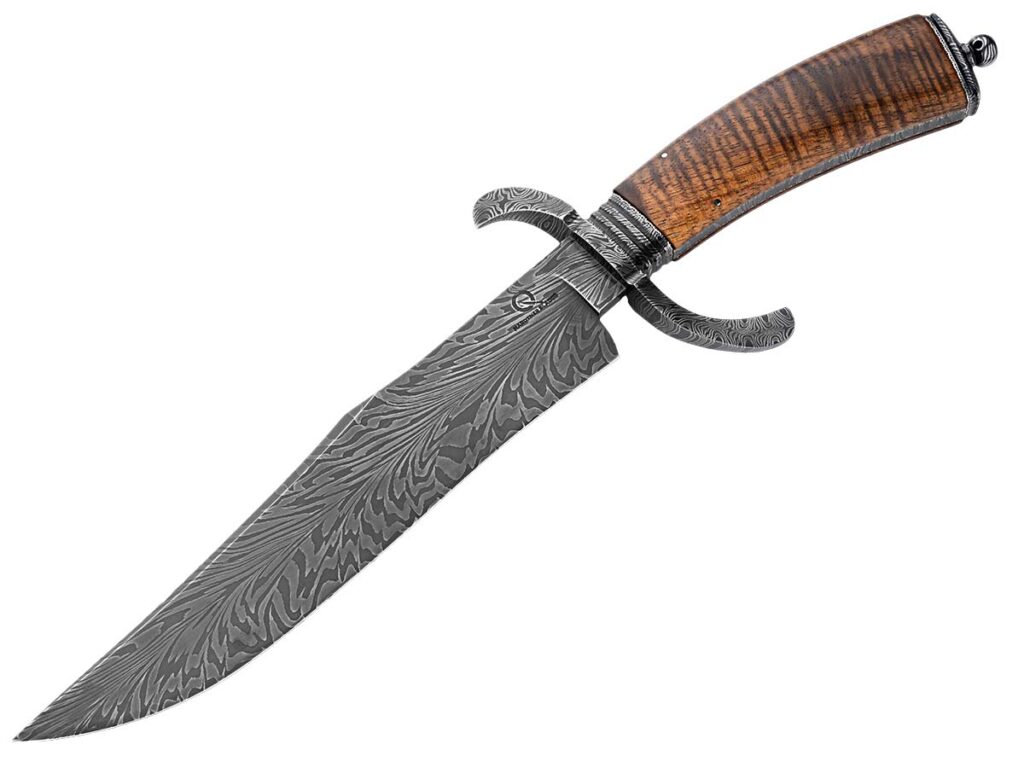
Quintin T. Hardtner IV Take-Down Frame-Handle Bowie
BLADE LENGTH: 8.25” BLADE MATERIAL: Feather damascus of 1084 carbon and 15N20 nickel-alloy steels BLADE GRIND: Flat SCALES: Curly koa FURNITURE MATERIAL: Same as blade SPACERS: Nickel silver OVERALL LENGTH: 13.5” KNIFE TO KNOW: Won Best Fixed Blade and Best of Show at the 2025 Louisiana Knife Show SHEATH: Leather; custom made by Bob Bobbitt MAKER’S PRICE FOR A SIMILAR KNIFE: $3,000 MAKER: Quintin T. Hardtner IV (Jocelyn Frasier image)
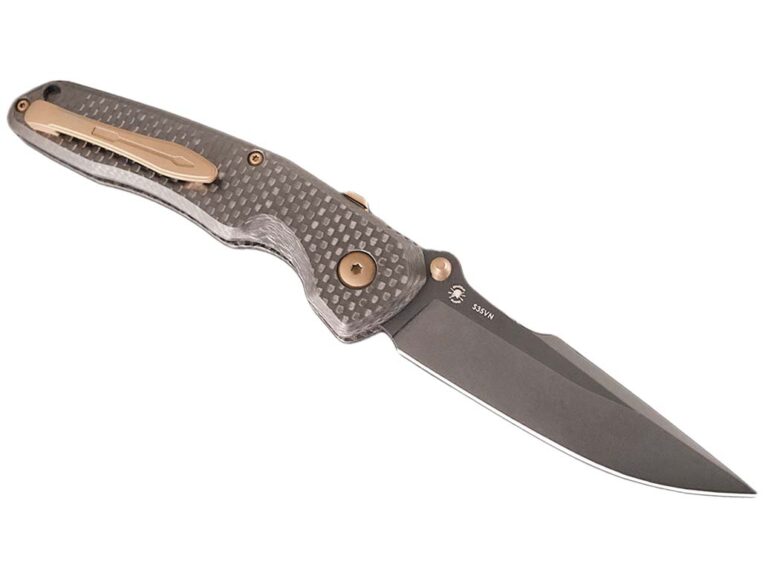
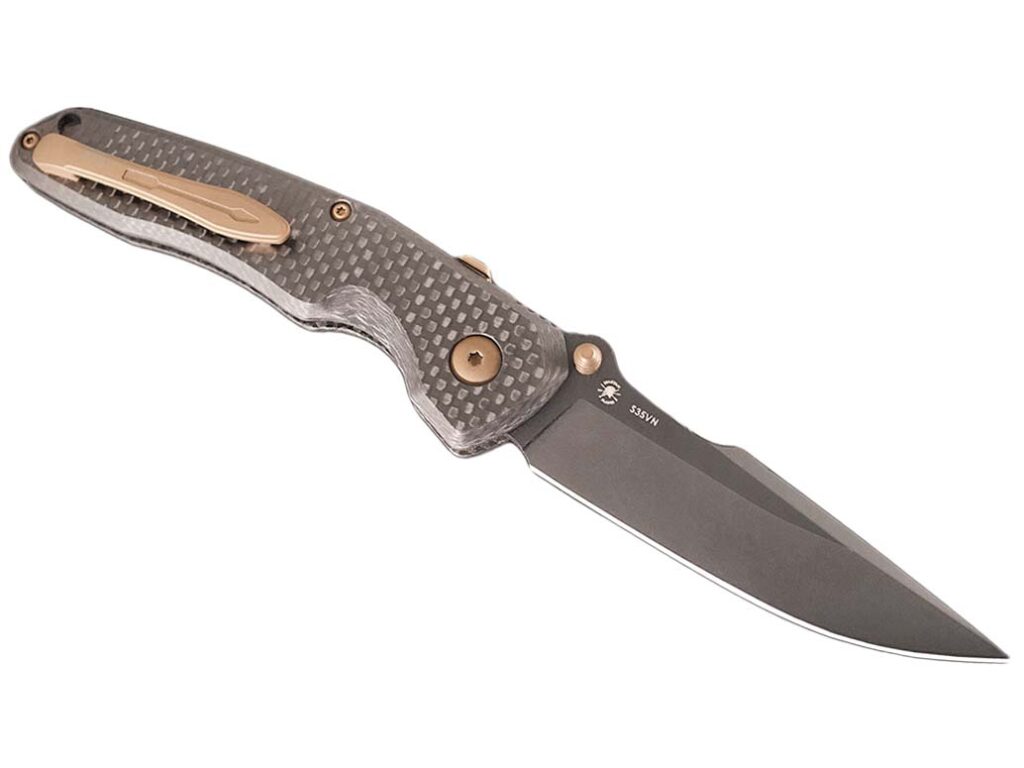
Spartan Blades Soter Carbon Fiber Edition
KNIFE TYPE: EDC folder BLADE LENGTH: 3.25” BLADE STEEL: CPM S35VN stainless ROCKWELL HARDNESS: 58-60 HRC BLADE FINISH: Satin HANDLE MATERIAL: Carbon fiber/G-10 composite LOCK: RaceLock™ POCKET CLIP: Machined from one piece of steel, PVD-coated in flat dark earth WEIGHT: 3.9 ozs. COUNTRY OF ORIGIN: USA MSRP: $310 KNIFE TO KNOW: Soter is the Greek mythological figure known as the “protector” COMPANY: Spartan Blades, spartanbladesusa.com
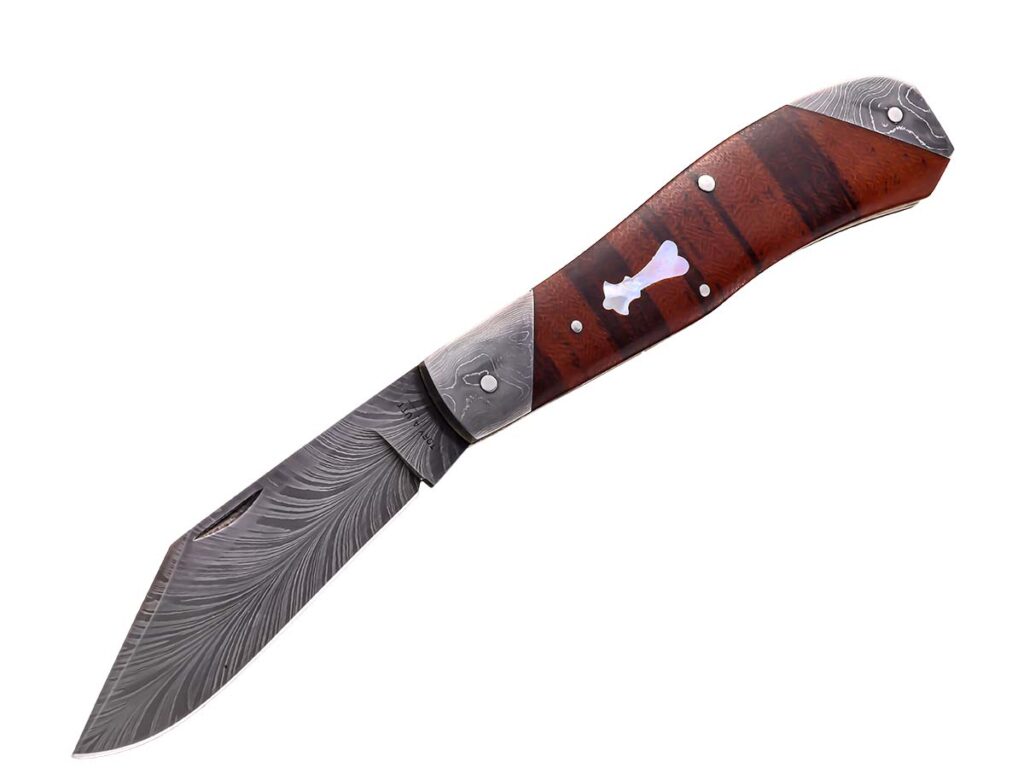
Tory Utt Arkansas Hunter
KNIFE TYPE: Slipjoint BLADE LENGTH: 4” BLADE MATERIAL: Feather pattern damascus forged by Bill Poor BLADE GRIND: Flat BLADE PATTERN: Clip point HANDLE FRAME: Nickel silver SCALES: Westinghouse Micarta® SHIELD: Mother-of-pearl BOLSTERS: Topo pattern damascus forged by Tory Utt CLOSED LENGTH: 4.25” MAKER’S PRICE FOR A SIMILAR KNIFE: $1,300 range KNIFE TO KNOW: Tory Utt has been making knives for 12 years MAKER: Tory Utt, sacredbearknives.com (SharpByCoop image)
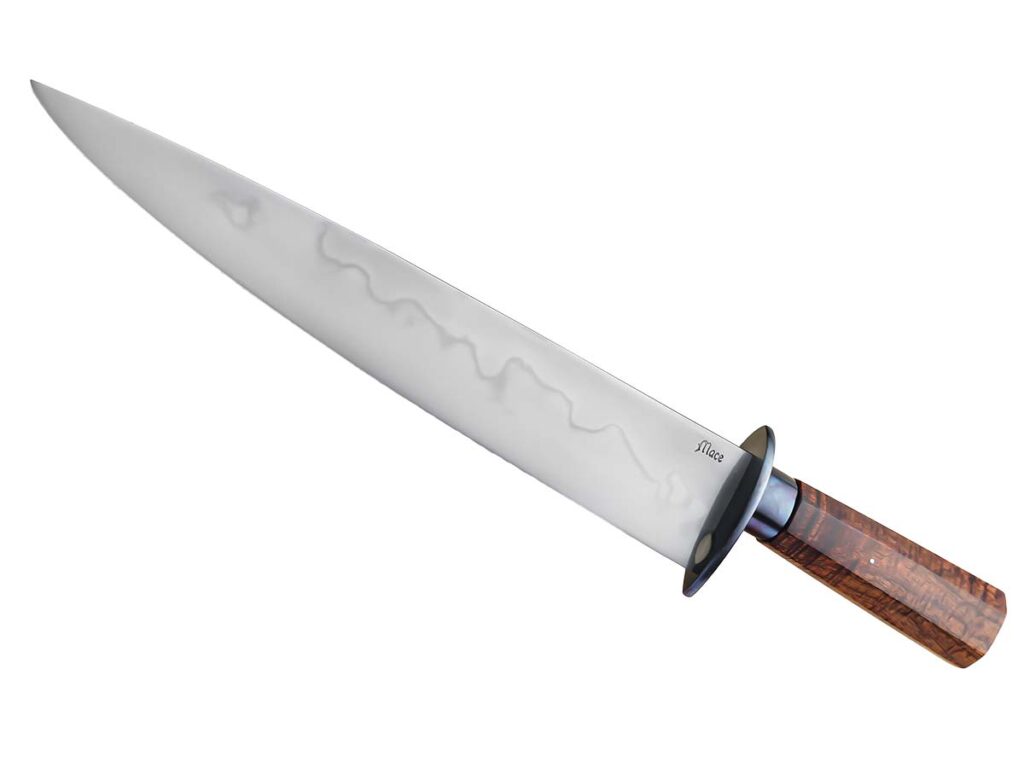
Mace Vitale Bowie
BLADE LENGTH: 12.5” BLADE MATERIAL: W2 tool steel w/hamon BLADE GRIND: Flat SCALES: Tasmanian blackwood GUARD & FERRULE: Mild steel OVERALL LENGTH: 17.5” KNIFE TO KNOW: The design is inspired by early American knives; Mace Vitale is a journeyman smith in the American Bladesmith Society MAKER’S PRICE FOR A SIMILAR KNIFE: $1,750 MAKER: Mace Vitale (SharpByCoop image)
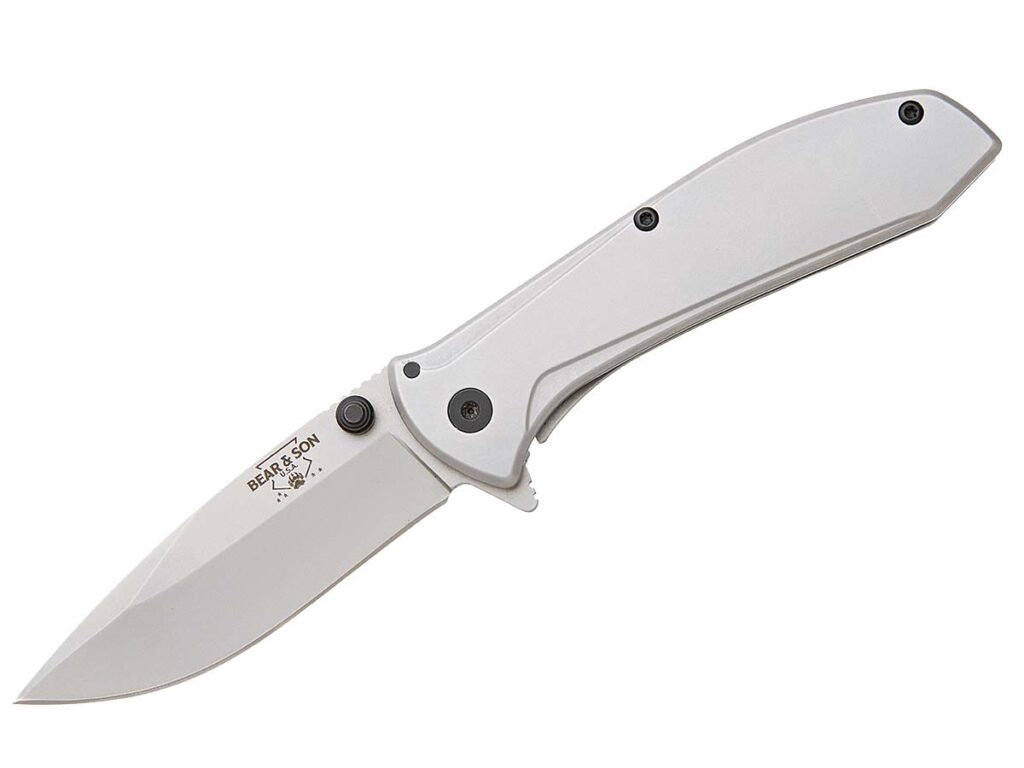
Bear & Son Cutlery 112A 4” Stainless Steel Framelock
BLADE LENGTH: 2 7/8” BLADE MATERIAL: Stainless steel BLADE PATTERN: Drop point BLADE OPENERS: Flipper and thumb stud OPENING MECHANISM: Assisted HANDLE MATERIAL: Stainless steel LOCK: Framelock POCKET CLIP: Yes WEIGHT: 3.8 ozs. CLOSED LENGTH: 3¾” COUNTRY OF ORIGIN: USA MSRP: $59.99 COMPANY: Bear & Son Cutlery, bearandsoncutlery.com
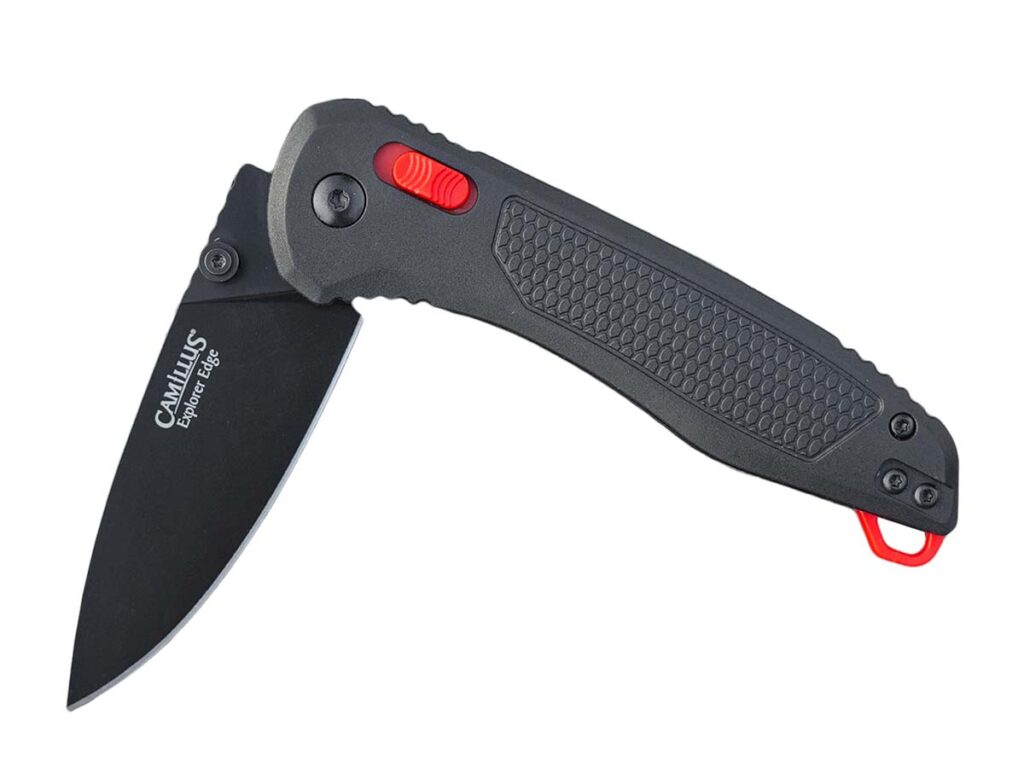
Camillus Explorer
BLADE LENGTH: 3” BLADE STEEL: 3Cr13 stainless BLADE PATTERN: Drop point HANDLE MATERIAL: Nylon glass fiber LOCK: Crossbar WEIGHT: 3 3/8 ozs. CLOSED LENGTH: 4.5” COUNTRY OF ORIGIN: Offshore MSRP: $29.99 COMPANY: Camillus, camillusknives.com
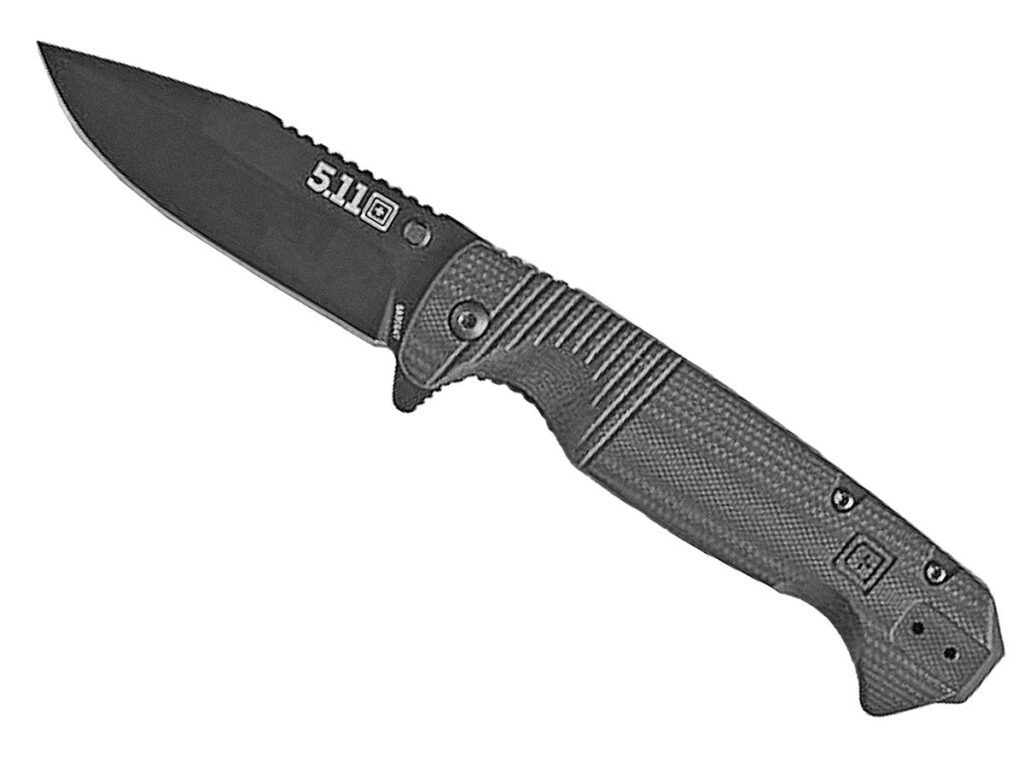
5.11 Pryme Double Duty DP
KNIFE TYPE: Folder BLADE LENGTH: 3.25” BLADE MATERIAL: D2 tool steel BLADE GRIND: Compound BLADE PATTERN: Drop point BLADE OPENERS: Flipper and thumb stud HANDLE MATERIAL: G-10 on mark side/420J2 stainless on lock side BOLSTER MATERIAL: 420J2 LOCK: Framelock POCKET CLIP: Steel, deep carry, reversible WEIGHT: 5.3 ozs. CLOSED LENGTH: 5.125” SPECIAL FEATURES: Built-in, full-handle-length pry tool/screwdriver/optic COUNTRY OF ORIGIN: China MSRP: $85 CONTACT: 5.11, 5.11tactical.com
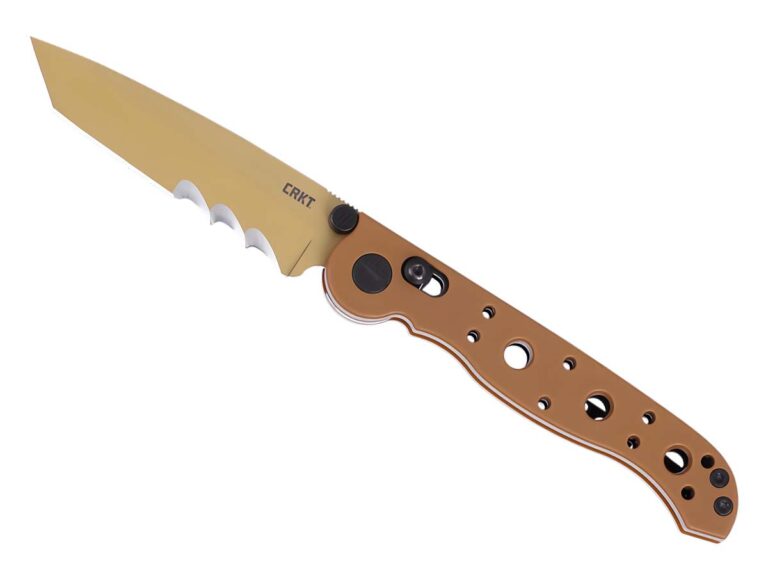
Celebrating its 30th birthday, the Kit Carson-designed M16 has an economical crossbar lock option.
It might seem surprising, but CRKT produced one of the most popular military knives of modern times. Here, we aren’t talking about issued blades, but working EDC options, typically purchased at a soldier’s local PX.
Aptly named, the M16 was the wire stripper, rope cutter, lid prier and snack slicer of choice for many a military man and woman from Kandahar to Kubal and Baghdad to Balad, and everywhere in between. And the unexpected warhorse is celebrating its 30th birthday this year.
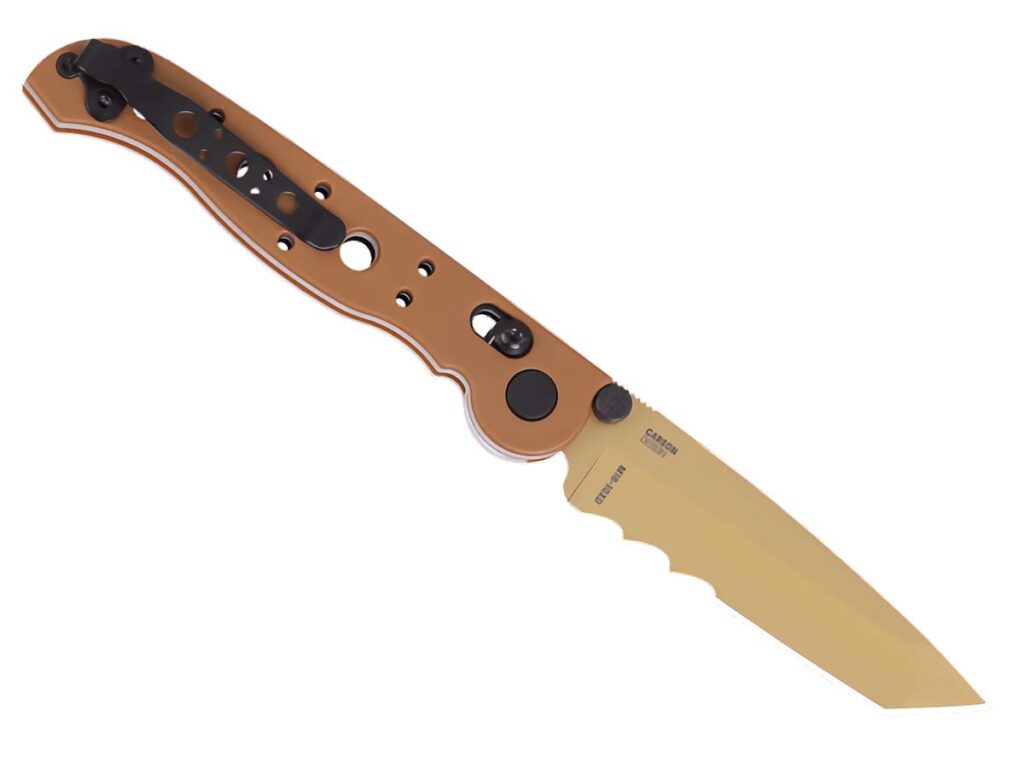
CRKT isn’t allowing this momentous occasion to slip by, with the Kit Carson-designed folder having a pair of new models added to the series. The black M16-10XK and tan M16-10XD hues aren’t the eye-catching aspect of the new knives, nor are the models’ crossbar lock—it’s available on a few other models. Instead, the M16 model’s price tag should get fans of the folder excited.
Both models come in with a very affordable $48 MSRP, making them among the most reasonably priced options in the family of knives. This is particularly true of the crossbar lock models, which start at $75.
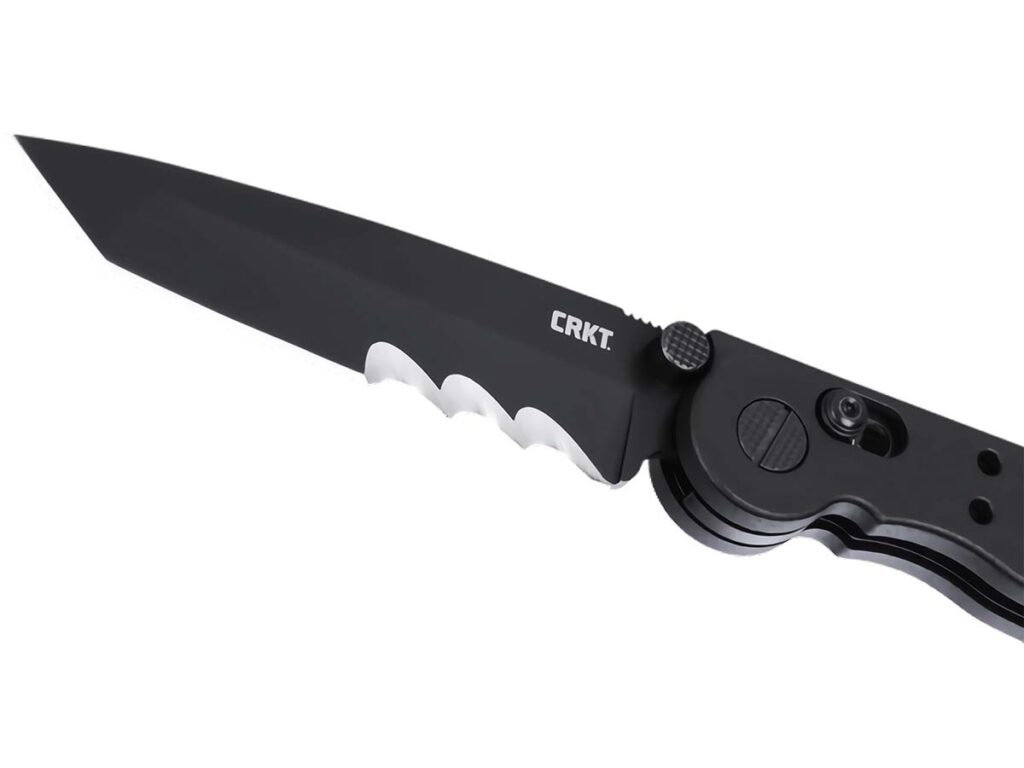
Enthusiasts or veterans looking to replace the blade they lost in the “sandbox” get a solid build out of the new M16s. Both models are outfitted with 3.03-inch 8Cr14MoV modified tanto blades, with titanium nitride finishes and sporting Veff serrations near the heel. The final aspect is wicked, giving the blade a highly aggressive cutting ability.
The blade deploys quickly, thanks to IKBS ball bearings and opens via thumbstuds or with a flick of the wrist, with the crossbar lock actuated. Note, the locking system is ambidextrous, rock solid and allows for single-handed manipulation. The handle is fiber-glass reinforced nylon, keeping the knife’s weight a very manageable 2.1 ounces.
CRKT has shown plenty of dedication to the M16 design and evolving it over the years. Early this year, the company dropped a balisong version of the knife, possibly the most unique riff of the time-tested design. In all, there are now 36 variations of the storied M16.
A couple of notes on the knife and its legacy. It was included on BLADE® Magazine’s top 10 tactical knives of the past decade in the early 2000s. Further, CRKT has created a video series on the knife’s design and military pedigree, with veterans and experts looking back on their time with the knife.
Survival Knives Need To Be Versatile, Durable, And Strong. These 10 Blades Are Everything You Could Ask For When In A Sticky Situation
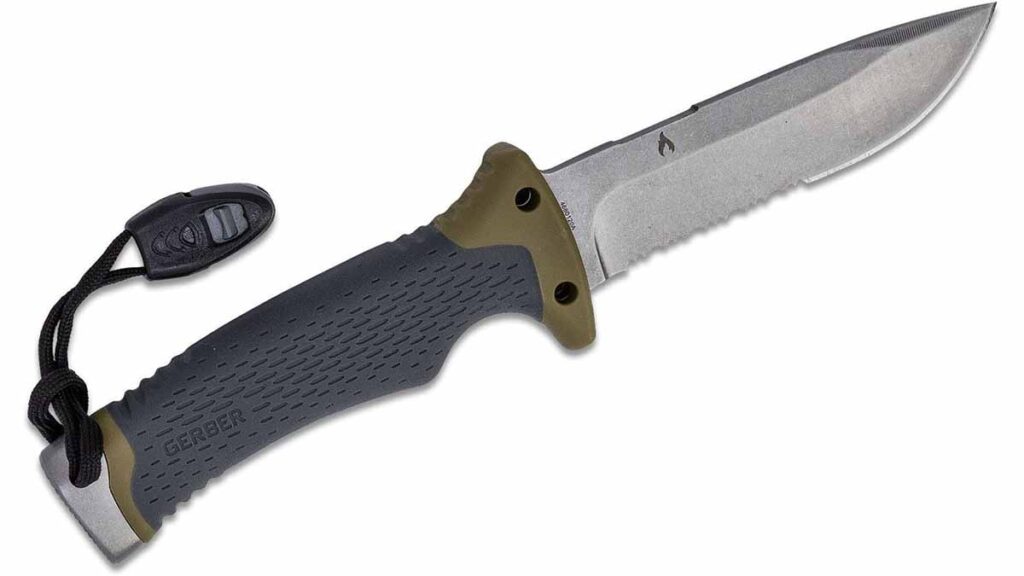
A survival knife is most often a heavy-duty fixed blade built to withstand hard use in multiple roles, generally in the wilderness. It must be able to whittle, carve, chop, slice, and maybe dig. It also holds down the regular duties of a knife and assists in all cutting chores. Additionally, if your back is up against a proverbial wall, it should have the chops to serve as a weapon.
Survival Knife Features
When looking for a quality survival knife there are four key things you need to look for: the quality of the steel, handle material, the robustness of the guard, and the caliber of the sheath.
Steel
As with all knives, it all starts with the blade steel. Carbon steel and stainless steel are both used with survival knives, both have their pros and cons.
Carbon steel requires a bit more diligence to maintain and keep from rusting but offers ease of in-field sharpening. Stainless steels are more resistant to the elements and, if you spend the money, the higher grades offer enhanced edge-holding capabilities.
Handle
Next, you want to look for a knife that has a comfortable handle. This is key, given you’ll use the knife for extended periods of time.
What you need to consider is:
How is the handle contoured?
Does it feel good in your hand?
Is it made of synthetic or natural handle materials?
Personally, I would stay away from leather because of its nature to soak up moisture. I would look to some sort of synthetic like G-10, micarta, or reinforced thermoplastic. These synthetic materials are dimensionally stable and are not affected by changes in temperature, humidity, and exposure to UV.
Guard
The guard keeps your hand in place by preventing any forward movement while the knife is in use. You might be able to wrap a finger around the guard to further choke up on the handle for extra control during cutting or whittling.
Given survival knives are tasked with a number of rough-and-tumble duties, it’s wise to consider an ample guard—at least for the sake of safety.
Sheaths
Not as sexy, sheaths are equally as important as the knife itself. Essentially, the accessory helps protect the knife when not in use, as well as provides a means of portability. Most attach to a belt or MOLLY field, in the case of a backpack.
Materials such as Kydex provide the best options. Why? The thermoplastic is light, form-fitted to the knife blade, and impervious to the elements. What more could you ask for?
You might also notice some sheaths are made of ballistic nylon with a hard plastic liner inside to prevent the knife from destroying the sheath. These are also a good alternative and are more cost-effective along with being fairly weather resistant.
Leather and other natural materials on the other hand, generally ware out quickly with active use. Worse yet, they retain moisture, which can be hell on a blade—especially a carbon-steel blade.
What To Avoid When Buying A Survival Knife
Yes, survival knives come with a host of features but there are some that are useless or worse. These three features aren’t worth the price.
Spine Serrations
Ugh … serrations on the blade spine. Admittedly, some like having serrations as a cutting option for certain materials. However, generally blade spine serrations offer limited use at best and are more of a hazard because of how close they are to your hand.
Honestly, if you need serrations, bring along a serrated folding knife like a Spyderco Delica or Endura. Problem solved.
Blade Holes
Alright, these serve no function at all, except they make the knife look cool. That might be alright for a collection novelty, but not a wise course when in the wilds.
Worst of all, the holes in the blade do nothing but weaken it. Stay away from them.
Odd Blade Designs
Like blade holes, they may look cool but rarely do they enhance the function of a survival knife. We’re striving for utility here, not unique looks.
Stick with the traditional blade styles—spear point, clip point, and drop point. These are proven and do the job perfectly.
10 Best Survival Knives
There are countless makers producing dozens of different survival knives. These 10 stand out from the pack for either their features, their toughness, or their price.
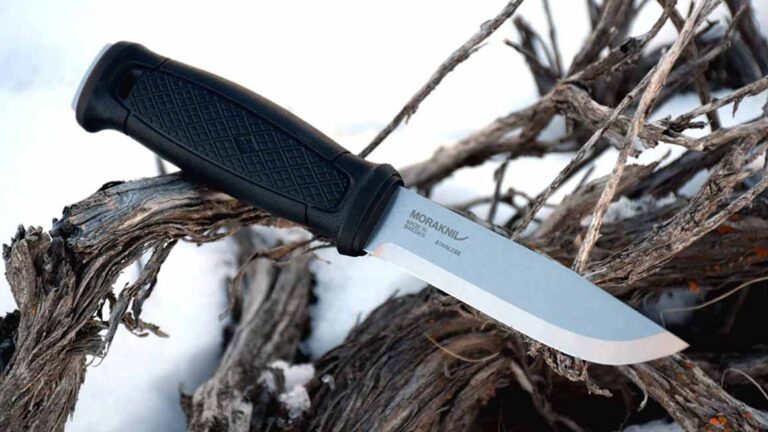
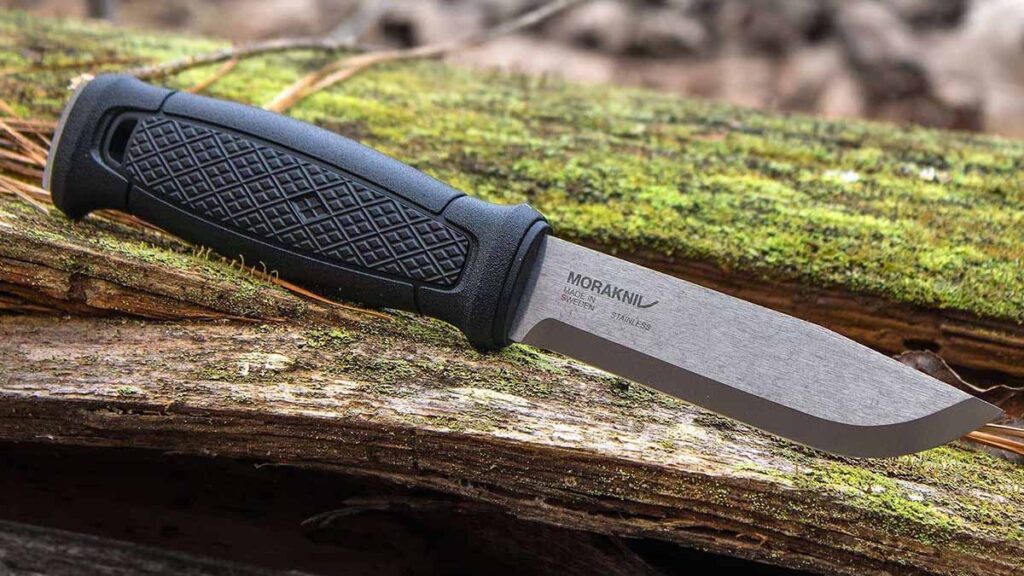
Mora Garberg
Mora is the king of value when it comes to inexpensive survival knives. Most come in at less than $50, but you are hardly compromising in quality.
I personally favor the Garberg, which has a 4.3-inch carbon-steel blade with a Scandi grind and a full tang through the handle.
The blade spine is at 90-degree, designed specifically for use with a ferrocerium fire starting rod. The dual-molded handle is made from weather-resistant polyamide. Its unique Multi-Mount sheath is included and fastens the Garberg to an ATV or snowmobile, as well as a belt.
It’s a tough too, so you are getting a lot of knife for your money. It’s made in Sweden and sold worldwide.
MSRP: $111.99
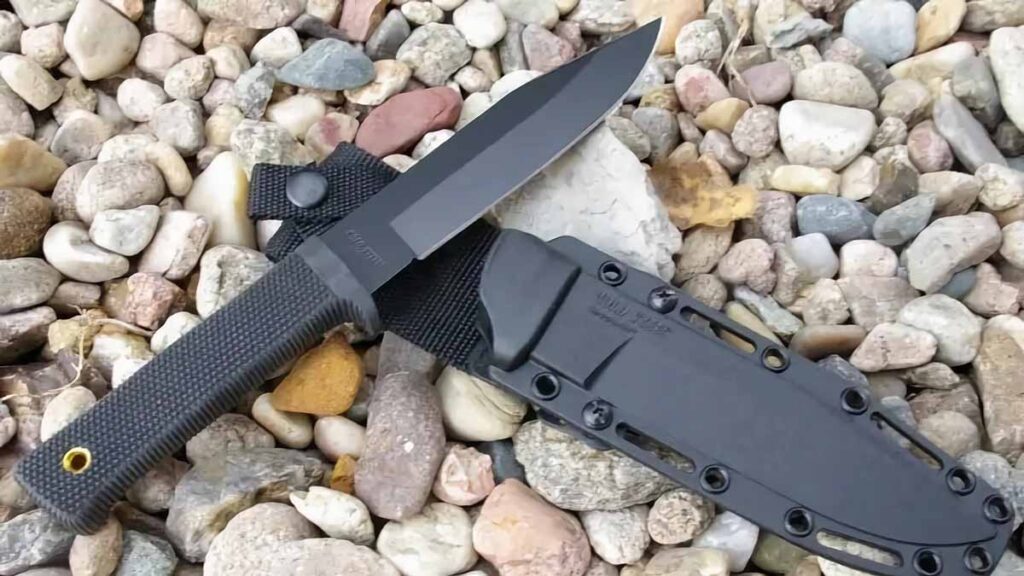
Cold Steel 49LCK-DTBK SRK Survival Rescue Knife
A long time classic of the Cold Steel product line, this knife is a proven, solid performer in the outdoors. Its 6-inch clip point blade is made of SK-5 carbon steel and attached to a textured desert tan Kray-Ex rubber-like handle that is textured for a great all-weather grip.
The blade has a black, epoxy-coat for low visibility and high weather resistance. And its single lower handle guard indexes to the grip.
The SRK is suitable as a hunting knife, survival knife, or even a fixed blade for military use. It’s a very handy design that excels at camp utility and food prep.
The stainless-steel blade provides ample resistance to the elements and holds an edge well. Its drop point design has plenty of belly for slicing and the partial run of serrations adds a bit more utility to the knife.
The handle material is rubber for an excellent non-slip grip. The large finger recess indexes your grip and allows for maximum user comfort. The butt cap of the handle is steel and can be used as a light-duty hammer when needed.
The hybrid nylon webbing and molded plastic sheath is durable and includes a fire starter and blade sharpener.
Superior handle ergonomics paired with a useful blade shape and partial serrations are what makes this one a winner.
MSRP: $62
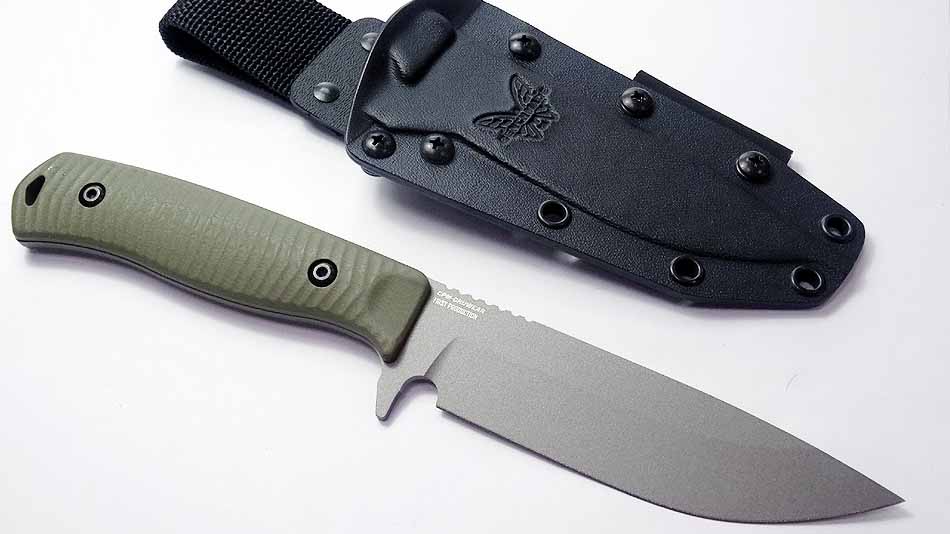
Benchmade Anonimus 539GY
This is Benchmade‘s new high-end fixed blade, with some excellent features. First and foremost, high-end CPM CRUWEAR tool steel, which provides ultimate wear resistance and edge retention.
The flat ground, 5-inch long drop point blade offers plenty of belly for effective slicing and cutting. Notches on the blade spine provide a secure non-slip grip for your thumb or index finger, and the single, lower guard keeps your hand in place.
The Anonimus is secured by a molded Boltaron belt sheath very similar to Kydex. The G-10 handle sports machined-in texturing for a non-slip grip.
MSRP: $290
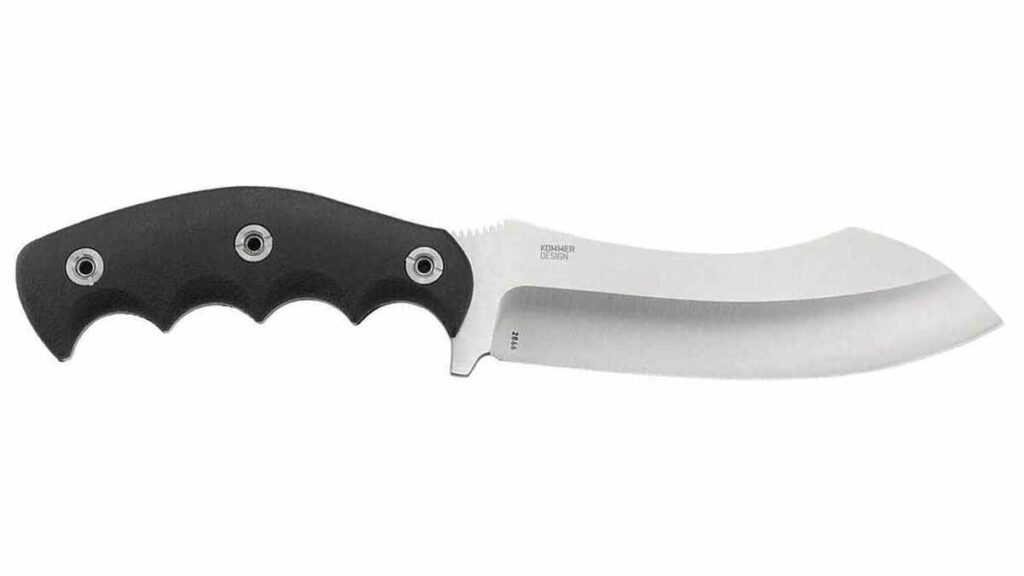
CRKT Catchall
Designed by custom knifemaker Russ Kommer, the Catchall by CRKT is on the heavy-duty side of things.
This broad chopper-style blade measures 5.5 inches in length and has a sheepsfoot-style blade. The blade is made from 8Cr13MoV stainless steel, which holds a decent edge and provides excellent corrosion resistance.
The ergonomic handle features finger grooves for a secure hold, and the handle material is rubberized glass-reinforced nylon. The Catchall might not be the type of knife for lighter cutting jobs but rather more intense tasks, such as chopping and baton work for splitting kindling for firewood.
The Catchall would be great paired with a lighter duty survival knife dedicated to finer chores. The sheath is a glass-reinforced nylon variation with ballistic nylon webbing belt loops. A single webbing strap with button snap holds the knife inside the sheath securely
MSRP: $79.99
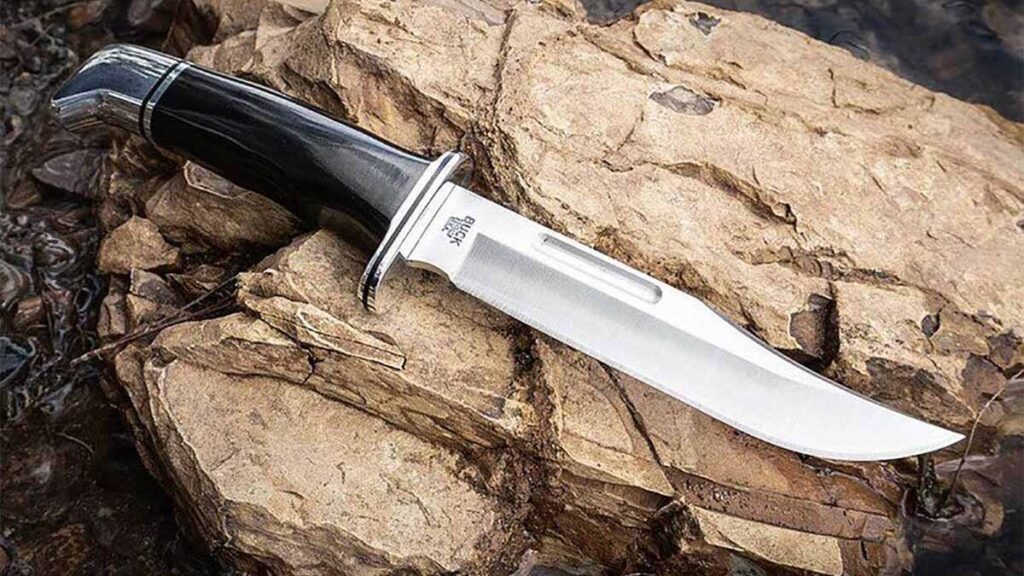
Buck Knives 119 Special
This is one of Buck‘s signature fixed blades. Sporting a 6-inch-long Bowie-style clip point blade made from 420HC stainless steel, the 119 Special has found its home in the outdoors with hunters and outdoorsmen alike.
The handle is a black phenolic resin, which is durable and highly weather resistant. And the knife comes with a black leather sheath. The handle butt cap and double guard are made from aluminum. The 119 Special is capable of handling both camp utility chores like whittling and baton work. The piece is also balanced enough to handle food prep.
MSRP: $96
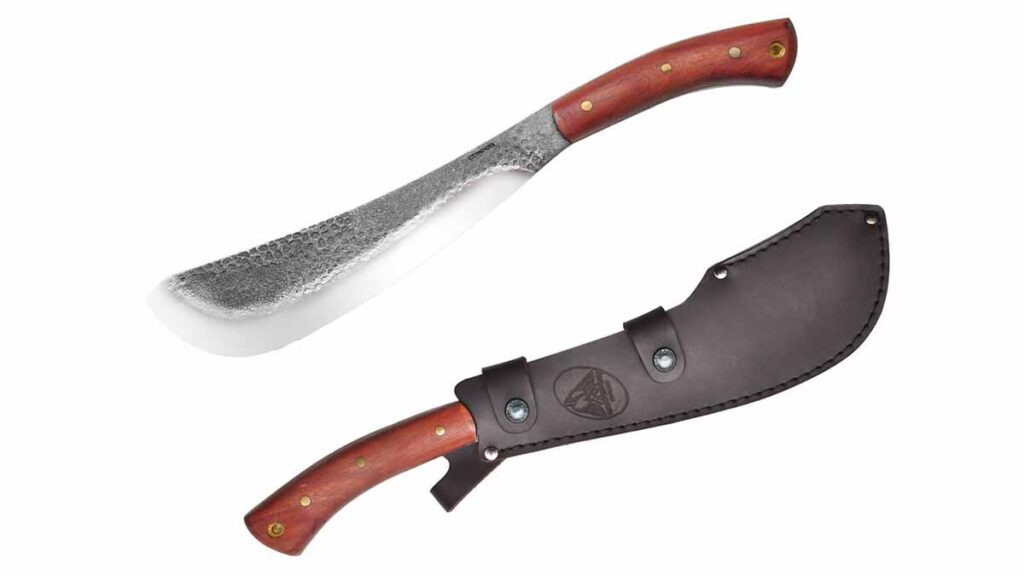
Condor Knife and Tool Pack Golok
The Pack Golok from Condor Tool And Knife is a devastatingly effective chopping tool, with its 11-inch long, convex-ground 1075 carbon-steel blade attached to a rounded walnut wood handle that adds tons of user comfort and control.
The upswept blade profile adds forward weight to the balance, which is key to the performance of this knife. It can take down saplings with ease and slay its way through weedy growth like a machete. It also handles baton work like a champ.
The Pack Golok is much more than just a machete and more useful than one, and it comes with a leather sheath and swivel belt loop for portability.
MSRP: $101
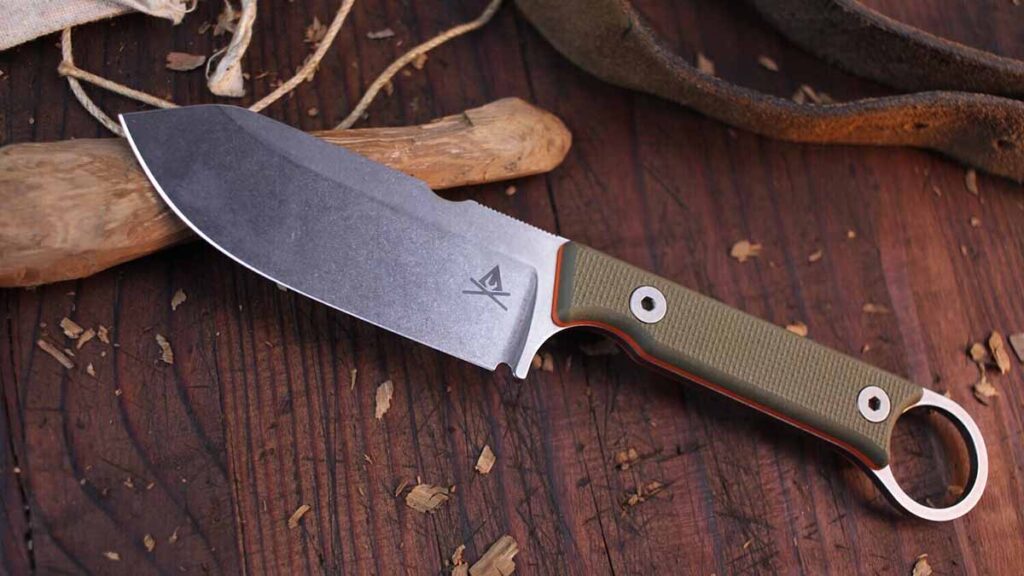
White River Knives’ Firecraft FC3.5 Pro
TheFirecraft FC3.5 Pro from White River Knives has a 3.5-inch-long spear point blade ground from high end CPM S35VN stainless steel. The handle is coarse-textured G-10 and comes in a choice of orange, black, or OD green.
Regardless of which handle color you choose, you are getting a no-nonsense fixed blade able to handle a wide variety of tasks at the campsite or out in the wilderness.
The notch in the blade spine allows for easy use with a ferrocerium fire starter rod. The wide blade can handle food prep chores and camp utility tasks. The finger ring allows you to dangle the knife from the pinky finger, keeping it close at hand, while retaining the ability to use your hand to grab or hold items.
The S35VN steel holds an edge well and is able to power through tough cutting. Each knife comes with a molded Kydex belt sheath.
MSRP: $160
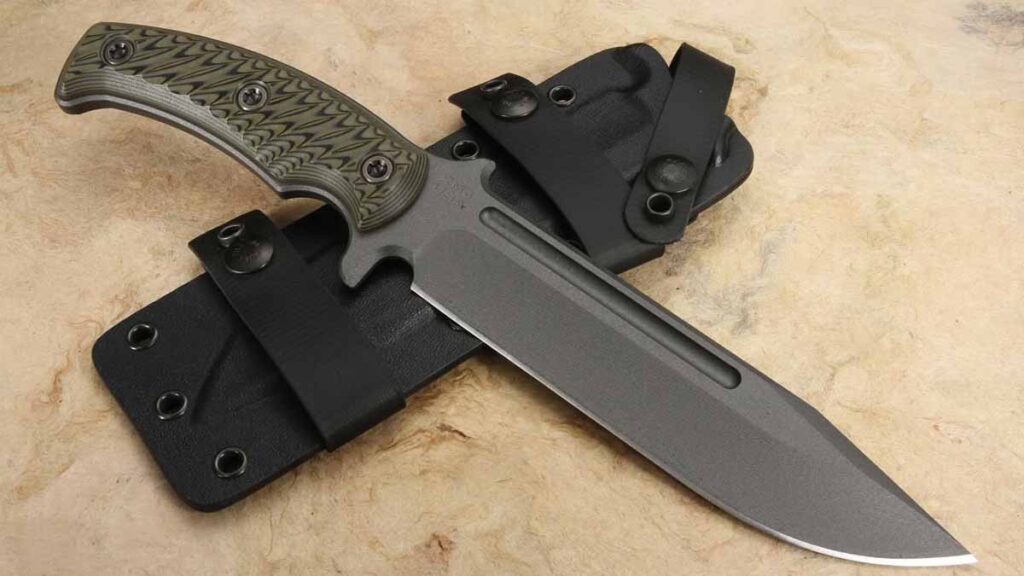
RMJ Tactical Combat Africa
The RMJ Tactical Combat Africa is one serious piece of bladeware that can serve as a survival or military knife. It’s 7-inch-long blade is made from 80CRV2 tool steel. The .25-inch thick stock means this knife can withstand some serious use and some prying as well.
The clip point shape allows for optimal penetration, with some belly for slicing applications. The 3D machined G-10 handle has diagonal flutes, adding hand traction and channeling water away for a comfortable grip.
Furthermore, the lower hand guard and blade spine thumb ramp help to keep your hand safe from sliding forward. The knife is capable of chopping, prying, batoning, and slicing.
The knife is a bit on the steep side when it come to price. But in return you receive the superior engineering and craftsmanship for which RMJ Tactical is known.
MSRP: $395
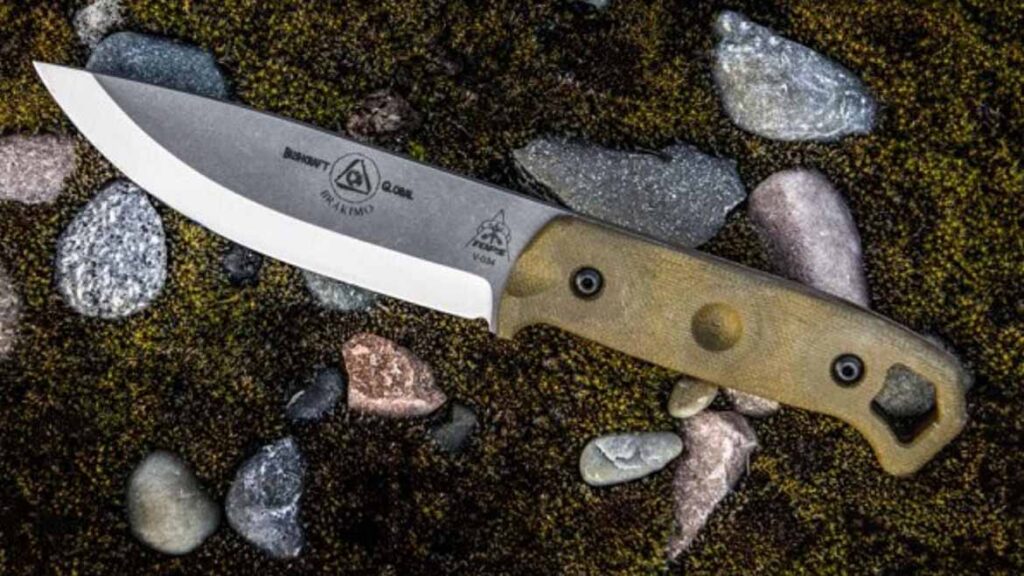
TOPS Brakimo
The TOPS Brakimo was designed by noted survival expert Joe Flowers, who owns and runs Bushcraft Global, a renowned survival school.
Flowers designed this knife to be a backup to a machete or a main camp knife. The 5.25-inch drop point blade is made from 1095 carbon steel. It is wide and sports a Scandi grind for optimal edge geometry for camp tasks. As a bonus, the carbon steel is easy to sharpen in the field.
The knife is rather weighty for its size at 9.4 ounces. The sculpted handle is made from OD green canvas micarta for a comfortable and nonslip grip. The handle’s downward turn at the butt allows you to choke up at the end of the handle during chopping. Each Brakimo comes with a molded Kydex belt sheath with large metal clip for easy belt attachment.
The BLADE Magazine 2021 American Made Knife Of The Year®, The Case Marilla More Than Pulls Its Weight.
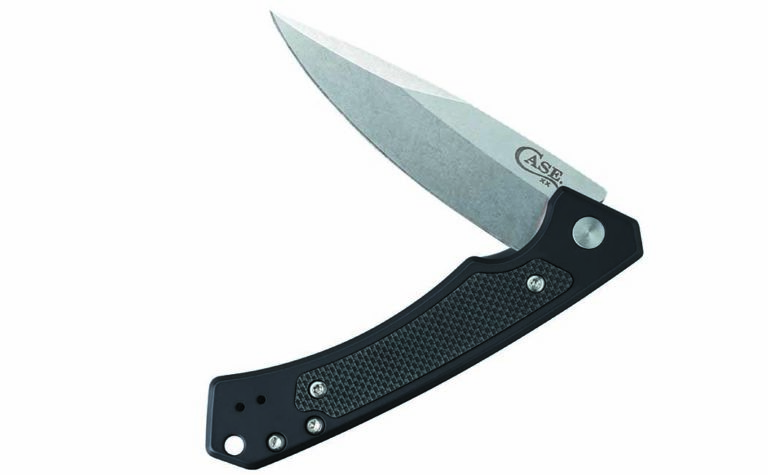
The BLADE Magazine 2021 American Made Knife Of The Year®, the Marilla from W.R. Case & Sons is a drop-point-blade EDC folder made for slicing and fine work. Aluminum framelock construction and CPM S35VN stainless blade steel result in a lightweight folder that doesn’t weigh your pocket down.
The Marilla opens fluidly via a flipper and closes positively. I really like the fact that the knife does not interfere with your hand when you reach into your pocket. That said, the Marilla must slice and dice to be an effective EDC.
How Sharp Is The Case Marilla
First, I like to do a quick sharpness test with copy paper. In full blade-length slices, the Marilla zipped through the stationery smoothly and with nary a snag. I could have sliced faster if I could have moved my fingers faster. The edge cut in outstanding fashion!
Heavy Cutting With The Marilla
Next up: double-walled cardboard. I used a push cut for a full blade-length slice. The Marilla was very aggressive parting the medium. The handle shape was a plus in controlling cut widths. The minimum curl of the sliced pieces was great.
The Marilla bit very aggressively while skiving a scrap piece of 8-ounce leather. It was very controllable on the thinness of the slices.
The Marilla bit very aggressively while skiving a scrap piece of 8-ounce leather. I could hear the crunching sound as the blade cut away. It was very controllable on the thinness of the slices and experienced no issues at all.
From there it was on to whittling firesticks. The edge made smooth cuts in the pine with a tight curl in the curly-cue. Thin curly-cues or thick, the Marilla kept the curls clean. The handle was very comfortable while making the deeper cuts, exhibiting no sharp edges in the wrong places to hurt my hand.
Marilla Edge Retention
To test edge holding, I like to use sisal rope. The Marilla crunched to 189 cuts before I felt the edge sliding a bit. Performance: excellent! The thumb notches helped in controlling the cuts. Again, the Marilla handle was comfortable even when I applied hard pressure to it.
Batonning The Marilla
To check the lock, I locked the knife open and batonned the blade into a piece of half-inch pine to make kindling. I hit the blade spine opposite the tip and middle and directly on top of the lock multiple times. The wood split with no problem and the lock stayed tight very well, maintaining 100 percent lockup throughout. There were no blade wobbles or looseness during opening, lockup or closing.
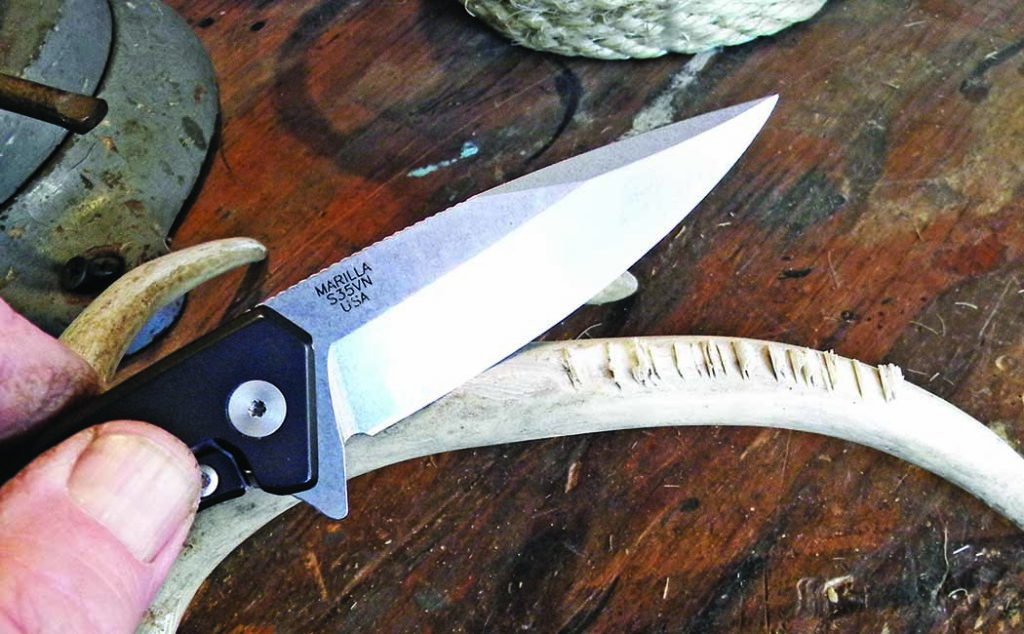
The final hurdle was the antler whack—wrist snapping the blade into an old whitetail deer horn to see if the edge would chip or roll. Thirty whacks later and the edge survived with no damage, indicating excellent heat treatment of the S35VN blade steel.
The final hurdle was the antler whack—wrist snapping the blade into an old whitetail deer horn to see if the edge would chip or roll. Thirty whacks later and the edge survived with no damage, indicating excellent heat treatment of the S35VN blade steel.
Report On The Case Marilla
The Marilla is an excellent EDC knife. It’s comfortable in the hand as well as the pocket. The blade stays sharp longer than most. It is a great choice for EDC.
I WOULD …
… prefer a hollow blade grind for keener slicing, though such a grind might compromise the blade steel.
As long as its knives are not abused, Case warrants them against defects. For more information, contact Case, attn: F. Feightner, Dept. BL2, 50 Owens Way, Bradford, PA 16701 800-523-6350 or 888-442-1932 [email protected], www.wrcase.com.
Classic and competent, no wonder why the clip-point knife remains among the most popular designs.
Clip-point blades are one of the most common profiles you will see throughout custom and production knives. You likely know the style, the familiar drop-off of the blade spine to a curved or linear transition that terminates at the blade tip.
The earliest noted clip-point blade style dates back to the Macedonian era. Flint-knapped stone blades in a clip-point shape were discovered from this time period. Today, clip points are found across a lot of knife genres from tactical to EDC to pocket knives to fixed blades.
Pros Of Clip Points
Due to its highly streamlined and optimized blade tip, the clip point has excellent puncturing capabilities. There is more of a true point that helps to penetrate thicker materials with ease. It is more aerodynamic than a drop point and even a spear point. Think of an arrowhead and how it penetrates, and you will get the idea. Clip points are also favored among the tactical crowd because of this characteristic.
The defined point also makes great scoring cuts because placing pressure on the blade tip results in the tip cutting through aggressively on the first cut. So, this blade shape is also one that is favored among those who use their knives for the trades, where having a good knife is imperative to the work at hand.
Cons Of The Clip Point
Conversely, the blade tip being tapered also results in a blade design that has a weaker tip. You cannot have everything, I guess! With a smaller clip-point blade like those found on pocket knives, refrain from any sort of prying with the tip because it will bend or break off entirely.
Clip-Point Styles
It’s interesting to note that there are different variants of the clip point blade. Two of the most recognizable are the California clip point and Turkish clip point.
California: Exhibits a long taper, which originates almost to the blade tang and gradually and progressively tapers down to the blade tip.
Turkish: It has a long taper as well (but not as dramatic as the California style) but also incorporates a little bit of a blade belly as well. The Turkish clip looks very stylish and eye-catching when done right.
You’ll see other variants like a saber ground clip point with a pronounced swedge, and even some fixed fighters with sharpened clip sections for added bite and powerful penetration.
Jack-Of-All-Trades
For general-purpose use, nothing beats a clip point for its versatility. You cannot go wrong by selecting a knife with this blade shape. Chances are high that if you are reading this, you already own a few knives that have a clip-point shape. If you don’t have any yet, here’s a rundown of 10 clip point blades knives that you should be on the lookout for and add one (or more) to your collection.
Among The Best Clip-Point Fixed Blade Knives Available Now
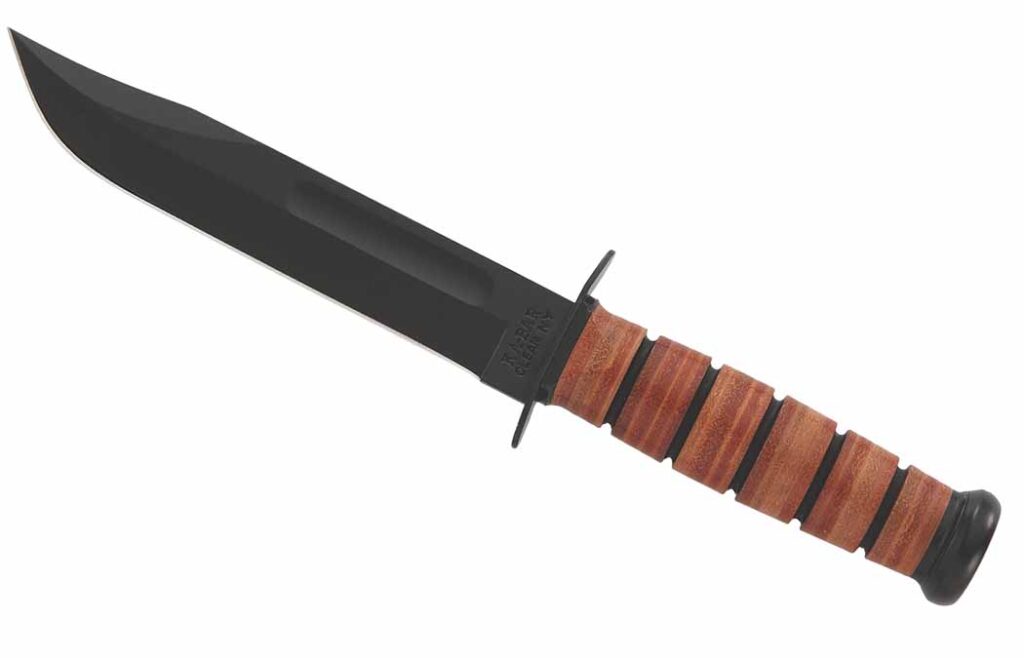
Kabar USMC Fighting Knife
This iconic fixed blade has seen action on battlefields the world over. This knife first saw action during WWII and it still is going to this day.
The 7-inch long blade is made from 1095 carbon steel, making it easy to maintain in the field. It’s fuller adds style and strength to the blade. The iconic stacked leather washer handle is both handsome as well as very practical with its deep grooves that enhance grip and the flat metal pommel which is useful for light hammering and crushing tasks. The double guard prevents your hand from sliding up on the blade. As a bonus, each USMC Fighting Knife comes with a leather sheath.
MSRP: $135 Origin: USA
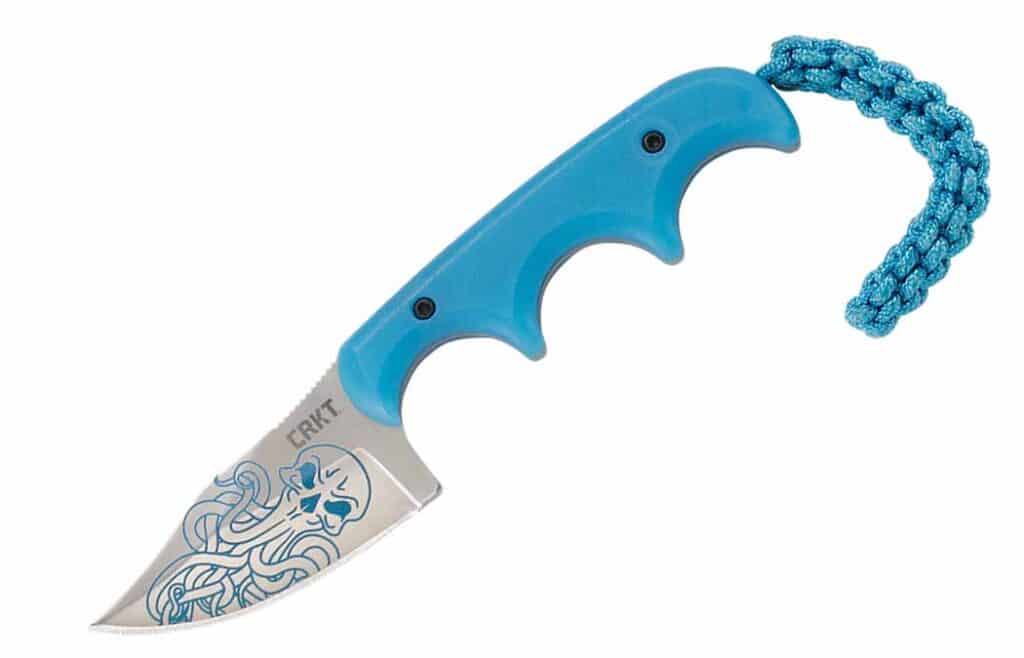
CRKT Minimalist Bowie
Designed by custom knifemaker Alan Folts, the Minimalist Bowie is one of Folts’ best-selling custom knives. It is available to the masses in the form of the CRKT version which sports a 2.1-inch long Bowie-style clip-point blade, made from 5Cr15MoV stainless steel.
Its prominent swedge adds style with function, permitting the blade easily penetrate most materials. The deep finger grooved handle has resin-infused fiber scales for light weight and strength. The entire knife is super comfortable to hold and it feels like the knife melts in your hand and remains very secure. It’s a small fixed blade without the bulk.
MSRP: $45 Origin: China
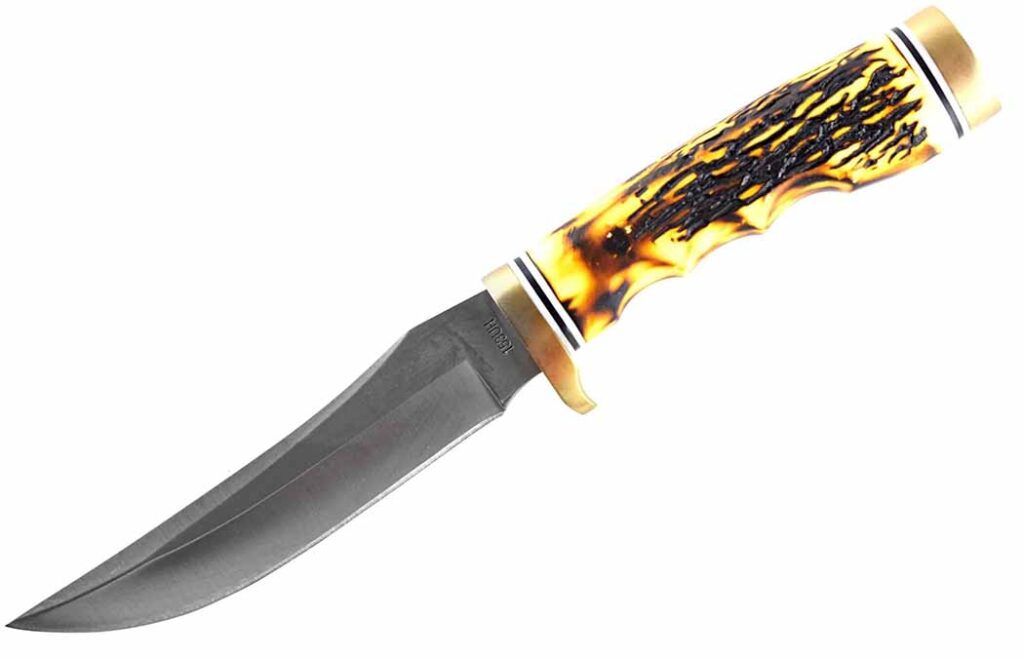
Schrade Uncle Henry Golden Spike
This one is an older design still manufactured today.
Its 5-inch 7Cr17MoV stainless steel clip point blade is a good example of what we call a California clip point, with its long taper to the blade tip. The handle is faux stag in Delrin, with finger grooves for security and control.
It is capped off at both ends with a brass guard and pommel to offset the overall appearance. This knife will fit the fill of an outdoor knife perfectly and not blow the budget. Each Golden Spike comes shipped with a leather sheath for easy portability.
MSRP: $46 Origin: China.
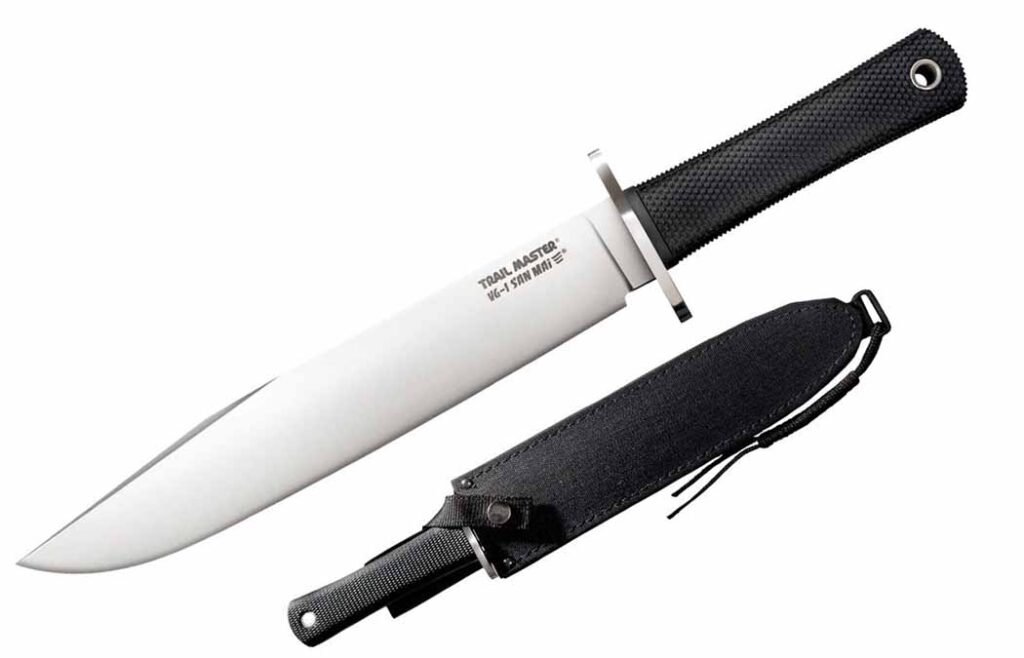
Cold Steel Trailmaster Bowie
This knife commands attention with its sheer size and heavy-duty build.
The Trailmaster Bowie is one of Cold Steel’s most recognizable fixed blades. The impressive 9 ½ inch long clip point blade is made of CPM 3V tool steel for toughness and edge holding. The unsharpened swedge gives the knife its attitude, and a full flat grind allows the Trailmaster to be an effective slicer and chopper as well.
The textured Kray-Ex rubber handle helps the Trailmaster remain in your grip and a double guard up front keeps your hand in place during use. The Trailmaster is adept at chopping and other hard-use outdoor tasks for the campsite.
It is the knife to have with you and instills user confidence when tackling tough cutting and chopping chores.
MSRP: $540 Origin: Taiwan
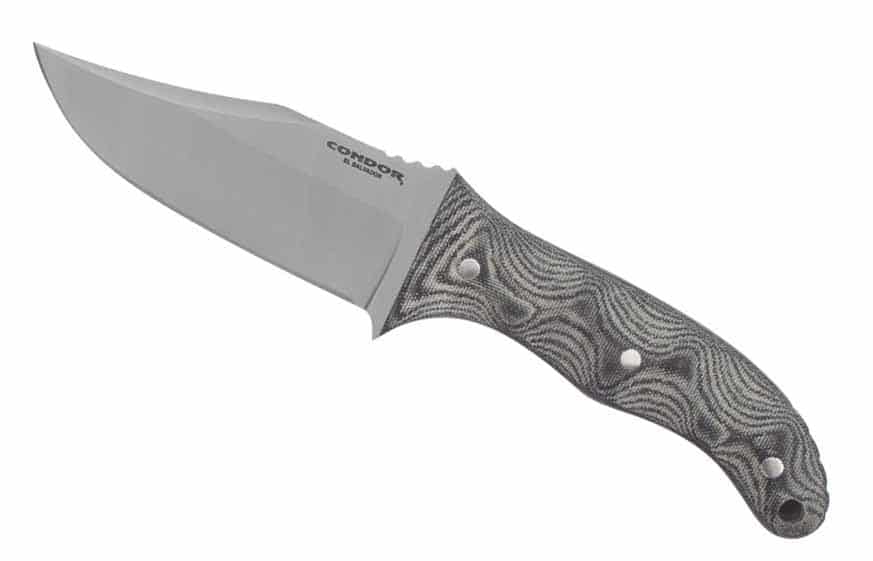
Condor Tool & Knife Little Bowie
Little knife…big attitude! That’s exactly what you get with the Condor Tool & Knife Little Bowie.
The 4.6-inch long blade makes it compact enough to carry comfortably on the belt. Overall length is just over 9.5 inches, making this knife about as long as some of the higher-end tactical folders when open. 1075 carbon steel was selected for the blade, making this knife both tough and easy to maintain. The bead-blasted finish adds a subdued finish for low reflectivity.
The ergonomic-shaped handle has black Micarta scales for a comfortable, all-weather grip. If you like Bowie fixed blades but don’t want to carry a full-size Bowie on the belt, the Condor Little Bowie fits the bill nicely. Each knife is shipped with a sewn leather belt sheath to keep the knife close at hand.
MSRP: $123 Origin: El Salvador.
Among The Best Clip-Point Folders Available Now
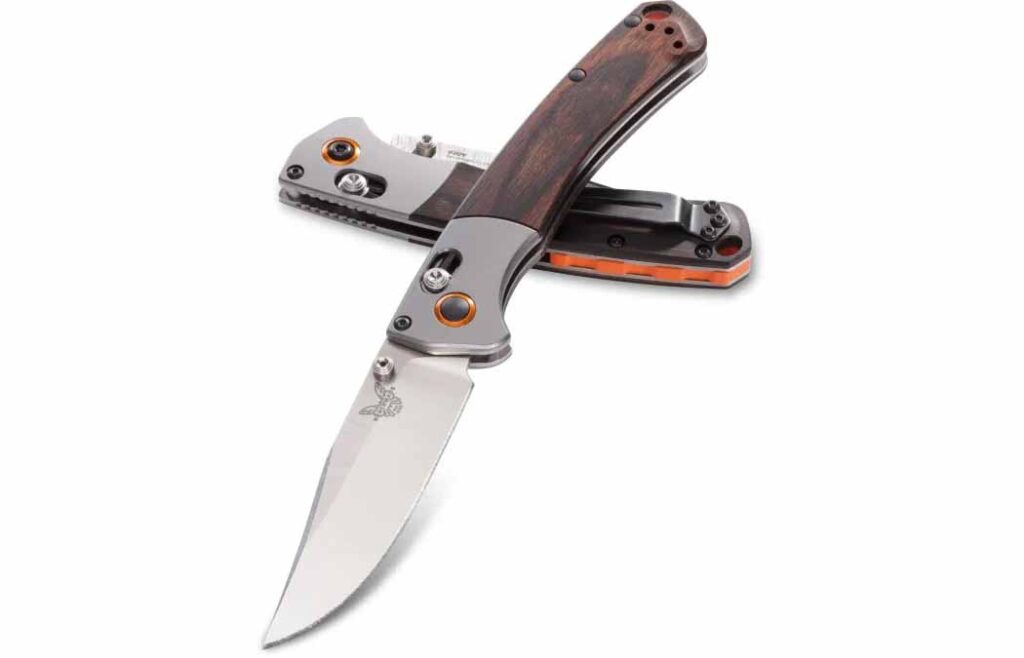
Benchmade Crooked River
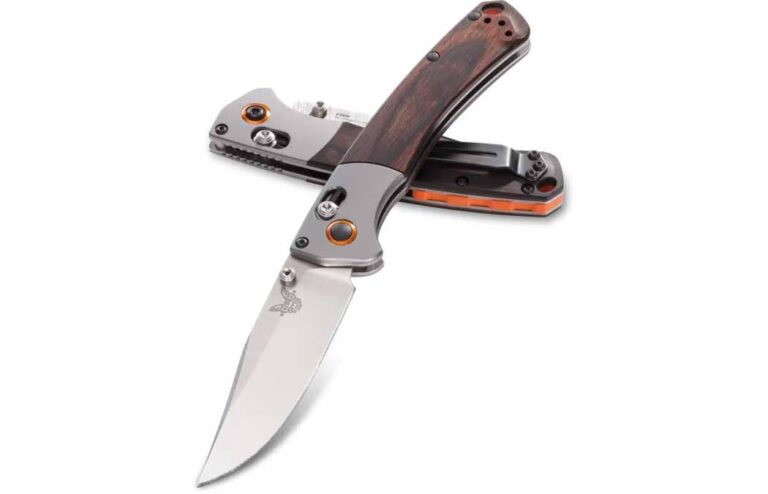
The flagship of their outdoor folding knife line, the Benchmade Crooked River is built tough for the outdoors, with a 4-inch clip point S30V stainless steel blade, anodized aluminum bolsters, and Dymondwood handle scales. The handle has a slight contour to it, making it lay in your grip that much easier.
The knife also features Benchmade’s own Axis Lock crossbar lock system for a safe and secure lockup. The Axis Lock is a Benchmade innovation that allows the blade to rotate smoothly and locks up tight, with very little blade play.
At over 9 inches overall, the Crooked River is a formidable folder that is ready to help tackle your field dressing or camp utility tasks. A steel pocket clip allows for easy carry. A Mini Crooked River is also available, scaling down the Crooked River model to a 3.4-inch blade length, and making it more EDC-friendly.
MSRP: $380 Origin: USA
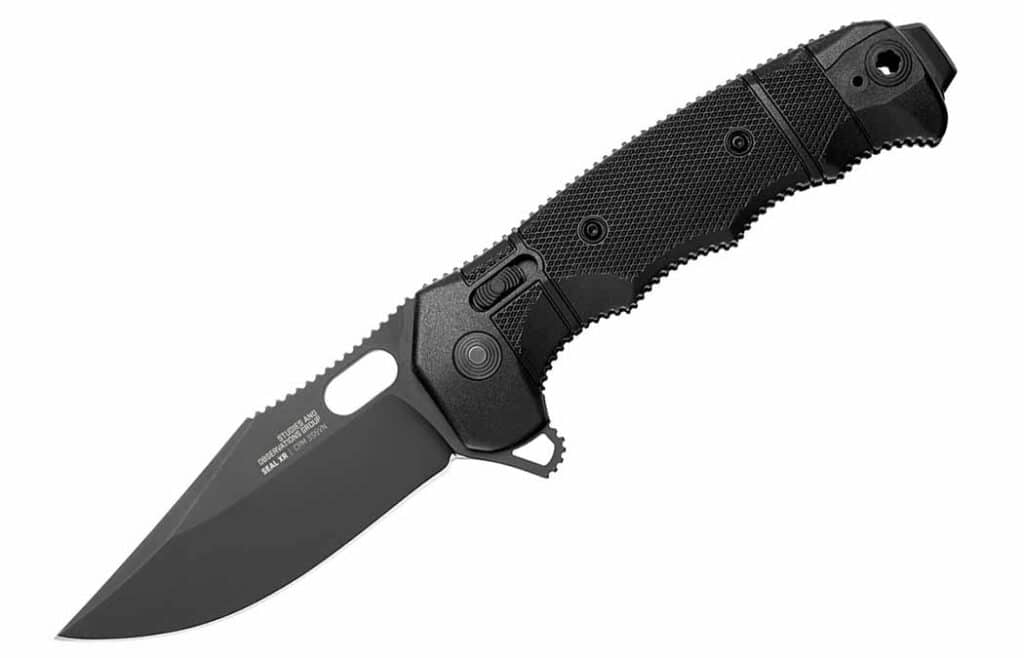
SOG SEAL XR
You want big and brawny? You got it with the SOG SEAL XR! Its 3.9-inch long Bowie style clip point blade is flat ground from premium CPM S45VN high-performance stainless steel. A blade hole and a flipper tab are present to offer two distinct methods of one-handed opening. The handle design is very similar to that of the SOG SEAL fixed blade. The build of the handle is definitely robust and heavy-duty, there’s weight to this knife that you notice when you pick it up.
Weighing in at a healthy 8.2 ounces, the handle has two steel liners, a steel handle spacer with an integrated extension that can be used as a blunt strike tool, and grooved, textured, and traction notches all around. The handle design is made to keep your hand in place. There is an integrated lower hand guard that prevents your hand from sliding forward. The blade lock is SOG’s own XR crossbar lock that offers true ambidextrous operation.
A beefy, wide steel pocket clip rounds out the SOG SEAL XR package. The clip won’t be sprung for sure, even with rough carry. This is by far an EDC folder due to the size and weight but if you need a knife for rough use and outdoor use, the SOG SEAL XR is it.
MSRP: $224.95 Origin: USA
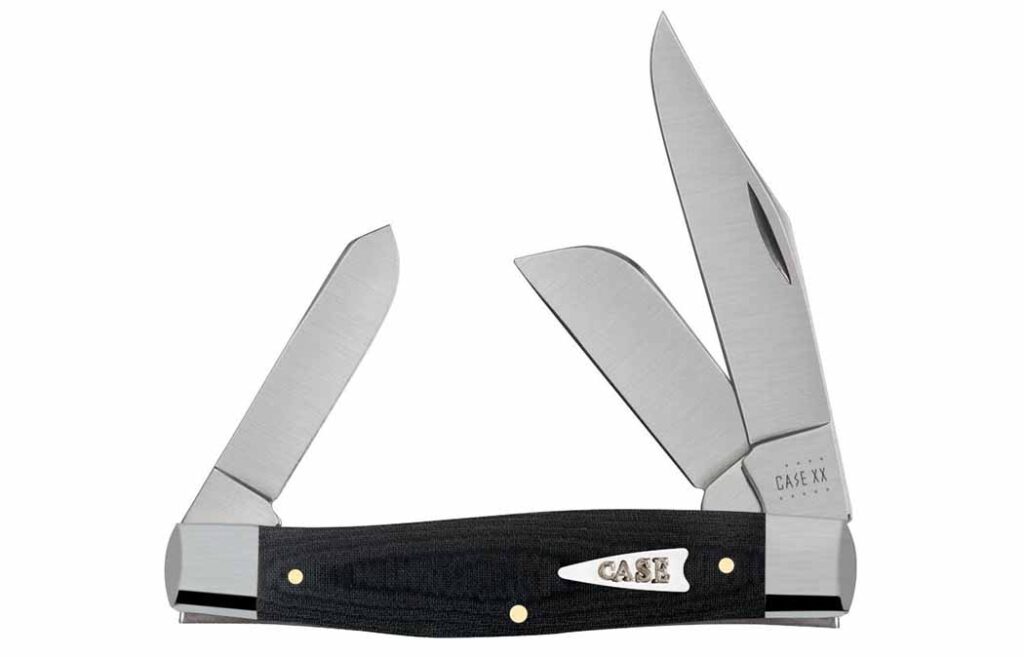
Case Large Stockman 10375
Clip points are found on many different patterns of multi-blade slipjoint knives, such as this Case Large Stockman pattern, model 10375. The main blade is a 3.3-inch long clip point, and two smaller blades – a 2.3-inch long sheepsfoot blade as well as a 2.2-inch spey blade. The blades are ground from Case’s proprietary Tru-Sharp surgical steel, and the handles are of black and green canvas micarta phenolic synthetic for long-lasting durability.
The beauty of knives like these is they are handy to have with you at all times as they sit in the pocket perfectly and they are low profile enough that using them in public won’t raise any eyebrows. These knives are used by everyone from farmers, ranchers, plumbers, electricians, carpenters, warehouse workers, and countless individuals who just want a good solid pocketknife. The main blade does well with opening packages, mail, cutting tape, stripping wire, cutting up cardboard, and any sort of utility or mundane cutting task that tend to pop up in daily life.
The clip point blade is ground fairly thin so it has really good performance characteristics and easily cuts whatever you need to. The Tru Sharp stainless sharpens up quickly and holds an edge fairly well. The stockman pattern is very handy due to the three distinct blade shapes, it’s the perfect pattern to have if you use a pocketknife frequently.
MSRP: $96 (Micarta Handle) Origin: USA
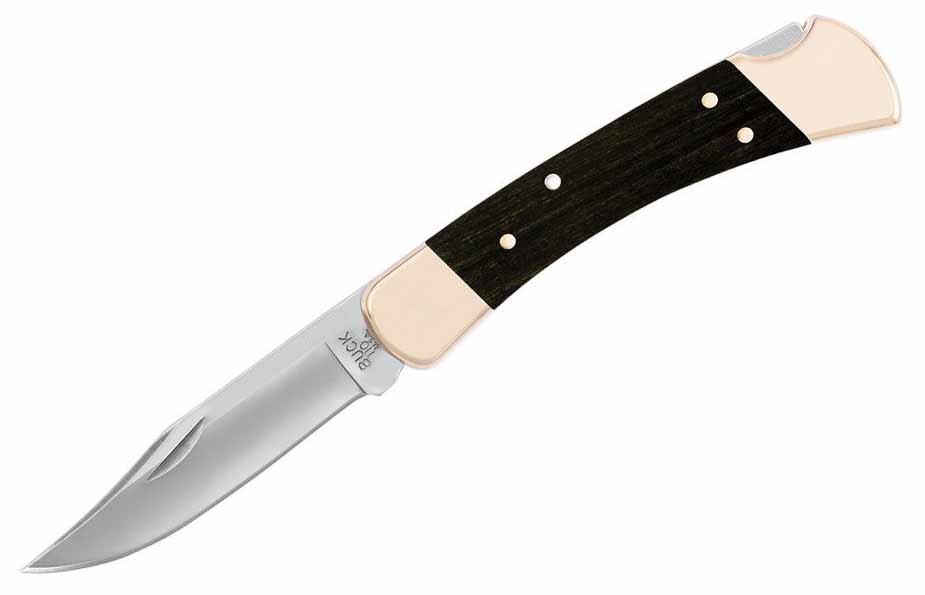
Buck 110 Folding Hunter
This knife perhaps is the signature clip-point bladed folder. Its design was innovative back in 1963 when it was released, and its quality and build have withstood the test of time.
Even today, the 110 Folding Hunter is still made and enjoyed by many. The 3.75-inch long blade is of a Bowie shape and is hollow ground from 420HC stainless steel. The handle is of a robust build, with double brass bolsters and a Crelicam ebony, stabilized hardwood handle. The handle definitely has weight to it, and it’s this exact heavy-duty build that has allowed the 110 Folding Hunter to withstand hard use over time, and still hold up beautifully. The lockback design secures the blade in the open position with a satisfying audible click.
The clip-point blade is ideal for field dressing as well as general cutting tasks. The 110 Folding Hunter originally was designed for hunters as an alternative to a fixed-blade hunting knife. But the knife also found favor with those who are in agriculture, the military, law enforcement, and countless knife enthusiasts as well. For all intents and purposes, it was the predecessor to what we know now as the modern tactical folder.
Still produced to this day in the Buck Knives product line, the 110 Folding Hunter has a few variants including a lightweight budget version, a pro-grade modern version with high-end blade steel and handle material, an automatic opening version, as well as countless collector variants available through the years from Buck as well as select Buck Knives retailers as exclusives.
MSRP: $88 (original 110) Origin: USA
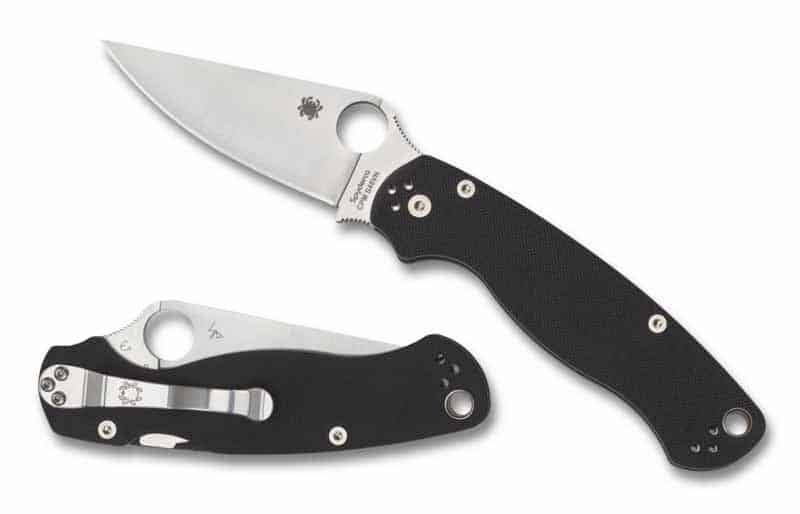
Spyderco C81GP2 Paramilitary 2
Spyderco’s Paramilitary 2 folder – better known simply as the Para2 – is a downsized version of the company’s popular C36 Military folder.
The Para2 offers the same cutting prowess of the full-size Military model with its full flat grind clip-point blade but in a more compact, pocket-friendlier form factor. The Para2’s blade measures 3.4 inches long and is ground out of premium CPM S45VN blade steel that is known for its enhanced edge-holding capabilities. The handle is textured black G-10 and mimics the ergonomics found on the C36 folder that make this one of the most comfortable and handy midsize folding knives on the market.
With an overall length of 8.2 inches, the Para2 is still large enough to tackle sizable cutting tasks. The blade is secured open by Spyderco’s own Compression Lock system, which permits easy one-hand opening and closing. It also allows the blade to have such smooth, silky-like action. The Para2 is a slender knife and carries well in the pocket.
The large blade hole allows for easy one-hand opening with either hand, even while wearing work gloves.
Performance-wise, this is one of the best in high-end folders as the flat grind clip-point blade sails through thick and tough materials easily. Spyderco engineers its blades to be some of the most efficient cutting tools on that market by paying attention to blade shape and blade grinds and optimizing both to create a cutting tool that is unmatched in both performance and value.
Looking to learn the proper names for everything that makes up a knife?
Like sailors, stagehands, and sommeliers, knifemakers have some very particular terms for the tools of their trade. It helps to know the lingo if you’re getting into knives, or just want to know what the hell “jimping” is when you read it in a product description.
Most of us use knives regularly, and some of us may even be sharpening pros, but there’s still a lot of knife terminology out there that doesn’t come up that often and some of it can be confusing.
Today, we’re going to clear all that up with a primer on all the major parts of modern knives. This is Knife Anatomy 101.
We’re not going to cover everything because you probably don’t need to know the exact name for the type of guard commonly found on a 14th-century German langmesser, but for those of you shopping for a new kitchen or pocket knife, this should cover everything you need to know.
Blade Essentials: Things (Most) Every Knife Has
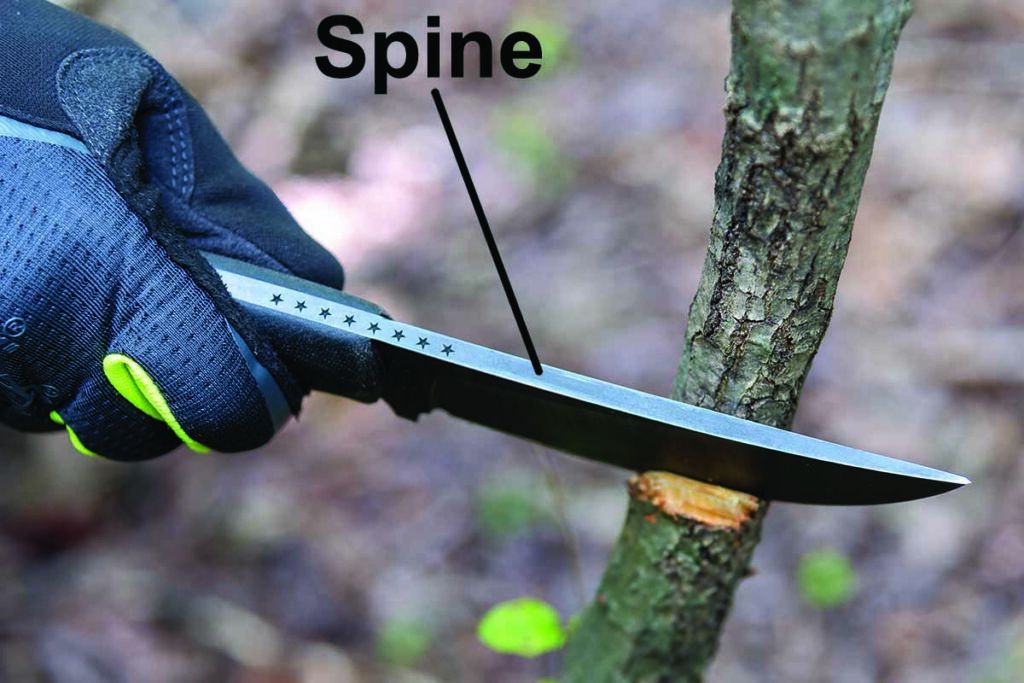
Spine
The spine of the blade is the part furthest from the edge or edges. On a single-edged knife, this would be the side of the blade opposite the edge, and on a double-edged knife or dagger, this is the middle of the blade between the edges.
The spine on a good knife will typically be heat-treated differently than the edge. The goal is usually to make the spine of the knife softer, and therefore allow it to flex and absorb energy while keeping the edge harder and more resistant to wear so it stays sharper longer.
This is called a differential heat treat and is especially important on larger, hard-use knives or other blades that might have to take impact forces.
Point
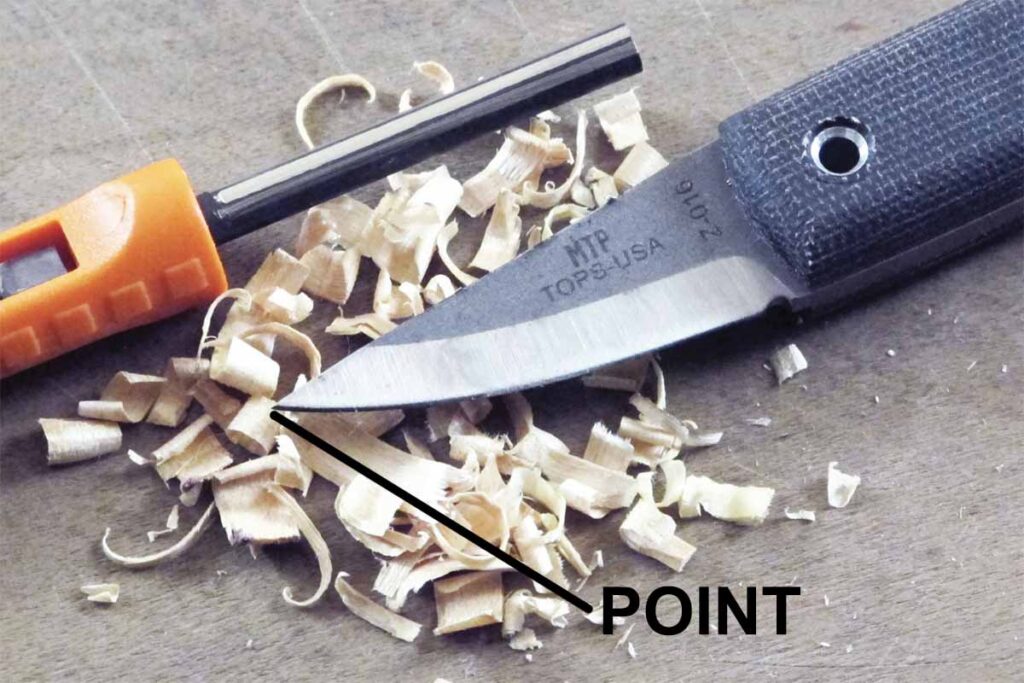
You probably know this one, I won’t lie, but technically the point is the place where the edge and the spine or opposing edge meet, typically at a very sharp (pun intended) angle. This is what you use for piercing, and most knives have one.
Tip
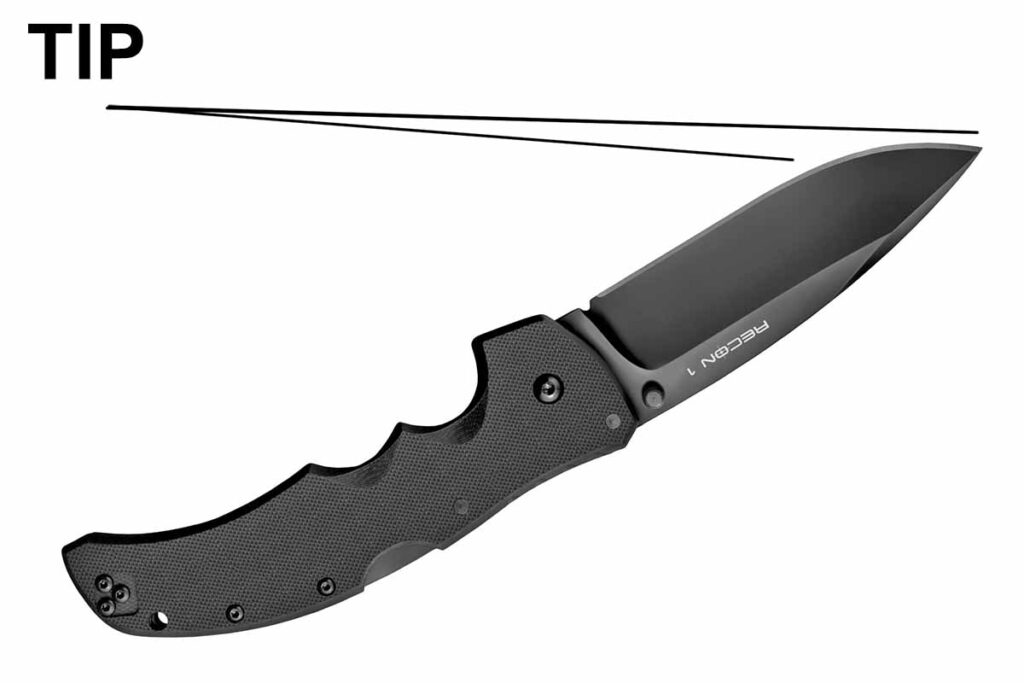
Technically different than the point, the tip of the blade is the forwardmost section of the blade, usually considered to be the last 20% or so of its length.
This section may be sharpened differently, have an unsharpened false edge along the spine, or be heat-treated differently to achieve different results. It includes the point of the blade.
Edge
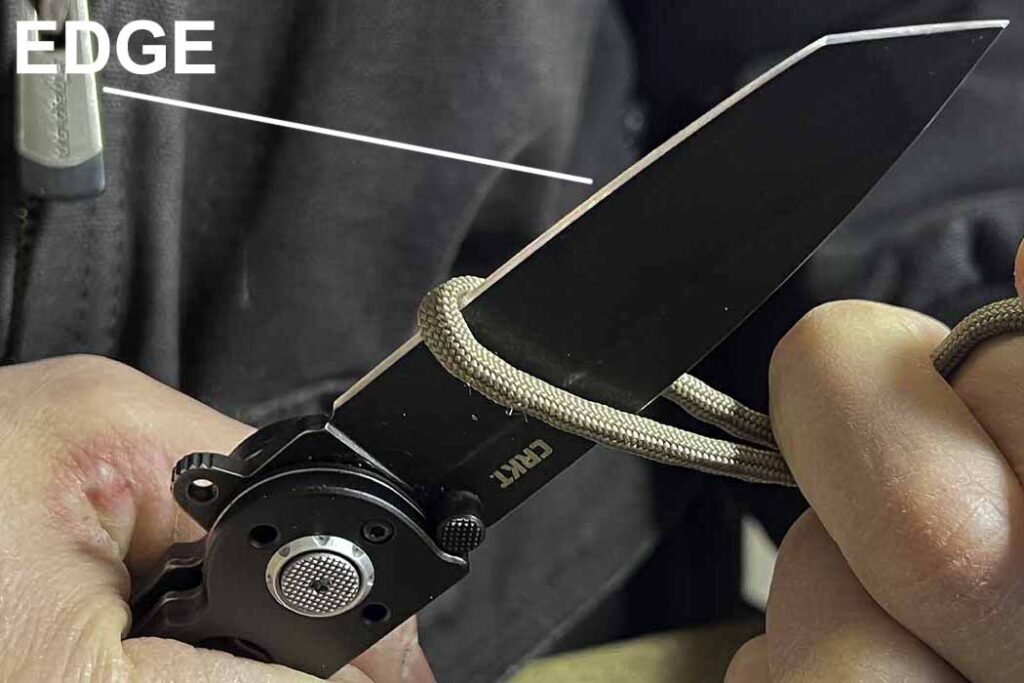
The edge of the knife is the (usually) sharpened portion furthest from the spine. It includes everything from the point to the heel, which we’ll get to later. Basically, this is the part you cut with, and on most knives, the whole thing will be sharpened the same.
There are some knives that have serrations for part of the blade, or certain fighting knives that leave sections unsharpened for the user to grip, though this fell out of fashion around the time the pilgrims landed in America. Today, most fighting or tactical knives are sharp from handle to tip.
One related term you will see is “edge geometry” or “edge angle” which refers to the angle at which the knife is ground or sharpened. Typically, this will be 20 degrees for something like a pocket knife or Western-style chef’s knife, or around 17 degrees for Japanese knives.
If you aren’t sure, a simple bevel gauge will tell you what the original edge is that you should be sharpening towards.
Grind
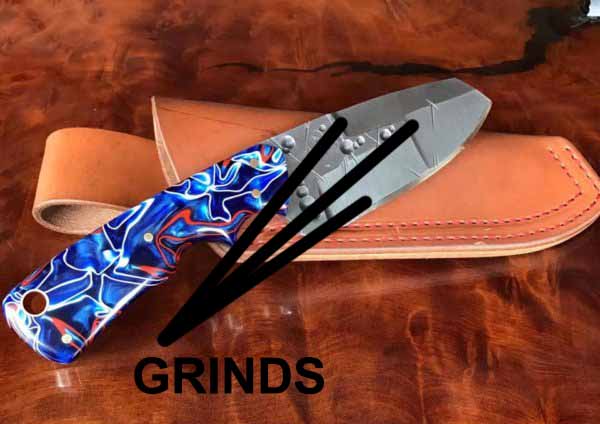
The grind of a blade, also called the geometry of a blade, refers to its cross-section and how the blade was ground by the maker. There are many different ways to grind a blade, with the most common being some form of hollow or flat grind, with convex grinds being a fairly distant third.
Every grind is a balance between strength and sharpness and is used for different things depending on the type of blade.
Some grinds lend themselves to a more robust edge that is less sharp, and some grinds, like the hollow grind you’ll find on most kitchen knives, give us an edge that is more susceptible to damage if misused, but better at slicing.
Various common grinds you’ll see frequently are hollow, flat, sabre (or saber), chisel, convex, and Scandi. All have their uses and are worth looking into further if you really want to dive into blade geometry and have the very best knife for the job.
Living on the Edge: Parts of the Sharp Part
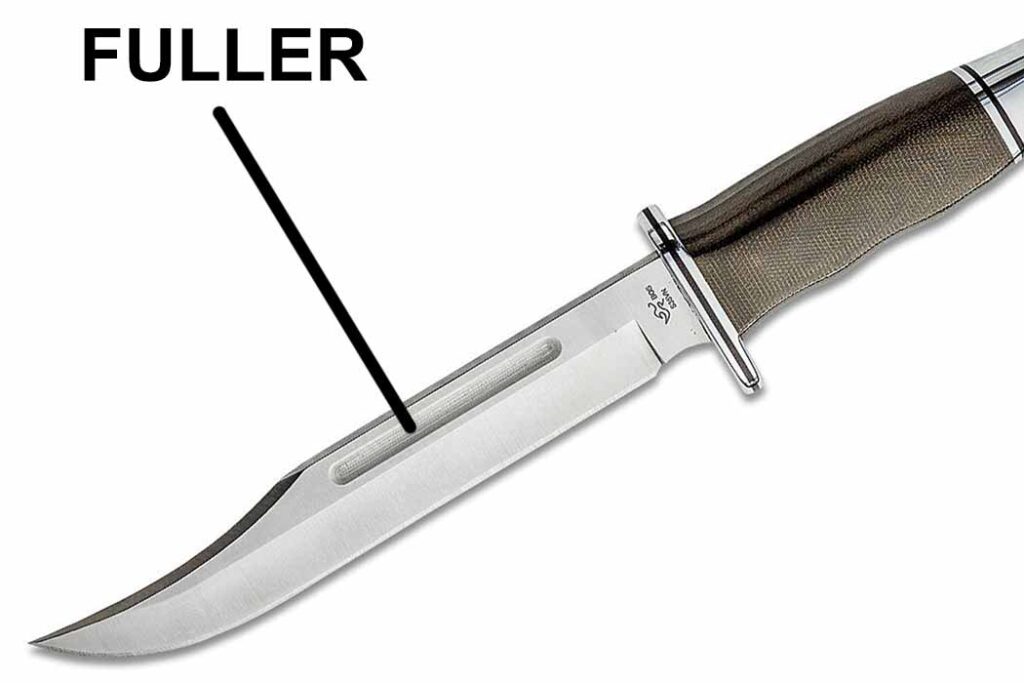
Fuller
A fuller is a rounded or beveled section of the blade that is either added as part of the forging process or ground in before the blade is heat treated. The purpose is to reduce weight and if forged, to strengthen or widen the blade as needed.
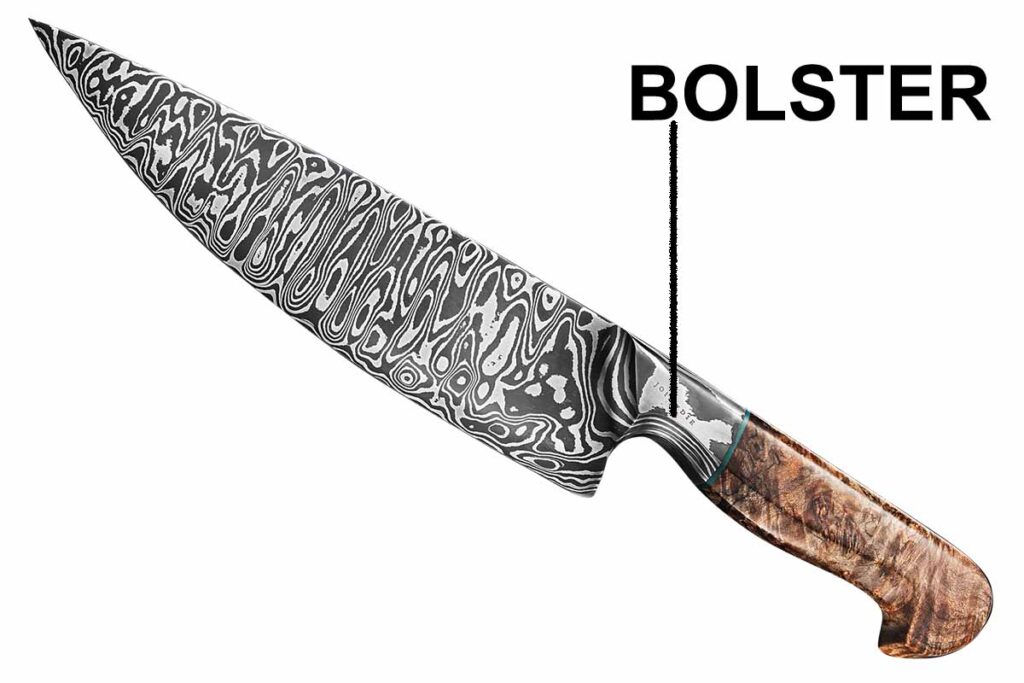
Bolster
The bolster of a knife, usually found on a kitchen knife or other fixed blade, is a thickened section of the blade that flows smoothly into the handle. This adds strength to one of the weakest areas of any knife (the junction between blade and handle) and helps with ergonomics by providing a smooth transition.
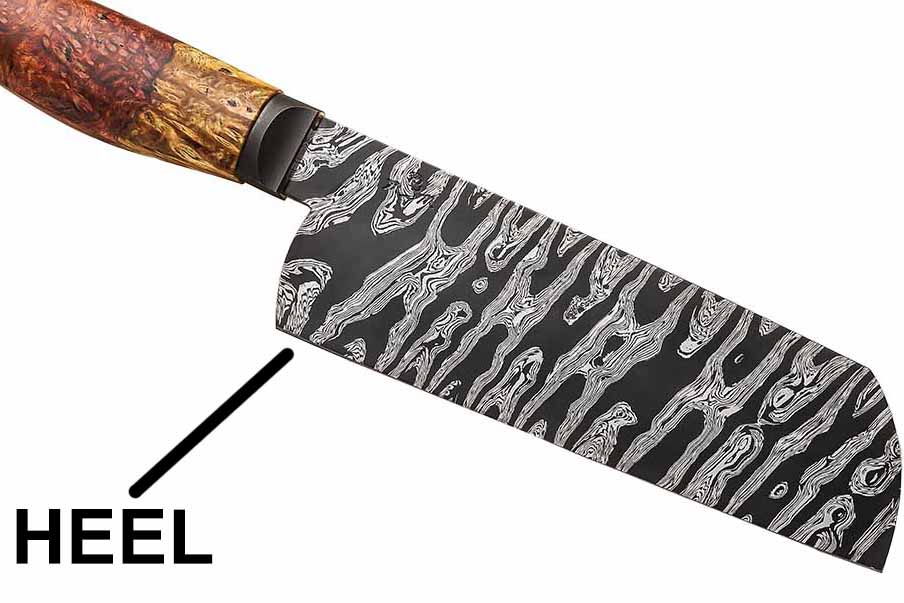
Heel
Not all knives have a heel, but if your knife has an edge that extends down and away from the handle, then you can think of the “bottom” of the blade furthest from the tip as the heel.
This is most common on kitchen knives and is typically rounded over or left rather wide to keep your middle finger comfortable when using a pinch grip. Japanese blades are notorious for having a prominent heel.
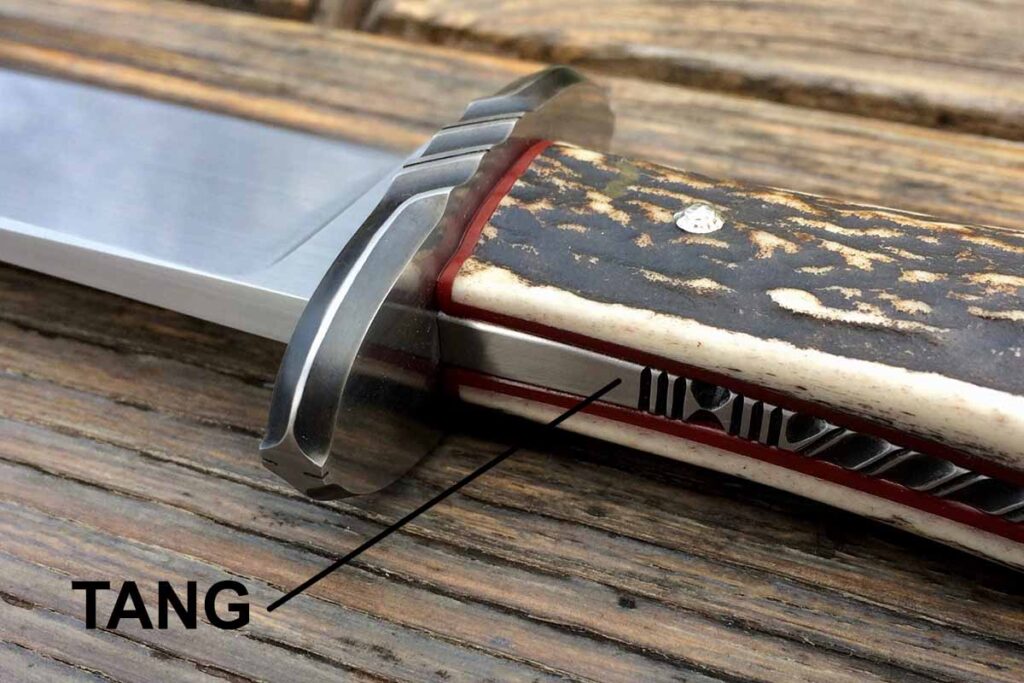
Tang
The tang of a knife or sword is the portion that extends into the handle. This can be the back of a folding knife blade that is drilled for a pivot, or the longer unsharpened rectangular section of a fixed-blade knife that the handle is attached to.
A “full tang” is when the tang extends all or most of the way through the handle, and adds a great deal of strength, making it the preferred style for hard-use or high-end fixed-blade knives.
Choil
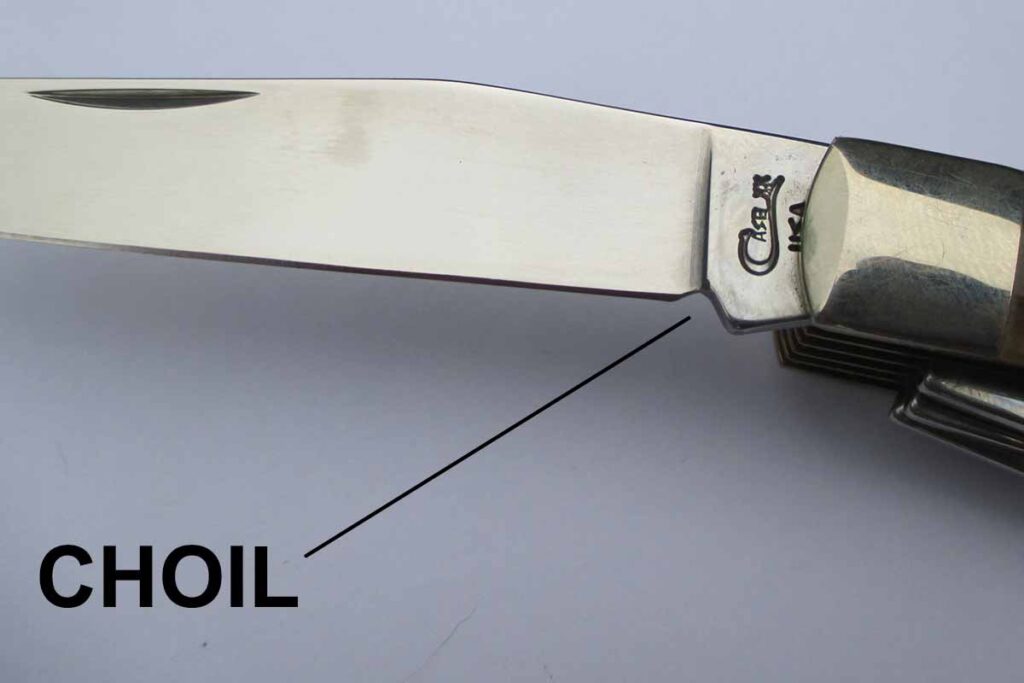
The choil of a knife is the space at the bottom of the edge, furthest from the tip and nearest the handle, and is left unsharpened and hollowed out. On some knives, it’s large enough to accommodate your index finger when using the knife in order to give you a bit more control.
However, the main purpose of the choil is so that the whole length of the edge can be sharpened without any issues.
Jimping
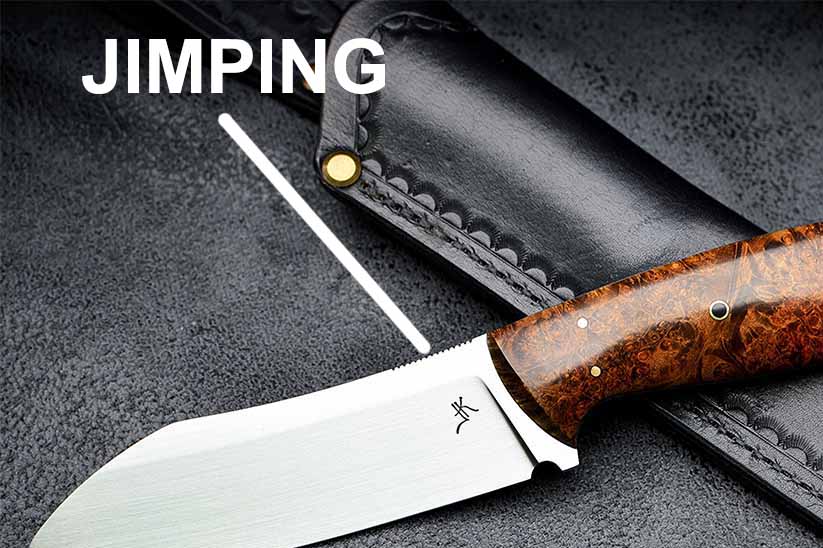
Jimping is the name of the grooves or notches added to the spine of a knife in order to increase grip. The most common places you’ll see this are on pocketknives and hard-use fixed blades, on the spine right where the blade meets the handle.
By having a grippier, high-friction surface there, you can better manipulate the knife, especially with wet or dirty hands
Getting a Handle on the Rest
Handle
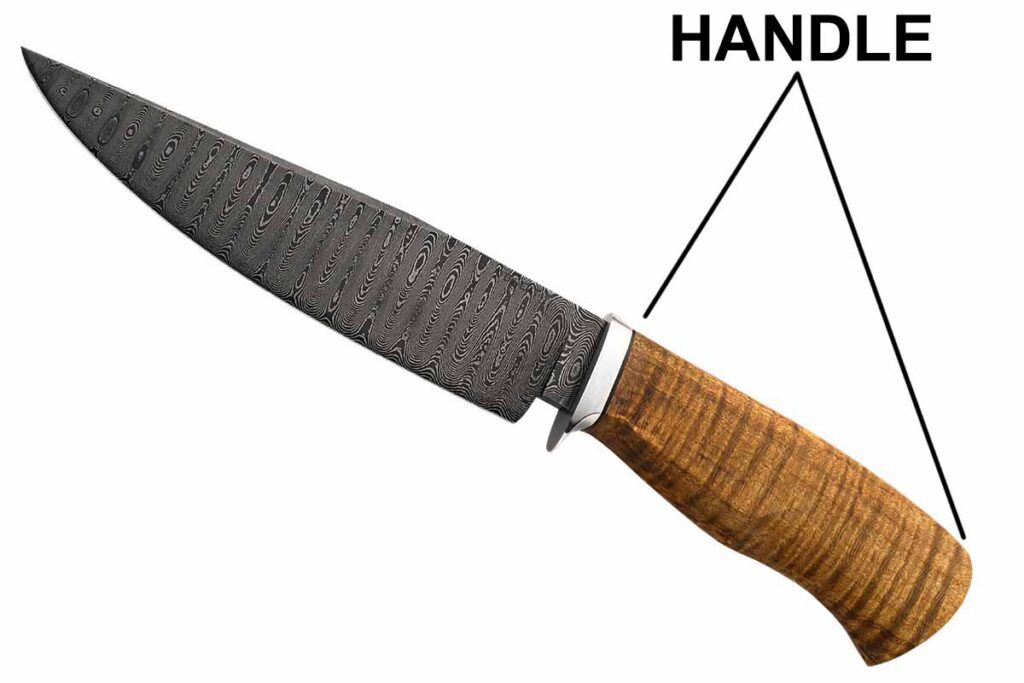
As you probably know, the handle of a knife is the part you hold. On a sword, or longer martial weapon, you will typically see the handle referred to as the hilt, but there’s not really much of a technical difference here.
It includes the guard, the grip, and the pommel if present.
Guard
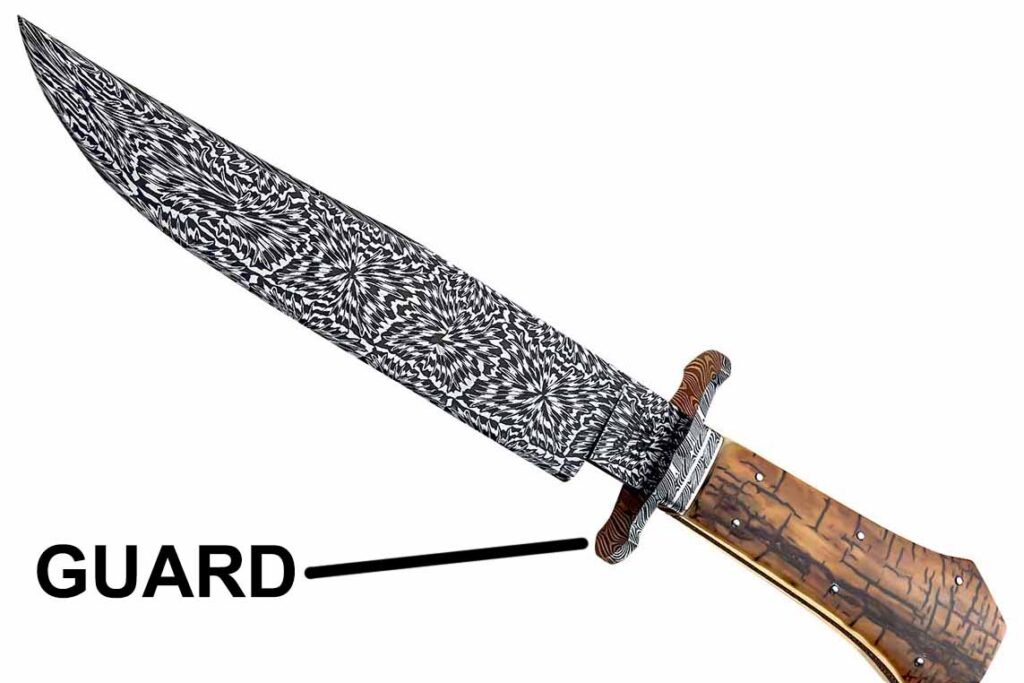
The guard of a knife is the bit that stops your hand from sliding forward and generally keeps you from hurting yourself with the knife. Many kitchen knives forgo a guard because you aren’t really supposed to stab them into things while fighting knives…well let’s just say swords had crossguards for a reason.
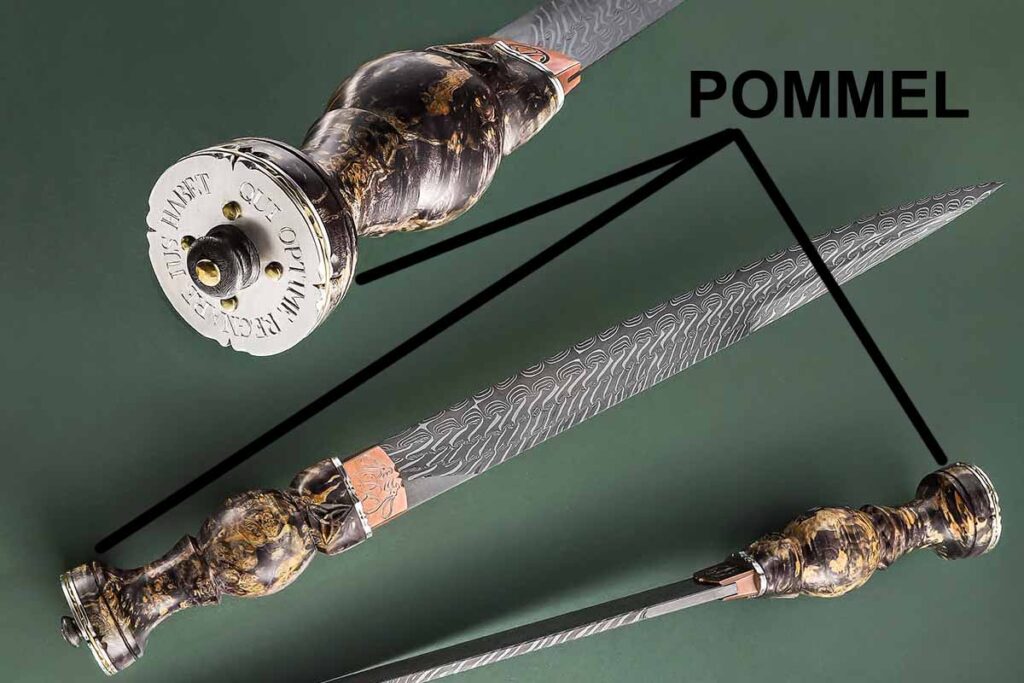
Pommel/Butt
Historically, the pommel of a knife refers to a weighted cap or round at the end of a handle that was meant to balance out the weight of a knife or sword blade. These days, few knives have one, but you may still see the bottom of a knife’s handle furthest from the tip be referred to as a pommel.
More commonly (and correctly) you’ll see this referred to as the butt of the knife.
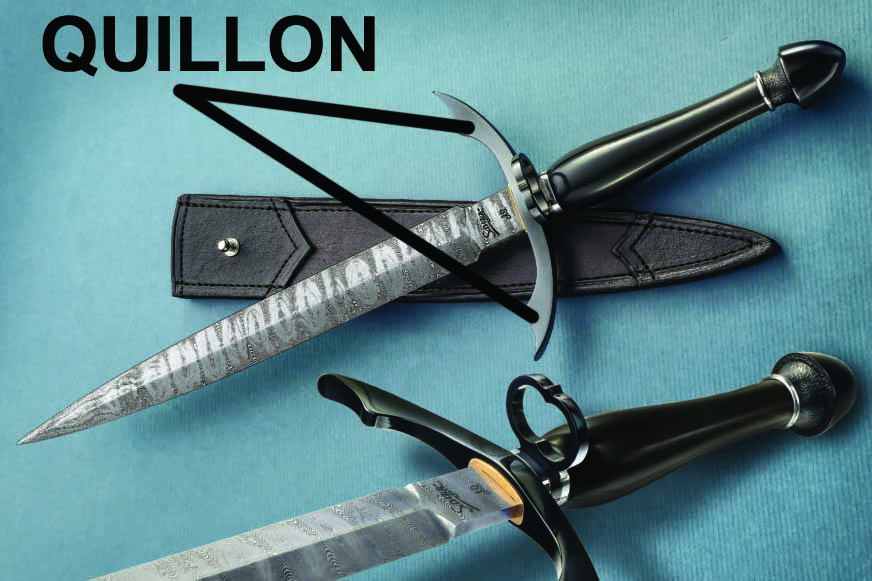
Quillon
On a sword or knife, the quillons are part of the guard that extends outwards at a right angle to the blade to keep the user’s hand from sliding up the blade when using it. These would often be very ornate on a more elaborate piece but would often be very simple.
Final Thoughts
And that does it for this one folks, thanks for stopping by. You should now know everything you need to know about the different (common) parts of knives.
There’s some other stuff out there that might come up if you start getting beyond Western-style knives or branching out from kitchen and pocketknives, but this is definitely 99 percent of what you’ll ever need to know when it comes to knife anatomy.
Also, the very distinctive nail-like guard that protrudes out on a messer is called a nagel and it is designed to stop parried enemy blades from sliding down and cutting your hand. In case you were wondering.