
Buyer's Guides

You’re looking for a new knife in a certain style – we’ve got recommendations on the best blades for every price point.

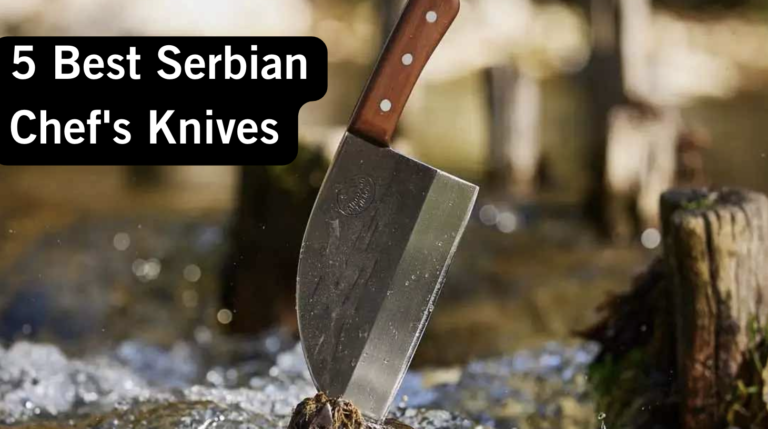
5 Best Serbian Chef’s Knives You Can Buy

Growing In Popularity, The Serbian Chef’s Knife Has Gained A Reputation For Strength And Versatility.

When many think of kitchen knives it falls into two categories: Japanese-style knives and German/Western-style knives. However, there is slowly a third type of knife gaining popularity: the Serbian knife.

Also known as an Almazan knife (or just an Almazan), the Serbian chef’s knife has a unique history when compared to other blade styles. Rather than evolving and adapting over time, the Serbian chef’s knife is tied back specifically to Almazan Kitchen.

Almazan Knife And Kitchen Backstory

The company was founded by two men in Serbia, uncle and nephew Boban and Aleksandar Almazan. Essentially, clever marketing and a unique look have vaulted the knife into the limelight.

Despite Almazan’s and other knives’ bucolic charm, there is little attaching the style to a particular historic Serbian design. Instead, the moniker comes from the Almanzan clan hailing from Serbia. In some corners of the globe, the knife is simply known as an Almanzan knife … makes sense.

Interestingly, the Almanzans seemed able to harness to disparate trends in the knife world with the Serbian chef’s knife. On one side, was the ever-growing interest in cooking, the other the rise of cleaver-like knives for bushcraft. They must have had some passing inkling of this crux, given they marketed their knives to both communities, as well as played up the wilderness and food prep in their marketing.

Serbian Chef Knife Design Points

Unless you’ve lost your glasses, it’s fairly apparent what sets the knife apart from its counterparts–its huge hooking blade. If we’re honest with ourselves it’s a cleaver with a tip–somewhat reminiscent of a large deba bōchō, but overall heftier.

Generally, most Serbian chef’s knife makers tout their wares as handmade–of course at factory scale, with all that entails. Most of the blades have a very thick spine giving them the chops to tackle heavy-duty jobs. Though, most lack a defined belly, lending them better hacking jobs.

By and large, Serbian knives are constructed of carbon steel and have won some kudos for maintaining a good edge. Furthermore, almost all makers favor a wood handle of some sort, most likely because it maintains the rustic, outdoorsy aesthetic Almazan originally pioneered.

Should I Get A Serbian Chef’s Knife?

Honestly, like all things knives, that’s up to you. Maybe the Serbian chef’s knife is the kitchen or backwoods tool you’ve been waiting for or perhaps is all online hoopla. There are many who fall in the latter category and are vocal about it.

Despite this, it does seem the cleaver-style design has a place in the galley, particularly if you happen to process chuck wagons full of meat. The large width of the blade makes it ideal for hacking, particularly joints and bone. Additionally, boasting a tip, it could potentially tackle basic kitchen jobs in a pinch.

That said, as a catch-all chef’s knife, most cooks are likely going to find themself more comfortable behind a traditional design. The large blade is unwieldy for basic cooking jobs, such as chopping and mincing. Furthermore, the lack of a belly on most examples slows the knife down considerably on general tasks.

Bushcraft? Sure, there’s the potential. A Serbian chef’s knife certainly has the ability to work in a hatchet’s stead. Outside of that, well, things get dicey. It’s not exactly the style of blade you’d reach for to skin a buck or whittle fuzz sticks. Not to mention, do you really envision toting one of those beasts in your kit? (Add a pound to your ruck, not mine!)

Of course, this is coming from a more traditional mindset of kitchen and backcountry work and utility. And much like beauty, utility is often times in the eye of the beholder.

5 Top Serbian Chef’s Knives

Almazan Kitchen Original Serbian Chef’s Knife

Almazan Kitchen Original Serbian Chef’s Knife

The blade that started the craze. The Original from Almazan Kitchen set the standard for every Serbian knife that’s come after it. Hand forged in Serbia, and weighing a shade under 1 pound, this blade is a menace in the best possible way. 

The carbon-alloy blade is tempered to a 58-60 HRC. The full-tang construction features a triple-riveted handle for grip and gives the user a sense of confidence. The uncle-and-nephew team that founded the company, Boban and Aleksandar Almazan, wanted to make a knife that would be as comfortable in the forest as it would be in the kitchen, for some they’ve succeeded.

Beyond just the knife itself, Almazan also sells accessories including leather sheaths, cutting boards, and kitchen equipment made from olivewood. 

The knives have also benefitted from the company’s wildly successful marketing, in particular the Almazan YouTube channel. Fueled by more than 3 million subscribers, the company and its knife have blown up in recent years.

MSRP: $152.92 (There is also a stainless version for $30 less)

Damas Knives Bushcraft Serbian Knife

Damas Knives Bushcraft Serbian Knife

This model from Damas Knives is emblematic of the new(ish) design, with its wide blade and rustic handle. The knife is hand-forged from a single sheet of XC75 high-carbon steel with a 59 HRC and ground to a 21-degree angle.

The blade’s strength and the Rosewood handle’s sturdiness allow the user to butcher big cuts of meats, nimbly dice veggies, and even slice right through small bones. Beyond the food uses, this piece can tackle cutting wood and brush on a hike. 

MSRP: $145

Imarku Butcher Knife

Imarku Butcher Knife

From one of the most trusted names in kitchen knives comes a budget Serbian chef’s knife that swings far above its price point. 

This knife from Imarku features a hammered design and is hand forged. The blade is made from high-carbon, high-manganese German X50CrMov15 steel. The hard 56-60 HRC steel holds a razor edge and has good rust resistance as well. You can see the spots from the hammering up and down the blade, which gives it its signature look.

The knife comes with a leather sheath and, like other Serbian knives, has the strength to cut through bones and butcher large meats. 

Imarku stands apart from other Almazans due to the price. The company has found a way to make a top-tier example for under $100. 

MSRP: $59.99

Kopala Original Kitchen Knife

Kopala Original Kitchen Knife

Now for a little something different from Kopala. Its original kitchen knife is made in the Serbian style but in a far different shape from the other knives on this list.

Instead of the rounded cleaver-esque design, Kopala has made a smaller, swooping blade–reminiscent of a scimitar–attached to a triple-riveted Rosewood handle. The high-carbon blade is balanced enough to cut through raw fish and other assorted meats.

The main drawback on the knife, unlike the others on this list, is the company did not design it to cut through bone. That takes away the versatility that makes the traditional Serbian knife so beloved. However, as the most inexpensive knife on our list, if that’s a compromise you’re willing to make then the knife is more than worth it.

MSRP: $29.88

HDMD Serbian Chef Knife

HDMD Serbian Chef Knife

Rounding out our list is a fine all-rounder from HDMD Knives. Handmade from high-carbon steel and pakkawood, this blade from HDMD is an excellent middle ground if you have any interest in a Serbian knife.

It follows the construction of knives like the original Almazan. It’s hand forged, roughly six inches long, and has a 56-58 HRC. It weighs about .75 pounds and can handle whatever you throw at it in the kitchen. 

Where it stands apart is in the price. This blade is under $100, which makes it a perfect entry point for this style of knife.

MSRP: $79

Read More

Samurai Chef’s Knives

Few Knives Have Been As Heavily Influenced By Japanese Methods As The Chef’s Knife. These Four Quality Blades Show Off The Modern Meeting The Historic.

The Japanese influence on custom knives is everpresent in the marketplace, and, aside from the tanto, nowhere is its flair and focus felt more than with chef’s knives. 

These tools of the culinary trade are functional as much as they are eye-catching, especially in examples of some of the top makers in the genre today.

Honyaki Byuto Hybrid By Dmitriy Popov

Popov Gyuto hybrid
Dmitriy Popov aligned the tip with the spine on his wide-bevel Honyaki Gyuto Hybrid for enhanced control during jobs requiring precise use of the tip. (SharpByCoop knife image)

Dmitriy Popov has conjured up a masterpiece he calls the wide-bevel Honyaki Gyuto Hybrid, a new take on a recognized Japanese style. 

“It isn’t a traditional gyuto, as it has an upswept tip and the height of a nakiri,” he commented. “Having the tip aligned with the spine of the knife gives the user a feeling of control for precise tasks requiring use of the tip. Having the extra height in the heel allows me to create a knife that is super thin behind the edge while also having a significant amount of mass above it.”

Popov’s creation includes a near 9.5-inch blade of differentially heat treated W2 tool steel and a handle combination of desert ironwood and osage orange complemented by a carbon fiber liner. His prices for similar knives range from $900 to $2,500 based on size and materials.

“The hamon and ashi* I am able to get out of the W2 is mesmerizing,” Dimitriy added, “and I spend a large part of my life going deep down the hamon rabbit hole. Honyakis are part art and part science, and the failure rate is a lot higher than I would like it to be. I really like the minimalist wa handle style [see page 14], and rounding off the bottom facet does not alter the traditional design much, while making the handle more comfortable in the hand.”

Having made knives since 2011, Dmitriy looks back at the beginning in everyday carry, tactical and camp models. After three years, he gravitated toward chef’s knives, and since 2016 they have been his sole focus.

“Everyone cooks, and at some point most cooks or chefs will come to appreciate the benefits of a good quality knife,” he observed of a chef’s knife field that has become quite crowded. “There are way more prospective customers than there are makers, so to succeed as a maker all you need is a very small slither of the pie and a drive to evolve your craft each day.”

Santoku-Style Knife By Eric Hemker

Hemker santoku
The long, nearly flat cutting edge of the damascus santoku by Eric Hemker enables it to slice, dice, and mince vegetables much easier than a blade with a sweeping belly. (SharpByCoop knife image)

While Eric Hemker admits he is still learning some subtleties of making chef’s knives, he has found that the santoku style is excellent for use in final food preparation. 

His custom-ordered version sports an 8-inch blade of random-pattern damascus forged from 1084 carbon and 15N20 nickel-alloy steels. The overall length is 14 inches, and the handle is exotic blue-dyed curly mango. His price for a similar knife is $960.

“The lack of a pointed tip on the blade means it is not well suited for delicate carving work such as breaking down bony proteins,” Eric explained. “However, its long and nearly flat cutting edge allows it to slice, dice and mince vegetables and proteins much easier than a knife with a sweeping belly on the cutting edge.”

Translating literally from the Japanese, santoku means “three virtues, or three uses,” and so the slicing, dicing, and mincing description is spot on. 

“This blade is 144-layer random-pattern damascus, and it features a full flat grind with a convex edge. The flat grind is my usual go-to grind for most general-purpose cutting needs that are common in the kitchen or in hunting-type knives. I also add a slight convex grind that leads into the cutting edge to aid in food release.”

Eric chose a modified wa handle configuration and attributes the decision to keeping step with traditional Japanese appeal. 

“The top of the handle has the traditional wa-style octagonal facets,” he said. “But I wanted to spruce this handle up a little to challenge myself, so the bottom is curved to give it a shield-shaped cross-section. The handle has a 304 stainless steel bolster and an heirloom-fit black G-10 spacer. One of the only things the customer specified was a colorful handle, so this piece of wood was a perfect fit.”

For Eric, the entire package comes together nicely, blending the good looks and function that are inherent in Japanese-inspired chef’s knives. 

“All these materials will hold up well in kitchens,” he remarked. “G-10 is a synthetic material that also holds up very well in any harsh environment, and since the wood is stabilized it should also hold up well in water and getting dirty in general. Since the handle is wood, it would still need to be oiled occasionally, and it should go without saying that a custom piece like this with a carbon steel blade and a wood handle should never go in the dishwasher.”

Eric began making knives six years ago and still considers himself at the beginning of a promising journey. 

“Kitchen knives have been some of my favorite knives to make from the beginning because everyone uses one,” he noted, “so they are some of the easiest pieces to sell and get feedback on.”

Meanwhile, he welcomes the expanding number of makers and buyers in the chef’s knife arena. 

“I don’t believe the custom chef’s knife market is overly saturated by any means,” he commented. “I think the demand really drives the market for these custom pieces, and I believe there will almost always be customers at every price point. In the last decade or so, there really has been a resurgence of demand for well-crafted handmade goods in almost every category of consumer goods, and I don’t believe that trend is going to be dying out anytime soon. This may be especially true for culinary knives when food is such a big part of many people’s lives.”

Straight-Edge Kiritsuke By Dre Laborde

kiritsuke by Laborde
The straight-edge damascus kiritsuke by Dre Laborde is specifically made to slice fish and some softer meats. The handle is curly maple from Realeyezwoodz. The sheath is stabilized maple and a joint project between Dre and Realeyezwoods. (SharpByCoop knife image)

The straight-edge kiritsuke from Dre Laborde is specifically made to slice fish and some softer meats, he says, and doesn’t necessarily lend itself to chopping vegetables. 

“I’m no expert on Japanese knives as a whole,” he noted, “but from what I can find the kiritsuke seems to be a cross between the longer yanagiba and the stockier gyuto. The steel is X-pattern-ladder damascus that I purchased from MVH Damast based in the Netherlands. These steels have given me nothing but positive results and I can’t recommend them enough.”

The blade is 9.5 inches and the overall length is 14.5 inches. The handle is curly maple from

Realeyezwoodz, and the price of a similar knife would probably exceed the featured piece. 

“It sold for $760,” explained Dre, “but it was a semi-experimental project for me, so a future project of this scale would cost more. The design, like all my knives, was drawn on paper to scale first and then made with the freedom to change the design as I see fit.”

The choice of handle material and design contributed to the overall appeal of the knife and its performance in the kitchen. 

“The wood is stabilized, which means it was put under vacuum in a resin and hardened,” said Laborde. “This makes it resistant to water and to staining. The handle design is a slight variation on the common shape I do, made slightly longer to fit the length of the knife.”

Dre has been making knives for about three years and in that time hasn’t seen the chef’s knife market becoming overcrowded, though he has heard such comments. “Those willing to pay for a custom chef’s knife often have many and recognize the price tag that comes with them,” he added.

Haetori Honesuki By Tony Cetani

Haetori Honesuki by Tony Cetani
The Haetori Honesuki by Tony Cetani is an all-around kitchen utility knife design based on the santoku and honesuki, the latter a Japanese boning knife. Whereas a traditional honesuki’s main task is for deboning poultry, Tony made the Haetori Honesuki to handle multiple kitchen jobs.

When Tony Cetani built his Haetori Honesuki with a 5.5-inch blade of Chevron copper-mai steel and an 80CrV2 core from Baker Forge and Tool, he added a handle of spalted box elder to complete the package and priced it at $1,000.

“Haetori means ‘jumping spider’ in Japanese,” he related, “and following my love for spiders this knife is named for the Haetori Gumo, a very common spider in Japan. It’s an all-around kitchen utility knife, and I based the design on the santoku and honesuki. Whereas a traditional honesuki’s main task is for deboning poultry, I made this to handle multiple tasks around the kitchen.”

Tony has been making knives since 2017 and tried chef’s knives for the first time three years later. 

“Once I got a few kitchen knives under my belt, I fell in love,” he smiled. “I wanted to put kitchen cutlery on the market that was different and not your traditional kitchen-style knives.”

He succeeded with this effort and chose a slightly innovative handle style. 

“This is a newer style that I designed specifically for this knife,” he said. “Adding a clip at the butt of the tang gives the palm a comfortable spot to rest when working the knife. I chose natural spalted box elder because it went well with the copper in the steel, and you can’t ever go wrong with box elder!”

As for today’s chef’s knife market, Tony sees strong demand and the capacity to supply it. 

“There are a lot of makers out there putting out phenomenal chef’s knives. I think every maker has their style, and the style is what grabs the attention of a potential customer.”

*Ashi are various notches or details in hamons. To produce ashi, the maker applies thin strips of clay from the spine of the blade to the edge during the clay tempering process, which contributes to interesting variations in the resulting hamons.

Read More

M-1 Folder Review: How Good Is This Folder?

The M-1 Folding Pocketknife From MECHFORCE Takes A Licking And Keeps On Cutting No Matter What’s In Front Of It.

Most people don’t like carrying a thick knife. They already have enough stuff without a bulky folder blocking access to the other goodies in their pockets.

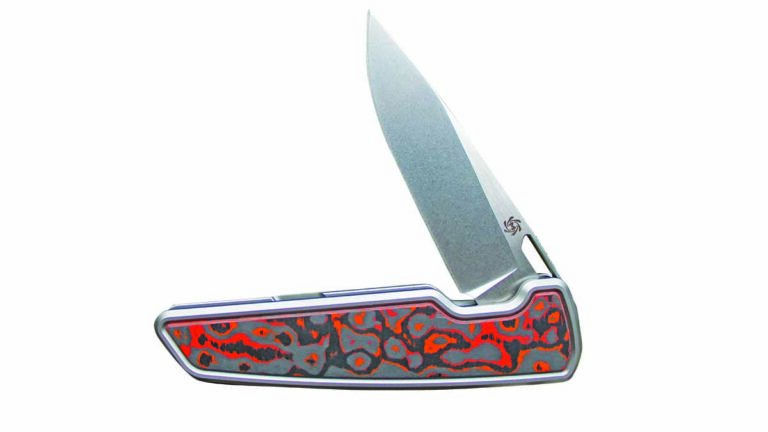
I really like the blade thinness of the M-1 folder by MECHFORCE. Add a deep-set pocket clip and the M-1 is low profile when attached to the lip of your pocket. Meanwhile, the handle feels great. 

The blade is a classic drop-point shape and cuts like … well, let’s see!

M-1 Folder Takes On Paper And More

Mechforce M1 sharpness test
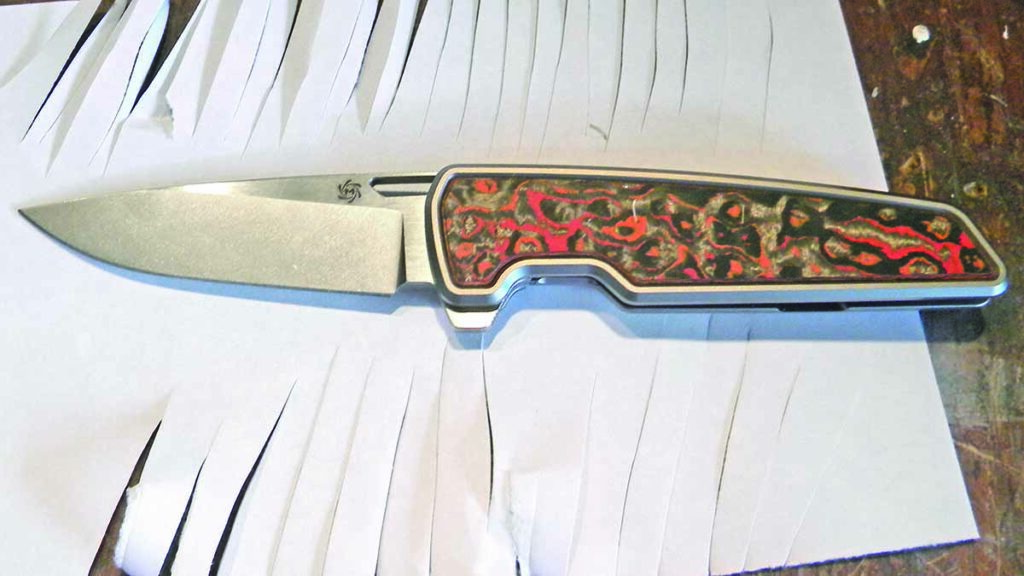
The M-1 sliced the 20-pound bond copy paper smoothly and quickly.

Twenty-pound bond copy paper is the first way to test the factory edge. The M-1 sliced the stationery smoothly and quickly. I put a few nicks in my fingernail by moving too slow. I could hear every slice in the paper. Very sharp!

On to double-walled cardboard. The blade bound a tad at the bottom of the cut and during withdrawal. The thicker slice is where I noticed the binding. Thinner slices were not a challenge. It sliced the cardboard fast overall.

I used some plastic board for the next medium. The M-1 sailed through every slice. It was easy to control the width of the cut. I like the shape of this handle a lot. It really gives me control with my sidewinder cutting style.

The M-1 bit into 8-ounce leather and did so with gusto. I could hear the aggressive sounds of the edge biting through the material—this is very addictive to do as you crunch away. The knife would excel at skinning game.

I did some skiving to check the control of the depth of the cut. There were no issues whatsoever on the leather—super thin cuttings every time. The flat grind really helped in cut-depth control.

Pushing The M-1 Folder

Mechforce M1 cutting rope
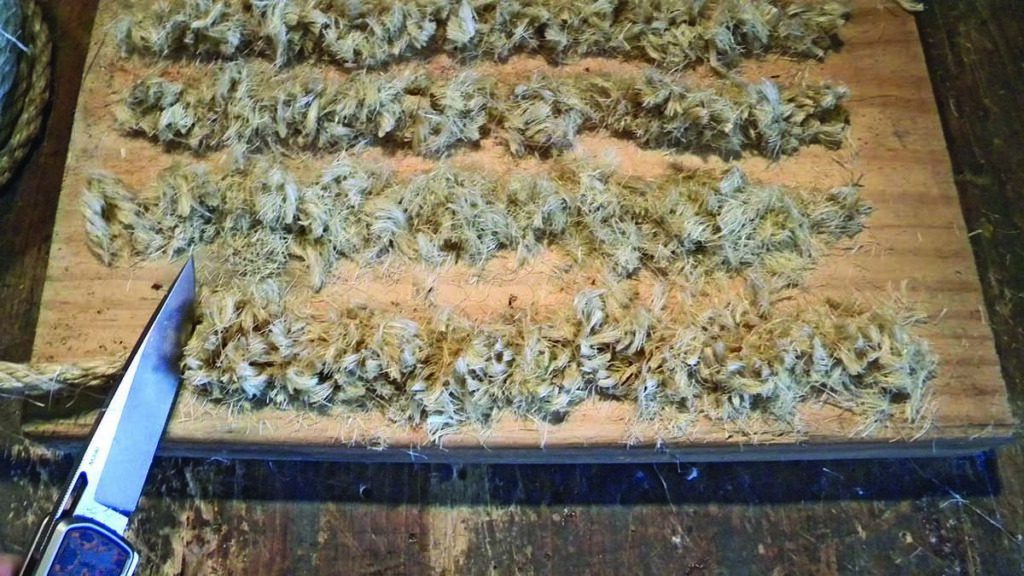
The M-1 Folder wore the author’s wrist out after 250 crunching cuts of half-inch sisal rope.

Next up: half-inch sisal rope—time to use more pressure on the M-1. The knife wore my wrist out after 250 crunching cuts. It still had more bite but I was done for the day on rope cutting. The knife gave me no hot spots and I found zero sharp areas on the handle. It was very comfortable with pressure cutting. Excellent work, MECHFORCE!

To give the edge a heavy workout, I grabbed an old whitetail antler and gave it 30 whacks. I expected to see a few small chips in the edge but none showed. The edge was still sharp with no snags, sure signs of tough steel and excellent heat treatment.

I switched back to slicing 20-pound bond paper to see if the edge was still field ready. It sliced cleanly throughout to the end of the testing.

The M-1 comes with a maintenance kit that includes how-to instructions, two sets of replacement adhesive strips, take-down wrench and a bandage. It’s well thought out.

Final Thoughts

Not much to say here—maybe add some skateboard tape inserts for a no-slip grip. The M-1 is a high-performance knife that takes a licking and keeps on cutting. It makes a great pocket addition.

M-1 Folder Knife Specs

Knife style: Flipper folder
Blade length: 3.5 inches
Blade steel: M390 stainless
Blade thickness at thickest: ⅛ inches
Blade grind: Full flat
Blade finish: Matte
Blade pattern: Drop point
Handle frame: 6Al4V titanium
Handle inserts: Mars Valley carbon fiber
Pocket clip: Deep set
Lock: Framelock
Weight: 5 ounces
Closed length: 4-11/16 inches
Knife to know: Features hidden-screw design
Country of origin: Partially made in the USA
MSRP: $385

Read More

Fillet Knives That Are Bad To The Bone

0

These babies will unzip your catch with ease.

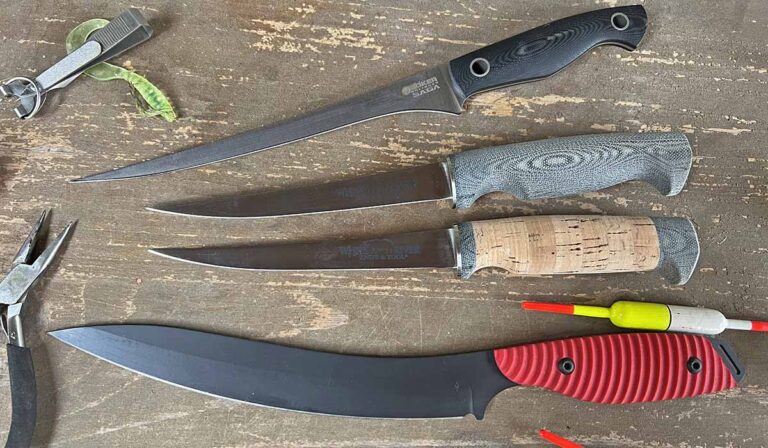
While you may think a fillet knife has only one purpose, there’s as much variation in fillet knives as there is with any other knife type. Just as there’s no one type of pocketknife, neither is there one type of hunting knife. Treating the fillet knife as an afterthought for your fishing is a mistake. In other words, you want to match your quarry to your blade.

Fillet Knife Size

The vast majority of American anglers, and most in Europe, fish either in inland waterways or along coastal waters. While it is certainly possible to catch large fish in these places, few people realize just how large of a difference there is between a 5-ounce bluegill and a 50-pound sturgeon. When you get above 10 pounds, you run the same risk of breaking fillet blades as you would breaking hunting blades on large game like deer. The flesh, bone and scales of fish are far tougher than many realize and a fragile blade can and will break if you put too much pressure on it. Heavy-duty fillet knives exist and are specially designed for larger fish.

Fillet knives handle
Handles are an important consideration. Texture matters on these fine knives and for some outings you need a very sure grip.

Likewise, small fish do not benefit from larger knives. This should seem like common knowledge, but I see anglers with 8-to-10-inch knives going after panfish. This is not a bad thing overall, just really unnecessary for the task. In my experience, large work like skinning deer and breaking down large game needs a 7-inch blade; you want to be able to see what you’re working with and keep your hand out of the body and highly visible. With small fish, you want the tip closer to your hand to better control your cuts. Fish cleaning is an activity that leads with the tip. You need to have it cut in easily and then glide. A paper-thin blade isn’t meant for chopping or sawing, unlike what you can accomplish with a thick-spined hunting knife.

Blade Flexibility

Flex is another important aspect of a fillet knife. Because of the way fish are shaped you want a blade that has the ability to match contours and glide along the spine or under the skin. Flex varies depending on the task. On large fish you’ll want the least flex, on small ones you’ll want the most. As for the tip, the largest fish need a reinforced tip because skin and fat can be extremely thick, and a thin tip is more likely to bend or break. Ideally, the tip should be as fine as possible and come to a narrow-angle. However, this becomes a hard thing to accomplish when you need a fillet knife that is also very strong. To get this, you need something like the tip of a wharncliffe pattern that provides a fine point while maintaining a thick blade.

Some Of The Best Fillet Knives

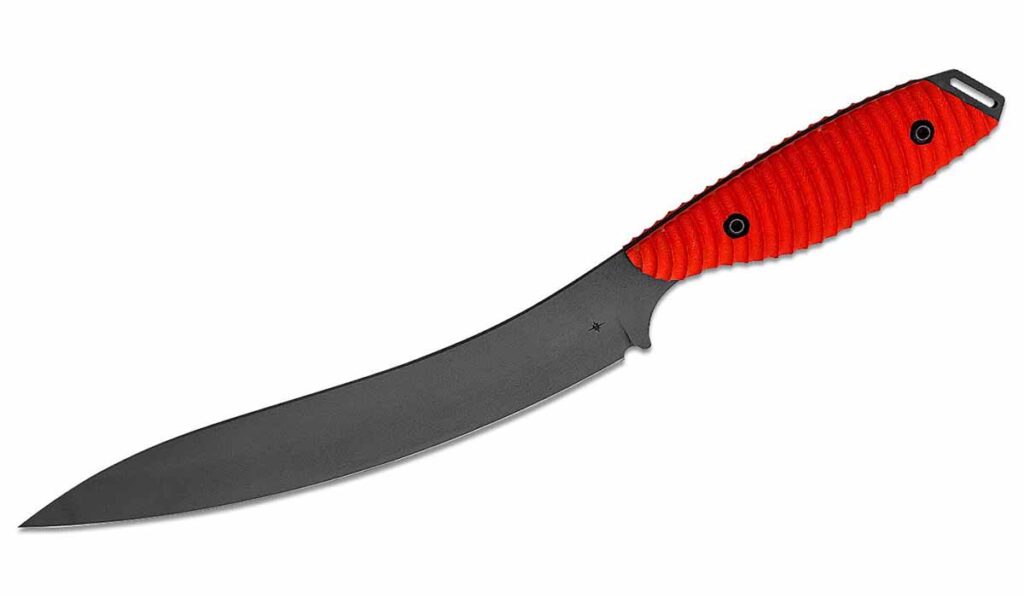
Toor Cardiff

Fillet Knife Toor

The Toor Cardiff is perhaps the most well-designed and best-thought-out knife for large fish. Just about every part of the knife is properly contoured and ground to achieve a light, thin blade that is also very strong and razor-sharp. It is the thickest knife of the test bunch, but, at just .09-inch thick, is still considerably thinner than standard blades. It does not taper substantially from pommel to tip. The point of the knife is quite fine but shaped with strength in mind. Its edge geometry enables it to be used on most sizes of fish, though it is at a slight disadvantage on the smallest bluegill or anything you would throw in the pan as one piece. This has more to do with the overall size of the knife than it does cutting ability.

Cardiff knife
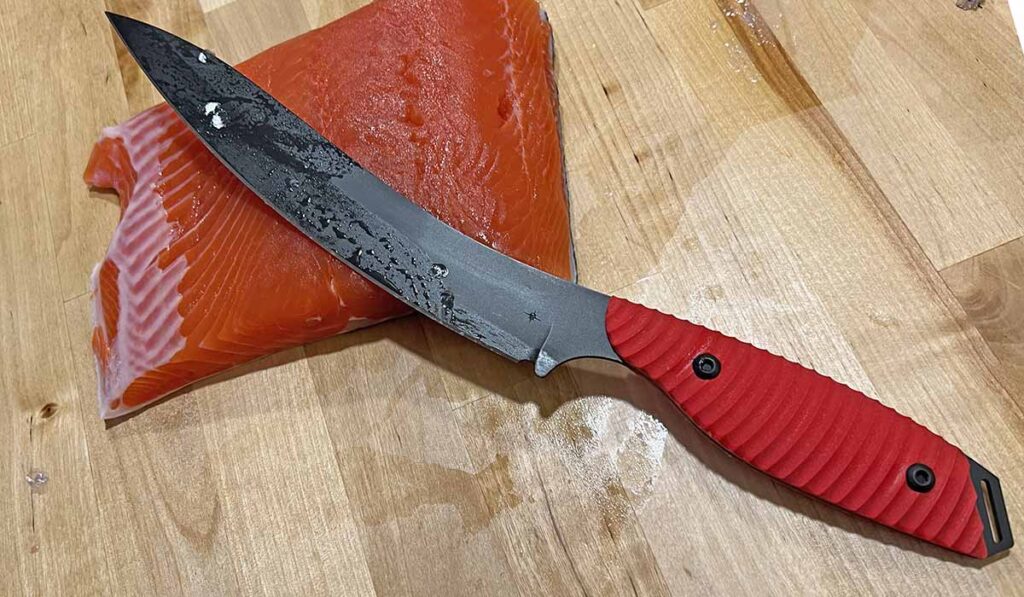
Large salmon were no match for the Cardiff, a well-thought-out, hard-use fillet knife that can also be used for large game. It is a crossover knife meant for the field, not just light work at the dock.

The blade has a curve with a deep belly. It permits the hand to sit at a more relaxed angle if you are cutting steaks or slicing a thick fish along the spine. The grip is very aggressive and promotes a firm hold even when your hands are covered in fish slime, water and blood. The knife is ruggedly designed and a suitable tool even for large game, including deer. While it does have some disadvantages as compared to a dedicated hunting knife, you could certainly get away with it as your primary blade for a mixed-bag hunting/fishing adventure. It does very well in the kitchen but you can tell it needs to be in the field.

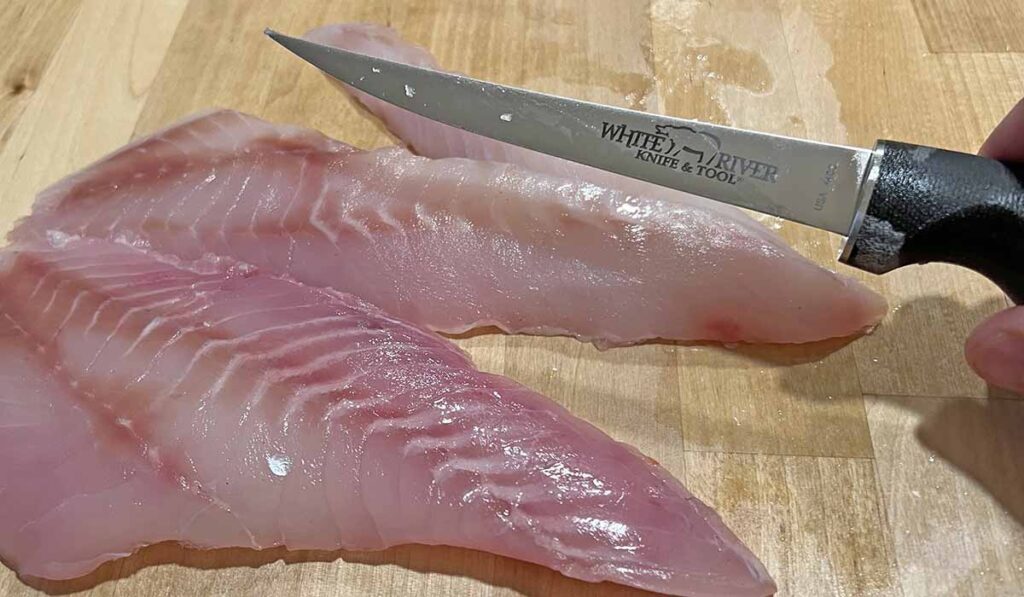
White River Knife & Tool Traditional Fillet

Fillet Knife Whit River

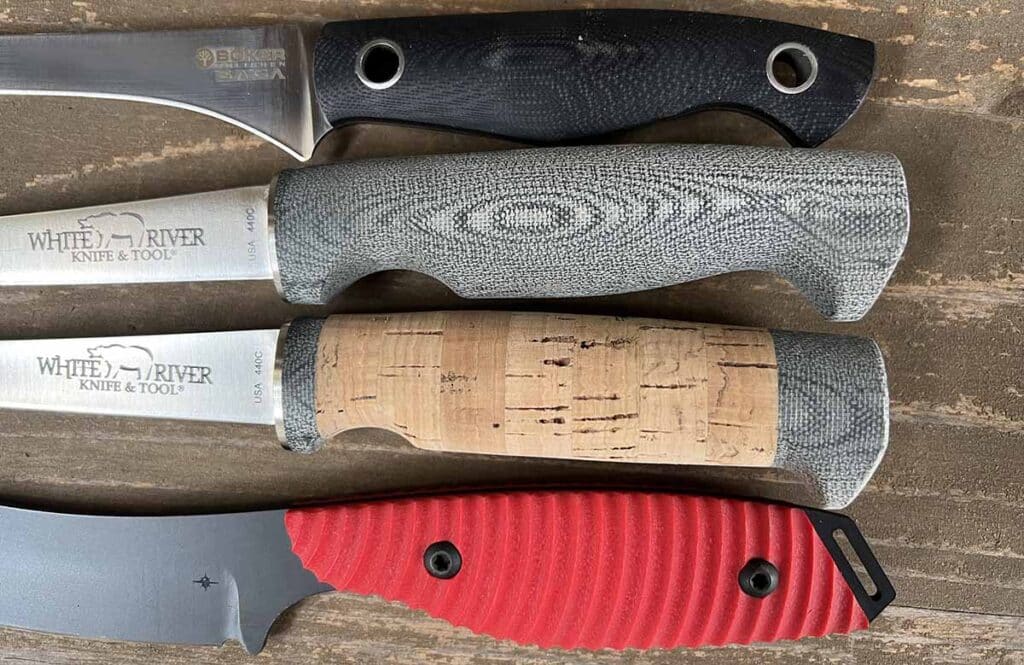
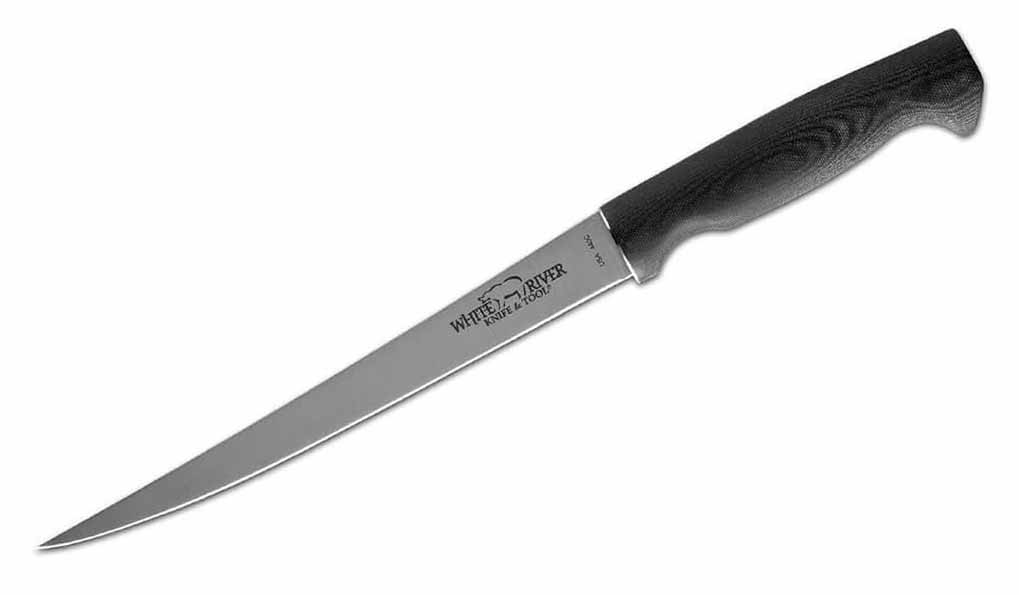
When you think of a fish knife, the White River Knife & Tool Traditional Fillet is probably what comes to mind. White River is excellent when it comes to delivering traditional appearance with modern function. I have been using White River knives almost exclusively in the field for years for deer hunting, and I jumped at the opportunity to look at its fillet knives. Not only are White River fillets some of the best money can buy, they also are the best across-the-board for general fishing use. Moreover, they display some noteworthy properties.

While there are two White Rivers in the review group, they are for all purposes the same except for the fact that the cork-handle version will float. I especially like this feature considering I spend some time in kayaks and canoes. A cork handle is not as durable as the full Micarta® version but will last a lifetime if properly maintained and not abused. The two are not for hunting. They are dedicated for fishing and should be used as such.

White River fillet knife
The White River fillets performed well for all general use.

As far as overall performance, the White Rivers will do everything you need and nothing you don’t. They are dedicated fillet knives that are, at least in the 6-inch size, best on intercontinental species. There really isn’t anything you can fish for in an American river that you can’t process with these knives. They are a tad thin for heavy-boned fish and the largest river catfish, but if you’re careful you should be just fine.

The knives come in an excellent wooden presentation box and have a functional, adjustable sheath with multiple mounting options. When sheathed, the blade can be used as a line cutter thanks to a small cutout toward the end that you can slip a line into. For dock work these knives are great. I eventually came to prefer the cork-handled version even though it is a little harder to keep clean. In the kitchen, they performed equally and stayed razor-sharp for the duration of testing.

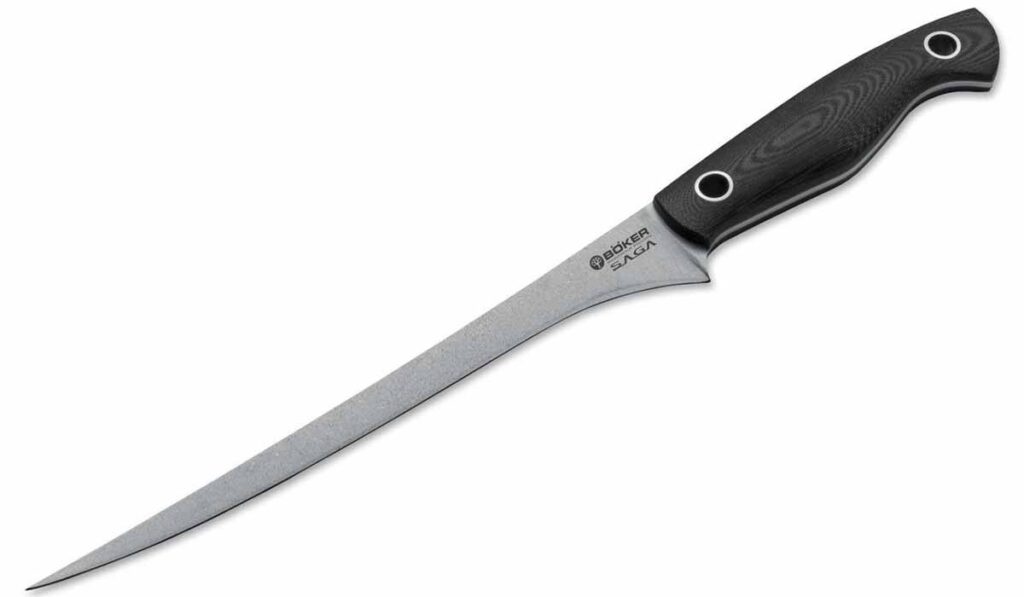
Boker Solingen Saga Filetiermesser

Fillet Knife Boker

From the moment you open the box, the quality of the Boker Solingen Saga Filetiermesser is immediately apparent. You can tell it was made with great attention to detail and is a singularly specialized tool. Unlike the other test models, it does not come with a sheath. It is also quite smooth in the grip and clearly meant for end processing in the kitchen.

It is the sharpest test blade and also the thinnest. The thickness at the choil is just .07 inch, and it tapers from grip to tip quite aggressively considering how thin it is to start. The tip is like a scalpel point. It is so incredibly fine that you must be aware of its presence when working. If you cut yourself with it, you probably wouldn’t even know. I didn’t.

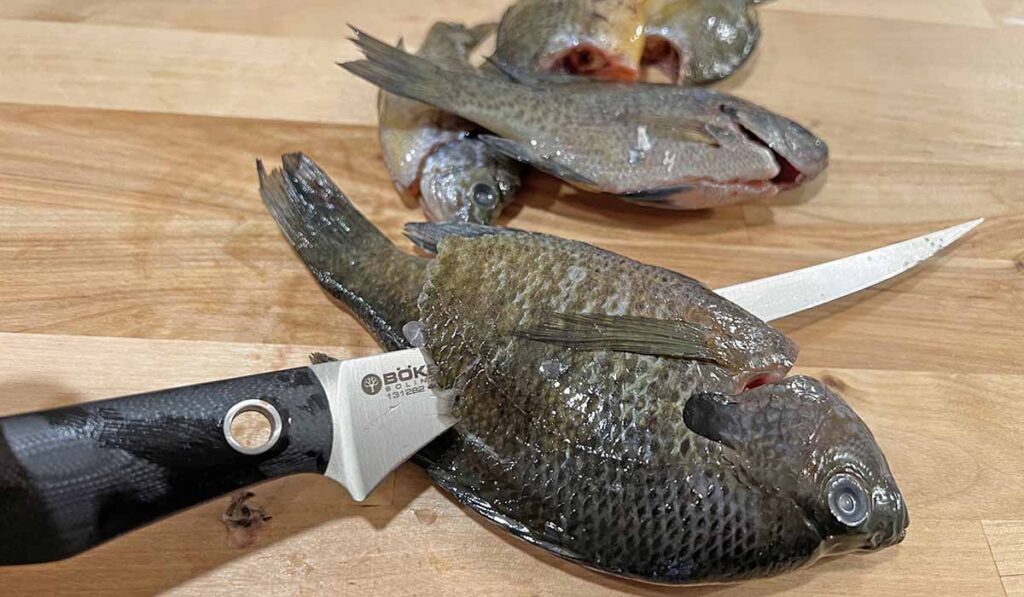
Boker Fillet knife
The Boker’s narrow edge makes it excellent on even the smallest catches.

Working with this knife in the kitchen is effortless. It is so sharp that it cut through all the fine bones in salmon; it simply glided right through. The blade is the most flexible in the review and bends quite a bit, though this is not a concern. The quality of steel and manufacture ensures it goes back to true even after substantial use. Because it has a smooth grip and is so incredibly fine at the tip, I would not immediately recommend the Boker for use in the field. If you decide to take it to camp, I would suggest either transporting it in a dedicated case or find a sheath that fits it.

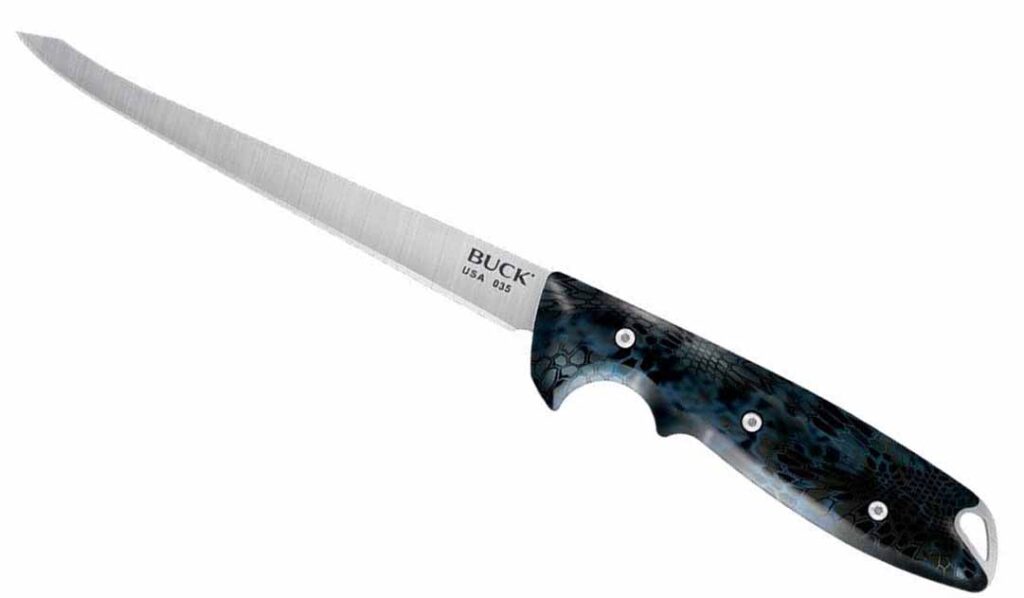
Buck Abyss

Fillet Knife Buck

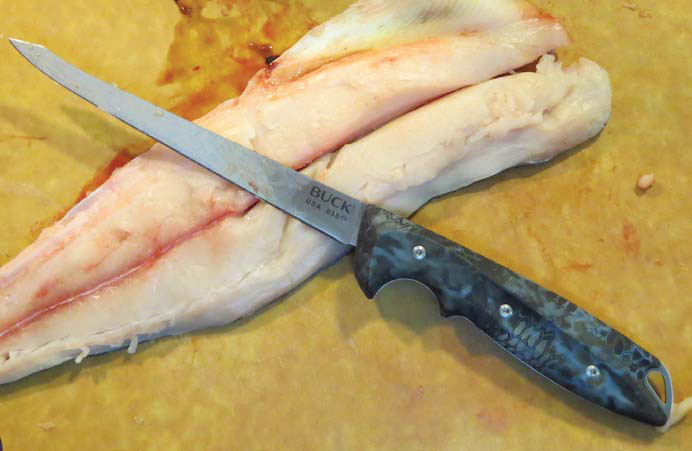
The Abyss is a fillet knife Buck brought a little style to by using a Kryptek Pontus camo handle. Normally you just get some kind of bright rubber but this handle has some style to it. Overall length is 12 inches and the blade measure 6.5 inches. Buck lists it as a 6-inch blade but I can tell you my tape measure isn’t broken.

The 420HC stainless steel blade features a double-ground tip and a distal taper. The double grind gives you an edge on the back of the tip to make puncturing and entry cuts easier. The distal taper gives the blade stiff ness toward the handle for use with large game fish. A more flexible tip area makes it useful for smaller fish. By using a distal taper, Buck can get away with having the Abyss straddle the fence between a stiff fillet knife and a flexible one.

The Kryptek scales have a slight texture but they also sport lateral contouring to aid in a secure grip. Sure, the Abyss does not have a super blade steel, but 420HC has been holding its own for years.
During testing the Abyss did fine for handling and cutting—in fact, I like the knife very much.

new fillet knives 2018
Buck’s Kryptek Pontus handle has style and utility. The appearance is somewhat reptilian and features a subtle texture. To add to the user friendliness, the contouring is well designed.

I would have to say my only doubts are about the sheath. Buck provides a simple pouch sheath with a plastic insert to carry the knife. Though I’m not planning any long adventures hauling it around with me, I still find the sheath lacking. Inserting and drawing the knife is a clumsy affair, as the fit is tight. I also find the material, in my opinion, not robust enough to take years of use.

Kershaw Folding Fillet K-Texture

Fillet Knife Kershaw

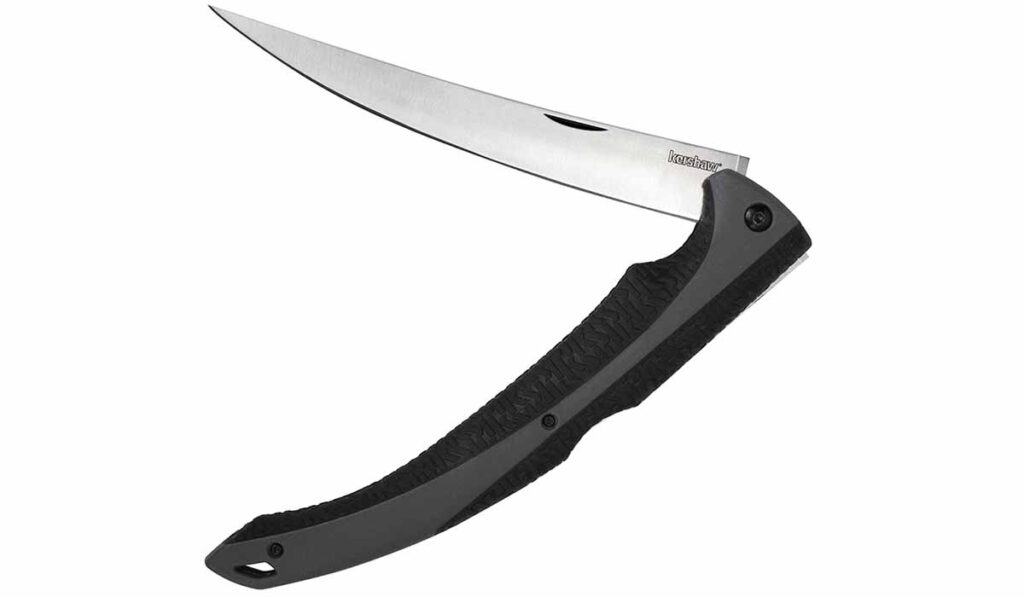
As with many folding fillet knives, the excessively large handle of the Kershaw Folding Fillet K-Texture tends to be disproportionate to the entire design. The 6-inch blade has a slight distal taper and is 420J2 stainless steel.

Even with a distal taper the blade has a mid-range flex—not really stiff but not very flexible, either. The lockback folder’s closed length is 7.75 inches. The knife does not come with a sheath.
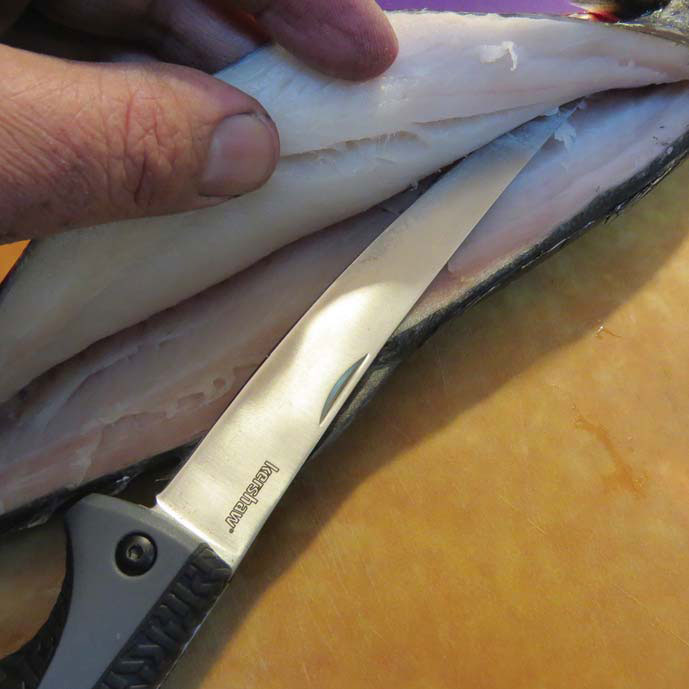
I like to test the blade’s edge right out of the box. One of the most difficult things to do with a knife, believe it or not, is put the first edge on the blade. To the best of my knowledge, with all the CNC machinery out there, this is an operation that is still predominantly done by hand. Out of the box, the Kershaw was razor sharp.

kershaw folding fillet knife
Kershaw’s fillet knife follows the spine bones for a perfect cut so you get the most from your catch.

Even before I took it fishing, I put it through some paces in the kitchen by skinning a tomato. I was impressed with the initial edge. Holding the knife is easy thanks to the duel-textured, or “K-Textured,” handle. The rubber has many small “K’s” patterned into it for the texture while the main plastic part of the scales is slightly textured. Accompanying the texture is an ergonomic handle, which seals the package.

Overall, I like the knife. It can be used for fishing under most any condition, but I see it as a great tool for fishing holes that require a long journey to access. The fact the knife folds gives you a fillet model in a smaller, safer and more convenient carry package.

Gerber Controller

Fillet Knife Gerber

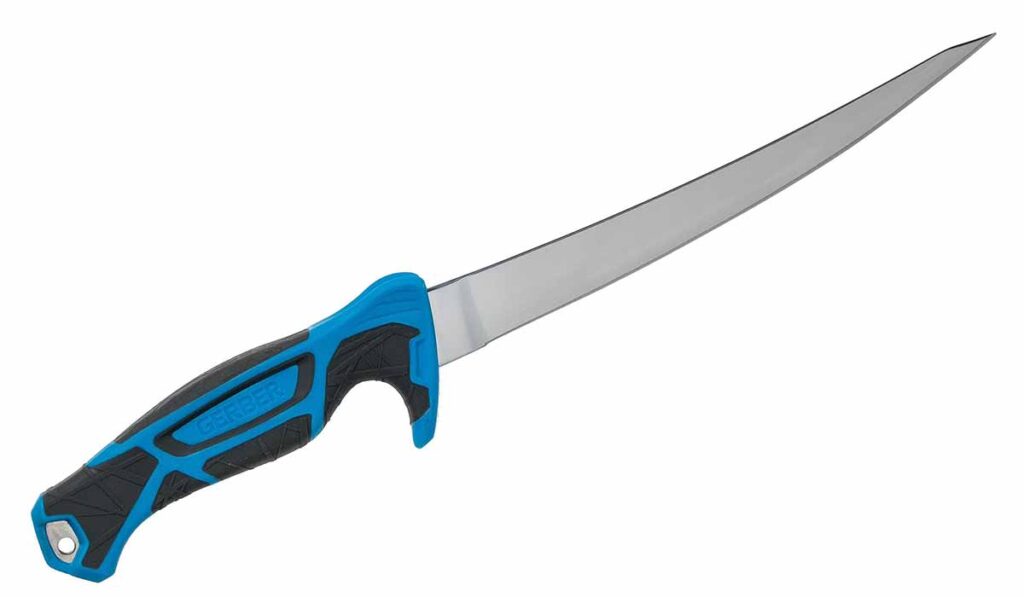
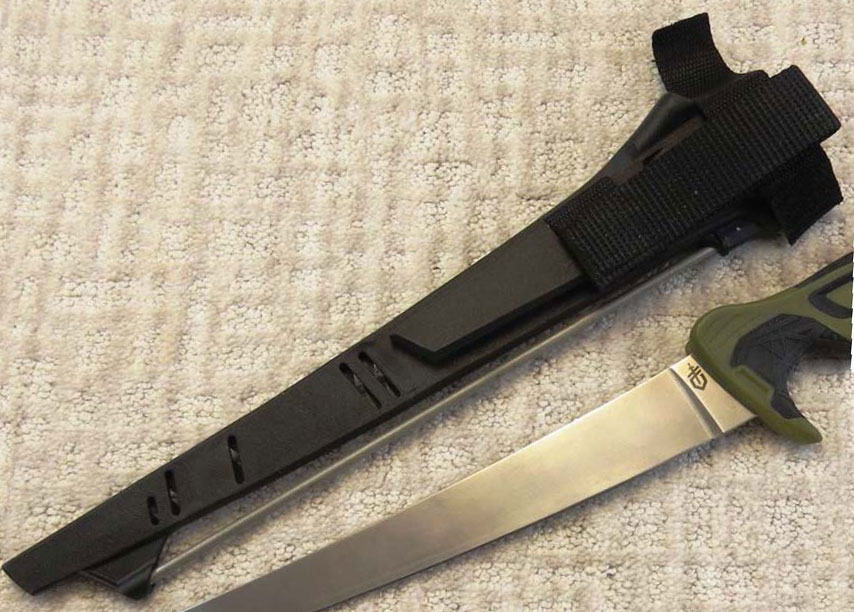
I am not in favor of loading a knife down with too many features. In the case of the Controller 10-inch fillet knife, Gerber has provided more than a knife but did not get carried away. The Controller is a full system fillet model. At 15.5 inches overall, it has a 10-inch blade of 9Cr18MoV stainless steel.

There are three knives in the series: the 10-inch and also 6- and 7-inch blades. I wish I had gotten the 6-inch model to test as well. All have a plastic molded sheath that provides secure carry and is puncture-resistant. Along the sheath’s body are multiple drainage points. On the sheath’s edge is a diamond rod sharpener for quick blade touch-ups.

best new fillet knives for fishermen
The Gerber Controller sheath features a diamond rod sharpener, plenty of drainage points and two carrying systems.

Here is where the devil is in the details. The sharpener is not fixed and can be rotated by hand so you won’t wear down one side of the diamond rod. The sheath impresses me. It comes with a nylon belt dangler and a clip molded in the back for belt carry. To finish it off they built in a natural thumb push-off that matches up with the handle. The knife clips into the sheath as well as having a fabric-fastener retaining loop.

If the sheath isn’t enough, Gerber hit it on the head with the knife. The handle consists of two materials: a hard plastic at the core and soft, textured rubber inlays at all the tactile points. The blade has a full flat grind with medium flexibility. The Controller sports the same style tip as the Buck Abyss except the edge is not ground back. I am very impressed with the whole system.

Editor’s Note: Josh Wayner contributed to this post.

Check Out More Outdoor Knives And Tools:

Butterfly Knife: Balisong Knives That Soar

To be competitive, today’s balisongs must excel at flipping as well as cutting.

It’s a focus of versatility. From the style of opening to the enthusiasts who perform a variety of maneuvers with it, blade exposed, the balisong/butterfly knife is an object of curiosity and fascination.

The original term for the subject knife, balisong, is a favorite of Lucas Cao, founder and president of Squid Industries, which produces the popular Tsunami balisong. “Butterfly is a great slang name that describes the mechanism,” he remarked, “but the word balisong has a rich cultural history behind it.”

James Hill
Flipping competitions have played a key role in the resurgence of the popularity of balisongs, especially among young enthusiasts. James Hill is an example of the latter. He won first prize of $1,000 at the West Coast Flipping Championship during BLADE Show West in Salt Lake City this past October.

With that observation in mind, the Tsunami is true to the Squid concepts of user accommodation. “Each knife we’ve created is on the basis of more variety while still offering a premium flipper experience no matter the price point,” Cao explained. “At the top of our ladder is the Tsunami, which we designed to embody peak performance and build quality.”

Squid Industries Tsunami

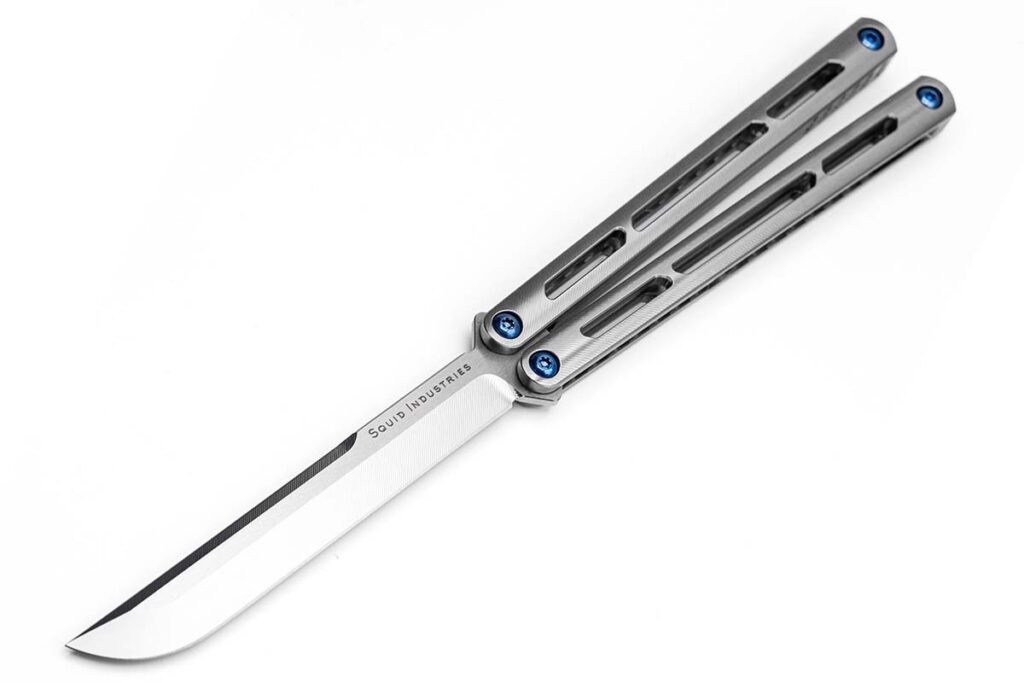
Tsunami balisong knife open
The Tsunami features a traditional Japanese-style tanto blade in a straight-back clip point and flat-ground CPM S35VN stainless steel.

The Tsunami features a traditional Japanese-style tanto blade in a straight-back clip point and flat ground CPM S35VN stainless steel intended to perform well across the spectrum of cutting requirements. However, the knife’s main constituency is the flipper community. “We serve a variety of customers with different requirements,” Lucas said, “but a majority of our customers are focused on the flipping aspect. If I had to estimate the customer desirability, I would say approximately 99 percent flipping and 1 percent cutting.”

The Tsunami employs a combination of bushings and phosphorous bronze washers in its mechanism, ensuring smooth deployment. “This is critical to flipping because it allows the user to consistently and reliably manipulate the knife,” he added. “Bearings aren’t used in our products and many other competitive balisongs from other brands because they produce a flipping experience that’s usually too smooth. Bushings are the preferred style because they offer a specific amount of smoothness and speed.”

Tsunami Butterfly Knife
The Tsunami reflects Squid Industries’ goal of offering balisongs that exhibit both variety and flipping fun, no matter the price. “At the top of our ladder is the Tsunami,” Squid’s Lucas Cao noted, “which we designed to embody peak performance and build quality.”

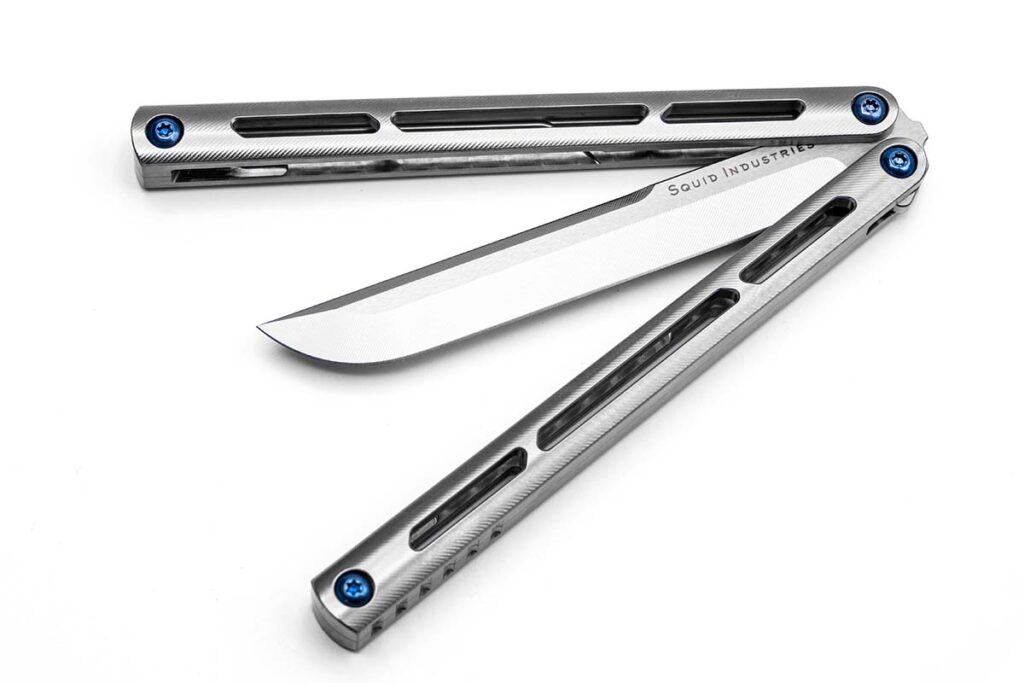
The Tsunami design is referred to as a “chainwich,” as its 6Al-4V titanium handles come together to mimic an integral grip. The handles themselves are designed with two specific tapers, one along the width and the other along the thickness. This dual taper design in combination with the rounding on the top create a comfortable and controllable feel in the hand, according to Cao.

Squid Industries Tsunami Specs
Blade Length: 4.5”
Blade Steel: CPM S35VN stainless
Blade Grind: Flat
Handle Material: 6Al-4V titanium
Latch: N/A
Pivot: Bushings and phosphorous bronze washers
Weight: 4 ozs.
Closed Length: 5.6”
Country of Origin: USA
MSRP: $775

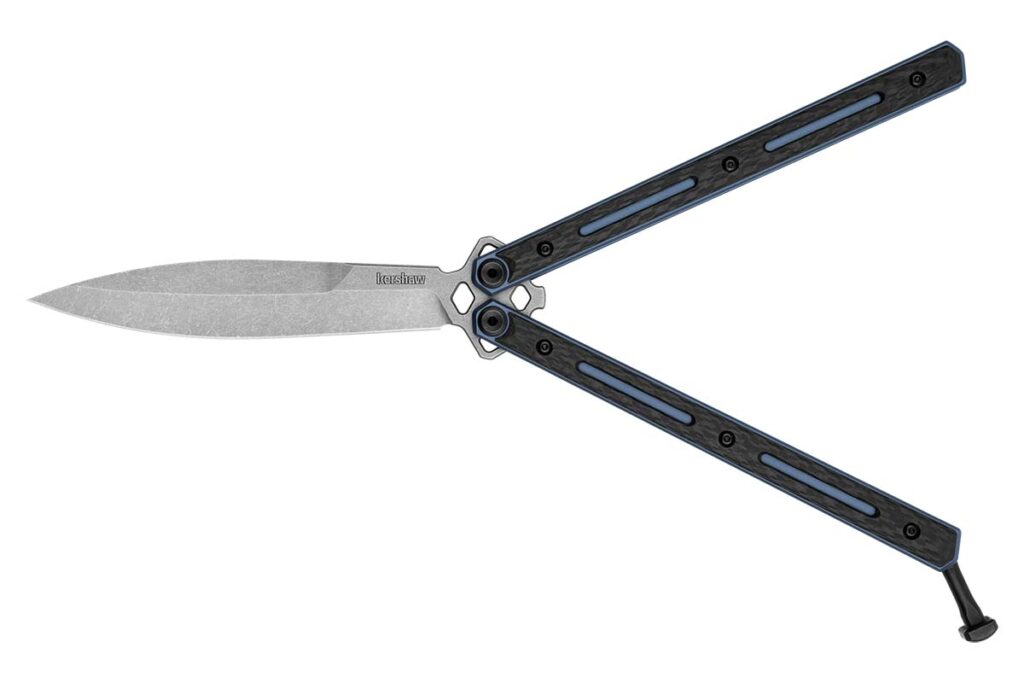
Kershaw Lucha Carbon Fiber

Kershaw’s Lucha Carbon Fiber Balisong
Kershaw’s Lucha Carbon Fiber is a premium edition of the company’s standard Lucha, including such high-end materials as CPM 20CV stainless blade steel and titanium handles with carbon fiber overlays.

The Kershaw Lucha Carbon Fiber’s spear-point blade of premium CPM 20CV stainless blade steel is ideal for piercing and slicing, while the “working” finish hides scratches from hard use. Company spokesperson Dominic Aiello related, “Our goal at Kershaw is to offer something for everyone, whether that be a budget-friendly knife you can abuse and lose all the way to a premium USA-made automatic. With that said, when we brought the original Lucha to the market, our goal was to offer a value packed, affordable, high-quality butterfly knife. It has been a huge hit and as a result we decided to release a premium version.”

Though the original emphasis on the practical use of the Lucha remains with cutting ability front and center, the knife illustrates the versatility inherent in the balisong style. “Of course, cutting is a critical component for any knife,” Aiello reasoned, “but with butterfly knives the flip ability, balance, and comfort are equally as important, if not more important. A lot of customers enjoy the Lucha for the fun and challenge of flipping, but there is also a segment of users that carry it as an EDC.”

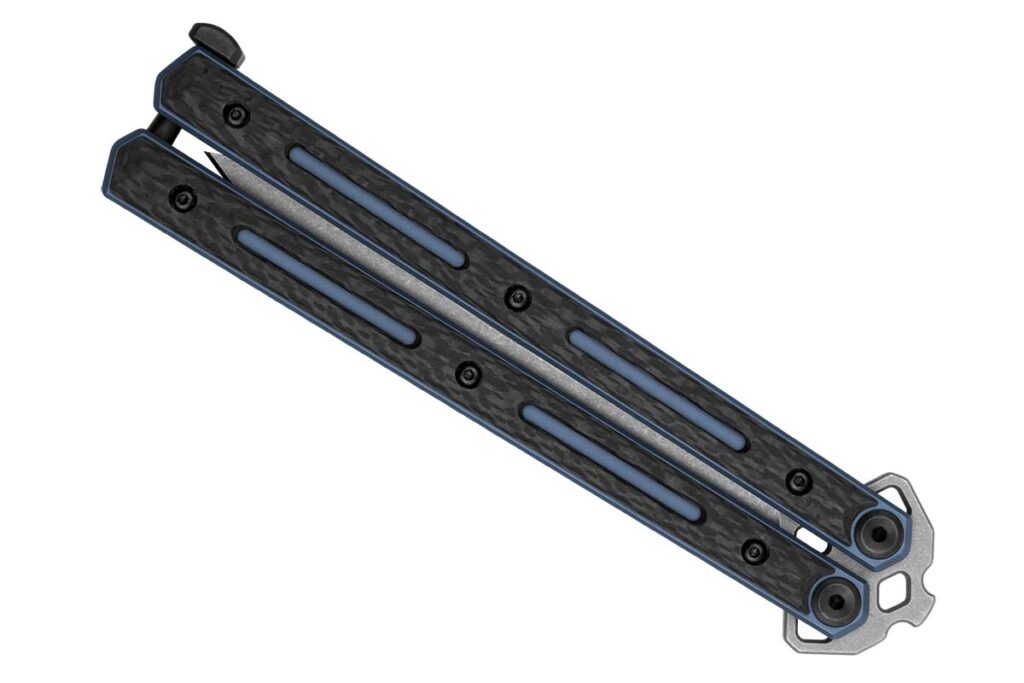
Lucha Carbon Fiber butterfly knife closed
The handles of the Lucha Carbon Fiber are titanium anodized blue overlaid with machined carbon fiber. The handles and carbon fiber are contoured for a rounded profile and ease of use.

The Lucha combines good looks with smooth mechanics and easy maintenance. “Each pivot uses two KVT ball bearings, four total,” Dominic commented. “The ball bearings provide an extremely fast and smooth action for easy flipping. The handles are blue anodized titanium with machined carbon fiber overlays. The handles and carbon fiber have been contoured for a rounded profile and ease of use.”

Kershaw Lucha Carbon Fiber Specs
Blade Length: 4.6”
Blade Steel: CPM 20CV stainless
Blade Grind: Flat
Handle Material: Titanium w/carbon-fiber overlay
Latch: Yes
Pivot: Ball bearings
Weight: 4.9 ozs.
Closed Length: 5.65”
Country of Origin: USA
MSRP: $423.99

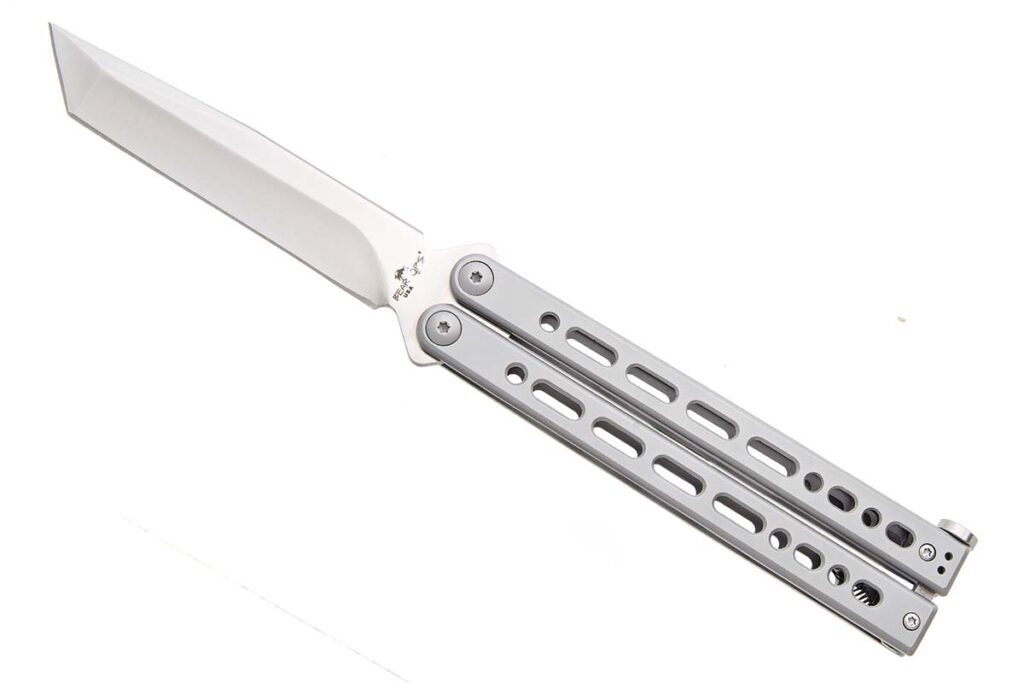
Bear & Son Cutlery Bear Song VIII

Bear Song VIII open
The Bear Song VIII includes a tanto-style blade in flat-ground 154CM stainless steel ideal for detailed cutting and general use.

Matt Griffey of Bear & Son Cutlery says the company has referred to the balisong as the “butterfly knife” since 1986. To that end, the company has continued to develop the famed flippers. With the release of the Bear Song VIII, the company’s design eye was fixed on a knife “being symmetrical and balanced, the most important design elements to start,” Griffey explained.

The Bear Song VIII includes a tanto-style blade in 154CM stainless steel, flat ground and ideal for fine cutting and general use. According to Griffey, the knife’s aptitude is 80 percent flipping and 20 percent cutting.

“A butterfly knife is the strongest folding knife, and as long as you are holding both handles it is as close to a fixed blade as possible for a folding knife,” Matt reasoned. “If the knife is maintained and tight there is almost no chance of lock failure. Maintenance should be just keeping it clean and oiled and checking it periodically to make sure it is not getting loose anywhere on the knife. If you find anything loose, remove the screw, and use Loctite® to replace the screw to the correct tension and let it set for at least twice as long as the thread locker recommends. We find they always give a time that is the bare minimum for the thread lock to work.”

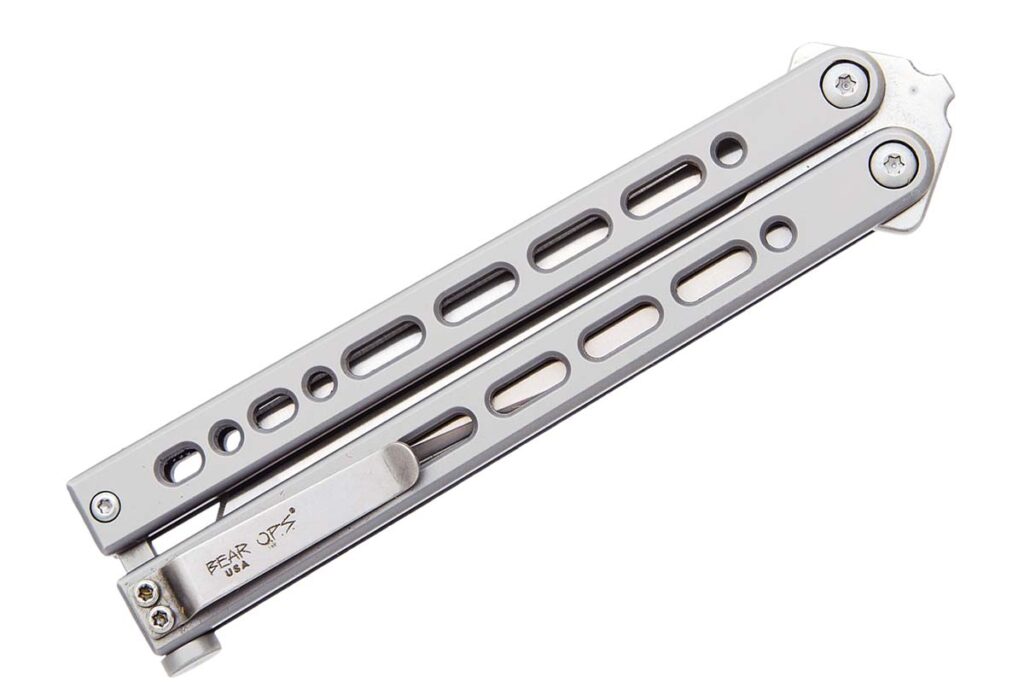
Bear Song VIII closed
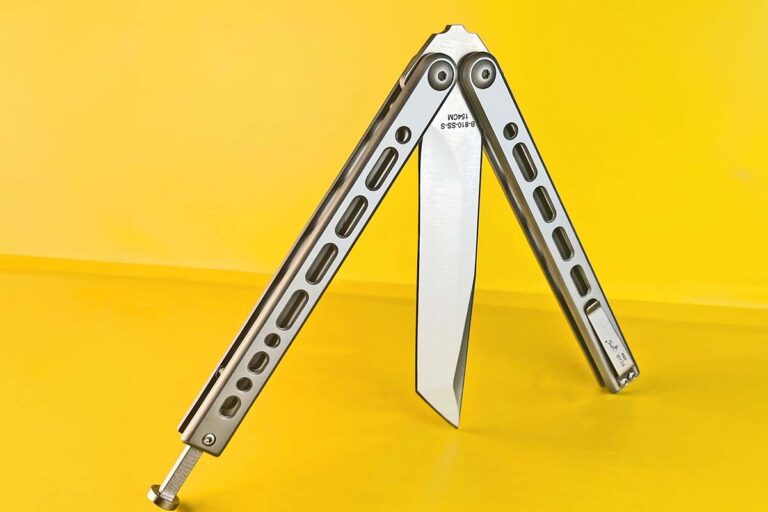
The Bear Song VIII sports stainless steel handles, rounded edges, and milled stepped holes and slots for user comfort. A spring-loaded locking latch and a stainless-steel pocket clip in a short design for easy carry and that can be removed if the user chooses completes the package.

In light of simple maintenance, the Bear Song VIII features an encased bearing design that is easily lubricated, while stainless steel handles, rounded edges, and milled stepped holes and slots provide user comfort. A spring-loaded locking latch makes operation a pleasure. A stainless-steel clip is in a short design for easy carry and can be removed if the user chooses.

“The Bear Song VIII has all the modern features with the timeless classic look,” noted Griffey, who sees the recent legislation regarding butterfly knives as positive (see sidebar). “Butterflies are far slower to open than a modern knife with a flipper on the blade that doesn’t have any spring mechanism. So anyone wasting time in their legislation to target this is just trying to fill time so they don’t have to do any work that might help the people they were elected to serve.”

Bear & Son Bear Song VIII Specs
Blade Length: 4”
Blade Steel: 154CM stainless
Blade Grind: Flat
Handle Material: Stainless steel w/Cerakote® finish
Latch: Spring loaded
Pivot: Ball-bearing washers
Weight: 5.1 ozs.
Closed Length: 5.25”
Country of Origin: USA
MSRP: $182.99

Butterfly Knife History

Butterfly knives, also known as balisongs, are one of the most popular knife styles today. They consist of a blade with two handles that rotate around a pivot and wrap around the blade in the closed position. That much is agreed upon. The origin of butterfly knives is still up for debate.

Where Were Butterfly Knives Invented?

Butterfly knives have a rich history, though much of it has been left up to speculation. Walk up to a knife enthusiast and ask, “Where did butterfly knives originate?” and you may get two very different answers.

Fuzzy historical records and well worn legends are to blame. The two main countries of focus are France and the Philippines. Each has evidence and supporters.

One Version: Butterfly Knives Came from the Philippines

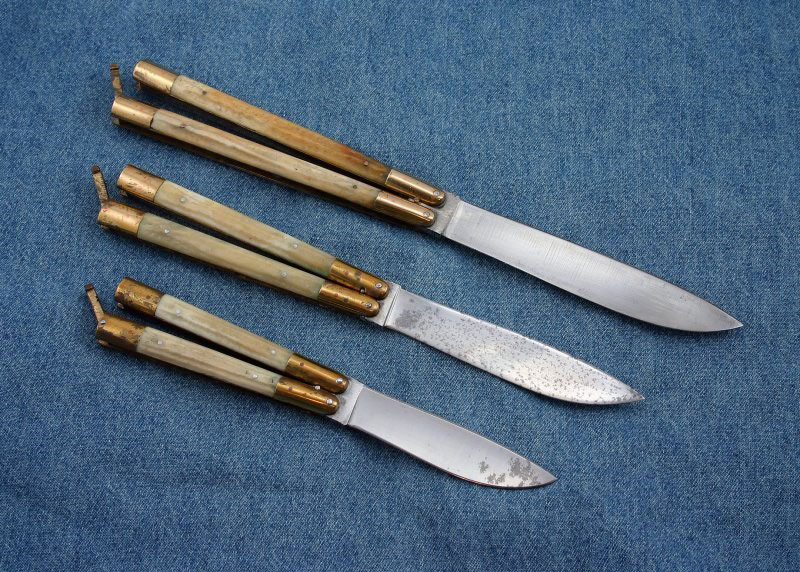
Balisong knife history
Authentic Filipino balisongs (Image from Balislinger on bladeforums.com)

The Philippines is often cited as the birthplace of butterfly knives, where “balisong” is a more appropriate term. Legend has it that the balisong knife has roots that go back to around 800 AD. This style of knife could be opened quickly with one hand and easily used as a weapon. It proved a common choice for self-defense and utility uses.

A rich balisong tradition has been present in the Philippines for more than a century. Countless stands and stores sell handmade butterfly knives today, and Filipino province of Batangas and the area of Balisong in Taal are known for the blades.

At the very least, the word “balisong” is widely recognized to have come from there. That said, the lack of physical evidence to support a Filipino origin fuels the argument.

Another Version: Butterfly Knives Came from France

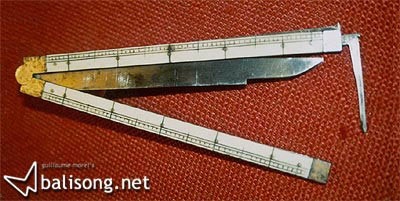
Pied Du Roi history
A vintage example of the Pied Du Roi. (Image from balisong.net)

Another claim is that the butterfly knife was invented in France between 1500 and 1700. The reason for this is the “Pied Du Roi,” which means “foot of the king” and is a French measurement tool that dates to the 1700s. The “Pied Du Roi” greatly resembles a butterfly knife. This tool has been pictured with measurement handles and a blade that folds out on one end. It looks like a butterfly knife, but could it be considered the first one ever made?

Proponents of the French origin argue that Spain, allied with France at the time, adopted the butterfly knife in their tasks and eventually took it to the Philippines as sailors sailed to different countries. Sounds reasonable, but hasn’t been proven.

Another supporting argument for the French is that these knives comes from Germany and England, where some butterflies can trace back to prior to 1900. I recently came across a collector’s piece online made in England with markings dating to 1873. This rules out the butterfly knife originating in the early 1900s in the Philippines, but like I said earlier, it has also been claimed to be influenced from similar Filipino knife models as early as 800 AD.

So Where Did Butterfly Knives Actually Come From?

Due to the popularity of balisongs in the Philippines, it isn’t surprising to suspect it started there. The lore passed down from generation to generation also support this idea.

On the other hand, France has pictures and documentation of a measurement device that resembles a butterfly knife and dates back hundreds of years. However, that measurement device likely wasn’t used for self-defense, flipping, or other tasks common to butterfly knives today. Could it be considered the same thing? Hard to tell.

Both sides have great arguments. More information is needed to finally determine this unsolved piece of butterfly knife history.

Butterfly Knives Today
Regardless of history, butterfly knives are rising in popularity due to the fun of “flipping.” Flipping involves tossing butterfly knives open to perform all kinds of tricks. Whether it’s the danger of it, the community, the collectible appeal, or anything else, there’s no doubt flippers are mesmerizing to watch.

Editor’s Note: Mike Haskew and Trevor Brown contributed to this article.

Read More On Butterfly Knives:

Case Axe Handle Lockback: Ruple Colabs With Case For First Time

First Case/Ruple collaboration officially debuts at BLADE Show ’24.

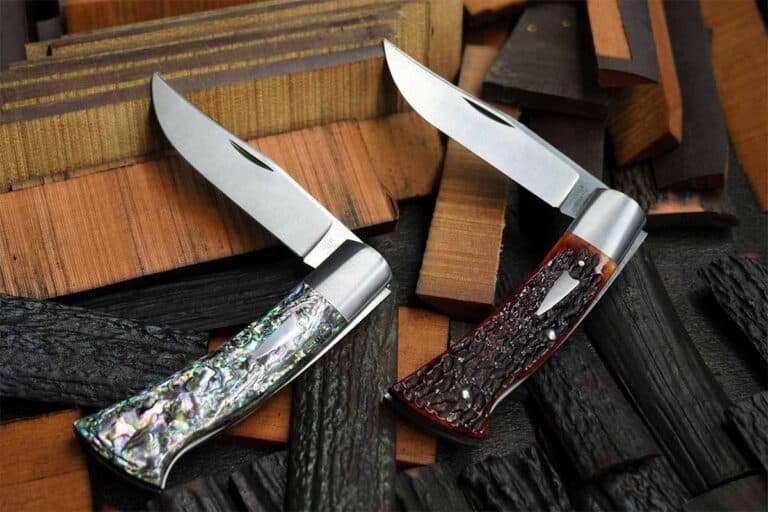
The combination of mechanical features, artistic design and choice of handle materials make the Bill Ruple x Case Axe Handle collaboration a unique knife for the user and collector.

Case Knives and BLADE Magazine Cutlery Hall-of-Fame® member Bill Ruple didn’t just bump into each other at the convenience store one day and say, “Hey, let’s do a knife collaboration.” That alone likely would have led to a great pocketknife, but no, there was a lot more planning and history that went into this new joint venture. We’ll talk about some of that but first let’s talk about the knife itself. It’s got some special character.

Case Axe Handle Design

Despite both being giants in the slipjoint field, Bill and Case sifted through some ideas and came up with a lockback pattern for an initial collaboration. It was not just one part but several features Bill combined together to make this knife unique.

Bill Ruple
Preeminent member of the Texas Slip Joint Cartel, Ruple more than understands what makes a good slippy.

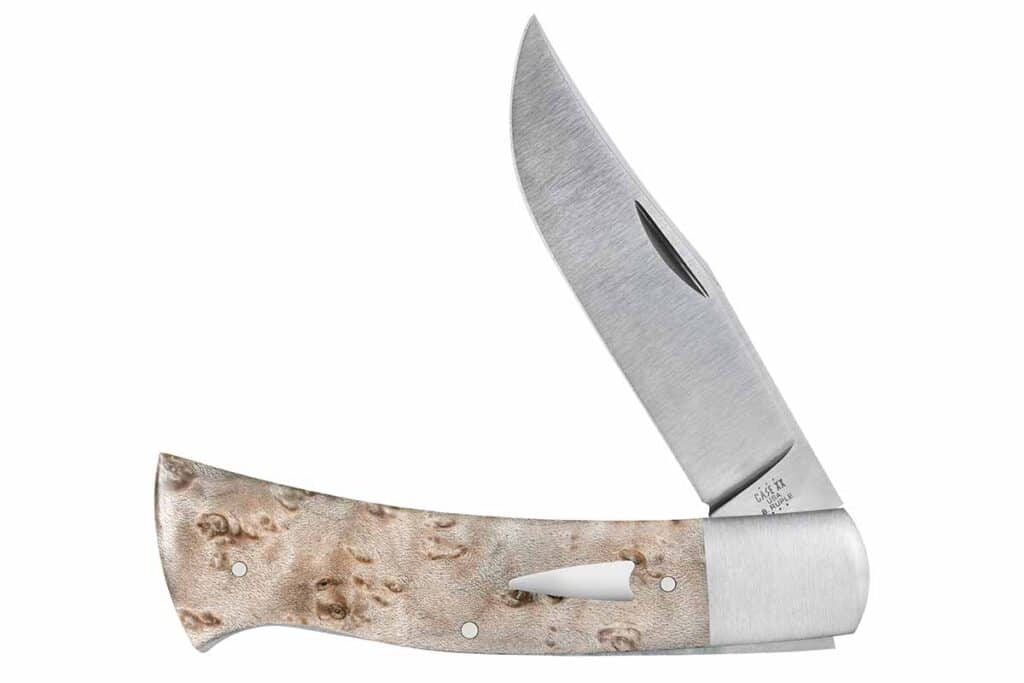
As a man who had farmed the soil, he noted the end of the knife resembled the shape of an axe handle, thus the name. The upward curve of the handle butt provides some useful ergonomics but also strategically holds the tail of the lockbar. In this location, there is resistance to accidental unlocking of the blade while it’s in the open position. As well, it eliminates the need for a thumb cutout in the handle to release the blade. With an upward curve partially concealing the lockbar plus the absence of a thumb cutout, the handle makes the knife appear not to be a lockback pattern at all. In fact, since at first glance it seems to be a slipjoint, it has a bit of the trick-knife or mystery-lock character.

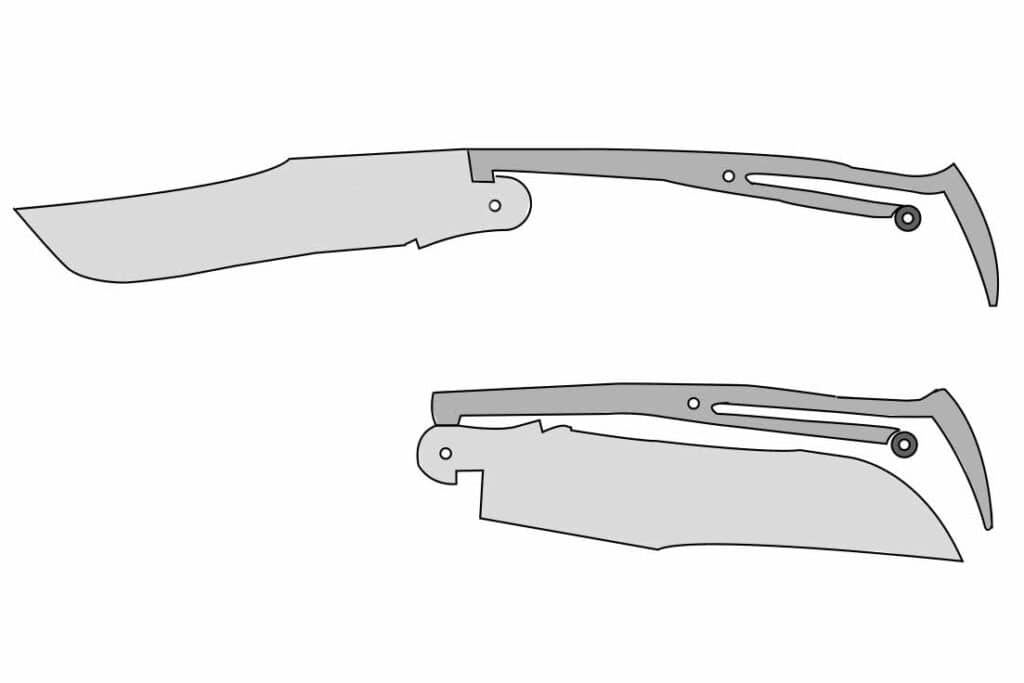
Initial prototyping by Bill in his shop hit a snag in that the slipjoint knives he’s used to creating have a rear bolster. That did not fit the artistic design for the new collaboration. However, Bill cleverly overcame the so-called snag by using a feature called a scissor spring (see illustration, page 40), which rests on a bushing to provide the needed tension to work the lockbar. Bill has prototyped knives for Case and also assisted with some aspects of manufacturing just as his Case collaboration predecessor, mentor, very close friend and fellow Cutlery Hall of Famer, Tony Bose, had done. Bill stated that nobody could replace Tony Bose and Case misses him. (Don’t be at all surprised if Case makes a commemorative knife in honor of Tony in the future.)

Bill Ruple's design drawning of the Case Axhandle
A few notes on Ruple’s design, the scissor spring (rear top right) is an efficient use of space with a one-piece unit of lockbar and spring. The bushing (lower fork of the spring), the spring rides on this avoiding excessive wear and taking up less room. It also acts as a rear spacer.

Both Case officials and Bill say Tony would be pleased with the new collaborative effort. The initial run will be 1,000 knives. Then the model will be made in a traditional slipjoint pattern. There is an aim at “near custom maker quality” for the first run, glibly naming the process “almost custom,” beginning with the parts being wire cut. That’s the cool way to say electrical discharge machining, or EDM. Production is assigned to a specific group of three workers only. No one else will work on the knives. That sort of consistency helps maintain quality control in manufacturing the knives.

MORE TO COME
Is this collaboration just an outlier or will there be more Case/Ruple lockbacks in the future? Interest in the knife at BLADE Show 2024 (page 26), where the knife was officially introduced, was quite favorable. Both Bill and Case officials were pleased with how things have turned out, so expect to see another collaboration introduced at next year’s BLADE Show. That knife likely will be a slipjoint. Another lockback might be seen in the future, though a bit further down the road.

The Axe Handle with the birdseye maple handle
Natural birdseye maple is one of but several handle material options on the new Bill Ruple x Case Axe Handle.

As collaborative efforts go between manufacturer and custom maker, the Axe Handle knife is a superlative effort. And there is strong motivation to produce more collaborations, both commemorative and unique.

Ruple’s First Case

Does BLADE Magazine Cutlery Hall-of-Fame® member Bill Ruple remember his first Case knife? Is Texas big?

“Oh yeah,” the good-natured, award-winning knifemaker and South Texas Slipjoint Cartel trail boss said. “My dad gave me a Case knife when I was 9 or 10 years old, and it was a yellow handle Case trapper. And man, in about a month I had sharpened the blades completely out of that knife. And he gave me another one, and so he told me not to sharpen it quite as often. But yeah, a long time ago.”

Case Axe Handle Specs
Knife type: Lockback
Designer: BLADE Magazine Cutlery Hall-of-Fame® member Bill Ruple
Blade length: 3.46”
Blade material options: Wire-cut 154CM stainless steel or damascus
Rockwell hardness: 57-59 HRC
Blade grind: Flat taper
Blade @ thickest: .126”
Blade pattern: Clip point
Blade finish: Satin
Handle material options: Natural birdseye maple, Rogers jig chestnut bone, standard jig antique bone, marbled black carbon fiber, abalone, English walnut
Lock: Lockback
Opener: Nail nick
Pocket clip: None
Weight: 4.21 ozs.
Closed length: 4.4”
Carry: Suede leather taco pouch
Special features: One-piece designed backspring & lock mechanism.
Country of origin: USA
MSRP: $599.99 to $774.99
Available: Late Summer 2024

More On Case Knives:

Balisong Knives: Top Butterfly Knives That Fly High

0

Factory balisongs reflect advances in steels, pivot action, designs and more.

The balisong has become a global symbol of precision and cutting-edge design, with Benchmade, Boker Plus, Schrade and Squid Industries among those pushing the boundaries of the knife’s craftsmanship. Incorporating high-quality steel alloys, handle materials and the smoothest in pivot technology have elevated the four companies’ latest balisongs—aka butterfly knives—and those of others as well to new heights of performance and aesthetics.

Boker Plus Papillon

The Papillon’s skeletonized scales combine aesthetics and function and reduce weight.

Inked Tanto Krake Raken Specs
Blade Length: 4.5”
Blade Steel: AEB-L stainless
Blade Grind: Flat
Blade @Thickest: .12”
Blade Finish: DLC (Diamond Like Coating)
Handle Material: Aluminum
Weight: 4.33 ozs.
Closed Length: 5.625”
Country of Origin: USA
MSRP: $295

Pros

  • Smooth Deployment
  • Lightweight Handle
  • Practical Finish

Cons

  • Potential Cleaning

The Boker Plus Papillon is a contemporary take on the classic balisong, blending traditional design with advanced materials and engineering. The skeletonized stainless steel handles, finished with a bead blast, provide a comfortable and secure grip, even during extended use. The heart of the knife is the blade of D2, a tool steel renowned for exceptional edge retention and durability. The stonewashed finish enhances the blade’s aesthetic appeal and corrosion resistance. The dimpled ricasso, a distinctive feature of the Papillon, adds to its tactical look and feel.

The ball-bearing mechanism ensures smooth and effortless blade deployment, a hallmark of high-quality balisongs. Overall construction is robust, designed to withstand the rigors of everyday carry and occasional tactical use. In short, the Papillon balances portability and functionality.

Schrade Alkemyst

The Alkemyst features an innovative spring-loaded latch on the bite handle, providing a user-friendly experience.

Alkemyst Specs
Blade Length: 4.5”
Blade Material: D2 tool steel
Blade Grind: Flat
Blade @Thickest: .12”
Blade Finish: Bead blast
Handle Material: Stainless steel
Weight: 4.1 ozs.
Closed Length: 5.25”
Country of Origin: USA
MSRP: $164.99

Pros

  • Good Action
  • Durable Finish
  • Lightweight

Cons

  • Small(ish)

Striking a balance of size and cutting power, the Schrade Alkemyst is a high-performance butterfly knife designed for beginners and experienced flippers. The sleek milled stainless handles reduce weight without sacrificing strength, making the knife easier to handle during extended use. The precision-engineered ball-bearing pivot system allows for smooth, effortless blade deployment. At the same time, the innovative spring-loaded latch on the bite handle provides a user-friendly experience. The Alkemyst is lightweight and portable, featuring a bead-blast finish for added corrosion resistance.

Squid Industries Inked Tanto Krake Raken

The author plays with the Squid Industries Inked Tanto Krake Raken. The redesigned bushing/washer system reduces blade play for ultra-smooth flipping action.

Inked Tanto Krake Raken Specs
Blade Length: 4.5”
Blade Steel: AEB-L stainless
Blade Grind: Flat
Blade @Thickest: .12”
Blade Finish: DLC (Diamond Like Coating)
Handle Material: Aluminum
Weight: 4.33 ozs.
Closed Length: 5.625”
Country of Origin: USA
MSRP: $295

Pros

  • Enhanced Grip
  • Excellent Blade
  • Good Flipper

Cons

  • Cutting Performance

The Squid Industries Inked Tanto Krake Raken is an exceptional blend of exact engineering and aesthetic craftsmanship. Upgraded for enhanced performance, it features deeper milling on the handles and substantial gimping for a superior grip. The handles are lightweight, channel-constructed 7075 aluminum, ensuring resilience and comfort. The highly anticipated Inked-DLC-coated tanto blade, crafted from AEB-L stainless steel, offers outstanding cutting performance, while the redesigned bushing/washer system reduces blade play for ultra-smooth flipping action. The knife is perfectly balanced for flipping and cutting tasks, making it a must-have for enthusiasts seeking reliability and style.

Benchmade 99 Necron

You can fine-tune the Necron’s balance and speed with adjustable tungsten weights and extendable handles.

99 Necron Specs
Blade Length: 4.59”
Blade Steel: CPM S30V stainless
Rockwell hardness: 58-60 HRC
Blade Grind: Flat
Blade @Thickest: .124”
Blade Finish: Satin
Handle Material: G-10
Weight: 4.21 ozs.
Closed length: 5.08”
Country of Origin: USA
MSRP: $500

Pros

  • Customizable
  • Latchless Handle
  • Good Looking

Cons

  • Expensive

The Benchmade 99 Necron is a high-performance butterfly knife designed for expert flippers and enthusiasts alike. The knife pays homage to Benchmade’s roots with the company’s classic trademark “Bali-Song” logo and adds modern features for enhanced performance.

The Necron has latchless G-10 handles and a scimitar-shaped blade, available in two customizable variants. You can fine-tune the knife’s balance and speed with adjustable tungsten weights and extendable handles. The knife boasts either jade or ruby red handles. The safe handle bears a hollow diamond texture, providing a tactile indication for users to avoid accidental blade contact. The Necron has a nylon sheath for secure storage.

Balisong Cuting Tests

In terms of blade patterns, the Krake Raken (left) with its tanto and Necron (right) with the scimitar contrast with the more traditional modified drop and harpoon patterns of the Alkemyst and Papillon, respectively.

I put the balisongs through the cutting board gauntlet that I use with most utility blades. Leather, wire, cardboard, heavy-duty tow strapping, paracord, nylon webbing and light-gauge tin were on the menu. However, it all started with plastic foam packaging peanuts.

Balisongs are used for all sorts of tasks, but with more flare. I started on the foam peanuts and moved on to various fibrous materials. The delicate peanuts told the tale of the tape. While all the blades completed the task, the Necron was on top from the start.

Each bali cut through the materials with a few setbacks. The tin showed a clear winner as the Krake Raken’s penetration scored on a colossal level, though the Alkemyst did very well due to its swedge and thinner stock.

Cardboard was tricky. The Alkemyst never made it through the box cardboard or paper towel roll. The Necron and Papillon sliced quickly, while the Raken was somewhere in between. The trend continued with the tow strapping and nylon webbing.

It was undeniable: the Necron, Papillon, Raken and Alkemyst sliced best, in that order.

Balisong Flipping Tests

The pivot systems of the four test balis are designed for a seamless combination of strength and fluidity.

Flipping each review bali had me picking a new favorite each time I switched them out, so don’t expect me to choose a favorite. I admit I was rusty as I hadn’t practiced in a while, but it was still fun.

I liked the weight and the way the Papillon flipped from the get-go. The latch helped with peace of mind in transport, as did the nylon carrying case. The skeletonized handle felt secure, made for a positive grip, and helped me confidently stop the action. It was smooth, solid and sharp as heck.

The Schrade Alkemyst was the smallest and lightest of the test flippers. It felt a tad slower due to the weight and handle length. Nonetheless, getting used to what you have is key. The spring-loaded latch on the bite handle is designed for convenience, ensuring a distraction-free flipping experience. The ball-bearing pivot system promoted smooth, effortless blade deployment.

A latch can add weight and create an imbalance in a bali, affecting handling during flips and tricks. In comparison, a latchless design offers enhanced balance and symmetry. The Squid Industries Inked Tanto Krake Raken and Benchmade 99 Necron are two examples of the latter.

It takes a while to manipulate the Inked Tanto Krake Raken as smoothly as possible, but it’s worth the time. I had to get used to not having a latch, as all my balis from the Philippines had them. However, I could tell the difference. Try it out for yourself.

After several years without offering a balisong, the 99 Necron is Benchmade’s first in nearly four years. I had to get accustomed to the feel, which is probably best. The action was smooth despite the lack of bushings—washers only for this one.

Ultimately, use what you like. Most balisong enthusiasts will weigh flipping over cutting. Try as many balis as possible to arrive at your favorite.

Read More On Butterfly Knives:

Advertisement

Must Read Articles

Read this before you make a knife

Knifemaking 101 – Read This Before You Make a Knife

  by Wayne Goddard My experience has taught me that there's nothing like digging in and getting started. I've often said the hardest part of the...
how to forge damascus steel

How to Forge Damascus

Advertisement
Advertisement