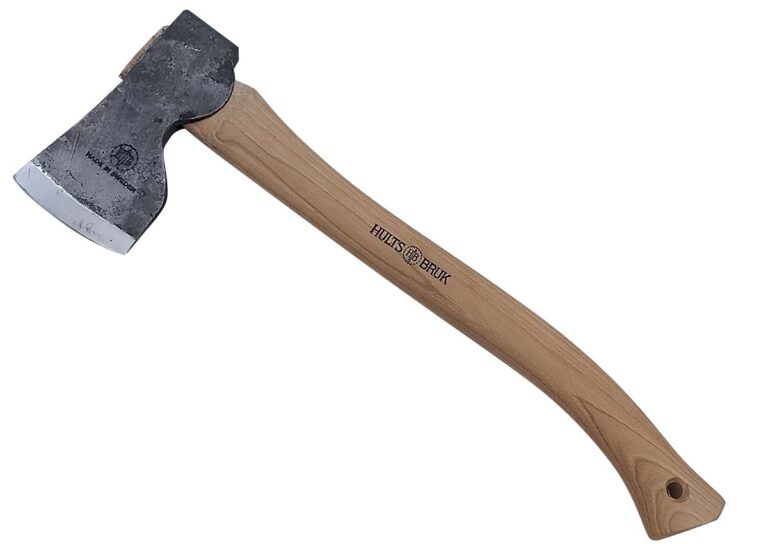
Sweden’s Hult Bruks Spika is a great all-purpose camping axe.
Most outdoorsmen use axes and hatchets—axes for chopping trees and splitting firewood, hatchets for lighter work. Axes were normally too big to carry backpacking, so we always settled on using a hatchet and made do. Some of us would cut the handle down of an axe to make it more manageable. Now, with the help of the internet, we’re able to see what other outdoorsmen use. The Spika from Hults Bruk of Sweden is the perfect size to handle most all axe chores and still be manageable to carry.
Spika Specs
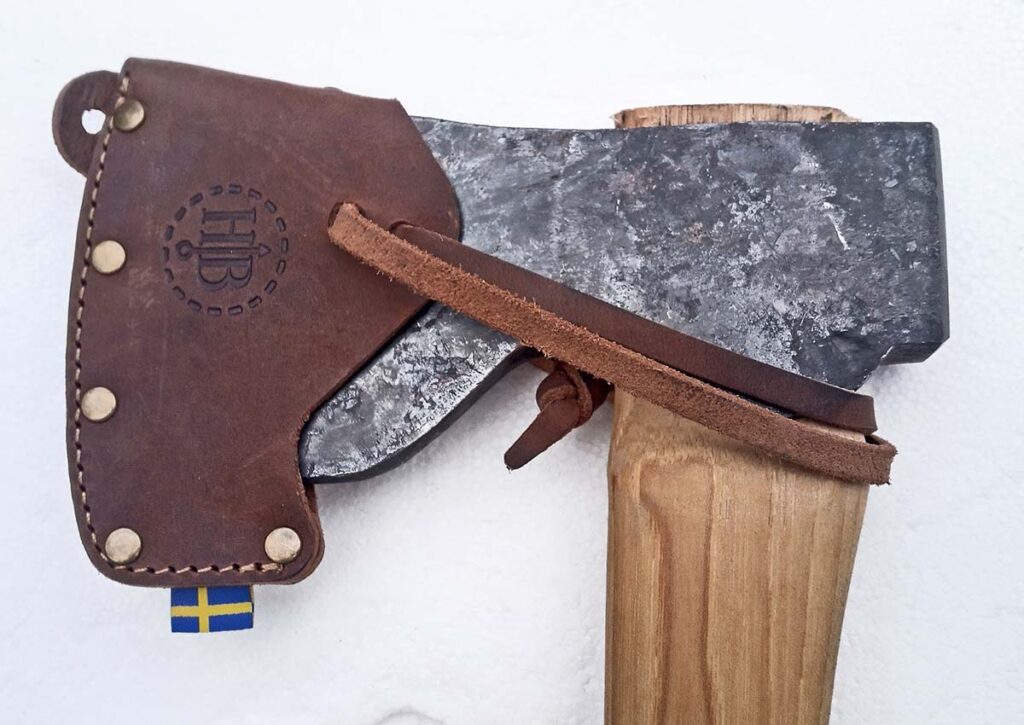
The leather edge cover is a strap-on model.
Pros
Perfect Mid-Size for Versatility
Razor-Sharp Edge
Forged Finger Notch for Control
Cons
Uncomfortable Ridge at the Choil
Price May Be High for Casual Users
Model: Spika all-purpose axe Company: Hults Bruk Edge length: 3” Head & edge material: Forged carbon steel Handle: Hickory Overall weight: 2 lbs. 5/32 oz. Overall length: 17.5” Sheath: Leather edge cover w/strap-on thong Country of origin: Sweden MSRP: $206
Light-Duty Cutting
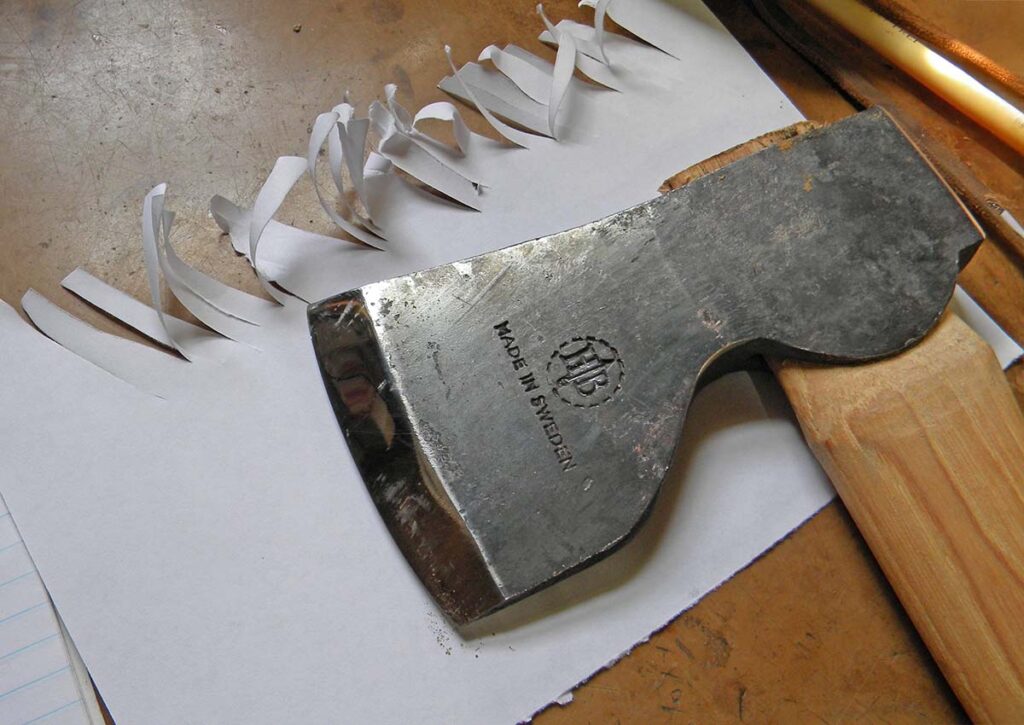
The Spika sliced the 20-pound bond paper like a champ.
I just had to do a paper slice because the Spika felt wicked sharp. It was challenging to get started but the Spika sliced the 20-pound bond paper like a champ. I choked up on the head and used push cuts. The first slice included a piece of my fingernail. Wow, this is a sharp axe! It was loud while slicing, that is, the sound of paper being cut.
Single-walled cardboard slicing was next. It was easier than the paper to hold and move my fingers out of the way. The Spika was surprisingly easy to control as there is a forged-out finger notch to aid in choking up on the head for finer work. The axe made the cardboard curl up, which makes great fire starter. Again, I used the push cut. I was slowly getting used to this mid-sized axe. I still had to account for the longer handle.
Medium-Duty Cutting
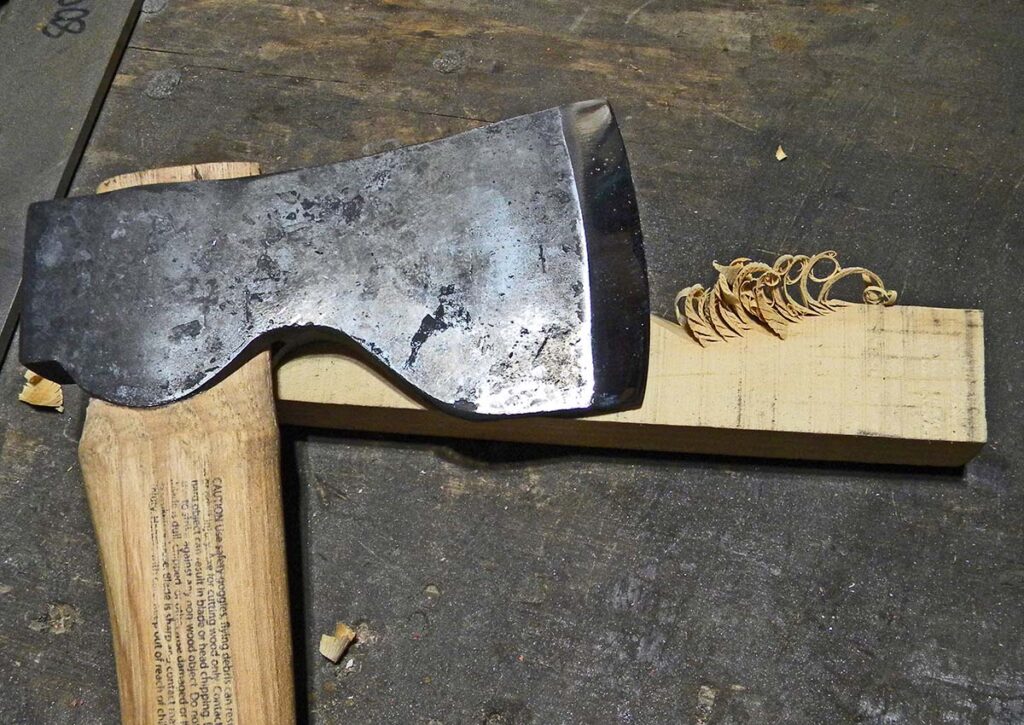
The super sharp edge rendered some very nice, smooth curlicues.
It was time to do some whittling on pine. The Spika was very controllable on the depth of the cut. The super sharp edge rendered some very nice, smooth curlicues. I did notice a sharp ridge on the choil area that needed to be softened if you are using bare hands. A few passes on a Kraton wheel made it easier on my index finger.
Chopping
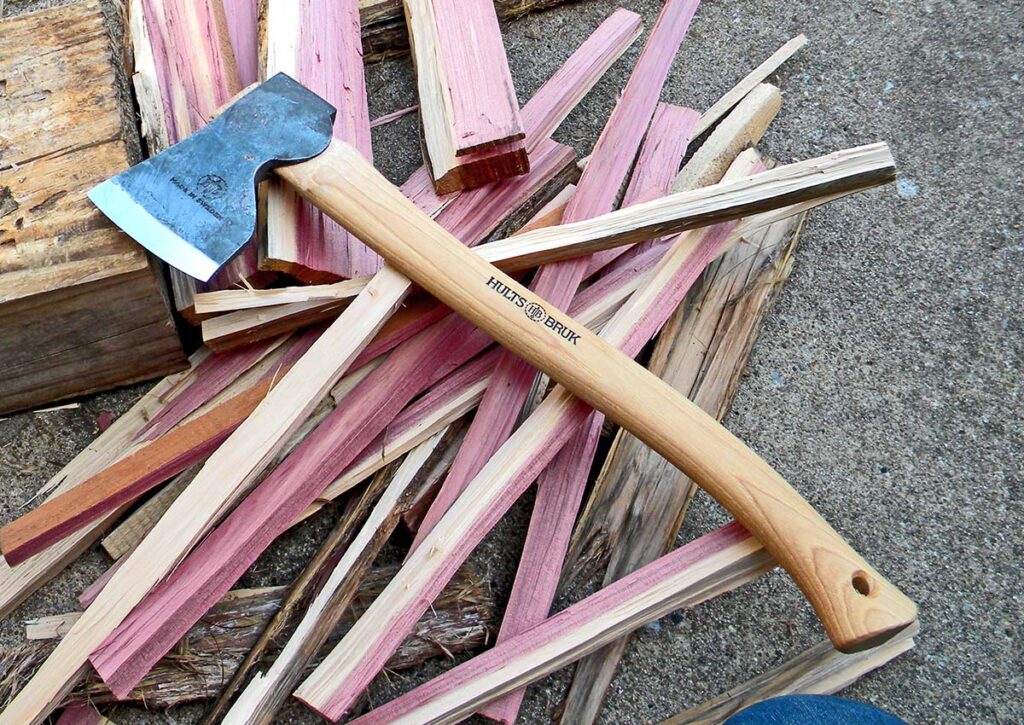
The Spika split one red cedar slab in one chop. The author kept on splitting till he had a nice pile of kindling.
With camping season kicking off, I had some red cedar slabs that needed splitting. The Spika split one in one chop. I kept on splitting till I had a nice pile of kindling. I did a few more firesticks to add to the pile. This is a handy axe for sure. You just have to find the sweet spot on the handle for splitting and keep your fingers out of the way.
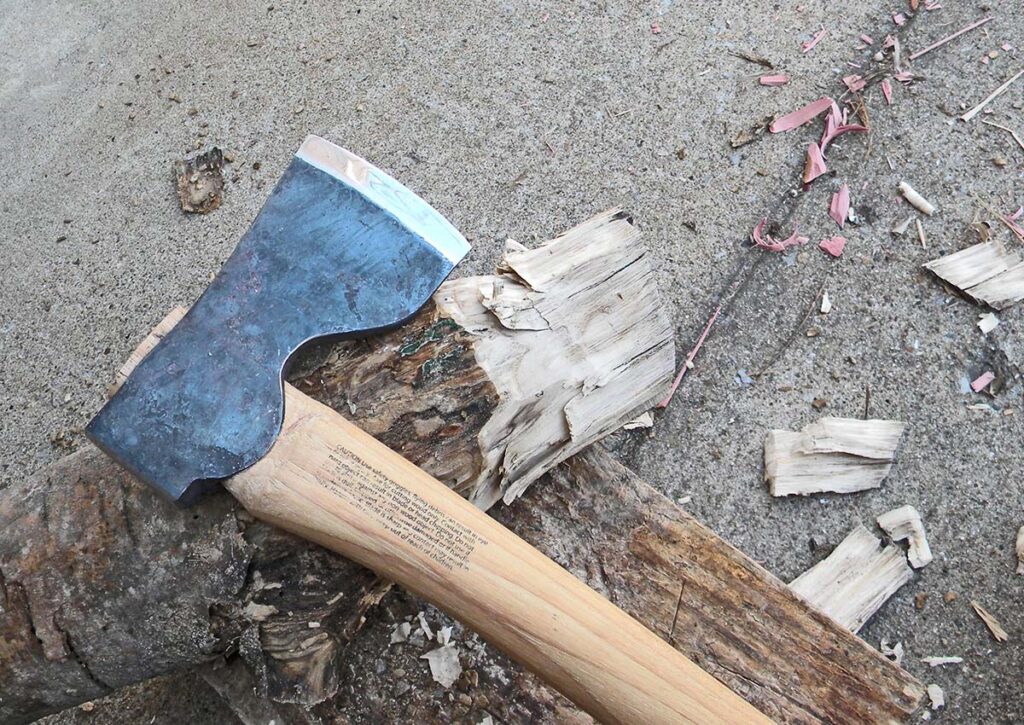
Near the bottom of the woodpile, I saw some seasoned hackberry chunks. It was time to try a little chopping—deep whacks for the Spika. It was accurate on the placement of the chops. (I really wanted to go after a standing tree but the neighbor didn’t go for that idea.)
Sharpness Test
It was time to try a little chopping on some hackberry chunks—deep whacks for the Spika. It was accurate on the placement of the chops.
I went back to 20-pound bond paper for slicing and the Spika didn’t disappoint, slicing the paper cleanly. That’s very impressive for an axe.
The Spika has a polished cutting edge, a smaller hammer head, and a leather sheath on the base model. Hults Bruk offers belts, an axe holder and sharpening stones. The company carries all things axe related—a very complete lineup.
Final Cut
The Spika needs softening where your finger rides when you choke up on the axe head. The SPIKA is a must have for backwoods camping. Its size makes it easy to carry. It’s top of the line in terms of axes, without a doubt.
Be it chopping wood or prepping a meal, a solid bushcraft knife is an essential piece of backwoods kit.
Bushcraft is a specialized skill set that ensures survival in the wilderness using foraging, hunting, fishing, shelter construction, and firecraft, all accomplished with minimal tools. The primary bushcraft implement is a fixed blade employed not only for food prep but the other mentioned skills, too.
As a result, such a fixed blade must be a tough tool capable of more than just standard cutting tasks, including whittling, carving, splitting wood or, in conjunction with a ferrocerium rod, starting a campfire.
What Defines A Bushcraft Knife?
Five basic chores of outdoor survival can be performed with a bushcraft knife. The tasks are elemental and a must-learn if you want to use a bushcraft knife to maximum effect.
Chopping
Batoning
Carving
Fire Starting
Food Prep
Chopping
Whereas a small hatchet, ax, or even a machete are better suited for the task, a bushcraft knife can turn the trick. Grip the handle as far back and as securely as you can, and chop as you would with a larger knife, ax, hatchet or machete.
Batoning
Basically, to baton a piece of kindling is to split it. Take a rather large/thick piece of wood to act as a baton/hammer in one hand, lay the blade edge on the end of the secured piece of kindling with the other, and, using firm, deliberate blows, pound the blade lengthwise through the kindling, effectively splitting it.
Again, an ax, hatchet or even a folding saw would be better, but if you lack any of these, your bushcraft knife is capable of handling such a task.
Carving
One of the most important bushcraft skills is to carve bowls, spoons, or even whittling sticks to roast hot dogs. Chopping and batoning are tasks using brute force; carving is more finesse and control.
This can be accomplished by using the knife and a ferrocerium (aka ferro) rod. The job is best done by using a knife that has a blade with a 90-degree spine as opposed to a chamfered or radiused one.
Grasp the knife firmly, cutting edge up. Lay the corner of the blade spine on the ferro rod and with one swift, downward motion, as if you are whittling o a piece of the rod, move the blade down it. Doing so will result in a white hot shower of sparks. The sparks can ignite tinder to start a fire.
The key to fire starting is always select a bushcraft knife with a 90-degree spine. If it lacks such a spine, you can always use the edge but this will dull the one spot on the edge faster than standard cutting will.
Food Prep
And, obviously, a bushcraft blade can also adeptly handle any cutting task related to food or campsite prep. Bushcraft knives prove a knife need not have sheer size and weight to be effective. It’s all in smart design of the blade and handle.
Our Picks For Best Bushcraft Knife
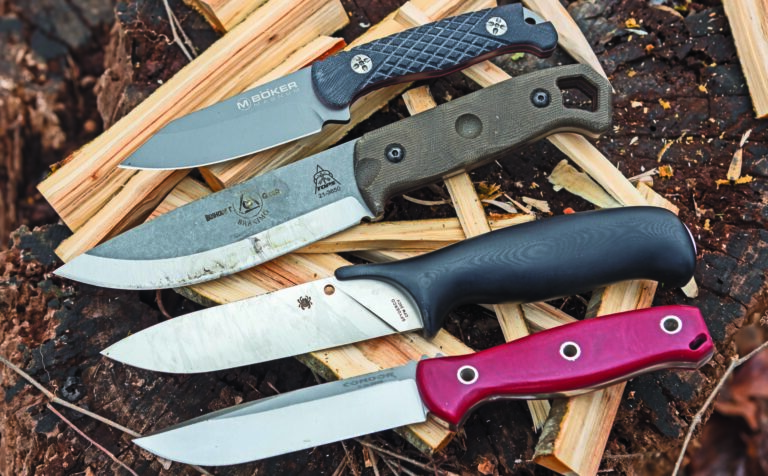
Boker Magnum Life Knife
Boker Magnum Life Knife
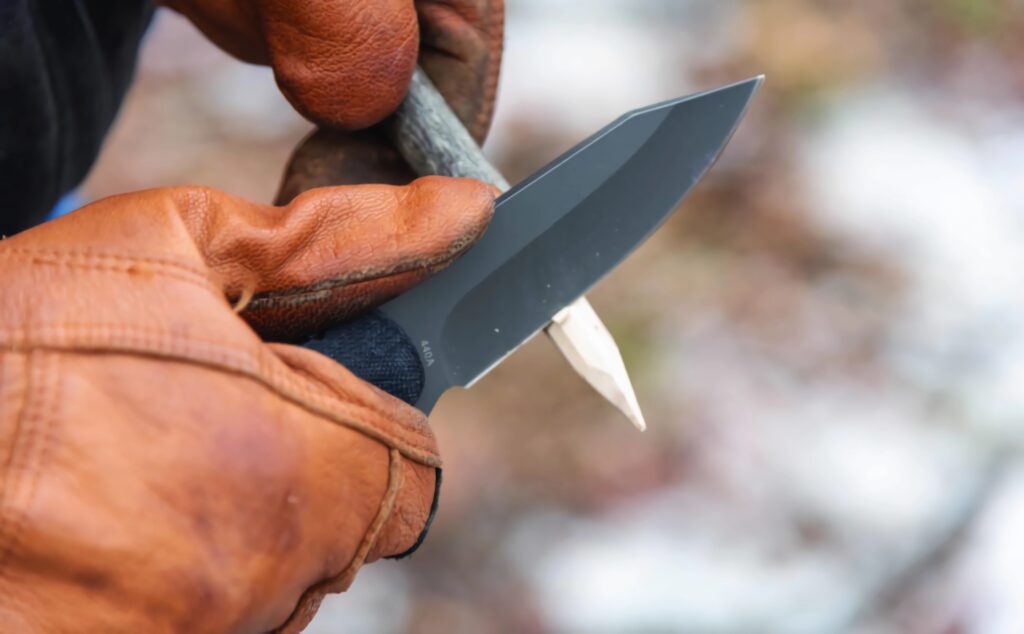
The most affordable bushcraft model of the test bunch, the Boker Magnum Life Knife has a 3.9-inch blade of 440A stainless steel in a modified clip-point pattern. Built rugged for the outdoors, the knife comes with a sturdy Kydex sheath for safe carry.
At 7.87 inches overall, the Life Knife sports a handle of machined black G-10 in a coarse crosshatched checkering pattern for enhanced hand traction regardless of conditions. The grooves in the crosshatching work are similar to those of a radial car tire by displacing moisture. Red fiber liners under the G-10 add a nice pop of color to an otherwise dark knife.
The handle includes integral forward and rear guards to prevent your hand from sliding in either direction. The three large traction notches in the thumb rest area of the blade spine also help improve grip. The handle felt a bit skinny in my hand, so I would prefer a slightly wider one.
Conversely, the Life Knife might be a great choice for those with smaller paws. The 3.9-inch blade is a great size for belt carry. The rather compact nature allows it to carry comfortably, with the length neither too long nor too short. The short blade tip accomplishes precise cutting chores easily.
The sheath is a simple fold-over design of Kydex with a Boker Plus clip for belt carry. The sheath features quality construction, retains the knife well, and is simple yet effective.
MSRP: $59.95
Condor Tool & Knife Bushcraft Bliss
Condor Tool & Knife Bushcraft Bliss
Composed of high-quality materials, the Bushcraft Bliss from Condor Tool & Knife boasts a 5-inch blade with a flat grind. The 1075 carbon steel can be rather easy to sharpen in the field and still retains an edge well. The modified clip point shape offers a generous belly for slicing and a defined point. A swedge gives the blade a bit of attitude, and bead-blasted flats and satin-finished bevels provide a two-tone finish that’s very eye-catching.
The ergonomic handle of red linen Micarta® is an excellent choice thanks to its being largely impervious to temperature and humidity changes. Three thong tubes fasten the scales to the full tang. Three large notches at the spine permit non-slip thumb placement so you can bear down on the blade. With its rounded edges, choil, and scale contouring, the handle felt as if it were molded to my hand.
The sheath is Condor’s hybrid molded Kydex and leather rig, an unusual material combo. The belt loop and securement strap are leather. The leather belt loop allows the sheath to move somewhat, unlike the more rigid molded clamshell fastener—which doesn’t—and makes it easier to sit down while wearing it. A thumb break molded into the top of the sheath assists in extracting the blade, which is a nice extra touch.
I found the handle to be very comfortable. A distinctive trait is the prominently elevated traction notches. They almost look like part of a gear. The feature ensures your thumb isn’t going anywhere.
The 5-inch blade makes baton work easy, as well as food prep tasks. Out of the box, the 1075 carbon steel was plenty sharp and ready for use. The Bushcraft Bliss is a consistent performer.
MSRP: $118
TOPS Knives Brakimo
TOPS Knives Brakimo
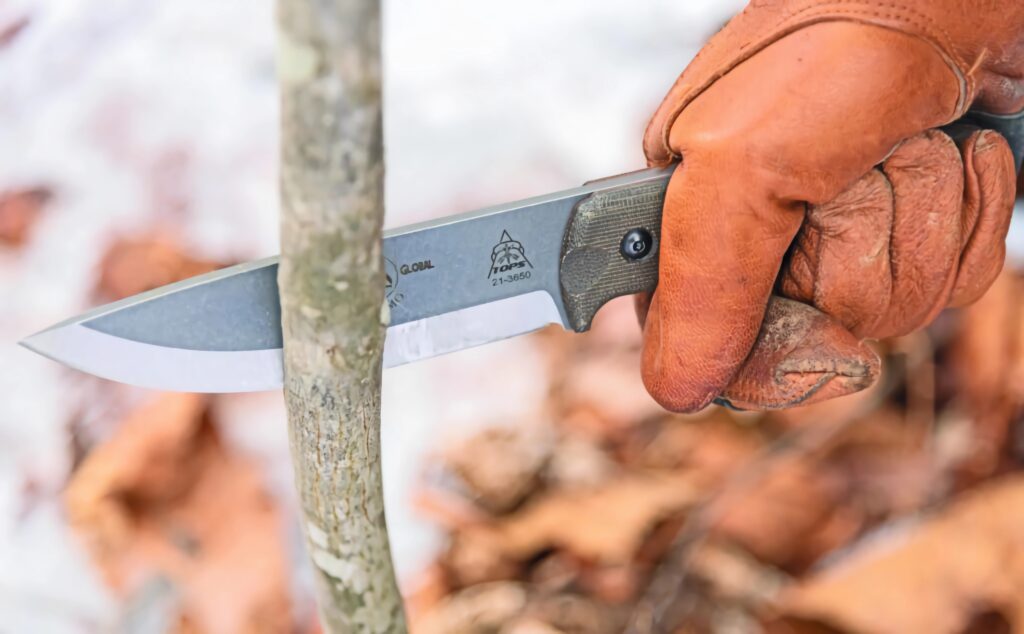
Joe Flowers runs Bushcraft Global, where he instructs students on basic and advanced survival skills while in the Amazon jungle. A notable authority in the field, he also designs knives, including the Brakimo from TOPS Knives, a tool that can carve, cut, split, and perform just about any task involving outdoor survival.
The 5.25-inch blade of 1095 carbon steel is a drop-point pattern with a Scandi grind. It has a generous belly for easy slicing and a defined point for delicate work.
The green Micarta handle is ideal for bushcraft given its stability and minimal weight. It is matte-finished for a nice grip quality without being overly aggressive. The integral front and rear guards provide a measure of safety that locks the knife in the hand. The divot in the handle is for use with a bow drill for making fire.
If there is a solid all-around performer of the test bunch, it’s the Brakimo. I like how it easily handles heavy work like chopping and baton work, as well as such lighter work as whittling and food prep. You can choke up on the handle for tasks requiring more control where a slicing or rocking motion is used. Grip the handle more toward the rear and feel how the balance point shifts to a blade-heavy profile for easy, effective chopping.
The Scandi grind acts as a wedge and splits the wood in a snap, almost as if no effort were invested—very impressive performance! For one knife that does it all, the Brakimo is it. In-hand it feels substantial and capable of taking on serious work.
MSRP: $225
Spyderco FB42G Zoomer
Spyderco FB42G Zoomer
Designed by Tony Zoomer, an outdoor enthusiast and survival skills instructor from the Netherlands comes the Spyderco FB42G Zoomer. Made of high-end materials, the knife is expertly configured and has a list of features that quite possibly makes it the most comfortable bushcraft knife you’ll use.
The 5-inch blade in a drop-point pattern is premium CPM 20CV stainless steel for enhanced edge retention. The blade has an ample belly for slicing and whittling/carving tasks and a defined point for close-up detail work. The full flat grind transitions to a convex edge, which is durable and extremely sharp.
The black G-10 scales are machined where they join the tang, so the handle is completely rounded in profile. This translates into a super comfortable grip that eliminates hot spots. An integrated rest at the blade spine permits placement of your thumb for additional pressure on cuts and for added control. The full tang extends a little beyond the end of the handle for use as a light-duty hammer.
The sheath is a custom-designed, well made leather drop-leg-style rig with a free-floating belt loop. It has an exterior storage pouch with a snap closure. The pouch can carry your choice of survival supplies, a large folding knife, a multi-tool, etc.
The free-floating belt loop allows the knife to swing freely as you move or pivot out of the way when you are seated. It also can temporarily break away in the event the sheath gets snagged by brush in the woods.
The Zoomer is a solid performer. The heavily contoured G-10 handle feels mighty good in the hand. The full flat grind allows the blade to sail through whatever you cut.
While the handle is comfortable, it felt big in my hand. Those with smaller hands might not take to it easily. While using high-performance CPM 20CV stainless steel is not typically a bushcraft thing, with some regular stropping and honing, you can prolong the edge and skip sharpening during your trip.
MSRP: $600
Fallkniven S1 Pro Forest Knife
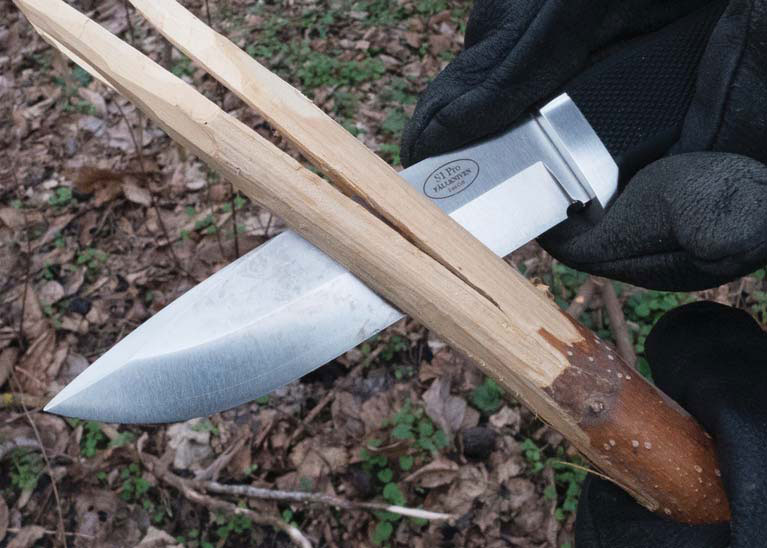
The Fallkniven S1 Pro Forest did fine work—as on this fish spear—with full control. (All images by Ash Ayres and Mary Lou Ayres)
Fallkniven’s S1 Pro Forest Knife is the evolutionary descendant of the company’s S1, which has been in production for over 20 years. The Pro version is made with better steel than the original S1, is more sophisticated and a better performer.
The S1 Pro simply does everything well and with no fuss. Its convex grind does not bind in deep cuts, goes through tough, knotty wood with little effort, peels bark, makes feather sticks, does fine work as on fish spear points with full control, and slices duck through skin, meat and bone like Luke Skywalker’s lightsaber. It cut through 2-inch-thick saplings in about a minute with little effort. The non-slip grip is comfortable and does not, in fact, slip.
Compact enough to always have on—or with a custom sheath, inside—your belt, the S1 Pro is as close as I’ve seen to the mythical “one knife to do it all.”
MSRP: $466
Ontario Bushcraft Woodsman
Bushcrafting chopping
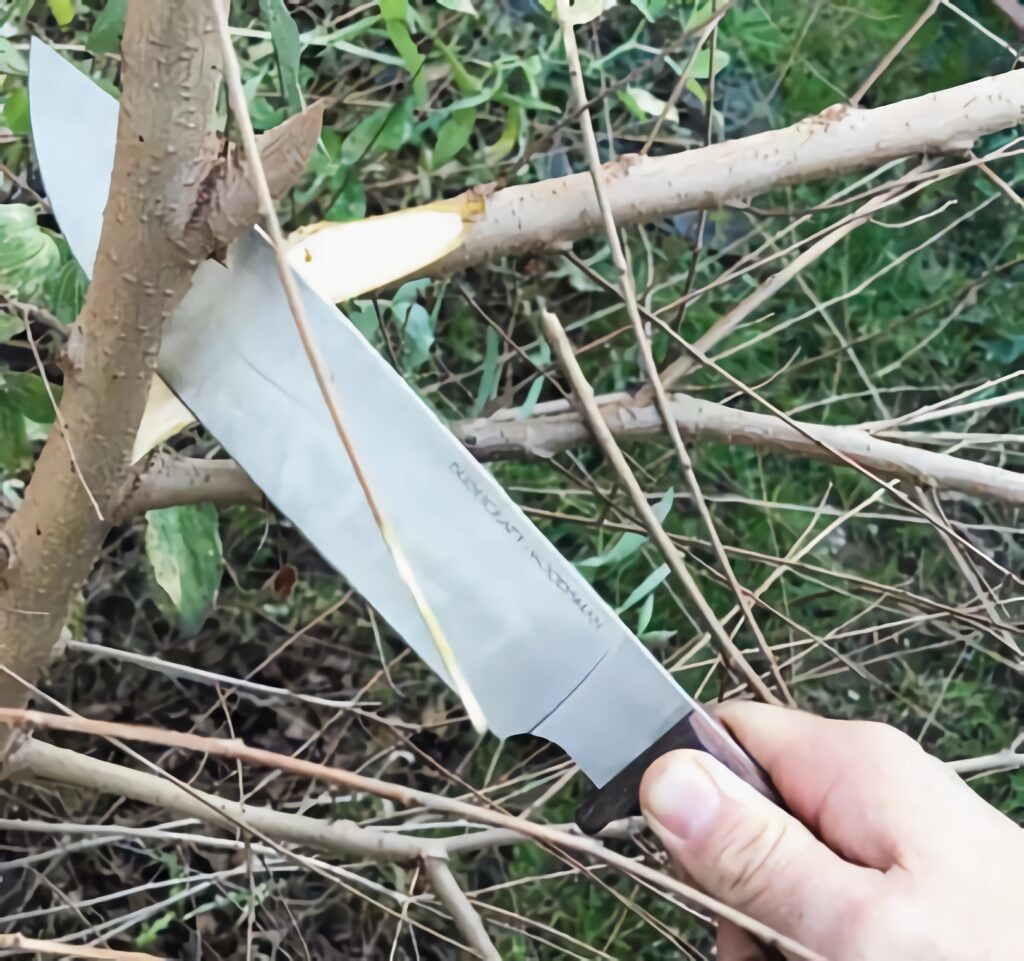
The geometry of the Bushcraft Woodsman’s blade, combined with the overall design, good steel and heat treat, make for an exceptional big knife.
Veteran bladesmith Dan Maragni designed this issue’s cover knife, the Ontario Bushcraft Woodsman. The big blade shows his expertise and lineage as an accomplished smith, and is far more sophisticated than a first glance might suggest.
The distal taper gives it excellent balance, and, combined with the taper from spine to edge, great chopping ability.
We slashed through 2-inch-thick saplings with a single swipe, an important point in the calories-expended-vs.-results-achieved equation, and when night is falling and you need to get a fire going.
The blade’s geometry, combined with the overall design, good steel and heat treat, make for an exceptional big knife. Again referencing Tolkien, Ash called it the “Goblin Cleaver.”
Not as handy for fine work as the smaller knives, Dan’s design is a reassuring blade to have by your side in deep woods when the jackals are howling—or the Orcs.
MSRP: $137
Larry Roberts Signature Edition Gen6 Scandi (L.T. Wright Handcrafted Knife Co.)
Due to its scandi grind, which tends to hang up in deep cuts, an average of three minutes was required to get through 2-inch-thick saplings with the Gen6 Scandi.
The Larry Roberts Signature Edition Gen6 Scandi from L.T. Wright Handcrafted Knife Co. performs like a “Mora on steroids,” according to Ash. I agree.
If you’re familiar with the scandi grind, the only surprise with the LRSEG6S is that it takes scandi-ground blades to a higher level of performance. It excels at controlled shallow cuts, holds an edge well, and is strong enough that when batonning you can twist the blade with no worries and quickly pop the batonned material apart.
I like the longer 6-inch blade much better than the popular 4-inch pattern because you can get more stuff done faster and at no penalty to doing fine work. Due to the scandi grind, which tends to hang up in deep cuts, an average of three minutes was required to get through 2-inch-thick saplings.
Comfortable in the hand, it is also beautifully made and finished. A good all-around performer, it is a classic belt knife for the woods.
MSRP: $253
Editor’s Note: Dexter Ewing and James Ayres contributed to this post.
Modern takes on a Stone Age standard come in a spectrum of styles.
Daggers have been a favorite go-to blade of humans for many millennia. Before the advent of metals, symmetrical blade styles such as daggers and spear points, as well as projectile points, were the earliest formal cutting edges of Stone Age peoples. It was only natural these forms carried over into the Bronze Age and, indeed, through to today.
The knife with the decidedly pointed tip and double edge* played a prominent role in both World Wars and continues to be a prime choice of many operatives. Some prefer one for self-protection in the home or as an EDC, and many cutlery enthusiasts collect them for sheer sentimental value. As an everyday working knife there are better-focused blade options, but in a pinch the dagger can perform basic functions. Where it shines, however, is when used for stabbing and slicing. Let’s look at several factory options and put them through their paces.
KA-BAR Ek Commando Presentation Knife
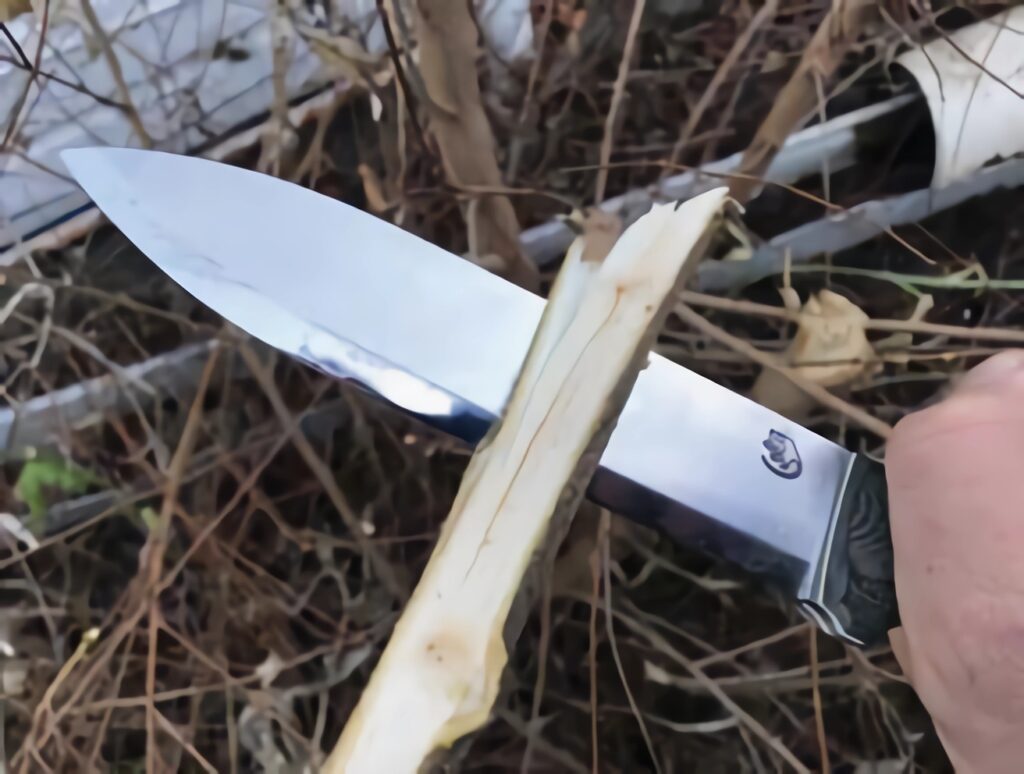
The Ek performed equally well in quick pull-throughs on the pork tenderloin and in piercing/splitting the apple.
KA-BAR Ek Commando Presentation Knife Specs Blade length: 6.625” Blade steel: 440C stainless Handle material: Walnut Weight: 8.8 ozs. Overall length: 12.625” Sheath: Brown leather belt model Country of origin: USA MSRP: $351.64
Pros
Historic Design
High-Quality Materials
Secure Grip
Cons
Weight Toward Tip
Expensive
The Ek Commando Presentation Knife is a high-grade commemorative in KA-BAR’s historic John Ek Knife Co. series. It features a double-ground, slightly waisted spear point blade in a mirror finish. The blade has a long, flat ricasso etched with the Ek Commando Knife Co. shield logo plus KA-BAR Olean, NY above the guard. The handle is lacquered walnut and the guard and lugs are brass with copper-washed accents.
Fox Knives Tactical Elementum Dagger
The Fox Tactical Elementum Dagger’s serrations provide an added level of utility. The knife dispatched 2-inch-wide seatbelt webbing with gusto. The dagger blade may not be as effective as other, more utilitarian styles but it can still cut well when needed.
Elementum Dagger Specs Blade length: 3.94” Blade steel: Bohler N690 stainless Handle material: Black polypropylene and Thermorubber (PP and TPE) Weight: 3.53 ozs. Overall length: 8.11” Special feature: One side plain, one side serrated Sheath: Kydex w/dual MOLLE mounts Country of origin: Italy MSRP: $123.40 at press-time exchange rate
Pros
Durable Finish
Ergonomic Handle
Compact
Cons
Niche Utility
Italian knife manufacturer Fox Knives originally designed the Tactical Elementum Dagger for flight crews of French combat helicopters. The knife boasts hidden-tang construction and a short blade in a matte black Idroglider finish. The two blade grinds meet in the middle at a small ricasso marked with the Fox logo, company location and blade steel. The handle has a ribbed double-guard at the top and six beefy diagonal ribs on the lower half terminating with a lanyard hole in the base.
Spartan-George Raider
The author tested the Spartan-George’s slim, trim blade for slice ability on pork tenderloin. Using quick, single pull-through strokes he cut off medallions of the tenderloin with ease.
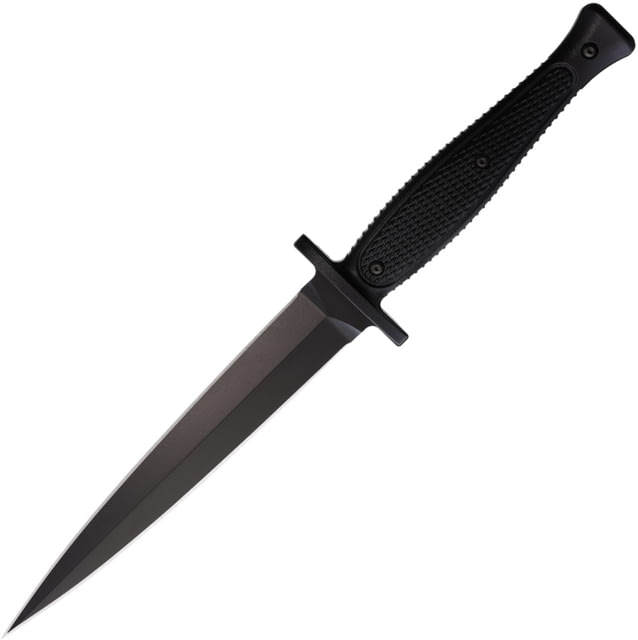
Spartan-George Raider Specs Designer: Les George Blade length: 7” Blade material: SK5 carbon steel Handle material: Black thermoplastic Weight: 7.1 ozs. Overall length: 12” Knife to know: Tribute to U.S. Marine Corps Raider stiletto of World War II Sheath: Black injection molded Country of origin: Taiwan MSRP: $150
Pros
Great Edge
Comfortable Handle
Durable Finish
Cons
Narrow Blade
Knifemaker/United States Marine Corps veteran Les George designed the Spartan-George Raider as a tribute to the U.S. Marine Corps Raider stiletto of World War II. The sleek dagger sports a double-ground, black-powder-coated blade. The opposing blade grinds meet in the middle, leaving a small ricasso at the base upon which a small Spartan and George logo are tastefully imprinted. The handle incorporates a double guard and a large ovate checkered section on each side of the grip for enhanced purchase. The sheath includes a 1.5-inch-wide black nylon hanger.
The SOG nailed one of the functions daggers do best—stabbing.
Pentagon FX Covert Specs Blade length: 3.41” Blade steel: Crucible Cryo S35VN stainless Handle material: G-10, flat dark earth Weight: 3.9 ozs. Overall length: 7.52” Special feature: Customizable grip Sheath: GRN (Glass Reinforced Nylon) thermoplastic, SOG Universal Mount Country of origin: Taiwan MSRP: $189.95
Pros
Removable Scales
Full-Tang Construction
Enhanced Grip
Cons
Specialized Design
The FX makeover of the SOG Pentagon is both innovative in its cosmetics and versatility. The blade is black titanium nitride coated. The grinds meet in the middle and there is a section above the short ricasso grooved two-thirds of the way up. The name of the knife is finely imprinted on the top front grind and the steel type and country of origin on the back. The blade and full-tang handle are fully exposed around the perimeter of the scales with gimping below the guard and on the base. The scales can be removed by a single lug on the base, allowing them to be swapped out, or the skeletonized steel frame can be used without them.
I tested the Ek and Spartan-George Raider for stabbing prowess by plunging them down through the core of fresh apples. The Ek took no prisoners, not only piercing through top to bottom but laying the fruit out in two neatly cleaved halves. The Spartan-George provided similar results, penetrating the apple but not quite splitting it in half due to the narrower blade width and thinner blade steel—though wicked nonetheless.
Pork tenderloin was the slicing medium. Using rapid, single strokes, I took the Spartan-George to task. The dagger is extremely sharp on both edges, so I took turns on each side of the blade doing pull-throughs on the hapless tenderloin. The knife sliced off perfect pork medallions at will, passing the slice test with flying colors.
The SOG Pentagon FX Covert (bottom) and Fox Tactical Elementum (top) proved useful when cutting paracord and rappelling rope. The shorter blades are very much in the scale to what many knife users are accustomed. The author indicated the test group’s two smaller daggers are easier to use than the larger ones “when getting down to the nitty gritty” is required.
After cooking the tenderloin, I tested the Ek in similar fashion and got similar results. The waisted blade profile shifts with more weight toward the tip and gives it excellent grab similar to a recurve. Like the Raider, the Ek performed quick pull-throughs with ease.
What the two smaller test knives, the Fox and the SOG, lack in size they make up for in ease of concealment. Both have EDC potential for a high degree of self-protection with a modicum of utility.
I tested the Fox’s serrated edge slicing standard 2-inch nylon seatbelt webbing and achieved excellent results. Likewise, the plain edges on both knives handled paracord in one pull stroke, and 3/8-inch rappelling rope laid flat on a wood surface in two strokes. Both daggers passed the pork tenderloin stab test with aplomb. Because they’re smaller, it’s easier to do detail and utility work with blades in their size range than with blades twice their length.
Dagger Sheaths
The Spartan-George Raider sheath (top) is more durable and versatile, while the Ek Commando’s commemorative leather sheath captures the period as it was intended.
The Fox has a MOLLE-compatible sheath with two simple DOTS gates that can be modified with a myriad of readily available aftermarket attachments. The SOG uses a proprietary setup—the SOG Universal Mounting System—developed for a group of the company’s fixed blades. Both of the smaller daggers can double as boot knives as well.
The sheaths of the Fox (left) and SOG (right) are radically different. The Fox has a simple MOLLE sheath with two simple DOTS gates, enabling you to modify it with a variety of attachments. The SOG uses a proprietary setup—the SOG Universal Mounting System.
The Raider’s black injection-molded unit is durable and versatile, while the Ek captures the period as it was intended. The Raider sheath lends itself to converting to a concealed inside-the-jacket shoulder rig as well.
Going Large Or Small
Daggers come in many shapes and sizes but all are primarily geared for self-defense, with any utility abilities a bonus. The first question you need to answer is whether a large or small dagger suits you best. Large daggers like the Ek and Spartan-George excel at sheer combat because they reach out and touch someone, aka an assailant, more easily. If ease of carry, especially concealed, is a top priority, both the SOG and Fox will serve you well. Choices abound in the world of the dagger.
*Despite recent advances in pro-knife legislation, check your local and state ordinances for laws concerning knives with double-edged blades. The same goes for concealed-carry knives.
We gathered up a bevy of new custom damascus blades that are sure to knock your socks off.
Our latest knife roundup features a stunning collection of new custom Damascus blades that are sure to impress. These meticulously crafted knives showcase the intricate patterns and superior craftsmanship that Damascus steel is known for, making each piece a work of art. Whether you’re a collector or simply appreciate high-quality blades, this selection is bound to knock your socks off with its blend of beauty, durability, and cutting-edge performance.
Brent Dignam Hunter
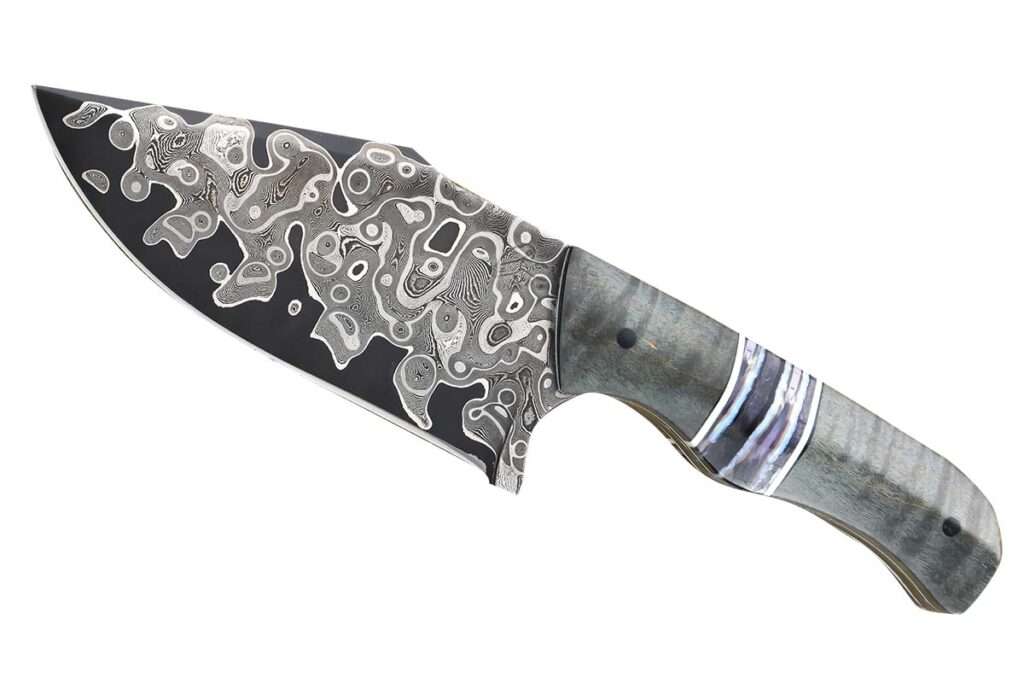
BLADE LENGTH: 5” BLADE MATERIAL: San-mai damascus w/1084 carbon steel core forged by Robert Corey Scott of Bulldog Damascus BLADE GRIND: Flat HANDLE MATERIAL: Curly maple LINER MATERIAL: G-10 SPACER MATERIAL: Mammoth molar OVERALL LENGTH: 9” MAKER’S PRICE FOR A SIMILAR KNIFE: $800 MAKER: Brent Dignam (SharpByCoop image)
Rick Dunkerley Persian Folder
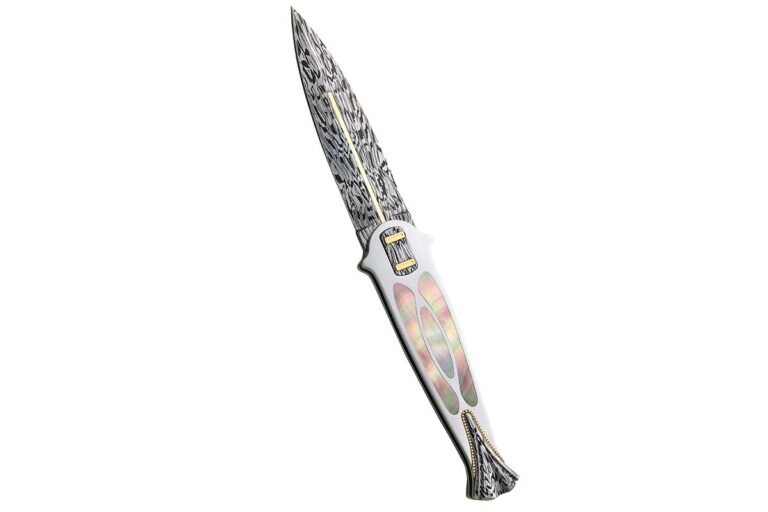
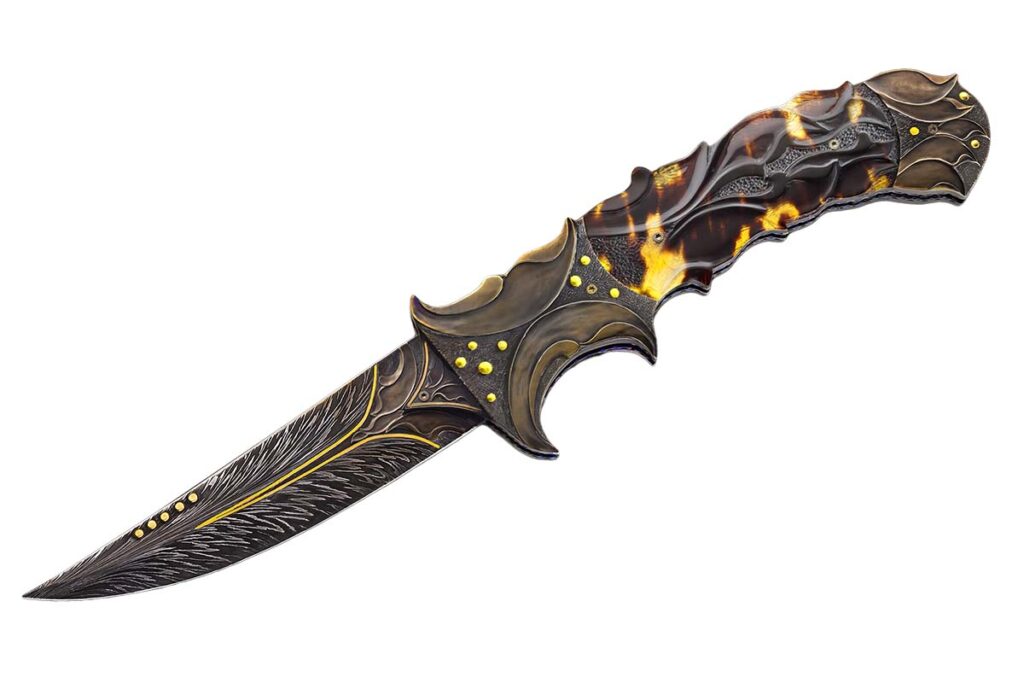
BLADE LENGTH: 4.25” BLADE MATERIAL: Feather pattern damascus of 1080 carbon and 15N20 nickel alloy steels; Dellana Dots in 18k gold BLADE GRIND: Double fighter HANDLE MATERIAL: Antique shell BOLSTERS: Milled steel EMBELLISHMENT: 24k-gold inlay in blade and bolsters CLOSED LENGTH: 5.25” MAKER’S PRICE FOR A SIMILAR KNIFE: $15,000 KNIFE TO KNOW: Rick Dunkerley is a master smith in the American Bladesmith Society MAKER: Rick Dunkerley (Mitchell Cohen image)
Mark Lambert Hunter
BLADE LENGTH: 4.75” BLADE MATERIAL: 320-layer ladder-pattern damascus of 1084 carbon and 15N20 nickel-alloy steels HANDLE MATERIAL: Bog oak GUARD MATERIAL: 413 stainless steel OVERALL LENGTH: 9 3/8” KNIFE TO KNOW: Contoured grip includes flats on either side starting around midway and extending to the bird’s-beak butt; Mark Lambert is an apprentice smith in the American Bladesmith Society MAKER’S PRICE FOR A SIMILAR KNIFE: Contact maker for more information MAKER: Mark Lambert (Jocelyn Frasier image)
John Horrigan Automatic
BLADE LENGTH: 3.75” BLADE MATERIAL: 6-bar Turkish twist damascus w/Dellana Dots BLADE GRIND: Hollow BLADE OPENER: Push button HANDLE FRAME: 416 stainless steel HANDLE INLAY: Edwards black jade MAKER’S PRICE FOR A SIMILAR KNIFE: $5,200 KNIFE TO KNOW: John Horrigan is a master smith in the American Bladesmith Society and sole authors all of his knives MAKER: John Horrigan (Mitchell Cohen image)
Q Hardtner Blades Fixed Blade
KNIFE TYPE: Fixed blade BLADE LENGTH: 8.5” BLADE GRIND: Flat BLADE MATERIAL: Feather damascus of 1084 carbon and 15N20 nickel-alloy steels FURNITURE: 416 stainless steel HANDLE MATERIAL: Ancient walrus tusk CONSTRUCTION: Takedown OVERALL LENGTH: 13.5” SHEATH: Made and handcarved by Bob Bobbitt MAKER’S PRICE FOR A SIMILAR KNIFE: $2,200 KNIFE TO KNOW: Quintin Hardtner has been making knives for about two years and mentored under veteran maker Dan Graves MAKER: Q Hardtner Blades (SharpByCoop image)
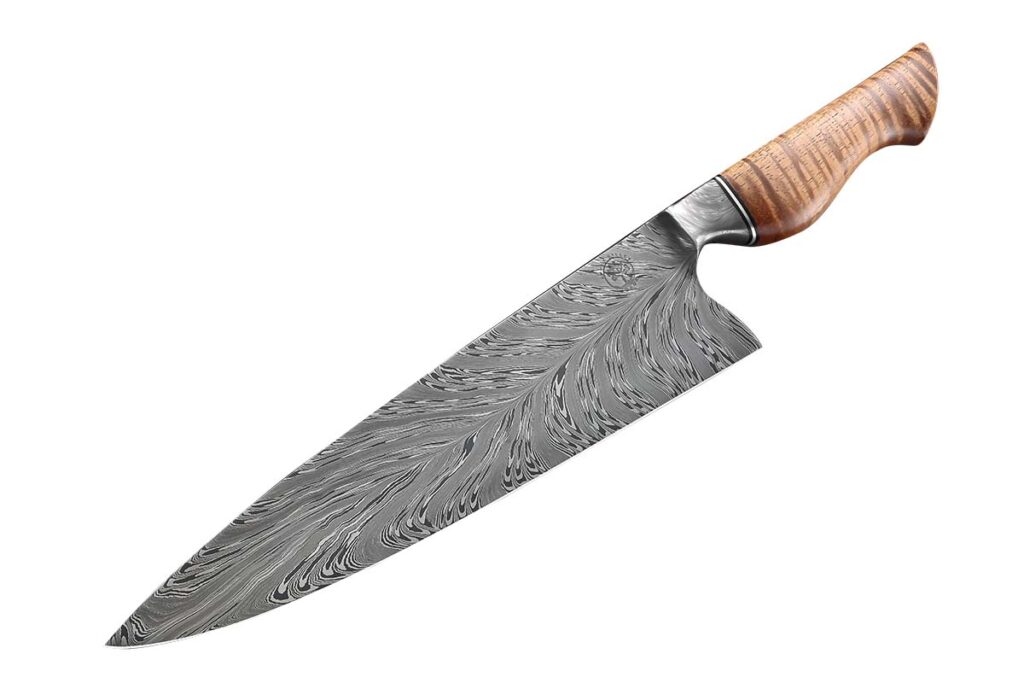
Trevor Morgan Jr. Chef’s Knife
BLADE LENGTH: 9” BLADE MATERIAL: Feather-pattern damascus of 1084 carbon and 15N20 nickel-alloy steels BLADE GRIND: Slightly convex flat HANDLE MATERIAL: Curly koa BOLSTER: Integral OVERALL LENGTH: 14” MAKER’S PRICE FOR A SIMILAR KNIFE: $1,750 MAKER: Trevor Morgan Jr. (SharpByCoop image)
David Longworth Emergence
KNIFE TYPE: Folder BLADE LENGTH: 3.8” BLADE MATERIAL: Mosaic damascus of 1084 carbon and 15N20 nickel-alloy steels BLADE GRIND: Flat HANDLE FRAME: 416 stainless steel HANDLE MATERIAL: Black-lip mother-of-pearl LOCK: Rocker Lock CLOSED LENGTH: 4.9” KNIFE TO KNOW: The Rocker Lock locks the blade in the open and closed positions; when the knife is closed, push the lower side of the button to unlock the blade; when the knife is open, push the upper side of the button to unlock it; the knife is a California or assisted opener, so the blade pops out a little when the button is pushed; all steel on the knife is hardened MAKER’S PRICE FOR A SIMILAR KNIFE: $8,000 MAKER:David Longworth (SharpByCoop image)
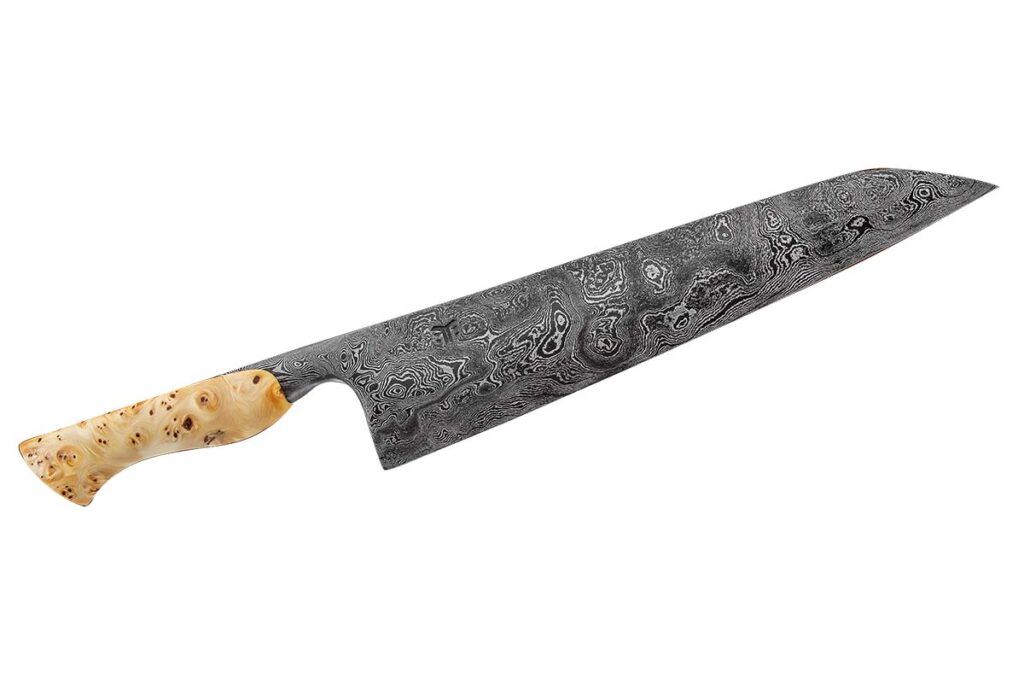
Koen Knives Chef’s Knife
KNIFE PATTERN: Chef’s knife BLADE LENGTH: 7.87” BLADE MATERIAL: Damascus of 1084 carbon and 15N20 nickel alloy steels BLADE THICKNESS @RICASSO: .157” BLADE @ WIDEST: 2.165” BLADE GRIND: Full flat HANDLE MATERIAL: Stabilized red mallee burl FERRULE: Brass and G-10 OVERALL LENGTH: 13.38” MAKER’S PRICE FOR A SIMILAR KNIFE: $600 at press-time exchange rate MAKER: Koen Knives (Rod Hoare image)
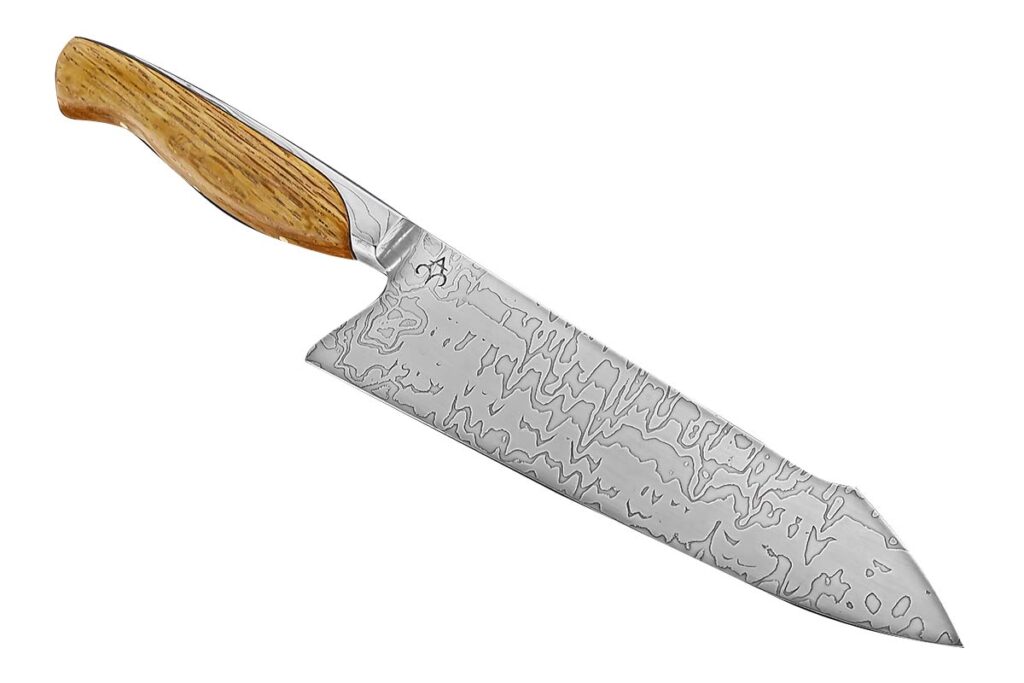
Adamas Forge Integral Horizontal-Tang Damascus Chef’s Knife
MODEL NAME: Horizontal Tang BLADE LENGTH: 7.87” BLADE MATERIAL: Damascus of 1084 carbon and 15N20 nickel-alloy steels BLADE @ THICKEST: .102” BLADE @ WIDEST: 2.04” BLADE GRIND: Full flat HANDLE MATERIAL: Stabilized white American oak OVERALL LENGTH: 12.59” MAKER’S PRICE FOR A SIMILAR KNIFE: Contact maker for more information MAKER:Adamas Forge (Rod Hoare image)
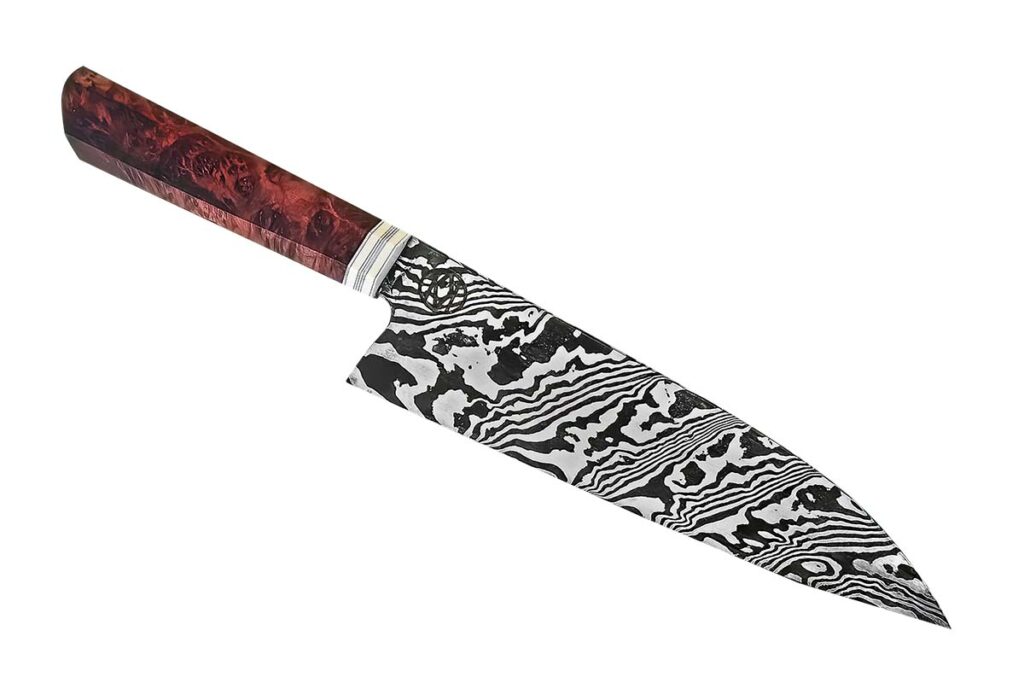
Brook Turner Integral Gyuto
KNIFE PATTERN: Integral gyuto BLADE LENGTH: 9.05” BLADE MATERIAL: 280-layer random-pattern damascus of 1084 carbon and 15N20 nickel-alloy steels BLADE THICKNESS @RICASSO: .216” BLADE @ WIDEST: 2.04” BLADE GRIND: Convex HANDLE MATERIAL: Stabilized huon pine burl OVERALL LENGTH: 14.17” MAKER’S PRICE FOR A SIMILAR KNIFE: $1,500 KNIFE TO KNOW: Brook Turner is a member of the Australian Knifemakers Guild MAKER:Brook Turner Blades (Rod Hoare image)
Bob Ohlemann Freelancer XL Model 2
KNIFE TYPE: Folder BLADE LENGTH: 3.5” BLADE MATERIAL: Chad Nichols stainless Boomerang damascus BLADE GRIND: Full flat BLADE PATTERN: Recurve w/harpoon swedge BLADE FINISH: Hand rubbed/etched BLADE OPENER: Thumb stud HANDLE MATERIAL: Double black Micarta® LOCK: Linerlock POCKET CLIP: Timascus; right-handed, blade tip up LINERS: Titanium, jeweled and anodized BOLSTER & PIVOT SCREWS: Zirconium PIVOT COLLARS: Timascus™ BACKSPACER: Titanium in black Cerakote® finish CLOSED LENGTH: 4.5” MAKER’S PRICE FOR A SIMILAR KNIFE: $2,060 MAKER:Bob Ohlemann (Jocelyn Frasier image)
With a simple finger flick or even in promo art, today’s flipper knives fly.
Early flipper folders were used in conjunction with assisted-opening mechanisms as a means for initiating movement, allowing the spring or torsion assists to open the blades the rest of the way. A few years later, folder pivots incorporated ball bearings, nearly negating the need for assisted-opening mechanisms on flippers.
This reduced friction simplified folder construction and provided glassy smooth blade rotation. Although a few companies still offer assisted-opening flipper folders, most production versions rely on ball bearings.
Flipper Folders: Function Flows From Form
A flipper tab and ball bearings don’t necessarily equate a folder with quick action and secure deployment. A flipper mechanism will not work properly without a well-designed detent.
Imperative is the detent’s power to secure and hold the blade shut. When placing pressure on the flipper tab with an index finger, the user should be able to feel the grab of the detent. With more pressure on the flipper, the inertia of the blade overrides the pressure of the detent, and kinetic energy swings the blade into the fully open and locked position.
An imprecise detent results in either sloppy action or a flipper mechanism that requires too much pressure against the narrow tab. Optimally, with pressure on the flipper tab, the detent holds its load for a second before letting the blade go with enough energy to snap it open.
Finding Fun In The Fidget Factor
It’s the flipper action that is so satisfying. It imbues a “fidget factor” that causes knife users to snap open their folders while watching TV, talking on the phone, lying in bed or practicing any number of mundane daily routines.
The latest flipper folders not only offer pleasing aesthetics but stay true to the ideals of their predecessors. With premium materials, designs that make use a pleasure and looks that astound, they epitomize some of the coolest knives around.
Best Flipper Knives
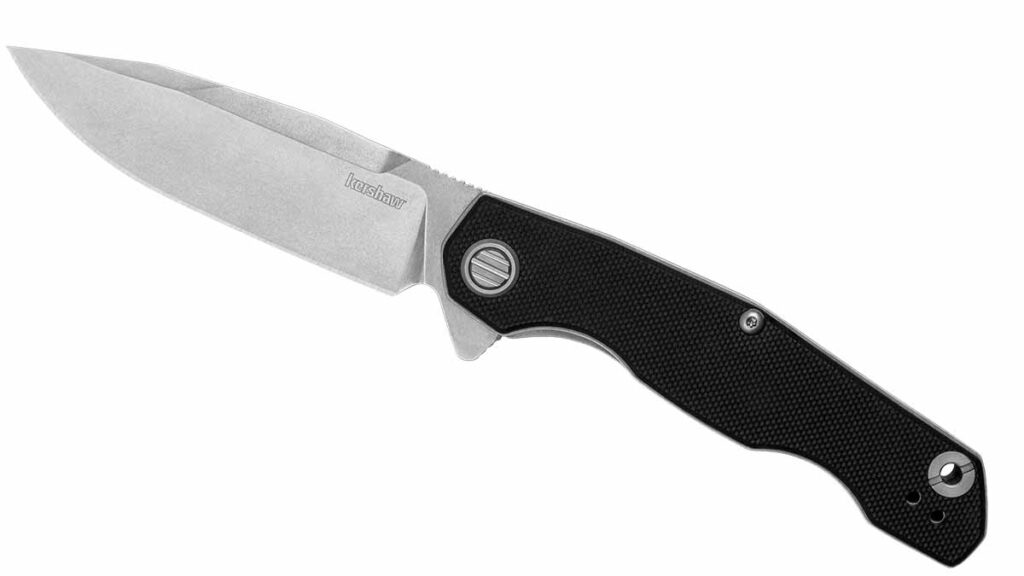
Kershaw Inception
The stonewashed blade of the Kershaw Inception pivots on KVT ball bearings. The custom pivot collar adds a touch of class.
At Kershaw, the Inception is looking good with performance to match. “I love the clean, stylish look,” related Kershaw Marketing Manager Dominic Aiello, “but the satisfyingly smooth action is what really makes the Inception a top-notch manual everyday carry.”
The flipper tab was not designed with the intention of acting as a single guard, Aiello says, but rather in combination with the textured handle overlays to help prevent the user’s hand from slipping. Along with that, the D2 tool steel blade .11-inch at the thickest provides enough heft to balance durability and ease of slicing. The clip is reversible and deep carry with flush screws that won’t snag in the pocket or impede quick deployment.
Kershaw Inception Specs Company: Kershaw Blade Length: 3.25 inches Blade Material: D2 tool steel Handle Material: G-10 Lock: Linerlock Weight: 3.1 ounces Pocket Clip: Ambidextrous/reversible, deep carry, tip up Closed Length: 4 inches Country Of Origin: China MSRP: $99.99
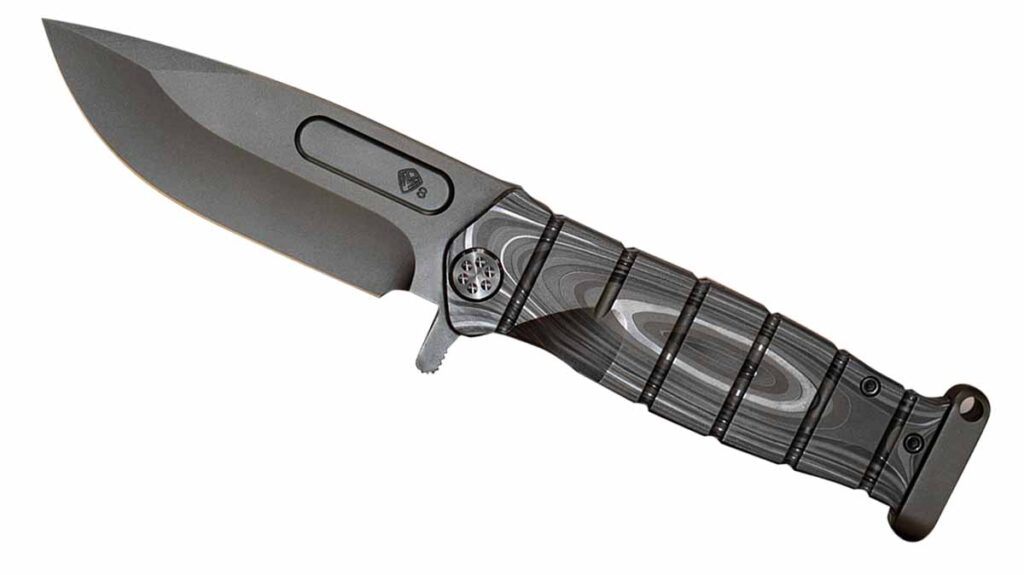
Medford Knife & Tool USMC Fighter Flipper
The CPM S35VN stainless blade of the Medford Fighter Flipper is 3/16-inch thick at the thickest and has a Rockwell hardness of 58 HRC.
The USMC Fighter Flipper from Medford Knife & Tool boasts an iconic name and incorporates titanium along with other highly durable components. “Where to start?” commented Medford representative Geoff Oprandy. “First, the USMC Fighter Flipper has superior design, engineering and aesthetics. When Greg Medford was inspired to make this knife, it didn’t take long for initial sketches to appear. He wanted a worthy companion piece for our top-selling Fixed Fighter, which has been a category king for quite some time.”
Oprandy describes the USMC Fighter Flipper as “a unique mixture of titanium components with the best CPM S35VN blade steel. This is a big, manly knife that’s as comfortable working as it is cruising around in your pocket. There is so much going on with it that it’s hard to take in, from the retro milling on the handles, drop-point blade, and integral Ti pommel to the bearing pressed into the one-of-a-kind pocket clip. The tab is designed to be a tad longer and has a unique radius with a knurled feature. For being a large knife [it provides] great purchase, and the flipper tab combined with the finger-indexing groove enable a great grip. The knife runs on phosphor-bronze washers custom made to meet our specs.”
According to Geoff, the knife has a special connection with the United States Marines Corps. As designer Greg Medford related, “When you hold it in your hand, almost 250 years of Marines speak to your soul.”
The design is intended to feel at home with users who prefer the “connection” made with a large folder, Oprandy says. “When people position the knife correctly and begin to use it,” he stated, “the energy transfer seems balanced, natural and confidence inspiring.”
USMC Fighter Flipper Specs Company: Medford Knife & Tool Designer: Greg Medford Blade Length: 4.25 inches Blade Steel: CPM S35VN stainless Handle Material: Titanium Pivot Action: Phosphor-bronze washers Weight: 9.8 ounces Pocket Clip: Titanium; standard carry Closed Length: 5.25 inches Country Of Origin: U.S.A. MSRP: $840 and up
Rick Hinderer Knives Full Track Spearpoint “Nuked”
The Full Track Spearpoint “Nuked” has a removable tool seated in the spine for disassembly/assembly of the knife. The scale on the show side is removable to store spare washers and spacers.
Sam Santa Rita, general manager of Rick Hinderer Knives, says the Full Track Spearpoint “Nuked” is a bigger version of the company’s “very popular Half Track model. It is one of our larger folders at 3.75 inches and has titanium handles with G-10 inserts. The Full Track features a removable tool seated in the spine of the folder that is capable of complete disassembly of the knife.” The folder also utilizes a G-10 insert cover on its show side that hides a pocket for the storage of steel inserts and washers for the Rick Hinderer Knives Tri-Way Pivot System. This allows the user to easily swap from bearings to washers or vice versa depending on the situation.
“Its size and durability coupled with the ease of maintenance and ‘customizability’ makes the knife a perfect hard-use folder capable in any environment,” Sam added. The Full Track is available in stainless blade steel options of CPM S35VN, CPM 20CV and M390. Another blade steel option will be released later this year.
The Full Track flipper tab doubles as a single guard, while the blade pivots on caged thrust bearings. Meanwhile, the Tri-Way Pivot System allows for the aforementioned use of Teflon™ and phosphor-bronze washers as well, which come standard with the knife.
Full Track Spearpoint “Nuked” Specs Company: Rick Hinderer Knives Designer: Rick Hinderer Blade Length: 3.75 inches Blade Steel: CPM 20CV stainless Handle Material: G-10 Lock: Framelock Pocket Clip: Yes Weight: 6.9 ounces Closed Length: 5.125 inches Country Of Origin: U.S.A. MSRP: $820
Spyderco Sliverax
The Sliverax is the first factory folder to combine Spyderco’s Compression Lock® with a flipper-style opener. Blade thickness and grind: .138 inch at the thickest and full flat.
The Sliverax is a bit of a departure for Spyderco. “It’s a flipper design, which is not common among Spydercos,” explained Joyce Laituri, company marketing manager. “The designer, Paul Alexander, is a different type of cutlery designer we have worked with in the past. He holds a doctorate in industrial design and mechanical engineering, and is a leading researcher for a company in the automotive industry.”
The Sliverax brings a shape with seamless flow and a slightly negative blade angle to enhance leverage, placing the point on the knife’s centerline for utility and control. “The negative angle also shortens the opening arc combined with the round hole and flipper mechanism for a full spectrum of positive, high-speed one-hand-opening options,” Joyce commented.
“The flipper tab doubles as a guard,” she continued, “and it’s easy to see and feel when the knife is held. There is a large, deep finger choil already, and the flipper mechanism in the open position extends the choil, creating a comfortable and deep guard for the index finger, or pinky if held in a reverse grip.”
Laituri describes the opening experience with the Sliverax as “slick as a Slip & Slide.” The mechanism features a phosphor-bronze bushing with ball bearings and a nested liner for structural strength. The CPM S30V stainless blade is exceptional in its combination of toughness, wear resistance and corrosion resistance as well, while the ergonomics of the handle are derived directly from its innovative shape, super-thin choil and expansion at the butt to fill the hand.
Spyderco Sliverax Specs Company: Spyderco Designer: Paul Alexander Blade Length: 3.48 inches Blade Steel: CPM S30V stainless Handle Material: Carbon fiber/G-10 laminate Lock: Compression Lock® Weight: 3.3 ounces Pocket Clip: Deep pocket, wire, ambidextrous, tip up Closed Length: 4.52 inches Country Of Origin: Taiwan MSRP: $306
Editor’s Note: Mike Haskew and Dexter Ewing contributed to this post.
We put a bevvy of today’s tomahawks through the wringer to see which of these choppers has bite.
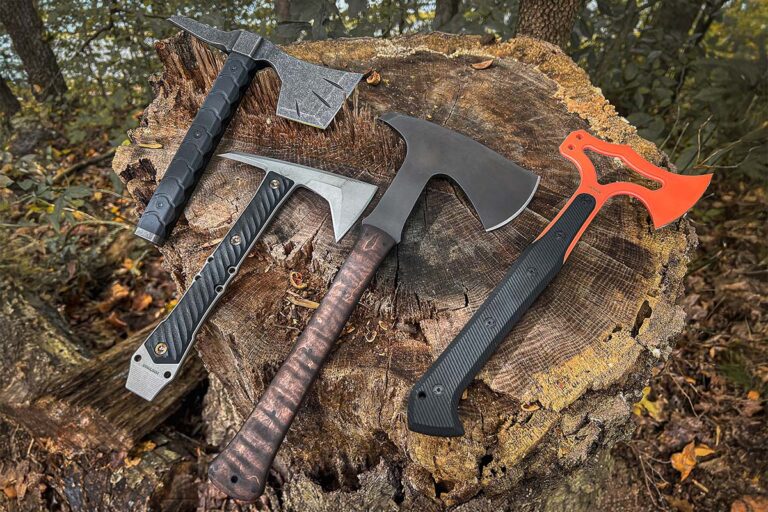
Tomahawks are interesting tools. They’re not knives but can cut like them. Though not full-blown axes, they can chop like them. Similar to knives, hawks are both tools and weapons. Like knives, they come in all price points, materials and features, as well as sheath styles/materials. Finally, they find wide acceptance in both the tactical and outdoor/hunting communities. Let’s take a deep dive into a quad of top factory examples of the genre.
Winkler Knives Ridge Line
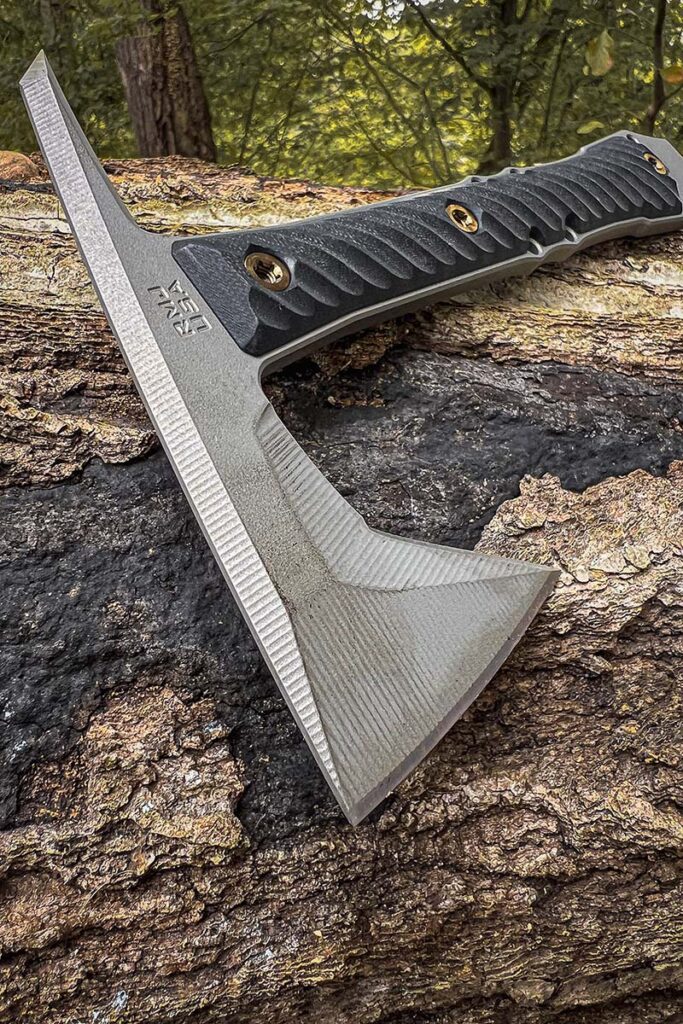
The Ridge Line’s shortened scales leave half of the tang exposed to prevent handle material damage in the event of a missed strike.
The Ridge Line from Winkler Knives is a hatchet that embodies elements from years of hatchet and hawk making, incorporating some of the more notable improvements made along the way into one piece. The head is 80CrV2 carbon steel for toughness and edge-holding ability. Stock thickness is ⅜ inch, giving the Ridge Line good balance while remaining somewhat lightweight and more agile in-hand. Cutting edge: 3 inches. Overall length: 13 ⅞ inches.
The shortened scales leave half of the tang exposed to prevent handle damage in the event of a missed strike. The scales come in several choices of Micarta® and maple. The material is attached to the tang using Micarta pins. The maple of the review sample is contoured well, has no hot spots and is quite comfortable.
The sheath is Boltaron® done in a way few do it. Winkler goes the extra step by lining the inside with felt so the hawks don’t get scratched up on insertion/removal. The biggest advantage of the felt lining is it’s not noisy during sheathing/unsheathing like standard Boltaron. A pair of nylon webbing belt loops with Pull-the-DOT® button snaps attach to a belt. A strand of 3/16-inch shock cord wraps around the head to secure it to the sheath. The sheath complements the high-quality construction of the hatchet itself.
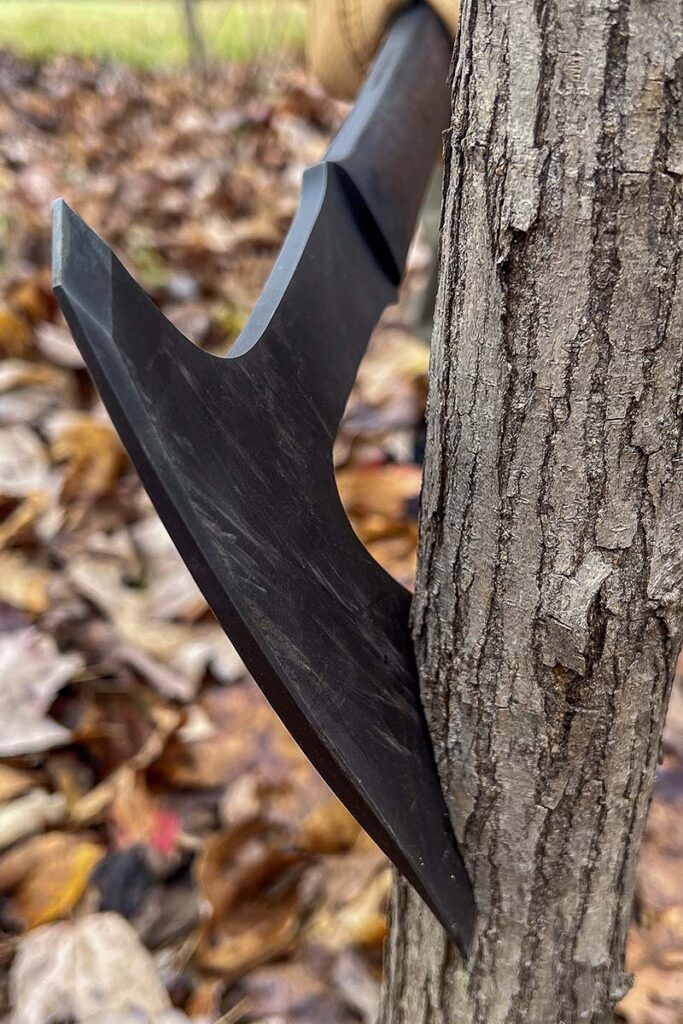
The curve of the head of the Winkler Ridge Line attacks wood at a slight radius, amplifying chopping power.
The Ridge Line is an absolute beast for chopping. The curve of the head attacks wood at a slight radius, amplifying chopping power. The forward weight means you can easily deliver powerful blows with minimal effort by letting gravity do its thing. The 80CrV2 takes an edge easily, so sharpening is not an issue. It also holds an edge respectably well, so performance wise it’s very reliable. I like how the handle flares toward the butt, acting as a stop to prevent the hawk from flying out of your grip during use.
Unlike a couple of the test hawks, the Ridge Line is strictly a chopping tool. Hence, using it for other tasks can be a bit awkward given the handle configuration and the exposed tang. If you’re looking for a pure chopping tool well designed and executed, this is it. Simply put, Winkler’s hawks are among the best in the business.
Multiple handle material options include camo G-10, black and tan laminate, black canvas laminate, brown canvas laminate, green canvas laminate, maple and walnut. The laminate material is similar to Micarta. There are also sculpting options on the camo G-10 and black/tan laminate handles. No matter the material, the Ridge Line has an MSRP of $635 and is made in the USA. At press time there was about a two-to-four-month lead time for delivery.
RMJ Tactical Dvalinn
The specially designed cutting head of the RMJ Tactical Dvalinn is sharpened on each side, increasing both utility and effectiveness as a CQB tool. A spike at the opposite end punctures effectively.
The RMJ Tactical Dvalinn is a collaboration with Andrew Bawidamann of Bawidamann Knives. It is equal parts defense/CQB (close-quarters battle/close-quarters combat) and cutting/chopping tool, all in a compact size for trouble-free portability. At 10.25 inches overall, the Dvalinn is easily carried on the belt or stashed in a backpack and can substitute for a fixed blade in some scenarios.
Starting with 0.270-inch-thick Nitro-V stainless steel, the Dvalinn is built equally tough as RMJ’s larger hawks. The specially designed cutting head is sharpened on both sides, increasing both utility and effectiveness as a CQB tool. A spike at the opposite end punctures effectively.
A single-beveled, exposed tang on the handle butt acts as a pry tool. The black G-10 grip sports a spiral-type machining pattern that enhances purchase with or without gloves. There are three Cerakote® finishes and handle colors: OD green coating with Dirty Olive G-10, tan coating with Hyena Brown G-10 and Savage Stainless with solid black G-10.
Each Dvalinn rides in a molded Kydex sheath with belt loops. Remove the retention strap and the hawk can be accessed and deployed quickly and effortlessly with one swift tug on the handle without having to worry about unbuttoning the strap first. The strap is a bit redundant as the sheath is very well designed and has more than enough tension to retain the hawk. However, the strap also is easily removable, which alleviates one step in freeing the tool.
If you choke up against the Dvalinn’s head—though be mindful of the inside edge and the spike—you have plenty of control for whittling. According to the author, the hawk is surprisingly agile in such a grip.
Though the Dvalinn is not designed for field use and is more for self-defense/CQB purposes, it still can be used for outdoor and general cutting tasks. Chopping is very limited due to the tool’s short length. It can handle common knife chores like cutting cardboard or plastic and any other applicable task. If you choke up against the head—though be mindful of the inside edge and the spike—you have plenty of control for whittling. It is surprisingly agile in such a grip.
The flat-ground head and excellent factory edge enable the Dvalinn to excel at general cutting. The top edge corner penetrates similarly to the tip of a knife blade. The spike is deadly, plain and simple. It’s ground and sharpened just right so it penetrates with surprisingly good results for such a compact hawk. The steel seems to hold an edge well. RMJ has built a solid reputation designing and building some of the industry’s best production hawks, and the Dvalinn is a great example. Country of origin: USA. MSRP in your choice of handle materials: $495.
SOG War Fighter
The handle of the SOG War Fighter is solid steel encased in black G-10 featuring multi-faceted machining for a superior grip. A raised diamond-type texturing accommodates your thumb and fingers.
The SOG Knives War Fighter is even shorter than the Dvalinn yet still packs a punch. At 8.75 inches overall, it is about as long as some larger field-grade fixed blades. The 4-inch head and spike are 3Cr13MoV stainless steel in a black stonewash finish. Like the Dvalinn, the head’s underside is sharpened for more cutting versatility. A beveled spike is on the opposite end.
The handle is solid steel encased in black G-10 featuring multi-faceted machining for a superior grip. A raised diamond-type texturing accommodates your thumb and fingers. A bolted-on steel buttcap serves as an improvised hammer if needed. The hammer function is something the other test hawks don’t have. If you need a hammer get one, but that’s not possible in some scenarios and having a tool that can provide such a function is valuable.
The War Fighter has a molded plastic sheath that fully encases the head and spike. A single webbing retention strap holds the hawk securely. A molded plastic belt loop attaches to your belt and is reversible for ambidextrous use. The sheath snaps on securely. Insert the spike end first then push in the rest of the head until you hear an audible snap. The sheath is on a par with most molded knife sheaths—nothing fancy but it does the job well.
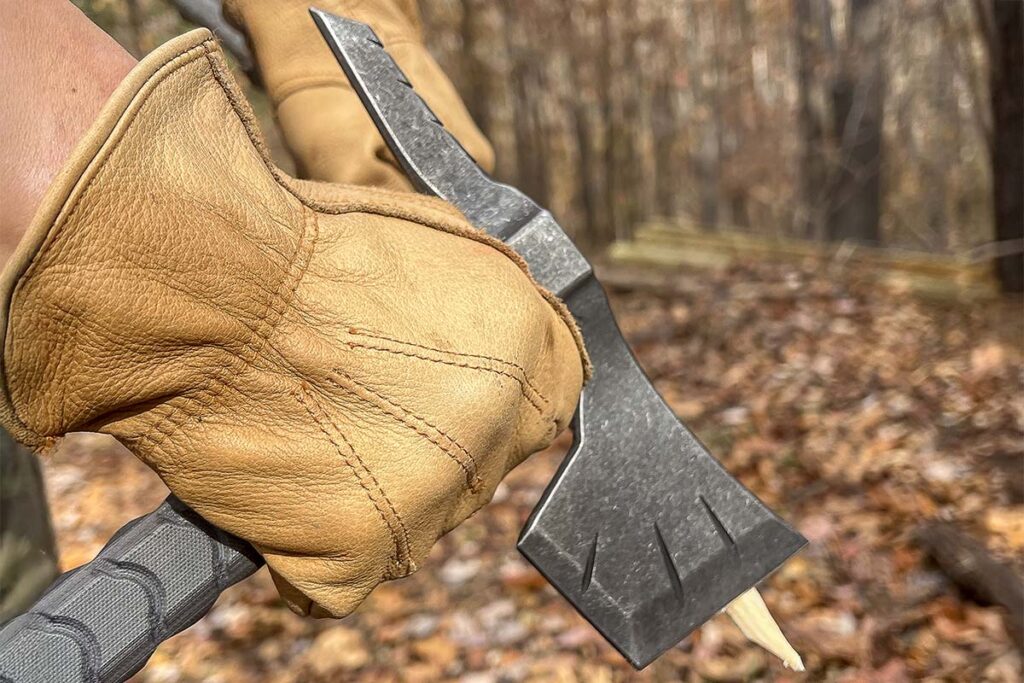
The War Fighter’s 4-inch head and spike are 3Cr13MoV stainless steel in a black stonewash finish. The head’s underside is sharpened for more cutting versatility. The spike is beveled.
Out of the box the War Fighter seemed an OK chopper. It’s short like the Dvalinn but has more head weight. I found the edge a tad thick so I used my belt grinder to reprofile it thinner, doing the final resharpening at 22 degrees convex. The bite and chopping noticeably improved as a result.
Another issue is the spike. It needs to be pointier and more aggressive. Out of the box it was blunt. To be a viable self-defense/CQB tool, the spike needs to have a sharp point to maximize penetration. As is it penetrates wood only so far. Additionally, the four notches cut into the spike are useless. Each one is very sharp and catches kind of like a fishhook. My recommendation is to remove those. I’d rather see the spike pointier than have the notches.
The handle with its various surface features does a great job at keeping your hand in place. I wore leather work gloves during testing and never felt the War Fighter was going to get away from me. G-10 is an excellent choice for handle material, given its dimensional stability and being impervious to most fluids. Country of origin: China. MSRP: $94.99.
Hogue EX-T01
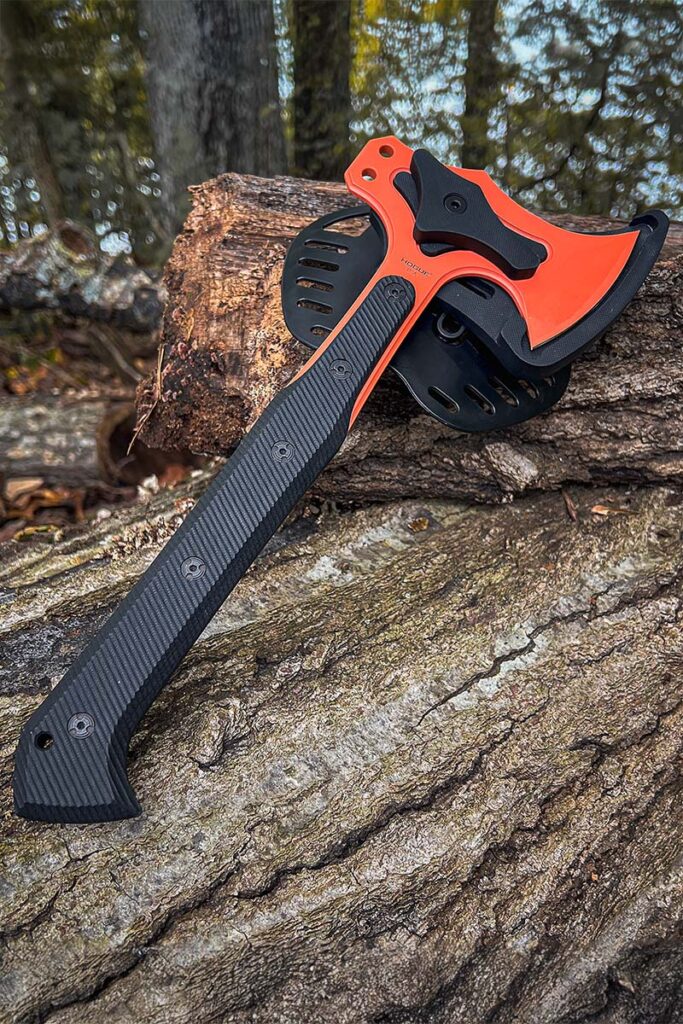
Designed by custom knifemaker Allen Elishewitz, the Hogue EX-T01 is designed to be an easily carried chopping tool and sports a distinctive carry system. The 3-inch head is S7 tool steel. The full-tang construction yields to a machined G-10 handle for superior grip with or without gloves in all weather conditions.
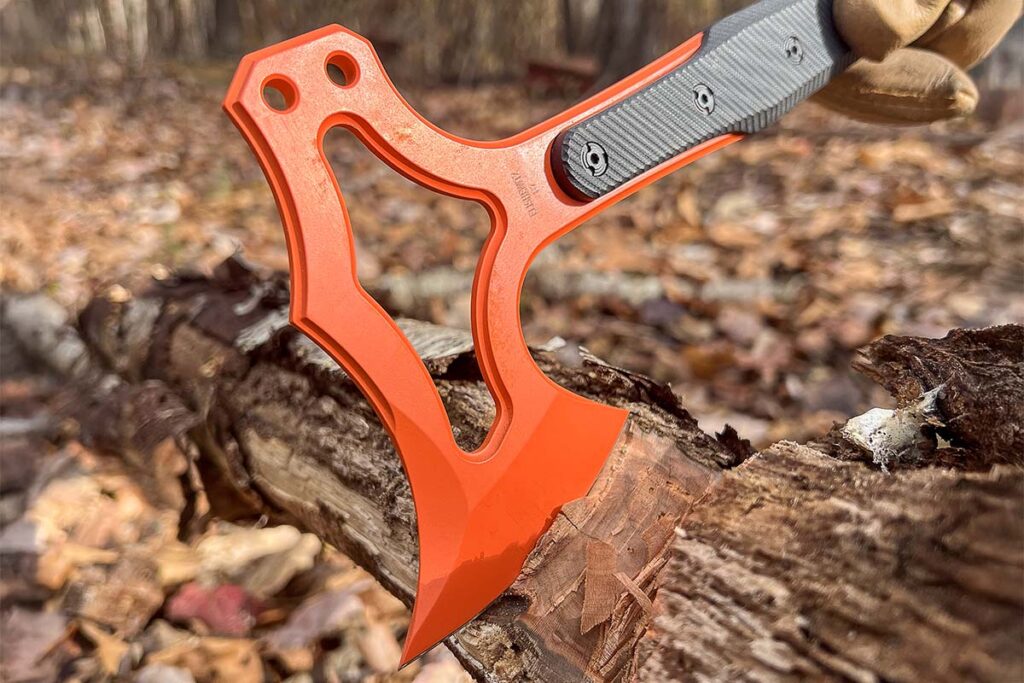
A smart design feature is a partially exposed tang about 2 inches below the head—from there the G-10 transitions to a fully encased design. The partially exposed tang would appear to protect the handle material against overstrikes. And the orange Cerakote finish appeals to hunters, being easier to spot if you drop the hawk in the field. S7 is easy to resharpen, a plus for field carry. The downside is it is not stainless, which partially explains the rust-resistant Cerakote finish. S7 is an excellent candidate for chopping due to its resistance to deformation or dulling from hard-use applications. It is the type of steel you want for a chopper.
The G-10 is chamfered nicely to eliminate hot spots, and the texturing helps provide a nonslip grip in all weather conditions. I like the bird’s-beak pommel forming a hook to capture the user’s hand. Five sets of bolts along the handle’s entire length hold the G-10 onto the full tang.
A smart design feature of the Hogue EX-T01 is a partially exposed tang about 2 inches below the head—from there the G-10 transitions to a fully encased grip.
The sheath system is rather intriguing. It integrates into the cutting head via a specially designed cutout that both reduces weight and provides an interface to secure the hawk to it. The main part is machined black G-10. The centerpiece is of the same shape as the head cutout, as well as a ridge section that protects the edge from inadvertent contact when sheathed.
Three rare earth magnets inlaid into the sheath plate in three different locations grab and hold the EX-T01 securely. Moreover, an integrated latch that turns and detents into place prevents the hawk from detaching. A flexible, contoured plastic-belt-loop attachment affixed to the sheath plate slides over and affixes to a belt. You need not loosen your belt to attach or remove it, so it’s quick, too. It’s a really neat way of carrying a tomahawk, very secure, safe and easy to use, and different from standard sheath systems.
Last but certainly not least, the EX-T01 is a blast to use. This is one dynamic setup, providing a lot for the money. Overall length: 14 1/8 inches. Country of origin: USA. MSRP: $329.95.
Check Out Outdoor Knife Reviews:
BEST TOMAHAWKS: OUR TOP HAWKS FOR BACKWOODS TO BATTLEFIELDS
Three new models are but a smattering of the boom in factory-made automatics.
When it comes to a truly original American knife, it’s hard to top the auto.
Unfairly maligned over the decades as the “weapon of street gangs” and other inaccurate smears, the knife still known to many as the switchblade is enjoying a renaissance in popularity due to the reversals of many statewide auto bans spearheaded in large part by the two leading pro-knife legislative action groups: Knife Rights and the American Knife & Tool Institute.
With autos now legal to many thousands of enthusiasts in dozens of states, one of the results has been a boom in factory-made autos by a growing number of knife companies.
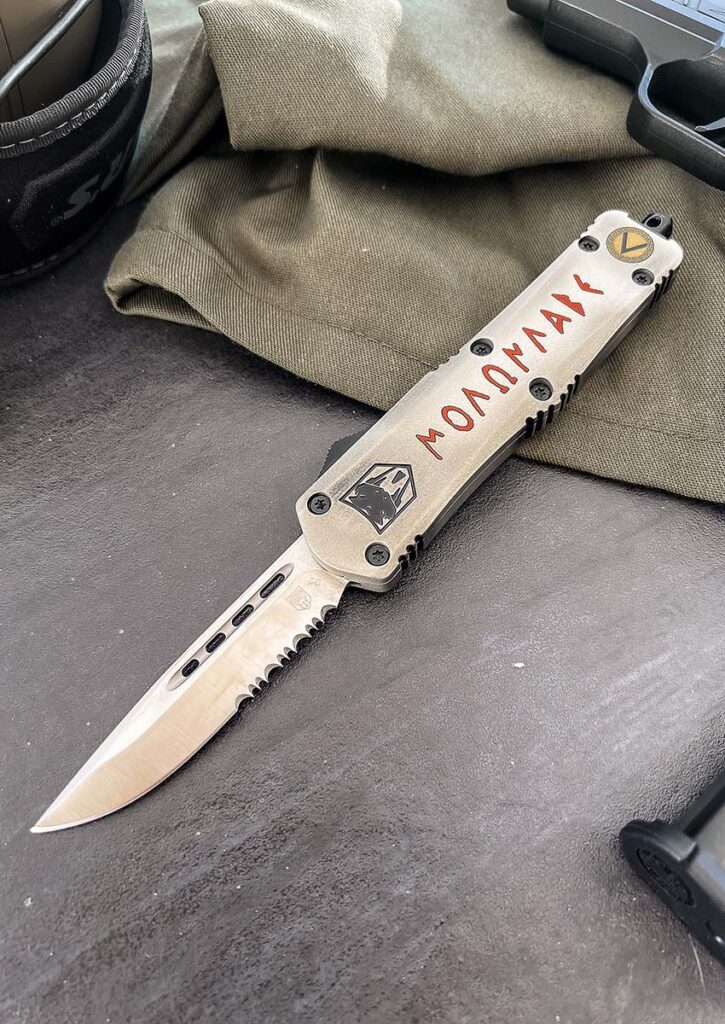
CobraTec FS-3 Molon Labe
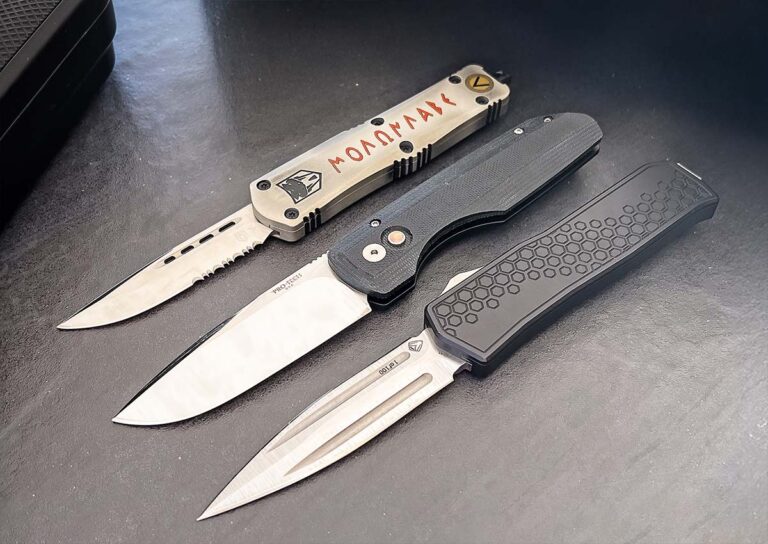
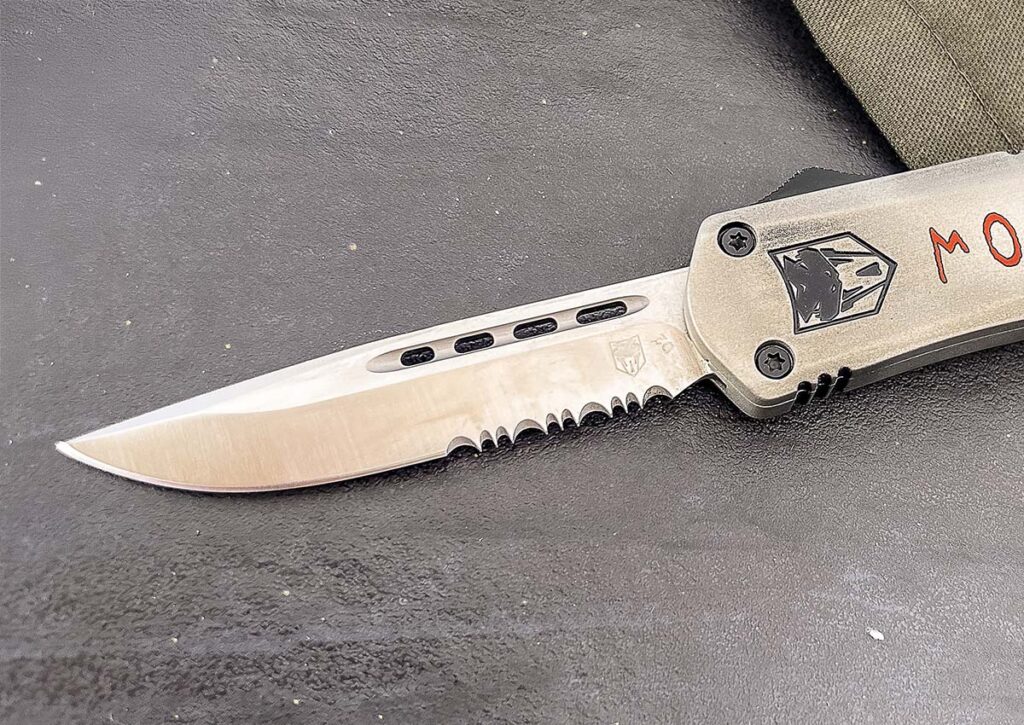
The handle of the CobraTec OTF has a Cerakote® finish and graphics with the Molon Labe—Latin for “come and take it”—text. A ramped thumb slide switch actuates the blade, which deploys and retracts with quick, crisp action.
If you’re into OTF (Out The Front) autos, Texas-based CobraTec Knives should be of interest. The small, family-owned operation offers entry-level, midgrade and high-end automatic and manual opening knives, as well as fixed blades.
Its OTFs* are a great bang for the buck. The medium FS-3 Molon Labe edition features a 3-inch clip-point blade of satin-finished D2 tool steel paired with a 4.5-inch aluminum handle. Available in either a plain or partially serrated edge, the test model is the latter. The serrations give extra cutting power through thick or fibrous materials.
The knife is sized just right to handle most cutting tasks and still be compact enough for comfortable carry. The handle has a Cerakote® finish and graphics with the Molon Labe—Ancient Greek for “come and take it”—text. A deep carry, reversible/ambidextrous pocket clip held by a large screw doubles as a glass breaker. A ramped thumb slide switch actuates the blade, which deploys and retracts with quick, crisp action.
A ramped thumb slide switch actuates the blade, which deploys and retracts with quick, crisp action.
D2 is known for toughness, edge holding and ease of resharpening. It’s been a popular choice for custom knifemakers for years and has become widely adopted in the production industry as an alternative to low-grade stainless steel, offering the enhanced edge retention at a nominal price increase, if any. The belly of the modified clip point blade has excellent slicing abilities.
Medford Knife & Tool MERC-1
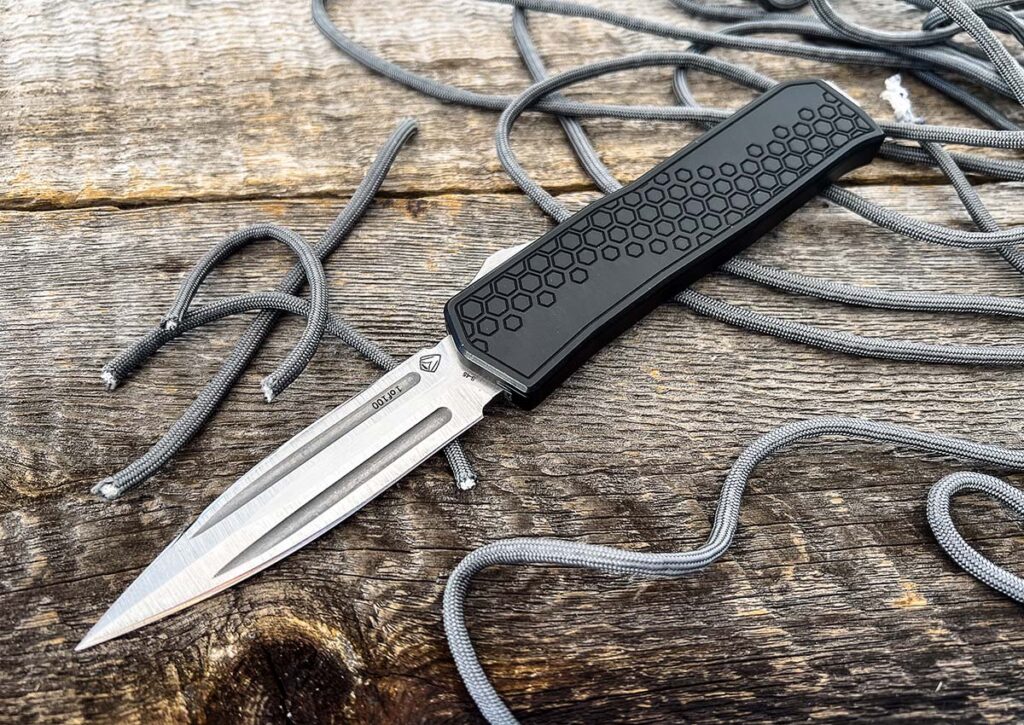
The MERC-1 has a symmetrical dagger-style blade of CPM S45VN stainless for enhanced edge holding.
If you think the Medford Knife & Tool MERC-1 is like all the other OTFs on the market, you’re wrong. The 3.75-inch blade comes in either a double-edge dagger style or Medford’s single-edge Praetorian-style drop point, each in CPM S45VN stainless.
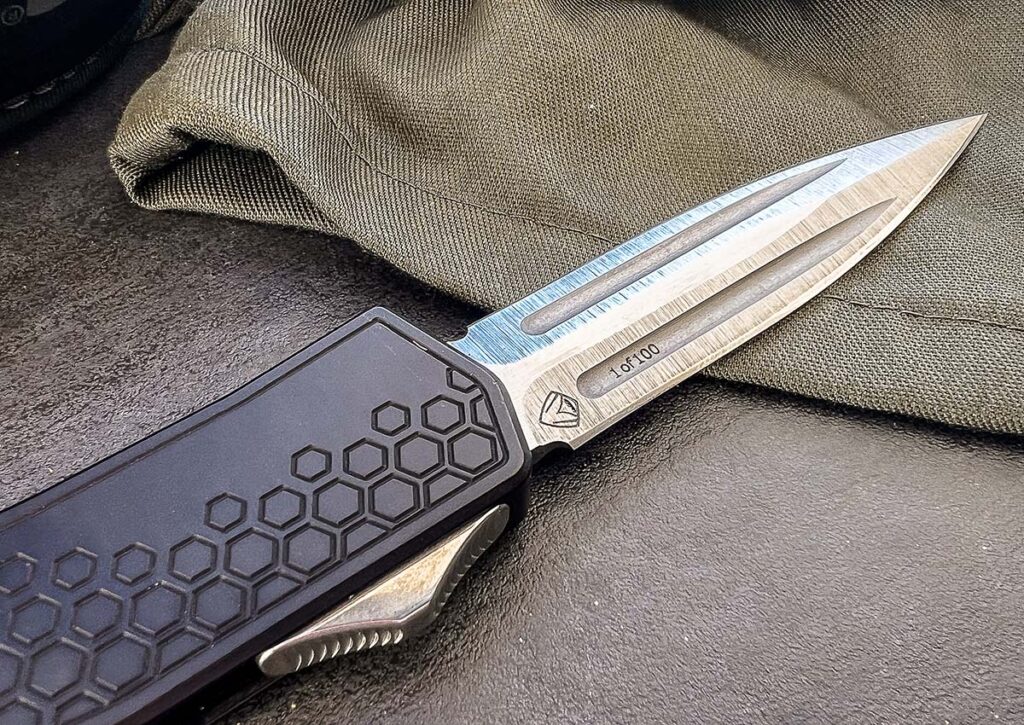
Sporting two sets of fullers, the dagger test blade is loaded with attitude. The 5-inch handle is hard anodized aluminum. A sturdy, wide, deep-carry pocket clip is affixed to the end of the handle by a large screw and has a glassbreaker point.
One of the more interesting facts about the MERC-1 is there are no handle assembly screws. How is this done? The top handle cover slides onto the body via a tongue and channel system. The large clip screw fastens the two together, preventing unwanted movement of the top cover. The no-screws approach provides a visually streamlined, cleaner look than most.
Note the MERC-1 blade’s dual fullers (page 44), reducing weight as well as giving the knife a double dose of attitude.
The MERC-1 is a solid performer. Blade deployment and retraction are quick with a solid feel. The sliding button requires some force to push and pull but once you get used to it, it’s no problem. This is done by design to prevent inadvertent blade movement.
The knife does well at general cutting but needs a bit of pushing to get through some tasks. Dagger blades are more for thrusting and penetration. One thing is certain, the MERC-1’s is definitely cool looking! (Author’s note: the knife for this review is an earlier version with a hex-bolt machining pattern on the handle. The pattern has been changed to a series of chevron lines and an engraving of a crossbow.) The MERC-1 is Medford’s first attempt at an OTF and an excellent one at that.
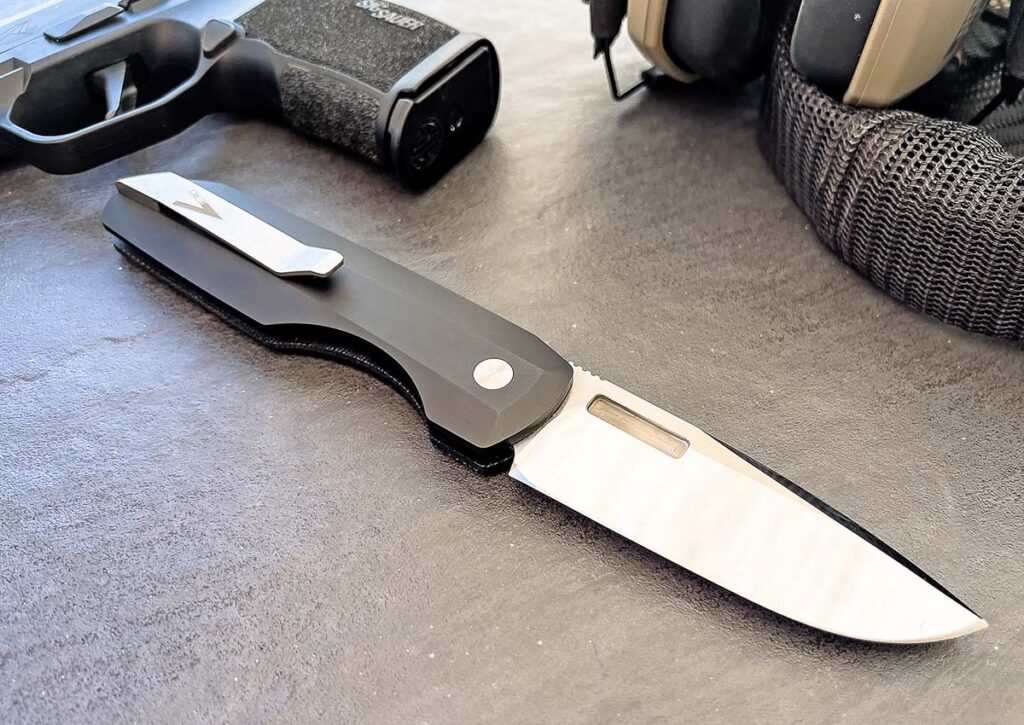
Vero Engineering/Pro-Tech Synapse
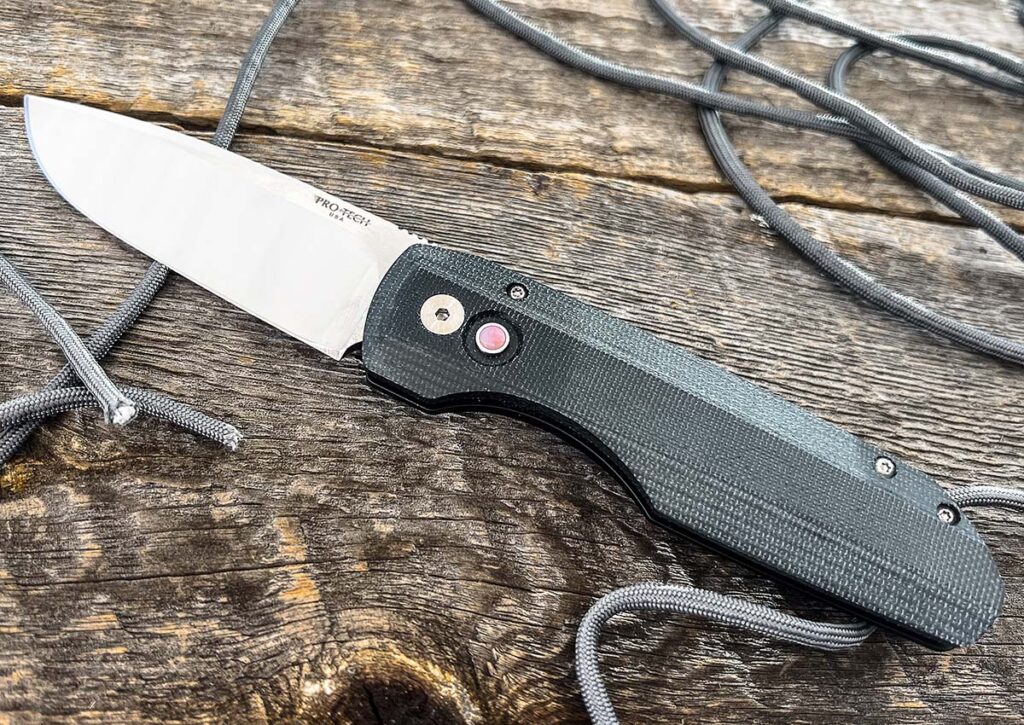
The Synapse handle is a half-and-half hybrid construction style, with a black Micarta® presentation side and the opposite side (right) hard-coat-anodized T6-6061 aluminum alloy for strength, light weight and minimal mass. A stylish milled titanium pocket clip carries the closed knife blade tip up in the pocket.
Pro-Tech Knives has teamed with Vero Engineering to produce a collaborative auto: the Pro-Tech Synapse. The framelock design features all advanced materials in a no-nonsense folder ideal for EDC. It’s especially notable for the infusion of Pro-Tech’s trademark ultra-snappy automatic opening action.
The 3.2-inch drop-point blade is flat-ground CPM MagnaCut stainless steel, which is known for its edge holding and corrosion resistance. The drop point shape provides plenty of blade belly.
The handle is a half-and-half hybrid construction style, with a black Micarta presentation side and the opposite side hard-coat-anodized T6-6061 aluminum alloy for strength, light weight and minimal mass. A stylish milled titanium pocket clip carries the closed knife tip up in the pocket. Another nice touch is the firing button, which sits inside a milled cavity to help prevent accidental blade deployment.
The Synapse’s drop-point blade of CPM MagnaCut stainless is conducive to a wide range of tasks. The blade action is quick and snappy as with all Pro-Tech autos.
With a closed length of 4.1 inches, the Synapse is neither too big nor too small. The large finger groove helps lock your grip onto the handle effectively, allowing a more secure grip with or without gloves.
The blade has an aggressive bite to it and the curve of the belly makes slicing almost effortless. The Synapse is a great working folder.
*Editor’s Note: According to CobraTec, its OTFs have a built-in safety feature that prevents the blade from fully deploying if anything is obstructing its path. Once in “safety mode” the blade must be reset by pulling it all the way into its locked position, making it fully functional again.





![Best Daggers: Top Options That Get To The Point [Tested]](https://blademag.com/wp-content/uploads/Daggers-8-768x512.jpg "Best Daggers: Top Options That Get To The Point [Tested]")