The gun maintenance equipment company tackles knives.
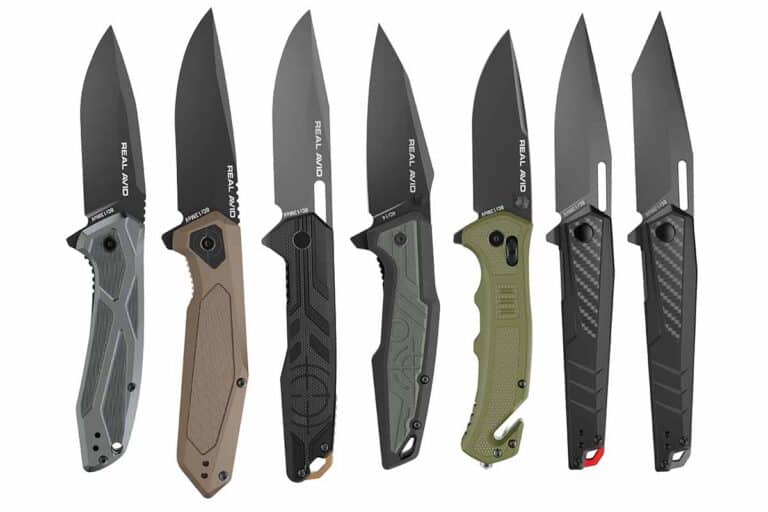
Any of you who tinker around with guns should be familiar with the name Real Avid. The company offers up some fairly innovative gun maintenance gear at a pretty decent price. But now the Minnesota concern is dipping its toe into the knife world with the release of what it calls its RAV series.
In all, the line folders comprise seven knives—all of them well falling into the budget end of the market. The offerings range from $29.99 to $49.99, making them ready for rough use and if need be worry-free replacement if your chores prove too taxing. Nearly across the board Real Avid 8Cr13MoV for the blade steel, except for the RAV-1—the most budget-conscious model—which has a 4cr14 blade. Overall, the steels sharpen well, but you’ll likely have to hone their edges plenty as retention in these stainless steels is marginal.
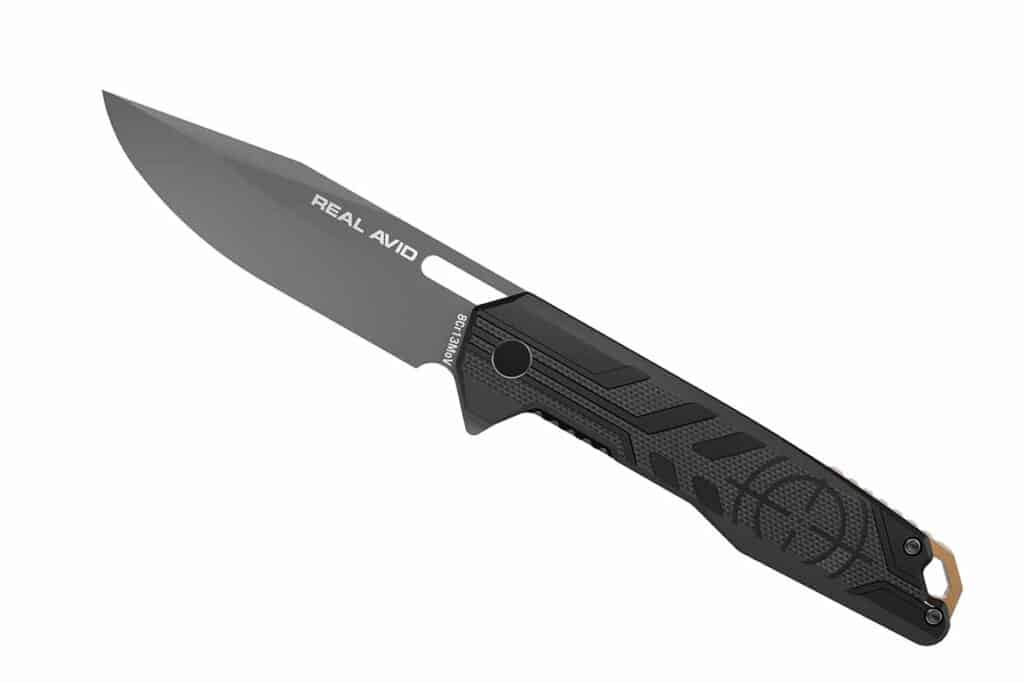
Real Avid RAV 7 with the bullseye pattern in it’s G-10 handle.
Almost every one of the RAVs has a drop or clip point of some style, except the 6, which stands as the lone tanto in the bunch. As for the handles, nylon, aluminum and stainless steel are pretty much the order of the day. However, the tonier RAV-7 does boast a G-10 handle with some nice texturing and a bullseye pattern in the middle. All of them are flippers, though a few models have been outfitted with thumbholes to offer multiple deployment options.
For the most part, these knives fit into Real Avid’s MO as a gun accessories company. Certainly, the blades aren’t going to knock the socks off your blade-aficionado friends. But for something to carry in a range bag, pry out stuck cartridges, unseal a can of ammo, or any other such thing, they’re right in line.
Somewhere between an EDC and a gentleman’s knife, the ACE Bleecker looks to be a slick sidekick.
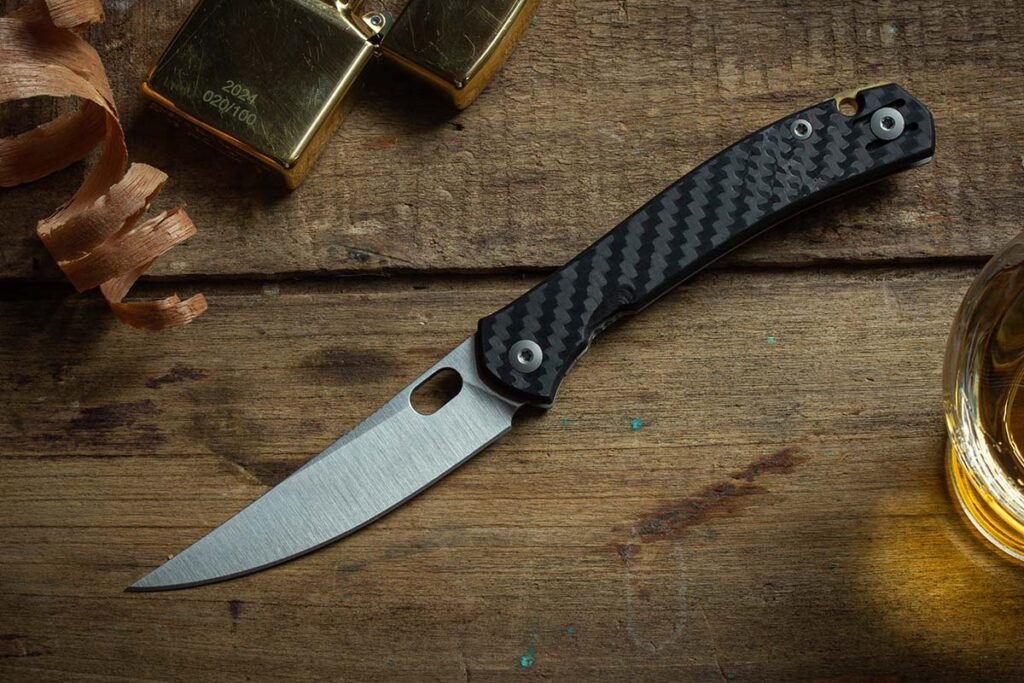
Giant Mouse is going gentlemanly but with an attitude. At least, that appears to happen with the newest addition to its catalog—the ACE Bleecker.
Named after Manhattan, N.Y.’s trendy Bleecker Street, the company seems to aim the frame lock toward hipsters’ hip pockets. The same with the sleek, yet somewhat understated lines. However, robustly built with premium steel and components the Italian import likely has the chops to pull off EDC duty—at least for those who tend to smaller knives.
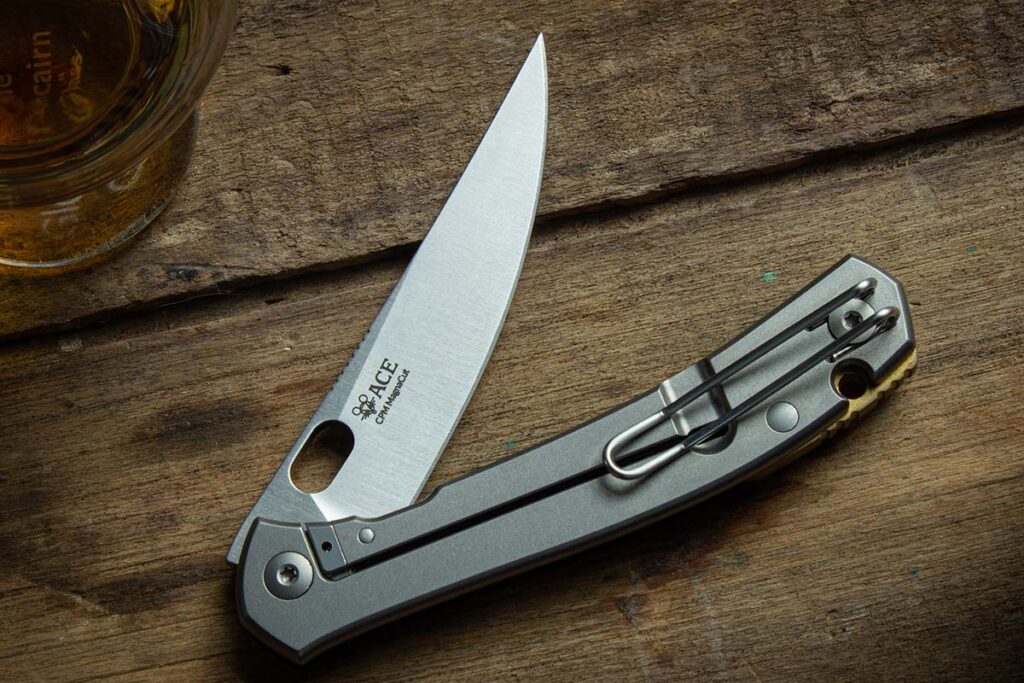
Right off the bat, the notable aspect of the ACE Bleecker is its slim design accentuated by a trailing point blade. In many respects, it’s reminiscent of Giant Mouse’s Knife of the Year award-winning GMX, only smaller and without an integral handle. Despite its svelteness, the company has ensured the knife is capable of more than cutting the foil off wine bottles by making the handle full-sized. It is a bit skinny in the hand, yet it nestles in the palm well enough to handle more aggressive cutting duties.
Giant Mouse went top-shelf for the blade steel, choosing Magnacut—albeit a softer version than some prefer. The company rates it at 62 HRC, a facet that might raise the hackles for the edge-retention obsessive. That aside, the geometry of the 3.26-inch blade is exquisite with a thick(ish) spine adding toughness to the design. The tip doesn’t jut too far above the spine, allowing users to choke up on the blade for finer work. And, boy howdy, should it ever prove apt at fine work, with a very fine tip.
The company has opted for a thumb hole as the opening mechanism on the Bleecker but has made it oblong. The choice is for more than aesthetics, making the knife deployable not only in the traditional style—the thumb—but also in reverse open. As an added benefit, this also makes the knife relatively left-hand friendly. The Bleecker’s well-tuned detent also goes a long way in adding to all these aspects—not so light as to facilitate a negligent deployment, but not overly stiff where users will struggle to get the blade to work.
As for the handle, Giant Mouse offers two options—titanium and carbon fiber. Both are attractive, though I tend to the titanium as it gives the knife more overall continuity and class. In both cases, the knife tips the scales at right around 2 ounces—the titanium a hair more—and measures at 7.43 inches in overall length. Worth note, Giant Mouse includes a notch on the thumb side and a chamfer on the lock that go a long way in making opening the knife simple. Also, it boasts a reversible wire pocket clip for tip-up carry.
With a gentleman’s design comes a gentleman’s price on the Bleecker. Giant Mouse lists the titanium model at $285 and the carbon fiber version at a slightly more affordable $245.
A Ken Onion design, the Kershaw Leek has cut a commanding profile.
It’s no wonder why the Kershaw Leek is such a phenomenal EDC folding knife. It has all the right elements that knife users crave—style, sturdy construction, premium materials, an impressive selection and is priced right.
The Leek is essentially the bigger brother of Kershaw’s Chive, answering the call from knife fanatics for a larger option of this Ken Onion design. And the petite option doesn’t disappoint.
We’ll examine why it’s been a popular seller for Kershaw, explore some popular variants and find out why this isn’t your garden-variety EDC knife.
Kershaw Leek Blade
The Leek’s blade measures 3 inches and is made from Sandvik 14C28N stainless steel, making it great at holding an edge. However, it’s the blade’s profile that demands attention. It’s a modified clip point and the profile tapers down to almost a needle tip. This is both a good and bad thing, which I will go into in depth later.
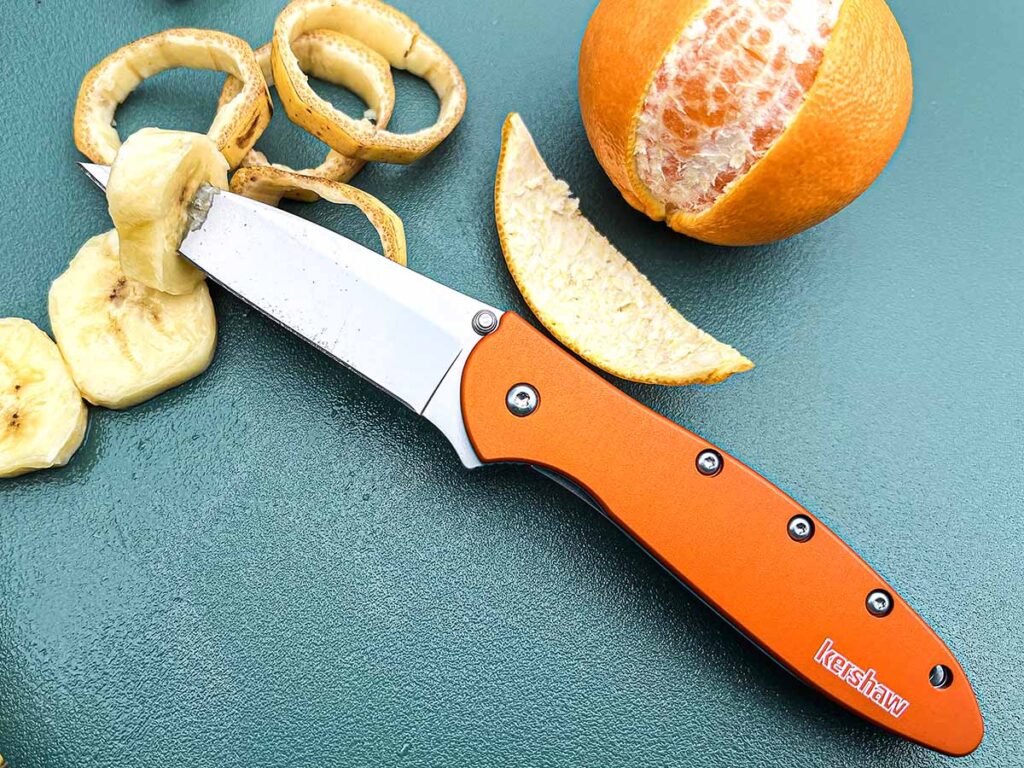
A born cutter, the Leek’s modified clip point blade made quick work of nearly any task set in front of it. Photos by Marty Stanfield, Marty Stanfield Photography
The hollow grind of the blade thins it down nicely to where the blade takes a smart, sharp edge easily. Dual thumb studs are present, but do not function as traditional thumb studs. Instead, they are used only for a positive stop in the open position.
Kershaw Leek Handle
The handle is a slender, elongated shape that favors daily carry due to its thin profile. The handle itself measures 4 inches, bringing the overall length of the Leek to 7 inches when open.
The handle sports a nice, comfortable chamfer all the way around making gripping it easier and presenting fewer hot spots. A large, steel pocket clip can be affixed to the handle to carry the Leek in the tip-up or tip-down position, whatever you wish to do. The clip holds the Leek securely in your pocket, and it can be removed as well should you desire to carry it in the bottom of your pocket.
A movable clip allows the Leek to be carried tip-up or tip-down. Photos by Marty Stanfield, Marty Stanfield Photography
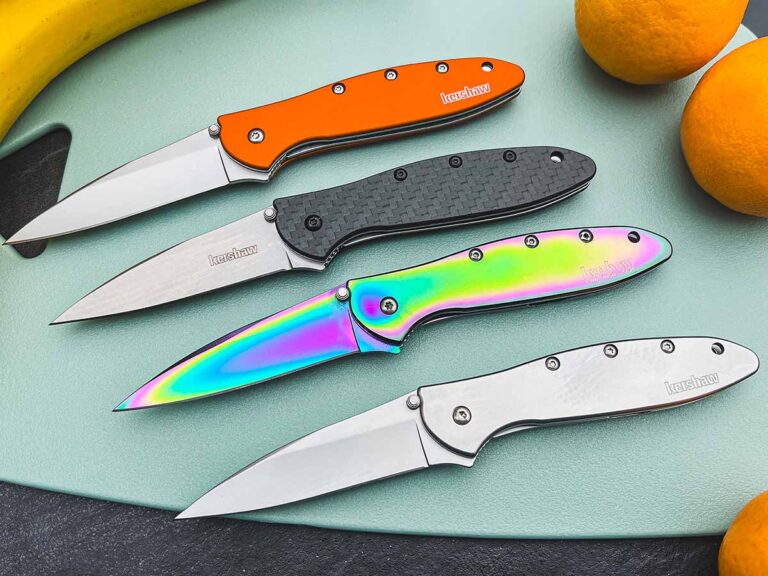
The base Leek (model 1660) has a handle of bead-blasted stainless steel with a matching bead-blasted blade. The Leek is available with a variety of handle finishes, from several colors of anodized aluminum to black PVD-coated, Blackwash and carbon fiber, to name a few.
As for the lock, it’s a frame lock that engages the blade tang positively, securing it in the open position. Very solid and easy to operate when you’re ready to stash the blade.
Testing The Leek
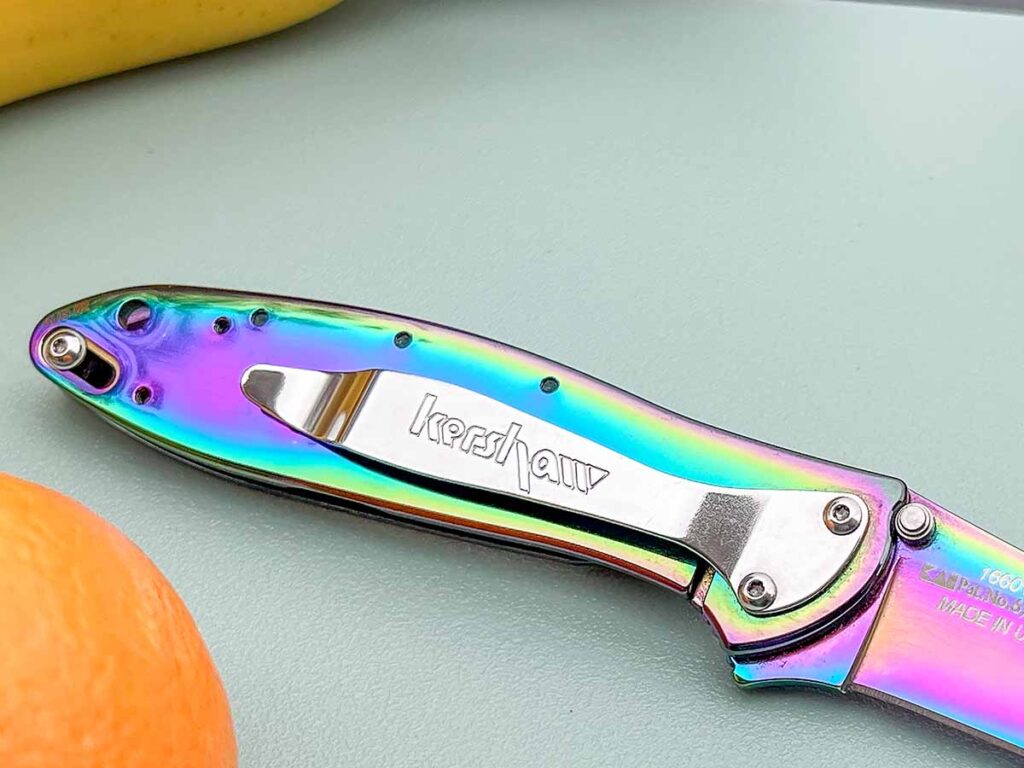
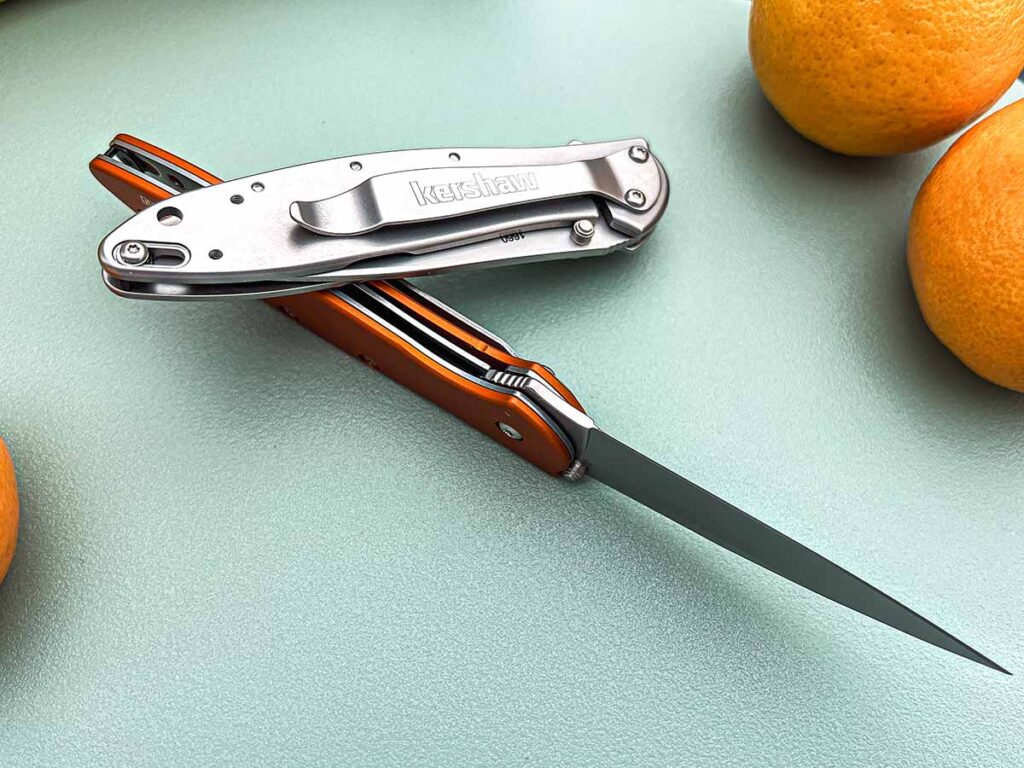
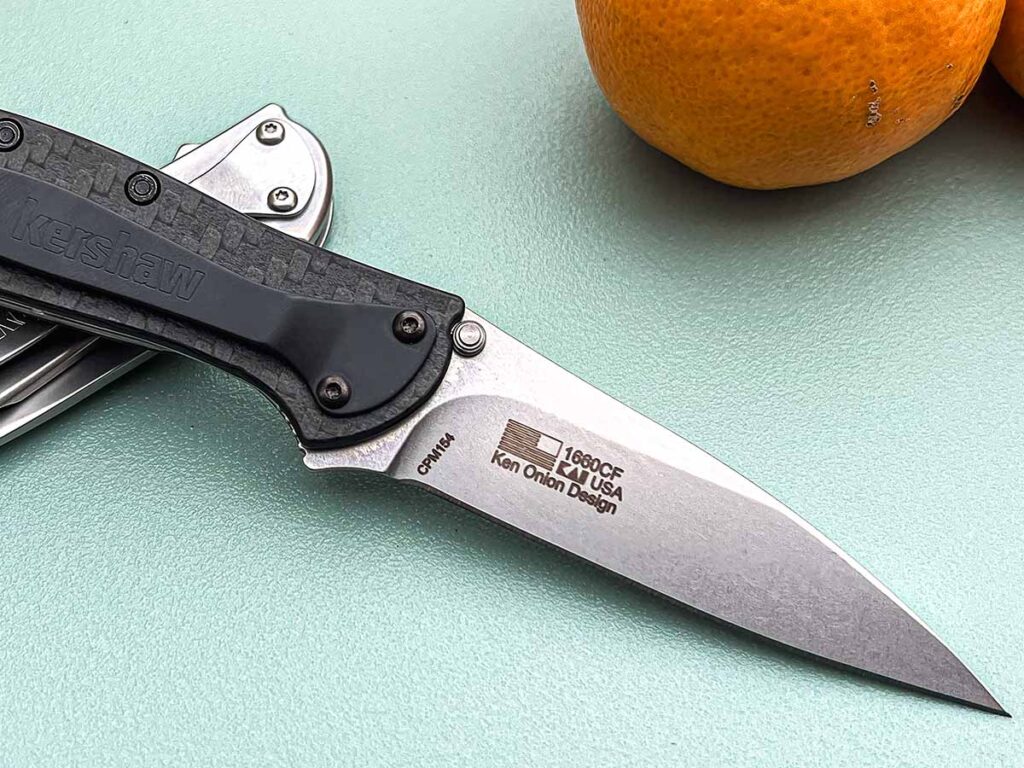
For this review, Kershaw sent me several of their popular selling Leek models for closer examination. I have the 1660 base model Leek with a bead blast finish on the blade and handle. The 1660OR is a liner lock and has orange-anodized aluminum handles. The Leek is available in an array of anodized aluminum colors. Speaking of colors, there’s also the very unique 1660VIB which is a high polish 1660 with the addition of a rainbow titanium coating. And finally, we have the high-tech 1660CF liner lock which features futuristic carbon fiber handles and upgraded blade steel to CPM154 for higher performance cutting and longer edge retention
My pick of this bunch is the 1660CF, given there’s a lot going on with this particular model. You get the benefit of the unique look and the lightweight of the carbon fiber, combined with the high-end blade steel. The 1660CF carries very well due to the reduced mass compared with the regular 1660 Leek framelock.
The Leek’s frame lock is sturdy and easy to manipulate. Photos by Marty Stanfield, Marty Stanfield Photography
Structurally speaking, the base model 1660 Leek frame lock has a very rock-solid lockup. It’s very hard to defeat and only closes when you deliberately command it to. It actually makes a good work knife as long as you use it as a cutting tool and nothing else that it wasn’t designed for (more on this in a bit).
Performance-wise, the Leek—across the board regardless of the blade steel or handle configuration—is definitely a slicer. The blade stock is very thin and when it is ground, it is attenuated even more.
Right out of the box, the leek has a lot of bite. It goes through thicker stuff like cardboard very easily. The tip being acute, makes for an excellent scoring tool as well. The Leek excels at being an all-around EDC cutter.
The blade opens fast, with the press of the exposed flipper tab on the blade spine, Kershaw’s Speed Safe assisted opening technology takes over and powers the blade to the fully open and locked position. It’s easy to see why the Leek remains a popular Kershaw model after all these years, it simply works well and is a good-looking design.
Leek Sticky Points
Two of the most common failures I have seen in the Leek are where folks misuse the knife as well as the sliding safety breaking.
While the blade is an accomplished cutter, it’s thin enough the tip is easily damaged when used to pry. Photos by Marty Stanfield, Marty Stanfield Photography
Because the tip of the blade is pointy, it’s a weak spot with the knife. Where you get into trouble is when you use the tip to pry, even lightly. This either results in a bend or break off entirely. This is a cutting tool, not a pry tool or screwdriver.
Each Leek also comes with a sliding safety that, when the blade is closed, you slide over the tip of the blade to physically block it from coming out of the handle. There is a hex screw on the backside you use your thumb to move and this moves the safety. Sometimes the safety can slide on its own while the blade is open; when you go to close the blade it comes down on the safety tab. If done hard enough this will cause the safety to break, as it is plastic. The nice part, the tab is replaceable.
Final Cut
Other than these points, the Leek is a proven EDC knife. It’s rather compact, slender, and doesn’t garner unwanted attention. It’s worth a look if you’re in the market for a blade that balances looks and performance.
As for price, the MSRP for the base 1660 Leek is $115. The 1660OR orange handle Leek is $105. And the Carbon Fiber 1660 CF runs $190. In the scheme of things, not bad pricing for USA-made EDC folding knife—particularly with an Onion pedigree!
Whether Large Or Small Game, A Good Hunting Knife Kit Is A Must
Skinning knives. Gut hooks. Fillet knives. There are so many different tools for a hunter to use when dressing their kill. However, having just one of those knives could make the process incredibly difficult. That’s where hunting knife kits come in.
These kits feature multiple knives and other tools to help make the process of, well, processing much easier.
Why Should I Buy A Hunting Knife Set?
One word: convenience.
Sure, you could try to skin, dress, and clean a whole buck or fillet a fish with just a caping knife, but good luck with that. A quality hunting knife kit should cover all the bases and give you the confidence of knowing that your needs will be met on a hunt.
What Do I Need In A Hunting Knife Kit?
Your specific needs may differ depending on the types of animals you’re hunting. However, regardless of the species there’s a few items you will definitely want in your hunting knife set.
Skinning Knife
Your list should start here. Any land animal, whether it’s a 10-point buck or a small rabbit, will need to be skinned as one of the first steps of processing. Having a nimble skinning knife in your kit will make your life far easier than trying to brute force it with a pocketknife or something much larger like a kukri.
Caping Knife
A capable caping knife is necessary to get into the little nooks to get all off the meat off the carcass. Small and nimble, a good caping knife is worth its weight in gold and absolutely necessary for hunters of all types.
Boning/Fillet Knife
This is a must especially if you’re fishing. The boning and fillet knife will allow you to remove the flesh from the skin and cut through smaller, more finicky, bones.
Bone Saw/Cleaver
While both are vastly different from each other, they both accomplish the same thing: breaking through large bones. A boning knife won’t be able to easily cut through something like the sternum or hip bones. A bone saw or a cleaver is the way to go. The cleaver, though, is more versatile as you can also prep the meat for cooking with it.
Gut Hook
The gut hook, at least a good gut hook, should open up the belly of a kill like a zipper and allow you to easily pull the guts and innards out. There are many high-end gut hook/skinning knife combo tools available so look for those as they’ll do both the jobs while also saving room in your pack. Standalone gut hooks are available as well.
5 Best Hunting Knife Kits
Gerber Myth Field Dress Kit
Gerber Myth Field Dress Kit
This is a perfect mix of rugged tools and true portability. This kit from Gerber only has two knives, but they’re both of the highest quality. A 7.25-inch caping knife and an 8.5-inch gut hook are both strong enough to process big game thanks to the stainless blades. The rubber handles provide an excellent grip while also being moisture resistant.
The piggyback sheath is just as important here, too. Both knives easily fit into the sheath, which is paracord friendly if not fully MOLLE compatible, and the built-in carbide sharpener will keep your blades slicing true when in the field.
The only knock on this set is that there is no saw included, but the quality of the tools here is more than enough to dress deer, rabbit, quail, and a whole lot more.
MSRP: $75
Ruko 131
Ruko 131
The last kit came in a sheath. This one comes in a briefcase. The 131 set from Ruko comes with eight different tools. The list includes a caping knife, skinning knife, bone saw, fillet knife, game shears, gut hook knife, standalone gut hook, and a cleaver. Yes, two gut hooks.
All of these tools come with an easy-to-see orange handle and are contained in a black polypropylene case. It truly is a one-size-fits-all set for hunters.
The tradeoff is in blade quality. All of the tools are made from 420HC stainless which, yes has good corrosion resistance but isn’t the top-quality steel of some other sets on this list. Regardless, if you’re looking for a high-volume, fairly-priced hunting knife kit, Ruko has you covered.
MSRP: $59.99
Victorinox Fish Fillet Kit
Victorinox Fish Fillet Kit
The first animal-specific set on our list is from Victorinox, the maker of the iconic Swiss Army knife. The company’s high quality and attention to detail is on display in this kit just like it is their famous red multi-tools.
This set includes a 3.25-inch paring knife, 6-inch boning knife, 8-inch fillet knife, and 10-inch breaking knife. There’s also a handheld sharpener and an included 8-slot knife roll. The high-carbon stainless steel blades are made in Switzerland and are just as at home at the campsite as they are in the kitchen.
While made for fish and smaller game like rabbits, especially the three smaller knives, the beefy breaking knife can also be used when processing larger kills.
MSRP: $172.99
Outdoor Edge ButcherLite Game Processing Kit
Outdoor Edge ButcherLite Game Processing Kit
This eight-piece hunting kit from Outdoor Edge is designed to process game all the way from field to freezer. The set includes a gut hook skinner, caping knife, boning/fillet knife, bone saw, rib cage spreader, game cleaning gloves, and a tungsten carbide sharpener so you can reset your knives’ edge when out in the field.
The blades are made from 420J2 high-carbon stainless steel that provides quality edge protection and the full-tang construction, along with rubberized handles, provide a well-balanced knife that’s easy to grip.
All of the tools tuck neatly away into the included nylon roll pack that converts to a belt scabbard for easy access when processing the animal. And, at just 2.4 pounds, this hunting knife set is light enough to easily tuck away in your pack.
MSRP: $64.95
Smith And Wesson Campfire Set
Smith And Wesson Campfire Set
This three-knife set features beefy blades and a straight-to-the-point ethos. With a caping knife, gut hook skinner, and cleaver, Smith and Wesson has made a no-nonsense set of knives that’s easy to pack away and versatile enough to break down your kills.
Made from 3Cr13 stainless, these blades come sharp and can handle the abuse you’ll most certainly throw at them. The included all-in-one sheath allows you to neatly pack away your knives for easy carry and transport.
There is no fillet knife so processing fish might be difficult, but the cleaver in place of a bone saw provides added flexibility. The cleaver can chop through most bones while also helping to prep food around a campfire.
SOG and designer Kiku Matsuda launch the Hidaka XR folder and FX fixed blade—rugged, Japanese-inspired knives built for outdoor adventure.
SOG has never been afraid to push boundaries, and the brand’s latest collaboration with master Japanese designer Kiku Matsuda proves it once again. August 2025 marks the debut of two new additions to the Hidaka series—the Hidaka XR folding knife and the Hidaka FX fixed blade. Both builds reflect Matsuda’s trademark blend of Japanese tradition and Western practicality, creating tools that are as striking to look at as they are dependable in the field.
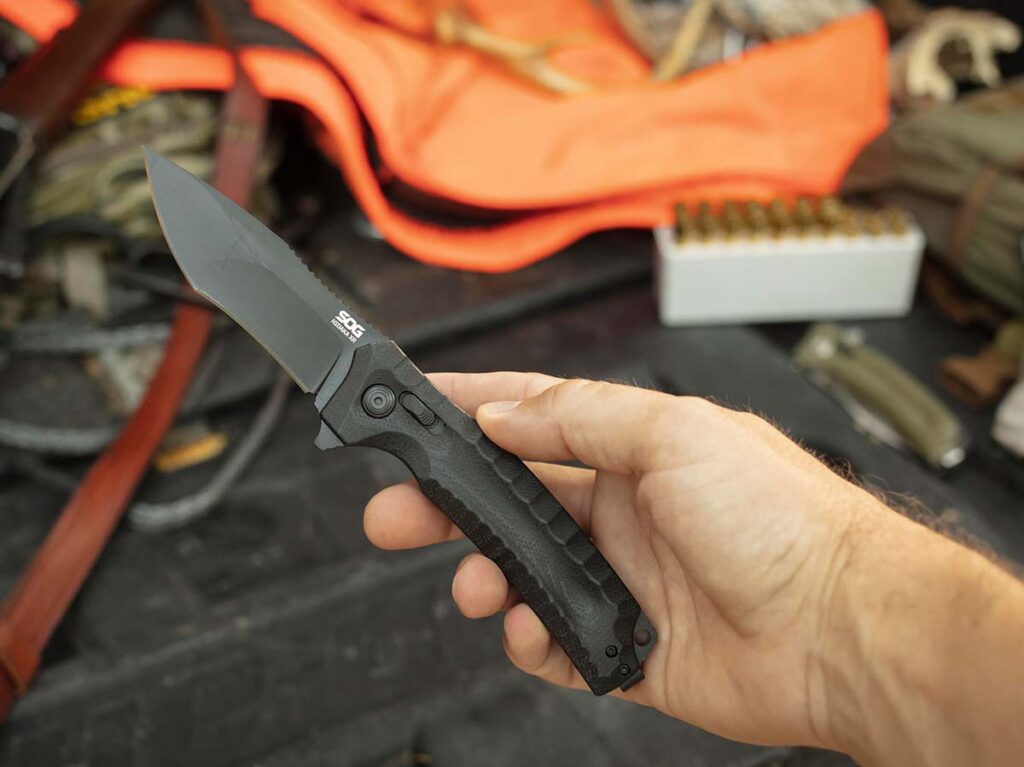
The Hidaka XR takes the foundation of the original folder and turns up the performance. This isn’t just a cosmetic refresh. SOG gave the XR a 4-inch modified tanto blade made from CPM 3V steel—steel that’s known for taking abuse and holding an edge long after lesser alloys give out. Designed with outdoor use in mind, the XR can chop, pry, and slice with equal confidence. The textured Micarta handle not only looks the part, it locks into the hand, even when wet, and the company’s XR lock system secures the blade under up to 1,500 pounds of force. In practice, it feels closer to a fixed blade than a folder, making it a smart option for anyone who needs a folding knife that can survive hard use.
SOG Hidaka XR
Then there’s the Hidaka FX, a fixed blade that ticks all the boxes for serious outdoorsmen. Its 4.8-inch CRYO 3V steel blade, satin-finished for clean cuts, is built for durability and edge retention. A linen Micarta handle ensures a secure grip, while resisting heat, moisture, and impact. Add in the streamlined Kydex sheath, and the FX becomes an easy-carry knife ready for camp chores, trail tasks, or emergency situations.
Together, the Hidaka XR and FX show where SOG is headed—knives that merge artistry, ruggedness, and advanced engineering. With Matsuda’s design touch and SOG’s proven reputation for innovation since 1986, these new Hidakas aren’t just fresh models. They’re proof the brand is still redefining what a modern survival and outdoor knife can be.
Take your pick of contemporary tactical and utilitarian cutters, custom & factory.
The new year is here and makers are hard at work in their forges and factory lines turning out new knives. We collected a bevvy of them, both custom and production, to kick off the coming year and continue to build out your wish list.
Ramm Bladesmithing Wapiti Hunter
Knife name: Wapiti Hunter Knife type: Fixed blade Blade length: 4.5” Blade material: O1 tool steel Blade grind: Flat Blade finish: Parkerized Handle: Black canvas Micarta® Guard: Bronze Overall length: 8.5” Sheath: By Peyton Ramm Knife to know: Peyton Ramm is an ABS journeyman smith Maker’s price for a similar knife and sheath: $700 Maker:Ramm Bladesmithing LLC (SharpByCoop image)
Dark Water Knives Tactical Hunter
Knife type: Tactical hunter Blade length: 5.25” Blade steel: CPM 154 stainless Blade grind: Flat Blade finish: Satin Handle material: Black G-10 w/red G-10 liner Overall length: 10.5” Sheath: Sedgwick bridle leather hand stitched w/linen thread Knife to know: Thanks to the exaggerated heirloom fit, the scales are left .059 to .078” larger than the tang instead of the usual slight oversize Maker’s price for a similar knife and sheath: $270 at press-time exchange rate Maker: Dark Water Knives (Rod Hoare image)
Don Sylvest Fat Bubba Skinner
Knife name: Fat Bubba Skinner Knife type: Fixed blade Blade length: 3.25” Blade steel: CPM 154 stainless Blade grind: Flat Blade finish: Stonewash Handle: Coyote Ultrex Overall length: 7.75” Maker’s price for a similar knife: $330 (includes a basic sheath) Maker: Don Sylvest (Jocelyn Frasier image)
Model: M-44 Knife type: Fixed-blade hunter Blade length: 4” Blade steel: Damascus Handle: Water buck horn Bolster: Stainless steel Overall length: 8.25” Sheath: Leather pouch belt model by Daniel Gallegos Maker’s price for a similar knife and sheath: $800 Maker:J. McClure Knives (SharpByCoop image)
Coast Founder’s Series Origin Tanto
Knife name: Founder’s Series Origin Tanto Knife type: Flipper folder Blade length: 3.35” Blade steel: 9Cr18MoV stainless Blade pattern: Tanto Blade finish: Glass bead blast w/black titanium nitride coating Handle: Stainless steel Lock: Framelock Pocket clip: Yes Knife to know: All-steel construction Country of origin: China MSRP: $49.99 Company: Coast
Australian and New Zealand Knifemaking 2025
Content: Profiles of top Down Under knifemakers, including leading lady makers, and stories on the mental health bennies of knifemaking, the Australian Knifemakers Guild, Australian Knife Art Association, New Zealand Blade Art Association, the ABS and knife shows, directories and more Format: 8.25 x 11.5” full-color paperback on slick paper; hundreds of pictures by some of the world’s top knife photographers; 288 pages MSRP: $46 at press-time exchange rate Publisher:Hoare Publishing/Rod Hoare Knife Images
Knife name: Prybrid Utility Clip Burnt Orange Knife type: Replaceable blade multi-tool Tools: Standard replaceable utility blade, stainless pry bar, nail puller, wire stripper, small and large flathead drivers, bottle opener and cord cut notch Handle: Glass-filled nylon Pocket clip: Yes Weight: 3.1 ozs. Width: 1.25” Overall length: 4.25” Knife to know: Dual-ended design and keychain for easy access MSRP: $16 Country of origin: USA Company:Gerber
GiantMouse ACE Biblio XL
Knife name: ACE Biblio XL Knife type: Flipper folder Blade length: 3.2” Blade steel: CPM MagnaCut stainless Rockwell hardness: 62 HRC Blade finish: Satin Blade @thickest: .138” Handle: Textured titanium Lock: Linerlock Backspacers: Brass Clip: Wire, reversible Weight: 5 ozs. Closed length: 4.375” Knife to know: Biblio is the name of the Williamsburg, Brooklyn, bar where the idea for the knife was conceived Country of origin: Italy MSRP: $295 Company:GiantMouse
Steven Bryan Baron Fighter
Knife: Baron Fighter Blade length: 10” Blade material: 80CrV2 carbon steel Handle material: Flash weathered maple Bolster: Oil-seasoned pipe collar Overall length: 16” Knife to know: Steven Bryan is an ABS journeyman smith Maker’s price for a similar knife: Contact maker for pricing Maker:Steven Bryan (Jocelyn Frasier image)
The M7 Bayonet Has Been Used By The United States Military For Almost 60 Years. The Dynamic, Multi-Purpose Tool Is Just As Useful Now As When It First Went Into Service.
When you first think of a bayonet your mind probably goes to the battlefields of the Revolutionary and Civil Wars. But no, bayonets aren’t some relic from a bygone era. While the days of bayonet charges are long long, the knives are still in use by the military today and have evolved into a multi-faceted tool.
The M7 Bayonet stands out due to its longevity. Built on the back of the M4 bayonet, which was issued toward the tail end of World War 2, the M7 is designed to be used with the M16 or the M4 carbine, although it can fit on numerous other rifles.
The History Of The M7 Bayonet
The M7 was first introduced in 1964 during the Vietnam War. The knife was initially made by Bauer Ord Company, but numerous companies did eventually manufacture the M7. Today, the lone remaining maker of combat-deployed M7 bayonets is Ontario Knife, though the knife is still available from at least one other company (Smith & Wesson).
Despite being issued by the United States military, the M7 was also made in Canada, West Germany, Australia, and in several countries in Asia.
How Does The M7 Work?
The M7 connects to the M16 via a lug thanks to a dual-lever locking mechanism. This secures the blade to the barrel while keeping the muzzle unblocked. A release mechanism on the pommel of the knife allows it to detach from the firearm easily.
Ontario Knife Company M7 Bayonet
Ontario Knife Company M7 Bayonet
Ontario Knife Co. was one of many makers to manufacture the M7, and it is the last to make the military issue variety of the blade. There is also a commercial version as well, which will be reviewed here.
It starts with a 1080 carbon steel blade with a zinc phosphate finish married to a modified Kraton handle. The blade is 6.7 inches long, and the whole construction is just shy of a foot in length. It tips the scales at 1.15 pounds. It looks beefy and feels hefty in the hand, as you would expect from a such a knife.
The included molded plastic sheath is a pistol belt clip. The lightweight sheath allows for safe, easy transport of the knife. While this knife is designed for combat, it’s burly design allows for multiple different uses. This would be a an excellent all-rounder when camping.