Buyer's Guides

You’re looking for a new knife in a certain style – we’ve got recommendations on the best blades for every price point.

Parts Of A Knife: Crash Course In Knife Anatomy 101

Looking to learn the proper names for everything that makes up a knife?

Like sailors, stagehands, and sommeliers, knifemakers have some very particular terms for the tools of their trade. It helps to know the lingo if you’re getting into knives, or just want to know what the hell “jimping” is when you read it in a product description.

Most of us use knives regularly, and some of us may even be sharpening pros, but there’s still a lot of knife terminology out there that doesn’t come up that often and some of it can be confusing.

Today, we’re going to clear all that up with a primer on all the major parts of modern knives. This is Knife Anatomy 101.

We’re not going to cover everything because you probably don’t need to know the exact name for the type of guard commonly found on a 14th-century German langmesser, but for those of you shopping for a new kitchen or pocket knife, this should cover everything you need to know.

Blade Essentials: Things (Most) Every Knife Has

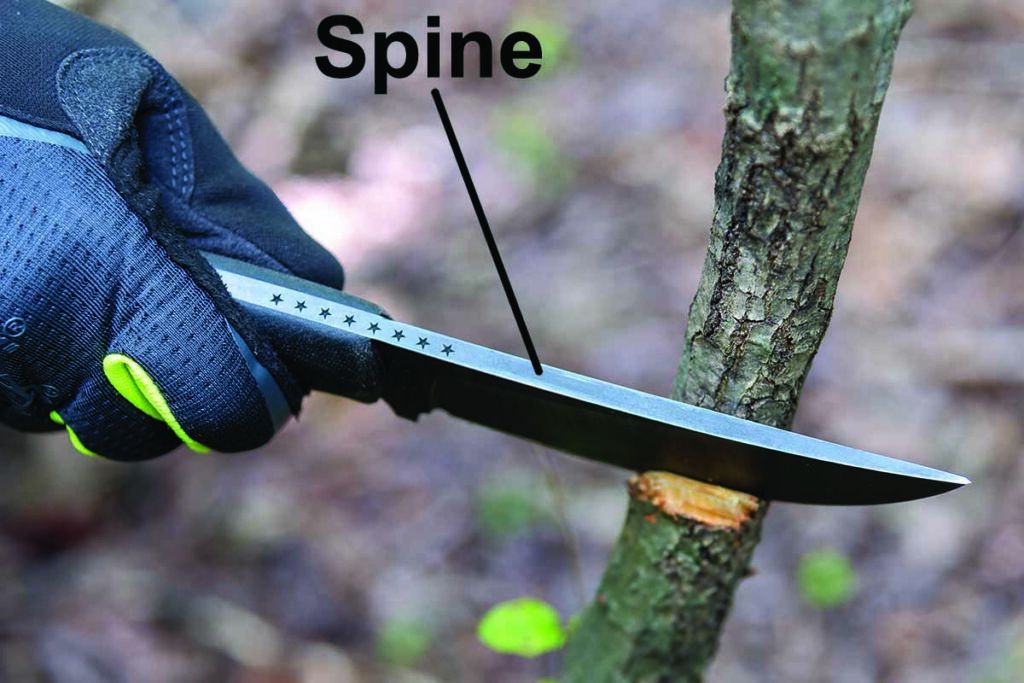
Spine

Knife Spine

The spine of the blade is the part furthest from the edge or edges. On a single-edged knife, this would be the side of the blade opposite the edge, and on a double-edged knife or dagger, this is the middle of the blade between the edges.

The spine on a good knife will typically be heat-treated differently than the edge. The goal is usually to make the spine of the knife softer, and therefore allow it to flex and absorb energy while keeping the edge harder and more resistant to wear so it stays sharper longer.

This is called a differential heat treat and is especially important on larger, hard-use knives or other blades that might have to take impact forces.

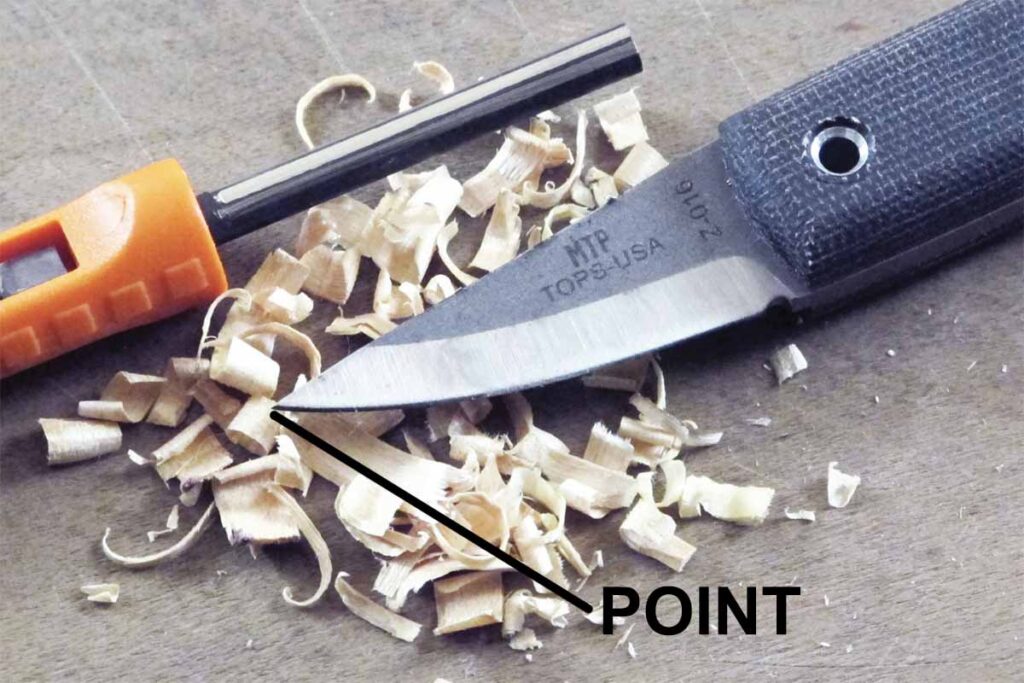
Point

Knife Point

You probably know this one, I won’t lie, but technically the point is the place where the edge and the spine or opposing edge meet, typically at a very sharp (pun intended) angle. This is what you use for piercing, and most knives have one.

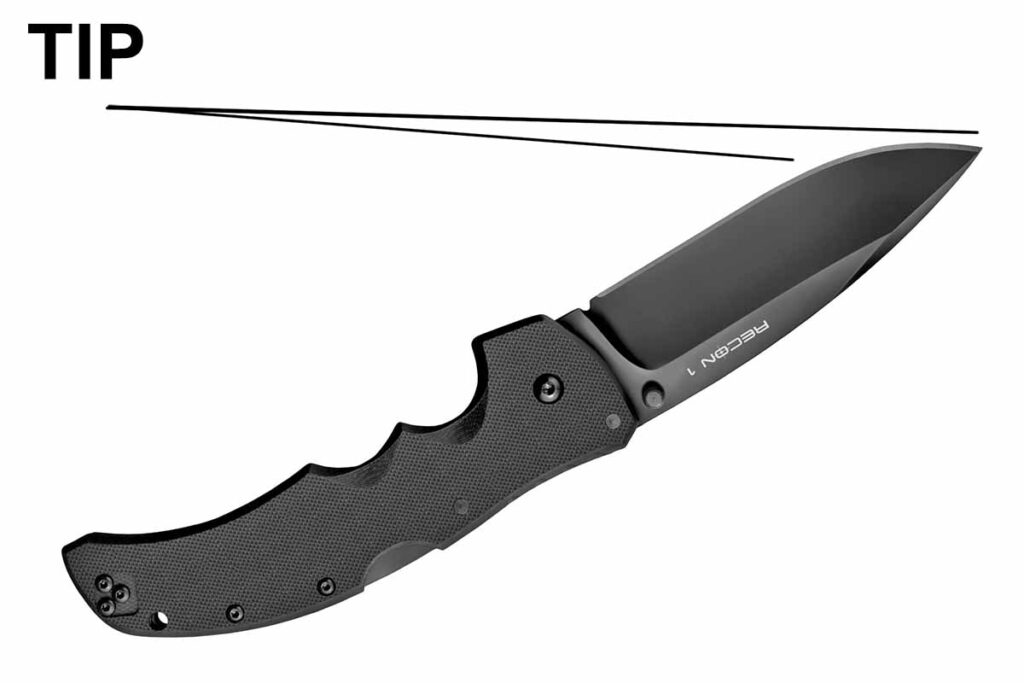
Tip

Parts of a knife, tip

Technically different than the point, the tip of the blade is the forwardmost section of the blade, usually considered to be the last 20% or so of its length.

This section may be sharpened differently, have an unsharpened false edge along the spine, or be heat-treated differently to achieve different results. It includes the point of the blade.

Edge

Knife Edge

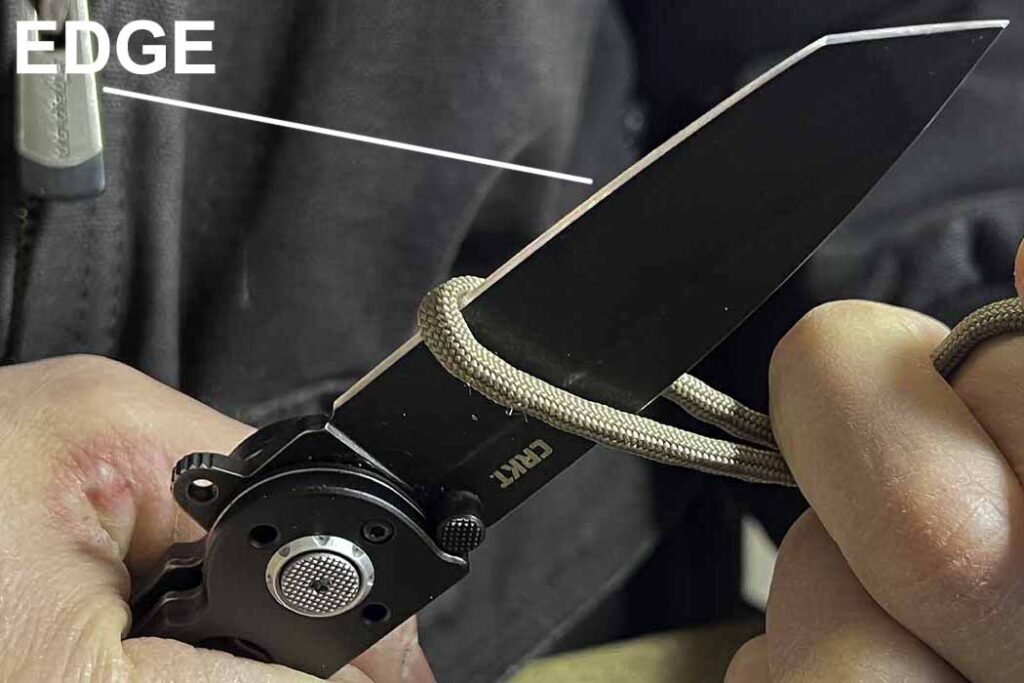
The edge of the knife is the (usually) sharpened portion furthest from the spine. It includes everything from the point to the heel, which we’ll get to later. Basically, this is the part you cut with, and on most knives, the whole thing will be sharpened the same.

There are some knives that have serrations for part of the blade, or certain fighting knives that leave sections unsharpened for the user to grip, though this fell out of fashion around the time the pilgrims landed in America. Today, most fighting or tactical knives are sharp from handle to tip.

One related term you will see is “edge geometry” or “edge angle” which refers to the angle at which the knife is ground or sharpened. Typically, this will be 20 degrees for something like a pocket knife or Western-style chef’s knife, or around 17 degrees for Japanese knives.

If you aren’t sure, a simple bevel gauge will tell you what the original edge is that you should be sharpening towards.

Grind

Parts of a knife, grind

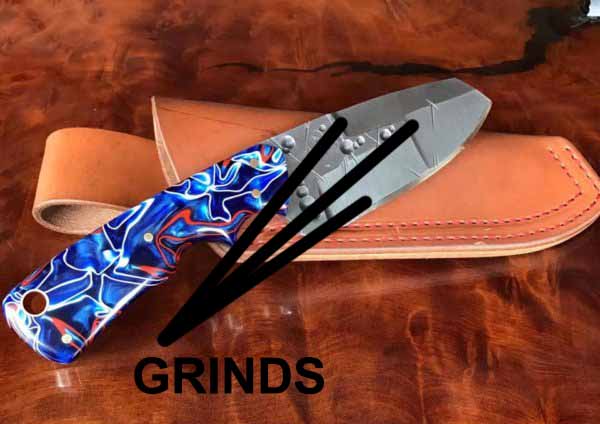
The grind of a blade, also called the geometry of a blade, refers to its cross-section and how the blade was ground by the maker. There are many different ways to grind a blade, with the most common being some form of hollow or flat grind, with convex grinds being a fairly distant third.

Every grind is a balance between strength and sharpness and is used for different things depending on the type of blade.

Some grinds lend themselves to a more robust edge that is less sharp, and some grinds, like the hollow grind you’ll find on most kitchen knives, give us an edge that is more susceptible to damage if misused, but better at slicing.

Various common grinds you’ll see frequently are hollow, flat, sabre (or saber), chisel, convex, and Scandi.  All have their uses and are worth looking into further if you really want to dive into blade geometry and have the very best knife for the job.

Living on the Edge: Parts of the Sharp Part

Fuller

Knife fuller

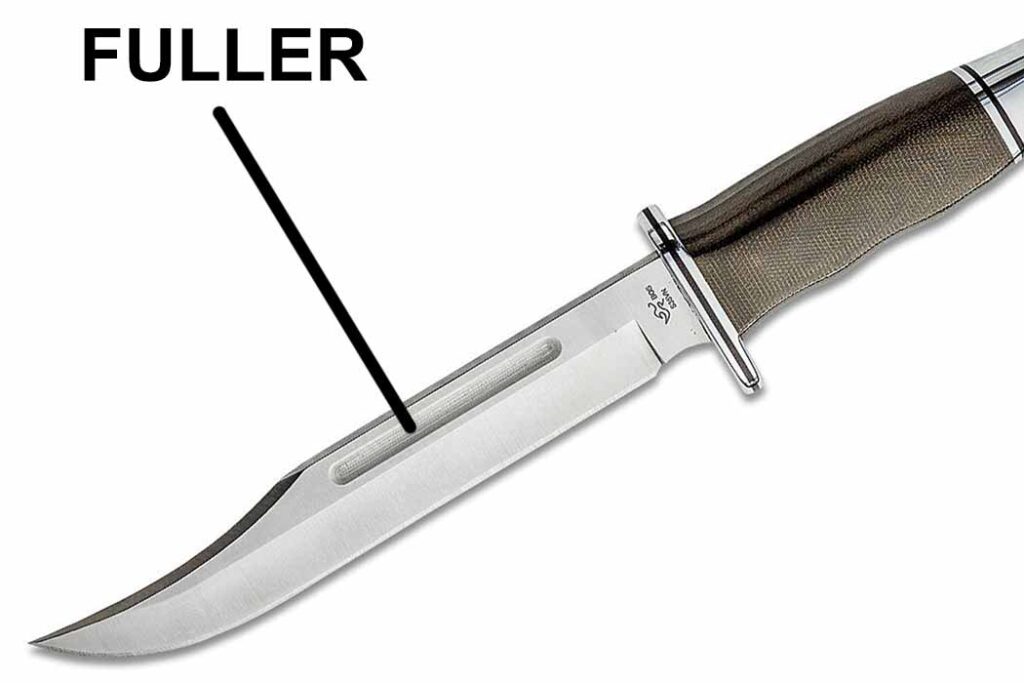
A fuller is a rounded or beveled section of the blade that is either added as part of the forging process or ground in before the blade is heat treated. The purpose is to reduce weight and if forged, to strengthen or widen the blade as needed.

Bolster

Parts of a knife, bolster

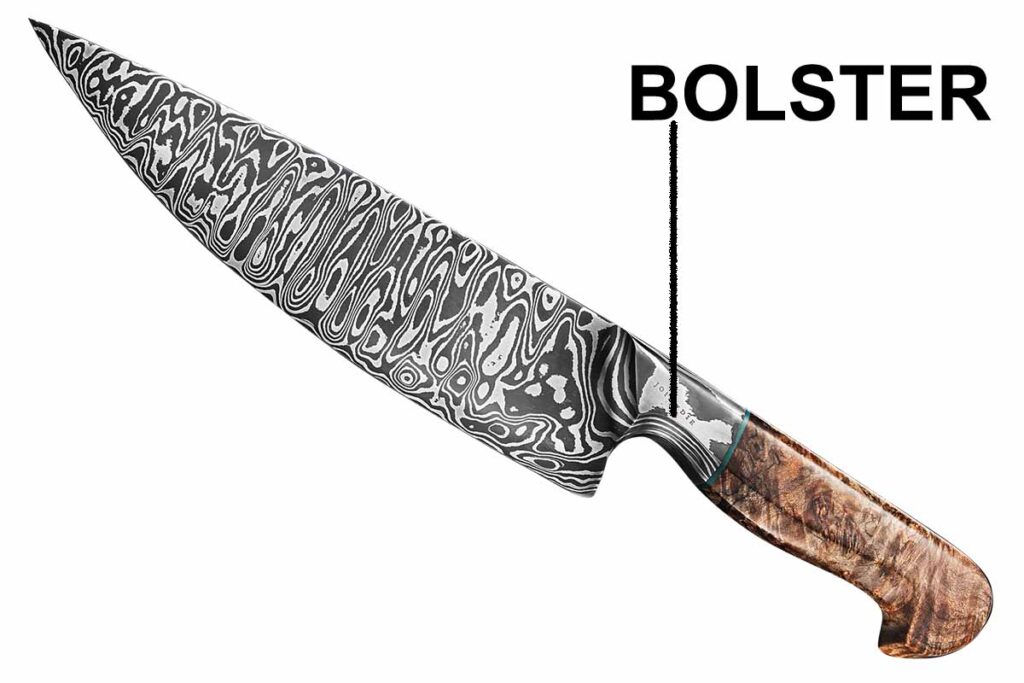
The bolster of a knife, usually found on a kitchen knife or other fixed blade, is a thickened section of the blade that flows smoothly into the handle. This adds strength to one of the weakest areas of any knife (the junction between blade and handle) and helps with ergonomics by providing a smooth transition.

Heel

Knife heel

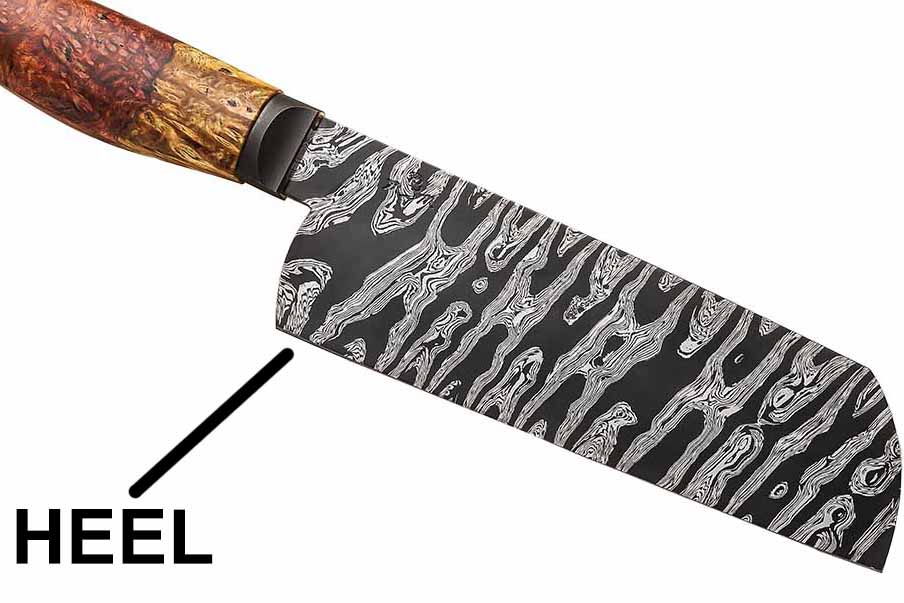
Not all knives have a heel, but if your knife has an edge that extends down and away from the handle, then you can think of the “bottom” of the blade furthest from the tip as the heel.

This is most common on kitchen knives and is typically rounded over or left rather wide to keep your middle finger comfortable when using a pinch grip. Japanese blades are notorious for having a prominent heel.

Tang

Parts of a knife, tang

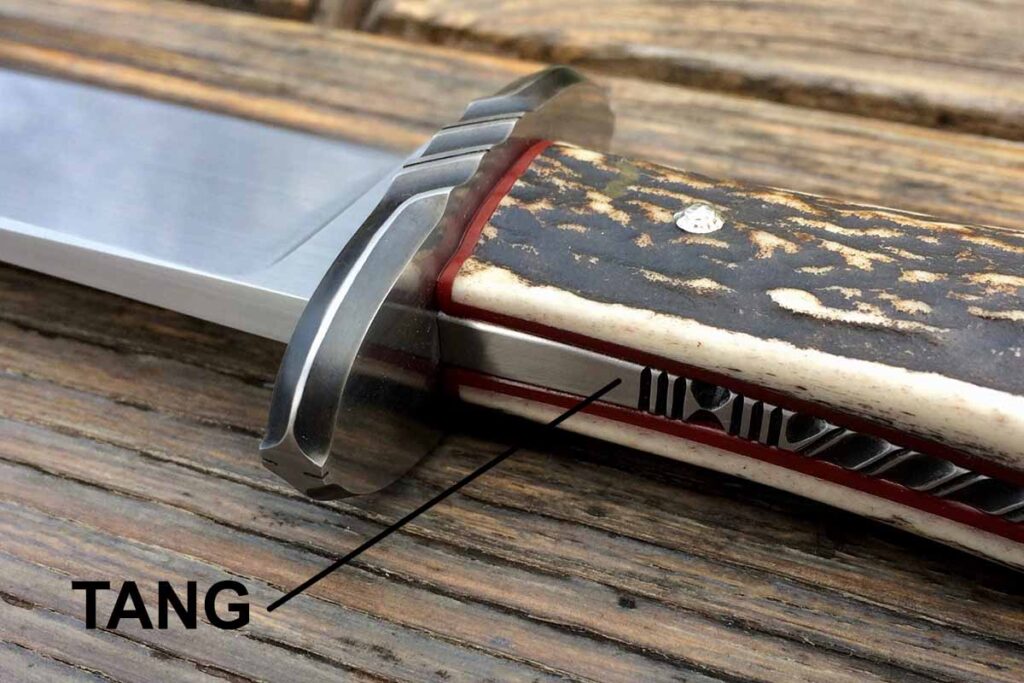
The tang of a knife or sword is the portion that extends into the handle. This can be the back of a folding knife blade that is drilled for a pivot, or the longer unsharpened rectangular section of a fixed-blade knife that the handle is attached to.

A “full tang” is when the tang extends all or most of the way through the handle, and adds a great deal of strength, making it the preferred style for hard-use or high-end fixed-blade knives.

Choil

Parts of a knife, choil

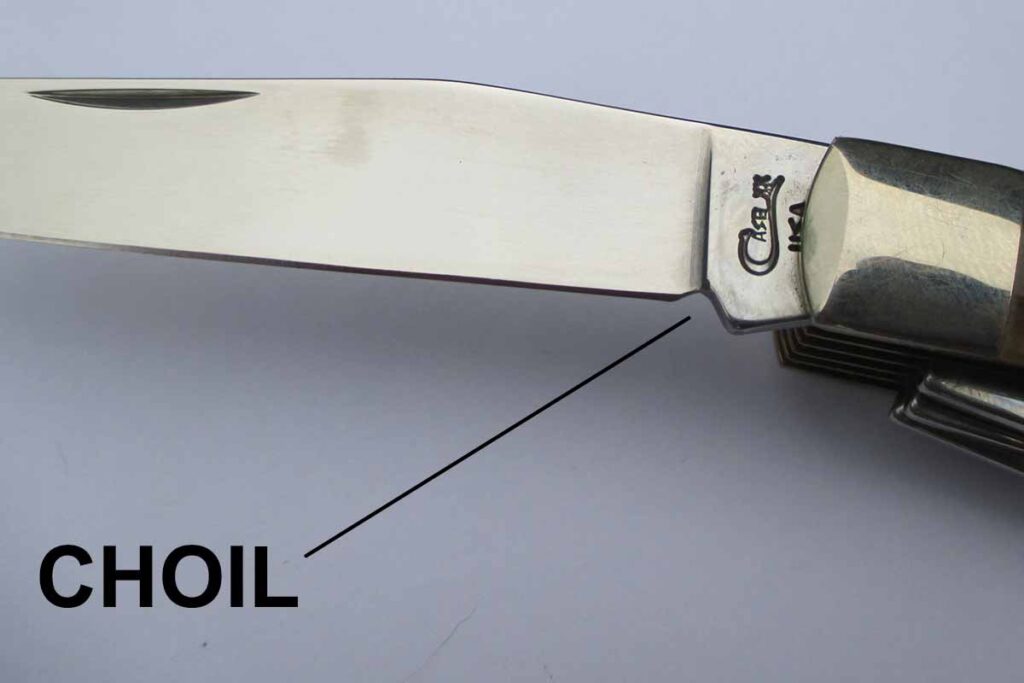
The choil of a knife is the space at the bottom of the edge, furthest from the tip and nearest the handle, and is left unsharpened and hollowed out. On some knives, it’s large enough to accommodate your index finger when using the knife in order to give you a bit more control.

However, the main purpose of the choil is so that the whole length of the edge can be sharpened without any issues.

Jimping

Knife jimping

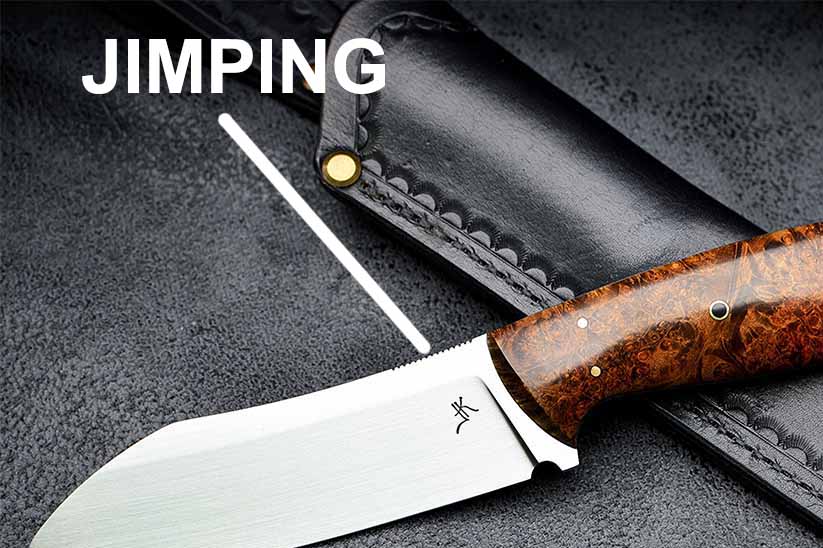
Jimping is the name of the grooves or notches added to the spine of a knife in order to increase grip. The most common places you’ll see this are on pocketknives and hard-use fixed blades, on the spine right where the blade meets the handle.

By having a grippier, high-friction surface there, you can better manipulate the knife, especially with wet or dirty hands

Getting a Handle on the Rest

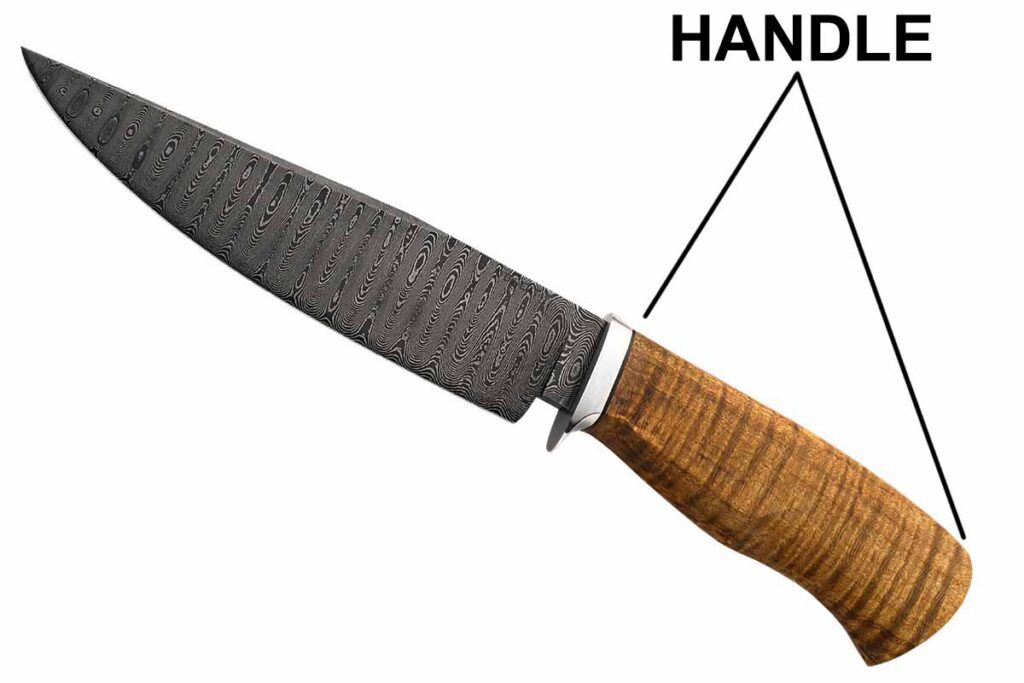
Handle

Parts of a knife, handle

As you probably know, the handle of a knife is the part you hold. On a sword, or longer martial weapon, you will typically see the handle referred to as the hilt, but there’s not really much of a technical difference here.

It includes the guard, the grip, and the pommel if present.

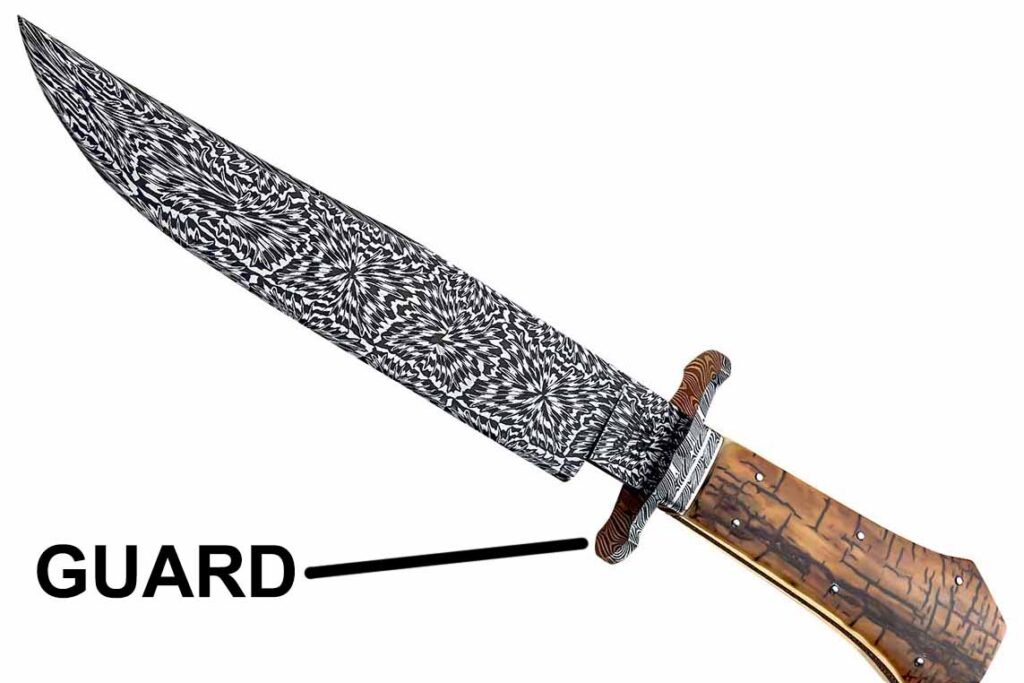
Guard

Knife guard

The guard of a knife is the bit that stops your hand from sliding forward and generally keeps you from hurting yourself with the knife. Many kitchen knives forgo a guard because you aren’t really supposed to stab them into things while fighting knives…well let’s just say swords had crossguards for a reason.

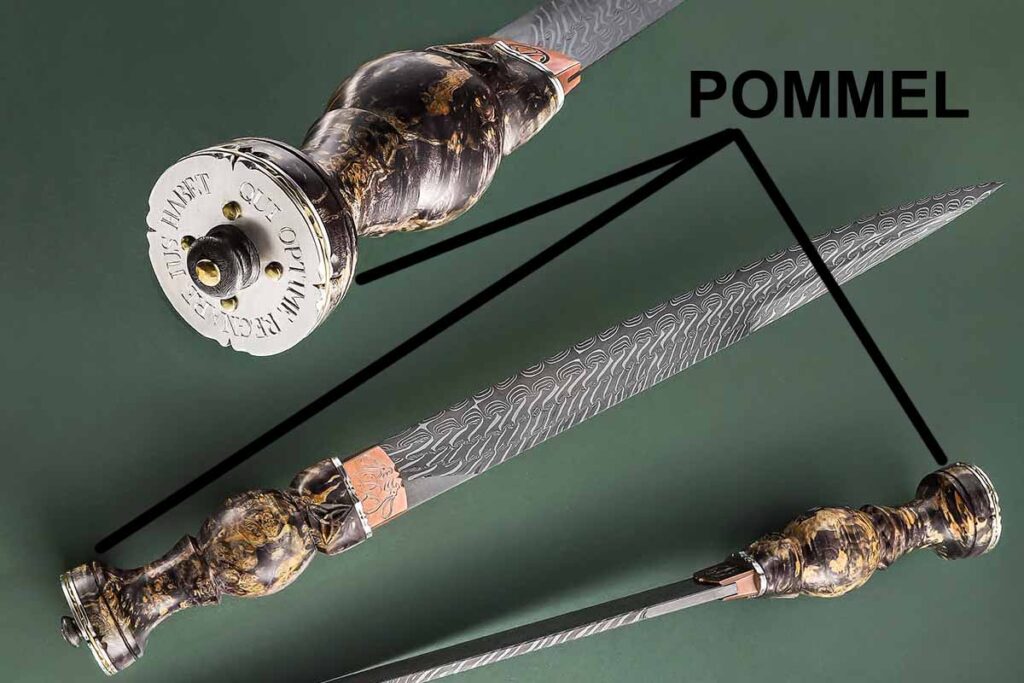
Pommel/Butt

Knife pommel

Historically, the pommel of a knife refers to a weighted cap or round at the end of a handle that was meant to balance out the weight of a knife or sword blade. These days, few knives have one, but you may still see the bottom of a knife’s handle furthest from the tip be referred to as a pommel.

More commonly (and correctly) you’ll see this referred to as the butt of the knife.

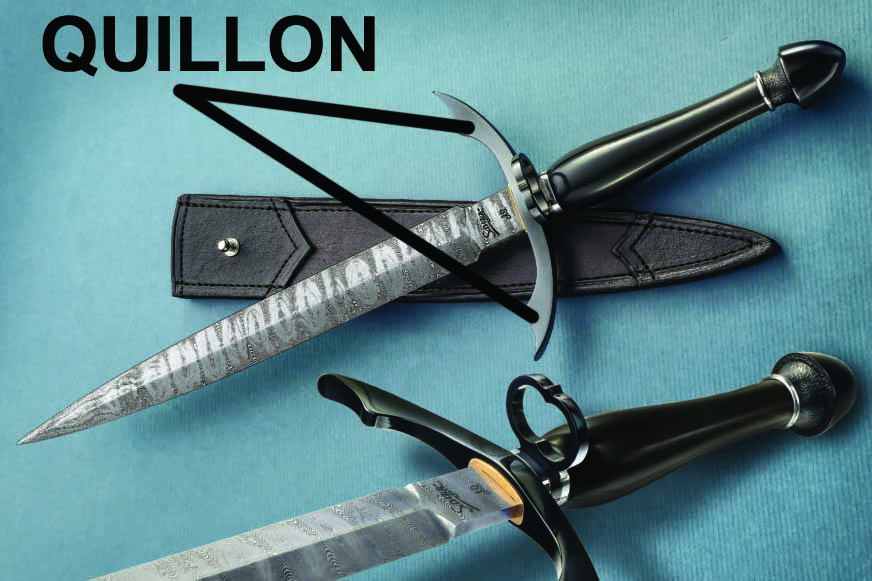
Quillon

Parts of a knife quilon

On a sword or knife, the quillons are part of the guard that extends outwards at a right angle to the blade to keep the user’s hand from sliding up the blade when using it. These would often be very ornate on a more elaborate piece but would often be very simple.

Final Thoughts

And that does it for this one folks, thanks for stopping by. You should now know everything you need to know about the different (common) parts of knives.

There’s some other stuff out there that might come up if you start getting beyond Western-style knives or branching out from kitchen and pocketknives, but this is definitely 99 percent of what you’ll ever need to know when it comes to knife anatomy.

Also, the very distinctive nail-like guard that protrudes out on a messer is called a nagel and it is designed to stop parried enemy blades from sliding down and cutting your hand. In case you were wondering.

More Knive 101:

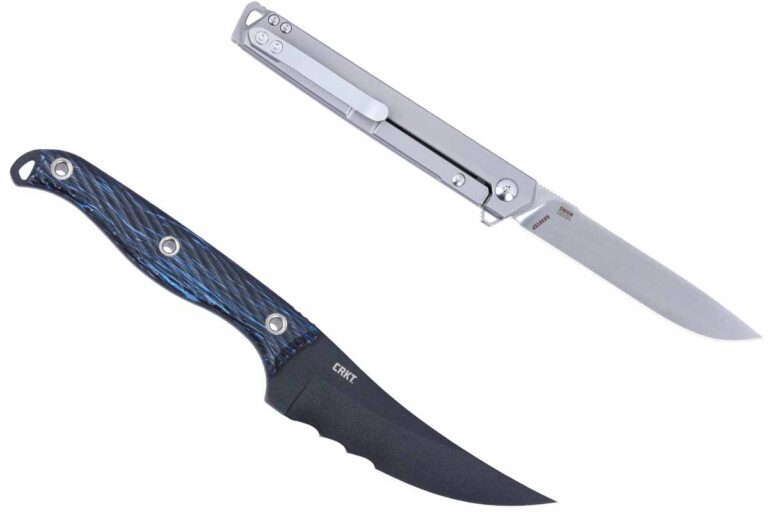
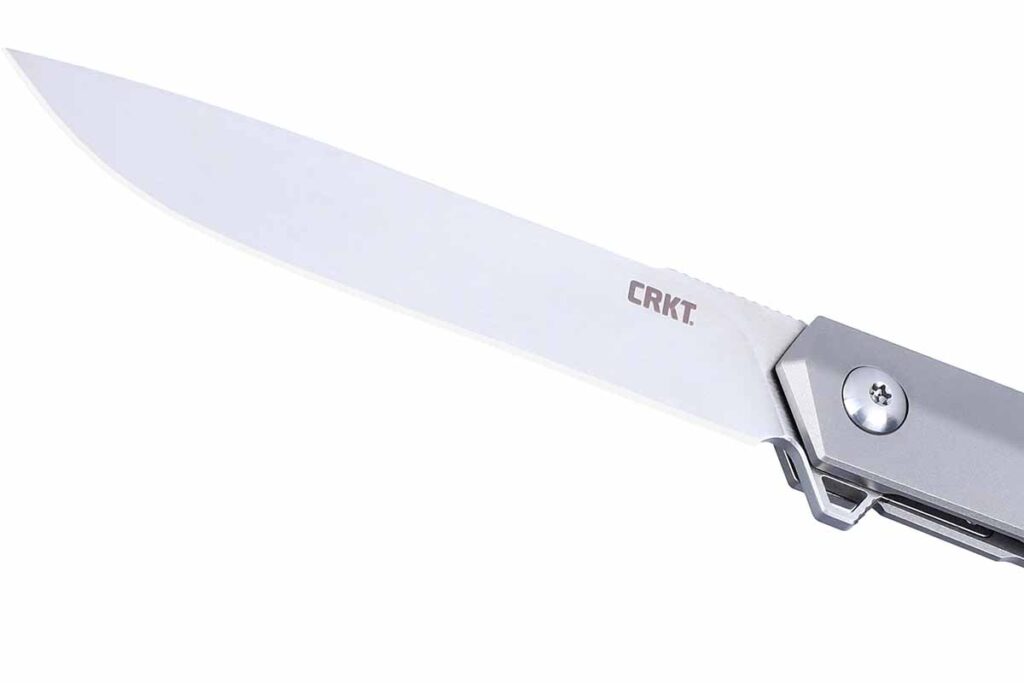
CRKT Clever Girl And Stylus Drop In November

1

Just in time for Christmas, CRKT adds a pair of sleek and stylish options.

Little surprise, CRKT’s insatiable march of designs continued in November with a couple of wickedly lithe designs.

The Clever Girl Fixed and Stylus most certainly cut different profiles from each other and seem different as night and day. However, the new release certainly mimics each other in their sleek and slender designs, with their nimbleness apparent even out of hand. Additionally, both are in time for the impending Yuletide season, making them both perfect additions under the tree.

Let’s take a look at what each of these new CRKT drops brings to the table.

Clever Girl Fixed

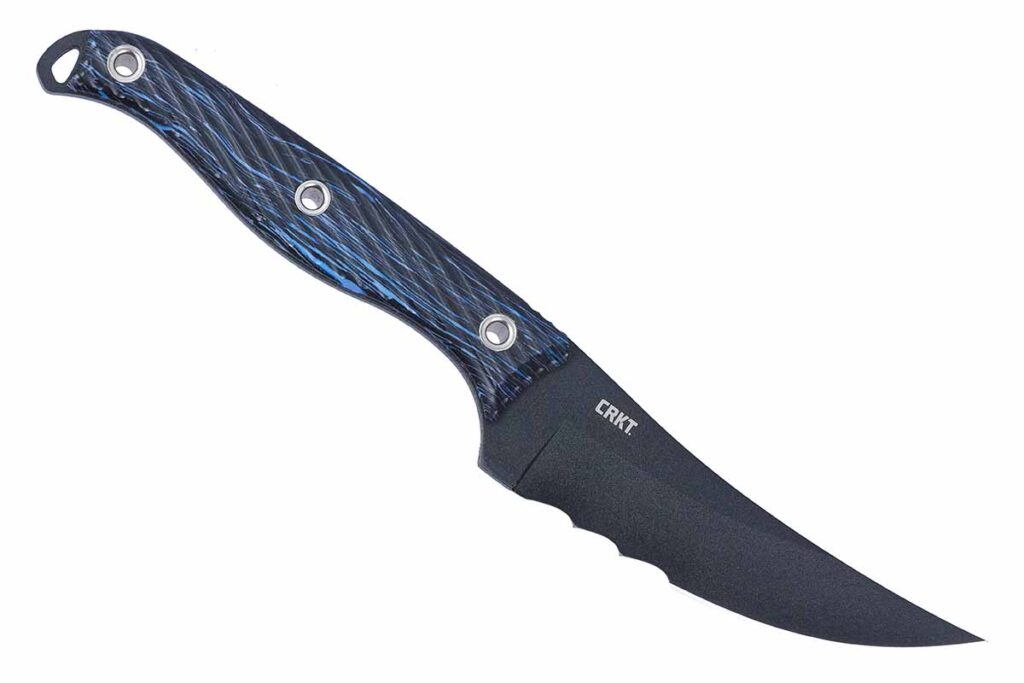
CRKT Clever Girl profile

This knife somewhat returns to its roots, taking the Clever Girl back to the fixed-blade configuration. However, the Austin McGlaun design has some new twists that keep the Persian-style trailing point fresh. In particular, partial serration of the blade.

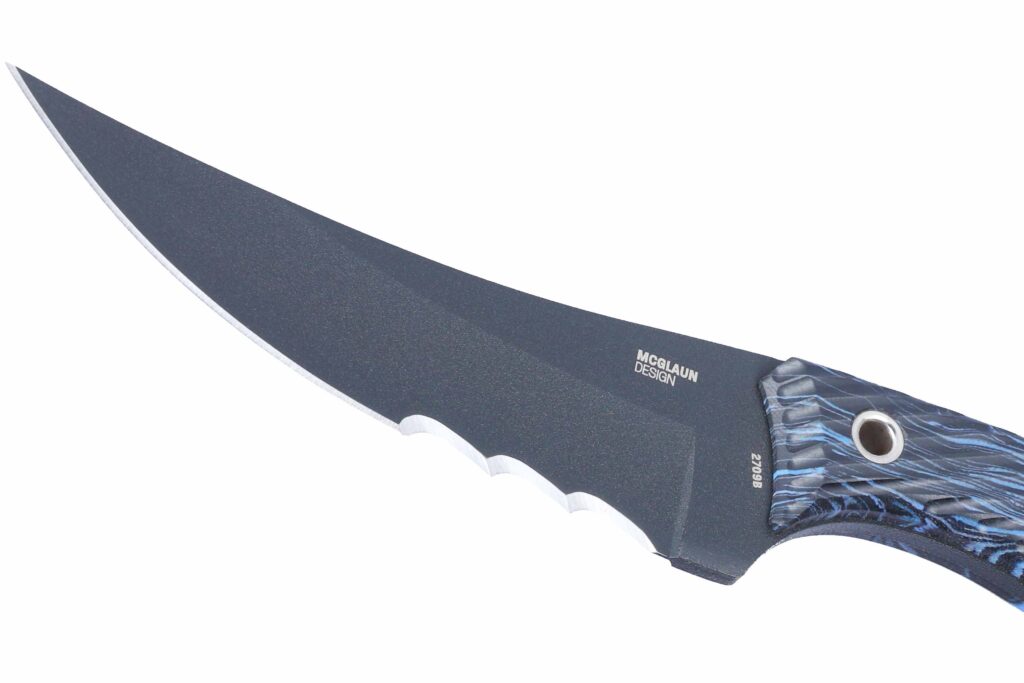
These are a series of three large, scalloped Veff serrations (CRKT proprietary and created by professional sharpener Tom Veff) running near the midpoint of the 4.6-inch blade. This enhances the knife’s sawing power, particularly against materials such as rope or fabric—think seatbelts. But let’s face it, it also takes a pretty menacing original design and makes it look a dash more ominous.

The other change on the Clever Girl Fixed is the handle, with CRKT bidding adieu to black G-10 scales and replacing them with marbled blew G-10. Not a huge switch-up, but one adding a touch of flair to the knife, particularly when offset by the black powder-coat finish on the blade.

CRKT Clever Girl Blade

As to the finer points of the knife, the blade is made from SK-5 steel, providing a good balance between toughness and ruggedness. It comes with a molded Kydex sheath for ease of carry. And it the Clever Girl Fixed watches her weight, tipping the scales at a very nimble 6.3 ounces. CRKT lists the knife at $114 on the company’s website and a portion of every sale—as with every knife in Columbia River’s Forged By War collection—is donated to the Green Bret Foundation.

CRKT Stylus

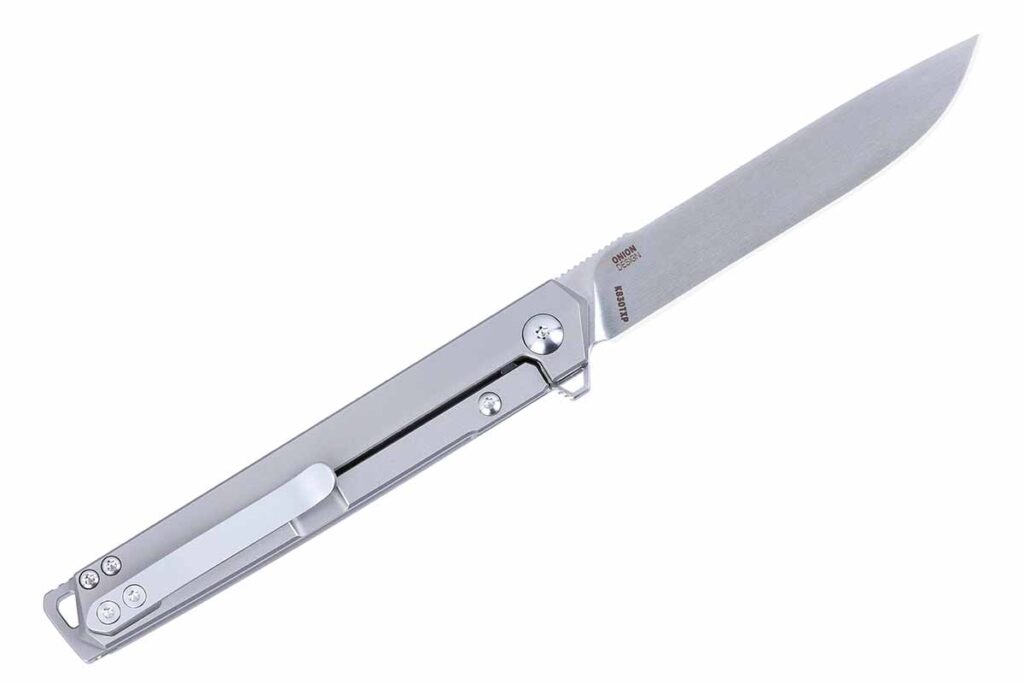
CRKT Stylus Profile

A Ken Onion classic CRKT brought to the masses a few years back, the Stylus has proven a popular addition to the company’s catalog. Unable to leave well enough alone—lucky for knife nuts—CRKT has released an updated version of the classy and svelte, assisted-open. In particular, the new version of the Stylus offers several upgraded materials, including a titanium handle and powerful CPM S35VN blade steel. The handle is especially nice, accentuating the crisp lines of the knife, making the already clean and sleek design seem even more so

CRKT Stylus Blade

The updated Stylus offers the points that have made the flipper a favorite of many, such as an IKBS ball bearing pivot for a silky blade deployment, a thick locking bar to secure the frame-lock’s blade and an extremely low profile. At present, CRKT lists the new Stylus listed at $195 on the company’s website.

More On Fixed Blades:

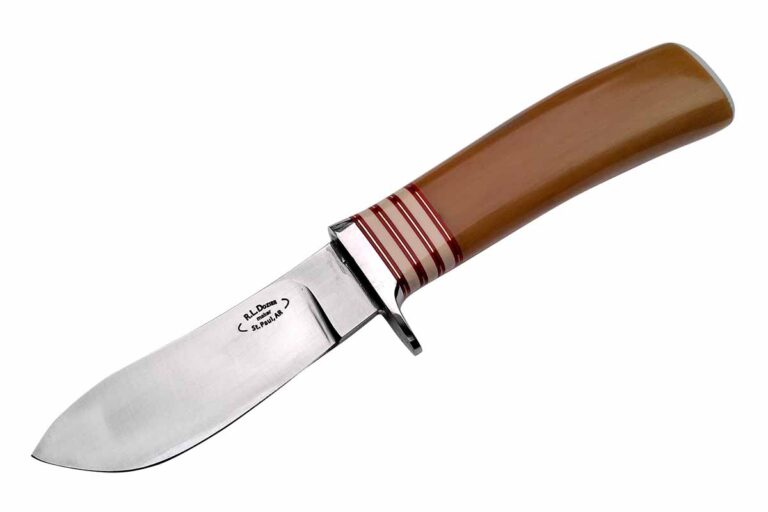
Bob Dozier’s Skinner Review: A Hammering Humpback

Bob Dozier’s skinner in CTS 40CP is the patient.

Once in a blue moon I get lucky. This time I get to cut with a knife by Bob Dozier, winner of the BLADE Magazine 2023 Industry Achievement Award and one of the legends of the custom knife industry.

I’ve known Bob since my first BLADE Show in 1992. He’s made his mark in the knife world time and time again, always willing to help a new knifemaker out with great advice. D2 is Bob’s favorite steel, so to test one of his knives made from a different steel type makes my day. I know of the extensive testing that Bob does on the steels he uses, so I was excited to see how well his humpback skinner in CTS 40CP performs.

Dozier Skinner Light Cutting Tests

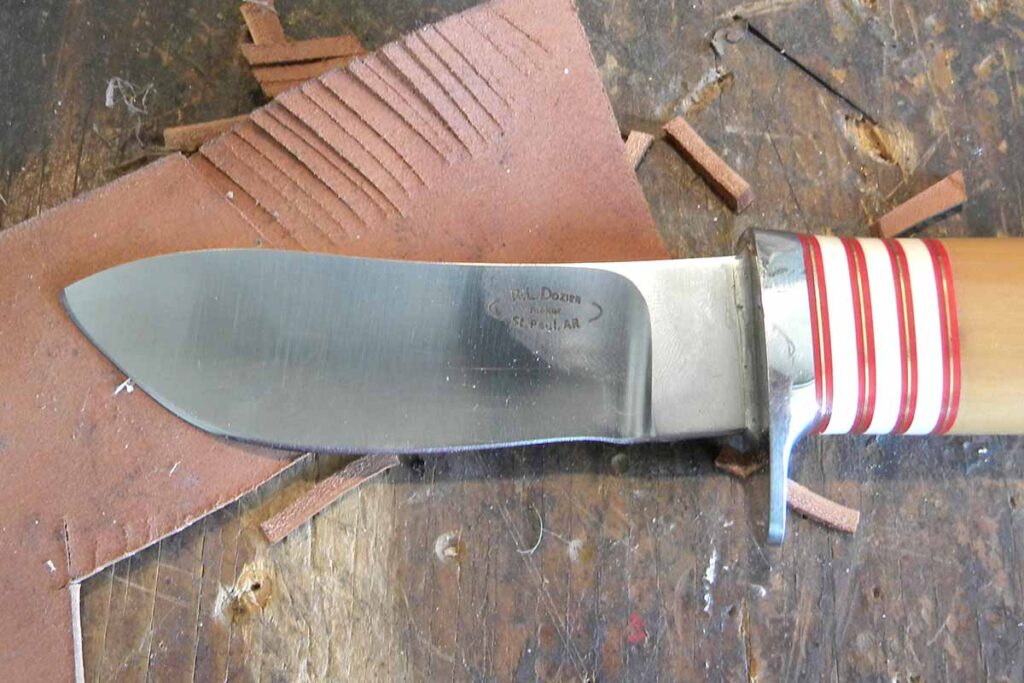
Dozier’s knife cutting leather
The knife zipped through the wide leather quite forcefully.

I checked the edge first with a slice of 20-pound bond paper. The “humpy” sailed through the slicing very fast with push cuts. The handle is extremely comfortable and makes controlling each slice easy. The knife is handle-heavy, so I felt no resistance on each slice.

On deck: double-walled cardboard. The CTS 40CP was very aggressive in cutting the material. You could hear the zipping sound on each cut. I really like the overall grip shape for cutting control; it provides good, positive handling.

To check the knife for what I call the “crunch effect,” leather skiving was next. The humpy was very aggressive slicing leather, crunching loudly on every cut. The high hollow grind made for easy thickness control on each slice. Just for kicks I grabbed some wider leather to cut. The knife zipped through the leather quite forcefully. I barely managed to keep my fingers out of the way of the sharp edge.

Dozier Skinner Heavy Cutting Tests

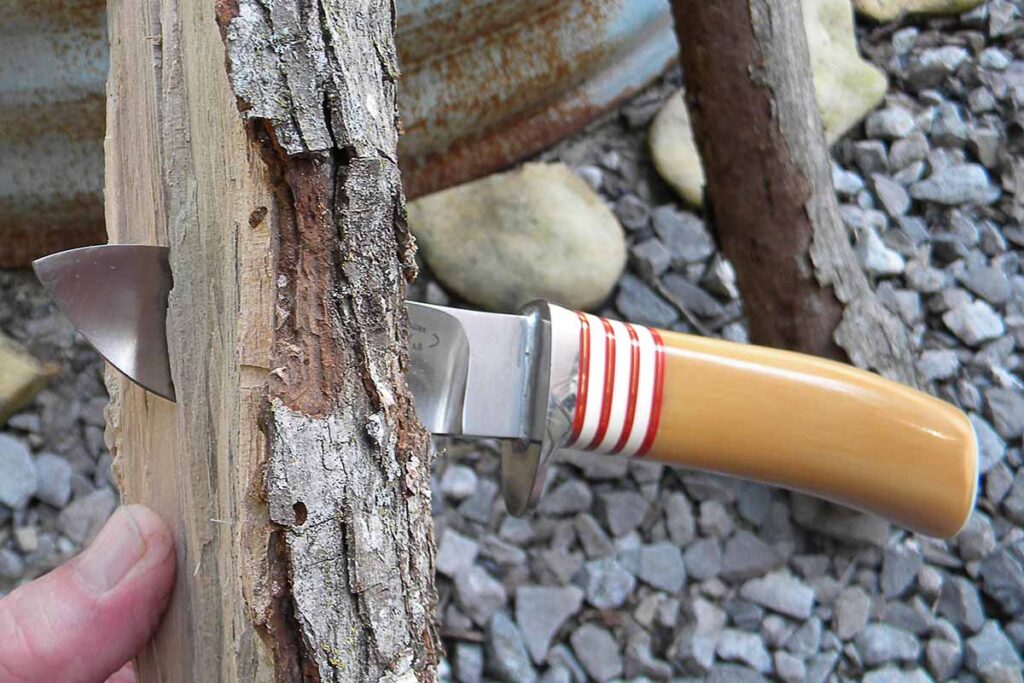
Batoning the Bob Dozier’s skinner
During the baton through firewood, the handle absorbed the shock and didn’t transfer it to the author’s hand. The humpback design provided a high spot to baton the blade. There was no damage to the handle or the edge.

It was time to whittle a firestick. The high hollow grind made controlling the depth of each cut simple. The blade produced good curlicues, both fine and thick. Again, the comfortable handle provided positive blade control.

I just had to smack the humpy through firewood. The handle absorbed the shock and didn’t transfer it to my hand. The humpback design worked out as it provided a high spot to baton as the blade bit into the wood. There was no damage to the handle or the edge.

It was time for my favorite all-around test medium: sisal rope. The humpy smoked through 200 crunching cuts before my hand started to tire. I experienced no hot spots from the handle. It was very comfortable. The blade just kept on crunching. Very nicely done, Dozier Knives!

Normally when I have a knife that cuts like a razor blade, the steel can be brittle along the fine edge. Thirty edge whacks on a whitetail deer horn would let me know if the heat treatment was on point. There was no damage whatsoever. I even returned to slicing 20-pound bond paper to see if the edge would hang up. Nope, nothing but smooth slices.

Overall Take On The Skinner

This is a very nice knife in form and function. It has an extremely comfortable handle design with a stainless blade that keeps on cutting. Excellent job, Dozier Knives. I might make the blade a tad thicker to even out the balance of the humpy.

Dozier Classic Nessmuk/ Dozier Knives Specs
Blade Length: 37/8”
Blade Steel: CTS 40CP stainless
Blade Grind: Full hollow
Blade Style: Modified humpback skinner
Blade Thickness: .156” @ thickest
Blade Finish: Satin
Guard: Stainless steel
Handle: Butterscotch Micarta® w/ivory Micarta®, brass, red and melamine spacers
Overall Length: 8.5”
Sheath: Custom-fit and molded-leather Snap-Lock belt/pouch model all handsewn by Bob Dozier; features custom-molded Kydex liner inside
Maker’s Price: $725

Read More Knife Reviews:

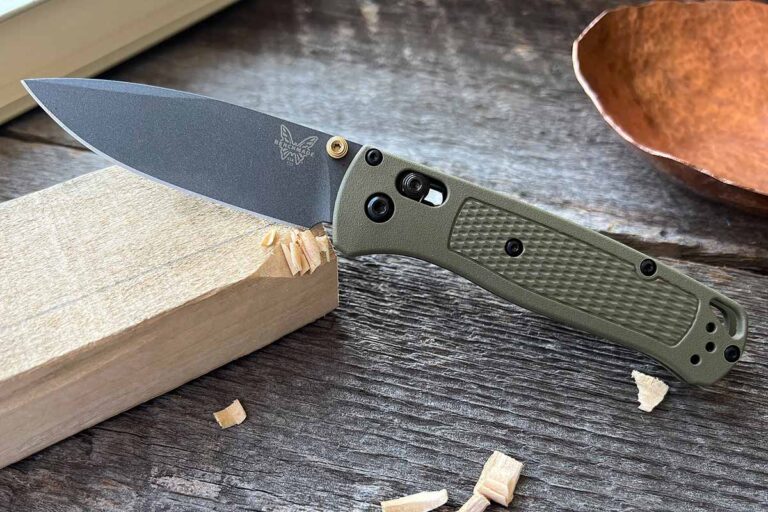
Benchmade Bugout Review: Getting A Handle On The EDC Icon

Is there a perfect EDC knife? If not, the Benchmade Bugout will do until perfect shows up.

When it comes to EDC folders, without a doubt the Benchmade Bugout is the king of the hill.

Its compact profile and just-right length make this model a popular hit with knife guys. It is all made in the USA with excellent fit, finish, and—perhaps key to EDC—Benchmade has cut its weight to the bone. Furthermore, the blade steel is premium level. In short, the Bugout is geared to go the distance.

So, if you haven’t yet checked out this icon, it’s high time you did. Because, if you take your everyday carry seriously, you owe it to yourself. We’ll lay a foundation for the knife in this article.

Bugout Blade

The Bugout is offered in two sizes—the Model 535, the company’s standard-sized version boasting a 3.2-inch blade, and 533 Mini, which pars the blade down to a very manageable 2.8 inches.

Benchmade Bugout Open
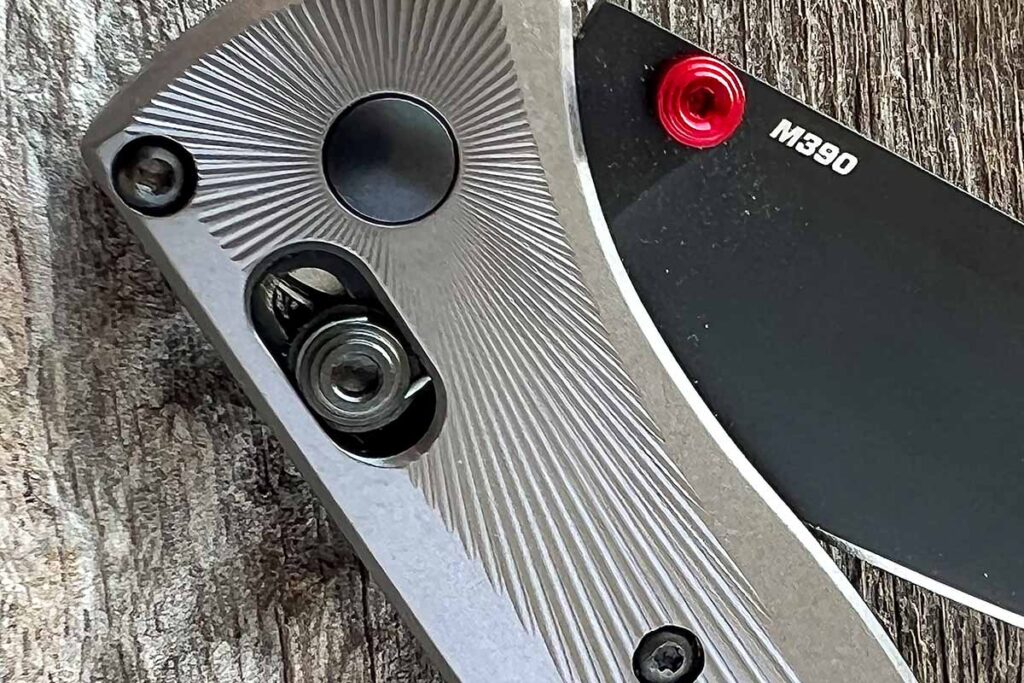
Standard-model Bugouts sport CPM S30V steel blades, however, S90V and M390 are available on higher-grade models. Photo: Marty Stanfield

The base models Bugouts use premium CPM S30V steel, a steel that is used widely for high-end factory knives. This is mainly due to its ability to hold an edge for an extended period, longer than most blade steels. Additionally, it is highly resistant to stains and corrosion.

As for the blade profile, the Bugout is a modified drop point and is highly adaptable to many tasks. Nicely, Benchmade outfits the knives with thumbstuds on either side of the blade, permitting ease of opening with either hand.  

Getting A Handle On The Bugout

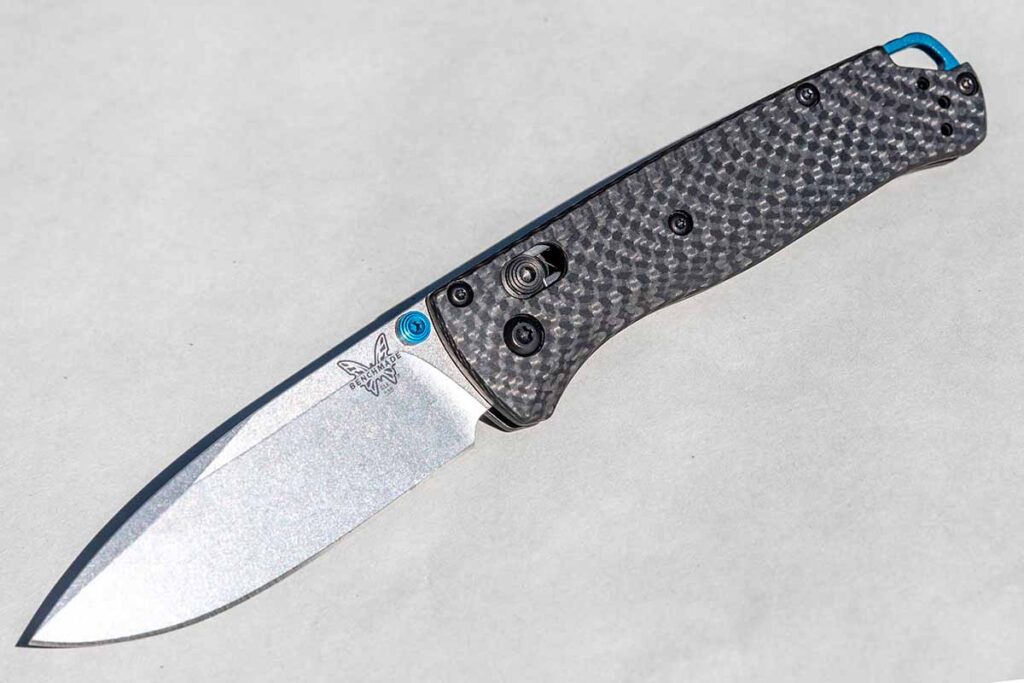
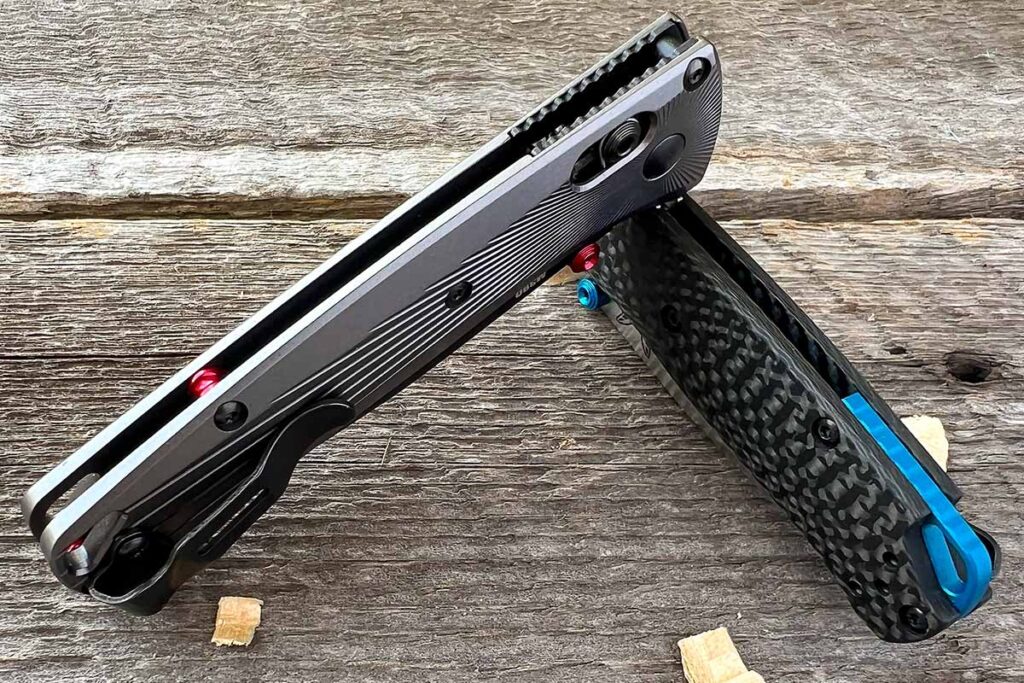
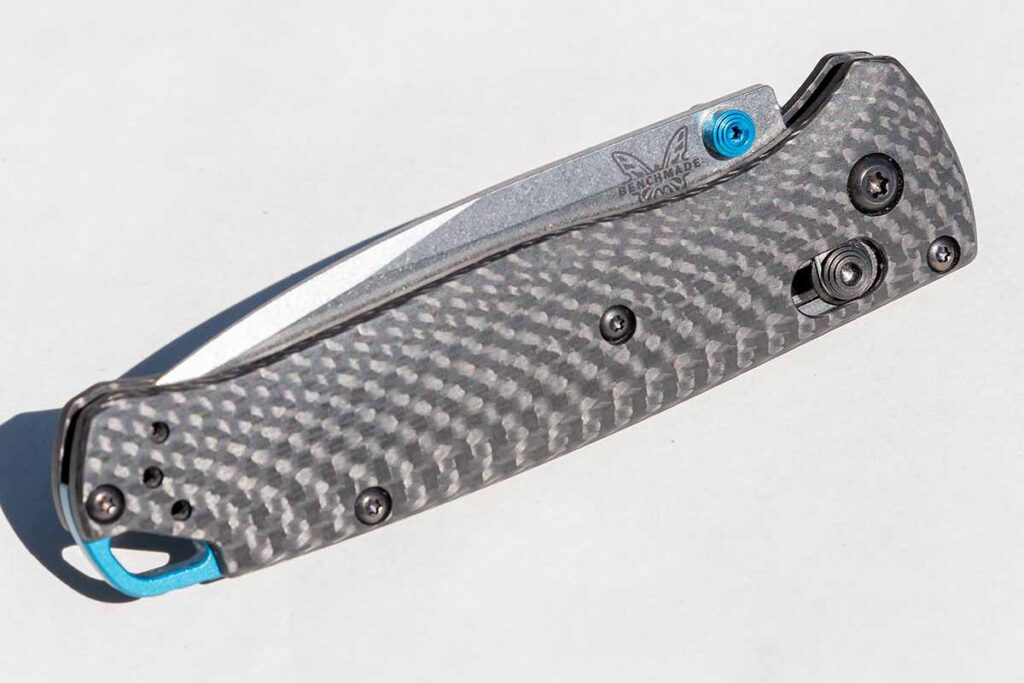
The handle of the base Bugout is made from molded Grivory, making the Bugout a very lightweight folder. The standard size tips the scales at 1.85 ounces and the Mini at 1.5 ounces. Benchmade offers other handle material options, including anodized aluminum, carbon fiber, and CF Elite (a glass-reinforced nylon synthetic material that is lightweight and stiff).

Benchmade Bugout Spines
Given there is a thriving aftermarket for Bugout scales, the sky is the limit on the knife’s handle. Photo: Marty Stanfield

And if you have to have custom, there are aftermarket scales for the knife in a host of materials—titanium, copper, brass, bronze, G-10, and Micarta. In turn, you can truly have a one-of-a-kind feel and look to your Bugout.

Bugout Action

The Bugout uses Benchmade’s critically acclaimed Axis Lock crossbar lock, hailed by many as ultra-strong yet extremely safe because you don’t put any fingers in the path of blade travel. Add on to this, it’s easy to unlock with either hand, and you have a naturally ambidextrous across the board. The lock is simple, just pull back on one of the exposed lock bar ends at the back of the handle and then rotate your blade closed. Internally, two Omega-shaped springs provide constant tension for the lock bar on the blade tang to ensure positive lock engagement.

Benchmade Bugout Axis Lock
The Bugout is outfitted with Benchmade’s rock-solid Axis Lock crossbar lock, which has the added benefit of being ambidextrous. Photo: Marty Stanfield

As for other odds and ends, the handle’s checkering does a great job of preventing your hand from slipping. A deep carry, fold-over pocket clip carries the Bugout deep in your pocket and can also be switched to provide easy carry for left-handers. Integrated lanyard hole permits the use of Paracord for a lanyard if you are into that sort of thing.  

Using The Bugout

In use, the Bugout hits hard in spite of its ultra-lightweight stature. The flat ground blade bites in and is very effective. Opening mail, opening packages, peeling an apple, cutting up hose, cutting cardboard, or stripping wire—the Bugout won’t break a sweat. Perhaps the best way of thinking about the knife is as a minimalist working folder.

The higher grades of the Bugout have carbon fiber handles and milled aluminum handles, paired with S90V and M390 blades respectively. These upgraded blade steels offer high-performance cutting with excellent edge holding. The higher-grade handle materials give a bit more heft to the Bugout as well as an enhanced, high-tech appearance. It only makes sense to have upgraded blade steel with upgraded handle material. 

Benchmade Bugout Closed
Overall, the knife is lightweight, rugged and more than capable of tackling most task. In short, it’s dang near the perfect EDC option. Photo: Marty Stanfield

Even with the base model’s S30V, you still pack plenty of muscle for those long-cutting jobs. I like how thin the Bugout’s blade stock is combined with the flat ground blade bevel giving it plenty of bite to it. 

Some knife folks favor not a high performance without the bulk. I get it, it all makes for a comfortable everyday carry folder. For those of you who favor these kinds of knives, the Benchmade Bugout is for you. You have a high-end blade steel with a proven and popular blade lock, with a no-frills handle design. 

MSRP for the full-size Bugout starts at $180 and varies up from there depending on handle material and blade steel. There is also a Mini Bugout which scales the size down some to an even more pocket-friendly size.

Go here for more information on the Benchmade Bugout.

Bugout Model 535 Specs
Blade length: 3.2″
Blade thickness: 0.090″
Overall length: 7.4″
Weight: 1.85oz
Blade material: S30V
Handle material: Grivory

Mini Bugout Model 533 Specs
Blade length: 2.8″
Blade thickness: 0.090″
Overall length: 6.5″
Weight: 1.5oz
Blade material: S30V
Handle material: Grivory

More Knife Reviews:

Tactical Fixed Blade Knife Buyer’s Guide

These tactical fixed blade knives are set to conquer the most extreme tasks.

When the Gulf War took off in Iraq in the early 1990s, the knife industry took off, too, and a steady stream of tactical fixed blades has surfed the wave ever since.

Needless to say, there are military fixed blades aplenty in the cutlery industry with no single design or manufacturer having a chokehold on today’s market. This has given knife users an abundance of choices, from pure fighters to utility users and everything in between.

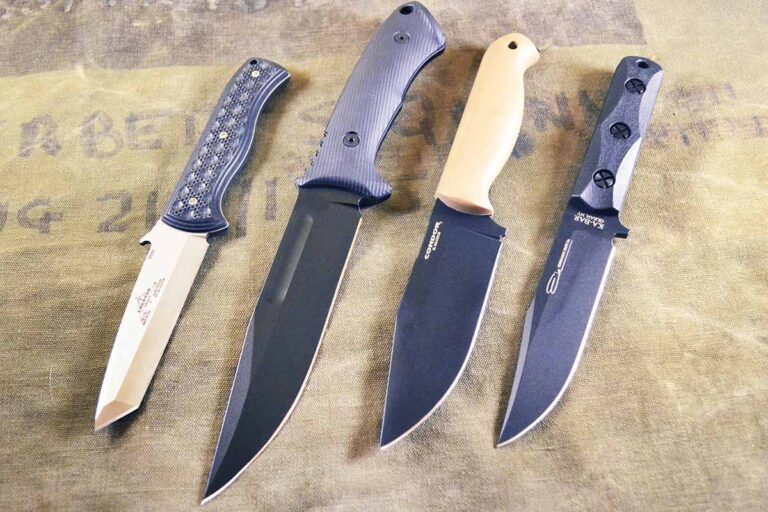
A diverse quartet of the genre includes the Condor Fighter Knife, Emerson CQC-7 Fixed Blade, KA-BAR/John Ek Commando Short Clip and Spartan Blades Harsey Fighter. To determine their strengths and weaknesses, the first order of business was a common test for penetration.

Testing

I set up a heavy-duty corrugated-board box with a 1-inch Styrofoam™ liner made for shipping frozen foods. I tested each knife by thrusting the blade into the side of the box forcefully, and then pushing it through from a standstill with the tip resting on the box. All the knives penetrated the thick, layered material with ease—not surprising considering they have either clip-point or tanto blade patterns, both adept at stabbing. There was very little differential from one model to the next. What follows is a look at each knife and how it performed other chores.

Condor Tool & Knife Fighter Knife

Condor Fighter
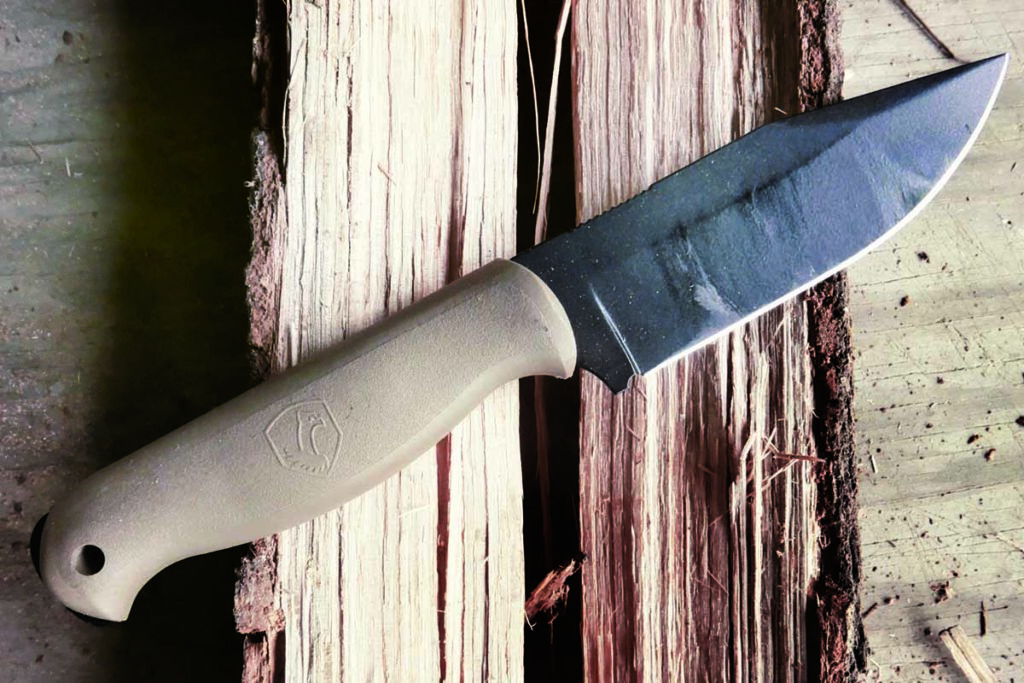
The author took the Condor to task batonning a length of seasoned hardwood with good effect. According to him, “This is one versatile knife that even a bushcrafter would love.”

Condor Tool & Knife specializes in bang-for-the-buck blades and the Fighter Knife is no exception. Indeed, it is the most affordable of the test group. From the side the knife appears to be pudgy but it is actually quite nimble. The clip-point blade has jimping on the rear of the spine for enhanced purchase on detail cuts.

The tan handle is hidden tang in construction with a fine stippled surface texture, an ample palm swell in the middle and a lanyard loop. The exposed steel at the butt can be used for hammering. The sheath is MOLLE compatible, injection molded and features a black leather drop loop.

The knife easily switches from combat to field chores—not surprising as the company specializes in both. The wider blade is similar to that of many field knives, as is its deep grind. Slicing 3/8-inch rappelling rope and taking curls for firestarter were a breeze. I set the blade across the end of a 15-inch piece of tough seasoned hardwood, 25/8 inches across, and drove it clean through. This is a rugged knife. The sheath is relatively unobtrusive and rides about 2 inches above the beltline.

Condor Fighter Knife Specs
Blade length: 4.91”
Blade material: 1075 carbon steel
Blade grind: Flat w/secondary bevel
Blade finish: Black Cerakote®
Handle length: 4.83”
Handle material: Tan polypropylene
Weight: 8.82 ozs.
Overall length: 9.74”
Sheath: Tan polypropylene/leather belt strap
Country of origin: El Salvador
MSRP: $100

KA-BAR John Ek Commando Short Clip

Ka-Bar Commando Shor Clip
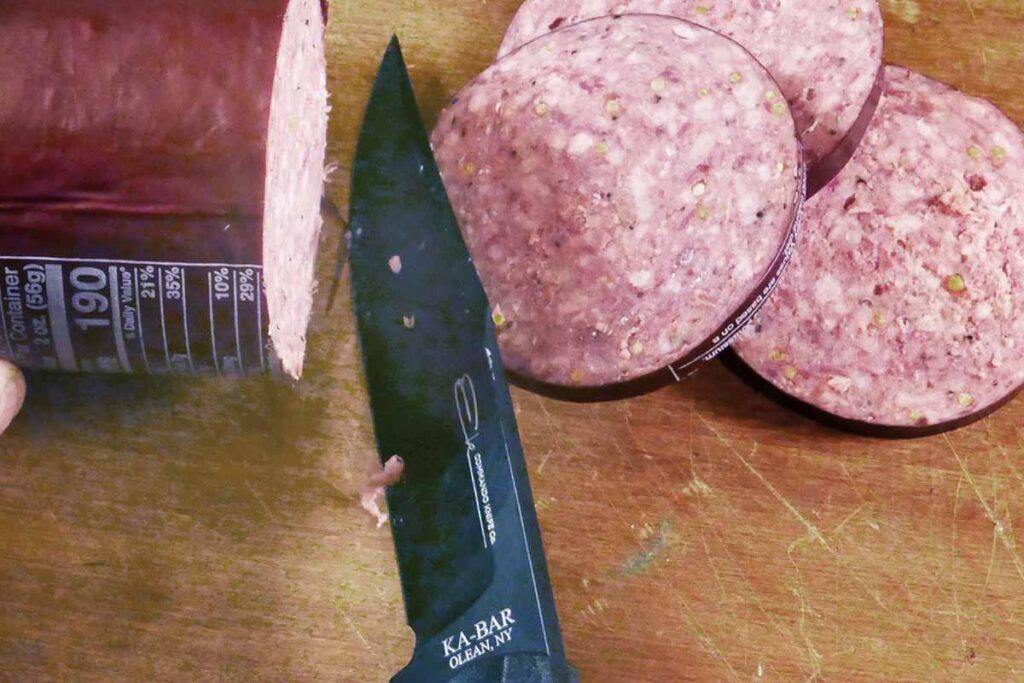
The Commando Short Clip tackled a 2.75-inch-diameter chub of summer sausage admirably. The blade is 5.125 inches of 1095 Cro-Van carbon steel, a time-proven KA-BAR favorite.

The John Ek Commando Short Clip is one in a series of military-type models KA-BAR Knives offers by the cutlery legend. This one is all black and a timeless, no-nonsense John Ek design. The blade is complemented by a 4.125-inch “stick” handle with scales affixed by big, fat screws, an Ek hallmark. The blade clip breaks with a slight harpoon kick, which I’m not sure Ek ever used, though it works wickedly, and there’s a short guard below the blade. The symmetrical handle has a lanyard hole at the butt. All of this is delivered with a modern, MOLLE-compatible sheath.
KA-BAR has done an admirable job picking up the John Ek banner and blending the old with the new. The Commando Short Clip’s narrow blade—1.31 inches wide—proved proficient at slicing. I tested it on paracord, 3/8-inch rappelling rope and a large round of 2.75-inch summer sausage, and it did a masterful job of tackling them all. It is a combat knife at heart and its light weight is not as skillful at tough field chores like hacking wood, but that’s not its department.

The handle is fine for small and medium hands but could be a challenge for those with large ones. The modern sheath is very well done and rides with the butt of the handle just above the waistband. Overall, this modern take on a classic leans toward a combat knife with enough utility to get you by.

KA-BAR/Ek Commando Short Clip Specs
Blade length: 5.125”
Blade material: 1095 Cro-Van carbon steel
Blade grind: Flat
Blade finish: Black powder coat
Handle length: 4.125”
Handle material: Polymer
Weight: 10.4 ozs.
Overall length: 9.25”
Sheath: Black polymer Celcon/MOLLE compatible
Country of origin: USA
MSRP: $155

Emerson Knives CQC-7
CQC-7 Fixed Blade
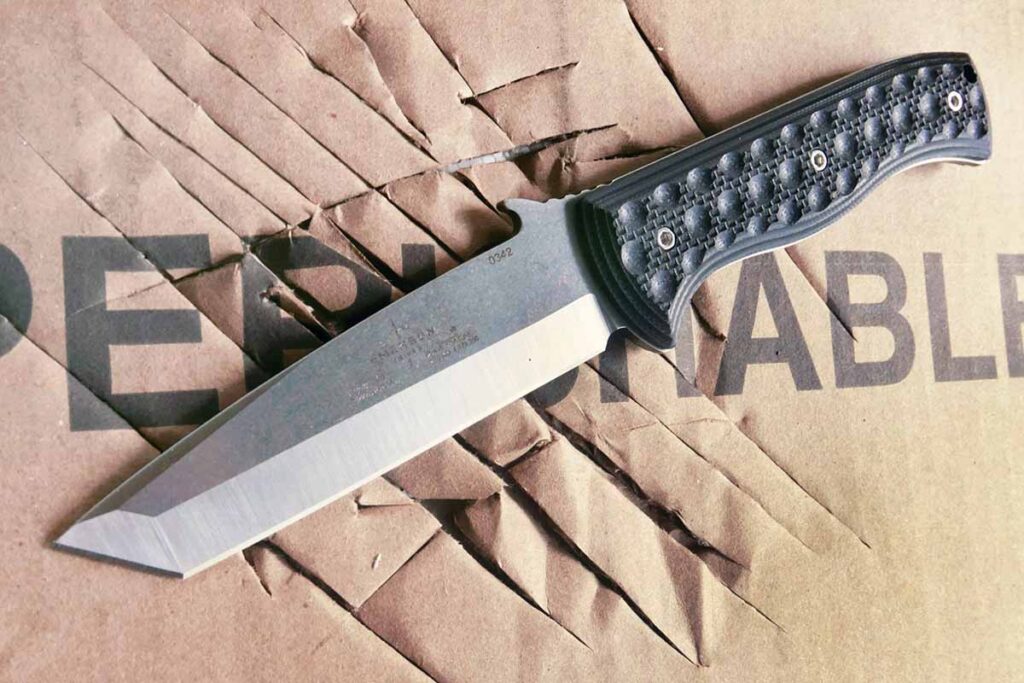
The CQC-7 Fixed Blade has an appetite for slicing and slashing. The 154CM stainless steel tanto blade was extremely sharp and penetrated both layers of the shipping box with controlled slices.

The Emerson Knives CQC-7 Fixed Blade hasn’t gotten a lot of face time because the overwhelming amount of tactical knife coverage of the company is devoted to folders. It’s the way of the world. The Emerson is the shortest of the review subjects and is also the one that tilts more toward being a pure combat knife—something its designer, martial arts specialist/custom knifemaker/cutlery entrepreneur Ernest Emerson, knows a thing or two about. The tanto blade sports a flat V-grind and a stonewashed finish. The blade has three straight grinds: the main edge, tip grind and a clipped saber grind. An Emerson Wave shape on the rear of the blade spine serves as a thumb ramp. The handle has a nice palm swell, a symmetrical dimpled texture for enhanced purchase and a lanyard hole in the butt.
The blade’s 7/16-inch edge grind was delivered wicked sharp and I took it to task slicing one of my favorites, 3/8-inch rappelling rope. The rope is extremely strong because lives depend on it. In one test I pulled the edge through three consecutive cross sections of rope. The drag on the blade was much less than I normally encounter—a pleasant surprise. It slashed the corrugated board outer layer into the Styrofoam effortlessly, and when I slowed the process down with a little more pressure, it dug through the foam as well. The sheath is a study in minimalism, but that’s what you want when concealment is at a premium.
Emerson CQC-7 Fixed Blade Specs
Blade length: 4.125”
Blade steel: 154CM stainless
Blade grind: V-grind
Blade finish: Stonewashed
Handle length: 4.625”
Handle material: Black G-10 composite
Weight: 5.86 ozs.
Overall length: 8.75”
Sheath: Black Kydex®
Country of origin: USA
MSRP: $237.95

Spartan Blades Harsey Fighter

Harsey Fighter
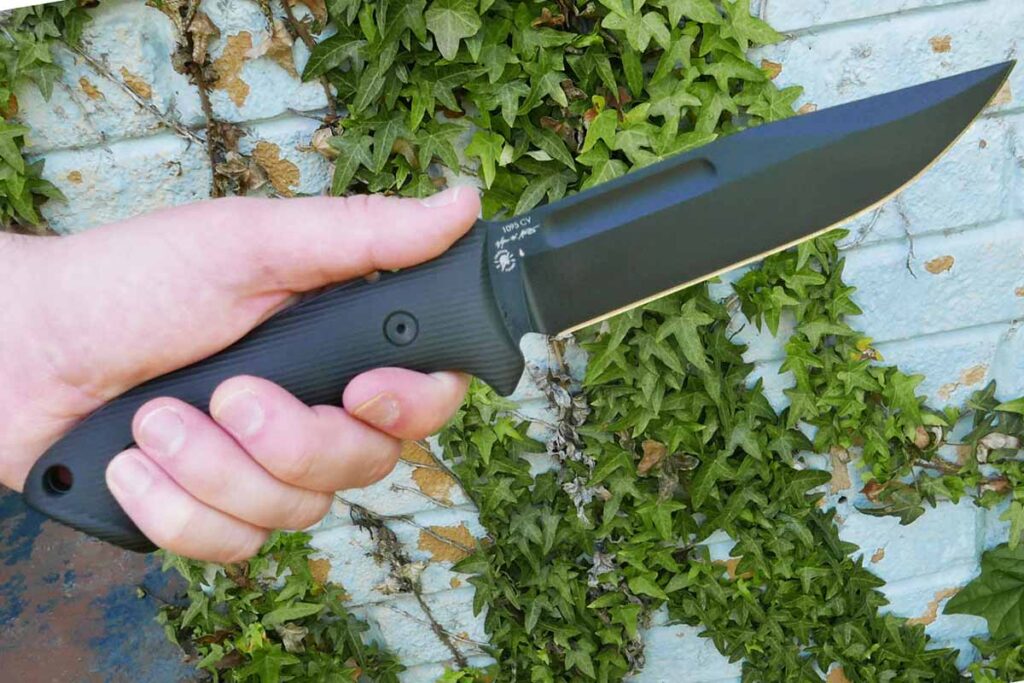
The Harsey Fighter’s ample 5.35-inch handle has black G-10 scales with a ribbed pattern machined into the surface. The flare atop the handle offers excellent finger protection and the grip accommodates the biggest of mitts.

A goodly portion of observers seem to believe the Spartan Blades Harsey Fighter is noted knifemaker Bill Harsey’s consummate work and, though he has a load of nice designs in his stable, I wouldn’t argue. It is the largest of the test knives and a blend of modern styling with traditional cues. It is the Pineland Cutlery version manufactured by KA-BAR under the Spartan label.
The clip-point blade has a fuller that butts up against the ricasso. The handle surface boasts a diagonal rib pattern for enhanced grip and an ample lanyard hole at the butt. The sheath has a fabric-fastener drop loop and retention strap. There’s also a swing-out lock at the rear guard that secures the knife in the main body of the sheath.

It’s amazing what a couple of inches in length, a couple of ounces in weight, plus an extra inch in the handle add to the versatility of a knife. That’s on average what the Harsey Fighter has over the other knives tested. This is not a knock on the others, just the advantage of having more knife.

For chopping ability I tested the blade on a thick-skinned cantaloupe. I had to chop the melon off center to clear the handle but the blade made its point in one fell swoop. The extra weight allowed me to tackle tougher chores and the added blade length made for excellent slicing and hacking. You can clear a camp with the Harsey Fighter. The comfortably sculpted handle can accommodate the largest of hands and the upper flare offers good finger protection. The sheath is very well made but the guard lock takes some getting used to and is one added step for a quick draw. All in all, the Harsey Fighter earned its mettle in spades.

Spartan Blades Harsey Fighter Specs
Blade length: 6.125”
Blade material: 1095 Cro-Van carbon steel
Blade grind: Flat
Blade finish: Black powder coat
Handle length: 5.35”
Handle material: Black G-10 composite
Weight: 11.5 ozs.
Overall length: 11.5”
Sheath: Black polymer/nylon belt loop/MOLLE compatible
Country of origin: USA
MSRP: $195

Check Out More Outdoor Knives And Tools:

Benchmade 940 Review: EDC Knife By The Numbers

0

Does it deserve its reputation as a definitive EDC knife?

What makes a great EDC folder?

Well, the obvious would be a highly useful blade shape paired with an ergonomically shaped handle. Then, make both out of high-grade materials for durability and longevity. It wouldn’t hurt to have a popular knifemaker scratch up the design and make certain the QA is in line.

Put together this amalgamation and the result might just be the Benchmade 940.

Designed by the late Warren Osborne, the production knife is some somewhat an outlier in his portfolio. The Texas maker is perhaps best known for his high-dollar art knives favored by discriminating collectors around the world.  Osborne’s 940 design was refreshingly non-tactical, especially for a company who a large presence in this niche.

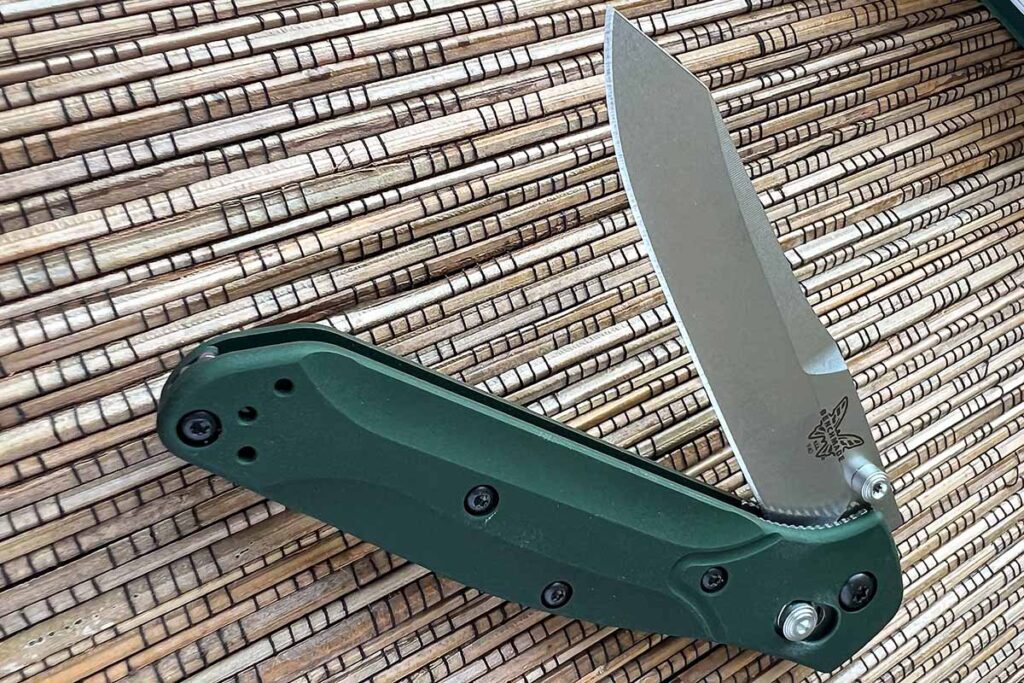
Benchmade 940 half open
A top seller for Benchmade, the 940 has come to help define EDC knives. Photo: Marty Stanfield

Furthermore, it has a broad appeal for those who are serious about their daily carry knife checking all the boxes. It’s no stretch to call the 940 a workhorse of a folding knife.

Since its introduction in the early 2000s, the Benchmade knife’s popularity has skyrocketed to the point it has a sort of cult following. We’re going to take an in-depth look at why this is so. It is why the 940 might even be worth adding to your collection.  

Benchmade 940 Blade

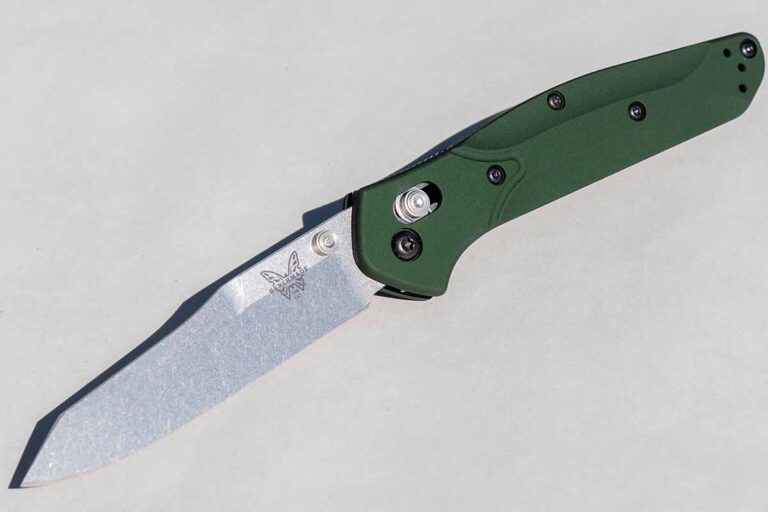
The blade profile of the 940 is a reverse tanto, in which the edge and spine of the classic tanto design are flipped. However, it does somewhat look like a clip-point blade, albeit one with an extremely abbreviated downward-sloping tip.

Measuring 3.4 inches long, the blade uses CPM S30V premium stainless steel for the ultimate edge-holding capabilities. The alloy provides the muscle required for most daily cutting chores inside and outside of your house as well as offering excellent corrosion resistance.

Benchmade 940 blade half open
The 940 boasts thumb studs and Benchmade’s ambidextrous axis-lock. Photo: Marty Stanfield

Dual thumb studs provide an ambidextrous opening with either hand. Satin is the standard finish, though a black-coated blade is available at a minimal cost increase. The blade’s slender form factor allows the 940 to get in and out of a variety of cutting tasks with great efficiency. Not to mention, this svelteness doesn’t raise eyebrows in public like some bigger, more brawny tactical folder designs.  

940 Handle

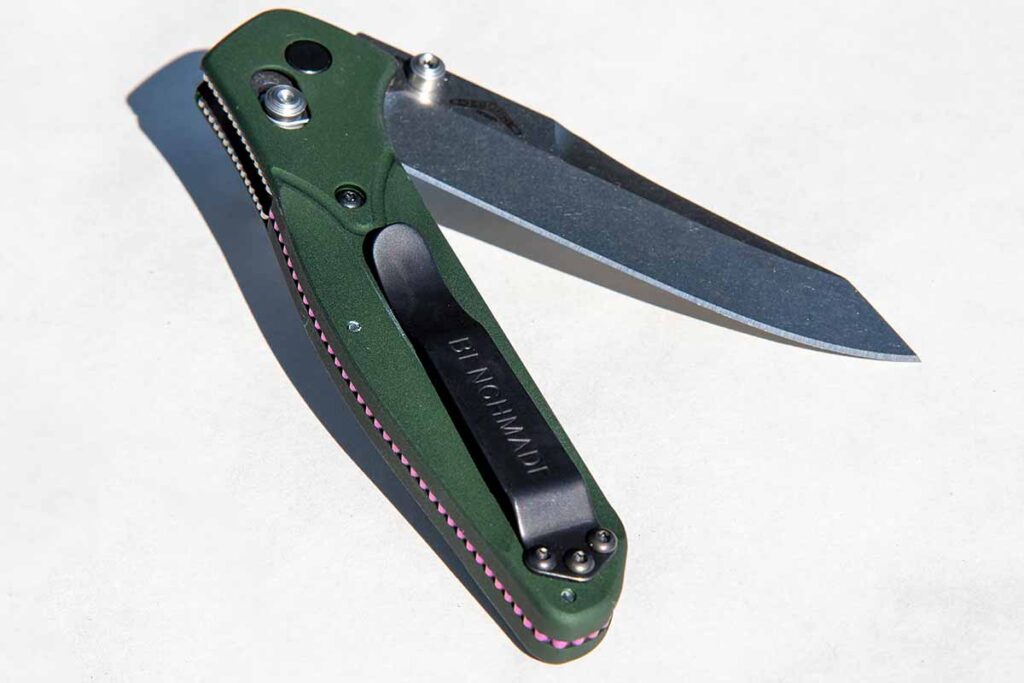
In the handle department, the 940 uses aircraft grade T6 6061 aluminum, offering excellent weight savings while not compromising strength. The handle is given a very nice dark green hard anodized coating, which is both scratch-resistant and aesthetically pleasing. Milled channels in the handle provide a slim-feeling knife in hand.

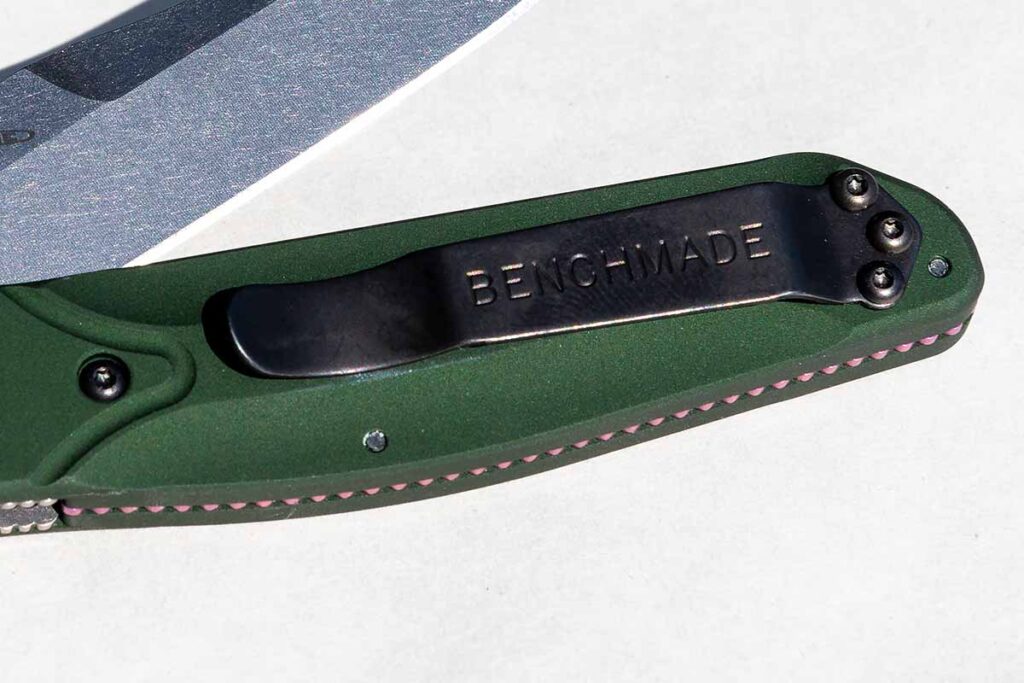
A tip-up-only pocket clip mounting is available on both sides of the handle to accommodate both left-handed and right-handed users alike.

Benchmade 940 clip
The clip is situated at the butt of the handle for tip-up carry. Photo: Marty Stanfield

The blade is secured in the open position by Benchmade’s own Axis Lock—regarded as the original crossbar lock. It promotes a smooth opening and closing action as well as very positive blade engagement, securely holding the blade open until you release it. Ambidextrous thumb buttons on either side of the handle allow one to release the lock with either hand. The Axis Lock is truly righty and lefty friendly, unlike liner locks that are specifically for right-handers.  

940 Performance

Not only does the 940 perform very well, but the knife also carries like a dream. It’s lightweight and compact, allowing it to disappear while clipped to jeans, casual pants, or dress slacks. It doesn’t weigh you down by any means. The handle sits deep enough in the pocket, away from prying eyes but there still is enough to grab onto when you want to retrieve the knife and put it to use.

In use, I appreciate the way the handle drops down a bit, forming a finger guard of sorts to keep your hand in place. It also helps to index your grip, as well. The purple anodized titanium handle spacer provides a neat pop of contrasting color against the green. Traction notches above the pivot give enough friction to hold your thumb or index finger in place during tough cutting tasks.

Final Cut

A great testament to Benchmade’s manufacturing quality, every single 940 I have seen out of the box, the blade is centered in the handle, and the action is very smooth. These knives are really dialed in when they come from the factory.  

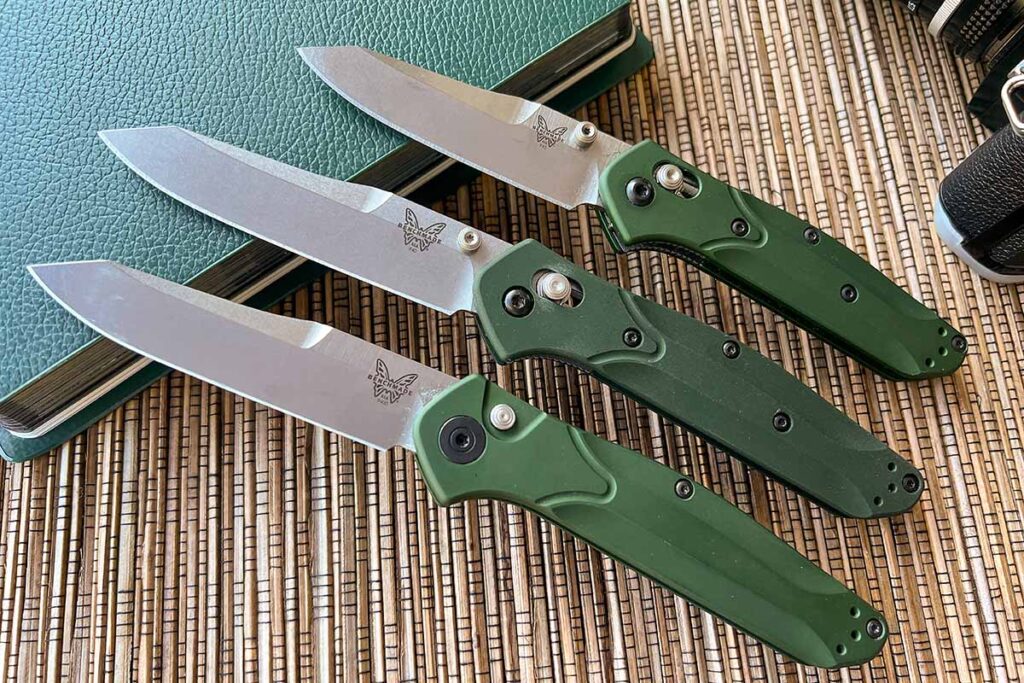
Benchmade 940 three models
Aside from the standard 940 (middle), Benchmade offers the automatic 9400 (bottom) and compact 945 Mini Osborne (top). Photo: Marty Stanfield

Benchmade also expanded the selection of 940 to include variants that have carbon fiber handles, G-10 handles, and even an automatic opening version with the model 9400, which utilizes a coil spring-fired blade and a button plunge lock as opposed to the Axis Lock. There’s also the model 945 Mini Osborne which scales the 940 down some, creating a nice, ultra-compact folding knife with a 2.9-inch long blade. It still opens quickly, and cuts efficiently.

MSRPs understandably vary with size and handle materials. However, the MSRP for the standard 940 is $240, which puts it on par with other USA-made folders on the market.

Get one and it became fairly clear why the 940 resides at the top of Benchmade’s catalog. Even better yet, you will not be disappointed with the knife as your everyday companion.

Benchmade 940 Osborne Axis Lock Specs
Blade length: 3.4″
Blade thickness: 0.115″
Overall length: 7.8″
Weight: 2.9oz
Blade material: S30V
Handle material: T6 6061 aluminum
MSRP: $240

For more information on the 940, please visit Benchmade.

More Knife Reviews:

Gerber Knives: The Blades That Made It Legendary

0

From kitchenware to commando companions, we go over how Gerber Knives became legendary and some of their all-time best offerings.

Gerber Legendary Blades, often known as just Gerber among the knife community (not to be confused with the equally legendary makers of fine baby foods and formula), is a name that you’ve probably heard. It’s hard to go into any outdoor store without finding one of its many blades.

But how much do you really know about the company?

Today, we’re going to do a deep dive into this iconic knifemaker that has helped shape the knife industry for so many years. We’re going to cover everything from its history to its new and exciting premium knife offerings, along with all the truly legendary knives it’s released along the way. 

Let’s get started. 

History of Gerber Knives

Cooked Up In The Kitchen

In the early 1900s, the Gerber family began their corporate climb with a simple advertising firm in Portland Oregon. As a promotion, Joseph Gerber sent out 24 sets of handmade kitchen knives to clients during the holidays. 

Vintage Gerber Kitchen Knife set
Vintage Gerber Kitchen Knife set. Photo: WorthPoint

These proved so popular that Abercrombie & Fitch, then one of the largest catalog retailers, requested more for its 1939 spring edition. Gerber Legendary Blades was then founded shortly after. 

Originally, Gerber focused on camp, kitchen, and carving knives, and did brisk business around the holidays and wedding season in the spring when many registries included a new kitchen knife set for happy couples. 

Off To War

Following WWII, Gerber expanded its focus and began to work on knives for military contracts, including the now-legendary Mark II fighting knife. Al Mar, a prolific knife designer, added some serrations to the blade allowing it to be marketed as a survival knife as well. 

Since then, the Mark II has been discontinued in favor of the Prodigy and LMF II knives, which are both in service with various militaries. The LMF II in particular currently sees services as an aircraft survival knife. It features a specially insulated handle so that downed pilots can cut their way free of airframes without risk of an electrical shock, even if they have to cut through the fuselage of the aircraft. 

Vietnam Era Gerber Knives Mark II
Vietnam Era Gerber Knives Mark II. Photo: Sharpinvestments.net

Other Gerber knives such as the often-imitated LST lockback folder changed the shape of the knife-making landscape forever. The 06 Auto was, and is, hugely popular with U.S. and NATO forces in the Middle East and has earned a reputation as a tough piece of gear that gets the job done. 

Into Every Niche

Gerber has also collaborated with a wide variety of knife makers and designers, as well as police trainers, special forces operators, and world-class martial artists to design hard-use knives that meet any need in the field. 

One of my personal favorites is Gerber Guardian, a “boot knife” designed by Bob Loveless—the man who popularized the hollow-ground drop-point blade—and is generally considered one of the most innovative knife designers to ever live.

Gerber Bear Grylls compact Scout Knife

Another, now collector’s item, is the River Master, a collaboration with legendary knife maker Blackie Collins. The River Master is an aggressive dive knife designed to cut through fishing lines, nets, vegetation, and other obstacles that can spell doom for a diver—particularly in murky water. 

Blackie Collins, incidentally, gave us the assisted-opening spring mechanism that so very many knives today use, including the 06 FAST, the more budget-friendly, non-automatic version of the 06 Auto. Not to mention he was the founder of a little publication called American Blade (i.e. Blade Magazine).

There’s also the Bear Grylls collection, which includes the top-selling Ultimate Pro knife, which has become somewhat iconic in the years since its release. The original Ultimate was a bit of a flop as Gerber outsourced more of its manufacturing and quality control suffered. 

Thankfully, Gerber has taken things more firmly in hand these days, and while it still offers a variety of very budget-focused “beater” knives, its premium Reserve offerings stand tall with the best of the best in the production knife world today. 

Are Gerber Knives Any Good?

Yes, Gerber knives are good. The company’s more affordable lineup offers great value for the budget-conscious, and their higher-end offerings (particularly the Reserve line) are as good as anything you’ll find in the world of production knives.

Don’t make the mistake of thinking those $7.99 knives on the clearance rack in the camping section of your local big box store are all Gerber has to offer these days. 

The new(ish) Fastball cleaver, the Sedulo, Terracraft, and the now-iconic 06 Auto are all incredible knives I can personally vouch for (we’ll talk more about them later, plus a few other iconic Gerber knives). 

Today, Gerber also remains one of the largest suppliers of knives to the U.S. military and has grown into one of the most respected names in the knife industry. Though owned by Fiskars, a Finnish company also known for great blades, most of Gerber’s best knives are made right here in the US as well.

As a great man in the knife industry has often said, quality is about effort, not geography. But it’s always nice to support the home team, especially when it comes to knives. 

All-Time Greats: Best Gerber Knives to Pay Attention To

06 Auto

Gerber Knives Auto 06

The Gerber 06 Auto has been a top seller for ten years now and has been a big hit with US forces in Iraq and Afghanistan. This is a knife that has been issued to US forces and flown off the shelves at the PX as well, so it’s safe to say it has the military’s stamp of approval. 

It’s an automatic opening knife, with a 3.6-inch CPM S30V blade. The auto opening and the blade length make it a very useable knife for everything from camp meal prep to self-defense but be sure to check your local regulations before picking one up. 

My time with the 06 Auto has been great, and I’ve used it for all kinds of cutting and sawing tasks around camp and even used it to open a “spam can” of Russian surplus 7.62x54R ammo out in the desert when we absolutely had to have the ammo for a video shoot. 

All in all, a great knife, with a battle-proven pedigree. 

Mark II

Gerber Mark II

The Mark II was introduced just before the kickoff of the American involvement in Vietnam and is one of the most popular knives around. It features a 6.6-inch 420HC double-edged blade with a black oxide coating. It also features serrations on both sides near the handle, giving it its iconic look.

It was originally conceived as a fighting knife by Captain Bud Holzmann, who based the design on a Roman Gladius, specifically the Mainz Gladius, which is a very famous example of the Roman blade that was found in the Mainz River. 

The knife overall takes some cues from the Fairbairn-Sykes fighting knife issued to British commandos and was the second-most commonly carried knife by American Troops in Vietnam, only behind the iconic Ka-Bar. 

The knife has also been quite famously featured in films like The Road Warrior as the knife carried by Max himself, in Aliens (the cafeteria scene), in the excellent knife fight scene in Captain America: Winter Soldier, and in the bananas knife fight scene at the end of Under Siege with Stephen Seagal. 

LMF II Infantry 

Gerber Knives LMF II Infantry

Currently, the LMF II Infantry is Gerber’s primary tactical fixed blade, and a great option if you need something robust that can be used in the field for just about anything from camp tasks to self-defense (or offense, if you have a profession that sends you into dangerous situations on purpose).  

The blade is 4.84 inches of 420HC stainless with a full tang and a striker pommel that can be used for pounding tent stakes, breaking glass, or whatever other tactical shenanigans you need a striking tool for. 

It also has partial serrations near the guard to allow for quick work sawing tasks, especially if you need to cut rope or thin lengths of wood in a hurry. Or use it to saw open a can because Kevin forgot the can opener. 

The ASEK version has an insulated handle and a partial tang, so it’s less suited for civilian tasks like processing firewood or what have you, but better for say, cutting your way out of a downed aircraft. 

Unless you’re a bush pilot, or cutting copper out of drywall for totally legal and normal reasons, the regular AESK is probably the better option for most folks.

Sedulo

Gerber Sedulo

The Sedulo is a new favorite among Gerber fans, and it takes a bit of inspiration from another insanely popular knife, the Benchmade Bugout, including Gerber’s version of Benchmade’s Axis lock (called the Pivot Lock). 

The basic version retails for less than the Bugout and features a reversible deep-carry pocket clip, a textured FRN handle, and a 3.4-inch CPM S30V stainless blade. That blade length is uncontroversially under 3.5 inches, which is a key cut-off point in many areas in terms of what you can carry, by the way. 

Gerber hasn’t reinvented the wheel here, but they have produced a rock-solid EDC knife with all the modern features we’d expect and is made in America, at a price that won’t lead to any tears when it’s time to whip the debit or credit card out. 

All in all, the knife is something worth paying attention to and a promising direction for the company.

Fastball Cleaver

Gerber Fastball Cleaver

The Fastball is a great knife, but for me (and everyone I could find in an informal inter-office survey of about 20 people) the Cleaver version is just superior. 

It features a ball-bearing action with a precision detent and a robust liner lock mechanism that works well. The real highlight is the hefty 3-inch cleaver-style blade is it’s great for regular EDC tasks, camp kitchen prep, and anything else you can think of. 

The blade is ground very flat and relatively thin at just .11 inches, making it an incredibly good slicer, as well as something you can depend on for relatively detailed work despite the .88-inch blade width. That hefty cleaver profile helps with quite a few tasks and is surprisingly useful for opening packages and such as well.

The 20CV steel is a great choice as well, as it sharpens well while also holding an edge for quite a while. In testing, it held an edge about twice as long as 440C. While more prone to edge damage, it held an edge longer than M390 as well (another incredibly prolific and popular EDC steel). 

Terracraft

Gerber Terracraft

Bushcrafters, survivalists, and wilderness enthusiasts, this one is for you. The Terracraft, along with the Sedulo, is part of Gerber’s new Reserve lineup. The Reserve label is, well, reserved for their premium, American-made offerings. 

The Terracraft features a CPM S30V blade that has a thick drop point profile, and a 90-degree spine for easy fire starting with a ferro rod. The handle is a beautifully contoured G10 that is sculpted to provide maximum grip even with wet or gloved hands. 

If you’re out in the woods a lot and need a fixed blade, the Terracraft is a phenomenal option, especially if you’re a backcountry hunter, bushcrafter, or just like being able to do everything with just one knife.

Empower

Gerber Knives Empower

The Empower is another great EDC knife that fits in the same general niche as the regular Fastball. It has a 3.25-inch S30V blade with a black oxide coating that gives it a more tactical look than the Fastball. 

The Armored Grip handles are very high-friction and perfect for use with gloves or wet hands. The rest of the handle is coated with a Type III hard anodization that will stand up to hard use, or to years of riding around in a pocket. 

Like all of Gerber’s US-made stuff, it has a lifetime warranty as well, so you know you’re covered if anything does go wrong, which is always great to know.

River Master (Blackie Collins Clip Lock)

Gerber River Master

Alright, so technically Blackie Collins helped this publication, but I promise that’s not why his knife is on the list. The man had around 100 knife mechanism and design patents and is the inventor of the assisted opening mechanism that so many folding knives use today.

Having said that, I’m including the River Master on here because 1) It’s a great knife and 2) Blackie passed in 2011 and the knife was discontinued so there’s not really a conflict of interest here, and 3) I was stealing my dad’s River Master out of the tackle box 15 years ago before I ever worked here or heard of the guy. I just knew it was a great knife. 

The River Master is a dive-style fixed blade with a handle that is all one piece of stainless so there’s very little chance of anything breaking, or of rust hiding in a gap under a scale or anything like that.

If you’re looking for a classic dive knife, the Clip Lock, specifically the River Master, is a great one to search for on the secondary market. 

Final Verdict on Gerber Knives

Gerber is a name you’d probably already heard of before you opened this article, but you may not have known much about it. Hopefully, we’ve rectified that and opened your eyes to some of the great knives from this industry giant. 

More Gerber Knives:

Advertisement

Must Read Articles

Read this before you make a knife

Knifemaking 101 – Read This Before You Make a Knife

  by Wayne Goddard My experience has taught me that there's nothing like digging in and getting started. I've often said the hardest part of the...
how to forge damascus steel

How to Forge Damascus

Advertisement
Advertisement