
Buyer's Guides

You’re looking for a new knife in a certain style – we’ve got recommendations on the best blades for every price point.

Bone Handle Knife: Tips For Picking The Best One

0

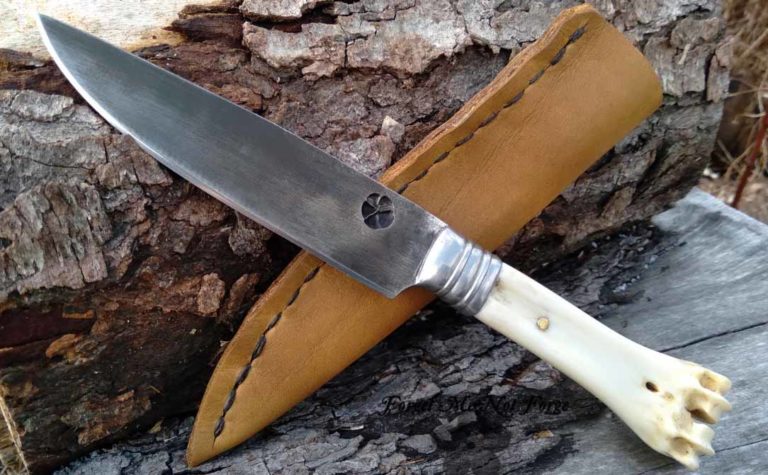
There’s something primal about a bone handle knife. We break down this eye-catching natural material, show what to look for and give you some top picks.

Bone has been around as a handle material just about as long as we have. It is safe to say that ancient cultures across the world have used bone as a handle material for as many as 100,000 years. Perhaps longer. Nobody knows for certain because these materials don’t last forever, even if perfectly preserved.

Bone Handle Knives History

Antler and bone have been used across the world and by virtually all peoples. We see, however, a distinct trend around 12,000 to 10,000 BC where they became the choice handle material for stone or volcanic glass blades. These handles were often carved to allow the instillation of replacement blades, given the brittle nature of the material.

These types of blades were state-of-the-art technology for millennia, with their traditional means of construction still in common use with many cultures at the time Europeans began exploring the world. The stone blades were extremely sharp and could last for months or even years if properly maintained.

Ancient people were experts at shaping these stone blades, and they could do so with great precision. Many of them were not small either, some stone spear points rival modern Bowie’s in length. The strength of these knives is largely dependent on the skill of the craftsman, and some of these blades and their handles still exist today.

Fast forward to the early modern era around 500-1000 years ago, we see that bone is purely a decorative choice on most knives. While functional, there is more of a challenge to working with it than there is wood. Wood in most cases is easily shaped while bone is a much more finicky medium. Bone is substantially more brittle, and it is harder to seal and finish. While it may seem like a durable material, it is quite porous and can shatter if struck.

In a way, bone went from being the material of choice to the choice of those who perhaps wanted to show off. Today this is the same story. It is hard to find individuals who carry around knives with ancient mammoth ivory grips, but they do exist. Will that same individual use that knife for camp work like ancient man? Again maybe, but not likely at the cost of that material.

Common Types Of Bone Used In Handles

Bone
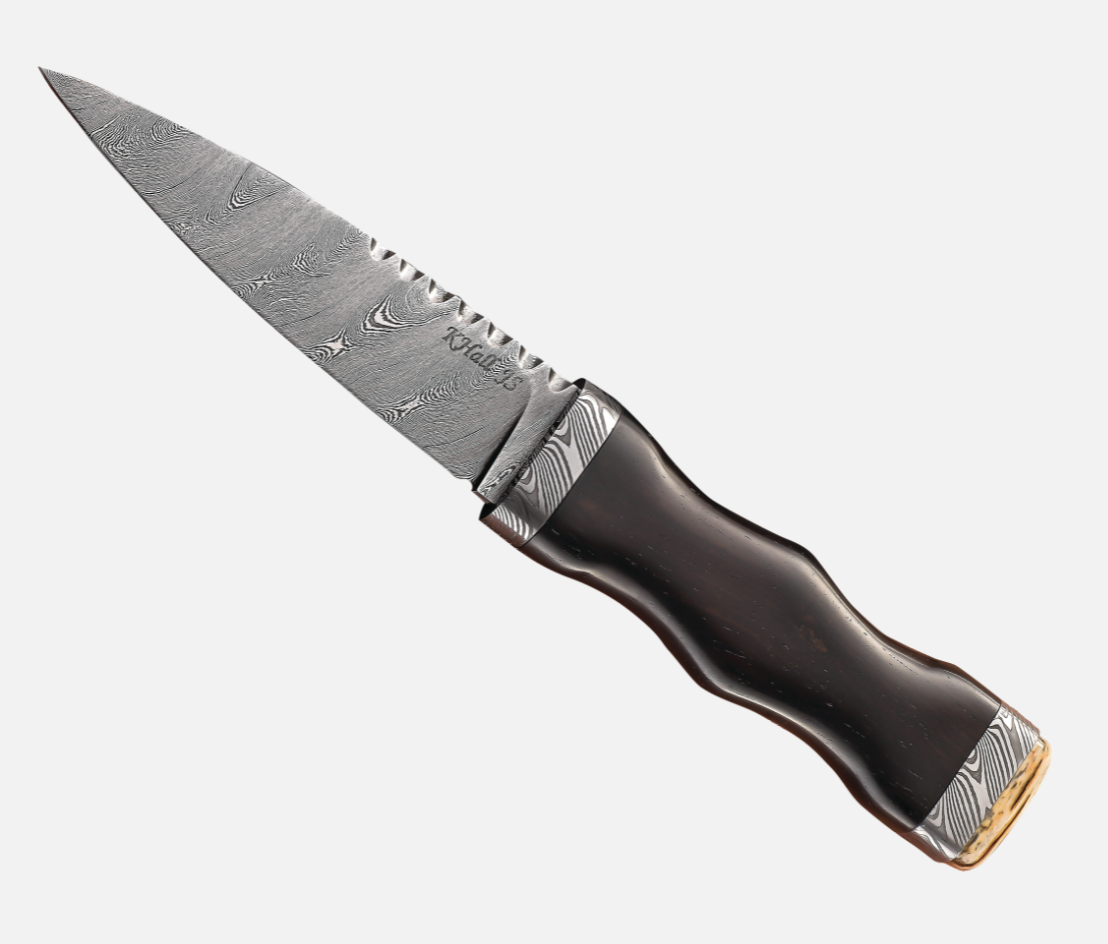
Ken Hall’s sgian dubh features a 4.25-inch blade of twist damascus in a blend of 1075 spring and 15N20 nickel alloy steels. The pommel is formed from stone and giraffe bone. The African blackwood handle not only is ideal for its carvability but also in keeping with the sgian dubh’s name, which is Scottish for black knife.

For the most part, bone handles were typically made from whatever animal was available in the region. In ancient times, this could be any type of bone that was easily hollowed out or shaped. The femur bone (thigh bone) was quite common. Equally popular were the bones of the arm, and even the jawbone, depending on the animal.

Antler
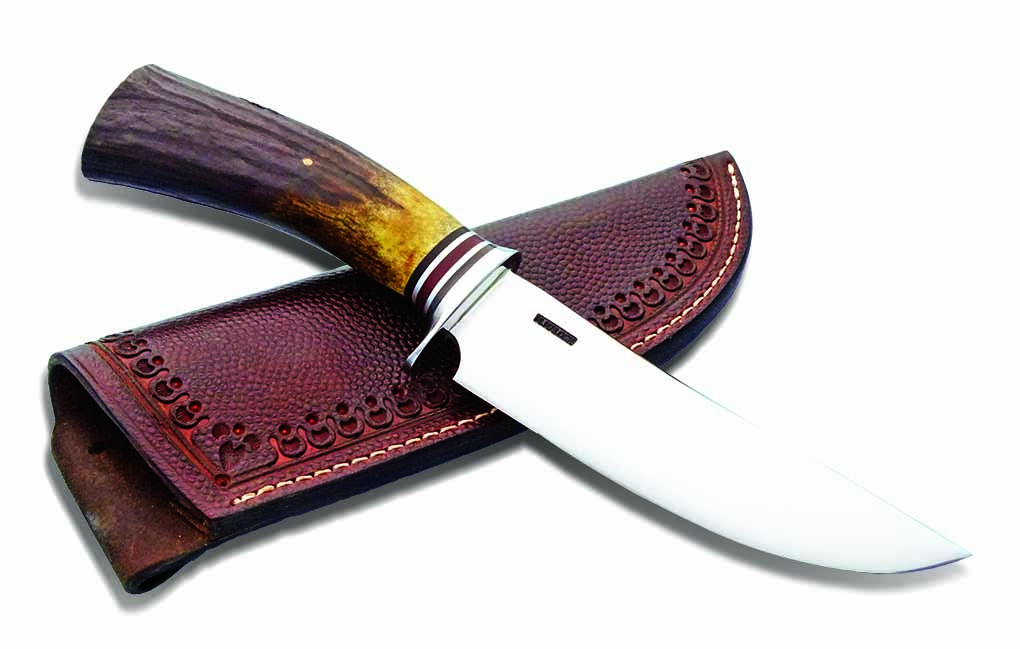
Mike Malosh opts for elk antler with black and maroon Micarta® and stainless steel spacers for the handle of his utility hunter. The 6-inch blade is W2 tool steel and the guard is stainless steel. Overall length: 10.75 inches. The knife comes with a leather sheath by Malosh. The maker’s price: $390. (Impress By Design image)

Antler is and always has been a better alternative than skeletal bone. Antlers grow on members of the deer family only, from the skull and are semi-vascular. This means they have blood flow and skin while they grow. What makes them appealing then and now are they are shed by the animals yearly. This makes them easier to source, not requiring a kill to obtain. Furthermore, antler is extremely strong and dense, much more so than skeletal bone. In turn, it is less prone to shatter and is substantially less porous, meaning it is easier to finish and maintain.

Ivory
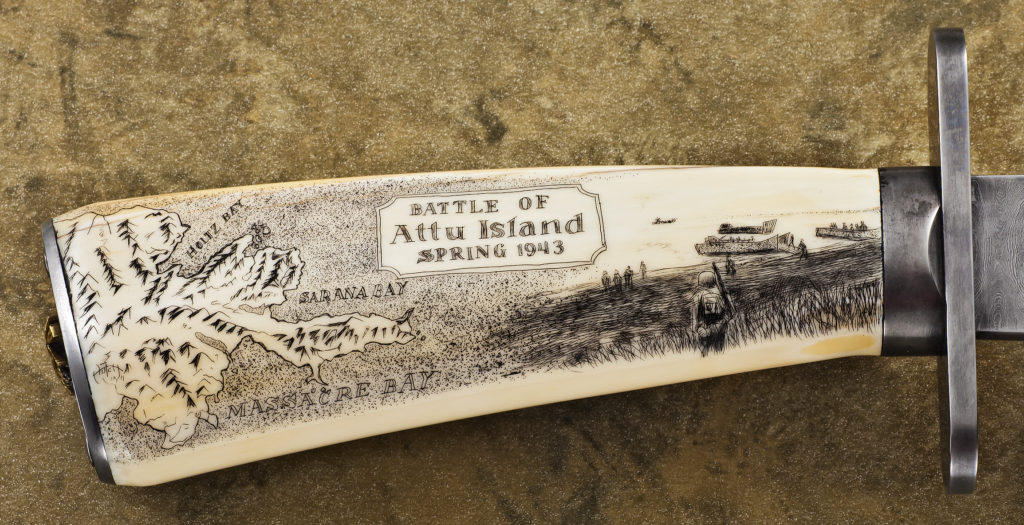
Sharpe used an ancient walrus ivory tusk he already had on hand. Richard (Hutch) Hutchings volunteered to scrimshaw the handle.

Ivory is another material that falls into the bone category. Elephant ivory has been strictly regulated for years. As a result, the material is exceedingly rare and possession of an unaccounted-for sample can land you in trouble. The ivory trade has been bad for the elephant population worldwide, but the animals are largely out of danger now, though this has not lessened ivory restrictions. It is a semi-grainless material that is not only strong but also easily shaped—lending to its popularity.

Mammoth Tusk
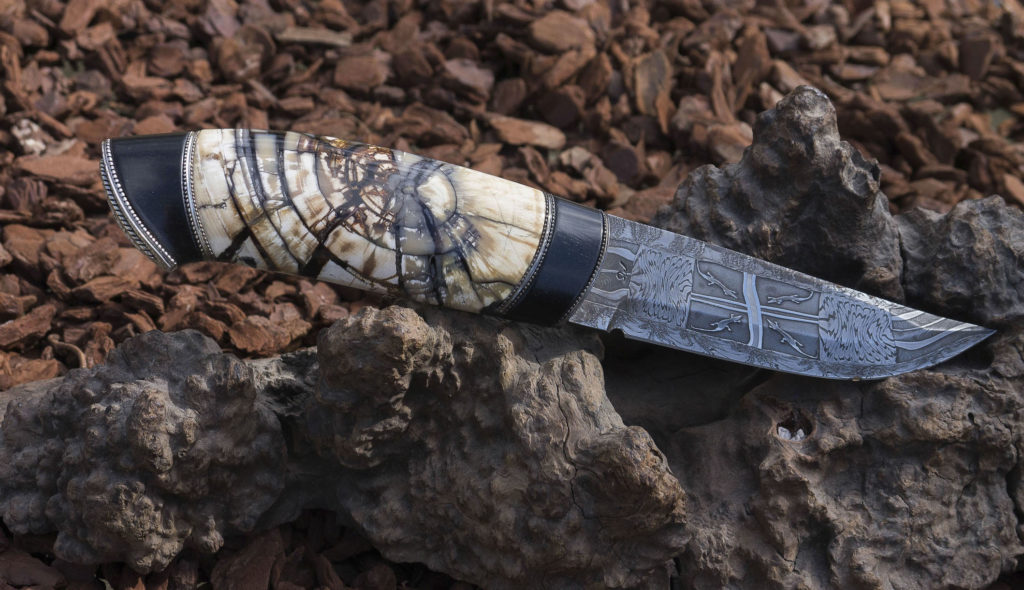
Raffir fossil mammoth
Raffir fossil mammoth ivory comprises the handle of Danish knifemaker Tommy Astrup’s mosaic damascus fixed blade.

While there are regional laws pertaining to mammoth tusk— California, New Jersey, and New York you can’t transfer it—this ancient material is generally legal to sell and possess. (Always check your local laws to make sure this holds true for you.) Given restrictions on ivory, this material has become more common in recent year, sparking a rush to collect it on the Siberian tundra. The permafrost makes it so that these tusks are almost like new. Working with it is no more challenging than working with modern ivory, given the state of preservation is usually excellent. Other ancient materials that are suitable for use on knives include the tusks of walruses and narwhals, but these too are regulated in some states.

Most Desirable Bone Handle Knives

Beauty is truly in the eye of the beholder. While bone handles are certainly attractive, they are not always the best choice for daily use.

The main reason, aside from antlers, most bone material gets very expensive very quickly. Mammoth ivory can run well into the thousands of dollars for enough to make a couple of handles. For this reason, you typically see it as thinner scales as opposed to a full carved grip. If you go that latter route, the finished knife cost can skyrocket into the thousands, perhaps even over $10,000 on a nicely executed custom knife.

Pros And Cons Of Bone Handles

In the world of Micarta and G10 there is little advantage in bone or antler, particularly in durability and longevity. Like any naturally occurring material, there is the presence of unseen flaws that may become liabilities during use. These materials aren’t weatherproof in a true sense and can take on moisture and pull in oils. The mineral structure is different on each bone or antler and as a result, there is no true gauge for strength across the board. The ergonomics are also a challenge as most of these bones and antlers are shaped in a preexisting manner by the animal they came from.

This is not to say that they are useless, rather it is a matter of personal preference. Some people truly prefer how these materials look and feel and that is their right. That does come with accepting that they may be restricted to certain uses as opposed to other handle materials. For instance, hard chopping work and batoning are difficult on handles due to flex and vibration, and bone or antler may simply crack at the pins if a strike is not performed perfectly. The nature of these materials is sentimental, not just to the individual but to mankind as a whole being that they have been with us since the beginning.

Top Bone Handle Knives

Wess Barnhil Gentleman’s Hunter
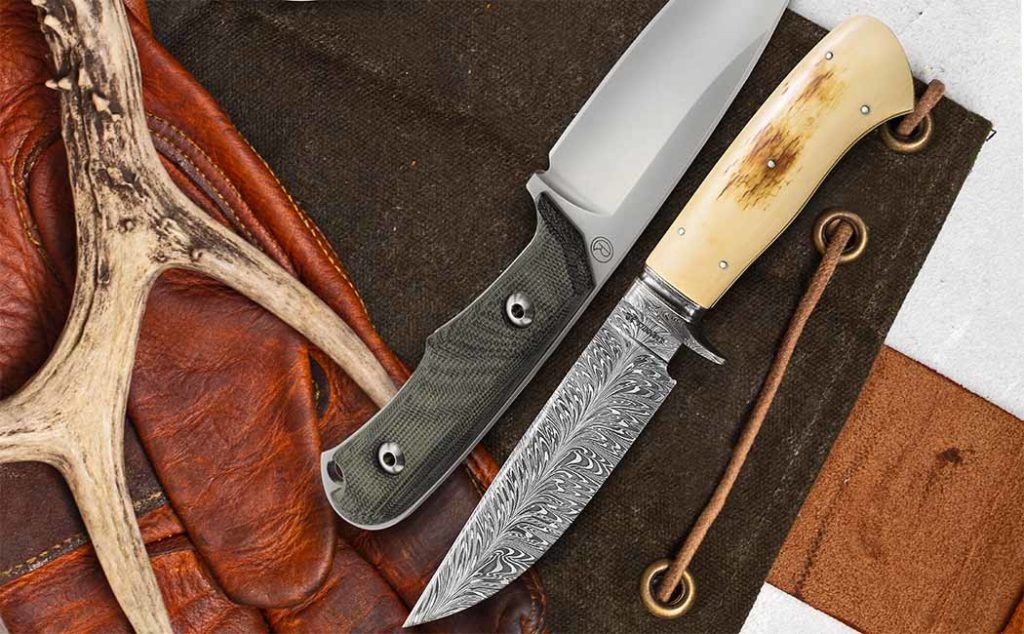
Wess Barnhil Gentleman’s Hunter
Wess Barnhil Gentleman’s Hunter (bottom)

A custom offering by Wess Barnhill, the Gentleman’s Hunter was featured in the November 2022 print issue of Blade alongside some other fantastic bone or antler-handled knives. Modestly priced for a Damascus steel blade, Barnhill’s knife displays an excellent profile and layout for real-world use but is so damn beautiful you’ll probably want to keep it safe from blood and guts! Barnhill’s portfolio features several knives with natural material handles, each a work of art.

MSRP: $1400

Mark Fleming Forged Southwest Trail Bowie
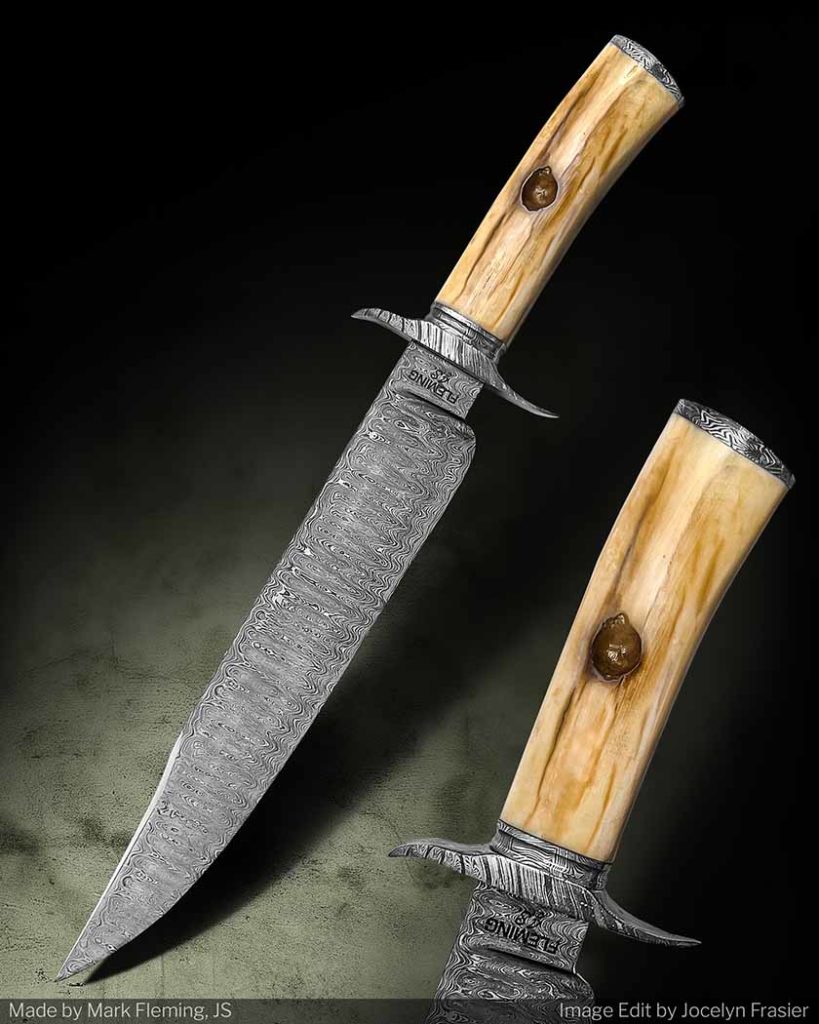
Mark Fleming Forged Southwest Trail Bowie

This knife was featured in the December 2022 print edition of Blade Magazine. Mark Fleming is an ABS journeyman smith, but his work looks exceedingly masterful at this point in his career. While this particular knife is custom, a similar piece will run you about $1,900, which is quite reasonable for such a complex execution. The knife as featured included an awesome-looking ancient walrus ivory grip, itself a relic.The grip material was salvaged from a native fire spindle that was used to start friction fires. Interestingly, you probably could still use this in that manner and you wouldn’t be outside the times. Grip indentations for starting friction fires are common on many knives today.

MSRP: $1,900 (for a similar design)

Rapid River Knifeworks Kodiak
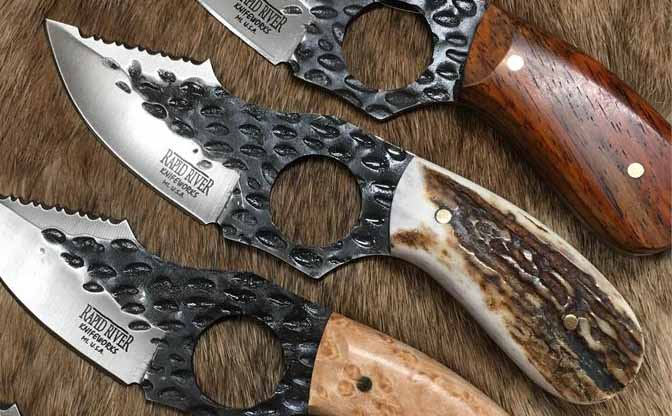
Rapid River Knifeworks Kodiak

Rapid River Knifeworks offers a tremendous number of custom services and a wide range of knife products. Located in Michigan’s upper peninsula, the company has excelled in adding traditional flair to its lineup and the products stand out from others across the board. The Kodiak is a hammer-forged knife that is offered in a dizzying number of configurations, not even including custom engraving. The variant we’re concerned with here comes with elk antler as a grip material, and it sure does look great! Unlike many knife companies, Rapid River has a showroom you can visit in person.

MSRP: $175

Randall Knives 3-Piece Carving Set
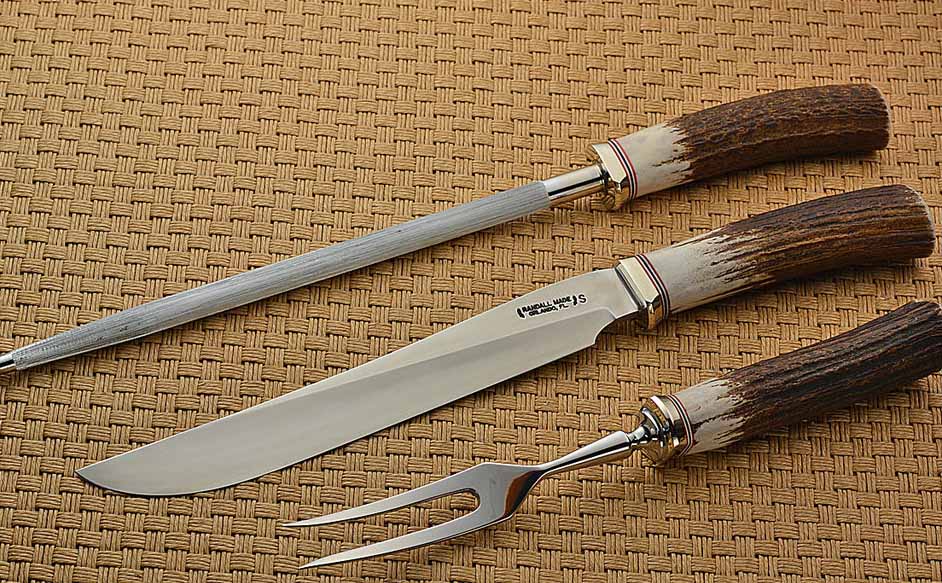
Randall Knives 3-Piece Carving Set

Randall Knives needs no introduction here, however, we are pleased to take a look at a less-prominent product from their standard lineup—its 3-Piece Carving Set. The set comes with a 9-inch carbine knife, serving fork, and sharpening steel, all of which are finished with stag handles. The set includes a storage box and the company notes that you should not put them through the dishwasher. Randall Knives, of course, offers some very well-known classics in natural material handles, many of them available in their standard lineup. If you so desire, you can also take a look at having something custom-built, but you had best get your orders in now. The company website is currently taking orders for delivery in four years!

MSRP: $680

Silver Stag Universal Chef Pro
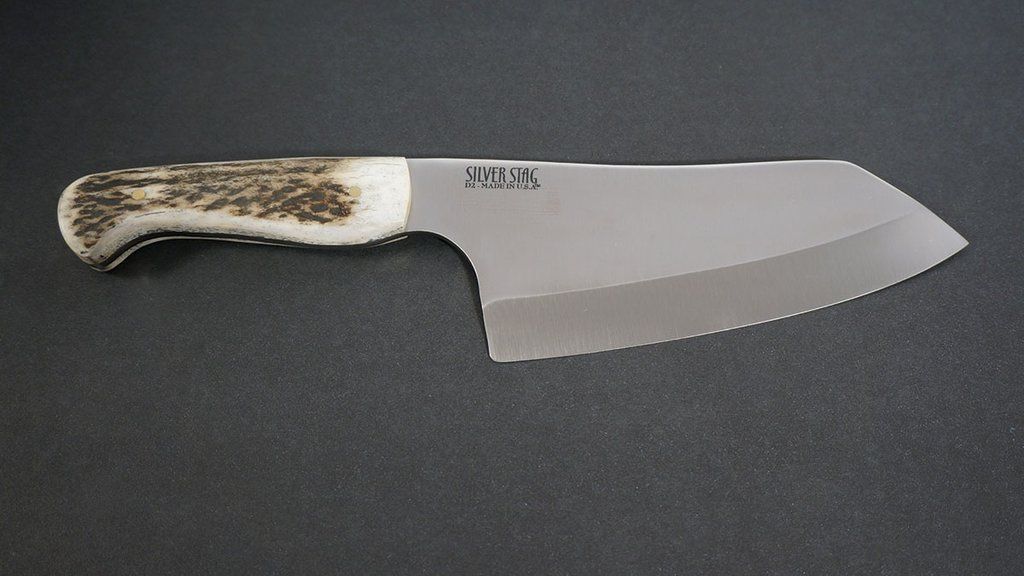
Silver Stag Universal Chef Pro

Silver Stag makes a great number of products that feature natural handle materials, but a standout example is the antler-handled Universal Chef Pro. This is an all-use kitchen knife that is at home in just about any setting—be it your home or base camp. The knife is ruggedly constructed and has a unique shape with a curved belly and sheep’s foot tip that allows it to be deftly handled for large tasks like carving down to fine dicing. Silver Stag offers a full line of antler-handled kitchen knives, as well as many other outdoor knives from filet knives to custom scrimshawed skinners.

MSRP: $218

More On Knife Handles:

Condor K-Tact Kukri Review: New Old School

1

With the K-Tact Kukri, Condor goes both old school and modern.

As with all knives, the steel is only as strong as the hand that wields it—and perhaps with no knife is this so true as the kukri.

The kukri—aka khukuri—has a reputation so legendary that even some non-knife enthusiasts recognize the knife when they see one. To understand how the kukri got its reputation, let’s examine the people who used it and help grow the legend.

Kukri History

You can’t mention the kukri without mentioning the hand behind the blade: the Gurkhas. The history of the Gurkhas dates back several centuries to the small mountainous kingdom of Gorkha, located in what is now central Nepal. In the early 19th century, the British East India Company was expanding through the Indian subcontinent and faced challenges from local rulers and neighboring powers. The Gurkhas had a reputation for being a substantial military force in the region. So, the company began recruiting Gurkhas into its own army. The first Gurkha units were formed in 1815 and they quickly gained a reputation for bravery and loyalty.

Gurkha with Kukris
Gurkhas not only were fearsome warriors with their kukris, they also used them for daily chores. This sketch shows Gurkhas catching fish with their kukris in India’s Bazar Valley circa 1900. (Istockphoto.com image)

Since the first Gurkha units were formed, they played a pivotal role in many conflicts and to this day remain an important part of the British Army. The Gurkhas fought for the British during the two World Wars, with Gurkha soldiers serving in various theaters of operations, including the Western Front, North Africa and Southeast Asia. About 200,000—virtually an entire male population—enlisted to fight in World War I. About 250,000 fought in World War II. In the two wars, 30,000 Gurkha troops were killed.

Continuing to serve with the British, they participated in the Falklands War in 1982, and have been involved in recent conflicts in Malaya, Borneo, Bosnia, Iraq—including the Gulf War—and Afghanistan. Soldiers that have served alongside the Gurkhas regard them with respect. The spine-chilling cry of “Ayo Gurkhali!”—“The Gurkhas are coming!”—has terrified countless enemies. The Gurkhas’ bravery and determination in battle earned them numerous honors and awards. In the two World Wars alone, they won nearly 5,000 medals for gallantry.

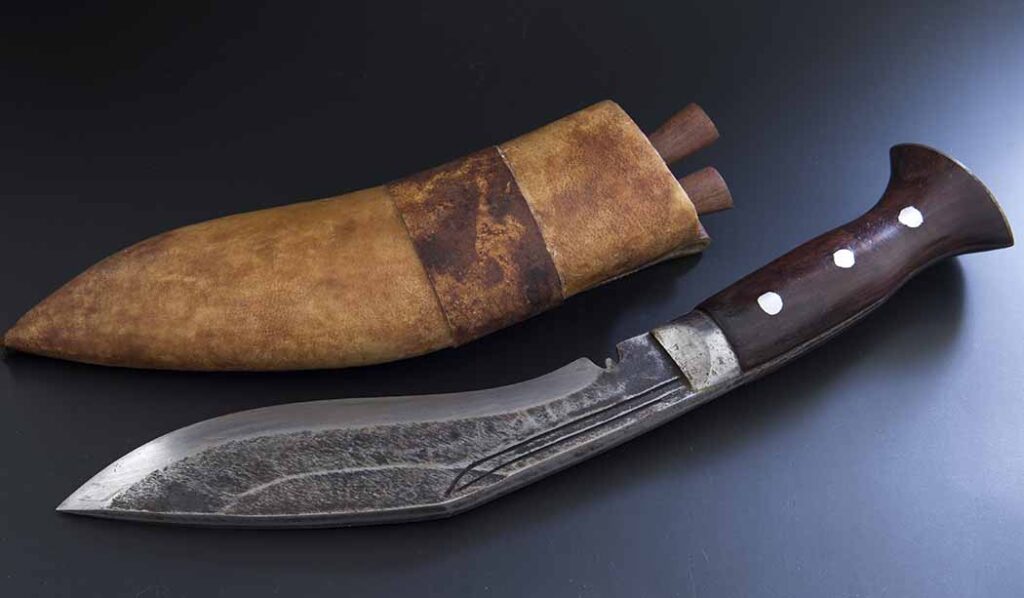
traditional kukri
The traditional kukri includes a natural handle material and the double-notched choil. Note the extra small knife and a sharpening steel—their handles protrude from the sheath here—that ride in the sheath. (Istockphoto.com image)

After the second World War, the British started to pull back from their colonial interests, allowing their various colonies to practice more independent self-governance. Even so, the British Army continued including the Gurkhas as an important part of their operations. Meanwhile, the kukri legend had no choice but to grow as it was made famous by the Gurkhas’ outstanding reputation for bravery and loyalty.

K-Tact Kukri Updates

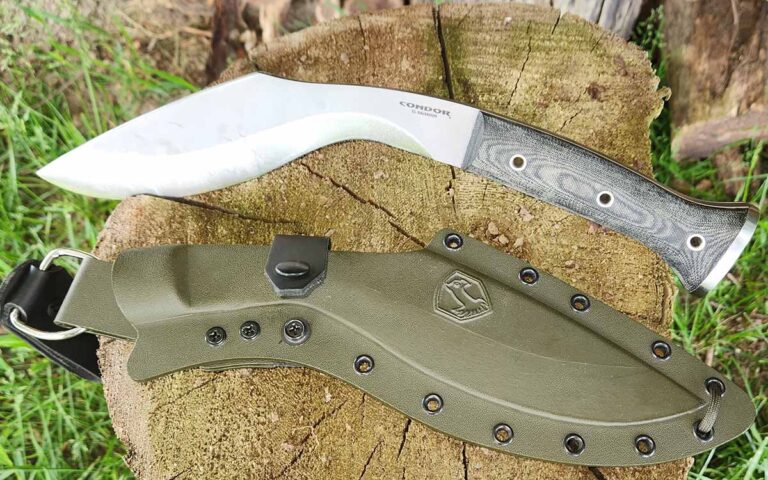
The traditionally made kukri is a coveted piece in anyone’s collection. Condor Tool & Knife has updated the design with the use of modern materials to bring about a new tool with a pedigree. With the K-Tact Kukri Knife Army Green designed by Joe Flowers, the company remains loyal to the original shape but modified some materials and proportions.

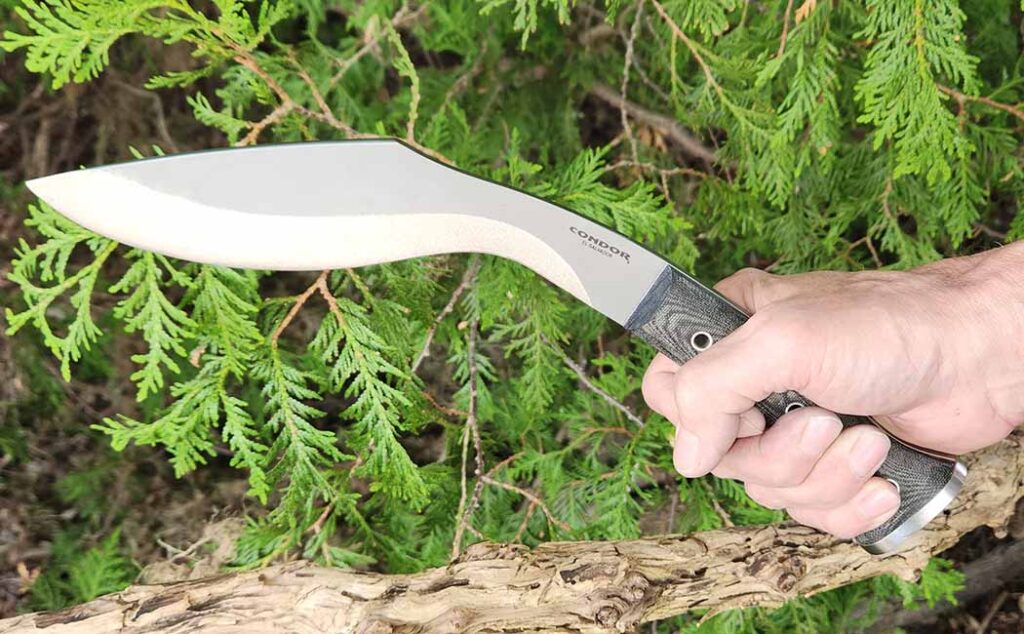
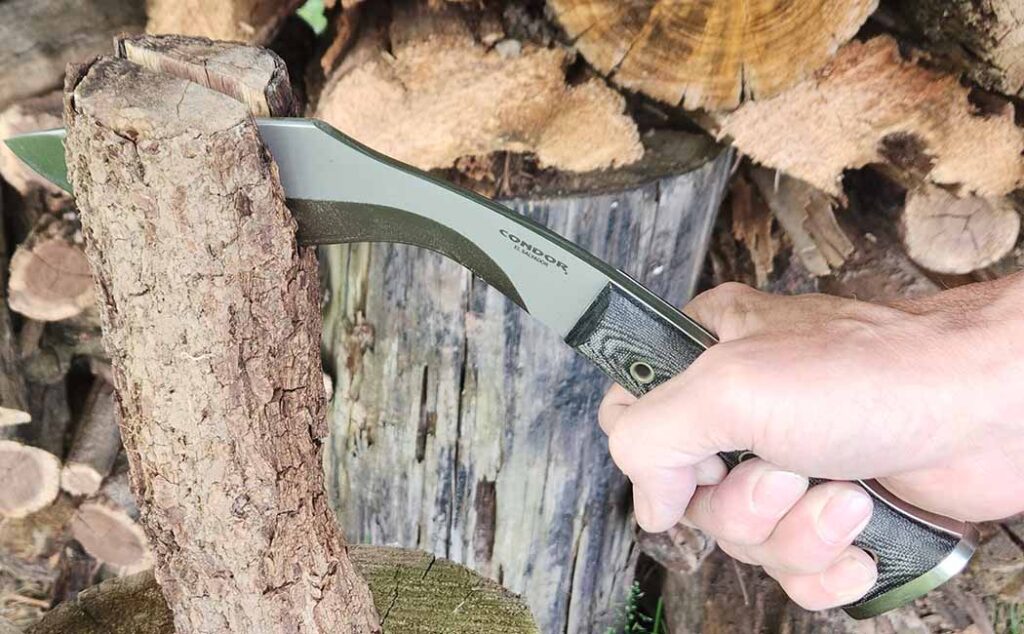
K-Tact Kukri in hand
The overall profile of the Condor Tool & Knife K-Tact Kukri forms somewhat of a pistol grip. The grip angle serves well during chopping and carving. In less peaceful times, it accommodates thrusting without the need for a guard. Blade and overall lengths: 10 and 14.5 inches.

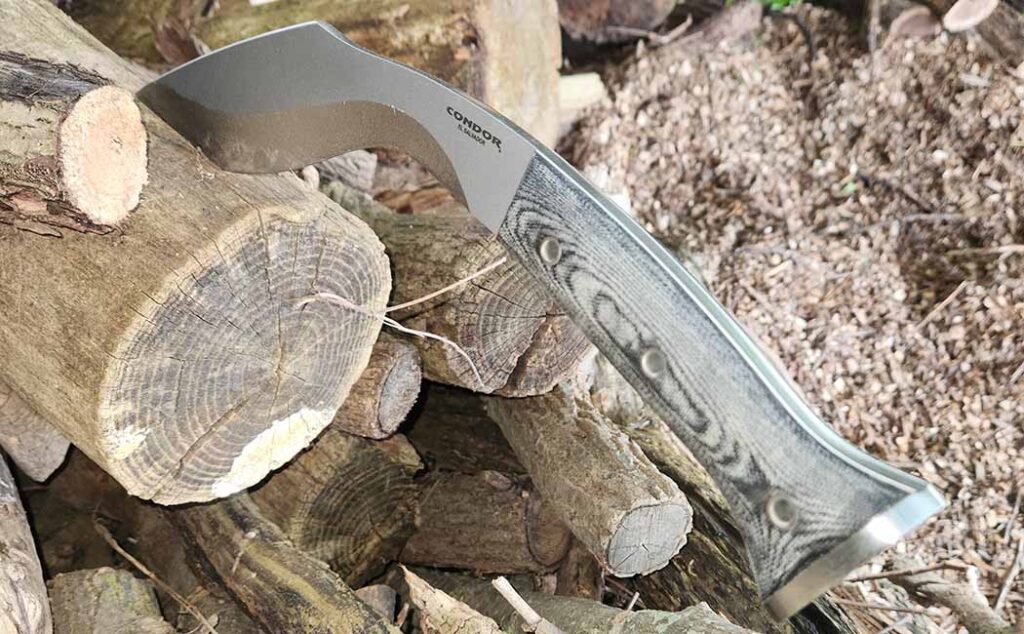
Instead of using the wide variety of natural handle materials seen on kukris over the years, Condor opted for a green Micarta®. Micarta is much more stable, and for better grip Condor gives it a textured bead-blasted finish.

You may have heard how the blades of the originals were made from truck leaf springs. Truck leaf springs were made from such carbon steels as 5160 or 1095, or reasonable facsimiles. I often wonder about the truck leaf spring story. If you think about it, seeing as how the kukri also was used by villagers along with other patterns of knives to get work done, that means a lot of trucks would be losing their springs. Condor uses 1075 carbon steel with a bead-blasted finish for the K-Tact, which is named after Alan Kay, season one winner of History Channel’s Alone reality survival show.

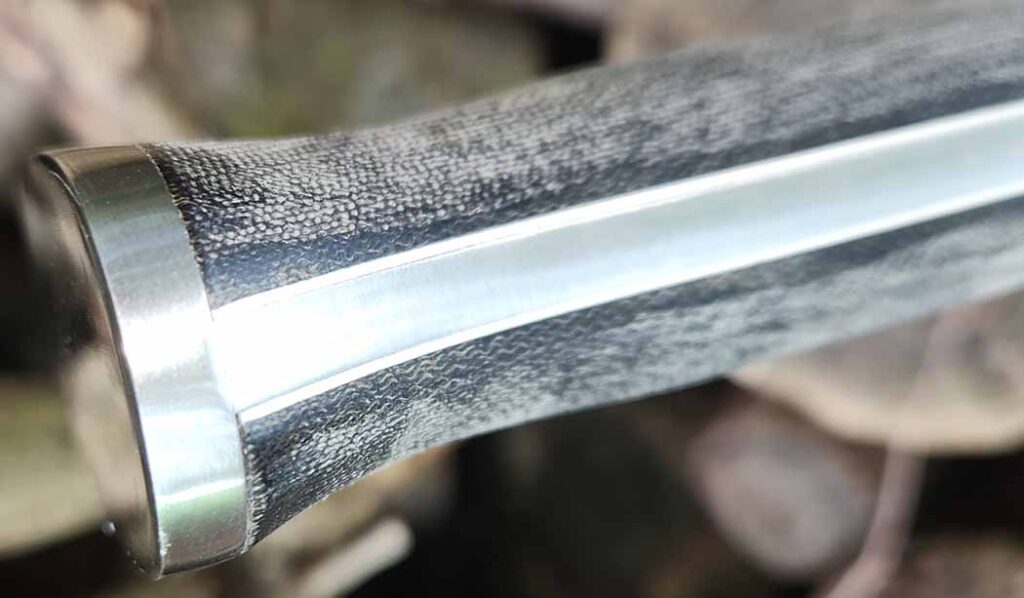
K-Tact pommel
The pommel helps balance the knife and serves as a hammer. According to the author, the synthetic Micarta® deals with any vibration from hammering and chopping better than natural materials.

Traditional kukris have a convex edge and are finished in a high polish. Condor convexes the K-Tact only part way up the blade and then leaves it flat. Blade thickness is .2 inch, thinner than most traditional models.

The average Nepalese villager’s kukri was made differently than the official Gurkha model. Possibly due to the time needed to make them and the lack of available steel, villager kukris had stick tangs. The Gurkha models have always been full tang and so is the K-Tact. Because of the thinner stock and the fact Condor took some weight off the blade with a stylized dip in the spine, the knife is livelier in the hand and feels more balanced.

Any of the traditional kukris I have held have had forward-heavy blades. They have a thick pommel plate the same thickness as that of the blade material. Having a thick pommel gives you a convenient hammer when needed and also enhances the knife’s balance.

K-Tact Kukri Versatility

One of the big keys to the kukri design is that it’s a great maker’s tool. It is not used for combat only. Among the recognized attributes of the Gurkha fighting units is their resourcefulness, and a large part of that is that the kukri lends itself to being a maker’s tool. Just the overall shape allows you to do many chores. It can act as a small draw knife due to the arched shape.

Chopping with K-Tact Kukri
The author is not a big fan of batonning. “If you are going to do so,” he observed, “the rule of thumb is baton through nothing larger than one third the length of the knife. Following that rule allows you to keep leverage on the cut.”

For the sheath, instead of the traditional water-buffalo-covered wood, Condor uses a molded Kydex with a drop-leg leather strap and a retention strap. Despite being a huge traditionalist at times, I have to say the modern sheath is a huge improvement. The fit is spot on and you get none of the Kydex-rattling syndrome.

If I had to voice a disappointment in the K-Tact, to be fair it would be more of a “I want my cake and eat it, too” complaint. On a traditional kukri you get an extra small knife and a steel that ride behind the blade next to your body in the same sheath. Though I don’t have much use for the sharpening steel—I carry other sharpeners—a secondary small blade is a key part to the maker’s aspect of the knife.

K-Tact Kukri chopping
Due to the profile of the kukri, the sweet spot for chopping is at the belly a bit farther back from the tip than on a number of other chopper designs.

Yes, I know, I can carry another smaller knife, hence the “cake and eat it, too.” Having said that, there is still something about the knife presenting as a kit all in one housing. Keep in mind I am a father-and-son-knife-set collector. All I’m saying is, it would have been nice to have a matching small blade with it.

Use Before Buying

I must say I have enjoyed playing with this knife. It works well. Kukri-style knives aren’t for everyone, so do try and use one before you buy. Each knife style has its own little ins and outs. If all knives worked the same, what reason would enthusiasts have to collect multiples?

As a final thought, the K-Tact is a good, solid, dependable piece of kit and in the right hands can take you far. Who knows? You might discover that you just want a modern version of a legendary style. Made in El Salvador, it has an MSRP of $162.84.

Check Out More Buyer’s Guides:

Parts Of A Knife: Crash Course In Knife Anatomy 101

Looking to learn the proper names for everything that makes up a knife?

Like sailors, stagehands, and sommeliers, knifemakers have some very particular terms for the tools of their trade. It helps to know the lingo if you’re getting into knives, or just want to know what the hell “jimping” is when you read it in a product description.

Most of us use knives regularly, and some of us may even be sharpening pros, but there’s still a lot of knife terminology out there that doesn’t come up that often and some of it can be confusing.

Today, we’re going to clear all that up with a primer on all the major parts of modern knives. This is Knife Anatomy 101.

We’re not going to cover everything because you probably don’t need to know the exact name for the type of guard commonly found on a 14th-century German langmesser, but for those of you shopping for a new kitchen or pocket knife, this should cover everything you need to know.

Blade Essentials: Things (Most) Every Knife Has

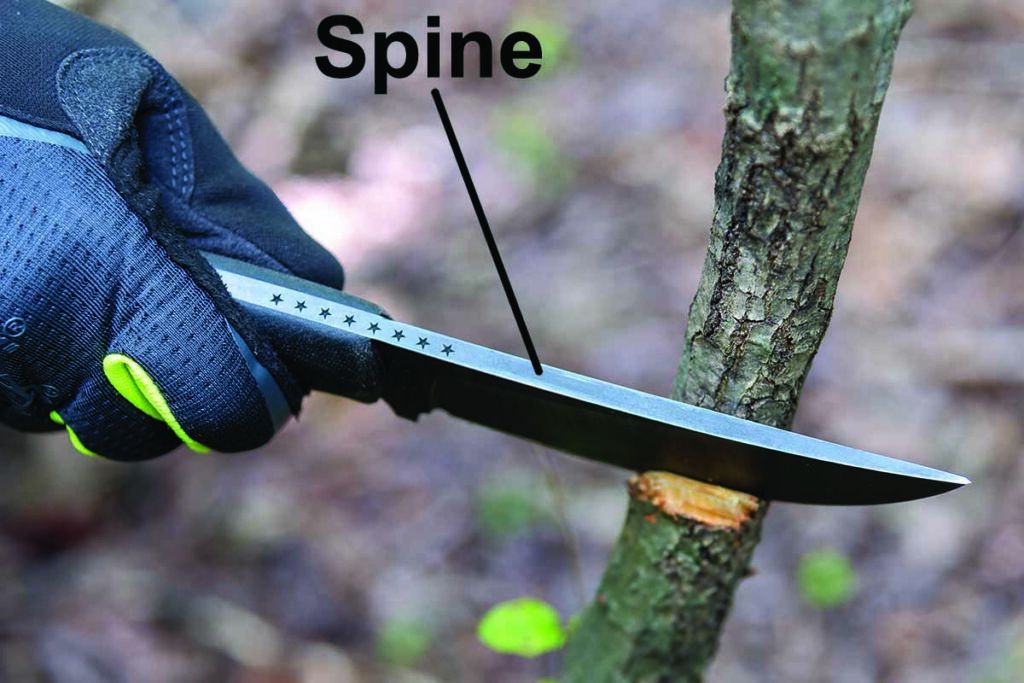
Spine

Knife Spine

The spine of the blade is the part furthest from the edge or edges. On a single-edged knife, this would be the side of the blade opposite the edge, and on a double-edged knife or dagger, this is the middle of the blade between the edges.

The spine on a good knife will typically be heat-treated differently than the edge. The goal is usually to make the spine of the knife softer, and therefore allow it to flex and absorb energy while keeping the edge harder and more resistant to wear so it stays sharper longer.

This is called a differential heat treat and is especially important on larger, hard-use knives or other blades that might have to take impact forces.

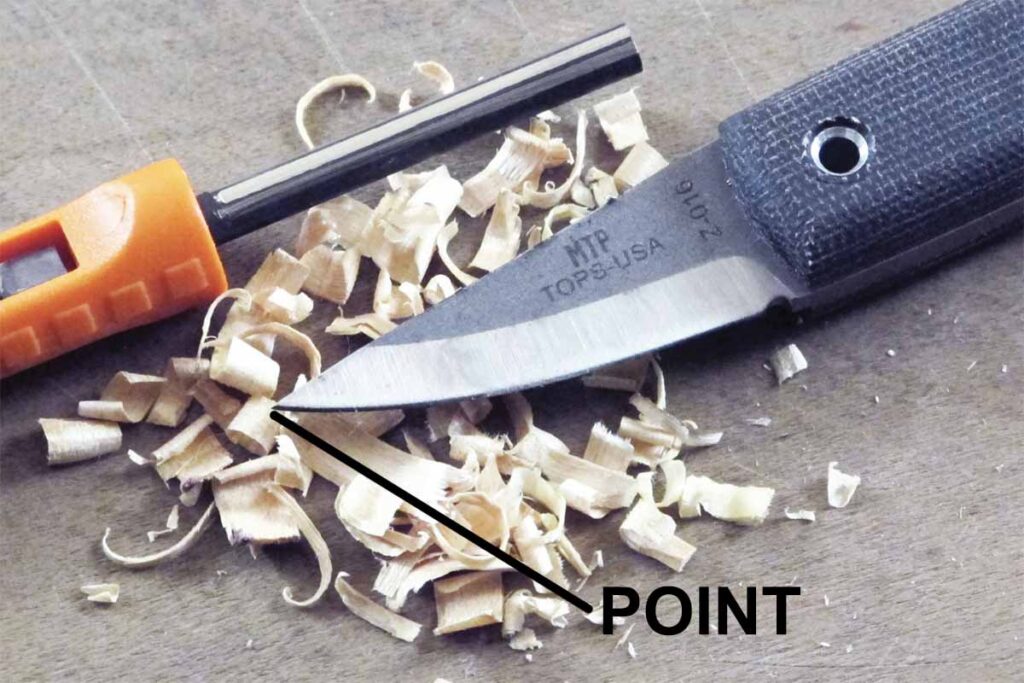
Point

Knife Point

You probably know this one, I won’t lie, but technically the point is the place where the edge and the spine or opposing edge meet, typically at a very sharp (pun intended) angle. This is what you use for piercing, and most knives have one.

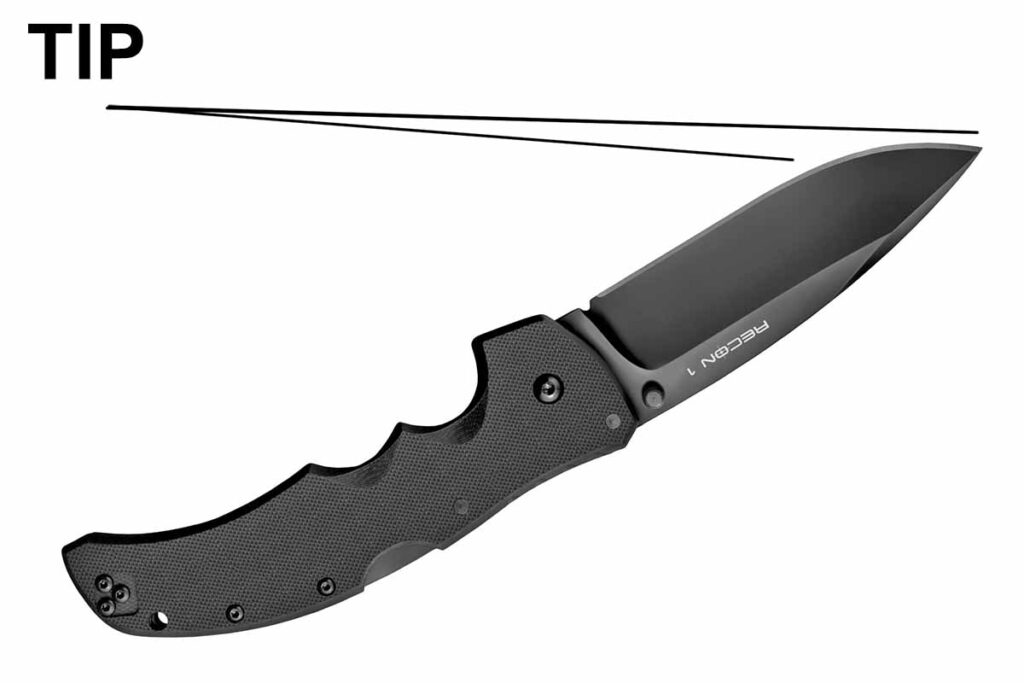
Tip

Parts of a knife, tip

Technically different than the point, the tip of the blade is the forwardmost section of the blade, usually considered to be the last 20% or so of its length.

This section may be sharpened differently, have an unsharpened false edge along the spine, or be heat-treated differently to achieve different results. It includes the point of the blade.

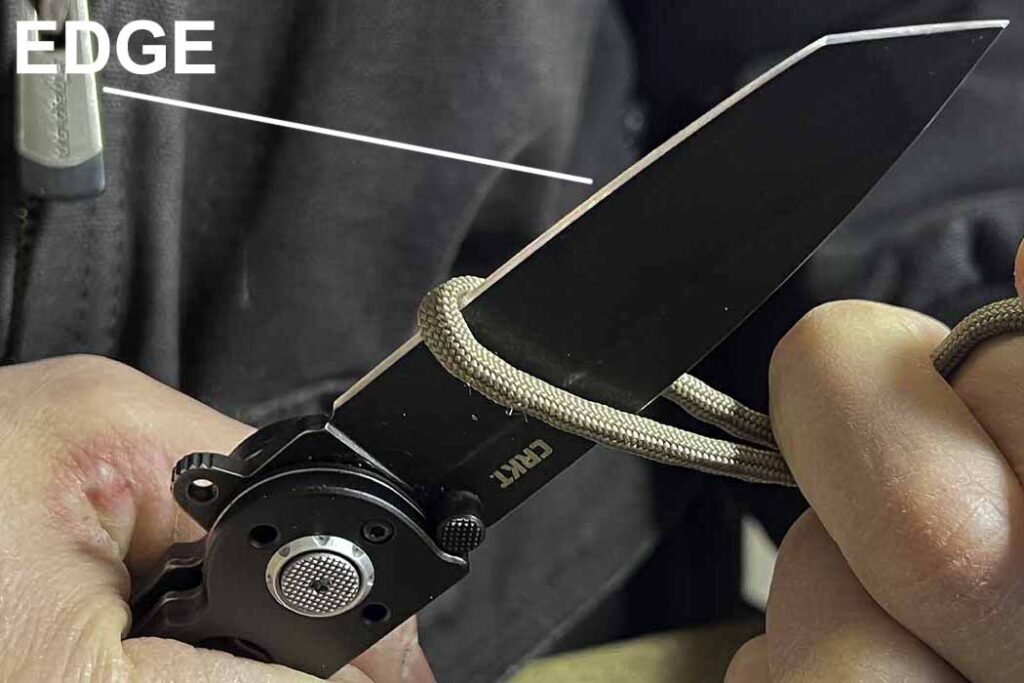
Edge

Knife Edge

The edge of the knife is the (usually) sharpened portion furthest from the spine. It includes everything from the point to the heel, which we’ll get to later. Basically, this is the part you cut with, and on most knives, the whole thing will be sharpened the same.

There are some knives that have serrations for part of the blade, or certain fighting knives that leave sections unsharpened for the user to grip, though this fell out of fashion around the time the pilgrims landed in America. Today, most fighting or tactical knives are sharp from handle to tip.

One related term you will see is “edge geometry” or “edge angle” which refers to the angle at which the knife is ground or sharpened. Typically, this will be 20 degrees for something like a pocket knife or Western-style chef’s knife, or around 17 degrees for Japanese knives.

If you aren’t sure, a simple bevel gauge will tell you what the original edge is that you should be sharpening towards.

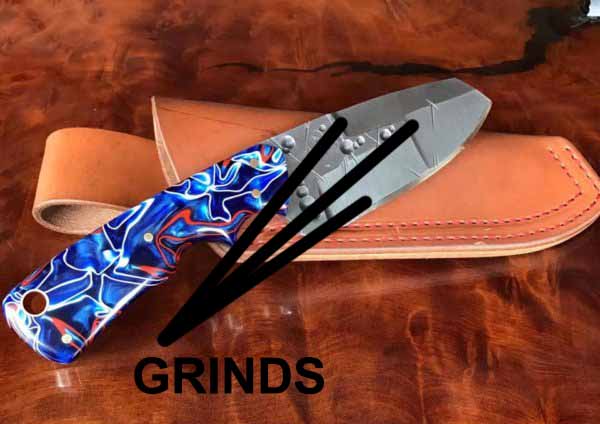
Grind

Parts of a knife, grind

The grind of a blade, also called the geometry of a blade, refers to its cross-section and how the blade was ground by the maker. There are many different ways to grind a blade, with the most common being some form of hollow or flat grind, with convex grinds being a fairly distant third.

Every grind is a balance between strength and sharpness and is used for different things depending on the type of blade.

Some grinds lend themselves to a more robust edge that is less sharp, and some grinds, like the hollow grind you’ll find on most kitchen knives, give us an edge that is more susceptible to damage if misused, but better at slicing.

Various common grinds you’ll see frequently are hollow, flat, sabre (or saber), chisel, convex, and Scandi.  All have their uses and are worth looking into further if you really want to dive into blade geometry and have the very best knife for the job.

Living on the Edge: Parts of the Sharp Part

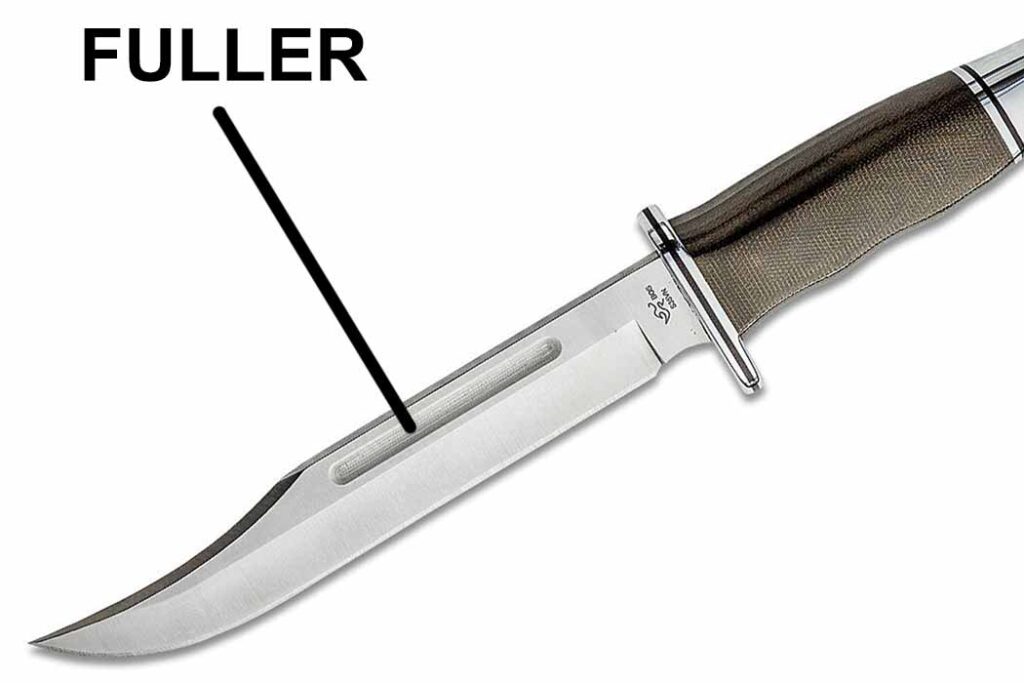
Fuller

Knife fuller

A fuller is a rounded or beveled section of the blade that is either added as part of the forging process or ground in before the blade is heat treated. The purpose is to reduce weight and if forged, to strengthen or widen the blade as needed.

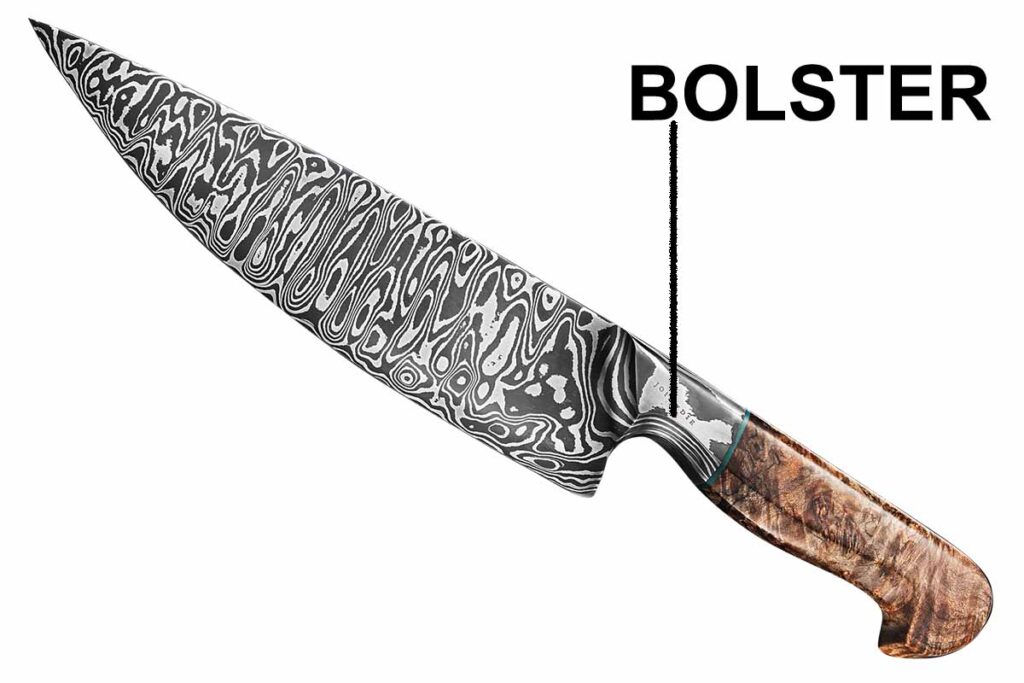
Bolster

Parts of a knife, bolster

The bolster of a knife, usually found on a kitchen knife or other fixed blade, is a thickened section of the blade that flows smoothly into the handle. This adds strength to one of the weakest areas of any knife (the junction between blade and handle) and helps with ergonomics by providing a smooth transition.

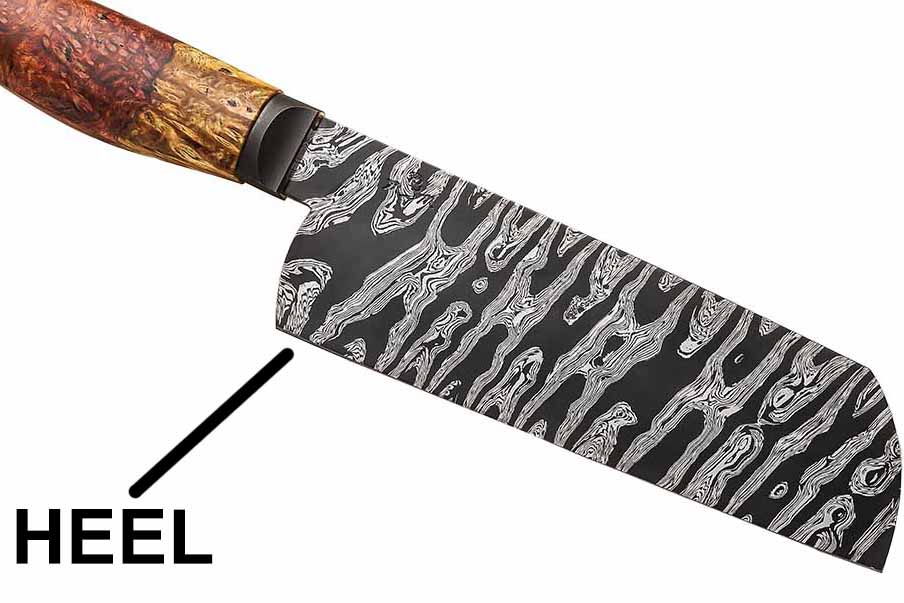
Heel

Knife heel

Not all knives have a heel, but if your knife has an edge that extends down and away from the handle, then you can think of the “bottom” of the blade furthest from the tip as the heel.

This is most common on kitchen knives and is typically rounded over or left rather wide to keep your middle finger comfortable when using a pinch grip. Japanese blades are notorious for having a prominent heel.

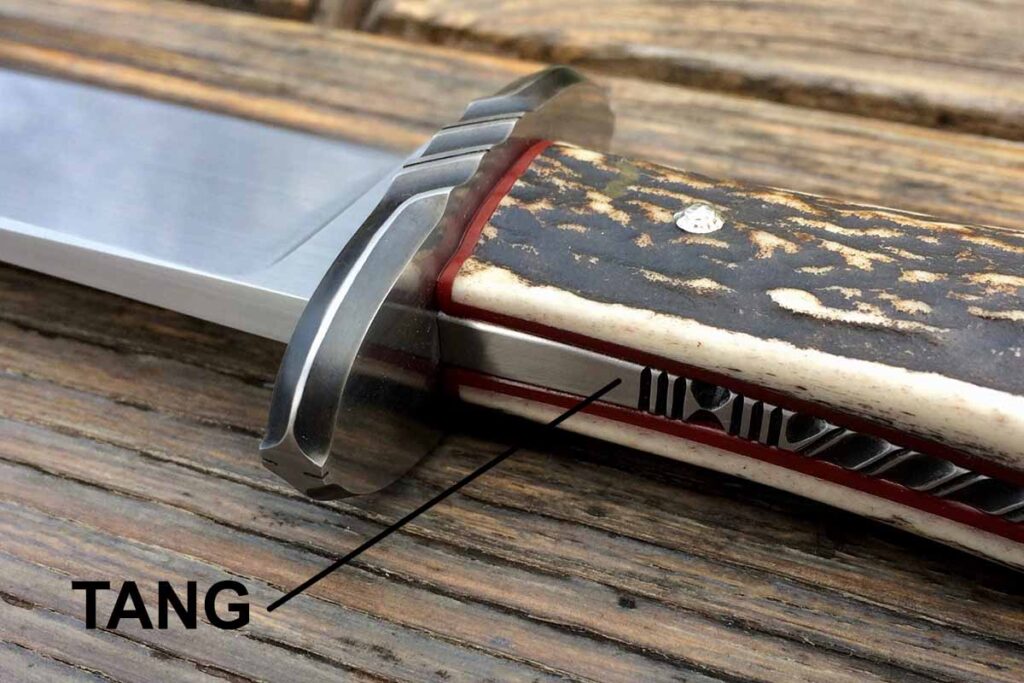
Tang

Parts of a knife, tang

The tang of a knife or sword is the portion that extends into the handle. This can be the back of a folding knife blade that is drilled for a pivot, or the longer unsharpened rectangular section of a fixed-blade knife that the handle is attached to.

A “full tang” is when the tang extends all or most of the way through the handle, and adds a great deal of strength, making it the preferred style for hard-use or high-end fixed-blade knives.

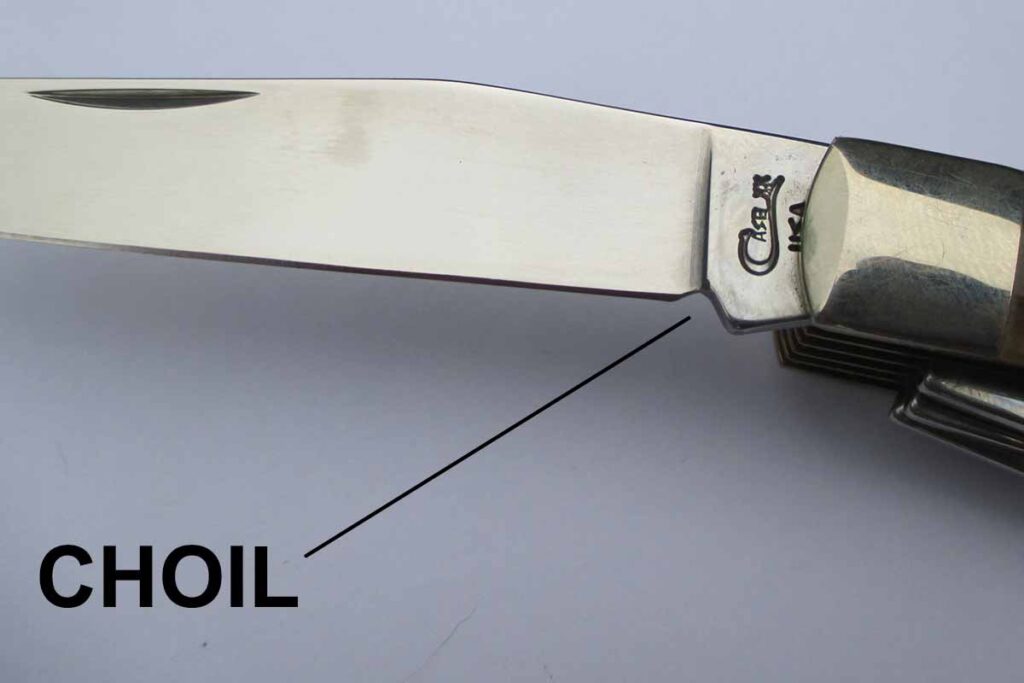
Choil

Parts of a knife, choil

The choil of a knife is the space at the bottom of the edge, furthest from the tip and nearest the handle, and is left unsharpened and hollowed out. On some knives, it’s large enough to accommodate your index finger when using the knife in order to give you a bit more control.

However, the main purpose of the choil is so that the whole length of the edge can be sharpened without any issues.

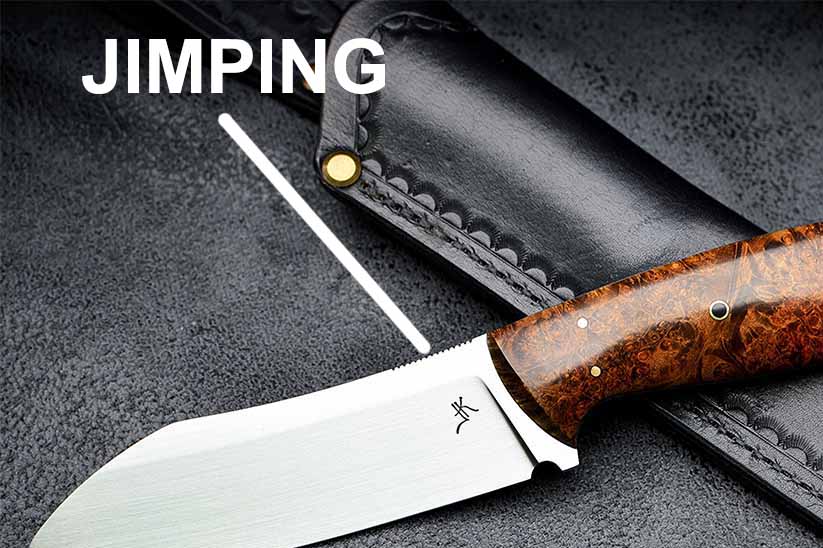
Jimping

Knife jimping

Jimping is the name of the grooves or notches added to the spine of a knife in order to increase grip. The most common places you’ll see this are on pocketknives and hard-use fixed blades, on the spine right where the blade meets the handle.

By having a grippier, high-friction surface there, you can better manipulate the knife, especially with wet or dirty hands

Getting a Handle on the Rest

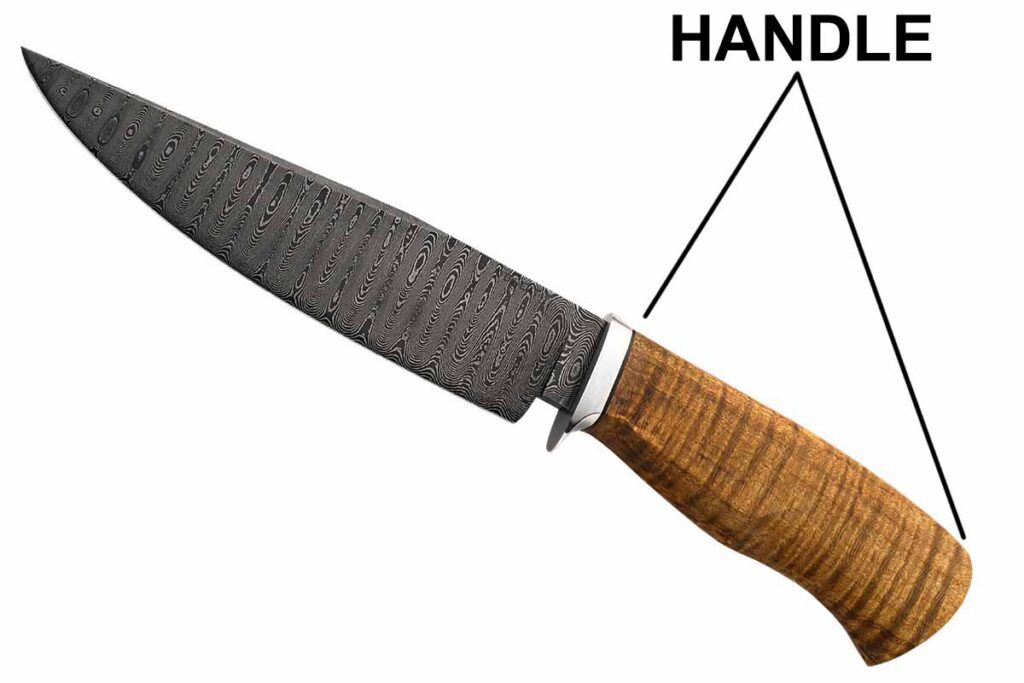
Handle

Parts of a knife, handle

As you probably know, the handle of a knife is the part you hold. On a sword, or longer martial weapon, you will typically see the handle referred to as the hilt, but there’s not really much of a technical difference here.

It includes the guard, the grip, and the pommel if present.

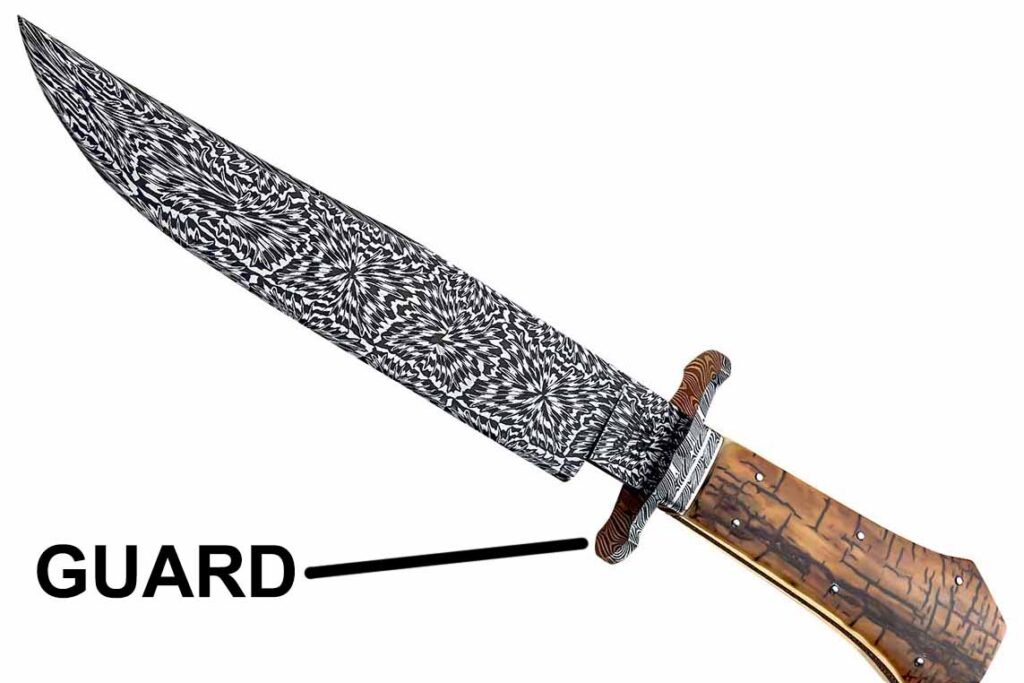
Guard

Knife guard

The guard of a knife is the bit that stops your hand from sliding forward and generally keeps you from hurting yourself with the knife. Many kitchen knives forgo a guard because you aren’t really supposed to stab them into things while fighting knives…well let’s just say swords had crossguards for a reason.

Pommel/Butt

Knife pommel

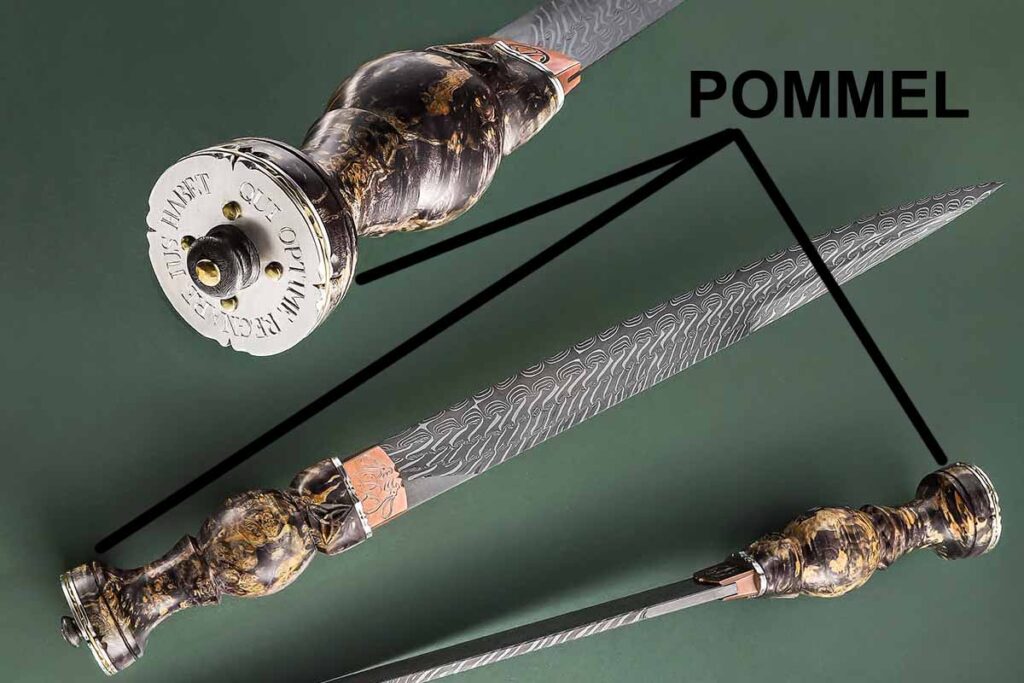
Historically, the pommel of a knife refers to a weighted cap or round at the end of a handle that was meant to balance out the weight of a knife or sword blade. These days, few knives have one, but you may still see the bottom of a knife’s handle furthest from the tip be referred to as a pommel.

More commonly (and correctly) you’ll see this referred to as the butt of the knife.

Quillon

Parts of a knife quilon

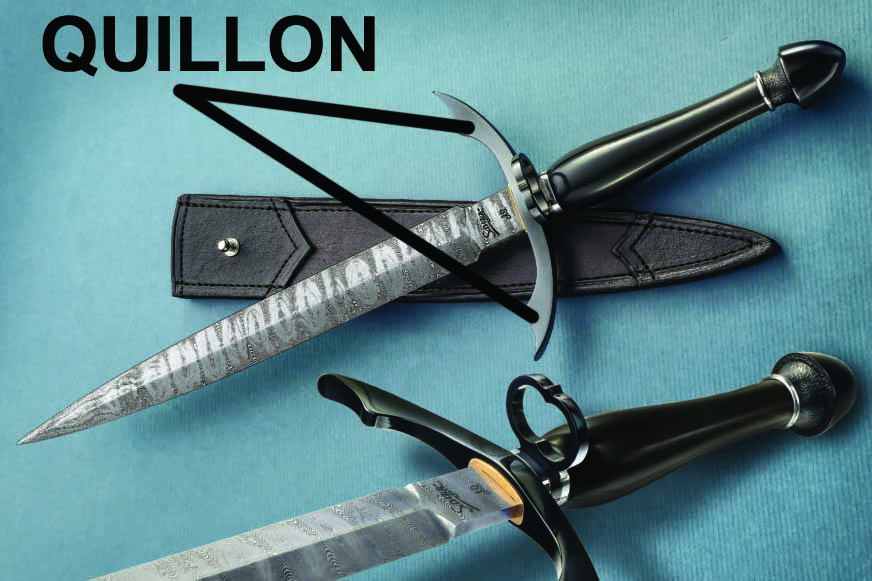
On a sword or knife, the quillons are part of the guard that extends outwards at a right angle to the blade to keep the user’s hand from sliding up the blade when using it. These would often be very ornate on a more elaborate piece but would often be very simple.

Final Thoughts

And that does it for this one folks, thanks for stopping by. You should now know everything you need to know about the different (common) parts of knives.

There’s some other stuff out there that might come up if you start getting beyond Western-style knives or branching out from kitchen and pocketknives, but this is definitely 99 percent of what you’ll ever need to know when it comes to knife anatomy.

Also, the very distinctive nail-like guard that protrudes out on a messer is called a nagel and it is designed to stop parried enemy blades from sliding down and cutting your hand. In case you were wondering.

More Knive 101:

The Viking Seax And Where To Get One

Deeply Rooted In Scandinavian History, The Seax, AKA “Scramasax” Or “Sax,” Was The Blade Shape Of Choice For The Much-Feared And Revered Vikings.

Typically the Norsemen were associated with their famous axes, but, truth be known, they also carried a knife that saw more general use: the seax.

The Scandinavians usually lived in villages, farmed the land and raised animals. In such an agrarian society, they also needed tools to help them work the land and harvest the fruits of their labor. This is also where a knife came into play.

“Their personal knife was called the seax and it never left their side because it was their version of an EDC,” begins Ernest Emerson of Emerson Knives, Inc. “The knife was tasked with a myriad of chores, from skinning a freshly taken deer to cutting up the turnips they grubbed out of the ground with the same knife.”

Seax blade shapes
The folding Emerson Knives Seax puts a modern twist on this age-old blade design. (Image via Emerson Knives)

Emerson said the seax also could be employed as a self-defense weapon if needed. It was truly a blade for all seasons: Harvest produce in the morning, fend off the enemy after lunch, and then prepare supper in the evening—all with the same blade.

Seax Designs

All joking aside, the seax was a handy blade.

“It is a bowie-style blade, a spear-point type of blade, a Loveless drop-point hunter-style of blade, and, of course, the well-known ‘broken-back’ style featuring a severe clip close to the front, finishing in a point well below the center line,” Emerson said.

He said the broken-back seax style is the most common and appears in TV shows and movies depicting Vikings.

Broken Back Seax
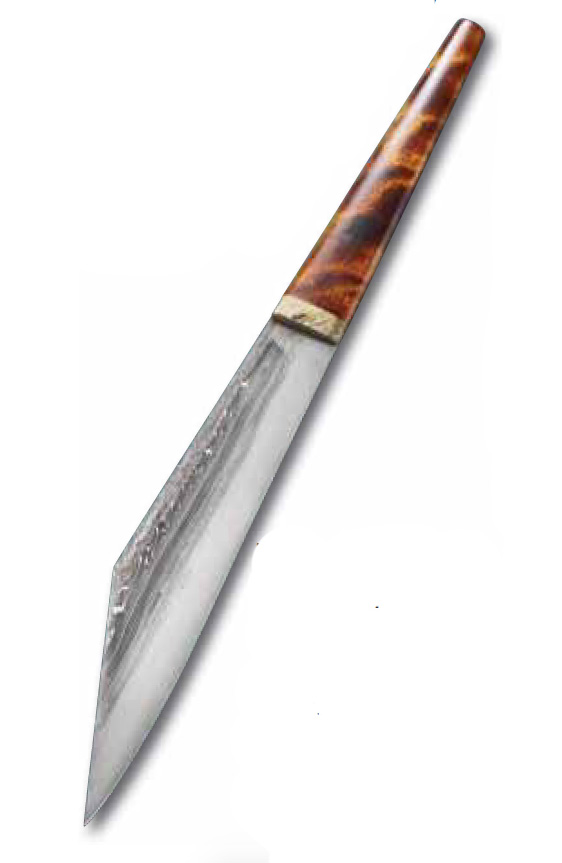
The Broken Back Seax by Aidan Garrity of Iron Lion Blades features a 10-inch damascus blade of 1095 carbon and 15N20 nickel alloy steels, and wrought iron. The handle is maple and the bolster is moose antler. Overall length: 18 inches. (SharpByCoop image)

Blade lengths varied wildly from seven inches on the short end and topping out at 30 inches, the latter Emerson called a short sword, basically.

“The seax needed to be an all-around utility tool that could chop, cut, slice, and sometimes stab, all with equal ease of application,” he said. “A Viking’s livelihood depended on self-sufficiency, resourcefulness, and the quality of his toolkit.”

What is a seax
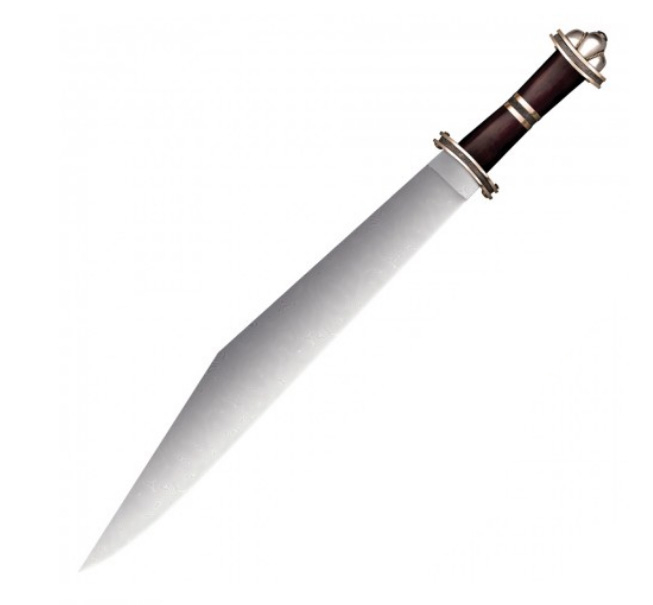
The Cold Steel Damascus Long Sax features a 17.25-inch blade with an edge that curves up toward the tip. MSRP: $635.99. (Cold Steel image)

At first glance, the seax may not seem as exciting as a recurve blade, but looks are not always everything. The beauty of such a blade lies within its ability to tackle cutting chores.

The straight-line cutting edge tackles a variety of tasks easily, and the point of the blade is both precise and powerful, with the ability to score as well as penetrate.

5 Best Seax Knives

The long history of the seax is still going strong today as companies young and old are making new versions of the historic blade.

These five are some of the more unique and exciting seax knives available today.

Terävä Skrama 240

Terävä Skrama 240
Terävä Skrama 240

Direct from the Finnish brand Terävä, the Skrama is a rugged bush knife great for chopping, slicing, and building shelters in the outdoors. The 9.4-inch blade is made from 80CrV2 steel with a 59 HRC. It comes married to a textured rubber handle for easy grip in any weather conditions.

The blade has a full tang and a flat edge but with a twist. It’s sharpened to a 34-degree edge except for the two inches closest to the hilt. That small section is sharpened to a finer 25-degree edge for more meticulous, precise knifework.

The Skrama comes with either a leather sheath or a plastic cover and has an MSRP of $69.99-109.99.

SZCO Supplies Brass-Studded Seax

SZCO Supplies Brass-Studded Seax

SZCO Supplies has made a fun, durable knife with its Brass-Studded Seax. The piece features a 10-inch blade married to a wooden handle. The knife is adorned with brass studs on the handle as well as a brass guard and pommel.

For a budge knife, it does have some weak points. The two main ones are that the leather sheath may need some working in to be at its best, and the knife may need a sharpen out of the box to have a pristine edge. Other than that, this is a good knife for the money.

Strong enough for a log, sharp enough for a piece of chicken, SZCO Supplies has made a  seax that is well priced at an MSRP of just $27.63.

Medieval Collectibles Viking Seax Knife

Medieval Collectibles Viking Seax Knife

This seax from Medieval Collectibles has the look and feel of a knife from the Viking era. It’s made from 5160 tempered carbon steel with a full tang, which is peened over the end of the handle’s metal end cap.

Just over 17 inches in length, and a blade length of 12.1 inches, the Viking Seax comes with a handle that has a wood grain finish and a hand-stitched leather scabbard with a belt hanger.

At just 14.4 ounces in weight this is a utility knife great for everything from chopping through wood and brush to defense and protection. The Viking Seax comes with an MSRP of $169.

Grimfrost Broken Back Seax, Type IV

Grimfrost Broken Back Seax, Type IV with scabbard

From Grimfrost comes a full-tang seax made of 1045 carbon steel. A reproduction of a 1,000-year-old seax found in London, the Broken Back Seax is 16 inches in length with an 11-inch blade.

The handle is handmade ash and the included leather scabbard is hand-stitched. It also features “Grimfrost” stamped in runes on the side of the blade.

Lots of time and care went into making this knife as authentic as it could be and it shows. So whether you want to feel like Leif Eriksson exploring new lands or just want a strong knife while chopping, Grimfrost has you covered.

The Broken Back Seax has an MSRP of $132.

Lunar Light Forge Damascus Sanmai Seax

Lunar Light Forge Damascus Sanmai Seax

This amazing seax is from the husband & wife duo of Nathaniel and Megan Everett at Lunar Light Forge in Akron, Ohio.

The damascus blade is made from 42 layers of 1095 and 15n20 steel around a 5160 core. It is paired with a handle made of Buffalo horn and Cocobolo wood, and it comes with a hand-tooled & hand-stitched leather sheath.

It’s just as much an art piece as it is an excellent utility knife. The 7-inch blade can process an animal, hack off tree limbs, and chop in the kitchen. It does have an MSRP of $722.50, but for the amount of craftsmanship and care that went into the piece, you’ll know you’re getting a knife of the highest quality.

Editor’s Note: Mike Abelson contributed to this piece

Read More

10 Best Kershaw Knives Available Today

There Are Few Factory Makers As Well-Known As Kershaw. The Oregon-Based Company Continues To Innovate And Create Top-Tier Knives.

Kershaw is a beloved knife brand set to celebrate its 50th year in business in 2024. In the years since the company was founded a half-century ago, it has delivered some incredible products that continue to set industry standards today. 

Kershaw has become a staple of the knife industry at large and they represent a significant percentage of what is being regularly carried in pockets all over the country. Pete Kershaw began the company to create excellent outdoor knives and eventually partnered with  Japanese company Kai to bring more high-quality products to market. 

The modern Kershaw knife is a truly high-quality tool, and lucky for us, the company has a dizzying number of options that can fit just about any niche you may have. 

Kershaw’s Top Ten

Kershaw has a large fanbase because the company is incredibly consistent at making quality knives at quality prices. These 10 have stood out as some of the company’s best.

Kershaw Leek

kershaw leek

The Kershaw Leek is arguably the most prominent product that the company has released in recent years. This knife is the epitome of what you would consider being an everyday carry tool: it is light, sleek, and has an extremely reliable mechanism. 

The lines of the product are immediately recognizable and it has achieved iconic status among knife enthusiasts. At the time of this writing, Kershaw offers over a dozen variations of the Leek, and, while the internal mechanism is the same, you get your choice as far as cosmetic features go. Currently, handle materials range from plain aluminum or color-anodized aluminum to exciting options like copper. 

The actual copper handle material will patina over time, giving your individual knife a unique look as you carry and use it. Despite the fact that copper weighs a little bit more than aluminum and this knife costs a bit more than the other products in the Leek line, it isn’t for everyone. The Leek’s mechanism is an assisted-open type, and it is one of the more reliable and energetic on the market. In carrying Leek knives over time, the author has never had a failure to open or to remain closed. 

Leek Knife Specs

Overall Length: 7 inches

Blade Length: 3 inches

Blade Steel: 14C28N

Weight: 3 ounces

Handle Material: 410 Stainless/Copper/Carbon Fiber

MSRP: $99.99-$174.99 depending on materials

Kershaw Skyline

kershaw skyline

The Skyline was one of Kershaw’s most recognizable products. The simple, black-handled knife

was one of the more popular carry options of years past and it earned a reputation for being strong and reliable at a good price. 

There are, of course, other products that now fill its niche, but the Skyline will not soon be forgotten. Its status as a common, affordable, and reliable knife helps it make this list even though it is no longer available. 

Many Kershaw fans have lamented the decision to axe this otherwise popular knife, and it has achieved a moderate collector interest since early 2021 alongside the Shallot and Camber, themselves very well-received by fans of their respective styles.

Skyline Knife Specs

Overall Length: 7.4 inches

Blade Length: 3.1 inches

Blade Steel: 14C28N

Weight: 2.5 ounces

Handle Material: G-10

Kershaw Lucha Carbon Fiber

lucha carbon fiber

At a hefty $500 retail the Lucha in carbon fiber is one of the more unique and interesting offerings currently had by Kershaw. This balisong is arguably one of the highest quality production blades of its type. Even custom options available on the market may not be able to match the Lucha in terms of overall fit and finish at the price. 

For fans of this type of knife, this is certainly a holy grail item, and it boasts some very nice features. The blade rides on KVT ball bearings for exceptionally smooth handling. At a full ounce lighter than the original model, the carbon fiber Lucha features striking handles that are composed of blued titanium and overlaid carbon fiber. 

The price is quite hefty for an EDC knife, though it’s without a doubt worth it to the person who loves flipping and twirling. While the fidget spinner craze ended a few years ago, you’ll probably find yourself playing with this knife in your hand more than you will end up performing cutting tasks with it. 

Lucha Carbon Fiber Specs

Overall Length: 10.25 inches

Blade Length: 4.6 inches

Blade Steel: CPM 20CV

Weight: 4.9 ounces

Handle Material: titanium with Carbon Fiber Overlay

MSRP: $499.99

Kershaw Federalist

federalist

Taking a departure from today’s tactical and overbuilt blades, the Kershaw Federalist is a rugged gentleman’s knife that has a number of interesting and tasteful features. While the company does make a number of traditional styles of gentlemen’s knives, the Federalist is geared for that man of taste that still has to get some work done throughout the day. 

This knife has a more traditional closing and opening mechanism reminiscent of the knives of yesteryear. It has a nail nick for opening and lacks any assist mechanism. In fact, the company lists this blade as a non-locking slipjoint with a dual-detent system. You’ll likely want to save this knife for general tasks and leave the heavy lifting to a more substantial tool. 

In place of polished wood and silver inlay, the Federalist features green Micarta grip panels and a matte finish. Seeing as how assisted opening and larger, tactical-style blades have the majority of market share, it is refreshing to see that Kershaw is still catering to people who view knives as simple, everyday objects.

Federalist Knife Specs

Overall Length: 7.5 inches

Blade Length: 3.25 inches

Blade Material: CPM 154

Weight: 2.1 ounces

Handle Material: Micarta

MSRP: $169.99

Kershaw Launch 14

Launch 14

The Launch 14 is a large, automatic opening, cleaver-bladed knife. This is a hard-use tool that has the looks of a collector’s piece. Not all automatic-opening knives are meant for daily use, but this one breaks the mold and is geared for any task you may find on the job site or in your daily adventures. 

The cleaver blade is not for everyone. Some people prefer to have a distinct drop point while others definitely prefer the more adaptable Wharncliffe style. The knife lacks a true puncturing tip, which to some could be considered a detriment. The steep tip angle on these cleaver-type blades is actually excellent for true cutting tasks where spear point or drop point blades may be too fragile. 

Using a cleaver-style knife for puncturing can be achieved, although the stout angle of the tip may be too coarse for fine work. When it comes to cutting things like straps and heavy tubing, the type of knife we see here definitely excels. The Launch 14 is elegant in its execution and has very functional, subtle features, such as a recessed opening button and carbon fiber panels.

Launch 14 Knife Specs

Overall Length: 7.75 inches

Blade Length: 3.375 inches

Blade Steel: CPM 154

Weight: 3.2 ounces

Handle Material: 6061-T6 Aluminum, Carbon Fiber Scale Front

MSRP: $239.99

Kershaw Reverb XL

Reverb XL

Borrowing the same features as its smaller namesake, the Reverb XL is a daily carry knife that has a wide range of uses for the outdoors. The knife has a long, upswept blade, reminiscent of fillet knives. Because of its size and light weight, it makes an excellent companion for the fisherman who enjoys working out of a canoe or kayak. 

The knife doesn’t take up much space and doesn’t require an additional sheath. Not only that, at under $50, it won’t cause you financial issues if it accidentally falls overboard. The knife is very simple in terms of operation, it is a manually opening blade with a liner lock. 

Although it lacks a fast opening blade, the discerning outdoorsman or angler shouldn’t find this to be an issue, considering that once the blade is out, it is likely going to get used for quite some time. If you find yourself in coastal towns, or perhaps going for a cold one after a fishing trip, this knife will not stand out like a fixed blade will.

Reverb XL Knife Specs

Overall Length: 7.4 inches

Blade Length: 3 inches

Blade Steel: 8Cr13MoV

Weight: 2.2 ounces

Handle Material: G10 with Carbon Fiber Overlay Front

MSRP: $53.99

Kershaw Lonerock RBK2

Lonerock RBK2

Knives with replaceable blades are something that have been around for quite some time. In the last 10 years, we’ve seen a greater interest in this style of knife, if you can even call it a knife in the first place. 

The Lonerock RBK2 is a kit that includes a main, folding handle assembly, and a non-folding ‘buddy’ handle. The ‘buddy’ is simple and non-folding, but takes the same blades as the folding assembly. The basis of this system is meant for hunters as a means to keep sharp blades at the ready with no additional maintenance. 

Keeping a good edge on the blade is no easy task in less than ideal conditions. Many people think that sharpening is as simple as pulling the blade through an off-the-shelf sharpener, but inevitably every knife needs to be professionally re-edged at a certain point. If your blade is replaceable, you shouldn’t have to worry about that latter part of the process. If the knife goes dull, simply pop in a new blade and keep working.

Lonerock RBK2 Knife Specs

Overall Length: 7.2 ounces

Blade Length: 2.8 ounces

Blade Steel: #60A

Weight: 1.4 ounces

Handle Material: Glass-Filled Nylon, Rubber Overlay

MSRP: $59.99

Kershaw Interstellar

Interstellar

At just under $60 retail, the Interstellar is a mean looking knife that has function at its heart. While it appears to be an out-the-front automatic, the Interstellar is instead a manual knife that opens in the same way as a standard box cutter. The blade features a serrated tanto point and has an affordable price to match its rugged looks. 

Kershaw lists this knife under their work knife category, and while it looks tactical, this knife is perfect for the job site. It is easy to use with heavy gloves on, and is excellent for controlled, one-handed operation. The tanto point is excellent for getting into those tight spaces and it is serrated for cutting through various types of cord and material. 

People that work with materials like drywall will enjoy its ability to score easily before cutting. If basic folders and box cutters aren’t your style, you should really consider the Interstellar for your daily use. After a long day, you may want to break open some cold ones, and the Interstellar comes with an integrated bottle opener in its frame. 

Interstellar Knife Specs

Overall Length: 6.9 inches

Blade Length: 2.7 inches

Blade Steel: 8Cr13MoV

Weight: 3.1 ounces

Handle Material: Glass-Filled Nylon

MSRP: $71.99

Kershaw Blur With Glassbreaker

Blur Glassbreaker

The Blur is a rugged and popular design from Kershaw. Not only is it a suitable knife for daily carry, the glass breaker version is a simple-to-use and affordable rescue tool. Similar to Kershaw’s other assisted opening knives, the Blur can open with one hand and is ready to go into action. The glass breaker can be used with blade open or closed. 

Additionally, the particular model we are talking about here also has a deep, swept belly with aggressive, scalloped serrations. This type of situation should make quick work of seatbelts or other types of common materials found in vehicles if someone needs to be removed quickly after an accident. 

This knife features a pointed tip, so unlike other types of rescue tools that are designed to be completely blunt, you will need to take care not to accidentally stabbed or cut someone you were trying to free with this tool.

Blur Knife Specs

Overall Length: 7.9 inches

Blade Length: 3.4 inches

Blade Steel: 14C28N

Weight: 3.9 ounces

Handle Material: 6061-T6 Aluminum, Trac-Tec Inserts

Kershaw/Emerson CQC-10K

CQC-10K

Emerson is well known for producing some exceptional tactical knives. The company needs no introduction here, and luckily, for us, they have collaborated extensively with Kershaw. 

This particular knife, the CQC-10K, is striking to look at with its green scale handles and aggressive, Bowie tip. The knife features the patented Emerson Wave Feature that allows for an otherwise unassisted knife to open instantly upon draw. With practice, this knife can be drawn and opened in a fraction of a second, even faster than can be attained with an assisted opening mechanism. 

This knife is not just for self-defense situations, it is ruggedly built, and should be an excellent friend for the field and trail. Thanks to its fine point, it can also be used for tasks such as fishing or skinning small game.

CQC-10K Knife Specs

Overall Length: 8.5 inches

Blade Length: 3.5 inches

Blade Steel: 8Cr14MoV

Weight: 5.1 ounces

Handle Material: G10 Front, 410 Stainless Steel Back

MSRP: $74.99

Read More

5 Best Pocketknife Options For EDC [2022]

Looking for the best pocketknife for your EDC needs? These five are certainly top options to get you well equipped.

The pocketknife stands alone when it comes to edged tools. Whether it’s outdoors, in the shop, in the kitchen or elsewhere, the number of uses for the pocketknife are seemingly endless.


And just as endless is the variety of pocketknives available today. With dozens of blade types made of dozens of steels with dozens of functions, it’s a deluge of knives that can be hard to parse through. 

Types Of Pocketknives

SOG Recondo FX with serrated edge

While there are thousands of different individual pocketknives out there, the vast majority fall into two categories: the single blade and the multi-blade.

The single-blade pocketknife is exactly that: a knife with one blade. We’ll get to the types of blades shortly. While a single-blade piece could be a small fixed blade with a pocket-sized sheath, usually it’s a folding knife. The folding versions are especially good as EDCs.

The multi-blade knife will usually feature two or three blades—some more—across many different styles. A good chunk of these models are slip joints, which use a spring that helps either keep the blade tucked away or open.

There are many different types of slip-joint multi-blades. The Boker Trapper Red Bone is a prime example of a high-quality multi-blade knife.

When it comes to a multi-tool type of multi-blade, think of Swiss Army knives. These are pocket-sized tools that feature an assortment of tools ranging from blades and screwdrivers to toothpicks, pliers, corkscrews and more.

Types Of Pocketknife Blades

The Microtech Scarab II’s drop-point blade accommodates most cutting tasks with gusto.
The Microtech Scarab II’s modified drop-point blade accommodates most cutting tasks with gusto.

The first pocketknives date as far back as 600 BCE in Europe, and folding knives have been found that date from pre-Roman times.

In the millennia since, the pocketknife has morphed and evolved in myriad ways. Today there are dozens of different types of pocketknives. Some are great for EDC use while others are more specialized. 

While the styles of blades are all a bit different, these are three of the most common types.

Drop Point

A common blade style for a pocketknife, the drop point curves up from the edge to the point. Popularized by BLADE Magazine Cutlery Hall-Of-Fame® member Bob Loveless for fixed-blade hunting knives, it is a great style for hunters and for slicing, and ideal for all-around EDC as well. The point is good for piercing and the edge, being good for hunting, is more than capable of doing things throughout your day like opening envelopes, slicing rope, or even cutting vegetables in a pinch. The GiantMouse Ace Corta is an example of a modified drop point.

Clip Point

The clip point swoops down from the spine to the point of blade. Since it looks like the forward part of the blade was “clipped” off, the name clip point stuck. The spine is usually unsharpened, and the clip point has a narrower tip than a drop point. The clip point is seen on many bowie knives.

An example of a clip point on an EDC knife would be the SOG Recondo FX.

Spear Point

The spear point is the style of the main blade of many Swiss Army knives. A great puncture instrument, a blade with a spear point is ideal for penetration. Many daggers and swords are ground to a spear point. 

Five Premier Pocketknives

We scoured the world of knives to pick out five of outstanding pocketknives available today. Across different styles, companies and price points, these five stood out from the pack. 

Swiss Army Knife Huntsman

Swiss Army Knife Huntsman

One could argue that the Swiss Army knife is the gold standard of pocketknives. This classic multi-blade from Victorinox has stood the test of time and now comes in dozens of varieties.

The Huntsman was selected because of its tool set. There are 15 different implements within the knife, including classics like the spear-point blade, reamer and can opener, as well as a wood saw, tweezers, scissors and wire stripper, among others.

All the tools, like with other Swiss Army knives, are made from stainless steel. Having at least one SAK in your tool drawer or travel bag is an absolute must, and you can’t go wrong with the Huntsman.

MSRP: $37.99

Opinel #8 Carbon Steel Folding Knife

Opinel #8 Carbon Steel Folding Knife

By any measure, the Opinel #8 is a classic. First made in 1890, the #8 is still popular today due to its simplicity. It features a 3.28-inch blade of XC90 carbon steel. It’s robust yet delicate. The single blade is fine enough for an artisan or craftsman and tough enough to handle hard use in the kitchen or workshop.

In an era when EDC knives are becoming more complex and packed with features, Opinel sticks to its roots with a piece that is often imitated but rarely replicated.

MSRP: $18.

Benchmade Bugout

Benchmade Bugout
Benchmade Bugout

Coming in numerous different colors and styles, the Benchmade Bugout is one cool-looking pocketknife. Slim and ergonomic, and incredibly light, the Bugout knives were designed for the outdoorsman but are great for EDC too.

The clipped drop-point blade—you can choose between a plain or serrated edge—is made from CPM S30V stainless steel with a Rockwell hardness of 58-60 HRC. It’s 3.24 inches long with a satin finish that looks good when paired with any of the five different types of handles Benchmade offers.

Handle materials—options include Grivory or CF Elite—are lightweight. The entire knife weighs just 1.85 ounces. It’s almost lighter than air.

MSRP: $160.

Boker Damascus Duke

Boker Damascus Duke
Boker Damascus Duke

If you’re looking for a showpiece that’s also a great utility knife AND won’t break the bank, Boker has you covered. The Damascus Duke features a 2.44-inch blade forged from 37 layers of steel. The artistic qualities don’t stop with the blade. Etched bolsters add to the beauty of the knife, and the root wood scales provide a classy grip.

But this knife is more than just a pretty girl at the prom. The lockback mechanism will give you confidence to put this piece through its paces. The short length of the blade makes this knife great for detail work or other finite tasks at home or on the road.

MSRP: $64.95.

Kershaw Blur

Kershaw Blur
Kershaw Blur

Designed by Ken Onion, the youngest-ever inductee into the Cutlery Hall of Fame, the Kershaw Blur may be as good of an all-around edged tool as you’ll find in knife shops today.

The recurve drop-point blade can cut cord and small brush while camping, or slice open an over-taped FedEx package and keep rolling along.

The blade is 14C28N stainless steel in a black Cerakote coat for enhanced corrosion resistance and protection. It’s married to an aluminum handle that features Trac-Tec inserts and a reversible pocket clip.

Made in America and tough as nails, the Blur won’t let you down.

MSRP: $107.99

Read More

What To Look For In The Best Santoku Knife: Buyer’s Guide (2023)

A kitchen do-all, the Santoku is a must-have for foodie pros and novices alike. Here’s what to look for to get the best, plus our top picks.

Santoku knives are becoming increasingly popular in the West, especially among foodies, passionate home chefs, and anyone who brings a knife roll to work in a kitchen. If you’ve been dying to learn more about this great Japanese knife, you’re in luck.

We’re going to go over everything you need to know about the Santoku, from its origins and design, to how to buy and use one in your own kitchen. We’re also going to go over the top Santoku knives on the market right now, in case you’re looking to pick one up for yourself (or as a gift).

Origin of the Santoku

Traditionally, in Japanese cooking, knives have different roles based on what you’re preparing, more than how it’s being prepared. Around 100 years ago, you would commonly see a Gyuto (basically what Westerners call a chef’s knife) used to cut beef, pork, and chicken, a Nakiri to cut vegetables, and a Deba to cut fish.

Each of these is designed for its specific task, and so they are specialized. Of course, they can be used differently, but the idea is to have a knife for every task, rather than a knife for any task.

Around the 1940s, as steel started to come at a bit of a premium due to some noted historical world conflicts, the desire for multi-purpose kitchen cutlery rose, and out of that desire came the Santoku, or “three virtues” knife.

The purpose of the Santoku, also translated as “three uses”, was to be able to handle most food prep duties with just one knife. To that end, it is designed to be able to handle chopping, slicing, and cutting tasks, which is another interpretation of the meaning of the name.

Santoku Design

A Santoku typically uses a sheep’s foot blade and tip, which gives you a long, relatively flat blade edge and a tip that sweeps back up in a large radius towards the spine.

Santoku on cutting board
A mid-range Santoku from my personal kitchen.

Edge

Most are between 5 and 7 inches and have an edge with a very Western-style bilaterally cutting edge with a 12 to 15-degree shoulder. Many Japanese knives are ground to a chisel edge, which is only sharpened on one side, but a classic Santoku has a more familiar Western-style edge geometry.

This does mean that, for those of us in the West, sharpening isn’t too much different than with any other kitchen knife, just with a different angle. It also means that Santokus are typically made of very hard steel to prevent damage to that thin wedge.

This makes them an absolute dream for slicing and chopping tasks. If you’ve ever wanted to reliably get those paper-thin tomato slices, you’ll have every advantage with a Santoku.

Handle

Most Santokus have no bolster, which may also take a bit of getting used to depending on your grip. However, many have a handle that tapers down towards the blade, making it very comfortable for the classic pinch grip most of us home cooks are probably used to.

Granton Edge

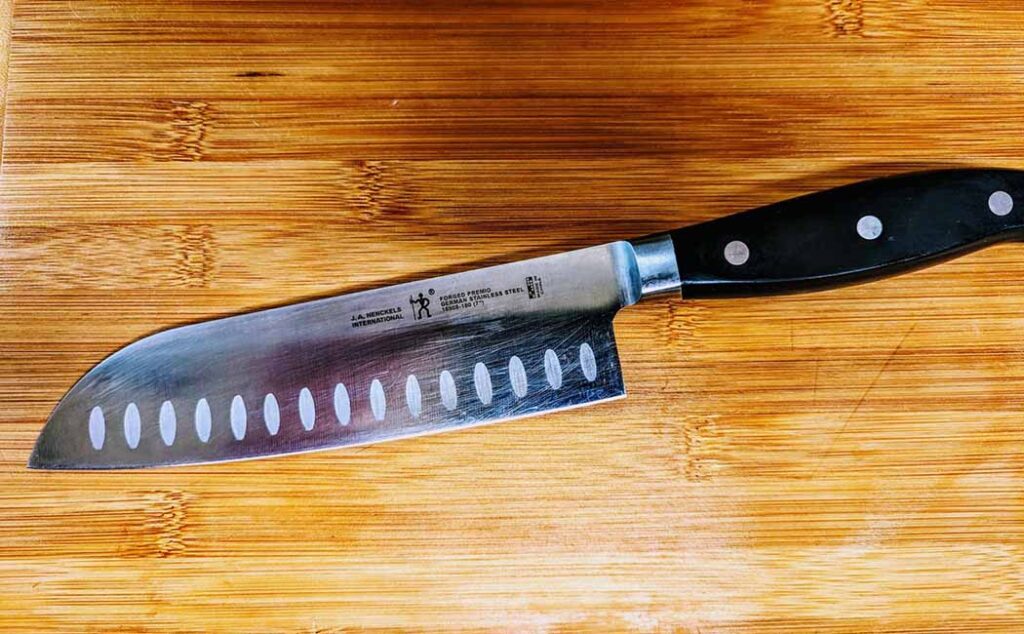
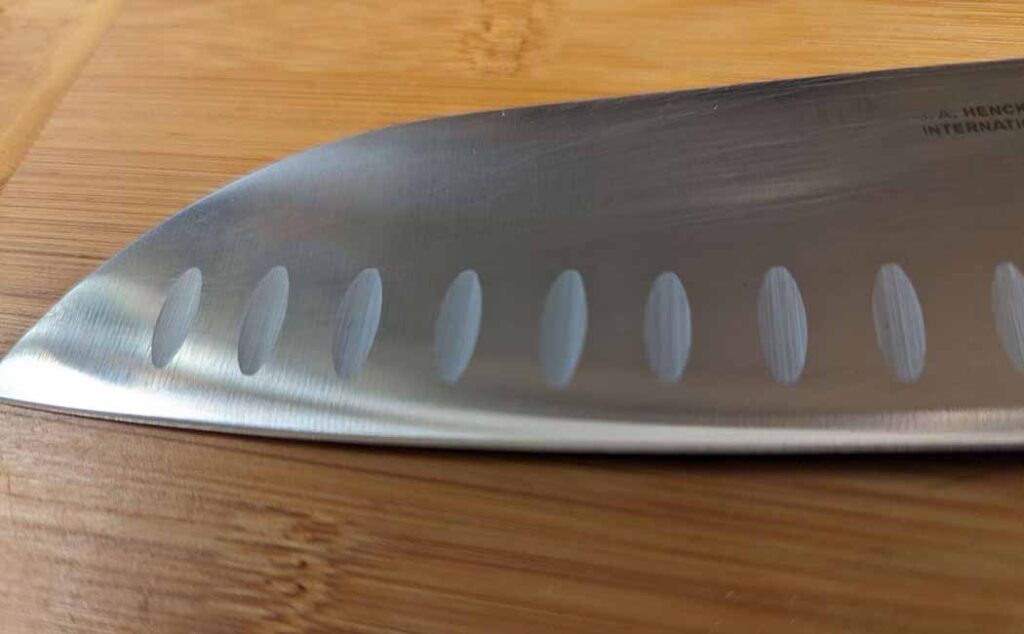
Lastly, many Santokus feature a “Granton edge”, which you can recognize by the slightly scalloped sides of the blade that look like someone took an ice cream scoop to the steel and removed little bits of the blade.

These little scallops help sticky, wet foods like meats and certain vegetables from sticking to the side of the blade as you’re chopping. If you’ve ever tried to slice tomatoes quickly or dice something like a chicken thigh, you’ll know how helpful this feature can be.

What To Look For In A Santoku

Here’s a fun fact I don’t get to bring up in my writing career a lot: I’ve worked as a chef in kitchens all over the South for a good portion of my 30ish years on this planet. In that time I’ve held a lot of knives.

Cooking may not be my main gig anymore, but it is something I’m still passionate about. I cook most meals for my family, and I still help out with the occasional catering gig when my chef friends need an extra hand.

All of which is to say, I’ve got some battle-tested, dinner-rush-proven opinions about what to look for in a kitchen knife, and we’re going to apply those to our Santoku shopping.

Blade Length

While Santokus come in a range of lengths, for your first one I definitely recommend sticking to a 5 to 7-inch blade. This is a good range for all the common tasks you’d likely want a Santoku for and makes for a very handy blade.

This gives you a blade that’s most likely shorter than your standard Western-style chef’s knife (or Gyuto), but still more than sufficient for chopping large, hearty vegetables when needed. It’s also not too big to quickly filet a fish, or other delicate tasks.

Steel

Blade steel is an important consideration with any knife, but especially the Santoku. As we discussed above, a Santoku has a very thin edge and narrow blade geometry.

While the thin edge gives you immense slicing and chopping performance when we’re dealing with vegetables, it’s potentially a liability. Specifically, the edge is more prone to rolling if you’re doing something like hacking through a chicken carcass.

To protect against such occurrences, a typical Santoku—and Japanese knives in general—are treated to a higher hardness than Western-style knives. Japanese knives like the Santoku are also typically high-carbon steel.

Practically, this means that you’ll have to put in more work to sharpen a high-quality Santoku than a Western-style knife. On the flip side, the edge will likely last you a good bit longer. This makes the Santoku a good everyday kitchen knife, especially if you don’t love sharpening.

Stay away from stainless steel, unless you’re really on a budget and want to try the Santoku out on the cheap before committing to a more expensive model. (We’ll have some very good budget-friendly options below if you want to go that route.)

Stick to a high-carbon steel of Japanese or German origin if possible, and look for something with a Rockwell hardness of 57 or higher at a minimum. I like 60 plus but that starts to get expensive quickly.

When in doubt, when it comes to any kitchen knife really, buy from one of the countries that lost WWII and you’ll probably do alright (I have similar opinions about cars).

Blade Height

Blade length and width are familiar decision points when buying a knife, but for something like a Santoku blade height (the distance from the blade edge to the spine) is also important.

Because these knives are designed for slicing and chopping against a cutting board, you want to make sure the blade is tall enough to keep your knuckles comfortably off the cutting board when using the knife.

This tall blade also makes it easier to create nice, even slices. The edge is less likely to wander to the left or right as you slice, and you have a nice large flat surface to index whatever you’re cutting against as you’re slicing.

A Note on Scalloped Edges, or Granton Edge

You will probably notice in your Santoku shopping many of these knives, and Japanese knives in general, tend to have a Granton edge. You’ll see dimples on the side of the blade.

Granton edge on Santoku
The dimples on my personal general-use Santoku.

The idea behind these dimples is to relieve the suction effect when slicing through thick vegetables or meats and keep things from sticking to the blade. How much does that help? I’ll be honest, I don’t know.

A lot of it depends on the geometry of the dimples, what exactly you’re cutting through, and its moisture content. In other words, you may not see a huge difference, so don’t get too hung up on the dimples.

Done right, they can definitely help though, so don’t completely discount them either.

Using a Santoku

Actually using a Santoku is a bit different from a Western-style chef’s knife, but don’t let that keep you from buying one!

With a Santoku, the chief difference from the knives you’re probably used to for general food prep is the thickness and the angle of the cutting edge.

A Santoku has an edge that is ground to a much more extreme angle than most Western-style knives, and the edge of the blade is fairly linear compared to your average chef’s knife here in the US or Europe.

Why does that matter?

Where a knife with a pronounced belly, like a Western-style chef knife, will slice downward and then you rock the blade forward just a bit to complete your cut. With a Santoku, the motion is more of a flat downward chop, with very little rocking.

I promise, it’s not actually all that different in practice, but you will have to adjust a little bit when you’re first learning to use the knife.

The other thing to keep in mind is that a Santoku is more prone to chipping if you really hammer it into something hard like bone. This is not what you should be using to hack through carcass joints. Use a cleaver for that and leave the Santoku for slicing and cutting meats, fruits, and vegetables.

Santoku vs Western-style Chef’s Knives

The Santoku is a multi-purpose knife with a similar role to the Western-style knives you’re probably familiar with, but with a very different design.

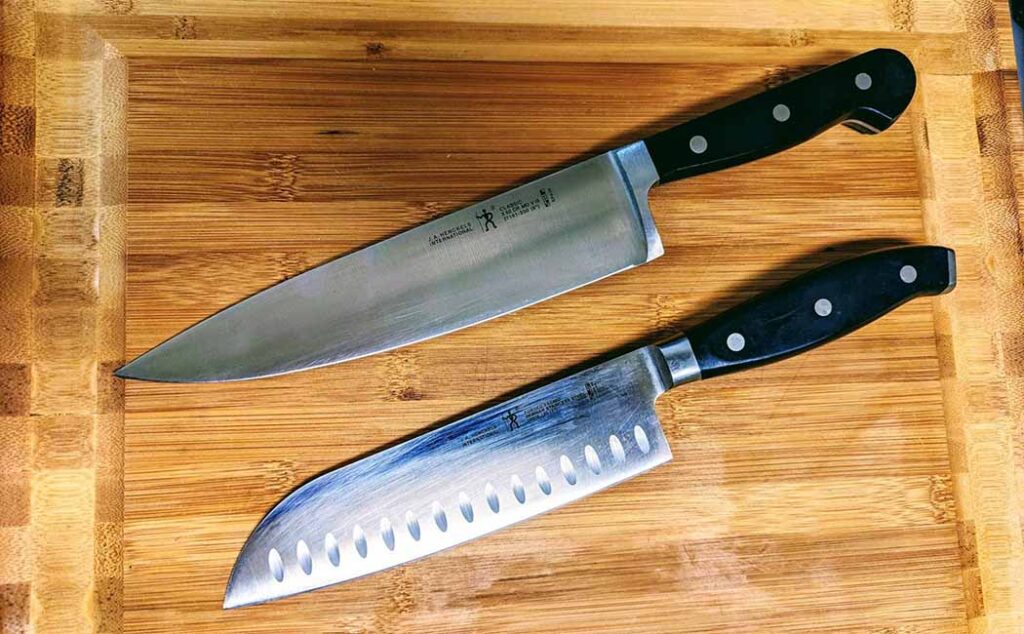
Santoku vs chef's knife

Compared to a Western chef knife, it is typically shorter, thinner, and consequently lighter. The lack of a pronounced “belly” to the edge also means you will have to adjust your technique if you’re used to cutting with a Western-style chef

A Western-style knife, or Gyuto, is going to have an easier time with fine tip work, and will typically have more of a “belly” to the blade to make it easier to rock back and forth on a cutting board.

In my kitchen, I have both and use them regularly. Like most cooks, I find that a Santoku excels in slicing tasks, particularly if you’re trying to get thin, even slices. If you’re caramelizing onions, slicing tomatoes for a BLT, or dicing up chicken into bite-sized pieces, a Santoku is excellent.

If you’re doing something that requires more of a rough chop, such as dealing with a large number of fresh herbs, a Western-style chef’s knife is probably going to be a better option as you can simply rock the knife back and forth through the herbs and be good to go.

A Western-style knife is also much better for preparing heavier proteins, such as breaking down a chicken carcass or carving up a roast. For one, the blade is longer which makes long drag cuts and slices through thick pieces of meat much easier.

The edge profile of the chef’s knife also handles hacking through bones whereas you’re basically asking to chip or roll your edge if you do that with a Santoku.

For things like fish where you’re typically working with much smaller portions, and you have lighter, thinner bones to deal with, a Santoku excels. Its shorter length is a boon instead of a hindrance here, and the thin edge and blade profile keeps those thin slices of fish from sticking.

As a general rule, for something like fish, garlic, or very wet vegetables and fruits that like to stick to your knife, a Santoku is better. For heavier tasks that require a beefier edge, or a longer cutting surface, your Western-style knife is better.

The type of work you’re doing also matters, with a Santoku being much better for a straight up-and-down chop or slice, and a Western-style knife being better for a rocking slice.

Best Santoku Knives for Any Budget

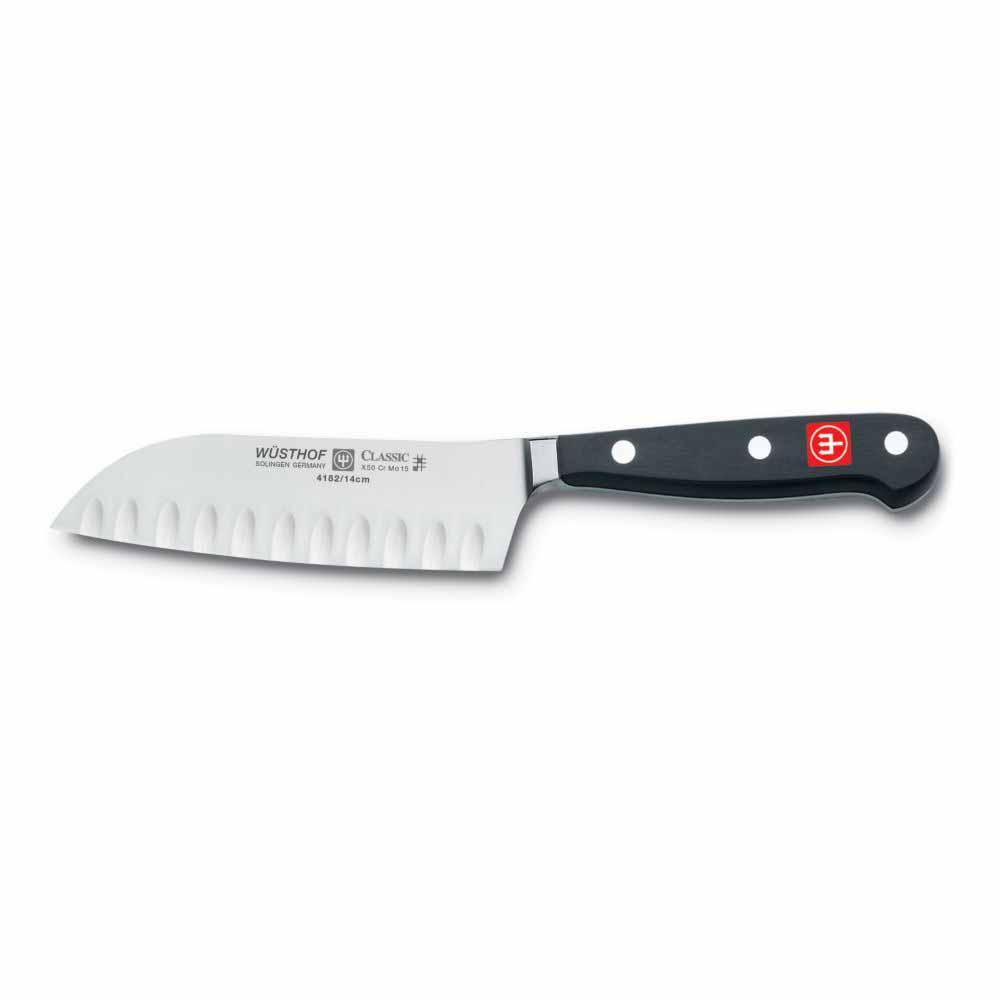
Wusthof Classic Hollow Edge Santoku Knife

Wusthof Classic Hollow Edge Santoku Knife

First up, we have a favorite of professional kitchens, the Wusthof Classic series Santoku. Wusthof, as you can probably tell from the name, is a German company, and they’re known for making outstanding cutlery. This Santoku is no exception.

This is getting into the upper end of the Santoku market (there will be cheaper options below, never fear) but it is still an excellent value if you’re looking for a durable, well-designed option that’s going to see some heavy use.

I’ve personally used this knife for years, and have one in my personal kitchen at home. In my experience, this is the best-slicing knife out there for vegetables and fish, and I use mine several times a week.

It has a 5-inch hollow-edge blade made of X50CRMOV15 high-carbon stainless steel, making it perfect for home cooks and pros alike.

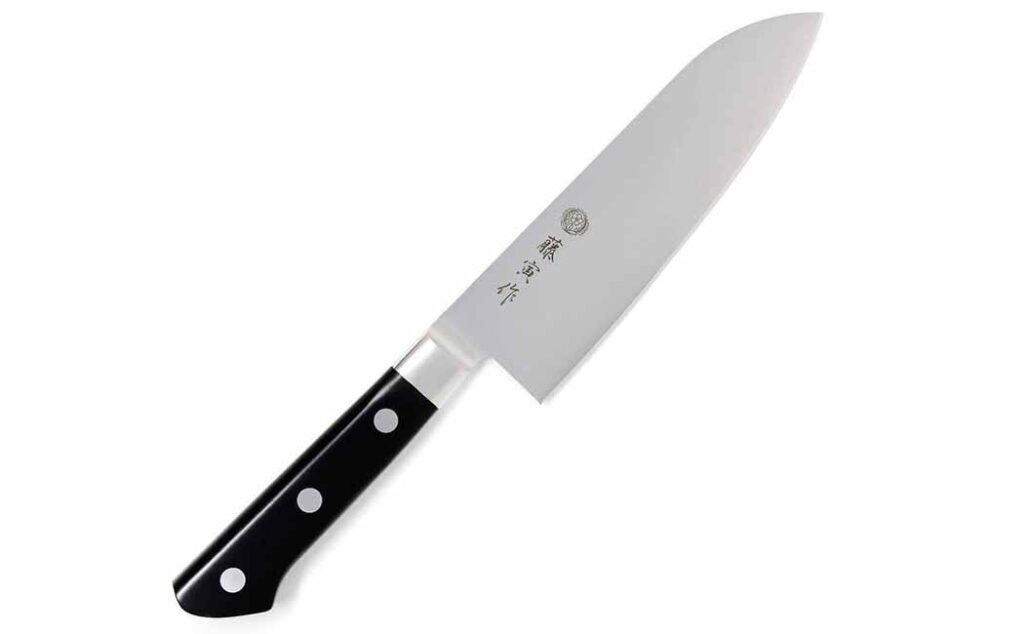
Tojiro 6.7-Inch Santoku

Tojiro 6.7-Inch Santoku

If the thought of paying more than $100 for a kitchen knife makes you a little itchy in the wallet area, don’t worry. Tojiro has you covered.

This Santoku is a bit on the longer side, making it a great choice for almost any kitchen task. I’ve personally used these knives for a number of years now, and I find them to be a bit chunky, but then I’ve got short sausage fingers. Your results may vary.

Even with my diminutive digits though, this knife absolutely sails through fish, chicken, and other light proteins, and slices fruit and veg like a dream. It has a bolster, and an evenly ground edge so it’s perfect for those used to more Western-style knives.

This knife has a 6.7-inch blade made of cobalt alloy steel clad in VG10, which is high-end Japanese steel with high chromium content. This makes it a great budget option for those who don’t want to spend a lot of time sharpening.

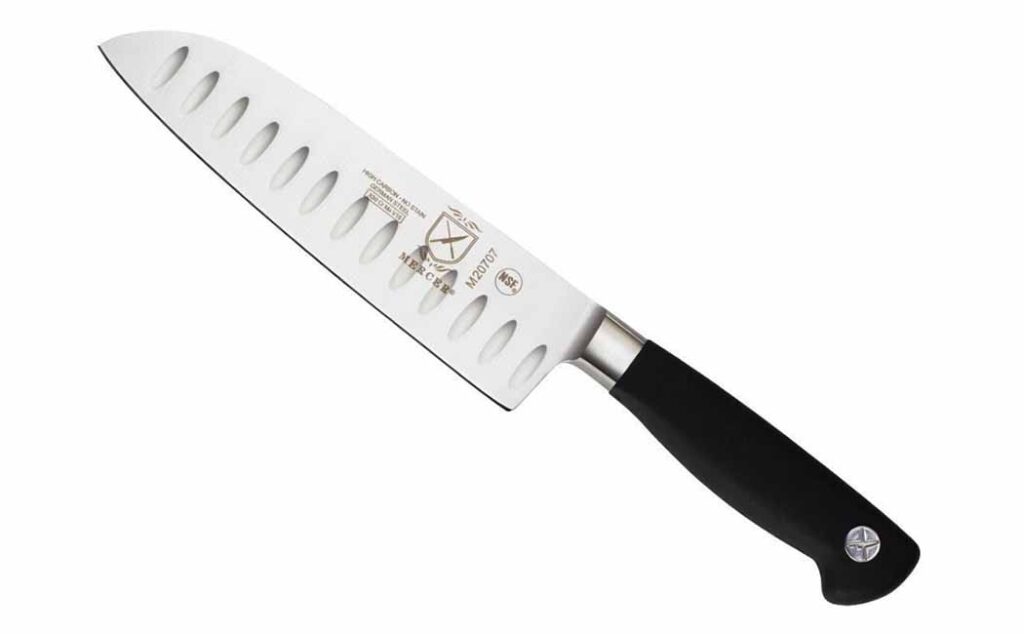
Mercer Culinary Genesis Forged Santoku Knife

Mercer Culinary Genesis Forged Santoku Knife

For the even more budget conscious, the Mercer Culinary Genesis Forged series is a great place to start. Yes, you can absolutely get an entire knife block for $40, but they’re going to be less than stellar.

You don’t need to spend a fortune on cooking gear, but there are some places where you definitely get what you pay for. With this knife from Mercer Culinary, you’re getting a solid knife that will last for years, without breaking the bank. This is about as cheap as I’d go, personally, but it’s no less effective for that.

The Genesis Forged Santoku has a 7-inch blade made of X50CRMOV15 high-carbon stainless.

MAC Professional Santoku Knife

This is another staple of professional kitchens and a great option for passionate home cooks, as well. MAC’s Professional line is a great option for foodies and pros, and their Santoku is no exception.

I actually think I like the handle on this knife the most of any on this list, but that’s down mostly to personal preference. The blade has a 15-degree edge that slices like a dream. The high-carbon alloy is sub-zero tempered to increase hardness and wear resistance.

The handle is made of a very lightweight wood laminate that is very tough and grippy in the hand. The blade is 6.5 inches long and is made from MAC’s Sub-Zero alloy steel.

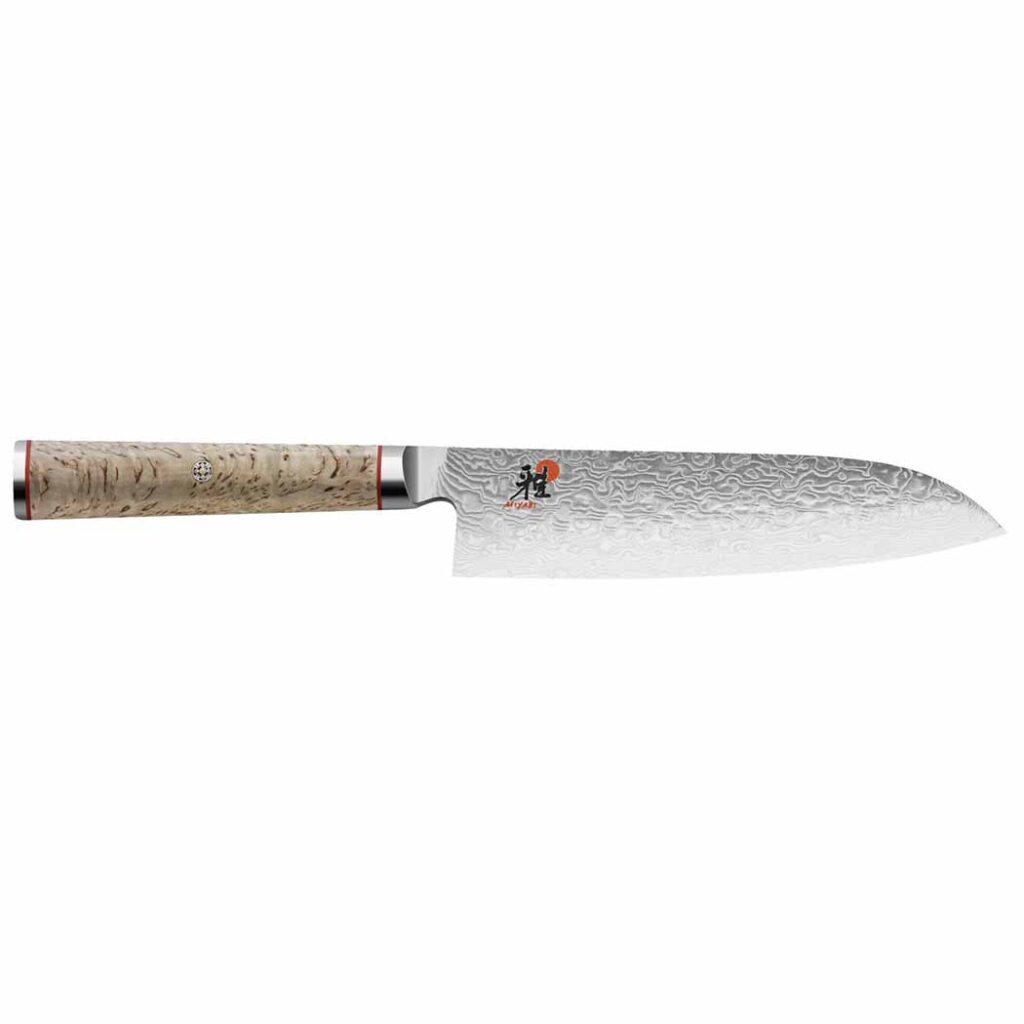
Miyabi Birchwood Santoku

Miyabi Birchwood Santoku

If you’re looking for something that really reflects the Japanese heritage of the Santoku, a knife that has an aesthetic as nice as its cutting performance, this Santoku from Miyabi’s Birchwood line is a great option.

With a blade made from powdered high-carbon steel that’s been folded over a hundred times and a handle made of a beautiful Karelian birch (the only wood to ever be used in a Fabergé egg), this knife is a serious showpiece that you’ll want on display somewhere.

It also cuts like Wolverine’s claws.

Seriously, if you want a beautiful gift to give that special chef in your life, or you just want a super high-end knife that looks great and slices even better, this is a great option.

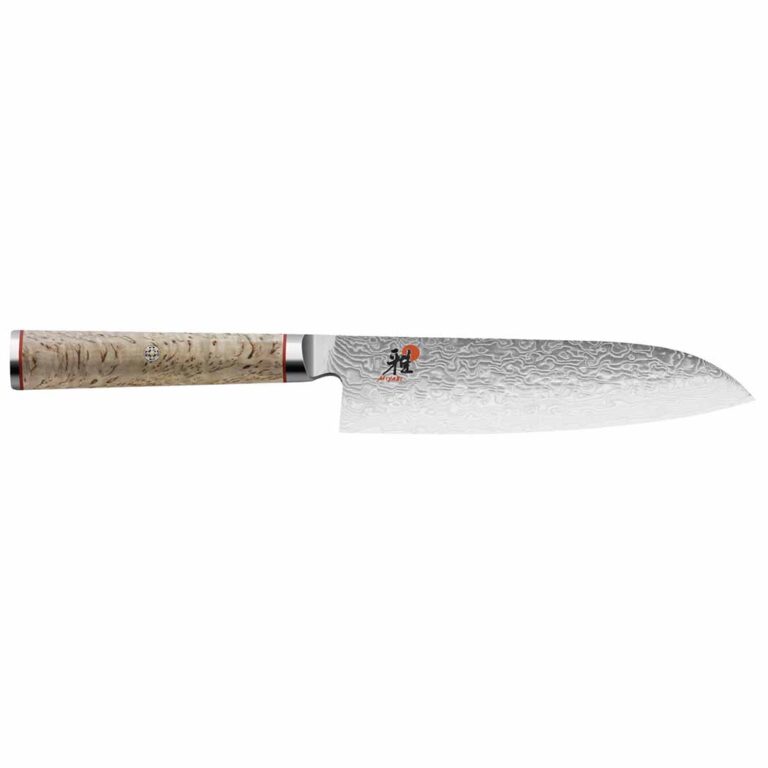
The Miyabi Birchwood Santoku has a 7-inch hand-honed blade made of G2 micro-carbide powdered steel in a folded, flower pattern Damascus.

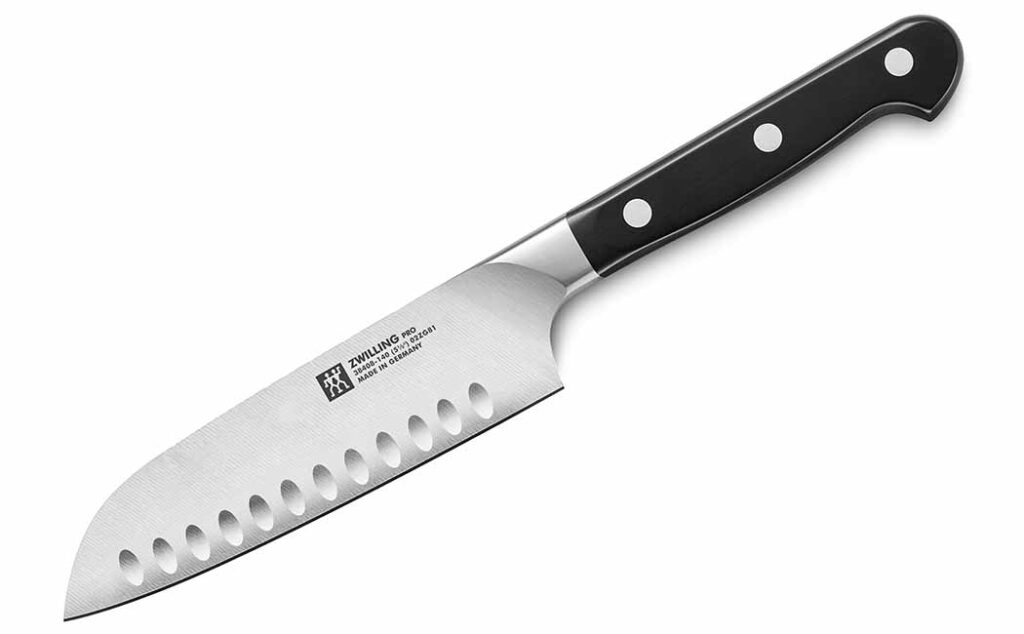
J.A. Henckels Zwilling Hollow Edge Santoku Knife at Amazon

Zwilling Best Santoku Profile

Our last two knives are from the same manufacturer, J.A. Henckels, possibly the biggest name in kitchen knives (with good reason).

The Zwilling Signature series is one of its higher-end options, featuring a hollow-ground edge and a very comfortable handle with a very minimal bolster. This is a good cross between a traditional Santoku handle and a more modern Santoku handle design.

The 7-inch blade is made of an ice-hardened (Friodur) steel that is proprietary to J.A. Henckels that lasts for a very, very long time in between sharpenings. For a bonus, you can get it custom-engraved for basically nothing since J.A. Henckels does everything in-house.

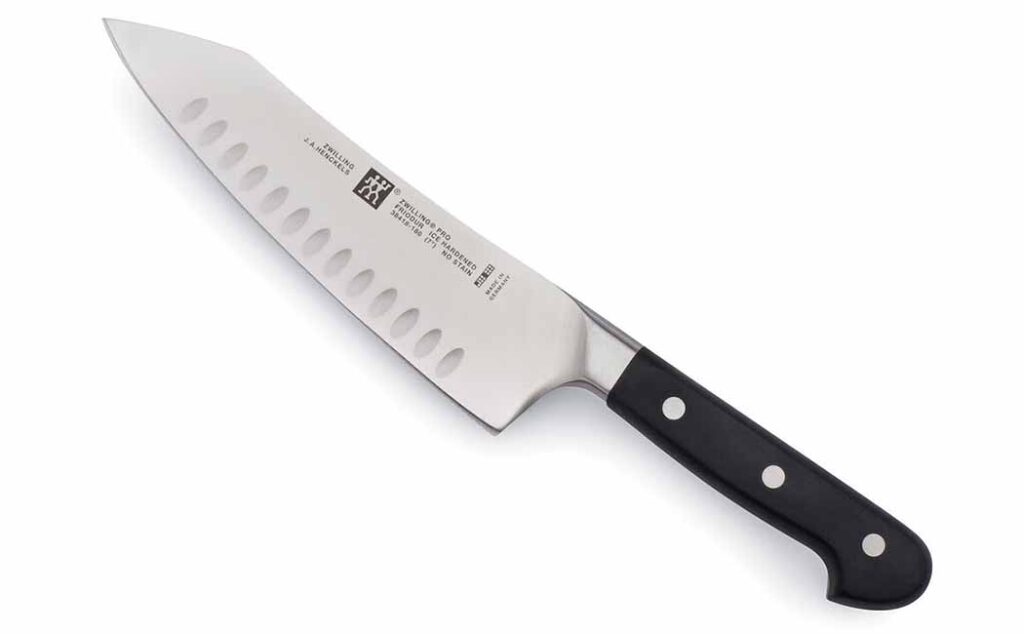
J.A. Henckels Zwilling Pro 7 Hollow Edge Rocking Santoku Knife

Zwilling Santoku

Lastly, we have a very similar knife to the one above, but with a more Western-style edge profile geared more towards the familiar rocking motion most of us know already. It still has a relatively flat edge, so you do get all of that Santoku performance, but with a little more versatility when it comes to a rocking chop.

Like the model above, it features a very comfortable handle, but the Pro series features a more pronounced, Western-style bolster, ideal for the pinch grip that we use here in the West.

It has a 7-inch blade made of proprietary high-carbon SIGMAFORGE steel (I don’t know what SIGMAFORGE means either, you’ll have to ask Henckels about it).

Learn More About Culinary Knives:

Advertisement

Must Read Articles

Read this before you make a knife

Knifemaking 101 – Read This Before You Make a Knife

  by Wayne Goddard My experience has taught me that there's nothing like digging in and getting started. I've often said the hardest part of the...
how to forge damascus steel

How to Forge Damascus

Advertisement
Advertisement