Buyer's Guides

You’re looking for a new knife in a certain style – we’ve got recommendations on the best blades for every price point.

Tactical And Switchblade Combs That Keep You Looking Cool

A Switchblade Comb Is A Fun Take On The Knife Design. Unlike The Knife, The Switchblade Comb Can Be Taken On A Plane.

The switchblade looks cool. The blade firing out at speed and satisfyingly clicking into place is one of the great joys of the knife world. However, many legal codes of countries around the world don’t look fondly on the fast-moving blade. But that cool factor has endured and can be seen in switchblade combs. And they have the added benefit of being far, far cheaper than even the lowest-quality stiletto.

Switchblade combs?

Yes. It’s a comb that deploys like a switchblade. Maybe you’re looking for a comb with a burst of excitement, or a comb that isn’t made of cheap, flimsy plastic. Or maybe you’re a Jet or a Shark that needs to look good for their next rumble.

No matter what the reason, the switchblade comb is a fun little tool to have. This knife… I mean comb shows what the switchblade comb is all about.

Etrading Italian-Style Automatic Comb

Etrading Italian-Style Automatic Comb

This comb is a perfect example of what a switchblade comb can be. The handle is made from pearl-toned polymer, and the blade is made from 440 stainless steel that’s built to last. At nine inches in length, with a five-inch handle, the comb sits well in the hand and feels good to use.

The stainless bolsters help take the look to the next level, and it all comes together thanks to the push-button deployment that sends the comb out in a blink. Additionally, there is a trigger lock-out that prevents the comb from opening in your pocket or bag.

This is a fun piece that you can show off to friends and keep your hair well-coiffed too.

MSRP: $10.50

Tops Knives Tac-Rake

Tops Knives Tac-Rake

For something a bit more robust there is the Tac-Rake from TOPS Knives. This beard comb is of the fixed-blade variety (yes, not a switchblade but it’s so good) that’s made from black traction-coated steel meted to a tan canvas micarta handle.

It’s only 5.88 inches in total length so it’s probably not the best comb for a full head of hair, but it is specially made for a beard and will keep your facial hair looking clean and sharp. The fact that you’ll feel like a champ while using it is just an added bonus.

The included leather sheath makes traveling with the comb easy and stress-free.

MSRP: $105

Microtech UTX-85

Microtech UTX-85

This OTF comb is the Cadillac of combs. The blade is stainless, and the handle is anodized aluminum. It’s luxurious to use, and the dual-action mechanism deploys and retracts the knife in the blink of an eye.

The teeth are nice and fine so it’ll brush your hair and your beard with ease. Adding to the tactical nature of the comb, the glass breaker at the butt of the piece is a handy tool to have on your person. And, since this isn’t a proper sharpened knife, you can take this with you wherever you go from a baseball game to a restaurant and even on a plane.

MSRP: $340

BeardAir Tactical Beard Comb

BeardAir Tactical Beard Comb

For a tactical combing experience, there is this sleek comb from BeardAir. With a blade made from 17-4PH steel, and a handle made from aviation aluminum. It’s light and strong, and the automatic open/close function deploys the comb with speed and style.

Unlike the other combs on this list, the Tactical Beard Comb comes in all sorts of different colors so you can find the one that fits your aesthetic the best whether it’s a more traditional black knife with red accents or something more wild like the olive green and pink one above. 

MSRP: $59.99

Read More

You Ought To Auto

This Quartet Of Automatic Knives Open In A Flash And Run The Gamut When It Comes To Their Versatility

Automatics fascinate many knife fans and non-knife fans alike.  Deploying the blade rapidly regardless of the situation is very important. There’s no fumbling around for the thumb stud, thumb disc, or blade hole—press the button and you’re ready to rock and roll. 

Pro-Tech Terzuola ATCF Folder

Pro-Tech Terzuola ATCF
The Pro-Tech Terzuola ATCF marries a tough working blade with an ergonomic handle design and an integral guard. 

Pro-Tech won a record-tying three BLADE Magazine Knife-Of-The-Year® awards at BLADE Show 2022 (September BLADE®, page 12), one of them Knife Collaboration Of The Year with Bob Terzuola for the Pro-Tech Terzuola ATCF Folder. The ATCF—short for Advanced Technology Combat Folder—is Bob T’s signature custom design and has been around for many years.

The 3.5-inch drop-point blade offers a high degree of utility. The handle features an integral guard and an ergonomic gripping area that is both comfortable and secure and works in conjunction with the blade spine thumb ramp. The blade material is CPM MagnaCut, a relatively new stainless steel that reportedly has the best edge holding of all high-performance blade steels.

The knife has an aluminum frame with an integral bolster, various handle material options such as G-10, Micarta®, and carbon fiber, and hardwoods like ironwood and maple burl. The push button inlay matches the handle material. Each knife comes with a distinctive, milled titanium pocket clip designed by Bob T. It screws to the handle from the inside for a clean, no-screw appearance. The downside is in the unlikely event you break the clip, you will have to return the knife for repair since it requires disassembly to get to the screws.

For this article, I selected Pro-Tech’s tuxedo configuration of the Terzuola ATCF. The handle consists of a black bolster with ivory paper Micarta. The firing button has an inlay of ivory Micarta to match.

Don’t let the upscale appearance fool you—the Pro-Tech ATCF can get dirty. The blade cuts easily and has the right amount of belly to facilitate slicing. The swedge on the spine enables the tip to penetrate and provides a slightly aggressive look. The handle has an integral forward guard. Along with the blade spine thumb ramp, it allows you to choke up for extra control.

MSRPs vary depending on handle material. All-aluminum-frame models are around $600, and the custom shop 416 stainless steel handle ones go for four figures.

“Bob and his wife Suz have been an absolute pleasure to work with,” noted Dave Wattenberg, Pro-Tech founder and president.  “I’m forever grateful that he shared not only his iconic design with us, but took the time to share his love for knifemaking with my entire team here, and gifted each of us with a signed copy of his book.”

Microtech Brachial

Microtech Brachial
The Brachial is very effective as a slicer due to the blade shape. Food processing made easy! (Dexter Ewing image) 

Designed in conjunction with Bastien Coves, aka Bastinelli Knives, the Brachial by Microtech is an exciting mix of tactical ferocity and sex appeal.

 “Bastien is extremely talented,” observed Tony Marfione, Microtech co-founder and president. “His designs are not only works of art but are original and purpose-driven.” Marfione and Coves have been good friends for a long time, which is extremely important when it comes to collaborating on a knife design.

Boasting a heavy Persian influence, the Brachial’s 3.25-inch blade is premium M390 stainless steel for enhanced edge holding. The handle is machined T6-6061 aluminum for strength and minimal weight. Pockets machined inside the handle further reduce weight, making the Brachial a pleasure to carry and use. 

A rugged steel pocket clip totes the closed knife blade tip up and right-handed. A frag pattern machined in the surface of the handle’s left side enhances grip traction, and there’s a small patch of frag on the clip side, too. The steel spacer adds strength to the handle, which has an integral lanyard hole.

Once you grip the handle, it’s quite evident the Brachial’s curves are not merely for show. The curvature seated the handle inside my hand as if it were made for it. The curved blade slices with great effectiveness. The flow of the blade from the handle enhances a sweeping cutting motion, with the edge presenting itself prominently to the target.

Microtech bills the Brachial at home hunting and outdoors equally as it is tactical. The upswept blade serves well at field dressing/processing game and food prep. The flat grind permits the blade to sail through media and presents a very aerodynamic profile.

I like the Brachial’s action. Once you press the button, the blade rockets out of the handle to the open and locked position, so hold on tight! I appreciate the shape of the firing button. Most companies use a round one and that works just fine, but a non-round shape is rarely seen. Microtech does this type of button on the Stitch auto as well. Once the blade locks open it is locked for sure. There’s no play in any direction, so the knife can be used with confidence.

The pocket clip carries the Brachial comfortably, and the curved grip allows the closed knife to sit in the pocket perfectly. Hence, as large as the folder is, you barely know it’s with you. While the size may not be ideal for EDC for a lot of folks, take comfort knowing that in case you do EDC it, the knife carries like a smaller folder. The clip is also heavy-duty—you’re not going to snag this one on obstacles or break it.

The Brachial sliced fruit and vegetables well. Outside the kitchen, it made very quick work of cutting cardboard boxes. I even took it into the woods to see how effective it would be as an outdoor knife. It did surprisingly well, including whittling points on sticks for makeshift tent pegs. The blade had plenty of bite into the wood and generated large shavings. The Brachial is an effective all-around cutting tool. Made in the USA, it has an of MSRP of $500. 

Heretic Knives Wraith

Heretic Knives Wraith
The Heretic Wraith offers the option of a partially serrated blade that can power through such tough materials as nylon webbing.

Heretic Knives won the Manufacturing Quality Award at BLADE Show ’22, a solid testament to the company’s commitment to excellence in its entire line. An example is the Wraith, a full-size side-opening auto. There are two blade options: a tactically oriented tanto or a more utilitarian clip point. Both are 3.6 inches and complete larger jobs easily. Blade material for the base model Wraiths is ELMAX, a high-end particle steel of European origin. It has very good edge holding and muscles through tough media.

The auto has a lack of assembly screws in the traditional locations. That means the aluminum grip is machined from one billet. Since it’s integral, it’s quite strong. A carbon fiber bolster simplifies final assembly by allowing full access to the pivot. The clip side of the handle has no bolster. This is the Wraith’s signature look. The handle’s left side features a checkerboard pattern for traction.

A press of the large, rounded/rectangular firing button deploys the blade. The button has a matching checkerboard texture to provide a sure grip. The blade pivots on caged bearings for a velvety opening. Blade lockup is secure. 

Even the pocket clip is nice—one-piece-milled titanium that features a single ball bearing pressed into the end to help hold the knife on the pocket. The clip is attached using a single hex-head screw, and the clip’s base sits inside a machined pocket to prevent the clip from rotating and working loose.

Everything about the Wraith clicks. The fit and finish is superb, the blade sits dead center when closed, the action is buttery smooth and the handle is a one-piece billet. The knife is chockful of cutting, piercing power. The serrated part of the edge will chew through most anything, and the plain edge portion does well with general cutting tasks.

The tanto blade’s secondary angled edge can be used as a light-duty scraper. The handle is plenty comfortable thanks to the chamfers and contours in the right places.

There are no problems with the Wraith in the performance department. The model in the two-tone black ELMAX tanto blade, billet aluminum handle, carbon fiber bolster, and the battle-worn pocket clip has an MSRP of $385. Prices vary slightly depending on the configuration. All Heretic knives are made in the USA.

Hogue Knives Ballista

Hogue Knives Ballista
The Hogue Ballista is a straightforward working design that makes a great utilitarian folder. The 154CM drop-point blade accommodates a wide variety of cutting tasks. Note the finger groove just before the choil that results from the junction of blade and handle that the author mentions in the story.

The Hogue Knives Ballista is a straightforward working knife with a 3.5-inch drop-point blade of 154CM stainless steel. The blade lends itself well to a variety of cutting tasks with the generous belly and a defined point with the ability to pierce if necessary. The handle is T6-6061 aluminum for light weight and strength. 

A series of traction grooves milled into the handle enhance grip in all weather conditions. Available in anodized colors of black and blue, the Ballista is also available in a 3.5-inch tanto blade. Either blade comes in a stonewash or a black Cerakote finish. A partially serrated model is available in the all-black tanto version only. The stonewash finish blades come with the blue anodized handle and the black Cerakote blades have black handles.

Blade deployment is sure and quick with the press of a button. A sliding button safety prevents accidental blade deployment.  Whichever version you choose, the Ballista comes with a nice, highly functional clip. It’s a fold-over deep-carry style and has louvers on it. They look cool and provide a no-slip grip when pulling the knife from the pocket. 

As a nice visual touch, a USA flag is laser engraved at the top of the clip, proudly stating country of origin. Two T6 Torx screws secure the clip to the handle, which switches easily to accommodate lefties.

It may not have the tactical edge in appearance, but this is a no-nonsense working knife. The 154CM has long been an industry standard for high-end blade steels. While the newer CPM steels dominate today’s high-end factory knives, 154CM has the advantage of not being as persnickety when it comes to resharpening. It’s easy to maintain, especially in the field.

The handle fit my hand comfortably and is flat to maximize portability. I love how the juncture of the handle and blade form a finger groove when the knife is open. I find myself using the groove to steady the knife during cuts that require it. The flat grind, a great choice in general for working folders, allows the blade to be thin yet have enough meat for strength. The Ballista excels at general work and maybe even as a folding hunter. MSRP in the stonewash, drop-point, plain-edge blade, and blue anodized handle is $189.95.

Read More

4 Perfect Pocketknives For Women

The Best Pocketknives For Women Are Knives That Are Easy To Maintain And Can Be Deployed In A Flash. These Pieces Stand Out From The Pack.

A pocketknife in and of itself isn’t gendered. It’s a piece of steel and aluminum, maybe Micarta®, that’s shaped to be a cutting tool. 

However, certain knives are better for women due to the convenience, the fact that they are a bit smaller, or that they are excellent knives that are great at protection as well as standard EDC tasks. Below are a quartet that stand out from a crowded field of knives, any of which would be a great gift for your wife, sister, or yourself.

Kershaw Leek

Kershaw makes excellent knives at excellent prices, and the Leek is no exception. With a 3-inch blade and coming in at just three ounces, the Leek would be a perfect carry in a bag or a clutch as it doesn’t take up too much space.

The drop-point blade of 14C28N stainless steel is shaped to be a great EDC cutting tool as well as a puncturing implement if called upon. The bead-blasted blade and steel handle give the knife a clean, monochrome look. Made in the USA, the Leek opens easily with a flipper, and will serve you well for a very long time.

MSRP: $79.99

Benchmade Mini Griptilian

Benchmade makes high-quality knives with exceptional craftsmanship. The Mini Griptilian is small, nimble, and rugged knife that will be your loyal sidekick. It starts with the glass-filled nylon handle that provides a great grip and can take a beating.


The 2.91-inch plain-edge drop-point blade is CPM S30V stainless steel, opens with a thumb stud, and has a flat grind designed for slicing through pretty much anything within reason. The AXIS lock is fun to use and secures the blade safely and solidly in the open position. At just 2.81 ounces it’s incredibly light and perfect for life on the go.

MSRP: $150

Brighten Blades Green Day

Brighten Blades is a small, women-run factory knife outfit based in Utah. The Green Day knife is part of the company’s “Not So Heavy Metal Series.”

The knife is a small, minimalist blade with a 2.5-inch 8Cr13MoV stainless steel blade and an aluminum handle in a rich green. The blade also comes with a suede carrying case to store in a purse or pocket. This also keeps the knife in one secure place and doesn’t allow for accidental deployment. 

The knives are fun to use and come in many different colors and designs. 

MSRP: $29.99

Victorinox Swiss Army Knife

The unstoppable Alpine Swiss Army knife (SAK) from Victorinox is a great pocketknife for women. Even this small version features numerous tools that will help every day, from a spear-point blade to tweezers, scissors, nail file, and screwdriver. 

All of the tools are made from stainless steel and are designed to last for life. The Swiss Army knife isn’t just for the intense outdoor enthusiast or craftsperson; the tool is excellent for busy parents looking to have a small toolbox at hand for whatever the kids can throw at them. The SAK is utilitarian and has endured for a reason.

You can also customize this version in 10 different colors, ranging from teal and pink to black and lime green.

MSRP: $21.99

Read More

First Look: GiantMouse GMF4

GiantMouse Has Taken A Big Step With Their New Fixed Blade. The GMF4 Is The Company’s Biggest Blade Ever And First Camp-Style Knife.

It’s a new era for GiantMouse. The company has stepped into the world of camp knives with the new GMF4. The knife is the company’s largest blade ever and comes in multiple finishes.

The star of the show is the blade. The N690 blade is 5.65 inches long, and the overall length is 10.45 inches. The steel has a flat grind and comes in two finishes: a traditional stonewash and a PVD stonewash. The PVD version is married to a Double Black Canvas Micarta handle, and the traditional blade is meted to a Double Red Canvas Micarta handle.

The handle is sturdy. The high flat saber grind is razor sharp, and the jimping helps stabilize it when cutting. There’s been a lot of thought put into the construction of this knife. A prime example of that is the lanyard hole.

Designed for outdoorsmen and campers, the lanyard hole is placed on the front of the knife so if a branch sneaks in there and pulls at the knife, it will be pulled forward and out of your hand rather than potentially snapping back and slicing you open.

No stone has been left unturned with this knife, and it will serve any and all campers well for a very long time.

MSRP: $245

Read More

Best Ka-Bar: Modern Options Of The Historic Knife

Ka-Bar Makes One Of The Most Legendary American Combat/Utility Knives. First Issued In 1942, The Knife Continues To Impress And Inspire Today.

Few knives are as beloved and inspire more contemporary blades, than the Ka-Bar USMC fighting/utility knife. Ka-Bar Knives’ designation for it is the 1219C2, aka “the Ka-Bar,” and the knife was, and still is, a high-quality combat/utility tool. Ka-Bar Knives makes the contemporary version in its factory in upstate New York. 

The History Of The Ka-Bar

As America entered World War 2, the Army and Marines took issue with the old World War 1-era trench knives that were being issued to them. The handles were too bulky, the blades were too brittle, and they were expensive to make. 

After trying a few stopgaps, the Army asked arms suppliers to design a new combat/utility knife. Marine officers John Davis and Howard E. America worked with the Union Cutlery Company (now Ka-Bar Knives) to design a model that took elements from an old Navy knife and civilian hunting knives to create the 1219C2. In addition to Ka-Bar, Camillus, PAL, Robeson Shuredge, Case and Ontario were among those who made a USMC fighting/utility knife or a reasonable facsimile.

The knife was first issued to elite Marine units in November, 1942 and became standard issue for all Marines by 1944. Today, the knife is manufactured for military use and marketed to civilians as a utility/hunting knife.

Modern Ka-Bar Knives

Along with the original USMC fighting/utility knife, Ka-Bar makes many different combat/utility knives. This trio is a prime example of what the company produces today.

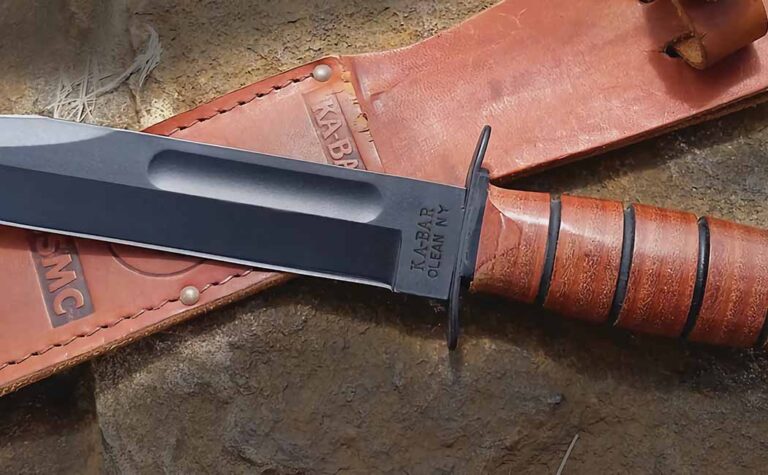
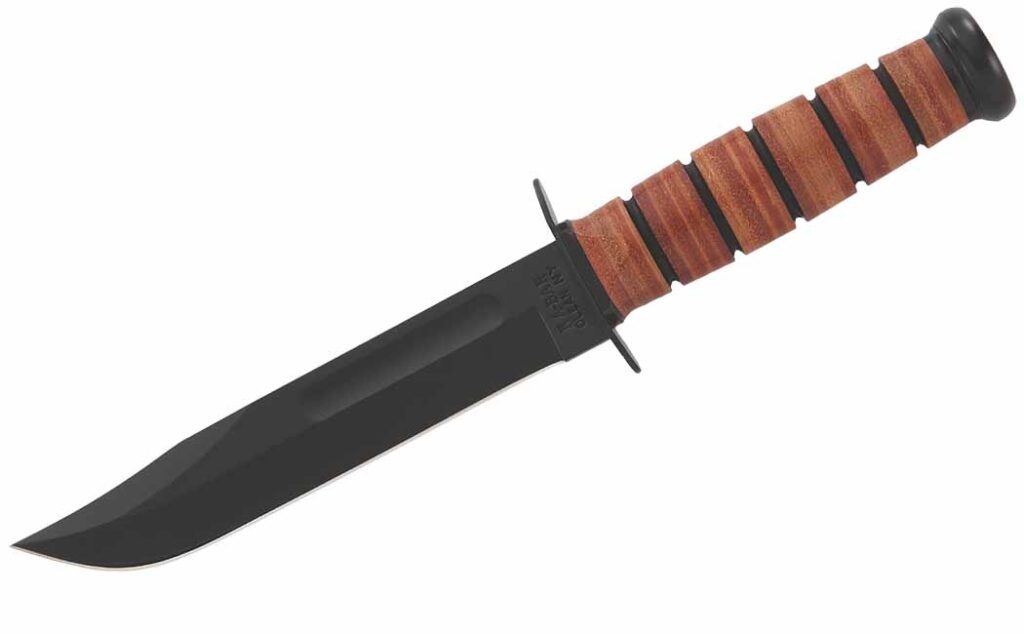
USMC Ka-Bar Plain Edge

Ka Bar Straight
The knife that made the Ka-Bar name famous is as popular as ever. There’s also a serrated version, but the plain edge is the original and is a hefty, economical knife.

The 7-inch clip point blade is made from 1095 Cro-Van steel with a 20-degree flat grind and a Rockwell hardness of 56-58 HRC. At just 11.2 ounces, it’s lighter than you might expect from a knife that size, which lets it flow smoothly when slicing, and the leather handle provides a secure grip. The rigid plastic sheath is MOLLE-compatible and can be carried vertically or horizontally.

Classics are classic for a reason, and the USMC fighting/utility knife is everything you could ask from a combat/using piece.

MSRP: $128.53

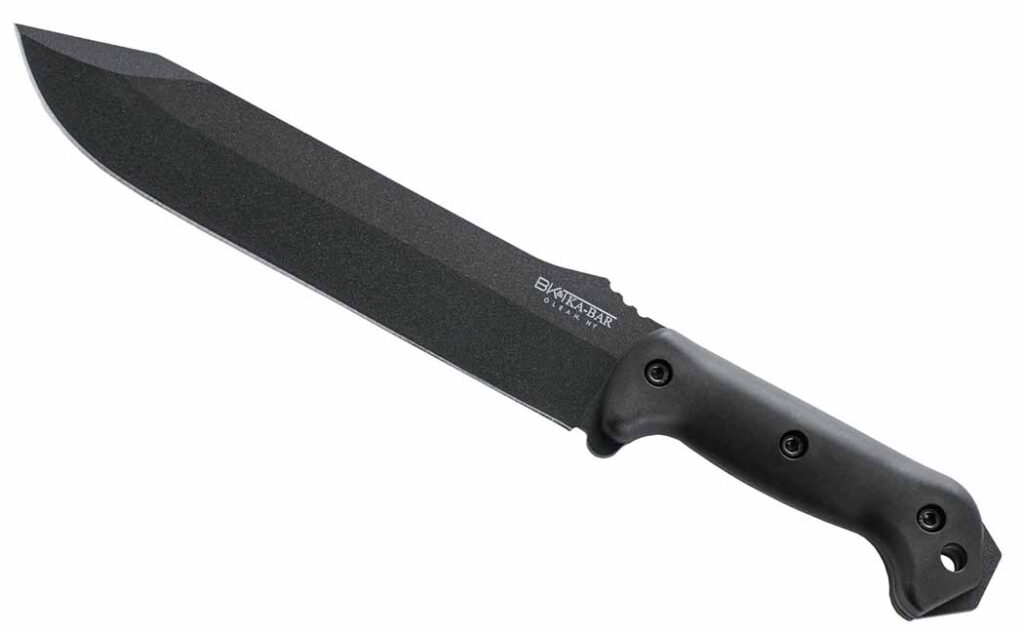
Becker Combat Bowie

Ka Bar Bowie
Melding an American bowie-style blade with Becker’s trademark ergonomic handle design and you get this sleek, all-black combat knife. It is designed for bushcraft or camping too.


The 9.25-inch blade is married to an Ultramid handle that provides a strong grip. At 17.12 ounces, it’s a bit heftier than the USMC fighting/utility, making it excellent for more heavy-duty work like trimming thicker branches and vines or cutting through medium brush. Similar to the USMC fighting/utility, the Combat Bowie is made from 1095 Cro-Van and has a Rockwell hardness of 56-58 HRC.

A heavy-duty polyester sheath is included and is MOLLE-compatible as well.

MSRP: $178.61

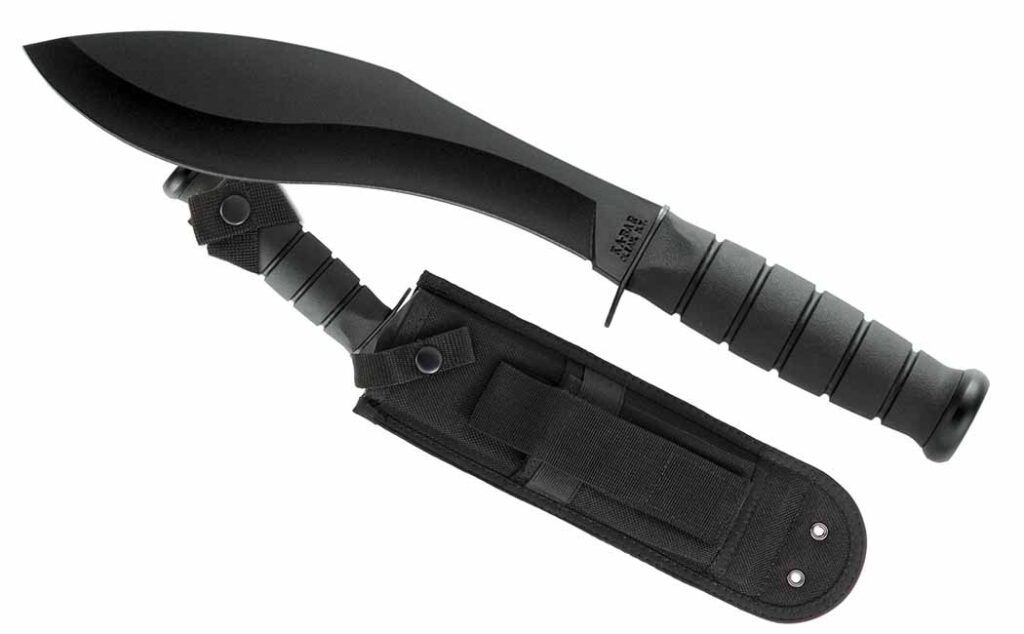
Combat Kukri

Ka Bar Kukri
This knife may have “combat” in the name, but its bread and butter is decimating small trees and vines. The kukri is smaller than a standard machete and is more finite in its cutting. That doesn’t mean that this blade can’t flex its muscle and chew through almost any brush you put in front of it.

This knife may have “combat” in the name, but its bread and butter is decimating small trees and vines. The kukri is smaller than a standard machete and is more finite in its cutting. That doesn’t mean that this blade can’t flex its muscle and chew through almost any brush you put in front of it.

At just under 16 ounces, it’s relatively lightweight yet robust.

If you’re buying it you’re most likely looking for a high-quality outdoors knife, and this kukri is it. The 1095 Cro-Van will need to be maintained to get the best out of it over time, but that comes with the territory of owning good knives. This knife will make a great companion working through the bush while camping or while cutting through bushes in the backyard.

MSRP: $122.68

Read More

Knife Review: Kizer Drop Bear

The New Kizer Drop Bear Is An Excellent EDC, And The Clutch Lock Is A Worthy New Addition To The World Of Axis Lock Knives

In the ever-growing world of EDC knives, finding ways to stand out is difficult. So many brands, so many steels, so much of everything. And even in that crowded field, the new Drop Bear from Kizer finds ways to catch the eye.

Boasting a high-quality blade, simple handle, and innovative lock, the Drop Bear is the kind of knife you’ll want to use every day … more so, it’s the type of blade you’ll go out of your way to use. 

Getting The Drop On The Drop Bear

The Drop Bear in both of its colorways: Gunsteel on top and Black, with the bright purple thumb stud, below.

First that name. For those wondering it originates from a beast of Australian folklore that–as the legend goes–drops from trees to attack humans. Pleasant.

However, Kizer’s Drop Bear (MSRP $158) allure isn’t its reference to free-falling arboreal bruins. Instead, it’s Kizer’s twist to Benchmade’s Axis™ lock configuration.

Called a Clutch Lock by the China-based company, the mechanism provides a dead-tight lockup. I put this through the wringer, but we’ll get to that in a moment. And while few locking mechanisms have ever sold a knife, this adds enough of a spin to the traditional drop point to make it stand out.

So, let’s talk a little bit about the Drop Bear’s Clutch Lock.

Clutch Player

The clutch lock seen after removing one of the scales. The lock can be adjusted, and scales replaced, in less than two minutes.

As the fidgety type, I have to confess up front I love this knife. Right off that should give some indication of what the Clutch Lock brings to the table.

Where Kizer gets it correct is by not improving an already proven system, with the blade unlocking similar to most other Axis-type locks. For those unfamiliar, a pair of buttons situated on either side of the knife–in this case behind the pivot–are retracted, thus releasing the blade. As mentioned, it’s an ideal lock for those of us who fidget.

However, Kizer has improved the system by tinkering with the pair of Gemini springs hidden beneath the scales. The rub here, their tension is adjustable. This is a big deal.

This concept is not entirely foreign to those bold enough to have skunk worked spring tension for years. Many times the results were less than optimal, which is why Kizer’s setup is desirable. Basically, you won’t make the Drop Bear a victim of shoddy kitchen-table knifesmithing.

The tension adjustment itself is simple, even for the mechanically challenged. The frame has five holes on each side in which the spring is loosened or tightened. If you want a faster open and tighter lockup, crank it up to the holes closest to the blade. Desire a looser action, dial it down.

Interestingly, and probably grasped by the mathematically inclined in the audience, the five holes on each side don’t add up to five settings. Instead, it’s 5X5 settings for a total of 25. Boy, if you can’t find what you’re looking for in that range, then nearly any knife is likely to leave you cold.

Bear Necessities 

The Drop Bear is a sleek, nimble knife as seen from above.

Novel as the Drop Bear’s Clutch Lock is, it wouldn’t add up to a pile of scrap if Kizer didn’t finish the job with all the parts to make a solid knife. Overall, they make it worth the price of admission.

With a quality EDC knife in mind, Kiser outfitted the Drop Bear with a blade a shade under 3-inches long–legal in most jurisdictions. The 154CM stainless steel, again becoming popular in this role, offers a Rockwell hardness of 58-61 HRC.

Topping off this end of the knife, Kizer applies a flat grind to help create the edge. Good choice, because it comes out of the box frighteningly sharp. Outfitted with moderately sized thumb studs with plenty of clearance, this attribute is quickly deployed.

In the hand, the knife feels light–listed as 3.7 ounces–but not light as air. This is a good middle ground for this class of knife, where it feels substantial in your hand yet won’t tear the rivets out of your jean’s hip pockets.

Much of the weight savings come from an attractive skeletonized frame, under the aluminum handle scale. With an ergonomic swell toward the middle of the handle, the Drop Bear offers purchase and plenty of control.

As for aesthetics, the knife comes in two colorways. The first style is a gun steel blade with a satin finish and black thumb stud. The second has a black blade with an eye-catching purple thumb stud.

Finally, a tip-up clip keeps the knife at hand and riding deep in the pocket.

Testing The Drop Bear

The Drop Bear was a joy to test and cuts most types of material with ease.

It’s an EDC so I wasn’t going to try and chop through the vines slowly overtaking the corner of my backyard fence. I used it around the house for a few days. 

It cut through plastic and tape like there was nothing there at all. It’s a perfect letter opener. The Drop Bear easily handles the daily tasks you’ll see every day. Taking it a step further, I used it as my only knife when prepping dinner for my wife and I.

First was the romaine lettuce, which the knife handled with ease. Whether holding the Drop Bear in the pinch grip like a chef’s knife or by using the jimping and pressing down with my thumb from the top down, the knife dispatched the lettuce easily.

Up next was the tomatoes, and it was the best experience I’ve had with a flat-edge knife cutting tomatoes. They were Campari tomatoes, so smaller and more delicate than beefsteak or Roma tomatoes, and the Drop Bear went through the flesh easily. This was best done in a pinch grip and got incredibly thin slices of tomato for the salad.

Celery is stiff and crunchy, and it was no problem for the Drop Bear. The chicken breast was easy too. I preferred cutting the chicken by utilizing the jimping, and the knife bit down easily and sliced through the meat without a hiccup.

My single favorite cutting task was the bell pepper. I chose to cut the pepper through the skin side as that is traditionally more difficult than cutting through the interior flesh. I have never cut through a bell pepper easier than I did with the Drop Bear. It left me thinking that this could reasonably replace a paring knife.

However, the Drop Bear did meet its match against a large carrot. The knife did not enjoy fighting through the harder, denser flesh, forcing me to switch to a kitchen knife to finish the job.

Beyond the kitchen, the Drop Bear shined. It gets through cardboard boxes like nothing. The corrugated cardboard can be the test upon which many knives fail, but the Drop Bear didn’t even blink. 

Additionally, I tested it on some brand new ⅜-inch polypropylene cord. I figured that the cord would provide some sort of fight for the Drop Bear. Instead, it was a first-round knockout as the blade smoothly sliced through the rope, leaving a clean cut with little in terms of frayed strands.

As for the action, I preferred the knife a little looser and set it at the second position. And the lock, I put the strength of the lock through the ringer. I did everything I could to break it. I bent it backward, sideways, every which way I could to flex the knife. The lock held firm and never budged.

Final Cut

Overall, the Drop Bear makes the cut for me. 

The knife has enough mechanical allure to make it intriguing while remaining practical. For tinkers and fidgeters, this is a big plus. For those less inclined to get wowed by engineering wizardry, Kizer’s creation still shows sharp.

The Drop Bear is more than ready to tackle most EDC jobs, though you might not want to push it too far out of its comfort zone. What knife isn’t that true for? But for the price, it seems Kizer has hit the mythological sweet spot for this class of knife.

Knife Specs

MSRP: $158

Blade Material: 154CM stainless

Blade Length: 2.97 inches

Blade Style: Drop Point

Full Length: 7.15 inches

Handle Material: Aluminum

Handle Length: 4.17 inches

Opening Mechanism: Thumb Stud

Lock: Clutch Lock

Pocket Clip: Tip-Up

Weight: 3.7 ounces

Read More

Six Fixed Blades Ready To Go To Work

A Good Work Knife Is Worth Its Weight In Gold. These Half-Dozen Blades All Excel At Something Outdoors From Gardening To Felling Trees.

Serious work knives are going to be fixed blades. Strength is something that can’t be sacrificed, and while many folders are incredibly rigid, they have mechanisms and moving parts that can and do become worn or damaged with hard use.

Modern folders are great knives. However, once mud, grit, sand, and the unexpected rock an inch underground comes into play, they tend to fail. Few folders are strong enough long-term for use as a trowel—fewer still can be safely batonned through wood. On the merit of ergonomics alone, the folder is usually slab-sided in profile and isn’t comfortable to hold for long periods, nor does it allow for easy cleaning. As such, the fixed blade is superior when the woodchips or dirt need to fly.

Defining work knives is merited by the individual task at hand. Some of the knives featured herein are not suitable to assume the role of another. Specialization is the name of the game and the knife you need for splitting wood is far different than one for working the ground. The main characteristic, across the board, is that these knives simply must hold up for their intended role and be at least serviceable in others should the need arise.

The test knives were all put to heavy use during an exterior cleanup, pulling up rotten posts, planting vegetables and bulbs, cutting down saplings and small trees, starting fires, making kindling, opening fertilizer and feed bags, and all sorts of things you would use a knife for in routine outdoor chores. They were exposed to rain, soil and, on occasion, cleaning supplies. I evaluated the edges and finishes for how well they cut and the handles for how well they felt in the hand after extended use.

Case Winkler Recurve Utility No. 6

The Case No. 6 was perfect for slicing straps on hay bales, removing small limbs and cutting various hoses and line.

A collaboration between Case and Winkler Knives, the Case Winkler Recurve Utility No. 6 is large, beefy, well-made, and very, very sharp. It arrived with a much finer edge than most Winkler designs, which made it all the more interesting when compared to the other Winkler knife in this article. 

One of this issue’s cover knives, the No. 6 is not machete size but is big and heavily built. The deep belly and recurve result in a wide, rounded curve up to the tip, with about an inch-and-a-half of front-facing edge to the point. It is excellent at digging but not great at penetrating materials.

Where the knife really excels is in deep, long cuts. The recurve shape and handle angle make it want to sink right in. It can be batonned through wood around 2.5 inches in diameter with ease, can make tinder and is great at striking. The knife comes with a leather sheath that includes a polymer clip for a Zippo mini lighter. This is probably the only downside to this overall fantastic knife—the polymer clip isn’t strong enough to keep the lighter firmly in place and it can and does fall out.

In terms of general utility, I used the No. 6 hard and heavily for just about every task I could think of in the yard/garden. It chops well for a standard-sized knife and takes down medium branches as well as a small saw. It wants to work and, due to its shape, is simply useful and never got into a place where it was too much or too little. Overall, it is a fantastic work knife that should last you a lifetime.

MSRP: $430.99

Winkler Knives Drop Point Crusher

As a medium chore cutter, the Winkler Drop Point Crusher was great and easy to carry. The glass breaker/striker pommel is wickedly effective.

A classically styled working knife, the Winkler Knives Drop Point Crusher is a rugged gentleman’s knife with an appearance that doesn’t immediately give away its abilities. It was the only test knife with a wood grip but this never became an issue despite it being the most organic in composition. It was, like the others, exposed to rain, sap, dirt and dried wood. In addition, and thanks to the glass breaker/striker pommel, it was also used to bust down rotten posts and break glass out of a damaged windowpane.

It is a lightweight knife and easy to carry all day long. While Winkler makes knives for some of the most tactical dudes in the world, this one doesn’t draw that sort of attention in the slightest. It looks old, like something your granddad may have carried while hunting, and most people just look past it. 

As an heirloom-quality knife it is hard to want to use it, but like all the Winkler blades I have looked at over the years, it wears nicely and simply gains character. For basic work the knife is great at everything but is just a bit thin for heavy batonning, though it can be used to split smaller pieces. 

As a work tool, it is firmly in the everyday use category but like the Earth Skills knife is best set aside for heavy work. This is the knife I ended up wearing the most and using for the greatest number of tasks as it was so effortless to carry.

MSRP: $375

Condor Tool & Knife Woodbuster

The Woodbuster split firewood easily.

The Condor Tool & Knife Woodbuster is the biggest knife I’ve tested for BLADE®. Because of the knife’s name, I decided it best to use it on as much wood as possible, from taking down branches to dropping small trees. Designed by Joe Flowers, it sailed through things like they were hardly there. It approaches machete size, though it is heavy and the energy you need to get it moving is wasted on small brush.

I chopped firewood and reduced sections of trunk 12 inches wide into firewood with the Woodbuster. It can be batonned with surety and is great in that it has no real tip, so you don’t risk catching your hand or fingers if the blade sticks in the wood. It chops as well or better than a camp axe and with less physical effort in preparing firewood. 

In taking down trees care is needed, but it is as good as an axe on anything under a foot across, which isn’t small by any stretch. The Woodbuster is 100 percent a working knife and is easy to become proficient with.

The only downside is the grip, which is rather round in profile. Smaller hands may have a hard time with it. The grip is also a bit smooth, though not all that noticeable if you wear work gloves. It becomes a bit hard to hold when wet and can roll in the hand after repeated strikes. This isn’t a serious problem, just something to be aware of.

MSRP: $171.58

KA-BAR Jarosz Camp Turok

The Camp Turok is a large knife that can handle branches, cutting chores, and light chopping.

The KA-BAR Jarosz Camp Turok is large but not as beefy as the Woodbuster, and much lighter. With the exception of heavy wood cutting and batonning, it performs most outdoor tasks. The blade is thick but draws to a relatively fine point.

Designed by Jesse Jarosz, the Turok is a great general-purpose outdoor tool in that it’s easily maintained and stays sharp when handling chores. It’s a bit too large for EDC and is, like the Woodbuster, something you will want to carry until you don’t; it’s an overt item. 

It is, however, the test tool that has the most utility for the price and the broadest range of uses. The only thing I don’t like is the grip—too smooth for my taste and slippery when wet. However, the scales are removable, making the knife easy to clean and maintain.

MSRP: $129.69

Benchmade 162 Bushcrafter

The handy Benchmade 162 Bushcrafter is eminently useful for most outdoor work, and easy to carry and maintain. Designed by Shane Sibert, it arrived with a very sharp edge, though more notable was the grip profile. It’s a relatively small knife and the handle is unusually shaped, almost like a dog bone in geometry, and is very easy to get a firm, solid grip on. It can’t really be used for chopping large materials but is exceptional for fine work. It’s great at making fire and excellent in the garden and for pruning.

While billed as a bushcraft blade, it’s really a fine everyday knife and graciously civilian in appearance. It doesn’t look tactical at all and won’t draw attention anywhere from the farmer’s market to the barnyard. It held up exceptionally well and maintained a sharp edge in use. 

It was used like the others to open feed and fertilizer bags and to cut cord and roots. The only downside is the sheath. While aesthetically pleasing, it has a suede feel and once wet tends to stay wet for a long time.

MSRP: $260

TOPS Knives Earth Skills Knife

The Earth Skills knife was at home in the garden and far more effective than a trowel at getting though tough roots.

The Earth Skills Knife from TOPS Knives is large and has a very atypical profile. Matt Graham designed it as a type of survival knife, though not necessarily a heavy-duty one. It is quite thin and has a generous Scandi grind, making it absolutely wonderful for working the earth, cutting through rooted soil to plant new bulbs or vegetables, and light work like cutting branches and digging up old wire netting. It’s great as a close work tool and for preparing food but has little value for hard-use tasks.

The edge geometry and thin spine are not suitable for batonning, though the blade is great scraping tinder and striking on a rod. Because of these special features, the knife is at home in the garden or camp in that it likely won’t be used for initial setup, but rather for cutting food, root vegetables, harvesting forage and as a light machete. The grip is very comfortable but quite large. The blade stayed very sharp through testing and accomplished tasks easily with minimal wear.

MSRP: $260

Read More

Advertisement

Must Read Articles

Read this before you make a knife

Knifemaking 101 – Read This Before You Make a Knife

  by Wayne Goddard My experience has taught me that there's nothing like digging in and getting started. I've often said the hardest part of the...
how to forge damascus steel

How to Forge Damascus

Advertisement
Advertisement