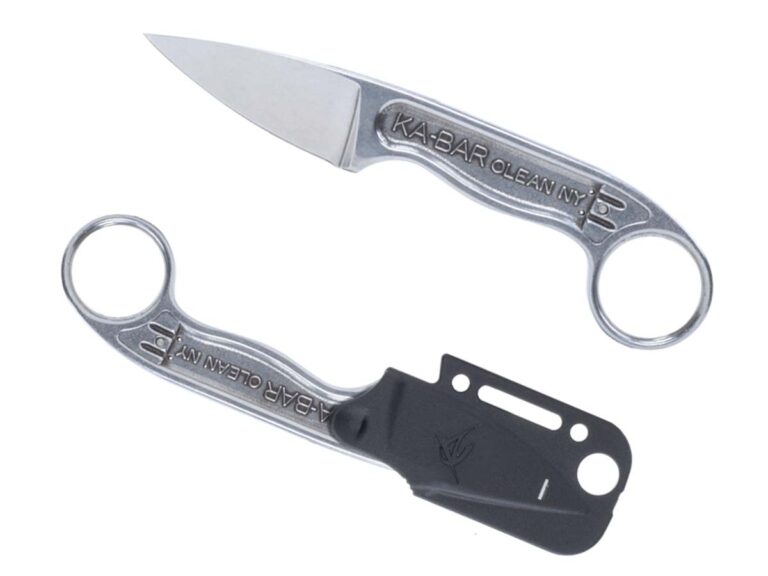
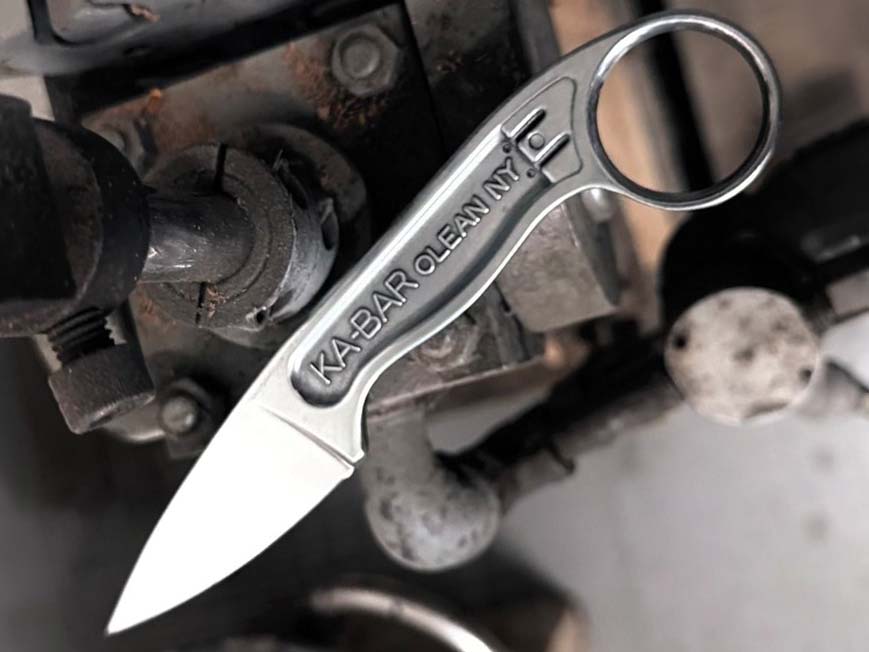
Designed by Allen Elishewitz, KA-BAR’s USA-made drop-forged EPT pairs a 2.5-inch blade with a clip-equipped sheath for easy pocket carry.
KA-BAR has expanded its line of drop-forged steel tools with the Elishewitz Pocket Tool, or EPT. Designed by veteran maker and former Force Recon Marine Allen Elishewitz, the compact fixed blade targets the growing daily carry market with a format tailored specifically for pocket carry rather than belt wear.
Built for Daily Duty
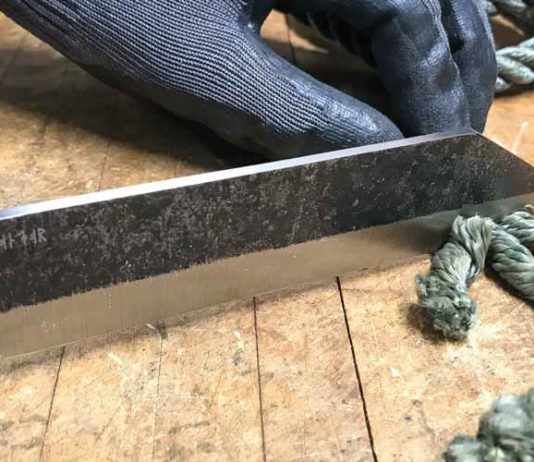
The EPT centers around a short, broad 2.5-inch drop-point blade ground flat to a 20-degree edge per side. KA-BAR crafts the knife from 0.1875-inch thick 425 high-carbon stainless steel, hardened to 56–58 HRC. The stout blade geometry offers plenty of strength for routine cutting tasks while keeping the overall footprint manageable.
Because the knife utilizes a one-piece drop-forged construction, the skeletonized handle is integral to the blade. A finger ring integrated into the butt end assists with control during use while serving as a quick-draw indexing point when pulling the knife from a pocket.
Pocket-Friendly Carry
Rather than relying on a traditional belt sheath, the EPT comes equipped with a custom USA-made sheath featuring a reversible, loop-over wire pocket clip. This setup allows the fixed blade to ride deep inside a pocket in much the same manner as a standard folding knife.
At 6.75 inches in overall length and weighing 3.2 ounces (0.2 lbs for the knife alone), the U.S.-manufactured piece delivers the structural integrity of a fixed blade without adding unnecessary bulk to a daily kit.
Elishewitz Pocket Tool (EPT) Specs Designer: Allen Elishewitz Overall Length: 6.75 in. Blade Length: 2.50 in. Blade Width: 1.70 in. Blade Thickness: 0.1875 in. Blade Steel: 425 High Carbon Stainless (56–58 HRC) Blade Type/Grind: Drop Point, Flat Grind Edge Angle: 20 degrees per side Construction: Integral drop-forged 425 stainless steel Weight: 3.2 oz. total (2.24 oz. knife weight) Sheath: USA-made sheath with reversible wire pocket clip MSRP: $78
Cigar Cutters Come In Three Distinct Styles. Picking The Best One For You Is A Matter Of Personal Taste.
Few gentlemen’s pastimes are as nuanced as the art of smoking a cigar. The choice of stogie, cutter and method of carry are, for better or worse, an indicator of just how serious an aficionado the person in question is. The little things can say a lot about the owners, and a lack of appropriate accoutrements is all some need to pass judgment on a peer.
I sat down with Alex Gregorian of Georgetown Tobacco & Pipe in Washington, D.C. He was kind enough to provide me with some choice cigars from the shop to use in this review. Gregorian first took up stogies as a hobby a decade ago and has since proceeded to transform his avocation into a job that benefits from his peerless expertise.
Georgetown Tobacco & Pipe has catered to many in government and a slew of celebrities, including actors Pierce Brosnan and Arnold Schwarzenegger, among others. Being in the nation’s seat of government affords Gregorian the opportunity to rub shoulders with an incredible clientele of cigar smokers, and I take his word as fact when it comes to picking out the right tools for enjoying a proper smoke.
“The first thing you’re looking for is something that will last longer than five cigars. The quality of the blade, like any cutting edge, is important,” he notes. “The cap, the portion where it is folded over on the end, is the most delicate part of a cigar. If you cut too far down the cap you risk losing smoke quality, and the cigar itself may become unwrapped. You want the cut to be small, just a nip off the end. No cigar should be completely flat or square on both ends. You’re not looking to make a cylinder; the cap end should have a taper to the mouth.”
While Gregorian’s store may or may not stock the three test pieces, the general basis for cutters falls into three main styles: scissor, guillotine and knife. One of each category is demonstrated here and I will later give my thoughts on their use and features.
Picking The Right Cigar Cutter
Each cutter is paired here with the cigar it cut. Note that the 208 (middle), a friction folder, caused some crushing. The author stated it is difficult to maintain a good cutting angle with consistent pressure when cutting a cigar with a friction folder.
“The scissor-style cutter is effective,” Alex opines. “It is basically a double guillotine and is much easier to make a flat, clean cut with. The scissor cutter is better in that it is far less likely to cause crushing or pulling apart of the tobacco at the cap. A single-blade cutter can get dull faster and can very much damage the cigar; two cutting surfaces will stay sharper longer and give a better cut.”
This is not to say that single-edge cutters are of no use, rather they require a steady hand and deliberate pressure on the cut. In my limited experience, at least compared to Gregorian, I have used single-bladed cutters and have generally failed to find one that works well enough to keep it in my rotation when I socialize in the few places that still allow smoking in my area.
“Things to watch out on single-bladed cutters are the angle of the cut and the edge type,” Alex advises. “Many cheap cutters end up just ripping or pushing the cap off, and this is no good for a nice smoke. You really want a good, thin, razor-sharp blade that goes through quickly and cleanly; you don’t want loose tobacco coming out in your mouth when you smoke.”
In closing with Gregorian, I wanted to see what a seasoned tobacco man smoked. Since you’re reading BLADE® I assume you’re cultured and have fine taste, and this advice will no doubt encourage you to pick up some cigars that befit those qualities.
“I recommend Davidoff for cigars. They are the top quality cigar made today. [Davidoff officials] are extremely selective on the tobacco they use, and each cigar is a work of art. It shows on each one you take out of the box,” Alex says. “The standard Davidoff runs about $25—not bad for a great smoke. Padron [cigars are] another I highly recommend. They are made with Nicaraguan tobacco.”
Fox Cutlery’s Acid-Etched Figaro Cigar Cutter
Fox Cutlery’s Acid-Etched Figaro Cigar Cutter
The lightest and most compact piece tested was Fox Cutlery’s Acid-Etched Figaro Cigar Cutter. It is an incredibly stylish and minimalist scissor-style tool, so light that you can easily forget it is in your jacket. It is also the lightest on the wallet of the three test models, though it cuts far above its price point and delivers great results. As a dedicated cigar cutter, it has no additional function.
What I really like about the Figaro is that it doesn’t try to be anything other than great at its job. It has no bells or whistles and slices nice and clean. It also offers a very precise slice as the cutter itself is so thin, there is no guessing where both blades are indexed. The larger test cutters are thick like a pocketknife and it is easy to overestimate angle, or how far the cap has been inserted through them when cutting.
MSRP: $75
TOPS Knives 208 Clipper Cigar Cutter
TOPS Knives 208 Clipper Cigar Cutter
While the 208 Clipper Cigar Cutter from TOPS Knives is advertised as a cigar cutter, I suspect this has more to do with skirting knife rules than it does its true role as an EDC multitool. While the 208 certainly can cut cigars, it does not do it as well as the other two test models. However, the other two cutters cannot be used for self-defense in non-permissive areas like the 208 can, either.
The TOPS entry has the most features of the group, but this comes at the cost of weight and safety. It is a friction folder and, unless carried in a sheath, is somewhat prone to unintentional opening.
The 208 is highly functional and also features a bottle opener on the tang. As a general utility tool that pops bottle tops, clips cigars, slices a seat belt and impresses your buddies, it’s great. As a dedicated cigar cutter it is somewhat wanting. The blade grind is very steep and thick, almost chisel-like in profile. This causes tobacco to tear as you cut with it, though for some, having the extra features and ability to use the 208 as a knife supersedes a rough stogie slice.
MSRP: $230
Benchmade 1500 Cigar Cutter
Benchmade 1500 Cigar Cutter
The Benchmade 1500 Cigar Cutter is a luxury item. It has no ability to function as a knife, but, unlike the Fox Figaro, easily can be mistaken for one—even up close. It features Benchmade’s AXIS lock system, a handy feature that is sure to draw interest.
As a dedicated cutter it functions extremely well. It is easily the sharpest of the review group and effortlessly passes through cigar caps. I experienced no tears or bad cuts, though it was very easy to sever the cap too far up if I didn’t take my time.
There is no doubt the 1500 is a very high-quality tool; for many it could be considered a status symbol. It is marginally more expensive than the TOPS 208, though it has none of the tactical vibe. Benchmade collectors I know drooled over it, so I figure the 1500 is something that at least stokes envy among the initiated.
Beyond the coolness factor, the Benchmade is truly a dedicated cigar tool, and its uses are limited to that arena. You would need to decide if so high end a cutter is worth it considering that a world-class tool like the Figaro can be had for a fraction of the cost and weight, and offer basically equal performance. If you enjoy several cigars a day or week, I can see how you would like the luxury of the 1500.
MSRP: $250
Gent’s Prerogative
The style and features of a man’s personal effects often tell you a great deal about what he prioritizes. Purely for cost and effectiveness, the Fox Figaro is hard to beat. I value this because I’m an amateur tobacco enthusiast. I’m not aiming to impress with my tools; rather, I just want to have something light and easy to keep on hand for that rare evening out with friends around the campfire.
Editor’s note: Don’t smoke tobacco—it can cause cancer. Secondary tobacco smoke also can cause cancer, so if you must partake, do so in a way that best protects the health of those in your immediate area.
When Hunting, One Knife Is Good But More Knives Are Better. These Knife Sets Can Help Make The Hunt Easier No Matter The Size Of The Game.
Each year hunting season rolls around there are experienced hunters and first-time hunters anxious to make their way into the field. Whether a bow hunter or a firearms hunter, one thing remains consistent between the two: They both need something to clean game and prepare it to be able to get it out of the field and home.
No one would argue that you don’t need a knife, but sure enough each hunter would back his choice of blade in a discussion led by the question “What do you use?”
This year, as usual, I found some likely candidates to add to the discussion of whose knife is better, though this time, instead of a single knife to tackle the project, let’s consider knife sets. They can’t get your game for you but we can put them through their paces to see if they can help make the most out of what you do get.
Gerber Moment
Here you get a good look at the size difference between the large Utility knife and small Finesse knife in the Gerber Moment. Sometimes a good picture is worth a thousand measurements. Blade and overall lengths: 3.625/3 and 8.625/7 inches. Blade and handle materials: 5Cr15MoV stainless and rubber overmold, glass-filled nylon
The Gerber Moment is a two-knife set. Of the test entries, this one is for the budget-minded hunters looking to spend the short dollar. It is made in China and the fit and finish is darn respectable considering each knife runs about $17.
The two knives were not hair-popping sharp out of the package, though it didn’t take long to up their edge games. Both the large utility knife and the small finesse model come with contoured rubber grips.
The scales do not totally cover the full-tang handle design. A small perimeter of the tang is left exposed around the scales. At the rear of each tang are small oblong-shaped notches to serve as lanyard holes. They’re small holes at that, as you won’t get much more than paracord through them. As mentioned, the edges of the tang are proud of the scale but not so much as to cause any hot spots.
Both knives are drop-point designs, with the large knife being hollow ground and sporting a gut hook. The small Finesse is a full-flat-ground drop point. Texturing on the rubber grips helps provide a good, solid purchase. Of the two, as you would expect, the small detailing knife is pretty agile, though it isn’t like the large one is clumsy. To tote them both Gerber provides a dual-carry nylon belt sheath with plastic liner inserts.
Overall, the knives are quite well made. The design cleans up easy. After you do some work to bump up edge performance, you’ve got some users.
I have never been much for gut hooks. I remember when the Wyoming Knife was new and loads of hunters were sold for life on gut-hook knives. Even though I don’t use them, I can see how some hunters could like them. The gut hook on the Moment is pretty large.
I would have to give the set a thumbs up. It would be good for a hunter on a budget or one looking to try out different styles until finding one that suits him best.
MSRP: $34
Outdoor Edge Razor Guide Pak
Some of the extra blades you get in the Outdoor Edge Guide Pak Razorbone include a selection of drop point, gut hook and boning/fillet patterns. All are neatly store in the waxed canvas roll. Blade steel: 420J2 stainless.
The Outdoor Edge Razor Guide Pak comes with two knives—the RazorBone and the RazorCape—along with a small bone saw. The knives take replaceable razor-blade-style inserts. Both are folders and come with multiple replacement blades.
Outdoor Edge provides a boning/fillet-style blade along with a drop point and gutting blade for the RazorBone. For the RazorCape knife, you get two cape-blade inserts. Both have glass nylon and TPR rubber inlay handles.
A lockback system secures the blades in the open position. The handles don’t have a lot of cross-sectional contouring and the texturing on the rubber inserts provides some traction to your grip. There’s a thumb groove with jimping on the spine of the blade holder.
What worked well for me was the difference in thicknesses between the blade holder and the blade gave me a great lip to secure my handhold while executing a pinch grip. As I used the RazorBone in a butcher grip, the thin tip of the insert snaked through joints and kept me close to the bone so that I didn’t leave any of the good stuff behind.
The RazorCape knife works well but has a large choil. I find such choils a waste of potential edge length. As if that isn’t bad enough on a hunting knife, they basically become a fur catcher. Both folders come with a pocket clip, though for me they are not pocket-carry-style knives. All the inserts come scalpel-sharp, so show them respect while handling them.
Lastly, the Flip n’ Zip saw works well but the anodized aluminum handle doesn’t do a lot for me. It makes a nice, thin package. A lockback system securely holds the blade in place. It’s just that the aluminum handle, even with CNC grooves, is thin and pretty slippery in my hands once things get wet.
Also, the handle is so thin it makes it a bit difficult for my fat mitts to hold onto it. I would hate to try it with gloves on while the handle is covered in blood. The extra blades, all 420J2 stainless steel, are stored in a wax canvas roll.
MSRP: $99
Knives Of Alaska Bobcat Combo
Knives of Alaska includes a top-notch leather sheath with the Bobcat Combo. The sheath has the hallmarks of solid craftsmanship. (The author indicated he put the nick there.)
The set from Knives of Alaska (KOA) comes with the Alpha Wolf knife and the Bobcat Hatchet—hence, the Bobcat Combo. I’ve used the Alpha Wolf before. It’s a full-tang design made of D2 tool steel and a layered polymer handle. The handle contouring includes four finger grooves, with the index groove on the ricasso. It is a straightforward, fully flat-ground drop-point design.
The Alpha Wolf comes shaving sharp out of the box and has a general curve to the cutting edge. I have to say as a game knife it handles well and you can exert a great deal of control over the cutting edge with little effort.
The design fits well in my meaty hand and the cuts get made where I need them without struggling. At the rear of the edge is a micro choil and, as usual, when the material being cut gets hung up there, it frustrates my workflow. I would say the only thing I would prefer is a bit of texturing to up the grip game.
As you can imagine, the Bobcat hatchet does things like splitting the sternum, cutting the pelvic bone and, if you want, it will bust out some of the tougher joints. It doesn’t have the heft of a full-size hatchet but as my buddy is fond of saying: if you put enough force behind anything you can make it fly. To me, it would be certainly neater than a chainsaw (don’t ask, it’s a drunken Canadian hunter thing). A gut hook is on the back.
A top-notch-made leather sheath carries the combo. I never reviewed a knife from KOA on which the leather wasn’t well executed. It’s a good combo and the Bobcat hatchet is such a neat tool I couldn’t resist using it in the kitchen as a small hand chopper. I know, somewhat sacrilegious, but it’s my kitchen. It’s a great set and as much of a trophy as the game you kill.
MSRP: $209.99
There’s a wide range of knives here from budget to bang and represents only a small sampling of the tools available to hunters these days. If you’re going for the big game, don’t ruin the moment by struggling with a poorly crafted tool. Take the time to round out your kit with a good field-dressing knife set.
Despite A Rocky History Of Legality, OTF Knives Have Endured And Are Some Of The Most Popular Pocketknives On The Market Today
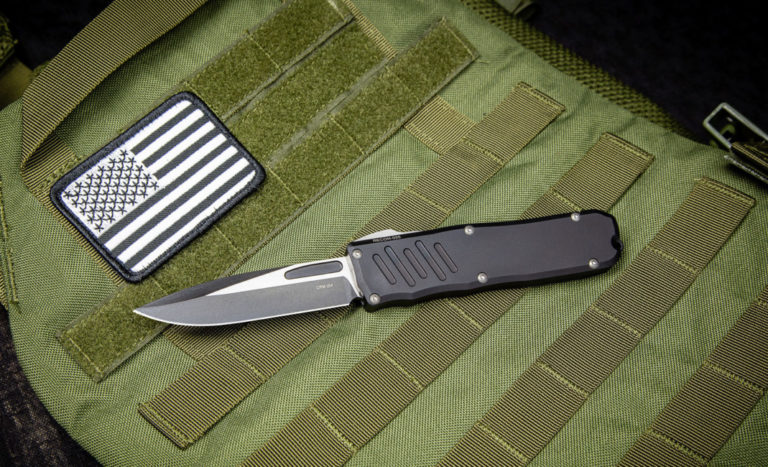
As its name suggests, an Out The Front (OTF) knife is a fairly straightforward affair. In short, it has an enclosed handle with a blade that deploys from the front–the bolster, hilt or what have you. In general, these fast-from-the-gate options are small, most with an average blade length of 3-3.75 inches, though there are certainly larger examples.
The knife is distinct from its “Out-The-Side” cousin, at least as a switchblade–one of its most common forms–in the variety of the way the blade is brought into action. Furthermore, the OTF knife needn’t any push-button, assisted-open system to flash cold, hard steel in the wink of an eye.
Overall, OTF knives are a fascinating, if not slightly intimidating, corner of the knife world. In this guide, we’ll look at some of the history, usage and types of OTF knives. Then we’ll show you some of the best options on the market today. Get ready to flick into action.
Legality Of The OTF Knife
In the past, these knives were favored by paratroopers and sailors. However, thanks to a media campaign in the 1950s that showed automatic knives as the tool of choice for criminals and underworld types, including popular movies like “Rebel Without A Cause”, automatic knives were banned nationwide. The Federal Switchblade Act passed into law on August 12, 1958 and effectively banned auto knives across the country.
Going into 2023, the panic over OTF knives and other switchblades has somewhat subsided. Most states now allow ownership and carry of OTF, and other types of, automatic knives. However, 11 states still have a blanket ban. Furthermore, there are some issues when it comes to what many places call ‘stabbing instruments’ and other vague terms. Where this becomes an issue is some states that allow automatic knives have laws against double-edged blades. Given many OTF knife options fall into both categories, certain models have a narrow window of legal ownership.
As always, if OTF knives or switchblades tickle your fancy, please check your local laws before picking one up. Better safe than sorry.
Types Of OTF Knives
As mentioned above, there are four types of OTF knives. Each has positives and negatives, and the prices will vary wildly. It’s important to know the differences so you purchase the option that best suits your needs.
Manual OTF Knife
The most basic and least expensive OTF knives are the manuals. They are exactly that, knives that deploy and retract through manual operation. The most common way of doing this is via a slider on the handle. The upside is that you are in total control of the speed of your blade. However, it may not have the wow factor of other knives on the list. But hey, you’ll be safe while using it.
Single-Action OTF Knife
These knives feature a powered deployment, usually with a button of some type, but require you to manually retract the blade to reset it. And it isn’t retracting like you might think. You pull a handle at the bottom to both retract the blade and recharge the spring so it’s ready to deploy again.
Double-Action OTF Knife
When you think of an OTF knife you probably think of double-action OTFs–better known as fully automatic. The blade deploys and retracts with the touch of a button or flip of a switch. Prominent companies like Microtech and Cobra-Tec make dozens of different double-action OTF knives.
Gravity Knives
The four-leaf clovers of OTF knives are definitely gravity knives. Few companies still make them. The blades deploy and retract with the help of gravity.
The Reate EXO is one of the most popular gravity knives on the market today and a great example of the style. Just take into account your local knife laws as some places have specific laws banning the ownership or carry of gravity knives.
What To Look For In A Quality OTF Knife
You can find decent, but basic, OTF knives in the $30 range, but expect to pay ten times that for a model that extends and retracts on its own with the push of a button. Though, the sky is really the limit when it comes to the features on these knives, as some can easily jump over $1000 depending on what’s included.
The rub, for the price, is that even the expensive options do not do well for anything other than basic and light use as they are not as strong as other types of knives.
The basic selling point of OTFs–aside from inherent coolness–is convenience. Read that as they can be entirely used with one hand. It’s best to think of the OTF knife as a refined gentleman’s blade: a cutting tool that you could rely on for daily life and its inconveniences.
OTF Blade Quality
The main issue surrounding blade quality on OTF knives is how light the blades have to be to function. Because the blade is entirely surrounded by the handle, the blade itself cannot be wider or longer than that existing space. As a result, most OTF knife blades are short and light.
These blades are rarely what we would call a full-profiled knife and many are under 3 inches despite a full-sized handle. These blades are not especially strong and are essentially for cutting only, though there is utility in thrusting or stabbing depending on the strength of the locking mechanism.
The small tang area is where the mechanisms are anchored, and this space is usually quite insignificant in surface area. It is entirely possible and even easy to break OTF knives if used improperly.
Practicality Of OTF Knives
If you are in the market for an OTF knife, realize that there are better designs for most daily work that are substantially stronger and can handle a much wider variety of tasks, not to mention are cheaper. OTF knives do have their niche, much like karambits, balisongs, and friction folders, but each of these designs has hard limits on what they can accomplish as opposed to a fixed blade or a suitably strong folder.
Best OTF Knives
SCHRADE VIPER OTF
Coming in at a relatively low cost (comparatively) is the Schrade Viper. The knife lacks some of the features of higher-end OTF knives, but at 1/10 the price of some of the others on this list, it is a good starting point should you want to familiarize yourself with the OTF style in general.
The knife is a bit more manual than others in that it is assisted opening but needs to be manually closed. The overall structure of the knife is not cheap. The handle is made of aluminum and includes an integrated glass breaker in the pommel. It also features a manual safety system for opening and closing the blade to ensure it only opens when you want it to.
MSRP: $75
SMITH & WESSON M&P OTF
The M&P OTF retails in the same range as the Schrade Viper and is largely a product that appeals to an entry-level crowd. Many OTF knives on this list retail for more than some of S&W’s guns–a telling sign this market is for the discerning individual. with the M&P OTF, you get a large degree of utility without some of the additional features and glamor of higher-end models.
Like the Schrade, this knife has an integrated glass breaker in the pommel and is similarly assisted opening/manual closing. If you already own an M&P pistol, you’ll notice that the handle contouring matches the slide machining cosmetically, including a safety lever that resembles the one on the pistol. MSRP: $70
HOGUE KNIVES COUNTERSTRIKE
Hogue’s new Counterstrike is a flagship design that is sure to impress, not only with its modest price point for a fully-automatic knife but also the materials it is made from.
What sets the Counterstrike apart is not just that sweet-spot price, but the high-end materials it’s made from and its excellent strength. Among these is the MagnaCut blade, which itself is a prime selling point. This steel is among the best in the industry and gives the Counterstrike excellent edge retention and adds rigidity to the already thin OTF blade profile. Additionally, the knife has a glass-breaker pommel, aluminum, and carbon fiber handle, and is made in the USA.
MSRP: $400
KERSHAW JENS ANSO KAPSULE MANUAL OTF
The Kershaw Capsule is a small manual OTF excellent for concealment. At just 3.25 inches while closed and with a 1.9-inch blade, this small knife is a great self-defense tool because of its size and unassuming appearance.
However, it’s much more than that. The spear point blade works like a box cutter. The tip is great for puncturing the and edge can handle the type of slicing work you’d expect from a commercial box cutter. It’s convenient and compact enough that it can even fit on a keychain.
MSRP: $35
MICROTECH ULTRATECH D/E
Microtech is one of the companies that popularized the modern OTF knife. In fact, most knife enthusiasts would go so far as to say that Microtech is completely responsible for this trend and has set the bar for all OTF knives going forward. The Ultratech is a solid example why the company calls the tune.A dependable OTF, the knife displays an excellent balance in terms of material, strength, and utility. It is a fully-automatic design that opens and retracts with the same switch. If you want an incredibly reliable OTF knife for your daily use, the Ultratech is arguably the knife on this list with the most pocket hours across the board and is from an established OTF brand. Like others on this list, it features a glass breaker pommel and is made in the USA.
MSRP: $310
HERETIC KNIVES ROC
Now here is something you don’t see every day. The Heretic Knives ROC is visually stunning, it is just so rare to see a curved blade on an OTF knife. The company no longer has the ROC listed on its site as of this writing, but it is available and in stock online. The ROC accomplishes its one-of-a-kind appearance by using a curved handle to match the blade, which overall seems like a no-brainer.
But it just isn’t seen these days, despite the advantages in self-defense or martial arts. While it resembles a karambit, this knife lacks a finger ring on the pommel. The ROC is a fully-automatic design that retracts and deploys on its own. If you are in the market for an eye-catching OTF design that is USA-made, you’d better get them before they are gone.
MSRP: $750
PIRANHA RATED-R
The Piranha Rated-R is one of the most discreet and well-designed knives on this list. The others we’ve looked at have release buttons/switches on the side of the grip in line with the spine of the blade, whereas the Rated-R has it conveniently mounted where the thumb rests near the end of the handle.
It is a fully-automatic knife and requires no movement of the hand to deploy and retract the blade thanks to the switch location. Unlike most of the others here, it lacks a glass breaker pommel, further adding to its discreet appearance. The knife is on the higher end of cost for OTF blades. But like any semi-custom product, it appeals to a certain customer that has specific needs for a strong, durable, and unassuming knife. The Rated-R is made in the USA.
MSRP: $490
BENCHMADE AUTOCRAT
This list wouldn’t be complete without a knife from Benchmade. The company has been producing visually attractive and highly functional blades for the most demanding end users: hunters, cops, rescue crews, anglers, and bushcrafters, among many more. The Autocrat is the most sought-after Benchmade OTF model and it has an excellent reputation for strength and sharpness.
The knife is in the same cost range as most high-end OTF knives at $500, making it an investment for most people but a steal for those who desire American-made quality. The knife is fully automatic and is available in two colors. It does not include a glass breaker pommel, making it easier to use in the hand and a bit more classy in overall appearance.
If you spend time camping, you know the importance of proper tool selection for your excursions. The right kit makes a difference in how you enjoy your weekend woods getaway.
From batoning firewood to prepping dinner, these are the blades that will help you conquer the wild.
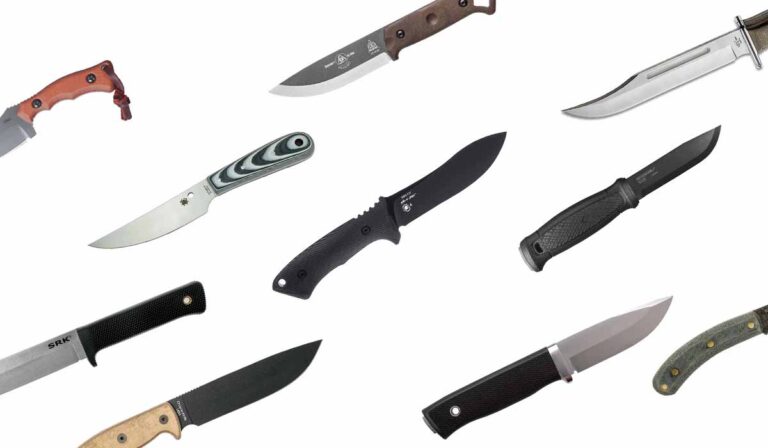
An important part of your gear should always include a camp knife of some sort. This multipurpose cutting tool takes on multiple roles in your camping trip and can handle the bulk of hard use when it comes to campsite tasks, campfire prep, processing food, and any other cutting task that comes up inside and outside of camp.
What Is A Camp Knife?
When you hear the word “camp knife”, what immediately comes to mind? Well, a rather larger fixed blade that has some heft to it. Which is partially true. Keep in mind not all camp knives are big, brawny choppers. And not all choppers can be camp knives either.
Blade: Camp knives have a proven blade shape. Nothing wild, but rather a design that can handle multiple tasks. Blade shapes like clip point, drop point, or even spear point.
Size: The knife also has to be of some length, around 7-8 inches is good. Such a blade length will facilitate tasks involving whittling, batoning firewood, chopping wood, or expediently slicing up food for cooking.
Handle: On the handle side, it’s important to have a handle shape that is very comfortable in your grip and incorporates design elements such as (but not limited to) finger grooves, palm swells, radiused edges, machined-in textures, and choils.
These features seat your hand better on the handle, making for a more comfortable user experience. Face it, if a handle isn’t comfortable you’re are not going to use the knife, regardless of how expensive it is or if it uses the best blade steel. Plus, as you are working, you want the handle to feel secure in your hand and not feel like it’s going to fly out. Therefore, such materials as G-10, micarta, and some molded thermoplastics are great choices for handle materials on camp knives.
Steel: What about blade steels? What about them? You have to remember the camp knife is a workhorse and you will probably have to sharpen the knife in camp. Carbon steel is still the steel of choice for this very reason of being easy to resharpen in the field.
1095 seems to be a factory favorite, found on outdoor knives, some fixed blade tactical, and EDC fixed blades. 1095 sharpens very easily but it’s not stainless so you will have to exercise extra care to make sure it’s dry as possible to prevent rust and stains.
Higher-end super stainless steels like S35VN are great and have the muscle to go the distance without frequent sharpening. Yet when it comes time to resharpen, you could end up investing a good deal of time.
To negate this, you can switch to a maintenance mode from resharpening mode, meaning, frequent honing will preserve the cutting edge. Something must be said for going old school, with carbon steel. There is a trade-off with frequent short-duration sharpening of blade steel that is softer and easier to manage, as opposed to spending a lot of time in the field sharpening a high-performance super stainless steel.
Now we have the basics out of the way, let’s dive further into some good examples of camp knives that might interest you.
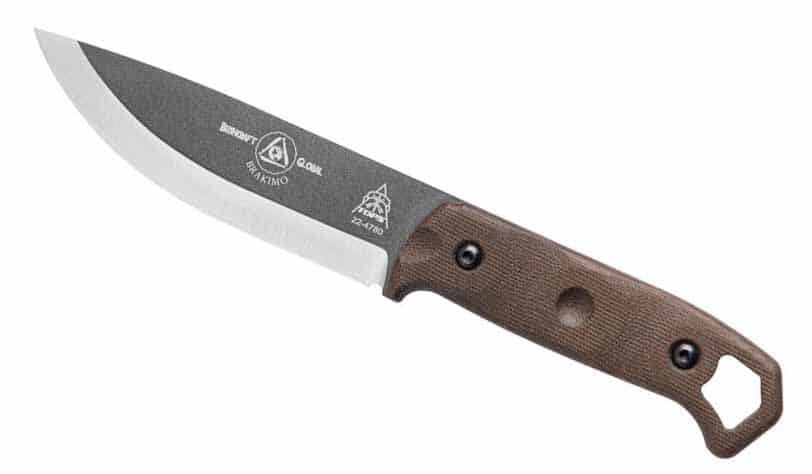
TOPS Brakimo
Designed by noted survival/outdoor expert Joe Flowers of Bushcraft Global, the TOPS BRAKIMO is as close to a do-it-all knife that can handle all tasks from whittling to cutting to chopping and baton work.
Its blade is 5 2/4-inches long and 0.190 inches thick and is made from 1095 carbon steel. The drop point shape gives plenty of belly to facilitate a broad range of tasks including but not limited to food prep. The modified Scandi grind is there for cutting performance as well as a thicker cross-section of the blade to promote strength in the blade. The handle is of OD green canvas micarta and has been finished to leave a “grip you back” quality to it. The edges have been chamfered for ultimate comfort, and there’s a divot for use with a bow drill. An extra-large lanyard hole allows you to use any cord diameter for a lanyard and possibly even attach it to a carabiner. Finishing out the Brakimo is a nice Kydex sheath that carries the knife at your side securely. A spring metal clip is the means to attach the sheath to your belt.
The Kydex sheath is nice although basic. But really in the end as long as it works, that’s all that matters.
MSRP: $169 Origin: USA
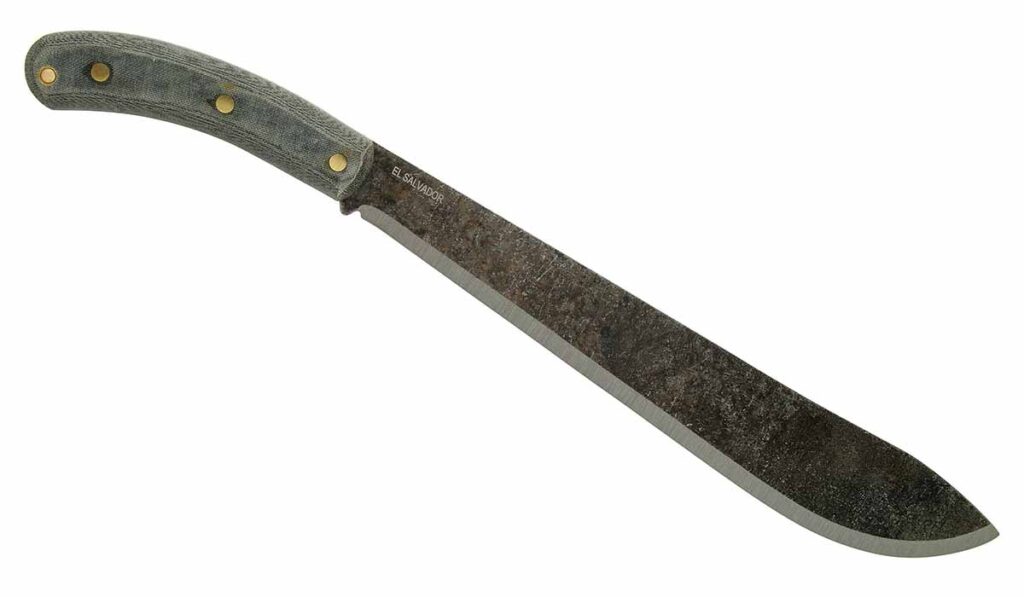
ESEE Expat Darien Machete
I know. This is a machete, but this is an article on camp knives. Truth is that machetes can be used in conjunction with camp knives. More so with the ESEE Expat Darien machete, this is also part machete and part knife as well.
Measuring a little over 18 inches, the Darien has a reach like any other machete, but it also has excellent balance and feels so agile in the hand that you can use it as a knife for whittling, chopping, batoning, and maybe some heavier cutting of camp food prep tasks. The blade is made from 1075 carbon steel and is very easy to resharpen in the field. At 0.094-inches thick, the blade stock is thin enough to be nimble and is thinner than most camp knives, which are at least ⅛-inch thick (0.125 inches).
The blade itself is a little over 12 inches, which is enough length to get work done. The handle is made from black micarta, which is a great choice because it’s a synthetic material that is dimensionally stable and has an excellent grip you back quality. The sheath is sewn canvas and is well made. An integrated belt look allows the Darien to be at your side whenever it is needed. Pair the Darien with a favorite full-blown camp knife and you have the ultimate combo!
MSRP: $121 Origin: El Salvador.
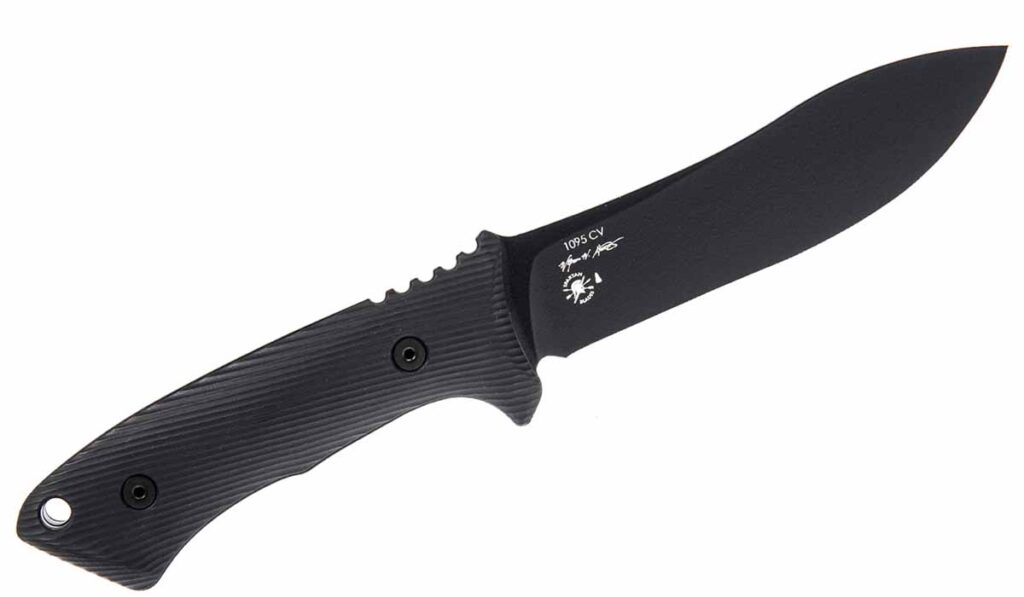
Spartan Blades Hersey Nessmuk
Spartan Blades made a name for itself as a top producer of high-end tactical and outdoor knives. It recently came out with a USA-made mid-grade line of professional use knives that are OEM’d by Kabar Knives in the Kabar factory in upstate NY. This series is known as the Silver line and offers enhanced features and value pricing. These are a step up from the company’s Bronze line of entry-level knives and a step down from its Gold line of elite, high-end knives. The Harsey Nessmuk was designed by knifemaker Bill Harsey to be a heavy-duty field companion on the hunt or at the campsite.
The Nessmuk skinner-inspired blade shape flares at the tip and is great for, well… skinning and slicing tasks. The 5-inch blade is big enough to get work done but short enough to not get in the way. 1095 carbon steel is used for the blade, and the high flat grind tapers allows it to slice cleanly and effectively. A black powder coating reduces glare and adds a layer of protection against corrosion.
One look at the handle design and you can tell it’s pure Harsey. Multiple features are integrated such as the lower hand guard, the palm swell in the middle, the traction notches at the thumb rest on the blade spine. There’s 3D machined texture for grip retention, all built into the black injection molded handles. Wrap your hand around the handle and you feel how secure and comfortable it is to grip, lending a feeling you can use the Spartan Harsey Nessmuk for extended periods.
It is a very well-thought-out design overall and meant for hard use in the great outdoors. The Harsey Nessmuk comes with an injection molded sheath with a thick webbing belt loop. An innovative retention feature locks the knife into the sheath, preventing it from coming out unless you want it to. There is a thumb button on the sheath you push up on as you grip the handle naturally to release the blade from the sheath. Not too many fixed blades have a feature like this and just rely on locking the sheath up around some part of the handle. When you insert the knife into the sheath, you will hear an audible click, indicating that the blade is locked. Very cool!
MSRP: $190 Origin: USA
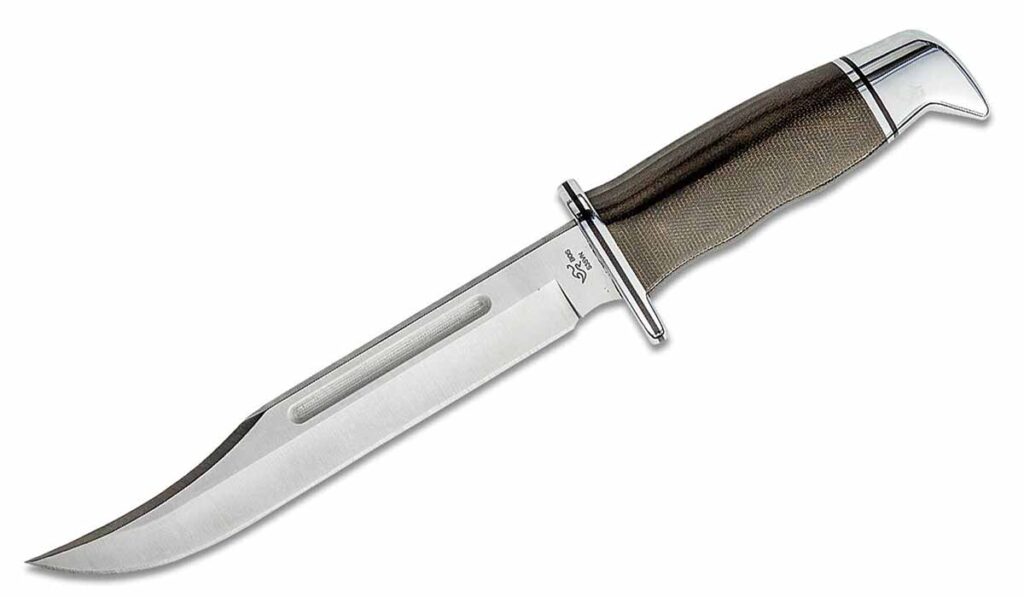
Buck Knives General Pro
Any article talking about outdoor knives isn’t complete without a mention of a Buck knife. The company has been synonymous with the great outdoors since its inception. Its model 120 General Pro is one such knife, built to take whatever the great outdoors can dish up.
Crafted with a blade made from premium CPM S35VN stainless steel, the General Pro is built for hard use in all environments. Measuring a little over 7 inches in length, the clip point blade has a hollow grind, pronounced swedge, and a milled-in fuller, giving the knife its aggressive look. The handle is made from OD green canvas micarta for the ultimate all-weather grip.
The signature aluminum guard and pommel, present on all Buck fixed blades, cap off the handle’s construction and appearance. The General Pro excels at camp food prep, whittling, some chopping, and baton work for wood splitting. At 12 inches overall, it’s the perfect large fixed blade to have when you hit the great outdoors. It is accompanied with a sewn leather sheath, as is common with all Bucks.
The General Pro is the tonier model, but if it’s out of your price range, the General model offers the same design only with 420HC stainless steel blade, black phenolic handle and lower price.
MSRP: $128
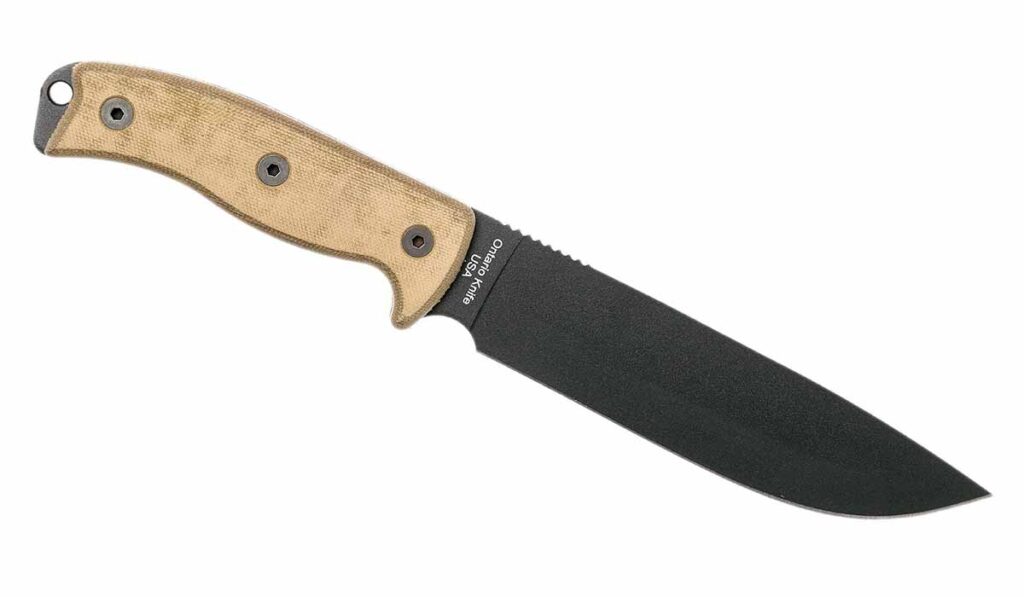
Ontario RAT 7
Ontario’s collaboration with Randall’s Adventure & Training has yielded a very highly successful series of folding and fixed-blade knives that are aimed solely at outdoor adventures. One such example is the RAT 7. The fixed blade is a larger knife that can handle all of your camp chores and some food prep. But tough work like chopping and batoning wood is what the RAT 7 is built for.
The 7-inch long, flat ground, drop point blade is ground from 1095 carbon steel and given an epoxy powder coating to keep rust and corrosion at bay. The handle is a tan canvas micarta, an excellent choice for outdoor knives because it is fully synthetic and is impervious to moisture, cracking, and gouging. The handle design itself incorporates an integral lower finger guard, an ergonomic curved gripping area, and an exposed pommel with a lanyard hole. There is also a forward choil at the tang so you can employ a choke grip for more control over the blade.
Each RAT 7 comes with a nylon belt sheath that features an exterior accessory pocket for storage of a sharpener, folding knife, or additional survival supplies.
MSRP: $135
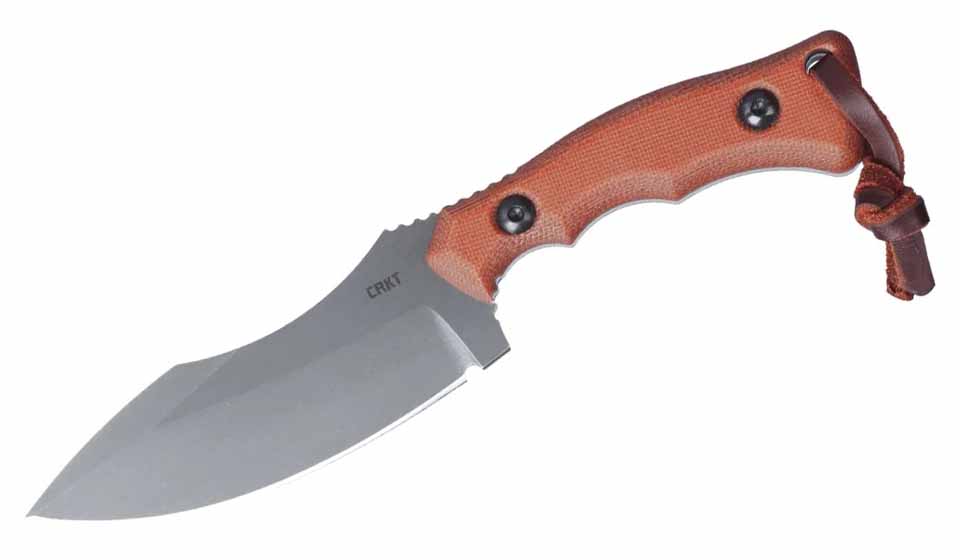
CRKT Bugsy
Designed by custom knifemaker and Discovery Channel’s Naked and Afraid star Kaila Cummings, the Bugsy is CRKT’s first USA-made fixed blade in the lineup. The knife receives its moniker from Cummings’s first appearance on the TV show when she received numerous big bites in the jungle in Colombia.
Featuring a 1095 carbon steel harpoon-style blade and a micarta handle, the Bugsy is as at home in the outdoors as it is an EDC fixed blade. With a blade length of a hair under 4 inches, the Bugsy is sized appropriately to take on most tasks inside camp or at home. Again, like some of the fixed blades discussed here, 1095 is used due to its low cost-to-performance ratio. It’s easy to resharpen in the field and offers reasonably good edge holding, which makes it a favorite amongst outdoor users.
The highly ergonomic handle showcases multiple finger grooves and an expanded butt end capture your hand to provide a secure, non-slip grip. Micarta is used due to its dimensional stability and excellent all-weather qualities—necessary for an outdoor use knife.
A leather fob is tied to the handle and acts as a handle extension for those with larger hands.
Accompanying each Bugsy is a high-quality leather sheath that holds the knife securely and at your side. There’s also a tactical version of Bugsy that features a black-coated, part-serrated blade and black G-10 handle. It comes with a black Kydex rig for belt carry.
MSRP: $200 Origin: USA
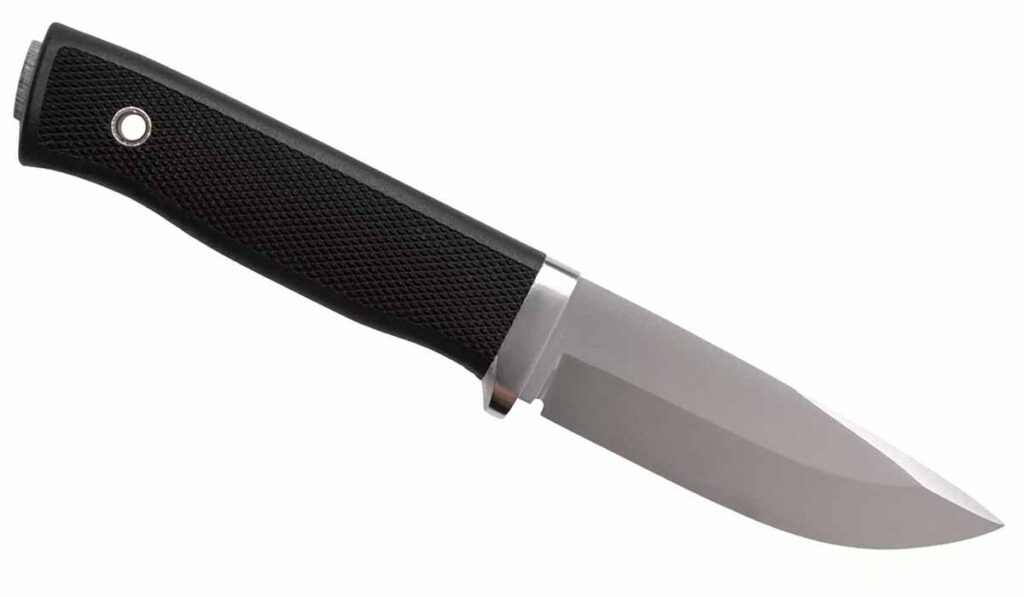
Fallkniven F1 Pro
For those not familiar with Fallkniven, it is a Swedish knife manufacturer with among the best-kept secrets in the production knife industry—its fixed blades. These tools are elegantly refined and yet sport blade and handle designs geared towards the practical. Like anything European, Fallknivens are a bit costly but are very worth it. You get what you pay for and then some.
Fallkniven’s F1 Pro fixed blade is a straightforward utility done up to the next level. The drop point blade is 4 inches in length and is ground from premium high-end ELMAX stainless steel, ensuring edge longevity and durability.
The handle is made from a polymer called Thermorun, a molded material soft to the touch. It sports checkered texturing that grips your hand back regardless of weather conditions. Hot, cold, wet, or dry…the Thermorun handle ensures a sturdy, comfortable purchase.
With an overall length of 8 and ½ inches, the F1 Pro carries very well in its hybrid molded Zytel sheath with nylon webbing belt loop. A secondary button snap strap secures the handle in place.
MSRP: $408
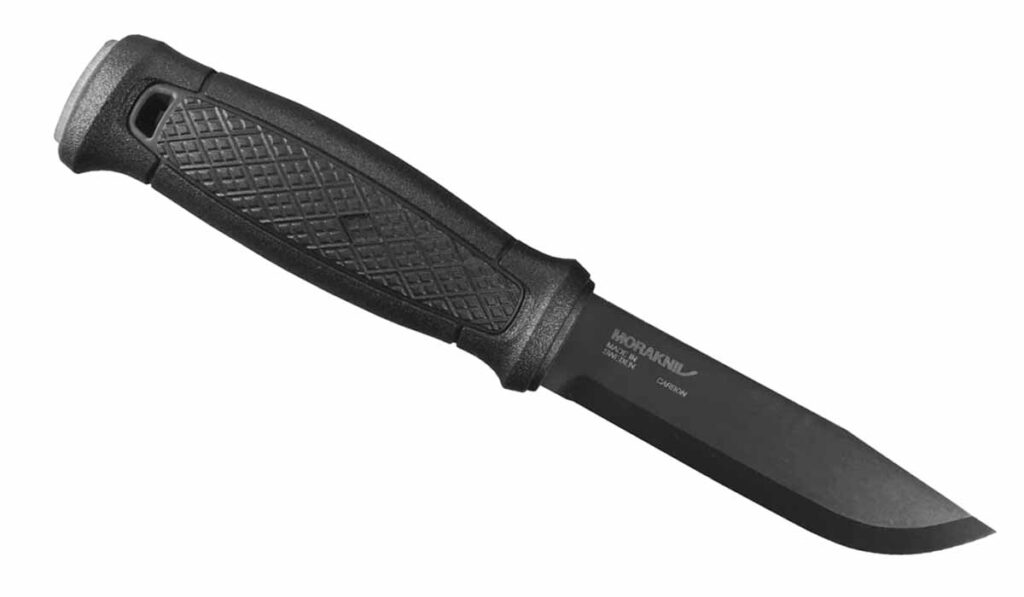
Mora Garberg Carbon
One of the best values in high-quality fixed blades undoubtedly is Mora, another Swedish knife manufacturer. Mora’s knives are highly functional and well-designed, yet they sell at prices anyone can afford. They are what I recommend to folks who want a good quality knife without breaking the budget. Mora’s Garberg is one of the company’s larger knives and is designed and built for survival and camping.
Starting with the blade, the modified clip point is made from carbon steel for ease of sharpening and is given a Scandi grind for optimum cutting performance and blade strength. The blade measures a hair over 4-inches long, which is enough to take care of most cutting tasks while being easy to carry. The blade is given a black coating to help protect it from corrosion since it isn’t stainless steel. The handle sports a full tang construction, the Garberg is the first Mora model to feature a full tang. This means the knife can withstand harder use than the other Mora knives.
The handle has a dual molded construction with molded Polyamide and hard rubber, for a durable and weather-resistant grip. The handle has rounded contours, which makes it easy on your hand for extended use. This handle design and construction is typical across the Mora knife line and is proven to be durable and comfortable in the long run. The sheath that accompanies the carbon steel Garberg is a nice leather sheath that protects the knife and allows the user to carry it conveniently.
MSRP: $130
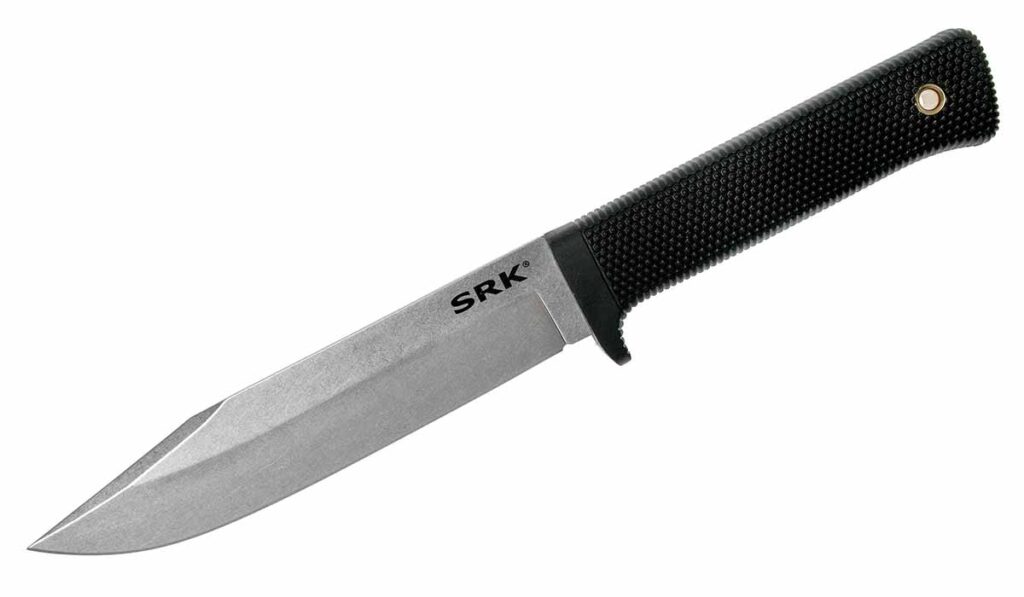
Cold Steel SRK
Those of you into knives for a while have heard of Cold Steel. It has been around for a long time and so have some of the company’s classic designs such as the SRK (Survival Rescue Knife). Don’t let the name fool you though, this knife also excels at camp chores as well as any cutting task indoors or out.
The 6-inch blade is ground from SK-5 carbon steel and given an epoxy coating to protect it from the elements. SK-5 is a Japanese steel that is roughly equal to 1080 carbon. The clip-point blade is straightforward, but pure utility all around. It can pierce, score, and slice its way through all your camp-cutting tasks.
The handle is a molded rubber-like material that Cold Steel calls Kray-Ex. It sports checkered texturing for the ultimate grip regardless of weather conditions. An integrated, lower hand guard prevents your hand from sliding forward. The handle color is available in black, tan, and OD green to suit your personal preferences and primary use environment. The overall length is a little over 10 inches, making this a larger fixed blade, and it’s ideal for hard-use applications. Each SRK comes with a molded Secure-Ex sheath which is very similar to Kydex, allowing the sheath to be form-fitting and securely carry the SRK without rattle.
MSRP: $62
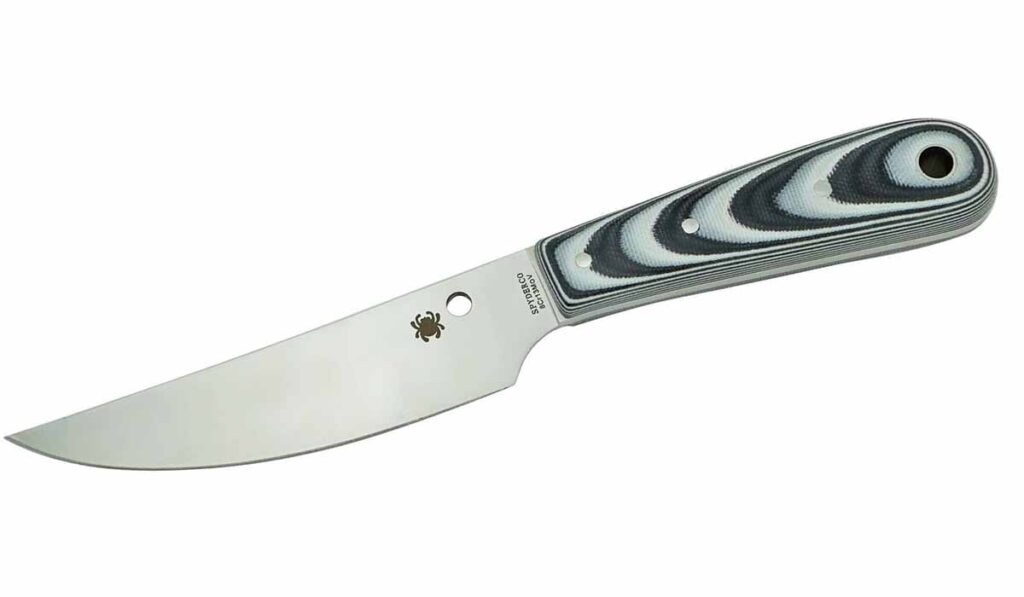
Spyderco Bow River
The Bow River from Spyderco is an affordable fixed blade in the SPYDERCO lineup that has great potential. Its trailing point blade style is highly adaptive to hunting, bird and trout, as well as general food prep in camp.
The blade is 4.4-inches long and is ground from 8Cr13MoV stainless steel, which is the Chinese equivalent of Japanese AUS-8 stainless. 8Cr13MoV is easy to sharpen out in the field and offers reasonable stain resistance. It’s a good middle-of-the-road production stainless steel, favored by quite a few production brands. The full flat grind ensures optimum cutting performance through a variety of foods and meats. The trailing point blade design offers a continuous blade belly that works excellently with food prep, facilitating ease of slicing motions. At an overall length of 8.1 inches, the Bow River is an excellent choice for a fixed blade that carries easily and won’t break the bank.
The handle is black and gray G-10, with alternating color layers that produce an interesting wood grain visual effect when the handle is contoured. The handle is rounded and contoured to lay in your hand easily and very comfortably. You can get a good grip on this shape, even though it lacks any texturing. Each Bow River comes with a sewn leather belt sheath that carries the knife, ready at hand for any task.
The author takes his Battle Blade to the next test level and up.
Ever since I started writing for BLADE® in 1990, I generally stick to similar cutting media to check the performance of the knives I test in “Spec Sheet.” That way it gives me a baseline as to how the different blades and their steels should perform. However, as a writer, I find it sometimes gets old doing the same testing. So why not beat the heck out of one of the test knives?
Well, first off, the knives are owned by someone else. They might be scheduled to be sold. You can see why I only push Spec Sheet test knives to a certain point. Unfortunately, the craving to give a test knife a brutal workout keeps coming, only to be done during my own testing using my knives.
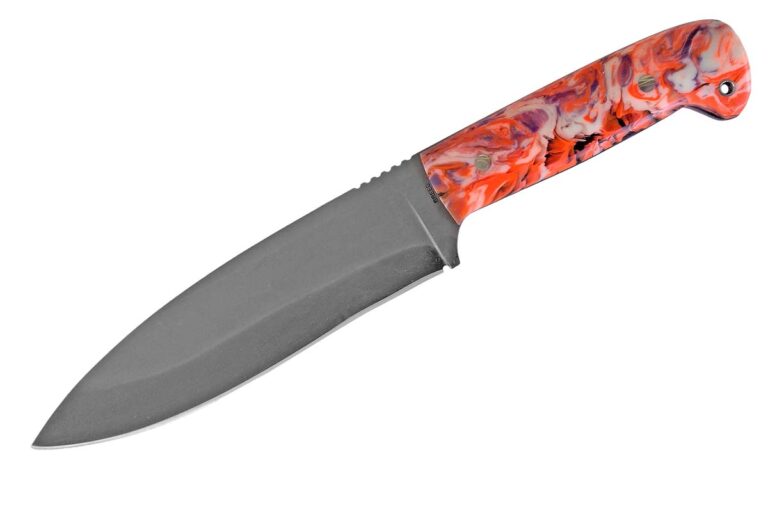
Here’s a crazy idea—I’ll test one of the knives I make! So, after pleading my case to the BLADE management, it was OK’d. Now it’s time to get down and dirty with my Battle Blade that has been my truck knife for the past year. Let the whacking begin.
Battle Blade Vs Normal Media
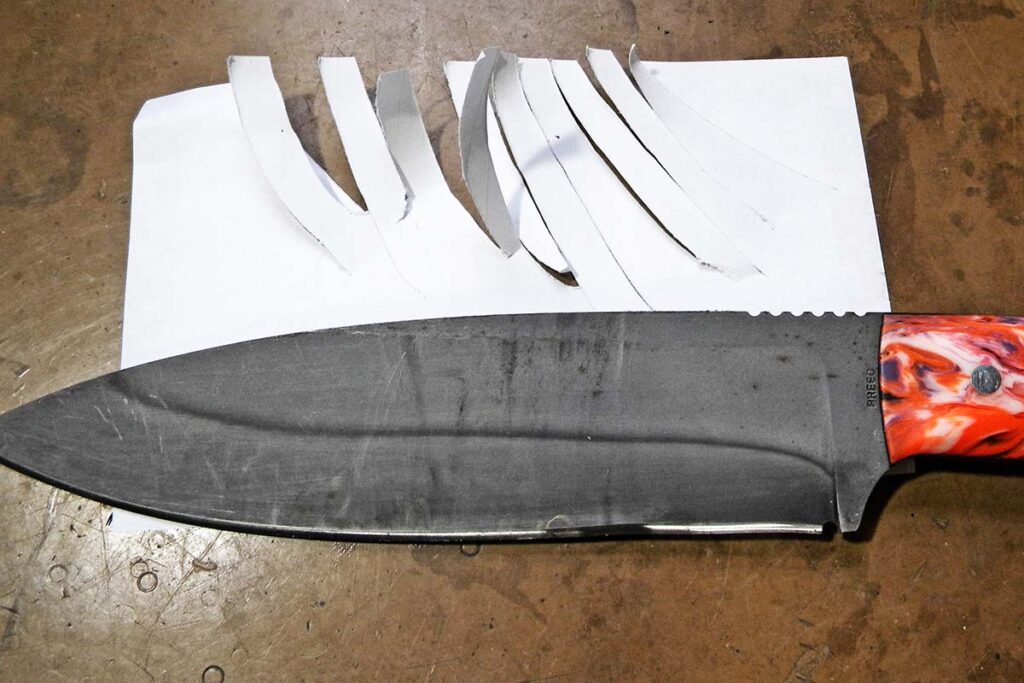
Serious whacking aside, I still executed a 20-pound-bond paper slice to show initial edge sharpness. The Battle Blade zipped quickly through the paper even with rust spots on the blade and edge. It was very smooth and aggressive during slicing.
To test initial sharpness, the author executed a 20-pound-bond paper slice. The Battle Blade zipped quickly through the paper even with rust spots on the blade and edge.
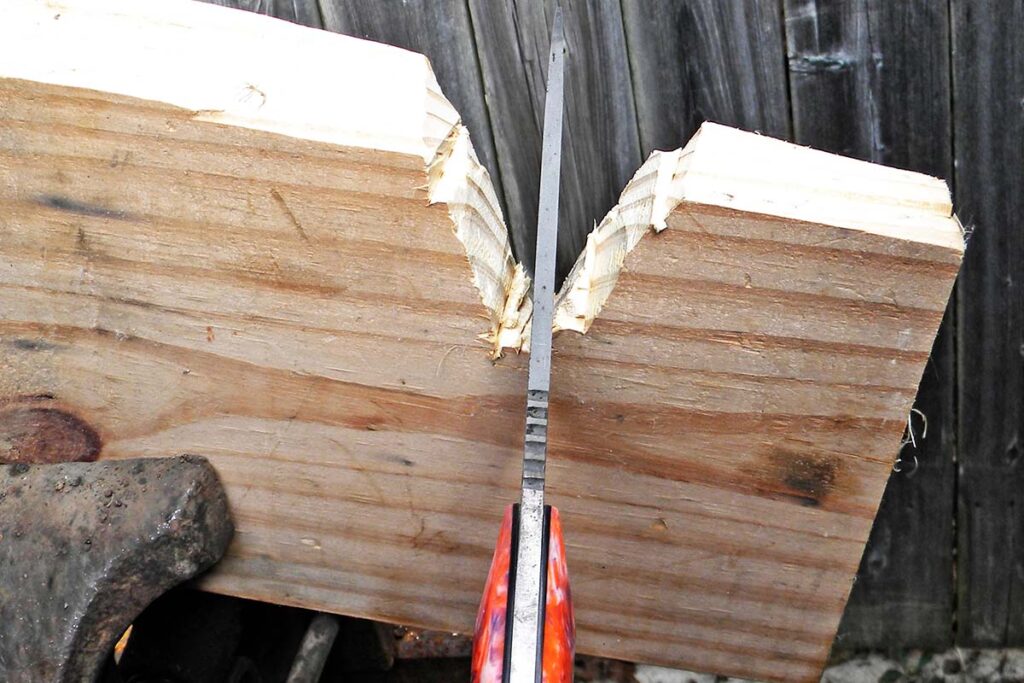
On to a nice 2×8 pine board locked in my shop leg vise. After 20 whacks I had a deep “V” chopped into the wood. The exercise didn’t bother the edge at all; it took a three-quarter-to-1 inch bite on each chop. The handle was comfortable but slightly smooth. (I should have put a thong cord on it.)
Since the whitetail antler I normally use in stories for edge whacking was all whacked up, it was time to replace it. As a result, I chopped it up into 1-inch pieces. The Battle Blade removed all the tines with nice, clean chops. The edge was still very sharp with no damage. Now I have chunks of deer antler all around my forge!
Battle Blade Vs Abnormal Media
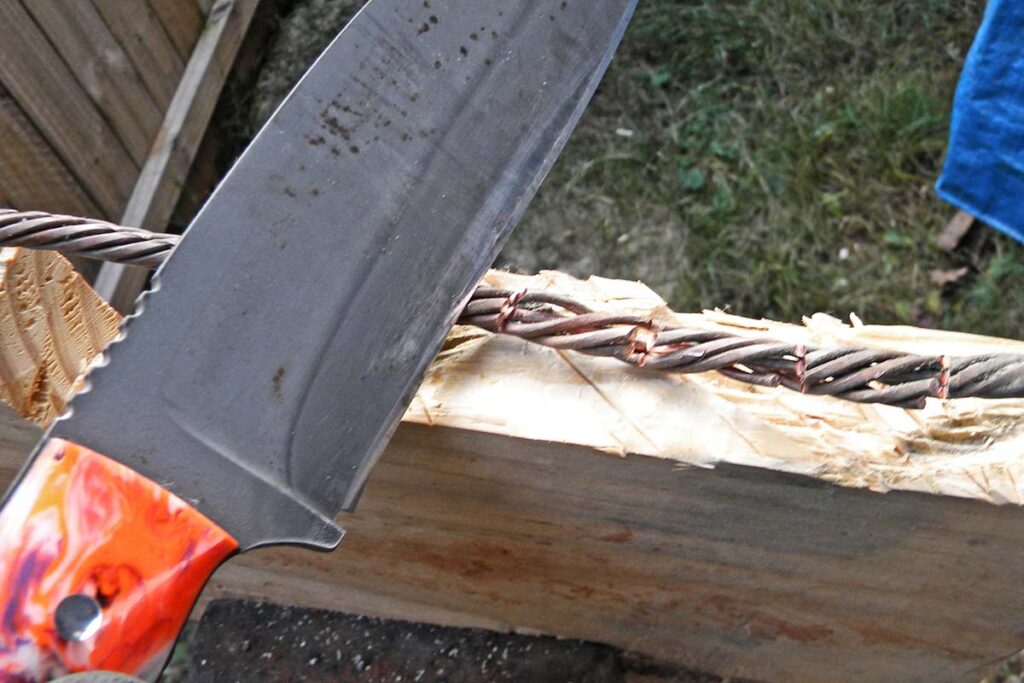
For the first “abnormal medium” I went with 3/8-inch-diameter twisted copper wire. I used the Battle Blade as a draw knife to flatten the 2×8 for a surface on which to chop the copper braid. Six hard whacks and the edge still didn’t make it through all eight wires. It seems the Battle Blade drove the last two wires into the 2×8. Note to self: use a hardwood next time. The copper braid only put a few streaks on the blade. There was no damage to the edge.
For the first “abnormal medium” the author used 3/8-inch-diameter twisted copper wire. Six hard whacks and the edge still didn’t make it through all eight wires. The copper braid only put a few streaks on the blade. There was no damage to the edge.
Next up: the acetone can stab. The Battle Blade fully penetrated both sides of the can repeatedly. I was worried about stabbing the leg vise more than any damage to the blade from the can. There were some nice scratches on the finish but the edge held up perfectly, as well as the tip.
It was time to get some steel involved: an older patio chair headed to the scrapyard, and its steel tubing. Bingo! So I dragged the chair into my forging area and prepared to trash my Battle Blade. Swinging as hard as I could, I chopped down into the arm of the chair. A loud clang let me know it was a solid hit. The Battle Blade bit a half-inch deep, through the top and bottom corners of the chair, along with the sidewall. I saw a little glint from the blade’s edge. Oh well! I gave the chair arm seven more very hard whacks. The edge had two little glints of rolls and three very small nicks.
After 20 whacks the Battle Blade had a deep “V” chopped into the 2×8 pine board. The edge took a three-quarter-to-1 inch bite on each chop and emerged unscathed.
The edge still felt sharp, so I returned to the 20-pound-bond paper slice. The edge sliced the paper, though not as smooth as at the start. I’ll take that anytime.
Final Cut
I’m very happy with the performance and feel of the Battle Blade. Normally I use a better gripping handle material for this model but this one’s mine. It had to be bold. The only change I’ll make, thread some cord through the thong hole for a more secure grip.
Battle Blade Specs Maker: Breed Custom Knives Blade length: 75/8” Blade material: 80CrV2 carbon steel Blade grind: Full flat Blade @ thickest: 3/16” Blade finish: Bead blasted Heat treatment: Differential Handle material: Swirl by J. Hue Customs Weight: 15 ozs. Overall length: 13 1/8” Sheath: Kydex w/Ulticlip Weight w/sheath: 1.25 lbs. Maker’s price for a similar knife & sheath: $450
See why the hot powder metallurgy steel is all the rage in knives.
You might have heard that CPM MagnaCut is the latest in high-end blade steels. You might have seen that knives with MagnaCut blade steel have been selling fast. Everyone wants MagnaCut! But what exactly is it?
What Is Magnacut Steel?
MagnaCut is the latest super steel offered by Crucible Materials of Syracuse, New York, the same folks who make such high-end blade materials as CPM S30V, S35VN, S45VN, CPM 154, 20CV, 3V and others. Metallurgist Larrin Thomas, winner of the BLADE Magazine 2024 Publisher’s Award, invented MagnaCut. His objective was to create a stainless blade steel whose properties are balanced and that would perform well in the critical areas of edge holding, corrosion resistance and toughness.
With other high-end steels there’s usually a degree of give and take where you might sacrifice a bit of one characteristic to gain more in another. This is something knife folks have endured for so long that they’re used to a certain degree of compromise in order to get a blade steel suitable for their needs. Simply put, MagnaCut could very well be the steel that has all the characteristics knife guys want in a blade material. Basically, it’s their dream steel come to life.
Compared with other CPM steels, MagnaCut has less toughness, though don’t look at that as a bad thing. It’s actually very good in that MagnaCut is easier for a knifemaker to work; that is, it grinds and drills easier. On the knife user end, it means MagnaCut is easier to resharpen than other CPM steels whose toughness rates higher. Still, I recommend using diamond abrasive sharpeners on MagnaCut to obtain the best results.
See now why MagnaCut is all the rage in the knife industry? Just about every major manufacturer is using it and even some custom makers. The switch to MagnaCut can be seen as a way for manufacturers especially to level up the performance of their knives.
Kershaw Launch 17
The Kershaw Launch 17’s clip-point blade in MagnaCut offers great utility for a wide variety of cutting chores.
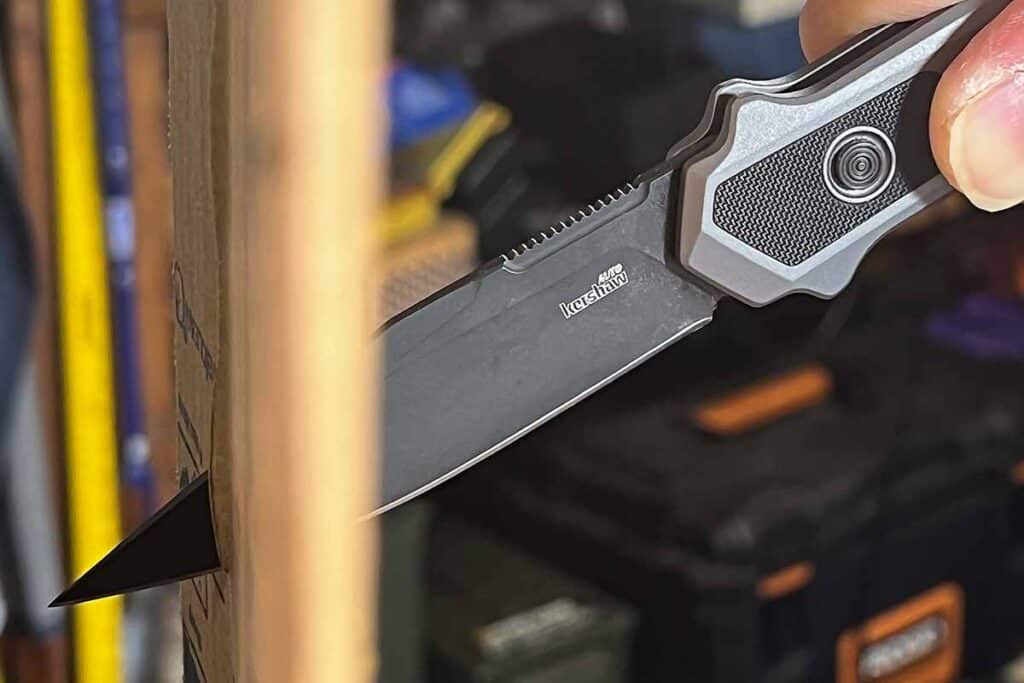
Among the latest factory knives to offer MagnaCut blade steel is the Kershaw Launch 17. The Launch 17 presents a slender carry handle profile with a highly usable 3.5-inch clip-point blade. At 5 inches closed the Launch 17 is on the bigger side of EDC knives, but its svelte handle makes it very comfortable to carry. The flat-ground blade is a great working shape that tackles just about any cutting chore.
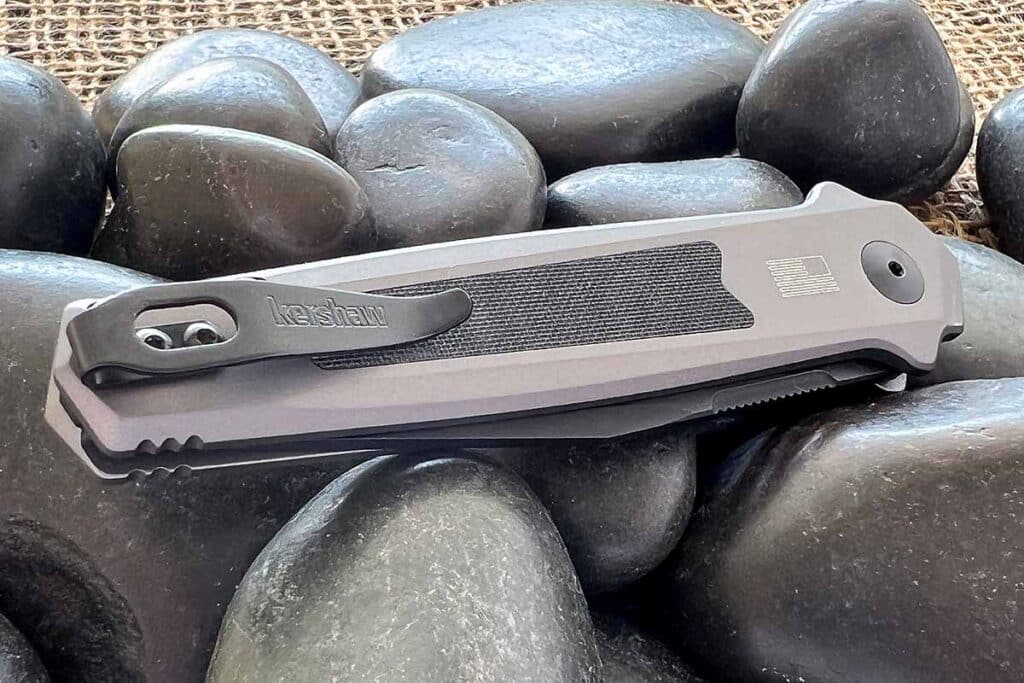
The handle is machined T6 6061 aluminum anodized grey and features textured black G-10 inlays for a neat contrast of color as well as purchase. The grip is symmetrical and an integral double guard keeps your hand in place. The handle is mainly an open-frame construction that allows easy cleaning with compressed air or water, and a clip mounted at the butt provides very deep pocket carry for ultimate concealment.
The deep-carry clip of the Kershaw Launch 17 allows the knife to sit very low in the pocket for ultimate understated carry.
The only downside I see is the placement of the firing button. I want to grab the handle in a way that my thumb falls right into the button. I had to consciously readjust my grip to where I hold the handle a bit further toward the butt so my thumb falls just behind the button. It’s not really a big deal and certainly not what I would call a dealbreaker, but just something to be aware of.
The clip point blade is one of the knife’s key selling points. An excellent shape for general use, it has a defined point for scoring and fine cutting tasks, and there’s plenty of edge real estate to tackle your toughest chores quickly. The opening action is quick yet with very little recoil. The lockup is very tight with zero play. The Launch 17 makes a great EDC auto that’s light both in the pocket and on the wallet. MSRP: $239.99.
Kershaw Launch 17 Auto/Folding Knife Clip Point, Gray – Smooth Action for Easy Use – 7951
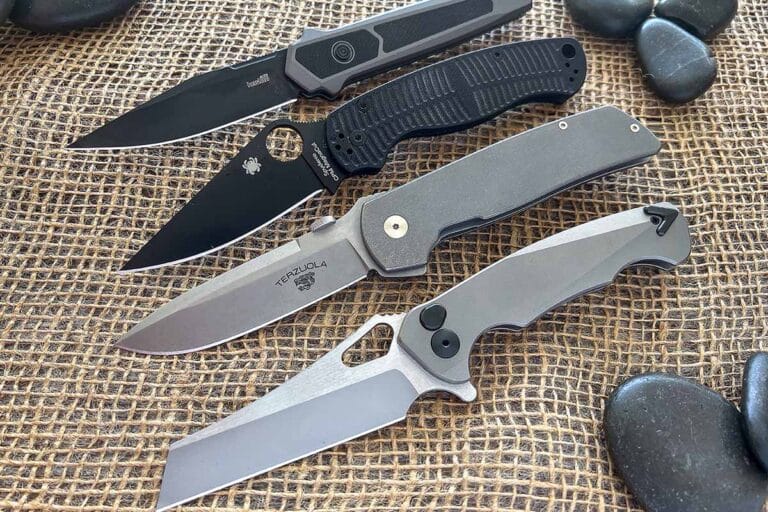
The ATCF Original Gangster from Fox in MagnaCut blade steel is an homage to Bob Terzuola’s iconic custom ATCF tactical folder. The initial Terzuola ATCF helped define the tactical folder era by incorporating features that are now standard with many folding knives of the genre.
BLADE Magazine Cutlery Hall-of-Fame® member Bob Terzuola introduced his quintessential custom tactical folder, the ATCF (Advanced Technology Combat Folder), in 1986-87. It is Terzuola’s best-known folder and most imitated design. The original included a host of features that are now standard on any top tactical folder, custom or production, including screw-together construction and a notched thumb ramp for aid in a nonslip grip and applying pressure for power cuts. It also incorporated a checkered thumb disc for ambidextrous blade deployment.
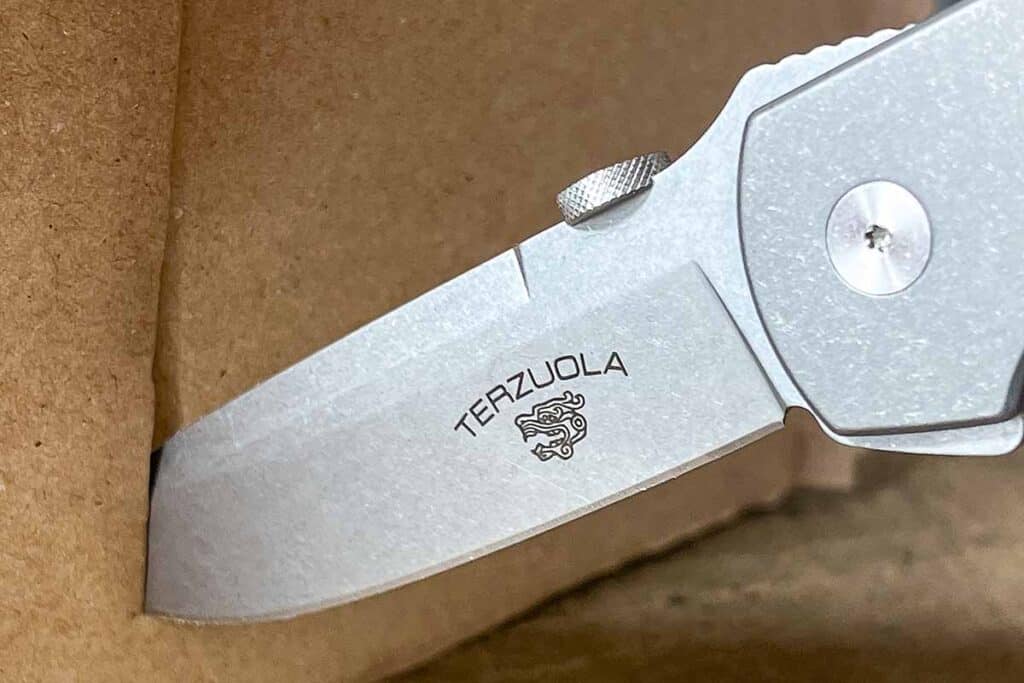
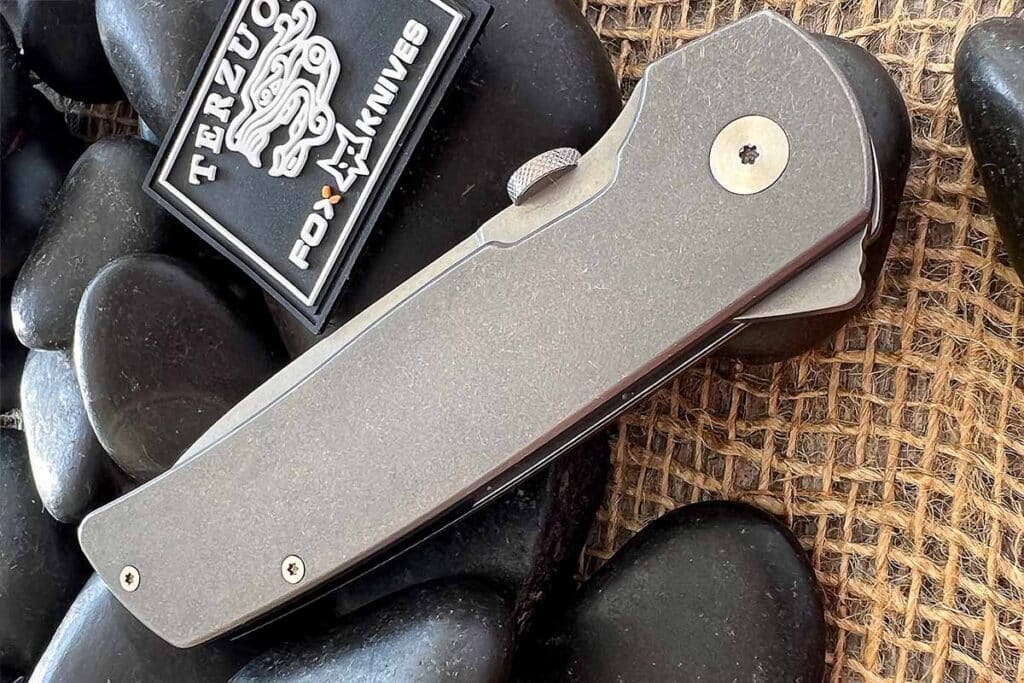
Fox Knives teams with Terzuola to release the ATCF Original Gangster. The knife is built almost exactly the way Terzuola builds his custom version, complete with the aforementioned features as well as MagnaCut. The 3.5-inch modified drop-point blade has a swedge. The addition of a flipper tab ushers the ATCF OG into the modern tactical realm and provides two blade-deployment options: ambidextrous thumb and flipper opening. The test sample is the SQ-ATC-OG01 with a titanium handle and stonewashed blade. The blade rides on bearings for ultra-smooth action. Like the addition of the flipper, this is also a modern innovation incorporated into the reproduction of the legendary folder.
The Fox ATCF Original Gangster features a flipper tab to aid in quick one-hand deployment. This was not a feature found on Bob Terzuola’s original ATCF design but rather incorporated by Fox as a modern convenience.
With its integral forward guard and slanted butt, the handle is another Terzuola signature design. The titanium scales have a matching stonewash finish and are devoid of any machining—just smooth titanium that’s comfortable in-hand. The lock is the tried-and-true linerlock. The blade-tip-up-carry clip secures via a single T6 Torx head bolt and is held in place inside a machined cavity that captures the clip and prevents it from rotating. Before you complain about the clip not being reversible, remember that the ATCF was introduced at a time when pocket clip folders were still a relatively new concept, much less ambidextrous clip carry. A solid G-10 spacer rounds out the look and leaves most of the handle spine open for easy cleaning. A pin recessed in the butt accepts a lanyard, though standard 550 cord is too thick to fit.
Everything works on the knife, from the integral single guard to the thumb disc for ambidextrous opening. The flipper works well, too. I like the drop-point blade, an all-around favorite of mine for a variety of tasks. It’s highly adaptable, from utility to survival to tactical. The titanium handle has a nice heft and it’s pure function with no additional machining or coloring added. It just works. Country of origin: Italy. MSRP: contact Fox for more information.
Spyderco’s Para Military2 Salt Black G-10
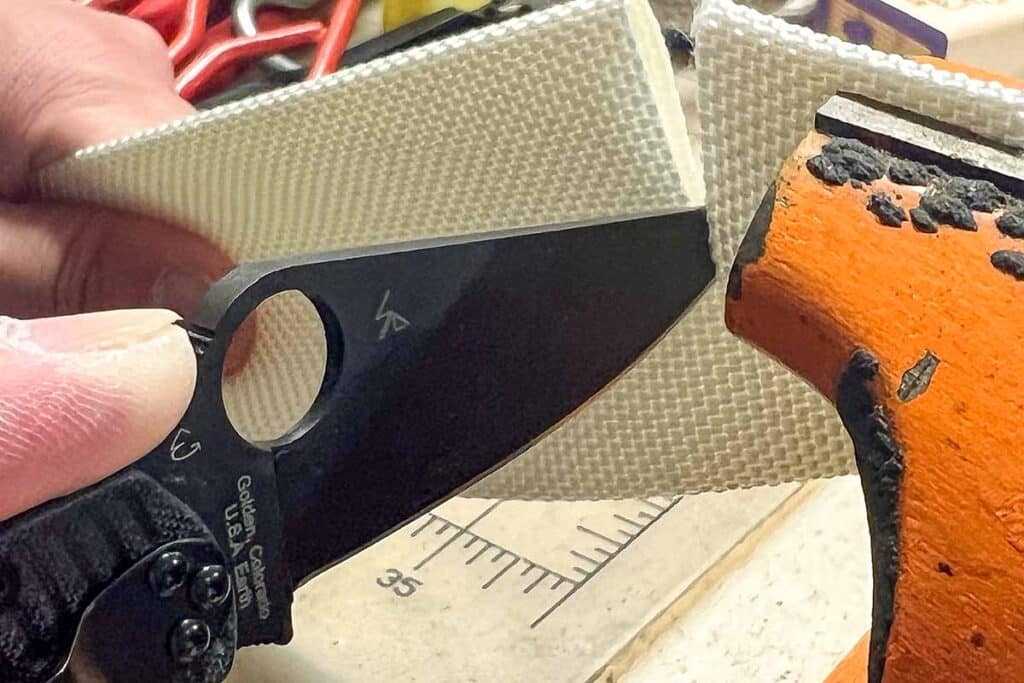
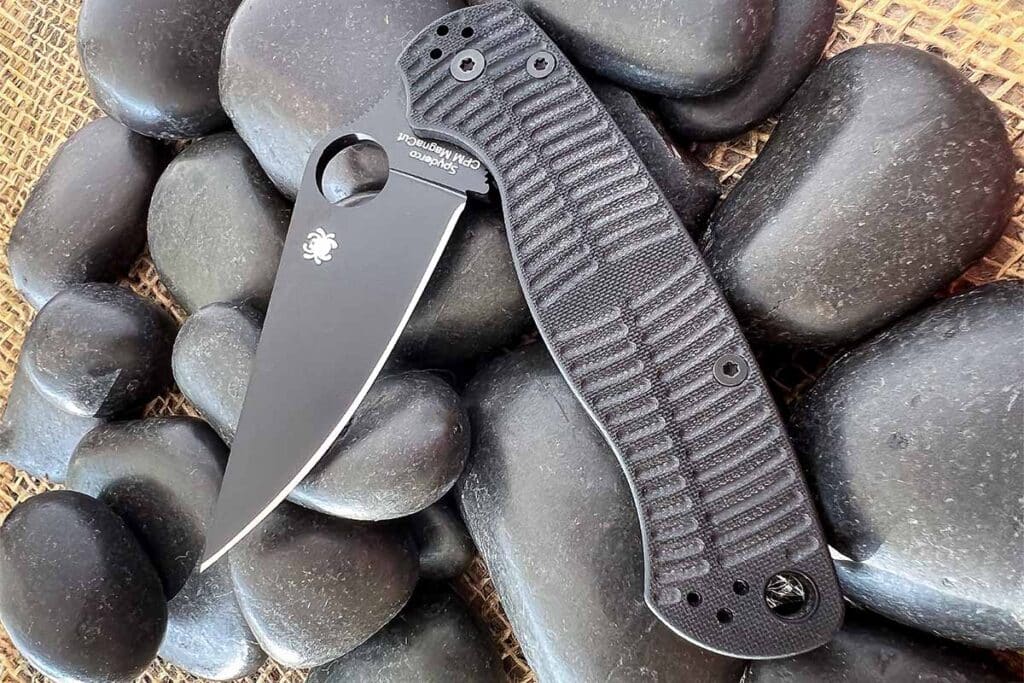
The Spyderco Para2 Salt has a full-flat ground blade of CPM MagnaCut stainless steel with a distal taper that allows the knife to be an extremely effective slicer with aggressive bite, perfect for tough tasks like cutting through fire hose material. It is the BLADE Magazine 2024 Most Innovative American Design.
The BLADE Magazine 2024 Most Innovative American Design, Spyderco’s Para Military2 Salt Black G-10 is in the company’s line of corrosion-resistant knives designed especially for fresh water and saltwater environments. It is basically a regular Para2 with the addition of MagnaCut blade steel and other steel parts such as liners, pocket clip, screws and standoffs covered in a black protective coating to boost corrosion resistance.
The 3.45-inch blade is a great size for a work knife. It’s not too long nor too short. A large blade hole aids in easy thumb opening and works well if you’re wearing work gloves. The blade secures open via Spyderco’s Compression Lock, which is designed to be both strong and easy and comfortable to operate. The blade’s full flat grind allows it to sail through a host of media, and right out of the box is razor sharp and ready to work. That’s one thing about any Spyderco knife—the blade shapes and grinds are optimized for high-performance cutting.
The Para2 Salt’s machined handle grooves offer enhanced traction even with wet hands. The texture is a nice extra touch for a working knife.
The handle surface is machined in a radial groove pattern that distinguishes the knife as a premier member of the Salt Series. Spyderco calls it the Caribbean Bi-Directional Texture pattern and it greatly enhances grip traction, more so than standard peel-ply texturing. An excellent choice when dealing with wet hands, the grooves channel water away for a surer grip. The handle includes four-way pocket-clip mounting, open spine construction and a Compression Lock. Releasing the lock is super easy and can be done with one hand, as well as closing the blade. The way you release it keeps your fingers out of the way of the blade’s rotation path, therefore negating accidental cuts. The Compression Lock is a rock solid design, one of the best locks around.
The full flat grind coupled with a distal taper of the blade from tang to top make the Para2 Salt a lean cutting machine. It goes through most any material, thick or thin, with ease and little force—a sign of a well-engineered blade. Not only is the blade shape very efficient but the handle design is, too. It fits my average-sized hand very well and instills true user confidence in its comfort and safety. Country of origin: USA. MSRP: $315.
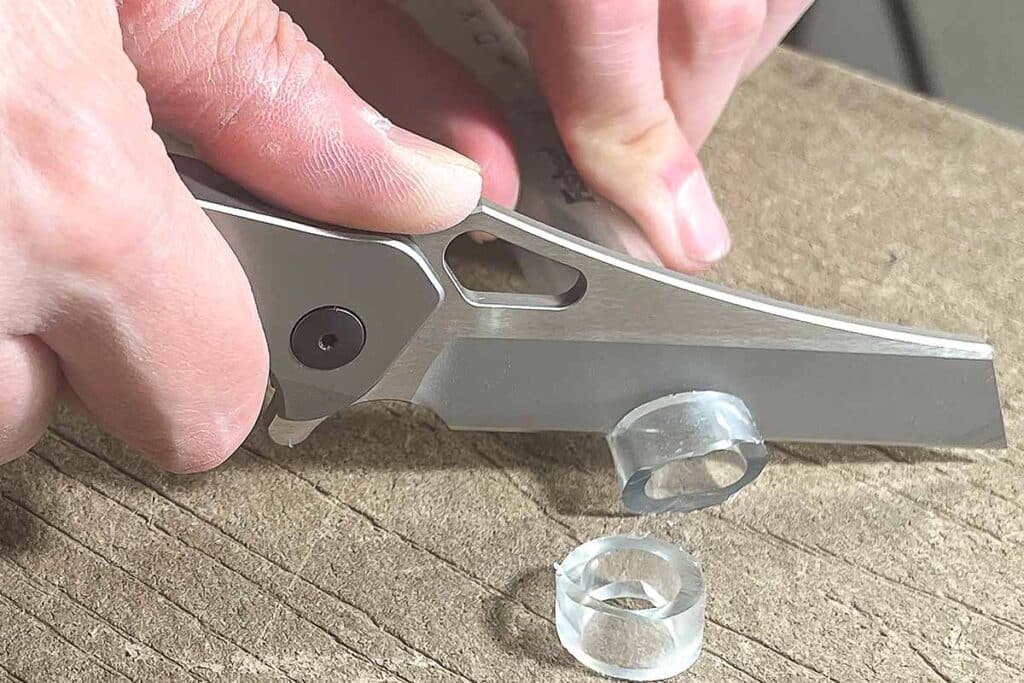
The Dead Reckon Ridgeback’s canted MagnaCut blade allows for greater knuckle clearance when working on a flat surface.
Dead Reckon is a new knife manufacturer and the Ridgeback folder is its first offering. There’s a lot going on with this folder, from the button lock mechanism, flipper opening and sealed bearings in the pivot to the integral handle. Crafted in the company’s Grove City, Ohio, facility, each knife is precisely and carefully manufactured to high standards that would satisfy the pickiest knife enthusiast.
An example is the Ridgeback in its “wharncleaver” blade and integral titanium handle. The 4.1-inch MagnaCut blade is of a hybrid wharncliffe/cleaver pattern with a distinctive slant nose tip and straight-line cutting edge. The knife offers two methods of opening: flipper tab and oblong blade hole. Whatever method you prefer, the blade operates smoothly thanks to the sealed bearing pivot. Just ahead of the flipper is a cutout for choking up for precise control.
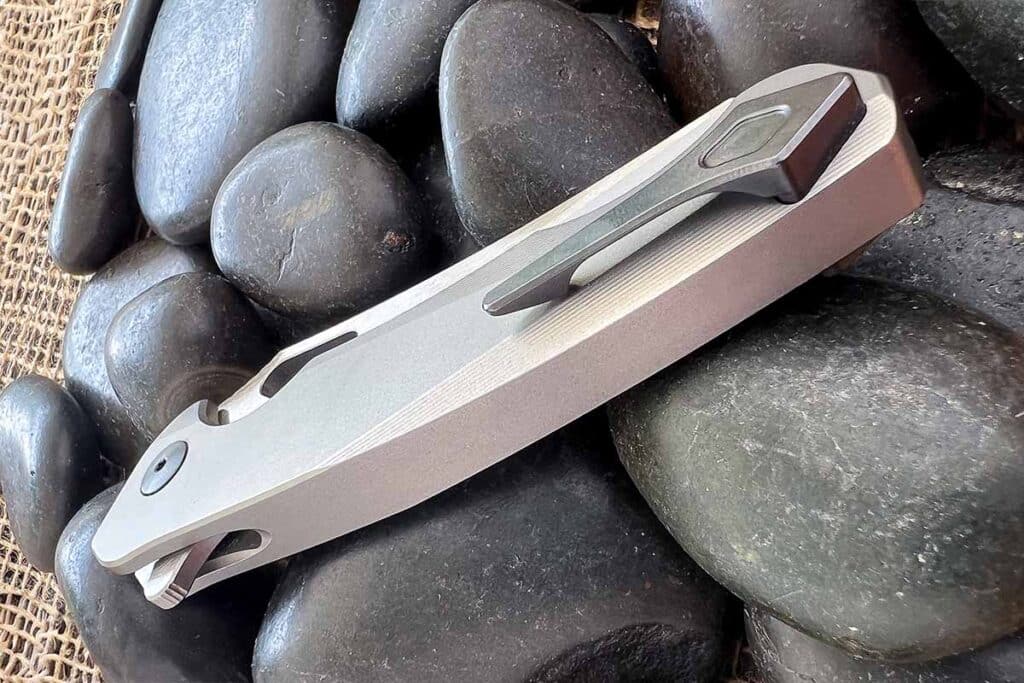
The handle is Grade 5 titanium, which is 6Al/4V titanium alloy. It is of an integral construction, which is difficult to manufacture. Only one other company I know of has pulled this off successfully. The Dead Reckon production staff takes one billet of titanium and machines the channel in the middle where the blade rests in the closed position. It’s all one piece with no assembly screws. It’s a very strong handle design and the lack of screws makes for a very clean appearance.
On most knives the pocket clip is a stamped and bent piece of steel. Nothing fancy or flashy but utilitarian. The Ridgeback clip is of a milled titanium that sports a very cool-looking geometric shape. It is quite eye catching, not an afterthought but an aspect that adds to overall appearance. The clip is at the right tension to hold the knife to the pocket without it wanting to slip out, while the ability to remove the knife remains fairly easy—the best of both worlds!
The one-piece handle construction of the Dead Reckon Ridgeback allows for a very strong grip but requires considerably more machining time than a standard handle, and therefore is more expensive.
For a very utility-friendly blade shape, the wharncleaver is it. There’s a lack of a defined blade tip, though there is one of sorts at the front of the cutting edge. Using a gentle pulling motion, you can use it to score materials easily. When cutting full on, the straight-line edge does so smoothly. With multiple grip options and a notched thumb rest, along with the cutout, this knife is easy to adapt to the cutting scenarios at hand.
Want more power? No problem. Use the thumb ramp to place more pressure on the blade. Want more control? Choke up on the blade using the finger cutout. The canted blade makes the Ridgeback more comfortable to use on a flat surface by offering enhanced knuckle clearance. You might think the appearance is a bit weird but don’t knock it until you try it. Country of origin: USA. MSRP: $475.