Whether A Stone, A Rod, Or An Electronic Device, There Are Many Quality Knife Sharpeners Out There. Here are five of the best.
There are all sorts of knife sharpeners out there. Some can fit in your pocket. Some are full-on appliances. Some are literal stones. No matter the type of sharpener you use, it’s important to make sure you get the best bang for your buck.
That’s why we’ve scoured the world of sharpeners to show you a variety of the five best out there today. Whether you’re looking for something quick and easy to give your knives a once over or a sharpener the pros use, there’s a knife sharpener out there for you.
Chef’s Choice Model Trizor 15XV 3-Stage Professional Electric Knife Sharpener, Platinum
Chef’s Choice Model Trizor 15XV 3-Stage Professional Electric Knife Sharpener, Platinum
The first one on this list could be called the Cadillac of home knife sharpeners. Named the best knife sharpener by numerous organizations including America’s Test Kitchen, the Trizor 15XV by Chef’s Choice is a beast of an electric knife sharpener.
It utilizes three separate stages to sharpen, hone, and polish your knives. It sharpens using proprietary diamond abrasives and then stropping discs to polish. It even adjusts between 15 and 20 degrees so you can sharpen multiple types of knives.
Yes, this is made for chefs and their kitchen knives but it’ll sharpen your EDC knives just as well. It’ll even sharpen serrated knives too! While it can’t sharpen ceramic knives or larger outdoor blades like axes, it does pretty much handles any other edge in your home or workshop.
It is pricey with an MSRP of $179.99, but if you want to sharpen like the pros you won’t find a better option on the market today.
Sharp Pebble Premium Whetstone 2 Side 1000/6000 Waterstone
Sharp Pebble 1000/6000 waterstone
I love sharpening my knives freehand. I find it meditative, fun, and refreshing. As more and more people look to whetstones as a way to sharpen their knives, there’s a glut of products on the market.
This is the type of stone I’ve used for the last several years, and it’s an excellent entry point into whetstones. Sharp Pebble has made a quality stone out of aluminum oxide that can sharpen and polish your straight-edge knives.
Starting with the coarse 1000-grit side, and finishing with the fine 6000-grit side, you can give your knives the love and care they need to stay sharp and cut at their best.
Another reason I like this stone is its accessories. It comes with a bamboo base to keep the stone secure as you sharpen. And it comes with an angle guide if you’re not confident in being able to keep the angle steady as you grind away.
While I love using my whetstone, it can be a bit confusing to jump into at first. Luckily, popular Youtube Ethan Chlebowski goes over the most common mistakes people make while using a stone and how to avoid them.
At an MSRP of $40.99, Sharp Pebble has made an affordable stone and a great entry point for those interested.
WorkSharp Guided Field Sharpener
WorkSharp Guided Field Sharpener
Need a sharpener while hunting or camping? The team at WorkSharp has you covered with their Guided Field Sharpener (GFS). Smaller than your cell phone, the GFS is packed with features any outdoorsman can appreciate.
The sharpener comes with two stones of 320 and 600-grit diamond and a 20-degree angle guide so each pass counts. It also comes with two finishing options, a ceramic honing rod and a leather strop, to polish your blade. You can even remove the diamond sharpening plates to reveal a small storage compartment with a built-in broadhead wrench.
And did we mention it can sharpen straight-edge blades, serrated knives, and even fish hooks? It really can do it all outside for you. It even has a lanyard hole so you can carry it without worry about losing it on the trail.
At an MSRP of $34.95, you get so much for the price and the peace of mind that comes with buying something sturdy from WorkSharp.
KitchenIQ Edge Grip 2-Stage Knife Sharpener
KitchenIQ Edge Grip 2-Stage Knife Sharpener
If you’re looking for a sharpener on a budget, this little countertop sharpener packs a big punch.
Available at numerous retailers, this sharpener from KitchenIQ is priced between $10-12 and will get your knives back to a sharp edge.
It uses two angled slots, one coarse (carbide) and one fine (ceramic), for you to pull your knife through. You hold it down with one hand and pull your knife through with the other. Pulling it through 5-10 times a side should be enough to reset the edge and polish it back to new.
Your sharpening time is seconds. If you’re looking for a sharpener that’s easy to use, doesn’t take much time, and gets your knives back to fighting fit, this is the sharpener for you.
Wusthof 9-Inch Honing Steel
Wusthof 9-Inch Honing Steel
The last piece on this list isn’t a sharpener, per se. Honing steels, or honing rods, are used to fix the small, microscopic imperfections that affect a knife over time. Using a honing steel will help get the edge back to where it was before but without removing material, as occurrences when sharpening.
A good honing steel should be used a few times a week while sharpening should be done a few times a year, and you can’t go wrong with this steel from Wusthof. From a company with more than two centuries of experience making knives, the honing steel is made from stainless and will help restore the edge of your kitchen knives.
With a low MSRP of just $25, you can’t go wrong with a steel from one of the most trusted knife brands in the world.
The New Kizer Drop Bear Is An Excellent EDC, And The Clutch Lock Is A Worthy New Addition To The World Of Axis Lock Knives
In the ever-growing world of EDC knives, finding ways to stand out is difficult. So many brands, so many steels, so much of everything. And even in that crowded field, the new Drop Bear from Kizer finds ways to catch the eye.
Boasting a high-quality blade, simple handle, and innovative lock, the Drop Bear is the kind of knife you’ll want to use every day … more so, it’s the type of blade you’ll go out of your way to use.
Getting The Drop On The Drop Bear
The Drop Bear in both of its colorways: Gunsteel on top and Black, with the bright purple thumb stud, below.
First that name. For those wondering it originates from a beast of Australian folklore that–as the legend goes–drops from trees to attack humans. Pleasant.
However, Kizer’s Drop Bear (MSRP $158) allure isn’t its reference to free-falling arboreal bruins. Instead, it’s Kizer’s twist to Benchmade’s Axis™ lock configuration.
Called a Clutch Lock by the China-based company, the mechanism provides a dead-tight lockup. I put this through the wringer, but we’ll get to that in a moment. And while few locking mechanisms have ever sold a knife, this adds enough of a spin to the traditional drop point to make it stand out.
So, let’s talk a little bit about the Drop Bear’s Clutch Lock.
Clutch Player
The clutch lock seen after removing one of the scales. The lock can be adjusted, and scales replaced, in less than two minutes.
As the fidgety type, I have to confess up front I love this knife. Right off that should give some indication of what the Clutch Lock brings to the table.
Where Kizer gets it correct is by not improving an already proven system, with the blade unlocking similar to most other Axis-type locks. For those unfamiliar, a pair of buttons situated on either side of the knife–in this case behind the pivot–are retracted, thus releasing the blade. As mentioned, it’s an ideal lock for those of us who fidget.
However, Kizer has improved the system by tinkering with the pair of Gemini springs hidden beneath the scales. The rub here, their tension is adjustable. This is a big deal.
This concept is not entirely foreign to those bold enough to have skunk worked spring tension for years. Many times the results were less than optimal, which is why Kizer’s setup is desirable. Basically, you won’t make the Drop Bear a victim of shoddy kitchen-table knifesmithing.
The tension adjustment itself is simple, even for the mechanically challenged. The frame has five holes on each side in which the spring is loosened or tightened. If you want a faster open and tighter lockup, crank it up to the holes closest to the blade. Desire a looser action, dial it down.
Interestingly, and probably grasped by the mathematically inclined in the audience, the five holes on each side don’t add up to five settings. Instead, it’s 5X5 settings for a total of 25. Boy, if you can’t find what you’re looking for in that range, then nearly any knife is likely to leave you cold.
Bear Necessities
The Drop Bear is a sleek, nimble knife as seen from above.
Novel as the Drop Bear’s Clutch Lock is, it wouldn’t add up to a pile of scrap if Kizer didn’t finish the job with all the parts to make a solid knife. Overall, they make it worth the price of admission.
With a quality EDC knife in mind, Kiser outfitted the Drop Bear with a blade a shade under 3-inches long–legal in most jurisdictions. The 154CM stainless steel, again becoming popular in this role, offers a Rockwell hardness of 58-61 HRC.
Topping off this end of the knife, Kizer applies a flat grind to help create the edge. Good choice, because it comes out of the box frighteningly sharp. Outfitted with moderately sized thumb studs with plenty of clearance, this attribute is quickly deployed.
In the hand, the knife feels light–listed as 3.7 ounces–but not light as air. This is a good middle ground for this class of knife, where it feels substantial in your hand yet won’t tear the rivets out of your jean’s hip pockets.
Much of the weight savings come from an attractive skeletonized frame, under the aluminum handle scale. With an ergonomic swell toward the middle of the handle, the Drop Bear offers purchase and plenty of control.
As for aesthetics, the knife comes in two colorways. The first style is a gun steel blade with a satin finish and black thumb stud. The second has a black blade with an eye-catching purple thumb stud.
Finally, a tip-up clip keeps the knife at hand and riding deep in the pocket.
Testing The Drop Bear
The Drop Bear was a joy to test and cuts most types of material with ease.
It’s an EDC so I wasn’t going to try and chop through the vines slowly overtaking the corner of my backyard fence. I used it around the house for a few days.
It cut through plastic and tape like there was nothing there at all. It’s a perfect letter opener. The Drop Bear easily handles the daily tasks you’ll see every day. Taking it a step further, I used it as my only knife when prepping dinner for my wife and I.
First was the romaine lettuce, which the knife handled with ease. Whether holding the Drop Bear in the pinch grip like a chef’s knife or by using the jimping and pressing down with my thumb from the top down, the knife dispatched the lettuce easily.
Up next was the tomatoes, and it was the best experience I’ve had with a flat-edge knife cutting tomatoes. They were Campari tomatoes, so smaller and more delicate than beefsteak or Roma tomatoes, and the Drop Bear went through the flesh easily. This was best done in a pinch grip and got incredibly thin slices of tomato for the salad.
Celery is stiff and crunchy, and it was no problem for the Drop Bear. The chicken breast was easy too. I preferred cutting the chicken by utilizing the jimping, and the knife bit down easily and sliced through the meat without a hiccup.
My single favorite cutting task was the bell pepper. I chose to cut the pepper through the skin side as that is traditionally more difficult than cutting through the interior flesh. I have never cut through a bell pepper easier than I did with the Drop Bear. It left me thinking that this could reasonably replace a paring knife.
However, the Drop Bear did meet its match against a large carrot. The knife did not enjoy fighting through the harder, denser flesh, forcing me to switch to a kitchen knife to finish the job.
Beyond the kitchen, the Drop Bear shined. It gets through cardboard boxes like nothing. The corrugated cardboard can be the test upon which many knives fail, but the Drop Bear didn’t even blink.
Additionally, I tested it on some brand new ⅜-inch polypropylene cord. I figured that the cord would provide some sort of fight for the Drop Bear. Instead, it was a first-round knockout as the blade smoothly sliced through the rope, leaving a clean cut with little in terms of frayed strands.
As for the action, I preferred the knife a little looser and set it at the second position. And the lock, I put the strength of the lock through the ringer. I did everything I could to break it. I bent it backward, sideways, every which way I could to flex the knife. The lock held firm and never budged.
Final Cut
Overall, the Drop Bear makes the cut for me.
The knife has enough mechanical allure to make it intriguing while remaining practical. For tinkers and fidgeters, this is a big plus. For those less inclined to get wowed by engineering wizardry, Kizer’s creation still shows sharp.
The Drop Bear is more than ready to tackle most EDC jobs, though you might not want to push it too far out of its comfort zone. What knife isn’t that true for? But for the price, it seems Kizer has hit the mythological sweet spot for this class of knife.
Cutting-Edge Karambit-Style Knife? Or Dull Player? The author searches for his cutting mojo with the Hawk Creek Blade E-VAC.
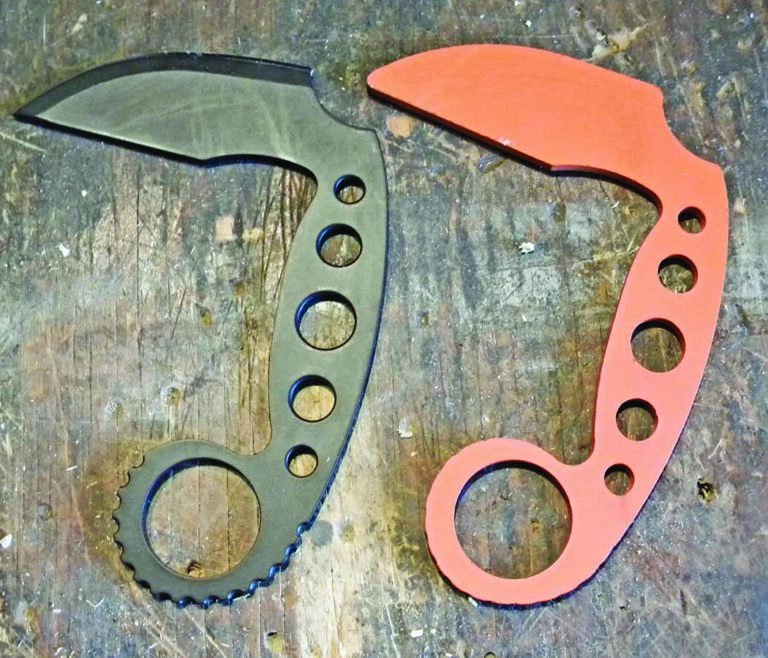
Though karambits/ringed knives are popular, I am not a fan. New from an equally new knife company—Hawk Creek Blade E-VAC is such a special-use knife, and it requires practice to use it to its full potential.
Normal cutting situations just don’t feel right to me with this knife pattern. I’m sure that with enough repetitions—that’s why they provide a mild steel training blade with the standard version—it would feel normal during most cutting chores.
Hawk Creek Blade E-VAC Edge Test
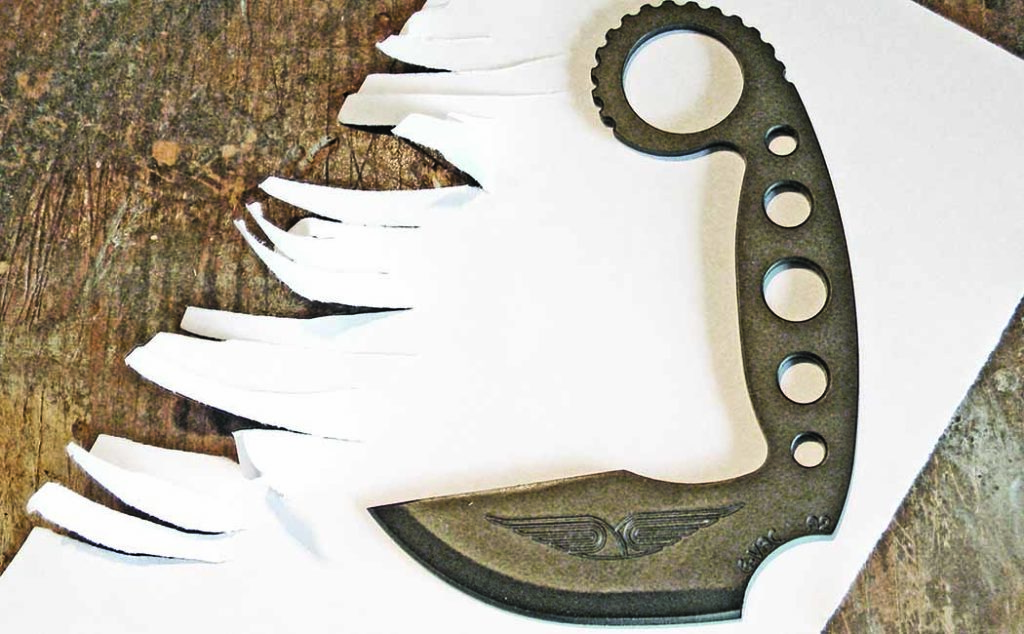
In slicing 20-pound bond copy paper, when the author got the cutting angle correct he was rewarded with an aggressive slice. When he got the angle wrong, the result was more of a torn slice.
In slicing 20-pound bond copy paper, when I got the cutting angle correct I was rewarded with an aggressive slice. When I got the angle wrong, the result was more of a torn slice. I need more practice with the E-VAC to get the hang of it.
E-Vac Heavy-Duty Cutting
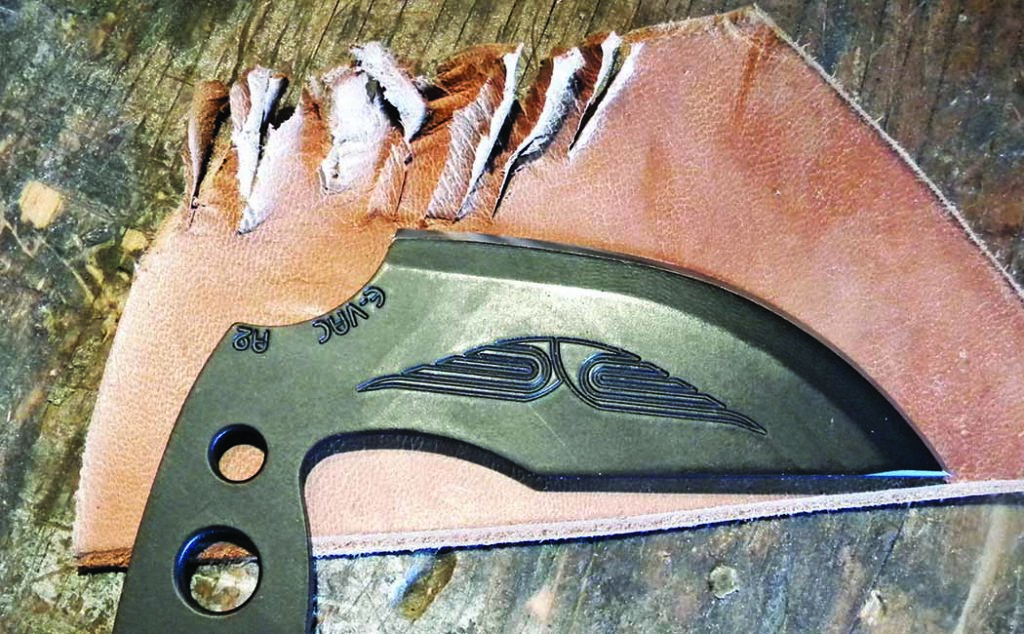
The E-VAC worked great skiving 8-ounce leather. The size of the cuts was controllable both in width and depth. Again, using the ulu style of rolling into the medium worked great.
On single-walled cardboard I did better with a push cut than a pull cut. Again, when I got it right, the knife cut aggressively. On the cardboard, I rolled into the push cut like cutting with an ulu. Using more of the wrist than the hand seemed to work best.
Moving on to some 8-ounce leather, I tried my luck at skiving. The E-VAC worked great. The size of the cuts was controllable both in width and depth. Using the ulu style of rolling into the medium worked great for me.
Batonning The E-Vac
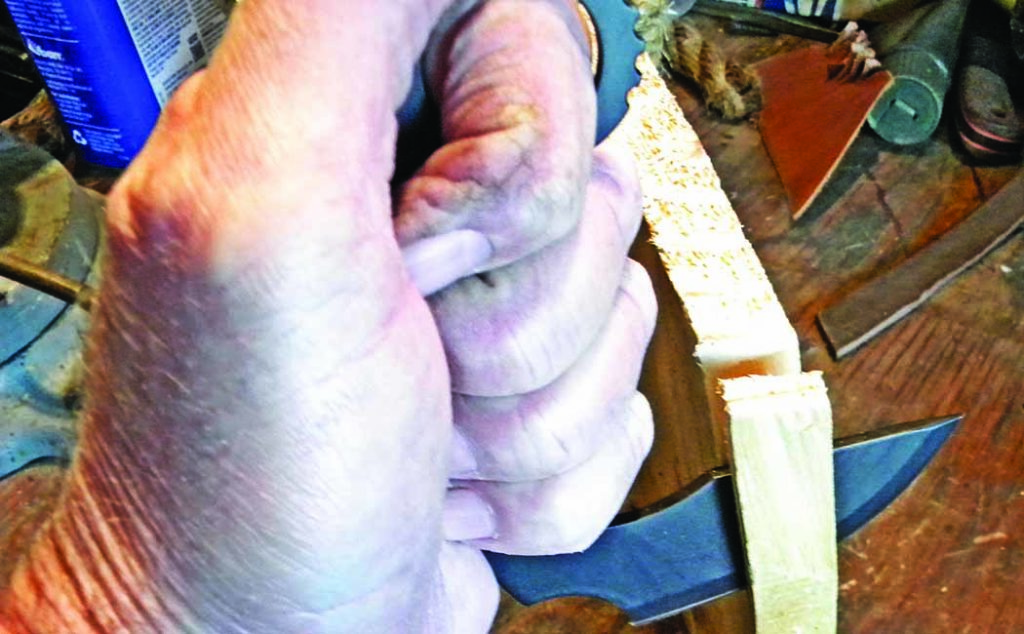
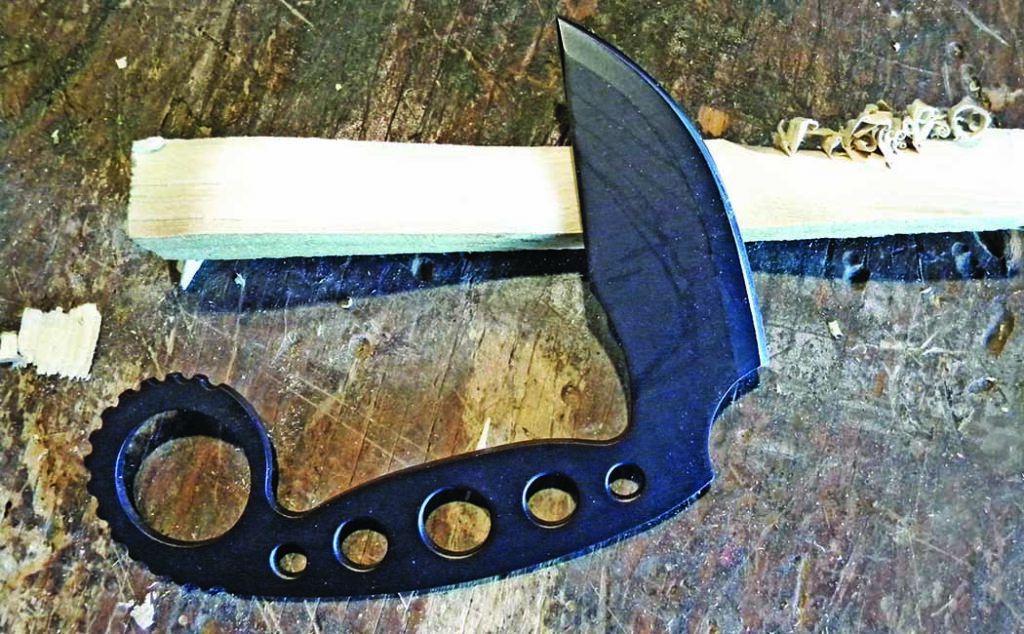
The author batonned the E-VAC through some left-over fencing 1/2-inch thick by 6 inches wide.
I batonned the E-VAC through some left-over fencing 1/2 inch thick by 6 inches wide. It was somewhat of a challenge to keep my knuckles out of the path of the dead blow hammer. However, once I got a rhythm going, the knife made short work of the scrap wood. The thin blade split deep on each blow.
E-Vac Smaller Wood Cuts
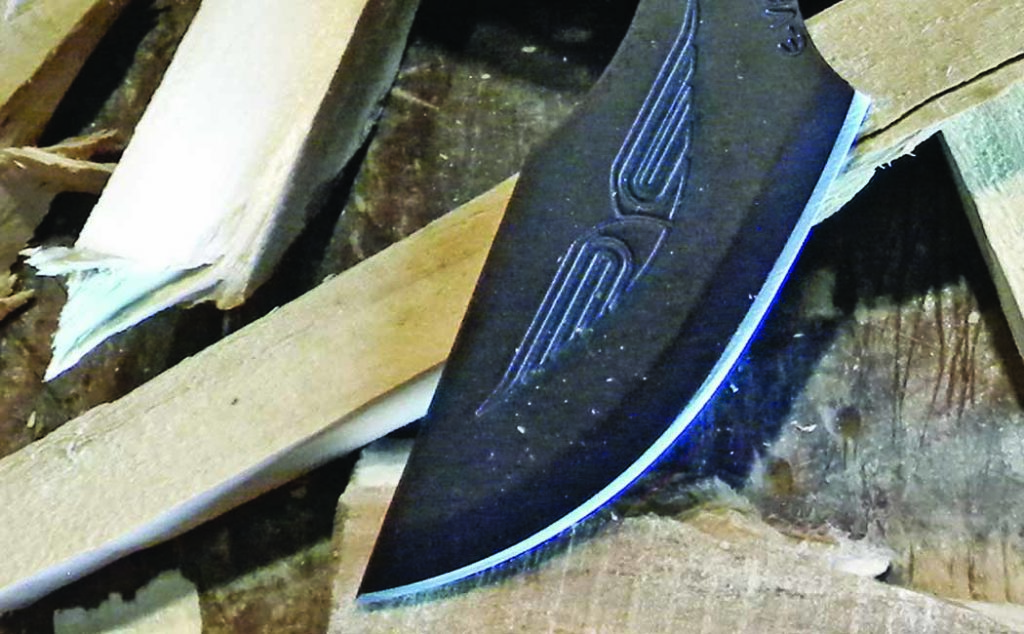
The E-VAC gave the author some decent curly-cues on the wood pieces left over from the batonning. Depth of cut was quite controllable.
Since I had a bunch of smaller pieces of wood, whittling was next. The knife gave me some very nice curly-cues. Depth of cut was quite controllable. Some thin scales or a 550 cord wrap would have given me a better grip for power cuts.
E-Vac Vs Sisal Rope
Once he got a rhythm going, the knife made short work of the scrap wood.
I did not do a sisal rope cut as I did not have the time to work on my rope-cutting technique with the E-VAC. Nonetheless, the edge feels plenty sharp enough to work well on rope.
As noted, Hawk Creek Blade provides a non-sharpened, coated mild steel trainer blade to practice your twirls and swirls without cutting yourself. It’s a very good addition to the overall package.
Assessment Of The Hawk Creek Blade E-VAC
The E-VAC works great for its designed purpose. Thinness and lightweight add to its usability.
Recommendations…
A somewhat thicker handle would give a more comfortable grip for stronger cuts.
Hawk Creek Blade warrants its knives against defects in material and workmanship. For more information contact Hawk Creek Blade Co., www.hawkcreekbladeco.com.
Hawk Creek Blade E-VAC Knife: E-VAC Company: Hawk Creek Blade Knife Pattern: Karambit Blade Length: 27/8 inches Blade Material: A2 tool steel Extras: Includes a coated mild steel trainer for training purposes Weight: 3 ounces (7 ounces w/sheath) Overall Length: 5 inches Sheath: Kydex MSRP: $135
With the K-Tact Kukri, Condor goes both old school and modern.
As with all knives, the steel is only as strong as the hand that wields it—and perhaps with no knife is this so true as the kukri.
The kukri—aka khukuri—has a reputation so legendary that even some non-knife enthusiasts recognize the knife when they see one. To understand how the kukri got its reputation, let’s examine the people who used it and help grow the legend.
Kukri History
You can’t mention the kukri without mentioning the hand behind the blade: the Gurkhas. The history of the Gurkhas dates back several centuries to the small mountainous kingdom of Gorkha, located in what is now central Nepal. In the early 19th century, the British East India Company was expanding through the Indian subcontinent and faced challenges from local rulers and neighboring powers. The Gurkhas had a reputation for being a substantial military force in the region. So, the company began recruiting Gurkhas into its own army. The first Gurkha units were formed in 1815 and they quickly gained a reputation for bravery and loyalty.
Gurkhas not only were fearsome warriors with their kukris, they also used them for daily chores. This sketch shows Gurkhas catching fish with their kukris in India’s Bazar Valley circa 1900. (Istockphoto.com image)
Since the first Gurkha units were formed, they played a pivotal role in many conflicts and to this day remain an important part of the British Army. The Gurkhas fought for the British during the two World Wars, with Gurkha soldiers serving in various theaters of operations, including the Western Front, North Africa and Southeast Asia. About 200,000—virtually an entire male population—enlisted to fight in World War I. About 250,000 fought in World War II. In the two wars, 30,000 Gurkha troops were killed.
Continuing to serve with the British, they participated in the Falklands War in 1982, and have been involved in recent conflicts in Malaya, Borneo, Bosnia, Iraq—including the Gulf War—and Afghanistan. Soldiers that have served alongside the Gurkhas regard them with respect. The spine-chilling cry of “Ayo Gurkhali!”—“The Gurkhas are coming!”—has terrified countless enemies. The Gurkhas’ bravery and determination in battle earned them numerous honors and awards. In the two World Wars alone, they won nearly 5,000 medals for gallantry.
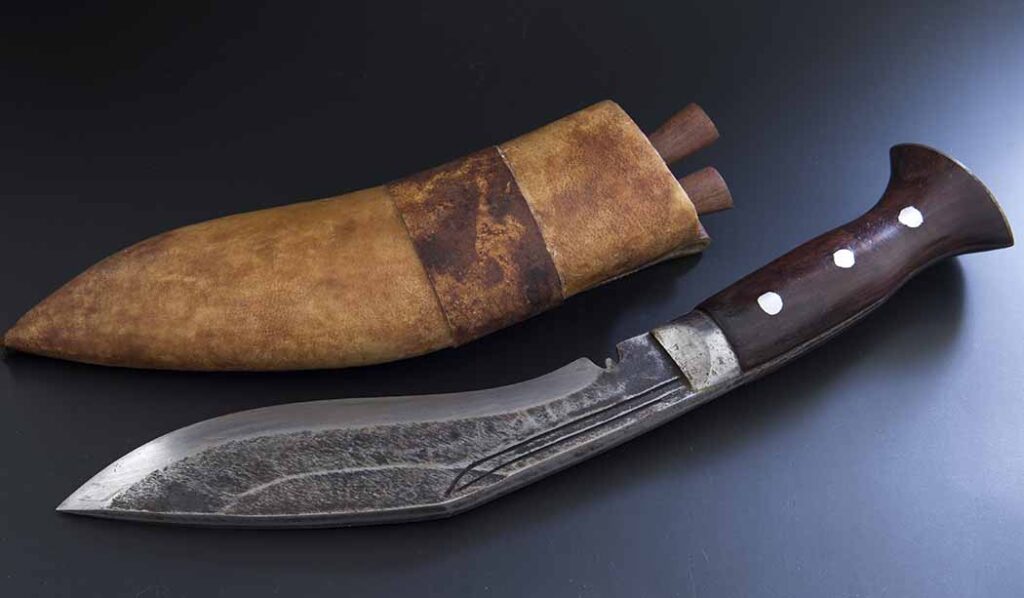
The traditional kukri includes a natural handle material and the double-notched choil. Note the extra small knife and a sharpening steel—their handles protrude from the sheath here—that ride in the sheath. (Istockphoto.com image)
After the second World War, the British started to pull back from their colonial interests, allowing their various colonies to practice more independent self-governance. Even so, the British Army continued including the Gurkhas as an important part of their operations. Meanwhile, the kukri legend had no choice but to grow as it was made famous by the Gurkhas’ outstanding reputation for bravery and loyalty.
K-Tact Kukri Updates
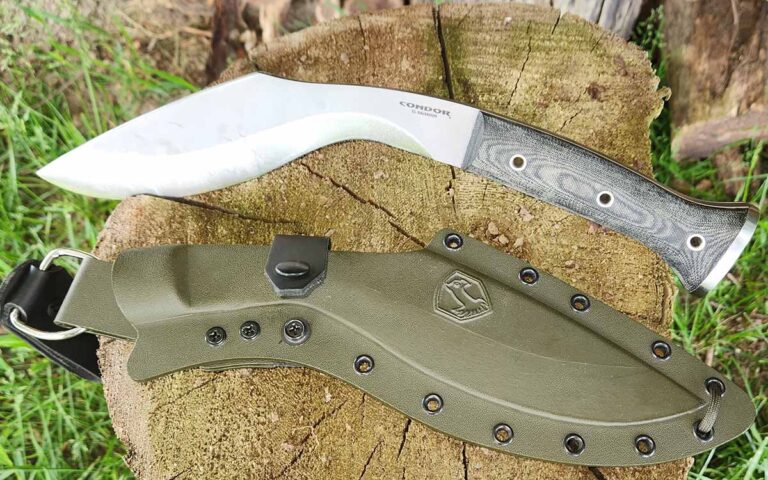
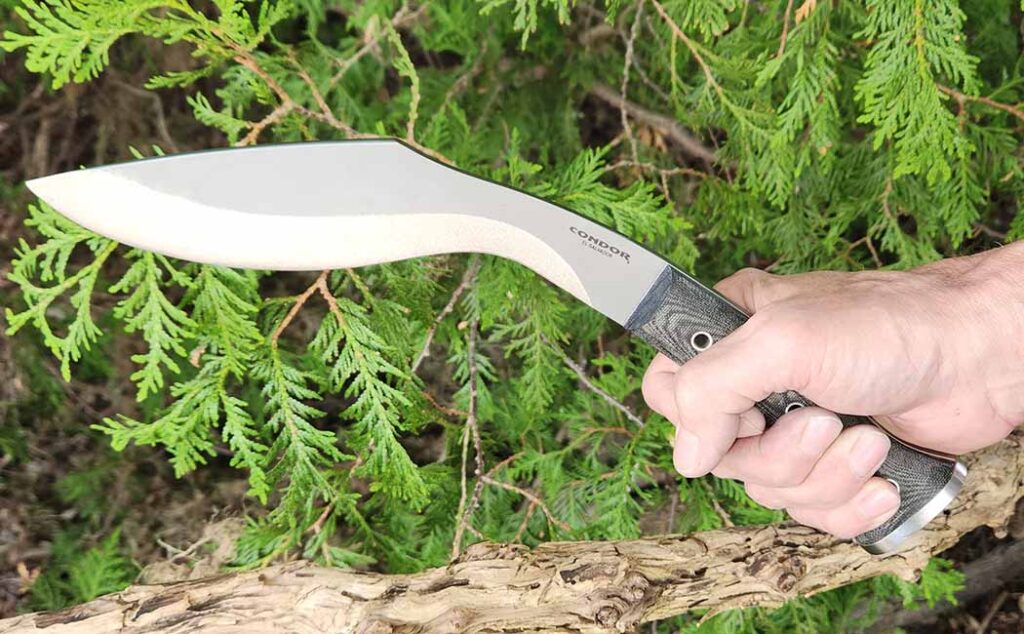
The traditionally made kukri is a coveted piece in anyone’s collection. Condor Tool & Knife has updated the design with the use of modern materials to bring about a new tool with a pedigree. With the K-Tact Kukri Knife Army Green designed by Joe Flowers, the company remains loyal to the original shape but modified some materials and proportions.
The overall profile of the Condor Tool & Knife K-Tact Kukri forms somewhat of a pistol grip. The grip angle serves well during chopping and carving. In less peaceful times, it accommodates thrusting without the need for a guard. Blade and overall lengths: 10 and 14.5 inches.
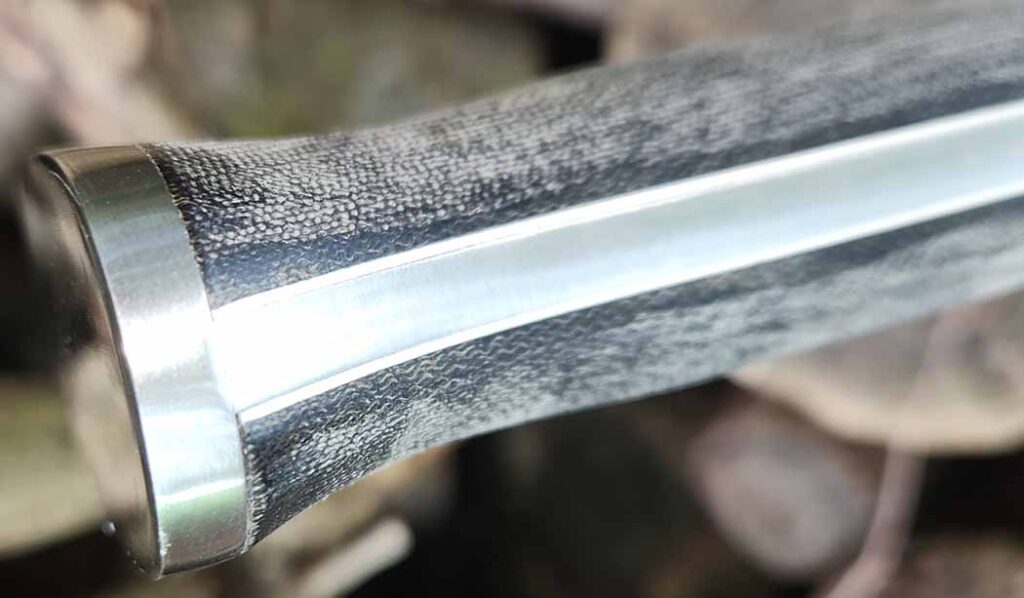
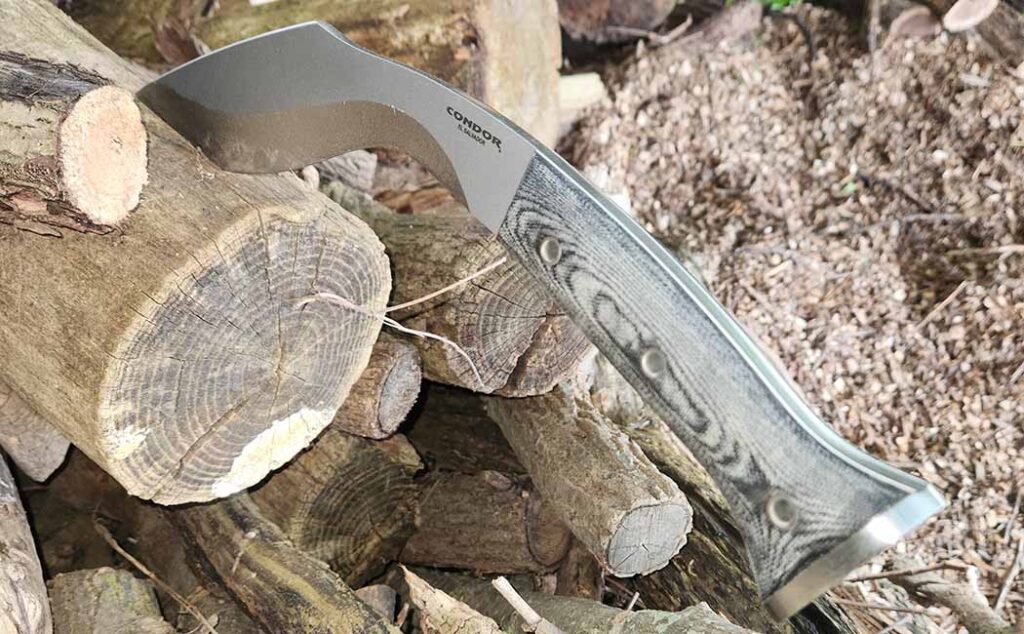
Instead of using the wide variety of natural handle materials seen on kukris over the years, Condor opted for a green Micarta®. Micarta is much more stable, and for better grip Condor gives it a textured bead-blasted finish.
You may have heard how the blades of the originals were made from truck leaf springs. Truck leaf springs were made from such carbon steels as 5160 or 1095, or reasonable facsimiles. I often wonder about the truck leaf spring story. If you think about it, seeing as how the kukri also was used by villagers along with other patterns of knives to get work done, that means a lot of trucks would be losing their springs. Condor uses 1075 carbon steel with a bead-blasted finish for the K-Tact, which is named after Alan Kay, season one winner of History Channel’s Alone reality survival show.
The pommel helps balance the knife and serves as a hammer. According to the author, the synthetic Micarta® deals with any vibration from hammering and chopping better than natural materials.
Traditional kukris have a convex edge and are finished in a high polish. Condor convexes the K-Tact only part way up the blade and then leaves it flat. Blade thickness is .2 inch, thinner than most traditional models.
The average Nepalese villager’s kukri was made differently than the official Gurkha model. Possibly due to the time needed to make them and the lack of available steel, villager kukris had stick tangs. The Gurkha models have always been full tang and so is the K-Tact. Because of the thinner stock and the fact Condor took some weight off the blade with a stylized dip in the spine, the knife is livelier in the hand and feels more balanced.
Any of the traditional kukris I have held have had forward-heavy blades. They have a thick pommel plate the same thickness as that of the blade material. Having a thick pommel gives you a convenient hammer when needed and also enhances the knife’s balance.
K-Tact Kukri Versatility
One of the big keys to the kukri design is that it’s a great maker’s tool. It is not used for combat only. Among the recognized attributes of the Gurkha fighting units is their resourcefulness, and a large part of that is that the kukri lends itself to being a maker’s tool. Just the overall shape allows you to do many chores. It can act as a small draw knife due to the arched shape.
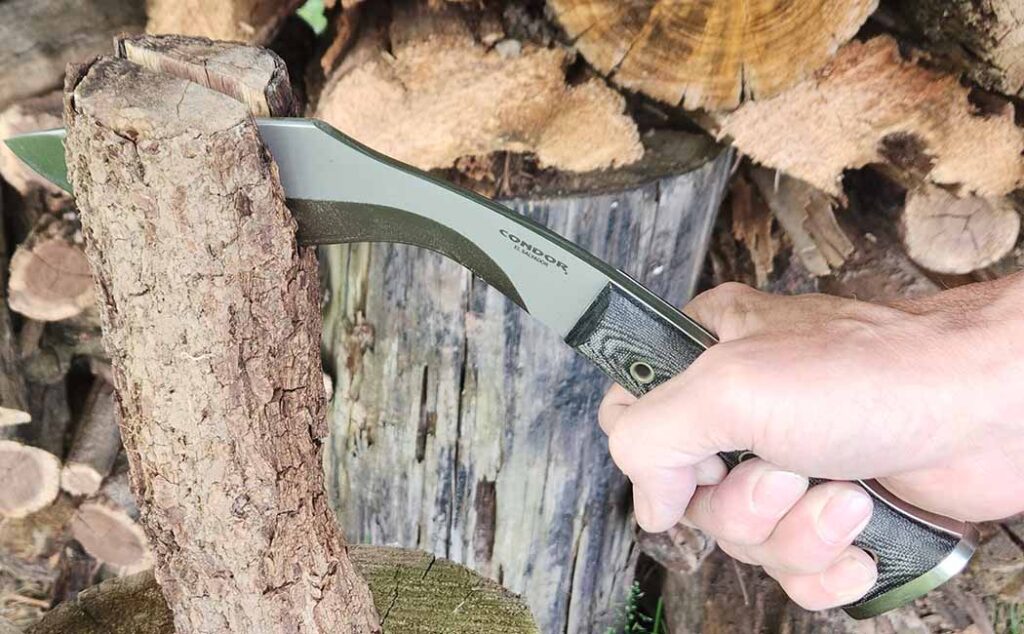
The author is not a big fan of batonning. “If you are going to do so,” he observed, “the rule of thumb is baton through nothing larger than one third the length of the knife. Following that rule allows you to keep leverage on the cut.”
For the sheath, instead of the traditional water-buffalo-covered wood, Condor uses a molded Kydex with a drop-leg leather strap and a retention strap. Despite being a huge traditionalist at times, I have to say the modern sheath is a huge improvement. The fit is spot on and you get none of the Kydex-rattling syndrome.
If I had to voice a disappointment in the K-Tact, to be fair it would be more of a “I want my cake and eat it, too” complaint. On a traditional kukri you get an extra small knife and a steel that ride behind the blade next to your body in the same sheath. Though I don’t have much use for the sharpening steel—I carry other sharpeners—a secondary small blade is a key part to the maker’s aspect of the knife.
Due to the profile of the kukri, the sweet spot for chopping is at the belly a bit farther back from the tip than on a number of other chopper designs.
Yes, I know, I can carry another smaller knife, hence the “cake and eat it, too.” Having said that, there is still something about the knife presenting as a kit all in one housing. Keep in mind I am a father-and-son-knife-set collector. All I’m saying is, it would have been nice to have a matching small blade with it.
Use Before Buying
I must say I have enjoyed playing with this knife. It works well. Kukri-style knives aren’t for everyone, so do try and use one before you buy. Each knife style has its own little ins and outs. If all knives worked the same, what reason would enthusiasts have to collect multiples?
As a final thought, the K-Tact is a good, solid, dependable piece of kit and in the right hands can take you far. Who knows? You might discover that you just want a modern version of a legendary style. Made in El Salvador, it has an MSRP of $162.84.
More than mere knife sharpeners, these options are complete honing systems that keep your blades razor-sharp.
Many of you probably learned to sharpen knives freestyle on a carbide, ceramic or diamond stone that required setting the proper angle by guesswork. The problem with sharpening a knife freehand is that no matter how good you are, the angle can vary with each stroke.
Fortunately, knife sharpening systems these days are so advanced they can virtually eliminate human error. Among other features, the systems allow the user to preset the blade angle and lock it in so it never varies throughout the sharpening process. Of course, systems that “lock in” sharpening angles are nothing new. However, the ways today’s angle-guide models do it not only are especially creative and user friendly, the best of them offer many other highly useful functions as well.
Before reviewing four of the latest examples, a word of advice when sharpening a knife: stop and gauge your progress as you go. It will help ensure you don’t miss a dull spot and also keep you from over sharpening/abrading, thus preserving the life of your blade.
Smith’s Edge Pro Electric Sharpener
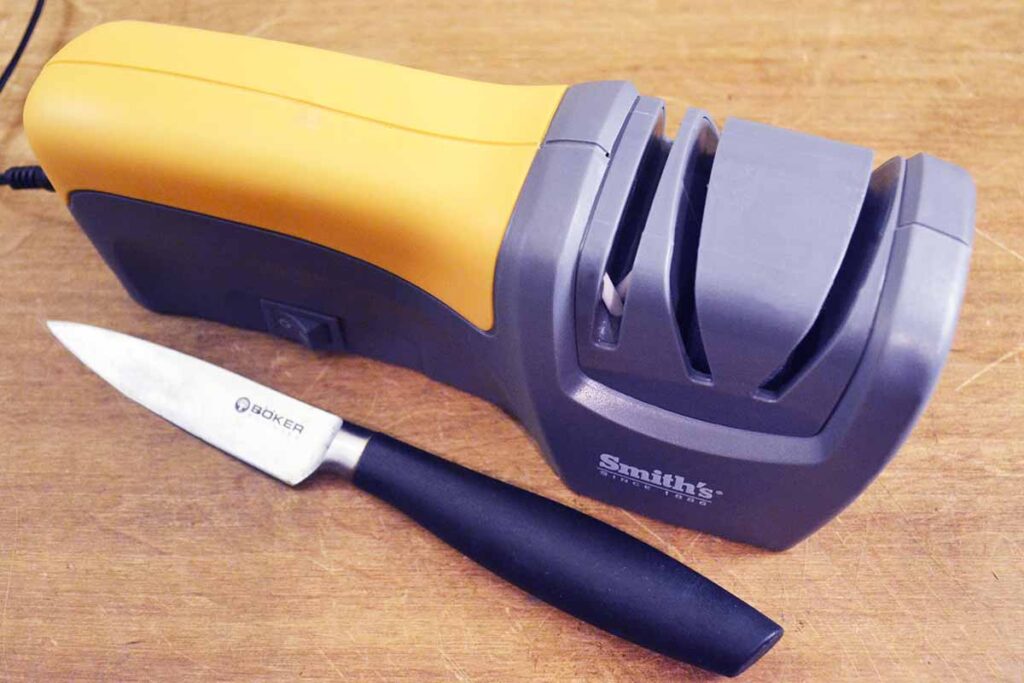
The Smith’s Edge Pro Electric Sharpener provides a competent edge in a minimum amount of time. It has angled, electric-powered left- and right-side coarse grinding slots (right), and a vertical manual ceramic rod slot (left) for fine honing. The knife is a Boker paring model.
Smith’s has gotten more into electric sharpeners lately and the Edge Pro Electric Sharpener is one of the company’s latest. It is a countertop unit with a 3-foot-tall main housing rounded at the top for gripping. It is a three-stage pull-through sharpener—right side blade, left side blade and vertical hone. The right and left side pull-through slots access coarse diamond wheels that sharpen each side of the blade via a motor turning the wheels, the end result being an angle of approximately 22 degrees. The non-electric third slot houses two crossed ceramic rods to hone and de-burr the edge. A detachable electrical cord with adapter plug is included and a rocker switch on the base cuts the unit on and off.
Sharpening with the Edge Pro is simple but some tips will make its use more efficient and hazard free. First, this is a pull-through sharpener, so do not try to push the blade through. Second, for the best edge keep the blade as close to level as possible. Last, don’t apply too much downward force—you can bog down the motor. Steady, moderate pressure works best. The hone slot removes any rough burrs and sharpens the edge. I finished the blade with a leather strop and the edge was shaving sharp.
Smith’s Edge Pro Electric Sharpener Specs Type: Benchtop electric, slotted Dimensions: 8.5” long, 3” wide, 3.5” tall Main body material: Plastic Sharpening slots: Two coarse, one fine Grit types: Diamond coarse and ceramic fine Carry: None; tabletop design Weight: 1 lb., 4 ozs. Country of origin: U.S.A. MSRP: $32.99
Cold Steel Benchtop Knife Sharpener
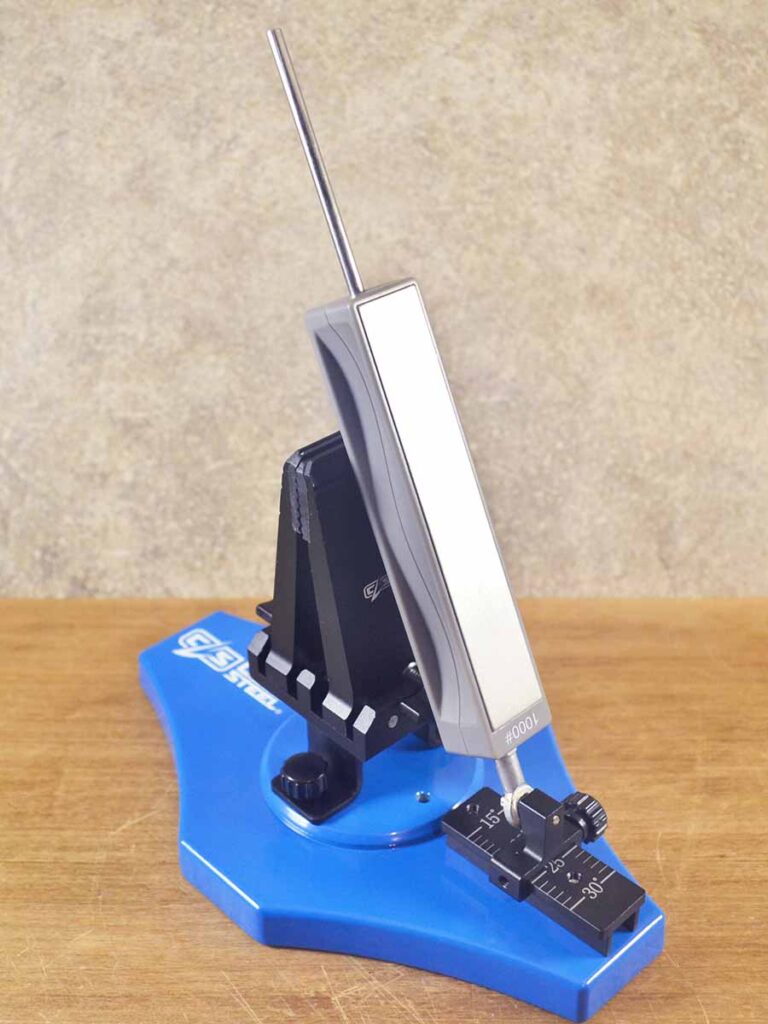
The rod angle of the Cold Steel Benchtop Knife Sharpener is adjustable from 15 to 30 degrees and is locked in by a thumbscrew on a sliding mount. To reverse the blade for sharpening the opposite edge, remove a thumbscrew from the base and rotate the tower 180 degrees.
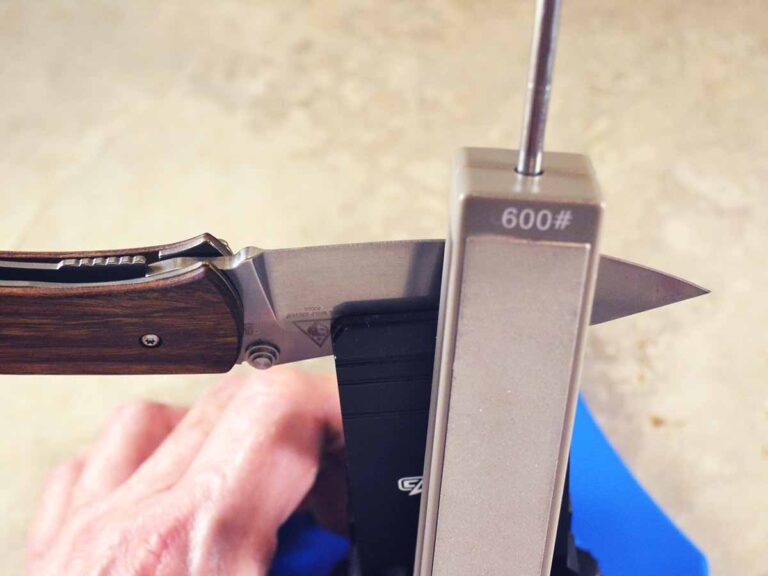
The Cold Steel Benchtop Knife Sharpener is an affordable version of the variable fixed-angle sharpeners folks like to demonstrate on Instagram and Facebook. The knife is mounted blade-up* in the jaws of a clamp and the grit block sweeps across the edge horizontally. The blade is mounted at the top of the unit upside down, and the rod that holds the grit block is mounted on one long end of the base. The rod angle is adjustable from 15 to 30 degrees and is locked in by a thumbscrew on a sliding mount. To reverse the blade for sharpening the opposite edge you must remove a thumbscrew from the base and rotate the “tower” 180 degrees. There are two grit blocks, each with different diamond-coated surfaces: 300 and 600 on the coarse block, 800 and 1,000 on the fine one.
There’s a good reason for watching videos on complicated sharpeners such as these. I noticed the tower (my jargon for the sharpener’s tall main component) where it mates to the base had slack in it, allowing it to rock when sharpening. I watched two videos and saw why. When sharpening the edge with a grit block, the loose base allows you to follow the edge of the blade as the block traverses from base to tip. To hold the tower stable, use your free hand to keep the tower from tipping backward while your other hand sweeps the blade edge with the grit block. This is a bit awkward until you get the hang of it. When you finish one side of the blade, undo a thumb screw and rotate the knife 180 degrees to do the other side. Then start over again with the next finest grit until you finish with the 1,000 grit.
It seems time consuming but remember, this is a budget fixed-angle sharpener that costs less than many diamond bench stones. If you want to learn the basics, this compact sharpener is a good one. (Author’s note: The clamp jaws are wider than on the other fixed-angle sharpeners, which means it will not work with as narrow of a blade width as the others reviewed.)
Cold Steel Benchtop Knife Sharpener Specs Type: Fixed angle, horizontal swing Dimensions: 8” long, 5” wide, 9.75” tall Main body material: Steel Grit types: 300, 600, 800 and 1,000, diamond coated Carry: Hard-shell thermoplastic case Weight: 2 lbs. Country of origin: China MSRP: $129.99
Work Sharp Precision Adjust Knife Sharpener Elite
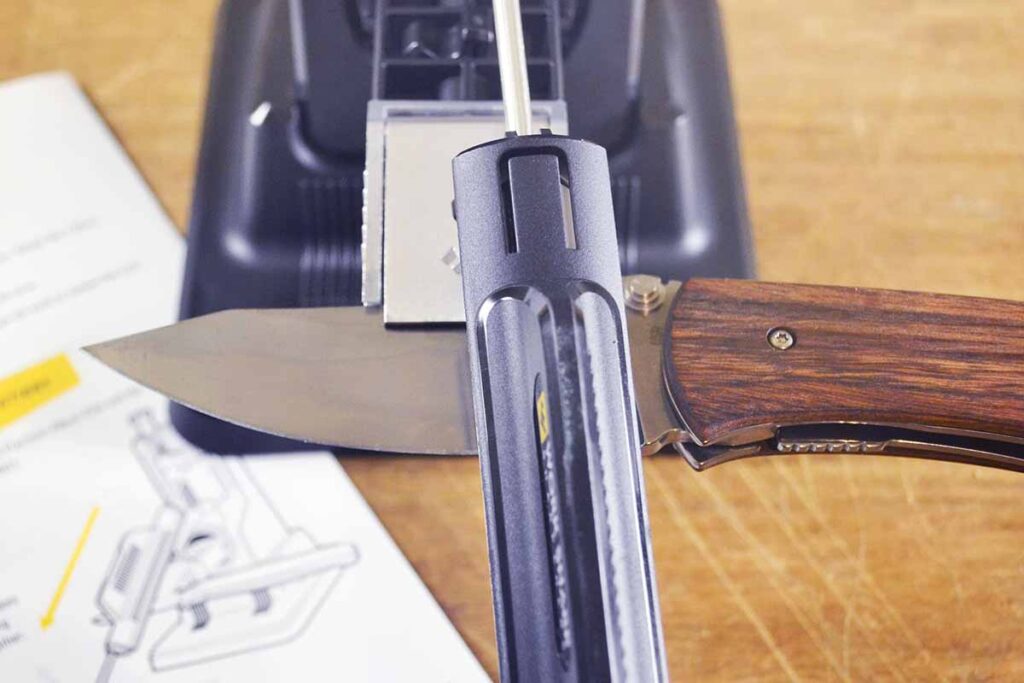
The Work Sharp Elite with the guide rod and a Tri-Brasive block is ready for action. According to the author, he snuck the Elite’s instruction pamphlet into the photo because Work Sharp does an outstanding job of providing set-up and use instructions, which is not always the case with some sharpeners.
The Work Sharp Precision Adjust Knife Sharpener Elite is an affordable, sophisticated sharpening system. It is a fixed-angle unit that operates using rods with an array of grit blocks that would make the pickiest sharpening aficionado drool: 220, 320, 400, 600 and 800, a ceramic rod for serrations, and a leather strop. That’s right, you can even strop with it. The tower clamps the blade, sets the angle of the edge you prefer, and holds the rod and grit block. It is the only sideways/horizontal blade mount of the test bunch. The Tri-Brasive grits are held in a special housing with a finger grip, three to a block—two total except for the ceramic rod and strop, which have their own smaller housings. Each housing has its own rod, making it easy to install and use. The clamp holds the knife with the blade edge facing the user. (Author’s note: This is the budget version of the Work Sharp Professional Precision Adjust Knife Sharpener, the BLADE Magazine 2023 Accessory Of The Year [page 16, September BLADE®], which has grit widths of approximately 3/4 inch like the other fixed-angle sharpeners reviewed. The Elite model has 3/8-inch-wide grit slabs that may wear out faster.)
Assembly is shockingly easy—no tools required. Once the blade is mounted in the clamp, the grit housing/rod locks into place with a magnet located under the degree-setting brace on the tower, and that sets your blade angle. The edge faces you horizontally, making it easy to gauge your progress. Simply work your way up the consecutively finer diamond grits until it’s fine ceramic and strop time, which gives the razor-sharp edge a blazing shine. The ceramic rod for serrations is a nice addition. The only thing that might give you trouble is the base can tip forward if you put too much pressure on the blade. Easy does it is the byword here. All in all, the Work Sharp Precision Knife Sharpener Elite is a breeze to set up, easy to use for blisteringly sharp results, and packs up nicely when it comes time to stow. It is a tremendous value.
Work Sharp Precision Adjust Knife Sharpener Elite Specs Type: Fixed angle, horizontal swing Dimensions: 5” long, 4.5” wide, 7.25” tall Main body material: Steel Grit types: 220, 320, 400, 600, 800 diamond coated, ceramic and leather Carry: Soft case Weight: 1 lb., 8 ozs. Country of origin: Assembled in the U.S.A. using foreign-made parts MSRP: $139.93
Wicked Edge WE66 Obsidian
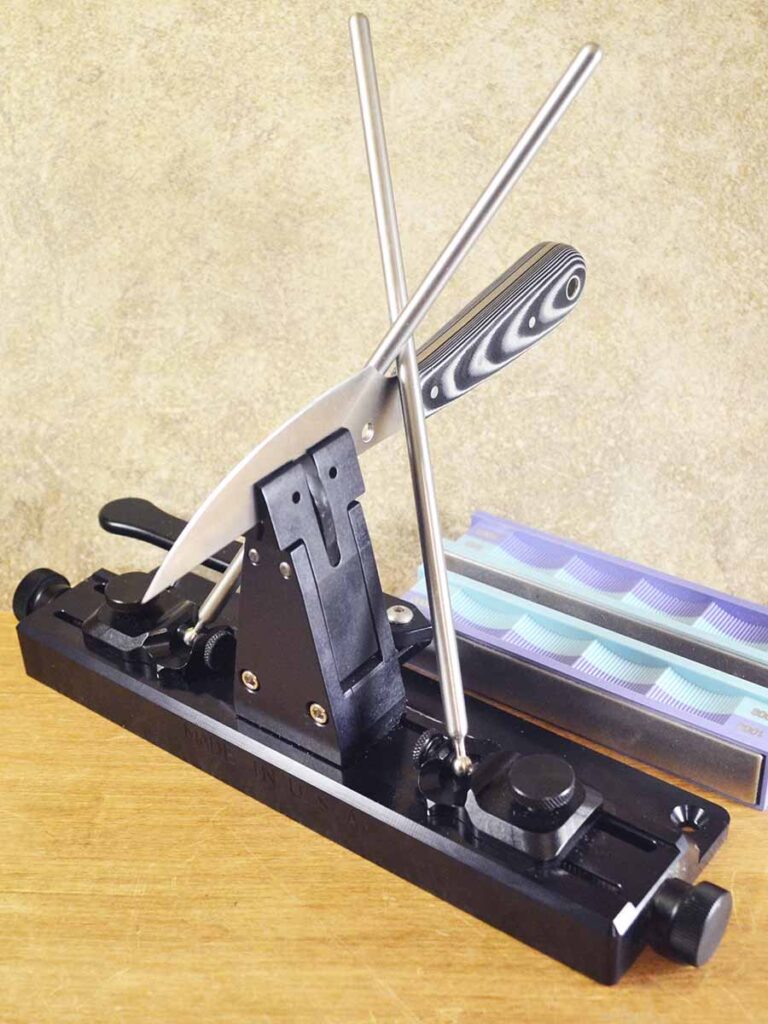
The Wicked Edge WE66 Obsidian is the only test model that sharpened both sides of the blade in one session without flipping the knife. The blade mounts atop the tower and the swing rods and grit blocks are used in alternating right- and left-hand sweeps. Note how the guide rods are held in mounts that also set the angle.
The Wicked Edge WE66 Obsidian is another upscale, state-of-the-art fixed-angle sharpener capable of delivering mind-blowing results. What sets it apart from the others is that you sharpen both blade sides in the same session—no flipping of the knife is required. The Obsidian is the largest of the sharpening systems reviewed and has an 8×11-inch base that weighs more than the system itself.
The Obsidian uses diamond blocks with two different consecutive grits on opposing sides. There are four blocks total, two each identical because you sharpen both sides of the blade at the same time. There are two sanding-block rods with orb-shaped bases that act like ball bearings in the mounts. The bases slide on a rail to set the sharpening angle. Despite sounding complicated, it’s actually quite simple. The angle settings are very easy to read on the side of the base. The blade mounts upside down in the jaws atop the center tower and locks in place via a lever.
To use the Obsidian, mount the knife so the edge points straight up, and operate the rods and blocks with opposing hands. Once you sweep the blade with one hand you switch to the other and repeat until that grit has done its business. Sharpen with the low grit and when done rotate to the higher grit on the other side. When you’re finished with that block, replace it with the other block of a higher grit. You’ll have to provide your own strop.
Wicked Edge WE66 Obsidian Specs Type: Fixed angle, horizontal swing Dimensions: 11” long, 3” wide, 4” tall Main body material: Steel Grit types: 200, 600, 800 and 1,000, diamond coated Weight: 2 lbs. 13 ozs. Country of origin: U.S.A. MSRP: $799
Due Diligence
Much of what is written here will make a lot more sense when you watch a video of the sharpener that strikes your fancy. It will make assembly easier as well.
There’s something for everyone here. If you don’t care to labor over sharpening but still want a very competent cutter, the Smith’s Edge Pro should suit you just fine. The Cold Steel Benchtop Sharpener offers fixed-angle sharpening at a budget price and is a perfect steppingstone for getting your feet wet in hi-tech sharpening. Finally, the Work Sharp Elite and Wicked Edge Obsidian are both lights-out sharpeners if you want outstanding performance. Both are truly state-of-the-art.
Editor’s note: Always practice extreme caution when working on a knife held in a clamp, vise, jig, etc., with the edge pointing up and/or toward you. When finished sharpening, remove the knife from the fixture immediately so the danger of accidental cutting is eliminated.
Doug Ritter’s folder more than ready to cut you out of trouble.
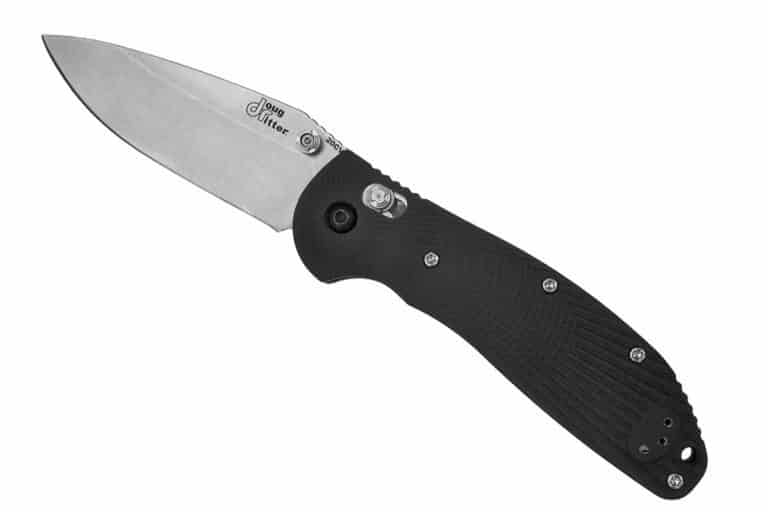
A folder always comes in handy. It hides in your pocket until you need it. Most people won’t freak out if you cut your steak in a restaurant with it. It’s a handy item for everyday use. The Doug Ritter RSK MK1-G2 is a classic example.
Let the cutting begin.
Light-Duty Cutting Test
Twenty-pound bond paper is my first choice for testing edge sharpness. The knife was aggressive and smooth slicing. The handle texture made control easy, so I didn’t lose any skin. I pushed the belly of the blade straight into the paper. (I’ll return to the medium for the last test to see if the blade will still slice.)
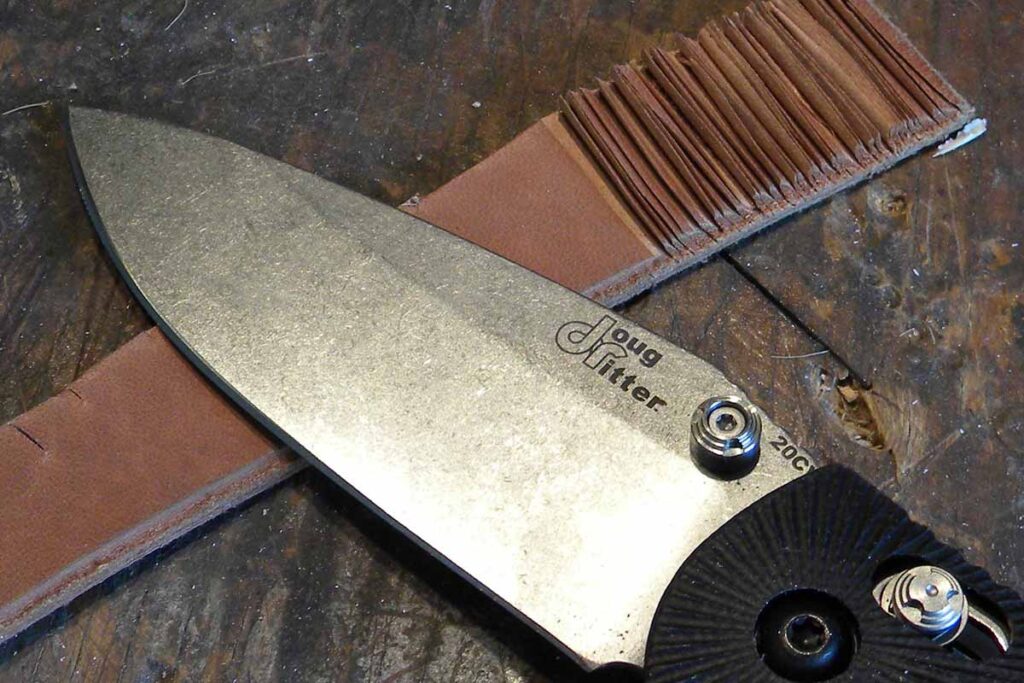
The blade made great crunching music as it bit quickly into the leather.
Double-walled cardboard was next. Cutting aggressively, the MK1-G2 bit deep into the cardboard and did so quickly. The cutting action was smooth with no snags. The cut pieces didn’t have much curl to them as the flat grind and thin blade cleanly parted the fibers.
I did some push cuts on 8-ounce leather. Nice crunching sounds accompanied each slice. The knife performed great—crunch, crunch, crunch! It was fun to do. The handle texture worked extremely well when I used a sidewinder grip, locking my fingers and hand in place.
As long as I was on leather, I might as well do some skiving—thin slices to thinner to the end of the leather. Once again the folder made great crunching music as it bit quickly into the leather. The test nicked a bit of my fingernail. I needed to be faster with the skiving for sure.
Heavy-Duty Cutting Test
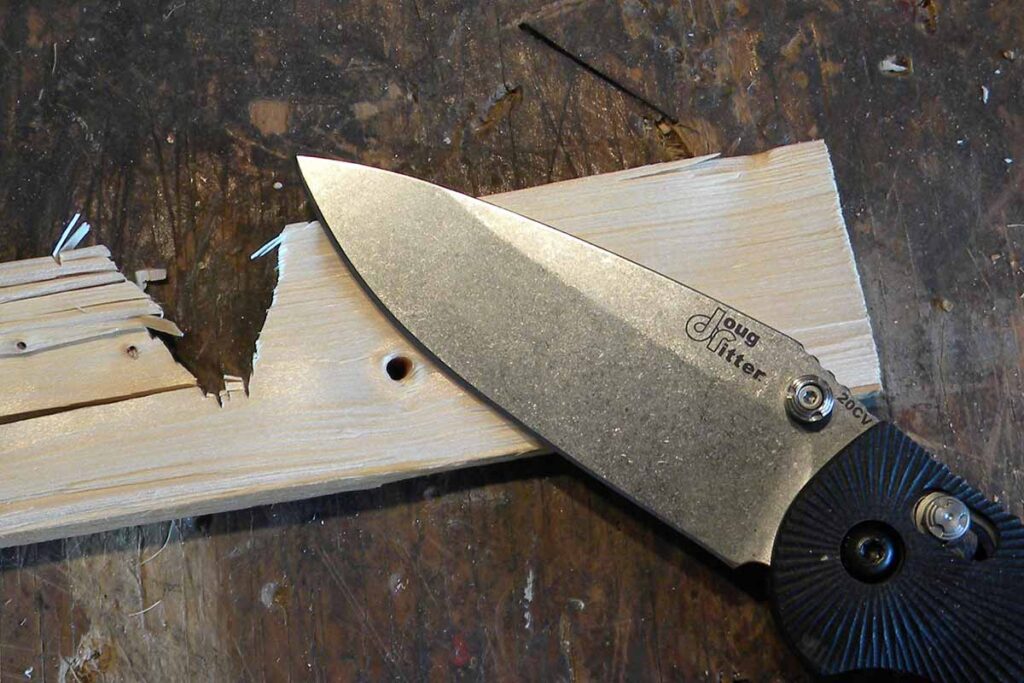
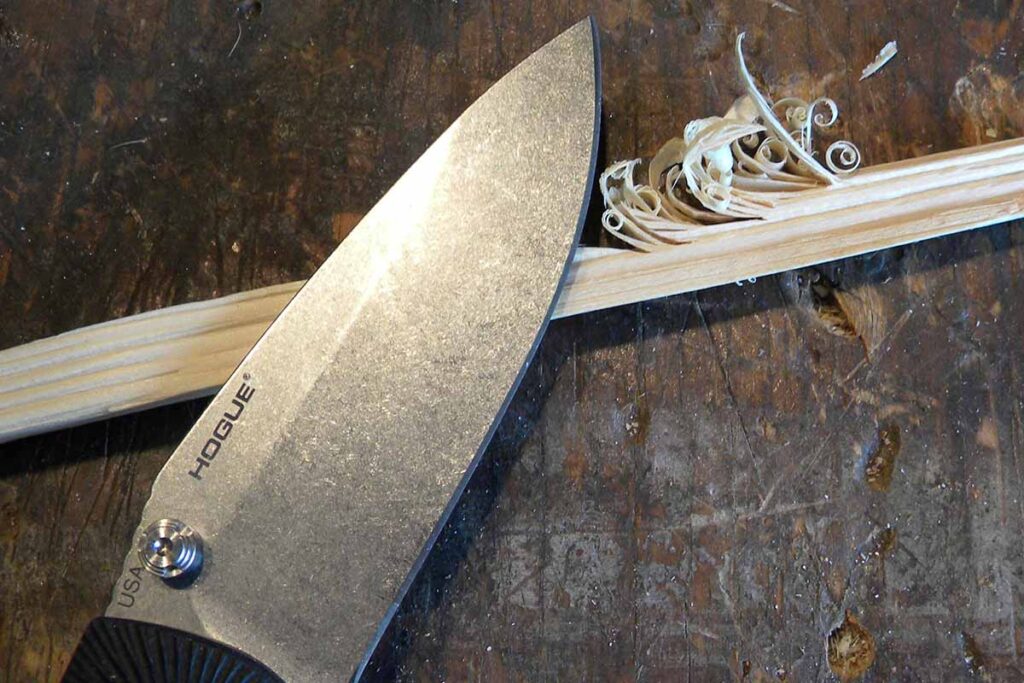
It was time for my favorite camping slack time filler: whittling. I whittled some cool curlicues from a two-by-four. The flat-ground blade made it easy to get fine curlicues. The MK1-G2 also liked thick cuts into the wood. It was very controllable during both depths of cut.
The knife excelled at thick cuts in the two-by-four.
I clamped a two-by-four slab in the vise for a small chop test for the edge and the lock. For a folder the MK1-G2 provided some deep chops, and there were no problems with the handle sliding around in my hand. The edge went through knots and straight grain wood very quickly. The edge was awesome and lockup was 100 percent.
Half-inch sisal rope was next on the docket. I checked to see if the notches on the blade spine would be too sharp on my thumb. To my surprise, they were among the best-feeling thumb notches I’ve experienced on a folder. They provided a good grip and are softened on the points, an indication of paying excellent attention to detail. After 100 crunching cuts, I switched to my sidewinder grip and managed to get another 97 crunching cuts before the bite slowed down. I didn’t find a single hot spot on the knife—outstanding work again.
I returned to the 20-pound bond paper. The folder still sliced smoothly, though I did tear the paper in a couple of places. I believe the tears were more my fault than the knife’s.
Final Cut
The flat-ground blade made getting fine curlicues a snap.
I might make the grind line a tad higher. I like this folder a lot. I would put it in my bugout bag.
Doug Ritter RSK MK1-G2 Specs Company: Hogue Knives Knife type: Locking folder Blade Length: 3.44” Blade Steel: CPM 20CV stainless Blade Grind: Flat Lock: ABLE Lock Liners: 301 stainless steel Handle: Black G-10 Weight: 5 ozs. Closed length: 4 13/16” Country of origin: USA MSRP: $179.95
Knife buying–particularly custom–can prove daunting. We gathered industry pros to give the top mistakes to avoid.
When it comes to acquiring knives, the informed buyer is most often the satisfied buyer when the transaction is complete. So in the spirit of friendly advice, BLADE® has enlisted the help of several knife industry pros to offer a few words on making the most of the knife-buying experience—or to put it another way, 11 mistakes to avoid when buying a knife.
Don’t Deal With Questionable Sellers
“A lot of it revolves around reputation,” said custom knife purveyor and collector Paul Farina of Farina Fine Arts. “Human beings can be different, but 80 to 90 percent of the people you meet out there are great. In the knife world, many of them will give you a refund if you aren’t happy.”
Dave Harvey of Nordic Knives echoed that sentiment. “Honest sellers are not hard to find, thankfully,” he said. “Look for those with years of experience. Generally speaking, dishonest sellers will not be in the business very long.”
Along the same lines, Daniel O’Malley of bladegallery.com cautions folks interested in buying online. “If purchasing online, make sure you are buying from a company that has been around a while,” he offered. “There are a lot of fraudulent websites out there these days—often ones that are trying to appear to be a well-known website. One dead giveaway that you may be on a fake purveyor website is if the prices are too good to be true. Unfortunately, you are unlikely to find a legitimate site selling knives for half the price of other legitimate sites.”
Don’t Buy Knives On Pictures Alone
“In most cases today, knives will be purchased online, and therefore you may have to judge the knife by photographs and listed descriptions,” O’Malley advised. “Since the value of the knife is greatly affected by small scuffs and scratches, it is important that the photos are clear enough that any imperfections will be noticeable.”
Along the same track, Harvey noted, “Pictures are great, but they never fully substitute for being able to see and hold a knife in person. Make sure you buy from someone or a dealer with a 100-percent-return guarantee. If you are not satisfied with your purchase, you should be able to return it in a reasonable period of time.”
Don’t Buy Knives On Steel Only
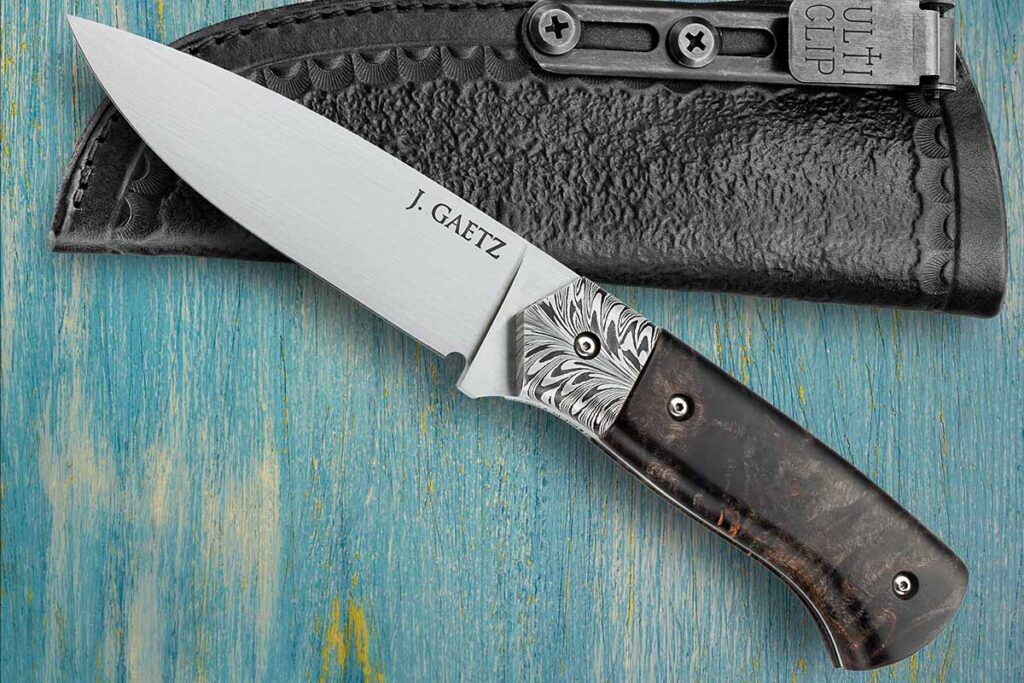
Daniel O’Malley advised that each year new miracle steels appear but often lose popularity after a year or two because they may not pan out. Conversely, tried and tested steels like CPM S35VN, Takefu SG2, 52100 and more are great benchmarks to test against. Jacob Gaetz forged the 4-inch blade of his fancy hunter from 52100. (Jocelyn Frasier image)
“I never talk to people too much about a particular blade steel,” commented Dave Ellis of Exquisite Knives. “I usually discuss with clients how the complete knife was made, how it was fashioned, and that is more important, I think. Someone may be enamored with a certain type of steel, but that is rare with my clientele and only a consideration in talking about the whole knife.”
Harvey reckons that few knife buyers take the “blade-steel-first” approach. “At least I would hope not,” he asserted. Farina added, “There are a few exotic blade steels out there right now, and these may be sought after just because they’re exotic. Also, some steels have been discontinued and knives with those steels may be selling because of the rarity.”
Taking the entire knife into account is the best way to reinforce a purchasing decision, according to O’Malley. “Knowing the stats on the knife is important,” he reasoned. “We want to know where it was made, who made it, in what country it was made, and what materials they used. That said, judging a knife by just the blade materials used ignores fit and finish as well as heat treatment quality. In some cases the identical steel at the identical Rockwell hardness can still have tremendously different edge holding. In fact, over the years I have found that the quality of heat treatment is perhaps even more important than the steel used.”
Don’t Buy Knives On The Handle Comfort
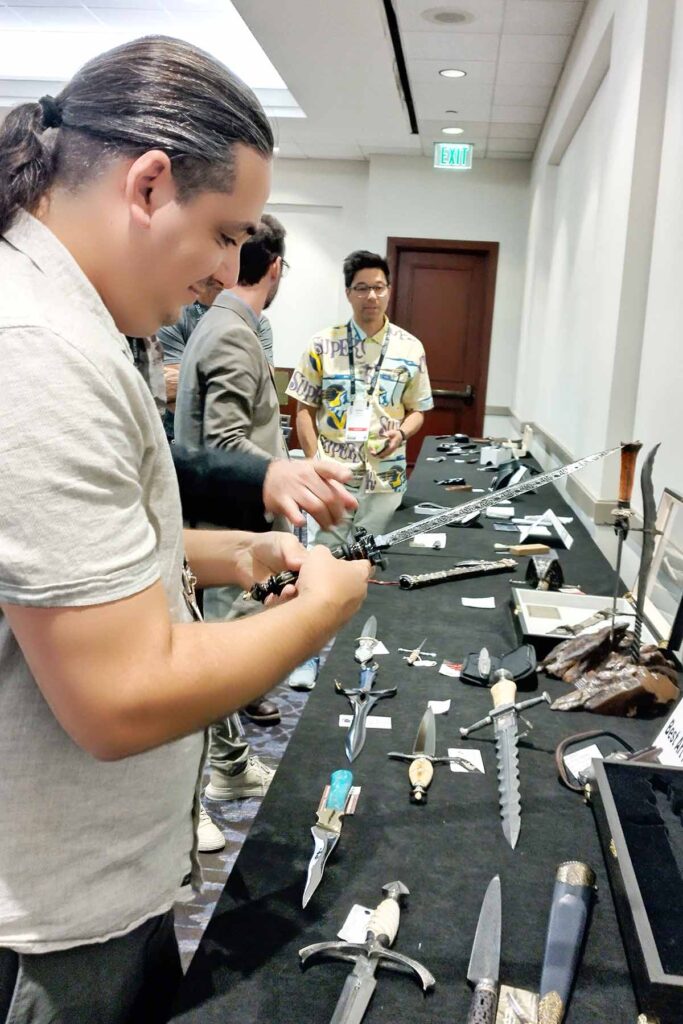
Daniel O’Malley said that even if it’s the best knife in the world, if you don’t like the way it feels it isn’t the best knife for you. Lee Lerman, a custom knife judge at BLADE Show 2024, checks the handle of one of the knives entered. In the background are observer Henry Wu (right) of the BLADE Show and judge Rodrigo Sfreddo (center).
“Getting a knife in hand and seeing what it feels like is ideal, though sometimes not possible if you are purchasing from far away,” O’Malley related. “I often advise potential buyers that even if they are holding the best knife in the world, if they don’t like the way it feels it isn’t the best knife for them. That said, some buyers feel a knife is comfortable just because it is familiar—similar to their last knife. They may have gotten used to the last knife and like the way it feels, but a different feel might actually be better, that is, a more ergonomic handle or lighter design. Sometimes it takes using the knife for a while before you know how you really feel about it.”
Don’t Adopt A Herd Mentality
“There are trends out there, but because I’m older and been around the art knife world so long, I’ve thought about the places to put my money,” Farina commented. “If you’re looking at an up-and-comer in knifemaking, check their quality, find out who taught them. That is how I get introduced to them. If they have been taught by an experienced maker, you can tell the quality, and the price may reflect in less money with younger guys.”
From the perspective of “hot styles,” Harvey remarked, “I don’t object to those who want to buy the ‘hot’ knives as long as they are styles and makers that they enjoy and collect. Buyers should always beware of ‘hot’ knife prices and not fall for overpricing.”
“What’s currently ‘hot’ isn’t always best,” O’Malley commented. “The knife industry develops relatively slowly and though each year we see new miracle steels come out, they often lose popularity after a year or two because they may not have panned out. Tried and tested steels like S35VN, Takefu SG2, 52100 and more are great benchmarks to test against.”
Don’t Overlook Makers By Name
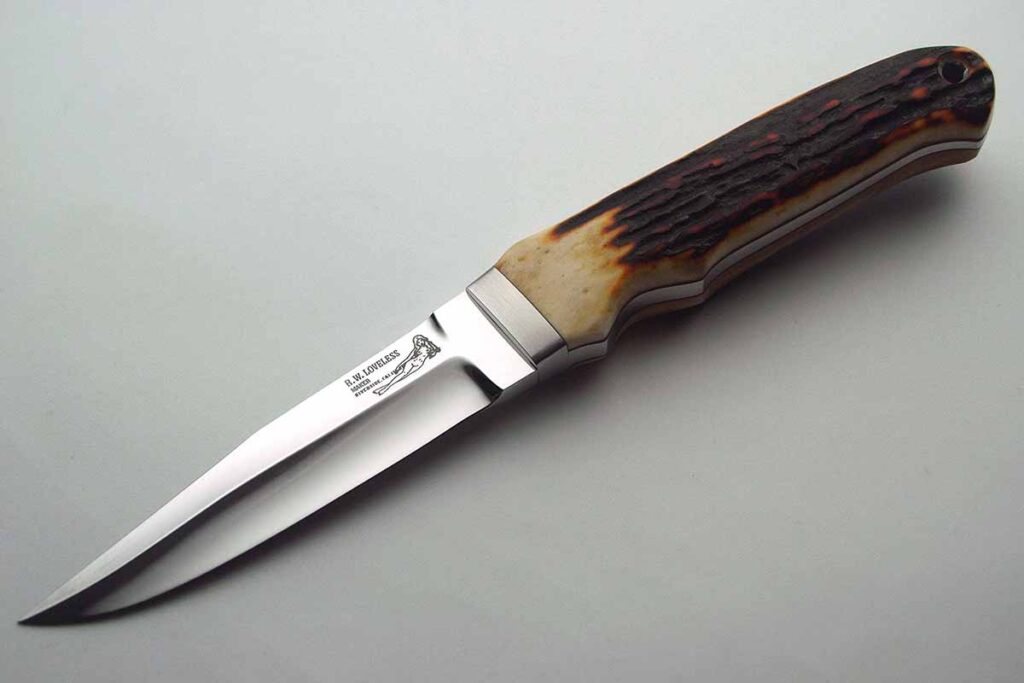
Dave Ellis said that instead of buying 10 knives you can afford, save up and buy one made by Bob Loveless. A Loveless hideout model in stag and with the iconic Naked Lady logo would be a good place to start. (Exquisiteknives.com image)
Ellis looks long-term and sees intrinsic value in the known commodities. “I recommend the blue-chip makers,” he declared. “Instead of buying 10 knives you can afford, save up and buy that one Loveless. This year I’ve sold 14 Lovelesses and the pricing has not gone crazy. So, an entry level $5,000 knife is not so ‘out there’ for someone.”
According to Harvey, most big-name makers have an established collector following, which typically relates to a lasting market for their knives down the road. However, O’Malley points out the benefits of considering numerous makers.
“The knife industry is full of tiny workshops that are doing the best work in the industry,” he noted. “While there are also some great big-name makers, these smaller shops are more likely to provide more bang for your buck. Additionally, in many cases, small workshops may be putting more attention toward quality of heat treatment, which can result in much higher performance.”
Don’t Overrate The Investment Factor
“Buying for investment is something I love because of the fact I can make money on knives,” Farina explained, “but this is not a blue-chip investment stock. So do it for the passion and love of the product. However, if the goal is only for investment, then be very structured. Listen to an adviser. I had a customer come to me after spending a lot of money in four years. He wanted to sell and make 20 percent profit on all the knives [he had bought]. Maybe that would happen on some stuff, but it is a bit unrealistic.”
O’Malley added, “Knives can be a great investment. Over the years, I have seen many knives increase dramatically in price, though certainly there are some that hold their price and even some that go down. Picking the right knives for investment does take a time commitment. You need to research and know the maker and their work. How does the knife fit in the range of knives that maker creates? Will the materials hold up over time? Where is the maker in his or her career? Taking all this into account, it is possible to collect knives as a great investment, though keep in mind that even with the best research not every investment will work out.”
For Harvey, the investment path requires some preparation. “Smart buyers can and do successfully invest in certain knives,” he said. “This does require a lot of knowledge and patience, as you generally won’t see significant increases in value in the short term. For most buyers, I suggest buying what you like and enjoy for your collection, not expecting a large return for it upon sale.”
Don’t Exceed Your Knife Buying Budget
Dave Ellis recommended setting a price limit at auctions and don’t exceed it or you will find yourself paying a lot more than necessary. “I remember a particular Jurgen Steinau fixed-blade knife a few years ago when an overseas bidder and a guy from the Bay Area were in there. The knife went for $110,000,” Dave noted. “People were in there butting heads and then it became an ego thing.” Steinau’s unique style is reflected here in his Folding Knife LBS. (Eric Eggly/PointSeven image)
Ellis provides sound wisdom on auction bidding. “Set a price at the auction and don’t go over the limit and find yourself suddenly paying a lot more than you wanted to pay. I remember a particular Jurgen Steinau fixed-blade knife a few years ago when an overseas bidder and a guy from the Bay Area were in there. The knife went for $110,000,” he noted. “People were in there butting heads and then it became an ego thing. Also, don’t buy with an eye toward flipping the knife. Avoid bid ups like the plague.”
“Auction sites tend to have horrible photos, making it impossible to ascertain what a knife is really like—and what it is worth. Since fit and finish as well as condition are so important to value, figuring out what to bid can be near impossible. Additionally,” O’Malley opined, “auctions can be a way to end up paying much higher than a direct-from-maker price.”
Don’t Discount Second Opinions
“Second opinions are nice and not too hard to get on many knives,” Harvey pointed out. “There are online forums and other social media outlets where collectors share information on many makers and knives.” Take advantage, then, of the availability of information but consider the source always.
“Knives are pretty personal,” O’Malley observed. “What works for you might not work for your buddy. It’s always fun to walk around a show with someone so that you can bounce ideas off each other, but at the end of the day, buying what you like is probably most important.”
Don’t Buy Knives Under Duress
Never feel pressured to make a knife purchase. Don’t always accept the line that the knife you are considering could be gone in the next few minutes. Take a deep breath and make the most informed decision possible in the current environment. If you don’t feel totally positive, walk away.
“Many knives are literally one in the world,” O’Malley said. “This means that if you don’t buy it, there is a chance that it will be gone. Over the years, I’ve found a good way to evaluate is to ask yourself, ‘If this knife sells to someone else, in three to five weeks will I be frustrated and still want to purchase it?’ If the answer is no, you probably didn’t need to purchase the knife. There will always be others. There are, however, a few knives that I didn’t buy that even years later I wish I had purchased. Figuring out if this is one of those knives lets you know to buy it before someone else does. Any big collector has had a few knives they didn’t purchase quickly enough that they still regret not purchasing today.”
Don’t Always Discount Deposits
Over the years of buying and selling knives, Daniel O’Malley said he found that the quality of heat treatment is perhaps even more important than the steel used.
“If a maker requires a deposit, he or she must be a good accountant,” Farina related. “Some are not businessmen. They are artists and machinists. So, it’s about reputation and feeling good about the maker you are working with.”
Trust is a big factor across the board. “Paying for a knife before it is completed can be complicated,” O’Malley maintained. “A well-regarded maker once summed up the problem: ‘It’s very hard to work on a knife that’s already paid for.’ That said, collectors often commit to a purchase, have a knife made, and don’t complete the purchase or just ghost [stop communicating with] the seller. For this reason, I feel it is reasonable to pay a relatively minimal deposit, 10 to 20 percent of the cost of the knife, when purchasing directly from the maker. If working through a purveyor and having a knife made, it isn’t unusual to have to pay the full amount up front since the purveyor is committing to the purchase for you.”
Stay Informed
Advice is free, for sure, but it comes from the voices of experience. When buying a knife, it pays to listen to those already engaging in the process. Of course, every situation is a bit different. There are always additional considerations. The bottom line is to approach a knife purchase on an informed basis. That translates into a confident buy!