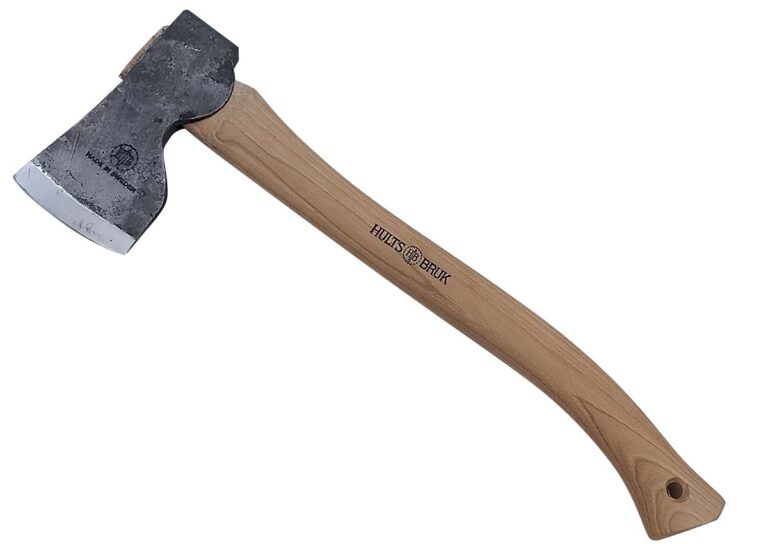
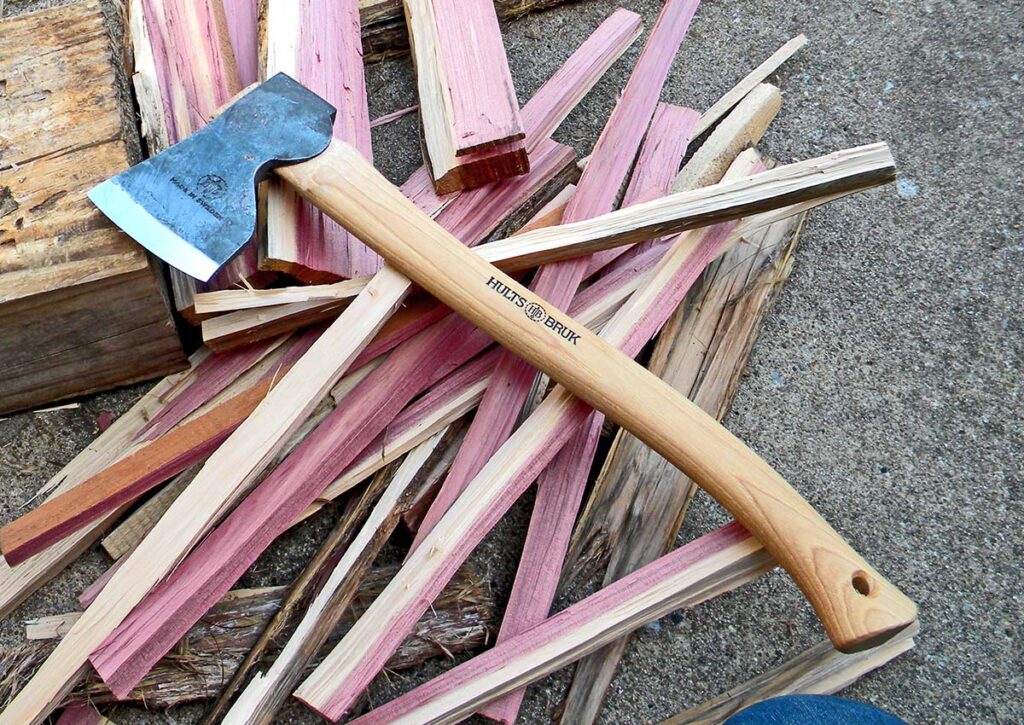
Sweden’s Hult Bruks Spika is a great all-purpose camping axe.
Most outdoorsmen use axes and hatchets—axes for chopping trees and splitting firewood, hatchets for lighter work. Axes were normally too big to carry backpacking, so we always settled on using a hatchet and made do. Some of us would cut the handle down of an axe to make it more manageable. Now, with the help of the internet, we’re able to see what other outdoorsmen use. The Spika from Hults Bruk of Sweden is the perfect size to handle most all axe chores and still be manageable to carry.
Spika Specs
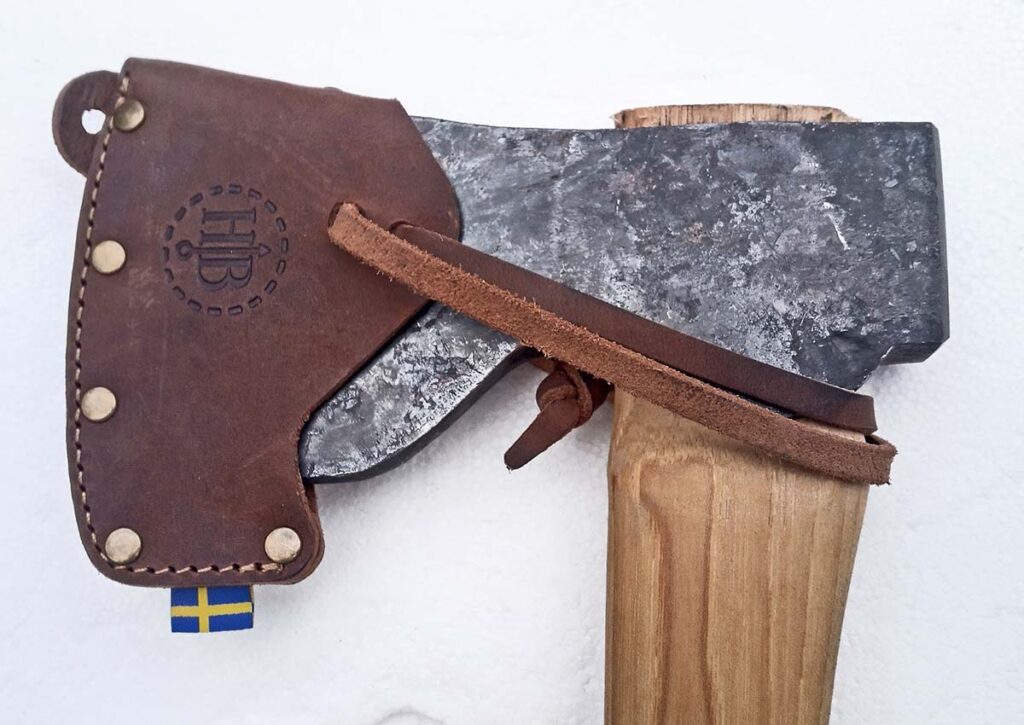
The leather edge cover is a strap-on model.
Pros
Perfect Mid-Size for Versatility
Razor-Sharp Edge
Forged Finger Notch for Control
Cons
Uncomfortable Ridge at the Choil
Price May Be High for Casual Users
Model: Spika all-purpose axe Company: Hults Bruk Edge length: 3” Head & edge material: Forged carbon steel Handle: Hickory Overall weight: 2 lbs. 5/32 oz. Overall length: 17.5” Sheath: Leather edge cover w/strap-on thong Country of origin: Sweden MSRP: $206
Light-Duty Cutting
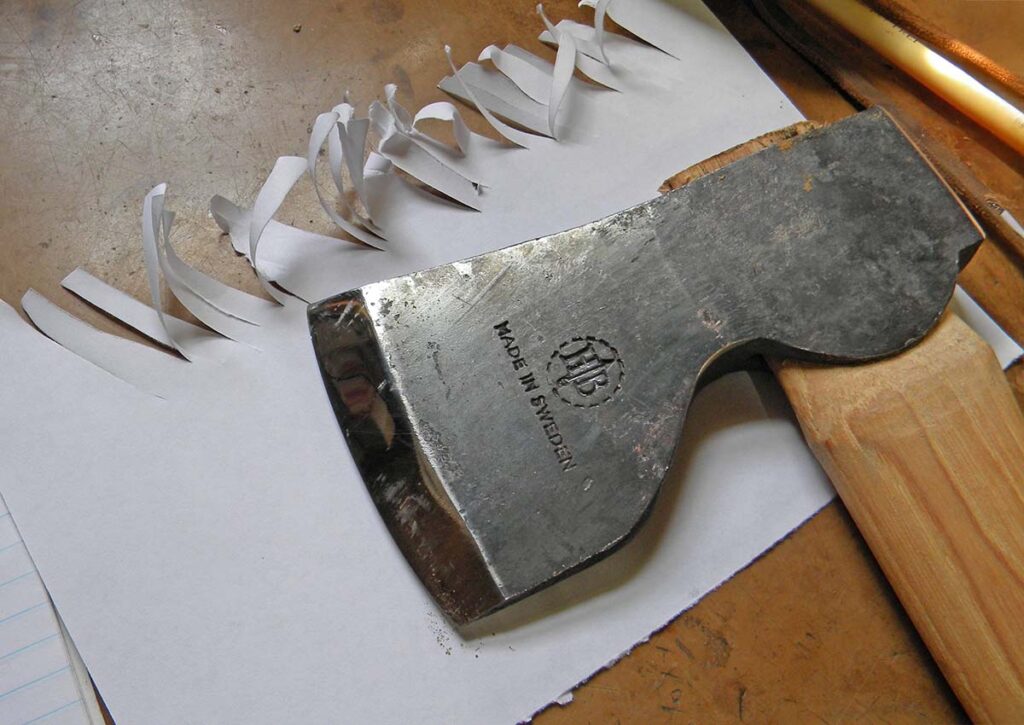
The Spika sliced the 20-pound bond paper like a champ.
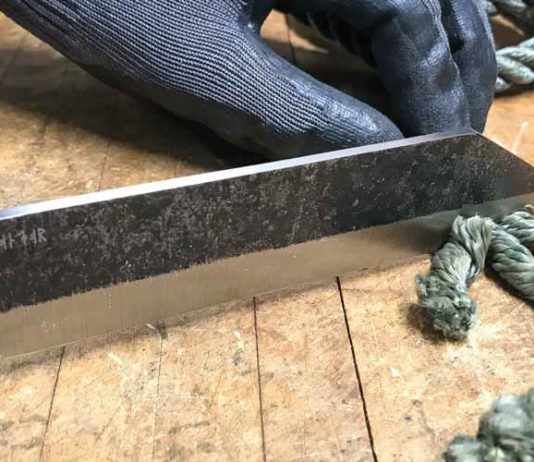
I just had to do a paper slice because the Spika felt wicked sharp. It was challenging to get started but the Spika sliced the 20-pound bond paper like a champ. I choked up on the head and used push cuts. The first slice included a piece of my fingernail. Wow, this is a sharp axe! It was loud while slicing, that is, the sound of paper being cut.
Single-walled cardboard slicing was next. It was easier than the paper to hold and move my fingers out of the way. The Spika was surprisingly easy to control as there is a forged-out finger notch to aid in choking up on the head for finer work. The axe made the cardboard curl up, which makes great fire starter. Again, I used the push cut. I was slowly getting used to this mid-sized axe. I still had to account for the longer handle.
Medium-Duty Cutting
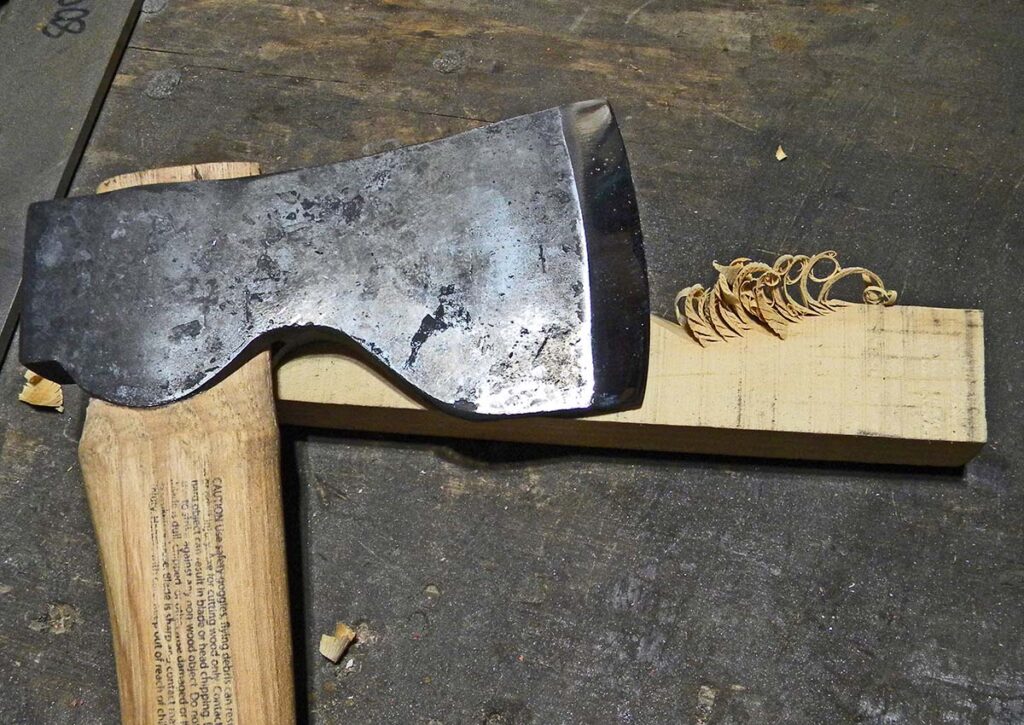
The super sharp edge rendered some very nice, smooth curlicues.
It was time to do some whittling on pine. The Spika was very controllable on the depth of the cut. The super sharp edge rendered some very nice, smooth curlicues. I did notice a sharp ridge on the choil area that needed to be softened if you are using bare hands. A few passes on a Kraton wheel made it easier on my index finger.
Chopping
The Spika split one red cedar slab in one chop. The author kept on splitting till he had a nice pile of kindling.
With camping season kicking off, I had some red cedar slabs that needed splitting. The Spika split one in one chop. I kept on splitting till I had a nice pile of kindling. I did a few more firesticks to add to the pile. This is a handy axe for sure. You just have to find the sweet spot on the handle for splitting and keep your fingers out of the way.
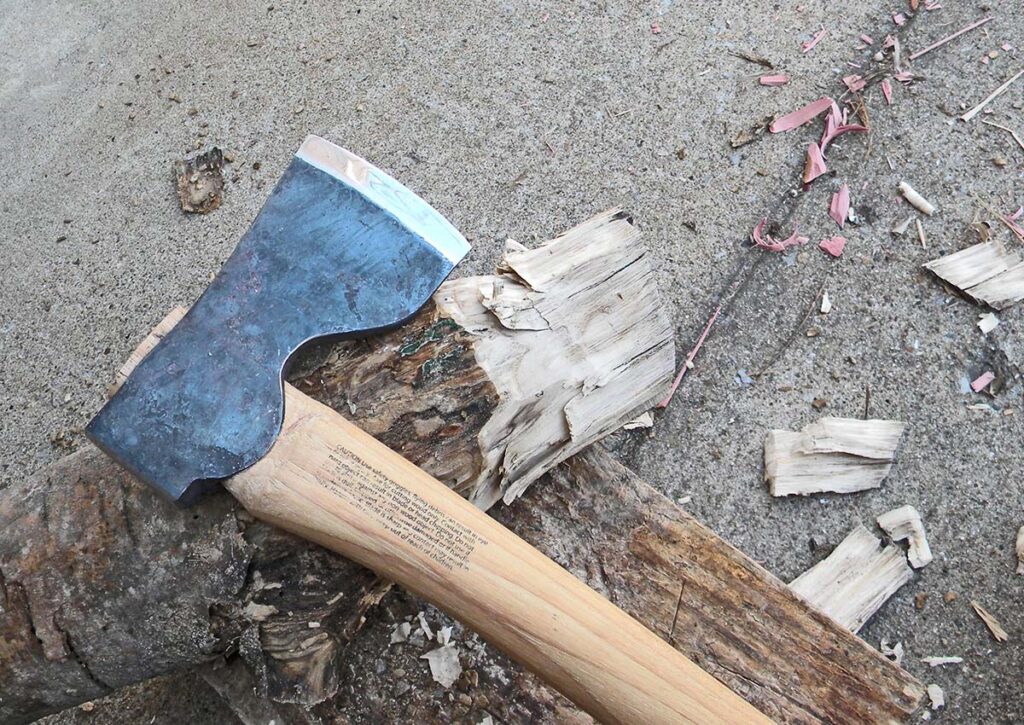
Near the bottom of the woodpile, I saw some seasoned hackberry chunks. It was time to try a little chopping—deep whacks for the Spika. It was accurate on the placement of the chops. (I really wanted to go after a standing tree but the neighbor didn’t go for that idea.)
Sharpness Test
It was time to try a little chopping on some hackberry chunks—deep whacks for the Spika. It was accurate on the placement of the chops.
I went back to 20-pound bond paper for slicing and the Spika didn’t disappoint, slicing the paper cleanly. That’s very impressive for an axe.
The Spika has a polished cutting edge, a smaller hammer head, and a leather sheath on the base model. Hults Bruk offers belts, an axe holder and sharpening stones. The company carries all things axe related—a very complete lineup.
Final Cut
The Spika needs softening where your finger rides when you choke up on the axe head. The SPIKA is a must have for backwoods camping. Its size makes it easy to carry. It’s top of the line in terms of axes, without a doubt.
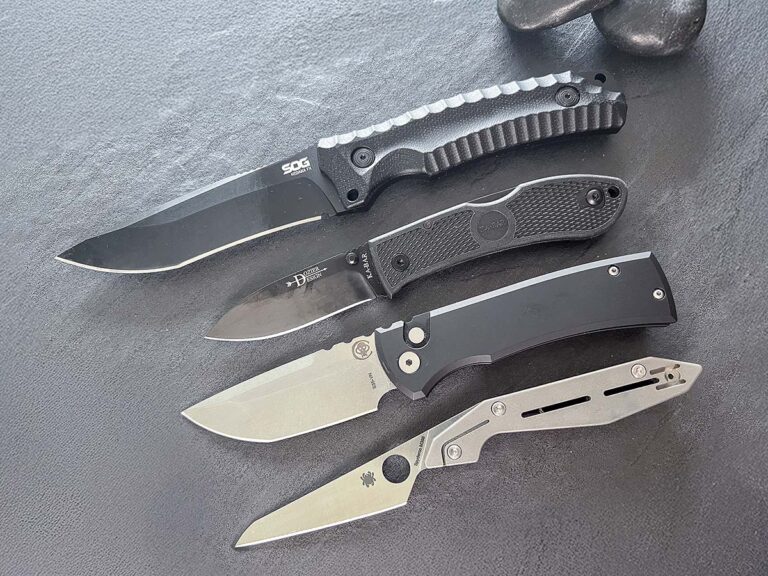
Cool collaborations offer the best of both blade worlds.
Custom/factory collaboration knives have long been popular sellers. A custom knifemaker designs the knife and the company either makes or has it made, providing cutlery consumers with a knife at a lower price point and readier availability than almost always is the case when ordering a custom version directly from a custom maker.
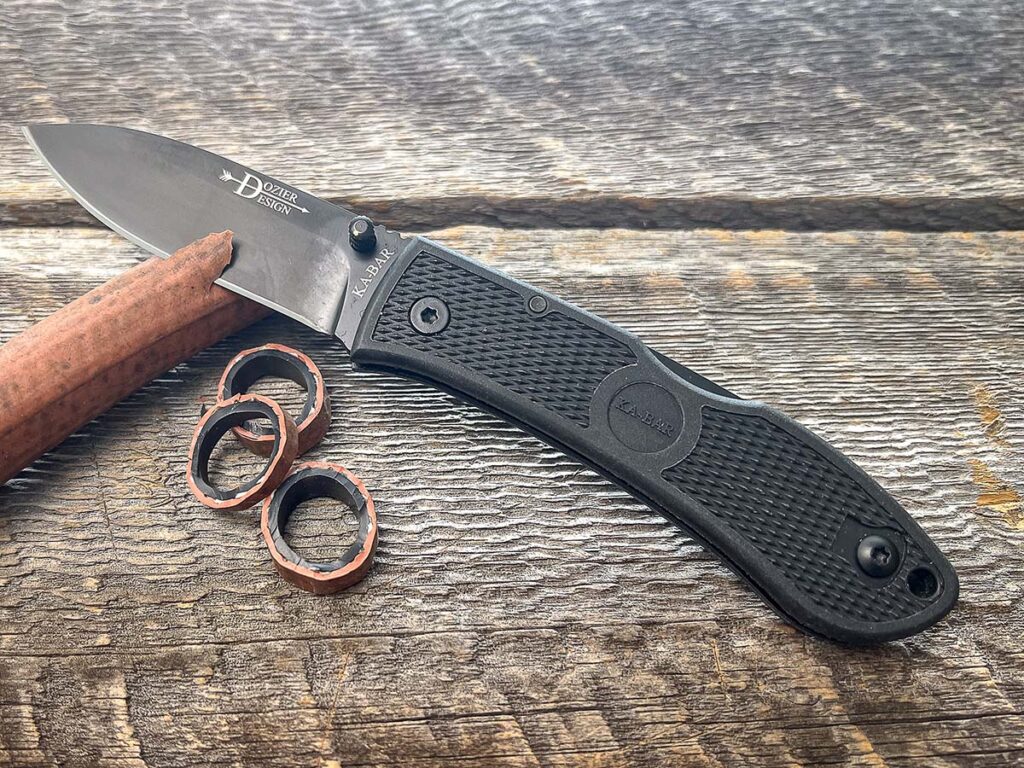
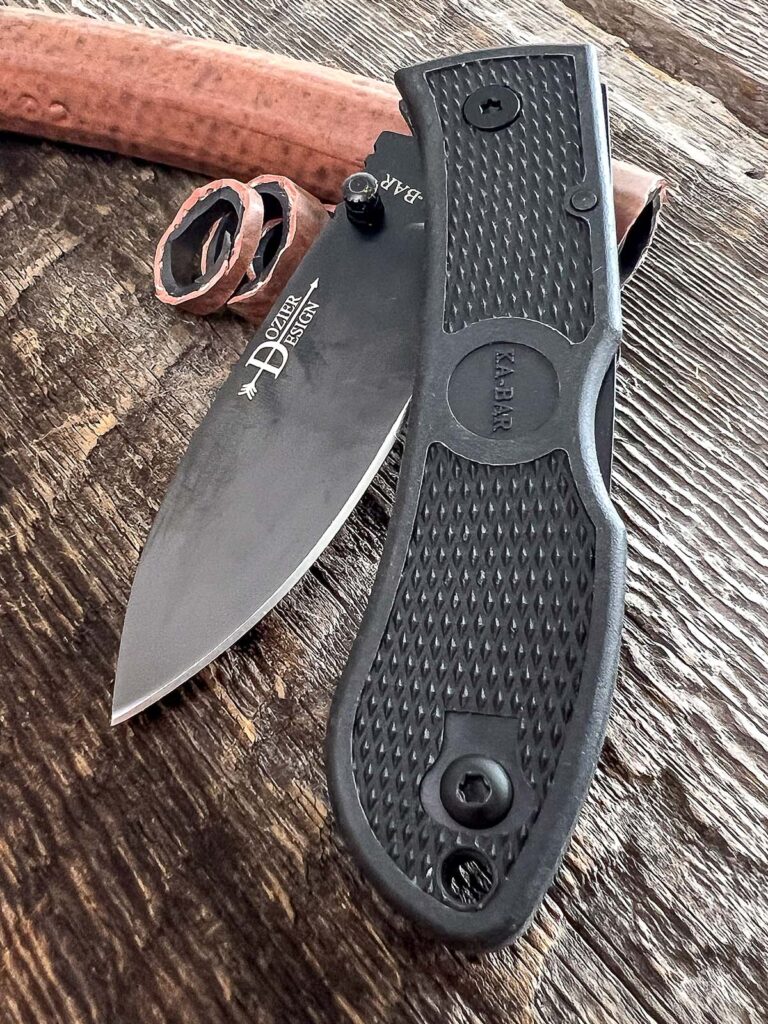
KA-BAR Dozier Folding Hunter
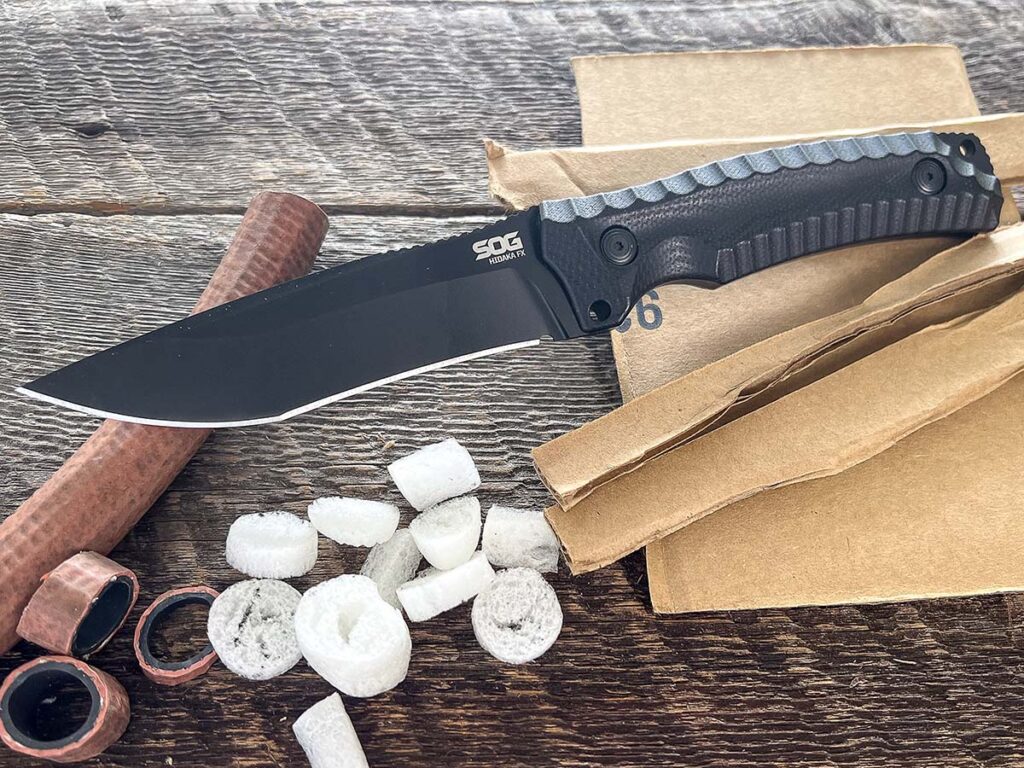
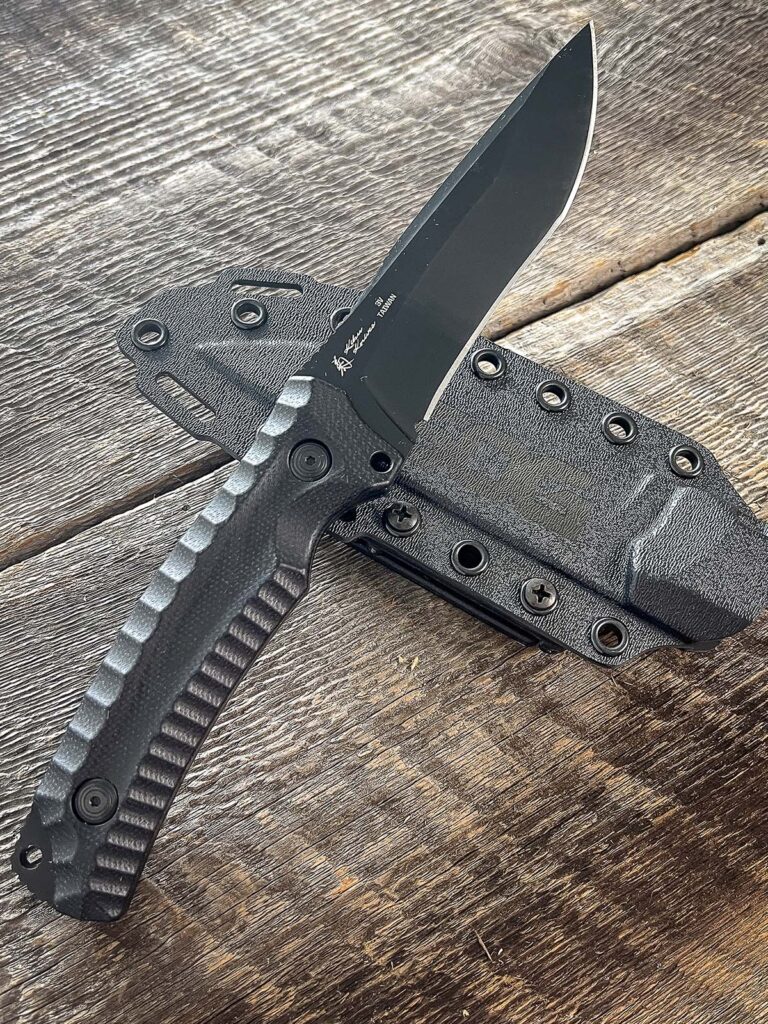
Thicker materials like cardboard and hose are no match for the blade of the SOG Hidaka FX 3V, a Kiku Matsuda design. A slight hint of a recurve to the main cutting edge no doubt helps cutting power. Overall length: 10 inches.
A long-time example of the genre is the collaborations between KA-BAR Knives and veteran knifemaker Bob Dozier. The original Dozier Folding Hunter series consists of mid-sized lockbacks with manufacturers’ suggested retail prices south of $50, offering plenty of bang for the buck. The knives provide ease of portability combined with the high utility of a drop-point blade.
The series proved such an excellent seller for KA-BAR that the company decided to also market it in a higher-grade steel to enhance performance and edge holding: CPM S35VN stainless. The standard KA-BAR Dozier Folding Hunter has D2, a very respectable, hard-wearing blade steel that’s tried and true in the industry. MSRP: $47.58. The S35VN iteration has an MSRP of $97.01 and like the D2 version is made in Taiwan.
While somewhat of a significant price increase, remember, you’re getting a high-end blade steel in return. S35VN behaves a lot like its predecessor, S30V, with a bit more edge-holding power. It’s also easier to resharpen than S30V. S35VN will go the distance, drastically increasing your intervals of sharpening over standard D2. This is especially important if you field dress game on a regular basis. Even though S35VN is stainless, the knife comes with a DLC-coated blade for low glare as well as added corrosion resistance.
Even though S35VN is stainless, the Dozier comes with a DLC-coated blade for low glare as well as added corrosion resistance. Raised diamond texturing molded into the handle does a great job at keeping your hand in place even when wet. Country of origin: Taiwan. Closed length: 4.25 inches.
Out of the box the edge on the sample was good, but not quite there for my tastes. So, with a bit of work I got the blade hair-popping sharp. The 3-inch blade is a sweet spot length for EDC—big enough to tackle most cutting chores and small enough to carry comfortably without added bulk or length.
The handle’s slender nature also enhances EDC ability. It’s flat and doesn’t “print” in the pocket. Raised diamond texturing molded into the black, lightweight Zytel scales does a great job keeping your hand in place even when wet. It might not be the best-looking grip but it’s definitely geared for function, and that’s very important in a working folder. The pocket clip carries the knife blade tip up and is reversible to accommodate lefties.
The single thumb stud deploys the blade easily and the action is smooth. The knife is very controllable at all times, a testament to both its overall size and handle design/ergonomics. The lockback mechanism is swift and secure. I had no problems with it at all. For a nice, sturdy, compact lockback folder, the Dozier in S35VN is hard to beat.
Spyderco/Paul Alexander SLIPIT
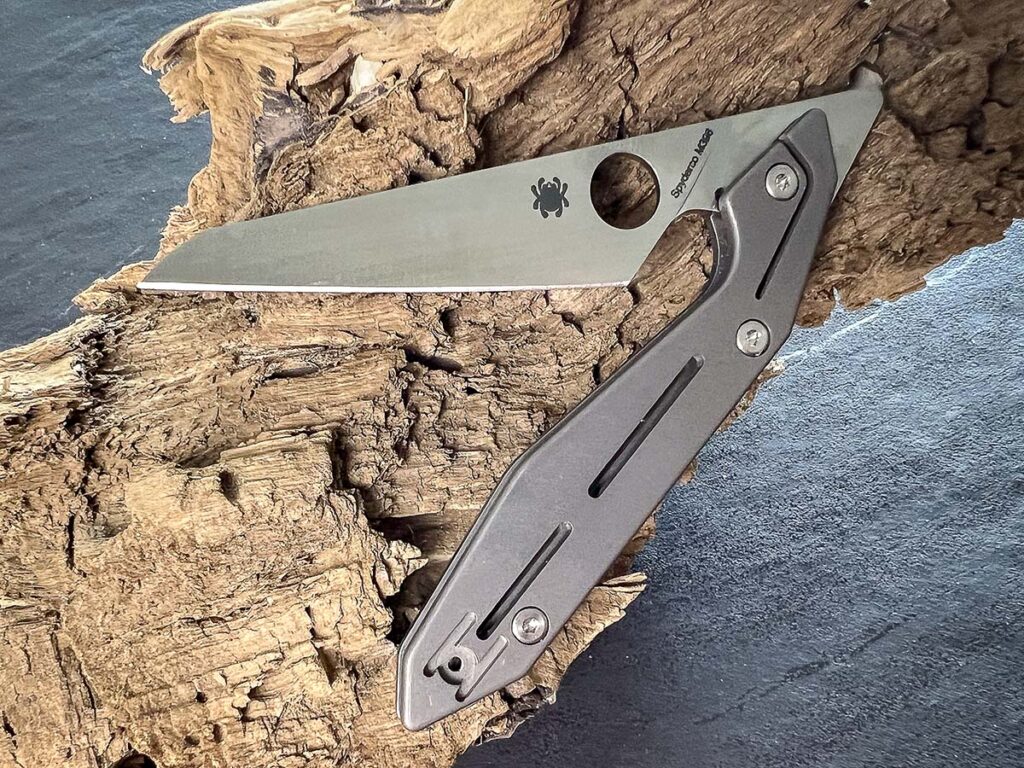
Designed by Paul Alexander, the Spyderco Nand and its angular handle theme carries over into the ergonomics, with finger recesses and a choil as well. Despite its angular appearance, the handle is quite comfortable. Closed length: 4.66 inches.
When it comes to collaborations, Spyderco has always been in the forefront of the genre. It also has some interesting folders in its SLIPIT family of non-locking folders. The Nand is an unusual, exciting example of both. Designed by Paul Alexander, an accomplished automotive mechanical engineer and a seasoned knife enthusiast, the Nand combines an angular approach to folding knife design with high-tech materials, all with the precise execution that Italian manufacturing offers. The result is sort of the Cybertruck of folders.
The 3.19-inch reverse tanto blade is fully flat ground from a new super stainless steel from Bohler called M398. Basically, Bohler took its M390 and increased the carbon and vanadium content for even more edge holding.
There are two methods of deploying the blade. The trademark Spyderco round hole is present as well as the extended blade spine that allows the Nand to be thumbed open similarly to a straight razor. The correct terminology for it is a front flipper.
Machined of titanium, the handle translates into an extremely lightweight knife and is where things get a bit interesting. The integral double-ball-bearing detent system not only holds the blade closed but also provides a positive detent when the blade is open. The “spring arms” for the detents are cut out of each handle half and, to create pressure, are bent in a similar manner to a framelock. Ceramic balls implanted on the ends of the spring arms create the open and close detents.
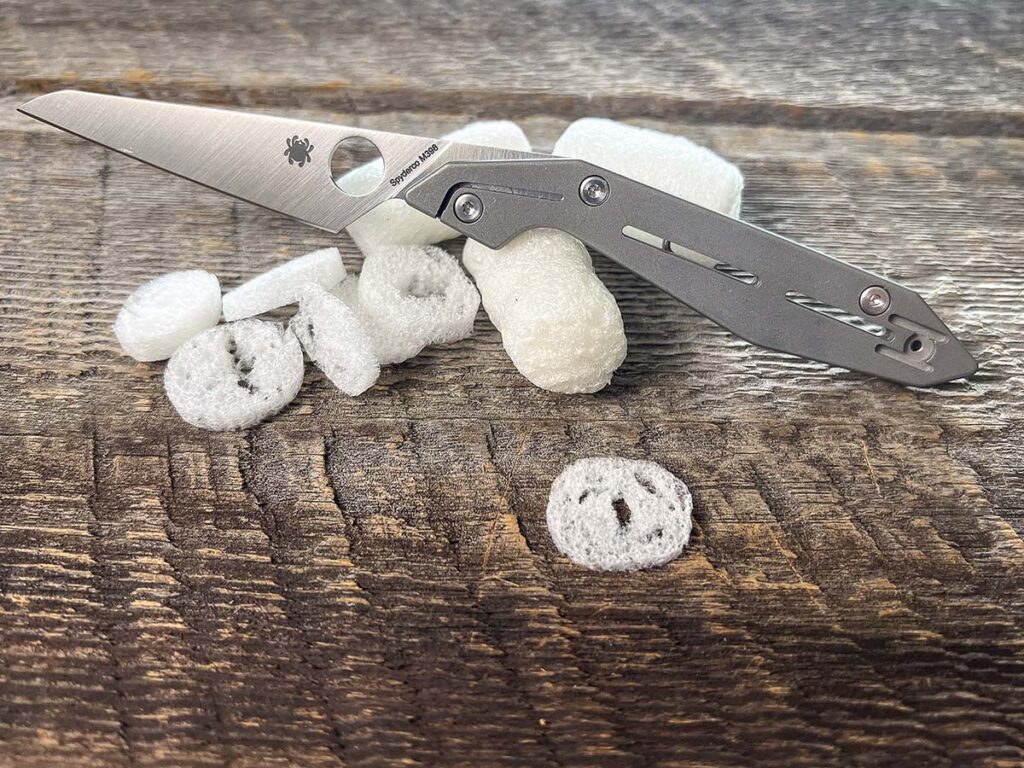
The wharncliffe blade has a full flat grind, which makes the Nand an excellent slicer. Out of the box, the knife cut plastic foam peanuts easily.
The handle’s angular features might make the knife look a bit awkward but don’t dismiss it until you put the Nand in your hand (see what I did there?). With the knife open, a kind of choil forms so you can choke up on the blade for an extra measure of control. Barring that, you can hold the knife a bit further back with your index finger resting inside the handle’s finger recess. Either grip brings your hand over the blade spine of the opened knife and helps secures the blade open as an added measure to prevent accidental closure. The minimalist wire clip is reversible to accommodate ambidextrous carry.
While the Nand may look a bit different, it’s easy to use and holds its own as an EDC folder. The reverse tanto blade has a highly effective tip that pierces easily. The straight-line cutting edge is simple to resharpen, has a lot of bite and slices through tough materials effortlessly. The knife feels very secure despite its slender nature. Choking up around the choil feels good and secure in-hand, rendering the Nand easily controllable.
SOG KNIVES Kiku Matsuda Hidaka FX 3V
Thicker materials like cardboard and hose are no match for the blade of the SOG Hidaka FX 3V, a Kiku Matsuda design. A slight hint of a recurve to the main cutting edge no doubt helps cutting power. Overall length: 10 inches.
The Hidaka FX 3V is a continuation of the exciting collaboration between SOG Knives and legendary Japanese knifemaker Kiku Matsuda. Known for their distinctive, flowing design style, intricately sculpted handles and hollow-to-flat compound-ground blades, Matsuda’s designs stand out.
His new SOG entry is an exciting tactical/outdoor fixed blade with a 4.8-inch tanto blade ground from ultra-tough CPM 3V carbon steel paired with a multi-faceted sculpted handle of black Micarta®. The blade’s angled tanto tip has a flat grind and the primary cutting edge is hollow ground. When you look at the blade in the light, you can see the grinds transition. Very cool—not too many factory knives have this feature and no doubt it’s much trickier to pull off than a standard tanto blade.
The flat-ground tip has a thicker cross section for greater penetration strength and general tip durability during hard use. The hollow-ground main bevel allows the blade to slice easily. Notches on the thumb-rest portion enhance control and a non-slip grip when bearing down on the blade. A black PVD coating helps with corrosion resistance and low-profile visibility.
The handle is as interesting as the blade. The distinct, intricately sculpted grip features are a Matsuda trademark. The sculpting is not purely for looks but where form follows function. The middle of the handle is hollowed out on each side like one long groove. The handle edges sport a heavy chamfer and a series of scallops all the way around, the latter to enhance grip. A prominent groove helps seat the index finger and provide an anchor point. The total blacked-out look—handle screws included—gives a somewhat sinister tactical appearance. The exposed pommel also sports traction notches for a better thumb purchase.
The SOG’S handle edges sport a heavy chamfer and a series of scallops all the way around, the latter to enhance grip. A sturdy molded Kydex sheath holds the blade securely and an audible snap lets you know when the knife is fully seated.
Overall, the Hidaka FX 3V is just an interesting fixed blade. Not only does the compound-ground blade look cool but it is also very practical. Thicker materials like cardboard and hose are no match for it. A slight hint of a recurve to the main cutting edge no doubt helps cutting power.
The knife comes with a sturdy molded Kydex sheath. It holds the blade securely and an audible snap lets you know when the knife is seated. A hinged fastener affixes the sheath to your belt. The device is similar to the Blade-Tech Tek-Lok and operates similarly. The knife rides comfortably on a belt and the handle is easily accessible. Country of origin: Taiwan. MSRP: $309.95.
Pro-Tech Knives Ramon Chavez Redencion 229
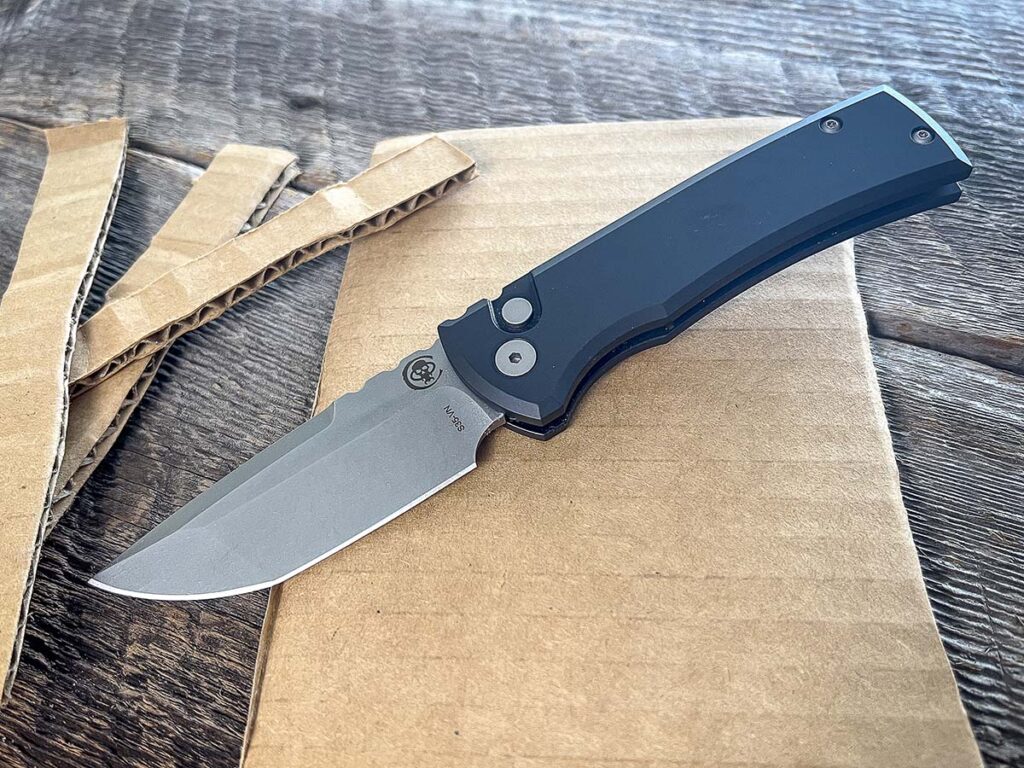
The Redencion 229 is a workhorse folder. The aluminum handle and S35VN steel blade denote that it’s in it for the long haul. Cardboard is no match.
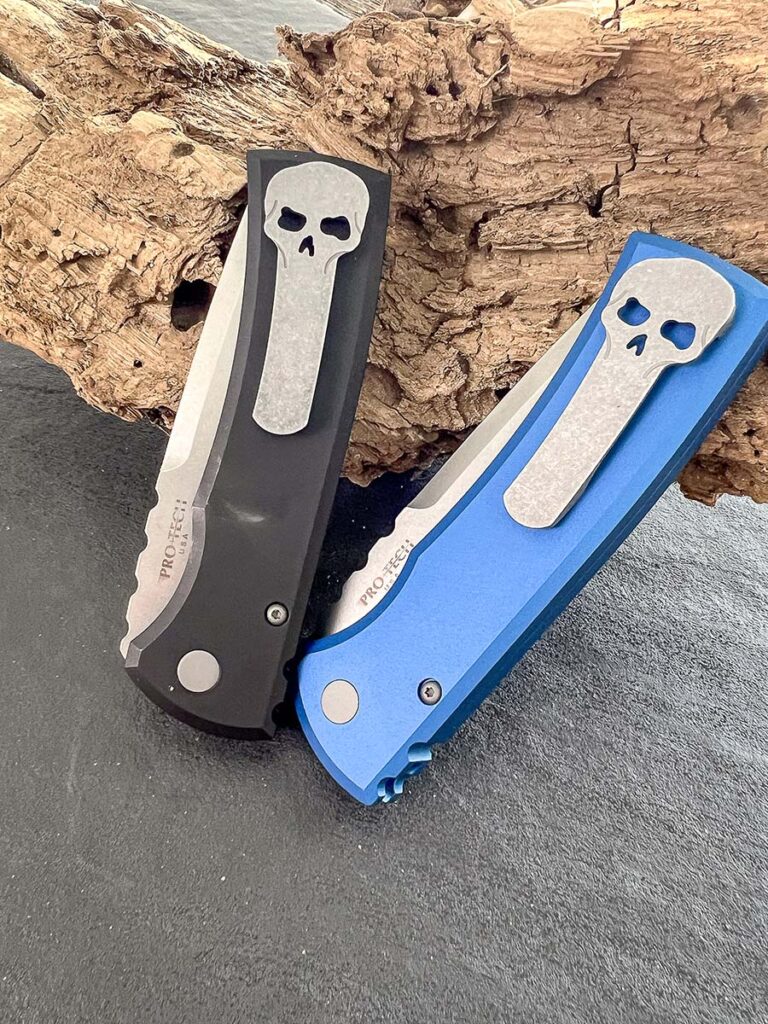
One of the most exciting factory automatics going is the Chaves Redencion 229 by Pro-Tech Knives. Designed by knifemaker Ramon Chavez, the auto combines his bold design style with Pro-Tech’s excellent manufacturing capabilities and automatic action. The 3.3-inch tanto blade is high-performance CPM S35VN. The handle is T6-6061 hard-anodized aluminum for light weight and strength. The Chavez signature skull pocket clip adds attitude to the hard-firing automatic. At 4.5 inches closed, the folder carries well and works hard.
With the press of a button, the blade flies with authority and hits hard when it locks. If you’ve played with Pro-Techs you know what I’m talking about. The blade is flat ground and comes with a very sharp cutting edge out of the box. It will easily handle most tough cutting chores. It goes through cardboard and hose easily.
Designed by Ramon Chavez, the Pro-Tech Redencion 229 and its skull pocket clip stand out. Given the clip’s width, it’s also highly functional and durable. You are not going to spring this clip from your pocket accidentally. Note that the clip screws are inserted from inside the handle for a cleaner look.
The blocky handle allows for a secure grip. I noticed no hotspots or any hand discomfort. The aluminum scales are solid and generally hold up to hard use. Some might be apprehensive about the pocket clip as I was at first. Its size and width makes it hard to feel in-hand. Another good thing is the width means it won’t accidentally disengage if caught on anything. It’s stout! It provides the right amount of tension when the knife is clipped to the pocket. Another neat thing is you see no clip mounting screws because the clip is screwed to the handle from the inside—a very cool extra touch.
The Redencion 229 is a great EDC automatic that has attitude and high utility all in one interesting folder. Made in the USA, the model with a stonewashed blade and black anodized handle has an MSRP of $300. Black blade iterations are also available, as well as a recently released drop-point version.
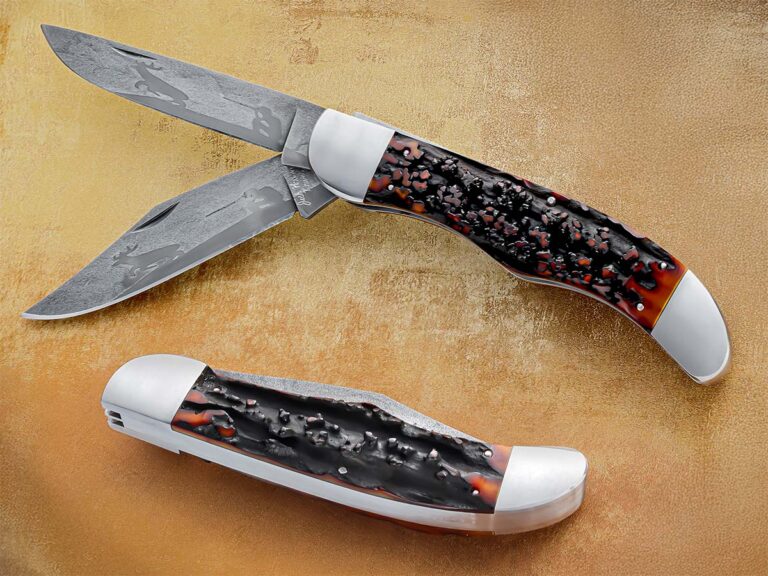
These slip joint knives overcome the mechanical challenges of the style to qualify as works of art.
The slip joint is the most recognized of any folding knife design. Variations on the theme continue to guide the custom knifemaker and the consumer through a journey of creativity and craftsmanship that is indeed endless.
The latest slip joints are true to this standard and don’t disappoint in looks or legs—easy on the eyes while walking and talking at the same time. They complement their makers’ personalities and demonstrate their skill sets in fit and finish, as well as mechanics. They provide pure inspiration for collectors and buyers alike, setting their own standard of excellence.
Standley Caldwell Five-Blade Cattle Knife
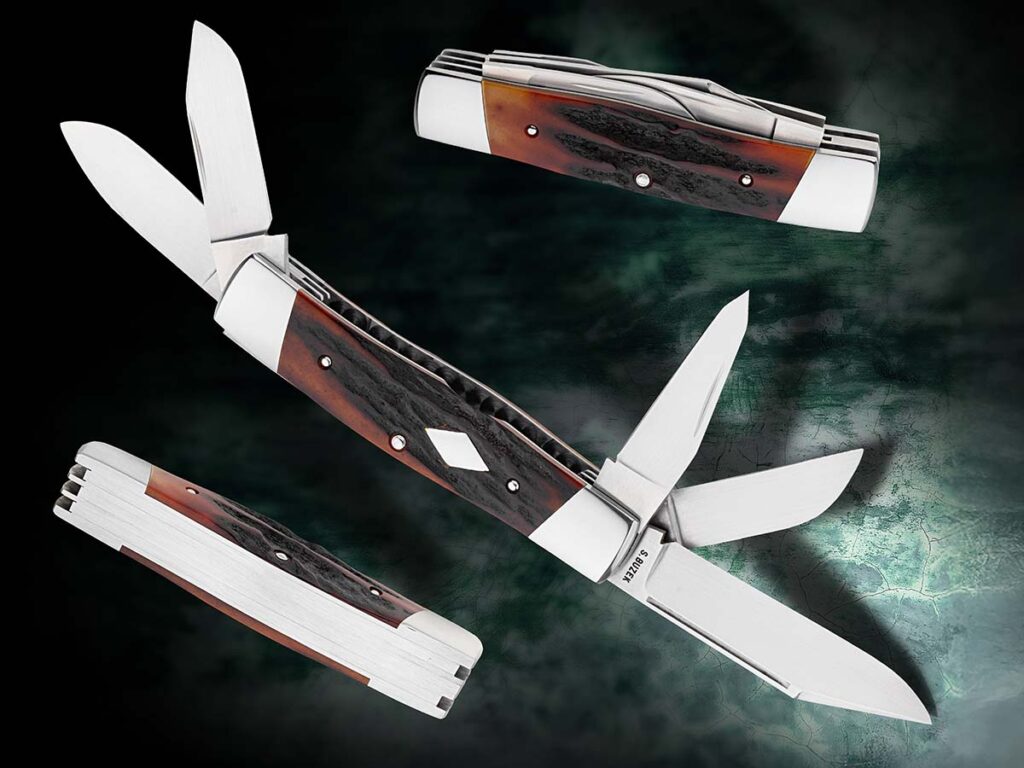
“The five-blade cattle knife is a very difficult build,” Stanley Burzek confesses. Not only are aesthetics at play, but mechanical aspects, such as the blades clearing frame and timed right, not to mention executing multiple grinds. Tackling more complex slip joints has been a natural progression for Stanley. The Texas maker began with single- up to three-blade stockmen but saw the more difficult projects as pushing his craftmanship to the next level. (Jocelyn Frasier image)
A slip joint maker for 18 years, Stanley Buzek of Caldwell, Texas, brought a beautiful five-blade cattle knife to life recently. Featuring a CPM 154 hollow ground blade with 416 stainless integral bolsters and liner, along with stag handle scales, the knife was a particular challenge.
“The five-blade cattle knife is a very difficult build, getting all the blades timed and working properly with everything flush in all positions,” Stanley explained, “and getting the blades to clear inside the frame in such a small area. The multiple offset grinds and the dagger grind of the awl blade make it especially challenging.”
Tackling the cattleman works right into the increasingly difficult projects Stanley has pitted himself against—even if it was a daunting proposition. “The five-blade was just a natural progression from the single-blade trapper, two-blade, three-bladed Stockman, and so on, to push myself to the next level of knifemaking,” he confided. “Actually, the hardest part was just getting over my fear of screwing it up and getting started on the build. It is an intimidating knife to build, having to pack so much into such a small area that you can paralyze yourself with the fear of getting started.”
Buzek got the pattern for the five-blade from Tim Robertson. He drew inspiration from the work of Tony Bose, whom he credits with bringing the pattern back. He has also seen photos of Reese Bose’s take on the pattern.
“I have received help from many great makers through the years,” Stanley reflected. “Bill Ruple and Rusty Preston were a huge help, and the South Texas Slip Joint School that I went to back in 2011 really increased my knowledge in how slip joints actually work. Right now, a lot of credit goes to Tim Robertson for pushing me and helping me with problems and us bouncing ideas off each other.”
Buzek makes all his slip joints with integral liners and bolsters accompanied by jeweling on the interior. He prefers slanted bolsters while gravitating toward natural handle materials such as jigged bone, mammoth and stag. “I think the single-blade slip joint will be the most popular for a long time for ease of carry and ease of build in the custom world,” he predicted. “Multi-blades, though not as popular, will push makers to step outside their comfort zone and show collectors and the general public alike the technicality and perfection and precision at which some of these pieces are made and will help makers improve their overall methods.”
Ted Friesenhahn Two-Blade Trapper
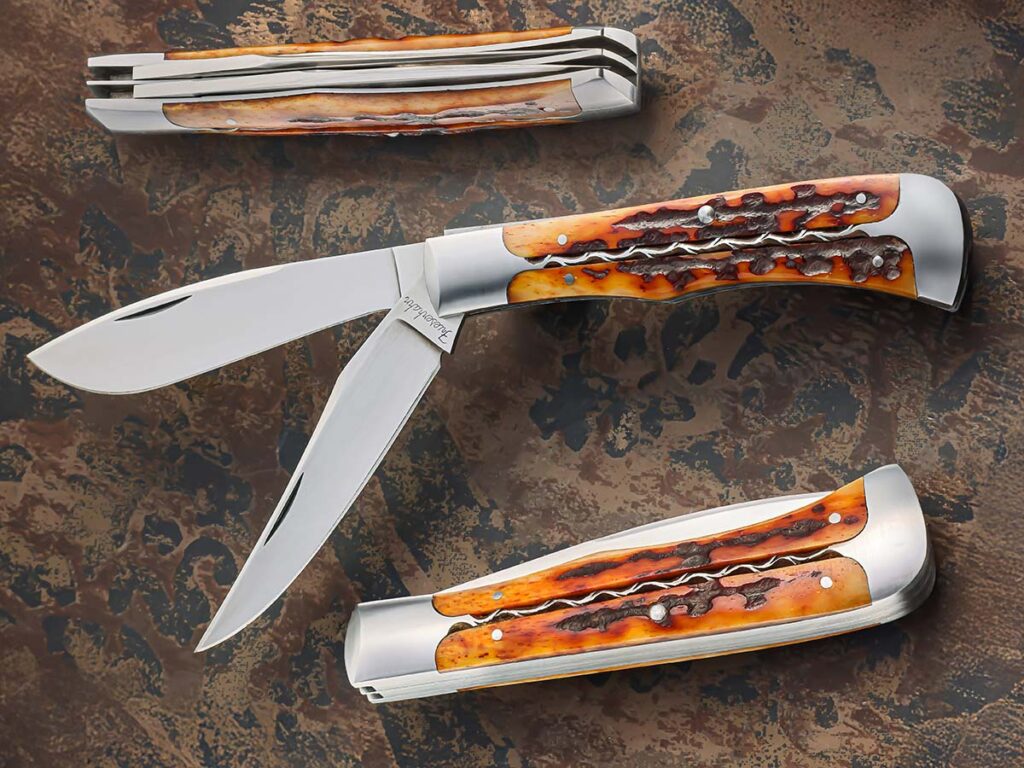
Like most custom makers, the most challenging aspect of the slip joint for Friesenhahn is getting the rise and fall of the blade correct. Add in embellishments, like the delicate vine filework down the center of his trapper’s handle, and the project becomes a taxing undertaking. (SharpByCoop image)
When Ted Friesenhahn took up the task of making his two-bladed trapper, he chose to make the second blade a “simmy” skinner. “This is the most popular slip joint, especially in Texas,” said the resident of Seguin, who has been a toolmaker since the age of 18. “I’ve worked in several different tool shops and have had the pleasure of teaching mill classes at hammer-ins.”
For his trapper, Ted chose a hollow ground blade of CPM 154 with a 416 stainless steel frame and bolster and a jigged bone handle. He added, “All of my knives have integral liners, and in this knife, the center is left standing. I have had this idea in my head for a while before I finally did it. I wanted something different and to be able to embellish it, so I chose to do vine filework.”
The most difficult aspect of the slip joint for Friesenhahn is common to most custom knifemakers—getting the rise and fall of the blade correct and flushed at closed, half stop, and open positions. “Of course, the walk and talk are key after all that fit and finish,” he said. “My first knife was an Old Timer Stockman that I had when I was growing up in the country. I have always carried a pocketknife, so like most makers and knife enthusiasts in this area, I had heard of Bill Ruple.
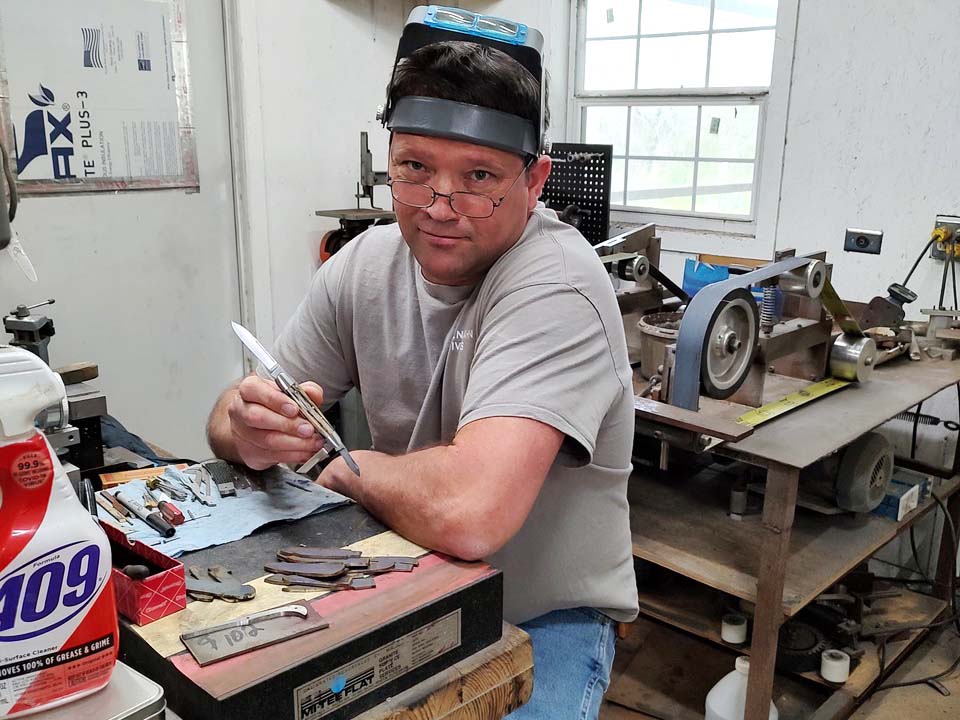
Ted Friesenhahn in his shop.
“Many years ago now, Johnny Stout and [ABS master smith and BLADE Magazine Cutlery Hall of Fame® member] Harvey Dean put on a hammer-in at Johnny’s shop in New Braunfels, Texas, where I first met Bill Ruple,” Ted continued. “He was teaching the slip joint classes, and he had a jig he came up with to measure the rise and fall of the blade and spring. It came to be called the Ruple jig … I still use this jig on every knife I build.”
Interestingly, Friesenhahn sees variations on patterns as emerging in popularity. “The current direction is in patterns being turned into different patterns,” he said, “in multi-blades like the stockman lockback whittler and sowbelly whittler. There seems to be a craze with the whittler, and of course, I have one of these variations in the works.”
Bill Burke Single-Blade Trapper
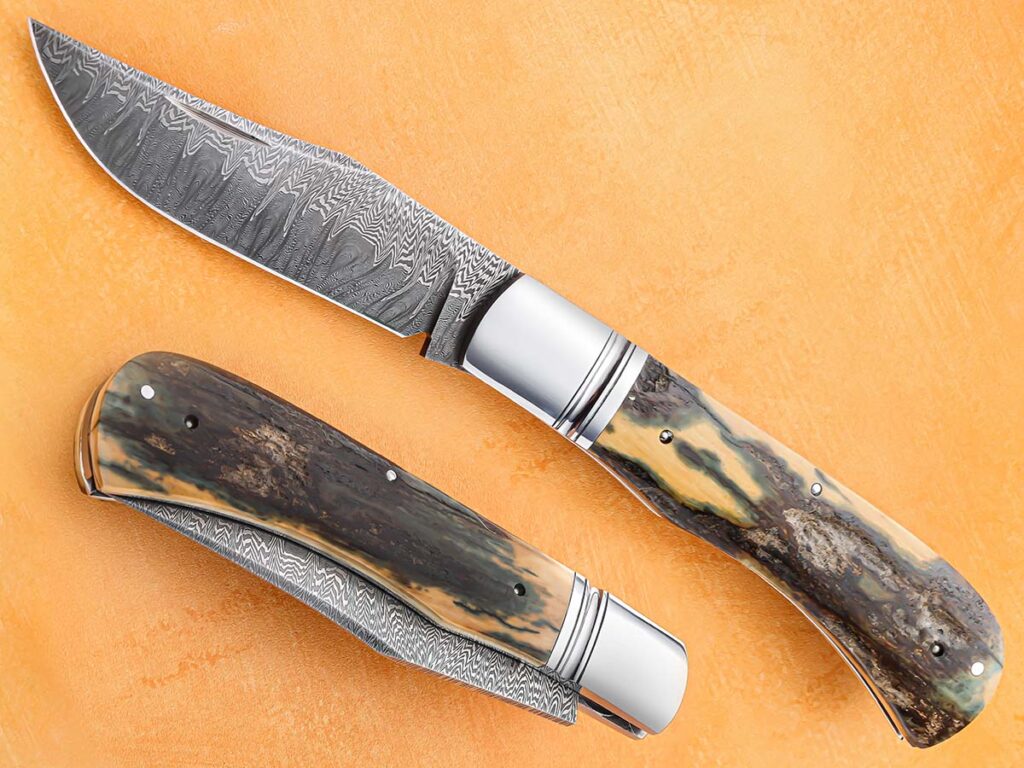
“This knife came about as a class demo for slip joint folders that I taught at Jim Poor’s Flatland Forge in Tuscola, Texas,” said Bill Burke of his single blade trapper, with a 3-inch stainless damascus blade and blacklip mother-of-pearl handle scale. (SharpByCoop image)
Master smith Bill Burke of Boise, Idaho, recently produced a handsome single-blade trapper with a hollow ground 3-inch blade of stainless damascus steel, blacklip mother-of-pearl handle scales, and 416 stainless integral bolster and liner.
“This knife came about as a class demo for slip joint folders that I taught at Jim Poor’s Flatland Forge in Tuscola, Texas,” said Bill. “The pattern for the class was the ever-popular large single-blade trapper. I added my personal preferences of filework and bolster fluting to this knife, as well as incorporating a piece of Jim Poor’s waterfall pattern damascus into the blade. The only guide I had was a pattern drawn on a piece of paper and e-mailed to me by Luke Swenson.”
Burke has found the most challenging aspect of the slip joint to be mechanical, sharing that observation with other makers. “The most difficult part of any slip joint, at least for me, is getting the timing right so that the spring is level with the frame/liners in all three positions, closed, half stop and open, while also keeping the end of the spring even with the end of the tang in the closed position,” he commented.
“I made my first slip joint folder in about 2001,” Burke continued. “It was a large trapper like this knife. I traced a friend’s knife on a piece of paper and used calipers to measure the dimensions of the tang. This knife was made because I had carried a slip joint pocketknife with me since I was about 5 years old. I can remember sharpening a pencil for a first grade teacher with my pocketknife.
“Over the years, I continued to make slip joints, and they did get better,” he observed. “But I always struggled with the spring timing. Fast-forward 16 years, and a friend of mine from Australia, [journeyman smith] Bruce Barnett, and I went to visit the maestro of the South Texas Slip Joint Cartel, Bill Ruple. We were at Bill’s shop for four days making slip joints. While there, Bill taught me the proper use of the Ruple jig, that little contraption he had put together to make timing of a slip joint something of a science instead of a swag. This little bit of knowledge changed my slip joints from being functional to well-working tools that I am proud of. Bill Ruple and Luke Swenson continue to motivate me to make better slip joint knives.”
As a master smith and forger of knives, Burke sometimes takes on that dimension completing the slip joint. “The only challenge is forging the steel, whether damascus, carbon or stainless, which is not commonly forged,” he advised. “Most people who do forge do not actually forge folder blades but instead forge the steel and then stock remove the blade from the forged steel. There are some who will forge damascus folder blades to get a specific pattern of damascus to follow the curve of the blade shape. This can be seen in the knives made by Owen Wood, Tim Foster, [master smith] Mike Quesenberry and a few others.
“I have forged san mai and damascus folder blades to shape when circumstances made it necessary but do not commonly do so,” Burke concluded. “The challenge making a slip joint knife from forged materials in my opinion is no different than doing stock removal with the possible exception of san mai blades and springs where careful attention has to be paid to ensure the hard core of blade and spring line up precisely so the components stay in alignment, keeping the spring from wandering off to one side of the blade. If this happens and is not corrected, eventually the bolsters will be forced apart and the spring will continue to wear on one side of the blade making the knife useless.”
Bubba Crouch Single-Blade Trapper
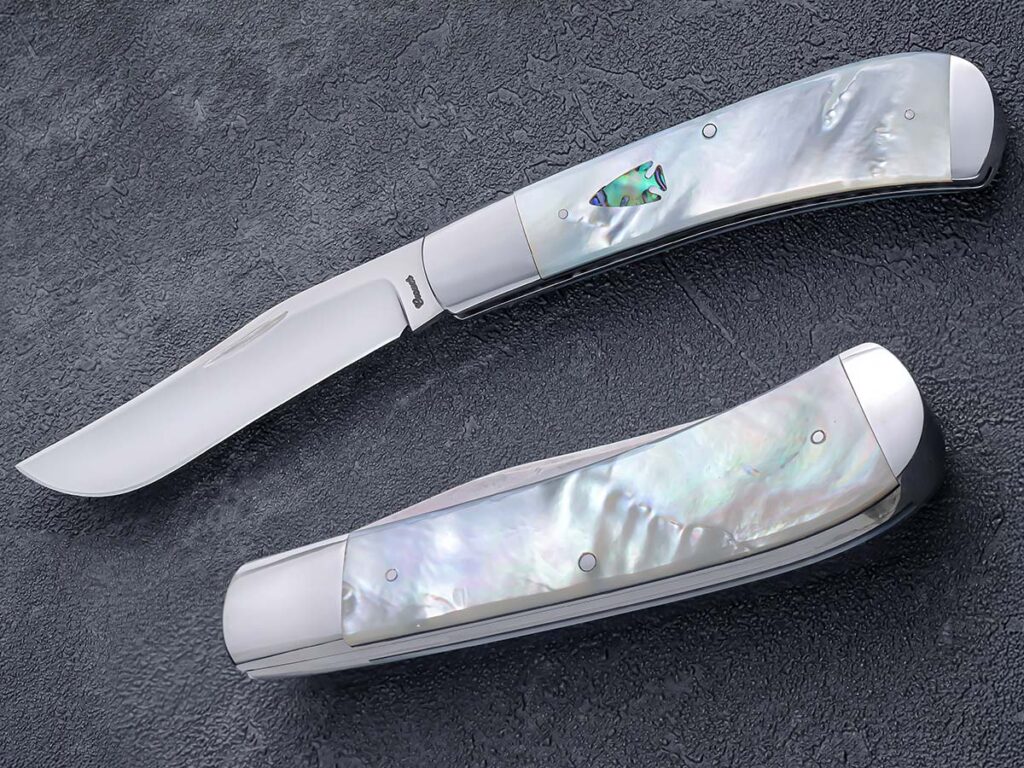
Bubba Crouch points to the influence of Slip Joint Cartel icon Bill Ruple in his career. More than anything, Ruple taught him to “make the next knife better than the last one.” Crouch’s pearl-handled trapper demonstrates that the knifemaker has taken this lesson to heart. The natural scale presented concerns in chipping, shattering, and even burning. (SharpByCoop image)
Bubba Crouch has been making knives in Pleasanton, Texas, since 2001 and lives just down the road from his friend and mentor Bill Ruple. While Ruple is the leader of the South Texas Slip Joint Cartel, Crouch is a founding member and revels in the lively exchange of ideas and the friendly banter that it provides.
Ruple’s influence is pervasive among slip joint makers, and Crouch is no different. “Bill taught me everything I know about knives,” commented Bubba. “I guess the most important thing he has taught me is to make the next knife better than the last one. That is hard to do!”
Recently, Crouch completed and sold the featured single-blade trapper to a resident of Philadelphia. His available knives sold out in two days during the last 10-day Las Vegas show, and the demand for his work is on the rise. This particular trapper features a 3¾-inch hollow-ground blade of CPM 154 stainless steel, an integral 416 stainless steel frame, and handle scales of pearl with an abalone arrowhead inlay.
“I do all 416 integrals,” Bubba noted. “So, I mill my liners instead of spot welding or soldering, and I have had a lot more luck keeping them flat and even. That makes a better knife, I think, and the integral frame prevents issues with warping and that type of thing.”
The biggest challenge in creating this trapper came with working in pearl, a natural material that presents concerns in chipping, shattering, and even burning. When working with the pearl, Bubba uses a thin liner material glued to the surface to stabilize it, and with the final grind, he removes the liner material while shaping the pearl to fit the handle space.
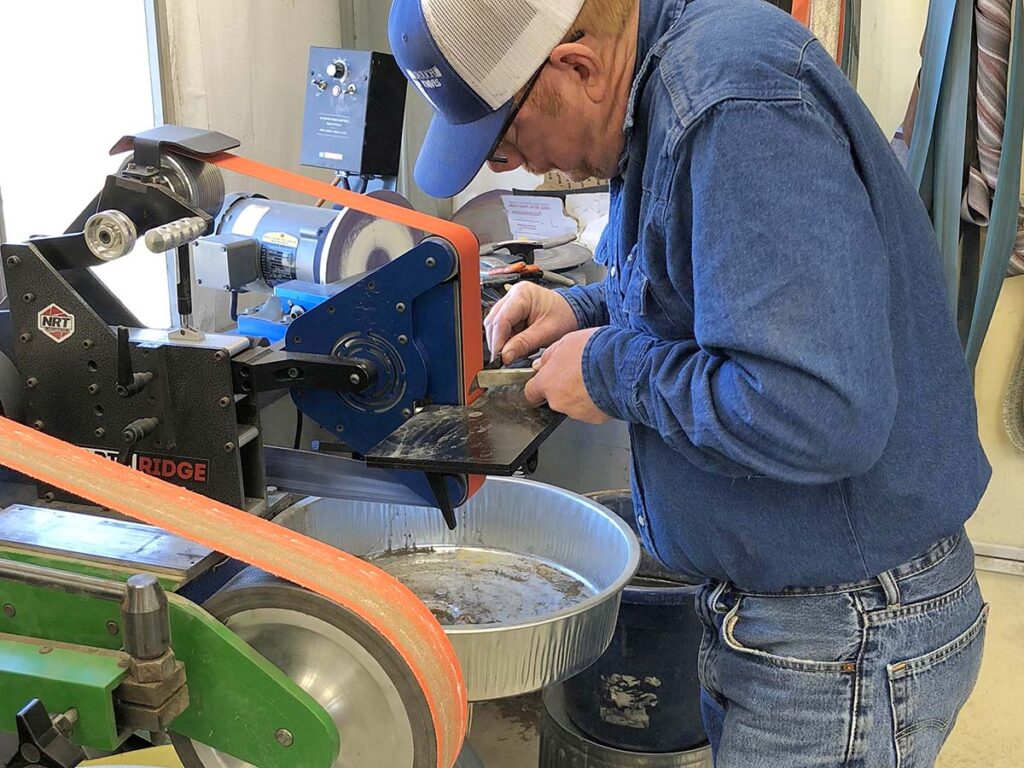
Bubba Crouch at his grinds a blade.
“If you look at the pearl on some knives, you can see a yellow edge from the heat sometimes,” he said. “I fit the pearl in the handle and then remove it, shaping it to the bolster to avoid the heat before putting it back in. When I’m sanding the pearl, I wet sand, and when I drill, I squirt water on it after starting the hole.”
The abalone inlay gives Bubba’s trapper a distinctive flair, and the process of inserting it is relatively simple. “I have a pantograph machine and use templates to cut the abalone and cut the pocket for it in the pearl,” he said. “You’ve got to be careful and don’t want to pop it in and out too many times. I drill a hole through the pocket that is pretty small and comes out the liner to test fit.”
Crouch enjoys building what he likes, and for now, that is the single- and two-blade slip joint. Multi-blades don’t have great appeal. “My clientele is the everyday carry guy,” he concluded. “So, I build those knives. I don’t see the slip joint market getting soft. It’s traditional and will stay stable. It’s what your grandpa and your dad carried, and as long as there are memories like that, there will always be a market for the slip joint.”
Demand doesn’t seem to waver with the slip joint, and today’s makers are eager to oblige the marketplace.
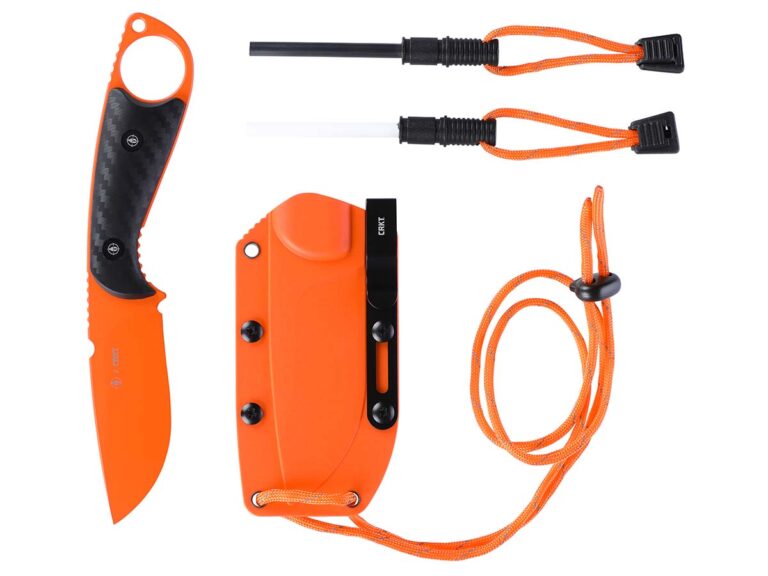
Designed with Spartan Precision Equipment, CRKT’s backcountry-ready Altai pairs 14C28N steel with an integrated fire rod and ceramic sharpener.
CRKT has teamed up with the shooting platform specialists at Spartan Precision Equipment to introduce a new backcountry fixed blade: the Altai. Named after Spartan founder Rob Gearing’s hunting excursions in Mongolia’s Altai Mountains, the knife integrates purpose-built field features directly into the cutting system and sheath setup.
Tailored for Field Processing
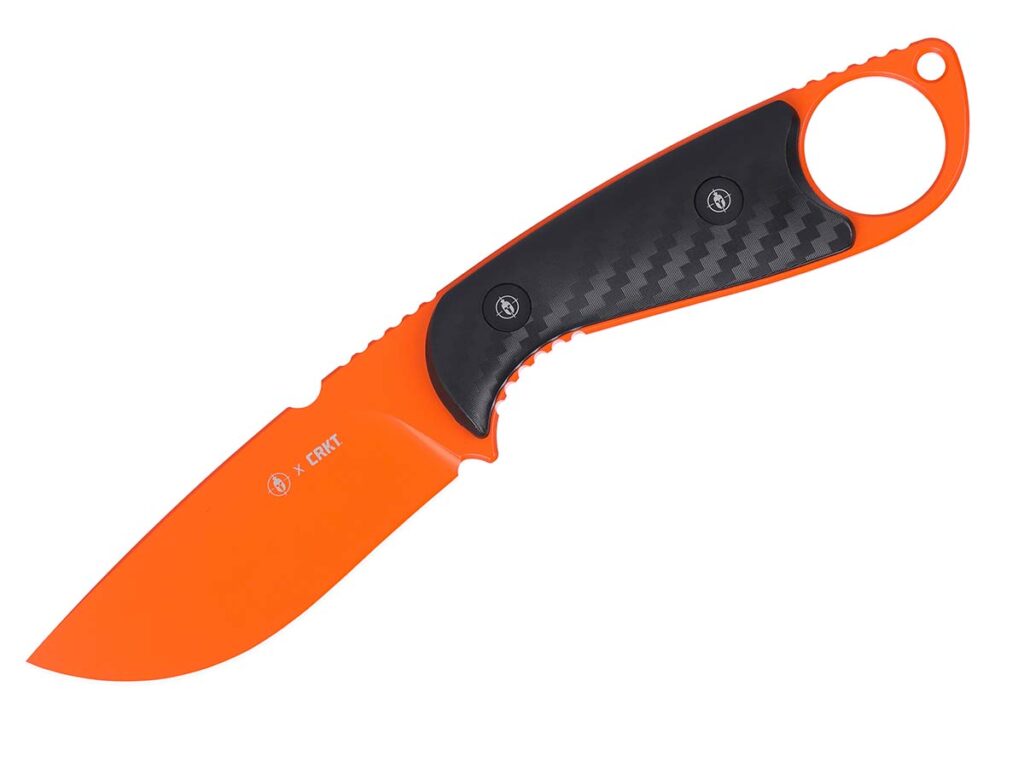
The Altai centers around a 3.53-inch plain-edge blade fashioned from 14C28N stainless steel. To withstand harsh outdoor environments, the steel is treated with a protective ceramic coating designed to bolster toughness and resist corrosion. The 0.13-inch thick blade is sized specifically to maintain maneuverability and control during game dressing, while jimping along the finger choil and spine provides positive tactile traction.
The knife features glass-reinforced nylon (GRN) handle scales textured with a carbon-fiber pattern, secured over custom pins bearing the Spartan head logo. High-visibility orange highlights run along the build, helping users spot the knife easily in dim light or deep cover. At the butt end, a ringed pommel allows for a fast draw—even when wearing thick gloves—and includes a lanyard hole for additional retention options.
Built-In Fire and Maintenance Kit
Rather than serving as a standalone cutter, the Altai incorporates essential survival and care tools into its carry rig. The knife’s spine includes a dedicated striking notch configured to work with an included magnesium alloy fire rod. For touch-ups during long trips, a ceramic sharpening rod is also housed directly alongside the blade.
Both maintenance accessories stow in the included molded thermoplastic sheath. Reflective orange paracord is used for the main lanyard as well as the pull tabs on the fire and ceramic rods, ensuring high visibility when working in low-light conditions.
At 8.0 inches in overall length and a weight of 3.6 ounces, the Altai offers a complete backcountry processing and field-maintenance package in a compact carry footprint.
Thanks To The Internet, Straight Razors Are Back In Style. These Trio Of Blades Can Keep You Looking Sharp And Feeling Smooth.
Mastering shaving with a sho-nuff handheld straight razor is a lost art that has recently become more popular thanks to social media shaving gurus and those who like a good challenge.
Straight razors never went away, the internet just has a knack for making old things new and cool again. Let’s look at a trio of current offerings and shave them through their paces.
Boker King Cutter
Boker King Cutter
Boker has been producing straight razors since 1869 and the company offers many models today. The King Cutter, the company’s most popular razor, features a carbon steel blade with a deep hollow grind. The handle is a black polymer with a brass Boker Tree Brand logo escutcheon. The King Cutter was the lightest of the three review pieces, tipping the scales at a svelte 1.47 ounces. It features a monkey tail tang for quick blade access.
Being the most expensive of the test lot by a long shot and from a company that has been making straight razors for over 150 years, you’d expect the King Cutter to perform well. Simply put, it did. The blade was, ahem, razor-sharp right out of the box and glided through my two-day stubble clean as a whistle. I never had to back up and go over an area to get it smoother.
The thinnest of the review blades, it got into tight spots a bit easier. However, a word of warning is in order. An extremely sharp blade like this will cut you faster, too, so take your time! The King Cutter’s high price tag may scare some away, though there are other straight razors out there that cost much more.
MSRP: $189.95
Rough Ryder Cinnamon Bone Stag Razor
Rough Ryder Cinnamon Bone Stag Razor
Rough Ryder’s Cinnamon Bone Stag Razor has all the trappings at a budget price, including the good looks of a traditional straight razor. The cinnamon bone stag handle, replete with an acorn escutcheon, is downright handsome—and Rough Ryder does bone stag well.
The cutting portion of the blade has a light yet distinctive damascus pattern running across its face, and a barber’s notch at the point aids in safely opening and deploying the blade. A monkey tail tang completes the package.
Right out of the box, the Rough Ryder entry shaved the stubble straight from my face. The blade was plenty sharp and I was able to get into tight spots with good results. When you get down to the nitty-gritty, there are differences between this razor and an expensive one like the Boker.
There is a tad more drag on the blade and I had to back up a few times to get the area I was shaving totally smooth. To be honest, I expect this from a razor at this price point, and you should, too. That said, the Rough Ryder Cinnamon Bone got the job done and was no slouch. I recommend this razor to those who want to get their feet wet before taking the plunge on a high-dollar cutter. And, by golly, it was the most attractive of the bunch!
MSRP: $29.99
TOPS Knives Tac-Raze 2
TOPS Knives Tac-Raze 2
The TOPS Knives Tac-Raze 2 is designed as an EDC and not billed as a straight razor. Nonetheless, we threw it into the fray to see if we could shave with it, letting the chips fall where they may.
A full 2.625 inches of the blunt-tipped blade has a slightly bowed edge. There’s a rat-tail tang reminiscent of the old friction folders, though not forged. The Tac-Raze 2 has a deep choil below the blade edge that splits time with the handle. TOPS includes a dark brown leather slip and a small bottle of protectant.
Would an EDC with a razor-style blade shave? Given how many YouTube videos there are of guys shaving with everything from bowies to kitchen fare, I figured why the heck not? A cursory check right out of the box with the blade warmed up and a light coat of shaving cream on a cheek gave me surprising results. Not only did the Tac-Raze 2 shave my stubbled skin with ease, it was darn smooth! Next, I cleaned the blade up and stropped it, and the shave was as smooth as I could get with a standard straight razor.
As I worked around my face I found some gremlins with the TOPS EDC. The handle is not nearly as nimble as a standard straight razor, which is to be expected since it’s not a standard straight razor. I found getting into tight areas like the crack between my upper lip and cheek particularly dicey. Bottom line? What you lose in dexterity with the Tac-Raze 2 you gain in versatility since, after all, this is an EDC knife with all the benefits—and it comes with a slick leather slip.
MSRP: $139
Scoring The Straight Razors
All three in our razor trio had their strengths and weaknesses, but all got the job done. The Boker King Cutter is the pro razor of the bunch. The Rough Ryder Cinnamon Bone is a nice entry-level shaver, and the TOPS Tac-Raze 2 is certainly the most versatile.
One final note: don’t be afraid to try a straight razor. As a knife enthusiast, chances are you’ve already developed a healthy respect for sharp blades. Wade in slowly and carefully—once you get a feel for the straight razor, it will feel right at home in your hand. Happy shaving!
The holidays are around the corner and besides spending time with family and stuffing ourselves with excellent food it is a time to give gifts and celebrate those we love. For the knife lovers in your family, whether they prefer a folder or a rugged fixed blade, now is the time to take advantage of Black Friday and Cyber Monday deals. Below are BLADE’S top picks for the best knife deals this holiday season.
This article will be updated as more deals become available, so be sure to check back often.
Amazon
Of course, Amazon has a ton of deals and is worth a look daily—especially if you’re on the hunt for a knife deal.
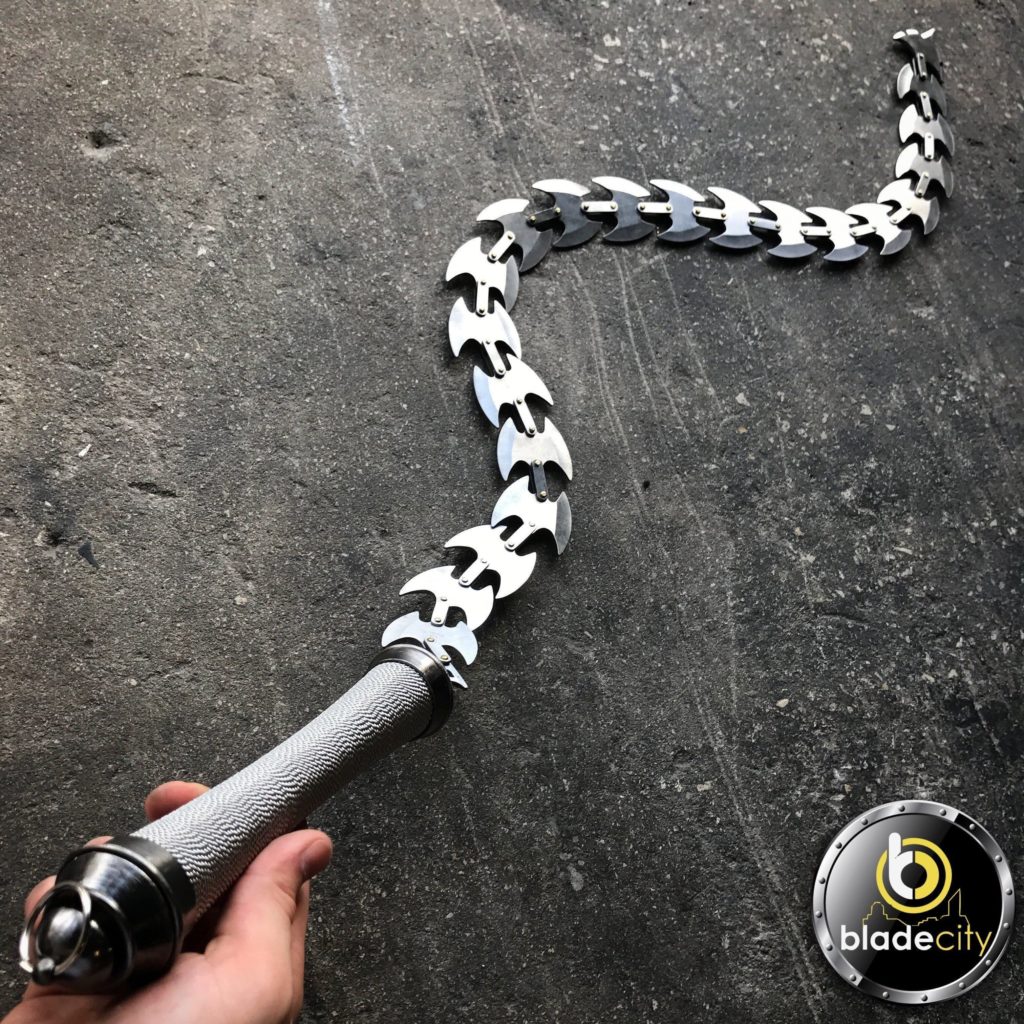
If the knife enthusiast in you life has more exotic tastes, Blade City will like scratch their itch. The site has its Christmas deals page up and running.
Blade HQ has a number of Christmas promotionals up and running. One of the more intriguing is laser engraving for an extra $9.99 on a purchase. Also, they’re giving away Winchester Shotgun Shell knives with a purchase over $75. Pretty Sweet.
The HQ also has a number of categories to shop their deals during the holidays:
SMKWis bursting at the seams with deals, with nine pages of site busters. You’re certain to find something for the knife lover in your life—even if that happens to be yourself.
Originally A Karambit, The New Provoke EDC From CRKT Takes The Kinematic Technology Into The Realm Of More Casual Knives.
Do you love Joe Caswell’s innovative Kinematic deployment system but don’t need a knife as aggressive as the CRKT Provoke? Say hello to the newest knife in the line: the Provoke EDC.
The knife takes all the best parts of the original Provoke but with one more casual, but massive difference: a drop point blade–the first in the line to veer from the karambit design.
Provoke EDC Blade
The drop point is just 2.56 inches long, but it really makes its money thanks to its thickness. It’s .27 inches thick, 22-percent thicker than the blade on the original Provoke and more than twice the girth of any of CRKT’s seven most-popular pocketknives.
This makes for a knife adept at heavy work, be it batoning wood or slicing through rope or even prying open anything short of a manhole cover.
At 3.6 ounces and 4.66 inches when closed, it’s light and easy to carry. The flush-mounted clip keeps it invisible in your pocket and quick to pop out. When deployed, the knife is 7.25 inches and is easy to control thanks to the handle. The handle is molded, similar to the original Provoke, so hot spots are non-existent as it sits flush in the hand when cutting.
Kinematic Action
The one-of-a-kind kinematic action is unlike any other deployment system on the market today. When released it’s fast-moving, smooth, and keeps that thick blade securely in place. It’s nearly impossible to flex the blade when deployed, a sign of a strong lock.
The action is powered by two pivoting arms connected to both the handle and the back of the blade. When released the arms swing forward, sending the blade out and locking it in place.
It is a dynamic system and is an excellent fidget, however, it may be a bit cumbersome for those with smaller hands. Since the handle was originally designed for a karambit, which is traditionally deployed in a reverse grip, it could be tricky to securely hold when trying to deploy the knife one-handed. To some, this might not prove as intuitive as a flipper or folder.
Other Provoke EDC Features
Beyond the blade, the most noticeable feature of the knife is its brilliant blue handle. The anodized aluminum visually pops and perfectly complements the satin-finished blade. And, since it’s aluminum, it is lightweight and can hold up to pretty much anything you can throw at it.
Overall, the Provoke EDC is a fresh take on everyday carry and is going to appeal to knife lovers looking for something that stands out.