Msg. Kim Breed (retired), a long-time field editor for BLADE best known for his knife reviews, will partner with DoubleStar Corp. to produce knives for that company’s Edged Weapon line.
There’s no doubt that Breed’s 18 years of experience in the United States 5th Special Forces Group will inform the designs that come out of the collaboration, as well as his time as the owner of Breed Custom Knives. Although DoubleStar has not announced specific models, a release from the company suggests that Breed’s custom work will be adapted for affordable price points.
“Kim is a legend within the custom knife community and we are very excited to have the opportunity to collaborate with him, turning his custom design into something that is accessible to a wider audience. Adding Kim to our already impressive roster of collaborators only strengthens our commitment to the edged weapon market, and we look forward to unveiling his designs soon,” stated Rob Cabrera, director of Edged Weapon, in a DoubleStar release.
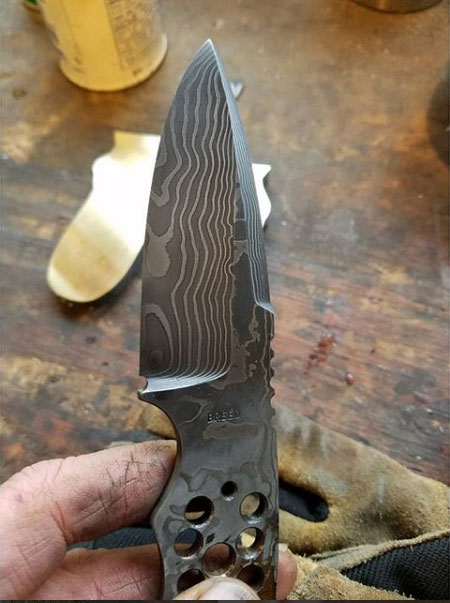
The following are examples of Breed’s custom knives:
Gerber Has Reinvented The Multi-Tool With The Dual-Force. Incredibly Strong And Versatile, The Dual-Force Is As Rugged As It Gets
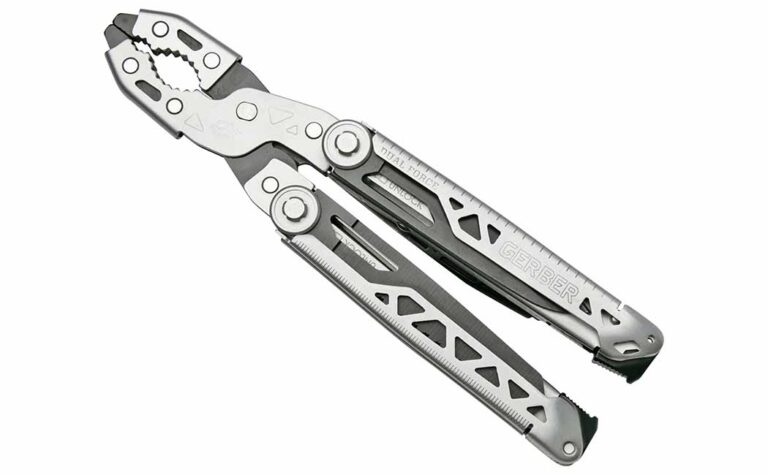
The multi-tool is beloved by many for its flexibility and ability to be useful in many situations. Gerber Gear has ripped up the book on the multi-tool and reinvented the genre with the 12-tool Dual-Force.
It is a monster. The Dual-Force is similar to other multi-tools in terms of the implements within it, but the strength level has been ratcheted up. The screwdriver and saw are beefier than in a Swiss Army knife. The driver is 3.25 inches and features Center-Drive tech so it feels and operates like a standard driver.
The Dual-Force has a dozen different tools.
The tool also includes a 3.25-inch plain-edge blade, which rivals that of many standard pocketknives.
But the star of the show is the pliers. There are so needle-nose pliers here. The Dual-Force features a robust set of jaws with a twin-position dual-lock design and large teeth for more control. The jaws dwarf the pliers offered on most other multi-tools.
The Dual-Force brings the quality you expect from Gerber Gear and an innovative design that makes it stand apart from all the other choices on the market today. MSRP: $110.
Editor’s Note: This post was written by Mike Ableson.
Here’s a look at a movie knife classic, First Blood, and a movie that tried to rip off Rambo. Spoiler alert: ripping off Rambo is never a good idea.
Knife Use in First Blood: Rambo-esque, but Not Ridiculous
After I saw First Blood, the first Rambo movie, some buddies and I started to look at it with a critical, knife-centric eye.
Nothing that Rambo does in the movie is impossible. Some of the feats require a very well-trained man who’s in excellent physical condition, not to mention one who’s stubborn as hell. The feats also require a great deal of luck.
I’ve always been critical of fight sequences where the hero beats up 10-15 opponents all at one time. You can see the bad guys hanging back, each waiting his turn. That doesn’t happen in real life.
However, in First Blood, each person Rambo fights is physically isolated, so Rambo can take each one on one-on-one. It could work that way. The movie was very well thought out choreographically.
At one point Rambo leaps from a cliff and falls through a pine tree, breaking tree limbs on the way down, and survives. Tricky and tough—and yet possible. I once fell out of a pine tree, breaking pine limbs on the way down, and wasn’t hurt at all except for my 18-year-old ego. It was about a 20-foot drop, not anywhere near what Rambo fell, but long enough to convince me that it was possible to survive it.
Rambo’s use of the knife in First Blood is excellent. He knows what he’s doing. One of the first things he does is use the knife to make a spear, which is a good idea because a spear is a better hunting tool and a much better weapon than a knife. For one thing, a spear has reach and speed over a knife alone.
First Blood is an exciting movie. If you haven’t seen it, rent it. It’s worth it.
Knife Use in The Hunted: Ridiculous
Several of my friends saw The Hunted and told me that it was the MOAB (Mother Of All Bombs). However, having seen The Musketeer, I didn’t believe them. While The Hunted isn’t the MOAB, I would put it in the 2,000-pound category.
The Hunted isn’t a remake of First Blood but copies it—and does a lousy job at that.
The movie opens with a hellish scene in Kosovo, with Serbs killing Albanians right and left, especially women and children. I think the viewer is supposed to get the impression that all the Kosovo violence has driven the villain, Aaron Hallam— played by Benicio Del Toro—crazy.
I realized that I was in a fantasy movie very quickly. Tommy Lee Jones, who portrays L.T. Bonham, is running through a forest that’s deep in snow when he sees a wolf caught in a snare. He catches the injured animal, frees it from the snare and then dresses its paw. The animal doesn’t bite Bonham or, for that matter, make any threatening moves whatsoever. Heck, my wife rescued a four-week-old puppy a few months ago and was bitten!
(image via imdb.com)
The plot is that Hallam is a real killing machine whom Bonham has trained. The main action takes place in the dense rain forest of Oregon—sound familiar?—and starts with a scene of two deer hunters. The hunters are equipped with bolt-action rifles sporting monstrous telescopic sights. Stupid is such a harsh word, so let me just say that it makes no sense to use telescopic sights in underbrush so thick you can’t see 10 yards in front of you!
Anyway, Hallam threatens the hunters, telling them they have no reverence for life, and they have to match their guns against his knife. Needless to say, he kills the hunters, and subsequent photos show that he chopped them up like butchered deer. Meanwhile, it turns out that he also has killed a couple more hunters. Since the movie never offers any other reason for Hallam’s behavior, I guess he must have joined a radical arm of PETA (People for the Ethical Treatment of Animals).
Bonham is an amazing tracker and expert knife fighter who’s called in to capture the killer. He starts out after Hallam and, of course, doesn’t take a weapon. Hallam immediately finds Bonham, they have a brief fight and the chase begins.
I can’t begin to tell you how incredibly stupid this movie is. For one, in one scene a thrown knife goes all the way through a tree trunk that looks to be about 3 inches in diameter! Bonham knaps a flint blade to use as a weapon, never thinking to simply buy a knife instead.
One of the most startling scenes is when Hallam breaks off chunks of leaf spring. He starts a small fire and then forges a knife using the chunks of leaf spring for steel, and another chunk as a hammer. After he rough forges the blade, he hardens it and then files it! I have no idea where he gets the file, let alone how an open fire that size develops the heat necessary to forge steel.
In certain segments, The Hunted is a direct steal of First Blood, right down to Bonham repeating a quote from the Stallone movie about how many body bags will be filled in the quest to nab Hallam.
The knife fighting and the scenes showing the training aren’t so much stupid as just silly. Some guy stands still as someone pretends to cut his throat, chest, stomach, brachial artery, and then moves down to cut both femoral arteries! I mean, what’s the point? How many times does your opponent need to bleed out? It’s like blowing up a rabbit with a stick of dynamite—the furry little critter can only die so much!
The final fight sequence between the two principals is very poorly choreographed. It bears no resemblance to a real fight. For those who have read my reviews about movie knives before, you know that I feel a fight must follow the flow of the film. In other words, it need not necessarily be a “real” fight but one that must be consistent with the plot. In that respect, the final fight does follow the plot—both are total and complete nonsense.
Don’t waste your time or your money on The Hunted. This time I did the suffering for you.
Whether Three Pieces Or More Than A Dozen, A Great Kitchen Knife Set Can Completely Change How Work With Food.
Kitchen knife sets are extremely popular, and it’s easy to see why. They keep all your knives safe, easily accessible, and add a touch of style to your kitchen counter. It’s important to keep a few things in mind when shopping for a knife set, whether for the home or a professional kitchen.
The Block Is A Piece
When you see that a set is three, six, or 15 pieces, it’s important to remember the knife block itself will count as one of the pieces. So don’t fret if you think there’s a missing knife because there isn’t.
Get A Set That Fits
If you’re a parent looking for a good set of knives that will last and help cook the family’s meals for years to come, don’t feel like you need to spend hundreds or thousands of dollars on a set with dozens of specialty pieces. Sometimes less is more and that six-piece set might be the perfect one for you.
Follow The Maintenance Directions
Just because your butter knives go into the dishwasher doesn’t mean that your kitchen knives will necessarily need to as well. Follow the care instructions of your set carefully so you get the most out of your knives and don’t see rust spots start appearing on your blades.
Best Kitchen Knife Sets
Japanese, German, forged, and stamped. These are descriptors of our five best kitchen knife sets. Large sets, small sets. We made sure to select something for everyone with our list.
Calphalon 321
Calphalon 321
What’s better than an affordably-priced knife set? How about one with a sharpener built into the block itself. That’s what you’ll get with the Calphalon 321. This set includes half a dozen steak knives to go with an eight-inch chef’s knife, serrated utility knife, paring knife, shears, and santoku knife.
Made from forged high-carbon steel, the blades prove tough and are able to maintain an edge. And their full-tang construction adds balance to the knives.
The wooden block features a built-in ceramic sharpener in the slots for the chef’s knife, santoku, and paring blade. This means that every time you pull one out of the block, it passes through the sharpener to maintain its edge. Another handy feature is the printed label on the end of each knife so you’ll know what you’re grabbing at a glance.
In totality, this is an excellent budget knife block. MSRP: $169.99
Buck 13-Piece Cutlery Set
Buck 13-Piece Cutlery Set w/Rosewood DymaLux Handles
Buck? On a list of kitchen knives? Oh yes, and the set is just as high quality as the company’s famous folders. By far, this is the largest set on the list.
The set features an 8-inch chef’s knife, slicer, two different paring knives, a spreader, serving/grilling fork, and six steak knives. Buck constructs the blades from 420HC stainless, except for the spreader, which is 410HC. Triple-rivited, the handles are durable and attractive.
There are two styles of handles. The Slate PaperStone is dishwasher safe while the Rosewood DymaLux is hand-wash only. And everything safely stores away in the wooden knife block.
This set is lovely and meets the lofty expectations you would expect from any other Buck product. MSRP: $599.99 for the Slate Paperstone, $749.99 for the Rosewood DymaLux.
Henckels Statement 12-Piece Kitchen Knife Set With Block
Henckels Statement 12-Piece Kitchen Knife Set With Block
A leader in kitchen cutlery, Henkels‘ set hits home run.
The set features single-piece stamped stainless steel blades that are full tang and precision-honed to give them a perfect edge right out of the box. The polymer handle also provides an excellent grip and is easy to clean. The wood block fits all the pieces which include an eight-inch chef’s knife, santoku knife, paring knife, bread knife, sharpening steel, and a set of six steak knives.
This set covers nearly every scenario you’ll encounter in a home kitchen, and it’s also the most affordable set on our list. MSRP: $119.95.
Mercer Culinary Genesis Six-Piece Knife Block Set
Mercer Culinary Genesis Six-Piece Knife Block Set
This kitchen knife set from Mercer Culinary has the most unique appearance of the items on our list, but it is so much more than just looks.
The glass block allows for a 360-degree display of the knives. The windows are attached on either side of the beechwood block which holds five knives.
This set of forged knives includes an 8-inch chef’s knife, paring knife, bread knife, boning knife, and utility knife. All of them are made from high-carbon German steel ground to a 15-degree edge and outfitted with a Santoprene handle for comfort and grip.
It’s a conversation piece. It’s a quality knife set. It’s an absolute bargain for the quality of the product. MSRP: $156.
Shun Classic 5-Piece Starter Block Set
Shun Classic 5-Piece Starter Block Set
Shun makes professional-caliber knives, and its Classic Five-Piece set maintains that standard.
There are only three knives included in the set, but they are of the highest quality. The 8-inch chef’s knife, paring knife, and utility knife are all made from 68 layers of stainless damascus cladding around a VG-Max core. They all tuck away in the Slimline Bamboo Black knife block, along with a honing rod. The trio of Japanese-style knives has ebony-finished Pakkawood handles with a full tang.
A unique aspect of this set is there are more slots than knives. The block comes with two extra slots, one of which is designed for shears. This gives you to tailor your tools to your needs in the kitchen.
Even though this is the smallest set on our list, it is the priciest due to the time and craftsmanship that went into every element of it. MSRP: $593.
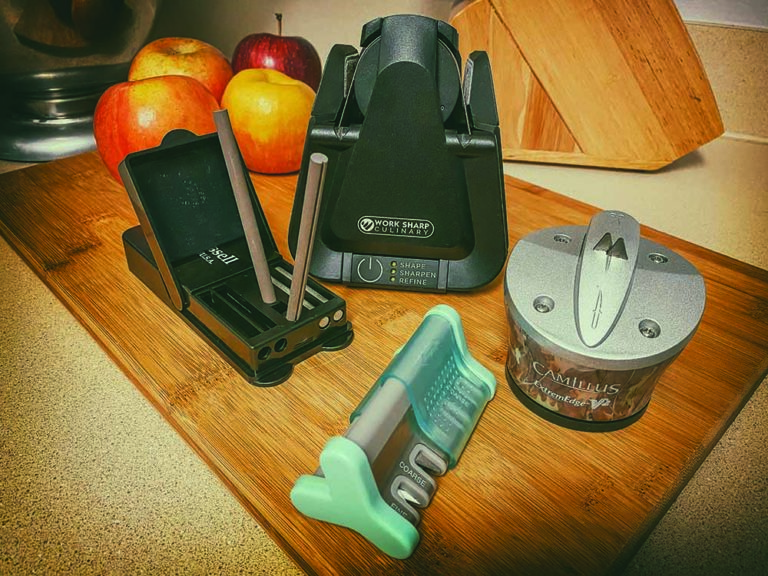
Correct sharpener selection is imperative for keen household cutlery. With that, here are four kitchen knife sharpeners that make the cut.
Dull kitchen knives not only make meal preparation more difficult, they also can slip and cut you when you least expect it. As a result, it’s imperative to keep them sharp. If you sharpen them yourself, correct sharpener selection is key.
A kitchen knife sharpeners can be as simple or complicated as you want. No matter your skill level, there is a sharpener for you. For those with little-to-no sharpening experience are the cost-effective pull-through sharpeners. These are as simple as simple can get. Often they are plastic-bodied devices with one or two slots. Inside the slots are the sharpening media. The media are permanently affixed at pre-set angles The most common media for the two-slotters are carbide and a fine-grit ceramic. The carbide quickly restores damaged and worn edges, while the fine-grit ceramic polishes and hones the edge to razor sharpness. Anyone can achieve a sharp edge with a pull-through.
Smith’s Products Slide Sharp Edge Grip
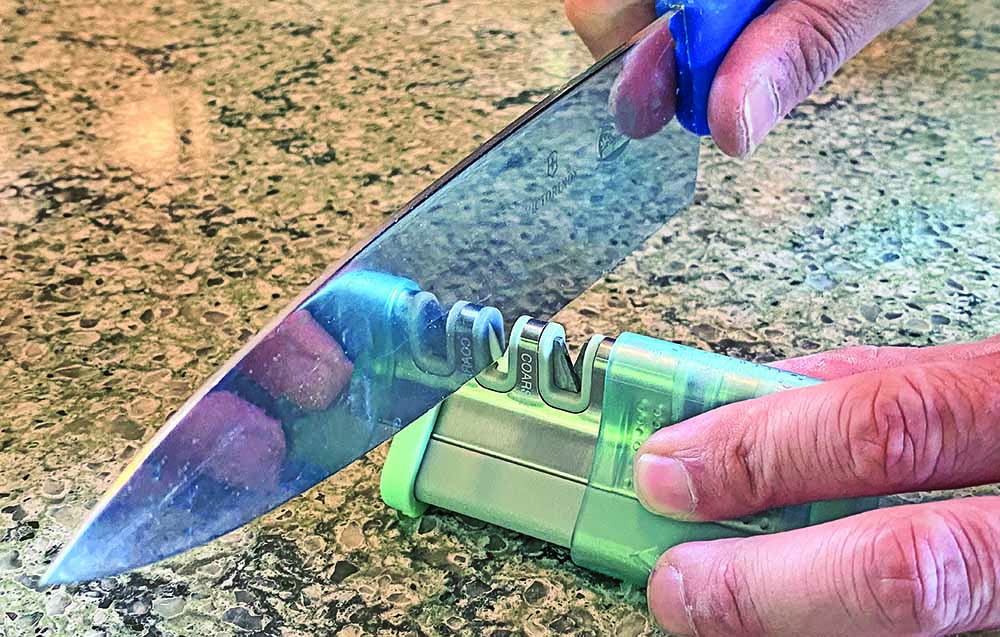
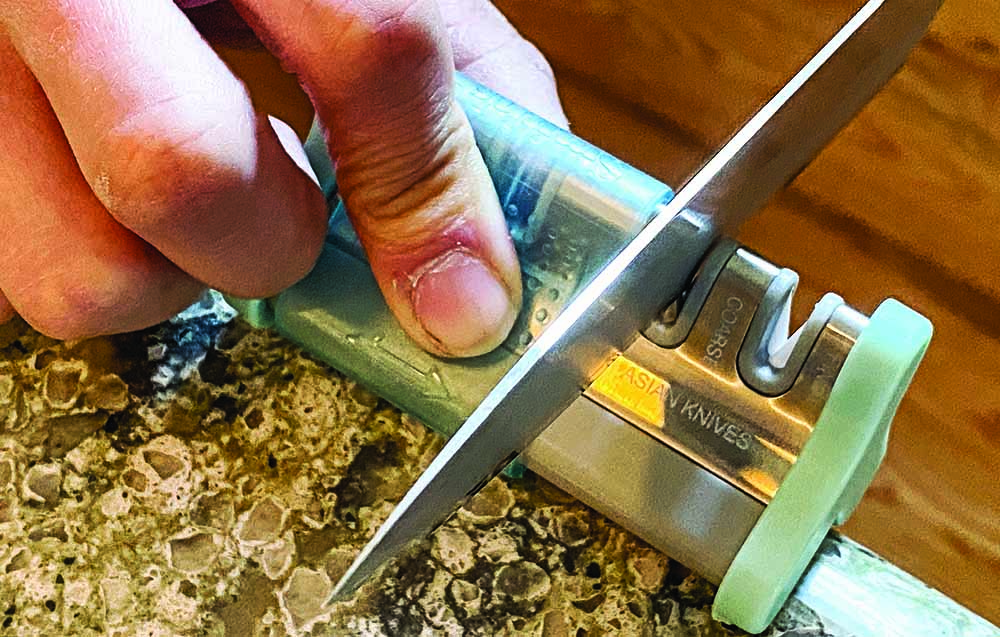
Smith’s Slide Sharp has two pairs of pull-through slots to address both standard and Asian-style kitchen knives.
One such kitchen knife sharpener is the Smith’s Products Slide Sharp Edge Grip. It has two sets of slots. One pair addresses standard kitchen knives at a pre-set 20-degree angle, and the other addresses Asian-style knives at a 15-degree angle. The standard slots have carbide for a coarse grit abrasive and ceramic for fine grit. The Asian-style slots have diamond rods for coarse grit and ceramic for fine.
The Slide Sharp’s indexed sliding grip is textured for a non-slip purchase to allow for secure sharpening. Depending on which slot set you use, the other set is covered by a sliding cover, which is how the sharpener is stabilized—by placing your hand over the sliding cover.
The cross-section of the sharpener resembles an upside-down “Y,” with the arched base held in place on the edge of a table or counter. This gives you another option for stable sharpener operation. Consequently, you have two ways to secure the sharpener during use. Few pull throughs provide such an option.
The Slide Sharp is effective and works as advertised. To use it on a countertop or tabletop, take one hand and stabilize it on the flat work surface. To use it on the edge of a kitchen counter, sit it on the counter edge via the “Y” legs and, while holding it with one hand, pull the blade through and down with the other. You have a better line of sight
to the sharpener this way and it’s very safe, too.
Designed with an upside down “Y” frame, the Smith’s Slide Sharp sits securely while held to the edge of a countertop. This puts the sharpening slots at an angle for better viewing while in use.
If you must use a pull-through, I highly recommend the Slide Sharp. I also recommend using the lightest pressure as possible to sharpen, as pull-throughs can remove too much metal, more so than ceramic, diamond or powered abrasive belt sharpeners. Removing too much metal can prematurely deform the cutting edge.
The Slide Sharp is a little over 1.5 inches tall and a bit under 3.5 inches long. Its compact nature enables convenient drawer storage. The manufacturer’s suggested retail price (MSRP) of $11.99 makes it incredibly affordable and provides no excuse for anyone to have dull kitchen knives. MSRP: $11.99
Camillus Extreme Edge V2 Knife & Shear Sharpener
The Camillus Extreme Edge V2 Knife & Shear Sharpener features a pull-through design with carbide media for kitchen knives and fine ceramic for shears to establish edges in quick fashion.
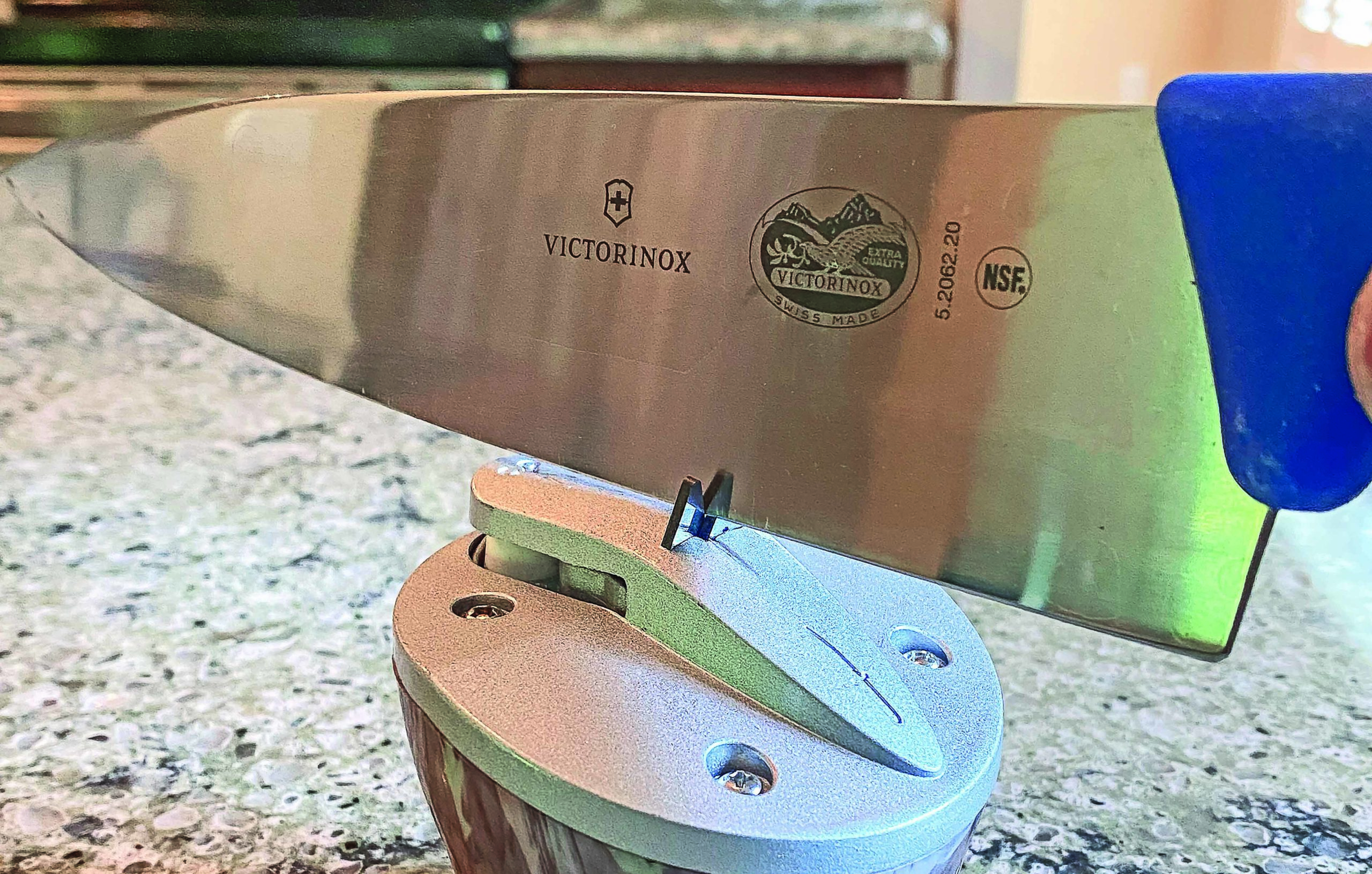
The Extreme Edge V2 Knife & Tool pull-through from Camillus is a two-for-one deal. A set of carbide abrasives addresses plain edge and kitchen knives. It also features a built-in shears sharpener.
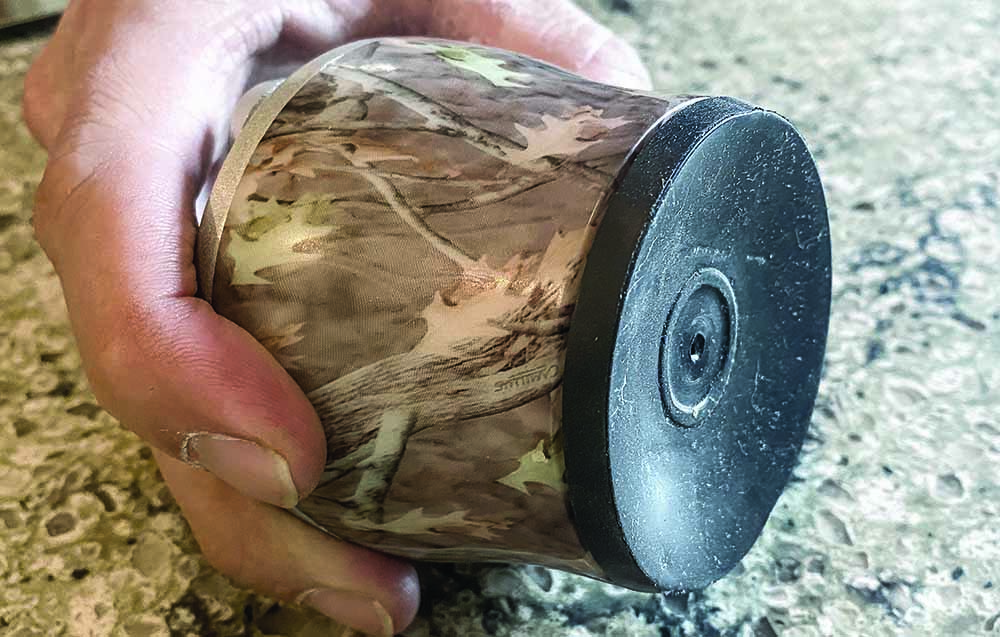
The cylindrical body is around 3 inches in diameter. The top is cast metal and houses the carbides, while the fine-grit-ceramic shears sharpener is in the unit’s rear. The plastic body has an outdoorsy camo theme appearance. For safe operation, a suction cup at the base activates by pressing down and rotating the unit to firmly grip the tabletop surface. For scenarios where the suction cup feature isn’t feasible, it acts as a standard non-skid base.
The sharpener works OK, though I didn’t feel the carbides to be as aggressive as with other pull-throughs I’ve used. The edge it produced was sharp though not surgical sharp. At least the V2 provides a functional sharp edge, which is better than having no sharpener and a dull edge.
The suction cup base of the Camillus Extreme Edge V2 is designed to stick to a slick surface for stable sharpening.
The suction cup base was a disappointment. I could not get it to cling to the slick worktop of my toolbox most of the time. You must really press down on the sharpener and twist it to get it to stick, but it kept loosening repeatedly. However, you can still use the sharpener safely and effectively by employing the suction cup as a non-skid rubber base. Oh, and one of the carbide teeth loosened up after the first few uses, which is unacceptable. MSRP: $19.98.
A.G. Russell Knives Field Sharpener
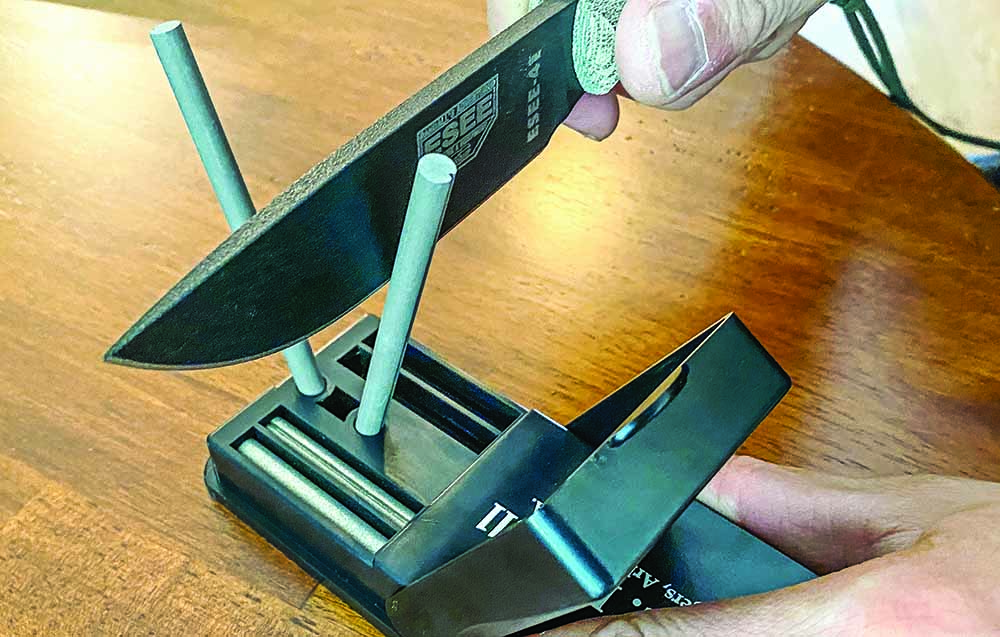
You can see the diamond-grit hones stored in slots in the base of the A.G. Russell Field Sharpener. This is a completely functional, self-contained guided sharpening system that goes anywhere you do.
The A.G. Russell Knives Field Sharpener is probably the most versatile of the test bunch of kitchen knife sharpeners. Not only does it sharpen kitchen knives but also pocket knives, hunting knives and tactical knives. Such value and versatility is a hard combo to top no matter how you slice it.
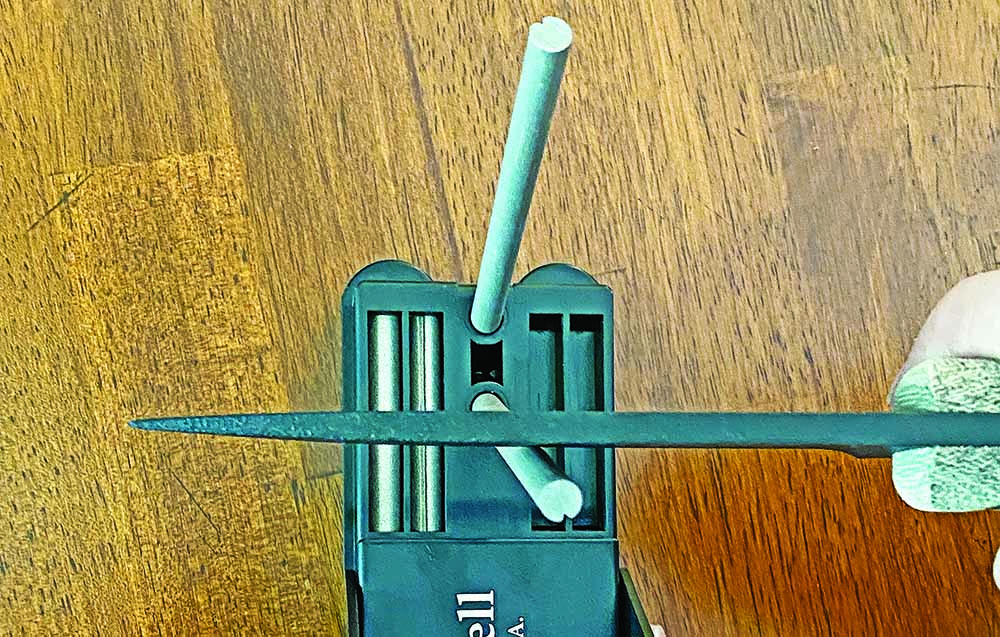
The Field Sharpener has a molded plastic base and hinged cover. You insert a pair of included 4-inch sharpening rods into two holes at a preset angle of 15 degrees. There’s a set of coarse diamond-grit rods to quickly repair a worn edge or rehab a damaged one. A set of medium-grit ceramic rods further sharpens and dials in edges to razor sharpness. The unit measures 5-by-2 inches and is compact enough for stowing in a toolbox, tacklebox, backpack or even a jacket pocket.
Place the sharpener on a flat work surface. Select the set of rods you wish to use and insert into the holes in the base. The flip-up cover secures the rods when they are tucked inside the base; when open, the cover forms a convenient guard to prevent the blade from coming down on your hand. Place one hand on the base to secure the sharpener. With your other hand, take the knife and move the blade down the rods, while pulling it across from tang to tip—two motions at once. Don’t use a lot of pressure; allow the weight of the blade to rest on the rods and move it down. Keep the blade positioned perpendicular to the tabletop surface; holding it straight up and down allows you to sharpen at the proper angle of 30 degrees inclusive.
The Field Sharpener’s flip-up cover secures the rods when they are tucked inside the base. When open, the cover forms a guard to prevent the blade from coming down on your hand.
The Field Sharpener is very effective. If you’ve used Crock Sticks or a Spyderco Tri-Angle Sharpmaker, you will take to this one easily. It requires the same motions. Unlike the Sharpmaker or Crock Sticks, it’s portable enough to take on outdoor adventures. It’s great for camping, especially if you use a variety of knives.
Given the longer length of many kitchen knives and the 4-inch rods, you must pull the blade across the rods with a bit of expediency to be able to capture the entire blade length in one downward pass. Just be mindful that this technique is more pronounced with longer blades. With shorter blades you won’t notice it as much. The round profile means the contact area of the rod to the blade is smaller and more effective at removing steel. It’s easy to use and highly effective. MSRP: $39.95.
Work Sharp E5 Kitchen Knife Sharpener
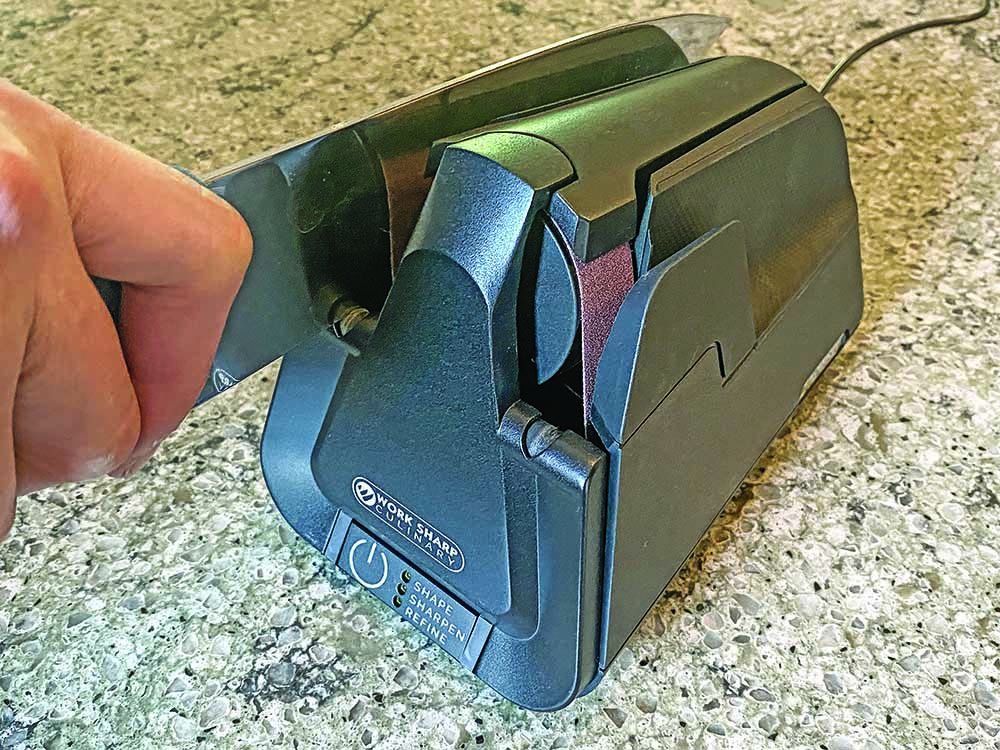
The Work Sharp Culinary E5 uses the same flexible abrasive belt technology as used on the company’s Ken Onion Edition sharpener. Three pre-programmed sharpening modes eliminate the guesswork of obtaining a professional edge.
The Work Sharp E5 Kitchen Knife Sharpener is a top-of-the-line powered kitchen knife sharpener, offering multiple modes, speeds, and the latest technology in providing consistent high-quality sharpening knife after knife. The E5 was designed from the ground up as a powered sharpener that can sit on a counter full time, blending in with other appliances with a minimal footprint. Like Work Sharp’s other powered knife sharpeners, the E5 uses flexible, long-wearing abrasive belts to create an ultra-durable convex edge.
Place the blade inside each slot and the abrasives do the work. Select from one of three sharpening modes via the one-touch programming feature. The Shape mode—three rapid clicks on the power button—starts at a high speed for fast cutting and repair of worn edges, then drops down to the Refine mode—one click—at low speed for the final touch up. The Sharpen mode—two rapid clicks—runs the belt at medium speed for routine edge maintenance, followed by the Refine mode for fast touch-ups.
Select the desired mode then alternate placing the blade in each of the slots. Watch the lights on the power panel. Whichever mode you select, a light shines next to it. Ten seconds before the machine changes modes, the light will begin flashing to warn of the upcoming transition to the next mode, or, depending on the mode, stop completely. Simply draw the blade through. The machine does all the work.
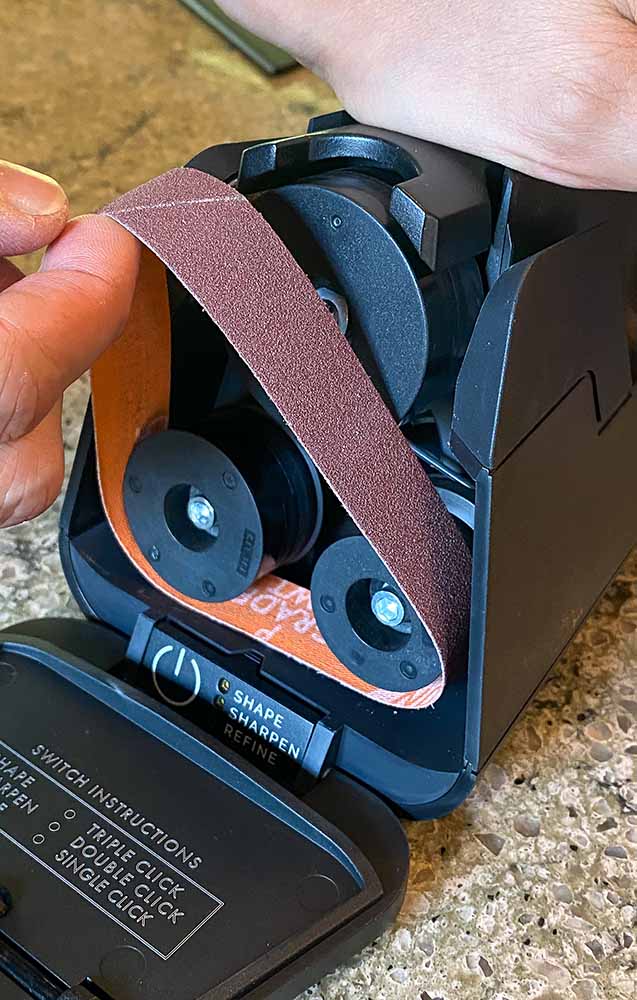
Changing belts on the Work Sharp Culinary E5 is easy. Flip down the faceplate. Press down on top of the machine with one hand to release belt tension, and, with the other hand, remove the belt. The new belt goes on in reverse order.
The first time you use the E5, you will be reprofiling your blades to the set 17-degree angle, which can take some time. At extra cost is an upgrade kit that includes more coarse belts, and 15- and 20-degree angle guides for enhanced versatility and quicker sharpening. MSRP: $59.95.
The E5 works well and produces the convex edge, which is very sharp and durable. The sharpener is quiet and easy to operate, something novices appreciate. If you are serious about cooking, it is essential to have not only high-quality knives but also a high-quality sharpener. The E5 is it. MSRP: $149.95.
Other Kitchen Sharpener Options
Shenzen Knives Electric Diamond Knife Sharpener
Shenzen Knives Electric Diamond Knife Sharpener
Diamonds aren’t just a girl’s best friend. This sharpener from Shenzen Knives features an electric diamond grinding wheel with two settings designed to sharpen both steel and ceramic knives.
Its powerful motor can remove chips as large as 1mm off of ceramic knives, and it easily comes apart for cleaning. An added plus is the universal knife guide slot, which is designed to keep your knives at the perfect angle for the best possible edge on both the fine and coarse settings. Specifically for kitchen knives, this machine is not meant to sharpen scissors, hunting knives, or any other types of blades.
MSRP: $49.99
Sharp Pebble Premium 1000/6000 Whetstone
Sharp Pebble Premium Whetstone Knife Sharpening Stone 2 Side Grit 1000/6000 Waterstone- Whetstone Knife Sharpener
The whetstone, and other sharpening stones, are a much more finite and meditative way to sharpen your knives. Coming in a variety of grit sizes, whetstones work by being submerged in a liquid, usually water, which enhances the stone’s ability to sharpen a blade while also allowing the chips and scrapes to wash away. Sharp Pebble offers a variety of whetstones in different grits and at different price points. (The 1000/6000 stone is a perfect stone for home sharpeners, and is the method I’ve used to sharpen my kitchen knives for the last several years. I enjoy the process of using the stone and feel it provides a quality edge whether it’s my chef knife or my paring knife.)
The majority of the stones come with an angle guide to help you get the best sharpening angle for your knife. These stones can also be used to sharpen other implements from razors to scissors to chisels.
MSRP: $40.99
Messermeister Fine Grit Honing Steel
Messermeister Fine Grit Honing Steel
Sometimes your knife needs honing rather than sharpening. That’s where honing steel, or a honing rod, comes to the rescue. Over time and normal use, the edge of your knives will bend and warp at a microscopic level. Honing steel works to massage the edge back into the proper position without removing as much material as sharpening would. (I hone my knives daily while sharpening them 2-4 times a year. By honing I’m able to maintain a sharp edge longer and maintain better control over my knives while I cook.)
Messermeister offers a variety of honing rods ranging from steel and ceramic to diamond. Their fine-grit rod is made of high-carbon tool steel and can be used to hone knives made from any material. It’s designed to never wear over its lifespan and should be able to hone your knives’ edges for decades.
For a fair price, you can’t go wrong with this rod, and your knives will thank you for it.
MSRP: $24.95 (10-inch), $29.95 (12-inch)
Worksharp Electric Kitchen Knife Sharpener
Worksharp Electric Kitchen Knife Sharpener
For a quality all-rounder, look no further than Worksharp’s newest electric sharpener. Roughly the size of a softball, the sharpener effortlessly sharpens anything you can throw at it in the kitchen including scissors and serrated knives.
Its sharpening slots feature built-in 20-degree angle guides so each edge comes out at a perfect angle. Beyond just sharpening, the device features a ceramic honing wheel as well that allows you to maintain your edge every day.
MSRP: $59.95
Editor’s Note:Mike Abelson contributed to this story
Cutlery Hall-of-Famer’s book showcases the most unique, historic and outlandish blades to enter their treasury.
Probably the most important international buyers of modern American custom knives ever, BLADE Magazine Cutlery Hall-of-Fame® members Aldo and Edda Lorenzi bought and then sold those knives and many other edged items in their iconic G. Lorenzi retail cutlery store in Milan, Italy.
Located on the Via Montenapoleone in the heart of Milan’s elegant retail sales district, and under Aldo and Edda’s direction, G. Lorenzi sold the finest knives, scissors, razors, table cutlery and assorted other edged wonders from 1959 to 2014, serving customers from every corner of the globe.
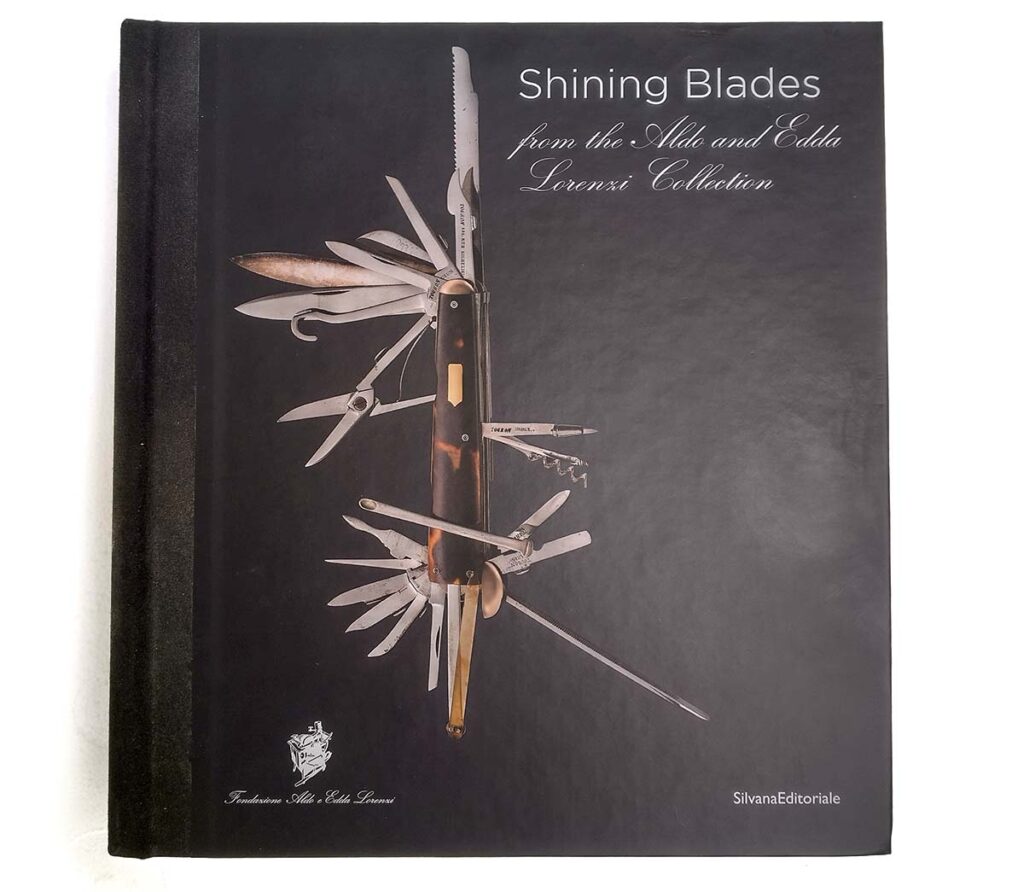
If you read BLADE® regularly, you know of the Lorenzis—but mostly only through the eyes of BLADE. In their new book, Shining Blades from the Aldo and Edda Lorenzi Collection, the Lorenzis recall their journeys far and wide in their lifelong search for the finest blades as only they can tell it, from the age of Elvis and crewcuts to the internet era.
Intrepidly scouring Europe, America and elsewhere for cutting tools of all kinds, the Lorenzis chronicle their travels in Shining Blades. From Aldo doubling Edda on their Guzzi Galletto motorbike through the snow and rain in the Alps on their first working trip to Fance in the early 1960s, to their early visits to the knifemaking shops of John Nelson Cooper, Cutlery Hall-of-Famer Bob Loveless and many other of the most famous American makers and beyond, the Lorenzis share their incredible story.
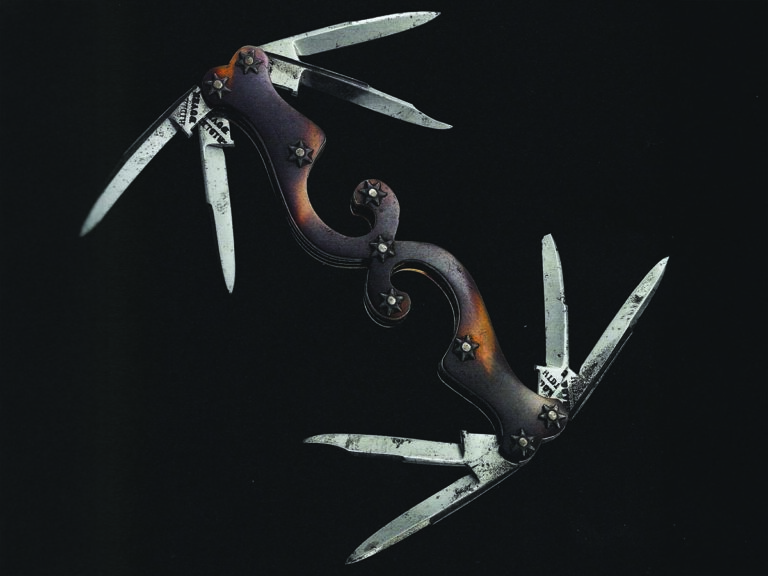
Shining through it all are full-page color images of some of the most spellbinding edged implements you will ever see. In addition to buying them the Lorenzis collected the vintage edged implements along the way. Bronze-Age spoons, folding forks and unbelievable folding knives of the 17th century forward are just some of the visual feasts of the edged art that populate the book’s pages.
For instance, if you think you’ve seen all there is to see in scissors, think again. The images of vintage scissors alone are enough to fill an encyclopedia on the subject. Spectacularly ornate and mystifying in construction, the scissors the Lorenzis amassed over the decades alone will take your breath away.
The preceding simply scratches the surface of what the book is all about. Most of what is illustrated and much more can be seen in the state-of-the-art Aldo and Edda Lorenzi Foundation museum in Milan.
The book also delves into some of the oldest knives known, from the 5,000-year-old knife of Otzi the Iceman discovered in 1991 on the Austrian-Italian border, the finest in European custom knives and knifemakers, ancient books on all things cutlery, notes on damascus steel and much more.
It’s all contained in a top-quality, 9 x 9.75-inch hardbound book with 344 pages that will provide you enjoyment for years to come. It’s a unique history with an MSRP of only $50—a ridiculously low price for such a landmark publication. However, as Edda Lorenzi noted, it’s not about the money so much as the education of worldwide edged tool enthusiasts and the recognition of those who authored some of the most fascinating edged tools extant.
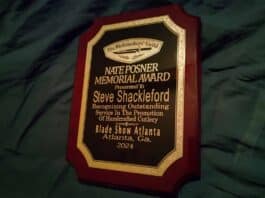
“The book cost us about double its sales price [to produce], more or less,” she began. “Keeping the price low was our choice. It is a choice in line with our Nate Posner Award—to honor the artisans who created the works we loved most and whose names we would like to be known by as many people as possible, and to encourage new generations of artisans who, unlike collectors, certainly do not have large sums of money to invest in expensive books. To achieve this, this choice had to be made!”
If most anyone else had written the preceding paragraph I might be going, “Yeah, right.” But with the Lorenzis, you can rest assured it’s true. If you don’t believe me, ask members of the old guard at knife shows who know of them. If anything, my assessment of Aldo and Edda isn’t laudatory enough.
Bob Dozier’s Bare Bones Buffalo Skinner is sharp—and comfy, too!
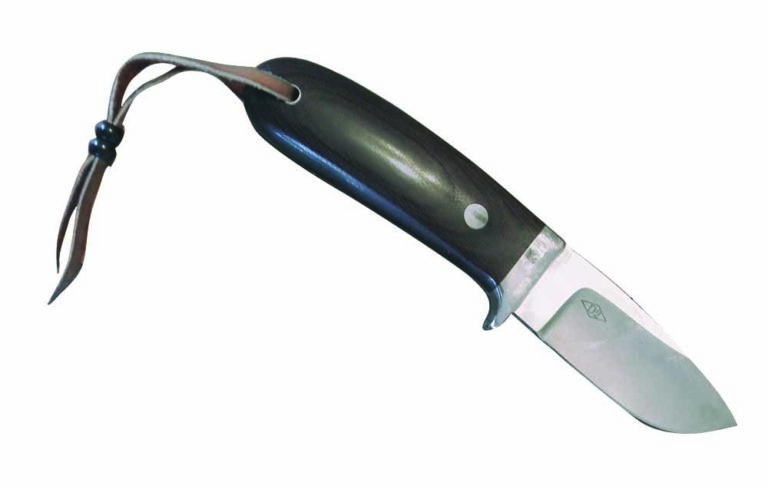
There’s nothing quite like holding a great-feeling knife that makes you want to cut something. Bob Dozier has been making custom knives to be used for over half a century and understands the importance of two major things: comfortable handles and sharp blades. They still have to cut and perform to be carried daily.
Let’s start cutting with the Bare Bones Buffalo Skinner.
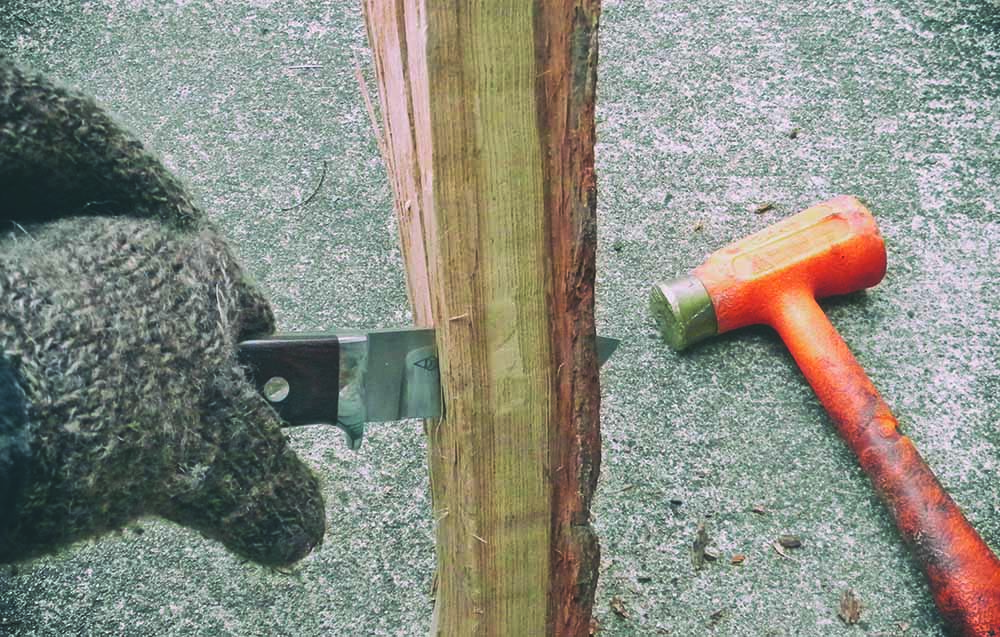
Using a dead-blow hammer, the author batonned the skinner into and through thin kindling. The knife proved a solid splitter. No damage occurred to the edge.
The quickest check to see if the knife has a sharp edge is to slice paper. You probably know by now that I use 20-pound bond copy paper for the job. The Bare Bones aggressively sliced into the paper using the knife’s own weight. The skinner is very controllable in use. The high hollow grind slid through the paper.
Moving on to single-walled cardboard for slicing, the aggressiveness continued. You could hear every cut made—the Bare Bones is a very loud slicer. I didn’t have any hang-ups during the test, just full, noisy cuts. The handle shape made controlling the cuts easy.
The knife performed aggressively in slicing single-walled cardboard. The handle shape made controlling cuts easy.
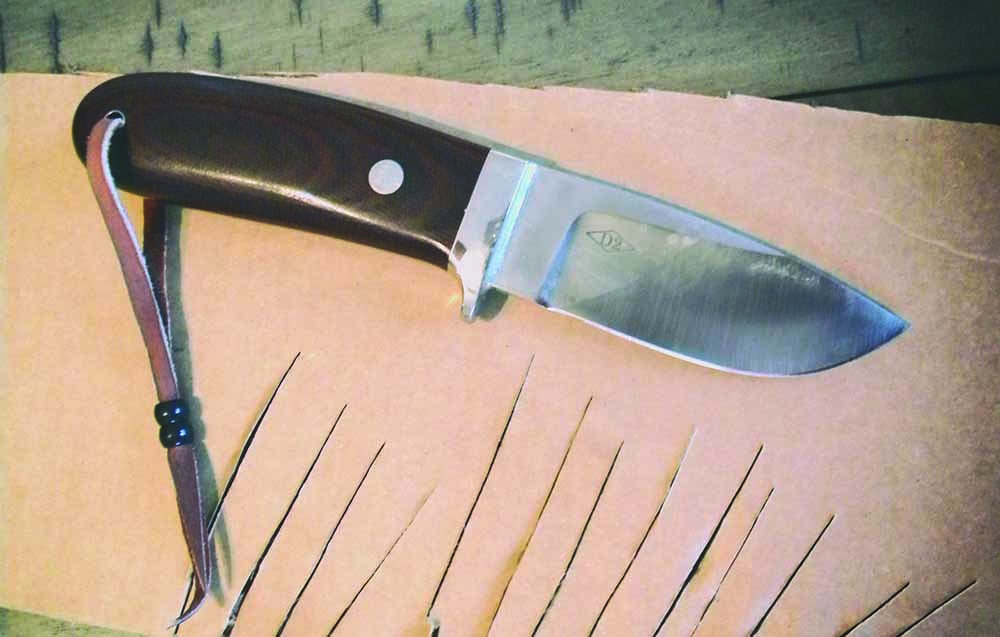
Next up: 8-ounce leather. This is where the Bare Bones was sweet. It zipped through the leather like it was cutting the 20-pound bond paper—just louder. It was super aggressive in slicing the medium, with hardly any resistance. I would love trying the Bare Bones on field dressing whitetail deer. Maybe come fall …
OLD-SCHOOL KINDLE
On to harder material. It was February, and I like to keep a supply of kindling and fire sticks to light a blaze faster. The Bare Bones made tight curlicues in the old pine. The wide blade and high grind worked out great for curling the wood. The handle shape excelled at controlling depth of cut. The single guard protected my fingers from getting splinters. Dozier’s knife embodies top-notch work.
The Bare Bones crunched to 225 cuts. The author stopped at 225, as he didn’t want to risk slicing a finger.
It was time to make some thin kindling. Using a dead-blow hammer, I batonned the skinner into and through the wood. The knife’s solid overall construction prevented vibrations to my hand. The skinner proved a solid splitter. No damage occurred to the edge.
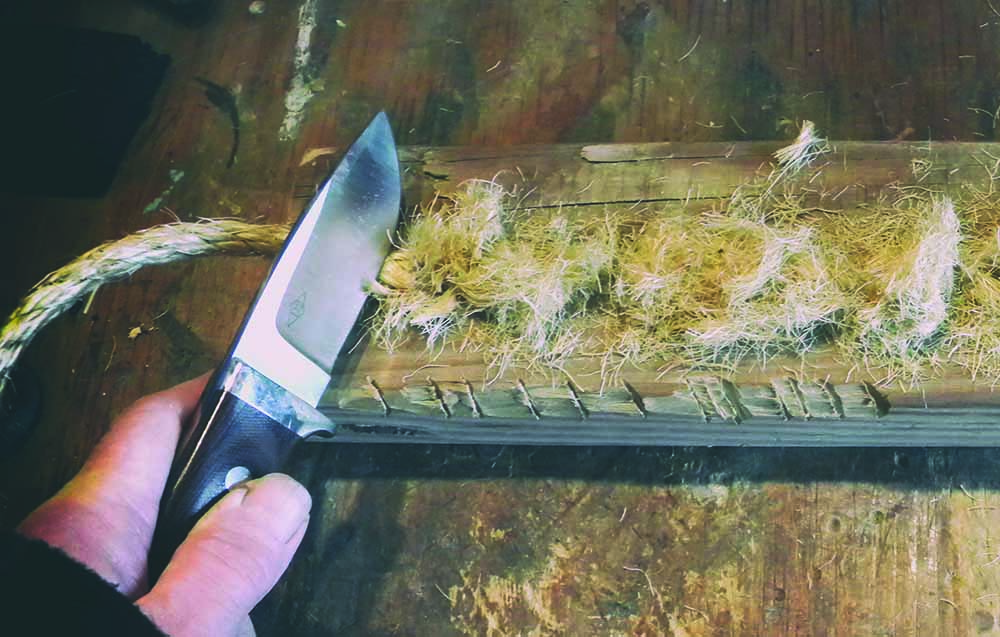
I had to warm up my fingers for the rope cutting. With no heat in my garage and the temperature at 17 degrees, I separated the test into 25 cuts per warm up. The Bare Bones crunched to 225 cuts. As I used the push method, it kept cutting. I stopped at 225, as I didn’t want to risk slicing a finger.
CHANGES
I might add some grooves to enhance grip.
OVERALL
This knife is a beast in the cutting arena. The comfortable handle made control easy. This knife is excellently made and perfect for the outdoors or hunting.
Bare bones Buffalo Skinner Maker: Bob Dozier Cutting edge length: 3.25” Blade material: D2 tool steel Blade grind: High hollow Blade thickness (at the thickest): .25″ Scales: Brown canvas Micarta® Guard: 416 stainless steel Extras: Tapered tang; thong Weight: 8 ozs. (123/8 ozs. w/sheath) Overall length: 8” Sheath: 8-ounce leather, pouch style Maker’s list price: $477